For a long time, I considered myself a huge fan of Tod Browning’s 1930s cult-horror curio Freaks, but a recent revisit complicated my feelings on its ethics as entertainment media in a way I never really stopped to consider as a jaded youngster. A circus-performer-turned-director in the pre-Code Hollywood Era, Browning asks his audience to think twice about treating the disabled & disfigured sideshow performers in his cast as inhuman monstrosities, but then parades them through horror genre conventions that require them to be exactly that. Most of Freaks functions like an empathetic hangout comedy where the titular “circus freaks” are afforded screentime outside the exploitative context that usually presents them as monsters. However, Browning’s choice of horror genre convention to tell that story eventually sinks them back down to that exploitative, dehumanizing lens. That exact self-contradiction of phony empathy for disabled & disfigured performers justifying Hollywood’s continued exploitation of those very same people for cheap entertainment is largely the subject of the new melancholy meta-comedy Chained for Life (which borrows its title from a drama starring Freaks vets The Hilton Sisters). An acerbic, behind-the-scenes satire on the set of a European auteur’s first English-language film (after building mystique around himself as a former circus performer runaway), Chained for Life starts by darkly poking fun at Freaks’s legacy in particular, but then expands its critiques to encompass all of Hollywood filmmaking, horror and beyond, from the Studio System past to present day.
Although set in modern day and guided by a post-modern narrative structure, Chained for Life still carries the tone of Old Hollywood pastiche. The supposedly artsy-fartsy indie film with “European sensibilities” its fictional crew is filming feels like an especially sleazy, colorized artifact from Universal’s Famous Monsters cycle. Among a cast of genuinely disabled & disfigured performers with abnormalities like gigantism, conjoined twinning, and disfiguring tumors, a “slumming-it” famous actress (Teeth’s Jess Weixler) gets attention & adoration from the press for “bravely” playing a blind woman. Chained for Life asks, somewhat cheekily, what the difference is between an able-bodied actor playing disabled and an actor performing in blackface, offering real-life award-winning examples like Peter Sellers, Orson Welles, and Daniel Day Lewis as food for thought. The actress’s initial awkwardness around her disfigured cast members is complicated by her increasingly intimate relationship with her co-star (Under the Skin’s Adam Pearson) whose neurofibromatosis exaggerates his facial features with large, appearance-altering tumors. A hint of schmaltzy Old Hollywood romance bleeds over from the movie the co-leads are filming to their “real” backstage dynamic, but Chained for Life is less interested in developing that dynamic than it is in exploring the social divisions between its abled & disabled crew and indulging in the loopy, post-modern structure of its meta-Hollywood satire. As the divisions between the crew break down, so do the divisions between the movie and the movie-within-the-movie, so that any linear romance melodrama or personal-growth narratives are lost to more academic, intellectually detached pursuits.
For a small-budget indie drama shot on super-16mm filmstock, Chained for Life is ambitiously sprawling in its narrative. Its non-linear, loopily meta plot structure allows it to feature a considerably large cast of well-defined characters (although one largely anchored by Pearson & Weixler). Outside its Beware of a Holy Whore film industry satire, the movie also stages a background police investigation for a string of local violent attacks by a disfigured man, subverting the audience’s cravings for this tradition of exploitation by never showing his face as the mystery unfolds. At times eerie, howlingly funny, cruel, sweet, and disorienting, Chained for Life mines a lot of rich cinematic material out if its initial conceit of discussing Hollywood’s historic tradition of exploiting disabled & disfigured performers for gross-out scares & sideshow exploitation. Freaks isn’t the movie’s target so much as its jumping point, so that Browning’s self-contradictory act of empathetic exploitation is demonstrative of how disfigured people are represented onscreen at large. This is an ambitious work with broad political & cinematic ideas that far outweigh its scale & budget, which is the exact balance you’d generally want from indie releases on the film festival circuit (perhaps explaining its Jury Prize for Best Narrative Feature at this year’s New Orleans Film Festival). That ambition is only amplified by its willingness to frankly discuss a socially award, taboo subject while admitting its own medium’s limitations in addressing it.
The riskiest gamble of Vox Lux: “A 21st Century Portrait” is that it looks and sounds like a mainstream movie with wide appeal when it is, in reality, a purposefully divisive work meant to enrage & alienate. Featuring an Oscar reel-worthy performance from Natalie Portman (in full Black Swan mode) and arriving just in time to make that PR push happen, the film masquerades as a must-see Important Drama friendly to mainstream discussion in wide release. It’s the most flagrantly misrepresented film in that vein I’ve seen since mother!, however, and it’s sure too piss off just as many onlookers unprepared for the cold, mean, absurdist melodrama that awaits them. The funniest thing about that gamble is that this is a film about marketing and public perception. It’s about a pop culture artist who has a hostile relationship with the public, so it’s already sneering in the general direction of its inevitable detractors. It’s brutal and coldly funny like a Yorgos Lanthimos film, yet it’s absurdly earnest like a Mommie Dearest melodrama. It’s a distanced philosophical statement on the current shape of Western culture, but also a gleefully perverse, intimate portrait of a woman behaving monstrously. There’s no way to properly market a work that tonally volatile to a mass audience, so the film is going to be paraded around like an Oscar Season drama when it’s actually something much weirder and more deeply sinister. It’s a Trojan horse, a wolf in sheep’s clothing, a concealed weapon; it’s a film I admired on its own merits, but also look forward to seeing it being met with hostile negativity.
Vox Lux’s cheeky air of self-importance extends beyond its festival circuit & Oscar Season release strategy. Its self-appointed intent to function as a “21st Century Portrait” is not only a reference to its depiction of a pop star’s rise from teenage darling to thirty-something monster, but also its cold, detached commentary on the modern world at large. A bitterly sarcastic antidote to the earnest, vulnerable pontification of 20th Century Women, the film is relayed through the dry, humorously overwritten narration of Willem Dafoe, who acts as our godlike tour guide of the last 20 years of terrorist violence & pop culture rot (and finding those two forces grotesquely symbiotic). Portman’s central character, Celeste, is a kind of cipher for this cultural commentary. A permanently scarred victim of domestic terrorism as a teenager, Celeste turns a personal tragedy into a hit song to achieve instantaneous fame, so that the film can comment directly on how horrific violence is marketed for easy profit. The pop music machinery of this divide is anchored by an original soundtrack of Sia compositions, performed by “Celeste.” The menacing violence of the world it exploits & mismarkets is represented in contrast by a horrifyingly minimalist score from Scott Walker, approximating his best 21st Century mutation of John Carpenter. That internal musical conflict matches the other binary confrontations represented throughout: pop vs. metal, terrorism vs. Public Relations, “real art” vs. “having an angle.” By the time the film reaches its climatic Celeste concert and all that’s left is the conflict between Sia’s songs & Dafoe’s narration, the clearest binary at play is Good Vs. Evil. Like mother!, Vox Lux is a divisive, gleefully unsubtle work that gets outright Biblical in its internal, philosophical conflicts. It dares you to hate it, then asks for forgiveness. It spits in your face, then blows you a kiss.
All that thematic discussion is just me intellectualizing the real reason I enjoyed this film: it’s fun to watch women misbehave, unconcerned with whether or not you like them. Celeste starts the film as a relatively normal teenager (played by Raffey Cassidy), but the circumstances of her rise to fame and 24/7 pampering transform her into a monstrous, irredeemable brat. Portman has way too much fun going over-the-top as a power-hungry villain in the role, chewing scenery with an exaggerated Staten Island accent and an addict’s insatiable desire for more, more, more. She admits her latest album cycle’s “sci-fi anthems” are creatively bankrupt in one breath, then claims she is a literal god in the next. She pretends to be a thick-skinned badass in a leather jacket, but crumbles at any mention of her glaring, public faults – a vulnerability visually represented by the decorative neck guards he uses to conceal the wounds from her teen-years tragedy. A lesser film would portray Celeste as a victim of her circumstances, a product of an abusive, exploitative culture and frustrated expression of mass violence. Vox Lux refuses to let her off the hook so easily, instead allowing her the space to alienate & enrage with a comically escalating set of temper tantrums and demands for attentive admiration. Even her one saving grace as an artist, the frequent defense that “at least she writes her own lyrics,” is demonstrated to be a vicious lie, as she constantly takes credit for loved ones’ work and then bullies them into silence. The concluding minutes of concert footage that gloss over all that backstage misery with a pure-fantasy pop star sheen only make her monstrous behavior more horrific in contrast: yet another internal conflict meant to sit queasily on the viewer’s stomach.
I don’t expect universal backup for my love of Vox Lux, nor do I really want it. Just like how the movie is perversely fun in its uncompromising depictions of a woman’s monstrous behavior, I suspect some of my enjoyment of it as a final product is its built-in divisiveness. There were several walkouts at our New Orleans Film Festival screening of the picture, and even the audience who remained to squirm in their seats weren’t sure what to do with the film’s cold brutality & absurd melodrama humor. You either revel in that discomfort or you dismiss the film as a failure, and I very much look forward to seeing the most polarized reactions in that binary divide. My favorite kinds of movies are the ones where I look forward to reading their most fiercely negative reviews; that’s not something I’m used to getting out of an Oscar Season prestige release, so I find this instance especially exciting.
In just a few high-profile creative projects, Drew Goddard has built up such an impossible stockpile of anticipatory goodwill that it was inevitable his second feature as a director would suffer some kind of sophomore slump. After his work on Lost, The Good Place, and (his debut feature) The Cabin in the Woods in particular, Goddard has become synonymous with high-concept philosophical interpretations of Purgatory. Goddard sets his most distinct projects in artificial environments where the morally judgmental voyeurism of the audience becomes part of the text. He uses this metatextual remove to explore the psychological & philosophical implications of audiences’ desire to judge fictional characters as either Good or Bad, Moral or Evil. His second feature, Bad Times at the El Royale, has all the makings of a perfect Drew Goddard project in that way. It’s set in a complexly mapped-out artificial environment that encourages voyeurism & moral judgements. It’s populated by troubled, mysterious characters who unsubtly teeter between Good and Bad on a moral scale. It’s also intricately constructed on a narrative level, coming together onscreen like a temporal puzzle or a Rube Goldberg contraption. Yet, there’s something lacking about Bad Times at the El Royale that keeps its overall effect disappointingly pedestrian, recalling Goddard’s creatively muted credits on Netflix’s Daredevil series or Ridley Scott’s The Martian. It’s a handsomely staged, frequently entertaining picture – yet it’s inevitable to feel letdown by it because we know Goddard can deliver so much more than that.
Even if Bad Times at the El Royale is a little underwhelming, its titular locale is a wonder of sinister-kitsch production design. A Lake Tahoe novelty destination that lost its luster as 60s swank descended into hippie rot, the hotel represents American culture in decline at one of its most turbulent times. Nixon, Vietnam, Hoover, Manson, Civil Rights protests, hippies, and heroin swirl around in the cultural zeitgeist outside the hotel like an especially morbid verse in “We Didn’t Start the Fire.” A perfectly preserved novelty from before those political flashpoints sparked a Cultural Revolution, the El Royale pretends on the surface to be a World’s Fair attraction vision of an idealized American past – complete with automatic food dispensers and a sense of lawless Wild West hedonism. Undercover G-men, bugged rooms, and a secret hallway that exposes each hotel guest to being spied on via two-way mirrors compromise that outdated idealism to reveal that the swanky 60s America of the past was no less sinister than the hippie 70s of the near future (the film is set in ’68). This is of no surprise to four guests who all converge at the El Royale at the exact same time to kickstart the film’s multilayered conflicts: a soul singer (Cynthia Erivo), a hippie (Dakota Johnson), a priest (Jeff Bridges), and a vacuum salesman (John Hamm, back in Don Draper drag). Each conceal mysteriously guarded identities & motives until all is inevitably revealed in an ultraviolent climax (excluding what was prematurely revealed in the film’s trailer). It all comes together with the routine precision of clockwork, mirroring both the cultural ticking clock of the setting and the patience-tested audience’s urge to check our wristwatches.
It’s difficult to parse out exactly why Bad Times at the El Royale lands as good-not-great, despite the wonders of its production design, costuming, performances, and intricate plotting. It could be that, at 140 minutes, the film is too narratively unwieldy to support the weight of its runtime. The nonlinear structure of the story, broken up into chapters by hotel room, certainly doesn’t help there; it’s difficult to become too invested in any particular story before film switches tracks & resets. That structure’s similarities to the post-Tarantino 90s aesthetic, echoed by its 60s soul needle drops & humorously overwritten dialogue, feels a little too familiar to land with any genuine awe (especially since it isn’t observed with any of Goddard’s signature meta critique). My best guess for Bad Times at the El Royale’s shortcomings, however, is that the film doesn’t fully commit to the supernatural Purgatory elements of its script that feels so uniquely menacing in Goddard’s superior works. The film feels like such a blatantly coded, exaggerated depiction of the 1960s’s cultural catharsis, covering everything from religion to drugs to race to sex to war, that it’s almost a shame the artificial conflict of that philosophical stew wasn’t made literal in the text. The way all four of the El Royale’s guests arrive at the same time feels like a fresh batch of applicants being processed as a group at the Pearly Gates. Snippets of dialogue & signage like “See You Again Soon,” “How did you end up at the El Royale?,” “This is no place for a priest,” and (from the advertising) “All roads lead here,” suggest a supernatural tour of the Afterlife, or at least something more philosophically sinister than the sprawling dramatic thriller that’s delivered instead.
We’ve seen Goddard strike gold with those philosophical breaks from reality before, so it’s tempting to want more of the same here. Either way, he’s demonstrated he can do something far more interesting than this handsomely staged, but logically well-behaved popcorn movie. I hope whatever he works on next is just a structurally complex, but infinitely more preposterous. I don’t need him to ground his meta-philosophical contraptions within the bounds of reality. Reality is limiting, if not outright boring.
The David Gordon Green-directed, Danny McBride co-written, Blumhouse-produced Halloween is colloquially being framed as the Force Awakens of its respective series. This makes total sense from a franchise storytelling POV. It’s a decades-late sequel to a widely beloved classic that’s meant to reinvigorate interest in its brand by both wiping out the taste of lesser franchise entries of the past in a nostalgic return to basics and setting up a foundational storyline that can excite new fans for future installments, box office willing. However, Halloween (2018)’s context as the Force Awakens of its franchise is ringing true to me in other unexpected, even blasphemous ways. Like with The Force Awakens’s relationship to A New Hope, I found this soft-reboot to be an improvement on the original Halloween film through thoughtful, purposeful revision – although one indebted to nostalgic homage. More enthusiastic appreciators of the John Carpenter original are likely to have a drastically different relationship with Halloween (2018), but that seminal 1978 work has never been a personal favorite of mine. I much prefer the later, weirdo outliers it helped inspire: The Final Destination, Slumber Party Massacre II, Sleepaway Camp, The House on Sorority Row, Halloween III: Season of the Witch, etc. Carpenter’s score for the film and the visual design for serial killer Michael Myers are undeniably iconic, but the overall effect of the barebones horny-teens-hunted-by-a-masked-killer slasher is never as interesting to me as the stranger, more outrageous mutations of the formula that followed. I’m appreciative of Halloween (1978)’s influence on the horror genre, but skeptical of most after-the-fact academic assessments of the film that explain Michael Myers to be the embodiment of pure, senseless Evil as if that were that were a mythology it fully defined. Beyond lip service to philosophical ponderings on the nature of Evil provided by crazed psychologist Dr. Loomis, what’s mostly onscreen in the original Halloween is hot teens being punished for behaving badly (like a decades-late update to the 1950s “road to ruin” pictures where sex = death). The philosophy behind its supposed explorations of Fate & Evil have become part of its lore in the decades since its release, so that this 2018 update to its formula has much more to chew on subtextually, growing from those early seeds of ideas through focused revision.
Halloween (1978) co-writers John Carpenter & Debra Hill rationalized Michael Myers’s targeting of young, wayward teens by explaining him to be the Shape of Evil itself (even billing him as “The Shape” in the end credits), but in the text itself he effectively acts like a typical human serial killer with both prurient & prudish interests. The original sequel to Halloween, Halloween II (1982), attempted to ascribe logic to his targeting of Original Final Girl Lorie Strode (Jamie Lee Curtis) by making him her brother instead of a random violent stranger. Halloween (2018) ditches that sibling explanation entirely and does more with the Shape of Evil rationalization than what’s enacted in the original. 40 years after the Halloween-night serial murders of the first film, Laurie Strode is a traumatized wreck. She has alienated her family by morbidly obsessing over the murders, still attempting to make sense of Michael Myers’s impulses all these years later, preparing (read: looking forward to) his return for a “final” bout of bloodshed & closure. True crime podcasters, obsessive criminal psychologists, and a few superstitious locals share this belief that a showdown between Michael Meyers & Laurie Strode is Fate – an inevitable, momentous event. This stubborn belief in Fate and the impulse to ascribe meaning to senseless, random cruelty & chaos only leads to more personal tragedy. Laurie Strode, in her need for closure, and others obsessed with understanding the mind of the killer artificially orchestrate this final showdown with a perverse glee, like how Doomsday Preppers not-so-secretly look forward to the Apocalypse instead of approaching it with a healthy sense of dread. When Michael does eventually escape police custody to go on another killing spree (there wouldn’t be much of a movie if he didn’t), he just sort of stumbles around, indiscriminately stabbing at anything. It’s Laurie who insists on reliving her past trauma at his hands because she’s stuck in it, putting her whole family at risk as a result. She gets the supposedly fated showdown with Michael she’s been preparing for at her doomsday compound, but only because she & others obsessed with her case make it happen. In the decades since the original Halloween, people on & off the screen have been attempting to rationalize The Shape’s chaotic, emotionless enacting of Evil. No film has actually made use of that theme in a clear, substantive way as well as Halloween (2018).
The brilliance of this conceit of artificially orchestrated “Fate” is that it allows Halloween to split itself into two separate narratives that satisfy two entirely different appetites. One narrative follows Laurie Strode as she (along with other Michael Myers obsessives) endangers her family in her struggles to process her decades-later Final Girl trauma. The other follows Michael Myers indiscriminately doing his thing, completely unconcerned with the Strode Family drama. It’s in that latter thread where the film has its fun as a nostalgic slasher genre throwback, both gleefully referencing callbacks to previous Halloween films and reliving the horny-teens-punished-for-their-supposed-transgressions formula of the genre Carpenter helped establish (for better or for worse). The payoffs in the Michael Myers murder spree “plot” are much more muted than those of the Strode Family drama. You can only derive so much pleasure from spotting the latex Halloween masks from Season of the Witch or hearing Michael’s original murder spree referenced as “The Babysitter Murders” (the 1978 film’s working title), which I suppose is the less forgiving implication when you refer to this soft-reboot as the series’ Force Awakens. The murders themselves, although they leave a grotesquely contorted body count in their wake, also have a limiting entertainment value; they’re deeply indebted to the usual tones & methods of the traditional slasher. When considered in isolation, the two separate plot threads of Halloween (2018) – the Strode Family drama & the Michael Myers killing spree – feel woefully incomplete. One is too brief in screentime to land with full emotional impact, while the other is too reference-heavy & genre-faithful to feel memorable or distinct. The film’s brilliance lies in the way these separate tracks work in tandem. Cutting between Laurie’s conviction that Michael is staging a showdown with her specifically and Michael’s entirely unconcerned, indiscriminate killing spree in seemingly an entirely different movie creates a fascinating narrative tension. It becomes increasingly tragic as Laurie gets what she wants by artificially forcing the two threads to converge as if it were her Fate.
Like with The Force Awakens, this Halloween sequel/remake/reboot has the impossible task of pleasing everyone, ranging from devotees of the original who want to know how Laurie Strode’s doing 40 years later to first-weekend horror-gobbling teens who just want some jump scares & interesting kills. I believe it did an excellent job of satisfying the most extreme ends of that divide by treating them as separate tracks, then giving them a substantive reason to converge. Fans of the franchise with sky-high standards & hyper-specific requirements of how the Laurie-Michael story should be told (Star Wars-type fans, if you will) are going to be the most difficult to please, since their beloved property has to cede so much screentime to roping in newcomers who needed to be won over for this gamble to work. For me, it’s that exact tension between the original Halloween’s storyline’s need to logically seek closure & the slasher genre’s need to propagate random, senseless violence that makes this film one of the best examples of its franchise – one that has something substantive to say about Fate & Evil in a way the original only motioned towards. And it managed to do so while still playing reverent homage to that seminal work’s iconic sense of style.
Every month one of us makes the rest of the crew watch a movie they’ve never seen before and we discuss it afterwards. This month Brandon made Boomer, Britnee, and CC watch Beyond the Black Rainbow (2010).
Brandon: Full disclosure: for a long time, I had planned for my final Movie of the Month selection for the year to be Mario Bava’s space exploration creep-out Planet of the Vampires, but I decided at the last minute to swap it out for another highly stylized sci-fi horror instead. When recently watching Panos Cosmatos’s grueling, psychedelic descent into human misery Mandy in the theater, I felt compelled to switch tracks and bring the Swampflix crew back to the director’s 2010 debut, Beyond the Black Rainbow. Mandy has been a highly divisive film, splitting audiences between finding its slow-motion, style-over-substance psychedelia frustratingly stubborn and being wholly won over by the pure sensory pleasures therein. I personally found Mandy’s religious worship of 80s genre cinema’s neon & synths aesthetic to be wonderfully stupefying, a technical & emotional knockout that had me stumbling from the theater in a daze. Oddly, I’ve also been obsessively reading fiercely negative takes on the film in the weeks since, browsing complaints as varied as it being too macho, too nostalgic in its retro genre pastiche, and too arbitrarily Weird as a for-its-own-sake indulgence. This happens often when I latch on to a new highly-divisive, highly-stylized genre film: it’s all I want to think or talk about for weeks, but I only want to read the most bitterly negative takes on its merits available, almost as if to challenge my own admiration. It’s happened recently with titles like The Neon Demon, Tale of Tales, We Are the Flesh, Double Lover, and mother!, but more importantly it also happened in the early days of Swampflix when I first discovered Beyond the Black Rainbow, Panos Cosmatos’s debut (and one of our very first five-star reviews). As I’ve been obsessing over both the immense sensory pleasures & fiercely negative critical takes of Cosmatos’s latest work, it feels like I’m re-entering a cycle I already lived through with his previous feature, making an intensive re-examination of Beyond the Black Rainbow practically mandatory.
Like Mandy, Beyond the Black Rainbow is set in an alternate-dimension 1983 overrun with evil LSD cults and heavy metal mysticism. This particular neon-lit nightmare is mostly contained in the (literally) underground Arboria Institute, a medical research facility dedicated to the Scientology-reminiscent goal of achieving happiness & inner peace through a melding of science & theology. This pseudoscience approach to achieving “serenity through technology” is vaguely defined at best, but mostly appears to be hinged on two key experiments: a 1960s LSD ritual explained in horrific flashbacks to open participants to Lovecraftian knowledge of the Infinite and current, ongoing research of a young woman with telepathic abilities who mysteriously seems to have been born of these earlier acid rituals. Most of the narrative (what little there is) focuses on the young woman, Elena, who is held captive at the Arboria Institute via a glowing pyramid-shaped contraption that limits her telepathic abilities when activated. Although the institute’s mission is to find happiness through science, this captivity has only served to make both the captive Elena and her menacing captors (especially the menacing brute Dr. Barry Nyle) the most miserable beings on the planet. Elena silently weeps in a depressed haze under the pyramid’s invisible oppression for most of the runtime, until she manages a slow-moving escape from the facility in the final act. The concluding minutes of Beyond the Black Rainbow make for a jarring tonal shift, as Elena & Barry’s violent clash with unsuspecting, beer-swilling metal heads in the real world feels like it’s from a cheap VHS-era slasher, whereas all the pseudoscience LSD mysticism that precedes it feels like it’s from another planet. There’s flashes of kitschy humor in the film’s earlier indulgences in 1980s genre imagery, but so much of the film is so stubbornly slow & relentlessly dour that the audience is not at all prepared for the more conventional horror payoffs of the concluding bloodshed.
It almost feels beside the point to discuss Beyond the Black Rainbow in terms of plot choices, but I feel like that final-minutes shift from ethereal mysticism to humorously familiar genre tropes is where this film loses even potential fans who are okay with its stubbornly quiet build-up. After so much careful attention is paid to the sensory delights & horrors of the first section’s reaches beyond perceived reality, that intentionally comedic return to pedestrian knuckleheads sharing cheap beer on Planet Earth has turned some audiences off for making the film play like a feature-length prank, whether or not they found any humor in the earlier stretch. Boomer, what do you think of Beyond the Black Rainbow’s balance between genuine filmmaking beauty and prankish 80s pastiche humor? Was your overall opinion of the film challenged or reinforced by its concluding minutes of genre-traditional bloodshed?
Boomer: It is interesting that, for the second month in a row, we’ve watched a horror movie that starts out as a psychological thriller, albeit one with pseudoscientific elements (the cryptozoological tra-la-logs in The Pit and the bizarre fringe parascience of Black Rainbow) that turns into a more conventional genre film toward the conclusion. Whereas that was something that I didn’t care for in The Pit, I found it less intrusive here in Black Rainbow, if for no other reason than that the latter seems to be entirely predicated upon both being extremely conventional in its subject matter while defying convention at the same time. Nostalgia for the horror of the late-1970s-bleeding-into-the-1980s is pretty much my jam, and although it’s certainly reaching a saturation point in the wake of Stranger Things, I had to keep reminding myself throughout the entirety of Black Rainbow that it predates Things by a the better part of a decade—beating some of the more triumphant examples of this subgenre, like 2014’s superb The Guest (which is the perfect distillation of this concept into a modern environment), 2015’s It Follows (which helped popularize the style in the mainstream, paving the way for Stranger Things, IT, and many others), and M83’s 2011 “Midnight City“-“Reunion“-“Wait” video cycle (which, for my money, is probably the purest and most beautiful example). So while Black Rainbow was ahead of the curve, riding the wave before the tide came in, its reversion to a more typical kind of 80s horror in its final minutes isn’t surprising or, to my mind, detrimental. Like the film overall, its magic (and madness) lies in invoking the rhetorical space of one concept and juxtaposing it with a dissonant one. For me, the best example of this is when the film forsakes its hypnotic droning during the emergence of the Sentionaut for a more evocative, almost peppy motif. It’s not just an auditory break in the—for lack of a better term—monotony, but its visuals as well, with the emergence of a Daft-Punk-by-way-of-Dave-Bowman entity into the Kubrickian ascetic aesthetic that permeates the film.
My roommate and I joked that the script for Black Rainbow was probably about 15 pages long, full of directions like “[droning]“, “[higher pitched droning]“, and “[buzzing]“. We got a kick out of the film, despite his general objection to films like this that he considers “self-indulgent.” Here’s a direct quote: “I”m really liking this movie, despite its best attempts to make me hate it.” Also: “See, this is what I thought Raw was going to be, which is why I resisted it for so long. Is this what Neon Demon was like?” And one from me, from the scene in which Elena (slooooowly) telekinetically crushes the head of Margo, the cruel nurse: “Man, they should have called this movie Scannerzzzzzzz.” It’s strange, because I often find myself drawn to movies that I would consider to be feature-length music videos and completely immerse myself in their worlds (Oblivion is a film I would consider to be part of this list, although it has a lot more going on narratively than most examples, even if said plot is fairly run-of-the-mill), but he and I both found Black Rainbow entrancing and sometimes it pushes you right out of the moment. What he calls “self-indulgent” I would consider to be more bathetic: many of the moments of Dr. Nyle staring into the middle distance hold on a frame (or thirty) too long, effectively losing the tension instead of sustaining it. Granted, this is a matter of interpretation, and likely has more to do with environment and frame of mind than the filmmaker’s intention. It’s all intentional and demonstrates a masterful ability of filmcrafting, not to mention a fearlessness when it comes to creating a piece of art that will not only be “niche,” but actively and viscerally rejected by the majority of the filmgoing audience. Black Rainbow is exactly the kind of sententious film that I imagine making, all maximal style and minimally substantive, hearkening back to the visual and visceral horror (that which was viewed and that which was imagined) of my youth, more imitative and moody than necessary. I would make a much worse movie, however.
One of the things that caught my attention in reading about the film after screening it was that director Cosmatos would often walk the horror aisle of the video rental shop and have to imagine what the film was like based on the cover and the title alone, as renting them was forbidden. This, too, I did as a child, and I vividly remember the giant cardboard standee of Silence of the Lambs and the cover art for Chopping Mall and So I Married an Axe Murderer (my imagined version of this was neither better nor worse than the real thing, but it was certainly gorier). Black Rainbow owes a lot of its plot (such as it is) to re-imagined bits and pieces of various 70s and 80s media, most notably taking visual inspiration from 2001 and borrowing most of the plot from a mishmash of Altered States (notably the mutation from psychedelic and hallucinatory experimentation), Akira, Firestarter, The Fury, and even a little bit of D.A.R.Y.L. with visual flair from Poltergeist for good measure. CC, do you think that this borrowing of visuals and ideas from other films strengthens or weakens Rainbow? What are some of the visuals that came from elsewhere that I’ve overlooked? (For instance, I know I’ve seen that mutant before, and the glowing pyramid, but I can’t figure out their origin.) Would the film have benefited from using more original concepts and ideas, or would that have missed the point?
CC: As a lifelong sci-fi fan, I really love the current trend of atmospheric horror filtered through half-remembered nightmares and analog equipment [see: The Void (2016), Berbarian Sound Studio (2012), We Are the Flesh (2016), High-Rise (2015), The Strange Colour of Your Body’s Tears (2013), and Too Many Cooks (2014)]. Beyond the Black Rainbow predated these films by at least a couple years and really set the stage for things to come. I think that for a film so sparing with dialogue and narrative explanations, having those familiar visual and auditory clues gave viewers something to grasp onto. In my case, I really latched onto Beyond the Black Rainbow‘s use of the popular 80s trope of children either in danger or the source of danger (which I have already mentioned in the last MotM as one of my favorite tropes). (Also, thank you Mark for sending us those M83 videos! They had completely escaped my radar.)
I think we’ve all done a good job so far of identifying the specific cinematic influences and tropes in Beyond the Black Rainbow, so I’ll address the weirder influences I noticed. Looking back at my notes on the Sentionauts (terrifying helmeted golems of red leather and black plastic), I wrote down Garth Nix’s book Shade’s Children, a 1997 YA novel where it is revealed that the gigantic humanoid soldiers (myrmidons) engineered by the bad guys are actually captured human children who are sterilized by excessive steroid use and put inside mind controlling mechsuits, which is a pretty good description of those things in the red suits. And, Mark, as for the zombie mutant she encounters, I keep trying to figure out what it looks most like and it’s a three-way tie between Dr. Pretorious in From Beyond, Bib Fortuna from Star Wars, and a neomorph.
I’ve never had an issue with a film borrowing the style or ideas from another movie, unless it constantly tells you it’s doing it [see: Deadpool]. Todd Haynes’s Far From Heaven and Wes Craven’s Scream are both examples of loving tributes to their source material and exemplary works in their own right. I feel like the endless rebooting, remaking, and remixing we’re seeing in popular cinema today is a natural outgrowth of post-Modernism and a defining characteristic of our cultural landscape; it’s not necessarily good or bad on principle (even though the films produced may certainly be judged on their own merits). We have access to so many sources of inspiration nowadays that a person can be influenced by the non-Euclidian angles of German Expressionist cinema and the garbage bin unsavoryness of 1980s video nasties. Pastiche is a way for filmmakers to explore the ideas that they’re most interested in through the visual language they were influenced by. In writing, pastiche is often used to better hone your own voice because using an exaggerated version of another author or genre’s style can help you figure out what’s unique about your work. It’s a useful tool.
Britnee, we keep looping back to all the ways Beyond the Black Rainbow pulls from other sources, but never really talk about what makes it original. Even though it is in constant dialogue with its influences, I’m not sure if I’ve ever seen anything quite like it. But maybe I’m wrong? In your opinion, what are, if any, the unique elements of this film?
Britnee: I don’t know if there’s something seriously wrong with me, but when I reflect on everything that happened in Beyond the Black Rainbow, my brain immediately goes to the scene where Barry’s wife, Rosemary, is caught sleeping/meditating (don’t ever let Barry catch you sleeping!), and she comes out of her trance to say, “If you’re hungry, there’s some brown rice and steamed asparagus in the refrigerator.” A leftover meal of brown rice and steamed asparagus is just as bland as the relationship between Barry and Rosemary, which is one of the more unique elements of the film. Sure, a miserable marriage in cinema is nothing out of the ordinary, but the way in which Barry and Rosemary communicate with each other is unlike anything I’ve really seen before. Rosemary makes only a few small appearances, but in each one, it’s obvious that she is terrified of Barry. After all, he is the living definition of a creep. Her fear of Barry is present in the way she speaks, her body language, and her mental state when she is in his presence. It’s not the type of fear that would lead one to believe he’s an abusive husband, but it’s more of a fear that he’s some sort of creature, keeping her captive in a remote house in the woods. Rosemary plays such a minor role in the film, and I’m amazed at how much of her character impacted me.
Another element that is unique to Beyond the Black Rainbow is the transitions between scenes. It reminds me a lot of the nuclear shadows caused by the bombing at Hiroshima. The slow transitions burned images from one scene into the next, and it was difficult to tell when they disappeared completely. I was hypnotized as I kept my focus on Elena’s face and it turned into a mere shadow in the bright, neon red screen before shifting to Barry lingering around the Aboria Institute. The way these scene transitions slowed my breathing and relaxed my muscles was super weird, but I was really into it.
Barry’s obsession with Elena has been sitting in the back of my mind for a while. He seems to get some sort of erotic pleasure from her, but I can’t figure out if it’s because he loved her mother or if he’s a sadist that gets off on her pain. Brandon, what are your thoughts on Barry’s fascination with Elena? Is she merely an experiment he’s highly interested in or is there something else going on?
Brandon: It’s difficult to say what any character in Beyond the Black Rainbow is thinking or feeling, since the film’s basic narrative is so opaque & stubbornly vague. The most emotion I sensed from Barry throughout the film was a seething resentment for everyone around him, almost in a macho midlife crisis reaction to the monotony his life had devolved into. The three women in Barry’s life (his captive Elena, his eternally sleepy housewife Rosemary, and his bumbling coworker/subordinate Margo) all receive the same hushed, barely-restrained anger from him, so it’s difficult to say if his resentment of & fixation on Elena is any different in tone than the mood he projects elsewhere in his miniscule social circle. The only insight we get into why he’s so corrosively resentful is in the flashback to the mysterious LSD ritual that transformed him (Altered States-style) into a new, inhuman beast. In a literal sense, Elena is a prisoner to the Arboria Institute’s experiments, as she’s physically held captive under Barry’s “care” (via the glowing pyramid contraption). To an extent, Barry himself is a figurative prisoner of the same experiment. He’s continuing the work of the decrepit, senile Dr. Arboria long after the research meant to achieve “serenity through technology” had demonstrably, disastrously failed. Elena personifies to Barry a failed experiment that he must see to the daily monotony of continuing out of habit & lack of other options. He’s technically freer than Elena to roam wherever he likes, but they’re both stuck on either side of the same observation glass, prisoners to the same never-ending, increasingly pointless research. That must be a difficult daily monotony to subscribe to after “looking into the Eye of God” in the earlier LSD experiment where he was the subject, a frustration he nastily takes out on everyone around him.
What I find most interesting about Barry’s seething, resentful anger is how it contrasts with the deep, unending despair suffered on Elena’s side of the glass. Elena is not afforded nearly as much backstory as Barry (read: any), yet Eva Bourne’s physical performance of total emotional devastation in the role conveys the full severity of what she’s feeling. I had remembered Beyond the Black Rainbow as being less plotty and less emotional than Mandy, but after this revisit I’m not convinced that’s entirely true. Between Barry’s resentful anger & Elena’s silent anguish, Beyond the Black Rainbow traffics in plenty of extreme emotional expression; it’s just not the aspect of the film that stuck with me most on first watch. Boomer, did any of the emotional havoc wrought by the Arboria Institute’s experiments on this small, quiet cast of characters resonate with you on your own initial viewing or was all of that effect overwhelmed by the film’s sensory pleasures and nostalgic genre throwbacks?
Boomer: Although I share Britnee’s enthusiasm for Rosemary (largely because the actor looked so familiar and I just could not place her until I looked her up; she was one of the representatives on the Quorum in the rebooted Battlestar Galactica!), the person I most connected to was Margo. It’s not that I was fond of her at all—she was cruel, almost needlessly so. In fact, the general emptiness of the institute and her presence in it was telling. Maybe “vacancy” is a better word than “emptiness,” since it’s not just the largeness of the space that’s so effective, it’s the extent to which it’s obvious to the audience that this space was designed for many more people than just Barry, his captive, and his single employee—break rooms, cafeterias, etc. The other staff is long gone, hopefully having moved on to other opportunities and not turned into mutants, but either way, Margo sticking it out for the long haul after all of her colleagues departed or were destroyed is troubling. Even the discovery of Barry’s incomprehensible journals (the only part of which that stays on screen long enough to have an impact is the word “spermy,” which is nauseating), although it freaks her out for a moment, has no lasting power, as she’s back to doing her nefarious master’s bizarre bidding almost immediately.
It’s in that following scene that Margo becomes so much more menacing than Barry, albeit more subtly. She turns on the charm with Elena, becoming warm and almost maternal. In an uncanny approximation of playfulness, she asks Elena to show her what she has in her hands. Elena hides the supposed photo of her mother, refusing to give it up. I’ve seen this scene many times, in which a warm authority figure tries to draw out a withdrawn child; notably, the TV show Fringe (which can be reductively but not-inaccurately described as “the post-9/11 X-Files by way of Altered States) uses this a few times, when victim-of-childhood-experimentation-turned-FBI-agent Olivia Dunham interacts with pretty much any kid on the show. In this scene, however, you’re almost tricked into thinking Margo might be sincere, before she rips the photo from Elena’s hands and destroys it, leading to her own undoing. She’s the evil stepmother of this particular neon-drenched 80s fairy tale, and her immediate comeuppance is a mirror of her destructiveness. It’s really effective, and I think it’s actually the best acting we see in the film. Elena’s anguish is palpable; Barry’s fury is understated. Margo’s convictions and desires are still completely opaque, and this small moment of misdirection and cruelty is far more intriguing than the, as noted above, kind of obvious “killer chases the final girl through the woods” conclusion. Maybe it’s that this scene, like the Sentionauts scene, is an island of something different happeningamidst the (intentional) monotony; after scene upon scene in which the only audio is a persistent and constant drone, the Sentionaut appears, accompanied by a gothy synth organ that calls to mind Claudio Simonetti or Ennio Morricone, Likewise, the scene with Margo is a rare event of explicitly human emotion happening amidst all of the inhuman ones.
CC, what did you think of Margo, who is arguably the most dynamic character in the film? Did her scenes speak to you the way they did to me, or am I latching onto something that’s not really there? What do you think her motivation was to keep working at this facility long after she had any reason to? Was it fear? Inertia? Something else?
CC: As a character, Margo did appear to be the only being within the film capable of acting and lying (or at least lying convincingly) and generally showed a wider range of emotions than Elena (blank and despondent), Barry (cold and furious), and Rosemary (sleepy and confused). To be honest, I never really thought about Margo after her (deserved) demise. Perhaps I dismissed her as a Nurse Ratched-type, a sadistic nurse who gets off on torturing their patients? When I look back at her scenes I find her so disgusted and pissed at Elena (and to be fair, Elena does give Margo a nosebleed with her telekinesis) that perhaps her later sadism towards Elena is not because she is evil or a sadist, but just because she’s an exhausted, put-upon woman who works for a psychopath and is the caretaker of a child that would love to blow her head off. Perhaps any of us would resort to crumpling a child’s only photo of her mom, if said child gave us nosebleeds every time we walked them back to their cell or if we were in charge of keeping a child in a cell so that a monster could conduct “experiments” that judging from his “notes” were mostly about reproductive organs, snippets of text like, “after she was drugged, she slept for 2 days”, and drawings of the third eye. But why stick with a job that turns you into a monster in the first place? You never get the sense that Margo wants to be there or that she’s contributing to the “vision” of the Arboria Institute. Barry, with his “appliances” and sexual obsession with Elena, is an obvious villain, but maybe the real evil in Panos Cosmatos’s film is the banal sadism of a person who doesn’t even know why they are participating in what is an obviously terrible situation.
Britnee, speaking of obsessive relationships, let’s talk about Panos Cosmatos’s obsession with films-within-films. He’s only made two movies so far, but both have featured fully realized short films (an infomercial for the Arboria Institute in Beyond the Black Rainbow and a mind-melting commercial for boxed pasta in Mandy). Do you ever get too into the fake films? In Hamlet 2 and Hunky Dory, both films about putting on a theatrical production, I always really want to watch the play instead of snippets of rehearsals between scenes of the actual film. Do you ever wish there were full-length versions of all these little things Cosmatos has obviously put so much work into?
Britnee: Speaking of the Arboria Institute infomercial, it reminded me of the “Behold the Coagula” infomercial in Get Out. Both give a quick background of each horrific institution and are significant pieces in their respective films. As for the question at hand, I could see the Arboria Institute infomercial as a sci-fi short film, but I think it would be kind of boring. Dr. Aboria’s voice sounds like a lame high school teacher, so having to listen to that for more than the three minutes in isolation would be a nightmare.
The Cheddar Goblin commercial in Mandy is a totally different story. With less than a minute of screen time, the Cheddar Goblin is the breakout star of the year. That cheesy little monster managed to sneak his way into our hearts, and he is practically an American icon at this point. I would love to see a feature length film about the Cheddar Goblin, presumably as would anyone else who has seen Mandy. Where did he come from and why does he want to eat macaroni & cheese only to immediately puke it up? We deserve to have these questions answered.
Lagniappe
Brandon: This years-delayed reassessment of Cosmatos’s debut felt more or less mandatory in light of his recent follow-up, so I was both immensely pleased by how well it holds up and relieved that everyone on the crew reacted positively to its sparse, beguiling charms. Just like Mandy, this is a beautiful, amusingly absurd bummer that I couldn’t fault anyone for dismissing as self-indulgent fluff even though I love it dearly. After the refresher, I’m not even sure I could pick a favorite between Cosmatos’s two features; I mostly just feel spoiled that we get to have them both.
Britnee: I seriously thought that Christian Bale was Barry Nyle until I looked up the movie on IMDb three days or so after initially watching it. I even had a conversation with my coworker that went something along the lines of “Hey, I watched this weird Christian Bale movie the other night called Beyond the Black Rainbow. You should check it out!” Perhaps I need some of the Aboria Institute’s services.
Boomer: I know I mentioned a lot of different pieces of media with regards to what this reminded me of, but I’ve finally got my roommate watching Fringe, and I honestly cannot recommend it highly enough. If you’re pressed for time, you can use Den of Geek’s roadmap for the series so you don’t have to watch every episode, as long as you go back and watch all the way through someday.
CC: Mark, I have a potential glowing pyramid visual reference, but this one is pretty niche. Do any of y’all remember the 1987-1991 NBC sci-fi sitcom Out of this World? No? I certainly do! The conceit is that our protagonist Evie Ethel Garland suddenly gains magical powers on her 13th birthday (Teen Witch much?) that cause all kinds of wacky mischief. She finds out that powers are inherited from her space alien father, voiced by Burt Reynolds, who was called back to his home planet when she was a baby. They really like to stress he is NOT a deadbeat dad; he reluctantly returned to fight in an intergalactic war. To communicate with his daughter while she learns about her powers, he gives her a glowing prism that is essentially a walkie-talkie. I should note that it does look more like a stack of clear cubes in a vaguely octahedron shape, BUT there are a bunch of glowing alien pyramids in the insane theme sequence:
Also, weird/fun MoTM tie-in, Evie’s best friend on Out of this World is played by actress Christina Nigra, who co-stars in next month’s MotM Cloak & Dagger!
Upcoming Movies of the Month December: Britnee presents Cloak & Dagger (1984) January: The Top Films of 2018
Here’s a quick rundown of the movies we’re most excited about that are screening in New Orleans this week, including repertory screenings of an Oscar Winning classic set in New Orleans.
Movies We Haven’t Seen (Yet)
Suspiria(2018) – Luca Guadagnino is cashing in the clout from the critical praise he earned for Call Me by Your Name to lavishly reimagine (not remake) Dario Argento’s classic witchcraft-giallo Suspiria. I’ve purposefully avoided the advertising for this one so far because I want to go in as blind as possible, but here’s what I know: it maintains the original’s ballet school setting but not much else, it’s polarizing critics into divisive extremes, and it’s by all accounts an artsy-fartsy gore fest. We did an entire Ballet Horror episode of the podcast a couple years back, and I’m stoked to find out how this one participates in that traditionally sensuous, eerie subgenre.
Panic in the Streets (1950) – An Oscar-winning noir about a plague outbreak and simultaneous murder investigation, set (and shot on location) in New Orleans. The film is notable for including many locals in its cast & crew, or at least more than you’d expect from an Old Hollywood production; so even if its Academy Award-winning “Best Story” doesn’t grab your attention, its documentation of a local past might. Playing Sunday 11/4 & Wednesday 11/7 as part of Prytania’s Classic Movies series.
Can You Ever Forgive Me? – An Oscar Season actor’s showcase for a once-goofy-now-serious comedian in a tonally muted biopic would normally not be something I’d rush out to see. The talent on-hand here is too substantial to ignore, however, as the comedian in question is the consistently-compelling Melissa McCarthy and the director behind her is Marielle Heller, whose previous feature The Diary of a Teenage Girlmight just be one of the best dramas of the decade. My genre-bias is showing in my struggle to stir up enthusiasm for this one; all signs point to it being a total stunner.
Movies We Already Enjoyed
Halloween (2018) –This David Gordon Green-directed, Danny McBride-cowritten, Blumhouse-produced soft-reboot of the eponymous John Carpenter 1978 proto-slasher has to satisfy two entirely different audiences: people who want to know what Original Final Girl Laurie Strode is up to 40 years later and first-weekend horror audiences who just want to see some interesting slasher kills. I believe it did a great job of satisfying both sides of that binary in two separate tracks, then converging them in a thoughtful way that has a lot to say about Fate, senseless violence, and the obsessive thought-loops of trauma recovery.
Venom – A C-grade superhero movie that treads water for at least a half-hour, then mutates into an A+ slapstick body-horror comedy with an outright Nic Cagian lead performance from Tom Hardy. Venom is a less satirically pointed, big-budget version of Upgradeor a modernized Henenlotter, but its highs are also much funnier (and surprisingly queerer) than either of those reference points. It’s a lot of fun if you maintain your patience through the first act.
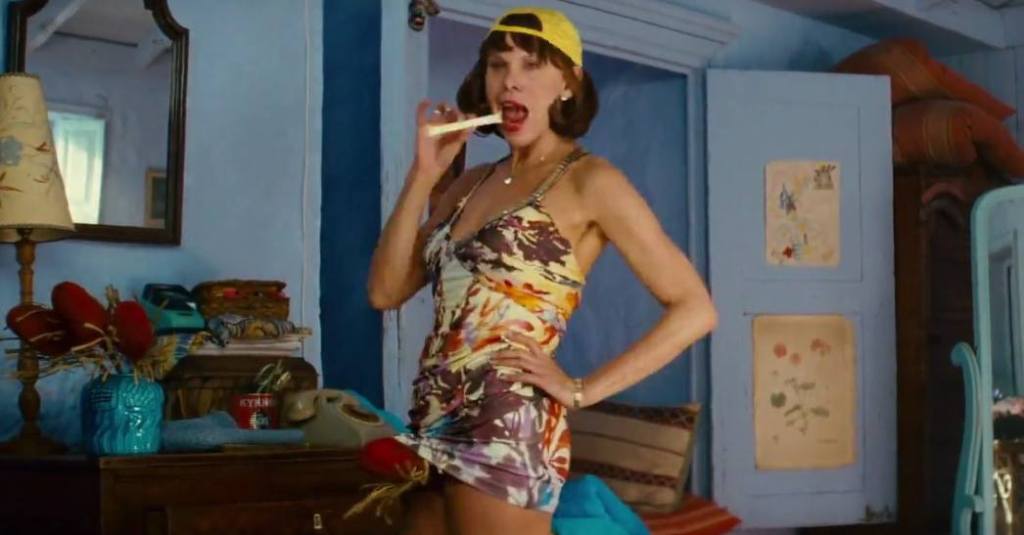
Mamma Mia! (2008) – You may know that this ABBA-themed jukebox musical is popular enough as a crowd-pleasing rom-com to have inspired a decade-late sequel this past summer. What you may not remember all this time later is that it is absurdly, deliriously horny. Mamma Mia! slyly slips under the radar as a cartoonishly horned-up sex comedy disguised in wholesome Family-Friendly clothing in a way we haven’t seen on this scale since Grease. For a refresher on how desperately thirsty this comedy-musical is, catch up with its Fathom Events 10th Anniversary screenings Sunday 11/4 & Tuesday 11/6, check out our recent podcast discussion of its prurient charms, or just have a peek at Christine Baranski pretending a flower is her dick:
Welcome to Episode #68 of The Swampflix Podcast. For our sixty-eighth episode, we wrap up the Halloween season with The Devil himselves. James & Brandon are joined by Krewe Divine co-founder Virginia Ruth to discuss three movies in which Keanu Reeves goes head to head with Satan. Also, Brandon makes James watch The Witches of Eastwick (1987) for the first time. Enjoy!
One of the more bizarre aspects of the initial slasher genre boom of the 70s & 80s is that it’s oddly just as prudish as the “road to ruin” exploitation pictures of the 1950s. In the 50s pictures, teens who dared to experiment with sex & drugs, especially girls, would swiftly be met with a violently tragic end as punishment. This formula allowed audiences to both indulge in the sexy, transgressive behavior of rebellious teens and wag a morally righteous finger in their direction once they get their inevitable comeuppance. Although packed with far more nudity & bloodshed, the slasher genre was generally just as condemning of teenage rebellion as the “road to ruin” pictures before it. Its teen characters were chopped down by humanoid monsters like Michael Meyers or Jason Voorhees instead of dying at the hands of syphilis or car crashes, but slashers were just as obsessed with punishing wayward youngsters for straying into the temptations of marijuana & premarital sex. The original entry in the Roger Corman-produced SlumberPartyMassacreslasher series both participated in and satirized this time honored tradition. Written by feminist author Rita Mae Brown, 1982’s The SlumberPartyMassacre is a straightforward slasher film that still punishes teens for their hedonistic behavior, but delivers its kills by way of an oversized, phallic drill that points to the absurd gender politics of its genre. What’s much more interesting than that subtle subversion in the mechanism of punishment, however, is the way its sequel, 1987’s SlumberPartyMassacre II, updated the source of its teenage moral transgressions to something more blatantly modern.
Marijuana & premarital sex had been triggering teen deaths in exploitation pictures dating all the way back to the 1950s, long before slashers added machetes & kitchen knives to the recipe. SlumberPartyMassacre II modernized the formula by introducing an entirely new source of teenage transgression, one highly specific to the 1980s: music television. In the five years between the first two SlumberPartyMassacrereleases, MTV had proven to be a kind of cultural behemoth instead of a flash-in-the-pan novelty. Suddenly, the already sinful business of rock n’ roll had a direct line to youngsters’ television sets, where it could tempt them into darkness with all of the sex, drugs, and partying their little eyes could take in. MTV had come to visually represent the teen rebelliousness that ruined so many fictional lives in exploitation cinema past and the Corman-funded, Deborah Brock-directed team behind SlumberPartyMassacre II were smart to adapt that visual language to the slasher genre format. It’s still a film where teen girls are murdered for straying from their parents’ protection to experiment with sex & alcohol. The difference is that the mechanism used to punish them is not a scary man in a mask wielding a comically oversized kitchen utensil. Instead, the victims in SlumberPartyMassacre II are hunted by a personified representation of MTV culture. In its own absurdist way, the film literalizes parents’ fears about rock n’ roll invading their homes to destroy their children’s lives. Better yet, it does so with a cartoonish slapstick energy usually reserved for a Looney Tunes short that keeps the mood consistently light instead of browbeating the audience for indulging in its sex & fantasy violence.
The youngest survivor of the titular slaying in the first SlumberPartyMassacre, Courtney, is now high school age, living alone with an overly stressed mother who shares her anxieties over her traumatic past. Instead of spending her birthday weekend visiting her sister (who also survived the massacre) in the hospital, Courtney convinces her mother to allow her to go on an unsupervised road trip with her small group of close friends. All four girls in this crew are members of a jangly, Go-Gos reminiscent garage band and plan to spend the weekend away practicing new songs. They, of course, also plan to drink excessively & sleep with hot boys. In the days leading up to this getaway, Courtney has recurring nightmares featuring a demon in a leather jacket, billed simply as The Driller Killer, who warns her not to have sex on the trip or else. Of course, being a teenager, Courtney inevitably ignores this warning and deliberately sheds her virginity with her biggest crush. The exact second Courtney has sex for the first time, the transgression gives birth to the rock n’ roll demon, who escapes from her nightmares and hunts down every one of her friends & bandmates with a giant, guitar-shaped drill. The physical manifestation of MTV culture, The Driller Killer is dressed like Andrew Dice Clay, except with a vampire collar on his biker jacket. Before drilling each teen dead with his unignorably phallic guitar, he suggestively delivers rock n’ roll one-liners like “I can’t get no satisfaction,” & “C’mon baby, light my fire.” He also had a rock n’ roller’s sense of open-ended sexuality, applying his drill to victims of all genders instead of reserving it just for the girls, like in the first film. The only way this sex demon could’ve been more MTV is if his name was Downtown Julie Brown.
Not all of SlumberPartyMassacre‘s MTV horrors rest on The Driller Killer’s leather clad shoulders. Besides its two music video tangents highlighting Courtney’s garage band, the film generally adapts music video language to its visual style. Drastic comic book angles, fog machines, and intensely colored lights shape a lot of the aesthetic of its nightmare sequences & third act slayings. The film’s sets, which include empty condo developments & construction sites, also recall early MTV-rotated rock videos that were cheaply, rapidly produced to feed the young channel’s bottomless need for content. The teen girls in the film are highly aware of this then-modern medium too. Minor scream queen Heidi Kozak, who plays the band’s drummer, exclaims in a pivotal scene, “Someday we’re going to be in movies and rock videos and everything, because my song is going to be a hit,” and, more directly, “MTV, here we come!” This declaration is promptly followed by the girls stripping down to their underwear (or less) and erupting into a dance party/pillow fight that could easily pass for a mid-80s hair metal video if it weren’t for all the nudity. The sequence is often viewed from the television’s POV, as if the music emanating from it was directly influencing their drunken behavior, enticing them to commit sins that will immediately get them killed. The broadcasted film soundtrack they’re dancing to is also none other than the Corman-produced classic Rock n’ Roll High School, which had its own significant impact on music video culture before MTV ever existed.
SlumberPartyMassacre II can sometimes be a nihilistically violent exploitation piece in the way that all slashers are, but mostly it just mirrors the light-headed inanity of pop music as a medium. Song lyrics like, “I wanna be your Tokyo convertible,” and scenes like the dance party/pillow fight keep the tone goofy & charmingly absurd. Even the film’s rock n’ roll demon, although a murderous creep, never feels like the kind of nightmarish threat that usually terrorizes wayward teens in this genre. The film not only modernizes the slasher formula by shaking off its 1950s cobwebs and updating its teen transgressions with a borrowed MTV flavor; it also makes its violent downfall seem just as fun & enticing as the sins that trigger it. Given the choice to either live a chaste life or die by the hands of MTV, it’s likely a lot of mid-80s teens would’ve eagerly chosen death, which feels like a different sentiment entirely from the third act downfalls of the “road to ruin” era of exploitation cinema. It’s funny that it had to return to the demonized image of a 1950s rock n’ roller to free itself from that era’s moralist trappings.
Our Movie of the Month ritual involves everyone in the crew taking turns introducing a film that no one else has seen yet. It’s an experience we try our best to enter blind, without any preemptive research. I failed that stipulation by just a week’s time this October by watching a stealth remake of CC’s first Movie of the Month selection, the 1981 Canuxploitation classic The Pit, without knowing what I was getting into. While I had never seen The Pit before, stray details of its cult-circuit reputation were still potent enough in the ether that I recognized I was spoiling the movie for myself by watching a parody of it a week early. The question is, how could I have possibly suspected that a parody of The Pit even existed until I was already watching it? What kind of deranged madman would even think to make a feature-length parody of that little-seen Canadian horror curio, much less actually follow through? The only possible answer, of course, is Matt Farley – but it’s a discovery that only leads to more questions as you track the ripple effects of Farley’s fixation on The Pit in the larger picture of his entire Motern Media catalog.
Once you’ve seen the original work, Matt Farley’s 2002 horror comedy Sammy: The Tale of a Teddy and a Terrible Tunnel is unmistakable as a feature-length homage to The Pit. I suspected as much when I originally watched Sammy (in my summer-long determination to watch all of Matt Farley’s available filmography), but what I didn’t realize was exactly how deep that influence seeped. In Sammy, Matt Farley changes his name to Jamie to match the protagonist of The Pit, even mentally de-aging his own character with a head injury to match the original Jamie’s emotional & sexual maturity. He carries an oversized, telepathic teddy bear that encourages him to violate the sexual privacy of his babysitter (including exact recreations of two key bathroom scenes from The Pit). He gets banned from the library for staging disruptive pranks. He wages war on a bratty neighbor named Abergail, who believes the phrase “funny person” to be the ultimate insult. He lures his perceived enemies to a woodland setting, where they’re eaten by a captive prehistoric monster that eventually breaks free to cause widespread havoc. Sammy is not a loose homage to The Pit; it’s basically a cinematic cover song, a low-key remake.
However, watching Sammy and watching The Pit are too wildly different experiences, mostly because of their respective, outright opposed tones. Part of what distinguishes Matt Farley from most microbudget, backyard horror auteurs is that his work is aggressively wholesome. I get the sense that he (along with frequent collaborator Charles Roxburgh) was raised on VHS-era horror oddities like The Pit, but doesn’t have the heart to recreate their cruelty. My favorite aspect of The Pit, beyond the volume & variety of its monstrous threats, was how uncomfortable & grotesque its depictions of pubescent sexuality could be. In The Pit, Jamie is a menacing pervert who squicks out his entire community with his weaponized libido, which he barely disguises with a Rhoda Penmark-style performance of innocence. In Sammy, by contrast, Jamie is an adult man conveying that exact childish sexuality, right down to the very same acts of bathtime inappropriateness, but somehow Farley makes its impact far less creepy. His favorite aspects of The Pit were obviously the more innocuous, absurd touches like the name Abergail, the “talking” teddy bear, repetitions of the phrase “funny person,” etc. When it comes to being genuinely creepy & sexually uncomfortable, he doesn’t seem to have the heart; it’s a wholesome monster movie aesthetic that makes his already hyper-specific regional cinema ethos all the more distinct.
When I mentioned to Matt that I planned to revisit Sammy in light of having recently seen The Pit (he is extremely, radically approachable), he “joked” that I must rewatch all of his movies in that context, as they were all influenced by that formative relic. I immediately saw his point. Besides Farley’s aggressively localized, microbudget version of horror-comedy worshiping the regional cinema ethos of The Pit as if it were a religious doctrine, his own movies follow its exact narrative pattern over & over again. In most contexts, The Pit’s structure of functioning as a psychological drama & a hangout comedy until rapidly mutating into a full-on creature feature in its final minutes would seem erratic & illogical. In the context of Matt Farley’s pictures, it’s a rigid blueprint. In most Matt Farley movies there’s a Riverbeast, a “Gospercap,” a cult of modern “druids,” or a shameless peeping Tom lurking in the woods just outside of the action for most of the runtime, then rushing in to cause havoc just minutes before the end credits. Watching Sammy, I was amazed that someone had committed to remaking a minor curio as underseen as The Pit (way back in 2002, long before every movie of its ilk got the 4k Blu-Ray restoration treatment). Since Matt Farley tweeted back at me, my amazement has only deepened, as I’ve since realized he’s been remaking The Pit over & over again his entire career as a filmmaker. It’s as impressively committed as it is baffling.
Yes!!
The Pit has influenced all our movies. So it’s time for a full Motern Marathon!
— Matt Farley of Motern Media (@MoternMedia) October 2, 2018
As interesting of a pairing as Sammy makes with The Pit, it’s not the first Matt Farley title I’d recommend to fans of that classic. His holy trinity of greatest accomplishments – Local Legends, Don’t Let the Riverbeast Get You!, and Monsters, Murder, and Marriage in Manchvegas – all convey the taste of The Pit’s influence on the Motern Media catalog you’d need to get the full picture, and they’re each much more satisfying as isolated works. (In true Matt Farley fashion, Sammy is part of a complex mythology of interconnected “druid” films, even though it doesn’t contain druids itself.) As a stunt & an act of stubborn follow-through, however, it’s astounding that Farley & crew completed a feature-length homage to that Canuxploitation gem in the first place, one made mind-bogglingly wholesome through revision & fixation. It’s worth seeing just for that commitment & audacity alone.
For more on October’s Movie of the Month, the horned-up Canuxploitation horror curio The Pit, check out our Swampchat discussion of the film, our look at its big-budget equivalent, The Gate (1987), and last week’s examination of how it could have easily have been a Gooby-level embarrassment.
Accessibility to a wide range of movie & television options in the online steaming era has made freedom of choice to be something of an overwhelming burden. There’s too much media to watch and not nearly enough time to even to distinguish which titles are worth the effort. This constant deluge of “content” has created a fascinating attention span phenomenon in the modern media consumer. We’ve reached a cultural paradox where audiences are reluctant to venture to the theater for a three hour film with a serious topic, but will happily binge dozens of hours of a mediocre television show on Netflix or Hulu merely for the convenience of its availability. Genre filmmakers & schlock peddlers of old have dealt with this exact attention span problem in the past, especially when they were catering to the teenage numbskulls who packed drive-in theaters to make out & party in the 1950s & 60s. In the modern streaming era, drive-in schlock has once again become a pertinent form of entertainment. Not only are many films of that era now available for easy (although frequently illegal) access on sites like YouTube; they’re also short & to the point. With over-the-top premises engineered to grab dumb teens’ attention in titles like Billy the Kid vs. Dracula & Frankenstein Meets the Space Monster, these films would typically stretch out only to an hour in length a piece, so that they could easily be stacked in a drive-in double bill. The convenience of being able to watch a goofy, high concept horror in an hour’s time is just as appealing now as it is likely was for anxious-to-neck teens half a century ago. You could gobble down an entire feature in the same amount of time it would take to watch a single episode of Stranger Things (and one that would require about the same amount of brain power).
The problem with a lot of drive-in era schlock, of course, is that the films themselves are often far more dull than what’s promised in their advertising. Old school genre film promoters lived & died by the ethos that it was far more important to get eyes on the screen (and, thus, cash in the register) than it was to deliver a high quality product. Many films with an eye-catching title & a killer poster would stop short when it came to actually entertaining audiences, since their job was already done before the first reel spun. Much like the majority of modern straight-to-streaming movies & television, a lot of drive-in fare was lazy & disposable. Their sixty minute runtimes make them much easier to dig through for the gems than most other eras of genre film entertainment, however, and there were plenty of high quality schlock titles that fully delivered on the promise of their attention-grabbing advertising. I can’t think of a better example of efficient, attention-holding drive-in schlock than the 1964 British export The EarthDiesScreaming. At 62 minutes in length, The EarthDiesScreaming succinctly packs at least three sci-fi horror premises into a single genre picture. It’s a cheap production that effectively conveys the scale of a global threat to humanity while only staging its events in a small studio lot section of London. Without narration or montage, it barrels through a series of paranormal obstacles for its small cast of characters to overcome, only to move the goalposts for victory at every possible opportunity. Its violence is mostly implied, yet its effect is genuinely chilling. As convenient as the movies are to watch, most drive-in schlock admittedly doesn’t bother to deliver a decent picture that lives up to the strength of its advertising; The EarthDiesScreaming somehow delivers three in a single, succinct package.
The film opens similarly to 28 Days Later, with its main protagonist roaming London as seemingly the only human left alive. Lifeless bodies are strewn about city streets as planes, trains, and automobiles crash in stock footage spectacle without navigators. The camera pans up to the sky for a dramatic title reveal in enormous block letters: THE EARTHDIESSCREAMING. Eventually, our square-jawed American hero finds fellow British survivors emerging from the wreckage. As a group, they search TV & radio signals for answers, finding only static & the hum of a strange, menacing tone. There’s little dialogue in this earliest sequence, until the group deduces that the lifeless victims outside have suffered an attack of weaponized gas, the source of which they speculate on without much evidence. Just as they come to a conclusion on what knocked out the first wave of victims, space alien robots arrive to sweep the streets for survivors, whom they incapacitate with a single gentle touch. When the majority of the survivors escape the fate of the alien robots, the robots then raise their dead as zombie drones with whited-out eyes to complete the mission. These individual obstacles don’t even cover the off-screen aliens who are deploying these threats or the mysterious signals being broadcast over television & radio waves. The EarthDiesScreaming doesn’t even devote energy to explaining what happens next after its in-the-moment crisis is solved immediately before the end credits. It just keeps its head down & throws every monstrous evil it can conjure at the screen, any one of which could have been developed into its on individual double-bill filler.
The most impressive aspect of The EarthDiesScreaming‘s genre film efficiency is how it finds the space to allow its central mystery to breathe. Its hour-long runtime is packed tightly with a wide range of villainous monsters, yet its pace is not at all rushed. In the classic Twilight Zone tradition, characters are allowed plenty stage play dialogue to ponder the possibilities of what alien force is planning their doom. The movie is disinterested in these characters as individuals, saving time by boiling them down to archetypes: the American Hero, the pregnant damsel, the uptight aristocrat Brit, the common thief, etc. By skipping in-depth characterization, it allows for unsettling questions to linger between the physical threats of the robots & their zombies. Was it actually a gas that triggered this crisis? What is the signal being broadcast on the radio supposed to signify? Are the characters already dead & navigating some kind of purgatory? Who is their true enemy? It even telegraphs some of the paranoid in-fighting of John Carpenter’s The Thing; the characters viciously bicker in distrust of each other as they fight a common enemy they cannot see.
From the design of its robot monsters to the eerie sounds of its ambient Elisabeth Lutyens score, The EarthDiesScreamingis shockingly well-made for a production of its scale & budget. What makes it a significant work, though, is its ability to cram three movies’ worth of entertainment into the space of an hour. Whether you’re a 1960s teen hoping for extra minutes of smooching after you leave the drive-in or a 2010s serial streamer pressed for time to take it all in, there’s a tremendous value to that kind of genre film efficiency. I’ve watched entire seasons of television with fewer ideas than this film conveys in its first half hour and I greatly appreciate that it doesn’t hang around for too much longer after it gets them across.