It was a little difficult for me discuss Anna Biller’s recent camp cinema triumph The Love Witch in full detail, at least partly because I don’t have the full mental library of reference points she was pulling from for the film’s psychedelic goth erotica pastiche. There’s an endless sea of cheap, sexed-up, psychedelic horror from the late 60s & early 70s that I don’t know nearly enough about to speak with any kind of critical authority. The Velvet Vampire easily fits that bill, though, and as soon as I saw the trailer my mind went straight back to Anna Biller’s The Love Witch. The interesting thing about watching The Velvet Vampire in this context is that because it’s a Free Love era horror picture directed by a woman, Roger Corman protigee Stephanie Rothman, it already has some of the feminist underpinnings foreign to the genre that Biller would later bring crashing to the surface in such a pointedly satirical way. The Velvet Vampire is by no means a forgotten pillar of fiercely feminist cinema; it’s just as much of a compromise between thoughtful art house horror & sexploitation smut as anything you’d expect to see from its spooky erotica peers. Its feminine gaze & dreamlike tone within that genre framework did help me better understand where The Love Witch was coming from culturally, though, a quality I expect to find in plenty more titles as I slowly catch up with Biller’s encyclopedic knowledge of this corner of schlock.
This dirt cheap, Corman-produced horror (alternately titled Cemetery Girls) starts by following a female vampire’s POV, an odd choice for a protagonist, as she’s threatened with sexual assault and stabs her would-be attacker, a nobody biker, to death in public. She calmly washes her bloody hands clean in a fountain while blues singer Johnny Shines wails onscreen about how she’s an Evil Woman (another odd choice). Later, we see our “Evil Woman” scouting potential victims at an art gallery and convincing a young married couple to visit her place in the desert for the weekend. The horny dolt husband (Beyond the Valley of the Dolls‘s Michael Blodgett) drags his perpetually annoyed wife out of the hellish desertscape just so he can ignore her and openly flirt with their vampiric host. They don’t even try to hide it either. While sitting down for dinner, the titular vampire describes her dune buggies to the lout right in front of his not-having-it wife, “It’s slow getting started. At first it takes a little manipulation. But once it’s warmed up it really comes alive. And you have to watch out. It’s really hard to control.” Subtle stuff. During the day she takes the couple sight-seeing to such exotic locations as a desert shack and an abandoned mine (fun!). At night she calmly watches them sleep & fuck from behind a false mirror and invades their dreams to seduce them individually with her feminine wiles. She’s not harvesting their blood for her own sake, though. She merely needs it to sustain the mummified, undead body of her husband, whose open coffin she visits often.
The frustrating thing about The Velvet Vampire is that it’s almost something truly great. The dreamscape seduction scenes have a surreal Altered States quality to them that makes them immensely exciting and there’s a few stray moments of cinematic beauty elsewhere in shots of the titular vampire eating raw liver in her lingerie or lying naked in her husband’s coffin. The film’s also slightly transgressive in its third act shift toward lesbian seduction once the husband is no longer interesting as a plaything, especially in the vampire’s monologue about men’s envy over the power of female sexual pleasure. The film doesn’t follow through on any of its genuine art film impulses, though, so it’s much easier to take delight in its campier touches like its rubber bats, loosely defined vampire rules (sunlight’s apparently not a problem), and inane dialogue (listening to a man scream in pain, the dolt husband shrugs it off with, “It’s probably just a coyote.”). Because The Velvet Vampire is so beholden to the slow & stoned hippie energy of its era (as opposed to the much more alive go-go erotica of The Vampire and the Ballerina), though, it’s difficult to get too excited about the film’s occasional pleasures that languidly float by onscreen. However, as some insight into the kind of territory Biller might’ve been mining for The Love Witch, it was invaluable, especially since it clued me in that female filmmakers have been working in the genre as long as it’s been around. Their work is just a lot harder to come by.
There’s a lot to be shocked about in February’s Movie of the Month, Brian Yuzna’s satirical class politics body horror Society, but long before the incestuous, gore-soaked surrealism of the film’s climactic shunting began I found one of my biggest shocks in a very minor casting choice. The protagonist’s Valley Girl brat girlfriend was a very much unexpected face, the same actress who played the drummer in one of my favorite discoveries last year: Slumber Party Massacre II. Heidi Kozak has a tidy little career as a television actor to her name, most notable from her arc on the long-defunct drama series Dr. Quinn, Medicine Woman. Her feature film career, however, is much more limited. After a single scene debut as a street tough in the Sharon Stone/Adam Ant cop thriller Cold Steel, Kozak enjoyed a brief run as an undersung scream queen in three 80s horror classics: Slumber Party Massacre II, Friday the 13th Part VII – The New Blood, and, of course, Society. Her respective roles as Sally, Sandra, and Shauna in these films were never big enough to snag top bill or make her anything close to a household name, but Kozak did find a way to leave a huge impression on horror schlock as an art form in just a few years’ time.
Sally
I ran through the entirety of the Slumber Party Massacre trilogy twice last year, not because each entry in the series blew my mind, but because the second film in particular was a life changer. Slumber Party Massacre II is an MTV-inspired fever dream of slain teenagers & nightmarish hallucinations that completely reinterpreted its straightforward slasher predecessor as a kind of surreal live action cartoon. All four girls in the film’s central garage rock band (a surprisingly decent The Go-Go’s knockoff) who embark on the titular doomed slumber party road trip are exciting to watch as performers. Courtney’s got the Final Girl timidity, Amy’s got the Best Friend sincerity, Sheila’s got the Rock Star sex appeal: each are entertaining in their own right. Still, I’d argue that Heidi Kozak’s performance as the band’s drummer, Sally, is a definitive show stealer. She not only features prominently in the movie’s most stomach-churning practical effects showcase (just one of her two onscreen deaths in the film), but she also brings a distinct Valley Girl cheese to the character that would make the actor so easily recognizable in her later horror works.
We don’t know much about Sally as a character except that she’s boy-crazy and she’s a drummer. The drumming part is something Kozak sells hilariously unconvincingly, endlessly miming the same repetitive motions with her drumsticks while the soundtrack does its best to make her seem competent. She does sell the character’s boy-crazy delirium quite well, though, chiming in as often as she can with announcements like, “I met this outrageous guy! He was such a babe,” and “I know what Courtney’s getting for her birthday . . . a boyfriend!” Sally seems to be her social group’s air headed cut-up, prone to shouting half-formed thoughts like, “Someday we’re going to be in movies and rock videos and everything,” and “Do anything you want to! Good times!” It’s easily the most dialogue Kozak is afforded in any of her works as a minor scream queen and she makes Sally out to be such a fun, bubbly character that every moment she’s onscreen is a gift. This is especially true of the first of her two onscreen deaths in the film, when Courtney hallucinates that a pimple Sally’s been worried about all weekend grows to encompass the entirety of her face and explodes all over the bathroom. It’s hideous, highly effective gore work and a much more memorable moment than when she’s later impaled by the killer’s phallic guitar drill. Poor Sally.
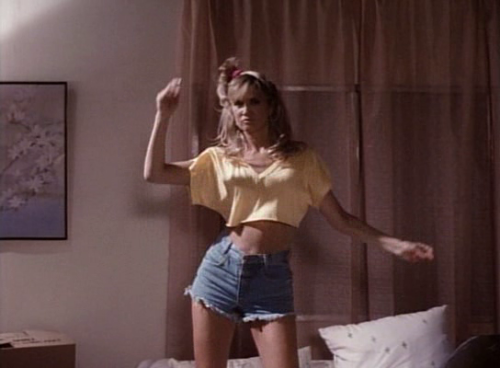
Most Killer Outfit: In the pillow fight scene, Sally sports a yellow crop top with Daisy Duke cutoffs and an asymmetrical ponytail. It’s the perfect outfit for any summertime sleepover, but it’s especially sporty for when you might need to flee from a demonic sex monster and his giant, guitar-shaped drill.
Sandra
A year after her scream queen debut in Slumber Party Massacre II, Kozak hit it big time (as far as mainstream horror franchises go). Friday the 13th Part VII: The New Blood practically lifted the Sally character wholesale from her previous film, only leaving behind her beloved drum kit. I can’t say that I especially enjoy this late-in-the-game franchise entry, but I do appreciate that it occupies the sillier end of Jason Voorhees lore that makes movies like Jason X and Jason Takes Manhattan, some of my favorites of the series. In this loosely sketched out version of Crystal Lake mythology, Jason’s dead body is reanimated & freed from its watery grave when a troubled young teen accidentally exercises her Carrie-like telepathic abilities in his general vicinity. Unfortunately, the film finds a way to make this ludicrous premise punishingly dull, despite some promising ideas about Jason functioning as a supernatural curse. There’s only two worthwhile aspects to The New Blood once the plot gets stuck in its by the books slasher rut: an inventive kill in which Jason smashes a girl zipped up in a sleeping bag against a tree (a kill later satirized to even greater effect in Jason X) and the casting of Heidi Kozak as inevitable victim Sandra.
Again, there isn’t much difference between Sandra & Sally in terms of character work, except that Sandra actually gets to act on her boy-crazy teen horniness while Sally only got to gush about it. In her introductory scene, Sandra is shown sunbathing and ogling a nearby hunk. In her second scene, she’s screwing a different boy, her boyfriend, in the back of a van, essentially marking herself as ineligible for Final Girl status, a surefire victim for Jason’s swinging machete. It’s in this romantic pairing that we get to see a different side of Kozak that wasn’t already covered in Slumber Party Massacre II. Because her wealthy boyfriend is hosting a teen party at his uncle’s Crystal Lake cabin, Sally winds up playing party mom during a large portion of the film’s first act. She’s still operating within her usual ditzy Valley Girl caricature, but now with a flustered sense of responsibility that has to negotiate between her oversensitive boytoy and some rowdy teens who just want to get drunk & screw. She makes no show of hiding why she’s with the wealthy dipshit either, answering his question, “When did you fall in love with me?” with a teasing, “The first time I saw the enormous size of your beautiful . . . wallet. The bulge in your pants was calling my name. Sandra, Sandra!” Unfortunately, Sandra’s life on this Earth is cut short when she gets the idea to go skinny dipping in Crystal Lake, one of Jason’s biggest pet peeves. She watches in horror as her boyfriend is decapitated on the shore and her naked body double is subsequently drowned. It’s a shame too, because she was one of the few compelling characters in a film that desperately needed more of them, yet she was one of the first to go.
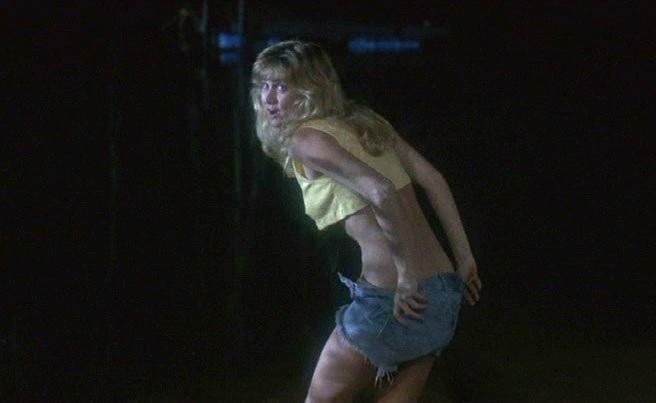
Most Killer Outfit: In accordance with her status as a more horned-up replica of Sally, Sandra sports a skimpier version of the yellow crop top & short jorts outfit from the previously mentioned pillow fight in her big skinny dipping scene. This time, however, it’s paired with a nude body double instead of an asymmetrical ponytail.
Shauna
Society is easily the strangest film in Kozak’s trio of horror outliers, depite each work being uniquely goofy in their own unique ways. Kozak reprises her Valley Girl routine for one final go-round in Brian Yuzna’s cult classic body horror, but not as a participant in the gore-soaked “shunting” climax, neither as a victim nor as a wealthy mutant “sucking off” the life force of the lower class. Instead, Shauna is a total outsider to the entirety of the plot. She’s just as clueless as the film’s protagonist as to what supernatural evils lie under the surface of the film’s well-to-do Society, but instead of investigating the Truth, she spends the entire film trying to join the ranks of a ruling class that has no use for her. Her character traits aren’t much different than Sally’s or Sandra’s, but Shauna’s ditzy, boy-obsessed teen routine is put to a much stranger use, likely because Society itself is much less structurally formulaic than the two straightforward slashers she worked on previously.
Shauna has exactly one goal in Society: to earn an invitation to rich cad Ted Ferguson’s party. She does not succeed. The high school cheerleader schemer pretends to be so into and in love with the protagonist, Bill, but her interest in him seems to be a political move based on his football star social status and potential election as senior class president. When Bill finds himself entangled with a potential love interest that actually wants to have sex, Shauna is incensed not because she’s jealous of the affair, but because she wasted so much emotional work with Bill and never earned that Ted Ferguson invite she wanted so badly. Once their romance is fully dissolved, Shauna’s storyline is left by the wayside and she disappears before the climactic shunting, forever an outsider, never to be heard from again.
As an actor, Heidi Kozak similarly disappeared. Her work as a minor scream queen dissipated within three glorious, but short years and it’s doubtful she’d be remembered for any other popular media contributions, except maybe by the most dedicated Dr. Quinn, Medicine Woman fans. I’d say she fully deserves to be remembered now, though. All three of her horror projects have proven to be such strange genre outliers with unexpected cult status longevity and she makes a striking presence in each instance. She’ll never enjoy the status of a Neve Campbell or a Jamie Lee Curtis, but she’ll always be a cherished scream queen to me.
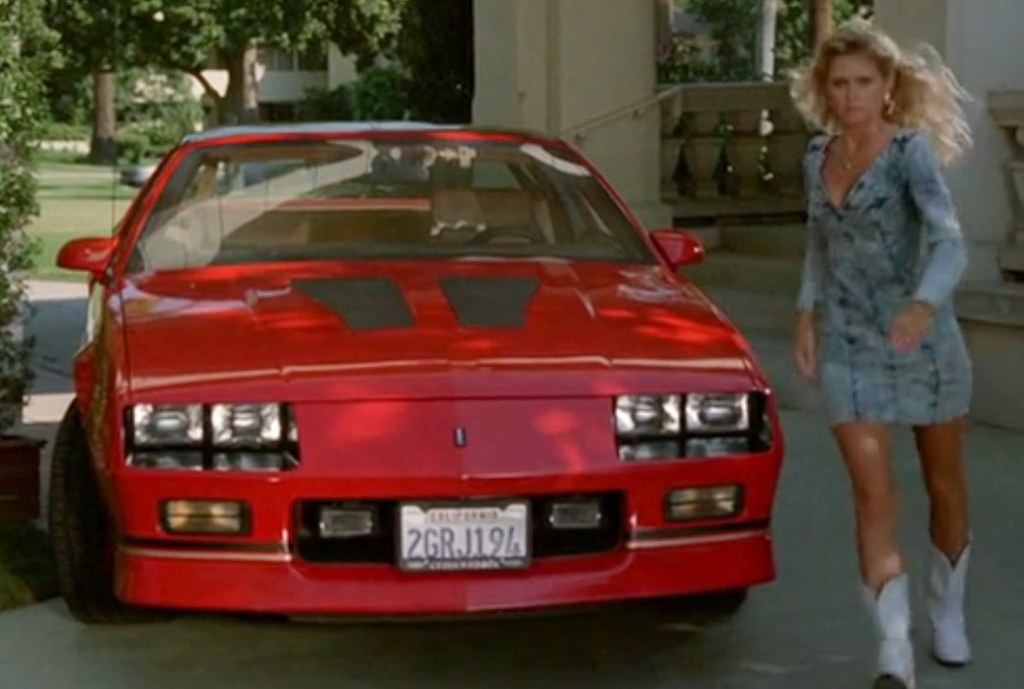
Most Killer Outfit: In the scene when Shauna confronts Bill for his cheating ways, she shows up at his house in a skin tight denim dress, paired with a candy red sports car. She looks incredibly powerful in that getup and Bill was a fool to let her go in his pursuit of the truth about the shunt, especially since his eventual fate was entirely unavoidable.
When watching the recent psychological/philosophical horror High-Rise, a movie that ranked very highly as one of my favorite films of 2016, I could only think of one viable comparison point for why it worked so well for me: Luis Buñuel’s surrealist classic The Exterminating Angel. The class system resentment & nonstop-party terror of The Exterminating Angel informs so much of what makes High-Rise a deeply unnerving picture, but something I had initially overlooked was how Cronenbergian the film was at the same time. The unspoken, unexplained psychology & philosophy that terrorizes audiences in High-Rise is very much reminiscent of the best of David Cronenberg, which is no surprise once you consider that Cronenberg is an avid fan of J.G. Ballard, who penned High-Rise‘s source material (as well as the source material for Cronenberg’s Crash). In fact, Cronenberg had made a film, his very first feature no less, that closely resembles High-Rise even more than The Exterminating Angel, especiallyin its narrative structure & visual palette, presumably because it was inspired by Ballard’s text.
Much like High-Rise, Cronenberg’s debut film Shivers is set entirely within a high-rise condo community where residents have very little reason to ever leave the convenience of their homes. An opening slideshow, narrated liked an advertisement, takes the audience on a guided tour of the high-rise, making a big deal out of its convenience commodities like swimming pools, medical facilities, and recreational sports courts. Unlike with High-Rise, however, the catalyst for this self-contained society devolving into an orgy of uninhibited bloodlust is never left ambiguous or open for interpretation. This particular community is torn apart when a mad scientist perverts an experiment meant to supplant traditional organ transplants with a bio-engineered parasite that can be made to assume an organ’s functions by making that parasite a kind of aphrodisiac & a stimulant. This experiment gets out of control when the mad scientist’s teenage mistress spreads the parasite through copious amounts of promiscuous sex and the entire building devolves into zombie-like behavior, except with a lust for sex instead of brains.
It’s fascinating to see a young, scrappy Cronenberg working within the framework of a drive-in exploitation horror before honing his craft in more focused, better funded works like The Fly or Videodrome. Although the usual Cronenberg themes of body horror & unexplainable paranoia are certainly present throughout, Shivers becomes a fairly standard creature feature once the venereally-spread parasite is let loose onscreen. Even the creature itself, which looks like a monster’s detached & wriggling tongue, is a far cry like from the special effects mastery of later Cronenberg works. You can also feel the cheap exploitation edge to the film in its various alternate titles, which are very un-Cronenberg: The Parasite Murders, They Came from Within,and (the shooting title) Blood Orgy of the Parasites. Unfortunately, Shivers is mostly notable because of its cultural significance as proto-Cronenberg & an early glimpse at what would later be perfected in High-Rise. On its own, it’s only a moderately interesting slice of exploitation cinema where a mad scientist torments an entire apartment building (including horror legend Barbara Steele among his many victims) because humanity has “lost track of its instincts” and would supposedly be better served engaging in “a beautiful, mindless orgy.”
The sexual nature of the violence in Shivers, as fascinating as it is in relation to venereal disease paranoia, means the film is far from a “fun” watch. Also, the budget of a first time filmmaker means Cronenberg couldn’t push the mayhem anywhere close to the scale of High-Rise‘s dissent into widespread madness. I can only recommend Shivers to those interested in the humble beginnings of Cronenberg & the influences of one of last year’s more unnerving (and incredibly divisive) horror films. It’s most interesting as a telegraphed version of better work that was to follow. That’s not to say there’s no value to that kind of entertainment, though, and Shivers worked best when it deepened my appreciation for movies that I already loved.
After a few decades in which the film fell into the public domain as a recobbled, poorly transferred, discolored, nigh-unwatchable piece of garbage, a restoration and Blu-ray release from Severin Films means a whole new generation can see Cathy’s Curse (aka Cauchemars, literally “nightmares,” the film’s original/French title) in all of its… glory?
The 1970s were banner years for the burgeoning Canuxploitation film industry, as our neighbor to the north saw a boom in production due to an increase in the Capital Cost Allowance (CCA) due to new tax shelter laws instituted to encourage Canadian filmmakers. Theretofore, most of these funds had gone toward producing documentaries, an influence which is evident in the observational, cinéma vérité nature of many of the films that followed regardless of genre; beginning in 1971, the Canadian Film Development Corporation pushed filmmakers to focus on those films that were more commercially viable in an attempt to recoup some of this funding. From this push we got the early films of our dearly beloved David Cronenberg, as well as great work from Bob Clark, who was recruited from Florida to lend his experience to the Canadian industry.
Of course, the exploitation of tax shelters is nothing new, and the availability of public funding has doubtlessly led to the implementation of various Producers-style bombs quickly slap-dashed together to take advantage of available funding. Cathy’s Curse is notably a tax shelter baby, although it’s much better than many other films that were created for similarly inartistic reasons.
The film opens on Mr. Gimble in 1947, who returns to his home to learn that his elementary-aged daughter Laura has been left alone by her mother, who absconded with Laura’s younger brother George. Mr. Gimble tells the little girl that her mother is a bitch, and that she will pay for what she did to Laura; I’m noting this here because, even in the remastered director’s cut, we never learn exactly what Mrs. Gimble did or why Mr. Gimble is so bitter about it. The two race away, and when the car swerves to avoid a rabbit in the road, both Mr. Gimble and young Laura are burned alive in the resultant crash.
Some thirty years later, George (Alan Scarfe, who played not one but two Romulans in Star Trek: The Next Generation) returns to the still-pristine house with his wife Vivian (Beverly Murray) and daughter Cathy (Randi Allen). Vivian has recently lost the couple’s second child and suffered a nervous breakdown as a result, lending her character a kind of otherworldly removal from the events at hand and planting the seeds for George to shrug off her concerns as the result of an inscrutable mental illness later in the film. Upon arrival, the family is greeted by housekeeper Mary (Dorothy Davis) and repairman Paul (Roy Witham), and Cathy befriends some neighboring children.
On the day of a pre-arranged play date, Cathy goes upstairs to get some rest beforehand, but is drawn to the home’s spacious attic, where she discovers a portrait of her dead aunt as well as a rag doll with sewn-shut eyes. The portrait’s eyes glow an eerie green, and so begins Cathy’s possession. While playing with the other children, she uses them to re-enact the night of Laura’s death, including urging one of the boys to say “All women are bitches!” The mother of these children, meanwhile, has tea with Vivian and another friend (Mary Morter), who identifies herself as a medium and has a full on psychic freakout after holding a picture of Laura and George’s father, complete with deep-voiced recitations and lots of Garth Marenghi’s Dark Place-style rapid cuts. This is interrupted when one of the children cries out after Cathy cuts her.
The connection between Cathy and the doll deepens, as she sees Laura reflected in her mirror instead of herself, and poor Mary is killed, as is Paul’s dog. Vivian is sent to a sanitarium for a while and Paul is tasked with watching Cathy during the day while George attends to unspecified business at a construction site. Paul himself is subjected to hallucinations and suddenly-manifesting lesions, but Cathy keeps him around (and drunk) apparently for her own amusement and perhaps in recognition that she needs to keep at least one person alive to take care of her while George is away. The medium returns more than once to the house and is continuously rebuffed by Cathy and a drunken Paul when she asks for Vivian, before a nightmare hallucination sends her out of the house and out of the film for good (she’s set up as almost like a Father Merrin type, but her appearances end up contributing nothing to the film).
Vivian returns home, and her protestations that something is deeply wrong with Cathy are dismissed by George with increasing irritation and accusations that her mental illness is tearing the family apart. Not helping is the fact that Cathy is a perfect angel when in her father’s presence, and her truly innocent nature seems to be, at times, attempting to exert itself. After a final confrontation, George ultimately sees the truth and Vivian saves her daughter’s soul by removing the stitches from the doll’s eyes, forcing the evil presence out of the house and their daughter.
For a low-budget attempt to cash in on the success of The Exorcist with some overtones from The Omen (complete with a nanny dying from a fall from an upper floor, although even a woman Mary’s age would probably survive a fall from the second story), Cathy’s Curse is decent, but nothing exciting or terribly special. There are plenty of laughs to be had, but it’s unclear which, if any, are intentional; my favorite is in the scene where the newly-possessed Cathy throws her cereal bowl across the room and Mary, thinking this was an accident, picks up approximately four pieces of broken china from a pile of dozens of shards and cheerfully declares “There, all better!” There’s also some humor gleaned from the possessed Cathy’s dirty mouth, where attempts to mimic the truly revolting and soul-crushing diatribes voiced by Regan in The Exorcist come across as distinctly Canadian in the script’s unwillingness to go too far.
Still, the film isn’t lacking in mid-budget charm. The restoration of the film may not be worth spending time to track down and watch, but if it happens to fall into your lap, there’s a moderately good time to be had.
I’ve been gushing a lot lately about superhero media that dials the clock back to before the adult-marketed era The Dark Knight has unwittingly spawned. Titles like Teenage Mutant Ninja Turtles: Out of the Shadows & Roger Corman’s infamously discarded Fantastic Four adaptation have been a comforting return to the Saturday morning cartoon era of superhero media for me, a time where kids’ stuff was actually made, you know, for kids. The recent animated feature Batman: Return of the Caped Crusaders brilliantly, deliberately calls back to the superhero movie’s goofy past that I miss so much. Especially in the face of Zach Snyder’s glowering realm of DC Comics adaptations, this kind of campy kids’ media is the exact breath of fresh air the world needs before it suffocates on its own doom & gloom. There were four feature films in the Batman universe released in 2016. Two of those films (Dawn of Justice & The Killing Joke) were tonal nightmares of ultra macho self-seriousness. The other two got by on the entertainment value of so-bad-it’s-good camp. Of that enjoyable half, only Return of the Caped Crusaders can claim to have been bad on purpose (with Suicide Squad‘s mild guilty pleasures seeming much more unintentional). I think it’s fair to say, then, that this silly, animated trifle was the best Batman movie of the year, which is an unlikely distinction, considering the crowded field and its dedication to camp & frivolity.
As with most bankable successes in recent years, Batman or otherwise, Return of the Caped Crusaders is a property that survives entirely on nostalgia. Its voice acting crew is a reunited cast from the original 1960s Batman series, featuring Adam West as the titular Caped Crusader and an ancient Burt Ward as his young . . . boy ward. Much like in the original series, the film’s overloaded with Batman & Robin saturating each line with unnecessary puns & alliteration. When they find a sheet of aluminum foil at a crime scene, they exclaim “We’ve been foiled!” They don’t operate regular civilian weaponry, but cleverly named artillery like “the batzooka.” They refer to Gotham’s A-list villains as “felonious fiends” and to Catwoman in particular as “that dominatrix of deviltry.” When Catwoman fights back by poisoning Batman with a substance she calls “batnip,” she gleefully brags, “His mass muscles will be mine to manipulate.” The whole movie is overwhelmed by these over-written punchlines and by the time Batman admonishes Robin for jaywalking with the line, “No one’s above the law, even when you’re trying to enforce it . . . To the crosswalk!”, it’s easy to wonder if the film is maybe a little too silly & self-aware. Think back to the Adam West performance in The Batman Movie (1966) in those moments. Is anything in Return of the Caped Crusaders really at all sillier than the physical comedy gag where Batman’s attempting to ditch a bomb; but ducks, nuns, and children keep getting in his way? The over-the-top goofball sense of humor in this profoundly silly cartoon match the energy of its source material exactly, right down to the “BOFF!”, “OOMPF!”, and “SPORK!” interjections that color its fight scenes. We’ve just gotten so used to a glowering, no-fun-allowed Batman in the last decade that this feels like a bit much; in truth, it’s exactly what we need.
If I could bother to complain about any one aspect of Return of the Caped Crusaders, it’d be easy to fault the film for having too loose & inconsequential of a plot. The episodic story beats of this animated production feel like a several installments’ arc of a new television series instead of a proper feature film. Batman’s unholy trinity of treacherous traitors are all present here: Catwoman, The Joker, The Penguin, The Riddler (Julie Newmar, Jeff Bergman, William Saylers, and Wally Wingert, respectively). They each get in a scheme to stop Batman and each fails in due time, usually because Catwoman is in love with the billionaire brute. This parade of failed crimes leads to some interesting novelty locations (a circus, a blimp, an American Bandstand knockoff, a TV dinner factory, outer space), but the story mostly just serves as an exercise for more puns & more alliteration. The only decidedly modern aspect to the film is that characters openly & frequently imply that Bruce Wayne & his young ward are a romantic couple, mistakenly believing that to be their reason for secretly sneaking off at night. Everything else feels like a low-ambition return to 60s Batman camp, a silly indulgence in returning to a time where Batman was fun and delighted both young children & stoned college students alike. Some of that 60s vibe doesn’t translate well into a modern context (especially in the multiple scenes of characters being drugged & “seduced”), but for the most part it’s a welcome return to the over-the-top absurdity I wish we’d see more of in our modern superhero movies. Return of the Caped Crusaders doesn’t amount to much more than a nostalgia callback, but it’s a callback to a gloriously silly time in comic book aesthetic we should have never left behind.
One of the most common complaints that documentaries suffer is the accusation that they exploit their human subjects for artistic (and financial) gain. It’d be difficult to argue against that accusation in regards to the recent HBO Docs release Beware the Slenderman, which turns the real-life stabbing of a twelve year old girl into a midnight movie creepshow & a jumping point for internet age fear mongering. Although I could comfortably call Beware the Slenderman exploitative, it’s exploitation cinema done exceedingly well. The first hour of the documentary is highly effective as bone-chilling horror, opening with a Blair Witch-style dramatization of the titular “creepy pasta” the Slenderman in a heavily pixelated version of the woods. As the film tracks the legend of the Slenderman from online fiction to amateur video games to Tumblr fan art to YouTube mainstay, it makes some really interesting and genuinely unnerving points about the evolution of memes as a collective “virus of the mind” and the function of online folklore as “digital fairy tales.” It’s when the film instead focuses on the 2014 stabbing of a young Wisconsin girl that it veers into the more exploitative True Crime territory and loses track of its Candyman-esque fascination with the nature of urban legends. I definitely found one side of that divide far more satisfying than the other, but watching Beware the Slenderman navigate this confusing tonal clash and gleefully cross some ethical lines to get its point across made for a unique documentary experience.
Two twelve year old girls are taken into custody and tried as adults for stabbing their friend 19 times in the woods of Wisconsin suburbia. As there has been no decision made in their first-degree attempted murder trial to this date, a charge that could possibly earn them each 65 years in prison, the two girls’ story has, by design, no conclusion. All we know upfront about the stabbing is that the victim thankfully survived and that the accused have made no attempt to hide the fact that they are guilty. The crime is introduced in-film through media coverage montage and long-form interviews with the accused’s parents, which tells their entire life story to a backdrop of home video footage. The parents describe mostly normal childhoods outside stray sociopathic reactions to pop culture media (specifically the infamously devastating scene from the beginning of Bambi) and a gothy tinge to their daughters’ online activity. There’s a lot of frustration and empathy in those interviews as the parents struggle to make sense of children they thought they knew, an internet culture they completely underestimated, and the earliest signs of mental illness in otherwise normal-seeming childhoods. The problem is that they aren’t the only interviews the documentary is structured around. In a much sleazier line of inquiry, Beware the Slenderman integrates long stretches of the two girls’ confessions/police interrogations from mere hours after the stabbing. Watching two children describe the stabbing of a third child in cold-blooded terms is just about the most exploitative thing I’ve ever seen in True Crime media, but it serves the material well, especially in the way it deepens the creepiness of the film’s titular monster, the Slenderman.
Originally penned as a creepy pasta, but earning a full-blown urban legend status through online folklore, the Slenderman is a tall, lanky being with long arms, claws, and retractable tendrils. He is faceless, always wears a suit & tie, and is naturally drawn to young children. Adults see his attraction to children as a threat of harm, but children (especially bullied outsiders) see it as welcoming & protective. As one interviewee puts it, “Often in the adult world, we can forget how much it sucks to be a kid.” This modernized version of the Boogeyman or the Pied Piper offers alienated children the promise of protection & community. The scary part is that some kids truly believe he’s real, real enough for them to stab a friend 19 times to “prove themselves worthy” and to “prove the skeptics wrong.” By their logic they had no choice but to slay a human sacrifice for the Slenderman, explaining, “I didn’t want to do this, but I was afraid of what would happen if I didn’t.” Richard Dawkins is brought in as an evolution expert on the way memes spread & adapt. Brothers Grimm scholars attempt to contextualize the phenomenon in the tradition of fairy tale folklore. None of the talking heads are nearly as effective as seeing for yourself how the Slenderman is represented in online multimedia art and hearing what the fictional character’s devotees are willing to do “for him” in the real world. It may be a question of my general genre preferences with all media, but I think this documentary works best when it pursues this type of urban legend horror aesthetic instead of playing with the ethics of True Crime narratives.
I’ll admit that as an audience, my biggest hurdle with Beware the Slenderman was its length, not its ethical dilemmas. At two full hours, the film outwears its welcome a bit by the concluding 30min stretch, which started to feel as pedestrian as an episode of Dateline NBC. I’m always advocating for my horror cinema to limit its runtime, though, and it’s that genre distinction that allowed me to enjoy the documentary despite its occasionally objectionable sense of morality. Using the near-murder of a young girl by her peers for shock value or an audience hook is certainly questionable, especially if the ultimate purpose of your works to creep adults out with technophobic warnings about what children are getting into online. That’s not even to mention that the film liberally appropriates artwork from those same children for its imagery without pay or credit. I expect that kind of unethical alarmism in my horror media, though, and I really like the way Beware the Slenderman tried to make phenomena like the Ice Bucket Challenge, planking, and YouTube reaction videos into just as sinister of a force as CandyCrush is in #horror and Skype is in Unfriended. Before the easy fact checking days of the internet, people used to believe films like The Blair Witch Project, The Texas Chainsaw Massacre, and Cannibal Holocaust were genuine documentaries, real life recordings of actual incidents. Beware the Slenderman works best as a continuation of that horror tradition by actually filling that role as a document of a real-life event. It’s a little overlong, a tad sensationalist, and mundanely sleazy in some of its True Crime touches, but it’s also a great horror film, especially for a documentary.
I was recently invited to contribute to The Bangers n’ Mash Show’s annual Phantom Awards episode to once again highlight the Best Films of 2016. According to the episode description, “Mr. Bangers and Mr. Mash welcome the new year with [their] annual tradition: The Phantom Awards! As [they] do every January, [they] gather to give awards out to the best sci-fi, horror, and fantasy films of the previous year.” I submitted a few audio clips to the episode along with several other contributors (including Crushed Celluloid’s Marcus Jones) to throw some much deserved praise towards the Kevin Spacey talking cat comedy Nine Lives, the under-seen home invasion thriller Emelie, and my beloved The Neon Demon.
Give a listen to the 2016 Phantom Awards below! And if you like what you hear, give a listen to more episodes of The Bangers ‘n Mash Show on their YouTube playlist.
“While it is a sad fact that mass homicide and practitioners of Blood Cults infest our society, the producers of this film wish to express that they do not condone, nor do they want to inspire, any of the human butchery or violence portrayed in this film. If you feel you will be offended by such material, please leave the theater at once . . .”
Opening with that grave, overly serious warning, you might expect Blood Diner to have the gritty grindhouse exploitation vibe of The Texas Chainsaw Massacre (an obvious point of reference for that tongue-in-cheek disclaimer). However, the truth is that Blood Diner is much more in line with the energetically violent slapstick comedy of The Texas Chainsaw Massacre II, except that its humor is a lot less shrill and the movie does a much better job of distancing itself from its own predecessor. A supposed sequel to the grindhouse “classic” Blood Feast (a film I have zero affection for), Blood Diner is pure 80s splatter comedy mayhem. It boasts all of the shock value violence & misogynistic cruelty of its predecessor (this time at the hands of a female director, Jackie Kong), but has a lot more in common with ZAZ spoofs or Looney Tunes than it does with its grindhouse pedigree. Everything in Blood Diner is treated with Reagan-era irreverence to the point where this pointlessly stupid horror comedy starts to feel like inane poetry. It shocks; it offends. Yet, Blood Diner is so consistently, absurdly mindless that all you can do is laugh at its asinine audacity in its cheap midnight movie thrills.
Two young children play in a Pee-wee’s Playhouse version of the 1960s, complete with kitsch toys, Cadillacs, and a radio broadcast of doo-wop singers maniacally crooning “Crazy, crazy, crazy, crazy” on a seemingly endless loop. This nostalgic reverie is disrupted when their serial killer uncle, announced on the radio to be responsible for the “Happy Times All Girls Glee Club Slaying” & “armed with a meat cleaver in one hand and his genitals in another” bursts through the door like Leatherface to say his final goodbyes before the police gun him down. In this final exchange, he takes the time to make sure that his ancient blood ritual religion has stuck with the children. Boy, did it ever. The brothers grow up to be screwball sociopaths, casual serial murderers who think nothing of ending a life for the sake of a punchline. They resurrect their uncle after a 20 year delay by grave-robbing his somehow still-intact brain & eyes and storing them in a mason jar in their hip vegetarian restaurant. Their uncle’s brain continues to brainwash them (ugh) from the comfort of its jar, pressuring them to collect female body parts from fresh victims to resurrect the ancient goddess they worship for an all-important “blood buffet” that’s ultimately staged at the city’s slimiest rock club. Their mission is, for the most part, a success.
Essentially, none of this matters. Minus the part where the brothers serve human meat to their vegetarian restaurant’s loyal patrons, the plot of Blood Diner falls somewhere between the female body reassembly of Frankenhookerand a version of Weekend at Bernie’s where every character is a potential corpse to play with. It’s somehow treated with less reverence than either of those titles. This is a film that survives entirely on a diet of small moments & constant sight gags. A mannequin is treated like a normal human character, his nature as an inanimate object never being mentioned. A shovel to the back of the head pops out a victim’s eyeballs with ease. One of the chef-brothers gets to live out his dream of becoming a pro wrestler and takes on a heel named Jimmy Hitler in the ring. A shitty new wave concert erupts into a nonstop orgy of metaphysical violence. This kind of irreverent mayhem can often feel grotesquely misogynistic, like when a nude aerobics class is gunned down by a killer in a Ronald Reagan mask. Even that line of gore comedy can be deliciously amusing, though, like when a female victim’s head is deep fried and emerges looking like a gigantic hush puppy. Taking a ZAZ-style approach to its live action cartoon cruelty, Blood Diner throws so many stupid jokes at the wall that eventually you’ll let your guard down enough for a fair number of them to stick and you’ll earn a hearty laugh.
It’s possible that because Blood Diner is so cheaply made and so blatantly stupid that I’m giving it more credit than it deserves, overlooking some of its more glaring, misanthropic faults. I’m definitely the kind of audience that’s willing to forgive the mistakes made by a scrappy production written around a terrible “blood donor” pun just so I can indulge in some aggressively juvenile humor about unwitting cannibalism and nudist Kung Fu. Blood Diner feels like a genuine version of The Greasy Strangler that was discovered in the wild instead of designed in a lab. It’s the experience I expected to have with Tobe Hooper self-parody in The Texas Chainsaw Massacre II instead of the the disappointing one I got, a rare schlock cinema balance where the grotesque humor is exhaustingly inane, but still impressive in its success rate. I’m curious to see what other atrocities Jackie Kong unleashed upon the world in her heyday, because she seems to have a strong comedic mind for someone who only managed to get a handful of projects off the ground. Even if Blood Diner is her only success, though, it’d still be a career worth being proud of, thanks to a grotesque cinematic prank that’s an outright miracle in the way it tests patience, outwears its welcome, and spits in the viewer’s face, while still feeling oddly endearing in its own dinky way.
I’m a huge fan of ambient, abstracted horror, but it’s a difficult formula to pull off. The quietly unnerving thrills of titles like Evolution, Beyond the Black Rainbow, Under the Skin, and The Witch are a lot more difficult to pin down than the inventive kills, gruesome creature designs, and effective jump scares more conventional horror films rely on for easy success. It’s always a bigger risk, then, for a horror picture to reach for that atmosphere over genre thrills ethos and I greatly respect I Am the Pretty Thing that Lives in the House for its ambition in chasing menacing abstraction. Unfortunately, though, this straight to Netflix cheapie never quite commands the confidence & soul-shattering dread needed to make its abstracted, intangible terror worthwhile. Instead of dealing in unnerving ambiance, I Am the Pretty Thing that Lives in the House winds up feeling like a studied exercise in emptiness. It’s an admirable stab at abstract horror, but the blade misses its mark and the audience walks away dazed, but entirely unharmed.
Part of the reason this small scale ghost story fails to connect with its atmospheric target is that its central victim never feels like a real person. A live-in nurse caring for an aged horror novelist finds herself alone for days on end in an ancient home. She explains several times in her near-constant narration that “A house can’t be bought or sold by the living. It can only be borrowed from the ghosts who stayed behind.” Although an ostensibly modern character, she always speaks in this measured, inhuman way, breathily peppering her dialogue with phrases like “Heavens to Betsy,” and explaining herself to be a notorious scaredy cat. What follows is a low rent version of Guillermo del Toro’s revivalist Gothic horror Crimson Peak, with the scaredy cat nurse investigating a possible murder committed in the house, one hinted at in her patient’s novel The Lady in the Walls (a nod to the similar in tone short story “The Yellow Wallpaper,” no doubt). Her fascination with this mystery slowly ramps up tension in a series of increasingly bizarre hallucinations, but never culminates in a satisfying way, mostly because the audience never really gets to know or care about the one character who quietly witnesses them.
I Am the Pretty Thing that Lives in the House very nearly reaches a worthwhile sense of menacing, abstracted dread in its third act hallucinations. Body horror scares mix with characters plucked from costume drama murder mysteries and a score of eerie hums to hint at the better movie this could’ve been with a better-defined lead character or more of a climactic playoff. Less-patient horror fans will be immediately turned off by the film’s whispered narration & representations of ghosts as feminine figures stalking blurred, black voids, but I don’t think that dedication to stillness & quiet is necessarily its worst impulse. I just think the movie fell a little short in achieving something memorably unnerving. The most immediately significant aspect of the film that comes to mind as I mull over its distinguishing details is a bit role from Bob Balaban, who was barely in the picture. This kind of abstract, loosely held together horror requires a lot of concentrated dedication from its audience’s end, which means that when it fails to make the effort worthwhile it’s easy to feel frustrated with its more glaring shortcomings. I respect I Am the Pretty Thing that Lives in the House for reaching for such a lofty, intangible goal, but it never quite met me halfway in achieving it.
When I first set out to track down a copy of Society, I turned to my old pal, the Vulcan Video catalog search, which showed that there was a copy at the location nearest me. When I went to locate it, however, it was nowhere to be found on the shelf, and the kind woman working the counter that day noted that their copy had actually been sold several years back and that the catalog listing was an oversight (an unusual lapse for the fine folk of Vulcan). We did eventually track down a copy of the film in their stacks, one of those early double-sided DVDs with Society on one side and Spontaneous Combustion on the reverse. I was pretty pleased by this, because a double feature usually means an easy instant follow up article (just add water).
I was wrong. I was so, so wrong. There’s nothing easy about Spontaneous Combustion.
The film stars America’s non-darling Brad Dourif as Sam, the adult son of a husband-and- wife team who were given an experimental anti-radiation injection during a propagandistic Cold War exercise. Following his birth, both parents spontaneously combust after contact with their new infant, leaving him to be raised by the mysterious Lew Orlander (William Prince), a wealthy industrialist who acts as the face of the original experiment when his company takes over from the government.
Some reviews identify Sam as a would-be actor, apparently based on his first scene in the film, in which he recites some lines of Shakespeare on stage with a student, but I think he’s supposed to be a teacher, as is his love interest Lisa (Cynthia Bain). One can hardly blame the audience for being unclear as to who Sam is, what his motivations are, or for failing to follow the so-called plot of the film. From what I can understand, Sam was once married to Rachel (Dey Young), Orlander’s granddaughter, who was always pushing Sam to visit Dr. Marsh (Jon Cypher), who is secretly in Orlander’s employ. Since their divorce, Sam has struck up a relationship with fellow anti-nuclear activist Lisa, but this relationship is also the result of Orlander’s manipulations, and the supposed homeopathic medication she has been sharing with him is actually from Dr. Marsh. These treatments are provided in order to encourage the growth of Sam’s supernatural power to start fires.
All of this seems pretty straightforward, but there’s also the mysterious reappearance of Sam’s childhood toy that sends him off searching for the truth of his origins, Sam’s budding powers and the ensuing accidental deaths thereof (including a couple of police officers and John Landis in a cameo as a radio . . . technician, maybe?), a radio evangelist/medium who seems to be speaking to Sam directly for reasons that are utterly unclear, the sudden reappearance of a woman (Melinda Dillon) involved in the original experiment and her just-as- sudden murder, the murder of another woman who was investigating the soon-to- be-activated nuclear plant nearby, Lisa’s own pyrogenetic powers, and an inordinate number of conversations held on neon telephones.
The composition and plotting of this movie are bafflingly inelegant, and even two viewings left me unable to accurately gauge just what in the hell was happening at any given time. This was a frustrating viewing experience, both times, and not in the sense that some deeply philosophical films are hard to parse. Instead, Spontaneous Combustion feels like a unauthorized, non-union sequel to Firestarter that was hastily edited together by someone trying to recreate the experience of watching that film with a 104° fever. It’s a movie that actively tries to discourage you from watching it even as the story (such as it is) unfolds, challenging the viewer to a test of wills.
Despite the incohesiveness of the overall plot, I was able to discern two similarities that would reasonably connect this film to Society and, to the inebriated mind of some marketing exec, warrant putting the two films on a single disc. First, the actor playing Sam’s father, Brian Bremer, also portrayed Petrie, Billy’s rival for student body president, in Society. More thematically, both Billy Whitney and Sam are the children of working class people raised by wealthy elites for their own nefarious purposes. It’s a bit of a stretch, but there it is.
Even if you find yourself with a copy of this double DVD in your pursuit of watching Society, don’t flip that disc. It’s not worth it.