Wetlands (2014)

EPSON MFP image

2014 was a weird year for the romcom. It’s not often that a modern romcom earns the kind of critical praise that lands it on Best of the Year lists or empathetically addresses a subject as sensitive as abortion, but last year’s Obvious Child accomplished both. The genre also found its first ZAZ-style spoof in They Came Together and some common ground with supernatural horror in The One I Love. These were all exciting developments in a genre long thought stagnant, but by far the strangest new territory under the romcom umbrella was explored by the German film Wetlands.

Most likely the cutest movie about an anal fissure you’ll ever see, Wetlands is by and large an exercise in depravity. It’s as if de Sade or Bataille had written a Tom Hanks/Meg Ryan comedy. If there’s a particular bodily fluid, sexual act, or unsanitary pizza topping that you absolutely cannot handle this may not be the movie for you. However, those who can endure a heap of gross-out humor are well rewarded for their fortitude. Like its 18 year old protagonist Helen (expertly played by Carla Juri) the film’s hard, shock value exterior is really a front for a big old softie lurking under the surface. For all of Helen’s filthy sex pranks and hygiene “experiments”, she’s really just an overgrown child who desperately wants her parents to get back together and for her hunky crush to notice her advances. There’s also some real pain behind her troubled relationships with her mother, her brother & her best friend, as well some surreally lyrical tangents involving dirty panties, microscopic closeups of bacteria, drug binges, and newly sprouted avocado trees. The film may be memorable for the depths of its depravity, but more importantly it manages a remarkable balance that allows it to stick to the romcom format while navigating those depths.

After its minuscule domestic release last year, I’m stoked that Wetlands is finally accessible for easy consumption on streaming platforms & physical media. As far as I know the only time it played locally was at Chalmette Movies during last year’s New Orleans Film Festival. The film was difficult to watch in more ways than one and, as it was my favorite comedy of 2014 (and in my top 5 movies overall), I’ve been sitting on my hands waiting for an opportunity to spread its name. If you’re worried that Wetlands is too grotesque for your taste, this (absurdly NSFW) trailer is a good litmus test. Otherwise, check it out on streaming or home video ASAP. It’s somehow just as cute as it is gross. It’s very, very gross.

-Brandon Ledet

Marks & Smarks: No Holds Barred (1989) & The Wrestler (2008)

wrasslin

Definitions pulled from Wikipedia’s glossary of professional wrestling terms:
-“Mark”: a wrestling fan who enthusiastically believes that professional wrestling is not staged.
-“Smark”: a fan who is aware of and interested in the backstage and non-scripted aspects of wrestling; a portmanteau of “smart” and “mark.”

Last night I attended my first live pro wrestling event, a months-long goal fulfilled. Despite the distinctly tame vibe of the crowd, I decided to misbehave. Couldn’t help myself. I got drunk, cheered for heels like a jerk, and shouted things that disturbed the 10 year old boy sitting in the row ahead of me. A few rows behind me, another ten year old was also yelling ridiculous taunts, but his were much funnier & more insightful than mine. I was thoroughly upstaged. Around a third my age, this kid had a preternatural comprehension of the sport that he thankfully shared with the neighboring crowd in short, high-pitched bursts. The kid ahead of me would be genuinely upset if he were in earshot. I know I upset him myself. I was sandwiched between a young mark and a smark, two different wrestling worlds clashing on either side of me.

I think it helps to appreciate both sides of the coin to experience the full potential of pro wrestling. Losing yourself in the characters & the soap opera drama is just as important as the in-the-ring athleticism. The violence wouldn’t mean as much without the camp. On the other hand, the context of the practical, behind-the-scenes operations of the sport gives deeper meaning to the in-the-ring storylines. It’s a scripted sport, but scripted in the style of reality television: the reality & the fiction are inseparable. One feeds off the other. A well-rounded fan needs a solid admiration of both.

Searching for this balance in pro wrestling cinema leads me to the bookends of the modern wrestling movie. 1989’s Hulk Hogan vehicle No Holds Barred perfectly captures the nature of mark mentality in the infancy of the current Vince McMahon era. 2008’s The Wrestler, by comparison, is a smark’s dream: an authentic look at the brutal truths of pro wrestling as a career. Together, help paint a complete picture, the fiction & the reality, one feeding off the other.

No Holds Barred (1989)
Although No Holds Barred was far from the world’s first pro wrestling picture, it was the first film produced by the World Wrestling Federation (now WWE). It would take over a decade after its release for Vince McMahon’s juggernaut wrestling promotion to form its own movie studio, so in this way No Holds Barred was ahead of its time. This was the only way it was ahead of its time. Miming the late-80s Schwarzenegger action movie format as much as the budget would allow, No Holds Barred was a blatant attempt to launch the movie career of Hulk Hogan, who had already dominated the “sports entertainment” world and was looking for his next conquest. The first sounds you hear in the film are the voices of Jesse “The Body” Ventura & “Mean” Gene Okerlund, who had come to define the era’s ringside announcing. The film’s head villain is character actor Kurt Fuller testing an almost exact prototype of his career-defining role as a television network scumbag in Wayne’s World. No Holds Barred is in every way a product of its time.

Keeping in line with the 1989 perspective of pro wrestling, before the internet’s obsessive nitpicking of the sport, No Holds Barred is firmly on the mark side of the mark/smark divide. Hulk Hogan’s character Rip Thomas is a superhuman beast in the ring and out. He leaps to incredible heights, destroys cars with his bare hands, and dismantles “bad guys” to an 80s “rock music” soundtrack, all while wearing a costume befitting of a superhero biker. In a world devoid of subtext he is a hero without flaw, an incredibly smart brute who’s dedicated to his charity work, the kind of guy who inspires lines like “Rip’s word is his bond” even when he’s not in the room. The entire movie exists to make Hulk Hogan look impossibly good. He’s a saint, a “good guy”.

Objectively, the movie is not very good. In fact, it’s awful. There’s some guilty pleasure to be found in its campy action movie spectacle, like when Rip force-feeds a rejected bribe to Kurt Fuller’s television executive and quips “I won’t be around when this check clears.” It’s also funny to think that Vince McMahon produced a film that indicts the evil nature of megalomaniac network executives, because, well, he’s a megalomaniac network executive. For the most part, though, the movie is shoddily made of generic kids’ stuff: jokes about “dookie” and slobbering hillbillies, world-class mean-mugging from immense muscle men, “good guys” beating up “bad guys”. It’s a movie you have to love for its savage idiocy, not in spite of it.

More importantly, it’s a document of a different time, a swan song for the era of the mark.

The Wrestler (2008)
A drastically different approach, Daren Aronofsky’s The Wrestler is an objectively good movie. I’d even go as far as to call it a masterpiece. Applying the modern online smark mentality to pro wrestling, Aronofsky turns the backstage repercussions of sports entertainment into a Greek tragedy. Unlike Hogan’s Rip Thomas, Mickey Rourke’s Randy “The Ram” Robinson is a real human being outside the ring. Well past his glory days, Randy struggles with health, finances, and personal relationships badly damaged from years spent on the road. In-the-ring injuries have increasingly severe real life consequences. In one particularly gruesome scene medics remove staples, glass, etc. from Randy’s skin as the camera cuts back to show how they got buried there in a horrific hardcore match, a bloodthirsty crowd chanting “You sick fuck!” in the background. As the pain periodically hits him throughout the film, the intense sound design cues you in with high-pitched noises to match his wincing. Referring to himself, Randy “The Ram” says “I’m a broken down piece of meat. And I’m alone. And I deserve to be alone.” Time proves him right. This is far from the marked-out world of Rip Thomas.

Aronofsky’s attention to authenticity is a remarkable achievement here. As I said before in my list of top pro wrestling documentaries, Randy “The Ram” feels like wrestlers we know, wrestlers like Scott Hall & Jake “The Snake” Roberts. Smarks would take particular interest in the way the movie depicts wrestlers planning spots before matches, laying out a basic framework within which they can improvise. The movie also addresses blading/juicing, steroid abuse, boozy bouts of self-medication after matches, shady promoters and minuscule pay. Randy directly refutes claims that wrestling is “fake” and shows off his scars as proof. Part of why it hurts to watch him despair over the old action figures, Nintendo games, and 80s monster ballads that serve as relics of his former fame is that it feels all too real. There are people who live like this.

Of course, an accurate portrayal of pro wrestling is seated somewhere between these two extremes, just as I was seated between two wildly different children last night. Without the glam showmanship, juvenile humor or outrageous superheroics of Rip Thomas, Aronofsky’s version of wrestling is a grim, lethal ordeal. The wrestling of No Holds Barred is an idealistic child’s macho fantasy. From The Wrestler’s viewpoint, it’s more like assisted suicide. To take in the full scope of the bizarre, idiosyncratic, self-contradicting superhero spectacle of the brutal sport, you have to appreciate both perspectives. You have to look through the eyes of the mark and the smark. Drunken yelling also helps.

-Brandon Ledet

I, Frankenstein (2014)

EPSON MFP image

onehalfstar

campstamp

Reading over Wikipedia’s plot synopsis of I, Frankenstien makes me feel like a cinematic amnesiac. All the talk of “Gargoyle Order” weapons wielded to “ascend” and “descend” demons & gargoyles sounds vaguely familiar, but the particulars of what Bill Nighy, Dr. Frankenstein’s book or the supermodel scientist were up to are fuzzy at best. Mostly I remember Aaron Eckhart testing out his gruff Batman voice as if his former role as Harvey Dent was a consolation prize. There was some fun to be had in the climactic good versus evil fight scene (especially in the detail of costuming the evil demons in business suits) but for the most part the whole affair felt grim & indistinct.

I, Frankenstein is definitive proof that this post-Dark Knight era of sad sack superhero movies is reaching its nadir. Reinventing the monster movie by fusing it with the superhero genre is an idea loaded with fun potential, so (to quote a popular, hideous dorm room poster & t-shirt) why so serious? After all of I, Frankenstein’s ridiculous trailers & nominations for Worst Film of 2014, it at least gave the impression that it could’ve been amusing. Outside of minor details like the business suit demons, I get the sense that I was promised more goofy antics than were delivered.

I haven’t seen a single entry in the Underworld series, which shares writers & producers with I, Frankenstein, but from what I understand they’re just as bleak. To an outsider, the most bewildering aspect of the vampires/werewolves “action horror” series is that there are four of the damn things. Despite the lackluster critical response and general sense of drudgery, Underworld found enough of an audience to justify 7 hours of celluloid. Building off that hubris, I, Frankenstein all but offers an “Until Next Time” promise after the credits in its conspicuous aspirations of launching a new franchise. The problem (besides its uninspiring box office performance)? It’s not the only self-serious “action horror” Frankenstein product in the works.

2014 also saw the release of Universal Studios’ first entry in the planned Shared Universe® for its classic monsters characters: Dracula Untold. For the most part the movie was Dracula Unremarkable, but there were some (underutilized) bright spots: the vampire deaths were surprisingly gruesome considering the PG-13 rating (a heap of melted flesh instead of I, Frankenstein’s more symbolic “descending”) and Charles “The Man” Dance made the most out of his limited role as the head vampire. Just as I, Frankenstein felt like little more than dull goth superhero franchise kindling, Dracula Untold was mostly a “this is just the beginning” letdown of a story. One of the other goth superheroes on the Universal docket, waiting to join Dracula’s ranks: Frankenstein’s monster.

Given the unlikely longevity of the Underworld series it’s possible that Lionsgate will ignore the Universal Studios famous monsters universe and we’ll live in a world with two dueling Gritty Reboot® Super Frankenstein franchises nobody asked for. Hopefully an I, Frankenstein, II would ditch the self-serious tone and work in more business-suit-demons humor, but I wouldn’t hold your undead, crime-fighting breath. Seriously, don’t hold it. It’s criminal for movies this ridiculous in premise to be so severe, but they’re unlikely to change their ways as long as they’re making money. Or in I, Frankenstein‘s case, at least breaking even.

I, Frankenstein is currently streaming on Netflix & Amazon Prime.

-Brandon Ledet

It’s A Disaster (2013)

disaster

fourstar

Although its sense of humor is decidedly more uncomfortable than either, It’s A Disaster is the same vein of realistic, self-absorbed approaches to widespread disasters as comedies like Shaun of the Dead & Life After Beth. Instead of a zombie attack, this small group of friends is trying to survive couples’ brunch . . . and the fallout from a series of dirty bombs set off in downtown Los Angeles.

Chemical warfare is the mechanism that keeps the characters cooped up inside the house, unable to escape brunch, but their toxic personal relationships are the real threat. Important news broadcasts are disregarded in favor of confessions of betrayal. Planning for survival takes a backseat to pointless power plays, cruel insults, and sexual advances. This isn’t quite the sadistic, drunken argument gallows humor of Who’s Afraid of Virginia Woolf? & The Boys in the Band, but it’s not far off.

It’s the kind of movie that has its cake and eats it too. With mimosas to drink. The personal relationships are vicious, but also sweet. The letdown of an ending is so well handled that it’s a send-up of letdown endings. Everyone’s having the worst day of their life, but also a pretty great time. There’s a very delicate balance between jovial & soul-crushing that It’s A Disaster handles expertly. It obviously helps that the entire film is hilarious.

It’s partly the casual nature of the performances that keeps the mood light despite the grim premise. Julia Stiles & America Ferrera are particularly great here, but the one performance that really struck me is David Cross’. Cross usually goes big in his comedic roles and is rarely afforded time to slowly ramp up the crazy the way he is here. Usually he plays a ridiculous caricature suited for his sketch comedy roots, his entire personality established early & often. Even in last year’s Obvious Child, Cross played the one character in a grounded cast that felt unbelievable as a real person. In It’s A Disaster, Cross is introduced as an audience surrogate, a doorway into an established world of ludicrous, lethal friendships before the pressure of the situation gets to him and he joins their ranks. I’ve always enjoyed Cross’ work, but this is up there among his best. It’s a great performance in a great film about an awful, awful brunch.

It’s A Disaster is currently streaming on Netflix, Hulu Plus, and Amazon Prime.

-Brandon Ledet

“Unedited Footage of a Bear” & The Year of the Doppelgänger

bear

After posting a too-long article trying to make sense out of last year’s surge of doppelgänger movies earlier this week, someone pointed out to me that I missed a major one: “Unedited Footage of a Bear”. “Unedited Footage” is a horror/comedy short from the same Adult Swim Infomercials program that produced the 2014-defining “Too Many Cooks”. (Did I get that song stuck in your head again? I am so sorry.) Where “Cooks” deconstructed an impressive range of television formats and worked them into a singular slasher film, “Unedited Footage” did the same with a much narrower genre: allergy medicine commercials. Using the fine print listed side effects of medication commercials & the intense artificiality of advertising in general to its disturbing advantage, “Unedited Footage” tells a tight, effective horror story in its fleeting ten minutes. A horror story that hinges on 2014’s biggest pet obsession: doppelgängers.

Although it plays on the popular doppelgänger obsession of last year’s features, “Unedited Footage of a Bear” isn’t a feature film itself. It isn’t even unedited footage of a bear. The entire doppelgänger/slasher storyline is framed as a tangent that distracts from the titular bear, but since it eats up all but 30sec of the runtime & the film never returns to the bear, the doppelgänger plot is the bulk of the film in every sense. Although it acts as the initial framing device, the bear is the tangent. The doppelgänger is the heart.

Despite the arrival of “Unedited Footage” at the December finish line & its depiction of a doppelgänger murder story, it’s hard for me to justify an addendum including it on that 2014 list. My intention with the “2014’s Doppelgänger Movies & Their Unlikely Doubles” article was to make sense of last year’s varied approaches to that genre by finding those film’s own doppelgängers in other seemingly unrelated movies. Besides the fact that I honestly forgot about “Unedited Footage” at the time, the problem with including it there is that I can’t think of its own double. I can’t think of another film that allows a single tangent to dominate the narrative in that way. (The only one that really comes to mind is that extended dream sequence towards the end of Romy & Michele’s High School Reunion where Lisa Kudrow’s Michele is sleeping in the passenger seat of a convertible, but believes she has gone into the reunion, expertly schmoozed her old classmates by convincing them that she invented the glue on the back of Post-it notes, fails to drag Mira Sorvino’s Romy away from a make-out session, gets hit by a limo, starts her own make-out session in that limo, loses her blouse, accepts an award in her bra, and grows old & wealthy still disconnected from her best friend before she finally wakes to discover it was all just a dream and she hasn’t even left the car. But that doesn’t even come close, really, because that dream only dominates a few minutes of the movie, which soldiers on after it concludes, the same way this article will soldier on after this tangent concludes. Also, I just saw Romy & Michele for the first time a couple nights ago so that’s totally why it’s fresh in my mind.)

2014 saw an unusual excess of new entries for the doppelgänger genre. The idiosyncratic “Unedited Footage of a Bear” deserves to be remembered among them, if not only because any film featuring an original score & brief cameo by Dan Deacon deserves to be remembered. It’s just unclear to me what the movie’s own doppelgänger in this world is, but I’m sure it’s out there, waiting to murder it. (Unless it actually is Romy & Michele, in which case it’ll most likely take it shopping or force-feed it junk food or make it watch Pretty Woman, like, 36 times, which is its own form of death.) Oh, it’s out there.

-Brandon Ledet

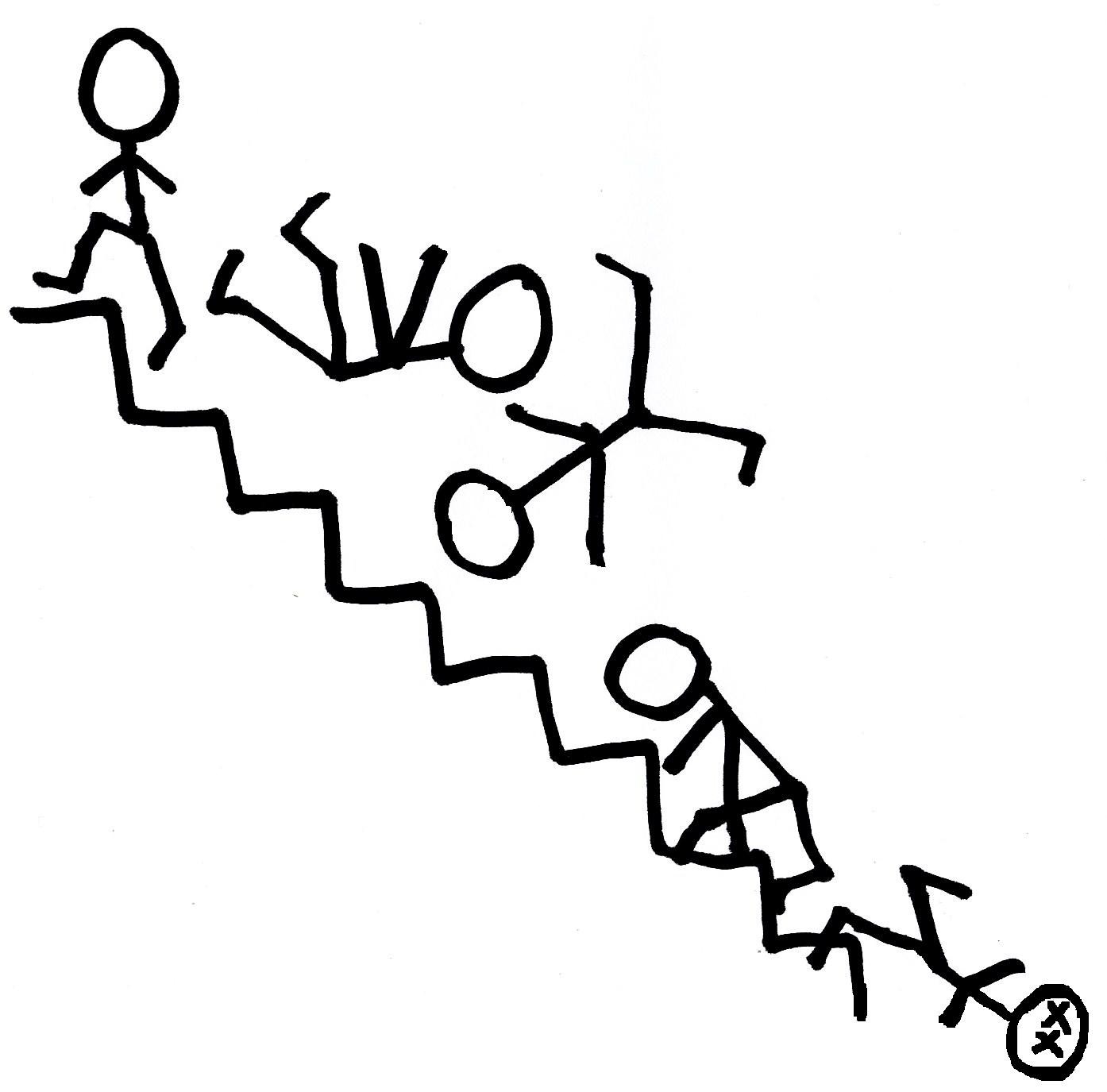
Britnee’s Top 5 Staircase Tumbles

stairs

Who doesn’t love a good tumble down the staircase? They’re just so dramatic and over-the-top! I love them so much that I’ve decided to share my Top 5.

1. Death Becomes Her (1992) – Meryl Streep is better than everyone at everything, even falling down the stairs. Although there is more than one scene where her character, Madeline Ashton, takes a dive down a flight of stairs, the first fall takes the cake.

2. Hush…Hush, Sweet Charlotte (1964) – As Velma Cruther (Agnes Moorehead) is being very vocal about ratting out the film’s antagonist to the sheriff, a chair is smashed over her head and down she goes. Should’ve kept that mouth of yours shut, Velma.

(Note: that tumble takes place @1min30sec in that clip, but there are plenty of other great falls included there as well – even some from this list).

3. Kiss of Death (1947) – Ma Rizzo (Mildred Dunnock) is violently pushed down a stairwell in a poorly- constructed wheelchair. The wheelchair is so crappy that it falls apart before making it to the bottom. That poor “lyin’ old hag!”

4. Maternal Instincts (1996) – “Sorry? It’s too late to be sorry!” Delta Burke’s tumble down a set of industrial steps is the highlight of the film.

5. Fried Green Tomatoes (1991) – Ruth Jamison (Mary-Louise Parker) gets kicked down the stairs by her repulsive husband, and while it’s one of the films saddest moments, never has a fall been so graceful!

-Britnee Lombas

Back Street (1961)

backstreet

fourstar

Based on the 1931 novel by the late, great Fannie Hurst, Back Street is a tragic film about the relationship between a man and his mistress. There are two other versions of this film that I have yet to see, but it’s only a matter of time until I get to the 1932 and 1941 Back Streets. I doubt that they will be able to top the decadent set designs and costumes from renowned designer Jean Louis, but I’m sure each film has an interesting take on this legendary love story.

Rae Smith (Susan Hayward) and Paul Saxon (John Gavin) meet by chance as Saxon is passing through Nebraska on military business, and they fall in love almost instantly. The problem is that Saxon is a married man. Once Smith finds out that he is married, she cuts him off and moves from Nebraska to New York as a form of therapy. She ends up running into him in New York after she has established a career in the fashion design industry. She rejects him once again and shortly thereafter earns an opportunity to move to Rome in order to expand her business. She immediately accepts, mostly because she wants to dismiss all chances of running into Saxon again. Guess whom she runs into in Rome? I swear he’s got some sort of tracking device on her. Once she runs into him, along with his entire family in Rome, she decides to just give in to the affair of her dreams. Of course, this doesn’t last for long and everything starts to fall apart as expected.

What I love most about this film is its ability to keep such a raunchy situation so classy. Their love just feels so authentic, mostly thanks to Hayward. I’m a pretty big fan of John Gavin, but this definitely wasn’t his best performance. He was just this sort of strange statue hanging around the set majority of the time (a very handsome statue at that). However, Hayward was, as always, astounding. Thankfully, the film focused more on her character than Gavin’s. Back Street is a film I watched years ago that I’ve kept on the back burner, but after watching it again recently it’s slowly becoming one of my favorite classics.

-Britnee Lombas

Jack Reacher (2012)

jack reacher

three star

campstamp

Imagine a world without Scientology, a world without Katie Holmes, a world without Oprah’s couch. In this alternate universe Tom Cruise’s decade-old public meltdown never happened. Cruise is still top gun in all of our hearts. Every film he stars in is a major success. Beautiful women throw themselves at his feet. He merely needs to show up & wink at the camera to win us all over and collect his giant paycheck.

This isn’t a world we get to live in all the time, but we are allowed to visit. For instance, last year’s surprisingly entertaining Edge of Tomorrow saw Tom Cruise in full movie star mode, smooching ladies & killing space aliens in a violent version of Groundhog Day. Even Edge of Tomorrow is a little too eccentric to recall vintage Tom Cruise, though. If you’re looking for purely smug, top-of-the-world, Days of Thunder Cruise you have to go back to 2012’s Jack Reacher.

Jack Reacher is a straight-forward Tom Cruise vehicle. It’s not stylish. It’s not cool. It doesn’t pretend to be anything more than it is: a loud & dumb action movie. Think less The Guest and more Face/Off or Road House. Cruise, who of course plays the titular Jack Reacher, is so deliciously full of his smugly sexy self here. He drives maniacally, flirts with co-star Rosamund Pike like she owes him something, has the problem solving skills & inherent knowledge of an omnipotent god, and delivers smartass one-liners before every inevitable kill (those one-liners take a nastily sexist left turn in a particularly anachronistic bar fight scene). If you have any affection or nostalgia for Cruise before Oprah’s couch outed him as a total weirdo, Jack Reacher is a sight for sore eyes.

Bonus Points: All of this Tom Cruise talk is truly burying the lede. The real Jack Reacher story is that auteur director Werner Herzog plays the movie’s villain. Herzog’s role is minimized in the film the same way it’s minimized in this review. He doesn’t appear onscreen until nearly an hour in and delivers maybe one or two speeches, but the potency even a couple lines from Evil Herzog is something to be cherished. If you have no affection for vintage Cruise (or loud, dumb action movies in general) you owe it to yourself to at least watch Evil Werner Herzog perform here in the film’s best two minutes.

–Brandon Ledet

Jack Reacher is currently streaming on Amazon Prime.

Rich Hill (2014)

rich hill

fourhalfstar

“God has to be busy with everyone else. Hopefully he will come into my life. I hope it happens. It’s going to break my heart if it don’t.” – Andrew

Andrew, Harley, and Appachey are teenage boys living well below the poverty line in Rich Hill, Missouri. Population: 1,393. Each boy has their own dreams, but the reality of their grim, rural surroundings severely limits their chances of obtaining them. Andrew, a sweet, hardworking athlete who loves God and his family, shows the most promise of the trio, but is constantly uprooted by his father in the search for steady employment. Then there are Appachey and Harley, whose anger and frustration sometimes lead to darker outlets. Appachey is a skater who wants to teach art in China one day. Rebellious and prone to violence, he lives in dilapidated squalor with his chain smoking mother and sisters and often gets into fights at school with students and administration. He seems irrevocably lost. Harley is funny and good natured but also socially awkward, lethargic, and obsessed with knives. He is taken care of by his grandmother after his mother is imprisoned for trying to kill his step dad, who Harley claims sexually abused him.

There are thousands of cities in America like Rich Hill, with thousands of children like Andrew, Harley, and Appachey. Small, impoverished working class communities where poverty, prison, drug abuse, and violence are the daily norm and hopelessness and lack of opportunity coincide with high school football, church, and 4th of July parades. Directors (and cousins) Tracy Droz Tragos and Andrew Droz Palermo chronicle this bleak slice of Americana with empathy and an open heart. Maybe it’s because the filmmakers are from Rich Hill, but they thankfully do not make this an issue film or a political statement. Instead the film’s focus is squarely on the boys who obviously trusted the filmmakers as they share intimate and painful details of their lives.

Stylistically, the film feels less like a documentary and more like a Terrence Malick film; its poetic realism and evocative score help capture the beauty in these bleak settings. Rich Hill is one of the great modern American documentaries and deserves to be held in the same regard as other modern classics like Hoop Dreams. Sobering, yet ultimately uplifting, it is a hauntingly powerful capsule, a mosaic of the impoverished working class, and a critique of the American Dream.

You can watch Rich Hill right now on PBS.com through Feb. 3, 2015.

-James Cohn

2014’s Doppelgänger Movies & Their Unlikely Doubles

doppelganger

2014 saw the wide release of an unusual bounty of films about doppelgängers. Besides comic book superheroes it had to be the most common cinematic topic of the year. As early as Spring there was a heap of press citing similarities between Enemy & The Double, two doppelgänger movies based on doppelgänger novels both titled The Double (one by José Saramago & one by Fyodor Dostoyevsky). I joked that if they shared a distributor (they don’t) they should be released on home video as a combo pack. It turns out that besides one (admittedly major) detail in premise the two films actually have very little in common. As the year went on I found the true spiritual doppelgängers of Enemy & The Double in highly unlikely places, as well as a few more doppelgänger movies & their own unlikely partners.

Of course there are possible spoilers for all titles listed in bold below.

The Double (2014) & Joe Versus The Volcano (1990)
Although Richard Ayoade’s The Double didn’t deliver the similarities to Enemy that I expected, it wore other, stranger influences on its sleeve. It not only boasted visual cues picked up from David Lynch’s oeuvre, but also intentionally mirrored Terry Gilliam’s Brazil. The Double’s similarities with Brazil are so purposeful Ayoade’s film could be considered a long-form homage. What’s infinitely more surprising to me is the similarities it shares with the Tom Hanks/Meg Ryan comedy Joe Versus The Volcano.

There’s a good deal of humor lurking under the surface of the Lynch & Gilliam influences Ayoade pulls from, but The Double is more of an unambiguous black comedy, its own dark humor resting in plain view. Its sinister amusement with depression & the grim life of an office drone positions it as more of a modern descendent of Joe in terms of genre. The Double’s Jesse Eisenberg’s work life is so surreally awful the only character in cinema I can compare it to is Tom Hanks’ Joe. The set design in both characters’ offices are achievements in over-the-top blandness. They both ache with yearning for coworkers who don’t know they exist. They even both serve clueless megalomaniac bosses portrayed by gifted character actors (Wallace Shawn & Dan Hedeya, respectively).

Admittedly, the resemblance fades after the first half of Joe. When the plot catalyst hits Joe (a life-threatening “brain cloud”) the protagonist gets to escape his oppressive life as a faceless worker & embark on a grand adventure in search of the titular volcano. The Double doesn’t allow its catalyst (a second Jesse Eisenberg, one less akin to George Michael Bluth) to shake things up in the same way. Ayoade instead forces his protagonist to see his grim, thankless life through to a bitter end.

Enemy (2014) & Stranger By The Lake (2014)
James & I once got in a particularly nerdy argument in a dive bar about the merits of Enemy. He was a huge fan of the film (it made his Top Ten list for the year after all), while I found it interesting, but far more self-serious than it needed to be (or maybe than I wanted it to be). Trying to discern what aspect of our personalities split us on the film (probably his love of & my aversion to philosophy), I brought up another recent release we were split on: Stranger By The Lake. In my attempts to defend Stranger in that conversation I noticed a common theme between it & Enemy. Both films feel like cryptic allegories for the dangers of carnal desire.

In an unfairly linear (& likely false) synopsis of Enemy, the protagonist’s libido tempts him to stray from intimacy with his pregnant wife to the point where his personality is split into two dueling halves. This split (again, in a deliberately simple analysis) leads the doppelgänger Jake Gyllenhaals into a deadly world of adultery & spiders. The protagonist in Stranger By The Lake, a man who regularly cruises for sexual activity on a gay nudist beach, feels a similar carnal pull. His two closest relationships, an unlikely friendship with a schlub he finds physically uninteresting but personally magnetic & a sexual affair with a very attractive man he knows to be a murderer, split his time in the same libido-driven downfall that corrupts the Gyllenhaals.

When viewed in a certain context, Enemy & Stranger can be interpreted as spiritual doubles in the parables they tell. Whether you value one over the other or not is, of course, a manner of personal preference.

Coherence (2014) & The One I Love (2014)
Two of 2014’s biggest surprises were the read-too-much-about-them-and-you’ll-ruin-them Coherence & The One I Love. Of the pair, Coherence was more of the critical darling, while The One I Love was more-or-less thought to be an interesting picture that couldn’t stick the landing. Personally, I believe The One I Love to be just as great (if not better) than Coherence. Both films push their supernatural left-turn premises to outlandish places while remaining grounded & emotionally potent. Together they help carve out a modern Romantic Horror genre (within which they’re the tiny indie equivalents to the major studio RomHorror Gone Girl).

Common assumption would suggest that Coherence’s rightful doppelgänger would be a Twilight Zone episode (particularly the classic “The Monsters Are Due On Maple Street”) but it’s inseparable from The One I Love in my mind. This may not be the most surprising pairing on this list, as The One I Love also owes a hefty debt to The Twilight Zone. Enjoyment of both movies is ideally enhanced by an ignorance of their basic plots, something so delicate I fear I’m wrecking it by including them here. They both do a lot with a little, squeezing impressive mileage out of small budgets & a few great actors.

Again, my preferences & James’ were at odds over these titles, as Coherence appeared on his best of the year list & The One I Love appeared on mine. In this case we both liked both movies a good deal, though. There was no nerdy dive bar discussion necessary.

Honeymoon (2014) & Slither (2006)
Speaking of Romantic Horror, the under-the-radar Honeymoon works like Invasion of the Body Snatchers by way of Safety Not Guaranteed. Its calm, pragmatic approach to its supernatural my-wife-is-not-my-wife plot recalls the vibe of Coherence & The One I Love more than any other doppelgänger pairing on this list. All three films make the most extraordinary plots feel like conceivable relationship troubles that every couple goes through from time to time. Honeymoon is not alone in this world & the comparisons to Body Snatchers are especially well deserved, but I found other surprising similarities in the central relationship of James Gunn’s 2006 slapstick horror Slither.

Besides its own debt to Body Snatchers, Slither is wildly different from Honeymoon in tone & intent. Where the escalation in Honeymoon is calm & measured, Slither throws everything (including buckets of viscera) against the wall to see what sticks. However, the gradual escalation of unignorable changes in a spouse’s behavior binds them together. In Slither, the antagonist Grant Grant (played by world-class creep Michael Rooker) initially seems a bit out of it to his wife following an incident in the woods. The changes in his behavior spiral out of control in the most horrifying (and shockingly funny) ways imaginable. Honeymoon’s horror hinges on its own in-the-woods behavior altering event, but the results are decidedly a quieter form of terror, as opposed to Slither’s fever-pitched absurdity.

These movies aren’t broadly linked in their approaches to horror, but instead in the detail of their threats’ gradual revelations to the ones they love.

The Face of Love (2014) & Birth (2004)
The least successful film on this list artistically, The Face of Love attempts the grounded approach to the paranormal Coherence & The One I Love achieve, but ultimately falls short. Despite an interesting premise & some great performances from familiar faces Annette Benning, Ed Harris, and Robin Williams, the film never breaks through the trappings of an undistinguished trifle. Part of the problem is that an eerily similar plot has been executed so well before in Jonathan Glazer’s Birth.

The Face of Love mirrors Birth’s story of a woman who improbably meets her husband after his death, but takes it to less ambiguous, less visually striking territory. It’s not a bad movie exactly, but instead a mediocre version of its superior double. Both movies tackle the grieving process in an unusual manner, but Birth does it better. There are images & moments from Birth that will stick with me my entire life. I expect I’ll forget most of The Face of Love within the month.

It’s a bit unfair to include a movie here only to suggest that there’s a better version of it out there, but in the end it’s the doppelgänger’s job to kill its weaker double. It’s only natural.

-Brandon Ledet