The Meta Experience of Prytania Screening Cinema Paradiso (1989)

paradiso

I was washing dishes this Thursday afternoon when I was unexpectedly alerted that Prytania Theatre was going to screen Cinema Paradiso for free in a half-hour’s time. I dried my hands, crated the dog and sped Uptown just in time to take my seat among the little old biddies and stray college students just before the movie began. With no time for Google or IMDb before I ran out the door, I went into the movie completely blind. All I knew was that it’s one of those foreign titles synonymous with phrases like “Oh man that’s a classic” and “How have you not seen that yet?” Oh man. It was a classic. How had I not seen that yet?

Cinema Paradiso is a movie about movies, cinema about a cinema, art about art. It’s one of those rare films that attempts to provoke every possible response in its viewers (laughter, tears, heartbreak, frustration, unbridled joy) and succeeds consistently. As the audience watches the story young boy grow into an old man, they also watch a history of how audiences have engaged with film over the course of decades. When we watch Cinema Paradiso, we watch the way people watch movies. At the beginning of the film the Cinema Paradiso’s audiences basically riot throughout the pictures. Towards the end they sit in rapt silence.

The audience at Prytania that day was anything but silent. They weren’t the masturbating, shit slinging, drunken near-rioters of Cinema Paradiso, but there was some audible chatter throughout the movie in the seats behind me and a full-on celebration in the lobby that could easily be heard through the dividing curtains. The Prytania was screening free movies that day and was gearing up for an afternoon block party to commemorate its 100th anniversary. As the oldest operating cinema in New Orleans and the only one in its neighborhood, it’s way too easy to draw connections between the Prytania Theatre and the titular Cinema Paradiso. Just as the Cinema Paradiso grows with & serves its Sicilian village, Prytania is a cultural mainstay of Uptown New Orleans. They planned on screening the film a second time later that night at the block party, the same kind of outdoor community screening Alfredo stages in the film.

Before the afternoon screening I attended began, Prytania’s 93 year old operator Rene Brunet told the following anecdote: When the one-screen theatre first ran Cinema Paradiso in 1989 it played for over six weeks, upsetting the locals (presumably the college kids) enough to picket the theatre to finally move on & play another movie. It’s the exact kind of episode that would’ve happened in the film itself, although presumably more tame.

The meta experience doesn’t stop there. When Cinema Paradiso was first released to an American audience, the undisputed king of cinematic self-sabotage Harvey Weinstein cut a full 51 minutes of footage from the Italian original (a tactic he almost repeated with last year’s Snowpiercer). The streamlined cut is the one that played at Prytania this Thursday, but it’s also the one that played in its original extended run at that cinema, as well as the one that earned the Oscar for Best Foreign Film. Oddly enough, Roger Ebert himself contended that the Weinstein cut is “a better film than the longer.” Whether or not that is true, it’s still hilarious to me that drastic edits were made to a film that depicts a priest making drastic edits to other films as one of its thematic lynchpins.

The programming choice to celebrate Prytania’s century long history with Cinema Paradiso was wholly perfect. It was the story of New Orleans’ most significant one-screen cinema examining itself by revisiting the most significant story of a one-screen cinema around. They could’ve played a more tragic (but just as potent) work of cinematic navel-gazing like 1971’s The Last Picture Show or last year’s Life Itself, but that would’ve undermined the reason we were all there: a celebration. Commemorating Prytania’s first 100 years with Paradiso left me with the hope that it will last at least 100 more. There was no  better way possible to celebrate the movies than to watch people watch movies.

-Brandon Ledet

Marks & Smarks: No Holds Barred (1989) & The Wrestler (2008)

wrasslin

Definitions pulled from Wikipedia’s glossary of professional wrestling terms:
-“Mark”: a wrestling fan who enthusiastically believes that professional wrestling is not staged.
-“Smark”: a fan who is aware of and interested in the backstage and non-scripted aspects of wrestling; a portmanteau of “smart” and “mark.”

Last night I attended my first live pro wrestling event, a months-long goal fulfilled. Despite the distinctly tame vibe of the crowd, I decided to misbehave. Couldn’t help myself. I got drunk, cheered for heels like a jerk, and shouted things that disturbed the 10 year old boy sitting in the row ahead of me. A few rows behind me, another ten year old was also yelling ridiculous taunts, but his were much funnier & more insightful than mine. I was thoroughly upstaged. Around a third my age, this kid had a preternatural comprehension of the sport that he thankfully shared with the neighboring crowd in short, high-pitched bursts. The kid ahead of me would be genuinely upset if he were in earshot. I know I upset him myself. I was sandwiched between a young mark and a smark, two different wrestling worlds clashing on either side of me.

I think it helps to appreciate both sides of the coin to experience the full potential of pro wrestling. Losing yourself in the characters & the soap opera drama is just as important as the in-the-ring athleticism. The violence wouldn’t mean as much without the camp. On the other hand, the context of the practical, behind-the-scenes operations of the sport gives deeper meaning to the in-the-ring storylines. It’s a scripted sport, but scripted in the style of reality television: the reality & the fiction are inseparable. One feeds off the other. A well-rounded fan needs a solid admiration of both.

Searching for this balance in pro wrestling cinema leads me to the bookends of the modern wrestling movie. 1989’s Hulk Hogan vehicle No Holds Barred perfectly captures the nature of mark mentality in the infancy of the current Vince McMahon era. 2008’s The Wrestler, by comparison, is a smark’s dream: an authentic look at the brutal truths of pro wrestling as a career. Together, help paint a complete picture, the fiction & the reality, one feeding off the other.

No Holds Barred (1989)
Although No Holds Barred was far from the world’s first pro wrestling picture, it was the first film produced by the World Wrestling Federation (now WWE). It would take over a decade after its release for Vince McMahon’s juggernaut wrestling promotion to form its own movie studio, so in this way No Holds Barred was ahead of its time. This was the only way it was ahead of its time. Miming the late-80s Schwarzenegger action movie format as much as the budget would allow, No Holds Barred was a blatant attempt to launch the movie career of Hulk Hogan, who had already dominated the “sports entertainment” world and was looking for his next conquest. The first sounds you hear in the film are the voices of Jesse “The Body” Ventura & “Mean” Gene Okerlund, who had come to define the era’s ringside announcing. The film’s head villain is character actor Kurt Fuller testing an almost exact prototype of his career-defining role as a television network scumbag in Wayne’s World. No Holds Barred is in every way a product of its time.

Keeping in line with the 1989 perspective of pro wrestling, before the internet’s obsessive nitpicking of the sport, No Holds Barred is firmly on the mark side of the mark/smark divide. Hulk Hogan’s character Rip Thomas is a superhuman beast in the ring and out. He leaps to incredible heights, destroys cars with his bare hands, and dismantles “bad guys” to an 80s “rock music” soundtrack, all while wearing a costume befitting of a superhero biker. In a world devoid of subtext he is a hero without flaw, an incredibly smart brute who’s dedicated to his charity work, the kind of guy who inspires lines like “Rip’s word is his bond” even when he’s not in the room. The entire movie exists to make Hulk Hogan look impossibly good. He’s a saint, a “good guy”.

Objectively, the movie is not very good. In fact, it’s awful. There’s some guilty pleasure to be found in its campy action movie spectacle, like when Rip force-feeds a rejected bribe to Kurt Fuller’s television executive and quips “I won’t be around when this check clears.” It’s also funny to think that Vince McMahon produced a film that indicts the evil nature of megalomaniac network executives, because, well, he’s a megalomaniac network executive. For the most part, though, the movie is shoddily made of generic kids’ stuff: jokes about “dookie” and slobbering hillbillies, world-class mean-mugging from immense muscle men, “good guys” beating up “bad guys”. It’s a movie you have to love for its savage idiocy, not in spite of it.

More importantly, it’s a document of a different time, a swan song for the era of the mark.

The Wrestler (2008)
A drastically different approach, Daren Aronofsky’s The Wrestler is an objectively good movie. I’d even go as far as to call it a masterpiece. Applying the modern online smark mentality to pro wrestling, Aronofsky turns the backstage repercussions of sports entertainment into a Greek tragedy. Unlike Hogan’s Rip Thomas, Mickey Rourke’s Randy “The Ram” Robinson is a real human being outside the ring. Well past his glory days, Randy struggles with health, finances, and personal relationships badly damaged from years spent on the road. In-the-ring injuries have increasingly severe real life consequences. In one particularly gruesome scene medics remove staples, glass, etc. from Randy’s skin as the camera cuts back to show how they got buried there in a horrific hardcore match, a bloodthirsty crowd chanting “You sick fuck!” in the background. As the pain periodically hits him throughout the film, the intense sound design cues you in with high-pitched noises to match his wincing. Referring to himself, Randy “The Ram” says “I’m a broken down piece of meat. And I’m alone. And I deserve to be alone.” Time proves him right. This is far from the marked-out world of Rip Thomas.

Aronofsky’s attention to authenticity is a remarkable achievement here. As I said before in my list of top pro wrestling documentaries, Randy “The Ram” feels like wrestlers we know, wrestlers like Scott Hall & Jake “The Snake” Roberts. Smarks would take particular interest in the way the movie depicts wrestlers planning spots before matches, laying out a basic framework within which they can improvise. The movie also addresses blading/juicing, steroid abuse, boozy bouts of self-medication after matches, shady promoters and minuscule pay. Randy directly refutes claims that wrestling is “fake” and shows off his scars as proof. Part of why it hurts to watch him despair over the old action figures, Nintendo games, and 80s monster ballads that serve as relics of his former fame is that it feels all too real. There are people who live like this.

Of course, an accurate portrayal of pro wrestling is seated somewhere between these two extremes, just as I was seated between two wildly different children last night. Without the glam showmanship, juvenile humor or outrageous superheroics of Rip Thomas, Aronofsky’s version of wrestling is a grim, lethal ordeal. The wrestling of No Holds Barred is an idealistic child’s macho fantasy. From The Wrestler’s viewpoint, it’s more like assisted suicide. To take in the full scope of the bizarre, idiosyncratic, self-contradicting superhero spectacle of the brutal sport, you have to appreciate both perspectives. You have to look through the eyes of the mark and the smark. Drunken yelling also helps.

-Brandon Ledet

“Unedited Footage of a Bear” & The Year of the Doppelgänger

bear

After posting a too-long article trying to make sense out of last year’s surge of doppelgänger movies earlier this week, someone pointed out to me that I missed a major one: “Unedited Footage of a Bear”. “Unedited Footage” is a horror/comedy short from the same Adult Swim Infomercials program that produced the 2014-defining “Too Many Cooks”. (Did I get that song stuck in your head again? I am so sorry.) Where “Cooks” deconstructed an impressive range of television formats and worked them into a singular slasher film, “Unedited Footage” did the same with a much narrower genre: allergy medicine commercials. Using the fine print listed side effects of medication commercials & the intense artificiality of advertising in general to its disturbing advantage, “Unedited Footage” tells a tight, effective horror story in its fleeting ten minutes. A horror story that hinges on 2014’s biggest pet obsession: doppelgängers.

Although it plays on the popular doppelgänger obsession of last year’s features, “Unedited Footage of a Bear” isn’t a feature film itself. It isn’t even unedited footage of a bear. The entire doppelgänger/slasher storyline is framed as a tangent that distracts from the titular bear, but since it eats up all but 30sec of the runtime & the film never returns to the bear, the doppelgänger plot is the bulk of the film in every sense. Although it acts as the initial framing device, the bear is the tangent. The doppelgänger is the heart.

Despite the arrival of “Unedited Footage” at the December finish line & its depiction of a doppelgänger murder story, it’s hard for me to justify an addendum including it on that 2014 list. My intention with the “2014’s Doppelgänger Movies & Their Unlikely Doubles” article was to make sense of last year’s varied approaches to that genre by finding those film’s own doppelgängers in other seemingly unrelated movies. Besides the fact that I honestly forgot about “Unedited Footage” at the time, the problem with including it there is that I can’t think of its own double. I can’t think of another film that allows a single tangent to dominate the narrative in that way. (The only one that really comes to mind is that extended dream sequence towards the end of Romy & Michele’s High School Reunion where Lisa Kudrow’s Michele is sleeping in the passenger seat of a convertible, but believes she has gone into the reunion, expertly schmoozed her old classmates by convincing them that she invented the glue on the back of Post-it notes, fails to drag Mira Sorvino’s Romy away from a make-out session, gets hit by a limo, starts her own make-out session in that limo, loses her blouse, accepts an award in her bra, and grows old & wealthy still disconnected from her best friend before she finally wakes to discover it was all just a dream and she hasn’t even left the car. But that doesn’t even come close, really, because that dream only dominates a few minutes of the movie, which soldiers on after it concludes, the same way this article will soldier on after this tangent concludes. Also, I just saw Romy & Michele for the first time a couple nights ago so that’s totally why it’s fresh in my mind.)

2014 saw an unusual excess of new entries for the doppelgänger genre. The idiosyncratic “Unedited Footage of a Bear” deserves to be remembered among them, if not only because any film featuring an original score & brief cameo by Dan Deacon deserves to be remembered. It’s just unclear to me what the movie’s own doppelgänger in this world is, but I’m sure it’s out there, waiting to murder it. (Unless it actually is Romy & Michele, in which case it’ll most likely take it shopping or force-feed it junk food or make it watch Pretty Woman, like, 36 times, which is its own form of death.) Oh, it’s out there.

-Brandon Ledet

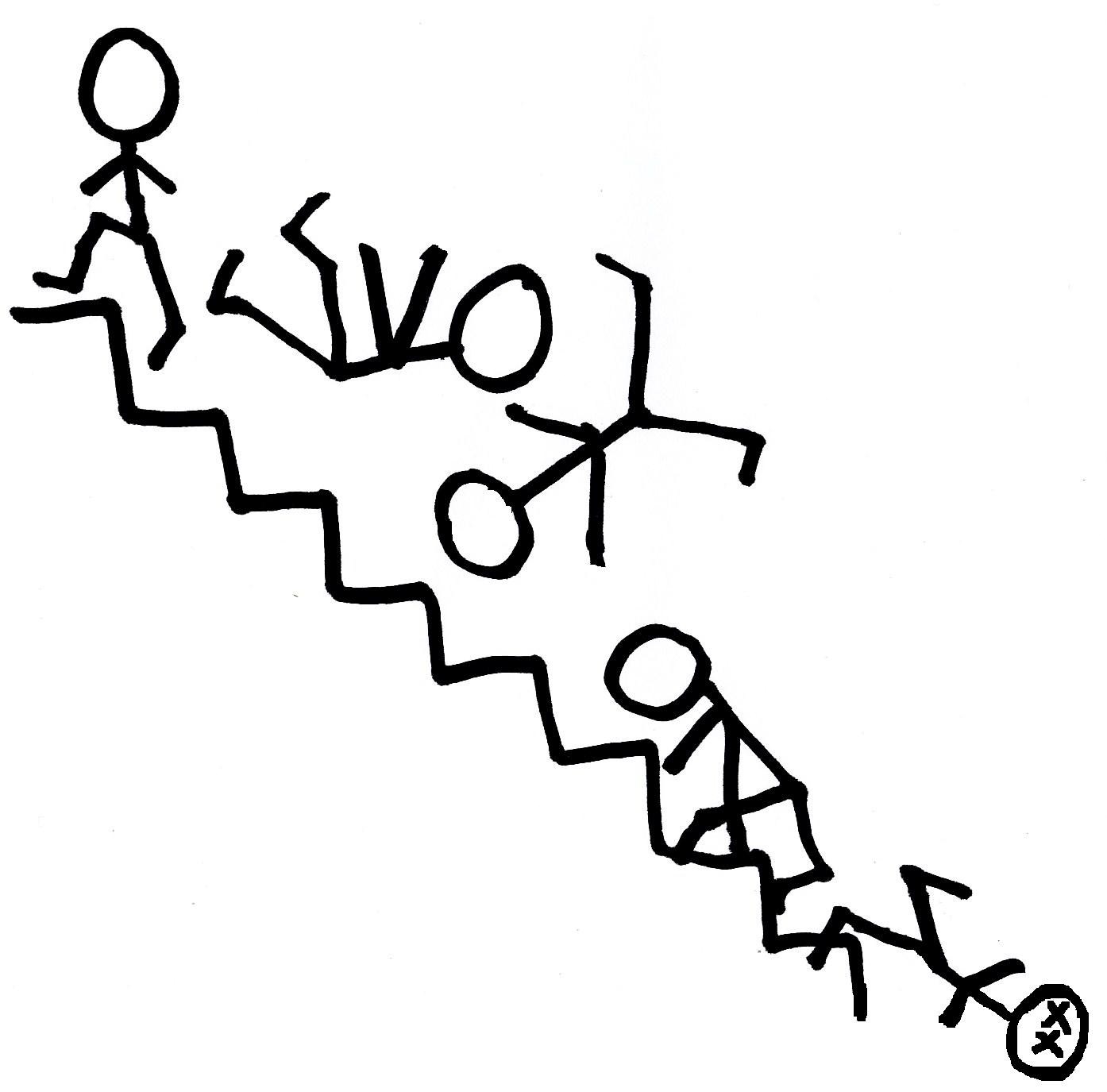
Britnee’s Top 5 Staircase Tumbles

stairs

Who doesn’t love a good tumble down the staircase? They’re just so dramatic and over-the-top! I love them so much that I’ve decided to share my Top 5.

1. Death Becomes Her (1992) – Meryl Streep is better than everyone at everything, even falling down the stairs. Although there is more than one scene where her character, Madeline Ashton, takes a dive down a flight of stairs, the first fall takes the cake.

2. Hush…Hush, Sweet Charlotte (1964) – As Velma Cruther (Agnes Moorehead) is being very vocal about ratting out the film’s antagonist to the sheriff, a chair is smashed over her head and down she goes. Should’ve kept that mouth of yours shut, Velma.

(Note: that tumble takes place @1min30sec in that clip, but there are plenty of other great falls included there as well – even some from this list).

3. Kiss of Death (1947) – Ma Rizzo (Mildred Dunnock) is violently pushed down a stairwell in a poorly- constructed wheelchair. The wheelchair is so crappy that it falls apart before making it to the bottom. That poor “lyin’ old hag!”

4. Maternal Instincts (1996) – “Sorry? It’s too late to be sorry!” Delta Burke’s tumble down a set of industrial steps is the highlight of the film.

5. Fried Green Tomatoes (1991) – Ruth Jamison (Mary-Louise Parker) gets kicked down the stairs by her repulsive husband, and while it’s one of the films saddest moments, never has a fall been so graceful!

-Britnee Lombas

2014’s Doppelgänger Movies & Their Unlikely Doubles

doppelganger

2014 saw the wide release of an unusual bounty of films about doppelgängers. Besides comic book superheroes it had to be the most common cinematic topic of the year. As early as Spring there was a heap of press citing similarities between Enemy & The Double, two doppelgänger movies based on doppelgänger novels both titled The Double (one by José Saramago & one by Fyodor Dostoyevsky). I joked that if they shared a distributor (they don’t) they should be released on home video as a combo pack. It turns out that besides one (admittedly major) detail in premise the two films actually have very little in common. As the year went on I found the true spiritual doppelgängers of Enemy & The Double in highly unlikely places, as well as a few more doppelgänger movies & their own unlikely partners.

Of course there are possible spoilers for all titles listed in bold below.

The Double (2014) & Joe Versus The Volcano (1990)
Although Richard Ayoade’s The Double didn’t deliver the similarities to Enemy that I expected, it wore other, stranger influences on its sleeve. It not only boasted visual cues picked up from David Lynch’s oeuvre, but also intentionally mirrored Terry Gilliam’s Brazil. The Double’s similarities with Brazil are so purposeful Ayoade’s film could be considered a long-form homage. What’s infinitely more surprising to me is the similarities it shares with the Tom Hanks/Meg Ryan comedy Joe Versus The Volcano.

There’s a good deal of humor lurking under the surface of the Lynch & Gilliam influences Ayoade pulls from, but The Double is more of an unambiguous black comedy, its own dark humor resting in plain view. Its sinister amusement with depression & the grim life of an office drone positions it as more of a modern descendent of Joe in terms of genre. The Double’s Jesse Eisenberg’s work life is so surreally awful the only character in cinema I can compare it to is Tom Hanks’ Joe. The set design in both characters’ offices are achievements in over-the-top blandness. They both ache with yearning for coworkers who don’t know they exist. They even both serve clueless megalomaniac bosses portrayed by gifted character actors (Wallace Shawn & Dan Hedeya, respectively).

Admittedly, the resemblance fades after the first half of Joe. When the plot catalyst hits Joe (a life-threatening “brain cloud”) the protagonist gets to escape his oppressive life as a faceless worker & embark on a grand adventure in search of the titular volcano. The Double doesn’t allow its catalyst (a second Jesse Eisenberg, one less akin to George Michael Bluth) to shake things up in the same way. Ayoade instead forces his protagonist to see his grim, thankless life through to a bitter end.

Enemy (2014) & Stranger By The Lake (2014)
James & I once got in a particularly nerdy argument in a dive bar about the merits of Enemy. He was a huge fan of the film (it made his Top Ten list for the year after all), while I found it interesting, but far more self-serious than it needed to be (or maybe than I wanted it to be). Trying to discern what aspect of our personalities split us on the film (probably his love of & my aversion to philosophy), I brought up another recent release we were split on: Stranger By The Lake. In my attempts to defend Stranger in that conversation I noticed a common theme between it & Enemy. Both films feel like cryptic allegories for the dangers of carnal desire.

In an unfairly linear (& likely false) synopsis of Enemy, the protagonist’s libido tempts him to stray from intimacy with his pregnant wife to the point where his personality is split into two dueling halves. This split (again, in a deliberately simple analysis) leads the doppelgänger Jake Gyllenhaals into a deadly world of adultery & spiders. The protagonist in Stranger By The Lake, a man who regularly cruises for sexual activity on a gay nudist beach, feels a similar carnal pull. His two closest relationships, an unlikely friendship with a schlub he finds physically uninteresting but personally magnetic & a sexual affair with a very attractive man he knows to be a murderer, split his time in the same libido-driven downfall that corrupts the Gyllenhaals.

When viewed in a certain context, Enemy & Stranger can be interpreted as spiritual doubles in the parables they tell. Whether you value one over the other or not is, of course, a manner of personal preference.

Coherence (2014) & The One I Love (2014)
Two of 2014’s biggest surprises were the read-too-much-about-them-and-you’ll-ruin-them Coherence & The One I Love. Of the pair, Coherence was more of the critical darling, while The One I Love was more-or-less thought to be an interesting picture that couldn’t stick the landing. Personally, I believe The One I Love to be just as great (if not better) than Coherence. Both films push their supernatural left-turn premises to outlandish places while remaining grounded & emotionally potent. Together they help carve out a modern Romantic Horror genre (within which they’re the tiny indie equivalents to the major studio RomHorror Gone Girl).

Common assumption would suggest that Coherence’s rightful doppelgänger would be a Twilight Zone episode (particularly the classic “The Monsters Are Due On Maple Street”) but it’s inseparable from The One I Love in my mind. This may not be the most surprising pairing on this list, as The One I Love also owes a hefty debt to The Twilight Zone. Enjoyment of both movies is ideally enhanced by an ignorance of their basic plots, something so delicate I fear I’m wrecking it by including them here. They both do a lot with a little, squeezing impressive mileage out of small budgets & a few great actors.

Again, my preferences & James’ were at odds over these titles, as Coherence appeared on his best of the year list & The One I Love appeared on mine. In this case we both liked both movies a good deal, though. There was no nerdy dive bar discussion necessary.

Honeymoon (2014) & Slither (2006)
Speaking of Romantic Horror, the under-the-radar Honeymoon works like Invasion of the Body Snatchers by way of Safety Not Guaranteed. Its calm, pragmatic approach to its supernatural my-wife-is-not-my-wife plot recalls the vibe of Coherence & The One I Love more than any other doppelgänger pairing on this list. All three films make the most extraordinary plots feel like conceivable relationship troubles that every couple goes through from time to time. Honeymoon is not alone in this world & the comparisons to Body Snatchers are especially well deserved, but I found other surprising similarities in the central relationship of James Gunn’s 2006 slapstick horror Slither.

Besides its own debt to Body Snatchers, Slither is wildly different from Honeymoon in tone & intent. Where the escalation in Honeymoon is calm & measured, Slither throws everything (including buckets of viscera) against the wall to see what sticks. However, the gradual escalation of unignorable changes in a spouse’s behavior binds them together. In Slither, the antagonist Grant Grant (played by world-class creep Michael Rooker) initially seems a bit out of it to his wife following an incident in the woods. The changes in his behavior spiral out of control in the most horrifying (and shockingly funny) ways imaginable. Honeymoon’s horror hinges on its own in-the-woods behavior altering event, but the results are decidedly a quieter form of terror, as opposed to Slither’s fever-pitched absurdity.

These movies aren’t broadly linked in their approaches to horror, but instead in the detail of their threats’ gradual revelations to the ones they love.

The Face of Love (2014) & Birth (2004)
The least successful film on this list artistically, The Face of Love attempts the grounded approach to the paranormal Coherence & The One I Love achieve, but ultimately falls short. Despite an interesting premise & some great performances from familiar faces Annette Benning, Ed Harris, and Robin Williams, the film never breaks through the trappings of an undistinguished trifle. Part of the problem is that an eerily similar plot has been executed so well before in Jonathan Glazer’s Birth.

The Face of Love mirrors Birth’s story of a woman who improbably meets her husband after his death, but takes it to less ambiguous, less visually striking territory. It’s not a bad movie exactly, but instead a mediocre version of its superior double. Both movies tackle the grieving process in an unusual manner, but Birth does it better. There are images & moments from Birth that will stick with me my entire life. I expect I’ll forget most of The Face of Love within the month.

It’s a bit unfair to include a movie here only to suggest that there’s a better version of it out there, but in the end it’s the doppelgänger’s job to kill its weaker double. It’s only natural.

-Brandon Ledet

Swampflix’s Top Films of 2014

snopiercershoe

1. Snowpiercer – A high-concept dystopian sci-fi parable, our choice for Movie of the Year is likely to leave you with more questions than answers. However, if you avoid getting wrapped up in the literal mechanics of how its world functions or in its generic political philosophy, there’s an excess of violence, absurdity, and genuine heart bending over backwards to entertain you. It’s a wildly exciting ride for those who stop questioning its methods and instead submit to its charms.

2. The Babadook – The best horror film of 2014 is flooded with genuine scares essential to the genre, but its true threat is more intimate & psychological than what you’d find in a traditional monster movie. The Babadook will linger in your mind for days, months. Maybe forever.

3. Gone Girl – The Lifetime movie this film pretends to be in its first half is merely a cover-up of the excessive, sociopathic spectacle lurking under the surface. Fincher proves again that he can do no wrong.

4. Interstellar – Grand, epic, visually striking. The volume & variety of complaints surrounding this wonderful film has got to be the most hilarious joke of 2014.

5. Blue Ruin – A grim, realistic, edge-of-your-seat revenge thriller that hits familiar beats carved out by directors like Jeff Nichols & The Coen brothers without ever feeling redundant.

6. We Are the Best! – A heartwarming story about three adolescents discovering their inner punks. These kids are the best.

7. Under The Skin – Haunting. Sparse yet loaded with unforgettable images & sounds. Glazer is a genius.

8. The Grand Budapest Hotel – Wes Anderson seems to be testing just how much Wes Anderson people can take with his last couple of features. When he’s working with images this strong & performances as hilarious as Ralph Fiennes’ is here, we can take a lot.

9 The One I Love – A romantic trip into The Twilight Zone that’s both hilarious & thought-provoking. We’re not sure if Romantic Horror is a genre, but this film might qualify if it were.

10. Venus in Fur – Disregarding Polanski’s personal life, you have to give him credit here for turning a delicate premise into such a humorous, sensual, and metatextual success. Venus is brilliantly acted, masterfully escalated, and wonderfully critical of both sex politics & theater as an art form.

HM. Obvious Child – Approaching a sensitive subject from a sincere & deeply empathetic place, this film deserves to be recognized as one of the all-time great romantic comedies. Or at least one of the best in recent memory.

-The Swampflix Crew

Read Britnee’s picks here.
Read James’ picks here.
Read Brandon’s picks here.

Britnee’s Top Films of 2014

hobbit

1. The Hobbit: The Battle of the Five Armies – A magnificent ending to the king of all trilogies (in my opinion). Peter Jackson spends no time pussyfooting around with intricate storylines. Instead, the film jumps right into the action that fans have been anxiously waiting for.

2. Gone Girl – What starts out as a film that would most likely end up on the Lifetime channel turns into a sociopathic extravaganza. The film becomes so extreme that it’s very easy to miss the 5 seconds of fame granted to Ben Affleck’s penis.

3. Veronica Mars – What happened to V. Mars after the much-loved television series came to an end? So many questions that have been sitting in the minds of Marshmallows for years are finally answered with this Kickstarter-funded flick.

4. Into the Woods – This is a film that you will love or despise with every bone in your body. It’s literally a Broadway musical with CGI graphics coming out the wazoo.

5. Maleficent – More like Magnificent! Angelina Jolie was born for this role.

6. August: Osage County – “I really shouldn’t be laughing at this” will be going through your head the entire time. Black comedy at its finest!

7. The Babadook – An intimate, heartfelt horror film that lingers in your mind for days, months, maybe even forever?

8. The One I Love – A romantic episode of The Twilight Zone that offers lots of laughs and food for thought.

9. Snowpiercer – So many questions surround this unsettling dystopian flick, but the answers aren’t served on a silver platter, making this film an engaging experience for all viewers.

10. No Good Deed – Honestly, it’s pretty bad, but at the same time it’s tons of fun!

– Britnee Lombas

Brandon’s Top Ten Pro Wrestling Documentaries

wrasslin

Between a few friends’ recently renewed enthusiasm for professional wrestling & my own recent introduction to the wrestling-heavy comic book series Love & Rockets, something happened in me last September: I started watching again. I’ve easily watched more pro wrestling in the past four months than I have in the last decade. A young fan during the sport’s famed Attitude Era, I lost my enthusiasm sometime in high school, a loss I now regret. Not keeping up with wrestling over the years meant missing out on large doses of my favorite two elements in popular media: camp & violence.

Approaching the sport as an adult, however, camp & violence weren’t entirely enough. I also craved context, something I never questioned as a teen. In addition to the countless matches I’ve watched in recent months, I’ve also been greedily consuming documentaries on the sport. The following list is the most helpful films I’ve found in my search for context. Together, they combine to explain to outsiders just what makes wrestling so fascinating & how it evolved to become the violent, campy spectacle it is today.

1. Beyond the Mat (1999) – Widely considered the Citizen Kane of the genre, Beyond the Mat is more of a love letter to the sport than an objective documentary. The 90s vibe is potent here. Vince McMahon is drunk on the power the Attitude Era has afforded him (a level of power he hadn’t tasted since the 80s). The close friendship detailed between hardcore legends Mick Foley & Terry Funk is movingly sincere. The devastating Jake “The Snake” Roberts scenes could conceivably have been research material for Aronofsky’s masterful film The Wrestler (right down to the troubled relationship with his daughter). The narrator’s urge to explain the basic appeal of a sport he loves, a sport that to many people “isn’t real” feels antiquated, but it’s more than forgivable given the time of production. If you’re looking for a beginner’s guide to appreciating pro wrestling as entertainment, this movie is a great place to start. If you already have any affection for the sport you will still love every minute of it, even when it makes you feel like shit.

2. Hitman Hart: Wrestling With Shadows (1998) – While Beyond the Mat documents the state of pro wrestling at the height of the Attitude Era, Wrestling With Shadows does a fine job of defining exactly what made that specific era so distinct. Wrestling icon Bret Hart struggles within the film to reconcile his own 80s-minded ideals of what the sport should be (especially in how it’s viewed by children) with the extreme late-90s direction it was going. There’s also some essential insight into Bret’s father, Stu Hart’s “The Dungeon” training room and the infamous Montreal Screwjob incident involving Bret. Both topics are interesting in how much the camera reveals as well as what it withholds. Is there more to the story than what we’re told? Hard to tell, but it’s still very informative even when mysterious. Unfortunately, Wrestling With Shadows also boasts the worst soundtrack I’ve ever, ever encountered in a documentary (a depressingly common problem with the genre). It’s a truly laughable distraction in an otherwise entertaining movie.

3. I’m From Hollywood (1989) – Andy Kaufman’s posthumous “documentary” (more of a mockumentary, really) about his wrestling career is unambiguously an angle, a continuation of an in-ring storyline. In the 80’s Kaufman fashioned himself an infamously effective heel by proclaiming himself the Inter-gender Wrestling Champion and challenging women in the audience to step up as his opponents. This escalated to a very public feud with wrestler Jerry “The King” Lawler that both men sold beautifully. It’s both amazing & unsurprising how well pro wrestling fit into Kaufman’s fucking-with-your-reality style of comedy. In its finest moments I’m From Hollywood is a document of how the demented, proto-Tim Heidecker genius Kaufman utilized the sport as a form of high art. It works best when interviewees like Jerry Lawler & the late Robin Williams are committed to the joke, as opposed to folks like Tony Danza who refuse to play along.

4. GLOW: The Story of the Gorgeous Ladies of Wrestling (2012) – A few of the docs on this list play into the self-aggrandizing of wrestling promos that make their subjects sound like The Best Thing Ever. The GLOW documentary excels at this showy brand of self-promotion that’s so inherent to the sport; it really does make GLOW look & sound way better than it could have conceivably been. This makes sense, considering the 80s wrestling company/television show it documents (“the only all-female wrestling show there’s ever been”) was firmly invested in the entertainment end of “sports entertainment”. The Gorgeous Ladies of Wrestling could wrestle, no doubt, but they mostly started as amateurs (hopeful actresses & models) roped into the business in boy-band levels of commercial-minded schemes & manipulation. The story of GLOW is the story of a brief, unlikely cultural phenomenon fueled by 80s glam, over-the-top camp, novelty rapping, and genuine beasts & bad-asses. All of this precious material is backed up by a wealth of televised footage to support the interviews & the best soundtrack of any film on this list (provided by outsider post-punk geniuses ESG).

5. Barbed Wire City: The Unauthorized Story of ECW (2013) – It’s difficult to find a truthful, comprehensive look into the legendary Extreme Championship Wrestling promotion among the various failed attempts. Barbed Wire City is a godsend of a corrective to that problem. Easily the best take on the subject to date, it features interviews from both world-class shit-talker (and morally-questionable businessman) Paul Hayman and the very people he built up & arguably screwed over. Barbed Wire City also postures ECW as the wrestling equivalent of the Roger Corman Film School, where talents would develop ideas & characters in a gritty environment before moving onto the big leagues (to the organization’s demise). It distinguishes itself from other docs in the genre by featuring interviews with old-school ECW fans (including a dorked-out Billy Corgan) who helped make organization special just as much as the performers did. Its actually-listenable post-rock soundtrack also assists in making it a godsend among its peers.

6. The Unreal Story of Professional Wrestling (1999) – A (mildly-condescending) history of old-school “wrasslin”, The Unreal Story explains how pro wrestling adapted from traveling circus to television mainstay. Although Steve Allen’s snarky narration in this TV doc prevents it from achieving the heartfelt love-letter status of Beyond the Mat, it does a great job of giving the evolution of the sport a historical context. My favorite outlandish claim from The Unreal Story is that Egyptian hieroglyphics depicting wrestling came with ancient promos that included insults threatening to make opponents “bleed before the Pharaoh” . . . brother. Not only is this history lesson informative (especially in its profiles of old greats like Gorgeous George & Ricki Starr), but it also offers a strange perspective of a time when 90s media did not know how to handle the Attitude Era’s sudden surge in popularity except to look backwards.

7. Lipstick & Dynamite, Piss & Vinegar: The First Ladies of Wrestling (2004) – A fascinating profile of the pioneer crop of 1950’s women wrestlers, it’s mostly comprised of modern interviews fleshed out with brief clips of televised matches, photographs, stock footage & era-defining television clips from game & variety shows. I’ve seen a few lackluster wrestling documentaries that are put together this way, but Lipstick avoids mediocrity by giving a mic to women who rarely get to speak at length & covering a subject that rarely gets its due time in the spotlight. It also serves as an interesting account of how pro wrestling evolved from the traveling carnival circuit to television, making it a sort of companion piece to The Unreal Story. At the very least, it’s like spending 90min kicking back a six-pack with the world’s coolest, most foul-mouthed old biddies.

8. Scott Hall: The Wrestler (2011) – A 20min ESPN short recommended for those who aren’t depressed enough by Jake “The Snake” Roberts’ story arc in Beyond the Mat. Documenting “Razor Ramon”/Scott Hall’s struggles with substance abuse, his own role as an absent father and the damage pro wrestling has inflicted on his body & his mind, the intimacy of this movie will destroy you. For folks seeking fame & recognition within pro wrestling, this doc should serve as a reminder to take care of themselves in the process.

9. MTV’s True Life: I’m A Pro Wrestler (1999) – This trifle boasts some valuable locker-room footage from the Attitude Era that serves as a strange time capsule of both a period when wrestling was a white-hot commodity and when performers Chyna & HHH were white-hot romantically. Most importantly, though, there’s some essential insight into the toll the training process can take on a fresh body as well as the dedication it takes to survive that toll. The short-form doc is a tryptic depicting life before, during, and after pro wrestling fame, a surprisingly balanced & thoughtful approach, considering it’s an MTV production.

10. Pinfall (2011) – An even more focused look at the pro wrestling training process than the True Life episode mentioned above, this small-scale short follows British wrestling fan & amateur filmmaker Adam Pacitti as he attempts to train for a wrestling match in just one month’s time. Pacitti initially enters the process with the wrong mentality & wrong physicality (especially in regards to his belief that he could properly train within a month) and is relentlessly punished for his naivety. In its most valuable contributions to the genre, the film offers both a unique look at the exact training patterns new wrestlers must follow as well as the disconnect between the hubris of what a fan believes they can accomplish in the ring & the harsh realities of a sport outsiders don’t believe to be “real” at all.

-Brandon Ledet

James’ Top Films of 2014

EPSON MFP image
1. Metalhead – A touching portrait of grief and loss, this Icelandic gem perfectly encapsulates the power of heavy metal as a cathartic and life affirming force. A beautiful story beautifully told. Two devil horns way up. \m/

2. Snowpiercer – A high concept dystopian parable with tons of action and violence, but most importantly heart. One hell of a ride.

3. Blue Ruin – A grim revenge thriller that will have you on the edge of your seat.

4. Whiplash – One of the greatest movies about the ambition it takes to be an elite musician. Look out for J.K. Simmons in a tour de force performance.

5. Enemy – A tense psychological puzzle that demands multiple viewings. Oh, and that ending!

6. Gone Girl – David Fincher proves again that he can do no wrong.

7. We Are the Best! – Heartwarming story about three adolescents discovering their inner punks. Have your tissues handy.

8. Venus in Fur – Despite your thoughts on the man, this is Polanski in high form. Brilliantly acted. Provocative.

9. Interstellar – Grand, epic, visually striking.

10. Coherence – A trippy, Twilight Zone-esque mind bender that uses its low budget to its advantage.

11. Obvious Child – One of the best romantic comedies in recent memory, Obvious Child approaches a serious issue with empathy and sincerity.

12. Cheap Thrills – This pitch black comedy works as a twisted satire, but also can also be enjoyed solely for its visceral game of one-upmanship.

13. Locke – A case study in less-is-more filmmaking. Tom Hardy gives a great performance in this taut thriller that elevates a simple premise of a man in his car (on the worst day of his life) to operatic heights.

14. Journey to the West – No other movie this year made me smile as much as this one. Healthy doses of ridiculous slapstick with elaborate set pieces. This is must-see viewing for fans of Kung Fu Hustle.

15. The Babadook – A psychological horror film with heart and plenty of genuine scares. Best horror film of 2014.

HM. The Grand Budapest Hotel & Under the Skin – Honorable mention to two films that may not have cracked my top 15 but their strong images are still embedded in my memory (especially a remarkable scene in Under The Skin involving a disfigured man).

-James Cohn

Brandon’s Top Films of 2014

top2014

1. Interstellar – The volume & variety of complaints surrounding this wonderful film has got to be the most hilarious joke of 2014. The score was beautiful, the recorded messages scene was a soul crusher, and the goofy back end felt like trashy, old-school sci-fi serials in the best way.

2. Snowpiercer – Deliciously excessive, hilariously absurd, cartoonishly violent. The half-baked political philosophy is mostly inconsequential, placing the movie in a long line of vague haves-vs-have-nots dystopian sci-fi whose world-building is entirely purposed for a badassery delivery system. It delivers. Just don’t take it too seriously.

3. The Guest – A John Carpenter throwback where the villain’s mask is a handsome smile. It’s packed with enough humor, cruelty, synths, blood, smoke machines & genre-bending to entertain/seduce/corrupt the whole family.

4. Wetlands – Most likely the cutest movie about an anal fissure you’ll ever see. It was a good year for weird rom-coms and this one gets huge bonus points for managing to stick to the format while plunging into de Sade levels of depravity.

5. Under The Skin – Haunting. Sparse yet loaded with unforgettable images & sounds. Glazer is a genius.

6. The Grand Budapest Hotel – Wes Anderson seems to be testing just how much Wes Anderson people can take with his last couple of features. I can take a lot, especially with performances as hilarious as Ralph Fiennes is here.

7. We Are The Best! – Those kids are the best.

8. The Babadook – Approaching this horror flick as a traditional creature feature is a huge mistake. The real threat is psychological and way more disturbing for it.

9. Blue Ruin – A realistic thriller that hits familiar beats carved out by people like Jeff Nichols & The Coen Bros without feeling at all redundant.

10. The Strange Color of Your Body’s Tears – The kaleidoscopic imagery & sound design are as intense as anything you’d expect from a Lynch, Jodorowsky, Argento, Glazer or Carruth. It was like if Under The Skin didn’t let every striking image bleed out, but instead threw a new one at you every few seconds.

HM. The One I Love, Frank, Obvious Child, Venus In Fir, Life After Beth – All five of these titles turned the most delicate of premises that could have turned into cutesy, winking indie trifles into refreshingly earnest/honest discourse. They’re all really good & totally worthwhile even if they aren’t The Best Thing EVER.

-Brandon Ledet