I never engaged much with the Harry Potter movies as they rolled out throughout the aughts, but from what I remember glimpsing in Dear Reader, Wizard People, Daniel Radcliffe was not an especially talented child actor. I couldn’t hear Radcliffe’s pipsqueak line-readings over the drunken growls of Brad Neely’s alternate narration track, but I distinctly remember him having a dazed, deer-in-headlights look in Wizard People that suggested even he didn’t know why he was helming the blockbuster franchise. It’s incredible, then, that Radcliffe was able to turn that early windfall into what’s now a decades-running acting career instead of just a passive, eternal source of royalty checks. What’s even more incredible is just how weird he’s committed to making that career. Radcliffe continually chooses projects where he gets to play absolute freaks: Dr. Frankenstein’s groveling hunchback lab assistant (and possible boyfriend), a computer nerd with guns surgically bolted to his hands, a farting corpse with a magical boner, any role he can land to distance himself from his association with Harry Potter – efforts I am cruelly undermining here. Much like the kids who headlined the Twilight series, Radcliffe has put his blockbuster blood money to great use in the years since he broke free. Only, while RPat & KStew are chasing high-brow critical prestige, Radcliffe is out there determined to be seen as the biggest weirdo to grace the screen since Nic Cage screeched about the bees. It’s been a truly magical transformation.
Radcliffe’s determination to let his freak flag fly recently reached its highest fever pitch in the Funny or Die sketch turned Roku Channel Original Weird: The Al Yankovic Story. Weird is a mock biopic that sensationalizes the notoriously squeaky-clean polka musician Weird Al’s life to match the more traditional rock ‘n roll hedonism of his MTV-era colleagues, complete with Dr. Demento scouting talent at the local biker bar and Al’s father forbidding him to play “the devil’s squeezebox.” It’s a single-joke premise that might feel a little redundant for anyone who’s already seen similar music industry parodies like Walk Hard & Popstar: Never Stop Never Stopping, but its single joke is still—importantly—very funny. Weird is the kind of comedy nerd’s comedy where every character introduction has you muttering “Oh, that’s good casting” under your breath. It’s Radcliffe’s casting that really makes the film special, though. As much as the purpose of Weird is to contextualize Al Yankovic as an essential American pop culture icon—alongside fellow greats like Madonna, Elvira, Pee-wee, and Divine—it also completes the mission of contextualizing Daniel Radcliffe as a true weirdo himself (although a Brit). Radcliffe commits to the bit with full fervor, playing the raw, scuzzy, self-destructive sexuality of Weird Al as if he were starring in an Iggy Pop biopic instead, strengthening the over-the-top absurdism of the film’s only joke by playing it with a straight face unseen in the genre since Leslie Nielsen passed. Radcliffe has played much weirder characters than Al in the past—the titular Swiss Army Man chief among them—but I’m not sure he’s ever done so more convincingly.
Things weren’t always this way. A decade before The Al Yankovic Story, Radcliffe’s career appeared to be taking a much more pedestrian leading-man path, starting with the 2012 adaptation of The Woman in Black. A comeback production for the legendary Gothic horror studio Hammer, The Woman in Black is super scary, both as a traditional ghost story and as a worst-case-scenario vision of Radcliffe’s potential career as a bland leading man instead of an eccentric weirdo millionaire. Both Hammer and Radcliffe had a lot to prove in the otherwise low-stakes, low-profile production, and only Hammer scored high in that gamble. In its story of a vengeful ghost who targets rural village children, Hammer was able to prove they were ready to produce well-balanced, traditionalist ghost stories again – offering a mix of shameless jump scares and long stretches of atmospheric quiet where all of the spookery lingers in backgrounds, mirrors, and mist. It’s not an especially shocking nor inventive horror film, but it is an efficient & effective one, where every adaptive choice helps amplify its eerie scares . . . except for Radcliffe’s casting as the lead. Much like in the early Harry Potter films, Radcliffe is just kinda there. He’d be easily replaceable as the film’s lead if it weren’t for his box-office draw as a recognizable name on the poster, which would only lead to diminishing returns if his career continued down that path (especially as the Harry Potter franchise sunk further into the toxic muck of TERFdom). The Woman in Black was marketed as Radcliffe’s debut as a serious adult actor, a legitimate talent with real staying power beyond the franchise that made him famous as a tyke. Instead, he comes across as just some guy, totally replaceable by any number of BBC repertory players.
The curious thing here is that The Woman in Black is a much better movie than Weird; it’s just not a better Daniel Radcliffe Movie. I would much rather live in a world where Radcliffe is a walking, talking Nic Cagian meme than one where he’s a competent but unnoticeable leading man. Looking back at the ten years between The Woman in Black and Weird, it appears that Radcliffe also wants to live in that world. He’s a genuine weirdo, and I think that’s beautiful.
Spending the holidays with family was a healthy shake-up for me after a couple years of COVID-related isolation, which only compounded my usual, longstanding reluctance to travel to rural & suburban Louisiana. Getting outside the city meant getting outside my bubble, and I talked to a few distant loved ones about movies without being able to cite relatively popular artists like Bergman, Lynch, and Cronenberg as household names. Meanwhile, actual household name Steven Spielberg’s magic-of-the-movies memoir The Fabelmans was being categorized as elitist snobbery for Julliard graduates on Twitter, and every movie without a blue space alien in it was drowning at the box office. And if you count cameos, at least one movie with a blue space alien was drowning too. Damien Chazelle’s Babylon sank while James Cameron’s Avatar sequel soared, and it was impossible not to fret over the two films’ disparate levels of success, since the madman Chazelle dared to include a few frames of Cameron’s Na’vi creatures in his film’s climactic Movies-Through-The-Years montage. The financial failure of Chazelle’s star-studded movie industry drama sounds surprising in the abstract, but after a few days of talking about movies with people who don’t often Talk About Movies it makes total sense to me. Caring about the craft & history of cinema as an artform is a niche interest, even when the cinema itself is populist media. The thing is that Babylon is explicitly about that exact disconnect: the horrifying gap between how much general audiences love to be entertained by The Movies and how indifferent those audiences are to the lives & wellbeing of the people who make them.
The obvious reasons for Babylon‘s financial failure extend far beyond expectations that general audiences would share its nerdy academic interest in the century-old history of pre-Code Hollywood moviemaking. If anything, Chazelle’s $80mil flop is most impressive in how eager it is to alienate its audience, regardless of its movie-nerd subject matter. It’s a three-hour, coke-fueled montage on double-speed that not only indicts the unwashed masses for our indifference to the artistry behind our favorite movies but also assaults our eyes with every fluid the human body can produce. Piss, shit, tears, blood, puke, and cum all dutifully grace the screen in their own time, with the piss & shit ticked off the checklist early on to help set the tone. Modern-day movie stars Brad Pitt & Margot Robbie suffer the same rough transition from silents to talkies that has been mythologized as the downfall of Early Hollywood since as far back as 1952’s Singin’ in the Rain. Only, their backstage debauchery between productions is cranked to a year-round Mardi Gras bacchanal never before depicted with so much onscreen hedonistic excess. It’s enough to make you want to puke yourself, if not only from the carsick momentum of the film’s manic pacing, which rarely slows down from its intercutting dialogue barrages to stage a genuine scene of real-time drama.
Because its characters are more symbolic than dramatic (directly recalling past industry castoffs like Clara Bow, Louis Armstrong, and Anna Mae Wong), Babylon is often more interesting for what it’s trying to say on a big-picture scale than it is for its scene-to-scene drama. I was particularly struck by the way its repetition of Singin’ in the Rain‘s talkies-downfall plot is directly acknowledged in the text, with Babylon consciously positioning itself as yet another example of Hollywood’s cyclical, self-cannibalizing nature. When most movies cite the magic of cinema being greater and more enduring than the people who make it, it’s coming from a place of awe & respect for the artform. Here, Chazelle projects pure disgust & horror. In its mission-statement climax, our low-level-fixer-turned-high-level producer POV character Manny (Diego Calva) watches caricatures of his dead friends & colleagues mocked as comic archetypes at a screening of Singin’ in the Rain, then slips into a subliminal montage of the next 100 years of Hollywood-spectacle filmmaking, with each successive title—Un Chien Andelou, The Wizard of Oz, 2001, Jurassic Park, Terminator 2, Avatar, etc.—building on and borrowing from the past for its own in-the-moment splendor until there’s no splendor left to go around. Chazelle even shamelessly participates in this ritual himself, as Babylon can easily be passed off a cruder, shallower Hail, Caesar! crammed into a Boogie Nights-shaped box. It’s an ungenerous reading of how cinema perpetually “borrows” from itself in a way that feels like homage but rarely acknowledges or takes care of the real-life people who built its founding texts. And when Manny snaps out of it to gawk at the uncaring, unknowledgeable audience cackling at ghosts of his loved ones, the tragedy of his cruelly perpetual industry hits way harder than any of the character deaths that sparked his melancholy in the first place.
I was most impressed with Babylon in its scale and in its eagerness to alienate casual moviegoing audiences. It likely would have been better received if it were a 10-hour miniseries that allowed each of its overlapping character arcs to breathe (especially since it already intercuts their stories like a long-running soap opera anyway), but its manic tempo is exactly what makes it special among the million other movies about The Movies, so it was probably better off flopping than capitulating. I also love that Chazelle projects such a sour view of moviemaking as an artform, a compulsory practice he immediately likens to dragging a diarrheal elephant uphill. The only reason I don’t fully love this movie is I can’t shake the feeling that I’ve already seen it all before (even if at half-time pace), but that kind of complaint only plays into exactly what Chazelle is trying to say about Hollywood’s cyclical history here. Even his climactic montage’s assertion that cinema has already reached its end—a death knell also sounded by the hundreds of click-bait articles that auto-populate every time a major production like Babylon flops—feels like a self-cannibalizing repetition of Hollywood lore. How many times has cinema already “died”? Did it die when the talkies ended the silent era, when television became affordable, when television went prestige, when normies began to stream? Every generation thinks they’re going to be the last, and although one day they’ll be proven right, the cinemapocalypse has yet to fully come to fruition. In the meantime, artists can only watch in horror as their work and their peers are absorbed, digested, and regurgitated by subsequent art movements they do not understand, with no wide audience recognition for how they contributed to that greater continuum. Even the populist Spielbergs of the industry become historical, esoteric references in the long run, and there will come a time when Chazelle’s own name is synonymous with The Russo Brothers, Kevin Feige, and Michael Bay as dusty antiques only of interest to high-brow academics.
M3GAN is the best horror movie of the year! I know it’s only the eighth day of the year so far as of this writing (I hope you’re all enjoying your king cake and that you all waited until this weekend to do so, since not waiting until after Twelfth Night is the reason we’re all cursed), and I’m sure a hundred other hacks have already made the same joke, but who am I to mess with the formula? After all, if it isn’t broke, don’t fix it. Right?
Four years ago, Child’s Play creator Don Mancini was on the Post Mortem podcast and confirmed what many had assumed for years: that the film that introduced us to the pre-eminent killer doll, Chucky, was a critique of consumerism. “Because of my exposure to the world of advertising and marketing through my dad,” he said, referencing his father’s pharmaceutical work, “I was very aware from an early age of the cynicism inherent in that world, particularly selling products to children. Madison Avenue refers to children as ‘consumer trainees’ and I discovered that as a child. I thought, I wanted to write a dark satire about how advertising affects children.” Many of those anti-consumerism elements were excised from the final product following editing and collaboration with John Lafia, but they’re not removed completely: the original Good Guys doll that is inhabited by the dark soul of a serial killer is still very clearly inspired by both Cabbage Patch and My Buddy dolls of the 1980s, up to and including the insidious nature of advertising directly to children through animated programming as seen in the Good Guys cartoon that Andy watches in the first film. By Child’s Play 3, toy company exec Sullivan (previously introduced in the second film) is expressing, verbatim, the things that Mancini quotes real life movers and shakers at the cathedrals of capital, saying “And what are children after all, but consumer trainees?”
Smartly, M3GAN initially seems to be coming at the “killer toy” plot from a similar angle, and although the corporate greed of toy companies remains relevant throughout (Ronny Chieng’s upper management character David Lin at one point expressed excitement at the prospect of the M3GAN toy finally letting their company, Funki, “kick Hasbro in the dick”), the story quickly becomes less about consumerism than it is about letting technology be your kids’ babysitter, or parent. The film opens with an advertisement for the “Purrpetual Petz,” in which a child mourns the loss of her dog but whose spirits lift immensely upon receipt of her new best friend, a giant fuzzy triangle that’s somewhere on the scale between a squishmallow and a Furby, with funny/scary human teeth for some reason, and which is capable of “defecating” little bits of scat if overfed (via the interactive app). We zoom out on said app to find Cady (Violet McGraw) feeding her Purrpetual Pet on a tablet in the backseat of her parents’ SUV, en route to a ski vacation that never comes, as the vehicle is violently smashed by a snow truck. Elsewhere, her Aunt Gemma (Allison Williams) is hard at work at Funki, the makers of Purrpetual Petz, along with her assistants Tess (Jen Van Epps) and Cole (Brian Jordan Alvarez). Her boss David (Chieng) is riding her hard to churn out a prototype for a less expensive version of the Petz line since their competitor has launched a knock-off version at $50, half the price of at Purr Pet; his sycophantic assistant Kurt (Stephane Garneau-Monten) constantly at his side. When David catches Gemma working on her pet (no pun intended) project, a Model 3 Generation Android nicknamed “M3GAN” instead of her assigned work, he puts her on notice, moments before she gets the call from the hospital where Cady is being treated, the lone survivor of the car crash. Gemma finds herself having trouble interacting with Cady, as her gorgeous mid-century modern house is a mixture of that era of furniture style with the sort of home personal assistant gadgetry that many people who are less paranoid than I am have in their houses. Gemma’s toy robot collection isn’t for playing, it’s for observing, and when Cady asks her to read her a bedtime story, Gemma has no books that might interest the nine-year-old and has to go searching for one on an app, which then has to update.
This is the meat of the film’s larger techno-hesitant themes; it’s not anti-technology per se, but it is invested in highlighting the ways that we let software and the expectation of instant gratification take on a huge role in our lives, to the point of supplanting our actual relationships. We’ve all seen it. Less than 48 hours before my viewing of the film, I went out Friday evening to a restaurant happy hour with the same friend who went with me to see M3GAN, and there was a mother-and-son duo seated near us who caught my friend’s attention, as the woman first tried to engage her young son in conversation before finally giving up and letting him have his device, and she herself got involved with something on her phone. My dinner companion noted that the kid was playing some video on his small tablet but wasn’t even watching it, as it sat in his lap while he ate with his headphones in. So often, when we see this thing play out in movies, it’s often a condemnation of the young, how they don’t have any attention span because of TikTok or how Gen Z is doing blah blah blah now that enough of them have come of age to become the new political scapegoats after we Millennials destroyed the diamond industry and somehow caused the downfall of the West because of avocado toast. M3GAN is acutely aware that this is a problem across all generations, and that the young aren’t to blame for the fact that algorithms are created to entrap them before they’re old enough to have the understanding of how they’re being psychologically manipulated, whether it’s Cady here or Andy in Child’s Play. Before their deaths, Cady’s parents discuss screen time, and how many hours a day Cady is allowed to interact with her device; later, it’s Gemma who is so caught up in staring at her phone that she doesn’t notice that Cady is eating her breakfast in silence and waiting for her aunt to talk to her, and when she encourages Cady to play with her tablet while the older woman puts time in on her work project, Cady asks how long she is allowed to do so before she has to turn it off, and Gemma is caught off guard by the notion that limiting screen time is something that parents even have to do.
For as long as I can remember, there’s been much ado about the effects of using TV as a babysitter. Won’t someone please think of the children? What long term psychological damage will little Johnny endure if he watches reruns of Growing Pains every day after school while one or more parents decompresses from the stresses of work? Is there maybe too much Tinkerbell content available on demand, and is it the worst thing in the world to let little Jenny absorb it for a few hours while dinner is prepared, now that she’s too squirmy to sit in the kitchen and watch how the sausage gets made? But none of us were really prepared for the way that video apps (especially ones with short-form content that consistently and continuously releases dopamine in the lizard parts of the brain) and constant connectivity were going to rock our world. I’m not just saying that because I’m Abe Simpson in that evergreen “Old Man Yells At Cloud” meme; I’m of the generation that were children when 9/11 happened and watched how every adult in the world lost their mind in a jingoistic fervor that, coupled with unfiltered access to constant one-sided news rhetoric, means we all have to monitor our parents’ social media as well just to make sure they don’t all start agreeing with Andrew Tate and Kanye West. Unfortunately, when this sort of presents itself in media, it’s often a very shallow, surface-level critique because, as Audre Lorde writes, “The master’s tools will never dismantle the master’s house,” and the same corporations that are causing and have caused reckless and irreparable damage to our society (and, if we’re being completely honest, to the fabric of democracy) are necessary tools of the same megacorporations that produce the content that we consume, so Disney can never really take the piss out of Twitter because that’s where all their megafans live and their engagement is driven.
M3GAN sidesteps this by not being “about” social media, or even “about” the so-called evils of technology. It’s about what happens when the responsibility of guardianship is overlooked, and it does so without shifting blame to the people who are the victims: the kids. There’s a lovely little visual storytelling beat in the aforementioned scene in which Gemma asks Cady over breakfast to entertain herself for a while; she promises that she won’t be more than a few hours, but we cut immediately to an establishing shot of the house, where night has fallen, signalling that Gemma has been caught up in her work all day. It’s not Gemma who suddenly realizes that she never made lunch or dinner that initiates the next scene, it’s Cady peeking into Gemma’s office and the latter making the connection that she’s been in her workshop all day with no regard for Cady’s well-being or engagement. That Cady has taken the time that she was alone and used it not to sit around and waste the day watching videos or playing one of the millions of Candy Crush derivatives that are out there these days but instead to draw is telling: children need more than just to be set up with a device all day, and it’s foreshadowing that M3GAN, for as much as she seems to be the perfect toy and friend, is never going to be able to replace real social interaction for Cady, even if the algorithms that drive her machine learning (like the algorithms that drive the online content that all of us consume) are working hard to replace all other areas of her life. Late in the film, the psychologist assigned to ensure that Gemma is capable of taking care of Cady (Amy Usherwood) has a discussion with the former, warning her that the kinds of connections that, according to attachment theory, children need. She warns Gemma that allowing Cady to invest so much time in M3GAN could consequently lead Cady to develop emotional bonds that will end tragically, one way or another.
All of this probably makes it seem like the film is super serious, but it’s not; it’s actually very funny. It wasn’t until after the viewing that I realized the director, Gerard Johnstone, was also the man behind Housebound, a film we loved so much that we made it into content for Swampflix twice: first with a very positive 2015 review and again five years later as the topic on one of our earliest episodes of the Lagniappe podcast. That actually explains the comedic sensibility; it’s not omnipresent, but it’s almost funnier that the jokes are paced with some distance between them, allowing them to break the tension when they reappear, and the emotional whiplash of it all is part of the fun. There are two perfectly attuned parodies of children’s commercials that appear in close proximity to each other, and although they’re probably more like the advertisements of the late-nineties to early-aughts than those of the present, that makes them familiar and charming to most of the intended audience. The first is the aforementioned Purrpetual Petz ad, and the second is an advertisement for the competing knock-off, which forsakes the pooping feature for a light-up butt that tells you the creature’s mood. Both have the energy of that Kooshlings commercial meets the one for Baby Uh-Oh with the one for Baby Rollerblade mixed in for good measure. Directly between them rests the scene depicting the harrowing death of Cady’s parents, which is fraught with tension throughout. They’re spread a bit further out than they were in Housebound, but they’re just as effective.
If I have one complaint, it’s that M3GAN is a little restrained with its violence in certain places. The final confrontation is as good as it gets at this level, with some real peril for a child, which always ramps up the tension. The kills get gorier as the film goes on, but it feels like it could have cut loose sooner and with more oomph, but that’s not the end of the world. It’s a worthy entry in the killer doll canon even if it decides to be demure and understated in certain places.
When Nope was announced earlier this year, Brandon reached out to ask if I wanted to do coverage of it and, of course, my answer was “Yes.” Get Out was my top film of 2017, and I was passionate about giving Usa five star review in 2019. The only issue was that, when Nope came out in mid-July, I was going through a pretty rough, prolonged breakup. I missed the screenings they were holding at the drive-in and wanted to see it so badly that when a copy proverbially fell off the proverbial back of a proverbial truck, I immediately watched it, but not without some difficulty. The audio quality was awful, so much so that some of the dialogue was virtually inaudible, and the video cohesion also suffered, especially in the night scenes. I was lucky to have a friend over watching it who had seen the film in theaters, so she was able to describe what was happening at times when the truck-fallen video didn’t have the resolution to speak for itself (most notably in scenes with Jean Jacket). And so when people asked if I had seen it, I said “Yes,” but for a long time, I hadn’t really. If anything, I had seen a bunch of shadows on a cave wall. But all that has changed, and although as I sit here on the first day of the new year fulfilling a very late promise, I’ve seen the real deal, and I can’t go back to the cave.
Nope largely takes place on the Haywood Hollywood Horse Ranch, a legacy and a legend which has passed the prime of its life. Otis Haywood Jr., or “OJ” (Daniel Kaluuya) has recently taken over the business from his father Otis Senior (Keith David), who was killed in a freak accident some six months prior when pieces of metal fell from the sky, supposedly from a plane. The horse that was being trained under the path of the inexplicable event had a key embedded in its flank, while Otis Senior somehow ended up with a nickel embedded in his brain through his eye. OJ inherited the gift of horse training from his father but lacks the elder man’s interpersonal abilities on the micro and macro levels, being unable to work a crowd as his father did but also failing to communicate with others on a day-to-day level without a high dose of awkwardness. All the social skills went to his younger sister, Emerald “Em” (Keke Palmer), a fast-talking, wise-cracking whirlwind who never stops hustling, much to OJ’s chagrin. We see this from one of the film’s earliest scenes, in which OJ begins to recite the rote speech that was no doubt his father’s, about their family’s descent from the Bahamian jockey who appeared inHorse in Motion, what is generally considered to be the first motion picture, and how they are keeping that tradition alive by continuing to train horses for film. OJ is hesitant, stumbling over his words, until Em appears and delivers the spiel with style and aplomb. When she wanders off during the actual screen test and the movie crew fails to heed OJ, causing the horse to act out in a way that costs them the job, we have the perfect vision of how the two siblings function as a team, two halves of a whole that only works when they are together. The two other major players in the film are Ricky “Jupe” Park (Steven Yeun), a former child star who experienced a harrowing and traumatic tragedy on the set of a gimmick 90s sitcom, and Angel Torres (Brandon Perea), a peroxide-highlighted electronics store employee who gets wrapped up in the Haywoods’ lives after he becomes suspicious while installing cameras and other monitoring equipment at their ranch.
Why do they need that monitoring equipment? Why, because OJ and Em are dealing with a UFO, of course. And if they can get footage of it, then they’ll be financially set, meaning that OJ will no longer have to sell off the horses from the ranch to remain solvent.
Jordan Peele’s films are always thematically rich, and manage to exist in that space where they remain fascinating, captivating, and utterly watchable. Many films manage to mostly stay the course and we can forgive their slight imbalances if they manage to avoid tipping too far to one side (Glass Onion comes to mind—it gets close at points but never tilts so much that it starts to take on water), and others can lean too far over one side and become (in the words of Lindsay Ellis) “Oops, all allegory.” There are dozens, if not hundreds, of things that Nope could be said to be “about,” or which present rich veins of interpretable ore to be hammered out and turned into gold by better writers than I am. So with that said, I want to talk about the three themes that are my favorites in Nope: the illusory nature of totems, the illusory nature of memory, and the illusory nature of media.
There are a number of totemic items present throughout the story: the Monopoly pieces that the crew sets out when planning to get the shot of the alien creature they have nicknamed Jean Jacket, after a horse that was supposed to have been Em’s ninth birthday gift but which ended up being selected for a movie; the VHS tape of her father’s spiel that Em watches the night that Jean Jacket vomits viscera all over the Haywood farmhouse; the giant balloon version of Jupe that suffers the same fate as the real one. Even the original Jean Jacket himself, in his absence, represents something about Em, her brother, and the fickle nature and absurd reality of the film industry. But the two biggest ones belong to OJ and Jupe. For the former, it’s the coin that improbably killed his father. For the latter, the impossible is represented in something equally quotidian and mundane that was given significance because of circumstance: a shoe. At one point in the film, OJ asks Em if there is a term for a “bad miracle,” referencing the way that his life has changed as a result of witnessing an extra-terrestrial, but this also plays into Jupe’s backstory, in which he was the ostensible human lead in Gordy’s Home, the aforementioned TGIF-style sitcom in which the gimmick was that a family had adopted a chimpanzee. During the filming of an episode of the show’s second season, one of the chimps playing Gordy was started by the popping of an on-set balloon and went on a violent rampage, killing several people and maiming the actress playing Jupe’s older sister, sparing only Jupe himself, who was transfixed throughout the attack on the unusual sight of a shoe standing straight up on its heel. Even as an adult, he keeps this same show in his ad hoc museum of Gordy’s Home memorabilia, enshrined in a place of honor. What differentiates the two men is that OJ ultimately realizes that the nickel that he’s pinned to his wall in memoriam of his father isn’t important, not really; it may have struck the killing blow but he recognizes that it is, in essence, a real life MacGuffin, with no inherent import in and of itself. Jupe continues to attribute significance to the show insofar as he comes to see himself as the recipient of some supernatural, if not necessarily divine, intervention. Late in the film, OJ notes that the alien Jean Jacket isn’t sticking around because doing so is in its nature, but because Jupe thought that he could tame the alien because his belief in his infallibility as some kind of animal whisperer, as made manifest by the impossibility of the self-stabilizing shoe, and he turned out to be very, very wrong. The power of totems is an illusion; it’s just people projecting their magical thinking onto objects in the same way that we often anthropomorphize nature, again to our detriment when it comes to predators.
For Jupe, part and parcel of this is the nature of his memories. When asked about the incident by Em, Jupe doesn’t recount any honest details to her: not his fear, not the sickening sound of flesh being struck by simian fists, not the panic in the voice of his TV father as he attempted to escape the carnage. Instead, he recalls a Saturday Night Live sketch lampooning the event, except that he doesn’t even really describe the sketch and how it plays out (other than the small detail that Sketch!Gordy panics at mention of the jungle, not the real cause of his outburst), only recounting which cast member played whom and praising Chris Kattan’s performance as Gordy without any specifics other than that Kattan was “undeniable” and “eating it up, crushing it, devouring every moment.” The real memory, as we see it play out, is visceral and full of intricate details, down to the particular transparency of the tablecloth on the on-set dining table that obscured Jupe’s eyes from Gordy, foreshadowing that Jean Jacket’s territorial attacks are only against things that it perceives as looking at it. We know that this event still haunts Jupe and that, like a lot of traumatic memories, the specificity of the day remains vivid and sharp in his mind, interjecting itself into his thoughts when he’s preparing for a performance at the ranch, intrusive. Jupe has taken this memory and buried it under layers of media interpretation and interpolation and changed its quintessential form, just as he has foundationally changed the “meaning” of the shoe. Jupe makes his living off of nostalgia and in so doing never leaves the past behind, and he has supplanted his own memories with, for all intents and purposes, a movie; OJ, meanwhile, is preoccupied with the future and finding ways to keep Haywood open, and Em is focused on the present, with her hustles both professional and romantic. As such, we spend much less time in full flashbacks for the Haywoods; though they are standing in the shadow of Otis Senior and talk about him, each character only gets one actual visual representation of their memories, and it’s open to interpretation how much of each is accurate. OJ’s takes the form of a dream in which his father, speaking of one of the horses, says “I guess some animals ain’t fit to be trained,” a statement which perfectly slots into OJ’s current situation and provides a key moment of insight/realization about the nature of Jean Jacket, in a manner perhaps too apropos for the elder Hayworth to have actually said it and instead synthesized from OJ’s real memories through that ephemeral nature of dreams. Prior to this, on her first night back at the farmhouse, Em recounts the days leading up to her ninth birthday and looking down from the window to see the two generations of Otises training the namesake Jean Jacket, speaking with a soft bitterness about how Otis Senior had given up her promised horse because of “some Western.” This memory, too, is flawed: OJ corrects her by saying that it was actually Scorpion King that the horse had been picked for, and that the film had ended up using camels instead. Memory can be a mirage as much as it can be a mirror, and it’s ultimately imperfect.
At its peak, though, that’s the biggest theme of Nope: the distortion of reality via the camera lens. One of my favorite lyrics from one of my favorite bands comes from the opening of Typhoon’s track “Young Fathers,” which is “I was born in September / And like everything else I can’t remember / I’ve replaced it with scenes from a film.” Jupe has done this almost literally, but Nope is also about the nature of how the proliferation of media has irrevocably changed our lives. There’s a really fun mixture here of media both real—Scorpion King, The Horse in Motion, Saturday Night Live—and imagined—Gordy’s Home, Six Guns, a nonexistent SNL sketch—which plays with the audience’s perception. After all, if you sort of half remember the SNL sketch in which Kattan plays the monkey man Mr. Peepers, then it doesn’t seem impossible that there was a similar sketch about Kattan playing Gordy. Theoretically, the camera lens should offer us perfect, objective truth, should record reality as it is without the wrinkles and imperfections that our memories include because of distance from events and the horizons of our experience, but that’s not what actually happens, because media is just as edited as our memories are, meaning that they are just as flawed in their ability to capture an inarguable “reality.” In few places is this more apparent than in media parasite organization TMZ, which becomes a literal part of this film when one of their employees appears at Haywood Ranch right in the middle of the Haywood crew’s big push to capture Jean Jacket on film, disrupting the entire operation while begging OJ with his dying breath to get pictures of the entity. This man values the money shot over his own life, and he pays dearly for it. The great irony is that nothing is “real” until it’s captured on film, but even that supposed “truth” is still subject to the edit; if nothing is real until we film it, but film is inherently not true either, then is there even such a thing? Every character in this movie navigates their life in some way informed by mass media: cinematographer Antlers Holst (Michael Wincott) intones a dead-serious rendition of the pop novelty song “One-Eyed, One-Horned, Flying Purple People Eater” at the Haywoods’ dinner table; Angel singsongs the famous “They’re here” line from Poltergeist when Jean Jacket appears; the course of Em’s life was changed in a small way by Scorpion King, and Jupe’s was altered on a mass scale by Gordy’s Home. It’s just as much a force in everyone’s lives as Jean Jacket itself.
There’s still more onion to peel back here, but it’s not for me to take up all that space. I could go on and on about how it’s a fascinating choice that almost no character is called by their real name but by a nickname or derivation thereof (even Holst is introduced offscreen as “Ants”), or about the performances (Kaluuya really embodies a specific kind of eyes-averting blue-collar humility that was familiar and beautiful to me, while Palmer is a natural at everything, it seems), or all the little bits of foreshadowing, but I think that’s enough for today. This review is long overdue, but if you’ve for some reason avoided seeing Nope up to this point, then there’s no time like the present. Giddy up.
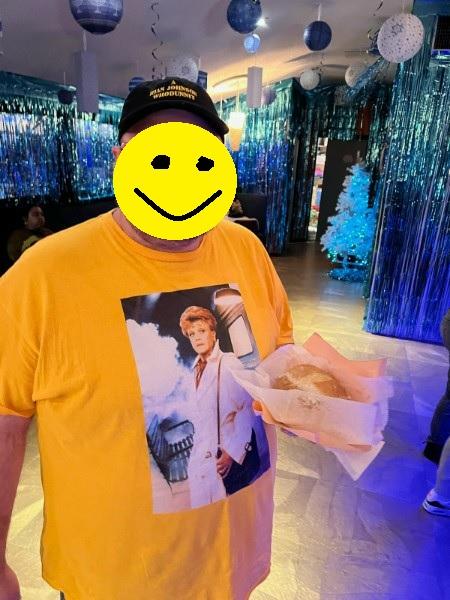
“It hides not behind complexity but behind mind numbing, obvious clarity!” So Daniel Craig’s Glass Onion character Benoit Blanc, called by Google “the world’s greatest detective,” says to much-vaunted “inventor” Miles Bron (Edward Norton) toward the end of this Knives Out sequel. I was a big fan of Knives Out when it premiered a few years ago. Brandon got a screener copy of its sequel along with some fun swag, and he was kind enough to both let me wait until the film fell into my greedy little clutches to publish a review, but also send along some of said swag, which includes the fantastic “A Rian Johnson Whodunnit” hat which you can see me wearing below while also clothed in one of my Angela Lansbury shirts:
For Glass Onion, Benoit Blanc once again finds himself insulated from the world among a smaller world of morons, ingrates, and moronic ingrates as well as hucksters, snake oil salesman, and politicians. This time, he has ostensibly received an invitation to a murder mystery weekend at the home of the aforementioned Bron, who is an amalgamation of various rich douchebag stereotypes (and truths) but who most closely resembles Elon Musk due to his involvement in various companies and businesses which work together to create an impression of a wise ubermensch, when he is in fact a little weirdo who obsesses over getting approval from others. Also invited to the island were several of Bron’s friends, each of whom received a puzzle box that required them to work together to solve and receive their invitation. There’s Birdie (Kate Hudson), the ignorant socialite whose put-upon assistant Peg (Jessica Henwick) has the full time responsibility of not letting her tweet something racist and dumb that could get her cancelled for good; there’s also sad MRA Duke (Dave Bautista) who lives in his mother’s basement while hawking various products that promise to make his viewers “alphas” like he presents himself to be, while his social-climber girlfriend Whiskey (Madelyn Cline) plays along with his internet image. On the smarter end of the scale of Bron’s friends is Lionel Toussaint (Leslie Odom, Jr.), one of the lead scientists at Alpha who liaises with upper management about Bron’s ideas; and the gang is rounded out by Claire Debella (Kathryn Hahn), former governor of Connecticut who is now campaigning for a senatorial run. Finally and apparently unexpectedly, also in attendance is Andi Brand (Janelle Monáe), a former business partner of Bron’s who was unsuccessful in preventing him from pushing her out of the business and exposing his questionable business practices. It’s May 2020, and they have gathered at Bron’s Grecian estate, which is topped with an ostentatious lúkovichnaya glava made of transparent glass, from which the film partially takes its name.
Of course, the title could mean a lot of things. For instance, it’s the name of the bar where all of the main characters (sans Blanc) gathered in their pre-wealth days, when Andi first brought them all together and before they all stabbed her in the back. It’s also, famously, the title of a track from what we colloquially call The White Album, although it’s properly titled The Beatles. Following all of the fan speculation about the meanings of some of the more psychedelic and impenetrable lyrics on their 1967 album Sgt. Pepper’s Lonely Hearts Club Band, John Lennon opted to pen a song that was intentionally antagonistic to anyone attempting to find a deeper meaning in the words; even if you don’t know the song title, you’re familiar with the Paul is dead conspiracy theory that’s now 55 years strong because of the lyrics “the Walrus is Paul.” Or, as Blanc says at one point: “I like the glass onion as a metaphor, an object that seems densely layered, but in reality the center is in plain sight.” From title to exposition, everything is a clue here, just as it was in Knives Out in 2019, and although the social criticism is a little shallower and more obvious than it was last time, I’m still here for the very fun ride.
Of course, that’s one of the things that makes films this elegantly constructed difficult to write about. You’re either going to end up recapitulating all of the fun and foreshadowing how it pays off, which ruins the ride for first-time viewers (hell, I’m already worried I might have given away who the killer is just from my little gags in this review so far) or you’re stuck trying to explicate on something in which the pleasure of the viewer lies in running alongside the narrative and having the revelations to the audience coincide with those to the characters. It’s tricky to pull off, and I’ve often cited how I feel comedy and mystery exist in and evoke neurochemical pleasure in the same parts of the mind: it’s all very specific planting and payoff, and if your audience gets to the solution/punchline too far in advance of the flow of the narrative, it can be death for both genres. Melding them together is a perfect idea (I’ve got more than one work in progress right now that does precisely that) that also doubles the potential for the film to crash and burn like, I don’t know, a SpaceX Falcon 1 launch. Both the previous Knives Out film and this one manage to pull it off. Every reveal makes total sense and falls perfectly in line with what we’ve already seen and what we already know while still allowing us to feel some sense of accomplishment in “figuring it out” along with the characters. It’s an effect you can only find in great examples of the genre, like Murder, She Wrote, which gets a loving reference here in the form of several celebrity cameos playing Among Us with Blanc during his quarantine blues before his invitation to the Onion, most notably and most wonderfully the divine, magical Dame Lansbury.
If I have any complaints about the film, they are few and far between. Blanc is bigger and bolder here than he was in the last film, which matches the zanier plot of this one but also makes it feel like the character isn’t quite consistent. This one doesn’t straddle the line of mocking conservatism and neoliberalism from a slightly left position as well as the last one did, which makes this one feel more “Hollywood” than the last one as well, despite both featuring a cast full of legitimate movie stars. It has a little bit of the Trump SNL taint on it (alternatively we could call it the There’s Someone Inside Your House problem), where just because something happens to align with my belief system doesn’t mean that it automatically makes it a better or more worthwhile piece of art. Most of its barbs are sharp, though. In particular, I love the detail that Birdie, who has already been shown to have zero concern about hosting a superspreader event in her apartment, arrives to the dock on the way to Bron’s island in what the script describes as a “fashionable but totally useless lace mask”. Some of them land a little more loudly or call more attention to themselves than they should, when I don’t remember the first film having any issues with this at all, but maybe that’s the nature of political satire now. There are elements of the plot, setting, and choices here that seem eerily prescient given how long the film took to make, like that it was in theaters at the time that Elon Musk had his bluff legally called and was forced to complete his purchase of Twitter, or that there is a giant mural in Bron’s house depicting Kanye West as Jesus Christ, which is both funny and depressing given the nature of West’s current public persona entirely revolving around spouting Anti-Semitic rhetoric with his whole chest. It recalls how there was an entire garden industry on the internet for a while of pointing out things that The Simpsons “predicted,” when the simpler and more depressing reality is that, with a few notable exceptions, there hasn’t been much of an improvement in most people’s lives since 1989. Glass Onion didn’t predict anything either, but it certainly has a talent to reflect how bleak things are at the moment.
At the end of the day, this is the kind of movie that I can only recommend you watch it or not, given that saying more than I’ve already said runs the risk of spoiling too much. If you’ve already got Netflix, you really have no reason not to, and I think that you’ll really enjoy the twists and turns along the way if you have the patience. And you’re at home, where you can pause and create your own intermission to go to the bathroom or make a cocktail, so why not? If nothing else, every person who watches this movie pushes Ben Shapiro closer and closer to having an epiphanic moment about what his actual place in the world is, and isn’t that a dream we should all strive towards?
In my needlessly personal and passionately incoherent review of and apologia for Bros, I neglected to mention that it was not the only gay romcom that came out this year. It wasn’t even the only one with Bowen Yang in it. Fire Island flew a bit further under the radar than Bros did, and although I’d like to give our dear friend Billy Eichner an object lesson about how something that isn’t associated with a Twitter tantrum might end up being better received critically than something that is, we can probably chalk the overall absence of Fire Island from the conversation up to racism. The only upside is that being outside of the conversation also puts you outside of The Discourse. Small mercies.
Fire Island is a contemporary gay update of Jane Austen’s Pride and Prejudice, sort of. Here, the biological Bennett family of the novel is replaced with a family of choice. Mrs. Bennett is replaced by Erin (Margaret Cho), who turned the misfortune of accidentally eating a piece of glass at an Olive Garden (or equivalent) into a house on notorious gay mecca Fire Island. In lieu of daughters, she is visited for a week every year by five gay men who are all at some point in the process of crossing the threshold from young adulthood to plain old adulthood adulthood. Max (Torian Miller) is the big guy of the group who loves to pretend that he’s “above” getting down and dirty on the island but who’s really the dirtiest of them all; hyper femme Keegan (Tomás Matos) wears crop tops and as little else as possible and also loves Marisa Tomei; while Luke (Matt Rogers) is also largely defined character-wise by his love of Marisa Tomei, although he also gets to be more involved in the actual plot than Max and Keegan as he takes Lydia Bennett’s role of being socially compromised by an immoral interloper. The real stars, however, are Bowen Yang and Joel Kim Booster as Howie (the Jane) and Noah (the Elizabeth and therefore our primary viewpoint character), who are clearly the two closest of the group, despite Howie having moved away from NYC to work on the west coast. The sexy, gym-bodied Noah provides the voiceover for the film, which starts with the famous opening lines of Pride and Prejudice: “It is a truth universally acknowledged that a single man in possession of a good fortune must be in want of a wife.” Noah then reveals his playboy nature to us by noting that not every man is looking to settle down. This is less true of Howie, who, at age thirty and dad-bodded, is stressed that he’s never had a boyfriend and fears that he’ll never get the romcom romance of his dreams.
Upon arrival to the island, Erin reveals that she’s broke (she invested too much in Quibi) and will have to sell the house soon, meaning that this is the last summer that the crew will have together at the house, unless one of the sisters can marry a wealthy man like Mr. Darcy. Wait, no that’s not quite right; everything before the Darcy stuff is accurate, but no one needs to marry, sorry. Noah agrees to avoid getting laid until he successfully wingmans for Howie and, having committed himself thus, sets out to accomplish his mission with gusto. Howie immediately hits it off with Charlie (James Scully), while Noah is initially drawn to the sullen Will (Conrad Ricamora) but then is put off by him after overhearing Will being grumpy in that traditional Mr. Darcy way. I’m being quite literal, by the way; Darcy says of Elizabeth that she is “not handsome enough to tempt him,” while Will says of Noah that “he’s not hot enough to be that annoying.” But of course, as we all know, you can’t keep an Elizabeth and a Darcy apart forever. They may loathe each other for a while due to operating under bad first impressions, but they’re going to end up together. That’s just how this works.
Fire Island is a fun, breezy, unpretentious movie. While I might have gotten more actual chuckles out of Bros, Fire Island is much more charming. One of the problems with Bros is the extent to which it felt the need to announce how important it was. And, I mean yeah, I wrote almost 3500 words about it; it is important. But it also never lets you forget that it knows how sophisticated and ground-breaking it believes itself to be, while Fire Island aims to be exactly what it is and quietly succeeds in being the best possible version of that thing. The pop culture references are funnier without needing to be so … explicative? Debra Winger’s bog monologue about how all gay men come to her with their relationship issues because in their minds she’s Grace Adler is funny, sure, but it has nothing on Keegan and Luke reciting dialog from My Cousin Vinny in an increasingly agitated hysteria because they’re stuck playing a celebrity guessing game with someone who doesn’t know who Marisa Tomei is. The jokes that allude to or directly cite other movies here are refreshing both in brevity and the fact that the film doesn’t need to belabor the audience with an explanation when, for instance, one character calls out another for being catty with the line “Way harsh, Tai.” If you get it, then you get it, and if you don’t, the movie’s already moved on to the next plot beat.
What also makes things work here is honesty. Noah and Howie are kindred spirits because each recognizes in the other the way that Asian men are ostracized within the community, and it brings them closer. Noah, however, can’t see past this surface similarity to be completely open and honest with himself about the way that he and the schlubbier Howie are treated differently on the island because of how one matches a very particular set of beauty standards and the other doesn’t. As someone with a fat body that prevents me from having the same social cachet as my better looking friends, this really hit home for me; not to keep comparing this to Bros, but in that movie, I couldn’t stop thinking about how the white, conventionally attractive Eichner feeling sorry for himself for his lack of a boyfriend while consistently hooking up with other attractive people was alienating and, frankly, dishonest. Howie’s emotional scene in which he begs Noah to really look at the two of them and see that although they are both two East Asian gay men who face the same ostracization from the mainstream, pretending Howie has the same more social credit as Noah—with his toned abs and perky pecs—is actually hurting Howie, even if Noah is trying to hype his friend up. Bros felt the constant need to draw attention to itself as “groundbreaking” gay cinema while Fire Island creates something that is fresh and new and hopeful simply by modernizing one of the cornerstones of romantic literature. If you’re only going to watch one, it should be this one.
Does sincerity have no place in low-budget genre trash these days? Must all of our D.I.Y. practical-gore freakouts be buried under mile-high layers of ironic detachment and nostalgia for decades of horrors past? I was really hoping the low-budget, psychedelic gore fest All Jacked Up and Full of Worms would live up to the gruesome glory of its title, and in some ways I guess it does. It’s impressively revolting filth in fits & jabs, at least when it’s leaning into the visceral disgust of its wriggling worm imagery – which ranges from real-life worms squirming in cigarette ashtrays to gigantic, intestine-length latex monstrosities stretching across warehouse-scale movie studio voids. It’s too bad all of that effort is undercut by its juvenile edgelord humor, though, as shock value topics like needle drugs, Satanic worship, and pedophilia are frequently mined for cheap, empty punchlines. When you see a “Special Worm Effects By” credit in the opening scroll, you’re prepared for a Screaming Mad George-style descent into Hellish, surrealistic gore. Instead, you get a movie custom made for middle schoolers to prank each other with as a sleepover dare.
Like this year’s much more sincere gross-out horror Swallowed, All Jacked Up is set in a fictional world where consuming worms—either orally or nasally in this case—creates a powerful psychedelic trip akin to an acid overdose. These are just regular, everyday worms, as far as the audience can tell – a conceit that’s underlined by the repetition of the word “worms” in every single line of dialogue. As it’s explained by a worms enthusiast, “There’s only one wrong way to do worms, man […] Not do worms!” This is a pure drug-trip movie, with several loosely connected characters becoming increasingly manic under the worms’ influence. I’d recount their exploits here if they were worth repeating, but they’re mostly just an improv comedy assemblage of self-amused bits that don’t translate outside the troupe. The worm imagery is frequent & remarkably grotesque, but so are the purposeless, off-topic jokes about sexually assaulting babies. Maybe it’s a matter of personal taste (or tastelessness), but I just wonder how much further this movie could push its discomforts if it were a sincere low-budget horror instead of an irony-poisoned horror comedy.
Anyway, if you really want to watch a retro, VHS-warped gross-out that’s overflowing with worms, you might as well watch the 1976 Tubi mainstay Squirm instead. It’s not an especially great film either, but it’s at least a genuine one. All Jacked Up and Full of Worms is a distinctly modern echo of that era’s pure-schlock filmmaking, mimicking long-outdated surface aesthetics instead of seeking genuine, of-the-moment terror. It’s likely unfair of me to pin it under the full weight of modern horror’s weakness for ironic detachment & retro aesthetic worship, but it was also unfair of the movie to make me sit through so many schoolyard jokes about baby rape, so let’s call it even.
I recently went on a delightful vacation to San Francisco, where I was free to explore the city on my own throughout the day while my travel partners were busy at an academic conference. Of course, I used that unstructured free time to bus around the city in search of movie nerd indulgences – including a City Guides walking tour of Hitchcock filming locations (as suggested by and enjoyed with my internet friend Sunil), an Oscar-qualifying screening of Guillermo del Toro’s Pinocchio, and a raid of local book & record stores for locally flavored physical media (where I scooped up copies of Kamikaze Hearts, Luminous Procuress, and San Francisco Noir). By far, though, my most rewarding indulgence in Bay Area movie tourism was my trip to the Roxie Theatre, a century-old, Prytania style single-screener in the Mission District. I was lucky to be in town for their only listed showing of Deaf Crocodile’s new digital restoration of the locally shot, locally proud blacksploitation relic Solomon King. The screening was a riot, a one-of-a-kind communal celebration that felt more like being invited to a family reunion than paying to see vintage schlock.
Local entrepreneur Sal Watts shot Solomon King on-location in Oakland, relying on his own businesses & employees to help buoy the budget as ready-made sets & cast. Self-credited as writer, director, producer, editor, and star, the film is undeniably a vanity project for Watts, who of course props himself up to be the most badass action hero who’s ever graced the screen. The titular Solomon King is positioned as a Black folk hero and wish-fulfilment fantasy, recalling other action heroes of the time like Shaft, Coffy, and Black Samson. Watts was working with a self-funded, sub-Dolemite budget, though. His kung-fu choreography is even less convincing than Rudy Ray Moore’s, with the editing room cuts doing most of the work to convey the film’s “action” sequences. Most of the dialogue is ADR’d onto the soundtrack as characters are walking & driving a long distance from the camera. Every shot holds a few seconds too long; the boom mic’s shadow often sways on background walls; the climax teases a sequel Watts couldn’t afford to produce. Still, Watts makes sure that he’s always the coolest, toughest brute in the room. He beds every hottie he meets within minutes of locking eyes; he single-handedly takes down an army of terrorists the racist higher-ups at the CIA are too cowardly to touch. The entire movie is about how awesome Solomon King—and by extension Sal Watts—is as a lone-wolf badass, and no budgetary limitations could hold back that kind of self-aggrandizing exuberance.
If anything, it’s Watts’s charming self-determination as a D.I.Y. filmmaker that makes Solomon King so delightful. The film’s story of an ex-CIA renegade (and current smooth-talking nightclub owner) who takes down the corrupt kingdom of an ambiguous Middle Eastern country all by his lonesome is pretty loosely defined, an afterthought secondary to celebrating Watt’s badassery. Mostly, Solomon King delights as a document of community theatre, as most of its cast consists of non-professional Oakland locals (give or take a small role for celebrity baseball player Tito Fuentes). That’s why it was such a treat to attend that screening at the Roxie, where I got to watch that community theatre with the community in question. During a post-screening Q&A with Watt’s widow Belinda Burton-Watts (who is set up as the star of the never-made sequel), it became increasingly apparent that about half the audience was connected to the production of the film in some way. It was the most heartwarming version of a “This is more of a comment than a question” Q&A session, since people were piping up to point out that they were in the movie as children or related to the cast or crew. I was also seated in front of Watts’s children, who provided live commentary throughout the screening (unprompted, free of charge), with adoring quips about how cheesy it was to see their dad act tough and how “Nobody wants to see their dad in a lovemaking scene.” It was quite literally a family affair, both in production and in presentation.
A representative from Deaf Crocodile was also on-hand at the Roxie to explain how lucky we were to be watching Solomon King on the big screen, as even the audience members with direct ties to its production likely hadn’t seen it since the 1970s, if at all. He apologized for the scratches and unintentional jump cuts in the digital scan, which was cleaned-up from a battered, pink-faded print borrowed from UCLA’s archives. Those flaws were occasionally noticeable but never severe, the kind of thing that would only drive you mad if you spent years restoring the film frame by frame. Their new scan of Solomon King is likely sharper & more vibrant than its local celluloid projections even would have been in its initial, limited release. More importantly, they were able to work with a copy of the original soundtrack negative from Belinda Burton-Watts’s personal archive, so that the dialogue was clearly legible in a way these regional action relics rarely are. That pristine soundtrack was also a boon for the original funk score & genre-obligatory nightclub acts that accompany Solomon King’s exploits. This upcoming Blu-ray release from Deaf Crocodile isn’t so much a restoration as it is a life-saving rescue mission.
Solomon King totally earns that treatment too. It’s easy to get hung up on (and delighted by) the film’s limitations as a truly independent, outsider-artist production, but it’s a consistently surprising, entertaining entry in its genre. Occasional shots of a criminal biker’s blood spurting onto cocktail glasses or Solomon King firing a pistol through a perfectly arranged stack of warehouse shipping palettes prove Watts had genuine artistic ambitions as a filmmaker, no matter how short-lived that side career might’ve been. The film isn’t as artistically substantial as similar Black, independent works of the era like Sweet Sweetback or Ganja & Hess, but it is substantial as a novelty action curio and an authentic slice of Oakland history. The closest I’ve ever gotten to experiencing a New Orleans version of that afternoon at the Roxie was an NOFF screening of the similarly rescued & restored Cane River in 2018. Even though I grew up in closer proximity to the community art project documented in Cane River, that regional romance melodrama cannot compete with the pure, skull-cracking entertainment value of Solomon King as a low-budget action picture, though. And there was just something magical about walking into the Roxie without knowing how intimate of a communal, familial experience that screening was going to be. Nothing but love for Oakland and San Francisco; and all hail Solomon King.
Holy Spider lands at the exact intersection of two genres I’m not especially interested in: the true crime serial killer thriller and the shoe-leather journalism drama. Its semi-fictional story of real-life confessed, convicted killer Saeed Hanaei’s street-level rivalry with a composite-character journalist determined to bring him to justice is something I was prepared to ignore entirely . . . until I saw who directed it. Iranian-born, Copenhagen-based filmmaker Ali Abbasi made such choppy waves with his previous film, Border, that I could not ignore whatever he made next, regardless of genre. Although no less morbid nor extreme, Border is in my genre wheelhouse, since its dark fairy tale setting lands it firmly in the supernatural. The ripped-from-the-headlines story behind Holy Spider can’t pretend to be as singular as that doomed trolls-in-love horror drama, but it does continue the disturbing brutality of Abbasi’s previous triumph, and likely puts it to more politically ethical use. No matter how little interest I may have in Holy Spider as a genre piece, it’s so fiercely unflinching & matter of fact in its observations of misogynist violence that I couldn’t help but be chilled by it. Abbasi is a fiercely effective purveyor of movie violence, often to a deliberately sickening degree.
Time-stamped with 9/11 footage looping on a background television, Holy Spider recounts the serial murders of sex workers in the “holy city” of Mashhad in the early 2000s. The women are choked to death—often in real-time on camera—with their headscarves by a serial killer posing as a potential john, using a religious symbol as a form of self-righteous punishment. Maintenance man Saeed Hanaei’s guilt in these crimes is not hidden from the audience. It’s barely hidden from the fictional journalist who takes him down, as her bare-minimum efforts to sniff him out expose the cruelty of local police’s indifference to the murder spree. Once caught, Hanaei proudly confesses his guilt, claiming the murders were a “jihad on vice”, calling for a “fatwa on immoral women”. Public response to his declarations is mostly positive, recalling the NIMBY cruelty towards real-life sex workers’ murders in the avant-garde musical London Road. It’s a pretty cut and dry story about the free-flowing bleedover of sexual repression into misogynist violence, one that only differs from its Hollywood true-crime equivalents in its cold, matter-of-fact depictions of sex & violence. Abbasi could be accused of edgelord pranksterism for some of the more shocking moments in Border, but these real-life murders are taken deadly seriously, without a hint of humor or sensational romance.
If Abbasi does anything especially unique with the genre traditions of the serial killer thriller, it’s in the way he continues Hanaei’s story beyond capture & punishment. Once caught, his rivalry with the feminist journalist determined to take him down continues in full stride, as he tries to weaponize the court of public opinion to justify his murders. After execution, his misogynist philosophies live on, particularly in the mind & actions of his teenage son, who idolizes his father as a morally righteous superhero. The typical Hollywood version of this story is pure copaganda, wherein putting Hanaei behind bars is enough to neutralize the threat. Instead, Abbasi finds deep terror & sadness in the continuation of Hanaei’s misogynist vision on a culture-wide level, continuing his work well after he’s physically neutralized. It’s a chilling picture, one that has more political & philosophical purpose than most true crime recaps of famous headlines or sensationalized hagiographies of journalists doing their jobs. As much as I would personally prefer that Abbasi return to the supernatural world in future projects, I still respect what he was able to accomplish while tethered to reality here. Both Border and Holy Spider feel like grueling ordeals rather than passive entertainment, and attaching that hurt to real-life victims doesn’t make them any easier to endure.
In the opening scene of the Nan Goldin documentary All the Beauty and the Bloodshed, the legendary fine-art photographer is leading a flash-mob protest at a modern art museum, demonstrating against their acceptance of donation money from The Sackler Family. She lays down on the museum floor, pretending to be a corpse alongside dozens of collaborators, and the camera catches glimpse of a “SILENCE = DEATH” tote bag commemorating ACT UP protests of decades past. Later in the film, similar archival footage from the ACT UP era shows Goldin decrying Reaganite Evangelical indifference to the AIDS epidemic, platforming fellow activist artists like David Wojnarowicz to combat institutional cruelty in an art gallery setting. Both protests are personal to Goldin, who has recently become addicted to the Sacklers’ profit-over-people product Oxycontin and has historically lost countless loved ones to the Reagan administration’s deliberate mishandling of AIDS. Both protests earn their screentime thematically, but only one is compelling to look at, having earned a fascinating vintage texture through the technological passage of time. The modern smartphone footage at an overlit Metropolitan Museum exhibit just can’t compete, since it’s near-indistinguishable from disposable one-glance content on a social media feed.
That textural difference between past & present footage weighs heavily on the film throughout. All the Beauty and the Bloodshed is half a career-spanning slideshow from Nan Goldin’s legacy as a fine art photography rock star and half a document of her current mission to deflate The Sackler Family’s tires, at least in the art world. The career-retrospective half can’t help but be more compelling than the current political activism half, since her archives are dense with the most stunning, intimate images of Authentic City Living ever captured. Her personal history in those images and her recent struggles with addiction more than earn her the platform to be heard about whatever she wants to say here, though, especially since the evil pharmaceutical empire she’s most pissed at has trespassed on her home turf. The protest group Goldin helps organize, Prescription Addiction Intervention Now, specifically aims to have the Sackler name and donations removed from fine art museums, attacking the family’s cultural prestige since it is improbable to dismantle their personal wealth. P.A.I.N.’s protests in the film only target museums that feature Goldin’s work in their permanent collection, leveraging her cultural clout in the art world to do as much practical damage to the Sackler name as they can. The only problem is that documentation of these efforts only amounts to Good Politics, not Good Art, which is an unignorable fault in a film that proves it’s possible to achieve both.
Documentarian Laura Poitras was likely excited to make a movie about Nan Goldin precisely because of those modern-day P.A.I.N. protests, since amplifying Goldin’s personal war on the Sacklers fits in so snugly with her past modern-politics documentaries about WikiLeaks, Edward Snowden, and the NSA. I’m grateful she took interest, no matter what her reason, since it’s the closest I’ll ever get to being in the audience for one of Goldin’s classic Ballad of Sexual Dependency slide shows. Setting up a rack of six slide projectors like a guitarist’s Marshall stack, Goldin’s slideshows register as more of a D.I.Y. punk act than a gallery exhibit. Here, she recalls her journey from developing her early drag bar photos at the local pharmacy to earning enough art-world clout that she can convince museums to turn down 7-figure donations from prestige-hungry, life-destroying benefactors. I’m used to seeing Goldin’s photos in isolation, collected as single images among her No-Wave NYC contemporaries’ similarly unpretentious, self-documentary imagery. It’s a treat to be immersed in her work at length here, learning the names & personalities of the recurring “characters” in her photos and getting a better sense of her iconoclastic presence in the larger world of fine art. So, of course, the modern protest footage that presumably drew Poitras to the project often frustrates in its distraction from what drew me to watch it. Goldin’s artwork is hardly a spoonful of sugar to help the medicine go down, though; it’s just more potent, tastier medicine.
Laura Poitras is not using Nan Goldin’s life story as an excuse to score political hits against Purdue Pharma & The Sackler family. If anything, this documentary feels like a fluid collaboration between the two artists, and Poitras is only there to give Goldin as much space as she wants to rant about how the Sacklers have turned fine art galleries into “temples of greed.” If Goldin wanted to tell the story of her life’s work separately from the story of her recent protests, I’m sure she could’ve found an obliging collaborator to film her self-narrated slideshows. She even could have made that movie on her own, since her control over the rhythm, scoring, and storytelling of her slideshows is in itself a kind of improvised filmmaking, a skill she’s been honing for decades. It’s reasonable to assume that the decision to give her modern crusade against the Sacklers equal weight as her bottomless catalog of breathtaking city-life portraits was partly—if not entirely—Goldin’s own. It’s a politically respectable choice, of course, but it’s also an artistically limiting one.