1. TheFrenchDispatch — A delightful, elaborate brunch of a film, offering a little taste of all your favorite flavors: something sweet, something savory, and a well-balanced cocktail to top it all off. The anthology format affords Wes Anderson carte blanche to cram even more visual detail into the frame than usual, making for a texturally rich text. Every chapter has a different approach to costume & set design, sifting through 1950s black & white crime pictures to colorful 1930s New Yorker cartoons to laidback 1960s talk shows. Anderson’s previous films are beautifully decorated cakes; this one is a full banquet.
2. French Exit — Michelle Pfeiffer was my favorite part of mother!, and it’s great to see her playing a similar role in this gem. I was surprised to see so many people turn their nose up at it. I could watch Pfeiffer chew scenery for all eternity, and here she goes as far as chewing up her martini glass, tossing the olive aside. I was also surprised to discover that it was adapted from a novel and not a stage play, although I’m not surprised that it started a literary text. The dialogue is not at all naturalistic, but it is extremely satisfying, like a good Albee or Pinter play. I’ve never experienced the life of the idle rich, but this movie allows you to indulge in their wicked, self-amused humor through a fictional remove. At the very least, it’s comforting to know that they apparently despise cops as much as us commoners, which is something you can’t say about the wealth & property-obsessed capitalists among them.
3. Mandibles— The stupidest comedy of the year, and my favorite. Sometimes I fear that I’m the least intelligent person alive and people are just flattering me by not calling me out on it. It’s reassuring to see two actual idiots on the screen for comparison, then, especially in a comedy that doesn’t have to go overly scatological or sexual to land its jokes the way similar Farrelly Brothers movies would’ve in the 90s. It’s somehow smarter and more imaginative than past examples of its genre like Dumb and Dumber or There’s Something About Mary—building its absurd story around a freakishly gigantic housefly—and yet it’s just as hopelessly stupid.
4. Lapsis — The most impressive sci-fi film of the year, especially in the skillful way it achieves wide-scale worldbuilding on a tiny budget. Its setting is not exactly our current reality, but it does closely mirror what’s happening right now, particularly in modern labor exploitation. It’s also smart about how it combats that exploitation, choosing to radicalize an unremarkable, politically mainstream worker instead of pretending a useful labor movement can be achieved with only leftist academics. It’s rare to see labor movements depicted as they actually are: democratic and beneficial to the common worker.
5. Zola— A “just vibes” movie that somehow has a plot. The vibes are mostly bad, but its mirrorworld fantasy sequences where dancers try on different outfits & personae achieve a kind of high-art serenity you won’t find in many madcap road trip comedies. It’s also an excellent adaptation of its online source material, capturing the breakneck pace of each new update steering its infamous Twitter thread into new, thrilling directions. There aren’t any major examples of how to translate that modern storytelling style to the screen, so this feels like it’s exploring entirely new territory – to the point where the tweet notifications on its soundtrack were instantly iconic.
6. Bo Burnham: Inside— I wanted to not like this for the very same reasons that Burnham mocks himself in it; his admissions that he’s a rich white guy with nothing substantial to contribute to society all ring true. I enjoyed all the songs, though, and his self-criticism ultimately ended up being what won me over. The more he focuses on his own shortcomings, the more this “comedy special” devolves into a relatable madness. It perfectly captures the feeling of reality itself crumbling around us as we remain in isolation, unable to tell what’s real and what’s not in our increasingly fake modern world.
7. Barb and Star Go to Vista Del Mar — This was almost the stupidest comedy of the year, losing that prestigious contest to Mandibles. It’s a type of mainstream comedy that you don’t often see anymore: something that’s incredibly idiotic but still has the grandeur of big musical numbers and expensive set pieces. I especially love that its heroines are unremarkable middle-aged women, a demographic who don’t often get to be the heroines of anything – even goofy comedies.
8. Wojnarowicz— This documentary about artist and political activist David Wojnarovicz made me seethingly, white-hot angry. I was angry at past injustices, but also the injustices of the present: the governmental cruelty that led to Wojnarovicz’s death and the fact that not a lot has changed since. It made me want to ACT UP.
9. The World to Come — Most costume dramas about doomed lesbian romances contain their affairs to fleeting moments and wistful memories. This one pushes the practical impacts of its romance much further, not shying away from the tragic, real-world consequences of expressing queer love in a brutal, patriarchal past.
10. Titane— I don’t feel as strongly about this film as the rest of the Swamplix crew seems to, but I can’t deny that it was one of the best-made films of the year. I watched about fifty movies released in 2021, and this was easily among the most memorable. It takes big swings at issues most movies don’t dare explore, especially in the way male socialization rituals that are often perceived as markers of toxic masculinity are actually important bonding experiences that connect people in a meaningful way, affording them a shared sense of humanity.
For this lagniappe episode of the podcast, Boomer, Brandon, and Alli discuss Guy Maddin’s My Winnipeg (2007), a “docu-fantasia” homage to the director’s Canadian home-city Winnipeg.
I decided to leave Marvel movies off of my list this year. Unusual for me, I know, but this comes after having no superhero movies at all on my list last year and sleeping the sleep of the innocent after separating comic book movies from other films when compiling my respective top 100 movies of the 2010s list vs. the top 15 four superhero flicks of the 2010s. That said, there is a movie on this list that’s technically a comic book movie, although for me it’s mostly on the list because it’s a (gross) James Gunn picture. So, yeah, I’ve already spoiled it. That having been said, I saw both Black Widow and Spider-Man: No Way Home and enjoyed them both quite a lot, so feel free to read my reviews of those.
For Christmas 2021, my best friend also gave me this shirt, which is an in-joke from Jenny Nicholson’s THE Vampire Diaries Video, which would be my favorite film of 2021, measured by any metric that counted said content as cinema. Apparently, in her order, my best friend thanked Jenny for creating the best film of 2021, and Jenny responded “Thanks.” When this was divulged to me, I had a parasocial glee that I can’t describe. I don’t know why I’m even explaining this, since it’s currently sitting at 6.9 million views (up from 5.9 million at Christmas), which means that, statistically, you’ve already watched it (twice). I will not be answering follow up questions about my mathematical process, but this was the best long form video format thing that cannot technically be called a movie.
I also want to say that I really wanted to like Together Together. I absolutely adore Patti Harrison. Although we only know of one planet with sapient life on it, I think Patti would be in the top ten funniest beings from the five funniest orbs. I don’t know why her Funny or Die skits in which she reviewed animals have disappeared from the internet, but at least they were up long enough for me to make some GIFs, like this one. I wish I could have put this in the top list, but while this one would be worth watching for Patti alone (and with appearances from Julio Torres and Rosalind Chao, that should really push it over the top), if you, like me, can’t really get behind a film that has Ed Helms as the leading man, maybe just stick to Patti’s standup.
Honorable mentions for what almost made the list: Rare Beasts (which ended up ranked at 16th), What Lies Below (discussed briefly here shortly after the 18-minute mark), and A Classic Horror Story.
Ok, without further ado!
15. Things Heard and Seen
This slow-burn thriller is the third annual winner of the unofficial “film with the most Shining vibes,” joining 2019’s champ Doctor Sleep and 2020’s winner The Lodge. Read my review here.
14. The Paper Tigers
The perfect movie to watch with your male relatives when you need something to fill the void between you! From my review: “The action here is nothing short of spectacular. It’s always a treat to see martial arts depicted with an emphasis on the arts over the martial, and this is a truly elegant film to behold. […] The comic elements are more grounded in character than we’re accustomed to [and] Paper Tigers doesn’t rely on old stereotypes and tiresome cliches to create a rhetorical space for joke-telling, and the comedy that does recall those dead horses is punching (and kicking, and breaking bricks) up, not down.”
13. We Need to Do Something
From my review: “We Need to Do Something proves that, even if one has to film under pandemic restrictions, some of our old stalwarts [like IFC Midnight] can still get something into the consumer’s home that mostly hits, all while doing more with less. […] I’ll grant that this could be because of some of my own psychological fears and damage contributing to the overall discomfort and anxiety that I felt during the runtime. Just asUnsane ended up as my number three film of 2018 by knowing where all of my fears live, so too does We Need to Do Something effectively and articulately seek out and find all of my weak points.”
12. The Toll
A movie that could easily have fallen into the trap of being kinda dumb, this one ends up being far more interesting than it has any right to be, as it counterposes images of memories with a truly deep, dark forest, within which dwells something truly inhuman. I feel like when I recommend this one to people, I’m like the older woman on the tractor who tells the main characters that it may seem like they’re in the same place but that they are really worlds apart, since it seems like no one else has been as impressed by this one as I have. Still, maybe you’ll like it, dear reader? Read my review here.
11. The French Dispatch
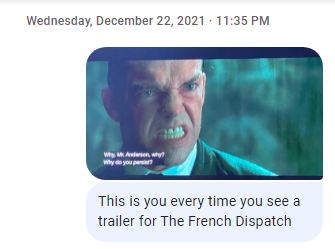
I have a friend who hates Wes Anderson. Like, really, really hates him. Seeing the trailer for The French Dispatch sent him into a rage, so much so that I sent this to him a while back:
I, however, am not a hater. In fact, when I learned from a friend who worked for Vulcan Video (North) that their DOS rental records went back so far that he could even take a look at what Anderson rented when he was a UT student developing the ideas and images that would go on to influence Bottle Rocket, I became obsessed with obtaining this information and possessing it for myself. If you’re reading this, Mr. Anderson, you can rest assured that this information never made its way into my hands, as the good people of Vulcan kept your privacy, and I couldn’t get my FOIA filed in time before that location closed. Even though the computer with that information sat at South Vulcan in order to merge the two databases, I still never managed to get my nerdy little talons on it. I do think that this is a more personal effort than others from the director’s oeuvre, and it’s as much a career inspection (I hesitate to use the term “retrospective,” as it has such a… finality) as it is a film, which means it doesn’t connect with me as a viewer with the same intimacy and immediacy as my favorites from that filmography (which, for the record, are Fantastic Mr. Fox, Royal Tenenbaums, Life Aquatic, and Grand Budapest Hotel). In those, the conceits of the story and framing form less of a barrier for me than they do here, as I didn’t really slide into the world of Dispatch as smoothly, but it’s still effervescent and fun, and I recommend it. Read Brandon’s review here.
10. The Suicide Squad
You know, I just love Starro. I think about every iteration of Starro that I’ve seen over the years and how they’re always kind of … cute. Blue and purple starfish guy; he’s only got one eye but it’s a big Bambi of a peeper, and he’s threatening but not very … gross. I’m a simple man and I like my James Gunn like I like my Cronenberg: again, gross. What The Suicide Squad has going for it in terms of sheer entertainment value is that it’s loud, slippery, fun, bloody, and full of bilge and bile. We all know seastars are gross, right? They have eyes at the ends of their limbs and they move around on gross little tentacles and there are over 2000 species of them in almost every kind of aquatic environment you can name. Here, Starro isn’t an adorable cartoon seastar but a massive, disgusting monster with nauseatingly realistic flesh, and then sometimes it opens up little trypophobia-triggering pores and shoots out more gross little dudes. I know I’m stuck on that point and there’s a lot more going on here than that, but I was very pleased with this one. Read Brandon’s review here.
9. Pig
I’ve been working on this list for a while, and this past week, the internet gifted us with this performatively sneering tweet about people watching “baby food culture” on airplanes, which of course set off a great deal of discourse about what constitutes said baby food, whether an airplane was really the proper space in which to engage with (presumably) richer texts like Schindler’s List or Hereditary. Others raised the point that some people opt for these as they are reasonably certain that they will be free of things that they might be embarrassed for watching in public (although I was plenty embarrassed to watch Ready Player One in 2018 but was reasonably certain that I would never see anyone on that flight again; now that’s baby food culture). There have been times for me when watching a movie on a plane actually contributed to the film, if that can be believed; there’s nothing like being forced to make yourself small as 6’2’’ guy with a shoulder width of 24+ inches sitting in a middle seat and subjecting yourself to Unsane. What I will say is that I watched Pig on an airplane, mostly, and I was still moved by it. Well, I watched the first 70 minutes on the flight from Raleigh to Atlanta, and then watched the rest of it on Hulu at home, and it was still one of the best films (and viewing experiences) I had last year, just as much as the Very Cinematic film that’s next on this list. Read Brandon’s review here.
8. The Green Knight
In what I advised in what I correctly characterized as “more of a summary than a review” of The Green Knight, I recognized that it was “an exercise for myself as much as it is a recommendation.” When talking about Alicia Vikander’s big speech, I asked and answered a question that applies as much to the film as a whole as it does to that scene: “Is it ‘good’? I’m not sure, but it sure was huge.”
7. Saint Maud
Last year during the introductory segment for our podcast about Ginger Snaps, we briefly discussed the film Ghost Stories, and specifically how it does “that thing I like.” We didn’t get into specifics since the specific thing that I like (henceforth TTIL) is always a spoiler, but for a longer discussion of that, feel free to check out our early Lagniappe episode about Housebound, which also does TTIL. All of this is to say that Saint Maudalso does TTIL, and it does so with style and aplomb aplenty. The trailer for this one played before the last film I saw in theaters before the first quarantine, and I had already seen it several times before then, but this was a film that was definitely worth the wait. The relationship between people of fundamentalist faith and those without is a constant source of interest for me, as demonstrated pretty extensively here over the years, not least of all with my Planet Mirth series. Here, our protagonist is a woman of a newfound faith, a belief born more of trauma and recrimination than one with which she was endowed by her parents or arrived at via a winding road of theological research. As such, it’s very personal and fervent while also being wild and piecemeal; despite its fragmentary and uninformed nature, the title character is nonetheless devoted and holds others to the strictures of her ideology, despite the fact that no one on earth could possibly know what’s going on inside her mind. And what’s in there is fantastical: visions of God and the devil, heaven and hell, and all of it finally coming to a head in an attempted act of self-canonization that’s almost too harrowing. Read Brandon’s review here.
6. Psycho Goreman
Brandon was less-than-sold on this one when he reviewed it last year, and I think that his review is fair and reflective of his taste. His opinions aren’t my own (although I would also compare it to Turbo Kid, which was my number three film of 2015), however, and although we align in a lot of ways, this one sat at the top of my list for most of the year, until a few late-in-the-year surprises managed to dethrone it. Although I used “smorgasbord” when describing Turbo Kid in the above-linked 2015 list, it’s been six years, so I feel comfortable using it again. This is a movie about a truly horrible and unlikable little girl, a bully who through nothing more powerful than coincidence comes into possession of a totem that allows her to control an otherwise unstoppable killing machine. Of course, Psycho “PG” Goreman (as she dubs him) isn’t a machine, he’s a living being, albeit one who defies “life” in much the same way as the monsters on the covers of 1980s metal album covers. Against his will, PG undergoes a journey of self-discovery, of a kind at least, as he learns that he has a fondness for hunky boys as well as dealing death. My favorite bits are when he is forced to become the drummer in his young friend(?)’s band, as well as the conversion of poor Alasdair into a big ol’ brain monster, which is never reversed. I got a kick out of this one.
5. Titane
When we recently discussed Titane on the Lagniappe podcast, I confessed to my intense jealousy about the fact that Brandon got to see (and review) the film before I did, especially after I got to see Raw in limited release and got copy on it to editorial within a day, beating a lot of actual media outlets to the punch, which is rare for our Little Swamp Engine that Can. There were many delays, caused first by COVID, then a friend’s school schedule, then COVID again, before I finally got the film through legitimate means (wink) and watched it at home. When I told the friend with whom I shared that viewing experience about how high the film would likely end up ranking on my list, she was shocked, and noted that she thought the film was pretentious. I could hardly agree less, to be honest, as I don’t think that this film is putting on any airs at all. It’s a body horror dark comedy about a serial killer who gets pregnant with a Cadillac’s baby and finds herself hiding out with an aging French firefighter and trying to disguise herself amongst a bunch of his macho employees. That it might be saying something about gender as performance is there, but I think it’s communicating less of a capital-M “Message” than something like Videodrome, which is the film it most reminded me of. It’s a long, strange journey, and I loved it.
4. Plan B
From my review: “[Plan B]’s not just funny, it’s funny in a very intimate way, which matches the subject matter, appropriately interspersed with emotional reminders of the potency of teenage emotion. […] And it does it all with humor that verges-upon-but-does-not-quite-become gross-out comedy, vignetted character portraits of outlandish but somehow instantly familiar personalities, and the warmth of basking in the effortless conversational volley between two best friends who know each other better than anyone else in the world.”
3. Dune
As I summed it up in my review of the film (slash jeremiad about the state of online film discourse and criticism, as is my wont), “Dune is good. See it.”
2. Cryptozoo
The end of the opening pre-title sequence of Cryptozoo may as well have been written by the Magical Realism bot on Twitter: In 1967, a woman wearing a unicorn’s horn around her neck finds a sign warning of dangerous cryptids; the paint is wet. And at that point, we’re only getting started. I was surprised to see only a single director listed on IMDb and Wikipedia for Cryptozoo, because I distinctly remembered seeing a woman’s name in the “A Film By” credit, which is usually reserved for the director(s), and marveling that I had accidentally managed to watch four films directed by women in a row without any intent to do so (following Rare Beasts, Plan B, and Matrix: Resurrections). The film does conclude with “A Film by Jane Samborski and Dash Shaw,” but Shaw is the writer and director, while Samborski is later credited as the film’s Animation Director, which I suppose makes a certain amount of sense, as the animation here is completely integral to the storytelling in a way that advancing animation technology has unintentionally driven creativity to the margins. As digital animation (or more specifically vector-asset based animation) becomes more the norm, a lot has been lost over the years. This can be found everywhere but the particular longevity of The Simpsons allows for an easy reference point: take for instance the way that Marge’s hair moves with character in this GIF of her in the opening credits that The Simpsons had for decades, and compare it to her hair’s stiff, lifeless lack of movement as she turns her head at the same moment in the HD credits which are now 10+ years old at this point. It’s not necessarily a bad thing that there’s now a lower barrier to entry for potential animators, but corporate interests mean that corners are going to be cut when it comes to animation and as a result, we now have stuff like that Red Ape Family cartoon thing that I’m not going to link to. The animation here is stunning, truly one of the most novel things I’ve seen in years, and I was captivated by every moment of this movie. This was released by Magnolia Pictures, and you know you wouldn’t see a film that would be so undisguised in its criticism of neoliberalism’s tendency to act capitalism apologia or attempt to correct social problems by invoking the free market in a wider release from a bigger studio; Disney Studios might let the Red Guardian in Black Widow have “Karl Marx” tattooed across his knuckles, but a monopoly of that size is never going to engage with leftist ideas in a meaningful way. Within Cryptozoo, capitalism will clearly not create a path for social acceptance of The Other. Simply gathering beings into a single location like a reservation zoo and grafting them onto the larger apparatus of capitalism will not forge freedom. Yes, it may possibly save them from greater harm in the outside world, but it also forces them to exist alongside of and engage with an economic system that allows them to subsist but not excel; cryptid keeper Lauren specifically notes that her business partner Joan’s inheritance will not last forever and that there is a profit motive to making Cryptozoo an enterprise and not merely a cryptid sanctuary because it is otherwise unsustainable. This is the best original animated feature I’ve seen in a very long time. Read Brandon’s review here.
1. Promising Young Woman
I kinda do this thing almost every year where I do a whole song and dance about how I feel that films released on or after Christmas don’t really count for that year’s list and should count for the following year’s. In 2016, this was my logic for including Anomalisa; in 2019, I did a whole round-up of films that I missed in 2018 because of my accident. This film, which released as a nasty little present on Christmas Day in 2020, is my holdover for this year, and ended up being my favorite movie of the year. And before you start flogging me for this choice: I understand that this is a Problematic Fave. I’ve read the thinkpieces about how this piece of media is Bad, Actually, and I don’t think any of them are incorrect. This one in particular is often pointed to as a source of the reasons why this movie is bad and you should feel bad for liking it, and I have to say that I don’t disagree with a single one of its points. I’ll try to avoid spoilers about it, but this is a movie about a woman getting revenge “on behalf” of her now-dead friend in a method that ultimately costs her everything and makes her a victim as well. That’s a totally acceptable thing to find objectionable, frankly. In fact, the backlash against this one was so bad that on three separate occasions, I withheld telling people this was my favorite movie of 2021 until pressed, and in each instance, my companion had pretty similar feedback about the ongoing problems with contemporary film discourse revolving around the apparent need for the objet d’art to perfectly align with their personal morals and ethics. I’m not going to pretend that I’ve never fallen into this trap myself (looking back, a one-star review for 4 mosche di veluto grigio is a little harsh, especially since my biggest problem with the film was just how shitty and unlikable the protagonist was), but I don’t think that this is the best way to discuss a piece of art, and certainly shouldn’t be the only way through which we explore the text. There’s a lot going on with our lead Cassandra’s self-destructive behavior and her self-sacrifice, and although the sheer volume of critical writing that takes aim solely or primarily at this aspect of the narrative is demonstrative that it can’t be just a few people for whom this is their primary critical lens, but a large portion of it. For some people, self-sacrifice is noble; for others, it isn’t. For me, something that aligns with my values, or professes to, does not make it a good work of art, and a piece of art does not necessarily become objectionable because it does not share my values. The SNL of the Trump years wasn’t funny just because they (professed to) hate him as much as I did. In fact, that was frequently the least funny satire they ever did; I spent a lot of my youth rewatching SNL in syndication with references to political events that were before my time or outside of my frame of reference, and they could still be funny even without knowledge of the specifics. The lip-service, inoffensively topical social statements in There’s Someone Inside Your House made the film worse, in my opinion, than it would have if it were simply a straightforward slasher. As I write this at this very moment, I have a poster from the Guggenheim’s 2014 Italian Futurism exhibit behind me; most of the participants in that movement were fascists, but Dinamismo di un Ciclista and Lampada ad arco don’t become bad paintings just because Umberto Boccioni and Giacomo Balla were bad people. To me, this was a fascinating piece of art, regardless of whether I thought its morals and values were aligned with my own. I felt its highs and its lows, the dread and the hope and the guilt and the exhilaration, and ultimately the vindication, in spite of itself. Read Brandon’s review here.
I’ve been thinking a lot about the erotic thriller’s migration from movie theaters to streaming services. Unless you’re lucky enough to catch French exports like Knife+Heart or Double Lover at a local film festival, most modern audiences’ exposure to the erotic thriller genre is going to be through straight-to-streaming releases like Netflix’s Deadly Illusions or Amazon Prime’s The Voyeurs. If there’s been a low-level resurgence of the erotic thriller in recent years, it’s already reached its direct-to-video nadir, where streaming services are playing the part of late-night Skinemax broadcasts while sex has completely evaporated from public screenings at the American multiplex. There’s no clearer indicator of this decline in theatrical exhibitionism than Disney’s handling of the upcoming film Deep Water. Originally planned for wide theatrical distribution under the 20th Century Fox banner, Deep Water is a mainstream erotic thriller with legitimate movie stars that’s now going to be quietly dumped onto Hulu, as if Disney is ashamed to let their freak flag fly in broad daylight. What makes that last-minute change in distribution model so symbolic of the state of the erotic thriller is that Deep Water was directed by Adrian Lynne, whose heyday titlesFatal Attraction, Indecent Proposal, and 9 1/2 Weeks essentially defined the genre. There used to be space in the theatrical market for Adrian Lynne’s mainstream erotic thrillers to become widely discussed watercooler movies; now they’re something we’re supposed to enjoy in private with the blinds closed so no one can see our shame.
One major blow to the erotic thriller’s theatrical distribution was the box office failure of the 1994 Jamie Lee Curtis vehicle Mother’s Boys, a financial loss that nearly obliterated Miramax. That bomb was one of Miramax’s first major releases after its mid-90s Disney buyout, the exact kind of studio gobbling that’s now allowing Disney to hide Adrian Lyne’s latest on a subsidiary streaming service. Mother’s Boys may have appeared to be a dime-a-dozen in its heyday, but I honestly think contemporary audiences missed out on a great time at the movies. It should have been a hit. Yet even this traditional erotic thriller blurs the lines between what’s theatre-worthy vs. what’s straight-to-video content in its own way. It’s high-style 90s trash packed with the kinds of recognizable movie stars & over-active camera trickery that are usually too big for direct-to-video budgets. At the same time, it’s also directly inspired by real-life Betty Broderick tabloid headlines (recognizable even in Curtis’s spiky blonde haircut), positioning it as a major studio mockbuster of the made-for-TV “movie event” A Woman Scorned. Personally, I found it to be more explosively entertaining than even the revenge-pranks half of A Woman Scorned: Part 1, but it’s still very much playing around with a psychotic-ex thriller template that’s been reserved for television broadcasts & streaming services since the erotic thriller was pushed out of theaters. To put it plainly, Mother’s Boys is the Lifetime thriller perfected.
Jamie Lee Curtis stars as an unhinged, sadistic mother who terrorizes her kids & husband (an architect, naturally) after abruptly disappearing for three years. She wears outrageous couture clothing, enjoys martinis in her bubble baths, and treats herself to unwanted sexual advances on her still-healing, single-father ex just for the pleasure of watching him squirm. The traditional erotic thriller elements are in watching that poor man (Peter Gallagher) resist the temptation of backsliding into their old red-hot sexual dynamic at the expense of the much healthier romance he’s sparked up in her absence. Like many a Michael Douglas character, it’s his job to resist her sexual charms and then violently punish her for her transgressions in a grand display of Hays Code morality. Those plot machinations almost feel like obligatory genre markers that (failed to) make the movie easily marketable, though, since most of its central drama involves Curtis’s relationship with her titular boys. While her estranged husband must resist her offers of mind-blowing sexual favors, their oldest son must resist her training to become a little sociopath molded in her image. It’s bad enough when she’s manipulating the three children to turn against their father’s new fiancée (mostly by bribing them with junk food & Gameboys), but by the time she’s purposefully traumatizing the oldest so he becomes mommy’s little sociopath, the movie transcends the limitations of the erotic thriller genre to become something uniquely upsetting. It’s fabulous, reprehensible stuff.
If there was any positive outcome in the shift from the theatrical erotic thriller template to its made-for-TV equivalent, it’s that the Lifetime movies tend to center the psychotic woman’s POV instead of her male victim’s. If Fatal Attraction was a two-night “movie event” like A Woman Scorned instead of a traditional theatrical release, Glenn Close would’ve been the main-POV character instead of Michael Douglas, and it likely would’ve been better off for it. Even though Mother’s Boys was designed for theatrical distribution, it was way ahead of the curve there. Curtis’s psycho-wife monster remains a kind of volatile enigma the entire runtime (what exactly was she up to for the three years when she abandoned her family?), but her over-the-top sexual & vengeful theatrics are given a lot more attention than Gallagher’s exhausted response to them. Direct-to-video erotic thrillers also usually have more freedom to dip their toes into outright softcore pornography than their theatrical foremothers, since they aren’t subject to the browbeating of the MPAA. I’d gladly sacrifice that Playboy Magazine-level titillation to be able to see movies as deliriously trashy as Mother’s Boys on the big screen again, though. Our current theatrical distribution market is a little too sanitized & predictable, more concerned with selling audiences on the nostalgic comforts of familiar IP than testing the boundaries of their good sense & good taste. We need to get a little more comfortable watching our horned-up, amoral trash out in public again. It makes for a fun night out, even if we all rush home to shower directly after.
As I’m writing this review of a movie that’s nearly as old as I am, there are currently two prestigey Awards Season dramas from well-respected auteurs in theaters that dabble in age-gap “romances” between adults & teenagers. In Paul Thomas Anderson’s Licorice Pizza, a 25-year-old-woman disastrously indulges a semi-romantic friendship with a 15-year-old boy. In Sean Baker’s Red Rocket, a 40-something conman actively grooms a small-town high schooler for potential employment in the pornography industry. Surprisingly, it’s the former film that’s taking a lot of online heat for its supposedly dangerous amorality, while the latter is enjoying a quiet, uneventful theatrical run. Maybe the difference is that Licorice Pizza‘s friendly quasi-romance is played with a nostalgic sentimentality, while Red Rocket more aggressively interrogates the moral shortcomings of its skeezy conman protagonist. Maybe it’s merely a symptom of Licorice Pizza reaching a wider audience, so more people are around to be offended by it. I’m going to make no attempts to pinpoint the discrepancy, as I’ve been constantly baffled by what movies have been singled out by the sharpened knives of Age Gap Discourse™ in recent years. Ever since Call Me By Your Name was treated like a Cuties-level provocation, I’ve struggled to figure out why we’ve completely lost our ability for nuanced discussion of morally ambiguous relationships, especially in discussion of fictional age-gap romances. One thing I do know, though, is that if it were released in this current hyperbolic environment, Agnes Varda’s Kung-Fu Master! would make these morally righteous kids’ heads explode.
Agnès Varda’s cinematic persona has been over-simplified into a kind of wholesome meme in recent years, but she made provocative, fiercely political art in her time. Even so, Kung-Fu Master! is one of the toughest watches I’ve seen from her, although it appears to have been made as a tossed-off afterthought mid-production on her documentary Jane B. Made as a collaboration with that documentary’s titular subject—actor & singer Jane Birkin—Kung-Fu Master! is a sentimental romance drama about a middle-aged woman who inexplicably falls in love with a teenage boy. The small cast includes Varda & Birkin’s own children, including Varda’s son Matthieu Demy as the snotty object of Birkin’s desire and Birkin’s daughter Charlotte Gainsbourg as his classmate & her romantic rival. It doesn’t sexualize the scrawny, boyish Demy in any way – outside maybe lingering on a few closed-mouth kisses with the adult Birkin. Still, it also doesn’t make any excuses for his adult fling’s transgressions. She is attracted to him specifically because he is underage, visibly fascinated by his juvenile ramblings about boyish nonsense like Dungeons & Dragons and the titular arcade game Kung-Fu Master!. Falling in love with him ruins her social life, isolating her from her own children & other adults. The movie doesn’t make any grand gestures to demonize her for her bizarre infatuation, though. It instead delicately interrogates the absurdism of an adult being so transfixed with a child she has nothing in common with. It’s a premise that would not survive a minute of modern Age Gap Discourse, at least not in the morally ambiguous way it’s handled here.
Personally, I think Kung-Fu Master! more than justifies exploring this specific moral transgression. It’s a movie that’s more about the why of its morally squicky events than it is about depicting the what; the most we ever see of Birkin & Demy consummating their onscreen fling are a few chaste little kisses and an implied sleeping bag sleepover. Meanwhile, the film is anchored to a grim contemporary context that’s presented with much harsher tonal severity. Kung-Fu Master! is not so much about its romance itself as it is about escaping from the grim circumstances of the AIDS epidemic by retreating into the innocence of schoolyard crushes. Divorced & painfully lonely, Birkin’s fantasy-prone protagonist longs for the flattery & safety of flirting with a teen boy instead of a sexually mature adult. She swoons for the smallest, scrawniest boy in her daughter’s class of brutes specifically because he is “curious & vulnerable”. Meanwhile, the video game arcades she trails him to are crowded by AIDS pamphlets & condom dispensers, constantly reminding her of the much more dangerous, complicated logistics of adult romance. It isn’t until the mismatched couple isolate themselves for an island vacation that they escape the havoc AIDS has wreaked on big-city living, and they enjoy a moment of interpersonal peace. It would be very easy to dismiss this film outright for the hands-off way it approaches the immoral romantic pairing at its core, and I wouldn’t fault anyone for being too squicked out by that predatory dynamic to appreciate its larger themes. I found it to be a tough but moving watch in more ways than I expected, though, especially the further it digs into the reasons for Birkin’s immoral predation.
Curiously, Kung-Fu Master! opens with a scene that’s perfectly tailored for today’s social media climate. The teenage Demy, dressed in a karate uniform, mimics the stilted video-game motions of his favorite arcade game by treating his city sidewalk as a sight-scrolling button-masher. It’s a visual gag that’s been repeated endlessly in TikToks & Vines, where teens will mimic the nonsensical body language of GTA maniacs or idle NPCs. I don’t know that modern social media discourse would have much breathing room for discussing anything that happens after that adorable intro, though, since Varda is entirely disinterested in damning her wayward protagonist for her crimes. I understand the inherent sensitivity of a film tackling statutory rape in its core narrative, but I still think there’s something lost when art is reductively discussed as real-life morality parables rather than a safe, fictional space to explore complicated ideas. Despite the obvious personal connection to Varda & Birkin’s own families (including the eventual loss of Varda’s husband & Demy’s father to AIDS complications), these are fictional characters whose onscreen behavior are not being endorsed by their real-life creators. However, the harsh circumstances of the world they occupy is very real, and their moral transgressions within it are a troubling psychological response to that circumstance. It’s deeply fucked up, but that doesn’t mean it’s not worth grappling with.
As is tradition, we’re spending the bulk of this January looking back at our favorite movie discoveries of the past calendar year, reducing hundreds of hours of thoughtful engagement with art to bite-size, shareable lists that will be forgotten by next month at the latest. That year-in-review listmaking process always tends focus on The New and The Novel, prioritizing discussion of movies that we’ve only seen once or twice without allowing them much time to saturate. Something that might be slipping through the cracks in that ritual is the value of the rewatch, noting what movies climbed in our esteem in years-later reappraisal. Personally, the movie that most improved in rewatch for me last year was the 1971 rodent-attack horror Willard. I had remembered Willard being painfully dull when I first saw it about fifteen years ago, likely because I was comparing it against the over-the-top mayhem of its Crispin Glover remake in the nü-metal 2000s. On revisit, I was horrified to discover how much I now relate to the titular rat-training avenger. Willard just wants the freedom to be lazy & enjoy his go-nowhere hobby (training an army of loyal, bloodthirsty rats), snapping back at the people in his life who pester him with chores & busy work. It’s Cinema of the Hassled, a disturbingly relatable mindset in an era when we’re pressured to remain constantly busy at work & home even though the world is crumbling around us, with most outlets for social leisure taken off the table in the greater interest of public health. Fortunately, I cannot weaponize my collection of thrift-store DVDs to attack my enemies on command, so the world is safe (for now), but I still saw a little too much of myself in Willard’s desire to shrink away from the world in his solitary, niche-interest hobbies without having to suffer the hassles of his daily responsibilities.
I won’t say that I “saw myself” in the 1976 thriller The Little Girl Who Lives Down the Lane—as it’s populated with the most reprehensible scum to ever grace the silver screen—but it did remind me a lot of Willard‘s Cinema of the Hassled tensions. In the film, a teenage Jodie Foster just wants to keep to herself in her beautiful house, but all the creeps of the world (cops, rapists, busybodies) keep barging in to disturb her solitude. They deserve the worst and they get it, fucking around and subsequently finding out, as Foster poisons the rude-mannered intruders and buries them in her spacious back yard. Contemporary marketing for the film didn’t know how to deal with the moral ambiguity of a teenager murdering adults simply for being a bother. Foster’s framed as a kind of Bad Seed serial-killer brat on the promotional poster, as if she were killing for sport. In truth, she’s doing her best to live a peaceful, solitary life – educating herself in academic subjects like Dickinson, Chopin, and the Hebrew language instead of wasting her time on more traditional, narrow-minded schooling. Her parents are out of the picture, but she can clearly take care of herself despite being in her early teens, asking “How old do you have to be before people start treating you like a person?”. It’s only the adult authority figures who violate that personhood—barging into her home uninvited to impose their will on her like schoolyard bullies—who suffer her delicate wrath, so there isn’t much sympathy to go around for her victims. It’s the ultimate Latchkey Kid movie, really, in that Foster is a fully autonomous child who would be perfectly capable of taking care of herself without any adult intervention. In fact, the adult intervention in her life is almost purely villainous, an obstacle for her living her best life, free of needless hassle.
In the 2003 remake of Willard, Crispin Glover repeatedly shrieks “This is my house!” at the adult bullies who scheme to hassle him out of his family home. My favorite thing about the original Willard is how uncomfortably relatable I found Willard as a character; my favorite thing about the remake is how much Crispin Glover is an absolute freak. I’m only bringing that up here to note that a baby-faced Jodie Foster also repeatedly demands “Get out of my house” in her own Cinema of the Hassled thriller, but delivers it with a much more believable, authoritative self-assertion. She very well may have been the greatest child actor of all time, conveying an intelligence & emotional maturity that’s hard to find in precocious theatre kids who don’t know how to play to the camera. Unfortunately, that perceived maturity often landed her in incredibly risqué, morally shaky movies. The same year that Foster starred in Taxi Driver as a teenage prostitute, The Little Girl Who Lives Down the Lane asked her to fight off the unwanted sexual advances of a fully adult Martin Sheen (playing a small-town, trust-fund creep) and to engage in a consensual, onscreen sexual relationship with a teen boy several years her senior. The film’s teen-romance dynamic would not survive the rabid Age Gap Discourse™ that seems to be constantly chewing up & spitting out new movie releases on social media hellpits like Twitter these days, but it’s mostly sweet in its portrayal. Still, the film asked that Foster appear nude onscreen in the movie’s only sex scene, and her older, adult sister had to act as a body double to protect her from that exploitation. Even as a one-of-a-kind talent in real life, Foster was hassled by a grotesque movie industry that did not have her well-being in mind. Thankfully, it seems her family was around to protect her as best as they could, and she didn’t have to poison any lecherous movie producers and bury them on the backlot (that we know of, anyway).
The Little Girl Who Lives Down the Lane is incredibly uncomfortable, but it’s also incredibly well-written & performed. It’s like a deranged stage play that got out of hand and became a movie by mistake, with sharply skilled actors verbally sparring in a single location for most of its unbearably tense runtime. That single location happens to be a teenage Jodie Foster’s living room, which she’ll politely ask you to leave several times before her demands for privacy get more volatile & lethal. Unlike original-flavor Willard, I don’t expect to revisit this film too many times in the future, even though I appreciated it just as much as a Cinema of the Hassled thriller. Foster’s hasslers are just too goddamn skeezy for the film to invite multiple rewatches. There are few people out there more frequently & grotesquely hassled than a teenage girl, and Foster clearly had to put up with a ton of undue bullying onscreen & off as a precocious kid with a talent for playing mature-for-her-age hardasses. At least in this case you get to watch her take calm, level-headed revenge on those bullies, may they rest in shit.
When I first learned of the #52FilmsByWomen pledge in late 2016, I was horrified to discover that I hadn’t reached the “challenge’s” quota naturally that year, despite my voracious movie-watching habits. Promoted by the organization Women in Film, #52FilmsByWomen is merely a pledge to watch one movie a week directed by a woman for an entire calendar year. It’s not at all a difficult criterion to fulfill if you watch movies on a regular routine, but so much of the pop culture landscape is dominated by (white) male voices that you’d be surprised by how little media you typically consume is helmed by a female creator until you actually start paying attention to the numbers. Having now taken & fulfilled the #52FilmsByWomen five years in a row, I’ve found that to be the exercise’s greatest benefit: paying attention. I’ve found many new female voices to shape my relationship with cinema through the pledge, but what I most appreciate about the experience is the way it consistently reminds me to pay attention to the creators I’m supporting & affording my time. If we want more diversity in creative voices on the pop media landscape, we need to go out of our way to support the people already out there who work outside the white male hegemony. #52FilmsByWomen is a simple, surprisingly easy to fulfill gesture in that direction.
With this pledge in mind, I watched, reviewed, and podcasted about 52 new-to-me feature films directed by women in 2021. The full inventory of those titles can be found on this convenient Letterboxd list. Each film is also ranked below with a link to a corresponding review, since I was using the pledge to influence not only the media I was consuming myself, but also the media we cover on the site. My hope is that this list will not only function as a helpful recap for a year of purposeful movie-watching, but also provide some heartfelt recommendations for anyone else who might be interested in taking the pledge in 2022.
5 Star Reviews
Starstruck (1982) dir. Gillian Armstrong – A new wave musical that plays both like a rough prototype for 90s Australian gems like Strictly Ballroom & Muriel’s Weddingand a jukebox musical adaptation of Cyndi Lauper’s She’s So Usual. A perfect movie; can’t believe it’s not routinely cited as an all-time classic.
Party Girl (1995) dir. Daisy von Scherler Mayer – The ideal version of a romcom: the romance angle doesn’t really matter and it’s all about the main character Finding Herself while modeling outrageous outfits.
Tank Girl (1995) dir. Rachel Talalay – There is strong proto-Birds of Prey energy running throughout this, right down to Margot Robbie & Lori Petty doing the same Sadistic Betty Boop Voice as their films’ respective antihero leads. It’s a shame neither movie was a hit, since they’re easily the most exciting specimens of superhero media since Burton revamped Batman as a fetishistic horndog.
Freak Orlando (1981) dir. Ulrike Ottinger – I think I got more out of watching Ottinger’s Feminist Alcoholism piece Ticket of No Return last year, but there are individual images in this follow-up that are undeniably sublime. Often feels more like a collection of performance art pieces than an actual Movie (especially in the way scenes defiantly loiter long past their welcome), but I enjoyed being mesmerized and confounded by it.
Bad Girls Go to Hell (1965) dir. Doris Wishman – I’ve slowed way down on my Doris Wishman consumption recently, mostly because the bulk of the remaining ones I haven’t seen yet are roughies, a genre I despise. Glad I held out for this one at least, since it was a novelty to see one of her films all cleaned up on the Criterion Channel, as opposed to hunting down a fuzzy VHS rip of Dildo Heaven on YouTube or a porn streamer. I would have enjoyed the experience a lot more if it were one of her early nudie cuties or late-career whatsits, but it still felt like an Event in its presentation.
There are a lot of things that they just don’t make like they used to. Cadbury creme eggs, Star Warses, western democracy. But one thing that’s still reliably chugging along through the same well-worn, comfortable ruts that the covered wagons made, and that’s the small-town crime thriller. Now with more Eric Bana!
Bana stars in The Dry as Aaron Falk, a federal agent in Australia who returns to his fictional hometown of Kiewarra, some twenty years after he was run out of town by locals who believed the then-teenaged Aaron (Joe Klocek) had something to do with the drowning death of his girlfriend, Ellie (Bebe Bettencourt). Although Kiewarra is now suffering economically due to the titular intense drought, flashbacks show a verdant river and fields as backdrop to the youthful friendship between Aaron and Luke (played by Martin Dingle-Wall as an adult and Sam Corlett in the past), as well as Luke’s then-girlfriend, Gretchen (Claude Scott-Mitchell). Unfortunately, it’s the tragic death of Luke and his family that’s brought Aaron home after all this time, in an apparent murder suicide at the hands of his old friend.
Asked by Luke’s parents to stay and investigate further in order to prove their son’s innocence, Aaron finds himself the object of scorn and scrutiny by Ellie’s older brother Grant (Matt Nable), who still believes Aaron got off scot-free for his sister’s murder, as well as Ellie’s now cognitively challenged father Mal (William Zappa), who confusedly accuses Aaron for covering up for his son, not recognizing that the man he’s accusing is the Falk boy. He also reunites with Gretchen (Genevieve O’Reilly), and the two reconnect while he investigates. While reviewing the files of Luke’s wife, Aaron discovers “Grant?” written on the back of a document, which leads him into conflict with Ellie’s family once again.
Most of the reviews for this film label it a “slow burn,” and it’s definitely that, with an emphasis on “slow.” This isn’t necessarily a bad thing, but it also wasn’t really what I was in the mood for when I was finally able to set aside some time to screen this one. There are no molds being broken here; nothing ever starts to get meta or strays from the conventional. It’s your standard Protagonist Archetype 7C (Law Enforcement Officer, Federal) with modifier 32-A (Chip on the Shoulder) sigma (adolescent tragedy), in setting 3 (small town) B (where they grew up) dash 5 (in economic crisis) dash B (due to inclement weather), where Kappa (a homicide) has occurred, involving Pi-3 (their childhood friend). The plot is solid and hangs together. It’s nothing new, but if this is the thing that’s up your alley, then you will enjoy it.
Normally, when we apply the descriptor “paint by numbers,” which certainly applies here, we’re talking about something with mass market appeal and application. This film is more of a masterpiece by numbers, where your end result is something that’s good enough to be truly proud of, or even be turned into a 1000-piece puzzle. I wish I could speak more highly of it, because what normally renders the more run-of-the-mill versions of these films to the heap of forgotten mediocrity is that they have no staying power beyond their twist, but this one is gorgeously shot, thoughtfully edited, and masterfully acted. You can really feel the heat radiating off of the ground in draught-addled Kiewarra, but it’s not enough to elevate this into the pantheon of its genre. It’s above average but does not exceed expectations.
I was very excited this past summer when, during that period when things were starting to reopen and I was able to go back to the theater for the first time sinceEmma. way back in March 2020, to seeBlack Widow. I managed to see two others in theaters before the end of the year, when threats of Omicron (Persei 8) means that many of us are once again sworn off of the in-person theatrical experience, Nicole Kidman be damned. For the past two weeks, I’ve been trying to squeeze in a few last 2021 releases in order to soothe my conscience with regards to ensuring that my forthcoming end of the year list was sufficiently well rounded and informed, consistently texting Brandon that “I just need[ed] to finish Matrix Resurrections/The French Dispatch/etc. and then I [would] ‘call it.'” Many years ago, I wrote that no one could gaslight me like I could gaslight myself, and like Charles Boyer himself, I just kept moving those goalposts, until I think we are finally at an end, as I got the opportunity to see Spider-Man: No Way Home in a relatively safe environment courtesy of coincidental access to a GMC Terrain and Austin’s own Blue Starlite Drive In.
Spoilers!
We open just where we left off inFar from Home, with our friendly neighborhood Spider-Twink (Tom Holland) having just had his secret identity as Peter Parker exposed by J. Jonah Jameson, once again played by J.K. Simmons, although this time instead of being an editorial-mad editor, he’s here running a Daily Bugle that, instead of being a decently respectable publication, is not-quite-InfoWars. Although no criminal charges associated with the accusation that he killed Mysterio manage to stick (thanks in no small part to Charlie Cox reprising his role as Matt “Daredevil” Murdock), the repercussions of the allegations ripple throughout his life. Peter and May have to move out of their apartment to avoid harassment from Mysterio truthers, and the controversy costs Peter and his friends the opportunity to go to MIT together. It’s the last of these that prompts Peter to seek out assistance from Dr. Strange to try and reverse the damage, but Peter’s second guessing causes the magic to go haywire, setting off a bizarre series of events.
Seriously, spoilers.
As a result, everyone who knows Peter Parker is Spider-Man, even in other universes, begins to appear in New York. Doc Ock (Alfred Molina) from Spider-Man 2? Of course! Willem Dafoe’s hypnotic Sam Raimi-movies Green Goblin? You betcha! Electro (Jamie Foxx) from Amazing Spider-Man 2? Um, ok, yeah. Thomas Haden Church as Raimi’s Sandman and Rhys Ifans as Lizard? If, um, if you want, I guess. Aunt May (Rosemary Harris)?! Unfortunately, no, although I kept an eagle eye out for both her and Mageina Tovah. Peter manages to round up these accidental invaders with help from Ned (Jacob Batalon) and MJ (Zendaya), and Strange prepares to send them back. However, when each of them shares that the last thing that they remember are the moments leading up to what we the audience know are their deaths (give or take a Sandman), Peter decides that he can’t knowingly send them to their respective dooms without instead curing them so that they might live instead: repairing the broken interface between Octavius and his cybernetic arms, ridding Osbourne of the Goblin identity, delectrifying Electro, etc. It’s actually kind of nice, but of course, goblins gotta goblin, so it goes off the rails, which is where things start to get really interesting.
I wasn’t sure what to expect from this one. A few years back, the CW DC shows did a big multiverse crossover event that managed to incorporate a shocking number of appearances from “other universes” that were explicitly other media adaptations: Smallville, Doom Patrol, Titans, the 1990s Flash, Superman Returns, and even more esoteric examples like Lucifer. There were appearances from Huntress from the short-lived Birds of Prey series from 2002, Burt Ward reprising his role as Dick “Robin” Grayson from the 1960s, and having Kevin Conroy, who voiced Batman in the 1990s animated series (aka my Batman), appear in the flesh as Bruce Wayne for the first time. Watching it unfold was like a matryoshka doll of niche specificity; it was a much lower budget than this, obviously, but it was still fun. I knew Far from Home was planned as a big crossover, that would start off the multiverse thing, which was hinted at in WandaVision and would play a big role in the upcoming Doctor Strange and the Who Cares, blah blah blah. But following on the heels of the what narratively should (but obviously capitalistically never could) have been the finale of this whole enterprise withEndgame, I didn’t really think that another installment in the Disney money-printing machine would manage to elicit the same kind of emotional thrill that of four-color yesteryear.
And then it did, somehow. Maybe? There’s no Disney logo at the beginning; when the Sony logo came up, followed by Tristar, I thought it was another trailer, until the ending audio from Far from Home played. But I’m getting off track. Pre-release, it was impossible to avoid the rumors. Would Tobey Maguire come back? Surely not. The rights alone would make it all so complicated. But someone saw, or said they saw, or maybe heard from the PA that you met at a friend’s party that Andrew Garfield and his Tumblr-famous jiggly puffs were spotted back in the old spandex. And somehow, post-release, even after a couple of weeks, I assumed that it must not have happened, since no one on Twitter had spoiled it (for me) yet, but yeah, here they are. And, like, it’s impossible not to feel a swell of something warm inside when they all meet here.
It’s common to call reference-heavy, perhaps even fan service-y fare a “love letter to the fans.” I’m not usually a fan of that phrase since most of the things that are intended to be so—perhaps especially when it comes to my beloved Star Trek franchise—usually come out muddy at best and are frequently, sometimes infamously, bad. And this does run the risk of that, especially if one is too young to really remember or to have ever even seen the older films referenced herein. But sometimes, especially in trying times, maybe a little bit of nostalgia is all that you need. Sometimes, it’s more than enough. Spider-Man: Three Spider-Men wrang legitimate tears out of me, and not just because no one bothered, I assume, to see what Rosemary Harris was doing. After the two older Spider-Men recount to Gen-Z Peter how they respectively lost their Uncle Ben and/or Gwen Stacy, Amazing Spider-Man gets the opportunity to save a falling MJ here, and this time he succeeds where he failed before, and it’s genuinely one of the most emotionally satisfying things that this bombastic, bloated franchise has ever managed to affect.
And that’s just the bittersweet stuff; there’s still plenty of humor to go around, although obviously not on the level ofHomecoming. I’ve spoiled enough of the drama that I’ll leave the comedy unrepeated so that there’s something for you to still discover if you haven’t already seen this one. If there’s one big quibble that I do have, it’s that Jameson as no-celebrities-were-harmed Alex Jones doesn’t quite work for me. Firstly, there’s no way that Marvel could ever let J.K. Simmons ever go full Jones; Disney might take a couple of potshots at him by having Jameson hawk not-quite-nootropics, but a film under their umbrella is never going to have Jameson get involved with Pizzagate or get taken to court for calling the Battle of New York survivors crisis actors. Although the film briefly touches on what the equivalent of our own real world conspiracy theorists would look like in the MCU, it’s pretty toothless. Going soft on Jones with a parody that neither sees him get his comeuppance nor push his pathological adherence to his outrageous beliefs past the line where his charisma fails to walk him back … you just wonder why they bothered.
I guess I should close by saying that although this was a lot of fun, it doesn’t really hook me on the franchise’s future at all. I didn’t stay for the post-credits scene, and although it’s true that I was, as stated, at a drive-in and that my bladder was full, I still simply couldn’t bring myself to care enough to stay. But, like, does that matter? Did it ever? Maybe. Probably not. As a capper on the Spider-Man series, this would also do, and it brings it all home.