Dreamchild (1985)

Just one year after the classic fairy tale “Little Red Riding Hood” got a post-modern feminist reexamination in The Company of Wolves, the classic children’s novel Alice’s Adventures in Wonderland got the same treatment in the less-seen, less-discussed Dreamchild. Both films juxtapose real-life sexual predation against its warped fantasy-realm mirror reflections, picking at the gender politics of their selected works to find surprising, uncomfortable nuance. For its part, The Company of Wolves asks how much tales like “Little Red Riding Hood” were meant to protect young women from the sexual predation of older men vs. how much they were meant to scare them off from participating in their own sexual development & pleasure. Likewise, Dreamchild revisits the sexual predation behind the writing of Alice’s Adventures in Wonderland and Through the Looking Glass to question just how diabolical Lewis Carroll’s relationship with his young muse was, or if there’s room to find his fixation on her empathetically tragic. The main difference between these two literary autopsies is that “Little Red Riding Hood” is a stand-in for all young women everywhere, while “Alice” was a real-life victim with her own name and her own internal life, which makes for a much more delicate, dangerous balancing act.

Carol Browne stars as the real-life Alice Hargreaves in her twilight years, summoned to a Depression Era NYC to commemorate the 100th birthday of the deceased author who made her famous as a child. American journalists hound the prim & elderly English woman the second she hits the shore, desperate for whimsical pull-quotes from The Real Alice to fluff up their human-interest columns. The barrage of questions about her childhood family acquaintance Reverend Charles L. Dodgson (pen name Lewis Carroll) sends her into a tailspin of repressed memories & demented hallucinations, effectively re-traumatizing the poor woman for the sake of a disposable puff piece. Preparing for an upcoming Columbia University speech to celebrate Dodgson’s birthday, she becomes unmoored in time, reliving both traumatic moments as her childhood self and fantastic moments as her famous literary avatar. It quickly becomes apparent in flashback that Alice’s Adventures in Wonderland was written as an elaborate grooming tactic, with the middle-aged Dodgson hoping to woo the 10-year-old Hargreaves into being his eventual bride. That toxic dynamic has soured her lifelong relationship with the Wonderland books in a way that the American press is entirely uninterested in interrogating, so she has to work through it isolated in her own dreams & memories. The nuance of that discomfort arises in recalling her own active participation & manipulation of the author-muse dynamic as a child, something she does not care to remember.

A less thoughtful version of this story might’ve characterized Alice Hargreaves as a victim first and a victim only, but Dreamchild puts a lot of work into fleshing her out as a thorny, complicated human being. She’s a hard-ass social tyrant in both her 80s & her adolescence, and she was too sharp as a child not to notice the unseemly power she had over Dodgson as her much-older admirer. Ian Holm does an incredible job invoking both menace and pity as the lonely, nerdy Dodgson, pining after a child in a way even he knows is wrong. The young Alice pretends not to catch on, but plays games with the older man’s heart in a way that recalls the cruelty of a school-age bully. Meanwhile, the 1930s NYC segments draw a parallel between their delicate power imbalance and the normal, socially accepted rhythms of heterosexual courtship, with a fuckboy reporter (played by Peter Gallagher) hounding the elderly Hargreaves’s teenage assistant for romantic connection so he can exploit her access for personal profit. The fully grown men are fully aware how vulnerable the younger women they pursue are to their gendered power & privilege, and they choose to cross the line anyway. What seems to haunt Hargreaves in her final days is how aware she was of that one-sided romantic dynamic as a child, and the ways in which manipulated it for her own amusement. It’s a difficult topic to discuss without slipping into blaming victims or excusing abuse, but the movie pulls it off.

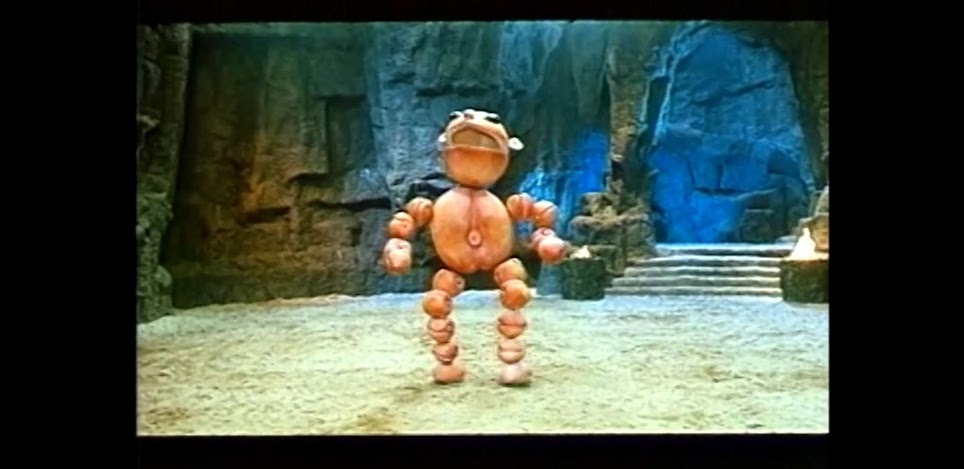
Dreamchild was the brainchild of screenwriter Dennis Potter, whose name is all over the credits as a producer who self-funded the project. All of the visual panache of the fantasy sequences arrive courtesy of the Jim Henson Creature Shop, who illustrate several key characters from the Wonderland & Looking Glass canon as nightmarish ghouls who haunt Alice Hargreaves in her old age. Those sequences are relatively sparse, though, and most of the runtime reflects Potter’s background as a journalist and television writer, staging lengthy exchanges of dialogue in hotel rooms & press offices. In those conversations, Potter pokes at the differences between American & British cultures’ respective relationships with money and, more bravely, the differences between 19th & 20th Century cultures’ respective relationships with age-gap courtship. As depicted in the film, Alice Hargreaves suffered self-conflicted feelings on both subjects and her own personal participation in them. She is, undoubtedly, Lewis Carroll’s victim, in that her entire life is unfairly shaped by his immoral yearning for her as a child. However, Potter finds enough grey-area nuance in her victimhood to allow her to appear onscreen as a fully realized human being instead of a historic symbol of trauma and abuse. Lewis Carroll himself is even extended that grace, regardless of whether he deserves it.

-Brandon Ledet

Podcast #241: Camille Claudel (1988) & Artist Biopics

Welcome to Episode #241 of The Swampflix Podcast. For this episode, Brandon, James, Britnee, and Hanna discuss a grab bag of biopics about famous visual artists, starting with 1988’s Camille Claudel, starring Isabelle Adjani as the titular sculptor.

00:00 Welcome

03:07 Linda (2025)
05:09 The Black Sea (2025)
08:58 Sinners (2025)
14:08 Popeye the Slayer Man (2025)
18:45 Dreamchild (1985)
22:27 The Story of Adele H (1975)

25:32 Camille Claudel (1988)
53:10 Pirosmani (1969)
1:03:28 Basquiat (1996)
1:19:01 Frida (2002)

You can stay up to date with our podcast through SoundCloudSpotifyiTunesTuneIn, or by following the links on this page.

– The Podcast Crew

Ebirah, Horror of the Deep (1966)

There are many ways in which the Louisiana education system is an embarrassing disaster. We often rank at the stank-ass bottom of US states in our education metrics, with a long history of political corruption, racial segregation, and religious privatization getting in the way of any progress towards improvement. So, I feel it’s totally legitimate to blame that system for the fact that I have been living in Louisiana for four decades and have never once seen the movie where Godzilla fights a giant crawfish. There should be annual screenings of Ebirah, Horror of the Deep in every local middle school. It should be as integral to Southeast Louisiana culture as The Blue Dog, “You Are My Sunshine,” and “They All Ask’d for You.” Godzilla fights a giant crawfish in it, for God’s sake. The school system has failed us yet again.

Part of the reason why Ebirah is missing from local syllabi is that the exact species of its titular crustaceous monster is up for debate. Most kaiju scholarship cites Ebirah as the middle ground between a shrimp and a lobster, citing that the “ebi” section of its name is interchangeable in reference to either shrimp or lobster in Japanese. It’s a compelling aural argument, but I also have eyes and, as a lifelong Louisiana resident, I know a crawfish when I see one. Ebirah enters Horror of the Deep claw first, smashing a fishing boat with its dominant limb to tease the mystery of what kind of giant crustacean it could possibly be: shrimp, crab, lobster, etc. As soon as its body emerges from the water to reveal its full form, however, the question is firmly, definitively answered. That’s a dang crawfish.

The kaiju saviors summoned to de-claw and dispense of this monster crawfish are Godzilla & Mothra, who spend most of the movie enjoying a nap. Returning to her winged moth form after spending a couple battles against King Ghidorah as a silk-spewing grub, Mothra is getting her beauty sleep on Infant Island, while the indigenous people she protects pray for her to wake up and save the day. Meanwhile, Godzilla is thought to be dead while he takes an angry-nap under a pile of rocks in a oceanside cave. He’s awoken Frankenstein-style via electric shock, channeling lightning through a sword and a trail of copper wire rigged to ruin his nap. Pissed, Godzilla immediately springs into action and destroys everything in striking distance, a rampage that includes ripping Ebirah’s claws off and kicking him back into the ocean depths.

Because the kaiju fights are delayed by siesta, Horror of the Deep leaves plenty of room for humans-on-the-ground drama, which it only takes semi-seriously. The story centers on a young man who’s desperate to reunite with a brother lost at sea, since he was told by a psychic that his brother is still alive. His schemes to engineer the family reunion improbably involve a televised dance contest, a stolen yacht, and a fugitive bank robber, only for both brothers to be shipwrecked on a small island overrun with militant fascists, thanks to Ebirah’s boat-smashing claw. You see, a vicious militia known as The Red Bamboo have forced the indigenous people of Infant Island to work as slaves in order to produce a fruit-based chemical that repels & controls the mighty Ebirah, and the only way to stop them is cause a little chaos by waking both Godzilla & Mothra — a scheme even more harebrained than saving the day via dance contest.

Once all of the skyscraper combatants are awake and engaged, Horror of the Deep proves to be one of the more fun, lively entries in the early Godzilla canon — the most playful since King Kong vs Godzilla. Director Jun Fukuda takes over from Godzilla mastermind Ishirō Honda here, and he loosens up the tone with some fun novelty additions to the format. Ebirah’s attacks are often filmed from a 1st-person perspective, shot in Crawvision. Godzilla also fights the crawbeast underwater, a precursor to the zombie vs shark fight of Lucio Fulci’s Zombi 2. His reluctant face-turn to heroism is jubilantly scored to surf rock, a soundtrack that seemingly inspires Godzilla to dance. The biggest laugh of the movie, however, is the dialogue exchange where our yacht-stealing hero answers the insult, “Your brother’s crazy!” with the deadpan retort, “Yeah, crazy about helping those in need.” That’s good stuff.

Regardless of your personal Louisiana residency status, Ebirah, Horror of the Deep lands as an especially fun, light-on-its-feet Godzilla outing. I was surprised to learn that its American dub, Godzilla vs The Sea Monster, was given the robo-heckling treatment on an early episode of MST3k, which means the show was ironically mocking a movie that was already clearly intended to be an unserious hoot. That’s not the only American institution that let the film down, though, or even the most egregious. It’s time that Louisianans write their  senators to petition for Ebirah, Horror of the Deep to be screened in all local grade school classrooms (assuming that Louisiana schools can even still afford the AV carts of yesteryear). The kids need to know about the giant crawfish movie.

-Brandon Ledet

Enter King Ghidorah

There’s just no way around it; King Ghidorah is the most heavy metal monster in movie history. I mean that in the literal sense, since the supreme kaiju being is seemingly armored by a layer of gold scales, making his “heavy metal” designation as matter-of-fact as Mechagodzilla‘s. Of course, I also mean it in the colloquial sense. The three-headed dragon beast is loudly & proudly metal as fuck on a cellular level. When Ghidorah flies into the frame to take down Godzilla and his fellow skyscraper flunkies, the image conjures the crushing sounds of heavy-metal guitar riffs in audiences’ brains, even in the 1960s pictures that were produced well before Black Sabbath had a record deal. Ghidorah is so metal, in fact, that it takes at least three other Toho-brand monsters to muscle him out of the pit, one for each lightning-spewing head. 🤘

The first time I encountered King Ghidorah was in the 1968 kaiju crossover picture Destroy All Monsters, in which the space-alien bio weapon was unleashed to union-bust a gang of kaiju that included Godzilla, Mothra, and Rodan (among the less-famous monsters Minilla, Gorosaurus, Anguirus, Kumonga, and Varan). Seen out of order in my winding journey through Criterion’s Godzilla box set, this appeared to be an especially grand ego-boost for the giant beast, like when WWE puts over their biggest, brawniest wrestler by having them eliminate every other competitor on the roster during the Royal Rumble. As it turns out, that was Ghidora’s exact funciton from the very beginning, and his debut entrance into the Toho kaiju ring marked the very first time Godzilla felt compelled to team up with other monsters to fight on humanity’s behalf. That Godzilla face-turn was in 1963’s Ghidorah, The Three-Headed Monster, in which evil space aliens declare interplanetary warfare by launching Ghidorah at Planet Earth, threatening to take over. It’s then up to Mothra, in her squirming grub form, to convince Godzilla & the pterodactyl-like Rodan to stop throwing rocks at each other like schoolyard children and instead join forces to fight off this existential, heavy-metal threat. They’re both petty assholes about it, but they eventually relent and team up to repel the flying hell-beast before going their separate ways.

The reluctant tag team of Godzilla & Rodan reforms when King Ghidorah returns in 1965’s Invasion of the Astro-monster. Rebranded with his new wrestler gimmick as Monster Zero, Ghidorah is once again deployed as an interplanetary weapon of mass destruction, one that can only be disarmed by the collective power of multiple kaiju opponents. His inevitable 2-on-1 battle with Godzilla & Rodan is delayed until the climactic 15 minutes of the runtime, though, as the invading Xiliens from Planet X smartly abduct Godzilla & Rodan with UFO tractor beams and imprison them for as long as possible so Ghidorah can do maximum damage, unchecked. Without the large-scale monster battles to fill up the runtime, Invasion of the Astro-monster spins its wheels with lengthy indulgences in political espionage and The X From Outer Space-style extraterrestrial cocktail parties. It’s maybe not the most thrilling approach to making a monster movie, but it does lead to some gorgeous 60s-kitch imagery. It’s impossible to decide what the most striking image of the film is in retrospect, but I’ve narrowed it down to two options: literalizing the Cold War aspect of the Space Race by putting a gun in the flag-planting astronaut’s free hand or Godzilla being abducted by a UFO. Then, Ghidorah soars into the frame to battle Godzilla & Rodan once again, erasing such questions entirely with heavy-metal bursts of lightning.

If there’s one detail of Ghidorah’s design that makes his metal-as-fuck majesty immediately obvious, it’s that each of his individual dragon heads moves independently, which is especially impressive when combined with his suitmation power of flight. It’s a lot like watching Kermit the Frog ride a bicycle for the first time in The Muppet Movie, adding an entire new dimension to kaiju suitmation spectacle audiences previously did not dream was possible. The suit was reportedly exceedingly difficult to operate as a result, often leading to longer shooting schedules as his operators struggled to keep his long, golden necks from tangling like noodles. Like headbanging to thrash riffs, it was well worth the headache. Everything else that makes Ghidorah so thunderously badass is immediately, visually obvious. He is the essence of metal, skyborne and beautiful. Godzilla mastermind Ishirō Honda’s impulse to bulk up the monster’s reputation by making him undefeatable unless several other kaiju attack in unison was a smart one, but it was also necessary. Look at him. No one would buy into the kayfabe otherwise.

-Brandon Ledet

The Tragedy of Man (2011)

The Tragedy of Man is one of the most triumphant pieces of art that I have ever seen. Functionally eternal in scope, limitless in imagination, and infinitely evolving and revolving, it’s no wonder that the 160-minute film took 23 years to complete. It’s lavish in the extreme, inventive in ways that I hadn’t even imagined that an animated film (or any film) could be, and is a fantastically layered text that could take half a dozen viewings to even get the full breadth and scope of it. Even for a film this long, it’s even more dense than you’re imagining, as the spoken dialogue comes at you quickly and at a pace that verges on relentless (and which is occasionally full of thous and thees). This is unsurprising if one considers that it’s based on an 1861 play by Hungarian aristocrat and author Imre Madách, which was itself based on a previous work of his, a dramatic poem that was about four thousand words long. It’s a tale as old as time, as it opens on a celestial scene in which Lucifer argues with God about creation, citing himself as the primeval spirit of negation, the shadow that must exist because of his Creator’s light. He claims that humanity will aspire to become gods themselves in time, and God gives Lucifer his share of the world, which takes the form of the twin trees of Knowledge and Immortality. 

You know how this story goes, and once the Fall occurs, Adam takes his first step into the apostasy of apotheosis by deciding that he will live on his own strength. As he and Eve find themselves living in a cave, he is never without Lucifer by his side, in various canine forms, man’s (false) best friend. Eventually, Adam demands that Lucifer follow through on the promised infinite Knowledge that he should have obtained from eating the fruit of temptation, so Lucifer does so by taking Adam on a spiritual journey that encompasses vast swaths of human history as Adam finds himself filling the role of various men of import throughout time. First is ancient Egypt, where Adam quantum leaps into Pharaoh Djoser in 2650 BC, where Eve takes the role of the wife of a slave who dies under the pharaoh’s demanding construction plans, with whom Djoser/Adam then falls in love, leading him to decide to abolish slavery. Lucifer, here appearing as Anubis in all of his dog-headed glory, tells him that history will still be a tapestry full of people enslaving one another, and that despite being as like a god as a man could be for that time, sand and time will reduce it all to nothing, and his proclamations of equality will change little, if anything. This will be the recurring theme of each of the time frames that Lucifer shows to Adam: mankind is on an eternal sinusoidal curve, and every time some kind of progress is made, it is inevitably corrupted because humans are savages at heart. 

What I haven’t mentioned yet is that the above opening captures almost half a dozen different aesthetic art styles within those first plot developments. Lucifer and God’s conversation plays out in nebulous, colorful cosmos that represent all of existence and God’s permeation of every aspect of it, with Lucifer as a pure negative space within all of that firmament, like a silhouette animation. After the expulsion from Eden, Adam and Eve suddenly have hyperrealistic features, with everything being animated in a way that’s reminiscent of illustrated children’s books about cavemen. They’re honestly ugly to look at, and it works as an externalization of their fall from beings of perfected flesh to mortal meat. Much of the Egyptian segment is made up of flatly rendered images that evoke the stiff body language of hieroglyphic figures, but at other times it shows both the labor below and Djoser/Adam gazing upon it. And so, the art changes between (and within) different time periods, usually choosing and sticking to a color palette for each segment but not to one specific style. When Adam becomes Militiades in Greece during the 5th century BCE, the animation style takes on the appearance of the images emblazoned on Grecian pottery, and when he finds himself in first century Rome, gladiators battle it out in moving mosaics. The film never stops to let you catch your breath, and by the two-hour mark I was leaning forward in my seat in eager anticipation, metaphorically headlong. 

Eventually, Adam’s journey catches up to the life and times of Christ, and he (and Eve) reconnect with God through him, embracing his message of love and fraternity, but they then watch in disappointed horror as Adam, in the form of Crusader Tancred, watches as the message that seemed poised to save mankind from itself falls into sectarian violence and strategy, with a debate between two branches of Christianity in the midst of a schism morphing into the shapes of the churches that they represent, which bash against each other until nothing is left but blood and bricks. With Adam then embodying Johannes Kepler in the seventeenth century (in a style of mostly monochromatic moving woodprints), it seems like scientific and rational progress will be the thing which leads humanity out of the darkness, only for Adam to then find himself in the stead of French Revolutionary figure Georges Danton, who is initially lauded for his anti-aristocratic stance but who finds himself executed when the mob considers him insufficiently radical. Adam finds himself wishing for a world in which society is organized along principles for the common good, and then he gets to see what that future will (or might) look like, in which all that remains of nature are the genetically modified beasts and flora and in which nations have been completely abolished. Of course, the end of nations has not meant the end of the state, as he learns quickly when he bears witness to a woman being severely punished when she refuses to hand her son over to the state for education and assignment to employment when he comes of age (he can’t be more than ten). Further in the future still, Adam is a giant floating in the void just beyond earth’s atmosphere, where machines arrive and replace his organic parts with mechanical ones that turn him into a humanoid spaceship, before he returns to see man’s end, in a distant ice age in which all that remains of Adam’s progeny are savages, but Lucifer argues that despite their bestial mutations, they are no different from humans of any other era, as people never fundamentally change. 

In all of these situations, Lucifer always brings Adam to the end of an age of progress, showing or implying the inevitable backward swing of the pendulum that (we hope) always bends in an arc toward justice. It’s arguable that this can’t be helped; he is, after all, the embodiment of shadow and obfuscation, and so there’s no purpose in showing Adam how democracy is born when he can instead reveal how it dies. That role falls to Eve, who likewise appears in every segment to be the voice of reason and hope for the future to counterpose the fatalistic nihilism that Lucifer is sowing into her husband’s mind. She’s the widowed slave whose love of Djoser ends slavery (at least for a time), both a guillotined aristocrat and a pro-Terror prostitute in Revolutionary France, the faithful wife of Militiades and the unfaithful wife of Kepler, and she is the woman who refuses to allow the state to essentially kidnap her child in the materialist future. The film’s a little trite and old fashioned in the way that it treats gender, as Adam (and therefore men) is always the historic actor while Eve (and thus women) exists to pull him back from the edge of the abyss, over and over again, but given that the source material predates the Transcontinental Railroad, it’s understandable. 

I can’t stress enough just what an amazing technical achievement this is. There are images from this that will stick with me forever. I can’t stop seeing the people of France dissolve into a great wave of red and blue that bears Danton/Adam aloft upon itself, or the shadow of the guillotine that is cast across his face. As the 20th century’s present comes into view, the endless gears of existence grind on, first as soldiers fall within the teeth of the cogs of the machine, followed by various pop culture figures as they replace the gods of eras past, and it feels like it could go on for the rest of time. And then it does. For all of its overt religiosity, there’s no denying that this is a monumental work of inarguable artistic relevance. At just under three hours, it’ll be a little while before I dig into it again, but I hope that it opens up for me even more when I find my way back to it again.

-Mark “Boomer” Redmond

D.O.A. (1949)

D.O.A. is a tight little noir thriller (#89 in Douglas Brode’s list in Edge of Your Seat, for those of you playing along at home) that’s one of the most perfect encapsulations of the genre. At 82 minutes, there’s almost no fat to be trimmed, and since it lapsed into the public domain years ago because of failure to renew the copyright, it’s accessible pretty much anywhere. Director Rudolph Maté, who would go on to helm When Worlds Collide just a year later, had risen through the ranks as a cinematographer, having earned his stripes on films as varied and well-remembered as Carl Theodor Dreyer’s The Passion of Joan of Arc and Vampyr, Alfred Hitchcock’s The Foreign Correspondent, and the Rita Hayworth vehicle Gilda from director Charles Vidor. That eye for composition is striking in the film’s opening sequence, a minutes-long tracking shot that follows a man through a vast and echoey police station to find a particular detective so that he can report a murder: his own. 

Frank Bigelow (Edmond O’Brien) is an accountant and notary public in the desert town of Banning, California, population about seven thousand at the time. His secretary, Paula (Pamela Britton) is madly in love with him, a situation that he seems disinterested in either quashing or pursuing. He springs the news to her that he’s taking a solo weekend trip to San Francisco, much to her disappointment, but there’s nothing she can do to stop him, and away he goes. Arriving at his lodgings, he discovers that the place is full of salesmen who have just wrapped up an annual conference and are holding various parties all over the hotel. The place is lousy with pretty ladies in expensive fur coats, and Frank seems more than ready to sow some oats hither and yon, but not before he returns Paula’s messages. She’s not pleased to hear all the caterwauling in the background, but she nevertheless dutifully reports that a man named Eugene Philips, an importer-exporter, had been desperately trying to reach him all afternoon, ending with the cryptic statement that if he didn’t talk to Frank right away “it would be too late.” Frank goes out with the salesmen from the room across the hall to a jazz bar, where the host’s wife starts to get a little too handsy, and he excuses himself to make small talk with a pretty blonde at the bar. Distracted, he doesn’t notice the lurking figure with his back to the camera surreptitiously slipping something into his drink. The next morning, he feels extremely ill and gets a terminal diagnosis; he’s ingested the “luminous toxin,” a poison with no antidote, and now he has only days left to live, not much time to find out who his killer is.

There’s a lot that happens in the first act of this one, which is great, since it means that the second and third acts move at a breakneck speed as Frank works to pull at all of the threads of a decently convoluted conspiracy and solve his own murder before he drops dead. Paula is a fascinating character, as she initially comes off as slightly off-putting, pestering Frank to the point of workplace sexual harassment. She insists that he take her out for a drink and is notably upset that Frank made plans for a weekend trip that didn’t include her, but she also seems to realize that this is Frank taking an opportunity to give himself one last weekend as a swinging bachelor before settling into a life with her in Banning. Upon awakening in San Francisco on Saturday morning, he’s clearly ready to go back and marry Paula, even before he learns that he’s dying. Once he tells her that he needs her, she shows up to act as his sidekick for the rest of the film, and there’s real affection there. The great tragedy may be that if she hadn’t been suffocating him so, he might not have felt the need to spend a weekend away from her, and then he wouldn’t have been poisoned. Alas. Not that it would have helped save Eugene Phillips, who was going to “commit suicide” that Friday night one way or another. 

One of the other great tragedies in this has a major noir bent, which is the trope of the innocent man caught up in a dangerous web of lies and crime. For Frank, it comes down to a particular bill of sale that he notarized for Phillips months in the past, one that would have proved the dead man’s innocence. It’s not really spoiling much; the film’s electric energy all revolves around Frank going from place to place and getting answers that lead to more questions, all leading back to Phillips’s untimely demise. Who’s the real villain here? Is it Phillips’s brother, who was carrying on an affair with his sister-in-law? Is it Halliday, Eugene’s business partner? Is it the mysterious George Reynolds, whom no one seems to have ever seen and which may be no more than an alias? It’s a tight little mystery that’s completely streamlined. Just as Frank is running out of time, he grows increasingly frantic and desperate to find out who’s responsible for setting his death in motion and ensure that Paula is out of their reach, and the film feels similarly harried and headlong as it rushes toward the conclusion. 

Maté’s is a name that one doesn’t hear bandied about in cinephile circles all that much. It can’t help that, looking at his CV, his filmography is all over the place. There are several films noir listed there, many of which seem intriguing even if I’ve never heard of them, like Union Station starring William Holden, Paula starring Loretta Young, and Forbidden starring Tony Curtis. But in the midst of those are a motley assortment of historical adventures (The Prince Who Was a Thief, The Black Shield of Falworth, and The 300 Spartans), romantic comedies (It Had to Be You, Sally and Saint Anne), Oscar bait (No Sad Songs for Me), and far, far too many Westerns to name. The man worked, and his talent is clear here, and I’m excited to see if I can track down some of his other noir and crime thrillers, even if I have no interest in Siege at Red River, The Far Horizons, or The Rawhide Years. The performances here are great as well, as O’Brien perfectly embodies a man who’s clearly been spending too much time helping farmers file their taxes and fending off Paula’s pawing at him and just needs to know he could still get a city girl’s number, even if he can’t follow through with ringing her up. Britton also walks a narrow tightrope here, needing to play Paula as written while also making her someone we find likable enough to root for her and Frank to get together. With such a short time commitment and widespread availability (it’s even on Tubi), D.O.A. is worth checking out. 

-Mark “Boomer” Redmond

Ballerina (2025)

While viewing the recent political satire Mountainhead, I kept thinking about that frequent online refrain that people use as a response whenever someone posts something conspiracy-addled or which otherwise blows the mind of the poster: “This must hit so hard if you’re stupid.” Mountainhead itself is not one of those movies, as for whatever issues one may have with it, it’s certainly not meant to appeal to the kind of people whose ignorance gives them delusions of intelligence; it’s a mockery of those people. Many lines that came out of the mouths of those characters felt like exactly the kind of thing that probably sounds very smart to very stupid people. I was also reminded of the phrase while watching the new action flick Ballerina, advertised as being “from the world of John Wick.” I’m fairly partial to the John Wick series, lumping the first three films together in the #40 slot on a list of my 100 favorite films of the 2010s (and later giving John Wick 4 a 4.5 star rating when it came out a couple of years ago). Even with that being said, that series and this spin-off are exactly the kind of films in which the plot exists solely to put the protagonist through the ringer and have them face off against hordes of killers, setting them up and mowing them down. The narrative choice of introducing a whole underworld society of assassins with their own rules, regulations, and responsibilities in the first film allowed for the franchise to let that choice of mythos grow (and perhaps even balloon and bloat). By the fourth film, we were introduced to the concept of “The Table” that oversees the whole masquerade, “Harbingers” who enforce their rules and customs, “Adjudicators” who investigate potential violations of the house rules of the Continental hotels, a vast network of intelligence operatives posing as panhandlers and led by “The Bowery King,” and the Ruska Roma, the organization that trained John Wick in his youth and which presents itself to the world as a premier dance theater and academy while disguising its role as a school for assassins. All of which probably hits so hard . . . if, well, you know the rest. But sometimes, it’s okay to dare to be stupid. 

The last of these was introduced in John Wick 3, when Wick (Keanu Reeves) meets with The Director (Anjelica Huston) to call in a favor. Ballerina has been in the works since before that time, when Lionsgate purchased the first script from screenwriter Shay Hatten with the intent to adapt it as part of the John Wick series. Hatten was then brought on to write both JW3 and JW4, which allowed him to plant the seeds for Ballerina, with the film eventually being produced nearly ten years after initial conception, with Len Wiseman, director of the first two Underworld films and former husband of their star Kate Beckinsale. Wiseman also directed that Total Recall remake that everyone hated, which, when placed alongside the duds in Hatten’s writing resume (which includes three Zack Snyder partnerships, for Army of the Dead and parts one and two of Rebel Moon), does not give one the impression that Ballerina was destined for greatness. It more than succeeds, however, at carrying the torch of this series, and is the first big dumb blockbuster of the summer, which I mean with all due respect. 

Javier Macarro (David Castañeda) is raising his daughter, Eve, in a large waterfront mansion home, where he dotes on and adores her. One night, their home is invaded by a man (Gabriel Byrne) who intends to kill Javier and return Eve to her mother’s family, citing that Javier had no right to steal her away. Javier manages to kill all of the man’s henchmen but their leader escapes, and Javier succumbs to his wounds. This prompts the arrival of Winston (Ian McShane), the manager of the New York Continental, who delivers Eve to the Tartakovsky Theatre and its Director, in the hopes that she might find her place in the world of assassins in which her father was raised. Twelve years later, Eve (Ana de Armas) has spent all of this time learning both ballet and the art of delivering death, although she’s struggling with the latter more than the former. After a pep talk from mentor Nogi (Sharon Duncan-Brewster) in which she is encouraged to “fight like a girl” (i.e., dirty), and when she eavesdrops on the conversation between John Wick and The Director in JW3 and then asks the man himself for advice, Eve starts to gain the upper hand over her opponents. After passing her final test, gets her first field deployment as an escort for the daughter of a rich man whose enemies may attempt to abduct and ransom her. After an impressive action sequence in an icy nightclub called -11, her getaway is foiled by the sudden appearance of an assassin whom she manages to subdue, discovering that he has the same scarification that her father’s would-be killers had. The Director refuses to reveal any information, which leads Eve to cash in on her connection to Winston, who points her in the direction of a mysterious man hiding out at the Continental in Prague (Norman Reedus) who might be able to tell her more. 

Strangely enough for these movies, the mythbuilding that has occasionally been a stumbling block for the series as it grew is hamstrung here. We eventually learn that Byrne’s character is the “Chancellor” of a cult that makes its home in the seemingly quaint European mountain town of Hallstedt, but while we hear about this cult over and over again, we never get any real idea about what their beliefs or goals are. There’s an electrifying scene early on in which Eve is put to her final graduation test at the dance academy, which sees her put in a room at a table with two disassembled guns, and another woman (played by Rila Fukushima, who is always welcome on my screen) enters, clearly furious and distraught that she’s been reduced to “a test.” When Eve asks her who she is, she tells her that she’s Eve, “in ten years.” Then a timer starts and she starts assembling the gun and … all we know is that Eve passed. When arriving at Hallstedt, all we learn about the people living there is that (a) no one is allowed to leave, and (b) it appears to serve the purpose of some kind of retirement home for past killers, where they can settle down and raise children. Other than the fact that you can check out any time you like but can never leave, there’s no indication that the so-called “cult” has any foundational beliefs or ideologies, and there’s a real missed opportunity there. Also, since most of us have seen John Wick 4, we know that John is destined to die, and sooner than later. Here, the film gives us two potential endpoints for Eve’s journey that show she doesn’t have to follow the same path that he does—retirement or “retirement”—but the film doesn’t seem all that interested in developing either of these ideas. They might be saving it for the sequel, but as a man who always loves fiction with cults in it, I was a mite disappointed that we never learned that the cult worships a personification of Death or is preparing for some kind of evil version of the Rapture, or anything else that would make them a “cult” and not a convenience for the narrative. Even the familial connections that we learn Eve has in Hallstadt are pretty obvious and end up being pretty irrelevant within minutes of learning them, and it wouldn’t be a Hollywood script if Eve wasn’t offered something tempting to her followed by someone making the obvious joke (which probably hits so hard if you’re stupid). 

The action here is stellar, as always. I was hoping that we would get to spend a little more time with Eve’s learning curve, and that is an element. The thing about John Wick is that he’s an unstoppable force. You might be able to slow him down a little but, but you can never stop him, and the franchise is built entirely around watching him utterly destroy everything that gets placed in front of him. It’s like the Mission: Impossible or Final Destination films in that way; you’re here to watch the same movie as last time and the time before that, and you’re going to like it. When I mentioned to a friend of mine that I was going to see this one, he said that he had tried to get into the first one and couldn’t, complaining “It’s just Keanu Reeves killing people,” and I replied that these are movies that are more concerned with the ballet of violence. Ballerina, naturally, is no different from the other John Wicks in that way, as we get to see Eve use a pair of ice skates in a way that Hans Brinker could never have imagined, tear through cultists with a flamethrower (ho ho ho), and utterly destroy a kill team that was foolish enough to bring guns to a grenade fight. While we do get to see her improve, it’s done in a fairly trite way, as Eve initially struggles to gain the upper hand in matches against her larger, male sparring partners, until Nogi tells her to “fight like a girl,” at which point she starts kicking dudes in the nuts and becomes the class’s top dog. It feels like a very 90s line and a very 90s cliché, but at least it gets a fun callback later when Eve, armed only with rubber bullets, shoots one of her attackers in the groin. Her evolution to killer happens fairly quickly over the course of a montage and by the time we see her in the field after a two-month jump, she’s almost unstoppable.

I suppose that this is better than watching her struggle a lot more than John does in his films, because the audience for these movies can trend a little toxic. I’m sure that the people who are already calling her a Mary Sue in some dark, roach-infested corner of the internet would have been complaining about her being a weak and ineffective hero in comparison to the unflappable Chad John Wick if we had gotten to see her spend a little more time on the road to becoming a finely tuned killing machine. Instead, the film plays it smart by showing us that Eve is fully dedicated and will push herself past her limits even when she falls short in her academic environment, such as it is, and then cuts to her displaying an almost John Wick-level of hypercompetence in the field of dealing death. Later, when her quest to avenge her father (and rescue a young girl whose father was willing to die to get her away from Hallstedt but who wasn’t as successful as Eve’s father) triggers a sharp exchange between the cult and the Roma Ruska with the promise of a war between them if Eve isn’t stopped, the Director calls in the favor John Wick owes her and sends him to Hallstedt. For her part, Eve is brave enough to try and fight him when he shows up on the scene, and although she’s giving it her all, it’s immediately clear that she’s completely outclassed by him. She’d be dead within moments if John wasn’t willing to hear her out and, sympathetic to her story, he gives her until midnight before he hunts her down. It’s a good balance that Eve seems just as implacable as John until she’s actually face-to-face with him in a combat situation and he’s completely unfazed, dodging her attacks without breaking a sweat. 

Beyond the aforementioned lack of depth given to the cult, my other big complaint about this film is that there’s just not enough ballet for a movie called Ballerina. We see Eve dance as a child and her tragic memento of her dead father is a wind-up ballerina, but after the opening credits, the ballet doesn’t come up again until the end, when Eve wistfully watches a performance by a former classmate who washed out (and fell back on her dream career of being a ballerina). I was really hoping that there would be a lot more dance-inspired action happening here, as would befit the title and concept. The film does seem more hesitant to show de Armas shooting people while Reeves was doing lots of gun-fu in his outings, which stood out to me a lot when her kit for her first mission is a non-lethal gun. We get to see her shoot a few people in Hallstedt, but until that point, we’re mostly limited to hand-to-hand combat, improvised weapons, and a whole lot of grenadery. I initially thought that this might be some old-fashioned Hollywood sexism happening in that they presume we won’t tolerate women being as violent as we allow men to be, but later in the film she burns dozens of men and women to death without flinching, which is even more horrific, so I’m not really sure. But given how much combat happened in the first half of the movie, would it have hurt to have Eve doing some pirouettes or en pointes somewhere to make her fighting style more distinct from John’s? In the moment in which she finds herself with a pair of skates in a boathouse and standing on the ice below the dock, I got terribly excited that we were about to see some ice dancing/fighting, but instead she just slices and dices. That’s all well and good (and hits hard if stupid), but it felt like a missed opportunity. This film could have been called Equestrian: From the World of John Wick and been about a girl’s riding academy that was secretly a cover for murder training and the effect on both the plot and the action would be negligible. If we go back to this well again, maybe we’ll get to see it next time. 

-Mark “Boomer” Redmond

Pavements (2025)

The 90s alt-rock band Pavement is, undoubtedly, one of “the most important and influential” bands of their time. There’s just no way to point that out without betraying their relationship with artistic sincerity & professional ambition. So, the new career-retrospective documentary Pavements has to hide that sentiment behind several layers of self-protective sarcasm & ironic remove, declaring Pavement to be “The World’s Most Important and Influential Band” of all time, forever . . . as a goof. Here, Alex Ross Perry gives the rock-band mascot of 90s slackerdom the same kaleidoscopic hagiography treatment Brett Morgan gave David Bowie in Moonage Daydream, except in this case his subject is around to make fun of that idea the entire time they’re going through the motions of it. They made fun of the positive press & financial success they found in the 90s too, constantly mocking the concept of rock stardom until they were no longer in danger of achieving it. And yet, both their songs and this nostalgic overview of their history can be genuinely beautiful & moving at times, despite all efforts to undercut any overt sincerity. The words are pyrite, but the soundz are gold.

Pavements is a loosely constructed document of four simultaneous projects meant to commemorate the important, influential art of Pavement’s heyday: a diary of their recent reunion tour, an art-gallery exhibition of their vintage artifacts, a Bohemian Rhapsody-style biopic spoof and, most improbably, a staging of an original jukebox musical. All of your favorite Pavement tracks from their Quarantine The Past greatest-hits compilation repeat several times throughout, but none are heard in total. They’re all fragmented between fictional & real-world variations in the four simultaneous projects, practically lyric by lyric. As a result, the film feels deliberately formless & unfinished, a documentary that runs over two hours in length but never feels like it truly gets started. That approach might be frustrating for newcomers hoping to actually learn something about the band or to at the very least be hooked by their standout singles. Anything I learned as a casual fan was entirely by accident – gleaning some interpersonal band member dynamics and album-cycle evolutions of their sound that I didn’t pick up on while discovering their records the decade after they broke up. Still, it’s a perfect approach for a band that was so stubbornly committed to maintaining their detached 90s slacker cool while contemporaries like Sonic Youth, Nirvana, and The Smashing Pumpkins were becoming unlikely household names.

The biggest surprise of Pavements is the comedic chops of Stranger Things alumnus Joe Keery, cast here as the fictional biopic version of Pavement singer Stephen Malkmus. Keery outshines the much more luminary comedic performers Jason Schwartzman & Tim Heidecker in those sequences, making a big show out of impersonating Malkmus with unwarranted method-acting commitment. Like everything else in Pavement lore, it’s a flippant mockery of artistic pretension, but it also occasionally touches on something strikingly impressive & true. There are several interview clips in which Malkmus is being aggressively sarcastic & uncooperative with press that are indistinguishable from their corresponding Joe Keery parodies until the camera reveals which of the two brats is yapping. Much like Sophie Thatcher’s performance in the recent music video for the once-obscure Pavement B-side “Harness Your Hopes,” Keery acts as a modern avatar for the band’s pranksterism so that they don’t have to take the spotlight themselves, and he provides a lot of the movie’s most coherent reference points for tone & narrative. Otherwise, Pavements is a scrapbook of 90s-era college radio slacker rock, as soundtracked by “the most important and influential” band to define the sound. Its fragmented approach that avoids enthusiastically committing to any one framework for retelling Pavement’s story is likely the only way that story could be told; it could only make fun of itself for trying at all.

-Brandon Ledet

Lagniappe Podcast: The Discreet Charm of the Bourgeoisie (1972)

For this lagniappe episode of The Swampflix Podcast, Boomer & Brandon discuss Luis Buñuel’s surrealist satire The Discreet Charm of the Bourgeoisie (1972), in which a small party of upper-class snobs are repeatedly deprived of their dinner.

00:00 Welcome

01:27 Batman Ninja vs Yakuza League (2025)
06:25 Vulcanizadora (2025)
09:52 Pavements (2025)
19:52 Ernest Cole – Lost and Found (2025)
25:51 Mountainhead (2025)
33:23 Ballerina (2025)
34:15 Drop (2025)
35:47 Bring Her Back (2025)
40:00 The Phoenician Scheme (2025)
49:28 Caught by the Tides (2025)
52:26 Rampo Noir (2005)
56:00 Tokyo Godfathers (2003)
58:58 Taxi Driver (1976)
1:06:54 The Tragedy of Man (2011)
1:09:42 Josie and the Pussycats (2001)
1:14:43 Popstar – Never Stop Never Stopping (2016)

1:19:31 The Discreet Charm of the Bourgeoisie (1972)

You can stay up to date with our podcast through SoundCloudSpotifyiTunesTuneIn, or by following the links on this page.

– The Lagniappe Podcast Crew

Mountainhead (2025)

I’ve never seen Succession, so I wasn’t terribly interested when I heard that the show’s creator had written and directed a new direct-to-HBO feature, but I found myself on a couch watching it with friends on a lazy Sunday afternoon after a dip in a municipal pool. Of the five of us, two of them had already watched it within the past couple of days and were excited to watch it again, one of whom was Erstwhile Roommate of Boomer, who described the film as having one of the funniest sequences he had ever seen in a movie. After this declaration, he expressed that he hoped he hadn’t hyped it up too much. This did turn out to be probably the funniest movie I’ve seen so far this year, although general audiences don’t seem to be connecting with it. 

Hugo Van Yalk (Jason Schwartzman), known to his “friends” as “Souper,” has invited the rest of said quartet to his recently constructed mansion, Mountainhead, in the remote mountains of Utah. The group, which calls themselves the “Brewsters” (presumably a play on Brewster’s Millions), consists of mega-wealthy a-holes who only have a few rules for when they get together for a boys’ retreat: “no deals, no meals, no high heels,” which is to say snacks only, no business, and no women. Despite the “no deals” disclaimer, Souper plans to use the time together to pitch the other three on investing in his meditation app, which he continuously and defensively insists is a “total wellness superapp.” The patriarch of the group is Randall Garrett (a pleasantly salt-and-peppered Steve Carrell), who has recently received a cancer diagnosis that gives him five to fifteen years, but don’t let that make you overly sympathetic to him right out of the gate. The two remaining members, Venis “Ven” Parish (Cory Michael Smith) and Jeff Abredazi (Ramy Youssef), are currently at odds with one another, as Jeff’s currently riding a rising tide made out of dollar bills as algorithm software that he invested in is seeing a major return at the same time that Ven’s 4-million user social networking app has just released a (too) powerful AI that’s literally breaking the internet. 

As the first order of business, we must establish that everyone here (with the possible exception of Jeff) is very, very stupid. They use a great deal of tech-based neologisms and throw around the names of philosophers like Georg Wilhelm Friedrich Hegel and Søren Kierkegaard as supposed sources for their personal philosophies (although Souper doesn’t seem to be able to graduate past Ayn Rand, given that his obsession with The Fountainhead influenced the name of the home for which the film is titled, with a copy sitting on a nightstand in one of the house’s many bedrooms). It’s clear from their feigned eloquence that they have, at best, secondhand knowledge of these schools of thought from pared-down excerpts that appear in the kind of pop-psych self-help/business fusion books that legions of “self-made men” are forever recommending to one another. They are society’s rotten creme which has risen to the top through lucky breaks, access to generational wealth, and stolen labor, and upon seeing themselves exalted to this position believe that they did so through some innate, unique specialness. We see this right off the bat when Randall, getting (at least) a second opinion that aligns with his previous doctors’ terminal diagnosis, insults his current oncologist’s intelligence directly to his face. Anger is just as normal a part of grief as denial is, but instead of raging against the heavens or the dying of the light, Randall defaults to personal degradation of someone who is, at a minimum, an order of magnitude more intelligent than himself. He’s so smart, you see? Intelligence makes money and since he has the most money, that makes him the most smartestest. 

Perhaps the worst among the crew is Ven, who is a borderline psychopath and, worse, their Elon Musk equivalent. His social network Traam has the exact same user interface, has tasked himself with moving mankind toward the singularity, and has a relationship with his oddly-named son Sabre that is so lacking in paternal qualities that it verges on being inhuman. He also hints at his belief in Simulation Theory in a conversation with Randall in which they both express that they don’t believe that there are really eight million real people in the world, and his desperation to seem approachable and well-humored makes him more alien and unlikable. At one point, he attempts to smile like a normal person and ends up looking like Conrad Veidt in The Man Who Laughs. Most tellingly, he has no reaction to the fact that Traam’s new AI platform is causing the end of the world while these four assholes are snowmobiling up to a mountain peak together to write their net worth on their chests and howl into the sky. Randall and Souper are likewise largely unphased by the breakdown of society, at their metaphorical and geographical remove from the real-world consequences of what Ven and Traam have wrought. Social media becomes inundated with AI-generated perfect deepfakes of everything from messages from loved ones to literal fake news; a man with a grudge against his neighbor can stir up a lynch mob to carry out his personal grievances in half an hour by quickly creating a video of a newscast calling the man as a pedophile. Literal wars break out globally as computer generated images of invasions along borders prompt real responses from governments and militaries, and Ven celebrates as his bank account swells. 

If there’s anyone here who has a speck of decency, it’s Jeff, as he’s rightfully horrified about the imminent downfall of nation states, while the others spitball the idea of a coup to establish their dominance in the world that is to come. Some of this is due to his anxiety about his girlfriend attending a sex party in one of the hot zones and his concern about her (a) survival and (b) fidelity, but he also has a moral framework that the others are completely lacking. He’s no saint, though, as his and Jeff’s falling out was over Jeff’s hiring of several of Ven’s programmers, who then went on to develop the exact content moderation algorithm that Ven needs, but for Jeff’s company instead. Selling the algorithm to Ven for Traam would at least prevent more new violence from breaking out, but he refuses to consider it, even as Rome (and D.C., and Buenos Aires, and Paris, and Melbourne …) burns. He does reach a point where he confesses to Randall that he’s thinking about turning the AI over to the real authorities so that they can try and put a cap on all this apocalyptic business, but this goes over poorly, and that’s when the film gets really interesting. 

I wasn’t terribly impressed with Guy Maddin’s Rumours last year, and although that one was about G7 leaders rather than four men with more riches than the pharaohs of old, the “Powerful people converge in a remote location while the world is ending over every horizon” structure is quite similar. Whereas that one is both too gentle in its handling of its characters and too broad in their characterization, Mountainhead goes full-tilt into making the Brewsters complete—and very specific—pieces of shit so that the movie can play around with people’s fates since there’s no real reason to root for any of these people for most of the runtime. By the time three of them turn on the other, the plot kicks into high gear with slapstick taking over, and although it never loses the witty dialogue of the first half, the film definitely picks up in the second half. One of my viewing companions mentioned to me after the film that he didn’t really enjoy it until this mid-film shift, and I can’t say that I blame him. Most of the film’s humor comes from the counterpoint between the Brewsters’ unflappable internal sense of entitlement and self-adulation and the external reality that they are all sad, sick men whose superiority complexes and narcissism mask deep neuroses and fatal flaws. It’s easy to get lost in their constant use of business buzzwords, but this also means that the film lends itself to an easy rewatch to pick up on even more of the rapid-fire nonsense that the leads spit out. It’s so fast that even though I rarely stopped laughing for much of the runtime, the bons mot were coming so furiously that few of them managed to embed themselves. It’s a movie that could easily become overquoted in the future, but is solidly funny in the moment. My favorite was probably Randall’s insistence that “We’re not talking about killing [character], we’re talking about killing a non-fungible human being who is identical to [character],” which really speaks for itself. 

-Mark “Boomer” Redmond