The Late Great Planet Mirth II – Revelation (1999)

EPSON MFP image

threehalfstar

campstamp

Welcome to The Late Great Planet Mirth, an ongoing series in which a reformed survivor of PreMillenialist Dispensationalism explores the often silly, occasionally absurd, and sometimes surprisingly compelling tropes, traits, and treasures of films about the Rapture. Get caught up in it with us!

Revelation, sometimes stylized as Apocalypse II: Revelation, is the first of three sequels to 1998 PPI release Apocalypse, and it is a massive improvement on the previous installment. Gone are the bargain basement community theatre actors who clogged up the works in the first flick, replaced by people you may have actually heard of before; gone is the soundtrack that consists almost entirely of Contemporary Christian Music artists, replaced by music that was actually scored for the film rather than haphazardly arranged behind it. Furthermore, the production value on Revelation is exponentially higher than that of Apocalypse, as this movie succeeds in actually looking like a movie and not a poorly produced television pilot shot on VHS. Although the proselytizing elements are still present in this film, they’re toned down significantly, and Revelation feels like it was conceived as a movie with the soapbox added as an afterthought, rather than the other way around.

The film opens on Thorold Stone, a counter-terrorism specialist whose wife and young daughter were among those who vanished three months prior; he spends his evenings reminiscing and watching old home films while flashing back to all the times his wife tried to convince him to join her in church. He is awoken from his reverie by news of a schoolbus bombing (which is a bit of a continuity problem, as all children were supposedly raptured, although this could have been a bus for teenagers), and he meets his partner at the scene of the crime. They trace the detonation signal to an underground church  meeting of “haters,” Christians who oppose the apparently benevolent Antichrist Franco Macalusso (recast and now played by Nick Mancuso, who would portray him for the rest of the quadrilogy). Although their orders are to kill all the Haters on sight, Stone and his partner arrest the group instead, allowing the Hater sect leader (Marium Carvell) to plant the seeds of doubt in Stone’s mind and pass him a CD-ROM that she says will show him the truth. Macalusso sends Len Parker (David Roddis, previously seen as the new head of WNN last time) to kill Stone and his partner, fearing they may have learned too much. Stone’s partner is killed, but Stone survives while the captured Haters are imprisoned and prepared for re-education.

The disc leads Stone to Willie Spino (Tony Nappo), a wheelchair-bound computer programmer who has been working on an incredibly advanced virtual reality program for Macalusso’s upcoming “Day of Wonders.” Spino is unable to access the disc despite it being part of his design, and his attempts to access the O.N.E. network reveal his location to the Antichrist’s forces; the two escape and make their way to the Christian underground, where Nappo reunites with his stepsister, who is revealed to be Apocalypse MVP Leigh Lewis, reprising her role as Helen Hannah. While the incarcerated Haters continue to persevere throughout their torture, blind cynic Cindy (supermodel Carol Alt), a member of Helen’s underground, voices her increasing frustration at having to live in hiding. When Willie manages to crack the final line of code, he learns what the Day of Wonders actually is: in the virtual world, everyone will face the choice of accepting the Mark of the Beast or death.

As noted above, Revelation is a departure from Apocalypse in quality across the board. Whereas Apocalypse featured a lot of montages in which the members of the audience are meant to meditate upon the ideas presented, this film finds its footing quickly and stays strong through the end. There’s a great sequence that follows Thorold’s introduction to Helen in which the two have a conversation about faith, which includes Thorold begging that God show him a sign as small as knocking over a water glass; Helen tells him that God doesn’t work that way, and even if he did make himself evident by causing the glass to tumble, Thorold’s mind would find another explanation for the event. After their discussion, Thorold stands and bumps the table on which the glass is standing, causing it to fall to the floor; still later, when their safehouse is raided by the Antichrist’s forces, the group is able to make their escape because Len Parker trips on the glass. It’s not the most elegantly composed chain of events, but it reflects an understanding of irony and foreshadowing that wasn’t present in Apocalypse, and the scene demonstrates a real understanding of how many people approach the question of the existence of a higher power. It’s surprisingly subtle and well-composed, and the film deserves credit for that.

On the other hand, there are problems with the script. Although the film’s intentional diversity is admirable in its inclusion not just of people of color but also the differently abled, the end of the film is arguably ableist in its approach to physical handicaps. Willie is the most fleshed-out character in the movie, and Nappo is obviously a talented actor, but his turn from reluctant ally to outright antagonist is abrupt. Further, the fact that only Willie and the blind Cindy are so quick to accept the Antichrist’s offer (which restores his ability to walk and her ability to see), and that they are the only two main characters to do so, is problematic in its implications; both are so desperate to be “whole” that they sacrifice their souls to do so, with the influence of the Antichrist turning them into cackling villains in the final act. It’s not a great message.

The film’s major issue, however, is also its greatest strength. Whereas Apocalypse was made with the intention of being an evangelical tool, Revelation has elements of that but is largely focused on telling a compelling story first, and it mostly succeeds. The problem with this is that the series has moved past the “world-building” stage and now expects the audience to be well-versed in the premillenialist dispensationalism that forms the narrative background. We learn in the opening moments that Thorold works for the O.N.E., which is never defined or explained. Readers of Left Behind and the works of Hal Lindsey will recognize that this is the “foretold” one-world government that the Antichrist will supposedly set up on the earth, and will likely assume that the O.N.E. is the One Nation Empire or One Nation Earth, but the casual viewer without a background in this particular eschatological concept is asked to accept a lot about this world that is not clearly explicated, which hurts the film overall. It may have been the intent of the filmmakers that non-specialized viewers then ask the PMD Christian friend who loaned the film to them to explain, but that’s asking a lot of a casual audience member. Still, this is a much more thoughtful approach to the subject matter than we got last time, and it manages to be genuinely compelling for most of its runtime.

-Mark “Boomer” Redmond

Daisies (1966)

EPSON MFP image

fourstar

I’ve been fascinated by isolated frames from the 1966 art house comedy Daisies for years, but never actually gave the film a chance until recently. Despite the intense, psychedelic cinematography that makes each scene so vivid in isolation, I was surprised to find that as a whole Daisies is for the most part an irreverent comedy. Adopting the same absurdist & humorous expressions of political unrest as the Dadaist movement during WWI, Daisies is a tonal protest against post-WWII Czech communism that combats the devastating emotional toll of war & totalitarian rule with sublime silliness. Director Vera Chytilová was years ahead of the curve on this absurdist comedy. Often cited as a cornerstone of the Czech New Wave and experimenting with visual trickery that still feels vivid & fresh five decades later (not to to mention predicting a lot of flower child hippie fashion), Daisies is an incredibly important work for something so wrapped up in absurdism & frivolity.

View Daisies in the wrong light & it might just play like a damning example of pretentious art cinema at its worst. Its disjointed, nonsensical dialogue about living as a “doll”, being “spoiled”, and “girls, girls, girls, girls” often feels like the more cringe-worthy aspects of performance art & slam poetry. The strange sound cues & alternating color filters often feel arbitrary at best, playing directly into the art-for-art’s-sake vibes of the film’s dialogue. Daisies is atonal & arhythmic in a way that’s sure to frustrate those who aren’t used to films that don’t aim to answer questions or satisfy genre requirements. Daisies is a provocation, a sort of a highbrow prank, and it’s too easy to see how that could be a turnoff for those who aren’t prepared for its obfuscation & deliberately nonsensical nature.

However, if you remove the intense cinematography, the ludicrous sound design, and the war imagery that opens & closes the film, you’d have what is at heart a remarkably silly comedy. Daisies follows two teenage pranksters (both ostensibly named Marie) as they leave behind a widespread trail of low-level mischief. Their worst crimes amount to leading along older men in order to eat lavish meals, disrupting night club acts, and some light pickpocketing. Daisies is just as girlish as it is disjointed & psychedelic. It’s hard to imagine exactly why the film got its director banned from working in her homeland for a decade for “depicting the wanton.” The film does depict its fair share of drunkeness & sexuality, but it mostly amounts to two teen girls (literally) swinging from the chandelier & cutting neckties like Harpo Marx. There certainly is a political tone to the film that suggests unrest & discontent, but just like everything else at play it’s mostly detectable as a prankish goof.

I think what I enjoyed most about watching Daisies was pinpointing where its influence has trickled down into modern media. Its absurdism & girlish pranks posit the film as an art house Broad City. The butterfly-heavy still image montages recall the hyperspecific beauty of (my favorite film from last year) The Duke of Burgundy. Its myriad of color filters & bizarre editing choices have been passed down through so many different films & television series over the decades that it would almost feel cliche if it weren’t for the date of its release. The giant scissors cutting up phallic symbols (sausages, bananas, pickles) in an intimate bedroom/art studio reminded me a great deal of Felt, a film I’ve been championing a lot lately. As much as these individual elements are recognizable in modern cinema in television, Daisies is still an idiosyncratic work. Its collage-covered bedrooms, classical surrealism (including a nod to Magritte’s green apple), still image montages, and maniacal giggling are all remarkably vivid & unique. Similarly, its Cubist approach to editing isn’t entirely impossible to find in other works (Hausu comes to mind), but it does still feel fresh & idiosyncratic.

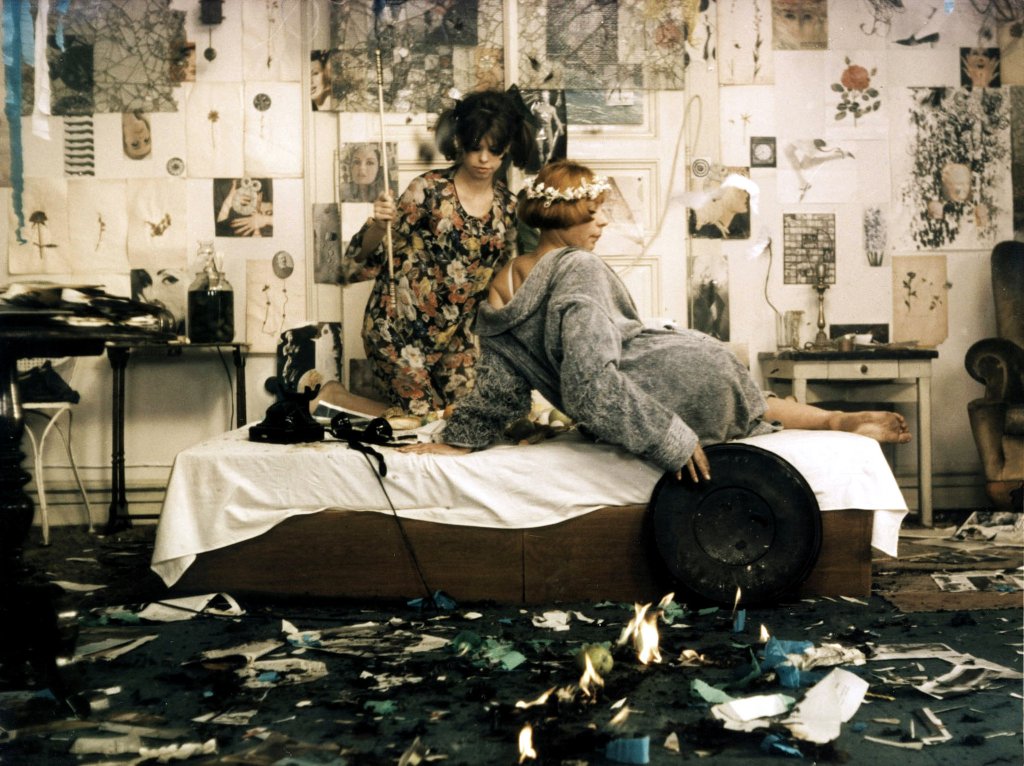
Still, I find myself going back to the still frames of the two Maries’ bedroom/art space for what makes Daisies feel special as a singular work. It really is a remarkably beautiful space, like life-sized shadow box or an art instillation piece. I didn’t expect the film that accompanied that set to be as silly or as politically storied as Daisies ended up being, but that was mostly lagniappe for a film that could survive solely on the strength of its imagery. I’m getting wistful just browsing through those images right now.

01VERA2-superJumbo

-Brandon Ledet

The History of Future Folk (2013)

EPSON MFP image

fourhalfstar

Once upon a time on a planet named Hondo a well-respected war general was asked to save his home planet from certain destruction via comet by finding a new, inhabitable world & destroying its current resident population with a flesh eating virus to make room for the Hondonian people. The general crash landed on Earth, but decided not to mass-murder the 7 billion people who inhabit it because it’s on this new world that he heard music for the first time. Now desperate to save Earth from the Hondonians, he attempted to alert his home world of the wonders of music via satellite transmissions, all while living a double life as a family man & a dive bar folk musician. The question is would he be able to get his message across before Hondonian assassins ended his traitorous life. This is, more or less, the history of Future Folk.

Future Folk is a duo of novelty musicians from Brooklyn, New York (Nils d’Aulaire & Jay Klaitz) who’ve been writing & performing songs around the above premise for more than a decade. If they hadn’t been toiling away at their shtick since the early 2000s it’d be pretty easy to accuse them of being derivative of similar, but more successful acts like Flight of the Conchords or Tenacious D, but the truth is they’re more contemporaries than copycats. And just like the two acts just mentioned, their transition from concert hall sketch comedy to television/film is an impressively smooth one. Their visual & narrative backstory feels well explored & intricately detailed, but more importantly their screen presence & dedication to the act feels entirely sincere. As a film The History of Future Folk is somewhere between a quirky indie comedy & a low-stakes sci-fi fantasy epic. As a contribution to the comedy landscape at large, the film is a priceless document of a finely-tuned two-person act that doesn’t have any other way to reach an audience outside the Brooklynites who’ve seen them perform it live.

The most amusing aspect of the Future Folk’s Hondonian backstory is the way it’s played with straight-faced deadpan. It’s first introduced as a bedtime story for a little girl who treats it like an awe-inspiring myth of the ages. The same exact story is later treated like comedy gold by the far less sincere hipster bar patrons who accept the threat of intergalactic war & flesh-eating viruses as an ironic joke. In both instances the misplaced Hondonian general speaks in total, unembellished honesty. What people do with the truth is largely dependent on the audience in question. This stripped down earnestness pairs nicely with the film’s complete absence of a budget. Many shots feel candid, as if they were stolen without a permit, but its cheapness never feels like a detriment. It only adds to the Future Folk’s brand of earnest charm.

I guess it takes a certain tolerance of twee preciousness to get on The History of Future Folk‘s wavelength, but like I said, its much more in line with the subdued humor of acts like Flight of the Conchords than it is with heart-on-the-sleeve indies like Me and Earl and the Dying Girl. The History of Future Folk works best as intricate, feature length sketch comedy. Its limited budget & dedicated-to-the-joke leads leave little room for vanity or pretension. There’s an endearing sense of heart & earnestness that adds to the film’s charm, but it’s most mostly remarkable for its ability to earn belly laughs through such unlikely sources as department store Muzak & red plastic buckets. The History of Future Folk is an easily-lovable, genuinely hilarious work of modern sketch comedy. It’s about as much of a crowd-pleaser as a quirky, low-budget indie comedy could possibly be, twee vibes be damned.

-Brandon Ledet

The Late Great Planet Mirth I – Introduction & Apocalypse (1998)

EPSON MFP image

Before we get started, let’s get this out of the way: the opinions contained herein are strictly those of the author and do not reflect upon Swampflix or its editors. These opinions are born out of a lifetime spent being reared in a particular theological worldview and its intersection with academic and scholarly studies of religious doctrine and eschatology. The introduction below is provided solely to present the ideologies that serve to make up the mindset from which the film(s) reviewed were created. No harm is intended, and this should not be interpreted as an invitation to discuss religion, positively or negatively.

I have a real fondness for media pertaining to that particular brand of Christian eschatology that centers around The Rapture. I was raised in a church that was highly obsessed with Christ’s ever-nearer return, and being born into and reared in that environment had an intense effect on me, as we were always preparing for the Second Coming and expecting it to happen any day now. From the outside, it’s impossible to understand just how deeply the conviction that the Glorious Return will play out exactly as depicted in the Left Behind series of books runs, but suffice it to say that the true believers of this worldview are true believers, and there’s not a lot of room for discussion or alternate opinions/interpretations on/of the subject.

Speaking of Left Behind, theologian Fred Clark over at Patheos has been working on dissecting that novel series for several years now, exploring all the ways in which they can be deemed “the worst books of all time” on both the literary and theological level (not to mention the revelations-no pun intended-he has uncovered about the personality defects of authors Jerry B. Jenkins and Tim LaHaye). In his ongoing exploration of the series, he gets into all of the ways that the novels are poorly written and center around horribly unlikable protagonists who are terrifyingly self-absorbed as well as the ways that the theological underpinnings of the books revolve around a questionable-at-best reading of Biblical scripture. He’s been writing that blog for a long time, and it’s absolutely brilliant and beautiful, often offering spiritual and moral guidance that is more scripturally sound and moving than anything Jenkins and LaHaye have to offer. Of course, I only know this because young Mark was a huge fan of Left Behind; it combined Biblical “prophecy” (in a very loose sense, which I’ll get to more in a moment) with political intrigue, and I was uneducated and foolish enough to find the plot compelling and intriguing. Only with the benefit of Clark’s insight and my own hindsight is it clear just how bankrupt LB is as a piece of art or theological investigation, and I highly recommend reading his analysis for anyone who is curious, although I must warn you that it’s just as staggering in it’s length as it is in its scholarship and entertainment value.

Of course, LaHaye and Jenkins didn’t create The Rapture out of whole cloth. The concept that Christ’s return will be heralded by the physical disappearance of Christians all over the world is nearly as old as the American nation, if not older, and its popularity as one of the myriad eschatologies is cyclical. One of my favorite stories of awaited Rapture is that of preacher William Miller, who led a congregation of Millerites (naturally) in his belief that the Rapture was definitively going to happen in May of 1844 (google “The Great Disappointment” for more information). Still, the fervor that overtook America in the nineties was born out of a renewed interest in Rapture theology, which first began to rise within evangelical Christianity in the 1970s following the release of several apocalyptic books by Hal Lindsey, with The Late Great Planet Earth being the most noteworthy among them (The 1980s: Countdown to Armageddon also holds a special place in my heart). The 1980s brought with it the rebranding of the Republican party, which helped cement Lindsey in the public consciousness and allowed Rapture fever to hit its zenith in the 1990s and early 2000s. Lindsey was a virulent believer in what has become the most commonly believed Rapture theory of modern times, more accurately called Premillennialist Dispensationalism.

The millennium referred to in the name of this approach has nothing to do with the divisions of the gregorian calendar and instead refer to a thousand-year period of earthly peace and prosperity. This period of piece will, they say, come after a period of Tribulation (usually seven years, but there is dissention about that). Premillenialists believe that the Second Coming will come at the beginning of this period and thus it will be ruled over by none other than Jesus himself, while postmillenialists are of the belief that Christ’s return will occur at the end of the millennium. Dispensationalism is the belief that Christ’s “flock” will disappear from the face of the earth in the Rapture before this period of Tribulation, rather than after, which is opposed by those who hold to the tenets of Raptural Historicism, which states that the Rapture will occur after the Tribulation. Still with me? I hope so, because it only gets more complicated from here; for the sake of brevity, I’ll be referring to adherents of this belief as PMDs.

Now, when I was a child, my paternal grandparents were very steeped in this paradigm of scriptural interpretation. They had only a small shelf of books in their home, and all of them were devotionals, hymnals, or books of the Lindsey mold: jeremiads about the rise of insidious cultural evil like tolerance, “Eastern Mysticism,” and (of course) homosexuality, and how these were signs and signifiers of the fact that the Rapture was so close that if Jesus wasn’t already on the threshhold, he was surely coming up the steps. As a voracious reader deprived of other material, I devoured these books when I would stay with my grandparents, and I would be lying if I said that didn’t warp me and my worldview for a very long time. It also put me in a unique position of being intimately familiar with the theological “scholarship” that underlines and supports the presuppositions of Jenkins, LaHaye, and their acolytes. I’ll try to summarize and synthesize as much as I can here, but it’s a big Gordian Knot that I’m trying to map for you, and having lived on the shore doesn’t always mean you’re going to be a great cartographer.

So here’s the deal: the thing that I liked about Left Behind when I was a kid was the way that it looked at lots of disparate pieces and put them together into one big prophecy puzzle, all the verses and chapters coming together into what seemed like an intuitive map of the near future. The problem, however, is that the methodology that led to the explosion of Rapture believers in the past few decades is that, to the layman, it looks like a brilliant decryption of arcane text. In reality, however, it’s more of an exercise in practiced self-deception and selective reading, itself colored by the political environs from which it was birthed. For instance, the Left Behind branch of Rapture belief is heavily influenced by Lindsey’s prophecies, which were in turn highly affected by the international political climate of the 1980s; Lindsey and his followers identified the nations of Gog and Magog in John’s Revelation as obvious references to the U.S.S.R., and used that assumption as a metaphorical weight-bearing cornerstone in their philosophy. With the dissolution of that federation, successive additions to this unusual canon have had to deal with the fact that no-longer-relevant nations, rulers, and ideologies played a pivotal role in the development of Lindsey’s eschatology, with each pulled thread threatening to destroy the entire tapestry.

And that’s just in the application of Biblical archetypes to the contemporary modern world; there’s a slew of other issues with the basis of this ideology. Lindsey, like William Miller before him, has a bit of an obsession with numerology and drawing lines between dots that probably weren’t meant to be connected on anything other than a thematic level. As such, Lindsey’s underlying conceits often rely upon an equation that involves several erratically chosen numerical references, divided by seven, or maybe twelve, and then assigning to the solution a number of years or days or other delineation of time. Then, once you factor in the year of an event of Biblical or historical relevance; 1948 is a favorite year of significance as adherents to this methodology are obsessed with the reestablishment of the nation of Israel and the way that it seems to echo the repeated diaspora and reunification of the Israelites in the Bible. And once you factor in that one such iteration of that cycle took place during the Babylonian Exile, and Babylon is mentioned in John’s Revelation, well, baby you got a stew goin’! Just ignore the fact that John was also writing in exile and drawing upon imagery with which his contemporary audience would have been familiar (“It’s a little thing called the Book of Daniel; you’ve probably never heard of it.” –Early Christian Hipsters, probably). Does this seem like an erratic train of thought? Are you picturing Lindsey standing in front of a corkboard full of Bible pages with red string tied between different pushpins next to highlighted passages, like the conspiracy theorist in every thriller you’ve ever seen? Then you’re starting to get the idea.

And let’s not forget that all of this is based on what the figureheads of the movement would call a “literal” reading of the text, even though this is pretty much the opposite of the meaning of the word. A reference to multi-headed dragons monsters with crowns? Surely, that literally means ten nation states that will make up the one world government that the United Nations will morph into under the advisement of the Antichrist. And, of course, there’s the small matter of nonsensical ideas that have made their way out of esoteric circles into the mainstream, like the very concept of the Antichrist himself; the word is only used in 1 John and 2 John, and an actual literal reading of those texts makes it obvious that the “antichrist” is a term to be used for corrupter or false teacher, not an infernally inspired world leader (for further reading on this topic, I suggest “The Antichrist Hoax,” by Dr. Joel McDurmon). Essentially, what I’m saying is that the genealogy of this branch of Biblical “scholarship” reveals a poisonous tree with its roots in half-understood historical contexts, willful ignorance about current events that do not coincide with their prescribed worldview, and numerology, which most Christians would recognize as an outright heresy were it not so thoroughly ingrained in the makeup of this eschatology.

I’ve given you the basics and the background, so here’s the Left Behind (et al) standard apocalypse gameplan: very soon, we will all be witness to The Rapture, in which the dead in Christ shall rise and living Christians will disappear in the blink of an eye (usually dramatized by showing piles of empty clothing). Included in the Rapture are also children who have not yet reached “The Age of Accountability,” an apocryphal, largely Southern Baptist theological concept that assumes children are inherently innocent and are deserving of Heaven by default.Thus, those who believed the Gospel Truth™ are spared the Tribulation, a seven year period that begins either with the Rapture or when the Antichrist signs a peace treaty with Israel, depending upon your interpretation. The Antichrist is himself a European politician who will assume power over the world by demonstrating great leadership (and perhaps even miracles) in the wake of the disappearances; he will install a global political system with himself at the head, and citizens will be forced to take his Mark or face persecution. The first three and a half years of this period will be marked by prosperity, while the last three and a half will be full of death, famine, war, plagues, toxic meteors, etc. The end of this period will see the glorious return of Jesus, to banish the Antichrist to the pit and rule for a thousand years, after which it’s all Heaven, all the time.

So that’s the basic premise, which brings us to the reason we’re here today: to discuss PPI Films’ 1998 DTV film Apocalypse. Apocalypse is not the first film about the Rapture. Actually, it’s not even the instigator of the first series of films about the Rapture; that honor belongs to 1973’s superior A Thief in the Night, which was followed by three sequels: A Distant Thunder (1978), The Image of the Beast (1981), and The Prodigal Planet (1983). The Thief series was so popular, in fact, that LaHaye and Jenkins have even admitted that it helped inspire them to draft Left Behind. Left Behind, in turn, influenced the Apocalypse series, so overtly that the first film’s protagonist has a great deal is essentially an even more bargain-basement version of Left Behind’s Cameron “Buck” Williams. Still, all of these films are part of an esoteric canon of movies that are long overdue for an investigation, and Apocalypse was the big one of the nineties.

EPSON MFP image

onestar

campstamp

Let’s get this out of the way: Apocalypse is a terrible movie. This is a film in which millions of people disappear from the face of the earth, nuclear war nearly breaks out in the Middle East and is only averted by divine intervention, Christians are herded into camps for execution and/or reeducation, and the President of the European Union announces that he is the Messiah. Yet, somehow, all of these situations feel as if the stakes are no higher than they would be if the main characters’ arcs revolved entirely around dealing with poor customer service. Never before or since has the apocalypse been presented in such a blasé and uninvolved manner. A lot of that has to do with the visual presentation of the film; it looks like it was shot using a video camera borrowed from the set of Passions and no one bothered to clean the Vaseline caked onto the lens. It creates a rhetorical space with which the audience is mostly familiar as reminiscent of daytime television, which is hardly the effect one would want when presenting the literal rise of Satan on Earth.

The film quality isn’t the only place where the film feels cheap, either. Peter LaLonde (who, along with his brother, created film distribution company PPI, which would later become CloudTen, the name under which the rest of the films in this series were released) was once the host of a Christian television program called This Week in Bible Prophecy, which sought to draw a connection between contemporary events and the End Times as outlined by PMDs. Clips from this series, as well as others hosted by noted PMDs/televangelists like John Hagee and husband/wife duo Jack and Rexella Van Impe, are present throughout the film, filling out running time that would be better served by character or world building. Instead, we watch characters as they watch television screens in silence, which is exactly as exciting as it sounds.

Above and beyond that, this movie feels like it’s about 50% montage, with half of those montages consisting of 1990s Contemporary Christian Music playing over real footage of actual riots and disasters, which is horrifying and offensive. In a perfect encapsulation of many of the bad ideas in this film, there is a scene in which an unseen video journalist is providing voiceover for footage of a protester of some kind immolating himself and lunging at police. The dialogue is just atrocious (“This man who lost his wife and daughter literally went crazy […] here he is literally setting himself on fire…”), and the scene appropriates this real-world footage for its purpose, overtly divorcing this protest from its historical context and the desired impact of the person whose image was used for this presentation. Burning churches, police brutality, freedom fighters: all are just set dressing for the film’s message, which is nauseating.

The plot follows World News Network anchors Bronson Pearl (Richard Nester) and Helen Hannah (Leigh Lewis) and their work leading up to and immediately following The Rapture. Pearl is on-site in the Middle East at the historical site Armageddon, where the Israeli Air Force is assembling against their vaguely defined enemies, and this struggle leads up to a mutually assured nuclear strike. Just as the missiles are ready to fall, they disappear from the skies, along with a particular subset of the population worldwide: Christians and children. Hannah, whose grandmother was one such vanished person and who had previously warned her of the impending return of Christ, struggles to accept that the warnings were real. After watching some John Hagee and Van Impe videos, she returns to work, only to find that EU President Franco Macalusso (Sam Bornstein) has taken credit for the miraculous event and declared himself the new Messiah, stating that he removed all the “haters” (i.e., followers of the false Messiah, Jesus) from the world in order to usher in a new era of peace. Hannah tries desperately to convince Pearl of the truth before it’s too late.

As noted above, the film is mostly padding, but there are some good ideas here. Immediately after Macalusso’s declaration, WNN is taken over by Len Parker (David Roddis), a weaselly man who is to serve as the Antichrist’s mouthpiece, and Roddis is obviously having a lot of fun devouring every bit of scenery in sight. There’s also a nice moment of foreshadowing when one of Pearl and Hannah’s co-workers leans over and instructs a technician to record Pearl’s frontlines exclamation that Macalusso is the Antichrist, saying that the recording “might come in handy;” this same person later barricades himself in the WNN booth to broadcast that same speech as an interruption of Pearl’s televised execution. It’s not a great example of narrative subterfuge, but bears mentioning as one of the few touches of subtlety in the film. The real MVP here is Lewis, however, as she manages to imbue a paper-thin character with a lot of real, earnest emotion. Even though the end of the movie makes it seem as if she, too, is about to face death, I don’t mind that the next film shows her alive and well and leading the resistance, as she’s by far the strongest actor in this first outing and I’m glad she was chosen to be the de facto main character of the series. It’s a shame that her IMDb page is so sparse, as, of all the performers on screen, she was the only one to show actual talent.

Nester easily stands out as the worst actor of the bunch; in fairness, I don’t know that the role as written gave him enough to work with to warrant calling out his particular theatrical failings. Pearl is essentially a carbon copy of the Buck Williams character from the Left Behind series, portrayed by fallen teen heartthrobs Kirk Cameron and Chad Michael Murray in their respective franchises. Unlike Williams, Pearl doesn’t get the chance to be unsuccessfully courted by the Antichrist’s new regime, which is a missed opportunity. There’s a parallel to the aforementioned scene wherein the media comes under the Antichrist’s control in the LB canon: Williams bears witness to the Antichrist performing supernatural mind control over his new cabal but is protected from this misdirection by his newfound faith. It’s a poorly written scene (as is LB in its entirety), but it does effectively build the Antichrist as a threat and gives insight into how he could gain the power that he does. In Apocalypse, Len just shows up and tells everyone he’s the new boss, and virtually all of Macalusso’s appearances are on a TV screen, which really goes to show the extent to which this film is but a shadow of something that wasn’t all that substantial to begin with.

What really sets Apocalypse apart from the later films in the series, aside from poor production value and an obnoxiously meandering narrative and the lack of “name” actors, is how obvious it is that this film was meant as a preaching tool. At the time when this film was made, I remember many pastors making their own post-Rapture videotapes, to be placed prominently in churches so they could be found by those left behind and provide guidance for them in the coming Tribulation (in the Left Behind films, if I remember correctly, the characters watch such a video prepared by Bishop T.D. Jakes). While watching someone struggle to come to terms with the fact that their entire conception of the universe is flawed could make for compelling viewing in theory, in practice these scenes are long and unengaging, as this is obviously the point in the film where the Christian audience is supposed to turn to the unsaved friend they foisted this movie upon and offer to guide them in prayer. Regardless of one’s point of view on that kind of proselytization, it’s inarguably bad film-making. Luckily for viewers, it gets better (and worse) from here.

-Mark “Boomer” Redmond

Body Puzzle (1992)

EPSON MFP image

threehalfstar

Body Puzzle is a 1992 giallo film directed by Lamberto Bava, the son of legendary Italian horror maestro Mario Bava and frequent collaborator of Dario Argento (having, among other things, been the assistant director of both Inferno and Tenebrae). The film follows the story of Tracy, a widowed manuscript editor who begins receiving body parts wrapped in wax paper following the revelation that her late husband’s body has been disinterred. Although the film as poorly received in its time, it holds up as a kind of last gasp of true giallo, even if the mystery of the film relies on a twist that doesn’t quite work.

The film opens on an unnamed man (François Montagut) who is seen playing the piano before his practice is interrupted by the memory of an evening in which he engaged in a car chase with a motorcycle rider, an apparent friend who he repeatedly demanded slow down; the chase ends with the biker crashing and dying. This same man then murders a confectionary shopkeeper, which brings Detective Michele (Tomas Arana, of La chiesa) into the fray, where he and his partner Gigli (Matteo Gazzolo) discuss the fact that ghastly murderers always seem to take a trophy from their victims. Elsewhere, Tracy (Joanna Pacula) plans to visit the grave of her husband, but is shocked to discover that his body has been dug up. She returns home to discover an ear wrapped in wax paper in her fridge, and Michele realizes that the serial killer on the loose has been keeping pieces of his victims not for himself but to give them to Tracy, who is understandable unnerved by this. As she and Michele grow closer, he realizes that all of the victims share one thing in common: they were the recipients of organs from Tracy’s dead husband, Abe; further, it seems Abe may not have been all he seemed on the surface when he was alive. The murderer may, in fact, be a former lover of Abe’s, driven to madness by the fact that he was responsible for the latter’s death.

I won’t spoil the ending for you, but this is a fun little giallo thriller, with delightful cinematography and a plot that works, for the most part. The tension builds slowly as it becomes apparent that there is no safe place for Tracy no matter where she goes, and the final reveal is foreshadowed in a manner that is utterly unexpected but fits all the clues that we have seen so far, minus a red herring that I am certain made most contemporary reviewers rather pissed, given the film’s overall low aggregate rating. The terror of the killer’s victims is palpable, and there are some great set pieces that permeate the run time: the multiple reflections of the killer’s visage as he stalks a woman in a mall before cornering her in a bathroom and amputating her hand is quite powerful, although it pales in comparison to the murder of a teacher in front of a classroom full of blind students, who have no idea what is happening. The film’s cinematography and planning is not perfect, however, and it’s a surprise how many amateurish mistakes slipped through in the film considering how long Bava had been directing at this point. There are reflections of camera operators in vehicle windows, which happens, but the final chase sequence uses undercranked footage to give the illusion of high speed but the movements of the actors and the scenery betray this attempted cinematic sleight of hand. Still, these imperfections don’t ruin the film, and it’s definitely worth watching if you get the opportunity.

-Mark “Boomer” Redmond

Stung (2015)

EPSON MFP image

three star

campstamp

A lot of people were harsh on last year’s winking-at-the-camera B-picture Zombeavers for being a little too try-hard & calculated. Personally, I’m a little more forgiving on silly, made-for-cult-audiences trifles than most, so I enjoyed its SyFy Channel-type camp well enough. What saved the picture for me more than anything was the handmade beaver puppets. The film’s dialogue was never quite as amusing as it wanted to be, but the slightest appearance of a zombie beaver puppet could have me howling.

Toeing the exact same line between terrible dialogue/acting & delightful special effects is the recent horror comedy Stung. The directorial debut of German special effects artist Benni Diez, Stung is a fairly basic creature feature about mutant wasps that brutally disrupt a stuffy garden party. Much of the film is bland & sloppily slapped together, but a few bonkers plot twists in the third act & a refreshing focus on handmade practical effects save it from feeling like another hopeless CGI-heavy cheapie like a Lavalantula! or a Sharknado 3. If you have little to no interest in monster movie creature effects, you’re likely to spend most of the film bored & frustrated in the wait for bodies to drop & the credits to roll. The only attraction featured here is the giant mutant wasps themselves.

Remove the mutant wasps from Stung & you basically have the world’s worst episode of Party Down. A small catering company handles a quirkily pathetic garden party while experimenting with a will-they-won’t-they romance that no one could possibly care about. The lead is a painfully unfunny physical comedian with a whiny “But I’m a Nice Guy”/friendzoned approach to romance. His love interest is a Type A Bitch™ we’re supposed to deride for caring more about her flailing small business & personal survival than getting laid by a bartender/clown/employee. The best bet for finding a worthwhile character is among the party guests, since the leads are such dull wastes of time. My vote for MVP (or maybe Only Valuable Player in this case) goes to genre film veteran Lance Henriksen as a drunken small town mayor.At the very least he gets a couple decent one-liners out, like when he quips “This party needs an autopsy” (before the killings start) and when he responds to the correction, “Those are not bees, those are wasps” with “Who gives a shit?” Even Henriksen’s world-weary irreverence does little to liven up the proceedings, though, and most of the film’s time that’s not filled by killer wasp mayhem feels like a huge waste of effort.

It’s a good thing, then, that there’s so much killer wasp gore to (excuse the expression) chew on here. Stung‘s gigantic mutant wasps click & screech like insectoid pterodactyls. When they sting their prey they use the victim as a flesh vessel to incubate even larger wasps. These transformations are massive, wet, disgusting, and above all else entertaining. The mayhem gets even more gnarly from there, especially in the film’s go-for-broke third act stupidity. Gigantic nests, wasp-controlled human drones, wriggling larvae, and flaming monsters all make for a wickedly amusing good time as long as you pay more attention to what the creatures are up to than anything said or done by their entirely-forgettable victims. Stung is to be enjoyed for its Them!-style monster puppets & 80’s Peter Jackson gore, not for its sense of narrative or tonal nuance. About the only thing that qualifies as a successful joke in the film is when one character carries around a can of bug spray as an in-vain mode of protection, but even that gag qualifies as a triumph of the costume department. Stung is all about its puppets & gore and nothing else. That just happened to be enough to make it worthwhile for me.

-Brandon Ledet

Ink (2009)

EPSON MFP image

three star

Online piracy is usually the scourge of the film industry, since many ticket & home video sales are lost to content that’s easily downloaded illegally. Occasionally, though, a small budget film will actually benefit from digital word of mouth & peer-to-peer sharing. The sci-fi fantasy epic Ink is a decent example of the way online piracy can boost a film’s notoriety. After a couple premieres at low-profile film festivals, Ink never scored a major theatrical or home distribution deal & initially suffered a limited, self-distributed DVD release with little to no fanfare. It wasn’t until the film saw major traffic on peer-to-peer torrenting sites that it earned any significant attention & it eventually scored VOD distribution that landed it on major streaming services like Hulu & Amazon Prime. Ink might be one of the few concrete examples of a film being saved instead of savaged by online piracy.

It’s not at all difficult to see how a film like Ink could attract a loyal cult fanbase. The specificity & intricately detailed structure of its dreamworld full of “pathfinders”, “storytellers”, “codes”, “access to the Assembly”, and magical bongos that open interdimensional doorways is perfect for fantasy nerds who eat up that kind of immersive worldbuilding. The film follows a group of mysterious dreamfolk who visit us while we sleep to protect our REM imagery from bad vibes. Aching to interrupt the fantasy are the nightmare assassins of bad vibes personified, a The Dark Side of dream warriors who range in style from plague doctors dressed in rags & chains to some kind of cyberpunk cross between Hellraiser‘s Pinhead & Bubbles from Trailer Park Boys. These fairy-like whimsies & cyberpunk nightmare baddies stage a literal battle between good & evil (complete with martial arts) while the “real” world tries to sleep through the night in peace. The fate of one little girl’s slumber & her workaholic father’s weakness for addiction give the story an in-the-moment sense of purpose & specificity, but for the most part the film is a work of fantasy genre worldbuilding more than it is a well-sketched out narrative.

The bummer about Ink is that it never feels like its means or its talent match the massive scale of its ambition. The film aims for the go-for-broke loopiness of a Terry Gilliam epic, but, unfortunately, also carries Gilliam’s languid sense of pacing without every nearing the same level of visual talent that the Monty Python vet commands with ease. At best the film feels like a lesser version of titles I hold in much higher regard. Its bedtime spookiness & made-for-TV visual cheese recall the sleep paralysis “documentary” The Nightmare. Its storybook push & pull between the dream world & waking life feels like a direct descendant of the far superior Dave McKean epic MirrorMask (right down to the annoying street performer/tour guide). Honestly, most of Ink feels inconsequential until a climactic narrative twist that lands with enough of a significant impact that you feel compelled to give the movie a second watch . . . or at least a hearty recommendation to a fantasy-minded friend (who’s already watched MirrorMask 1,000 too many times).

Still, I was ultimately surprised & charmed by what Ink delivered, if not only because of its limited budget visual cheapness & lack of a vocal fanbase. The film has an endearing pedigree as an underdog story of mishandled distribution & subsequent reappraisal. I found myself rooting for it to succeed & there was enough payoff in its last minute narrative twist & overall attention to worldbuilding that made the effort feel worthwhile.

-Brandon Ledet

Pride and Prejudice and Zombies (2016)

EPSON MFP image

three star

campstamp

The convenience of films with titles like Pride and Prejudice and Zombies is that you pretty much know ahead of time whether or not you’ll be on board with what they’re selling. Do you enjoy costume dramas? Are you not yet completely exhausted by the staggering amount of zombie media out there? Surely there are enough people who sit comfortably in both categories. Just take a random polling of attendees and any Tori Amos or Rasputina concert & you’re bound to find a few.  And you can count me among them. I can enjoy a good, middling costume drama any day of the week & I’m more or less in the same camp when it comes to mediocre zombie mayhem (although that genre tests my patience more every coming year). I never bothered reading the print version of Pride and Prejudice and Zombies (which the film’s opening credits claims is a “Quirk Book series classic”) because it seemed kind of mindless & arbitrary, but luckily mindless & arbitrary are two attributes of genre cinema I can usually get behind. Basically what I’m saying is I knew approximately how I was going to feel about Pride and Prejudice and Zombies before I even got to the theater and I suspect most people are in the same boat. The film itself did little to exceed or subvert expectation, but honestly I was fine with that.

As you might expect with a literary adaptation where zombies are air-dropped into a classical work, Pride and Prejudice and Zombies somehow keeps its Jane Austen plot & its zombie mayhem somewhat separate. Early scenes show young maidens cleaning guns instead of sewing (or something similarly ladylike) & including knives in their garters & corsets dress-up montages, but for the most part its polite society parlor drama & the zombie killing rampages mix about as well as oil & water. The film has fun with genre-bending lines like “Zombies or no zombies, all women must think of marriage, Lizzie” & “I don’t know which I admire more: your strength as a warrior or your resolve as a woman,” but its two plot lines rarely bleed together in a satisfying way. On one hand you have a small gang of unmarried sisters trying to land wealthy beaus while staying true to themselves. Happening almost entirely somewhere else: the zombie apocalypse & an alternate history of England as a country. The film’s line of horror comedy is mostly an occasional interjection that disrupts these dueling plot lines. For a film with such a winking joke of a premise Pride and Prejudice and Zombies takes both ends of its titular mashup surprisingly seriously.

There is exactly one thing that stuck surprisingly  astute with Pride and Prejudice and Zombies as a Jane Austen adaptation. One thing the film does very well is to bring attention to the way Austen’s characters are viciously combative in their hushed, “polite” conversation. During scenes that might’ve played as subtle verbal sparring on the page are accompanied here by not-subtle-at-all literal sparring. For each verbal jab someone throws at their societal opponent a corresponding jab is thrown with a fist. A perpetually slumming-it Charles Dance (who now has a history of working in this realm thanks to Victor Frankenstein & Dracula Untold) plays the girls’ paterfamilias & describes his progeny as “our warrior daughters”. It’s true that the girls were already warriors in the zombieless Jane Austen source material, but their modes of violence & agency were a little less easily detectable. God help any desperate high school student who tries to pass an exam on Pride and Prejudice by watching this film, but the thematically obtuse might get a better understanding of the novel’s modes of societal combat by watching it play out visually on the screen.

That small insight aside, Pride and Prejudice and Zombies is mostly a silly endeavor, never entirely serious about engaging with its source material in any sincere way. It’s also not all that committed to the zombie end of its premise. The monster make-up is solidly on point, but the film shies away from the gore end of the genre that made folks like George Romero & Peter Jackson masters of the form. Hardcore Pride and Prejudice fans and hardcore zombie movie fans are both likely to find plenty to gripe about here, since the film splits its time between both halves without  ever fully committing to either. The ideal audience, then? I’d say folks easily impressed by costume dramas who wouldn’t mind a little zombie mayhem peppering the genre for superfluous flavor are most likely to enjoy themselves. Pride and Prejudice fans are likely to be annoyed by how the novel’s feminist themes are cheapened by being boiled down to sexy women playing with weapons in complicated underwear. Zombie creature feature nerds are likely to be bummed by how the genre’s go-for-broke gore has been mostly supplanted by bodice-heaving romance. Personally, I took perverse pleasure in both of those aspects (especially the part about the complicated underwear; can’t help myself). For me, Pride and Prejudice and Zombies’ worst crimes are being a little overlong & having the gall to flash back to earlier scenes from within its own film in an especially-lazy letter-reading scene. For a film that sets the bar so low & expectations so specific in its very title & premise, those are two faults I’m more than willing to forgive.

Side note: I love how insular casting in the costume drama/fantasy cinema world can be. Besides Game of Thrones‘ Charles Dance & Lena Headey, there’s Lily James of Downton Abbey & Cinderella, Maleficent‘s Sam Riley, Noah‘s Douglas Booth, and (my personal favorite) Boardwalk Empire‘s Jack Huston. I guess you could include Doctor Who‘s Matt Smith in there as well, given that series’ time-jumping aspects. I’m sure for the actors this kind of typecasting can be an annoyance, but as an audience I find it oddly fascinating.

-Brandon Ledet

Roger Ebert Film School, Lesson 2: Persona (1966)

Roger Ebert Film School is a recurring feature in which Brandon attempts to watch & review all 200+ movies referenced in the print & film versions of Roger Ebert’s (auto)biography Life Itself.

Where Persona (1966) is referenced in Life Itself: In the first edition hardback, Persona is referenced on pages 1, 154, 267, and 270. It is the film most often referenced in Roger’s book. He first likens its opening credits & mid-film “break” to the way life & memory flicker into existence, initially without cohesion. He later describes how as a young critic he met an inability to discuss exactly what happens in the film, which prompted him to write about what happened to him as an audience instead (a technique of critical subjectivity he would return to often). He also describes Bergman’s casting of the film as being surprisingly impulsive in a brief anecdote.

What Ebert had to say in his reviews: “Most movies try to seduce us into forgetting we’re ‘only’ watching a movie. But Bergman keeps reminding us his story isn’t ‘real.’ At a crucial moment in his plot the film seemingly breaks, and after it rips for a dozen frames it seems to catch fire within the projector. We see it melting on the screen. Then blackness, then light and then the old silent comedies again, as Persona starts again at the beginning.” – From his 1967 review for the Chicago Sun Times

“Persona is a film we return to over the years, for the beauty of its images and because we hope to understand its mysteries. It is apparently not a difficult film: Everything that happens is perfectly clear, and even the dream sequences are clear–as dreams. But it suggests buried truths, and we despair of finding them. Persona was one of the first movies I reviewed, in 1967. I did not think I understood it. A third of a century later I know most of what I am ever likely to know about films, and I think I understand that the best approach to Persona is a literal one.” – From his 2001 review in his “Great Movies” series

There are two massive, go for broke moments in Ingmar Bergman’s small cast drama Persona that tend to overwhelm discussion of the film. The first is the film’s opening six minutes. A chaotic montage of loose film strips, whirring projectors, impossibly bright light bulbs, grainy footage of what looks like a silent era horror, spiders, human hands, animal slaughter, exposed organs, an erect penis, and crucifixion imagery overwhelm the film’s first breaths. Even today these fist few minutes of visual chaos are disturbingly vivid, but difficult to pinpoint with any certainty as to what they could mean, exactly. Somewhere in the fog I see a progression of life → art → death, but that personal interpretation is far from concrete in any significant way. As difficult as it is to decipher Persona‘s opening minutes today, it’s even more of a mystery to me what the experience would’ve been like for someone watching the film fifty years ago. As if that opening barrage weren’t enough, Bergman then repeats the trick a second time in the film’s second Go For Broke moment. A little over halfway into the film’s runtime the movie essentially breaks down & returns to the visual chaos of its opening minutes, wiping the slate clean & completely changing the rules of its delicately laid-out narrative. It makes total sense that these two moments would dominate most discussion of Persona & the strange places its story goes in its haunting final minutes, but for the most part the film itself is a rather quiet, intimate drama.

A somewhat mousy nurse is assigned as a caretaker for an actress who has not spoken in three months’ time. After a dreary stay at a hospital, the two women attempt a therapeutic, seaside respite to help cure the actress of her anxieties. To fill the void left by her nonverbal companion, the nurse gabs incessantly, first about seemingly nothing at all and then about deep seated fears & regrets. Take away the two experimental jaunts of rapidfire montage & Persona is mostly a collection of monologues, sometimes delivered directly to the audience in a way of breaking the fourth wall that recalls the grave seriousness of a stage play instead of the winking Ferris Beullers of the world. The topics covered in these speeches are a wide range of concerns from the importance of art in people’s lives to a distant memory of casual sex & subsequent abortion. If it were anyone but Bergman at the helm, the film’s existential crises could possibly play as arthouse self-parody, especially once one character starts pondering about “the hopeless dream of being. Not seeing but being. In every waking moment aware, alert. The tug of war between what you are with others & who you truly are.” The navel-gazing & despair in Persona is so tragically sincere, however, that there’s no way to avoid being arrested by it. Bergman may work with a tone of cinematic obfuscation that’s been copied & parodied endlessly in the last few decades, but he does it with such sincerity & confidence that it still knocks you on your ass, despite familiarity with how his style has been assimilated into cinema at large. In a lot of ways the bare bones monologues of Persona can be just as unsettling as the film’s Big Risk montages of pure light & sound.

Of course, Persona‘s ambitious Big Risk montages & low-key, confessional monologues cannot be considered in total isolation. One plays directly into the other. Shortly before Persona‘s mid-film narrative “break”, the overly-talkative nurse confesses to her silent companion “Somehow I think I could change myself into you if I tried. I mean, inside. You could be me, just like that.” An act or two of betrayal sets in motion the pure light & sound montage “break” that allows that fantasy to become a tangible reality. The two women’s identities shift & meld. Ugly anxieties about fear of motherhood & questions of sexual desire bubble to the surface in such a horrific, unsettling way that you could consider the film a work of avant-garde horror if you view it in the right context. Persona was my first introduction to Bergman as a filmmaker and I’ve heard that entry point likened to jumping into the deep end. This is a messy, languid picture that somehow pulls together a pointed & purposeful tone from the wreckage without ever affording the audience a clear picture of what exactly is transpiring.

It’s no surprise, then, that reviewing Persona was such a daunting task for a young Ebert or that the film resonated with him in such a vivid way throughout his life & career. One thing I picked up while reading over his reviews of the film that I may have missed the first time I watched it was how artificial the whole thing felt. While watching Bergman’s so-called “Silence of God” trilogy during our Movie of the Month discussion of The Seventh Seal last year, I became intensely focused on the way the director called attention to the artificiality of his films by making them feel like staged plays. Returning to Persona (with Ebert’s take in mind) made me realize how much that film in particular pushes that idea to an extreme. In the film, Bergman not only calls into focus the artificial stage of his  narrative, but also the medium through which he delivers it. Literal film strips & projectors appear in the film’s two biggest moments (even breaking down the narrative in the second instance) and the film’s final scene cuts away to show camera crews filming the actors on set. As Ebert puts it, “Most movies try to seduce us into forgetting we’re ‘only’ watching a movie. But Bergman keeps reminding us his story isn’t ‘real.’ […] We have been brutally reminded that the story is being filtered through technical equipment.” Persona‘s ambiguity & existential distress is rewarding enough on its own to demand multiple viewings, but looking for that self-referential artificiality in the film was alone well worth a revisit.

EPSON MFP image

Roger’s Rating: (4/4, 100%)

fourstar

 Brandon’s Rating: (4.5/5, 90%)

fourhalfstar

Next Lesson: Apocalypse Now (1979)

-Brandon Ledet

Big Business (1988)’s Old Hollywood Roots in Duck Soup (1933)

EPSON MFP image

During our Swampchat discussion of February’s Movie of the Month, the Bette Midler/Lily Tomlin swapped-twins comedy Big Business, we paid a lot of attention to the film’s roots in Old Hollywood farces. Although Big Business originates as an adaptation of Shakespeare’s The Comedy of Errors, its tone & setting are much more in line with a very specific era of 30s & 40s Hollywood comedy pictures. This makes total sense, since it’s the exact kind of stuff Tomlin & Midler would’ve grown up loving.

It’s easy to see the Old Hollywood love all throughout Big Business, but I think the most recognizable, highly specific moment where its homage to the era bleeds through is in the scene where Midler meets her estranged twin in a bathroom “mirror”. Besides being an exquisite display of physical comedy that recalls leftover tricks of the trade from the silent era & vaudevillian performance, it’s also a near-exact replica of a scene from my favorite Marx Brothers’ film, Duck Soup. Midler’s scene requires her to carry a full load of work that was shared between Harpo & Groucho Marx in its Duck Soup origins, so the dynamics of the gag are a little different, but I believe the sentiment shared between the two scenes is nearly identical.

See for yourself! If you haven’t had the pleasure of watching Big Business or Duck Soup (and you really should), at least check out the extended “mirror” gag shared between the two films. They’re sublimely choreographed examples of physical comedy at its best.

For more on February’s Movie of the Month, 1988’s Big Business, check out our Swampchat discussion of the film.

-Brandon Ledet