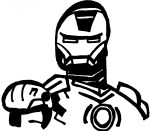
Agents of S.W.A.M.P.F.L.I.X.: Iron Man 2 (2010)

EPSON MFP image

Superhero Watching: Alternating Marvel Perspectives, Fresh and Longterm, Ignoring X-Men, or S.W.A.M.P.F.L.I.X., is a feature in which Boomer (who reads superhero comics & is well versed in the MCU) & Brandon (who reads alternative comics & has thus far seen less than 25% of the MCU’s output) revisit the films that make up the Marvel Cinematic Universe from the perspective of someone who knows what they’re talking about & someone who doesn’t have the slightest clue.

Boomer: After the somewhat surprising success of Iron Man and the mostly tepid response to The Incredible Hulk, Marvel Studios allowed their product line to lie fallow for 2009. Instead, they spent most of their behind the scenes time conceptualizing and drafting the growing interconnected universe and putting forth just enough information to whet the appetites of the general public. Iron Man 2 in 2010! Thor and Captain America (which would later have the silly, unwieldy subtitle The First Avenger added to it) in 2011! Avengers in 2012! Iron Man 2 was heavily marketed in the U.S., but there was a distinct decline in the attention from film and comic trade papers compared to the whirlwind of publicity that surrounded the first picture. If anything, most of the hard copy from trade journals was less about the film itself and more about notable lunatic Terrence Howard’s exit and replacement by prestige performer Don Cheadle. Howard has claimed on separate occasions that he left the film of his own volition and that he was let go, the former statement having only recently become part of his repertoire of stories. Lately, his claim is that his departure was due to a vast pay discrepancy between himself and Robert Downey, Jr., but Howard is also infamously difficult to work with—just look no further than the madness that was his September Rolling Stone interview for proof. Imagine what it must be like to work with someone whose conceptualization of mathematics makes Time Cube seem straightforward in comparison. I would prefer working with class act Don Cheadle, too.

There’s not as much backstory about the history of this film, but the expansion of the cast is noteworthy. Of the four main actors appearing in the first film, only Gwyneth Paltrow and Downey reprise their roles, due to Howard’s exit and the death of Jeff Bridges’s character. Samuel L. Jackson’s role was expanded, and Mad Men actor John Slattery was cast to play Tony’s father Howard Stark in file footage. Sam Rockwell joined the cast as rival weapons mogul Justin Hammer, and Mickey Rourke, of all people, was cast as unrepentant Russian ex-con Ivan “Whiplash” Vanko. Even stranger, likable comedian Garry Shandling was brought on board to play blowhard politician Senator Stern. Most notably, the film introduced Scarlett Johansson as S.H.I.E.L.D. agent Natasha Romanoff, a.k.a. Black Widow, in a role that raised the profile of both actress and character significantly. Director Jon Favreau returned to helm the film and appear as Tony’s driver, “Happy” Hogan, and screenwriting duties were handed over to Justin Theroux, who is more recognizable as an actor in films like Mulholland Drive and American Psycho (and as the current Mr. Jennifer Aniston) than a writer. He also played the villain in Charlie’s Angels: Full Throttle, following on the heels of Rockwell’s villainous turn in the first Angels film. Can the two of them working together make a decent Iron Man film? Read on for our reviews!
EPSON MFP image

twohalfstar

Brandon: Are we back to this dude already? Seems like just two films ago I was complaining about Tony Stark’s obnoxious rich boy D-bag fantasy fulfillment horror show of a personality. And here we are again, watching The Last of the Famous International Playboys work the crowd in his expensive suits & Guy Fieri sunglasses/goatee combos. As much as I would love to say I hated it even more the second time around, Jon Favreau’s second Iron Man film wasn’t nearly as bad as the first. Despite insistent warnings from friends that this would be the worst entry under the MCU brand to date, I found myself enjoying a great deal of the film, especially in moments where Mr. Stark was nowhere to be seen. Even though I could feel myself being won over, though, I think it’s much more that the MCU is growing on me & coming into its own than it is that this individual property is worth anything more than mixed praise.

The major improvement in Iron Man 2 is in the strength of its cast. Don Cheadle was a huge get in replacing Terrence Howard as Col. James Rhodes & it was super cool to see him fly around in a spare Iron Man suit, effectively establishing himself as the MCU’s first non-white superhero. Jon Slattery is as amusingly smug as ever in his role as Iron Dad. Gary Schandling & Sam Rockwell are always-welcome faces, even if the latter was asked to do such undignified things as blabbering about super-“cool”, super-deadly weapons to an obnoxious blues rock soundtrack. Scarlett Johansson is a refreshing glimpse into a better, future MCU in her kickass performance as the (undercover) Black Widow. Even the much-complained-about Gwyenth Paltrow gets a couple great moments in there, especially in her delivery of a particularly passionate line-reading of “ARE YOU OUT OF YOUR MIND?!”

The real MVP here, though, is Mickey Rourke. I suspect that Rourke’s performance as the oddly grandmotherly supervillain Ivan “Whiplash” Vanko wasn’t universally beloved by fans, but I was personally won over. I can’t be too objective about Rourke in this film because I’m pretty much on board with everything he’s done on film in the past 15 years or so. Even in dire properties that I have no patience for like Sin City & The Expendables, Rourke’s weird, hardened, subdued energy is a breath of fresh air. It’s hard to tell how much of this is leftover goodwill from how much I love him in Aronofsky’s The Wrestler, but it’s true all the same. Rourke’s softened, heavily tattooed Russian terrorist of a villain is easily the most deliciously over-the-top aspect of anything I’ve seen in the first three MCU entries. I loved everything about him, from his dumb girl’s-first-year-at-Burning-Man dreds to his fetish-inspiring lightning whips. When the film opens with Rourke’s oddly gentle brooding I was expecting to fall for Iron Man 2‘s charms . . . a feeling that lasted only briefly, as it was promptly interrupted by Iron Man flying around to AC/DC dad jams & my Iron Man 1 deja vu kicked in.

The problem with Iron Man 2 is not in the villains, but in Iron Man himself. I wasn’t convinced that Tony Stark’s reformed bad boy act in the first film outweighed his more unpalatable impulses as a rakish dick & he indeed dismisses his moral salvation in that film (an interest in renewable energy sources instead of military grade weapons) as a “liberal agenda” that he now finds boring here. I guess his new path to salvation is in his evolving romance plot with Pepper Potts. I’ll admit that I find the characters’ chemistry fairly compelling (way more than Ed Norton & Liv Tyler’s chemistry in The Incredible Hulk, at least), but there’s too much else working against Stark’s personality for it to save the movie for me. It’d be one thing if Stark’s go for broke narcissism were played as villainous, but it’s largely celebrated in the film. He’s applauded for “successfully privatizing world peace” without a trace of irony. He sexually objectifies the MCU’s first female superhero at first glance, joking “I want one of those” in ScarJo’s first scene, and the audience is supposed to think “Heh, heh me too”. And then there’s his love of a expensive-looking version of European NASCAR, Iron Gams chorus girls, and – worst yet – scratching records like an idiotic RoboDJ. Ugh. I’m surprised they stopped short of giving him a backwards baseball cap & a skateboard.

I could probably get behind Tony Stark’s persona if he were played as a villain, but he’s just too openly celebrated in the film for it to work for me. When he jokes about a beautiful woman standing next to his ride, “Does she come with the car?” we’re supposed to think “What a cool dude!” instead of “What a vile pig!”, which is the film’s main problem in a nutshell. Perhaps as his relationship with Potts develops the more grotesque aspects of his personality will soften, but for now I mostly find Stark to be a source of embarrassment. This isn’t helped at all by director Jon Favreau’s now-extended glorified cameo as Stark’s personal driver, since it confronts the viewer with the film’s oddly conservative power fantasy looking us in the eye, desperately hoping some of his creation’s supposed cool will rub off on him.

There’s so much going on in Iron Man 2 that had me rooting for the film – mostly in the superhero/villain antics of ScarJo, Rourke, and Cheadle. It’s just a shame that Iron Man had to get in the way of what makes Iron Man 2 work. When one character warns Stark, “The device keeping you alive is also killing you” I found myself thinking, “Would his death really be so bad for this franchise?” I doubt that was the desired effect.

EPSON MFP image

three star

Boomer: When Brandon told me that he had watched this film, I expressed my sympathies and referred to IM2 as the nadir of the MCU. Upon rewatch, however, this film was a lot better than I remembered, and outpaces The Incredible Hulk easily. The problem, I think, is that I had never actually sat through the entire film from beginning to end without commercial interruption, which bloats the already overlong film out to an interminable three hours and exacerbates the film’s pacing problems as well. It’s not great, but there were a lot more fun elements present than I remembered. Unfortunately, those moments are buried under a mountain of bizarre acting choices, miscast roles, and about 50% more subplots than any film should try to support.

How many subplots are there? Do we define the main plot as “Tony Stark attempts to find the cure for the blood toxicity problem caused by his arc reactor,” given that this would presuppose that “Tony faces off against the son of a man from whom his father may have stolen ideas” is not also the main plot? Of course, that would also further presuppose that “Tony faces off against the spoiled, rich weapons manufacturer who he could have been (and kinda is)” is not also the main plotline. Right away, the fact that all three of these ideas are primary narratives in their own right means that the film is overloaded. Then there are all the subplots: the Senate subcommittee hearings, the tension between Tony and Rhodey as the latter is pressured by the government to obtain an Iron Man suit, Pepper’s promotion to CEO of Stark Industries, the introduction and integration of Black Widow and the reveal of her true alliances, the uneasy alliance between Vanko and Hammer, Tony coming to understand his father’s real legacy and accept their emotional distance, and Tony forging a new element (“LOL” -everyone who paid even the barest minimum attention in high school chemistry). Every time the film changes scenes, you find yourself thinking “Oh, right, these people are doing things in this movie too; I forgot.” There are too many sequences in the film, and by the final act, there’s such a sense of narrative fatigue that you can hardly bring yourself to care.

A lot of the performances are flat and, frankly, terrible. ScarJo’s Black Widow had a lot of presence in the first Avengers film, and her appearance in Captain America: The Winter Soldier is far and away one of the best things in an inarguably fantastic film, but here, she’s wooden and unlikable. There are a few moments in which her emotionless seems like a façade (the way she drops her smile when Happy makes dismissive and sexist assumptions about her physical prowess is a nicely underplayed moment, actually), but it’s obvious that she had a hard time finding this character. Of course, given that her character seems poorly thought out on paper as well, this is hardly a surprise. Paltrow’s Pepper is also more of a damsel in this film than she was in the last, which is a disappointment, and Cheadle’s Rhodey is written as decisive in his actions but easily swayed in his motivations; both of them feel like they were written down in this installment in praise of the almighty Tony Stark.

Speaking of which, Tony Stark is a self-important blowhard who lacks humility, not entirely unlike Downey (who’s basically a white Kanye with an ego that the general public doesn’t police as heavily because of his whiteness); in order to make him more likable, his villains have to be utterly devoid of any redeeming features that could accidentally render them sympathetic. Ivan Vanko can’t just be a prodigal son seeking revenge on the child of the man who he believes stole his father’s legacy, he has to be a criminal who sold uranium to terrorists, and his father must also have been involved in wartime espionage. Senator Stern can’t possibly be presented as someone with reasonable objections to Tony Stark’s self-described privatization of worldwide peacekeeping; he has to be a barely-competent parody of fear-mongering, war-hungry senatorial arrogance. And Justin Hammer can’t just be a rival industrialist who wants to experience the successes that seem to come so easy to Tony Stark; he has to be a spoiled brat infatuated with his own decadent lifestyle and possessed of the misconception that he is capable of being intimidating, with occasional bouts of impotent rage.

Everyone in this movie feels like they’re slumming it, and the bad performances I mentioned earlier really show through in regards to the villains. Sam Rockwell is particularly terrible. I mentioned above that this movie has a longer running time than is necessary or warranted, and the film doesn’t have to be as long as it is, either. It’s unusual to feel a film’s length because of performative choices, but a good five percent of this film consists of Rockwell (and, to a lesser extent, Downey) repeating and repeating their lines, not for emphasis but as filler. Every scene that Rockwell is in feels interminable, and it only gets worse once he breaks Vanko out of prison and enlists him to make Hammer’s failed experiments moderately functional, with Rourke’s choices as the Russian criminal/mechanical genius almost (but not quite) working based purely on their sheer audacity. Without these two characters, almost nothing of substance would have been lost (less the Monaco racing/action sequence, which was a better set piece than the overloaded finale and a highlight of the film). Further, more time could have been spent focusing on the way Tony’s self-destructive behavior pushed his friends away, rather than abbreviating that plot point.

Overall, Iron Man 2 is a film that is overburdened by too many ideas, only half of which should have made it past the first draft. Returning characters are marginalized in lieu of introducing two major villains, when the plot of Tony’s poisoning and his completion of his father’s legacy would have been sufficient to carry a grounded and compelling film. Instead, those interesting narratives become so lost in the shuffle that by the time Tony invents his new element (LOL) you’ve already forgotten why he needs to. Still, I’d put it on nearly the same level as the first film, even if it doesn’t come together as coherently in the end.

Lagniappe

Brandon: Iron Man 2 feels like the MCU finally coming into its own. I get frustrated when the individual movies include references to other MCU properties with no in-the-moment consequence besides promoting The Next Big Show. There are indeed a few MCU calling cards left on the table here with no purpose for the task at hand – Captain America’s shield, Thor’s hammer, an envelope that reads “The Avengers Initiative” – but they’re isolated moments in a more general push to truly get the ball rolling. The biggest change here is that the characters of Sam Jackson’s Nick Fury & ScarJo’s Black Widow are given more to do than just to pop in & acknowledge their own existence. A move away from brief cameos toward active involvement is an important one. When Black Widow gets her hands dirty kicking nameless goons’ asses towards the film’s climax the crossover potential of MCU properties finally, excitingly sees some payoff. If it weren’t for Mickey Rourke’s lightning whips weirdness it would’ve been my favorite moment in a film that almost worked for me (when its titular “hero” protagonist wasn’t getting in the way).

Boomer: This film is really the first one in which a larger universe feels like it’s beginning to unfold, as evidenced by Nick Fury’s exasperation at having to deal with Tony Stark’s emotional problems when he has bigger fish to fry. Hammer and Vanko are distinctly disposable villains in a way that Obadiah Stane was not, which makes the decision to kill him off in the first film even more shortsighted; theoretically, we could see Hammer reappear, but it hasn’t happened yet, and I’m glad for it. Johansson will have solidified Natasha’s character by the time of her next appearance, and she definitely goes on to be one of my favorite things about the MCU as a whole. Even though I complained about the paper-thin characterization of Senator Stern above, I’m looking forward to his later appearances. Finally, one of the things that I really disliked about this film is that Tony, even when he is staring his mortality in the face, never seems to feel the weight of his impending death in a way that matures him; I’m looking forward to rewatching Iron Man 3, which I remember having the most depth of character of all three, despite its poor reputation.

Combined S.W.A.M.P.F.L.I.X. Rating for Iron Man 2 (2010)

EPSON MFP image

three star

-Agents of S.W.A.M.P.F.L.I.X.

Pandora Peaks (2001)

twostar

campstamp

In the two decades between Russ Meyer’s last proper theatrical release, Beneath the Valley of the Ultra-Vixens, and his straight-to-video swan song, Pandora Peaks, the once-on-top-of-the-world pervert auteur suffered a long line of never-completed projects. He mostly attempted to continue his thread of warped, post-Beyond the Valley of the Dolls retreads of his former glory days that started with Supervixens. This included the never-realized The Jaws of Lorna; The Jaws of Vixen; Blixen, Vixen, and Harry; Mondo Topless, Too; Up the Valley of the Beyond; and Kill, Kill, Pussycat! Faster!. Even more intriguing were the announced anthology projects Hotsa, Hotsa & the reportedly 17 hour in length The Breast of Russ Meyer. Worse yet was the nearly-realized Sex Pistols film Who Killed Bambi?, with a Roger Ebert screenplay ready to go. Dejected by the endless assault of false starts, Meyer had pretty much resigned himself to retiring from filmmaking altogether & focusing on his 1000+ page autobiography A Clean Breast (which actually did see the light of day). It wasn’t until a friend introduced him to the money-making possibilities of the home video market that he decided to return to his home behind the camera.

Pandora Peaks is a home video advertisement for its eponymous stripper/porn star. A supposed “documentary on Pandora at the peak of her popularity, the film plays like an episode of HBO’s Real Sex or a Playboy TV exclusive. Narrated by Meyer himself, Pandora Peaks resurrects the rapid-fire montage & non sequitur background chatter of the feverish go-go dancing nightmare Mondo Topless, but distinctly lacks that film’s white hot passion. You can also find traces of his home movie tourism in Europe in the Raw in sequences featuring a Hungarian stripper named Tundi (whose “interview” dialogue is provided by Meyer vet Uschi Digard), but again the film lacks any of the paranoid jingoism that made that “documentary” special. Perhaps the saddest part of the whole going-through-the-motions affair is that he director continuously references the glory days of past works in the film, particularly the successes of Faster, Pussycat! Kill! Kill! & Beyond the Valley of the Dolls. As clips from better Meyer times & shots of Pandora doing her thing at old shoot locations roll in, it’s apparent that the director is in an exhausted, retrospective mood, clearly disinterested in making earnest art out of what ultimately feels like a DVD extra.

There are some residual Meyer charms lurking in Pandora Peaks, mostly in the way the innocuous narration mixes harshly with the supposedly titilating imagery to crate a disorienting effect. As Pandora herself tells fond childhood stories about her enormous breasts & her over-active libido, Meyer blandly intones passages from his 1000+ page autobiography A Clean Breast. His anecdotes about how his boob fetish saved him from a dull life toiling away in a battery factor & why he loves to go fishing with his old war buddies are oddly sober & level-headed, far from the unfocused ramblings of the madman vision in his previous two pictures: Up! & Beneath the Valley of the Ultra-Vixens. The best effect the film has is in its way of lulling the viewer in to a dulled, hypnotic state, one occasionally interrupted by slide whistle & sqeaking toy sound effects. In its worst moments, though, it’s an entirely dismissable home video of a nightmarish Dallas strip club on a field trip. Even excusing his diminished enthusiasm, Meyer’s aesthetic didn’t translate well to the modern, plastic era. The plastic Walkmans & modern street signs of Pandora Peaks have nothing on the old world radios & hand-painted advertisements of Mondo Topless, Similarly, the director’s love of gigantic breasts had reached its crescendo in its final picture, with Pandora trying to pass off her HHH-sized busom as a natural phenomenon, fooling no one.

If Meyer hadn’t already entered the arena of self-parody critics had been accusing him of since Beyond the Valley of the Dolls, Pandora Peaks pretty much solidified the transition. It’s a little disappointing that his career ended with such an empty exercise instead of a more ambitious project like Who Killed Bambi? or The Breast of Russ Meyer, but there are honestly worse possible fates. At least Pandora Peaks is far from the morally reprehensible depths of Blacksnake or Motorpsycho!, except maybe in a couple isolated moments of casual homophobia. The saddest aspect of the film is the way in which the auteur & eternal perv is yearning in some way to make sense of his own career, reaching back to past glory & repeatedly cutting to a mosaic representation of his own face as if frustratingly gazing into a mirror & asking what will become of his legacy. 15 years after Pandora Peaks & 11 years after Meyer’s death the answer to that question is still ambiguously hanging in the air. He’s a tough artist to pigeonhole, a complicated brute of a man that defies you to defend everything he’s said & done in its entirety. And yet he’s made some of the most vibrant, idiosyncratic films the world has ever seen. The question is what are we to do with the mess he’s left behind? It’s been fun picking through the pieces of the wreckage, but I doubt I have any significant answer to that conundrum now that I’ve made it through to the other side. I doubt I ever will.

-Brandon Ledet

Beneath the Valley of the Ultra-Vixens (1979)

EPSON MFP image

three star

campstamp

For better or for worse, Russ Meyer’s penultimate feature film repeated both the virtues & the failures of his previous film, Up!. With script contributions from a pseudonym-masked Roger Ebert, the film feels in its first 15 minutes as if it might be one of Meyer’s finest works, a vibe spoiled early on by irreverently-treated sexual assault. The film starts with Meyer-vet Stuart Lancaster playing an omnipotent narrator from Small Town, America giving a tour of “beautiful people driving terrible cars & living in squalor . . . all oversexed.” After a brief prologue in which an escaped Nazi general has vigorous sex in a coffin with an Atari-playing religious radio host (the Atari feels anachronistic in Meyer’s universe until she tweaks its controls like nipples) while the pair sing “Give Me That Old Time Religion”, Meyer assaults the viewer with a trademark rapidfire montage of America’s dumps, boudoirs, and radio towers, this time with a welcome return to the pastel voids of his early “nudie cuties”, particularly The Immoral Mr. Teas. I could’ve ridden the wave of that eccentric intro forever, but it promptly crashed on the jagged shores of pointless sexual assault & the fun was over.

Beneath the Valley of the Ultra-Vixens‘ conflict centers on an otherwise-loving husband who can only perform sexually when engaging in anal intercourse. This plot was reportedly concocted by Meyer when his then-girlfriend (and Ultra-Vixens star) Kitten Natividad introduced the aging director to anal play, a practice he found most distasteful. At first the conflict plays as if the husband is being shamed for working instead of attending to his wife’s sexual needs, a classic Meyer plot. As he crunches numbers in the living room, his wife masturbates with a comically oversized vibrator in a cacophonous attempt to drive him mad. This is an absurdly well-executed example of Meyer’s war of the sexes set-pieces . . . until the husband forces himself on his wife despite her protests. I’m not sure that Meyer realized the full impact his work’s depictions of sexual assault had on his otherwise playful atmosphere. I’m actually not sure that he had much of a grasp on “normal”, healthy sexual behavior at all. That doesn’t make watching it play out any more amusing, though.

It’s no surprise, then, that the husband’s spiritual quest to save his marriage by learning how to “look a good fuck in the eye” is not nearly as interesting as the film’s more general detailing of an oversexed, underserved Middle America. Beneath the Valley of the Ultra-Vixens has such an uncomfortably surreal view of the world’s garbage men, lingerie salesman, and barroom strippers that they could, with a little tweaking, easily pass for characters in a Werner Herzog or Harmony Korine feature. There are some obscured touches to the film (for example, a coward bleeds yellow; a black man bleeds white; a gay man bleeds pink, all for reasons unknown) & Meyer became increasingly adventurous in his onscreen sexuality, depicting here an extensive pornographic use of a double-ended dildo as well as close-up shots of the head of a penis. Since these weird touches are mixed with the film’s homophobic caricature & clueless depictions of sexual violence, though, it’s impossible to commit to Beneath the Valley of the Ultra-Vixens‘ sexually-adventurous charms wholesale. Much like with Up!, Ultra-Vixens features some of Meyer’s best moments when considered in isolation (I particularly like the caveman line “I don’t eat pussy. It’s un-American.”), but they’re poisoned by his most vile tendencies, resulting in the ultimate mixed bag of failure & fascination.

It’s probably a godsend that Ultra-Vixens proved to be Meyer’s last theatrical release (he would later attempt to cash in on the home video market), despite the film’s promise/threat of a The Jaws of Vixen follow-up. Regardless of Ultra-Vixen’s recognizable charms as an over-the-top mess, it’s an ultimately exhausting exercise. Not only is the film exhausting in itself but as yet another assault from a director who had been hammering at the same themes for two solid decades, it was also exhausting in the context of his career at large. The movie concludes with a very touching scene of Meyer himself packing up his camera equipment & calling for his Kitten to pack it in, seemingly conscious that it would be his last outing as a feature film director. Just as with his career as a whole (if not just his post-Beyond the Valley of the Dolls work), Ultra-Vixens portrays Meyer as an eccentric character with an overly voracious love of gigantic breasts & a limited understanding of the nature of women & romance that sometimes clouded his more admirable achievements as an intensely-focused artistic eye with a masterful command of the editing process. Even though it’s far from his best film, it’s an appropriately fitting, but complicated end to a bizarre, near-unbelievable career in Hollywood.

-Brandon Ledet

Star Wars Episode VII: The Force Awakens (2015)

EPSON MFP image

fourhalfstar

I can’t tell if J.J. Abrams’ current career status would be a nerd’s wildest dream or their worst nightmare. Both? Simultaneously tasked with commanding sci-fi nerdom’s two most beloved properties, Star Wars & Star Trek, I’m sure he’s giddy with the power of adapting two franchises he surely grew up loving. Nerds are a tough bunch to please, though, so there’s an absurd amount of external pressure to not muck up their sacred texts, a pressure even Star Wars creator George Lucas wasn’t protected from (after he admittedly mucked them up spectacularly). One of the most delightful things I have to report about Abrams’ first Star Wars feature (of presumably many to come), The Force Awakens, is simply that it is by no means a misstep or a failure. I’m in a nice sweet spot of expectation where I grew up loving the original Star Wars trilogy, but not to a rabid, detail-obsessed degree that would leave me nitpicking whatever Abrams delivered. Coming from that perspective, I can’t exactly speak on behalf of Star Wars fanatics, but as a movie lover it’s hard to imagine that they’d be anything but pleased by The Force Awakens as a finished product. A great balance of enthusiastic fan service & promising new ideas/story threads, the latest entry in the Star Wars universe is far from the muted, just-good-enough, tragedy-averted compromise of 2015’s The Peanuts Movie (or Abrams’ own Star Trek work, for that matter). It’s an actually-great, entirely successful new birth for the franchise, sometimes feeling like it could be in contention as being nearly just as good as Episodes IV or V. The overall feeling I got while watching The Force Awakens is “What more could you ask for?” Abrams has successfully walked the Star Wars tightrope & delivered something sure to please both newcomers & skeptics and, more importantly, something that’s deliriously fun to watch when divorced from the burden of expectation.

Of course, because the film is so fresh & so highly anticipated, there’s an intense fear over the possibility of spoilers among some viewers, so I’ll try to tread lightly in this review. Even a simple roll call feels like a small betrayal, but it’s a somewhat necessary one. On the fan service end of Abrams’ well-calculated formula, the film could’ve just as easily been titled Star Wars Episode VII: The Gang’s All Here. Luke Skywalker’s importance to the universe has escalated to mythical proportions as he’s reported to be “the last Jedi.” His sister Leia has graduated from princess to general, establishing herself as the figurehead of The Resistance. Speaking of which, The Resistance is an obvious stand-in/update for The Rebel Alliance of the original trilogy, just as its The First Order big bad is a stand-in/update for the older films’ Galactic Empire. The only figure that seems to not have changed a lick is swashbuckling smuggler Han Solo, who remains as steadfast in his personality as a droid would, just as unable to evolve in his demeanour as the same-as-ever C-3PO. The characters are far from the only elements re-purposed from the franchise’s origins, though. A quest to locate Luke & the wisdom of Jedi knowledge is very much reminiscent of Luke’s quest to train with Yoda. There’s also some major theme callbacks like struggling with identity in the context of parentage and, of course, the eternal struggle of Good vs. Evil (in the succinctly-framed balance of The Force) mixed among much smaller tips of the hat to details like space chess & the infamous Cantina scene. I also had a lot of fun with the way it indulged in recreations of the older films’ exact screen wipes & Force-manipulation battles (which are essentially 100% sound cues & intense trembling). The greatest trick The Force Awakens pulls off, though, is when it finds a metaphor for its own existence in the callbacks. For instance, an almost exact replica of The Death Star is represented here, except that it’s 20 times larger, much like Abrams’ budget vs. what Lucas was originally working with. And then, of course, there’s the BB-8 “ball droid”, which is essentially a cuter, more technically impressive, surprisingly versatile version of R2-D2. It’s a modern update to a classic model, much like the film itself.

Speaking of BB-8, that little bugger has got to be the most exciting new addition to the Star Wars canon right? It’s at least the film’s breakout star, a kind of acknowledgement to the merchandising end of the franchise (in that it’s super cute & palatable for children), but also a ruthless, shrewd, determined, even dangerous character in its own right (possibly in a conscious effort to distance its cuteness from the heavily debated, somewhat purposeless existence of Ewoks). For the full year of advertising we all survived in order to get to this point, all I could think about in relation to this film was BB-8. Comedian Paul F. Tompkins’ four second delivery of “I’m Ball Droid. I gotta roll on out of here,” got me more hyped on watching The Force Awakens more than any particular ad did (and, of course, that clip continuously played through my head once I actually got to watch it). There are a lot of of other great, new characters introduced to the Star Wars universe in The Force Awakens, including a new possible future for the Jedi tradition, a rage-filled Sith-in-training prone to on-brand temper tantrums, and a Storm Trooper With a Heart of Gold, but in a lot of ways they feel like echoes of characters we’ve seen in the past films (well, except maybe for that Storm Trooper dude). There’s just something really special about the BB-8, whether or not it’s taking up the baton from a still-beloved R2-D2. It’s a pretty remarkable achievement in character design as well as exploitation of body language & subtle vocal manipulation. For new viewers entering the Star Wars universe for the first time with The Force Awakens (and they do exist) a lot of old, well-established familial ties & big concepts like The Force are going to be somewhat off-putting, since the film is not going to be able to hold their hands through the catch-up process, but BB-8 is such a great encapsulation of what makes the franchise work for so many people that it might not be a problem. It’s the perfect little tour guide for a space-set soap opera that’s only going to get more tangled & complex as these films continue to be produced (which will probably be for eternity, considering how much money this one will make at the box office). It’s instantly loveable & accessible.

I’m not going to pretend that The Force Awakens is perfect. I was a little off-put by some of the CGI reliance, particularly when it came to intimate interactions with alien faces. A lot of the CGI is nicely restrained & deftly employed, but it gets tiresome to look at (and is guaranteed to age poorly) whenever it’s used on a green-screened character with more than a line or two of dialogue. I also felt that the action sequences could sometimes go a bit long in a way that softened their impact, but that’s a small quibble, especially considering just how visceral & vicious things get in the climactic lightsaber battle. For the most part, though, it’s a remarkably difficult film to complain about. Even with lines like the racially-tinged throwaway gag “Droid, please”, which should fall flat in a very uncomfortable way, the film somehow makes it work. It’s easy to tell that Abrams & his collaborators were huge fans of the franchise doing their best to deliver a film that most people could love. He finds an immensely satisfying balance here of recreating past successes from the original trilogy, but with entirely new purpose. Much like the universe it inhabits, The Force Awakens feels old, beat up, lived in, the exact kind of world-building last year’s The Guardians of the Galaxy strained to establish in just one film, but this time with an extensive back catalog of content for support. The film’s ragtag group of heroes more or less winging it in their quest to overthrow The First Order may be very reminiscent of a similar motley crew who tried to overthrow The Galactic Empire (for instance, a female lead most certainly not in need of constantly being saved shouts “Stop taking my hand!”, which could have very easily been an old-school Leia moment), but they’re more of a refreshing evolution than a shameless retread. Sure, The Force Awakens can rely on work already put in by past films for lines like “Without the Jedi there can be no balance in the Force” to actually mean something, but it also finds its own touching moments, like in the question of when is running from a threat a form courage & when is it a submission to fear or in finding the simple goodness of people in exchanges like “Why are you helping me?” “Because it’s the right thing to do.” Most importantly, it feels like all of the ground work of pleasing fans through callbacks & establishing its own competence as a unique property are now out of the way, which is in a lot of ways a burden lifted. When the film ends, you’re genuinely excited to see where the story goes next because the future of the franchise is promised to be less self-reflective, more open-ended, uncharted territory. I’m already getting amped about Episode VIII‘s release in Spring 2017 as I type this, which I guess is a sign that Abrams did something exactly right in The Force Awakens.

Bonus points: There are a lot of great new-to-the-scene actors in this film – Adam Driver, John Boyega, Lupita Nyong’o, etc. What really made me giddy, though, is that both Domhnall Gleeson & Oscar Isaac made the cast, which makes for just about the most unexpected Ex Machina reuninon I could possibly imagine. Those two films are so far from one another on the opposite ends of the sci-fi spectrum that it’s difficult to justify that they’re billed as being in the same genre at all.

-Brandon Ledet

The Good Dinosaur (2015)

EPSON MFP image

twostar

Pixar released two feature films this year: one that made me question my typical lukewarm attitude toward their output & one that confirmed my usual indifference. Inside Out was a remarkable example of effective world-building, establishing a clear, concise visualization of the abstract concept of emotion & inner conflict. It wasn’t a particularly great looking movie, but it was so committed to its high-concept premise that the flat, simplified look of its CG animation didn’t matter all that much. The Good Dinosaur, on the other hand, goes skimpy on both visual intensity and narrative & world-building. It’s not much of a surprise given the film’s years-in-the-making troubled production, but The Good Dinosaur is frustrating as a finished product, as so much of the film is hopelessly bland, but there are flashes of brilliance trapped in the muck begging to be employed in a much better film.

The most glaring shortcoming in The Good Dinosaur is in its cutesy character designed. The film’s backgrounds are hyper-realistic , an incredible feat in CG animation. Its campfires, running water, and swaying tree branches are all so tangibly real-looking that they seem like nature photography. Even small, unimportant-to-the-plot creatures like bugs, birds, and lizards are visually well-defined, fitting in remarkably well with the background work. That’s why it’s such a shame that the dinosaurs themselves, the stars of the show, are such vague, babyish cartoon nothings. I get that it probably wouldn’t have been a good idea to have hyper-realistic dinosaurs running the show & scaring the crap out of children, but surely there was a better compromise to be had between the two extremes than what was delivered.

That said, it’s not just that the dinosaurs look vague & uninteresting. It’s also that their personalities are generically human in a too-predictable, clichéd way. The couple of times in the film where dinosaurs act like wild creatures instead of civilized people are genuinely entertaining, but they’re few & far between. The film’s Dinosaurs Are People Too approach to storytelling honestly isn’t worth much more than an eyeroll or two. Its depictions of dinosaur farmers & dinosaur cowboys are exhaustingly hokey to me, barely a step above the polar bear political lobbyist Rob Schneider voices in the dire-looking Norm of the North trailers. This isn’t helped at all by the detail that human beings are feral “critters” in this dino world, a corny bit of Now That’s What I Call Irony emptiness. There are a couple dinosaurs-acting-like-dinosaurs moments in the film. A couple vicious carnivores have their time to shine & there’s a particularly . . . trippy scene where the two main characters get intoxicated from a stockpile of fermented fruit (a scene that reminds me of the documentary Animals Are People Too, funnily enough), but most of their behavior is so human that they might as well have had desk jobs  in the 2010s instead of farm work 65 million years ago.

The Good Dinosaur gives off the distinct feeling of being a Pixar knockoff instead of the real deal, the same way Don Bluth productions used to feel like leftover Disney scraps a couple decades ago. The problem is that The Good Dinosaur is less Land Before Time (which told a human story, but still echoed believable dinosaur behavior) and more Rock-a-Doodle (which thought that a rooster Elvis was a kooky enough idea to carry an entire feature). The film isn’t a total shitpile. I kind of appreciated its Gravity-style plot structure where the central dinosaur is just beaten to shit by life & has to navigate a relentless gauntlet of problem solving. There are also some tear-jerking moments dealing with loss, mourning, and learning to let go, as well as a worthwhile overall message of “Sometimes you gotta get through your fear to see the beauty on the other side” that all could’ve belonged in a much better film. Unfortunately none of these moments amount to much more than  3 or 4 quick run-ins with intimidating antagonists & some familial tragedy borrowed wholesale from The Lion King.

The Good Dinosaur is ultimately of no consequence, a feature film not worth the emotional weight of its most admirable moments. It goes without saying that if you’re only going to see one Pixar movie this year you should make it Inside Out. I could probably go a step further, though, to say that if you’re going to watch two Pixar films this year, you should maybe consider watching Inside Out twice.

-Brandon Ledet

Morty Fineman’s Filmography as Listed at the End of The Independent (2000)

Our selection for December’s Movie of the Month is The Independent, a straight-to-DVD mockumentary in which Jerry Stiller plays Morty Fineman, a Roger Corman/Russ Meyer/Ed Wood/David Friedman schlock director archetype with a grand vision & limited means. Way ahead of its time considering the modern comedy landscape, The Independent features great Christopher Guest-style character work in its talented cast of deeply flawed anti-heroes, but our favorite part of the film is its short-form B-movie spoofs handpicked from Fineman’s fictional filmography. There are dozens of titles from Finemans’ collection represented in the film in the form of brief clips & mock-up posters, but the only representation of his work as a whole can be found in the “complete filmography” that runs in tandem with the end credits, kind of like James O. Incandenza’s “complete filmography” footnote at the back of Infinite Jest.

Fandom for The Independent is scarce at best, so it’s difficult to find too much information on the film. I though it was a shame, for instance, that there’s no trace of Morty Fineman’s “complete filmography” listed online, since it is a pretty great collection of ridiculous one-liners. A lot of our conversation about the film centered on which of Fineman’s films we’d like to see realized, but since the complete list is only available in the end credits, I’m sure we missed a bunch of great gags worth exploring. So, here’s a complete transcription of Morty Finemans’ 427 feature filmography as it appears in The Independent. I don’t mean to make myself out to be a hero, but I feel I’m doing the world a great service here, just as I expect Fineman felt he was doing the world a service when he warned the troops about the dangers of herpes in The Simplex Complex or when he exposed the evils of marijuana in Panic Grass.

MORTY FINEMAN: A COMPLETE FILMOGRAPHY

1964
The Simplex Complex (Non-Theatrical)

1967
Corn: The Ear of Plenty (Non-Theatrical)

1969
Groovy Hippie Slumber Party
Free Love for Sale
Psychedelic Elevator
Brothers Divided
Mondo World
The Young Hip-Ocrits
The Mod, Mod Miniskirt

1970
The Student Coeds
The President Wore a Bikini
The Peacenik Orgy
Bummer, Ma’am
Teenage Flag Burners
Suburban Peepers
Pig Busters
Hillbilly Slip-Around
Panic Grass
33 1/3rd Sexual Revolutions

1971
L.S.D.-Day
The Naughty Swingers
Meter Reader Lolita
One-Eyed Wink
Sock It To the Man
Hot Pants Hoedown
The Evil Membrane
Luv Canal
His ‘n’ Hers ‘n’ His
Papa Woody!
The Eco-Angels

1972
Teenie Weenie Bikini Beach
Squished
Draft Dodger
Lawn Honkie
Crazy Dragonbreath: The Forgettin’ Tibetan
Shindig Motel
Strong, Hard and Black
The Free Riders (Chico and Chaco)
The Well-Marbled Goddess
Itty Bitty Fragidity
Sympathetic Vibrations
Diaper Service
The Peace Zombies

1973
The Moistening
Kung Funk: The Funky Fu
World War III
Diorhythm Method
P.U.!
Day Glo Decolletage
Legalize It
Der Ubergoober
Brothers Under the Covers
The Pollenators
Blood Haze
Neat But Not Clean
Amazon Hot Box
Giant Rabbit, Run!
Destination ‘Shroom
Bald Justice

1974
(Plain Ole) Pud
Draft Dodger II: Makin’ Canadian Bacon
Hollywood Squares: The Movie
Kung Funk II: The Spooky Fu
Coven of Witchiness
American Flesh
Our Gas Line Affair
Kidnap Those Kooks
Chicks With Hicks
I am Curious . . . You are Yellow
The Harlem Globetrotters Meet the Black Panthers
Giant Crab, Run!
Roachclip Motel
Venus De Mofo
Romeo-a-Go-Go
Buddy Cops: Bookworm and Garter Snake
The True Life Historical Search (For Genuine Real Stuff in the Bible)
Carnival of Mutants
Giant Rabid Dog, Run!

1975
Kent State Nurses
What Planet is This? (Oh My God It’s Earth!)
The Wrath of the Sabine Women
Truckstop Nurses
White House Crooks
C.B.B.C. (Citizen’s Band Before Christ)
Pull My Finger
Brick Sh*thouse
Puberty County Line
Strong, Hard and Native American
What’s Your Sign, M’Lady?
Kohutek, Run!
Swig and Guzzle
Smooth Move, Ex-Wife
Buddy Cops II: Hammerhead and Nailbiter
Life Spasm
Psycho Vet
BT off a Zombie
Infection
Something Big’s on Fire ’75
Bigfoot, All American
Gas, Grass or Ass
Pigeonholers
Assassin in a See-Thru Blouse

1976
The Foxy Chocolate Robot
Return to Moonshine High
The Greatest Bicentennial American Patriot
Da Brothers Bump
Cage Full of Waitresses
Draft Dodger III: The Me Decade
Contact High School
Hot Mamarama
Three Times Fast
Unknown Epidemic, Run!
Metaphors Are Like Dreams
Used Tissue of Lies
Wind and Rain and Wet T-Shirts
Dirt Claude
Ten on a Couch
Buddy Cops III: Strawman and Firebrand
Fat, Dumb and Fuzzy
Sand in my Teddy
Sex Doctor to the Stars
Third Leg’s a Charm
A Stranger Wears My Pants
Nuclear Nun
Wise and Foolish Vixens

1977
Psycho Vet II: The Reenlistment
Cattle Mutilation
Prescription for Justice
Tarzan of the Mall
Neurotica
Mythomania
Steel Hog Hunger Rumbles
Dirt Road Blacktop
Similes Are Dreams
Six-Chambered Heart, Four-Chambered Gun
Go Tell it on the Mountain, Just Get the Hell Out of My House!
Normal Horny Norman
Ebony, Fawn & Jade
Buddy Cops IV: Short Fuse and Longhair
FLK [Funny Lookin’ Kid]
The Family Jeweler
Driving Under My Influence (In Hypnovision)
Saturday Night Fever Blister
Hot Buttered Fingers
Talkin’ Dirty to the Dead
Abra-Cadaver
A Very Malcolm X-Mas

1978
Nanny Hooter’s Hootenanny
Recycled White Trash
World War III II
The Twin Ledgers of Justice
Aerobicaphobia
Gin Blossom Special
“Bang!” (There, I Said It)
Pong: The Movie
Tora! Tora! Tora!
Shuda, Wuda, Cuda
Fudge Factor
Strong, Hard and Chicano
That Rascally Mutt
Dying Kids
Cousin Bloodshot Buckshot
A Stiletto Affair
Buddy Cops V: Hayseed and Toughnut
Plumber’s Little Helper
Esperanto Girls
Baby Booty, Booty Baby
Where to, Brute?
Punks Vs. Jocks
We’re F.*.C.K.E.D.!

1979
Adolescent Sexopolis
Your Stepfather’s Mustache
Lover is a Five Letter Word
Hot Justice in Less than Thirty Minutes (Pizza Franchises as Heroes)
Disco Incantations
Uncle Tomboy
Dying Kids II: The Plague
Summer Bods (For Women)
Summer Bods (For Men)
Barnyard of Hate
Marry Me Heels
Buddy Cops VI: Milquetoast and Honey
Love Hears Everything
Fireball
Pigtails
Pants Full of Ambition
Keeping Secretions
Jungle Freaks
S-E-X! That Spells Sex!

1980
Hoary Old Truths and Truthful Old Whores
The Earth Movers
The Devil Needs a Drink
Asylum of Angels
Victoria’s Principles and Secrets
One Million Years A.D.
The Justice League of Superfreaks
The Love Bombardier
Dying Kids III: Schoolbus Full of Donor Hearts
The Bodacious Oasis
Buddy Cops VII: Flatfoot and Higheel
Did You Feel That?
Starring the Braless Cloggers
Andy Opia: Lazy Private Eye
Pencils Down!
Chunk of Change
Monster Truck Monster
He Bites!

1981
I See London, I See France
Casting Out Nines
Nazis of the Third Reich
Hooked on Classics: The Movie
A Tempting Fate
Solid Gold Dancer Murders
Alfpha and Omega and Pinky
The Ominous Attic
A Filthy Masquerade
Rock ‘n Roll Golem
Festering Destiny
The Despot Removers
Calamari
The Arouser
(Steam Rises At) The Hump Swamp
Throb
Trolling Stone Sober
Whale of a Cop
Nocturnal Suspicions

1982
Sick Gloria’s Transit
Sammy Davis Junior High
Don’t Pick at It
The Pagan Gladiators
Hello, Me!
Undercover Monk
The French Method
The Tender Gender Bender’s Agenda
Priapism Diary
Undulations
The Dirty-Minded Dozen
Death Toll: Turnpike of Destruction
Laughing Til I Hurt You
Joan of Arkansas
Large Angry Antennae
Wallets and Groins
U.F.O. Babes
Aromarama
The Mummy Blushes

1983
Psycho Vet III: Assignment Grenada
I Say!
Right to Live, Left to Die
The Pulverizer
Feelin’ Your First One
Madam Madman
Strong, Hard and Vietnamese
Muff
Two Humans
The Telltale Sheet
King Kong Christmas
Serrations
Foresaking No Others
Learn to Paint with Morty Fineman
Acupuncture Academy
Madam, I’m Adam
Pitbulls vs. Piranhas (Animated)
Which Way to the Money?
The Savage Rebel Savages
Heil, Titler!

1984
Christ for the Defense
Lottery of Doom
Shaft Canary
II Madam, I’m Adam II
Man in the Iron Lung, The
Stop it, You
Cannibalistic Missiles
The Rupture
Hip-Hopocratic Oaths
AKA Dickweed
Jazzercide
Two Humans II: The Humid Humus
A Lick and a Promise
Fistula
A Single Shard of Mercy
Philosophy of Desire
Acupuncture Academy II: Pointy, Pointy, Pointy
E. Teen
The Grounded Stewardesses
Sweet Sinews of Grief
You Killed My Partner, Now I Want Revenge
Cheerleader Camp Massacre

1985
Grounded Stewardesses II: Snowed in at Lake Tahoe
Lower Education
Camisole Man
Three Ho’ Punchout
Street Value of Seduction
The Long Tongue of Memory
Abrupt Reclosure
Ablation!
Blackout (Released in Europe as “Noir”)
Big Burning Boat
The Terrorarium
In the Eyes of the Apes
Arrows and Quivers
Get Down, Moses
The Mini-Computer Wore a Mini-Skirt

1986
Thong Monster
Akimbo Drumbeat
Teachers vs. Students
That’s General Psycho Vet to You!
Attack and Decay
Death’s Black Beemer
Aboriginal Sin
The Vile Turn-On
Dear God, No!
Perpetration
The Phantasy Cult
Thicker Than Blood
This Constipated Earth
Tactile Concentration
Heather, Tethered
Nude Cop
Grounded Stewardesses III: Mechanical Failure in Rio
Ten Million Ways to Die
Dreams, Wet and Arid
Celebrate for the Hell of It

1987
K-9 Bone Patrol
The Grammar of Longhair
1-900-TABOOOO
Twelve Angry Men and a Baby
Eden for Hedonists
Requiem for a Babysitter
Lascivious Neighborhood
Strong, Hard and Hmong
Geographical Bachelors
Grounded Stewardesses IV: Extended Layover in Miami
Large, Natural Laughs
To Hell in a Basket
Star Light and Coffee Black
Safeword Abductions
Trauma, Bwnt Trauma
The French (They are a Funny Race)
Planet Perverted

1988
The Heart is a Strong Muscle
Drive-By Drive-In
Elephant Walk
Searching for L’Ptetomaine
Love is the Right to Leave
I Do; Adieu
RoboHomo
Gladhand
Splattered Palate of Urges
The Moon’s White Torso
A Tube of Forgiveness
Rogue Mime, The Taoist Tatooist
Grounded Stewardess Christmas, A
Man With Two Things, The

1989
Telegasm
Dracula Lambada
B.F. DeeDee
I Smell London, I Smell France
Executrix
Temblor!
Insignificant Others
Sans-a-Belt Slackers
The Electrocutioner
Unnecessary Roughage
Perchance to Nightmare
Dead Cat Bounce
Thai Food Mary

1990
Supermodel Carnival
The Decapitators
Psycho Vet IV: Panama
That’s President Draft Dodger to You!
The Temptation game
Asphalt by Candelight
The Violet Catastrophie
Squall!
Compassion Fagigues
Herm-Aphrodite: God and Goddess of Love
Oh, Flagrant Fragrance! Oh, Pungent Ungent!
Tantric or Treat
The Uncensored History of Revealing Swimwear

1991
You’re Only Worth One Bullet
The Ignoble Calculations of Mme. F. and Her Pimp
Grounded Stewardess Reunion, A
Pomegranite: An Extended Metaphor
Desert Psycho Vet
Hollywood’s Private Personalized Plates
Aromatherapy Execution
My People are Naked
Song of the Pitiful
Vicissitudes of Wickedness
Fluff Pulp Babe
Supermodel Carnival II: Runway Runaways
Secrets the Mouth Won’t Tell

1992
Meal of Generation X
Def 2 Da Noiz
Draft Dodger Meets Psycho Vet
D.O.A. Hole
Obsessionary Income
Thrill Collector
Requesting Network Attention
First Lady Chatterly
Rap Riot
Supermodel Carnival III: Adam and Evil
The Whole of America

1993
Amateur Faces of Death
A Man and a Woman and a Deck of Cards
Psycho Vet Meets Hercules
Consortium and Loss
Duk ‘n’ Run
Two-Hand Solitare
Hot Squat
Uncle Sampire
Who Got the Soul Clap?

1994
Deep Bruise
Prickly Heat
The Sad Forehead in My Mirror
Large Bore Killers
Highest and Best Use

1995
Dessicant Sky
The Spanking Machine

1996
Learn to Paint with Morty Fineman
Learn to Cook with Morty Fineman
Learn to Make Love with Morty Fineman

1997
Arriverderci, Morty
Virtual Wife

1998
The Desert of Small Dreams
Tatoo II: Pierced by an Angel

2000
Ms. Kevorkian

For more on December’s Movie of the Month, 2000’s The Independent, check out our Swampchat discussion of the film.

-Brandon Ledet


Agents of S.W.A.M.P.F.L.I.X.: The Incredible Hulk (2008)

EPSON MFP image

Superhero Watching: Alternating Marvel Perspectives, Fresh and Longterm, Ignoring X-Men, or S.W.A.M.P.F.L.I.X., is a feature in which Boomer (who reads superhero comics & is well versed in the MCU) & Brandon (who reads alternative comics & has thus far seen less than 25% of the MCU’s output) revisit the films that make up the Marvel Cinematic Universe from the perspective of someone who knows what they’re talking about & someone who doesn’t have the slightest clue.

Boomer: In our previous installment, we talked about how Marvel managed to keep itself afloat in dark financial times by licensing its properties to other companies across different media platforms, which led to many Marvel characters being distributed to different film studios. This was a move that saved the company while causing other issues down the line, but even when playing from a disadvantage, Marvel’s lawyers knew how to build in failsafes. After the mixed box office reception to Ang Lee’s meditative but pretentious and reviled 2003 film Hulk, Universal Pictures failed to produce a sequel within the appropriate timeframe required to retain the rights to the character (which, as you may recall from Brandon’s Fantastic Four review, was the reason Roger Corman’s notorious FF film exists). The rights to the character reverted to Marvel, with Universal merely distributing. Writer Zak Penn, who had written a previous Hulk treatment script ten years before, was brought on to write the first draft of the script for The Incredible Hulk, which was initially planned as a sequel to Ang Lee’s film. The 2006 and 2007 trade papers referred to the film as such and stated that the character of Bruce Banner had been recast with Ed Norton, while heavily implying that everyone else would reprise their roles. The script Penn turned in was designed to begin welding together the larger interfilm universe, which means it was very nearly the case that the Lee Hulk was technically the first MCU film.

Ultimately, this bullet was dodged when Marvel eschewed the sequel nature of the project and instead chose to treat this as the MCU’s introduction to the Hulk. There are still some parts of the final draft that are obviously left over from earlier versions (General Ross at one point states, for instance, that Banner has been on the run for five years—the same length of time between the Lee film and this one). Gone are the melodramatic contemplations of Lee’s film; gone too are most of the elements of the Hulk’s origins, replaced with a montage sequence played over the opening credits that encapsulates how Banner and the Hulk came to exist and borrowing extensively from the imagery of the 1970s Incredible Hulk TV series.

Norton himself performed an overhaul on the script, and the reportage and history of what happened next are contentious. Some articles printed at the time seemed to state that Norton had edited the script with the studio’s blessing, and he claimed to have edited it so extensively as to deserve a writing credit. To this day it’s not entirely clear why he went this far (although the potential to collect royalties as both an actor and a writer certainly makes it worth an attempt), but there was hostility behind the scenes, with Penn upset that Norton was claiming he “wrote” the script and the WGA having to get involved, ultimately siding with Penn. Although Norton isn’t named for this contribution in the film’s actual credit reel, the publicity surrounding the issue made it a moot point, and the fact that Marvel had recast the Hulk yet again by his next appearance in 2011 does strongly imply that Norton might have been considered a problem, even forgetting that he already has a reputation for being difficult to work with. Still, the new and improved Incredible Hulk was well-received in its day, with most criticism comparing it to the previous film and praising its improvements. But, would and can it be appreciated now, as a film so distanced from the failures of its predecessor that it can’t simply be judged as being better than it? Can it be enjoyed as a solo film, divorced from its context for fans of the MCU and Marvel Comics in general?

EPSON MFP image

twostar

Brandon: Okay, I have so many questions about just what in the living fuck is going on in Not-Ang-Lee’s Hulk movie, but I guess the most pressing one is about the film’s quality. Is it a hot mess, a hopelessly mediocre bore, or a mixed bag floating somewhere between either extreme? Is it possible that it could be all three?

Even having just watched The Incredible Hulk for the first time, I have no idea where to land on a solid assessment, which isn’t a good sign in terms of the film’s overall quality. It’s at least pretty easy to point out what doesn’t work here. The casting is all wrong, first off.  Any “Hey that’s not Ed Norton!” awkwardness that must’ve cropped up when Hulk reappeared in the first Avengers film was well worth the transition into Mark Ruffalo’s reign as the Angry Green Giant. Norton is far from the only miscast role (any movie where Liv Tyler is more than a supporting player raises an instant red flag for me), but because he plays the titular beast, his presence is a huge drag on the film. I genuinely enjoy Norton as an actor & he’s engaging enough in Bruce Banner form, but his CGI Hulk incarnation feels entirely removed, like it couldn’t possibly be the same person as Banner. That’s not an effect you want in a Dr. Jekyll/Mr Hyde situation. Another easily recognizable flaw is the film’s CGI itself, which is so excessive, empty, and flat that I can’t believe the Marvel folks (successfully) gambled to bring the character back in The Avengers. And that’s not even to mention some leftover late 90s/early 00s visual cheese (including a Matrix-like view into the Internet) that could’ve been lifted from such shitfests as Swordfish or XXX or, hell, the also seemingly-outdated Iron Man from the very same year. At some point the MCU became the cutting edge in superhero cinema (especially considering how the still on-going, seemingly endless parade of grim Dark Knight knockoffs choose to dwell in the past) but in 2008 it felt at least five years behind the times.

But, you know what? Complaining about comic book movies on the Internet is such a cliché at this point that I fell the urge at this point to mention that 2008’s The Incredible Hulk is far from a total wash. At the very least I appreciated that it sidestepped a by-the-numbers origin story narrative (perhaps in an attempt to learn from Ang Lee’s mistakes) & relegated Bruce Banner’s “gamma poisoning” past to a quick Hulk Cam montage during the opening credits. The movie also seemed to be well aware of how flat & false its CGI looked, making conscious efforts to hide its Hulking Out transformations in the shadows, the way an old school monster movie would. There are also some spare weird ideas here or there that make the journey almost-worthwhile (the blood gallery, a blood-contaminated bottle of not-Surge, and Tim Roth’s rival Hulk monstrosity Abomination come to mind), as well as some decent, humorous irreverence, like when Banner poorly translates his infamous catchphrase to “You wouldn’t like me when I’m hungry.” I’d be a total liar, though, if I didn’t admit that my favorite moment of the whole film was Lou Ferrigno’s featured cameo as a nameless security guard. It’s a sublimely silly moment in a movie that could’ve used more of them. My picture of the writer’s room for The Incredible Hulk is Michael Bluth urging his son George Michael to “keep your head down & power through.” For all of its occasional virtues, the film often feels hopelessly dutiful, necessary to further the MCU narrative, but never establishing its own individual purpose.

In the end, I get the sense that The Incredible Hulk is a mostly forgettable entry on the MCU landscape. Mark Ruffalo’s re-casting of the role was honestly a godsend for the franchise. Norton is a gifted actor, but he was entirely wrong for the role, a feeling that’s only reaffirmed by my giddiness over seeing Lou Ferrigno’s appearance, since Ferrigno is The Hulk. Still, the film’s not quite bad enough to be outright hate-worthy like the dad rock soundtracked, wealthy D-bag fantasy fulfilment of Iron Man. If nothing else,  The Incredible Hulk is a difficult film to pin down. I didn’t like it, but I couldn’t fully dismiss it.

EPSON MFP image

three star

Boomer: I hadn’t seen The Incredible Hulk since it first came to DVD over half a decade ago. During the intermittent times that I happened to have cable, FX never had quite the hard-on for re-running this film that it did for the first two Iron Man flicks and, about a year ago, Captain America and Thor, although I do remember a time when it felt like the Lee Hulk aired at least twice a week. As a result, I have more memories of watching that picture than this one. The 2003 film is in many ways a very flawed enterprise, although within the past year the internet at large has noted that it might be worth reappraisal; I’m not sure that I agree, as the film is almost inarguably a failure, but I also appreciate that the things that it attempted and failed at were weighty and introspective. It stands out because it tried to be an exploration of too many ideas: mad science experimentation, the lingering traumas of child abuse, military dominance, the interconnectedness and fragility of the ecosystem, and the duality of how two lovers exist within their relationships to and with their respective fathers, to name a few. Then, Lee paired those concepts with bizarre cinematic experiments like transitions and multi-angle shots inspired by the paneled nature of the comics page. It’s an attempt to fuse a superhero narrative with art film composition, but the demands of those two disparate approaches to film as a medium ended up making a muddled mess of ideas.

So, of course Incredible Hulk was more well-liked, although its concepts are smaller in their successes than Hulk was in its failures. Even at the time, it was noteworthy for its starpower, the one-two punch of Norton and Robert Downey Jr. both appearing in superhero movies in the same year going a long way to legitimize the growing MCU and the exponential growth of comic adaptations as a genre, paving the way for a decade that has seen both The Walking Dead and Jonah Hex brought to life. Of course, getting the star of such award-attracting fare as American History X and The 25th Hour was a good idea—that backfired on both sides of the camera. Norton intentionally plays up Banner’s social awkwardness and makes him seem like much more of a weirdo, imbuing the character with a lot of traits that make the performance seem overthought and out of place rather than organic. On the one hand, I want to praise the film for not attempting to play up Norton’s Banner as a hunky scientist and instead treat him as the kind of average-looking, highly-intelligent guy who spent most of his adolescence and adulthood in a lab. On the other hand, the film still expects us to buy that this kinda nerdy biologist had an intensely loving and powerful relationship with Betty Ross. Don’t get me wrong: I’m not saying that I have difficulty accepting that Betty and Bruce would fall in love with each other, or that there’s anything unbelievable about them having had a relationship. I’m merely saying that I have a hard time buying that the relationship between them could be so sweeping, with him having a passion for her that fuels his desire to find a cure, even after five years with no contact.

This isn’t helped by the fact that Norton and Liv Tyler have no real chemistry either. The under-baked Betty as she existed on paper would seem incompletely conceptualized even if she weren’t acting as a foil for Norton’s overwrought Banner character, seeing as so much of her role is to be observed through a gauzy lens while in the path of destruction and let her hair blow in the wind. There’s a dissonance in the way that she and Norton approach the material and that gives neither anything to play off of in their intimate scenes; if they don’t seem to be passionate about one another, it’s difficult to accept that Betty would just leave the new relationship that she’s in and take back up with Banner as soon as he reappears after such a long period of time with no interaction. It would have been a more interesting narrative choice if she and Bruce had reunited and she had moved on in the meantime, but she still loved him enough to help him seek a cure. As a plot element, this would also leave Bruce emotionally compromised in a way that paved the way for the Hulk to emerge. Instead, she completely leaves behind all of her responsibilities, including a boyfriend she seems to be living with, to go on the run with Bruce.

It’s not that Tyler’s a bad actress (necessarily), but Betty is barely a character in this movie, existing solely to motivate the two men in her life: Banner, and her father, General “Thunderbolt” Ross. William Hurt turns in a slightly hammy performance as Ross, cartoonish in the way that a lot of notable actors were when appearing in genre pictures of the Aughts before they became the new normal. His obsession with revisiting the (arguable) success of creating the Hulk demonstrates such an intense lack of foresight that he’s impossible to empathize with, when he would be better served by a more nuanced approach. Tim Roth’s character takes this even further, and his generic compulsion to become More! Powerful! makes him one of the more unmemorable villains of the genre (although he’s not as bad as what’s coming next time).

Overall, even though this is a more objectively successful film than the much-maligned Lee Hulk, it’s also a more mainstream and flat one. It does not follow as a matter of course that a film becomes more emotionally compelling or better art simply because its narrative holds together better than another. Virtually every actor in the film feels miscast, and the film as a whole doesn’t demand or reward investment, which I felt that even Iron Man managed to accomplish. Despite the fact that it leaves the door open for several ideas to recur in the MCU, like Abomination, Tim Blake Nelson’s character (i.e., the future Leader), and Betty, none of these threads has been followed up on, so I give this one a solid “skip,” unless your appetite for metropolitan destruction is still going strong after destruction porn like 2012 and Man of Steel. It’s a fine movie, it’s just not necessarily worth your time.

Lagniappe

Boomer: I understand why Banner isn’t a developer of a gamma-based weapon in most of the adaptations; not only would that make it more difficult to empathize with him, we’ve already got a weapons designer who’s hard to like in the form of Tony Stark. Still, it is weird that no adaptation of the Hulk to date has used his actual origin story, at least to my knowledge. It’s like if every non-comic incarnation of Superman had his ship landing in a farm in Nebraska instead of Kansas; it’s not different enough to elicit fanboy anger, but it is unusual. Additionally, were it not for the fact that Hurt is set to reprise his role as General Ross in Captain America: Civil War (he can be seen in the trailer), this film could be almost complete dismissed from the MCU. Abomination and the Leader actually could be interesting foes to appear down the line, but it seems unlikely that Kevin Feige and company will drag them out of the mothballs after over seven years. The weirdest thing is that Betty has been virtually excised from the MCU as a whole, what with her never reappearing, Banner being recast, and Age of Ultron establishing a romantic relationship between Banner and Black Widow. I’m not really all that sad to see her go (sorry Liv, but I’m Team Jennifer Connelly for life), but it is worth remarking upon. As Civil War does look like it’s set to address the way in which costumed heroes/vigilantes are responsible for mass destruction, it’ll be interesting to see if Abomination’s path of destruction in New York will be referenced (it hasn’t been at all in either Daredevil or Jessica Jones), especially given that the responsibility for that damage falls on General Ross more than anyone else.

Brandon: Ugh, America’s favorite D-bag billionaire Tony Stark drops by in The Incredible Hulk‘s final scene to promise a crossover that ain’t coming for four more features. I’m hoping at some point I’ll warm up to MCU’s interplay between its individual properties, but so far it doesn’t amount to much more than Downey’s Stark or Sam Jackson’s Nick Fury ominously hinting at future payoffs in films where they don’t belong. Surely, there’s a way to incorporate these characters in each other’s universes besides arbitrary cameos with no in-the-moment narrative consequence, but I’m just not seeing it yet.

Combined S.W.A.M.P.F.L.I.X. Rating for The Incredible Hulk (2008)

EPSON MFP image

twohalfstar

-Agents of S.W.A.M.P.F.L.I.X.

Felt (2015)

fourhalfstar

“My life is a fucking nightmare. Every waking moment. Every time I close my eyes I just relive the trauma. I’m never safe. I can’t even tell what’s real anymore. Everything just blurs. I don’t sleep. I don’t eat. Just . . . walking through this dream. Ghosts haunting me.”

Just as its protagonist, Amy, describes in the above prelude, Felt is a hazy waking dream of a film, one haunted by a vaguely-defined sexual assault that occurred long before its first frame. It’s a story of coping, self-therapy, and retribution & as such it’s an ambiguous, wandering, deeply misanthropic work without any clear A-B narrative . . . until it reaches a shockingly violent conclusion. The purpose of the film, if there even is one, is intentionally left just as vague as the assault that started Amy’s emotional unraveling. Felt dares its audience not to get on its wavelength. Visual artist Amy Everson is deliberately obfuscated in her performance as the fictional Amy. The film’s warped dream logic structure stretches out its 80min run time to a downstream drift. Its full-on assault against rape culture & its deniers is sure to illicit some defensive balking. Still, if you can submerge yourself in the film’s striking imagery & connect with its protagonist’s frustrated emotional turmoil in any significant way, it’s an entirely singular work guaranteed to stick with you long after the end credits.

The men of Felt are a despicable bunch. They’re selfish, exploitative brutes who casually make rape jokes, pressure women to drink, and make them feel “constantly objectified and discredited for anything you do because you’re female.” Amy has a couple . . . unusual defense mechanisms for her world’s plague of predatory brutes, tactics that gradually escalate during the film’s runtime. Her first line of defense is a deliberately juvenile sense of scatological humor where “Ladies fart too” is more of a war cry than an obvious truth. She also indulges in fantasizing about torturing & killing men in a fanciful bid to reclaim power she lost in her assault. Amy’s most striking self-therapy & reclamation of her power, though, is in her trips to the woods where she dons self-made “superhero” costumes: a second, exaggerated skin that makes her look like gigantic, naked muscle men complete with hand-carved weapons & a lifelike penis.

In a world where men dominate public spaces, Amy finds her solace in the insular world of her bedroom/art studio & in the immense, primal embrace of Nature. It isn’t until she makes herself vulnerable to a male love interest by inviting him into these private spaces, only to be promptly betrayed, that her coping mechanisms are pushed beyond the point of no return & the film takes a nasty turn towards a psychological horror, one with a stomach-churning, blood-soaked conclusion. A lot of Felt echoes outsider art therapy themes you’d find in Miranda July’s work or in the documentary Marwencol and because most scenes are quick & visually intense, it often functions like a well-curated art gallery, a dream-like montage of gigantic, exaggerated genitals, fetal Hitler, and creepy bearded masks.

I’ve read complaints that Felt‘s images & dialogue are sometimes too “on the nose” (one of my least favorite critiques in general; subtlety often bores me) in how they relate to the themes of sexual assault recovery and the many forms violence & abuse can take in the patriarchy, but the film is so deliberately loose in its narrative & opposed to explaining its intent that I couldn’t disagree more. In a time where people are citing television as the next great art form, I find myself falling in love with films like Felt, Under the Skin, The Duke of Burgundy, etc. that achieve an aesthetic that can only exist in cinema & in no other format. Felt‘s “Life in general is awful” mindset & remarkably fluid procession of striking, subliminally horrifying imagery obviously amount to an overall bleak effect, but I found that allowing myself to get lost in its gloomy, loopy dream logic was invigorating in that it served as a reminder of how powerful & distinct cinema can be when it’s allowed to indulge it is own self-absorbed world. If you’re looking for a movie that’ll make you love movies, but hate people, Felt might be worth a gander. I can’t say I’ve ever seen anything quite like it before, which is always a great place for a film to start.

-Brandon Ledet


Up! (1976)

three star

campstamp

After Roger Ebert’s first & final official screenwriting credit in Beyond the Valley of the Dolls his employers at the Chicago Sun-Times gave him an ultimatum: either to further pursue his journey under the wing of sexploitation schlockmeister Russ Meyer or to continue his career as a newspaper man & a film critic. They wouldn’t allow him to do both. It’s just as well, since Meyer’s post-Beyond the Valley of the Dolls work witnessed a decline both in quality & in financial success, something that might’ve done damage to Ebert’s reputation on the snobbier end of film critic circles. Although he officially cut professional ties with Meyer, Ebert did continue to contrite to the director’s work behind the scenes, sometimes under a pseudonym. These contributions included generating the dialogue for Kitten Natividad in the sexploitation comedy/murder mystery Up!. Natividad functions as Up!‘s Greek Chorus. How do we know this? She helpfully explains, “I am your Greek Chorus,” in her opening monologue. Meyer instructed Ebert to produce something, anything for the buxom Greek chorus to blabber as a means to tie his 20th feature together and that method of storytelling is exactly how loose & pointless Up! feels as a final product.

Sometimes the film’s who-cares? approach to narrative structure or general cohesion can be sublimely refreshing. In fact, in its first fifteen minutes Up! seems as if it might amount to one of Meyer’s finest works of rapidfire inanity & sexually charged nihilism. Images of bananas being eaten through zipper holes of S&M masks & disembodied tongues (much like off-screen gloved hands of giallo films) licking dangling cherries mix with ecstatic, nature-set fucking & close-ups of pubic mounds during the opening credits. This out-the-gates visual assault is followed by a scene of Adolf Hitler (billed here as Adolph Schwartz  for reasons unknown) being whipped by a Pilgrim in a dungeon while motorboating a woman in an S&M hood, an onlooker stirring a mysterious cauldron & acting like a kitten in the background. This bizarre, ritualistic act is followed by Hitler paying extra for the Pilgrim to fucking him with his comically oversized dildo-dick while of one of the other participants sneaks out to have sex with a lesbian trucker who sports a strap-on dildo so large that it requires shoulder straps for extra support. These representations of homosexual kink are far from progressive in their intent, but they at least bring the homoerotic subtext of Supervixens out in the open where it cannot be denied. It’s a bewildering sequence, one that concludes with, of all things, Hitler being murdered via a bloodthirsty piranha dropped in his private bathtub.

The sublime pleasures of this opening assault fade hard & fast, unfortunately. The 1970s were a particularly gross time for the exploitation trade, leaning heavily on sexual violence for shock value in a way that always leaves me cold. Every time I watch a slice of 70s schlock I always prepare myself for the possibility of a grotesque rape scene, which makes the era my least favorite cinematic run for B-movies. Not one to miss a beat in following/pioneering the evolving tone of the sex film, Russ Meyer includes two extensive rape scenes in Up!. An early sexual assault of a jogger immediately ruins the good vibes of the film’s opening. The film almost recovers when the jogger immediately breaks her attacker’s neck & kills him, but that retribution is muddled by her decision to then have vigorous, consensual sex with the cop assigned to the scene (immediately following her assault). This is repeated later when a gigantic Franken-brute simultaneously rapes two women in a bar until he’s murdered with a chainsaw & the two freshly-assaulted women immediately engage in consensual cunnilingus. There’s so much cartoonish insanity in Up! that makes it an ultimately worthwhile oddity, but Russ Meyer’s irreverent approach to sexual assault makes the film impossible to defend in its entirety. It’s difficult to say if he was aware of the full impact of what he was representing in these ugly scenes of sexual violence, but the effect is troublesome nonetheless.

Where Up! escalates its sexual content to an unfortunate degree, finally earning the “hard sex” label only feigned in films like Vixen! & Cherry, Harry, and Raquel!, its violence is also exaggerated for an over-the-top effect. The film’s chainsaw, axe, and piranha murders build on the violence of Supervixens‘ vicious bathtub stomping, suggesting what almost amounts to Russ Meyer’s version a of a slasher film, a concept that would be worth drooling over if Up! were only more focused & discarded its irreverent representations of rape. Instead, its bloodshed plays just as pointlessly nihilistic as the films pornstar fuck sessions & references to old Meyer one-liners like “I’d like to strap you on sometime” (this time said by a man) & “Taste the black sperm of my vengeance.” A few of Meyer’s critics & friends cite Up! as an early sign that the director’s mental facilities might’ve been slipping (although I’d say traces of that were visible in Supervixens) and there’s some legitimacy to that theory, especially in the film’s ecstatic adoption of kink, something Meyer would normally avoid like the plague.

At the very least, it’s safe to say that the director was losing grasp of how to control the tone & effect of his work, which means that Up! comes across as the ultimate mixed bag, a collection of Russ Meyer’s best & worst tendencies presented side by side without rhyme or reason. Ebert was a good friend for contributing his isolated aspect of the film, but also smart to keep his name off a project I doubt he, or anyone but Meyer himself, could defend in its entirety. Up! is a fascinating mess of a misfire, one that soars in its finer moments of wild abandon, but is barely watchable in its darkest impulses. It’s 100% Meyer, but in an unfortunately unfocused way that makes no effort to keep his vilest id in check.

-Brandon Ledet

Supervixens (1975)

EPSON MFP image

fourstar

campstamp

“Is the fucking you get worth the fucking you get?”

The back-to-back financial failures of Russ Meyer’s near-campless Blacksnake & The Seven Minutes left the director pretty shaken. Runaway successes like Vixen! & Beyond the Valley of the Dolls had inflated Meyer’s already oversized ego to the point where he was convinced that the sex film was a fixture of his past, something he had outgrown. Although I felt the vicious critical reception of The Seven Minutes was largely unjustified, audiences were very clear that Meyer films without over-the-top silliness (& endless parades of gigantic breasts) just weren’t doing it for them. The director heard them loud & clear. Supervixens was supposed to be Meyer’s return to his roots, a back to the basics tour through his (recent) past life as a sexploitation schlockmeister. Self-reflection wasn’t the only thing on the director’s mind, though. Fresh from a nasty divorce from actress Edy Williams (a featured player in Beyond the Valley of the Dolls), Meyer let his troubled love life poison his work even more than it ever had before. The vitriolic war of the sexes the director had explored before in his delightfully hateful soap operas Good Morning . . . and Goodbye! & Common Law Cabin paled in comparison to the (literal) romantic warfare he punished the world with in Supervixens.

In its own strange way, Supervixens plays like a Greatest Hits collection of Russ Meyer’s past achievements. The film is crawling with “super” versions of bombshells from Meyer’s past work: SuperCherry, SuperLorna, SuperSoul, SuperHaji, SuperVixen, etc. Callbacks to classic lines like the “Suck it!” snake bite scene from Motorpsycho! & the infamous “Can’t wait to strap on your man sometime” quip (wow, that really has changed meaning over the past few decades) are almost word-for-word passages from old screenplays. Then there’s the farm life pastiche from Mudhoney, Mudhoney‘s despicable portrayal of a deaf & mute “perfect woman”, Faster, Pussycat! Kill! Kill!‘s desert sands drag racing, and the mindless go-go dancing of his “documentaries” Mondo Topless & Europe in the Raw. The difference is that the ugliness of Meyer’s past work is cranked up to an impossible heat, one that intentionally corrupts the frivolity on display with a severely misanthropic take on the state of male-female romance.

At first it may seem that the war of the sexes on display in Supervixens is no more dangerous or violent than it is in Meyer’s past films, but it gets rough. Clint, a brutish gas station attendant, is shamed for ignoring the advances of his oversexed wife & eventually blows his top, berating her in the following tirade: “Always dealing from a position of strength, blowing my hard-earned bread . . . Angel #1, screw everybody else. Giver her what she wants, when she wants it, how she wants it. Money! A shit pile of it, just lay it on Angel. Forget where it comes from, right?” Not one to take this lying down (after she’s through having sex, anyway), SuperAngel taunts Clint into a frenzy until he punches her & winds up in trouble with the law. SuperAngel then seduces Harry, the police officer in charge of the case, in order to further punish her husband, only to discover that Harry is impotent (another classic conflict in Meyer’s work). SuperAngel then turns her womanly villainy on Harry, taunting him with homophobic slurs & shouts of “All those muscles & not the one that counts! Get out of my bedroom, you phony!” Henry reacts . . . poorly, stabbing SuperAngel in the shoulder just before stomping her to death in a bathtub. That bathtub stomping is one of the most violent attacks I’ve ever seen on film, much less in Meyer’s work, and it’s followed by a ridiculous, cartoonish death-by-electricity finisher. As a whole, the scene is Supervixens in a nutshell: horrific violence in one breath & over-the-top camp in the next. It’s a difficult combo to rationalize, but so is most of Russ Meyer’s catalog.

After the brutal bathtub scene, Clint is convinced that he’ll be blamed for Harry’s murder of his wife, so he hits the road in an attempt to escape the charges. It’s on this cross-country trip that he has run-ins with hot-to-trot bartenders, farmer’s wives, motel owner’s daughters, and diner waitresses (all of which sound like the set-ups to bawdy jokes or letters to Penthouse) in a Middle-America take on Beyond the Valley of the Dolls. After that bit of adultery-laden silliness, SuperAngel magically reappears both as a goody-two-shoes version of herself named SuperVixen and as a Greek chorus ghost version of her former incarnation. I’m not going to pretend that this particular detail makes sense in any way, because the movie doesn’t either. Following SuperAngel’s transformation, Supervixens‘ war of the sexes becomes literal as Harry catches up with the now-happy couple of Clint & SuperVixen, attempting to blow them up with stolen dynamite on a desolate mountaintop while SuperAngel’s ghost comments on the action from the mountainside perch of out-of-nowhere bathtubs & bed frames. It’s pretty nuts, but it’s also so vile in its violence that it’s difficult to fully enjoy as campy entertainment.

A few people cite Meyer’s next film, Up!, as the early signs of the director’s gradual mental decline & as a hint that he may have dealt with unaddressed issues of repressed homosexuality. Although many of the director’s friends & fans would deny both accusations outright & chalk up the bizarre crumbling of Meyer’s plots and his newfound interest in gigantic dildos & half-dressed beefcake to a growing disinterest in traditional narrative structure, I find that there’s a good deal of credence in those two claims. In fact, I think traces of Meyer’s mental decline & possible bisexual attraction surface as soon as Supervixens. There’s no doubt that there’s some sort of subliminal symbolism at work in Clint & Harry’s violent war over SuperVixen, but what it means exactly is anybody’s guess. At times it feels like it could be that Meyer’s conscience (Clint) & his violent sexual id (Harry) are battling it out as an external projection of an internal struggle, whether that was a conscious decision or not (probably not). Still, there’s enough homosexual subtext to support a possible romantic connection between the two characters. The two are shown congenially entering a bathroom together, sensually fellating cigars, stroking police batons, and often spurning the sexual advances of women they obviously hate. Even with all of the film’s the-lady-doth-protest-too-much homophobic slurs (when Harry turns down a blowjob from SuperAngel, for instance, he spits “Knock that queer shit off!”), there’s way too much macho beefcake on display between the pair for that reading to be dismissed entirely. Even their character names, Clint Ramsey & Harry Sledge, sound like the lead credits for a gay porno.

Russ Meyer made a deeply strange film with Supervixens, one that earned its X-rating from its violence alone (not that the boobs didn’t pitch in). It was validated both by the public at large (making an impressive $17 million profit from a measly $221,000 budget), but also from Master of Suspense Alfred Hitchcock himself, who reportedly had immense respect for the brutality of the bathtub stomping scene. It’s tempting to read a lot into the film’s homoerotic subtext mentioned above, but there’s just so much unusual-for-Meyer weirdness going on in this film– female on male rape, gigantic breasts used as weapons, sudden use of Nazi imagery & sound cues, female masturbation, rampant F-bombs, Olympic fucking that tears down beds & buildings, reincarnated ghosts — that it’s difficult to say if Harry & Clint’s potential romantic attraction means any more or less than anything else in play.

The only clear thing going on in Supervixens is Meyer lashing out at ex-wife Edy Williams and, thus, womanhood at large (it’s probably no coincidence that the title sounds similar to “supervillains”). I think the rest of the film is a coin flip between either Meyer’s growing indifference for clear narrative structure or the early signs of his fading mental facilities, something apparently very recognizable in his final three films. The result of that dichotomy’s internal struggle is a strange work both at times deliriously campy & disturbingly misanthropic. It’s difficult for me to say if these dueling tones ever reach a harmonious balance. It’s more like they co-exist side-by-side, difficult to digest, amounting to the cinematic version of what Clint orders from his reincarnated wife when he finds himself in her roadside diner: “a cheeseburger with everything.” It’s just that the “everything” in question sometimes includes enough hatred & violence to spoil the trashy, fast-food charms of the cheeseburger camp.

-Brandon Ledet