Get Excited! Swampflix is Exhibiting at This Year’s New Orleans Bookfair

EPSON MFP image

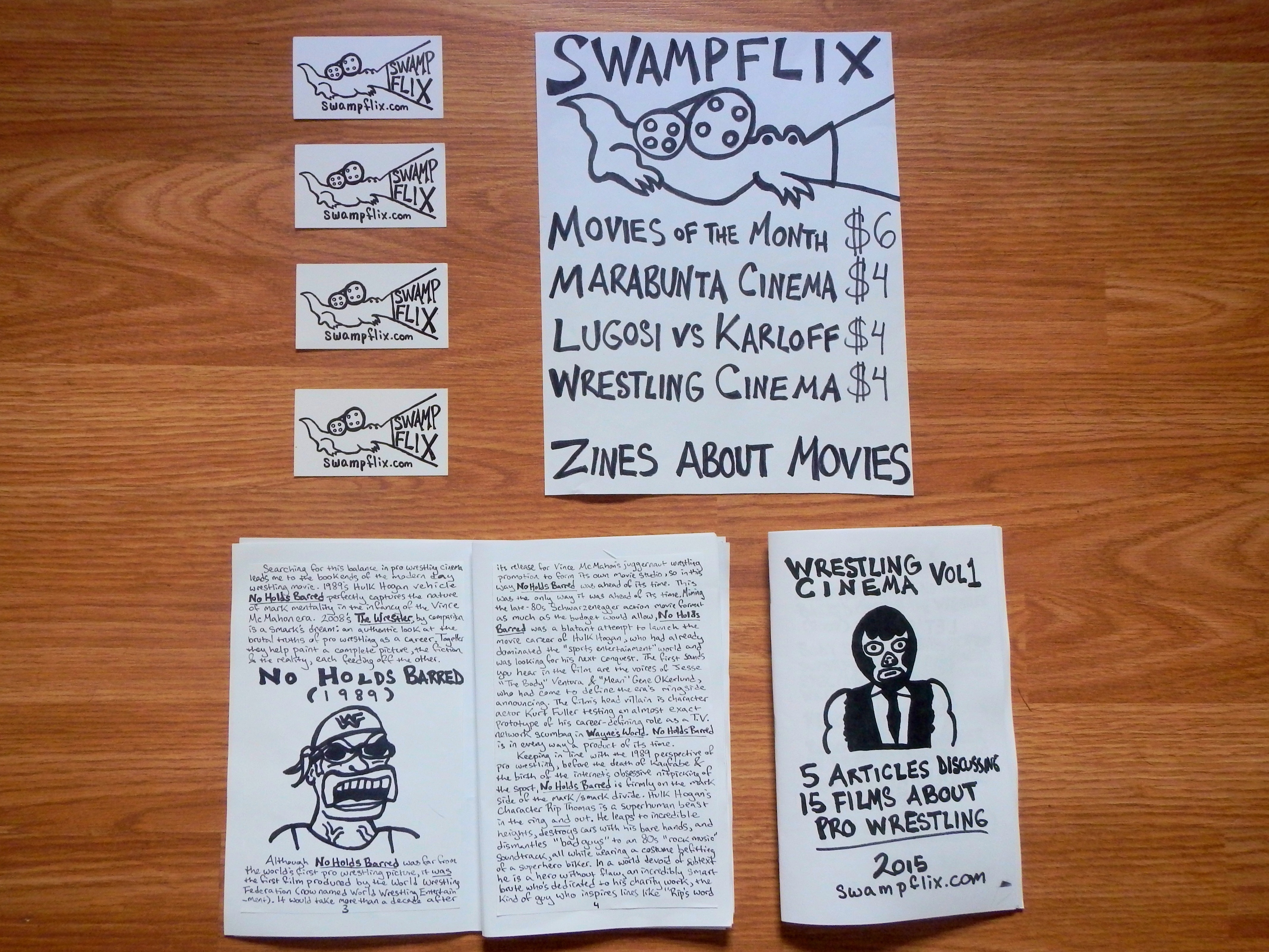
Attention, Swampflix readers in the New Orleans area! Swampflix will be exhibiting tomorrow (December 12th) at the fourteenth annual New Orleans Bookfair along with a bunch of other super cool books, comics, and zines exhibitors. We will be selling the print versions of the three Swampflix zines we sold at last month’s NOCAZ Fest (“Marabunta Cinema“, “Lugosi Vs. Karloff“, and 2015’s Movie of the Month conversations) PLUS a brand new collection of articles from our Wrestling Cinema page for all of you marks & smarks out there.

The Bookfair will take place Saturday, December 12th from 11am-5pm at Clouet Gardens (707 Clouet St., New Orleans, LA   70117)  in the Ninth Ward.

DSCN1460 (Modified (2))

DSCN1456 (Modified (2))

DSCN1455 (Modified (2))

I’ve lowered our prices a little since NOCAZ so all four pieces are dirt cheap. They all feature dozens of new illustrations & hand-transcribed text from the site and the Movies of the Month zine is a ~90 page whopper featuring work from everyone who’s contributed to the site this year.

For more info on the Bookfair (which features a whole lot of other activities besides book-selling), check out their website at NewOrleansBookfair.com  & refer to the poster below.

Book-Fair-8x11

We hope to see y’all there!

-The Swampflix Crew

The Nightmare (2015)

EPSON MFP image

fourstar

Rodney Ascher is a rare bird in the documentary world. His debut feature Room 237 took a wildly unique approach to exploring the cultural staying power of Stanley Kubrick’s The Shining. It didn’t detail The Shining‘s production or much of its technical achievements, but instead provided a forum for the film’s conspiracy theorists to voice their own outlandish theories about what Kubrick mean to achieve in the film, which ranged from ideas about Native American genocide & the Holocaust to the accusation that the film was Kubrick’s way of apologising for faking the moon landing. Ascher’s follow-up applies Room 237‘s judgement-free presentations of wild supposition to a different subject entirely: the phenomenon of sleep paralysis. Halfway between the late night paranormal radio broadcast Coast to Coast AM & the hyper-artificial dramatic re-enactments of Rescue 911, The Nightmare pushes the boundaries of what a documentary even is & what it possibly could be. Ascher’s approach has little concern for evidence or context, but instead builds narratives from the oral history end of anthropology. This technique is sure to frustrate many a purist, but in its own weird way it reveals more about the power of its subject than a Wikipedia-in-motion style of documentary could.

Sleep paralysis is a medical condition in which a person is temporarily left paralysed after stress-interrupted REM, caught halfway between dreaming & reality and unable to snap out of it. It’s a condition without any real, physically-threatening symptoms, except for an intense, psychologically torturous sense of fear. The strange, paranormal aspect of sleep paralysis is that the nightmare hallucinations are remarkably similar across sufferers’ personal experiences. Almost every sufferer of sleep paralysis reports the undeniable presence of “intruders.” Individual interpretations of “intruders”  vary greatly & include such beings as aliens, ghosts, cats, soul-sucking  demons and, most common of all, a dark, ambiguous figure called The Shadow Man. As the eight sleep paralysis sufferers interviewed share their experiences, they hypothesize about whether the condition is an out-of-body experience or a journey to the spiritual realm or something else entirely. The only theory they won’t accept is that it’s an imagined experience, both because it feels so palpably real and because the visions of the intruder are so universal among sufferers.

Rodney Ascher reportedly chose this project because of a personal experience with sleep paralysis, but he makes very few moves to legitimize the claims of his interviewees, instead presenting their personal anecdotes without bias, the burden of interpretation left entirely on the shoulders of the viewer. The dream logic of these anecdotes are fascinating & The Nightmare‘s strongest moments are in its dramatic re-enactments of run-ins with soul-sucking shadow demons, TV static aliens, and chest-sitting cats with glowing red eyes. The only time you can truly see Ascher’s own personality peaking through is in a fascination with the way sufferers find solace & community in films like Insidious, Communion, and (duh) A Nightmare on Elm Street, since their claims are largely brushed off by the scientific & medical communities (for obvious reasons). Ascher has obvious love for film and often indulges in somewhat radical ideas about the power of personal interpretation & the basics of what makes a documentary that can both excite & bewilder, sometimes simultaneously. I can’t say that I’ve specifically learned anything from his two features, but paradoxically they’re both distinctly informative in such an unusual, sometimes frustrating way that their power as oddities on the documentary landscape are undeniable.

-Brandon Ledet

Dracula 3D (2012)

EPSON MFP image

twostar

campstamp

I have to admit, I was a little worried that by the time I finished watching and writing about all of Dario Argento’s movies, I would cause his death through some terrible accidental sympathetic magic problem. Luckily it looks like that is not going to be the case. Or, maybe fate’s planning to keep him going until I’ve finished my determination of which Argento is the most Argento is the most Argento. We’ll see.

Dario Argento’s Dracula 3D is not the director’s worst film. It isn’t his worst adaptation, or his worst period piece (Phantom of the Opera holds the record in all three of those categories). It’s no surprise that people dislike this movie; what is a surprise is that, while Opera holds an abysmal 13% on Rotten Tomatoes, Dracula holds a barely­-better 14% approval rating, which is strange considering that it is merely a bad movie, not one that is an affront to good taste and the basic tenets of human decency. There are even some fresh and original ideas here that work in the film’s favor, unlike Phantom, where the new ideas were detrimental to the overall film in virtually every instance (steampunk rat killing cart, anyone?). I’m not arguing that this is enough to save the movie—it definitely isn’t—but it does make the viewing a much less painful experience. There were times when I found myself enjoying the film and its eccentricities in spite of its multitude of flaws.

You know this story, for the most part. The film opens to find a young woman named Tanja (Miriam Giovanelli) sneaking out on Walpurgis Night to tryst in some hay. After she and her lover part ways, she is pursued by a dark force and flees through the woods, coming upon the home of Zoran (Giuseppe Lo Console, who portrayed the nameless butcher in Giallo and Federica’s nameless boss in Do You Like Hitchcock?, so good for him getting a name this time around). For a moment, it seems Zoran will help her, but he instead just watches when she is attacked by Dracula (Thomas Kretschmann, who previously appeared in La sindrome de Stendhal as rapist/killer Alfredo Grossi). Later, Tanja rises from the dead as a new vampire so that she can fill the role of “vampire bride” in this narrative. The story proper gets going when Jonathan Harker (Unax Ugalde, which I’m pretty sure is the also the name of an artifact that Captain Picard is set to unearth on his next furlough) arrives in Transylvania aboard a CGI train and makes his way into the town. He spends the night at a local inn so that he can head to the count’s castle the next morning, but he spends enough time there to take note of all the garlic heaped around and be accosted by an imprisoned Renfield (Giovanni Franzoni). He also visits Lucy (Asia Argento), who is a dear friend of his wife, Mina. She warns him about the count in a very vague way, and she and her father fear for his safety when he finally departs. At the count’s home, he witnesses some strangeness and Tanja attempts to seduce him, but Dracula screams that Harker is his; he feasts on the younger man, who also becomes a vampire and then is dispatched in short order. Mina (Marta Gastini) arrives and begins to investigate, and she is aided by the sudden appearance of famed vampire hunter Abraham van Helsing (Rutger Hauer). Dracula recognizes Mina as the rebirth of his long dead love and tries to put her under his thrall. Can she resist his charms long enough for van Helsing to end Dracula’s reign of terror? (Yes.)

I love Rutger Hauer. His face alone is iconic; his line readings are the stuff of legend. He’s one of my favorite actors of all time, and even though I don’t understand his interest in appearing in mixed-­quality vampire media, I will never turn down the opportunity to watch; they’re two great tastes that taste great together! Whether he’s camping it up as Lothos in the 1992 film version of Buffy the Vampire Slayer, portraying Dracula himself in Dracula III: The Legacy, bringing un-life to Kurt Barlow in the remade Salem’s Lot, or slumming it as Sookie’s fairy godfather on True Blood, I am there. I’m tempted to give this film an extra star just because he’s in it, but I’ll refrain, if only because I’m saving all my stars for Ladyhawke (come at me talking shit about Ladyhawke, and we will throw down). Unfortunately, even Hauer can’t make this film work, although his presence lends the film more credibility than it really deserves, but all his gravitas can’t make large swathes of his dialogue sound like something a real person would say.

As for the new and interesting things that Argento brings to the table, there are a few. In this retelling, the villagers are all complicit in Dracula’s killings, having made a pact with him in exchange for various favors (this Dracula paid for several townspeople to go to college, which is both awesome and ridiculous). The scene in which the Count repays their attempt to back out of the deal by slaughtering all of them is probably the best in the film: first, Phenomena­-esque swarms of flies appear in the inn dining hall as different people voice their objections; the swarm then coalesces into Dracula as the last few flies are absorbed into his person. It’s a really cool effect in a sea of bad CGI and incomprehensible lighting choices that lend the film an overall Asylum Studios feeling (the composited train is the most offensive; could Argento really not get a real train car?). I also enjoy the character of Zoran, whose blind devotion to Dracula in the face of his fellows’ wishy-washiness makes him a strangely compelling figure, whether he’s doing something as small as not giving Jonathan a letter that Mina has sent or something as eventful as taking it upon himself to murder Tanja’s mother to prevent her from reporting the appearance of Dracula to the authorities in the city. There’s also some nice use of legacy dialogue from previous Dracula adaptations, most notably the “children of the night/what music they make” line.

But, as I said before, this is not a good movie. The subplot involving Tanja is completely pointless and serves only as an excuse to bare some breasts (Asia also has yet another scene in this film in which she showers/bathes, which only gets more weird and uncomfortable every time). Renfield is likewise wasted, as he is devoted to Tanja, not the Count himself, in this retelling. The dubbing is some of the worst I’ve ever seen and heard; inexplicably, Lucy’s surname in the film is changed from Westenra to Kisslinger, and the dubbing wreaks havoc here as some pronounce her name as Kissinger (no “l”) a la Henry, while other characters enunciate the name as kiss-­linger. Aside from the swarm of flies, all of Dracula’s alternate forms are rendered very poorly; history will never forget the scene in which he transforms into a giant praying mantis in order to kill Lucy’s father, but the Drac-­wolf that tears out Jonathan Harker’s throat is actually much, much worse. Perhaps the worst thing of all, however, is that this is the only film from the entire Argento canon that is available on Netflix. I had to actually leave my apartment to track down every other film in this retrospective, but Dracula 3D came to me. It’s a shame that this weak entry in the director’s oeuvre is the one that is most accessible. This is a movie that, frankly, doesn’t really need to exist, but it does, and we all have to live with it. I recommend the film for Argento fans and hardcore Hauer devotees; the rest of you should just skip it.

-Mark “Boomer” Redmond

Brooklyn (2015)

three star

When I first heard of Brooklyn‘s young-Irish-immigrant-tries-to-make-it-in-NYC premise I expected a Christ in Concrete or The Jungle type narrative set decades before in a time where the Irish & other immigrant communities were worked to death building NYC’s massive infrastructure & quickly discarded once the job was done. There’s a little bit of that history visible in Brooklyn‘s 1950’s setting, particularly in the film’s second-generation Irish-American communities & in the old men left homeless after their construction work dried up. Brooklyn is an entirely different kind of immigrant-story costume drama, though. Its protagonist, Eilis, has a relatively easy journey to the United States, with a remarkably large network of support helping her assimilate into a new land. After a prison-conditions, sea-sick ship ride across the ocean & a nervous encounter at customs, Eilis’ journey is less of a history of immigrant struggle in the New World & more of a traditional coming of age drama & chest-heaving romance.

The conflicts in Brooklyn are less life-threatening than they are emotionally troubling. Eilis struggles with severing family ties in her big move, petty jealousies among her boardinghouse mates, neighborhood gossip, the possibility of lifelong poverty, Catholic guilt, the pressures of rapid dating cycles (mentions of “I love you”s & children are almost instantaneous) and, of course, culture shock. The concerns are far from the grim trials & tribulations I had assumed she’d go through based on the film’s premise & from past films like last year’s The Immigrant. Besides a prudish shopkeeper & an overactive teenage libido, there isn’t much danger in Eilis’ life at all. She loses intimacy with the family & community she left behind in Ireland & they try to suck her back into their world, but for the most part her conflict is internal. Her love for a little James Franco-type Italian weirdo & her transition into a confident, autonomous woman are what drives the narrative, with nearly every other conflict falling into place seemingly without effort.

Saoirse Ronan is an incredibly gifted actor, a world class emoter, and she does as much as she can with Eilis’ torn-between-two-worlds inner-conflict, but it’s difficult to say if the low-stakes narrative she’s afforded is worthy of the quality of her performance. A couple other gifted, familiar faces, including Mad Men‘s Jessica Paré and Frank & Ex Machina‘s Domhnall Gleeson, check in for limited impact, all dressed up with nowhere special to go. The best chance Brooklyn has for finding a longterm audience is in fans of costume dramas & traditional romance plots built on yearning & the threatened development of love triangles. Outside Saoirse Ronan’s effective lead performance, I mostly found the film entertaining as a visual treat. Its costume & set design are wonderful, particularly in the detail of Eilis’ wardrobe – beach wear, summer dresses, cocktail attire, etc. That’s probably far from the kind of distinction the Brooklyn‘s looking for in terms of accolades, but there’s far worse things a film can be than a traditional, well-dressed romance.

-Brandon Ledet

Agents of S.W.A.M.P.F.L.I.X.: Iron Man (2008) & The Rise of the MCU

EPSON MFP image

Superhero Watching: Alternating Marvel Perspectives, Fresh and Longterm, Ignoring X-Men, or S.W.A.M.P.F.L.I.X., is a feature in which Boomer (who reads superhero comics & is well versed in the MCU) & Brandon (who reads alternative comics & has thus far seen less than 25% of the MCU’s output) revisit the films that make up the Marvel Cinematic Universe from the perspective of someone who knows what they’re talking about & someone who doesn’t have the slightest clue.

Boomer: It’s hard to believe now, but there was a time when superhero films were considered box office poison, and Marvel wasn’t even thinking about producing live­action adaptations of its material for the big screen. I won’t get into all the gritty details of the rise and fall of the House of Ideas here, but suffice it to say that political machinations behind the scenes and creative differences abounded, meaning that one of the most recognizable brands in the world nearly went bankrupt many, many times. If you’re looking to take the equivalent of a capstone class in the history of Marvel Comics, I recommend a viewing of Chuck Sonnenberg’s “Rise and Fall of the Comic Empire” video series on his website SFDebris, which offers a fair and concise outlining of Marvel’s corporate shenanigans and infighting over the past four decades, and that series still clocks in at thirteen segments ranging from ten to thirty minutes in length. I’ll try to be more succinct here.

Considering that Marvel consistently has the creative edge over the more staid DC Comics, it’s ironic that DC is usually the first to enter new realms of media. DC put two live action television series on air (the Adam West Batman in the 1960s and Wonder Woman in the 1970s) before Marvel ever got a TV show off the ground, and they beat Marvel to theatres by two solid decades (not counting the Republic Pictures Captain America serials of the 1940s and George Lucas’s 1986 Howard the Duck, which is best forgotten). Richard Donner’s Superman took the world by storm in 1978 and was followed by three sequels and an attempted spinoff. As a result of the increasingly diminished returns on the Superman film series, the general public largely fell out of love with film adaptations of comics, before the genre was briefly reinvigorated in 1989 following the success of Tim Burton’s Batman and that film’s first sequel. That franchise also devolved into garbage, with the DC’s box office domination effectively being murdered in 1997 by the dual death blows of the notoriously terrible Batman & Robin and the stunningly unimaginative Shaquille O’Neill vehicle Steel. Finally, it was Marvel’s turn.

Although the X-­Men were unquestionably Marvel’s most lucrative property in the eighties and nineties, and many people would credit the success of the X-­Men film series (alongside Sam Raimi’s Spider­-Man films) as creating the modern zeitgeist of superhero saturation, bringing Beast, Storm, and Nightcrawler to life in a film was considered prohibitively expensive at the time. The real catalyst for this revolution was the surprising success of 1998’s Blade (budgeted at $45 million but earning over $131 million worldwide). Blade proved that superhero movies didn’t necessarily have to be created by committee to appeal to a wide audience, and that a comic book adaptation could be financially successful even if it eliminated the merchandising potential of toy sales (which tied the hands of the creative teams involved; in order to prevent watchdog and advocacy groups from causing a stink about inappropriateness of toys, films had to be made not only safe for children, but to appeal to them as well). Blade was an R-­rated movie that brought in tons of new fans for Marvel, and kick­started the company’s interest in features. The problem was that, to save itself from going under following the Comic Speculator Bust of the Nineties, Marvel had sold off the film rights to its most noteworthy properties in order to get funding to keep the lights on and the presses printing. Japanese film company Toei produced a (notably ridiculous) live action Spider­Man series in the 1970s, and the character was the most popular Marvel property in that country; as a result, his film rights ended up in the hands of Sony. Twentieth Century Fox ended up with the rights to the X-­Men, the Fantastic Four, and Daredevil. Marvel pictures were making money, but the comic company itself was still struggling.

This diaspora of character rights didn’t leave Marvel many characters or franchises to choose from, and the company made the logically sound but ultimately detrimental choice to make its first foray into film production with Marvel icon The Incredible Hulk. The television series based on the character had run for five successful seasons in the seventies and the gamma­-irradiated antihero had long been a mascot for Marvel as an instantly recognizable figure and a representative of Marvel’s introspective approach to storytelling in contrast to DC’s implacable supermen; investing in a film adaptation seemed obvious. Unfortunately, Ang Lee’s 2003 film Hulk was a mess, and it would take years before Marvel started co-­producing films in a meaningful way again. With the further failures of forgettable fare like 2004’s The Punisher and 2007’s Ghost Rider, it became apparent that a new approach was needed.

Kevin Feige was a Marvel exec who actually cared about the stories and characters, and he came up with a plan of creating a movie franchise that would function in much the same ways as the books did, allowing characters to cross over, team up, and occasionally come to blows. Since Hulk had been such a disaster, the newly founded Marvel Studios (with Feige at the helm) decided to move forward with an adaptation of Iron Man first, hitching the fledgling production company’s wagon to Robert Downey Jr.’s unpredictable star. And the rest, as they say, is history. In the seven years since that film’s release, the studio has moved from co­-producing features with Paramount to releasing directly through Disney (Marvel’s decades of questionable solvency having ended with the decision to allow the media demigod to buy them out) and churned out two “phases” of films, with Phase II having concluded with Ant­-Man, which was my first review for this site. With Phase III set to take off in a few months with the release of Captain America: Civil War, and with Brandon’s Russ Meyer project and my Dario Argento project winding down, we’ve decided to go through all twelve official Marvel Cinematic Universe films in order and review them, from the perspective of an old hand (me) and a newcomer (him). We’re calling it Agents of S.W.A.M.P.F.L.I.X..

EPSON MFP image

threehalfstar

Boomer: I’ll be as upfront about this as I possibly can: I never really cared much for Iron Man as a character. I didn’t dislike him, I simply remained utterly apathetic to him for most of my life. Of all the Marvel cartoons that aired during the nineties, his was the most forgettable and (to my memory) the most cheaply animated. On the Marvel side of the comic aisle, I loved the X­-Men most of all, but I also liked the titular Thor beginning with J. Michael Straczynski’s run, the recently popular (and I love it) Jessica Jones, and Captain America, who represented, to me at least, the purest ideals of true ethical and upright citizenship. Then, in 2006, along came Marvel’s Civil War crossover event, which pitted Steve “Captain America” Rogers against Tony “Iron Man” Stark. To keep it simple, the narrative of Civil War was instigated by a deadly event that led Iron Man and Cap to fall on opposite sides of a political issue, the Superhuman Registration Act; the SRA would be a government mandate requiring all superpowered individuals (which in the comics is a huge but socially vulnerable minority) to reveal themselves to the government and be registered (and basically submit to the superhero version of the selective service, if the selective service had a 100% drafting rate, but I digress). Marvel’s editorial mandate was that Iron Man’s weirdly conservative Pro­Registration side be depicted as being “right,” with Cap’s more individualistic and liberal Anti­Reg side being shortsighted and “wrong.” This was despite the fact that a proposed Mutant Registration Act had been a topic of plots in the X-­Men comics for literally decades, with such a missive being treated (and rightfully so) as a gross civil rights violation. (The trailer for Captain America: Civil War that was released last week seems to show that the film version will have a more balanced approach.) I won’t discuss how that comic arc played out for fear of potentially spoiling the viewing experience for Brandon, but I will say that I found Iron Man’s choices to be unconscionable and eventually came to hate Tony Stark the way that the blogosphere hates Gwyneth Paltrow. Of course, I was super pissed a year later when I read a copy of Wizard Magazine and learned that a character responsible for so much that I hated would be the face of Marvel’s new cinematic initiative.

I still watched it, though. Eventually.

I saw the first fifteen minutes or so of the film while hooked up to a centrifuge at a plasma “donation” center, literally selling part of my blood for an extra $40 a week because I suffered from the distinct but common misfortune of coming of age in Bush’s America and the accompanying recession. The center had a small collection of DVDs they would play in the donor area to pass the time, and someone must have rented Iron Man since it was screened only once (as opposed to the dozens of times I watched their copy of Miss Congeniality, a movie I can recite backwards and forwards, much to my own embarrassment). I have to admit, Iron Man didn’t leave much of an impression on me at the time, but after nearly a decade to get over my sophomoric and hormone­-addled (if well­-founded and still totally justified) feelings about Civil War, I found this viewing to be much more enjoyable, even if it errs on the side of disbelief a bit too often.

By the way, has this review seemed a little overly political to you? That’s intentional. Iron Man is a strange movie in the way that it is paradoxically both steeped in and independent of the politics of 2008, especially with regards to the othered “foreign” antagonists. White businessman Obadiah Stane and his vaguely country accent have a clear narrative arc: Stane likes money, and he wants to keep making money, and if he has to play both sides to keep raking in the dough, he has no moral or ethical qualms about doing so. The motivations of the vaguely Middle Eastern group (who are obviously modeled after Al Qaeda but have an English language group name and live in an unnamed desert country) are never explained and implicitly irrelevant. The script takes great pains to dance around the word “terrorist” when discussing the Ten Rings, instead opting for “warlord,” but it clearly utilizes visual rhetorical strategies to evoke that image. But to what end? Why are they rounding people up? Is Stane complicit in an ethnic genocide? A bloody border dispute? The film expects you not to think too hard about it, or anything else, for that matter, especially not matters of narrative convenience.

For instance, Stane confronts the leader of the terrori—I mean, the Ten Rings, and obtains the suit Tony built “in a cave(!) with a box of scraps(!)”; in the next, Pepper visits Tony and he asks her to go to Stark Industries and steal files using his magic flash drive; in the very next scene, Pepper finds plans for a finalized Iron Monger suit on the desktop before Stane walks in. Everything that happens off-­screen happens instantly. It’s so ridiculous that it would be insulting if the film didn’t make up for its inadequacies by being so much fun. The intermix of horror tropes that seem to come out of nowhere (in the scene of Tony’s escape at the end of Act I, and when Pepper is startled by Stane in the Monger suit, for instance) somehow don’t feel tonally inconsistent, and there are scenes that are, frankly, exhilarating; in fact, I think the fighter jet set piece is probably one of the best sequences that Marvel has done to date, and easily out-paces the finale. A lot of that fun comes from the tightness and polish to the script, which reads like an exemplary if basic lesson in successful planting­-and­-payoff, with regards to things like high-­altitude freezing points, magic nuclear pacemakers, and the sonic paralyzer (I have no idea if that device has an actual name). It’s easy to go along for the ride if you can accept it for what it is: a comic book movie.

EPSON MFP image

onehalfstar­­­­­­­­­­­­­­­­­

Brandon: Full disclosure: A large part of the reason I’ve been avoiding catching up with the dozen or so MCU movies & TV shows I haven’t bothered with is my distaste for Robert Downey Jr.’s Iron Man. The four hours I’ve spent with the character in the two Avengers films has been more than I would’ve ever asked for. He just hits this annoying little anti-hero sweet spot that always gets on my nerves: the “lovable” jerk. The philosophical opposite of characters like Kenny Powers & BoJack Horseman, who ruin everything they touch, the lovable jerk is a character you’re supposed to celebrate for their asshole tendencies. If you want a concrete example just look to just about any character Vince Vaughn has played since Old School. Or, better yet, look to Tony Stark, a womanizing drunk whose reformed bad boy act is never quite as convincing as his grotesquely egotistical beginnings.

I’m admitting to all of this prejudice early because it was highly unlikely that I was ever going to be able to get on Jon Favreau’s Iron Man‘s wavelength. As soon as the dad rock licks of AC/DC play Tony Stark into the frame so he can crack smarmy, chauvinistic jokes in the back of a limousine in the film’s opening scene my worst fears about Iron Man were confirmed  & the next two hours left me with the distinct feeling of taking my medicine so that I can enjoy better MCU titles down the line. Everything from the stewardess-banging to the US-Iraq War context to the throwaway transphobic joke in the airplane hangar to Stark’s horrific Guy Fieri sunglasses & facial hair combo were huge turn-offs for me. By the time our hero suffers the irony of being attacked with the very weapons he pushed as an arms dealer & gets the liberal bug, all of a sudden super stoked about renewable energy sources instead of getting laid, it registers as too little too late. Too much of the film reads as a being-a-rich-dick fantasy fulfillment for me to focus on anything else.

Speaking of which, I’ve  been so wrapped up in ranting about Iron Man’s Lifestyles of the Rich & Douchey aspects that I forgot to mention that it’s also a superhero movie. The few elements of Iron Man I appreciated were distinctly non-Tony Stark related. Jeff Bridges was deliciously evil & barely recognizable in his role as the film’s Big Bad, who was giving off an unignorable daddy bear vibe (especially in a bedtime Skype session). Gwenyth Paltrow had a gloriously uncomfortable surgery scene that has inspired a new fetish in me: chest-fisting. I also liked a good deal of the film’s gadgetry, especially J.A.R.V.I.S. the sassy robot, the car battery heart Stark carries around like a lunch box, and the crude Iron Man suit prototype he builds in a terrorist cave to take advantage of the gullibility of his unintelligent brown people captors (ugh). And, you know, there’s always plenty of mindles surface pleasures to be found in watching two dudes in mech suits fighting it out. By the end of the film, even the flying-through-the-air superhero antics were exhausting to me, though, especially in the relentless suiting up montages & the empty spectacle of the climactic battle.

I’m promising myself & anyone else who’s interested that I’ll be more open-minded about future MCU outings, especially since the select few I’ve already seen (the two Avengers films, Ant-Man, and Guardians of the Galaxy) were all very enjoyable, Tony Stark content notwithstanding. I just couldn’t commit to what Iron Man was selling me & I expect that it’ll probably stand as one of my least favorite entries in the MCU franchise. I also suspect that it’s probably a crowd favorite among George W Bush & his supporters, since it feels distinctly tied to the tail end of their era of American thinking.

Lagniappe

Boomer: As to where Iron Man fits into the rest of the MCU, I have to say it’s a pretty good place to launch, and it was probably a smart decision to focus the first Marvel pic on an entirely human character whose gimmick is combining wealth and mechanical genius, rather than going straight for the Norse gods, sentient robots, and super soldiers. Regarding plots left to unfold, I think the fact that this film was only responsible for sowing a few seeds of the larger universe contributed to the movie’s more laid­back feeling. As someone who spent his childhood obsessing over Star Trek and his adolescence reading comics and Kurt Vonnegut books, I’m used to the idea of maintaining an elaborate, intersectional fictional universe in my head; I don’t generally think too much about accessibility, but, looking back, Iron Man is refreshing in its simplicity in this regard. S.H.I.E.L.D. is present throughout but only tangentially, with the first appearances of fan favorite Phil Coulson and Nick Fury’s post­-credits scene comprising the organization’s entire role in the plot. It actually made me a little nostalgic for the early days of the MCU, when things were less complicated and not all villainy had to link back to Hydra somehow. But I’m getting ahead of myself.

Brandon: When I was watching Jessica Jones last month I found nearly every element of the series enjoyable except for its gestures to tie itself into the MCU at large. Fans already tuned into the MCU were likely tickled by offhand references to the Hulk & the loose ends of Luke Cage’s storyline, but I found they were mostly wasted efforts, weakening some of the the series’ strengths as a self-contained property. Iron Man’s Nick Fury & S.H.I.E.L.D. nods work sort of in the same way. I get the feeling that the MCU’s formula is going to play out the same way as pro wrestling or soap operas or, hell, comic books: always promising to deliver on the next spectacle instead of focusing all efforts on the task at hand. I’m not entirely opposed to letting the story arcs build toward a larger goal, but as a moviegoer unfamiliar with the comic book source material, it can be a little frustrating to not know where this whole thing is going or if it even has a final destination to begin with.

Combined S.W.A.M.P.F.L.I.X. Rating for Iron Man (2008)

EPSON MFP image

twohalfstar

-Agents of S.W.A.M.P.F.L.I.X.

The Hunger Games: Mockingjay – Parts I & II (2014, 2015)

EPSON MFP image

fourstar

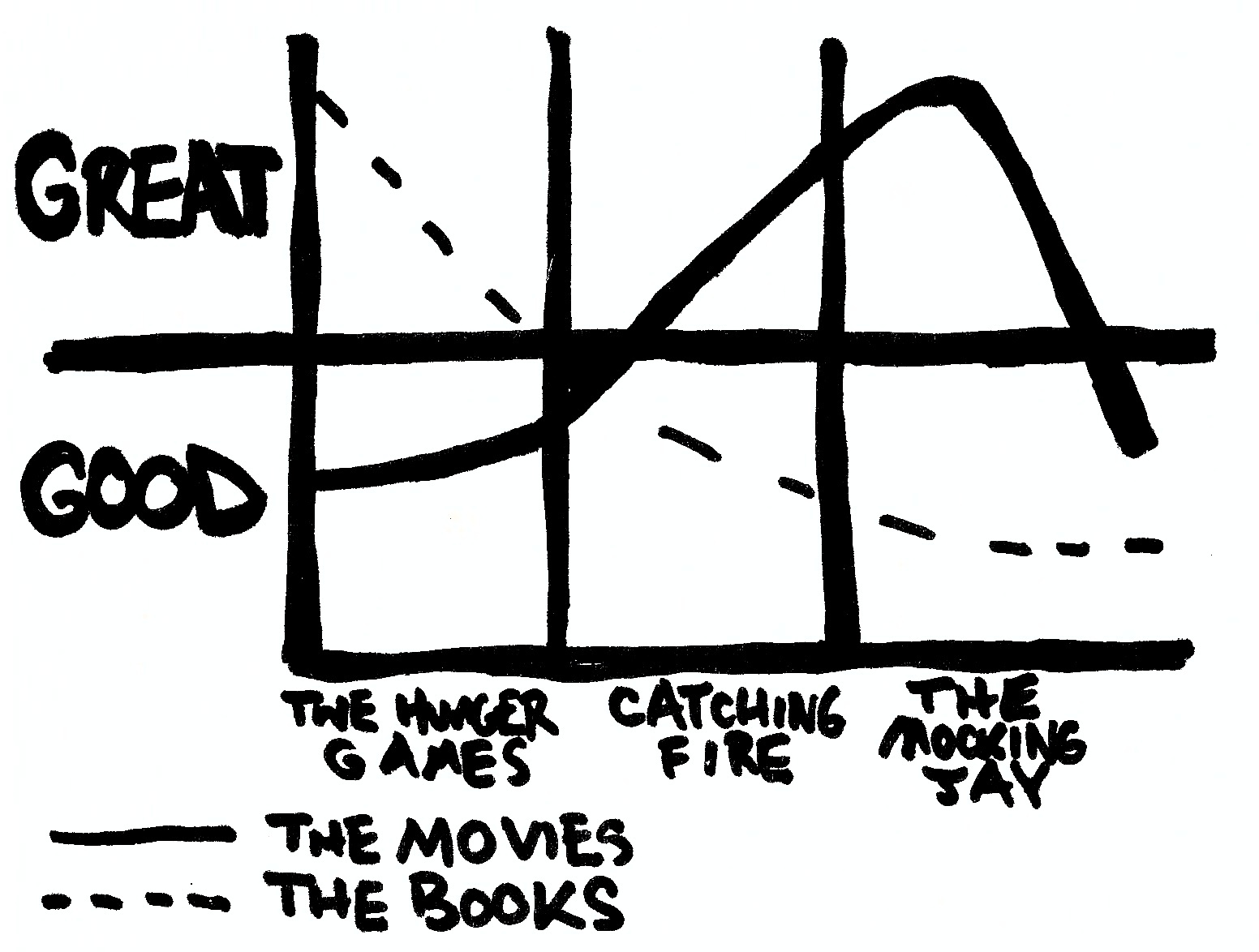
I’ve enjoyed following the Hunger Games saga, both as a series of YA novels & and as a series of dystopian sci-fi film. It’s a pretty grim franchise for something a lot of people consider “kids’ stuff”, one that takes its forcing-to-children-to-fight-to-the-death-for-entertainment premise very seriously. Its haves-vs-have-nots dystopian world-building is nothing particularly new and can especially be seen telegraphed in properties like Battle Royale & The Running Man, but I think it’s a pretty great sci-fi intro for teens, especially refreshing for its strong female protagonist Katniss Everdeen (played by Jennifer Lawrence in the films, duh) & in the way its potentially-corrosive love triangle conflict is handled. One strange aspect for me has been how the film versions of the Hunger Games trilogy have resisted the law of diminishing returns. I felt that Suzanne Collins’ novels started at their strongest point, doing a great job of establishing an in-the-moment intensity in its abysmal future-world by dragging the audience along closely with Katniss’ experience navigating the Hunger Games. The quality dropped off a bit for me in the sequels, though, as the pacing seemed to get away from Collins and large swaths of summarizing overtook the focused intimacy of early scenes. The first movie was pretty great as well, doing a good job of capturing Katniss’ in-the-moment POV, but the film series subsequently seemed to improve from there, knowing exactly what to show & what to ignore in Collins’ sprawling narrative for maximum effect.

EPSON MFP image

Mockingjay – Part I might just be the pinnacle of the Hunger Games movies for me. General consensus has the franchise peaking with the second film, Catching Fire, but I’d say it’s at the very least a close call. the film’s themes of PTSD, regret, powerlessness, and the pressures of being the face of a revolution all hit me pretty hard. I’ve heard friends & family describe the film as boring, saying nothing happened, which is pretty surprising for a film with such a high bodycount & grandscale warfare, but I had a genuinely emotional reaction to its horrors, getting teary-eyed at the film’s hospital bombings, mass graves, and three-fingered solutes. Its murderers’ row of talented actors certainly didn’t hurt: Philip Seymour Hoffman, Julianne Moore, Jeffrey Wright, Natalie Dormer, and Donald Sutehrland are all at the top of their game here, which is really saying something. I also appreciated scenes of Jennifer Lawrence, who is an incredibly gifted actor, pretending to be an incredibly inept actor as Katniss fails miserably to produce convincing propaganda clips to rally support for a revolution. Mockingjay – Part I‘s riots, uprisings, strikes, and rescue missions were all a lot more satisfying to me than expected & Lawrence deserves a lot of credit for anchoring the film’s emotional resonance.

Mockingjay – Part II unfortunately didn’t hold up quite as well for me. I think the issue is that Collins’ summarizing had gotten out of control by the final book, so that the film version struggles to make individual scenes count for much as it chases an exponential momentum of a plot trying to wrap up a widespread political revolution, a small family’s struggle to remain a unit, and a strained, increasingly bitter love triangle in just two hours time. There were a few small moments to enjoy in the chaos — my favorite was when Katniss is called out for the “tacky romance drama” & cliché  “the one” specialness of her mythology at a wedding — but for the most part the films struggles to let its Big Moments properly breathe. Mocking Jay – Part II‘s killer C.H.U.D.s & third act Major Character Death both failed to land with full impact thanks to the runaway momentum of Collins’ plot & pacing. And because director Francis Lawrence did such a great job with Catching Fire & Mockingjay – Part I, I’m willing to give him the benefit of the doubt & suppose that the rushed nature of Mockingjay – Part II was far from his fault. Considering all of the ground that the novel covers (I’m struggling not to go long here just touching on it), Francis Lawrence  could’ve stretched Mockingjay into its own separate trilogy & given each underserved scene its own proper moment to shine.

I can’t imagine impatient fans, who groused about splitting the finale into two parts in the first place, would’ve been receptive to a Mockingjay – Part III,  though. If you consider that Francis Lawrence had no choice but to split the finale into two parts, I think he did a great job of adapting a difficult work of fiction for the screen. Mockingjay – Part I carries the emotional weight the film series as earned over the last few years & Mockingjay – Part II does the necessary work of bringing the whole thing to a close. The two halves function well together as a single, four-hour feature. One picks up exactly where the other leaves off & together they do a satisfactory job of carrying a work that’s spread pretty thin to a convincing conclusion. Although I’d contend that Part I is the far superior picture, they average out to something pretty great in the end, which fairly unusual for the third film in a sci-fi trilogy.

Bonus points: I’d like to take this opportunity to give kudos to the Hunger Games series for being the only action franchise I can think of where fashion as an artform plays a deeply integral part to the films’ central themes. I particularly liked a moment in Mockingjay where Katniss is told she’ll be “the best dressed rebel in history” & it’s a sentiment that actually means something significant. It’s a cool, distinguishing detail, if nothing else.

– Brandon Ledet

My Father the Hero (1994)

EPSON MFP image

halfstar

Every now and then, The Dollar Tree will have a handful of DVDs for, you guessed it, only a buck! Recently, I was going through the infamous dollar DVD pile, and among 10 copies of Madonna’s flop Swept Away, there was a copy of My Father the Hero. After noticing that the film’s cast contained a couple of decent actors (Gérard Depardieu, Katherine Heigl, and Lauren Hutton), I decided to buy it. How bad could it be?

I could sense that the film was going to be pure garbage within the first five minutes, and because I absolutely love garbage movies, I was getting a little excited. The film starts off with Andre (Depardieu), a neglectful father, arriving to New York City to pick up his 14 year-old brat of a daughter, Nicole (Heigl), for a father-daughter trip to the Bahamas. At this point, the acting was horrific and Depardieu looked like Uncle Fester with his bowl cut wig from Addams Family Values. I was loving it!

Screenshot from 2015-12-07 10:37:29 (Modified)

Unfortunately, everything took a turn for the worse once Andre and Nicole arrive in the Bahamas. Nicole develops a crush on an island boy, and she tells him that she’s on a trip with her lover, Andre. Yes, she pretends that her father is her older lover. And it gets even worse! She then tells her crush that she has to pretend that Andre is her father so that they won’t get into any legal trouble. Why would anyone think that this would be a cute idea for a family comedy? I’m sure the writers thought that this “cute” lie would cause the duo to get into all sorts of funny, wacky situations, but instead, it made this film an excruciatingly painful experience.

There are too many awkward moments in this film for me to discuss in this article (it would literally be the entire film script), but here’s my top 3:

  1. 14-year-old Nicole wears a white thong bathing suit while lying out by the pool, and all of these creepy old guys are checking her out. Oh yeah, and her dad is at the pool as well.
  2. After Nicole makes it well known that Andre is her lover, she attempts to make her crush jealous by having a semi-sensual slow dance with her father. At this point in the film, I recall screaming “Please! Just make it stop!” really loudly.
  3. Nicole eventually comes clean and tells her father about her little white lie, but instead of putting an end to all of this nonsense, he agrees to pretend to be her lover for the rest of their vacation. I’m not one to preach about parenting skills, but I’m pretty sure you shouldn’t condone your child’s lies or pretend to be their lover.

I have one wish for this holiday season, and it’s to have all copies of My Father the Hero destroyed. Please, if you are able to spare a buck, look for a copy of this film at your local Dollar Tree and burn it.

-Britnee Lombas

Blacksnake (1973)

EPSON MFP image

halfstar

I was quick to defend Russ Meyer’s first supposed foray into territory outside the “sex film”, The Seven Minutes, but I’m afraid the good vibes died a horrific death as soon as the director’s next picture. Hollywood success may have clouded Meyer’s already inflated hubris when he struck it big with his camp masterpiece Beyond the Valley of the Dolls, (mis)leading the director to believe he had the capability within him to command complexly nuanced, important films about issues like slavery & institutional racism. He was miserably mistaken. Black Snake cost Russ Meyer hundreds of thousands of dollars, a lot of it his own money now that he was back operating outside the studio system, and stands as his worst picture since at least the wildly misogynistic Motorpsycho!. Meyer should’ve known better than to tackle a period piece about slavery and, yet, Blacksnake somehow exists, adding nothing of value to the world but unwatchably dull stretches of wretched dialogue and as yet undiscovered, fresh ways to create corrosively racist art in the guise of enlightened progressivism.

Ever since the pointlessly racist rants in Vixen!, Meyer’s films had gradually escalated the respectability of their black characters. Starting with adding the first black actress to Meyer’s bevy of babes in Cherry, Harry, and Raquel! (a small step, that), the director went on to cast feature roles for black actors in both Beyond the Valley of the Dolls & The Seven Minutes, a huge improvement on the lack of diversity in his back catalog. All of that goodwill goes out the window as soon as Blacksnake‘s opening credits, which features slaves on a plantation being beaten to the sound of playfully swanky music, racial slurs, and cracking whip sound effects (the film’s title itself refers to the shape of a whip) in an assault of unwelcome irreverence. It isn’t very often that I hate a film before its first proper scene, but Blacksnake is instantly recognizable as vile garbage.

It doesn’t get much better from there. Sexual relations between slaves & their owners are played as comical instead of rape. There’s a perverse amount of whippings & racial epitaphs to the point where it feels like they’re supposed to be a source of entertainment, which is pretty much a worst-case scenario. The worst part is that the slave revolt that concludes the film is excessive in its violence to the point that it plays as if you’re supposed to feel bad for the slave-owners being hung & whipped to death (for a change). While making the film, Meyer was quoted as saying, “Sex is out, violence is in. This film will have every conceivable death you can think of – death by hanging, by double-barreled shotgun, by whipping, by machete, by crucifixion and by shark.” The problem is that the violence in the film plays as nihilistic at best, and deeply, subliminally racist at worst.

With Blacksnake, Meyer had tried to make a Big Issue film & failed miserably. Even his wild rants about the wicked nature of women & heterosexual romance in past works were more nuanced & insightful than his supposedly anti-racist sentiments in Blacksnake. If anything good at all came out of this dumpster fire, it’s that the film’s failure & resulting financial ruin drove Meyer back into the open arms & comforting bosoms of the nudie pic. Meyer may have been done with the sex film, but the sex film was far from done with him, He had no other available recourse but to return to sexploitation in his next picture, Supervixens, having fallen from grace in his two sole self-serious dramas.

-Brandon Ledet

The Seven Minutes (1971)

EPSON MFP image

fourstar

“The sex film? I think it’s on the way out. I want to get into horror films. Suspense, mystery.” -Russ Meyer

Russ Meyer may have been done with sexploitation (if you believe that for a second) but the bosoms weren’t done with him. The director’s follow up to his camp masterpiece Beyond the Valley of the Dolls may have pretended to be a straight-laced courtroom drama, but The Seven Minutes was just as plagued with Russ’ sexual id as any of his nastier works. Reportedly, Fox Studios took the opposite approach to its hands-off policy with Beyond the Valley of the Dolls & pressured Meyer into not only adopting this specific property (an Irving Wallace novel) for the screen, but also demanding that the film achieve an R-rating from the MPAA, perhaps as a reaction to the sting of the studio’s X-rated disaster Myra Breckinridge. High octane Meyer works like Beyond the Valley of the Dolls & Faster, Pussycat! Kill! Kill! had established a certain maniacal standard for the director’s work that The Seven Minutes demonstrates little-to-no desire to fulfill. Still, I find that the negative reaction to The Seven Minutes was largely unwarranted. It was far from Meyer’s most personal picture, but I found it to be more enjoyable than a majority of his catalog, much to my surprise.

Despite how subdued The Seven Minutes may come across at first glance, it actually commanded twice the budget of Meyer’s previous big studio effort & the director’s all-time longest runtime. There’s no doubt that the director initially intended the film to be his grandest work, his once chance to be taken seriously. So, where did he choose to set his sights for his major studio manifesto? Now on top of the world (in terms of ticket sales, anyway; most critics still scoffed at him), Meyer gloatingly fired back at the censorship boards & moral policing that plagued the theater run of his otherwise-successful film Vixen! just three years earlier. The Seven Minutes (named for the average time it takes for a woman to achieve orgasm), revolves around a courtroom battle in which an oversensitive moral vanguard attempts to convict a sexually-oriented novel guilty for the rape of a young college student by providing “living proof that a dirty book can destroy a  clean boy.” Of course, Meyer’s tirade stands firmly on the other side of the issue, railing against the hypocritical piety of the prosecutors looking to condemn this piece of fictional smut and, by extension, condemning the work of Russ Meyer himself. In a lot of ways The Seven Minutes is a highly paranoid piece of art, one that thumbs its nose at the extensive past of Meyer detractors in a grandly expensive display of gloating.

Solidifying the film’s straw man argument against the freedom of expression of sexual liberation in art, The Seven Minutes openly mocks the fictional Strength Through Decency League. One of the best stretches of dialogue in the film is the following rant at one of the STDL’s political rallies; “There is virtually no area that remains untainted by the quick buck artists who pander to our lowest forms of taste, and the public be damned. Just the other evening, my first night off in weeks, I decided to take my wife Mary & our three children to the movies. In our neighborhood, we had such subject material as rape, lust, motorcycle gangs, homosexuals, lesbians, drug abuse, you name it. Whatever happened to the movies we used to be able to take our children to?” What’s so great about this speech is that it not only jokingly jabs at the exact smut Meyer had himself been peddling for over a decade, but it also serves as a distinct antithesis to the anti-censorship rant that opens Meyer’s Cherry, Harry, and Raquel!. Meyer never forgave the goody two shoes who complicated his otherwise-successful run with Vixen! He wasn’t satisfied with protesting them at the beginning of his modest indie movie Cherry, but waited to use the big time stage of his second major studio release to portray censorship-happy do-gooders as two-faced monsters who pretend to be “protecting the public”, but behind closed doors are hoarding pornography for themselves while maintaining a holier-than-thou public persona.

This aspect of The Seven Minutes positions the film as a personal work for Meyer, even if his personal interest in the work is centered mostly on a vicious pettiness. It’s not the only thing that distinguishes the film as a uniquely Meyer work, though. Old Meyer standbys like Charles Napier, Stuart Lancaster, and Uschi Digard appear in the film, as do old-hat Meyer tropes like themes of male sexual inadequacy and the idea that heterosexual romance is a form of emotional pugilism, an antagonistic back & forth  seeped much more in vitriol than sexuality. Perhaps the best metaphor for what the film accomplishes can be found in the character Babydoll, played by Shawn Devereaux. As rooms full of law men argue about decency & censorship, Babydoll undulates like the go-go dancers of yesteryear, purring like a high-pitched kitten, blaring hip dance music, and trying to make innocuous acts like eating potato chips the most seductive transgressions imaginable. When her lecherous, lawmaking cohorts bark commands like, “Babydoll, shut off that damn radio!” the push & pull between Meyer’s natural absurdity & the studio’s forced browbeating can be felt in full effect.

The difference between my reaction to The Seven Minutes & that of the film’s contemporaries is that I find that compromised dichotomy fascinating, while critical publications like Playboy Magazine called it “a losing battle of mind over mattress.” In short, The Seven Minutes featured a lot of dudes talking & not a lot of boobs bouncing, something that couldn’t be saved by Meyer’s trademark rapid-fire edits or lip service paid to the virtues of smut in the eyes of the film’s contemporary audience. The critics & the box office returns had their way with the film, making sure that it stood as the very last major studio production that Meyer saw to completion.

Although I’d sympathise with the idea that The Seven Minutes‘ courtroom procedures & undercover police work aren’t as interesting in the abstract as Meyer’s feverish nudie pictures could be, I still stand by the film’s quality as a finished product. I think that being the very first Russ Meyer film that couldn’t be read as a campy trifle may have clashed harshly with what people had come to expect from the director, resulting in a vicious reaction to a decent film that didn’t deserve to be met with such an easy dismissal. Meyer himself had even distanced himself from The Seven Minutes in the end, blaming a lot of the film’s shortcomings on the studio’s oppressive influence. I’m willing to chalk that reaction up to wounded pride resulting from the film’s hurtful reception, though, as The Seven Minutes reads as far too distinctly personal for me to dismiss it outright.

-Brandon Ledet

The Night Before (2015)

fourstar

I should preface this review with the confession that Scrooged is my favorite Christmas movie. Bill Murray worship not withstanding, I feel like Scrooged is typically considered a minor, non-traditional Christmas comedy at best, not a typical go-to for the genre. I’m saying this because I greatly enjoyed The Night Before, but it’s hard to tell if its irreverent, drug-fuelled take on Christmas tradition will win over any longterm audiences, since it very much mimics the alcohol-soaked magic & pessimism of Scrooged. The Night Before not only mimics Scrooged‘s cynical, modern-world take on A Christmas Carol, but expands its adaptation scope to include touches of How the Grinch Stole Christmas, Home Alone, It’s a Wonderful Life, and (duh) “The Night Before Christmas”. Its excessive aping of former Christmas tales approaches allusions the same way its characters ingest “every single drug in the whole world.” Scrooged was a cynical, surreal adaptation of a Christmas classic told through the lens of alcoholism & Reaganomics. The Night Before is a similar beast, but it’s much less picky about its controlled substances or its source material & its lens is obviously more of a social media-era millennial brand.

You might expect that a raunchy comedy featuring long stretches of a Jewish man sweating his way through an aggressive cocktail of cocaine & psilocybin mushrooms would have little care at all for Christmas tradition, but The Night Before is far from the tradition-breaking excess of this year’s Everly or Tangerine. At its heart, the film is a simple story about three friends learning how to reconcile the changes that come with growing up & what it means to be a family. The three buds in question are living out a chaotic holiday ritual in which they fuck, drug, and vandalize their way through Christmas Eve while most people are sleeping or preparing for the big day ahead. Fearing that they might be becoming “those kids who won’t stop trick or treating” they decide to have one last drug-fueled blast to put the tradition to rest. And because they’re adults with adult issues looming over them, this hallucinatory catharsis of an evening brings to the surface crippling anxieties about their families, their careers, and the difference between being a good friend & being an enabler.

I wasn’t entirely stoked about director Jonathan Levine’s other Seth Rogen/Joseph Gordon-Levitt’s buddy comedy 50/50, but I did respect it for aiming for a more melancholy, real-talk vibe than most of Rogen’s comedy vehicles. The Night Before is a pretty great compromise between 50/50‘s grim tone & Rogen’s more over-the-top Judd Apatow-style ensemble comedies. Much like a lot of comedies in Rogen’s past, The Night Before survives a lot on the strength of its extensive cast of great comedians: Tracy Morgan, Ilana Glazer, Jason Mantzoukas, Mindy Kaling, Lizzy Caplain, Nathan Fielder, and Jillian Bell, who is so much of a perfect romantic match for Seth Rogen that I’d love to see them repeat their chemistry for at least one more feature. There are a few celebrity cameos to boot, which I’ll try my best not to spoil here, except to say that the mystic weed dealer character made me quite giddy. What makes all this work as something more than just an empty comedic exercise is Jonathan Levine’s touch with the tender & the melancholy. The Night Before has some grotesquely cynical moments for sure, mostly in its obnoxious ad placement for Sony & Red Bull, but for the most part it does a great job of balancing its lavish fantasy-fulfillment partying with subdued moments of emotional fragility. The tough-as-nails front the three leads put on is a deception at best, as is the film’s own supposed hedonism. It’s truthfully an old softy at heart, a traditional Christmastime sap-fest concerned with the (literal) magic of the season & the importance of familial bonds. It just happens to be one that features a supernatural weed dealer & vigorous bathroom sex.

-Brandon Ledet