Cop Car (2015)

EPSON MFP image

fourhalfstar

Cop Car is the second feature helmed by 34-year-old director Jon Watts, and it is hands down one of the best new thrillers that I have seen in quite some time. Somehow, it’s a Coen Brothers crime thriller that features no involvement from either Joel or Ethan, an unblinking gaze into Everytown, America, full of heartless thugs and killer cops, long empty highways, oppressive silence, and inevitable death. There are only five characters of significance, all but one in search of an exit, and the sweet, sweet voice of Kyra Sedgwick as the unseen dispatcher. It’s moody, cinematic, and not to be missed.

Two elementary-age boys, Travis (James Freedson-Jackson) and Harrison (Hays Wellford), have run away from home; after travelling what they guess must be fifty miles, they stumble across a cop car in a thicket. After a series of escalating dares, the two end up finding the keys to the car and taking it for a joyride, where they nearly run Bev (Camryn Manheim) off the road. Unbeknownst to them, the car belongs to Sheriff Kretzer (Kevin Bacon), who left the vehicle behind in order to drag a corpse to what I can only describe as his “murder hole,” a covered hole the size of an old well, where he drops the corpse and sprinkles it with quicklime. He returns to discover the car is gone, along with the other body (Shea Whigham) in the trunk.

I can’t really say more than that without giving away too much; I only recapped what could be gleaned from the trailer in the paragraph above, and even that feels like it verges on being too spoilery. The film’s appreciation for the seemingly endless vastness of rural living, the way it extends for as far as the eye can see while you’re standing in the middle of it, is captivating in its paradoxically warm yet clinical approach. There’s an inherent serenity to the calm and quiet of dry country, and the way that this peacefulness is disrupted and destroyed throughout the film is effective every time. The tension in the film begins almost immediately, and the way that it builds as the boys innocently and stupidly play with deadly police equipment (including a defibrillator which one child is preparing to shock himself with before he is distracted) plays out like a Fibonacci sequence of increasing anxiety as things get worse and worse, in the best possible way.

Bacon plays the sheriff’s spiraling mania and intermittent calm with perfection, and Whigham’s character is also delightfully terrifying. The film has a great deal of trust in its audience’s intelligence, which is a rarity in contemporary film, and the movie refuses to spell anything out for you or hold your hand through the narrative. The most Coen-y thing about it, however, is the way that you, as a member of the audience, are expected to fill in the blanks and the backstory. We never are told for certain who Whigham’s character is (he’s never even named), why exactly the Sheriff had him in the truck, or who the other person was, although it can be assumed that it has something to do with drugs. Why are these boys running away from home in the first place? That’s for you to decide, making the film more immersive than it would be if we knew more about the characters’ home lives than the tidbits we get. If you actually want to be on the edge of your seat this year, check out Cop Car.

-Mark “Boomer” Redmond

Suffragette (2015)

EPSON MFP image

three star

Suffragette is a costume drama set in an early 20th Century London in which working class women frustrated with the women’s suffrage movement’s lack of progress gained through years of peaceful protest decide to stake their claim through civil disobedience. You can pretty much guess how the film goes from there, as there are very few stylistic embellishments provided to distinguish the film from the majority of its genre. Much of Suffragette is a dutiful catalog of the daily injustices a typical working-class woman might’ve suffered a century ago, including domestic abuse, the tyranny of the second shift, lack of rights in terms of child custody or property ownership, rampant sexual assault from male authority figures, more work for less pay, and a brutal class system that essentially amounted to lifelong indentured servitude for the less-than-fortunate. In response to these oppressive forces, lofty proclomations are announced for the audience’s benefits, phrases like “All my life I’ve been respectful, done what men told me. I know better now,” “If you want me to respect the law, then make the law respectable,” and “You’re a mother, Maude. You’re a wife. My wife. That’s what you’re meant to be.” “I’m not just that anymore.” The rest of the dialogue is mostly comprised of the film’s “suffragettes” greeting each other by name at various political rallies in long strings of “Edith.” “Maude.” “Violet.” Etc. There’s some genuine tension achieved through the gradual escalation of violence in the women’s various protests, but for the most part Suffragette‘s significance as entertainment depends heavily on how you feel about straightforward costume dramas as a genre. As for me, I thought it was pretty alright.

Perhaps the only real surprise Suffragette brings to the table is the way it also plays like a wartime drama. Filmed in drab earth tones & grimly scored, the film literally pits men & women together as opposite sides in a hard-fought war. Police stations function as war rooms, women train themselves (often through montage) to look tough by not crying & to fight hand-to-hand, violence escalates from smashed window displays of shops to homemade bombs, men detect & dissect weaknesses in their ranks, and so on. Suffragette seems very much aware of its war movie tendencies & draws a distinctly linear, A-B progression from how the idea that “It’s deeds, not words that will get us the vote” leads directly to the assertion that “We burn things because war is the only language men understand.” It’s, of course, a well-justified shift in protest tactics, since the men in charge were highly unlikely to budge from their stance that “Women are well represented by their fathers, brothers, and husbands” without intense physical provocation. As far as war films go, Suffragette is light on both violence & battlefield strategic planning, but that genre context is still undeniable.

If Suffragette suffers one particular Achilles heel that hinders it from exceeding its genre limitations, it’s in the film’s pacing. As a mildly-fictionalized historical overview of a specific moment of tribulation in London’s past, the film feels the need to hit a wide range of plot points like it’s dutifully fulfilling a checklist. The always-welcome Carey Mulligan is perfectly engaging as the protagonist Maude, but the way the movie moves through her various victories & degradations rarely leaves enough room for her moments of crisis to properly land will full impact. Just like how Maude is sort of swept up by the suffragette movement around her without ever intending to become an activist, her run-ins with threatened imprisonment, police brutality, troubled relationships with family & employers, and subsequent public shaming all feel like natural, easy-to-come-by progressions instead of the moments of utter devastation that they could have been if they had allowed to properly breathe. In a lot of ways the sole moment the film allows the proper reverence for is an overblown Meryl Streep cameo in which the universally-loved actress is treated like royalty as she briskly passes through the film (even though she”s prominently featured on the poster). Not helping at all is a steady-as-she-goes score from Grand Buddapest Hotel‘s Alexandre Desplat. The score sounds fine, but it rarely escalates to match the action, so that the whole runtime just sort of runs together with very little tonal distinction.

I almost hate to say it, since it plays into the current cultural tidal shift in media preference, but Suffragette might have been better served as a television show or a one-off mini-series than as a feature film. The movie covered a little too much ground to establish any significantly intimate moments with its characters and as a result I really felt the back & forth war of the sexes would’ve played much better over the course of 20 hours instead of 2. As is, it’s a serviceable genre film that melds the finer aspects of the costume drama & the war film into a just-alright compromise of the two aesthetics. It’s pretty much destined to be mid-afternoon easy-viewing for a certain kind of target audience. And there are certainly much worse fates than that.

-Brandon ledet

The Cheap, Diminished-Returns Depths of Class of 1999 II: The Substitute (1994)

EPSON MFP image

November’s Movie of the Month, Class of 1999, is by no means a great movie. It’s a strange, didactic, dated, entertaining, culturally intriguing piece of mindless cyborg action with misguided social commentary, but while it’s a movie that holds a special place in my heart, there’s nothing groundbreaking or objectively iconic about it. For all its strengths and weaknesses, it’s a movie that truly commits to its fictional world and its boundaries and stays within those strictures: the grime is grimy, the robots are robotic, and the violence-prone teenagers are teenaged and prone to violence. The idea that armed, militant teenagers whose schools are at the heart of free fire zones would continue to attend class is absurd, but the movie never winks at this idea. Sure, the dieselpunk armored vehicle chase that opens that film is ridiculous, but the movie plays it with sufficient sincerity to make it, if not believable, at least explicable. The sequel? Not so much.

Class of 1999 II: The Substitute isn’t just a movie with a title that combines Arabic and Roman numerals in an attempt to drive classicists insane, it’s also one of those sequels that features no returning cast members and seems to have missed the point of the first film. I hardly know where to start here—there’s almost nothing right about this movie and so very much that’s wrong. According to the poorly composed Wikipedia plot summary of the film, Substitute is, like the original Class, set in “a violent future metropolis where gangs rule the hallways.” This is a lie; the setting of Substitute is somewhere in the featureless American midwest, judging by the area surrounding the school, in a building that the crew wasn’t allowed to alter in any way. Early in the movie, a character stands atop the school’s roof, and the entire background is just rural dusty nothingness, where cars move slowly and lazily down a traffic-free highway. With regards to set design, the graffiti that covers the walls of the school is clearly painted on translucent plastic sheeting that moves in the wind, demonstrating zero effort to maintain the illusion that this isn’t just some random school that was open for filming on weekends. A teenage wasteland it most definitely isn’t.

The plot follows John Bolen (Sasha Mitchell), a substitute-of-fortune who happens to be a decommissioned and repurposed military android, just like the three killer bots from the first film, apparently the last of his kind still wandering the earth. He is being pursued—if lackadaisically and perfunctorily following the trail of a killer robot can be called a pursuit—by a man whose sole purpose is to provide voice-over exposition in the form of digressive verbal journal entries, named G.D. Ash (Rick Hill). Bolen’s left a trail of bodies behind at every school that has had the misfortune of playing host to one of the iterations of his cycle of violence, and he’s just arrived at a new school. Jenna McKenzie (Caitlin Dulany) is a teacher there, although she’s suffering harassment at the hands of gang members who support Sanders (Gregory West), a gangbanger against whom Jenna is planning to testify; she’s the only one who saw him intentionally aiming at a fellow student who was supposedly killed by an accidental gun discharge. Her boyfriend, Coach Grazer (future Alpha Dog director Nick Cassavetes), is also the curator of the local military history museum, and he pleads with Sheriff Yost (Jack Knight) to increase his protection of Jenna, but Yost doesn’t have the manpower (in fact, there is not one other police officer in the entire film, seeming to imply that Yost is the beginning and end of this town’s police force). Bolen shows up and immediately starts killing students. He also develops an attraction to Jenna, whom he protects from attacks by Sanders’s goons.

You’ll notice that there’s scarcely a mention of students in the above paragraph, or of classes, or of school. Unlike the previous film, wherein the teenage students were the protagonists, here they are indistinguishable cannon fodder, with Jenna and Grazer as the unmemorable leads. With Class, even if the characters were thinly defined, there was a supporting group of recognizable people with different clothes and hairstyles rounding out the main cast of teen characters like Angel, Cody, and Hector. Here, every single teenager wears a prison orange jumpsuit, even though they’re not incarcerated or even particularly violent; the only two teenagers of consequence are Sanders and his lieutenant Ice (Diego Serrano), and neither of them are ever seen attending school. We never even find out what subject Jenna teaches! Grazer doesn’t mention that he’s a coach until well into the film and long after the audience has made the assumption that he’s just some survivalist who Jenna happens to be dating, like Burt Gummel from the Tremors series. Class was about kids whose teachers happened to be military killdroids. Substitute is, instead, about a killer robot who happens to be a teacher, and only the former is relevant. There’s no reason that this narrative needed to be set at a school at all; the plot could be transposed to a law firm, a diner, or a grocery store with no significant effect on the storyline, which is a problem when your title has the word “class” in it.

I hate to keep coming back to the problem with the film’s setting and the difference from Class, but it’s quite distracting, especially since the movie itself refuses to let you forget that it’s a sequel, what with all the reused footage that illustrates Ash’s expository narration. The editing in Substitute is already schizophrenic, but Ash’s presence in the story is particularly poorly integrated, as his stream of information feels like it was initially written as one long monologue that was then chopped up and distributed throughout, played over unconnected footage from the first film. Case in point: one sequence of the film features Ash describing Bolen’s M.O., “His method is to cap off a series of onesie/twosie murders with a mass kill.” This information is relayed over footage from Class of the P.E. teacher’s Terminator walk, the teachers’ Taurus flying over the edge of a dock, and a random fire. This is followed by a scene of Jenna and Grazer talking about their relationship, which is itself followed by more expository monologuing that begins with “This is consistent with his infiltration programming….” The monologue is one uninterrupted thought that is artificially broken up into incomplete chunks. That’s madness.

That’s not even getting into the nitpicky inconsistencies with Class‘s worldbuilding, such as it is. The entire plot against Jenna hinges upon the fact that Sanders claims his gun went off in class accidentally, ignoring that the first film made it abundantly and explicitly clear that weapons were confiscated at the entrance and students had to go through metal detectors, not to mention that this would have gotten a kid in 1994 charges of criminal negligence and possession of a firearm at the very least. There’s also the fact that the excesses of 1989 made their way into Class‘s vision of the future, while the relative drabness of real-world 1994 meant that Substitute‘s aesthetic was more realistic but much less visually intriguing. Class‘s northwestern shooting locations rendered that film’s post-apocalyptic world in an effective perpetual overcast, whereas the glaring sun in this movie makes for a complete tonal reversal, further distancing Substitute from its predecessor. And I haven’t even mentioned that the big, violent setpiece that serves as this movie’s anticlimactic climax is a paintball game, whereas Class ended with full-on warfare between killer droids and a unified teenage front comprised of rival gangs. Comparatively, imagine that Rocky II had boiled down to Stallone battling the antagonist at Rock ‘Em Sock ‘Em Robots, or that the conclusion of Terminator II featuring Sarah Connor and the T-1000 settling their differences with laser tag.

This movie is cheap in every conceivable sense of the word. Its sets are cheap, its actors are cheap, its plot is cheap, and it’s not really all that entertaining. The bizarre editing sometimes makes the movie seem to have more energy than it actually does, which is a mark in favor of the editor. The few jokes that we get about the future are likewise cheap, like references to the impeachment of Bill Clinton (“hahaha”) and the reference to American domination of Japan in the realm of computer advancement, a jingoistic attitude that carries over into the film’s inexplicable and sudden occasional fervor for and idealization of the war machine and military history. Substitute also has the ultimate cheap ending: Bolden isn’t even a military droid after all! He’s actually the son of Robert Forrest, the creator of the robots, memorably portrayed by Stacy Keach in Class. His robotic behavior is the result of PTSD, and all those times he was shot and kept going was because he was wearing Kevlex, silvery spandex that can stop bullets! To be fair, I did find myself wondering early in the film why he would be out taking a jog if he didn’t need exercise, and why he would be programmed to sweat while experiencing lustful thoughts, but the explanation that he’s actually human doesn’t make sense either, given all the buildings and precipices he leaps from with impunity.

It’s really no surprise that the director of the film has never made another feature, although he helmed several episodes of the terrible 90s series Team Knight Rider and has credit as a second unit director on 72 projects, although his major area of expertise is in stuntwork. Writer Mark Sevi appears to have rooted his entire career in drafting scripts for bad DTV sequels to forgotten and forgettable fare like Excessive Force and Relentless; it was not until his ninth script that he wrote something that didn’t have Roman numerals in the title, and two of his last five writing credits appear to be creature features of the Asylum Studios mold. Star Sasha Mitchell was arrested a year after release for alleged domestic assault, and a year after that he was briefly a fugitive after skipping out on his probation, a debacle that cost him his lucrative main cast role as lovable dimwit Cody on TGIF staple Step by Step; his career never really recovered. No one emerged from this movie unscathed, save for Cassavetes, who will still be remembered by history as the man who directed The Notebook, so the curse touched him as well.

If this were just a standard review, this would be the point where I would say “avoid this movie” and award a star value, but this movie is more than just a 1.5 star piece of DTV detritus, it’s a time capsule that reminds us of a period when sequels were all but guaranteed to be cheaper, less imaginative retreads of a more successful movie, and not even one that was particularly popular or noteworthy. It represents the beginning of the era we live in now, where everything from My Big Fat Greek Wedding to Sinister to Cars can and will get a sequel that sees a theatrical release. It was a sequel that required no knowledge of the first film, and one which actually makes no sense in the original’s context. It has a place in history, but isn’t worth celebrating.

For more on November’s Movie of the Month, 1989’s Class of 1999, check out our Swampchat discussion of the film.

-Mark “Boomer” Redmond

Lovedolls Superstar (1986)

EPSON MFP image

twostar

campstamp

The other day I was struggling with the question of whether or not the 1984 micro-budget indie Desperate Teenage Lovedolls qualified in any way as an actual movie. One of the stranger details backing up its validity as a feature was the fact that the desperately-amateur production had somehow spurned a sequel just two years after its release. Unconvinced that the sequel was a real movie either, I decided to track it down & that’s how I ended up sitting through all 80 minutes of Lovedolls Superstar, something I doubt too many people have done in the past decade or three.

I’ll say this much on Lovedolls Superstar‘s behalf: unlike its predecessor, it is clearly an actual movie. With a run-time that stretches beyond the one-hour mark, plot threads that (sort of) reach an A-B conclusion, and a cast that can for the most part read their lines without giggling, it already has a head start that Desperate Teenage Lovedolls couldn’t afford. However, that doesn’t necessarily mean much in terms of the film’s overall quality. I picked on the first Lovedolls film for not being able to reach a legitimate feature length, but its sequel wasn’t really improved with the embellishment, not knowing at all what to do with the extra thirty minutes of runtime.

After catching audiences up on the first installment through a montage in the opening credits, Lovedolls Superstar checks back in on the formerly-famous, now-homeless lead singer of the fictional punk group The Lovedolls as she bathes in a drainage canal. Meanwhile her estranged drummer has used her past fame to fashion herself as a cult leader among her punk peers (“If a wannabe rock star Charles Manson could do it, why not me?”) and the two eventually join forces for a Lovedolls reunion (“We could be on top again! We could be drinking champagne instead of Night Train!”). Splitting their time between getting the band going again & running a Satanic cult that convinces kids to kill their parents for Jesus, the girls more or less relive the can’t-run-from-your-past tribulations of the first film and build a growing list of enemies that would love to see them dead. The main difference is that Lovedolls Superstar forgoes the Valley of the Dolls tragic ending of the first film in favor of a conclusion that sees The Lovedolls boarding a rocket ship for a space adventure in a third installment that certainly was never coming. I promise it sounds way cooler & more watchable than it is in reality.

As poorly made as these movies are, I’ll admit that morbid curiosity would’ve lead me to watching Lovedolls in Space had it ever been made. If nothing else there’s a few interesting ideas running around in Lovedolls Superstar that might’ve worked in a shorter, more well-planned film. I had fun with the Satanic cult activities (which included fantasy fulfillment assassinations of cops, record executives, and Bruce Springstein) in particular, since it at least showed a vague interest in taking the movie’s blasé attitude into more exuberant territory. They’re just wasn’t any true effort there to back it up. Once again, the film plays like kids making a home movie for kicks & works best as a document of 1980s California punk fashion more than anything. Also on the plus side, its soundtrack includes pre-fame Sonic Youth, Dead Kennedys. Meat Puppets and, of course, Redd Kross (whose bassist Steve McDonald plays an antagonistic role in both films). When the movie’s not making grotesque “jokes” about how feminists are “dykes’ & sex workers are “trash”, it actually works as a half-decent montage with a great soundtrack. The sound & the imagery are there, just with no structure to support them.

My ideal version of a Lovedolls 3: Lovedolls in Space would be a dialogue-free, punk-soundtrack montage of the first two films’ highlights leading all the way up to the (underwhelming) rocket ship blast off conclusion of Lovedolls Superstar, followed by a music video-esque continuation of those images with a space backdrop. It could be entertaining for at least a half-hour’s time. That formula wouldn’t necessarily amount to a true feature film, but neither did the twice-as-long Desperate Teenage Lovedolls and Lovedolls Superstar didn’t know what to do with that distinction anyway. It would, however, have a much better chance of being enjoyable.

Side Note: There is a very brief cameo of a young Jello Biafra playing the President of the United States in this film, which is a funny thought, for sure, but not funny enough to earn 80 minutes of your valuable time. I promise.

-Brandon Ledet

Jenifer (2005)

EPSON MFP image

twostar

Steven Weber is not a movie star. I’m sorry, but it’s true. Every time I see him, all I can ever think about is his character from Wings, a sitcom that ran for the better part of a decade and then was syndicated for the entirety of my formative years. I can only see Brian Hackett. Even when Weber is supposed to be Jack Torrance in Stephen King’s poorly overproduced miniseries remake of The Shining, or whatever his character’s name was in that Larry David movie that Larry David hates, he’ll always be slacker Brian Hackett to me. The inverse is also true; Argento is not a director who should be bound by the limits of the small screen, as was seen in Do You Like Hitchcock? and here. Apparently Weber has a talent for screenplay writing, which he exercised here in this first season Masters of Horror episode, adapting a horror story from a 1974 issue of Creepy: “Jenifer.” This is also Dario Argento’s return to America after Trauma, which he chose to shoot in what he described as “featureless Minnesota” for presumably thematic reasons that I still don’t understand. All discussion about his crumbling auteurship aside, it can never be said that Argento does not put all of his energy into his work. The Masters of Horror DVDs are some of the best you can ask for, featuring hours of special features for each episode, including interviews with actors who worked with the director of that episode earlier in his career as well as featurettes and other behind-the-scenes footage; here, it’s really evident that Argento, despite being in his sixties at the time, is working just as hard on this one hour film as he did on the exalted films from earlier in his career. It’s just too bad that the end product isn’t really all that worthwhile.

Frank Spivey (Weber) is a police officer who shoots and kills a derelict when the man refuses to drop the giant blade he is holding to the neck of a woman whose face is unseen. With his dying breaths, the man warns Spivey that he can’t comprehend what he has done, before Spivey sees the face of the woman he rescued and recoils in horror. Jenifer (Carrie Anne Fleming), as we will learn she is named, has an attractive body but a terrifyingly hideous face, featuring enlarged and asymmetrical black eyes and a malformed mouth full of jagged teeth; she also drools profusely and her tongue appears to be covered in food bits at all times. Spivey becomes obsessed with her despite her appearance, inviting her to stay in his home while they look for her family. Things start to go awry almost immediately, as Jenifer gorily eats the family cat, prompting Mrs. Spivey and the couple’s son to leave the home, but Jenifer and Spivey begin to have sex and Spivey seems addicted. When he cannot curb Jenifer’s cannibalistic outbursts (which culminate in the killing and eating of the little girl who lives next door), Spivey moves Jenifer to a cabin in the woods and takes a job as a shelf stocker at a grocery store operated by a single mother (Cynthia Garris). Jenifer can’t help but kill yet again, eviscerating and feeding upon the entrails of the shop owner’s teenage son (Jeffrey Ballard). Realizing that he can never stop her, Spivey takes Jenifer into the woods to kill her, but is shot by a hunter before he can complete the deed; Jenifer goes with the hunter, to begin the cycle anew.

Jenifer succeeds in one way that Argento’s previous films didn’t: Jenifer herself is positively grotesque and disgusting. As in the original comic story, there’s never an explanation given as to where she came from or why she does what she does, although Argento imagined that she was an alien life form of some kind and instructed the makeup department accordingly, making this the first and only appearance of an alien life form in his body of work to date. I mention this not only because it is noteworthy, but because much of the short itself is not. Everything interesting about Jenifer is revealed and discussed in the supplementary materials, not in the text proper, which is a problem. The plot is paper thin, and the fact that this is apparently a recursive narrative is the only thing that makes it notable at all. Of the two television projects that Argento worked on in 2005, this one manages to be stronger than Do You Like Hitchcock? in its sense of style and its lush Oregon landscape, but this is still a paper-thin plot about a man whose sex drive is stronger than his will to live or his oath to protect people, which makes him difficult to care about. Although it is apparent that Jenifer is warping his mind somehow from the moment the two meet, we spend no time with Spivey before this event, so we have no way of knowing if he was ever a decent cop and good father who is turned by his weakness to his lusts, or if he was always as pathetic as he is presented to be at the conclusion.

Masters of Horror was always better in concept than in action. In practice, it seems that most of directors invited to be part of the series were past the point where they or their points of view could be said to have any cultural relevancy. The BTS materials demonstrate that Argento was somewhat hamstrung by the sensibilities of the network, even though you’d expect Showtime to have a loose hand. A monstrous woman with a hideously deformed face but great breasts eviscerating and feasting upon a cat and a seven year old girl? Fine. But show her chowing down on a victim’s penis? Too far! According to Howard Berger, who designed and applied the prosthetics and makeup for Jenifer, Argento also asked him to design a horribly alien murder vagina, which he then crafted out of chicken parts and prosthetic teeth; Showtime nixed this idea as well. And frankly, I don’t know how to feel about that. At the time of filming, Argento was still physically directing his actors, acting out how he wanted them to move and react to things like a person truly passionate about their craft; he was also trying to push the boundaries of horror and good taste, taking no prisoners and holding back nothing in the pursuit of an artistic endeavor. But not being able to realize his perversely horrifying or horrifyingly perverse ideas isn’t really the problem with the final product. Passion isn’t imagination, or talent, or relevance. It’s vital but insufficient, and the problems with Jenifer are that it’s just too blasé, too 1990s The Outer Limits, too television. Jenifer herself will give you nightmares, but that’s the discomfort of the uncanny valley, not tension. The story is repetitive despite its short run time (“Will Jenifer kill again? Yes.”), and it has no staying power.

-Mark “Boomer” Redmond

Yokai Monsters: Spook Warfare (1968)

EPSON MFP image

fourhalfstar

campstamp

If anyone tells you that you need something more than just a few cool monsters to make a great film, they’re spreading lies. Sure, over-the-top creature design works best when it’s paired with an intricate narrative structure, as is the case with John Carpenter’s immortal The Thing. It’s not a necessary combo, though. One of my favorite discoveries this past year, for instance, was the creature-laden Monster Brawl, which was essentially just famous monsters murdering each other in graveyard pro wrestling matches with little to no narrative embellishment. The monsters were impressive enough & the premise was silly enough for the movie to work on that bare bones formula. The sensation of watching Monster Brawl brought me back to the days of banging action figures together on the carpeted floor of my childhood home, imagining epic battles between fantastic monsters & superhuman muscle men.

That same childish exuberance for fantastic monsters is what won me over wholeheartedly in the late-60s Japanese film Yokai Monsters: Spook Warfare (aka The Great Yokai War). The second installment in a series of three Yokai Monsters movies released in just one year’s time (alongside One Hundred Monsters & Along With Ghosts), Spook Warfare was the most popular film of its trilogy, as it focused more on the personalities of the fantastic monsters at its core instead of the humans that live in their presence. For Japanese audiences, the film has a built-in historical context for each of its monsters, but for American audiences unfamiliar with the intricacies of Japanese folklore, the film’s oddball collection of “apparitions” read like psychedelic precursors to the work of such luminaries as Jim Henson and Sid & Marty Krofft. Where I see sentient umbrellas, (literally) two-faced women, and a ladies with snake-esque necks that stretch like Mr. Fantastic, native audiences see very specific legends from the jokingly-titled “Apparition Social Registry” with names like Kappa, Futakuchi-onna, and Kasa-obake.

I say “apparitions” instead of “creatures” because the “spooks” in The Great Yokai War are not quite monsters, but the ghosts of ancient monsters, which adds a whole other fascinating level of awesomeness to their peculiarity. To provide a conflict for these apparitions to combat, the film brings to life a “several thousand years old” monster from the ruins of Babylonia named Daimon. Daimon is a bird-like humanoid wizard prone to blowing himself up to kaiju proportions & possessing the minds of local magistrates in order to turn them into godless tyrants. Daimon is pretty bad-ass, but he stands no chance against the water-nymph bird-fish (who could pass for a bassist in the animatronic Chuck E Cheese band), his long-tongued umbrella, and the ghosts of a hundred of their closest friends. Besides the general disruption of peace & order the ghost monsters are insistent on putting a stop to Daimon’s evil deeds post haste because “Shame will be brought upon Japanese apparitions” if they don’t.

Perhaps the strangest detail about the ghost monsters in Spook Warfare is just how kid-friendly they look. I didn’t use the comparison to the soon-to-follow work of Jim Henson and Sid & Marty Krofft lightly. Many of the creature designs are just aching for plushie doll or action figure merchandise, a sensation backed up by the film’s broad physical comedy & the fact that they befriend children in the film. What’s strange about this is that so much of the film would be a nightmare for certain young audiences. Ghosts take shape from magical, colored mists in spooky swamps. Buckets of giallo-crimson stage blood is spilled in the film’s many brawls. Adult language like “damn”, “bastard”, and “hell” are liberally peppered throughout the script. This is all jarring at first, but when I think back to staging action figure battles on the living room carpet, that sort of violent crassness actually makes total sense. Children can often be goofy & violent in the same breath, so then it’s really no surprise that Spook Wars was somewhat of a cultural hit upon its initial release. Even as an (admittedly goofy) adult, the mere sight of the film’s gang of monsters was enough to win me over as a fan, effectively bringing out my inner child enough to sidestep any concerns with plot or general purpose. Sometimes monsters brawling really can alone be enough to make a great film & Spook Warfare stands as a prime example of that maxim.

-Brandon Ledet

Get Excited! Swampflix is Exhibiting at This Year’s NOCAZ Fest

EPSON MFP image

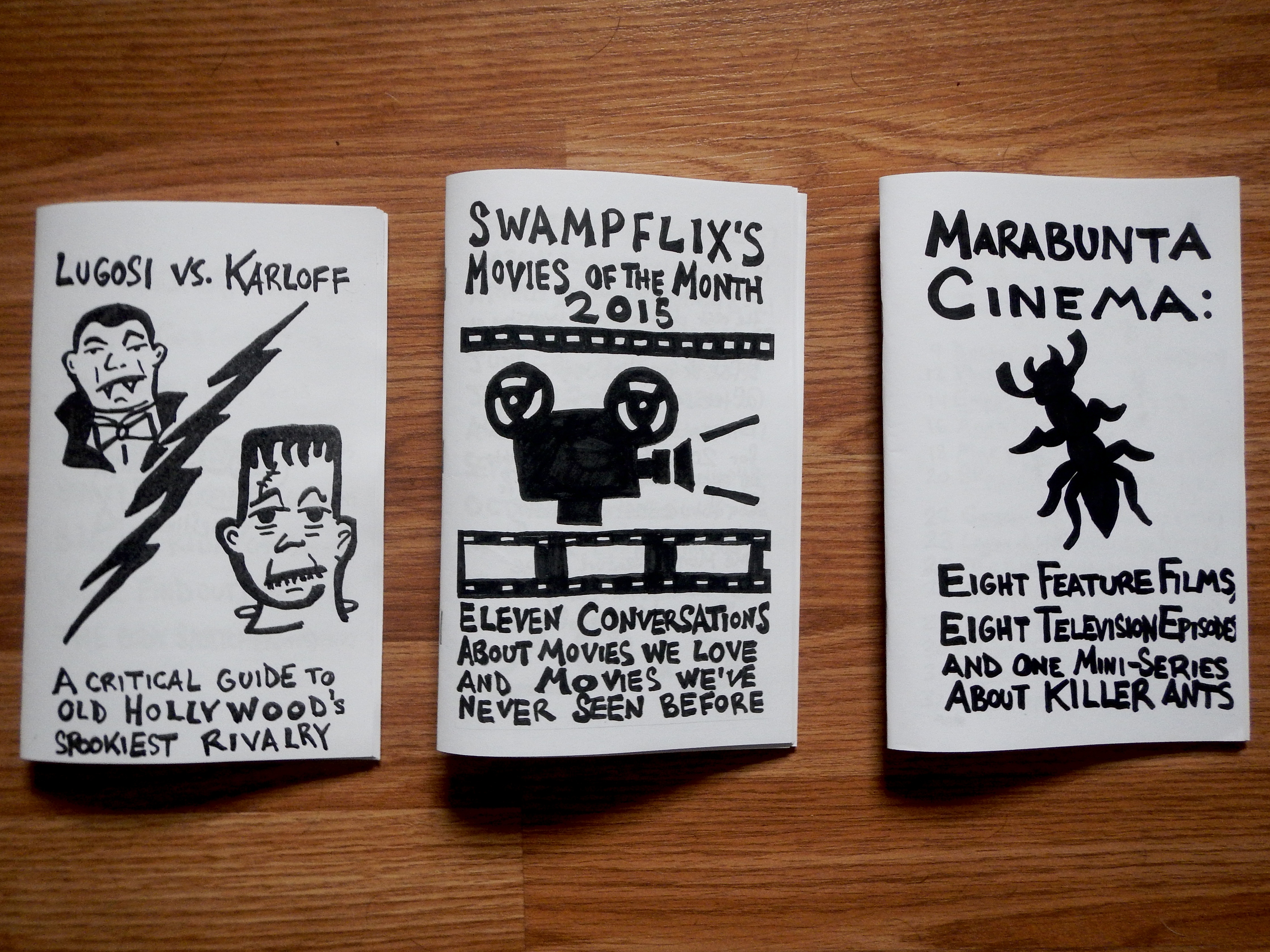
Attention, Swampflix readers in the New Orleans area! Swampflix will be exhibiting tomorrow (November 14th) at the second annual New Orleans Comics & Zines Festival along with a bunch of other super cool comics & zines exhibitors. We will be selling print versions of three Swampflix pieces (“Marabunta Cinema“, “Lugosi Vs. Karloff“, and a collection of our Movie of the Month conversations) from 11am-5pm at the Main Branch of the Orleans Public Library on Loyola Ave.

DSCN1455 (Modified (2))

DSCN1456 (Modified (2))

That middle piece is a ~90 page whopper featuring work from everyone who’s contributed to the site this year. All three feature dozens of new illustrations & hand-transcribed text from the site and, of course, all three will be dirt cheap.

For more info on the festival, check out their website at Nocazfest.com & refer to the poster below.

static1.squarespace.com

We hope to see y’all there!

-The Swampflix Crew

Head Over Heels (2001)

EPSON MFP image

fourstar

campstamp

Watching Do You Like Hitchcock? reminded me of one of my favorite guilty pleasures. In much the same way as Britnee discovered The Boyfriend School on cable late one night, so did I stumble upon the nearly-forgotten romcom crime thriller Head Over Heels. Two parts standard turn of the century romcom, one part Rear Window, with just a dash of genderbent Zoolander, this second feature from director Mark Waters (following the darkly comical Parker Posey vehicle House of Yes) was despised by critics and the general public alike. Roger Ebert gave the film a scant 1.5 stars, and the film has an abysmal Rotten Tomatoes score of 10%. To put that in perspective, Dario Argento’s Phantom of the Opera, a movie so bad I would recommend screening it as punishment for unrepentant murderers were that not potentially a war crime, has a 13% approval rating. People hate hate hate this movie. And I love it.

Amanda Pierce (Monica Potter) has a talent for choosing terrible men. Born in Iowa, Amanda now works as a restoration artist in the Renaissance wing of the Metropolitan Museum of Art, where her lesbian best friend Lisa (China Chow) warns her that if she devotes too much of her life to her work, she’ll end up like the three elderly spinsters who work in the same department. When she tries to surprise her boyfriend (a cameo by Timothy Olyphant), she catches him in bed with another woman and leaves him. She finds an unrealistically cheap room in an gorgeous apartment, and although she is initially skeptical of her roommates, a quartet of international fashion models, she bonds with and helps ground them as they help her become more outgoing and engaged with the world. They are: Holly (Tomiko Fraser), the one who skipped a free ride to Stanford to model; Jade (Shalom Harlow), the most approachable one; Candi “with an ‘i'” (Sarah O’Hare), an Australian woman who grew up on a farm under the eye of her creepy uncle and receives various facial surgeries throughout the film; and Roxana Milla Slasnakova (Ivana Miličević), a Russian woman with deadpan delivery.

Amanda has a meet cute with their neighbor, Jim Winston (Freddie Prinze, Jr.), that involves a Great Dane named Hamlet whose rambunctiousness is a recurring joke. Although she is immediately weak-in-the-knees attracted to the young fashion entrepreneur, she and her four roommates spend some time watching him through his windows from their living room, Rear Window style, because she assumes he must have a hidden flaw if she is attracted to him. After several potential negatives turn out to be misunderstandings, the models convince Amanda to crash a party that they see Jim preparing for. The two eventually hit it off, and Amanda returns home to share her experience with Candi (unable to attend after her most recent surgery), only to watch in horror as Jim apparently murders one of his guests after the party is over.

Here’s where the movie really kicks into high gear, as Amanda and her entourage of supermodels must take up their own investigation after the police fail to take them seriously. This includes more Hitchcockian hijinx, including Holly’s frantic attempts to alert the other women that Jim is in the hallway while she watches them search his place for clues, culminating in a scene where Jade, Candi, and Roxana must hide in the shower while Jim takes a really gassy bathroom break. It’s not the highest form of humor, but it’s toilet humor that works somehow. Of course, once Amanda is finally convinced that she can trust Jim, it turns out that he really isn’t who he says he is.

It’s no surprise that Waters would go on to direct Mean Girls just a few years after this, as that film has a similar tone, although the differences in sensibilities between the two make it obvious that one film was written by Tina Fey while the other was initially conceived by the chuckleheads behind There’s Something About Mary. Still, this is a movie about unlikely friendships between women who empower each other as much as it is about a woman who finally finds Mr. Perfect, and there’s a lot to be said for that. The supermodel characters could easily be stereotypical airheads who are always the butt of jokes, and although that description isn’t entirely inaccurate, the film never treats them disrespectfully or cruelly, and their specific knowledge ends up being critical in the solution to the crime at the end of the film. Although they are beautiful, vain, and err on the side of ditziness, they are nonetheless good people who care about Amanda and genuinely want the best for her, and it’s refreshing to see a group of attractive women in a movie written and directed by men who don’t conform to being characterized as catty or combative.

This is also a very witty movie, which I suspect is part of the reason it was so poorly received upon release. The filmmakers have said that they conceived the movie as a deliberate throwback to stylized comedies of yore, with urbane and carefully composed dialogue delivered amidst slapstick visuals and ridiculous setpieces. With regards to the dialogue, Miličević is obviously the MVP here, as her background in stand-up comedy makes her perfect as the punchline spouting Russian sexpot. Potter is a surprise comedian, as she generally plays the straight man against whom the jokester acts out (Patch Adams probably being the best and worst demonstration of this); here, she gets in on the action with her rapid-fire witticisms and her willingness to go all the way with her slapstick. Amanda tumbles down stairs, gets tackled by a giant dog multiple times, and takes a dive from a catwalk, and it’s absolutely hilarious.

The verbal jokes are also great, and I found myself laughing out loud all alone while rewatching this movie, which rarely happens. The models grow very tense when Amanda mentions that her boyfriend was cheating on her with a lingerie model, and their palpable relief upon learning none of them was responsible is great (Jade: “I’m so glad we don’t have to deal with that… again.”). Every character gets to be funny, even the villain’s henchman at the end who is present when the gang realizes that the mafia isn’t laundering money but smuggling diamonds (Jim: “If this had been a rhinestone I could have bitten straight through it instead of chipping my tooth!”), who realizes this is the reason why the mafioso never let him take one of the diamond-encrusted dresses “To give to [his] girlfriend! Or [his] wife!” This is also a surprisingly queer movie, especially for a film from 2001. Beyond Amanda’s teen sweetheart (whom she catches kissing another guy at homecoming) and her friendship with Lisa, there’s also Jim’s building super, who lets the women into his apartment in exchange for Roxana’s leopard print dress, which we see him wear with great delight.

Head Over Heels is not a great movie, but it’s also not nearly as terrible as critical contemporary reception would lead you to believe. It’s a delightful bit of romcom fluff with enough self-awareness and love for Hitchcock to carry you past the wayposts that all romcoms seem to have. In only 86 minutes, Freddie Prinze, Jr. will sweep me off my feet–I mean, sweep Monica Potter off her feet, and you’ll get a fair number of chuckles from it. If you catch it on cable late one night, give it a chance; just try not to wake your housemates with your giggles.

-Mark “Boomer” Redmond

Do You Like Hitchcock? (2005)

EPSON MFP image

twostar

Way back when I first started working my way through the films directed by Dario Argento, I opened my review of The Bird With the Crystal Plumage with a reference to  the early U.S. promotional materials for that film, which banked on the connection between the young Italian director and Alfred Hitchcock. The quotation from Hitchcock cited therein, that he found Argento’s work to be troubling, fascinates me, especially as Argento himself was known at the height of his career as the Italian Hitchcock. As I reach the end of Argento’s C.V., I have to note that this comparison is reductive and does a disservice to both men. Even at their worst, Hitchcock’s stories always made sense, and his reprehensible antihero protagonists were viewed from a distance that was sufficient to allow the audience to have ambivalent feelings about them. For instance, famously, the intent of the scene in which Norman Bates pushes a
car into a bog was designed to elicit an anxious reaction when the vehicle failed to sink, because part of you wants him to succeed. After three and a half decades directing films, Argento was finally able to go full Hitchcock in this tepid made-for-tv picture.

The film opens with an utterly inconsequential sequence in which young Giulio (Elio Germano) is riding his bike in the woods before stumbling upon two women, who make their way to an abandoned shack. He spies on the two through the window as they excitedly slaughter a rooster and dance about in its blood. They discover him peeping and chase him away, screaming after him that they will catch him eventually (they don’t). We then see Giulio in the present day; he’s now a film student working on a thesis about German expressionism, whenever he can tear himself away from peeping on his neighbor, Sasha (Elisabetta Rocchetti), in various states of undress. He also bears witness to Sasha’s frequent altercations with her mother. One day, while visiting his local video rental outlet, he notices Sasha and a blonde woman, Federica (Chiara Conti), both attempting to rent Strangers on a Train. Sasha ultimately rents the movie, but promises to bring it back the very next day so that Federica can have her turn. Giulio befriends the slacker shop owner, Andrea (Ivan Morales). A few nights later, an intruder enters Sasha’s home and kills her mother. Because Giulio had previously seen Federica and Sasha laughing together in the park, he becomes obsessed with the idea that they’ve entered into a murder pact, Strangers on a Train style.

Giulio’s girlfriend Arianna (Cristina Brondo) thinks he’s being absurd, and her mood doesn’t improve when she realizes his evidence gathering technique involves spying on nude women. Giulio begins snooping around Sasha’s apartment while cleaners are there and goes so far as to steal a piece of her mail, which shows how much she stands to inherit from her mother’s death; Sasha realizes Giulio is spying on her. Later, while he is in the shower, an intruder breaks in but is scared off, prompting Giulio to have his locks changed. The next day, he meets up with Andrea, who asks him to mind the shop for a moment; Giulio uses this opportunity to get Federica’s address from the customer database, and to flirt with Sasha when she stops in. Giulio then follows Federica from her home to work one day, where he sees her supervisor behaving inappropriately. He follows the two back to the boss’s apartment, where it is revealed that she stole money from the company and that he is blackmailing her for sexual favors. Before he can force himself upon her, however, he notices Giulio doing what he does best, peeping, and pursues the kid into the street, where he sustains an injury to his foot before absconding on his comical scooter. He’s in full-on Rear Window mode now, with his binoculars and his foot cast, and when evidence starts to mount that he might not be as crazy as was initially suspected, including an attempt on his own life, Arianna joins him in his investigation.

Do You Like Hitchcock? is an unimaginative movie, full of twists that ultimately render the mystery moot and featuring a thoroughly unlikable protagonist. Giulio is a creeping peeping tom, and there’s no way around it; his Harriet the Spy hijinx are not adorable when applied to an adult who only becomes aware of a murder because it interrupts his voyeurism. This is, apparently, the message of the film, given that the final frames are dedicated to reminding the viewer of all the times he spied on people without their knowledge. There’s no denunciation of his activities on the part of the film, and the only person who calls him out on the inappropriateness of this behavior is Arianna, who is presented as an unlikable shrew who lashes out and fails to believe Giulio when he needs her to.

As an Argento product, this is most clearly similar to The Black Cat, except that here the object of emulation is Hitchcock, not Edgar Allan Poe. There are a few reasons why that film worked and this one doesn’t; first and foremost is in the different lengths of the two films. It’s not as if giving Argento a shorter running time will guarantee a great picture (as we’ll see next time), but a lot of Black Cat‘s tautness can be attributed to its abbreviated running time, which ensured the director’s digressions were largely kept to a minimum. Secondly, the characters in the 1990 film were pastiches of ideas and character traits from several different Poe characters, so they felt both familiar and novel, grounded and immortal at the same time; here, it’s impossible not to compare Giulio to both James Stewart’s L. B. Jeffries and Harvey Keitel’s Usher, and where the latter two are consequential, the former is blandly nonpresent, existing only as a cipher through which the plot can happen. And that’s not even getting into the vast difference in acting ability.

There’s also the fact that, in Black Cat, characters couldn’t just walk around saying, “Oh, this killer’s M.O. reminds me of ‘Berenice’,” or “oh, this crime scene is just like ‘The Pit and the Pendulum’.” Hitchcock could have gone all the way with this metatextual reframing of the narrative, making this movie like Scream with Hitchcock films in place of slasher flicks. Instead it falls flat, as Giulio says things like “I thought they were doing Strangers on a Train, but they’re doing Dial M for Murder!” Subtlety has never been Argento’s forte, but this movie has virtually no subtext whatsoever, save for one recurring visual that is probably unintentional. There’s a rather large poster for Il cartaio on the video store door, right next to a poster for Hitchcock’s latter day thriller Marnie, which is largely forgotten or reviled these days, with good reason (if you ever wondered what it would look like if James Bond raped Tippi Hedren, Marnie is the movie for you, you sick bastard). Cartaio and Marnie are very dissimilar films, but they both represent a period in each of their respective directors’ careers where the bloom was off the rose, so to speak; their best works already having been completed and canonized as classics, but neither director was ready to go quietly into obscurity.

The connection to Marnie is further underscored by Federica’s similarity to the title character of that film, as both are blackmailed and assaulted by their employers for having stolen funds. Aside from the obvious references to Strangers and Dial M, there are also a few other appearances of elements from Rear Window, some of which are updated for modernism in a way that I actually enjoyed. If you ever wondered how the finale of Rear Window would have been different if Stewart could have just called Grace Kelly on her cell phone, this is the movie that will answer that question for you, for better or worse. The rooftop pursuit has elements of Vertigo in it while also harkening back to a similar chase sequence in Cat o’ Nine Tails, which is a nice touch. Maybe it’s the inherently small nature of television that held this film back, but all in all, it’s one that’s not really worth bothering with. If you want to see Argento try his hand at Hitchcock and succeed, go back and rewatch the opening of Sleepless again; the train-bound chase sequence that centers around the retrieval of mysterious files and papers is very much a spiritual descendant of similar scenes in North by Northwest and The 39 Steps, and packs more of a punch (and more respect for Hitch and his legacy) into 13 minutes than this film does in its entire runtime.

-Mark “Boomer” Redmond

Desperate Teenage Lovedolls (1984)

EPSON MFP image

onehalfstar

campstamp

Ever encounter a movie so poorly made that you’re not quite sure it even qualifies as a real film? Over a year ago Britnee pressured me to take a couple shady-looking DVDs from the trunk of her car in a NASA parking lot in New Orleans East (true story) & I’m not quite sure that either one qualifies as a “real” film. I stil haven’t forced myself to suffer through whatever Da Hip Hop Witch is (though I plan to soon), but after much procrastination I finally dove into the bargain bin depths of Desperate Teenage Lovedolls. Having now actually watched the movie, I still remain unconvinced of its validity as a feature film. Recorded on super 8 cameras in the 80s California punk scene, the “movie” has the feeling of a goofball group of kids’ backyard home video. As soon as the animated heroin needle on the DVD menu & the horrendously dubbed dialogue of the first scene grace the screen, Desperate Teenage Lovedolls at best feels like a project the Troma kids started, but never bothered to complete. It’s an effortlessly punk production for sure, but it’s the kind of half-assed, sloppily drunk punk that registers as less than endearing.

With direct references to past virgins-in-peril melodramas like Valley of the Dolls, Desperate Teenage Lovedolls is a very straightforward story of two female teen punks navigating a male-dominated world of rock & roll stardom. In their pursuit of fame, the two protagonists find themselves homeless, drug addicted, thieving, and suffering the sexual advances of record label sleazeballs before their band (The Lovedolls, duh) finally hits it big time (in a little over a month). By the time they achieve fame, of course, it’s far too late & their lives are destroyed by heroin, gang violence, and looming murder charges. Since the “movie” can’t even muster up a full hour of running time, these plot points all whiz by at a pace that should benefit what is essentially a genre spoof comedy, but no attempts at humor even come close to landing, despite the charmingly amateur “actors” constantly stifling their girlish laughter. Here’s an example of a typical “joke”: a man in drag plays one of the teen’s pesky mothers, so the teen complains, “Mom, you’re such a drag.” The mother later comes back at her, “I’ve always tried to be a mother & a father to you.” Laughing yet? I couldn’t conjur up a chuckle either. And that’s not even to mention the way the “movie” casually mines homophobic slurs & sexual assault for “humor”. Throw in some pitifully slapped-together costumes & knife fights as well as some obviously uncleared tunes from names like Hendrix, Zepplin, and The Fab Four and you’re still left wondering at the end credits, “Is this a real movie?”

Here’s where I try to say some nice things about Desperate Teenage Lovedolls, whether or not it felt like a legitimate movie. If nothing else, it’s a great historical document of 80s California punks, particularly that of teenage girls. I know many a Tumblr that would salivate over the fashion on display. I also got one genuine laugh from the deadpan exchange “Thanks for killing my mom.” “No problem.” Although the “movie” was missing more outright humor in that vein, it did have the general feeling of kids having fun, just making a movie for kicks. I’m glad they had fun, but a lot of what made it to the screen has the distinct feeling of “highdeas”: things that were probably funny while the writers/performers were stoned, but didn’t hold up to later scrutiny. There’s no way that anyone could actually believe the blurb on the cover that claims Desperate Teenage Lovedolls “rates up there with John Waters’ finest early work” (at least I hope not; those are some of my favorite movies), but you can at least feel some of Waters’ style (as well as that of his early muse Russ Meyer’s) coursing through the film’s veins. I can also say this: the film has an incredible soundtrack, headlined by the big deal punk band Redd Kross, who proved its theme song: “Ballad of a Lovedoll” & a villainous performance from bassist Steve McDonald. Some of the “movie”’s best moments were montages that let the music breathe & the failed humor dissipate. It was also amusing to watch the girls pretend that the were playing Redd Kross’ songs, despite the male lead vocals. There were some other interesting incongruities, like a melodramatic drug freakout that relied on strobe lights & paused VHS tapes as well as the fact that the girls are supposed to be homeless, but still have a place to store & practice on their band equipment.

Still, none of this adds up much in terms of a completed product. Desperate Teenage Lovedolls still feels surreally fake to me, exactly like the kind of movie a friend who usually can stomach the worst media imaginable passes off to you in perplexed defeat. There are enough real movies out there that achieve what Desperate Teenage Lovedolls vaguely attempts (drugged out weirdos having fun being drugged out weirdos on film), ranging from John Waters’ Dreamlanders era all the way to this year’s wonderful Tangerine, that you needn’t bother with this half-assed mess, yet it still exists. It exists & it was well remembered enough to reach the DVD format two decades after its release. Even stranger, this supposed “movie” even spurned a sequel titled Lovedolls Superstar in 1986. That can’t possibly be true, but there it is, existing, being a real thing, even though I remain unconvinced.

-Brandon Ledet