Swampflix’s official coverage of the best films of 2023 won’t start until January 2024, but listmaking season is already in full swing elsewhere. General consensus on the best films of the year is starting to take shape as regional film critic associations are publishing their collective Best of the Year lists, and I’m proud to say I was once again able to take a small part in that annual ritual. I voted in the Southeastern Film Critics Association poll for the best films of 2023, representing a consensus opinion among 89 critics across nine states in the American South. Winners were announced this morning, and it’s a pretty solid list. At the very least, it’s cool to see Lily Gladstone get recognition for her star-making work in Killers of the Flower Moon and to see Justine Triet’s Anatomy of a Fall take the prize for Best Foreign-Language Film after winning the Palme d’Or at this year’s Cannes.
The biggest story of last year’s SEFCA list was the total dominance of the Daniels’ big-hearted sci-fi comedy Everything Everywhere All at Once, which went on to be named Swampflix’s Movie of the Year as well. This year, the list was dominated by Christopher Nolan’s nuclear science bio-epic Oppenheimer, which was awarded Best Picture, Best Actor (Cillian Murphy), Best Supporting Actor (Robert Downey, Jr.), Best Ensemble, Best Director, Best Adapted Screenplay, Best Cinematography and Best Score. To quote SEFCA President Scott Phillips in today’s press release, “This fall featured three big films from three grandmasters of cinema. Martin Scorsese released Killers of the Flower Moon. Ridley Scott brought Napoleon to the big screen and Michael Mann hits theaters next week with Ferrari. Despite this bumper crop from heavy-hitting auteurs, Christopher Nolan’s film from six months ago is walking away with eight SEFCA awards. Oppenheimer is a stunning cinematic achievement. Our members recognized that in July, and they are rewarding it in December.”
Before his death in 2020, director Stuart Gordon was planning a comeback, alongside his screenwriting collaborator Dennis Paoli, with whom he had worked on films like Re-Animator, From Beyond, and Castle Freak. That intended return was to be Suitable Flesh, another Lovecraft adaptation, and although Gordon didn’t live to see it completed, his friend and longtime collaborator Barbara Crampton was determined to usher it to completion, which she achieved this year with Joe Lynch in the director’s chair. I’ve never seen any of Lynch’s feature work, but I was very impressed with his short film Truth in Journalism that was a bit of an internet phenom a few years ago (although the fact that everything that references the film online now gives away the twist, sometimes in the title). And while there’s nothing that’s technically wrong with this one, I have to admit that I just didn’t enjoy it.
Elizabeth Derby (Heather Graham) is a psychiatrist living an idyllic life of career success, loving marriage with handsome if temporarily unemployed husband Edward (Johnathon Schaech), and a fulfilling best friendship with colleague Daniella Upton (Crampton). After a session with a man who is trying to give up smoking, a young man from the nearby Miskatonic University bursts into her office and introduces himself as Asa Waite (Judah Lewis, of The Babysitter). He tells her that his father, Ephraim (Bruce Davison), wants his son’s body, in a scene that would have been more effective if it had been played with more ambiguous dialogue that implied (for instance, abuse at the hands of his father), but instead just sounds like ranting and raving. When she gets a phone call from Asa later, she fears that he’s in danger and goes to his house, only to become embroiled in an apparent domestic disturbance situation that belies dark magic. Eventually, Derby finds herself swapping back and forth between her body and that of Asa, but the entity with which she is exchanging corporeal forms with is not Asa, but something much older and more powerful, and if they switch a third time, it will be permanent.
Narratively, this one is a bit sloppy, and it’s also not really a surprise that the Lovecraft story from which is takes its concept, “The Thing on the Doorstep”, is often considered one of the talented racist’s lesser works. Lewis is doing fine work as the menacing thing that first possesses Asa’s father before taking him over, and although I love seeing Graham in just about anything, there’s a bit of a disconnect between Lewis’s version of (what we’ll call) the spirit and hers, and I wish Graham’s version was as menacing as Lewis’s. There’s also something very fun about the idea of a possessing spirit that has bodysurfed through time in male bodies because of its misogynistic ideals, only to end up in a woman’s body and learn how much it enjoys riding dick. Unfortunately, that’s not enough to save this movie, nor is its gruesome final act, which is what I think will end up being what Suitable Flesh is most remembered for. A shambling, battered corpse that begs for death isn’t the freshest idea (An American Werewolf in London and Return of the Living Dead immediately spring to mind), but it’s realized here in a truly horrifying fashion.
Still, for me, the film’s highlight was Crampton (as she often is). She looks amazing here, and her turn as the confused Dr. Upton who has to come to terms with the fact that her best friend is not losing her mind but is in fact experiencing a truly supernatural event is a sight to behold. In many ways, she’s the true protagonist, the one with the most character development and the person with whom we sympathize the most. It makes the first half of the narrative seem like filler until we get to the good parts, and I have to be honest, I think the late Gordon would have gotten us there faster and better.
Stroszek is a relentlessly downbeat tragicomedy about one man’s inability to escape the prison of society. The film opens with Bruno Stroszek being released from prison, where the kindly warden makes him promise to never drink again, as the street performer’s only crimes were all related to or caused by his alcoholism. As soon as he departs the office, however, he goes straight to a local pub, where the bartender recognizes him and greets him (as) warmly (as 1970s German stoicism allows), despite the fact that Stroszek has been gone for two and a half years. Stroszek attempts to greet Eva, a woman he knew before, but the two men with her reveal themselves as her pimps and send him on his way, but not before he offers to let her come and stay with him in the apartment that his old neighbor Mr. Scheitz has kept for him. Stroszek attempts to return to street performance, but there’s little love for the vagabond who can never remember to zip his fly, and although Eva does find her way to him and tries to help him spruce up the place, this ultimately leads to further harassment and beatings at the hands of her former pimps. Unable to turn to the police for help, Mr. Scheitz offers to let Eva and Stroszek accompany him to Wisconsin, where he is moving to live with his nephew for his remaining few years, and he even gets jobs for them as a waitress and a mechanic, respectively.
Upon initial arrival in the states, the trio feels a rush of excitement and possibility while sightseeing around New York before they purchase an old car and make their way to the prairie town of Railroad Flats, an indistinguishable little spot of nowhere, a barren place of dead grass brown and dirty snow. Scheitz’s nephew is amenable to them, and things start out well for them at first despite the humility of their surroundings, as Eva finds her new line of work much more agreeable than her old, and Stroszek gets along with his equally alcoholic colleagues, and the nephew Scheitz even lets them set up a mobile home on his property to give them a leg up. The elder Scheitz is considered a bit of a curiosity around town, but the townsfolk are more bemused than annoyed at his wandering around and purportedly measuring “animal magnetism” using some kind of ammeter, speaking a language that none of them understand. Unfortunately, the good times aren’t meant to last; a “friendly” visit from an officer of the bank reveals that they are behind on their payments due to Stroszek’s inability to read the fine print on many of the documents that he signed, and although Eva is able to secure a temporary reprieve from repossession by temporarily returning to her old line of work, she is unsatisfied with where life has taken her and ultimately runs away, hitting the road with a couple of Vancouver-bound truckers.
When Scheitz is arrested for a poorly-thought-out attempt at vengeance on the bank for taking Stroszek’s trailer, he is truly alone, with no music to play and with no one around who even speaks his language. Stroszek seeks out the only person he knows, a German businessman who was being harassed at the start of the film by Eva’s pimps and who said that he was going to a specific place in America where there was a park where people could see freely roaming bears. This turns out to be Cherokee, NC, and it is Stroszek’s final destination as well.
If this were a different kind of movie, one might expect that Eva would turn around one day at her waitressing job and see that her two pimps have found her and plan to take her back to Berlin, or you might think that the fact that there are four unsolved and seemingly connected murders in Railroad Flats would come back as a plot point or be relevant in some way, but nothing like that happens. There are many long montages of hard work that drive home the mindless repetition of labor, and which contribute nothing to the film narratively but serve a purpose for defining the film’s mood. It’s a movie that requires the kind of patience that a lot of audiences no longer have, as it often lingers on its tableaux in order to fully sell the scale of the feelings of loss, loneliness, and hopelessness that the characters face. As an indictment of the American Dream and all of its unfulfilled promises, it functions beautifully and has a real sense of immediacy; within a few days of arriving in Railroad Flats, Stroszek witnesses his American benefactor pull one of his own teeth with a set of pliers for a sense of relief, which he witnesses with shock made all the more isolating by his lack of understanding of English.
The film is not without its comedic moments, but even these are meant to speak to a greater melancholy. The biggest laugh that I got came in Wisconsin, when Scheitz translates his nephew’s admonition to Stroszek to stay away from a particular fence because the strip of land on the other side is in dispute between two farmers, both of whom refuse to let his enemy plow the area, which is explicitly called “fallow.” We see these two farmers as each gets very close to the edge of the disputed territory, both of them driving their tractors with their shotguns on their hips, pointed skyward … for the moment. It’s a very funny visual, evoking the image of jousting knights with their lances at the ready, but it also speaks to the kind of violence that America is capable of. Just as the two pimps in Berlin exercised control over Eva, these two men are also primed and ready to commit violence, with potentially life-ending consequences. Stroszek also visits a kind of arcade where trained animals perform tricks; put in a quarter and watch a rabbit run into a tiny fire engine and sit there as if he is the driver, or watch a chicken peck at a tiny piano as it plays a tune, or watch another chicken dance after pushing a button in a tiny jukebox. Not so funny is how Stroszek presumably sees himself in these beasts, forced to perform over and over again for a pitiable amount of money like a trained animal; in fact, the dancing chicken is the last image that we see of the film, and it lasts for some time, as a reminder of what Stroszek became before the end.
I have to admit that, despite all my writing about film, I’ve actually seen very little Herzog (in fact, this is only my second, after Grizzly Man), but from what I’ve absorbed about the man’s work from the pop cultural landscape, this seems like one of this works that defined his sensibility in the public eye. It’s bleak, but beautiful.
If you’re a particular kind of self-serious cinephile, every new Jonathan Glazer movie is a Cultural Event, largely because of scarcity. The director only has four features to his name, stretched across two decades, with half of that time passing since his previous film Under the Skin arrived in 2013. Glazer has been “a name to watch” since his early 2000s stunners Birth & Sexy Beast (if not since his iconic 1990s music videos like “Virtual Insanity” & “Karma Police”). Every project is so carefully planned & crafted that there’s always intense anticipation of what shape his career is going to take overall. He makes too few films for anyone to predict the big-picture trajectory of his art; there just isn’t enough data. So, I have to admit that I was a little disappointed by the announcement of his latest project, The Zone of Interest, because it doesn’t fit the shape I personally wanted for his career. I would’ve much preferred that Glazer dove deeper into the uncanny surrealism of films like Birth & Under the Skin than where he chose to go: sinking further into ice-cold Hanekean cruelty instead. Still, The Zone of Interest is a title of interest by default, regardless of subject or approach, and Glazer at least makes the misery meaningful & worthwhile.
The Zone of Interest is the rare war atrocity drama that doesn’t let its audience off the hook for not being as bad as literal Nazis, but instead prompts us to dwell on the ways all modern life & labor echoes that specific moment in normalized Evil. Sandra Hüller (Toni Erdmann, Anatomy of a Fall) stars as the doting housewife of the Nazi officer who runs Auschwitz (Rudolf Höss, played by Christian Friedel). The couple’s idyllic home shares an external wall with the concentration camp, which soundtracks their daily domestic routines with the excruciating sounds of torture & genocide. The wife raises children, hosts parties, and tends to the garden. The husband works tirelessly to invent more efficient ways to gas & incinerate Jews. Both are separated from the tactile details of the violence that makes their lovely home possible, except in stark reminders when the busy work of the day is over and all that is left is the quiet of their conscience: lounging in a calm river polluted with the ashes of their victims, struggling to sleep in a house lit by the orange glow of the crematoriums, etc. It’s a slowly escalating, dehumanizing horror that they’ve deliberately numbed themselves enough to not even notice, but it deeply sickens outsiders who briefly visit their home to smell the flowers or play with the kids.
If Glazer were a lesser artist, he would have firmly anchored his WWII drama to the tools & tones of the past, comforting his audience with the emotional distance of time. Instead, he shoots The Zone of Interest in the style of a modern reality show, documenting the domestic busyness of his central couple on continuously running security cameras like an especially horrific episode of Big Brother. There are even night-vision sequences that catch small acts of subversion the cameras aren’t supposed to see – good deeds that eventually go brutally punished. Later, he interrupts the 1940s timeline with images of concentration camps’ current function as history museums, again finding a way to frame them as sites of heinous banality. The automated-home modernization of this historical drama might initially register as a formalistic novelty, but the constant reminder that the movie is being made now with today’s technology gradually has a clear thematic purpose. Anyone with a smartphone should be familiar with the feeling of becoming numb to grand-scale injustice & genocide as background noise while we busy ourselves with the meaningless tasks of the day. Anyone who’s ever been lucratively employed should recognize the feeling that our jobs & lifestyles are causing active harm to people we cannot see. We’ve all seen too many Holocaust dramas to truly feel the emotional sting of another one as if it were out first; Glazer does his best to shake us out of that numbness by making one specifically rooted in the doomscroller era.
Everything is tastefully, technically on-point here. I was initially distracted by the automated security camera editing style, which had me looking for visible cameras in every frame, but the approach eventually proved itself thematically justified. Mica Levi’s thunderous, minimalist score is maybe their sparsest work to date, but it’s effective in its restraint. A24 has been well-behaved in their marketing & distribution of the film, refraining from selling boutique Nazi merch or leaning into trite FYC awards campaigning. Glazer has again taken his time to deliver something thoughtfully crafted but not overfussed, proving himself to be one of our most patient auteurs. I likely would not have watched The Zone of Interest if his name were not attached, since I’m generally skeptical of what yet another wartime genocide drama could possibly illuminate about history that audiences don’t already know (and have learned to ignore). Glazer sidesteps that tedium by stating the historical facts of the narrative in plain terms – illuminating the dull, background evils of modern living instead of safely retreating to the past. It’s not the project I would’ve greenlit if I were signing his checks, but it’s a worthy entry in his small canon of thorny, alienating features. All I can do now is sit in the tension of what he’ll make next, likely until sometime in the 2030s.
Piaffe is a post-adolescence coming of age story about a shy adult shut-in who musters up the courage to learn new things about her desires, her body, and her self outside her cloistered home. In doing so, she grows a horse tail, has masochistic sex with a perverted botanist, and takes on a new trade as a commercial foley artist. Most of the events that transform her life & body are a natural matter of course rather than a deliberate, personal choice. The foley artist job falls in her lap when her nonbinary mystic sibling is unexpectedly institutionalized, leaving her to complete their work providing horse-riding sound effects for a TV commercial advertising a mood stabilizer called Equili. She gets into character as the horses she soundtracks by clopping dress shoes onto wooden dresser drawers, which causes her very own horse tail to grow from the base of her spine. Her sexual relationship with the botanist is more of a personal choice than something that happens to her, but it’s a choice she can only make after truly getting to know herself as a literal horsegirl with increasingly specific sexual desires – mostly involving getting her tail hair brushed. Falling somewhere between the stern kink dynamics of the dark 2000s office romance Secretary and the flippant, prurient surrealism of the 1970s dark fantasy piece The Beast, Piaffe is funny, sexy, cool, and inexplicable, but never in an especially showy way.
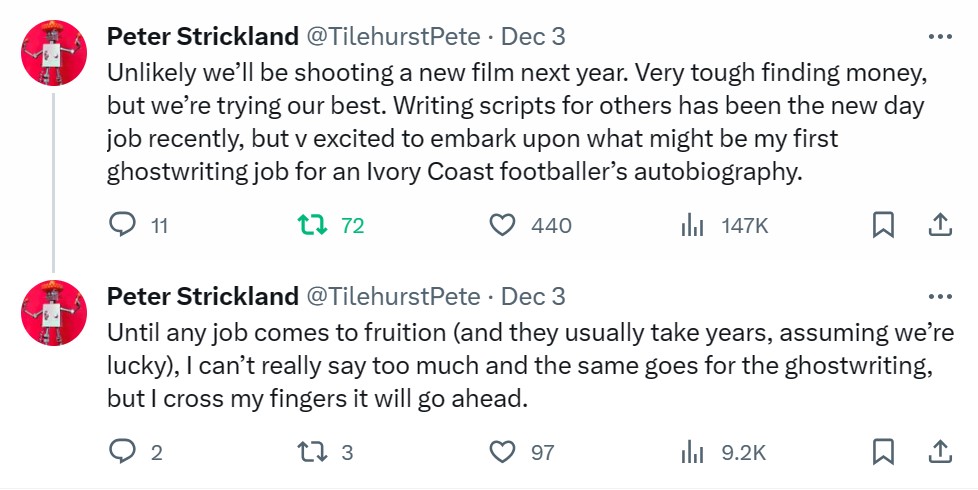
It isn’t the movie’s fault, but there was something grim about watching Piaffe the same week that England’s premiere auteur fetishist Peter Strickland was stress-tweeting about struggling to find funding for his next project. One of our greatest working directors can’t get a new movie off the ground, and yet he’s formidable enough that younger artists are out there making (pretty great, possibly unaware) pastiches of his work. Piaffe plays as just as much of a career-retrospective overview of Peter Strickland’s style as his recent music industry satire Flux Gourmet, which likewise combined his foley-art giallo throwback Berberian Sound Studio with his kink-dynamic relationship drama The Duke of Burgundy into a single, self-spoofing work. The ASMR phone sex of Piaffe, wherein our equestrian protagonist brushes her tail hair over a telephone receiver to excite her lover, feels like a gag pulled directly from a Strickland film that doesn’t yet exist. And given that Strickland is struggling to land funding for his next project, maybe it never will. What Piaffe offers is a sturdy Strickland substitute that proves he’s not the only filmmaker who can reliably deliver weird-for-weird’s-sake fetish comedies for the midnight movie crowd; in that context, it’s maybe the best of its kind since The Berlin Bride. I can still only take it as a consolation prize, though, as I’d unquestionably list Strickland among the most exciting artists working in cinema right now (alongside Amanda Kramer & Bertrand Mandico), so I’m bummed to hear he’s not currently working on anything at all.
For all I know, Piaffe director Ann Oren has never seen a Peter Strickland film, and their parallel sensibilities are entirely coincidental. My only previous exposure to Oren is in her outsider-art Hatsune Miku cosplay documentary The World is Mine, which is specifically about the erosion and erasure of identity within a digital-age fandom “community.” I will refrain from assuming anything about her based on this high-art horsegirl cosplay erotica follow-up, except maybe that experimentation with new, fabricated identities & personae is an artistic preoccupation of hers – something that can only be confirmed as she establishes a larger body of work. I have hopes that, in time, Oren will prove to be just as formidable a prankster artist as Strickland. It’s something I already felt in this film’s fetishistic fixation on the mechanical tools of filmmaking & horseback riding, grazing its fingertips over leather harnesses and the rusty metal gears of an ancient zoetrope. I just need to see more of her work to know what to anticipate in the next picture. Meanwhile, I already know what I want & get out of Strickland’s films, and I’m stuck looking for those qualities elsewhere while he’s twiddling his thumbs waiting for someone to sign the checks.
There’s something distinctly Kaufman-esque about Dream Scenario, and it’s not just that the film stars Adaptation performer Nicolas Cage. All of Charlie Kaufman’s films are ambitious narratives that revolve around a man who is in some way, be it major or minor, removed from the reality of the people around him, and who ends up caught up in a widespread event that is (usually) not of their own making or volition. In Adaptation, meek screenwriter Charlie ends up caught in a criminal enterprise as a result of simply trying to adapt a non-fiction book into a workable film adaptation; in Anomalisa, Michael Stone’s apparent mental disorder causes him to see all faces as identical, and he gets swept up in a nightmare scenario of bureaucratic intrigue; in Synecdoche, New York, Caden Cotard’s creation of a nesting doll of reality takes on a life of its own and he is swept away inside of it. All of his works are also about a person being forced into a situation that is, to their mind, completely unfair, and their myopic reactions to it exacerbate the situation. It seems unfair to Joel in Eternal Sunshine of the Spotless Mind that Clementine has intentionally lost her memories of him, so he pursues the same avenue to have her removed from his thoughts; it seems unfair to Philip Seymour Hoffman’s character in Synecdoche that his wife has left him and taken their daughter with her, and his imaginings of the worst possible outcomes of that situation contribute to his declining health; the unfairness of a life of unfulfilled dreams causes the janitor character in I’m Thinking of Ending Things to fantasize a completely different life, which has its own horrors.
Paul Matthews (Nicolas Cage) is, like many of the Kaufman protagonists listed above, a man with a fairly decent life, including a tenured position at a small college. He and his wife Janet (Julianne Nicholson) have a pleasant enough life, living in her spacious childhood home with their teen daughters, elder typical teen Hannah (Jessica Clement) and younger Sophie (Lily Bird). Paul isn’t a bad person, but he is hapless and overly invested in other people’s perception of him. The film opens in Sophie’s dream, where objects begin falling from the sky, and although she calls out to the Paul in her dream for help, he doesn’t react; when she tells her parents about the dream the next morning, Paul gets hung up on the fact that the dreamed version of himself was apathetic to his daughter’s concerns and worries about what his daughter thinks of him. On campus, he’s too focused on his students talking about him behind his back. He has the respect of his school’s administrator (Tim Meadows), but he yearns for acknowledgement from his former academic colleague Richard (Dylan Baker), who is known for hosting fabulous dinner parties for other people he considers elite. This seems terribly unfair to him, even though there are actions he could take to better himself. Instead of humiliating himself by pleading for a co-author credit from a different former colleague on a subject he claims to have conceived of first, he could stop talking about “thinking about writing a book” and actually do some of that research and writing himself.
Despite his relative anonymity, Paul finds himself a sudden subject of internet virality. After running into an old girlfriend (Marnie McPhail) after a play, she tells him that she has been dreaming about him and asks if she can blog about the experience. In doing so, she links to his Facebook page, which results in a huge influx of notifications from hundreds, then thousands of others, all who have seen Paul in their dreams; Paul is flustered that he seems to be a passive observer in all of these scenarios. Suddenly flush with positive attention, Paul attempts to leverage this into a book deal, and signs up with a P.R. firm headed by the neurotic Trent (Michael Cera) and Mary (Kate Berlant), who swings back and forth between sycophantic and self-absorbed. In so doing, he meets assistant Molly (Dylan Gelula), who leads him to realize that doing nothing in people’s dreams is actually the best case scenario here. The general public turns on him for reasons I won’t spoil, and all of it is out of his hands.
I couldn’t have imagined that I would reference the 2007 novel Mon Cœur à l’étroit (My Heart Hemmed In) by Marie NDiaye in a single review this year, let alone two. In writing about Beau is Afraid, I talked about how the protagonist of the novel awoke one morning to learn that all of her neighbors despised her, or perhaps that they suddenly all despise her at once, after years of apparent tolerance. Like her, Paul is a teacher here, and although the reason for the sudden change of heart among her peers results in not just the loss of academic prestige, but its conversion into outright hostility. Although the reason that the narrator of Hemmed is ostracized is less explicit than in Scenario, the reasons are nevertheless just as ethereal, and the horror comes from the way that something over which one has no control can completely destroy their life. Hemmed never mines that field for comedy like Scenario does, but they exist in the same rhetorical space nonetheless, wherein a fairly well-liked educator becomes a pariah because of circumstances in which they have no say.
There’s a deft handling of the metaphor of fame in Dream Scenario that I really enjoyed. Like many people who achieve a modicum of viral fame, he didn’t do anything to make himself the center of attention, at least initially. His sudden appearance in people’s dreams has no explanation and isn’t the result of anything that he has done. Although he initially appears in the dreams of people who know him like his daughter and students, he only becomes known to the public because of his ex-girlfriend’s blog post, when strangers become aware that the man that they are seeing in their dreams is a real person. Like all internet fame, however, it’s fleeting, and his attempts to leverage it into achieving his actual desires are stunted when his dream persona moves from being an apathetic bystander in their dreams to an active participant and, eventually, a source of terror, all of it once again having nothing to do with anything that Paul himself has done. Sure, he’s hapless and selfish, but no more so than the average person, and it’s hard to blame him for wanting to use this unwanted stardom to get something that he actually wants. Although he is pathetic, letting his ego get the best of him, there’s nothing malicious about anything that he does, which makes his sudden turn into Twitter’s villain more pitiable; his poorly received, self-serving online apology makes things worse (as they often do, just look at Colleen Ballinger), but unlike a lot of the internet celebs whose attempted apologies are dissected to hell and back for their insincerity, Paul actually didn’t do anything to deserve his backlash.
The film ends on an ambiguous and bittersweet note, which reflects the film’s slow turn from being a comedy about an upper middle class nobody to a horror story about being a public figure with no control over his perception. There are still comedic moments as the final minutes approach, including a scene wherein Cage goes full-camp in a photoshoot with a bladed gauntlet that is similar to but legally distinct from Freddy Krueger’s, as well as a visual call back to an earlier discussion of Paul’s Halloween costume from a few years prior, but it ends without setting everything in Paul’s reality back to where it was before, ultimately making it the kind of somber movie that so often plays so well during this time of year.
Allow me to introduce you to a 1990s romcom starring Sarah Jessica Parker as a lovelorn Manhattanite whose romantic rut dating commitment-phobic bachelors is disrupted by the attentions of a brash Big Spender. Instead of talking it out over brunch with the gals, she’s rescued by a skydiving Nicolas Cage in an Elvis costume. Okay, in all honesty, Honeymoon in Vegas has very little in common with Sex and the City outside of Parker’s casting. If anything, the film is more weirdly predictive of the Adrian Lyne erotic thriller Indecent Proposal than it is of Parker’s signature HBO sitcom. For one thing, its story is filtered through the perspective of her reluctant fiancée, a marriage-cynical private eye played by Nic Cage. While Sex and the City is narrated by Parker’s voice as a cosmopolitan sex columnist, Honeymoon in Vegas allows Cage to narrate the story in 1940s noir speak, the film’s only notable stylistic touch (before it floods the screen with Elvis impersonators in the third act). The closest Parker’s allowed to get to a full Carrie Bradshaw moment is in her casino-lobby outrage with Cage for getting them into an Indecent Proposal scenario in the first place, shouting within earshot of children & milquetoast Midwest tourists, “I’m a whore, Jack! You’ve made me into a whore. You brought me to Las Vegas, and you turned me into a whore!” It’s impossible to watch this incredulous meltdown without recalling Bradshaw’s outburst at an Atlantic City craps table in the classic Sex and the City episode “Luck Be an Old Lady.” That is, it’s impossible if you happened to have spent all of this year catching up with and thinking about Sex and the City for the first time in your life, which is exactly where I’m at right now.
I’m only focusing on Sarah Jessica Parker so much here because it’s rare to see her out of Carrie Bradshaw drag, whereas opportunities to see a frantic Nic Cage impersonate Elvis are much more plentiful. See also: David Lynch’s Wild at Heart, SNL’s “Tiny Elvis” sketch, and Cage’s real-life marriage to The King’s daughter, Lisa Marie. I guess it’s pretty rare to see him dressed up in the full Elvis costume, though, unless you’ve happened to be personally invited to tour his home full of Elvis memorabilia. In order to justify this indulgence, Cage had to team up with workman comedy director Andrew Bergman, who cast him in two back-to-back mediocre romcoms as a hapless leading man: Honeymoon in Vegas & It Could Happen to You. He’s less of a Nice Guy dreamboat here as he is in that latter film, spending most of his honeymoon tailing James Caan’s high-roller conman villain as he seduces Parker away from him. Cage starts the film terrified of marriage because of a deathbed promise he made to his mother, but he loves Parker’s sweetheart schoolteacher character so much that he’s willing to go back on his word. Only, he doesn’t act quickly enough, so Caan swindles him into a rigged card game, bullying him to put a weekend with his fiancée on the table as a substitution for poker chips. Parker’s outrage with being “turned into a whore” isn’t played for the same moral or seductive complexity as Demi Moore’s own monogamy crisis in Indecent Proposal, even as she flirts with the idea of letting Caan sweep her off her feet (via helicopter). Mostly, it’s just an excuse for sweaty, farcical Mad, Mad, Mad, Mad World shenanigans as Caan elbows Cage out of the picture . . . until he skydives back into it dressed as Elvis.
There isn’t much on Honeymoon in Vegas‘s mind besides setting the stage for its ludicrous skydiving-stunt finale, which is emphasized in a marketing tagline that sells it as “A comedy about one bride, two grooms, and 34 flying Elvises.” The Elvis costumed skydiving team The Flying Elvi has since become a legitimate Vegas attraction, boasting on their website to be “the only officially licensed skydive team by Elvis Presley Enterprises.” The creation of that novelty act might be the movie’s only lasting triumph, but it’s at least more a more appropriate movie tie-in than, say, the Mardi Gras scooter gang The Krewe of the Rolling Elvi hosting a private screening of Sofia Coppola’s dour drama Priscilla (a real thing that recently happened at The Prytania; I cannot imagine the mood that took over that room by the end credits). Otherwise, there’s nothing especially recommendable about Honeymoon in Vegas except for its opportunities to think about where it fits in its various players’ long-term careers. James Caan coasts along as the comedic heavy. Pat Morita & Peter Boyle give career-worst performances as a disaffected cab driver and a Hawaiian mystic, seemingly having gotten their scripts swapped in the mail. Seymour Cassel is given the funniest character detail as a mobster named Tony Cataracts. A young Tony Shalhoub is adorable as a nervous concierge who’s terrified of Caan. An even younger Bruno Mars is even more adorable as the world’s tiniest Elvis impersonator. Nic Cage gets in a few signature bizarro line-readings in his sing-songy angry voice, getting increasingly funnier as his character gets increasingly apoplectic. And then there’s Sarah Jessica Parker, who gets one big scene where she gets to shout about being made into a hooker before being passed around like a trophy between the two male leads. Luckily, she got a lot more to do down the line in the Sex and the City series, unless you want to take a really cynical view of Carrie’s long-term love triangle with Aidan & Big.
Welcome to Episode #201 of The Swampflix Podcast. For this episode, James and Brandon discuss cinematic representations of Elvis Presley, from his youth-culture acting chops in Michael Curtiz’s New Orleans noir King Creole (1958) to his recent post-mortem biopic depictions in Baz Luhrman’s Elvis (2022) & Sofia Coppola’s Priscilla (2023).
Mumblecore may be long gone as a moment in time, but the Duplass Brothers are still out there keeping its memory alive. While mumblecore overachievers Greta Gerwig & Noah Baumbach made the highest-grossing film of the year—a feature-length toy commercial, no less—The Duplasses are still making low-key, low-profile indies, still putting together dependably entertaining pictures with limited resources. Even so, their new sci-fi bromance Biosphere feels like a mumblecore throwback stunt in its limited scope, featuring only two actors on a single, sparse, Apple Store futurist set. That scaled-down approach to movie production made more sense when they were making lockdown-era laptop dramas like Language Lessons, but at this point in on-set COVID safety protocols, it’s more of a flex than a necessity. In cynical Gen-X 90s terms, the narrative would’ve been that Barbie was a sign that Gerwig & Baumbach “sold out” and that the Duplasses are somehow nobler artists for continuing to slack around on a condemned & abandoned mumblecore playground. In these post-Poptimism times we’re living in now, though, there’s no such thing as selling out, and all that really matters is that Barbie is one of the best movies of the year, while Biosphere is just the latest example of what its producers have been consistently making for the past couple decades running.
That doesn’t necessarily mean they’re lacking in ambition, though. Biosphere takes admirably big swings on its tiny playground, and it scores major bonus points for taking those swings early, so that it actually has to fully deal with the social discomforts of its premise instead of saving it all for a last-minute twist. Mark Duplass stars opposite Sterling K Brown as childhood best friends . . . and the only two human beings left alive after a nuclear apocalypse. Every detail outside the bond of their friendship gets phonier & phonier the further the story spirals out from there. Duplass unconvincingly stars as the Republican president of the United States and the main instigator of the nuclear shoot-out that ended it all, despite having more of an under-achieving court jester vibe. Brown is slightly more believable as the politically progressive scientist who built the self-contained biodome they’re riding out the Apocalypse in, but the circumstances of when & why he built it get less credible by the minute. That doesn’t matter nearly as much as the question of how two cisgender men are supposed to rebuild society without any outside collaborators for procreation, a question made even more uncomfortable by how their dorm-room college bro relationship is tested by their newfound need to be Everything to each other in a world the size of a living room. Since the movie is most effective when it’s about the specifics of their evolving friendships, it’s probably for the best that there is no world outside their biohome.
I can’t say much more about Biosphere‘s premise without completely spoiling it, which I guess means that you should watch it with your best bro, so you have someone to talk it out with. It’s thematically provocative in its discussions of the physiology & power dynamics of gender, poking specifically at the most sensitively guarded area of the topic: straight male companionship. What does it say about the Duplasses’ filmmaking ambitions that Mark already starred in a movie about those exact bromantic sensitivities way back in 2009? I’m not sure, but I do know that Humpday was received as a substantial entry in the mumblecore canon, while Biosphere feels untethered from anything especially urgent or substantial at all. Even within the subgenre of movies contained in biospheres, it’s nowhere near as provocative as the eco-terror bomb-thrower Silent Running nor as memorably goofy & inane as the stoner bro comedy Biodome. It’s just a Duplass Brothers movie that happens to have a sci-fi theme – the kind of low-key, oddly phony drama that makes you wonder why they didn’t just stage an off-Broadway play instead of making a movie. I appreciate its ambition to challenge its audience in its thematic ideas, while I also question when The Duplasses are going to start challenging themselves with cinematic ones.











 Swampflix