Podcast #214: Jackie Brown (1997) vs. Pam Grier Classics

Welcome to Episode #214 of The Swampflix Podcast. For this episode, Hanna, James, Britnee and Brandon compare Quentin Tarantino’s love letter to Pam Grier, Jackie Brown (1997), against her early run of 1970s blaxploitation classics.

00:00 Welcome

03:36 The Nutty Professor (1996)
08:07 I Capture the Castle (2003)
11:44 What a Way to Go! (1964)
16:48 The Feeling that the Time for Doing Something Has Passed (2024)

21:34 Jackie Brown (1997)
47:18 Coffy (1973)
58:29 Foxy Brown (1974)
1:13:26 Friday Foster (1975)

You can stay up to date with our podcast through SoundCloudSpotifyiTunesTuneIn, or by following the links on this page.

– The Podcast Crew

Podcast #213: Grey Gardens (1975) vs. Grey Gardens (2009)

Welcome to Episode #213 of The Swampflix Podcast. For this episode, Britnee and Brandon compare the iconic documentary Grey Gardens (1975) against its made-for-TV dramatization Grey Gardens (2009).

00:00 Welcome
02:17 Mother of the Bride (2024)
06:23 Buddies (1985)
11:55 Entertaining Mr. Sloane (1970)

17:44 Grey Gardens (1975)
35:02 The Beales of Grey Gardens (2006)
42:06 That Summer (2017)
53:00 Grey Gardens (2009)

You can stay up to date with our podcast through SoundCloudSpotifyiTunesTuneIn, or by following the links on this page.

– The Podcast Crew

Movie of the Month: Torch Song Trilogy (1988)

Every month one of us makes the rest of the crew watch a movie they’ve never seen before, and we discuss it afterwards. This month Brandon made Boomer and Britnee watch Torch Song Trilogy (1988).

Brandon: On a recent vacation to San Francisco, I found myself in the Haight-Ashbury location of Amoeba Music, digging through the LGBTQ section of the record store’s used Blu-rays & DVDs.  There were plenty of obscure gems in there, as you might expect, and I took home copies of the surrealistic drag-queen freak show Luminous Procuress as well as the punk-and-junk porno chic documentary Kamikaze Hearts.  However, my biggest score that day was a used copy of a film distributed by Warner Bros subsidiary New Line Cinema, something much more mainstream than the other standout titles in the bin.  1988’s Torch Song Trilogy has been commercially unavailable since I first watched it on the HBO Max streaming service back in 2021, when it caught my eye in the platform’s “Leaving Soon” section.  Since then, it has only been legally accessible through used physical media, as it is currently unavailable to rent or stream through any online platform.  The Streaming Era illusion that everything is available all of the time is always frustrating when trying to access most movies made before 1990 (an illusion only made bearable by the continued existence of a public library system), but it’s especially frustrating when it comes to mainstream crowd-pleaser fare like Torch Song Trilogy.  This is not the audience-alienating arthouse abstraction of a Luminous Procuress or a Kamikaze Hearts; it shouldn’t feel like some major score to find a copy in the wild. It’s more the Jewish New Yorker equivalent of a Steel Magnolias or a Fried Green Tomatoes than it is some niche-interest obscurity.  I have to suspect it’s only being treated as such because it’s been ghettoized as A Gay Movie instead of simply A Good Movie, which is a shameful indication of how much progress is left to be made.

Torch Song Trilogy is Harvey Fierstein’s big-screen adaptation of his own stage play about a drag queen’s life, loves, and heartbreaks in 1970s New York.  It might be one of the few 80s & 90s gay classics that doesn’t have to touch the communal devastation of HIV/AIDS, since it’s set before the darkest days of the epidemic.  The opening shot of a graveyard at the outskirts of New York City feels like visual acknowledgement of how cultural circumstances had changed between the film’s setting & production, but the mission of the story that follows is mostly to show an adult gay man living a full, healthy, normal life . . . filtered through the wry humor of Fierstein’s hyper-specific personality.  There’s a little hangover Boys in the Band-style, woe-is-me self-pitying in Fierstein’s semi-biographical retelling of his own love life, but he remains delightfully charming throughout as he recalls his two great loves: one with a strait-laced, self-conflicted bisexual (Ed, Brian Kerwin) that was doomed to fail and one with a perfectly angelic partner (Alan, Matthew Broderick) that only failed because of violent societal bigotry.  The major benefit of the film’s strange distribution deficiencies is that owning it on DVD means you can also access Fierstein’s lovely commentary track and double the time you get to spend with his unmistakable voice & persona; it’s like becoming good friends with a garbage disposal made entirely of fine silks.  Loving the movie means loving his specific personality, from his adorable failures to flirt graciously to his fierce defenses of drag queen respectability and the validity of monogamous homosexual partnership.  His stage performances as Virginia Hamm are classic barroom drag that feel like broadcasts from a bygone world (one I last experienced first-hand at Aunt Charlie’s Lounge in San Francisco), but a lot of his observations about seeking traditional love among strangers who are just cruising for sex still ring true, especially as modern dating rituals have been re-warped around the de-personalized window shopping of hookup apps.

There’s something about how complicated, interwoven, and passionate every relationship feels here that reminded me of Yentl of all things, except transported to a modern urban setting I’m more personally connected to.  Structurally, there are some drawbacks to Fierstein’s insistence on covering decades of personal turmoil & interpersonal drama in a single picture, but the movie’s greatest accomplishment is ultimately its approximation of a full, authentic life – something gay men were rarely afforded onscreen at the time, even the cis white ones.  By all accounts, the original stage-play version of Torch Song Trilogy approximated an even fuller, more authentic record of gay life in 1970s NYC, since it was twice as long as its movie adaptation.  One of the producers’ only contractual obligations was that the movie could be no longer than 2 hours, which meant a lot of tough-choice editing of a play that ran for 4.  Instead of narrowing in on a few key moments in his life (through the fictional avatar of Arnold Beckoff), Fierstein decided to maintain the full breadth of the play’s story for most of the runtime, so that an inopportune bathroom break means that you could miss a half-decade of love & loss.  It isn’t until the final sequence that he really slows the story down to stew in the drama of one key event: a home visit from his loving, homophobic mother (Anne Bancroft).  After so many sweeping gestures covering long stretches in Arnold’s life, there’s initially something jarring about stopping the momentum cold to depict a heated bicker-battle between mother & son, but that’s also where a lot of the strongest, most coherent political arguments about the validity of gay life & gay romance are voiced in clear terms.  Boomer, what did you think about the lopsided emphasis on the drama of the final act and how it relates to the broader storytelling style of earlier segments?  Was it a meaningful dramatic shift or just an awkward one?

Boomer: There’s something important to note here about the original staging that contributes to this: each of the three segments were meant to be done in different styles, so much so that it’s almost a miracle that they work when smashed together into the veritas of the screen. In the first segment, International Stud, the story is told in fragments between Arnold and Ed, with the two actors kept apart on stage and the narrative being relayed through a series of phone calls (staged like this), while Fugue in a Nursery, which is the play in which Alan and Arnold visit Mr. and Mrs. Ed, is staged with all four actors in one giant bed (see this image from the 2018 revival). It’s only the final segment, about Arnold and his mother, that the style is more naturalistic and less surreal, in an effort to make the pain of those moments all the more visceral and meaningful. That carries over into the film, and in all honesty, it ought to. Joy can be fleeting, especially for those in the queer community (as we see all too gruesomely with Alan’s death at the hands of a band of bigots, who are seen standing around at the scene even after the ambulances arrive, watching with impunity as their victims are carted away while they remain free men). When you’re happy and in love, it really can feel like three years pass in the blink of an eye, while pain, especially that which comes from intolerance, ends up taking up much more room in our memories than our happiness. 

There’s verisimilitude in that, but that doesn’t mean that we don’t get to spend a long time in sympathetic happiness with Arnold and his loves during the good times, too, and the dilation of unhappy times isn’t merely realism for its own sake, it gives us time to really ground ourselves. This is a piece of fiction that’s about gay people but was breaking out of the mold at the time by not being simply for gay people as well. We see this in the difference between Arnold and his brother Phil, who understands his brother better than their parents do but whose life is clearly one with very few stumbling blocks and in which he can simply saunter without much trouble. The straights in the audience are presumed to be of the same cloth and thus need to have the portrait of what it’s like to have to deal with one’s (loving and beloved) mother also behave in a manner that’s dismissive, cruel, mean-spirited, and bigoted toward her own son, and they need to look into that portrait long enough to get it. Even if the need to provide some socially conscious “messaging” has dimmed in the intervening decades, this scene is also still the tour-de-force segment that makes auditioning for the role of “Ma” worthwhile, enough to attract an actress of the caliber of Estelle Getty (as in the original staging) or Anne Bancroft (as in the film). While I agree that it changes the timbre, I’m not sure I’m fully in agreement that it changes the momentum, as it still feels like it’s barreling through, helped along by the frenetic energy that the desperate-to-please soon-to-be-adopted David brings to the proceedings; he and Ed never seem to really sit still, so it creates the illusion of motion even if the subject matter at hand is heavy and slow. 

One of the things that I really loved about this one was that it wasn’t (and felt no need to be) a “message” picture. With the first cases of HIV being diagnosed in the summer of 1981, the triptych of plays first opened less than two weeks after the January 4th establishment of GMHC (Gay Men’s Health Crisis), the first U.S. community-based AIDS service provider, on the fifteenth of that month. As such, there’s really no room in the narrative for the specter of HIV/AIDS to loom large, and although the intervening years between the play’s premiere and the release of the film were haunted by that epidemic, it’s still banished from the narrative. That’s because this is a story about queer . . . well, not queer “joy” exactly, but one in which the omnipresent shadow of social inequality, potential violence, and familial rejection is outshone by the light of authentic living, easy intimacy, and finding the humor in things. As such, although it may be telling the audience something they might not know or understand about the way that gay people are treated by their families, it doesn’t feel the need to educate them about those broader social issues, the way a lot of other queer films of the time did. 

Britnee, given that this was originally a (series of) stage production(s), there’s a lot of room for more sumptuous, lived-in set design in a film adaptation, as well as the opportunity to do a little more visual storytelling. One of favorite bits of this is how Arnold shows us that the ASL sign for “fucking” is to make two rabbits with your hands and bang them together, and then we see that Arnold’s decor is more rabbit centric than your local grocery store in the lead up to Easter. Another is the change that we see in Ed’s farmhouse between Arnold’s first and (possibly) last visits there, that tell us how much time has passed as Ed has had the time to repair the steps and put up proper supports on the porch. This, more than the change in tempo, is what stands out to me about the final scenes with Mrs. Beckoff, as they are heavier on dialogue (read: argument) for exposition and character work, as those last few scenes of the two of them feel more like a stage play than any other part. Are there any visual flourishes or touches of visual storytelling in particular that stood out to you? 

Britnee: Torch Song Trilogy has been on my watchlist for years. I didn’t have much knowledge of what the film was actually about or based on, but I knew that Harvey Fierstein starred in it. That’s more than enough to pique my interest because he is such a gem. I had no idea that it was based on a play that Fierstein wrote himself! Like Brandon, it reminded me so much of Steel Magnolias, which was also a film adapted from a play with a personal, auto-biographical touch. Both films have loveable characters, witty dialogue, and create a feeling of intimacy between the audience and characters. I felt like I was Arnold’s confidant, following him throughout his journey. Of course, that intimacy with the audience is very typical of a stage play, but it doesn’t always translate to film as successfully as it does in this one.

Until you mentioned it, Boomer, I didn’t notice the rabbit connection! I was admiring the rabbit tea kettle among all of the other rabbit trinkets of Arnold’s, but I had no idea that it was in reference to the ASL bit. There are just so many layers to discover! If I had to highlight any other the visual storytelling touches, there is only one that really stuck with me. I adored the opening sequence of a young Arnold playing dress-up in his mother’s closet, which then transitions to adult Arnold in his dressing room before the first drag performance. There were so many important moments that occur in his dressing room, and to remember one of his earliest crucial moments occurred in his first makeshift dressing room (his mother’s closet) really touched my heart. The ultimate sacred space. 

Lagniappe

Brandon: I’m glad to hear y’all were also delighted by the overbearing rabbit theme of Arnold’s home decor.  I’ve obviously only seen this movie a few times so far, but with every watch my eyes are drawn to more rabbit decorations that I didn’t catch previously.  They’re hopping all over the frame, and yet the only acknowledgement of them (besides the ASL connection) is a brief moment when a hungover Alan quizzically examines a rabbit-themed mug Howard hands him with breakfast before noticing he’s surrounded by them.  Otherwise, it’s just one of many small touches that makes Arnold feel like a full, real person instead of a scripted character and a political mouthpiece.  

Britnee: The dramatic relationship between Arnold and his mother gave us some powerful moments, but I kept wondering about the relationships Arnold had with his brother and father. We do see these characters interact with each other and there’s some dialogue referring to each in various conversations, but I would have loved to see their relationships explored more. Since the play is twice as long as the movie, I’m curious to see if they’re more explored there and were cut for time.

Boomer: Because I always want to recommend it to everyone, especially because it’s one of the few musical theater adjacent texts that I, a musical agnostic, enjoy, I want to call attention to the fact that Tovah Felspuh is totally channeling Anne Bancroft’s Mrs. Beckoff in her introductory scene in Crazy Ex-Girlfriend, beyond just cashing in on some of the same character tropes. Secondly, as a film that is filled with countless quotable lines, the one that has resounded around in my skull the most since the screening is “He used to be a euphemism, now he’s just a friend.” And finally, I find it funny that Brandon should mention the apps in his intro, since I watched this film in a way that I hope Fierstein would appreciate: lying on a bed in a Denver hostel, swiping away app notifications as they attempted to grab my attention and cover the top half of my screen. 

Next month: Boomer presents Notorious (1946)

-The Swampflix Crew

Podcast #211: Funny Girl (1968) & Babsapalooza

Welcome to Episode #211 of The Swampflix Podcast. For this episode, Britnee, James, Britnee, and Brandon discuss a wide range of Barbra Streisand films, from her Oscar-winning breakout role in Funny Girl (1968) to her Oscar-nominated directorial effort The Prince of Tides (1991).

00:00 Welcome

02:53 The People’s Joker (2024)
07:47 Civil War (2024)
19:23 American Psycho (2000)
25:09 Keeping the Faith (2000)
30:19 Singapore Sling (1990)

34:07 Funny Girl (1968)
57:39 The Owl and the Pussycat (1970)
1:06:02 What’s Up Doc? (1972)
1:16:39 The Prince of Tides (1991)

You can stay up to date with our podcast through SoundCloudSpotifyiTunesTuneIn, or by following the links on this page.

– The Podcast Crew

Podcast #210: In a Violent Nature & Overlook Film Fest 2024

Welcome to Episode #210 of The Swampflix Podcast. For this episode, Brandon, James, Britnee, Hanna, and guest Bill Arceneaux discuss a selection of horror films that screened at this year’s Overlook Film Festival, starting with the gory slow-cinema slasher In a Violent Nature.

00:00 Welcome

04:47 In a Violent Nature

23:43 Moviegoing with Bill
32:16 ME
46:12 Dream Factory
53:47 Hypoxia
56:54 The Influencer
1:04:03 Red Rooms
1:24:58 Humanist Vampire Seeking Consenting Suicidal Person
1:35:46 Infested
1:41:07 Oddity
1:44:54 Cuckoo
1:48:46 I Saw the TV Glow
1:55:20 Abigail

Overlook 2024, Ranked and Reviewed

  1. ME
  2. I Saw the TV Glow 
  3. Cuckoo
  4. In a Violent Nature 
  5. Infested 
  6. Oddity
  7. Red Rooms 
  8. Sleep
  9. Look Into My Eyes
  10. Hood Witch
  11. Azrael
  12. Arcadian
  13. Abigail 

You can stay up to date with our podcast through SoundCloudSpotifyiTunesTuneIn, or by following the links on this page.

– The Podcast Crew

Movie of the Month: A Place in the Sun (1951)

Every month one of us makes the rest of the crew watch a movie they’ve never seen before, and we discuss it afterwards. This month Britnee made Boomer and Brandon watch A Place in the Sun (1951).

Britnee: Based on Theodore Dreiser’s 1925 novel An American Tragedy, George Stevens’s melodramatic noir masterpiece A Place in the Sun is one of my all-time favorite films. It’s overdramatic, shocking, gripping, and stars a young Elizabeth Taylor. That alone should convince anyone to watch it. Stevens won the Academy Award for Best Director for A Place in the Sun in 1951, and several years later in 1956, he won the award again for Giant (which also stars Elizabeth Taylor!). He treats his characters with such thoughtfulness and uses unique filmmaking techniques to drill through the layers of their humanity, drilling especially deep in this one.

George Eastman (Montgomery Clift) hitchhikes to California with the hopes of starting a career at his wealthy uncle’s factory. He’s working class and comes from a poor family, but he badly wants to be a part of the upper class. That’s American dream, isn’t it? He is given an entry-level job at the factory, where he hits it off with his co-worker, Alice Tripp (Shelley Winters). They become a couple but don’t make their relationship public because it’s against the rules for male and female factory workers to fraternize. Gradually, George starts to step out on Alice to get closer to Angela Vickers (Elizabeth Taylor), the daughter of another wealthy industrialist in town. He’s hypnotized not only by Angela’s beauty, but by the status that she and her family hold. Angela is drawn to George as well, and she begins to invite him to more social events with the upper crust of society. Alice becomes increasingly upset as George puts her on the backburner to attend numerous fancy gatherings, and her frustrations are elevated when she finds out she is pregnant with his child. After her attempt to have an abortion is unsuccessful (in a very scandalous scene), she begins to pressure him into marriage. At the same time, his romantic relationship with Angela is blossoming.

Angela invites George to spend Labor Day weekend at her family’s lake house, which he does after telling Alice the trip is for his career advancement. Poor sweet Alice opens the morning paper to find a front-page photo of George having the time of his life on a boat with Angela. She tracks him down and quickly arrives to the town where they’re vacationing. This is the part of the film where I yell “Hell yeah, Alice! Show him you’re not messing around!” Unfortunately, when George meets her in town, he realizes that he needs to get rid of Alice to move on to a life with Angela, and that’s when the film takes the turn into being more of a legal thriller than a melodrama.

I’m always impressed by how much I’m drawn to the humanity of each main character in this film: Alice, Angela, and George. I know that George is terrible, but I’m almost able see into his soul. All of his sadness, confusion, and internal struggle with his conscience is boldly laid bare by Clift’s performance and enhanced by Stevens’s intense camera close-ups. Brandon, did you have a similar experience with George’s character?

Brandon: For me, the most surprising aspect of George’s character is that he’s not especially violent or sociopathic by nature; he’s just desperate.  When compared to the most infamous rowboat killer of Old Hollywood—Gene Tierny’s heartless murderess in 1945’s Leave Her to Heaven—George ain’t all that bad.  He’s operating from a similar place of selfishness, but it’s more out of financial gloom than it is out of inhuman cruelty.  His humanity didn’t strike me as especially deep or complex, though – just realistic.  One of the reasons Angela is so drawn to George is that he’s so quiet & pensive, which she misinterprets as him being “complicated”.  Really, he’s just distracted by the walls closing in on his potential future as the husband of a wealthy heiress, dooming him instead to a life as the impoverished husband of a lowly factory worker.  The more streetwise Alice, on the other hand, sees right through his desperate social climber schemes, since she doesn’t view his troubled badboy persona through the same naively romantic lens that Angela does.  Her own downfall is also one of financial desperation, making this more of a story about the evils of money & class division than it is a story about the evils of personal moral failure.

No matter the motivations for George’s mistreatment of Alice, he still behaves like an absolute scoundrel and a coward.  At its heart, A Place in the Sun is an epic-scale fuckboy melodrama about the moral crimes young men were willing to commit for the chance to be with Elizabeth Taylor, often at the expense of less outwardly elegant women like Shelley Winters.  After all, Taylor was the most marriageable woman of all time, apparently lethally so.  As with most classic melodramas, I found the interior lives of the two main actresses far more compelling than their counterpart in the male lead.  Montgomery Clift plays an adequate prototype for a leather clad street-tough that would soon be perfected by the likes of Marlon Brando & James Dean, but I mostly found him useful as a point of contrast between Taylor & Winters.  Elizabeth Taylor is the more stunningly beautiful actor of the pair, and she would go on to become one of the most-imitated, most-well-paid, and most-gossiped-about stars of studio-system Hollywood.  Shelley Winters acts circles around Taylor in the picture, though, and her talents were mostly rewarded with a late-stage career resurgence as a psychobiddy freakshow in hagsploitation schlock like Whoever Slew Auntie Roo?  One was great at acting, while the other was great at being a movie star, and I find it fascinating how that difference is reflected in their characters here, so early in their respective careers.

Boomer, since this is ultimately a movie about callously comparing women against each other, what do you make of the difference between what Elizabeth Taylor & Shelley Winters bring to the screen in their competing roles as Alice & Angela?

Boomer: Looking back to the Wikipedia summary for this film, I’m immediately struck by the second sentence. From the top, it reads: “In 1950, George Eastman, the poor nephew of rich industrialist Charles Eastman, is offered an entry-level job at his uncle’s factory, where he begins dating co-worker Alice Tripp. Alice believes George’s Eastman name will bring her advantages” [emphasis added]. I don’t think that this is true, actually. If it was said explicitly, then I missed it, and if it’s not explicit, I think that’s more of an inference on the part of the composer of the plot description than something that’s implied in the narrative. If anything, Alice just seems like a lonely girl stuck in the kind of job that women in the 50s were supposed to do until a man married them and they could become housewives, but there are plenty of women around her who are older than she is, so there’s an implication that she worries she could end up an “old maid” like them. The implication that Alice is concerned with hitching herself to George for financial reasons is particularly unkind to her; her willingness to terminate her pregnancy (even if she can’t find a doctor to perform the operation) makes it clear that she’s not trying to entrap him with a child, and her declaration that she doesn’t care if they have to live in poverty as long as their together rings true.

On the other hand, Taylor brings a lightness to her character that’s lovely to behold, and I think that we’re supposed to be as entranced by her ethereality as George is. Her name implies an angelic nature not just in that she remains faithfully devoted to George until the end, but also that she’s a being that’s forever out of his reach and unable to be touched. But there’s also a naivety to her, and I can’t tell if that’s something that I’m projecting from the metatext, or something that’s really there. Before this, Shelley Winters was a huge sex symbol, and her dressing down to play dowdy Alice here was actually her playing against type, and that undisguisable beauty that lies beneath is impossible to completely conceal. Some quick research tells me that this was filmed from October of 1949 to March of 1950, which means that Clift and Winters were 29 during filming, and Taylor turned 18 during February, 1950. Although Winters still has a healthy vitality and youthful glow under all their attempts to frump her down a little, Clift very much looks older than his age, and far too old for the high school aged Taylor. To me, that discrepancy implies that there was never really a chance that this would work out – that Angela’s infatuation with George, while reciprocated, is not really as deep as Alice’s genuine love for him, and is more of a passing fancy and a fascination with someone outside of her privileged class than loving devotion. Then again … I’m keenly aware that I’m looking at this from a modern perspective and from within the horizon of my own experience, so maybe I’m no better than the person who crafted that implication that Alice was a gold-digger in the Wikipedia article. At least I’m admitting it’s my interpretation and not citing it as a fact! Ultimately, I think that the fact that Taylor brings the air of the ingenue to the role and Winters, by default having to play the supposedly less desirable option, is the perfect foil to her. Both of them deserve better than what they got, but it’s particularly hard to watch what happens to Alice. 

While we’re on the topic of Alice, I do want to note that one of my favorite things about this one was the way that the art direction was such a powerful contributor to the narrative, since that hasn’t been touched upon yet. In the scene in which George calls home to tell his mother about his promotion, there’s a giant sign above the men camped out in her mission house asking the reader how long it’s been since they’ve written their mother, just to underline the distance between George and his mother, and the lack of contact between them. 

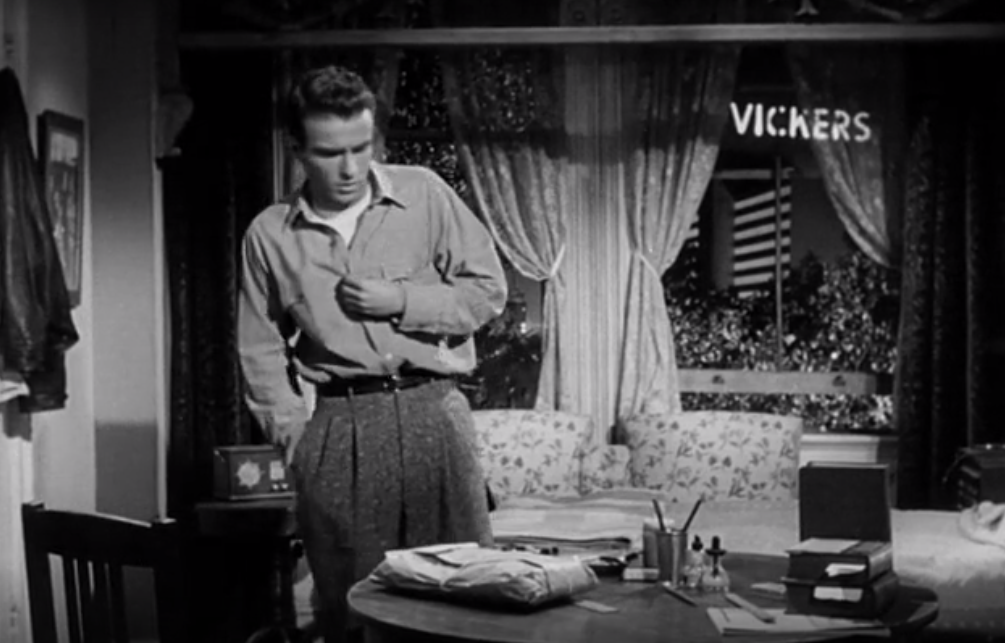
Still later, when George is at home obsessing over Angela, a neon sign in the distance flashes her last name (presumably on some building that her father owns) in the distance, illustrating his preoccupation. 

It’s not subtle, but I do like it. One that was subtle, however, was that every time we saw Alice’s address, whether it be on a piece of mail or on the side of the building where she lived, we saw that she lives at 4433 ½. It’s just another way that she’s stuck in the margins, a place not really held for her but one where she has to find somewhere to try and dig in and make space for herself. Poor Alice. 

Lagniappe

Boomer: The dissolve transitions in this movie are amazing. There’s so much storytelling happening in the visuals alone in this movie; the superimposition of shot over shot to convey mood, a character’s internal thoughts, everything — truly solid filmmaking, even if the movie milks its melodrama a little hard. 

Britnee: The atmosphere of Alice’s room in the boarding house really stuck with me. All of the claustrophobic shots in that room are so haunting. Particularly the scenes with that big open window at night. It’s the first thing that comes to my mind when I think about A Place in the Sun. I really can’t explain why.

Brandon: To further highlight the difference between what I appreciated in Taylor vs Winters, I’d like to point out my favorite moments of their respective, separate screentime.  Taylor’s best moment is in an early scene when she first flirts with Clift at a party, modeling an incredible, white floral Edith Head gown that has been imitated just as often in the decades since as her iconic hairstyle.  Meanwhile, Winters’s best moment is in the subtle choreography of her own flirtation with Clift at a movie theater, signaling her availability to him solely through strategic shifts in her body language.  Both contributions are essential to what makes this movie so great, but they’re very different contributions.

Next month: Brandon presents Torch Song Trilogy (1988)

– The Swampflix Crew

Podcast #209: Moonstruck (1987) & Valley Girl (1983)

Welcome to Episode #209 of The Swampflix Podcast. For this episode, Britnee & Brandon return to Nic Cage’s heartthrob era by discussing two classic 1980s romcoms: Moonstruck & Valley Girl.

00:00 Welcome

04:48 A Handful of Dust (1988)
08:16 Lisa Frankenstein (2024)
10:15 Immaculate (2024)
15:00 The Telephone Book (1971)

19:32 Moonstruck (1987)
40:22 Valley Girl (1983)

You can stay up to date with our podcast through SoundCloudSpotifyiTunesTuneIn, or by following the links on this page.

– The Podcast Crew

Podcast #208: Lenny Cooke (2013) & Basketball Docs

Welcome to Episode #208 of The Swampflix Podcast. For this episode, Brandon, James, Britnee, and Hanna celebrate March Madness by discussing a handful of basketball documentaries, starting with the Safdie Brothers’ 2013 profile of Lenny Cooke.

00:00 Welcome

07:23 How to Have Sex (2024)
13:52 The Double Life of Véronique (1991)
19:11 The Marsh King’s Daughter (2023)
24:11 Out of the Blue (1980)

30:23 Lenny Cooke (2013)
55:30 Hoop Dreams (1994)
1:19:46 AND1 Ball Access – The Mixtape Tour (2002)
1:40:01 Dennis Rodman’s Big Bang in Pyongyang (2015)

You can stay up to date with our podcast through SoundCloudSpotifyiTunesTuneIn, or by following the links on this page.

– The Podcast Crew

Podcast #207: Tenet (2020) & 2024’s Best Director Nominees

Welcome to Episode #207 of The Swampflix Podcast. For this episode, Brandon, James, Britnee, and Hanna discuss the earlier works of this year’s Best Director Oscar nominees, starting with Christopher Nolan’s backwards-explosions sci-fi action thriller Tenet (2020). Enjoy!

00:00 Welcome

01:33 Harakiri (1962)
06:50 King of the Gypsies (1978)
10:24 Obsessed (2009)
15:35 New Orleans French Film Fest 2024
19:00 Our Body (2024)

24:06 Tenet (2020)
44:47 The Lobster (2015)
1:02:15 Birth (2004)
1:22:49 After Hours (1984)
1:39:47 Sibyl (2019)

You can stay up to date with our podcast through SoundCloudSpotifyiTunesTuneIn, or by following the links on this page.

– The Podcast Crew

Podcast #206: Anguish (1987) & Total Momsters

Welcome to Episode #206 of The Swampflix Podcast. For this episode, Britnee, James, Brandon, and Hanna discuss four cult classics about monstrously mean but lovingly devoted moms, starting with the Zelda Rubinstein horror vehicle Anguish (1987).

00:00 Welcome

03:20 Cat Person (2023)
12:03 Après Vous (2003)
15:28 Breaking the Waves (1996)
20:07 Husbands (1970)
23:59 Soft & Quiet (2023)
29:48 Heavy Petting (1989)

36:04 Anguish (1987)
53:23 Serial Mom (1994)
1:13:00 Mom (1990)
1:24:09 Hush (1998)

You can stay up to date with our podcast through SoundCloudSpotifyiTunesTuneIn, or by following the links on this page.

– The Podcast Crew