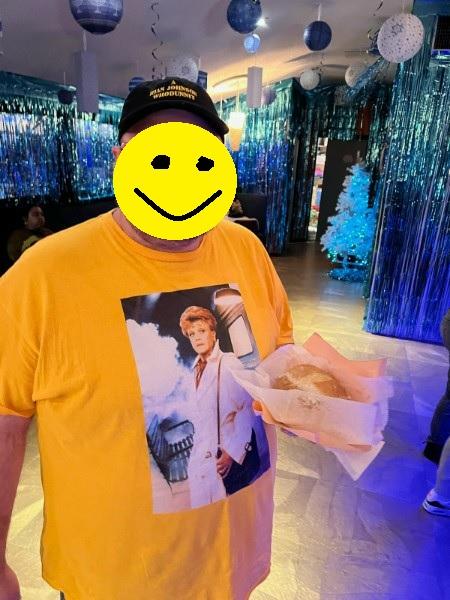
“It hides not behind complexity but behind mind numbing, obvious clarity!” So Daniel Craig’s Glass Onion character Benoit Blanc, called by Google “the world’s greatest detective,” says to much-vaunted “inventor” Miles Bron (Edward Norton) toward the end of this Knives Out sequel. I was a big fan of Knives Out when it premiered a few years ago. Brandon got a screener copy of its sequel along with some fun swag, and he was kind enough to both let me wait until the film fell into my greedy little clutches to publish a review, but also send along some of said swag, which includes the fantastic “A Rian Johnson Whodunnit” hat which you can see me wearing below while also clothed in one of my Angela Lansbury shirts:
For Glass Onion, Benoit Blanc once again finds himself insulated from the world among a smaller world of morons, ingrates, and moronic ingrates as well as hucksters, snake oil salesman, and politicians. This time, he has ostensibly received an invitation to a murder mystery weekend at the home of the aforementioned Bron, who is an amalgamation of various rich douchebag stereotypes (and truths) but who most closely resembles Elon Musk due to his involvement in various companies and businesses which work together to create an impression of a wise ubermensch, when he is in fact a little weirdo who obsesses over getting approval from others. Also invited to the island were several of Bron’s friends, each of whom received a puzzle box that required them to work together to solve and receive their invitation. There’s Birdie (Kate Hudson), the ignorant socialite whose put-upon assistant Peg (Jessica Henwick) has the full time responsibility of not letting her tweet something racist and dumb that could get her cancelled for good; there’s also sad MRA Duke (Dave Bautista) who lives in his mother’s basement while hawking various products that promise to make his viewers “alphas” like he presents himself to be, while his social-climber girlfriend Whiskey (Madelyn Cline) plays along with his internet image. On the smarter end of the scale of Bron’s friends is Lionel Toussaint (Leslie Odom, Jr.), one of the lead scientists at Alpha who liaises with upper management about Bron’s ideas; and the gang is rounded out by Claire Debella (Kathryn Hahn), former governor of Connecticut who is now campaigning for a senatorial run. Finally and apparently unexpectedly, also in attendance is Andi Brand (Janelle Monáe), a former business partner of Bron’s who was unsuccessful in preventing him from pushing her out of the business and exposing his questionable business practices. It’s May 2020, and they have gathered at Bron’s Grecian estate, which is topped with an ostentatious lúkovichnaya glava made of transparent glass, from which the film partially takes its name.
Of course, the title could mean a lot of things. For instance, it’s the name of the bar where all of the main characters (sans Blanc) gathered in their pre-wealth days, when Andi first brought them all together and before they all stabbed her in the back. It’s also, famously, the title of a track from what we colloquially call The White Album, although it’s properly titled The Beatles. Following all of the fan speculation about the meanings of some of the more psychedelic and impenetrable lyrics on their 1967 album Sgt. Pepper’s Lonely Hearts Club Band, John Lennon opted to pen a song that was intentionally antagonistic to anyone attempting to find a deeper meaning in the words; even if you don’t know the song title, you’re familiar with the Paul is dead conspiracy theory that’s now 55 years strong because of the lyrics “the Walrus is Paul.” Or, as Blanc says at one point: “I like the glass onion as a metaphor, an object that seems densely layered, but in reality the center is in plain sight.” From title to exposition, everything is a clue here, just as it was in Knives Out in 2019, and although the social criticism is a little shallower and more obvious than it was last time, I’m still here for the very fun ride.
Of course, that’s one of the things that makes films this elegantly constructed difficult to write about. You’re either going to end up recapitulating all of the fun and foreshadowing how it pays off, which ruins the ride for first-time viewers (hell, I’m already worried I might have given away who the killer is just from my little gags in this review so far) or you’re stuck trying to explicate on something in which the pleasure of the viewer lies in running alongside the narrative and having the revelations to the audience coincide with those to the characters. It’s tricky to pull off, and I’ve often cited how I feel comedy and mystery exist in and evoke neurochemical pleasure in the same parts of the mind: it’s all very specific planting and payoff, and if your audience gets to the solution/punchline too far in advance of the flow of the narrative, it can be death for both genres. Melding them together is a perfect idea (I’ve got more than one work in progress right now that does precisely that) that also doubles the potential for the film to crash and burn like, I don’t know, a SpaceX Falcon 1 launch. Both the previous Knives Out film and this one manage to pull it off. Every reveal makes total sense and falls perfectly in line with what we’ve already seen and what we already know while still allowing us to feel some sense of accomplishment in “figuring it out” along with the characters. It’s an effect you can only find in great examples of the genre, like Murder, She Wrote, which gets a loving reference here in the form of several celebrity cameos playing Among Us with Blanc during his quarantine blues before his invitation to the Onion, most notably and most wonderfully the divine, magical Dame Lansbury.
If I have any complaints about the film, they are few and far between. Blanc is bigger and bolder here than he was in the last film, which matches the zanier plot of this one but also makes it feel like the character isn’t quite consistent. This one doesn’t straddle the line of mocking conservatism and neoliberalism from a slightly left position as well as the last one did, which makes this one feel more “Hollywood” than the last one as well, despite both featuring a cast full of legitimate movie stars. It has a little bit of the Trump SNL taint on it (alternatively we could call it the There’s Someone Inside Your House problem), where just because something happens to align with my belief system doesn’t mean that it automatically makes it a better or more worthwhile piece of art. Most of its barbs are sharp, though. In particular, I love the detail that Birdie, who has already been shown to have zero concern about hosting a superspreader event in her apartment, arrives to the dock on the way to Bron’s island in what the script describes as a “fashionable but totally useless lace mask”. Some of them land a little more loudly or call more attention to themselves than they should, when I don’t remember the first film having any issues with this at all, but maybe that’s the nature of political satire now. There are elements of the plot, setting, and choices here that seem eerily prescient given how long the film took to make, like that it was in theaters at the time that Elon Musk had his bluff legally called and was forced to complete his purchase of Twitter, or that there is a giant mural in Bron’s house depicting Kanye West as Jesus Christ, which is both funny and depressing given the nature of West’s current public persona entirely revolving around spouting Anti-Semitic rhetoric with his whole chest. It recalls how there was an entire garden industry on the internet for a while of pointing out things that The Simpsons “predicted,” when the simpler and more depressing reality is that, with a few notable exceptions, there hasn’t been much of an improvement in most people’s lives since 1989. Glass Onion didn’t predict anything either, but it certainly has a talent to reflect how bleak things are at the moment.
At the end of the day, this is the kind of movie that I can only recommend you watch it or not, given that saying more than I’ve already said runs the risk of spoiling too much. If you’ve already got Netflix, you really have no reason not to, and I think that you’ll really enjoy the twists and turns along the way if you have the patience. And you’re at home, where you can pause and create your own intermission to go to the bathroom or make a cocktail, so why not? If nothing else, every person who watches this movie pushes Ben Shapiro closer and closer to having an epiphanic moment about what his actual place in the world is, and isn’t that a dream we should all strive towards?
In my needlessly personal and passionately incoherent review of and apologia for Bros, I neglected to mention that it was not the only gay romcom that came out this year. It wasn’t even the only one with Bowen Yang in it. Fire Island flew a bit further under the radar than Bros did, and although I’d like to give our dear friend Billy Eichner an object lesson about how something that isn’t associated with a Twitter tantrum might end up being better received critically than something that is, we can probably chalk the overall absence of Fire Island from the conversation up to racism. The only upside is that being outside of the conversation also puts you outside of The Discourse. Small mercies.
Fire Island is a contemporary gay update of Jane Austen’s Pride and Prejudice, sort of. Here, the biological Bennett family of the novel is replaced with a family of choice. Mrs. Bennett is replaced by Erin (Margaret Cho), who turned the misfortune of accidentally eating a piece of glass at an Olive Garden (or equivalent) into a house on notorious gay mecca Fire Island. In lieu of daughters, she is visited for a week every year by five gay men who are all at some point in the process of crossing the threshold from young adulthood to plain old adulthood adulthood. Max (Torian Miller) is the big guy of the group who loves to pretend that he’s “above” getting down and dirty on the island but who’s really the dirtiest of them all; hyper femme Keegan (Tomás Matos) wears crop tops and as little else as possible and also loves Marisa Tomei; while Luke (Matt Rogers) is also largely defined character-wise by his love of Marisa Tomei, although he also gets to be more involved in the actual plot than Max and Keegan as he takes Lydia Bennett’s role of being socially compromised by an immoral interloper. The real stars, however, are Bowen Yang and Joel Kim Booster as Howie (the Jane) and Noah (the Elizabeth and therefore our primary viewpoint character), who are clearly the two closest of the group, despite Howie having moved away from NYC to work on the west coast. The sexy, gym-bodied Noah provides the voiceover for the film, which starts with the famous opening lines of Pride and Prejudice: “It is a truth universally acknowledged that a single man in possession of a good fortune must be in want of a wife.” Noah then reveals his playboy nature to us by noting that not every man is looking to settle down. This is less true of Howie, who, at age thirty and dad-bodded, is stressed that he’s never had a boyfriend and fears that he’ll never get the romcom romance of his dreams.
Upon arrival to the island, Erin reveals that she’s broke (she invested too much in Quibi) and will have to sell the house soon, meaning that this is the last summer that the crew will have together at the house, unless one of the sisters can marry a wealthy man like Mr. Darcy. Wait, no that’s not quite right; everything before the Darcy stuff is accurate, but no one needs to marry, sorry. Noah agrees to avoid getting laid until he successfully wingmans for Howie and, having committed himself thus, sets out to accomplish his mission with gusto. Howie immediately hits it off with Charlie (James Scully), while Noah is initially drawn to the sullen Will (Conrad Ricamora) but then is put off by him after overhearing Will being grumpy in that traditional Mr. Darcy way. I’m being quite literal, by the way; Darcy says of Elizabeth that she is “not handsome enough to tempt him,” while Will says of Noah that “he’s not hot enough to be that annoying.” But of course, as we all know, you can’t keep an Elizabeth and a Darcy apart forever. They may loathe each other for a while due to operating under bad first impressions, but they’re going to end up together. That’s just how this works.
Fire Island is a fun, breezy, unpretentious movie. While I might have gotten more actual chuckles out of Bros, Fire Island is much more charming. One of the problems with Bros is the extent to which it felt the need to announce how important it was. And, I mean yeah, I wrote almost 3500 words about it; it is important. But it also never lets you forget that it knows how sophisticated and ground-breaking it believes itself to be, while Fire Island aims to be exactly what it is and quietly succeeds in being the best possible version of that thing. The pop culture references are funnier without needing to be so … explicative? Debra Winger’s bog monologue about how all gay men come to her with their relationship issues because in their minds she’s Grace Adler is funny, sure, but it has nothing on Keegan and Luke reciting dialog from My Cousin Vinny in an increasingly agitated hysteria because they’re stuck playing a celebrity guessing game with someone who doesn’t know who Marisa Tomei is. The jokes that allude to or directly cite other movies here are refreshing both in brevity and the fact that the film doesn’t need to belabor the audience with an explanation when, for instance, one character calls out another for being catty with the line “Way harsh, Tai.” If you get it, then you get it, and if you don’t, the movie’s already moved on to the next plot beat.
What also makes things work here is honesty. Noah and Howie are kindred spirits because each recognizes in the other the way that Asian men are ostracized within the community, and it brings them closer. Noah, however, can’t see past this surface similarity to be completely open and honest with himself about the way that he and the schlubbier Howie are treated differently on the island because of how one matches a very particular set of beauty standards and the other doesn’t. As someone with a fat body that prevents me from having the same social cachet as my better looking friends, this really hit home for me; not to keep comparing this to Bros, but in that movie, I couldn’t stop thinking about how the white, conventionally attractive Eichner feeling sorry for himself for his lack of a boyfriend while consistently hooking up with other attractive people was alienating and, frankly, dishonest. Howie’s emotional scene in which he begs Noah to really look at the two of them and see that although they are both two East Asian gay men who face the same ostracization from the mainstream, pretending Howie has the same more social credit as Noah—with his toned abs and perky pecs—is actually hurting Howie, even if Noah is trying to hype his friend up. Bros felt the constant need to draw attention to itself as “groundbreaking” gay cinema while Fire Island creates something that is fresh and new and hopeful simply by modernizing one of the cornerstones of romantic literature. If you’re only going to watch one, it should be this one.
One of the bigger trends of the 2022 movie calendar was the prominence of stop-motion animation as a medium. Netflix’s cheeky horror anthology The House was the first Great film of the year, and that early stop-motion triumph rolled into the wide, acclaimed release of so much direct competition that it now feels distant & puny in retrospect. Rolling into awards season,Marcel the Shell with Shoes On and Guillermo del Toro’s Pinocchio are formidable contenders for best animated film of the year against the more typical Disney-funded CG mediocrities that have earned that prize by default since Toy Story put Pixar on the map. And then there was Phil Tippet’s magnum opus horror show Mad God, which pushed the stop-motion medium to the outer limits of what animated cinema can achieve. Usually, I’m on top of all stop-motion feature films as soon as they’re released, but this year offered so many varied, prominent titles in that category that I let a couple slip through my fingers until now. Neither The Old Man Movie nor Wendell & Wild completely blew my mind as I caught up with them for Best of the Year listmaking season, but that was mostly a result of them joining such an already crowded field. In a more typical year, these would have been the only two stop-motion releases of note, and I likely would have been much more ravenous for what they have to offer.
The more disappointing title of this late-entry pair is Wendell & Wild, since it’s the one with the highest pedigree behind its production. Not only does it reunite the iconic comedy duo Key & Peele as a pair of wisecracking demons, but it’s also the comeback film of legendary stop-motion animator Henry Selick, who has not directed a film since 2009’s Coraline. As a recently converted Monkeybone apologist, it brings me no pleasure to report that Wendell & Wild is, by far, Henry Selick’s worst film to date. The good news is that it’s still pretty great, as long as you only pay attention to its mall goth art design & vintage Black punk soundtrack. Story wise, the film is a sprawling, unresolved mess in a way a lot of blank-check Netflix productions have been for directors like Scorsese, Baumbach, Fincher, and The Coens, who have been putting in some of their career-weakest work on the platform with no one to push back on or hone their ideas. Out of the pair, Netflix was smart to give del Toro’s Pinocchio the bigger Oscars Campaign—it is the better film—but it’s also far from del Toro’s best work either. If anything, the two films could have borrowed and swapped a lot of their shakier qualities: Wendell & Wild should have been a punk rock musical, since its charms rely entirely on its soundtrack & visual spectacle, and Pinocchio should not have been a musical at all, since its entire songbook is limp & forgettable. They’re both decently entertaining movies about rebellious youth, though, with Wendell & Wild falling somewhere at the Hot Topic end of that spectrum.
If the story of a high school punk rocker teaming with a pair of wisecracking demons to resurrect her dead parents with magical hair cream (and to avenge the wrongful deaths of the family’s condemned root beer factory while they’re at it) is a little overly complicated, maybe The Old Man Movie has a leg up on Wendell & Wild. In The Old Man Movie, three siblings have to recapture & milk their grandfather’s escaped cow before its udder explodes, nuking their entire village in a milky “lactocalypse”. Those are pretty clear, cut-and-dry stakes even if they are ridiculous ones, and the movie even provides a helpful 24-hour deadline before that udder catastrophe strikes. The Old Man Movie also enjoys the benefit of nonexistent expectations. Henry Selick’s previous films Coraline, The Nightmare Before Christmas, and James and the Giant Peach rank highly among the most beloved stop-motion films of all time. By contrast, The Old Man Movie is the most profitable animated film ever exported from Estonia, but it’s likely most audiences outside that country have never heard of it. That might hint at its comparatively limited appeal, since Selick makes mildly spooky movies that are still friendly enough for children, while The Old Man Movielooks like it was made for children but would likely psychologically scar any who wander into the room. It performs the shrill gross-out humor of Ren & Stimpy in the once-wholesome visual language of Wallace & Grommet. It’s teeming with grotesque milk monsters, mile-high piles of pig shit, and unstoppable killer kratts – pushing it more into Phil Tippet nightmare territory than Henry Selick’s goth kid starter packs.
Some of The Old Man Movie‘s one-off gags offend, especially when it singles out hippies & women as targets for mockery. Other gags deliver enormous laughs that make the eyerolls worthwhile, especially in its visible disgust for the gnarlier details of daily farm work. While Wendell & Wild pushes the boundaries of stop-motion as an artform into the technological marvel territory of a Laika film, The Old Man Movie scales it back down to a handmade claymation style that feels a little like serial killer bedroom art. It was refreshing to see a film so volatile in its moods & humor after the more cumbersome, plot-fixated machinations of Wendell & Wild felt so weighed down by its own enormity. That’s not to say Wendell & Wild isn’t shocking or over-the-top in its own ways; it’s especially bold to see a children’s film about a rebellious youth’s team-up with demons get a major-platform release in a year when online Evangelicals are obsessed with the ways Satan is “grooming” children into cannibalism & debauchery through “hidden” messages in popular media. What’s most incredible, though, is that neither The Old Man Movie nor Wendell & Wild qualify as the wildest, most outrageous stop-motion release of the year – a title that has a shocking amount of competition (and still belongs to Mad God). There has been enough of a wealth of anarchic, ambitious stop-motion feature films that I can be a little bratty and brush both of these movies off into the “Pretty Good” pile instead of the “Saviors of Modem Animation Pile.” I want to live in a world where I’m this spoiled every year.
I know that I read Don DeLillo’s post-modern novel White Noise in high school (along with his Lee Harvey Oswald fan fiction Libra) because I still see my beat-up copy on a friend’s bookshelf every time I drop by for a visit. I just could not recall anything that happens or is said in that book if asked, while similar works from authors like Kurt Vonnegut, Joseph Heller, and Barry Hannah have remained vivid in my memory. That’s okay, though, because Noah Baumbach is on-hand to transcribe DeLillo’s novel word-for-word to jog my memory. Baumbach’s live-action illustration of White Noise gives DeLillo’s words the Shakespeare in the Park treatment, parroting without edit or interpretation. It’s the worst kind of literary adaptation, the kind that runs itself ragged trying to encapsulate everything touched on in its source material instead of reducing it to core essentials. It’s aggressive in that approach, too, as its inhuman archetype characters recite dialogue directly off pages of the novel in a deliberately alienating, absurdist exercise that has no business leaving the art school context of a fiction-writing workshop or a black box theatre. All Baumbach has accomplished here, really, is issuing an $80mil reminder to audiences that White Noise is worth a read (which, to be fair, is a more noble waste of Netflix’s money than most).
The second half of this 136min existential epic is almost worth the exercise. White Noise starts off as a sweaty, distinctly Netflixy disaster thriller in which an academic couple (Adam Driver & Greta Gerwig) bungle their family’s escape from an “Airborne Toxic Event” that threatens to damage the health of the entire college town where they live. Between the Altmanesque overlapping dialogue, the Spielbergian wonders-stares at the sky, and the academia in-jokes about the overlap between Hitler Studies & Elvis Scholarship, there is plenty enough movie in that first half alone to justify a standalone feature. It’s just a movie without much of a point, nor many successful jokes. In the second half, Driver & Gerwig really get into the selfish secrecy and personal struggles with existential dread that threaten to melt down their seemingly perfect marriage, and the purpose of adapting the novel in the first place starts to become clear. If Baumbach wanted to make a movie about the crushing fear of death that keeps these characters from truly connecting with each other, I don’t know why he’d waste time running rampant making a disaster epic first, instead of either editing those events out of the picture entirely or summarizing them in flashback. Adapting a novel does not mean you have to adapt all of the novel since, you know, cinema & fiction are two different artforms with drastically different qualities & necessities.
White Noise occasionally lands on some striking imagery by leaning into the intense artificiality of “The Netflix Look,” especially in scenes set at an overlit A&P grocery store (a setting it milks for all its worth in its concluding LCD Soundsystem music video). More often, it’s just a baffling waste of talented performers’ time & energy. Gerwig delivers an emotionally gutting monologue mid-film that’s a welcome reminder how talented she is on both sides of the camera. Driver’s goofball physicality is naturally funny throughout, even when the words he’s reciting are too stiff to land a punchline. If this were a shrewdly edited-down domestic drama about their crushing, isolating fears of death in the aftermath of a bizarre “Airborne Toxic Event,” the movie might have achieved the intellectual transcendence it’s straining for. Instead, the event itself is given equal weight, exhausting the audience before the core story even takes shape. I have no doubt this adaptation will have a dedicated cult, though. Diehard fans of Charlie Kaufmann, Under the Silver Lake, and getting cornered at parties by chatty academics will find plenty to love here. Personally, all I saw was a reminder that the things I love in creative writing are not the same qualities I value in cinema, as well as an ominous vision of what will inevitably happen when some misguided fool “adapts” Infinite Jest.
Our current Movie of the Month, 1972’s A New Leaf, was the directorial debut of stage comedy legend Elaine May. May reluctantly starred in the film herself opposite Walter Matthau, who plays a destitute, asexual playboy aristocrat who plans to marry her neurotic heiress character, kill her, and liquidate her fortune. Only, his plans are thwarted when it gradually dawns on him that there is one thing in the world he enjoys more than money: his wife’s company. A New Leaf is a darkly funny, bitterly anti-romantic romcom until, against all odds, it ends on the familiarly sweet notes of a traditional romcom. Elaine May’s performance is a large part of its success, as the only reasonable response to watching her nervously unravel under her gigantic glasses is to immediately blurt out “Marry me,” regardless of whether you also want to kill her for her inheritance. It’s a shame, then, that her frustrations behind the camera tripped up the film’s potential success.
Every movie Elaine May directed was delivered over-schedule & over-budget. Even her relatively laidback, low-budget debut stretched 40 days past its shooting schedule, with an entire hour of extraneous bits & bobs the studio edited out of the final product despite May’s protests that it needed to be a three-hour romcom to work. If she had delivered A New Leaf on-time, on-budget, and properly trimmed, it would’ve been considered a huge hit instead of just breaking even, and she might’ve had an easier time fighting for her cuts of similarly troubled productions down the line. Instead, she toiled away in the background, writing screenplays for some of the most beloved Hollywood comedies of all time – poor thing. She did manage to squeeze four feature films out of Hollywood producers before they took away her director’s chair, though, and luckily for audiences they’re all great movies, whether or not they lost money. If you enjoyed A New Leaf, I recommend that you watch all three films May directed afterwards, detailed below. And if you’re a Hollywood producer, I recommend that you spend even more money on whatever dream project the 90-year-old auteur wants to see made before she leaves this world. Chances are high you’ve already wasted much more money on much worse films.
The Heartbreak Kid (1972)
I guess it’s inaccurate to claim that every Elaine May movie was a commercial flop. Her follow-up to A New Leaf was her one hit comedy, enough of a financial success that it inspired a major studio remake starring Ben Stiller in the aughts. Curiously, it’s also the only film in her catalog that’s not currently available to watch at home through official means. The Heartbreak Kid has been left to rot on YouTube and Archive.org as a long-forgotten 20th Century Fox acquisition that the art-indifferent overlords at Disney have no concern for. Which is a shame, sinceit might very well be May’s career best as a director. At the very least, its anti-romcom humor is even darker & more vicious than A New Leaf’s, which is impressive since that debut was about marital murder.
Charles Grodin stars as a fresh-out-of-college shit-talker who immediately realizes on a honeymoon road trip that he despises his bride. While vacationing in Miami, he ditches her for a younger, blonder co-ed who he has no business fooling with, inevitably finding himself still deeply unhappy after another successful romantic conquest. The Heartbreak Kid is essentially a horror film about a nightmare world where everyone has to marry the first person who makes them horny before they get to have sex, regardless of compatibility or moral deficiency. May’s psychedelic zoom-ins on the Miami resort sunshine, Groden’s complaints that his wife is “not really his type,” and the escalating tension of the plot’s sitcom hijinks are outright maddening, whereas the similar poisonous romance humor of A New Leaf plays oddly, subtly sweet. Together, they make a great pair, and they’re the best argument for May’s genius as a comedic auteur.
May’s least typical work is her all-in-one-night gangster drama Mikey & Nicky, starring Peter Falk & John Cassavetes as a pair of uneasy, paranoid friends at the bottom rung of the crime-world ladder. Falk appears to be the kinder, more calming presence of the two, but over the course of the film both characters expose themselves as low-level scumbag criminals without a decent bone between either of their bodies. They’re not all that different from the self-absorbed, oblivious brutes of May’s comedies, except that working in a different genre means she no longer has to ingratiate them to the audience for the story to work. Moving away from a character-based comedy structure also expands her scope to capture a portrait of a grimy, pre-Giuliana era NYC instead of just a couple losers who occupy it. The film’s late-night setting, 70s funk soundtrack, guerilla-style camerawork, and authentic casting of dive-bar creeps as background extras all feel like they’d be much more at home in a Scorsese picture like Taxi Driver or Mean Streets than a typical film from Elaine May. But she’s damn good at it.
Mikey & Nicky presents the best argument that May deserves as much time to tinker around in the editing room as she desires. The dialogue has a tight, pointed feel to it, as if the screenplay were written for the stage. So, it’s mind-blowing to read about how its narrative flow was mostly constructed after-the-fact in the editing room, like a sprawling, improv-based Apatow comedy. Her way of putting a story together might not have been financially sound at the time (considering that her over-schedule shoots were burning through celluloid while Apatow’s only clutter up digital servers), but you can’t argue with the results. She makes great movies.
The only time I can feel the overcooked, under-planned sweatiness of Elaine May’s directorial style is in her final picture, the one that effectively became a punchline synonym for box office disaster. Ishtar is not nearly as bad as its contemporary reviews suggested. In its earliest stretch, it’s an ahead-of-its-time, Tim & Eric style anti-comedy, starring Dustin Hoffman & Warren Beatty as a pair of sub-mediocre songwriters who abandon their shared dream of making it big in New York City to instead make some quick money as a nightclub act in Morocco. The film also isn’t as great as its modern reclaimers suggest. Once it arrives in Morocco, May loses the personable intimacy that makes her earlier comedies so great, as Beatty & Hoffman’s buffoons are gradually drafted against their will into a conflict between the CIA, leftist guerillas, and the dictator of the fictional country of Ishtar. The movie loses a little of its post-Andy Kauffman, proto-Tim & Eric sheen as the whole battle comes to a head in its third act slump, which involves a blind camel, some unfortunate detours into brown face, and our bumbling leads getting lost in the desert.
Despite some of that exhausting, comedy-killing bloat in the third act, Ishtar does not deserve its reputation as One of the Worst Comedies of All Time. It’s doubtful it was even the worst comedy released in the spring of 1985. The film is often funny in a strikingly subversive, adventurously unconventional way. It even goes as far as to include harsh criticisms of US interference with political affairs in the Middle East instead of broadly stereotyping the people of the region the way lazier 80s comedies would (for the most part). Still, it ended up being the straw that broke the proverbial camel’s back, as it finally sealed May’s reputation as box office poison after four consecutive debacles. Even the critics had turned on May at the arrival of her final feature, seemingly eager to tear it down before it was even released. Even if her productions were overly extravagant for what she was supposed to be delivering, I’d say that was a mistake. After all, she was only hurting the money men. She consistently put out great art, even when it was bad for business.
For this lagniappe episode of the podcast, Boomer and Brandon discuss the bad-taste Christina Ricci comedy Pumpkin (2002), in which a WASP sorority girl falls disastrously in love with a mentally disabled athlete.
00:00 Welcome
01:20 The Rehearsal 06:06 Guillermo del Toro’s Pinocchio (2022) 11:27 Death Becomes Her (1992) 21:00 True Grit (2010) 23:23 Gods of Egypt (2016)
As the Fall Film Festival season spills over into the Year-End Listmaking frenzy and the new year’s hangover Awards Ceremonies, it’s easy to be tricked into believing that movies are Important. Forget all the jump-scare horrors of October and the action blockbuster bloat of what’s now a six-month summer. This is the time of year when cinema cures all the world’s ills, from “solving” racial & economic injustice in 180 minutes or less to fortifying millionaire actors’ praise-starved egos with gold-plated statuettes. And so, it’s the perfect time of year to catch up with the Spanish film industry satire Official Competition, which is exactly as cynical about the absurd ritual of Important Cinema Season as the ritual deserves. Dissatisfied with merely being grotesquely wealthy, a pharmaceutical CEO decides to purchase cultural clout by funding a high-brow art film. He employs a temperamental arthouse auteur to complete the task in his name (Penelope Cruz, sporting one of cinema’s all-time greatest wigs). To make the most of the opportunity, she has to manage the competing egos of her two male stars (Oscar Martinez as a pretentious stage actor & Antonio Banderas as a himbo film star), and the three mismatched artists violently bicker their way into purchasing a Palme d’Or. Hilarity ensues, with none of the pomp nor dignity of Prestige Filmmaking left intact.
As you can likely tell from the dual presence of Cruz & Banderas, Official Competition borrows a lot of aesthetic surface details from the Almodóvar playbook: ultra-modernist art gallery spaces, video-instillation digi projections, cut-and-paste magazine collages, etc. It just repurposes those Great Value™ Almodóvar aesthetics for broad goofball schtick instead of subtly complex melodrama. And it works! The jokes are constant & consistently funny, always punching up at the absurd self-importance of artsy filmmaker types’ delusion that they can change the world through a millionaire producer’s vanity project. From the himbo’s Instagram charity sponcon to the theatre snob’s practiced awards rejection speech to the auteur’s failure to master TikTok dance crazes, the movie constantly pokes fun at its three central players for being far less Genius, Important, and Uniquely Talented than they believe themselves to be. At its core, this is a comedy about a boyish rivalry between the two actors under Cruz’s direction, and her mistaken belief that she’s the sole voice of reason on-set. They’re all equally ridiculous and all a constant source of verbal & visual punchlines.
Even though Official Competition is essentially a farce, it can’t help but absorb some of its own arthouse prestige through proximity. The three main actors all put in great, nuanced performances as broad film-world archetypes, especially Cruz as the exasperated auteur who can’t fully domesticate her collaborators. The Almodóvar set details afford it a crisp art instillation feel, especially in a lengthy gag involving a loudly mic’d lesbian makeout session. Its icy humor at the expense of its own industry also goes subzero in the third act, when the vicious on-set rivalries become outright lethal. It’s a very smart comedy about a very silly industry that thinks very highly of itself, an easy but worthwhile target for ridicule. It’s around this stretch on the annual film distribution calendar—when the novelty horror titles dry up between Halloween & January dumping season—that I’m desperate for a little novelty & levity in my moviewatching diet. Official Competition meets me halfway in that respect, finding plenty novelty & levity in Prestige Filmmaking itself.
Every month one of us makes the rest of the crew watch a movie they’ve never seen before, and we discuss it afterwards. This month AllimadeBoomer,Brandon, and Britnee watchA New Leaf (1971).
Alli: Oh, heavens! I’m so glad to finally share this movie with y’all.
Elaine May’s 1971 black comedy A New Leaf is about bachelor Henry Graham (Walter Mathau), who goes absolutely broke after squandering his fortune on his Ferrari, horses, exclusive clubs, fancy restaurants, and his impeccable art collection. After getting the idea from his butler, he decides to marry a rich woman and kill her for her money. His target is botanist Henrietta Lowell (Elaine May), who is a hopelessly clumsy, gauche, and stunted adult. As their marriage and the movie progresses, Henry takes on more and more responsibility in their household in the hopes of having the opportunity to murder Henrietta and become independently wealthy again. I like to describe this movie as the “anti romcom.” There are plenty tropes of a standard romcom with none of the actual romance: a bachelor who has never considered marrying, a meet cute featuring lots of spilt tea, an impossible deadline for the wedding, and disastrous boat trip (although this one is a disastrous canoe trip). I’d even argue that there’s a sort of “opposites attract” dynamic at play.
Except they’re not exactly opposites. Henry. Henrietta. Two sides of the same coin. They’re both adults unable to handle the day to days of adult life. For Henry, it’s because he doesn’t want to. For Henrietta, she’s just so caught up in her ferns that she’s clueless. Both are unmarried and not actively searching until now. With Henrietta getting the confidence to hang off cliffs to find her ferns and Henry learning the practical logistics of household management and taxes, they find a way to—for lack of a better term—complete each other. By the end of the movie, I find them endearing together somehow.
What did y’all think of the movie? Do you think they belong together even if they’re not lovers and—with some obvious queer subtext—Henry has no interest whatsoever in women?
Brandon: Funnily enough, when I search for “Walter Matthau A New Leaf gay subtext”, the top Google result I’m getting is Alli’s original review of the film for Swampflix in 2016. Considering how much online movie nerds like to read into fictional characters’ “queer coding”—intentional or otherwise—you’d think we’d be in our usual spot in the double or triple digits of results pages. All I can really confirm is that Henry’s sexuality was on my mind throughout the film. I kept trying to pin him to a specific modern queer context every time he intimately grabbed his butler’s arm or scoffed when a country club manager expressed surprise at his sudden (financial) interest in women. Elaine May has enjoyed some recent reappraisal as an overlooked auteur in historically macho film canons (alongside other greats like Varda, Ottinger, Wertmüller, and Campion), an effort that’s intensified even since we covered Mikey & Nicky as a Movie of the Month in 2017. So, it’s a little curious that there doesn’t seem to be much consensus on how this marriage-cynical anti-romcom could be interpreted through a queer lens.
Ultimately, I settled on both Henry and Henrietta being some form of ace. They are both so unbothered with and oblivious to physical sexual attraction that it doesn’t even occur to them that the everyday companionship of marriage might be emotionally beneficial even if they have no desire to fuck. The entire arc of Henry’s character here is the painfully gradual realization that he enjoys & benefits from Henrietta’s company. That delay is, of course, comically ridiculous, since no reasonable human being could watch Elaine May nervously unravel under those gigantic glasses without immediately blurting “Marry me!” (whether or not they also want to murder her for her inheritance). Plot-wise, the two movies A New Leaf most reminded me of were Charlie Chaplin’s against-type black comedy Monsieur Verdoux and its Ealing Studios descendent Kind Hearts and Coronets, both about the convenient financial gains of murder. The difference is those predecessors have ice-cold hearts that May’s film only pretends to emulate in its earliest stretch. This ultimately is a very romantic movie about two absolute weirdos who belong together but don’t know how to express—or even realize—their mutual fondness in a world oblivious to their asexuality. At least, “Walter Matthau A New Leaf asexual” leads to much more credible online resources than this unpolished, self-published blog.
Boomer: I’m also going to throw my hat into the ring for Henry being asexual. There’s that scene right around the 25-minute mark where Bosley from Charlie’s Angels tries to fob Henry off on a water skier at some social event, and, when the two are alone in the night, she attempts to remove her bathing suit top and Henry bleats in terror: “No! Don’t let them out!” I laughed quite a lot at the delivery, but there’s something so bone-deep terrified in that line read that doesn’t say “gay,” to me, it says “completely and abjectly terrified at the very prospect of sex in any form.” It’s also the first time that we’ve seen Henry hit an emotional peak; he’s mostly just gruffly irascible and impatient, but he never hits a boiling point and instead stays in a low, simmering annoyance. The closest he comes before this moment to showing a positive emotion is when he surveys his favorite lunch restaurant and speaks, not to the handsome waiter but to the dining area itself, as if he is a lover bidding a final farewell. “Desire” only exists to Henry insofar as he can only tolerate the finest that life has to offer.
To be honest, at first this felt like it was going to make me hate this viewing experience. When Henry’s attorney, Beckett, is finally able to make contact with him in order to tell him that he’s used up all of his (vast, incomprehensibly vast) funds, it follows closely on the heels of a scene in which Henry is about to go gallivanting around the skies in a fighter plane, and he doesn’t even seem like he’s having a very good time doing it. But even with all that rich assholery, it’s impossible not to love Walter Matthau in anything that he’s in; even when he’s a total jerk, you can’t help but be charmed by him and his curmudgeonliness. By the time he was wistfully bidding farewell to all of the cultural hallmarks of excessive wealth, I hadn’t come to like him necessarily, but I wasn’t taking delight in laughing at his downfall either. When it comes down to it, he’s ultimately very good with the household finances and starts plugging up holes in Henrietta’s estate budget immediately, which immediately stops her unscrupulous family lawyer from continuing to leech from her. That was the first scene where I really liked Henry, and it carried through the rest of the film.
Britnee: I really enjoyed this! It’s the asexual “romcom” that I didn’t I needed. A New Leaf is one of the best comedies I’ve seen in a while. It reminded me of one of my favorite films of all time, What’s Up, Doc?. Both came out in the early 70s and are so comically chaotic. Walter Matthau’s performance as Henry, the spoiled middle aged man-child, completely blew me away. I’d only previously seen him in the Grumpy Old Men movies, Dennis the Menace, and Cactus Flower. He somehow looks like he’s been 70 years old forever. What a face! His emotionless delivery of back-to-back sassy lines had me howling. The scene where a child walks in on him while he’s getting dressed for the wedding is one of the best. When he yells at her to get out and repeats “I won’t have her touching my things!”, I saw so much of myself in his character. It’s very “psychobiddy,” even coming from a 50 year-old man.
I also have to mention how impressive Elaine May is. To manage such a brilliant film as her directorial debut while starring in it herself is such a major accomplishment. I’m ashamed to not have known of this sooner. This is why Movie of the Month is so great! Also, I’m dying to try one of Henrietta’s Malaga Coolers. Not only has May made her mark in the film industry, she’s also made it into the world of fragrance, as the Demeter fragrance line has a perfume based on the beverage. I’ll have to get one for my purse!
Like Boomer and Brandon, I also picked up on the asexuality of the main characters. It made sense for Henry, but I had to think a little more to figure out Henrietta. She was more into Henry than he was into her (obviously), but she was more interested in the companionship Henry offered than anything sexual or romantic. They both remind me of these old neighbors I had many moons ago. They would sit on their shared porch and nag each other constantly, but they hung out every day and appreciated each other in their own weird way.
Lagniappe
Britnee: Renee Taylor (Sharon) is fabulous for her entire four minutes of screentime. That waterski scene is comedy gold. The character played like a younger version of her famous role in The Nanny (Fran’s mother, Sylvia Fine), which makes me wonder if that’s her true personality or just a character she’s developed. Either way, I’m so thankful for her existence.
Alli: I’m also fascinated by the Malaga Coolers. All a quick google search on them brings up is this movie, so it was obviously the worst imaginable offense against wine snobs she could invent, which I love. BUT I actually have tried this beverage. Once, as an adult, I went to my grandma’s house, and she busted out the Mogen David and soda to whip some up. It was … not great, as you would expect.
The Malaga Cooler: the drink of awkward botanists and crazy Grandmas everywhere. (RIP my grandma, who died this year. She was quite a lady.)
Boomer: So after having to drive my friend’s car back from the Halloween party last weekend because someone forgot to eat before drinking, I took my own car out for a midnight drive to get some fast food. Unfortunately, after passing the Whataburger because the line was insurmountable and getting halfway to Jack-in-the-Box, my check engine light came on, so I turned around and went straight home. After going to the AutoZone first thing the next morning for their free diagnostic, it turned out that there was an issue with my catalytic converter. You see, I had carbon buildup… on my valves. The man at the store asked if I took mostly small, short trips (I do), and apparently I, like Henry, simply don’t take my car out for enough long drives to “clear the throat” of my car, as it were. As a non-car-guy, I didn’t realize that this was what was happening with Henry’s car as well; I just let that whole scene float past me in the stream. Luckily, I went and got it checked out quickly enough that the AutoZone employee was able to recommend something called Cataclean, which you pour into your tank and it clears out all the carbon (from the valves). I’m happy to say that, four days later, my check engine light has gone off! (Not sponsored.) So this is my advice to all of you out there in readerland: if you take a bunch of short drives, like I do, then get you some of this stuff and use if before it becomes a problem. And if your check engine light comes on, don’t ignore it; get it checked out right away. The life you save could be your own (car’s).
Brandon: Having now seen all four of Elaine May’s feature films, I find myself struggling with the question of whether or not she’s a “great” director. She certainly makes great films. Even the worst of her catalog, the misunderstood anti-comedy Ishtar, deserves more attention and praise than it gets. At the same time, each of those movies was delivered over-schedule & over-budget, so it’s not like she was especially adept at managing her shoots. This relatively laidback, low-budget debut stretched 40 days past its shooting schedule, with an entire hour of extraneous bits & bobs that the studio edited out of the final product despite May’s protests that it needed to be a three-hour romcom to work. If she had delivered A New Leaf on-time, on-budget, and properly trimmed, it would’ve been considered a huge hit instead of just breaking even, and she might’ve had an easier time fighting for her cut of similarly troubled productions like Mikey & Nicky down the line. Instead, she toiled away in the background writing screenplays for some of the most beloved Hollywood comedies of all time, poor thing.
I suppose Elaine May is a great director in the only way that should matter to audiences: her movies are sharply funny & uniquely entertaining. How she manages time & money is more of an issue for Hollywood executives to worry about; they’ve certainly invested a lot more financial capital on projects with a lot less cultural value than May’s four modest bangers. I only really bring up the question here to note that her management of the practical & financial aspects of filmmaking is remarkably similar to the disastrous, hands-off way she runs her inherited estate as Henrietta in A New Leaf, adorably so.
Longtime readers of the site will know that I’m not just a writer who likes to amble through my reviews, but that I like to preamble them, too. It’s one of the various little tricks that one might pick up at the Royal Baton Rouge Academy of Writing Tricks, or from watching too many video essays of widely varying quality on YouTube. Instead of just beginning this post with “Bros is very funny” and then going into a listing of some of contributors to its existence as a filmic product that you might want to go and see, I’ll throw a bunch of pieces of seemingly unrelated information at you that will, if I do my unpaid job correctly, make sense as all of the ideas flowing through me coalesce over the course of the essay: the number of times that I saw the trailer for Colossal, the mockery that I once endured for sharing information I had recently read about Abraham Lincoln’s possible bisexuality with a friend in high school, David O. Russell, Maggie Fish’s most recent video essay, and everyone’s favorite topic, Twitter discourse. Fun fact: in grad school, one of my professors told me that they got the impression that I just sat down and started writing with no plan, and they were right! They also once sent me an email in response to my soft inquiry about a PhD program letter of recommendation with the advice that I should really start with professors who gave me an “A” first.
Anyway, a little bit further ado: of late, when I tell people about the movies that I’ve been seeing, there are those who want to talk to me about the text itself, and those who know more about The Discourse. (For those who might be interested, Erstwhile Roommate of Boomer hatedDon’t Worry Darling.) Bros was undoubtedly doomed to be part of The Discourse, not just because of the film’s content, but because of its polarizing and contentious star, Billy Eichner. For the uninitiated, Mr. Eichner is a comedian whose first big break was on Fuse’s Billy on the Street, in which a tall, sassy gay man wandered NYC and handed money to people he encountered for answering pop culture trivia questions, sort of like a Cash Cab for pedestrians. What made the show work was the interaction between a flamboyant host who could best be described as a “bitter theatre kid” and the people he encountered and his “man-on-the-street” interviews with them; that having been said, live unplanned interactions are always a gamble, especially in a place like New York. Not everybody who is out and about in the world is going to want to play with you, and although it’s part and parcel of this kind of content that it’s partially about catching people off guard and pushing them towards (not out of the edge) of their comfort zones, there are also going to be people who just don’t want to participate, and part of being good at that job is recognizing those signs. Notably, one interaction that I’m shocked made it to air was one in which Billy continues to hassle a single mother of four about her lack of interest in La La Land, repeating the name of the movie and the phrase “it has Oscar buzz” over and over again until he sounds like he’s talking gibberish. You can watch it here with some commentary tweets below. On the Street was still in production not that long ago, but I doubt this would be put on television in 2022; it assumes that we the viewership will find the interviewee to be unreasonable and “crazy” because she eventually tells Billy off, but after watching Billy continue to engage a woman who’s clearly trying to be left alone about something as vanilla as La La Land, we’re on her side. At least I am. From there, Eichner had a recurring role on Parks & Rec and then co-headlined the Hulu sitcom Difficult People for a few years, although I mostly know him from his appearances on American Horror Story.
We’ll circle back around about Billy. In the meantime, the synopsis: Bobby Lieber (Eichner) is a podcaster who has everything but love. He has a dream Manhattan apartment, is the incumbent recipient of an LGBTQ+ award, will soon be the curator for the city’s first LGBTQ+ museum, etc. This is most obvious in his group of friends, which includes his lady best friend and her husband as well as two gay couples: one has just learned from their surrogate that they will be having triplets, and the other has just announced that they’re expanding to a throuple, while Bobby drifts from one empty sexual encounter with anonymous Grindr torsos to another, trying and failing to convince himself that he prefers it this way. At a club, he has a chance encounter with a handsome gym bunny named Aaron (Luke Macfarlane). The two flirt and Billy Bobby self-deprecates and makes no real secret that he expected Aaron to be an ignorant meathead, but they charm each other nonetheless. They flirt and kiss, but Aaron disappears – his fast, Batman-like offscreen exits an early indicator of his fear of commitment. From there, all of the normal romcom stations-of-the-canon stuff happens, with the early miscommunications, the bumps in the road, the familial warmth and swelling this-could-be-the-one-ness that precede the Act 2 complication, said Act 2 complication, etc. You’ve seen one of these before, I’m sure. If you’re anything like me, then at the point in the movie when things start to seem like they’re going well, you start to wonder when the other shoe is going to drop: Who’s going to be tempted? Is someone going to cheat? It does seem to be leading in that direction when Aaron’s old hockey teammate from when they were in high school comes out of the closet and he and Aaron are flirting at a holiday party, but since this isn’t When Harry Met Sally or whatever, they just have group sex. Instead, it’s a visit from Aaron’s family that shakes up the dynamic, as Aaron asks Bobby to be a little less himself around them, and when there’s a disagreement at dinner about education, Aaron also overreacts. The two part ways and Aaron is caught with his old teammate in a compromising position, and so we get our big mid-film break.
Here’s the thing about Eichner. He’s not a bad actor. He is, however, a branded one, and his brand, for better or for worse, is comedy that is caustic, acerbic, and confrontational, regardless of the role. There’s nothing wrong with that, and there’s nothing wrong with wanting to break out of that mold, either, and create (or at least try to create) something with a little more gravitas and seriousness. There are several sections of this film in which Bobby opens up about how being gay created barriers for him, and how hard it is to break through societal boundaries to find success in a world that devalues you while still being your true self with all of that criticism and negativity internalized, even from people that you love. The more traditionally masculine Aaron admires Bobby’s confidence to live without concerns about how others perceive him, which is at the root of his commitment issues, while Bobby has convinced himself that he can’t rely on anyone but himself, which is the source of his. To me, Eichner sells these scenes, but I know that won’t be the case for everyone. First of all, you’re automatically not going to see this if you’re a dumb ding-dong who sees a black mermaid or a gay rom-com and fly into a rage because you’ve been trained like one of Pavlov’s dogs to froth at the mouth when you see extremely cynical corporate media schemes masquerading as progressive media because your master taught you to bark woke woke instead of woof woof. When I watched these scenes, Bobby was talking about me; I heard my own experiences and the experiences of so many that I know. For some people, failing to empathize with Bobby would be a moral failing because the American audience is composed of a lot of people who completely lack empathy for those who are different from themselves. For others, the extent to which you can empathize with Bobby is going to be based on how much you’re able to empathize with Billy, which for a lot of people is not very much. And I don’t blame you, because that’s his brand: the dance partner he came with and the horse he rode in – his acidity. Like Nathan Fielder and Tom Green, he has a public persona that blurs the line between reality and character. On that front, the movie worked for me, but I don’t begrudge that it might not work for others.
Recently, Magge Mae Fish put out the second part of her series about The Hero with a Thousand Faces author Joseph Campbell; in particular, this one covers Campbell’s troubling dismissal of contemporary criticism of the Nazis (for those needing to peg this to a specific time frame, Campbell was Professor of Literature at Sarah Lawrence College from 1934 to 1972, and Hero was published in 1949). In the video, Fish succinctly summarizes an important point about cultural criticism that is forever being missed (or in the cases of intentional right wing con artistry, intentionally suppressed): many cultural commentators look around themselves at a highly managed garden of “canonical” literature and scholarship and treat that space as if they have entered an inherently natural, unguided forest of discourse. That is to say, they would walk out into a metaphorical yard with perfectly trimmed grass, a man-made picnic table, and highly curated flower beds and begin to examine it and make judgments about the “natural” “world” based upon something which is almost entirely the result of deliberate cultivation – and pruning. This is a vital part of understanding our entire world and the way that the machinery of power operates: for centuries, the gatekeepers of Western academia suppressed any literature that was not explicitly pro-Christianity (Catholic or Protestant, whichever was in vogue at the time), male-focused, male-created, European-curated, and heterosexually-dominated, and then looked around at the patriarchal, white, heteronormative, messianic text that was left behind and deemed what they saw to be the platonic ideal of art. Religion is the same; politics are the same. Regressives will look at the rise of equality and egalitarianism and are threatened by it, call it wokeness and decry it without realizing how absurd they look while doing so, because to them, maintaining the status quo of a manicured lawn gives them power, even if calling it “the natural order” is a pathetically transparent lie.
That suppression of non-mainstream ideas is inextricable from larger cultural repression over time, and it’s text and metatext with regards to Bros. While announcing the opening of the museum, Bobby projects an image from the tomb of Khnumhotep and Niankhkhnum, two ancient Egyptians who were buried together and whose images are intertwined with one another in the same visual language as other depictions of intimate relationships in art of the same era. Even the editorial tone of the introduction of the Wikipedia page about the couple that states “They are notable for their unusual depiction in Egyptian records, often interpreted as the first recorded same-sex couple, a claim that has met considerable debate” [emphasis added] is sneering, a microcosm of how all queer scholarship is treated in larger circles. That’s part of the point of the use of the image in the movie: queer art has been burnt, buried, and obscured, and the lack of it in our society is not a reflection of a lack of queer history (or a sudden explosion in queer people as part of some some bizarre conspiracy theory), but its suppression. That’s the whole reason that you and I were never taught that Abraham Lincoln was probably bisexual based on his own writings, and why people are in such intense deinal of the possibility and the evidence in favor of understanding the man through that lens, including my otherwise very smart high school classmate. If the world of the film and the world we live in was one in which this hadn’t happened, there wouldn’t be a need for an LGBTQ+ museum, because queer people would already rightfully be recognized as an integral part of all history, not some derivation from the norm that needs its own special space – and there also wouldn’t be a need for Bros, because queer audiences would have always had gay (and bi, and pan) romcoms alongside the deluge of Runaway Brides, Pretty Women, French Kisses, and You’ve Got Mail…ses. In short, culture at large has such “they were roommates” goggles with regards to queer history that even when some bit slips through the cracks, it’s easier for people with pitifully limited critical thought and lackluster imagination to conclude that gay people suddenly sprang into existence in the Twentieth Century and that any statement to the contrary is libtarded revisionism.
When texting about the movie with my friend, he said “I’m not mad at straight people for not paying money to go see a gay romcom.” And that’s a perfectly reasonable point of view, especially because Eichner can be such a polarizing figure, but I don’t blame him for being mad about his art failing to reach people. A part of me thinks that maybe we should be mad, and the only thing holding me back is that defending the perfectly good—but not necessarily great—Bros just isn’t the artistic hill I want to die on. For one thing, I don’t think there’s anything wrong with making a film where every single person in the cast, even those playing presumably straight people, were queer (other than celebrities playing themselves, like Debra Winger), but the discourse online isn’t led by rationale and empathy, it’s already weighted in favor of pseudo-intellectual self-described “public thinker” con artists (and their bots, disciples, and disciple bots) stoking indignation in an ignorant populace. Because Eichner made a movie with an all queer cast, this film was fighting from the start against the same reactionaries who respond to announcements that such-and-such organization is specifically looking to recruit a certain quota of people from this-or-that group of people who didn’t win the privilege lottery with frothing screaming that NASA is too woke now or that they’re cancelling their Sports Illustrated subscription because curvy women don’t get their dicks hard. They are not the majority (if they were, they wouldn’t be so angry or trying so hard to turn back time*), but they are the loudest and most noticeable voices.
*They don’t want to turn time back too much, of course. The Jordan Petersons of the world want to return to a very specific time of European white domination of culture, when women looked like Betty Draper because they weren’t allowed to hold positions of power and when they complained about it doctors doped them up with amphetamines. If Peterson had a public meltdown because he couldn’t get off toYumi Nu, he really wouldn’t want to live in a time when beauty standards skewed more Venus of Willendorf and Venus of Dolní Věstonice thanVenus Pudica. Remember, to them, “tradition” means “whatever I want, regardless of history.”
I don’t blame a creator for getting frustrated that there’s no way to know how successful their comedy would have been if it weren’t for straight up bigotry. And further, that as a minority creator, knowing that you have to succeed and failing is an injustice all its own. When my friend that I was texting with about the movie told me that he was specifically turned off by Billy’s tweets, he sent me a screenshot of one message in which Eichner had written “Even with glowing reviews […] straight people, especially in certain parts of the country, just didn’t show up for [Bros]. And that’s disappointing but it is what it is.” I don’t look at that and see a temper tantrum, but it is an unavoidable fact that, because of the brand that Eichner has built for himself, many people will, rather than an earnest expression of frustration against a system of inequality through the lens of someone seeing it in the trenches, their work being riddled with bullets. When I went searching for those tweets in order to link to them, I discovered that they had been deleted, but one of the words I searched for in Eichner’s archive while looking was “Universal,” which led me to a link to this Deadline article announcing production on the film. When I first went to that page, the very top article that appeared on the trending sidebar was this one, about the box office disappointments of David O. Russell’s Amsterdam, and “What This Means For Upscale Movies.” Russell’s history of abuse of his cast and crew is legendary, but he still gets to distance himself from his failures despite the fact that maybe nobody wants to go see this guy who was abusive on a set in a movie directed by this fucking asshole. The deck is always stacked, in the entertainment industry and in life, to allow for men like Russell to fail over and over again and blame everything but the director while the Olivia Wildes and the Eichners of the world are told that the failure of their art to penetrate a system that has been manicured and cultivated to keep them out is the fault not only of their art but of themselves.
None of that will ever really sit right with me, but it’s also true that this movie didn’t reach gay audiences, either, and not just because (as in the case of my friend referenced above) Eichner’s public persona has made him seem unlikable. Within the actual text of the film, there’s a much larger discussion about intersectionality than the marketing, which focuses almost entirely on the romance between the two conventionally attractive white male leads, lets on. Bobby has a fat friend, but he’s not an integral part of the story, and I would be much more willing to write an angry letter of protest on his behalf if one or both of the male leads had more profound problems than “I’m trapped in a glass case of toxic masculinity” and “I hook up with hot guys on Grindr but not, like, circuit queen hot.” The truth, whether he wants to admit it or not, is that Eichner has really only reached this level of success because he actually mostly conforms to Eurocentric beauty norms. If it were someone who looked like Bruce Villanch up there on the screen getting rammed by Luke Macfarlane, this movie (a) wouldn’t be made at all, and (b) some of this backlash would look less… personal. And, of course, (c), every gay blog on earth that did a write-up of the movie would be riddled with “well actually” posts in the comments section that contain nothing but body-shaming under the false banner of medical concern; that’s not relevant to this particular discussion, but in case you didn’t know, it is depressingly omnipresent. I saw one tweet that mocked the movie for being about Eichner’s own image issues, since it can (reductively but not wholly inaccurately) be said to be about how not finding Billy Eichner attractive is a moral failing. And if my other friends who were so sick of seeing the trailer that they never wanted to see the film (like me with Colossal, since that came out during the height of my MoviePass usage) are anything to go by, that overexposure of the marketing to the people most likely to see it might have done more harm than good.
So … Bros is very funny. I got a lot of good laughs out of it, had a lot of fun seeing a lot of unabashedly queer people yuck it up, and there was a country ballad at the end that made me tear up. And I know that there are a lot of people who would read that and be either utterly confused or irrationally angry, but at the end of the day, it’s the truth. Even if you’re not queer, when this comes to rental, maybe throw some dollars its way, so in ten years time, we can get a truly, loudly, unconventional queer movie in mainstream theaters, just in time for all the crops to fail. See you next time!
It probably comes as no surprise that I am a man whose limited social media use includes following the Twitter accounts of several Buffy-related content producers. I used to follow the one and only Mrs. Sarah Michelle Gellar on Instagram until I got sad that her manager was making her do the same branded social media content that fame bottom feeders like Patreon-less YouTubers and people who make cakes that are 80% fondant are doing; I felt like Sideshow Bob shivering upon learning that “TV’s bottomless chum bucket [had] claimed Vanessa Redgrave.” No judgment on our adulated SMG, of course; I love her like Broadway queens love Patti LuPone. I’m just saying everybody needs to go stream BTVS on Hulu like, right now, so that she never has to do another one of those unless she actually wants to. So, of course when I heard that Her Excellency was going to be in a new movie that was being billed as the high school version of Strangers on a Train, and that I didn’t even have to leave the house to see it, well, of course I was going to.
At 28 minutes into Do Revenge, the traditionally attractive Drea (Camila Mendes, of Riverdale), having convinced gawkishly gorgeous Eleanor (Maya Hawke) to do revenge with her, gets excited:
Drea: First we have to fix (pulls Eleanor in front of a mirror) … this. We have to do—
Eleanor: Please don’t say “makeover.”
Drea: —a makeover! Yay! (jumps up and down)
Eleanor: (with vocal fry) Feels problematic.
Drea: It is, but it’s fun!
Do Revenge presents itself as a pretty conventional movie, and in many ways it is, despite its winking self-awareness that it’s trafficking in cliches. Prior to this scene, when Eleanor is offered a tour of her new high school, she responds “I mean, as a disciple of the ’90s teen movie, I would be offended if I didn’t get one.” It’s borrowing from a deep, deep well: high school-set literature adaptations, the sharp wit and ear for dialogue that permeates the mean girl movie canon, and revenge thrillers. The film opens with narration from Drea, who fills us in on how, from humble beginnings, she has clawed her way to the top of the social hierarchy at Rosewood Country Day, an elite private high school in the Miami area. “They all want me as a friend or a fuck,” she says. “I’m worshipped at Westerburg and I’m only a Junior.” Wait, no, shit, that’s Heather Chandler. The words are different, but the speech is the same: it’s the end of her junior year, and she’s done something or other with Teen Vogue. Her friends are mostly vapid hangers-on, and although she thinks of herself as a scrappy underdog, she’s just an Alpha Heather with good publicity. She’s also dating star student Max (Austin Abrams), a weaselly little rich boy who happens to be class president. Since they won’t be seeing each other, he asks her to send him a sexy video, which is then leaked to the whole school. She ends up painted as the aggressor when she punches Max in the quad, and it nearly costs her the scholarship she depends on.
Humiliated, Drea spends the summer friendless, working at a tennis camp for rich girls, a group that includes Eleanor. When the girls there also get their hands on the “leaked” video, Eleanor names Erica (Sophie Turner) as the distributor, and is impressed with how swiftly Drea ruins Erica’s life, planting cocaine on her and remaining calm in the face of Erica’s furious accusations. When Drea has car trouble at the end of the summer, Eleanor drives her back, and they bond, with Eleanor relating a particularly traumatizing story about being outed as queer by a girl she had a crush on, who also told gossipy lies about Eleanor being a predator. Eleanor also happens to be transferring to the same school as the girl who bullied her, which is also Rosewood Country Day. On the first day, Max gives a speech which appropriates the language of resistance in order to distance himself from accusations that he was the one who leaked Drea’s video, shames the people who shared and viewed the video, and humiliates Drea by making her stand up in the assembly. He also announces the formation of the new school club “The Cis Hetero Men Championing Female-Identifying Students League,” which is to be exclusively male and straight, for men to become better allies (I fear I’m underselling the intentional tastelessness and invoked odiousness here, but he’s just awful). Eleanor and Drea run into each other again in the bathroom, and agree to each do the other’s revenge: Drea will get close to and socially destroy Carissa (Ava Capri), the girl who outed and started rumors about Eleanor, and Eleanor will get close to Max and help Drea get her own vengeance, and then they act out the scene transcribed above.
You might be asking yourself where Sarah Michelle Gellar is in all of this; she’s the headmistress of the school who’s heavily invested in Drea’s academic success. Although her scenes are too few, too brief, and too infrequent (although every single entrance made me gasp and say “She looks amazing“), her presence is felt throughout the narrative, and that’s not just me singing her praises. All our favorites are here, blended into a pastel smoothie: one part Mean Girls if Janis Ian used to be Regina George; one part Jawbreaker if Vylette’s makeover was arranged by Julie in order to get back at Courtney; two parts Heathers if Veronica allied herself with Betty Finn instead of Jason Dean; there’s even a little zest of that scene in Cruel Intentions where Reese Witherspoon distributes copies of Ryan Phillipe’s catty little journal to the whole school, except this time it’s copies of Max’s data that proves he’s faking his apparent progressivism, from the top of his stupid earrings to the tips of his “masculinity reimagined” painted nails. And I’m not just projecting that; both movies use Fatboy Slim’s “Praise You,” for goodness’s sake. And that’s not even getting into the (frankly inspired) choice to have the school uniforms uniformly look like Cher Horowitz’s Martha’s Vineyard Easter attire (which gives the whole thing aD.E.B.S. flair). It’s like a greatest hits album, right up until the moment that it suddenly isn’t anymore: well-worn and funny until everything gets turned on its head. I won’t spoil the very Patricia Highsmith twist here, but it disrupts the complacency with the familiar into which the audience has been lulled in a clever way. You thought that just because there was a scene in this movie where someone gets a tour of all the school’s cliques like in She’s All That and Ten Things I Hate About You that it meant you were going to ride the whole thing out in your comfort zone, but there’s something fresh and new here, too.
I’m not really sure what demographic this movie is aiming for, but I’m in it. A few years back, I asked about the decade’s successor to the legacy of the Heathers -> Jawbreaker -> Mean Girls pipeline and nominated New Year, New You as the heir apparent, but there’s something new and fun here. This one is also theoretically aimed at the contemporary teen market, what with the inclusion of Riverdale‘s own Betty with Cabelo, Outer Banks hunk Jonathan Daviss, Alisha Boe from Thirteen Reasons Why, and Stranger Things actresses Hawke and Francesca Reale. (After the recent and dreadful He’s All That, I can only presume that the rest of the cast is filled with TikTokers and former Disney sitcom children.) At the same time, the soundtrack, like the films from which the narrative cribs, is very 90s focused. Aside from the aforementioned Fatboy Slim, the soundtrack also features tracks from The Cranberries, Meredith Brooks, Harvey Danger, the Symphonic Pops, and even The Mighty Mighty Bosstones, if you can believe it. Drea and Eleanor first bond while the dulcet tones of Third Eye Blind’s “How’s It Going To Be?”, and, because someone wanted to make me happy specifically, Le Tigre’s “Deceptacon.” And yet there’s also more contemporary music like Olivia Rodrigo and Billie Eilish (although the simple fact that I, a man in my thirties, knows them could mean that they are no longer cool).