New Orleans Film Fest 2023: Documentary Round-Up

Normally, when I scan the New Orleans Film Fest line-up for titles I might be interested in, I rely heavily on the “Narrative Features” filter on their schedule.  This year, only the gross-out Juggalo road trip comedy Off Ramp grabbed my attention from that section of the program, and I look forward to reviewing that film with regular podcast guest Bill Arceneaux later this month.  Otherwise, the most exciting selections at this year’s NOFF were all documentaries, at least from what I could gather scrolling through blurbs & thumbnails on the festival’s website.  All of the movies I ventured out to see on my own this year happened to be documentaries; they also all happened to feature queer themes in their subjects – sometimes subtly, often confrontationally.  

So, here’s a quick-takes round-up of all the documentary films I caught at the 34th annual New Orleans Film Festival.  It’s a short but commendable list, one that will make me think twice about my small-minded Narrative Feature biases in future years.

The Disappearance of Shere Hite

Since not all documentaries can get away with pushing the boundaries of fact or form, the medium is often most useful at its most informative rather than its most innovative.  The Disappearance of Shere Hite feels like vital, vibrant documentary filmmaking without ever challenging the rules or structures of its medium; it’s simply an act of “Hey, were you aware this amazing person existed?” post-mortem publicity.  Personally, I was not aware of Shere Hite’s existence before this doc’s festival run (starting way back at Sundance this January), which is something the movie assumes of anyone who’s too young to have experienced first-wave Feminism first-hand half a century ago.  Shere Hite did not “disappear” in the Connie Converse sense; she only carries a similar air of mystique because the American media chose to forget her and willed her name recognition into cultural oblivion.  Once upon a time, she was an important sex researcher whose debut publication The Hite Report was just as essential to American sex & romance discourse as the more formalist work of researchers like Kinsey and Masters & Johnson.  That initial entry into the American sex chat was controversial in its time for reporting that most cisgender women orgasm through clitoral stimulation, not through vaginal penetration.  It’s something that now registers as common, everyday knowledge but in the 1970s was treated as a vicious attack on traditional marital relations.  In her most widely publicized follow-ups, she also dared to report that traditional masculine gender roles leave most men feeling dangerously lonely and that married women commit adultery just as often as married men.  By that third common-sense statement, she was ridiculed out of her field by macho mob justice, fleeing to Europe so she didn’t have to hear any more angry men react to the headlines she made without ever actually reading the books she published.

Shere Hite conducted her research through self-printed sex-questionnaire zines.  She was strikingly beautiful and dramatically eccentric in her fashion, making do as a nude model before reinventing herself as a D.I.Y. punk sex scientist.  Her performative Old Hollywood glamour makes her an innately cinematic subject, so that there are hundreds of hours of televised interview footage to supplement the text of her writing.  In a time when mainstream media was skeptically evaluating “the question of The Women’s Movement”, she devised a way to ask women what their private sexual lives were actually like in an intimately truthful approach, suggesting that there was obvious value to putting the tools of sex research in the hands of actual sex workers.  I only know these things because I watched a documentary about her, even though there was a time when I could have seen her interviewed out in the open by the likes of Oprah, Geraldo, and Larry King.  The Disappearance of Shere Hite is a politically sharp, oddly romantic documentary profile of an important figure the American media deliberately forgot because her challenges to traditional sex & gender dynamics were too uncomfortable to tolerate.  The only thing that doesn’t fully work about the movie is Dakota Johnson’s softly precious narration as “the voice of Shere Hite” while reading her unpublished diaries between interview clips.  It’s a performance that’s missing the Sandra Bernhard sass, Patricia Clarkson fierceness, and Susan Sarandon seduction of the real Shere Hite’s voice, which we often hear in direct contrast to Johnson’s.  Still, having a movie star’s name attached to a woman who’s been deliberately stripped of her own name recognition is probably for the best.  Anything that works towards undoing the Mandela Effect of a world without Shere Hite is worthwhile, so I can’t fault the movie (or Johnson) too much for it.

Going to Mars: The Nikki Giovanni Project

Speaking of Sundance selections about badass women who’ve fostered combative relationships with the American press, Going to Mars is a wonderful, kaleidoscopic portrait of poet-activist Nikki Giovanni.  Whereas The Disappearance of Shere Hite is formally straight-forward in its linear overview of its subject’s biography & professional record, Going to Mars: The Nikki Giovanni Project attempts to at least partially match the inventive fervor of its subject’s art in its own impressionistic approach (and attempts to better match her tone in its own celebrity voiceover track, provided by Taraji P. Henson).  It weaves together threads of Giovanni’s current, relatively comfortable life as an aging academic with her radical past as a Civil Rights organizer and her romantic visions of a sci-fi future led by Black women.  The title refers to her assertion that no one is better prepared for space exploration than Black American women, whose ancestors were already forcibly transported to an alien planet and forced to mate with an alien species.  Recordings of her poetry performances are just as often paired with outer-space screensavers as they are with footage of Civil Rights protests of the 1960s & 70s.  Somewhere between those two distant worlds, there’s Giovanni’s current status as a peaceful, settled citizen of suburban America – still clear-eyed in her awareness of the nation’s ongoing racial atrocities but content to leave the fight for justice to future generations.  There’s great tension in the way the archival footage’s incendiary fury clashes with her current-day domestic comfort, but what’s really impressive is how sharply observed her poetry remains in both states.  She’s still one of America’s great thinkers; it’s just that her observations now sound closer to Wanda Sykes stand-up than Angela Davis activism.

There’s always great tension in Nikki Giovanni’s relation to the world, whether answering Q&A softballs from well-intentioned but intellectually inferior audiences or chain-smoking while verbally sparring with an equally thorny James Baldwin.  It would be inaccurate to say she has no fucks left to give in her old age, since she’s always been a no-fucks-given communicator in her art & public persona.  What Going to Mars offers is a chance to celebrate that combative candidness as a personality trait beyond its political utility; it celebrates her as a great, greatly difficult person.

Anima: My Father’s Dresses

Moving on to the festival’s Virtual Cinema program (which is still running through the end of this weekend), the German documentary Anima might be the most formally experimental documentary I saw in this year’s line-up.  It’s an epistolary film, functioning as a posthumous conversation between director Uli Decker and her deceased father, Helmut.  There aren’t many home movies or personal photographs to illustrate the details of that conversation, though, because it’s specifically about a family secret held while Helmut was alive and able to speak for himself.  So, Uli reads his words from personal diaries and sends her responses via voiceover narration, often deviating from conventional interview footage to instead indulge in roughly animated collage.  It’s an intimate family portrait personalized to look like a cut & paste sketchbook, staging a conversation that could have never happened in real time due to the Catholic conservatism of their family background.  The film is about the shocking death-bed reveal of a family secret, but there’s nothing especially surprising about the story it tells its audience (save for the bizarre, newsworthy circumstances of Helmut’s sudden death).  The project is not so much about telling a story as it is about offering Uli a sounding board where she can work out & express the feelings her guarded relationship with her father never made room for while he was alive.

The secret Helmut guarded was that he was a crossdresser in his private life.  The betrayal Uli feels about that secret being kept from her is mostly resentment that her own explorations of gender & sexuality were severely policed by her family in her youth, as a queer woman who grew up as an eccentric theatre kid.  Her father felt a close affinity to her as someone who felt constrained by traditional gender roles, but never expressed that affinity in any meaningful way while alive.  He hid it in journals, which she could only access after he passed.  To the audience, this is not especially groundbreaking subject matter.  Between the anarchic formal experimentation of Ed Wood’s Glen or Glenda? in the 1950s and the extensive visual documentation of vintage closeted-crossdresser culture in this year’s Casa Susanna, there have been plenty of more artistically & historically substantial works to seek out before making time for Anima.  Uli’s frustration with her family for playing the game of posing as a “normal” middle-class Catholic household that wouldn’t allow itself to be free & happy is the personal touch that can’t be found anywhere else, which makes it one of the few documentaries that can get away with this kind of shameless cornball navel-gazing (alongside Stories We Tell, Madame, Origin Story, etc.). I’m also a crossdresser who grew up struggling with Catholic shame, though, so maybe I’m just a hopeless sucker for this kind of material in general.

Chokehole: Drag Wrestlers Do Deutschland

If you’re in need of an advertisement for the benefits of proud, public queerness (in opposition to self-imposed Catholic penance), NOFF also offered a short-form documentary on the local drag collective Chokehole.  It even took the drag-wrestling hybrid show on the road to Germany, where the much more somber Anima is also set.  I use the term “advertisement” deliberately, too, as Drag Wrestlers Do Deutschland feels like the exact kind of Tourism TV commercial filmmaking that’s only available on hotel room channels, prompting you to get out of your complimentary bathrobe and contribute some vodka-soda money to the local economy.  The first few Chokehole shows I attended were can’t-miss community events, the culmination of everything I love about Art: the absurdist exaggeration of gender performance in pro wrestling & dive bar drag, the half-cooked fever dream storytelling of vintage B-movies, the D.I.Y. construction of artificial worlds on no-budget sets, etc.  I had ascended to genre trash heaven.  By contrast, this documentary plays like an infomercial for a drag-themed amusement park.  Curiously, the movie it reminds me most of was fellow globetrotting queer travel guide Queer Japan, not the sister Altered Innocence doc made by its director Yony Leyser, Queercore: How to Punk a Revolution.  

This aesthetic quibble isn’t a dealbreaker, exactly.  The Chokehole crew totally deserves the professional spotlight they’re afforded here.  I’m just hopeful this short is a proof-of-concept tease for a grander statement down the line, where the tongue-in-cheek psychedelic editing that goes into Chokehole’s live-show video packages will inform the cinema about those shows the same way The Disappearance of Shere Hite is informed by its subject’s sensual mystique, Going to Mars is informed by its subject’s combative poetry, and Anima is informed by its subject’s cloistered intimacy.

-Brandon Ledet

Dismembering the Twin Cities Alamo

We do not have an Alamo Drafthouse in New Orleans and, to be honest, I’m totally okay with that.  I appreciate the chain’s consistent enthusiasm for programming retro genre schlock, but there’s just something off-putting about watching any movie while underplayed teenagers scurry like peasants in the dark, delivering little treats & trinkets to the royal customers on our pleather thrones.  Canal Place’s worst era was the brief period when it attempted to mimic the Alamo dine-in experience, which I’m saying as someone who worked in the theater’s kitchen during those long, dark years.  I mean, why pay for a $20 salad when you can simply wait an hour and then literally walk to several of the greatest restaurants in the world?  It was a baffling novelty in our local context.  I was recently invited to an Alamo Drafthouse while vacationing in the Twin Cities, though, and I feel like I got introduced to the chain’s whole deal in the one context where it does make sense.  For one thing, the Twin Cities Alamo is not located in the Twin Cities at all, but rather way out in the strip mall suburbs where there’s nothing better to do or eat within walking distance. In fact, there’s hardly anything within walking distance at all.  “Public transportation” instructions on Google led me to take a train ride from downtown Minneapolis to downtown St. Paul, then a bus ride from St Paul to the side of a featureless suburban highway, and then a cheap Uber ride for the final stretch to the theater.  That’s hardly equivalent to wedging a combo restaurant-cinema onto the busiest corner of the French Quarter.  Also, I traveled there specifically to attend an all-day horror movie marathon, where mid-film snack & drink deliveries were necessary for my hourly survival.  That overpriced pizza saved my life.

The annual “Dismember the Alamo” event is a Halloween Season tradition where the theater chain programs four-to-five “surprise” horror films, typically selected from the AGFA library.  The program varies theater to theater, so I can only report on what screened this year at the Twin Cities location (which is, again, not located in either of the Twin Cities).  It opened with two movies I’ve already reviewed for this site in Octobers past: Messiah of Evil (which I love) and The Changeling (which I tolerate) – two artistically minded, leisurely paced horrors of relative respectability.  The plan was then to screen two more slower paced, fussily styled horrors Swampflix has already covered in Ringu and Blood & Black Lace, but technical difficulties intervened.  While the staff scrambled to get the second half of the program running, I was happy to have time to chat with a long-distance friend in a venue notorious for not tolerating mid-film chatter of any kind.  Then, when the show got back on the rails, they had thrown out the planned program to instead play two oddball 80s novelties I had personally never seen.  The pacing picked up, the movies got weirder, and the room took on more of a horror nerd party vibe than the horror nerd sleepover feel of the opening half.  I got treated to the full surprise lineup experience of the Dismember the Alamo ritual, to the point where even the marathon’s programmers were surprised by the titles they ended up playing when the DCPs for Ringu & Black Lace refused to cooperate.  The Great Pumpkin smiled warmly upon me that day, which I very much needed after traveling alone in the Minnesota cold.

The third film in this year’s Dismember the Twin Cities Alamo lineup was the 1988 haunted house horror Night of the Demons.  It was perfect Halloween Season programming, regardless of its function as a much-needed energy boost within the marathon.  In the film, the absolute worst dipshit teens to ever disgrace the screen spend Halloween night getting torn to shreds by demons whenever they get too horny to live.  In the audience, the awed seriousness that met The Changeling gave way to chortles & cheers, especially as the Reaganite jocks onscreen received their demonic comeuppance from the monstrously transformed goths they bully in the first act.  That vocal response continued into the opening credits of 1981’s The Burning, which is credited as the brainchild of a young Harvey Weinstein.  Weinstein’s name lingered in the air as the film’s horndog teen boy protagonists pressured their coed summer camp cohorts for sex in nearly every scene, only to be violently interrupted by a disfigured slasher villain named Cropsy.  The Burning proved to be a fascinating bridge between the urban, gloved-killer grime of Italo proto-slashers and the sickly summer camp hedonism of the standard American brand.  I imagine it would’ve inspired multiple bodycount slasher sequels if it were simply retitled Cropsy instead of the much more generic The Burning, since the horrifically disfigured villain on a revenge mission has an interesting enough look & signature weapon (gigantic gardening shears) to justify his own long-running franchise.  He at least deserves it as much as Jason Voorhees, since The Burning is a major improvement on a template established by early entries in the Friday the 13th series.  Likewise, I wonder why Linnea Quigley’s hot-pink harlequin bimbo look from Night of the Demons hasn’t inspired decades of Halloween costumes among the horror savvy.  It might be her at her most iconic, give or take her graveyard punk look from Return of the Living Dead or her chainsaw-bikini combo from the cover of the Linnea Quigley’s Horror Workout VHS.

If there are any lessons in horror marathon programming here, it might just be in the attention paid to pacing. I love giallo & J-horror just as much as the next schlock junkie, but I was excited to watch objectively worse movies than Ringu & Black Lace just to make sure I didn’t end up using my pizza as a greasy pillow.  Also, if you have to improvise your lineup on the fly, you might be surprised by the connections that arise from the last-minute entries.  All four movies in this particular lineup were about cursed spaces haunted by the sins of the past — violence that lingers in the landscape where it took place, to the point of supernatural phenomena.  In Messiah of Evil & Night of the Demons, that violence is perpetuated by otherworldly embodiments of pure Evil.  In The Changeling & The Burning, it’s perpetuated in acts of revenge for personal wrongs of the recent past.  All four films are connected by the tropes & traditions of horror as a storytelling medium & communal practice, a connection strengthened by a well-informed, horror savvy audience who stays immersed in that milieu year-round.  More practically, though, what I learned is that the Alamo Drafthouse experience makes total sense in that movie marathon context.  I cannot imagine a more comfortable venue where I could binge four horror movies in a row, save for my living room.  And since I’m unlikely to invite 200 strangers to my house to watch a surprise horror movie lineup, even that caveat is moot.  If there were a New Orleans branch of the Alamo Drafthouse, I’d attend the Dismember the Alamo marathon every year with religious devotion.  I’d just hope that they’d stick it way out in the suburbs of Metairie or St. Bernard so that it’s competing with AMC instead of our humble indie spots like The Prytania, who’ve done a great job restoring Canal Place to its former glory.

-Brandon Ledet 

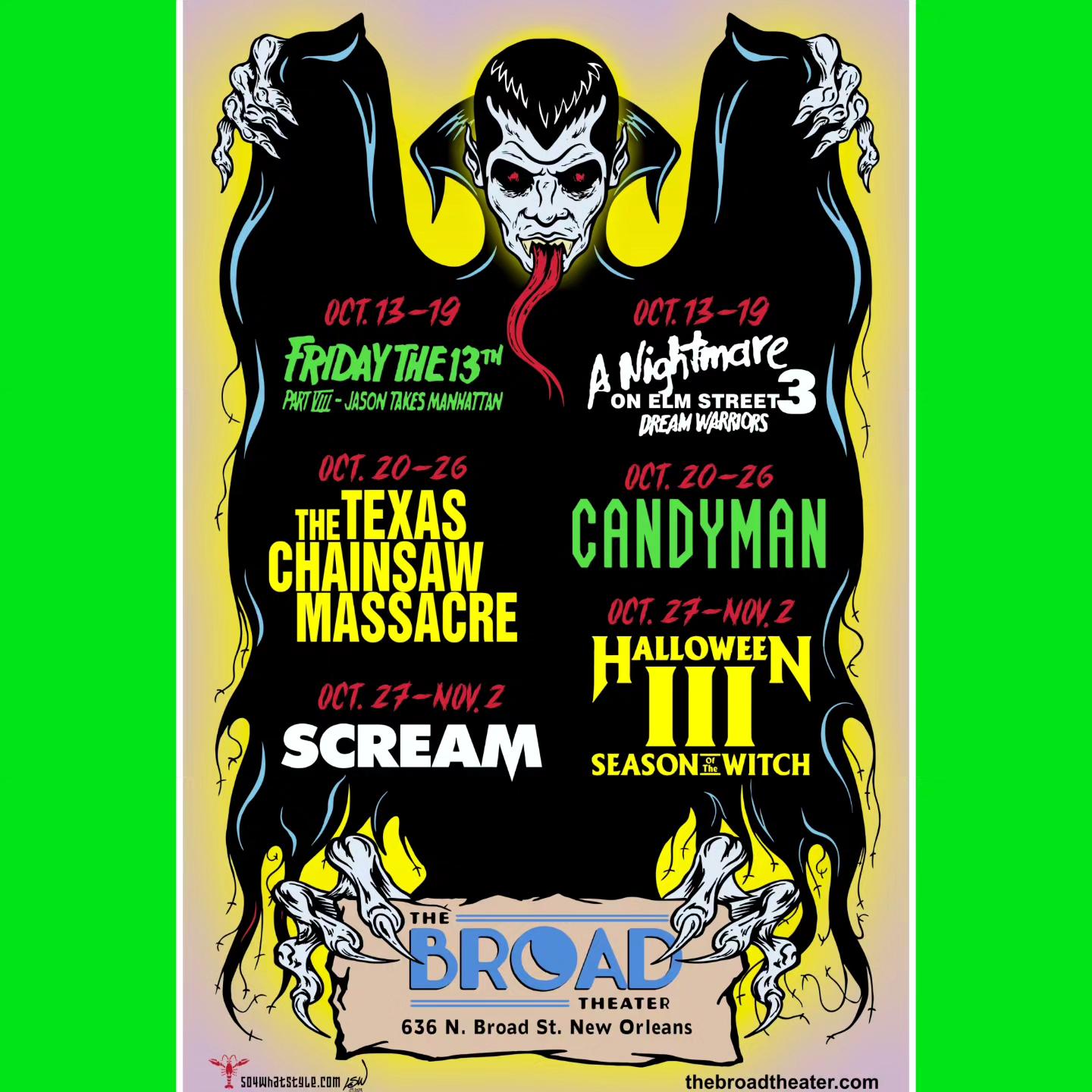
The Nightmares on Broad Street

The early-Fall lull between the Summer Blockbuster schlock dump and Awards Season prestige rollouts is always somewhat of a cinematic dead zone, but this year’s has been especially harsh.  The ongoing SAG/AFTRA strikes have scared major studios into delaying some of their biggest Fall releases for fear that their marketing would fail without the star power of a Zendaya or a Timmy Chalamet doing traditional promo, leaving very little of note on the new release calendar (until the Studios cave on those actors’ reasonable demands for fair compensation).  I’m sure it’s been a strain on movie theaters in the meantime, and I hope that they squirrelled away enough of that sweet Barbenheimer money this summer to survive the drought.  Speaking selfishly, though, it’s been awesome for me as a regular moviegoer.  Stumbling into this new-release wasteland during Halloween Season inspired local indie theaters to get creative in their respective repertory programming, resulting in what has got to be the greatest month of local film listings I can remember in my lifetime (with the caveat that I grew up in the era when suburban AMC multiplexes strangled the life out of what used to be a much more robust New Orleans indie cinema scene).  I spent most of October bouncing and forth between The Broad and The Prytania on the same #9 Broad bus line, frantically catching as many never-seen-on-the-big-screen horror titles as I could while the getting was good.  And there were still plenty more I missed that I would’ve loved to see properly projected, including the early Universal Horror all-timer The Black Cat.  What a time to be unalive!

If I were to parse out the two distinct flavors of these theaters’ dueling Spooktober line-ups, I’d say The Prytania offered an older, dustier variety of venerated genre classics while The Broad offered slightly warped cult favorites of the video store era.  I personally trekked out to The Prytania to see odds-and-ends obscurities I’d never seen before at all, let alone on the big screen (Dracula’s Daughter, Bell, Book and Candle, The Creeping Flesh), but they also programmed a long list of definitive Hall of Fame horror classics that should be checked off of any genre fan’s personal watchlist (Don’t Look Now, Psycho, The Wicker Man, The Shining, The Exorcist, etc.).  Meanwhile, The Broad’s lineup made a few more surprising, left-of-field choices, mostly in straying from the classics to instead screen their most chaotic, divisive sequels.  While The Prytania screened the John Carpenter slasher-definer Halloween, The Broad screened its Michael Meyersless sequel Halloween III: Season of the Witch.  While The Prytania screened fellow slasher-definer Friday the 13th on Friday the 13th, The Broad screened Friday the 13th, Part VIII: Jason Takes Manhattan, its most over-complained-about sequel.  The Prytania’s schedule was so plentiful with exciting horror titles this October that I hardly had time to watch movies anywhere else, but I pushed myself to catch the most esoteric selections in the “Nightmares on Broad Street” program anyway, just to support the iconoclasm, as detailed below.  And while I’m comparing the two theaters’ programs here, I should note that the one film they both played last month was Wes Craven’s teen meta-slasher Scream, which I suppose makes it their consensus pick for the greatest horror film of all time.

A Nightmare on Elm Street 3: Dream Warriors (1987)

The most rewarding trip I had to The Broad this October was to revisit Dream Warriors, a movie I mostly remember from late-night cable broadcasts and oft-repeated Blockbuster VHS rentals.  The film marks Heather Langenkamps’s return (and shockingly morbid departure) as the series’ Final Girl figurehead, now a young medical student researching violent sleep disorders in order to help suffering teens survive nightly dreamworld visits from Freddy Kreuger.  The film’s limited setting in a mental hospital narrows its focus to a small group of traumatized teen insomniacs and their befuddled doctors who can’t quite figure out how they all suffer from the same group delusion that causes them to self-harm; spoiler: it’s because Freddy is real.  Dream Warriors has long been a favorite of mine in the series due to the novelty of its imaginative kill scenes, which include Freddy puppeteering one of his victims using their exposed veins as marionette strings and Freddy transforming his finger-knives into hypodermic needles to feed the hungry mouths of another victims’ pulsating track marks.  It’s pretty fucked up, especially since it’s combined with Freddy’s early stirrings as a stand-up comedian – crushing one victim’s head with a television while quipping “Welcome to primetime!,” declaring another victim “tongue-tied” after literally tying them to a bedframe with his detachable tongue, and punctuating every misogynist kill with the punchline “Bitch!”.

What will always stick with me about Dream Warriors now, though, is that it’s the only Nightmare on Elm Street movie that has managed to make me cry.  Maybe I’m getting too soft in my old age, or maybe it was just the theatrical atmosphere replacing the film’s usual brewskies-on-the-couch presentation, but I got unexpectedly emotional watching these kids get disbelieved and blamed for their own illness for so long before finding unexpected strength in solidarity.  Every authority-figure adult in their lives is dismissive of their nightly suffering except the one who happened to go through their exact supernatural torture in her own youth, and then she teaches them how to fight against their isolating threats as a collective group through lucid dreaming.  It’s oddly sweet, even as it is hideously gruesome.  It’s probably no coincidence that the three best-remembered Elm Street movies are the ones Wes Craven had a direct creative hand in—the original, Dream Warriors, and New Nightmare—and, while I might personally prefer New Nightmare in that trio, they’re certainly all worthy of standalone repertory programming.  Not many theaters would take a chance on the sequels outside a marathon context, though, so Dream Warriors immediately registered as mandatory viewing, even in such a crowded month.

Friday the 13th Part VIII: Jason Takes Manhattan (1989)

Speaking of slasher sequels no one would usually take a chance on, holy shit.  Dream Warriors has plenty of long-running goodwill among horror addicts as one of the best of its franchise, but Jason Takes Manhattan has a long-running reputation of is own as one of its franchise’s worst.  Wrongly.  The standard-issue complaint about this much-mocked slasher sequel is that it’s flagrantly mistitled, promising that Jason Voorhees will take a grand budget-burning tour of New York City, when in reality he spends most of the runtime killing teens on a boat trip to the city.  Given that marketing department disappointment, I wish the film had simply been retitled Jason Takes a Cruise to calm the horror nerds’ nerves.  Complaining about the locale of Jason’s tireless teen slayings in this outing three decades after the first-weekend jeers is idiotically shortsighted & petty, since Jason Takes Manhattan is scene-to-scene the most memorably entertaining entry in its franchise, give or take Jason X (which is mostly set on a ship of sorts itself).  En route to Manhattan, Jason punishes high school seniors for celebrating graduation with the old-fashioned teen sex, drugs, and rock ‘n’ roll that he loathes so deeply: filming amateur rock videos in the engine room, snorting coke off mirrors in the supply closet, and seducing the uptight principal to get out of completing their science fair projects.  It’s a random assemblage of quirky slasher-teen behavior that even on land would be more entertaining than the snoozy cabin-in-the-woods doldrums of earlier Friday the 13th sequels, and then the Manhattan-themed rampage promised in the title is delivered as a sweet novelty dessert.

If anything, there’s something immensely satisfying about the way Jason’s whirlwind Manhattan tourism is delayed for a condensed, climactic payoff instead of being drawn out into urban slasher tedium.  An opening credits sequence details the grimy back-alleys of 1980s NYC, particularly focusing on a barrel of toxic sludge that serves as the bathtub for a gigantic rat.  We do not return to that alley until the third act, when Jason drowns the film’s most detestable character headfirst in that exact barrel, the rat now dead beside him to emphasize just how gross the sludge truly is.  There’s also some great metaphysical character at work here as well, where Jason now appears to be made entirely of toxic sludge himself, having been submerged in the murky waters of Crystal Lake for so long that he’s essentially a hulking collection of sentient goo.  His younger, drowned self appears to the film’s Final Girl in frequent, psychedelic hallucinations during the boat trip to Manhattan – underlining the killer’s supernatural constitution, connecting his qualities as an aquatic zombie to the waters that connect Crystal Lake to the Hudson Bay and, frankly, killing time between his actual kills.  Mostly, though, his gooey, goopy body is just an extension of the way the movie associates New York City with sludge & grime, painting it as a landscape made entirely of rats, rape, street punks, and shared hypodermics. In a way, you get a little taste of Manhattan on the ride to its shores in Jason himself.  More importantly, it’s one of the precious few entries in his franchise where he isn’t a total bore.  Too bad so few people get past the misleading title to see that; it was the least well-attended horror screening I saw all month.

Opera (1987)

Now here’s where things get interesting.  The Broad had already filled its schedule with classic horror films at the start of the month, and then Taylor Swift dropped a rushed-to-market concert film that cleared even more room on local marquees, since film studios were scared to compete with the most famous woman alive.  I’ve never been a bigger Swiftie.  Because Swift’s Eras Tour cleared the weekly release schedule, The Broad added three additional classic horrors to its line-up, all digital restorations of vintage gialli by Dario Argento.  And so, I got to see my personal favorite Argento film on the big screen with my friends instead of the way I’ve watched it previously: alone as a fuzzy YouTube rip.  Like with my appreciation for Jason Takes Manhattan, Opera is far from the wider consensus pick for Argento’s best; I was genuinely shocked to see it theatrically listed alongside his better respected works Deep Red & The Bird with the Crystal Plumage on The Broad’s marquee.  At this point in the month, it was starting to feel like someone was programming a mini horror festival just for me, and it was delightful to see plenty likeminded freaks in the audience instead of the empty seats I was met with at the screening of my favorite Friday the 13th.

Opera finds Argento working in his Inferno mode, putting far more effort into crafting individual images than weaving them into a cohesive story.  After being hired to direct a real-life opera of Macbeth and abandoning the project before production, Argento salvaged his scrapbook of ideas for its staging in this loose mystery crime thriller about a gloved killer’s obsession with an opera singer.  The killer’s mechanism for torturing his muse is tying her up with pins pointed at her open eyelids so she cannot look away from his violent slayings of her friends, lovers, and collaborators.  It’s a double-contrivance of Hitchcockian voyeurism, where the killer obsessively watches the singer from the anonymous crowds of her opera house and, in turn, makes her watch him perform his art backstage.  It’s also just an excuse for Argento to indulge in a glorious clash of high & low sensibilities, alternating between operatic vocal performances in the theatre and thrash-metal slashings on the streets.  Opera might feature his most overactive, over-stylized camerawork to date, too, most notably in scenes where the camera adopts the POV of the trained ravens on his Macbeth set to directly attack his own audience in murderous swoops & dives.  Opera may not be as beautiful as Suspriria, nor as horrifying as Tenebrae, but it’s Argento’s mostly wildly impulsive vision – both his most invigorating and his most incompressible.  I loved seeing it get the proper theatrical setting it deserves.

Halloween III: Season of the Witch (1982)

YWhile there may still be some novelty in exalting Opera & Jason Takes Manhattan as the top of their respective classes, I’d say Halloween III: Season of the Witch has been thoroughly reclaimed in the modern discourse to the point where calling it The Best Halloween Movie is almost an online Film Bro cliche.  Hell, that thought even occurred to me back when we covered it on the podcast in 2016, when I called it the best Halloween movie.  There’s some necessary semantic clarification to make there, though, because I’m not only saying that its infamous Michael Meyersless deviation from the John Carpenter slasher franchise makes it the most interesting movie of its series.  I’m saying that it’s the best horror movie in any context that’s specifically about Halloween as a holiday, from the roots of its pagan Samhain traditions to its modern Trick or Treat rituals in the American suburbs.  The only films I skipped on the Nightmare on Broad Street roster were the widely beloved horror classics The Texas Chainsaw Massacre, Candyman, and Scream, and I believe the horror nerd community has gotten over Season of the Witch‘s disregard for Michael Meyers slashings well enough that it now registers among that verified pantheon of seasonal greats (in a way they still haven’t gotten over the title of Jason Takes Manhattan).  The reason I didn’t skip Season of the Witch, though, is that The Broad happened to screen it on Halloween Night, and I couldn’t fathom a better way to cap off this exquisite month of local repertory moviegoing. It was a hoot, and I’m already excited to see what they pull out of the haunted vault next year.

-Brandon Ledet

The Chucky Movies, Rated and Ranked

Child’s Play 2 (1990)

My favorite of the original Child’s Play trilogy, and thus my favorite Chucky movie overall. I love the way it trades in the grimy cruelty of the original for the visual sensibilities of a children’s film, from its exaggerated cartoon framing to its primary color palette to its bookend trips to the toy factory. Speaking of which, the climactic spectacle on the factory floor is some A+ mayhem, really leaning into the novelty of killer-doll gore at its purest. It’s one of those R-rated horrors that feels like it was specifically made for an audience of children sneaking the TV remote past their sleeping parents.

Child’s Play (1988)

The original Child’s Play hits all the exact story beats you’d expect from its Killer Doll: The Movie premise, but its in-the-moment execution is often exquisite.  The animatronic puppetry is mind-boggling, the patter of little doll feet in the Evil Dead POV shots is somehow genuinely chilling, and the gradual transformation of Chucky’s head from generic My Buddy Doll knockoff to Baby Brad Dourif really sells the dark Movie Magic of it all.  It’s also really funny to imagine the excruciating boredom a serial strangler would feel having to hang out with the world’s sweetest child until it’s time to smite his enemies; not to mention the frustration of having little plastic hands you can’t even properly wrap around a throat – horrifying.

Child’s Play (2019)

An in-name-only “remake” that exploits the Chucky name to make its own evil-doll horror comedy for the A.I. era, functioning more as a prototype for M3GAN than a direct mutation of the 1988 original. While a drastic deviation from the Original Flavor™ Child’s Play in terms of plot & tone, though, it does ultimately amount to a similar effect. It plays like the exact kind of nasty, ludicrous horror flicks kids fall in love with when they happen to catch them at too young of an age on cable. It’s too violent for children but far too silly for adults, the exact formula that made early Child’s Play movies cult classics in the first place.

Bride of Chucky (1998)

Chucky is resurrected for the post-Scream era, complete with a nü-metal soundtrack, mall goth costuming, and postmodern references to competing horror villains like Freddy, Jason, Michael, and Pinhead. Thankfully, this comedic rebrand also pairs him with a totally committed Jennifer Tilly, who counterbalances the killer’s trademark misogyny as a bimbo-dominatrix-turned-fellow-doll who gleefully pushes all his psychosexual buttons just to watch him squirm. It’s not all that tense or upsetting as a horror film, but it’s highly amusing as a “The straights are not okay” anti-romcom, and it’s fun to finally see Chucky mastermind Don Mancini queer up the franchise that pays his bills.

Seed of Chucky (2004)

Don Mancini’s New Nightmare, riding the final ripples of the post-Scream meta horror trend as far as it had left to go (not very). It’s a mixed bag from start to end, but enough of the jokes land and the Glen-Or-Glenda doll is a novel enough intrusion for it to mostly make up for the eyerolls. Also very cute to see John Waters nerding out as an obvious fan as if he won a “Be in a Chucky movie!” contest, even if he just missed the series’ glory days

Child’s Play 3 (1991)

Things would get worse down the line, but this has always been my least favorite of the original Chucky trio. It’s fun to see Chucky fully come into his own as a mainstay slasher villain, since this is late enough in the series for him to start quipping his way through every kill with catchphrases & cheap one-liners. Having to spend even 90 breezy minutes in its drab military school setting is a chore, though, and I always feel like I’m being punished alongside Andy for crimes I didn’t commit. That boredom is rewarded with a last-minute trip to an amusement park, but the killer finale makes me slightly resentful that we don’t spend the whole movie there.

Curse of Chucky (2013)

Considering how much flak the 2019 Child’s Play remake got for straying from Mancini’s original vision, it’s incredible that Mancini had made his own in-house, in-name-only Chucky knockoff just a few years earlier. In this case, Chucky’s more of a haunted house catalyst than of an A.I. cautionary tale, so he’s more Annabelle than M3GAN. Unlike Annabelle, though, this evil doll actually moves; his kills are brutal enough to make up for a lot of the usual trappings of a purposeless, tropey reboot.

Cult of Chucky (2017)

With Curse of Chucky, it felt like Don Mancini wanted to make a generic haunted house movie and the only way to land funding was to put a Chucky in it.  Here, he does the same with the spooky mental asylum genre, except he puts many Chuckies in it.  It’s the cheapest and least substantial of the bunch, but the gore gags are gnarly enough to make it worthwhile, and it’s delightful to see how convoluted the series lore has gotten to keep the story going.  This has to be the all-time silliest ten hours of prerequisite homework to fully appreciate a TV show in the history of the medium, but if you’ve made it this far, you’re doomed to keep tuning in.

-Brandon Ledet

Dracula’s Children

Like all corners of the creative arts, Universal Picture’s classic horror period was overrun with nepo babies.  Carl Laemmle, Jr. kicked off the studio’s Famous Monsters brand by producing 1931’s Dracula after Carl Laemmle, Sr. passed down his studio-head executive position to his son instead of a more qualified protégée.  Lon Chaney, Jr. changed his name from Creighton Chaney to cash in on the name recognition of his early-horror legend father, making him a more credible, marketable Wolf Man.  Then, of course, there’s the case of Dracula’s children, who waltzed into power in Universal’s most prestigious sequels after their father’s untimely second death at the end of the first film in their franchise.  While The Wolf Man fathered no cubs to take over his sequels, and Frankenstein’s Monster only made it thirty seconds into his own marriage before burning down the lab, Dracula’s progeny did a good job making the most of their family name.  The Dracula kids don’t appear to have met or crossed paths, but their polygamous father did have multiple wives in the first film, so I suppose that doesn’t undermine the series’ narrative continuity.

Much like the goofier Frankenstein sequels from this early Universal period, 1936’s Dracula’s Daughter is an absurdly direct follow-up to the Tod Browning original.  The film opens with Van Helsing being arrested for Dracula’s murder at the scene of the crime, and then spending the rest of the film convincing his jailers that actual, real-life vampires are afoot.  Dracula’s immediate replacement is his angsty goth-girl daughter, who is reluctant to continue the family business of draining innocent civilians of their blood despite it being the only thing she’s trained to do.  She’s rebelled by moving to the big city, where she stalks the streets as a bisexual vamp, picking up hungry artists’ models and lustful playboys to drain back at her spacious parlor.  Foretelling a lot of the later Famous Monster sequels, she feels incredibly guilty about this blood-addiction vice and spends most of the film seeking a medical cure for the family legacy that has shunned her from polite society & daylight – ultimately to no avail.  Inevitably, like all nepo babies, she ends up not being able to strike it out on her own after all and moves back to the family castle in Transylvania for some super traditional Dracula kills, meeting the same tragic end as her father.

Like the direct sequel to James Whale’s original Frankenstein movie, Dracula’s Daughter has earned more critical respect in recent decades than the film that precedes it.  Its reputation has largely risen due to the sexual transgressions of its lesbian seduction scene, in which the titular vampire convinces a young woman to expose her bare neck for the sucking by telling her she’s going to pose for a nude portrait.  Likewise, Bride of Frankenstein‘s gender politics have drawn a lot of attention with modern viewers for the concluding scene in which the titular monster takes one look at her assigned undead groom and decides she’d rather be dead (again) than mate with her “man.”  Of the two films, Bride of Frankenstein is the better direct sequel overall, since Whale was given unprecedented creative freedom to play up the stranger, campier elements of his original text in an anything-goes horror comedy free-for-all that doesn’t even bother to deliver on its central premise until the final three minutes of runtime.  By contrast, Dracula’s Daughter has the generosity of affording its titular villain plenty screentime & pathos, which is invaluable in the Boys Club of Universal’s Famous Monsters.  Like the Monster’s bride, she effortlessly, tragically cool, so it’s nice that we actually get to spend time with her beyond a few quick frames of celluloid.

While Dracula’s Daughter exemplifies the Famous Monsters sequels’ penchant for direct, narrative continuations set seconds after their preceding films’ endings, 1943’s Son of Dracula exemplifies their penchant for wildly recasting the central villains from film to film.  The most hilarious example I’ve seen is Bela Lugosi’s miscasting as the Monster in Frankenstein Meets The Wolf Man, a performance so laughably unconvincing that studio executives decided to remove his heavily accented dialogue from the final cut, fearing audience mockery.  Lon “Wolf Man” Chaney, Jr. made more visual sense as the Monster in the previous picture, Son of Frankenstein, but could not be tasked with sitting in the makeup chair for two separate monster performances in the same picture (not to mention the narrative contrivance of Lugosi/Igor’s brain being transplanted to the Monster’s body at the end of Son of Frankenstein).  Appropriately enough, that film was made the same year Chaney got his own laughably bad Famous Monster miscasting as the mysterious “Count Aculard” in 1943’s Son of Dracula.  The reason Chaney works so well in his tyepcast roles as The Wolf Man, Frankenstein’s Monster, and Lennie from Of Mice and Men is that he looks like a sweet, lumbering oaf who doesn’t know his own strength.  That image doesn’t translate especially well to playing a debonaire European vampire who seduces women to their doom.

Despite Count Aculard’s ridiculous appearance and name (which registers among the all-time goofiest horror pseudonyms, like Dr. Acula in Night of the Ghouls, Jack Rippner in Red Eye, and Louis Cyphre in Angel Heart), Son of Dracula is a surprisingly solid supernatural melodrama.  Unlike his rebellious daughter, Dracula’s son has enthusiastically taken to the family business of seducing young women to death, moving to a Southern plantation to hypnotize & marry its recent heiress.  Dracula’s daughter-in-law is a bit of a gloomy goth herself, and she attempts to manipulate the power of the Dracula dynasty for her own wicked profits, but the inevitable tragedy of the undead couple’s Southern Gothic surroundings makes a happy ending impossible.  For his part, Count Aculard adjusts to the Southern atmosphere incredibly well, literally becoming a part of it by materializing as swamp gas in his nightly rises from the coffin.  The movie carries over a lot of classic spooky set dressing of the original Dracula film despite this new locale, including a return to the flapping rubber bats that were missing from Dracula’s Daughter.  Still, it’s visually accomplished in continually surprising ways, including an early version of the double-dolly shots from Spike Lee’s playbook as Count Aculard glides over the marshes to drain his victims.

Pumping out cheap-o sequels to Universal’s most successful horror films was obviously more about doing great business than it was about making great art.  Through the tougher stretches of The Great Depression & WWII, the Famous Monsters that made Universal a major player in the first place were a near bottomless well for immediate cashflow.  Frankenstein & The Wolf Man got stuck with the goofiest, trashiest end of that rushed-to-market schlock production, and by the time their many crossover sequels brought an off-brand version of Dracula into the fold (in John Carradine), the character was so far removed from Bela Lugosi’s performance in the original that it could do no real damage to the Dracula brand.  Meanwhile, Dracula’s more direct sequels about his undead children are both very stately, handsome productions that hold up on their own among the best of Universal’s early horror run.  Dracula’s Daughter is certainly the cooler of the pair and has rightfully been reappraised as a great work by modern critics.  Son of Dracula would likely earn its own reappraisal too, if it weren’t for the goofy miscasting of Lon Chaney, Jr. as the titular vampire.  Unsurprisingly, nepotism is a double-edged sword, one that can open opportunities you’re not always the best fit for.

-Brandon Ledet

Halloween Streaming Recommendations 2023

Halloween is rapidly approaching, which means many cinephiles & genre nerds out there are currently planning to cram in as many scary movies as we can over the next month. In that spirit, here’s a horror movie recommendation for every day in October from the Swampflix crew. Each title was positively reviewed on the blog or podcast in the past year and is currently available on a substantial streaming service. Hopefully this helps anyone looking to add some titles to their annual horror binge. Happy hauntings!

Oct 1: Let’s Scare Jessica to Death (1971)

“Sunshine, wine, swimming, antiquing, ambient acoustic strumming … If it weren’t for all of the violent hallucinations & vampiric ghouls this would be a pleasant little getaway” Currently streaming on Paramount+, for free (with a library card) on Hoopla, and for free (with ads) on PlutoTV.

Oct 2: Calvaire (2004)

“I braced myself for it to be far more needlessly vicious than it was, given the New French Extremity’s fetish for grisly details.  Calvaire does a good job of implying instead of dwelling and, more importantly, of cutting its unbearable tension with gallows humor so it’s not all misery & pain.  Part of my amusement might have been enhanced by the two main characters being assigned names I associate with comedy: Marc Stevens (who shares a name with John Early’s grifter villain on Los Espookys) and Paul Bartel (who shares a name with one of the greatest comedic directors to ever do it).  Regardless, director Fabrice du Welz also amuses himself by framing this grim & grueling torture session as ‘the best Christmas ever’ in its sicko villain’s mind, contrasting the hyperviolent hostage crisis the audience is watching with the delusional family reunion of his imagination in a bleakly hilarious clash of realities.  I don’t mean to imply that Calvaire‘s not also a nonstop misery parade, though.  It’s that too.” Currently streaming on Shudder.

Oct 3: Candy Land (2023)

“A very cool, loose hangout dramedy about truck stop sex workers that gradually turns into a rigidly formulaic grindhouse slasher to pay the bills. Not everyone gets to be Sean Baker; sometimes you gotta cosplay as Rob Zombie to land your funding.” Currently streaming for free (with a library card) on Hoopla and for free (with ads) on Tubi.

Oct 4: There’s Something Wrong with the Children (2023)

“What I mean when I say ‘kids are scary’ is that being around other people’s children naturally makes people anxious and nervous, or at least that’s my experience. What if they trip and fall while running past my table at a cafe? Do I suddenly become responsible for their wellbeing? What if the parent thinks I tripped them? What if the kid thinks I tripped them and blames me? Kids are tiny, vulnerable people, but they also have a capability for pure, unfiltered malice that can be creepy as well, and since they’re only just learning how to regulate their emotions and communicate their thoughts, interaction with them can be a minefield. There’s Something Wrong with the Children is probably the first film that I’ve ever seen that captures that particular unease.” Currently streaming on Amazon Prime and MGM+.

Oct 5: The Peanut Butter Solution (1985)

“In which a pair of drunkard ghosts coach a child who’s been scared bald on how to grow his hair back, only for their advice to work way too well for his own good. Little-kid nightmare logic that you can only find in German fairy tales and Canadian B-movies, pinpointing the middle ground between Hansel & Gretel and The Pit. Wonderfully deranged.” Currently streaming for free (with ads) on Tubi.

Oct 6: Day of the Animals (1977)

“I was starving for a genuinely over-the-top animal attack movie after being let down by Cocaine Bear, and this hit the spot. It’s basically the same faintly sketched-out story, but its tactility & sincerity go a long way in making its attack scenes much worthier of the ambling journey. There’s something especially unnerving about the way the animals appear to leap out of stock footage, as if they’re crossing a forbidden barrier into reality to tear into the character actors (and, more often, the stunt doubles). Incredible that it wasn’t directed by Larry Cohen.” Currently streaming on Shudder and for free (with ads) on Tubi.

Oct 7: The Outwaters (2023)

“As trippy as it can be in its Skinamarinkian disorientation, it’s anchored to a concise, recognizable premise that could neatly be categorized as The Blair Witch Project Part IV: Blair Witch Goes to Hanging Rock.  It strikes a nice balance between the slow-moving quiet of its bedroom art brethren and mainstream horror’s return to big, bold, bloody haunted house scares.  Maybe that makes it a less artistically daring film than World’s Fair or Skinamarink, but it also makes it a more overtly entertaining one.”. Currently streaming on Screambox, for free (with a library card) on Hoopla, and for free (with ads) on Tubi.

Oct 8: Bones and All (2022)

“Seeing a lot of grossed-out responses from unsuspecting audiences wishing this was more of a straightforward road trip love story. I’m coming from the opposite direction, wishing it weren’t so tenderly underplayed & remorseful about its hunger pangs for gore. It’s kinda nice to have something that drifts between those two magnetic pulls, though, especially since it’s so unusual to see a Near Dark-style genre blender positioned as a prestigious Awards Contender.” Currently streaming on Amazon Prime and MGM+.

Oct 9: Lost Highway (1997)

“Feels like Lynch twisting himself in knots to make the James from Twin Peaks archetype genuinely compelling … and he eventually gets there. I’ve been thinking a lot lately about how noir antiheroes are mostly just sad sack losers who make their own shit luck by feeling sorry for themselves, and this one turns their mopey interchangeability into a kind of existential horror.” Currently streaming on The Criterion Channel.

Oct 10: Hideaway (1995)

“In The Lawnmower Man, director Brett Leonard justifies testing the limitations of stage-of-the-art 90s CG animation by inventing convoluted science lab experiments that create a VR cyberworld.  Here, he takes a bold step forward by suggesting that exact CG cyberworld is where our souls go when our bodies die, treating his Windows 95 screensaver graphics as if they were the most typical, durable approach to visual effects available.  Stunning, even if extraordinarily goofy.” Currently streaming for free (with ads) on Tubi.

Oct 11: Antiviral (2012)

“Brandon Cronenberg’s deeply unnerving debut is a sickly TMZ geek show. I need to stop hanging out online, because I keep reading flippant dismissals about how unimpressive he is as body horror’s premier nepo baby, then still really enjoying each of his movies when I get to see them for myself.” Currently streaming for free (with ads) on Tubi.

Oct 12: Scalpel (1977)

“In which a madman plastic surgeon transforms an injured go-to dancer into his missing daughter’s doppelganger, in order to claim her inheritance in her absence. Technically, this is a PG-rated comedy, but it feels like it should have been bumped to the top of the video nasties list. Delicious, deep-fried Southern sleaze.” Currently streaming on Screambox.

Oct 13: Flesh for Frankenstein (1974)

“Hideous gore, gratuitous male & female nudity, and a babyfaced Udo Kier soaring miles over the top as a camped-up villainous lead. What more could you want?” Currently streaming on The Criterion Channel and AMC+.

Oct 14: The House that Dripped Blood (1971)

“Like all other Amicus anthology horrors I’ve seen, this is consistently entertaining throughout but never exactly surprising nor even thrilling.  It’s horror comfort viewing, best enjoyed under a blanket with a humongous mug of tea.” Currently streaming on Screambox, for free (with a library card) on Kanopy, and for free (with ads) on Tubi.

Oct 15: The Company of Wolves (1984)

“The greatest British portmanteau horror of all time, trading in the rigid stage-play traditionalism of classic Amicus anthologies for a more fluid, music video era dream logic.” Currently streaming on Shudder and for free (with a library card) on Kanopy.

Oct 16: Enys Men (2023)

“A pure psychedelic meltdown of id at the bottom of a deep well of communal grief. Restructures the seaside ghost story of Carpenter’s The Fog through the methodical unraveling of Akerman’s Jeanne Dielman, dredging up something that’s at once eerily familiar & wholly unique.” Currently streaming on Hulu.

Oct 17: Huesera: The Bone Woman (2023)

“A pensive motherhood horror about the pain of trading in youthful passion & rebellion for familial comfort & ease. Lots of thematic overlap with The Five Devils in that way, even if they’re nothing alike aesthetically. Besides landing every one of its scares and dramatic beats, this just has some truly world-class hand acting. Cracking knuckles and spatchcocking chickens will never feel the same again.” Currently streaming on Shudder and AMC+.

Oct 18: The Stepfather (1987)

“Without question, the greatest evil-stepparent horror of all time, a superlative indicated by its definitive title.  Terry O’Quinn is the stepfather, a sociopathic serial killer who cycles through families like he’s updating his wardrobe, killing the old batch in cold blood instead of dropping it off at Goodwill.  O’Quinn is an explosive volcano of white-man rage, barely suppressing his violent outbursts under a thin facade of Ward Cleaver, Father Knows Best-style suburban Family Values.  It is one of the all-time great villain performances, regardless of genre.  There was already a bland, forgettable remake in the aughts, but the only other actor who could maybe pull this performance off is Will Forte, whose comedic version of bottled-up fury is a direct echo of the terror in O’Quinn’s piercing, hateful eyes.” Currently streaming on Peacock, Screambox, for free (with ads) on Tubi, and for free (with a librarby card) on Kanopy & Hoopla.

Oct 19: The Plumber (1979)

“A tense domestic thriller about a pushy, macho plumber who walks all over a married couple of uptight academics; directed for television by a young Peter Weir.  Cuts to the core of liberal urbanites’ fear of the working-class brutes they invite into their home for routine repairs; a home invasion thriller where the menace is politely welcomed inside.” Currently streaming on The Criterion Channel.

Oct 20: Massacre at Central High (1976)

“As absurd as this prototypical slasher can be tonally, it feels true to how I remember high school: a conformity cult led by fascist jocks, lording over poorly socialized losers who would’ve been just as awful if we were given the opportunity. Our jocks never offered to take us hang-gliding, though, so now I feel like I missed out on something.” Currently streaming on The Criterion Channel.

Oct 21: Scream VI (2023)

“A strong sequel in a very strong franchise, possibly the horror franchise with the best hit to miss ration (5:1, in my book, and even the dud has Parker Posey to liven it up, so that’s something). Even though there are moments that are questionable (some of the people we see attacked should not have survived what happened to them), there are more than enough great sequences, character beats, and thrills to make up for them.” Currently streaming on Paramount+.

Oct 22: M3GAN (2023)

“It wasn’t until after the viewing that I realized the director, Gerard Johnstone, was also the man behind Housebound, a film we loved so much that we made it into content for Swampflix twice: first with a very positive 2015 review and again five years later as the topic on one of our earliest episodes of the Lagniappe podcast. That actually explains the comedic sensibility; it’s not omnipresent, but it’s almost funnier that the jokes are paced with some distance between them, allowing them to break the tension when they reappear, and the emotional whiplash of it all is part of the fun. ” Currently streaming on Amazon Prime.

Oct 23: Evilspeak (1981)

“A young, baby-faced Clint Howard stars as a military academy misfit who summons Satan to smite his bullies using the Latin translation software on the school computer.  It’s a dual-novelty horror that cashes in on the personal desktop computer & Satanic Panic trends of its era, combining badass practical gore spectacles with proto-Lawnmower Man computer graphics.  It isn’t long before the prematurely bald Baby Clint graduates from translating Latin phrases from a Satanic priest’s diary to asking the computer dangerous questions like ‘“’What elements do I need for a Black Mass?’”’ and ‘“’What are the keys to Satan’s magic?’”’, stoking parents’ technological and religious fears with full aggression.  And the third-act gore spectacle he unleashes with those questions is gorgeously disgusting.” Currently streaming on Shudder.

Oct 24: Barbarian (2022)

“Some fun, fucked-up Discomfort Horror that Malignantizes the post-torture porn cruelty of titles like Don’t Breathe into something new & exciting.  It also has the best end-credits needle drop since You Were Never Really Here, leaving the audience in a perversely upbeat mood despite the Hell we just squirmed through.” Currently streaming on Hulu and Max.

Oct 25: Skinamarink (2023)

“Simultaneously a familiar experience and an alien one, mixing generic horror tropes with an experimental sensibility – like a Poltergeist remake guided by the spirit of Un Chien Andalou.  It’s the kind of loosely plotted, bad-vibes-only, liminal-space horror that requires the audience to meet it halfway both in emotional impact and in logical interpretation.  In the best-case scenario, audiences will find traces of their own childhood nightmares in its darkened hallways & Lego-piece art instillations.  Personally, I was more hung up on the way it evokes two entirely separate eras of my youth: my alone-time online as a sleep-starved teen and my alone-time in front of cathode TVs as a sleep-starved tyke a decade earlier.” Currently streaming on Hulu and Shudder.

Oct 26: Gaslight (1944)

“Before pressing play I was skeptical this would be enough of a Horror Film to work as proper Halloween season viewing. One of the first shots is a newspaper headline that reads ‘STRANGLER STILL AT LARGE!'” Currently streaming on Amazon Prime and The Criterion Channel.

Oct 27: The Woman in Black (2012)

“Super scary, both as a traditional Gothic ghost story and as a worst-case-scenario vision of Daniel Radcliffe’s career path as a bland leading man instead of an eccentric weirdo millionaire.” Currently streaming on Paramount+ and for free (with a library card) on Hoopla.

Oct 28: House (1986)

“The surprisingly goofy midway point between Poltergeist and Jacob’s Ladder. Can’t quite match the euphoric highs of either comparison, but it’s still a fun dark-ride attraction of its own merit. The rubber-mask monsters are adorably grotesque, and they pop out of the most surprising places.” Currently streaming on Shudder, Amazon Prime, and for free (with ads) on Tubi.

OCT 29: Dr. Giggles (1992)

“A deliciously trashy VHS slasher where every single kill comes with its own punny quip.  You hardly have time to question why they call him Dr. Giggles before he’s performing involuntary open-heart surgery while giggling like a madman and proclaiming ‘”‘Laughter is the best medicine.'”‘ It has no idea how to fill the time between the kill gags, but it really delivers the goods where it counts.” Currently streaming for free (with ads) on Tubi.

Oct 30: The Suckling (1990)

“A kind of anti-choice, pro-environmentalist creature feature where an aborted, toxically mutated fetus gets its revenge on the brothel-clinic that brought it into this sick, sad world.  It’s not a perfect movie but it’s a perfect This Kind Of Movie, delivering everything you could possibly want to see out schlock of its ilk: a wide range of rubber monster puppets, over-the-top character work, stop-motion buffoonery, and multiple opportunities to feel greatly offended while never being able to exactly pinpoint its politics. Wonderfully fucked up stuff.” Currently streaming for free (with ads) on Tubi.

Oct 31: The Beyond (1981)

“I always assumed we didn’t have basements in Louisiana because we’re built on mushy swampland. Turns out it’s because we’re built on seven gateways to Hell. Honestly makes a lot more sense.” Currently streaming on Shudder, Peacock, and for free (with ads) on Tubi.

-The Swampflix Crew

Apocalypse After: Films by Bertrand Mandico (1998 – 2018)

Only two feature films into his career, I’m already comfortable thinking of Bertrand Mandico as my favorite working director, even though only his debut was a total stunner.  Mandico’s The Wild Boys is my favorite film released within my lifetime – a Bidgoodian wet nightmare about gender dysphoria and, ultimately, gender obliteration.  His follow-up, After Blue (Dirty Paradise), is more of a flippant prank, using the same sensory intoxication & erotic menace for a much sillier purpose: worshipping the almighty Kate Bush in the rubble of our fallen civilization.  Although it’s seemingly shot in a muted black & white that sidesteps the cosmic blues & purples that make his other features so vivid & vibrant, I’m dying to see his third feature, Conann, which appears to be a gender-subverted riff on the pulp fantasy character Conan the Barbarian. It’s going to take a while for that latest dispatch from Mandico’s id to reach American screens (it just premiered at Cannes this summer), so I decided to placate my curiosity as best as I could by digging into his back catalog of short films.  Altered Innocence has consistently been Mandico’s home distributor since the company’s inception; it’s even arguable that Mandico’s films have been a brand-defining cornerstone for the Vinegar Syndrome partner label, along with the similar dreamlike genre throwbacks of Knife+Heart director Yann Gonzalez.  Given that close affiliation, their publishing a collection of Mandico’s short films on a single Blu-ray disc, titled Apocalypse After, was a total no-brainer.  Given my own personal obsession with The Wild Boys, the only surprising thing is that I didn’t jump on this disc the second it was released last year.  I guess I needed to get worked up about a new feature from Mandico dangling just outside my reach to seek out his already-available shorts I hadn’t yet seen.  Well, that and if I immediately jumped on every new Altered Innocence release I wanted to see I’d struggle to pay my energy bill, and I wouldn’t be able to watch them anyway.

The titular short on this disc, “Apocalypse After (Ultra Pulpe)”, is a calling-card submersion in the subliminal perversions of cinema, consciously transforming “science fiction” into “science titillation” while shouting in frustration that the images still aren’t erotic enough for the director’s liking.  Longtime Mandico collaborator & muse Elina Löwensohn stars as the director’s avatar, an arthouse pornographer named Joy d’Amato (in cheeky reference to real-life pornographer Joe d’Amato).  Mandico’s films are full of sarcastic allusions to real-life artists he admires in this way: Kate Bush, Henry Darger, Jean Cocteau, Walerian Borowczyk, etc.  Curiously, he has yet to name-drop the three filmmakers he most reminds me of—Kenneth Anger, Guy Maddin, and James Bidgood—likely because their influence is already blatantly apparent in the text.  Joy d’Amato is more Bertrand Mandico than she is Joe d’Amato, though, shooting a live-action version of paperback sci-fi cover art with the same vintage porno sensibility you can find in all of Mandico’s recent work.  In a way, the film shoot setting positions “Apocalypse After” as Mandico’s Knife+Heart (a movie he acted in as a porno cinematographer), but it’s even less of a coherent, linear story and even more of an expression of its director’s fascinations & frustrations with his artform.  Dialogue that declares details of the film shoot “magnificently hideous” or complain, “It’s beautiful, but at the same time I don’t know what he means,” function as meta commentary on the achievements & shortcomings of Mandico’s art.  No dialogue feels more essential to the piece than an actor’s monologue recalling watching forbidden, adult films as a child – compelled & mesmerized by the images on the screen but too young to fully comprehend them.  Mandico has a way of turning pornographic indulgence into transcendent visual art, and even then he directs his avatar in Löwensohn to shout that the images are still not erotic enough.  Nothing ever could be.

The “Apocalypse After” short is a thematically cohesive but logically incoherent collection of all the stylistic flourishes & quirks sketched out in Mandico’s first two features: the plant life molestations of The Wild Boys, the hollow geode-face zombies of After Blue, and the practically achieved glamour that merges their aesthetics – gel lights, rear projections, body glitter, smoke, prosthetic nipples, etc.  The presentation of Mandico’s previous shorts on the Apocalypse After disc is strictly chronological, so you can watch the director arrive at that personal aesthetic over decades of obsessive tinkering.  Over three full hours of his two decades of short-form experiments, Mandico Heads get to watch the filth maestro develop his cosmic visual language in ten preceding works.  In that context, “After Apocalypse” is less of a jumbled collection of Mandico pet obsessions than it is a natural crescendo of a clear pattern in methodology.  His seemingly weird-for-weird’s sake indulgences become more recognizably thoughtful & designed in retrospect, the same way the “Magick Lantern Cycle” packaging of Kenneth Anger’s shorts makes “Lucifer Rising” feel like the most obvious place his art could lead him, not an out-of-nowhere novelty.  The Apocalypse After disc starts with Mandico imitating Jan Švankmajer’s stop-motion nightmares in antiqued sepia tone, then seeking the same ancient artifice in short-form magical realist dramas.  He hits a breakthrough mid-career with the mid-length film “Boro in the Box”, which playfully reimagines filmmaker Walerian Borowczyk’s life in the style of Au Hazard Balthazar (a prototype for the more recent Balthazar riff EO).  By the time Mandico returns to stop-motion in his post-“Boro” short “Living Still Life” (this time animating taxidermized animals), his style is distinctly of his own.  As a result, all of the essential Mandico bangers arrive late on the disc, after he finds his distinct voice as a filmmaker: the Cronenbergian colonoscopy sideshow act “Prehistoric Cabaret,” the fairy tale creature feature “Our Lady of Hormones,” the unlikely Enys Men sister film “Depressive Cop” and, of course, the aforementioned self-portrait in heat “Apocalypse After.”

There are certainly other current filmmakers whose every feature I anticipate with the same gusto as Mandico’s, namely Peter Strickland and Amanda Kramer. None in that unholy trio of perverts gets the critical respect they deserve as playful subverters of the artform.  The academic interest critics used to have in similarly perverse, cerebral genre filmmakers like Cronenberg, Lynch, and Jodorowsky has more recently shifted to formally muted & restrained works of slow cinema auteurs instead.  A lot of the leeway we used to give venerated genre freaks of the past hasn’t trickled down to the unvenerated genre freaks of today, at least not for anyone who hasn’t struck a distribution deal with A24.  Altered Innocence appears to be committed to the cause at least, offering a step-by-step study of Mandico’s work for anyone who cares to learn how he arrived at something as wildly baffling as The Wild Boys.  The only other comparable presentation of a current director’s shorts that I can name is the The Islands of Yann Gonzalez, which I will leave to your imagination what is covered and who handled the distro.

-Brandon Ledet

Casa Azul

I have an ambivalent relationship with my gender identity, which I tend to label with “cis enough” and “cis-by-default” so I don’t have to think about it too hard in concrete terms.  Part of that ambivalence is in figuring out where a mostly-straight male crossdresser fits in the current gender studies zeitgeist, which is righteously (and rightfully) focused on ensuring that trans people have a right to exist in public.  Any personal irresolution I carry around as a man who’s both attracted to women and to wearing “women’s” clothing feels at best secondary to that political activism, especially in recent years when Conservative pundits have turned the basic daily existence of transgender people into an easy Culture War target for fascists & bullies.  My interest in trans narratives in cinema is two-fold, then: admiration for the societal transgression of decidedly rejecting your assigned gender identity and belief in the necessity to reinforce that trans and gender non-conforming people have always been part of the human social fabric.  There have been at least two great recent releases that speak to that dual interest, two documentaries on vintage trans life that allow their subjects to tell their own stories at length without editorial interruption.  And since this is the most I’ve ever overshared in a single paragraph on this blog, I will report that I recently watched them both in a comforting afternoon double feature while recovering from a vasectomy.

The most recent film in this pairing is the new documentary Casa Susanna, which was plucked from its festival run for television & streaming broadcast in PBS’s American Experience series.  The titular Casa Susanna was an American getaway camp for covert crossdressers in the 1950s & 60s, established as a Catskills meeting place for a larger attempt to build “a national sorority of crossdressers” who organized through backpages in the era’s fetish magazines.  Documenting a time when public crossdressing was against the law outside “female impersonator” nightclub performances to entertain the straights, Casa Susanna is a heartfelt tribute to the value of “safe space” havens in a rigidly moralistic world.  Two elder trans women who met at the getaway camp in their youth reunite at the historic site and trade stories with the daughter of an attendee who documented his own time there in a book titled A Year Among the Girls.  The director only intrudes on these oral histories through inclusion of archival footage that establishes the general mood of the era, from anonymous home videos of the scenery to news reels of Christine Jorgensen reluctantly announcing her historic, headline-grabbing sex change.  Mostly, the history of American transgender identity in the era is recounted by two women who lived it, whose full stories are told in long takes with no contextual chyrons or talking-head punditry.  They talk about how some crossdressers (including their younger selves) used the societal isolation & like-minded camaraderie of Casa Susanna as a trial run for full-time public trans identity, while others used it as a temporary break from “playing the game” of straight, cisgender life.  In the film’s most vivid sequences, they narrate a breathtaking slideshow of vintage glamour photos taken at Casa Susanna in its heyday, invaluable evidence of authentic American life that the American majority seeks to extinguish & forget.  It’s a small, intimate film that only covers the personal stories of the few remaining women who were still around to tell them, but it does so with immense care & warmth.

1983’s Vestida de Azul (Dressed in Blue) is a much more substantial, confrontational work.  Restored & re-released this year by MVP queer cinema distributor Altered Innocence, it’s a Spanish documentary about trans sex workers in the country’s post-Franco years.  Those women’s stories are likewise told directly by the subjects in question, but in this case they are supplemented by dramatic re-enactments of their most cinematic anecdotes.  The women meet at an artificially staged Sex and the City-style brunch to gab about the ups & downs of their collective lives as a social class, then are each allowed command of the narrative to invite audiences into their individual worlds.  There’s a consistent class consciousness to their self-advocacy, explaining that they only participate in sex work en masse because no other profession has made room for their public existence, and because they need to eat.  Lines like “Crimes are always committed by the poor” resonate just as sharply and vividly as the women’s stunning early-80s fashion, typified by black-lace lingerie worn directly under a fur coat.  Where Casa Susanna is gentle & warm, Dressed in Blue is aggressively candid, documenting estrogen injections, breast surgery, and sex-trade price negotiations with a confrontationally matter-of-fact candor.  The entire picture is thorny, sexy, and cool – instantly recognizable as a Paris is Burning-level cinematic landmark, except about the art of hooking instead of the art of voguing.   It’s essential viewing for anyone with affection for queer resilience stories or, more generally, for documentary filmmaking as an artform.  You can practically hear a young Pedro Almodóvar frantically scribbling details in his notebook in the background and, as much as I love his early work, there’s something invaluable about directly hearing these women’s stories without the filter of his well-represented perspective.

It’s occurred to me in writing this that I’ve committed the exact mistake I’m praising these two documentaries for avoiding: pointlessly imposing my own voice on these women’s stories.  The impact & importance of Casa Susanna & Vestida de Azul rely on their shared cultural value as oral histories.  The amount of time their subjects are allowed to talk without interruption is remarkable in both cases, even if the earlier film allows room for more traditionally, transcendently cinematic indulgences.  At the same time, their dual effect triggers an unavoidable moment of self-reflection in the audience – both in assessing our own personal relationships with gender and in political rage against the systems that make those relationships so needlessly strained & unnatural.  That’s what I was thinking about while icing my testicles with frozen peas last month, anyway, in an unrelated private struggle with my body.

-Brandon Ledet

Graphic Sex at the Multiplex

And so, with all of the festival buzz surrounding Yorgos Lanthimos’s upcoming vulgar Frankenstein riff Poor Things, we have lived to suffer yet another round of online Sex Scenes Discourse.  It’s only been a month since the young Evangelicals of the American suburbs were traumatized by brief flashes of Florence Pugh’s breasts in Christopher Nolan’s Oppenheimer the last round, and now we’re hearing from international YA fiction nerds who claim that “Most actors and many viewers don’t particularly like or miss [sex scenes in movies].  Only film critics and some directors seem to want them.”  Like everyone else who’s addicted to online outrage bait, I always find myself scrolling through the replies to these Sex Scene diatribes in stunned disbelief of the support they receive, convincing myself that Zoomer prudes are itching to bring back The Hays Code.  Also like everyone else who’s addicted to this monthly ritual, I’d be a lot better off just putting down my phone and watching a dirty movie instead.  It’s worth reminding ourselves that these anti-sex scene freaks don’t speak for an entire generation of moviegoers; they’re isolated cases of puritanical mania, most of whom get their steady stream of chaste content through Disney+ and romance paperbacks written for teens, only to be scandalized by intimate moments of nudity & bodily contact the one or two times a year they accidentally watch a movie for adults.  For the rest of us—audiences who believe sex is a common aspect of human life worth interpreting onscreen—there are still a few cinematic holdouts that haven’t given up the culture war to The Prudes, despite constant online chatter decrying their existence.  The very best way to combat Sex Scene Discourse is to log off and go see a dirty movie in public, the filthier the better, which is exactly what I did the week Poor Things kicked off another round of puriteen grumbling online.  Actually, I saw two.

Because America is a nation founded by Puritans, my best bet finding graphic depictions of sex at my local multiplex is catching up with the few adult dramas that happen to land domestic distribution at international film festivals.  Memphis-born American director Ira Sachs seems to understand this conundrum, which is likely how he ended up making his messy bisexual love triangle drama Passages in France instead of the US.  Here, Passages was threatened with an “NC-17” rating for its frank, onscreen depictions of queer sex, the modern equivalent of an “X.”  In Europe, it’s a standard-issue adult drama, acted out by a small cast of Euro film fest regulars familiar to mildly risqué dramas just like it: Franz Rogowski, Ben Whishaw, and Adèle Exarchopoulos.  Rogowski stars as a temperamental, narcissistic German filmmaker living in Paris with his much stabler, milder-mannered English husband (Whishaw).  At the end of a typically tense film shoot (of a fictional movie also titled Passages), Rogowski feels the communal attention to his control-freak antics & directorial authority plummeting, so he acts out by sleeping with a French woman on the film’s crew (Exarchopoulos), seemingly on a first-time bisexual whim.  Addicted to the thrill of stirring up drama in his marriage and in the romantic life of his new sexual partner, the film follows his desperate, darkly hilarious stunts for attention as he plays his two lovers against each other for his own momentary amusement, until he pushes both relationships past their breaking point, leaving him inevitably, permanently alone.  It’s basically Poly Under Duress: The Movie, as anyone who makes the mistake of finding Rogowski attractive is sucked (literally and figuratively) into his hedonistic little orbit.  There’s nothing especially deep or revelatory about Passages as a character study of a horned-up narcissist, but it is always encouraging to see that someone is still out there making complicated dramas about messy adult relationships, and Sachs goes the extra mile by centering this particular story on The Messiest Bitch in Paris.

Sachs also dared to directly engage with the Sex Scene Discourse in his response to the MPAA’s decision to slap this would-be R-rated drama with a higher, penalizing NC-17 rating – yet another data point in the organization’s long history of homophobia (see also: their egregious R-rating for M Knight Shyamalan’s Knock at the Cabin earlier this year).  The main sticking point with most sex scene haters is that they’re “unnecessary” because they “do not advance the plot.”  Personally, I think anyone who’s watching movies for The Plot above all else are already lost causes and would be better off reading an airport novel than engaging with cinema as an artform, but I appreciate the way Sachs pushes back on this notion anyway.  In Passages, all advances in plot & characterization are achieved through sex scenes.  We learn more about these characters in their private moments of intimacy than we do in their more guarded public lives, and there’s something especially pointed about the way Rogowski’s character deliberately creates drama in the bedroom to make his weekly schedule more interesting now that he doesn’t have a film project to work on.  In explaining his refusal to edit Passages to meet the MPAA’s criteria for an R-rating, Sachs stated, “It is a film that is very open about the place of sexual experience in our lives.  And to shift that now would be to create a very different movie.  To make an interesting sex scene is not easy.  Each of the sex scenes to me is a chapter in the film.  It has a story.  And I wanted each one to have its own relevance and have its own details and be interesting to the audience.  I think making interesting sex scenes is the hardest thing . . . What I tried to track here was not to look at sex, but to look at intimacy, not constructed through editing and avoidance.”  That sounds like an artist who’s committed to the cause, and we’re lucky to have him fighting on the frontlines of the online Sex Scene Wars.

All that said, I don’t know that treating sex as a normal, natural human behavior onscreen is enough anymore.  It might be time to escalate the weaponry of war and make our dirty movies even dirtier, officially adopting a scorched Earth policy.  That’s why it’s always important to go see a John Waters repertory screening whenever it’s offered to you, and I’m fairly sure The Prytania’s recent screening of 1977’s Desperate Living was the first time a Waters film has played here since NOMA’s retrospective of his work in 2017.  It’s been even longer since I watched Desperate Living in particular with a crowd, and it was projected off the same ancient DVD scan of the film both times, well over a decade apart, because there’s no better version available – a damn dirty shame.  Partly a hand-constructed dystopia about a community of crust-punk murderess outcasts and partly a storybook fairytale about a lesbian uprising that topples an unjust monarchy, Desperate Living is my personal favorite John Waters film and, thus, my favorite work of art.  About halfway through this most recent screening, I was thinking that this little D.I.Y. geek show manages to touch on every single cinematic subject I’m passionate about except witchcraft, and then I had the joy of rediscovering Mink Stole cooking up a magic rabies potion in a giant cauldron, completing the full set.  I was also delighted to see more graphic queer sex on the big screen for all the same reasons detailed above, including its unexpected contributions to the almighty Plot.  Yes, Waters includes plenty of his signature pure-shock-value sex & violence in Desperate Living, most notably in scenes where Edith Massey’s evil-queen villain expresses a distinctly Gay Male sexuality purely for the audience’s delight: spanking her army of leather-clad twink underlings, huffing their jock straps, and cheerfully exclaiming “Look at those balls!” at their naked, writhing bodies.  However, there’s also a surprising tenderness in the sex scenes between the various lesbian couples of Mortville, most significantly in how Mink Stole’s relationship with fellow fugitive Jean Hill evolves from employer-employee to partners-in-crime to mutually-betrayed-lovers, all tracked through their onscreen sexual contact.

Waters has also been roped into commenting on the state of Gen-Z puriteens and Sex Scene discourse, because he’s the kind of interview subject that regularly gets roped into commenting on the state of everything.  An interviewer from the Los Angeles Review of Books writes, “From the rosary job in Multiple Maniacs, to Divine playing both participants in a filthy roadside fuck in Female Trouble, to penetration via chicken in Pink Flamingos, Waters’s films are chock-full of sexual debauchery.  I elicit his take on a recent opinion, seemingly held among a younger, online generation that sex scenes in films are unnecessary. Waters scoffs: ‘I haven’t heard that one.  That’s a good one.  Young people don’t want to see sex in movies?  Jesus Christ.”  Honestly, I appreciate that complete dismissal of Sex Scene Discourse as a worthwhile topic of discussion even more so than Sachs’s earnest attempts to combat it through his art.  It’s laughable that an entire generation of young people would be disinterested in sex as a cinematic subject; we just happen to live in a time when that outlier opinion gets amplified online for outrage engagement, making the voice of a few sound like the voice of the many.  I can report from the ground that there were plenty of young people (presumably ones with internet access) present at that recent screening of Desperate Living, and they were hooting & hollering just as loud as the elder perverts in the room, myself included.  There was something righteous & defiant about watching such a filthy movie in public (screened as a weekend kickstarter for this year’s Southern Decadence festivities), as if we were protesting for our Constitutional right to watch graphic sex at the multiplex.  Meanwhile, my mid-afternoon screening of Passages at The Broad that same week was much more subdued, as it’s a movie that treats sex as a normal, healthy aspect of daily life instead of a nuclear weapon to wield against Evangelical suburbanites.

In summary, the answer to the supposed problem of Sex Scene Discourse is the same answer to most problems in the Internet Era: go outside.  It helps to live in a sizeable city with adventurously programmed cinemas like The Prytania and The Broad, of course, but according to the easily spooked adult YA readers of the world, you can’t seem to go see any movie without being accosted with an “unnecessary” sex scene these days, so any theater will do.  And if there is absolutely no public access to adult-targeted movies where you live, it is your solemn duty to invite friends over to watch the filthiest movies you own with popcorn at home.  Having recently invited friends over to watch Rinse Dream’s semi-pornographic take on Dr. Caligari, I can proudly say that I am doing my part.  It is imperative that the puriteens do not win this particular battle in the culture war, even though I’m starting to think there aren’t enough puriteens in the world to register as a genuine threat in the first place.

-Brandon Ledet
Teenage Mutant Ninja Turtle Movies, Rated and Ranked

Teenage Mutant Ninja Turtles (1990)

Just like when I rated & ranked the Alien franchise, the original Ninja Turtles movie remains an easy favorite. It’s not only a priceless time capusle of bodacious 90s kitsch, but it also exemplifies how attention to visual craft can make a classic out of potentially disastrous material. Without the Jim Henson Creature Shop’s involvement the first live-action Ninja Turtles film would be ranked on the same worst-of-all-time lists as Howard the Duck, Troll 2, The Garbage Pail Kids Movie, and Mac & Me. All those titles have their own mesmeric movie magic to them, but this one needs much less good will & forgiveness from the audience to legitimize it. It’s a legitimately great children’s film, one with a surprising amount of grit & gravitas considering the inherent goofiness of the source material.

Teenage Mutant Ninja Turtles: Mutant Mayhem (2023)

The franchise’s most recent theatrical outing (and, obviously, the inspiration for this ranked list) is not only the best Ninja Turtles movie in the three decades since the original, but it’s also generally the best mutation of the breakthrough Spider-Verse CG animation aesthetic to date and the most a Trent Reznor score has actually sounded like Trent Reznor’s band. It’s particularly delightful to see a TMNT movie focus on the “teenage” portion of the acronym by making everything as gross as possible and by making the young, crimefighting turtles’ ultimate goal to save prom from being cancelled. In all other Ninja Turtles movies, the titular heroes’ “teenage” status is an aspirational quality for younger viewers, who look up to them as skateboarders, pizza-chompers, and users of obscure slang (“Cowabunga!”, “Radical!”, “Tubular!”, etc.); in this one, being teens means they’re charmingly awkward dorks still figuring out their place in the world, which feels more accurate as an adult looking back on those years.

Turtles Forever (2009)

This genuinely funny fish-out-of-water comedy imports the deliriously goofy Ninja Turtles from the 1980s cartoon series into the (slightly) more realistic world of the 2000s Ninja Turtles cartoon (and then eventually imports both crews into the even grittier world of the original underground comics, sans sarcasm). It has aged remarkably well, both as a loving nostalgia piece commemorating both TV shows and as an early predictor of the superhero genre’s current, implosive addiction to multiverse team-ups. I can’t wait to see the Mutant Mayhem turts repeat the gimmick in their own inevitable multiverse sequel.

Teenage Mutant Ninja Turtles (2014)

It’s easy to work up nostalgia for 1990s pop culture all these decades later, but it takes a real trash connoisseur to look back fondly on the crass commercialism of the recent past. Michael Bay’s CGI Ninja Turtles film is bad-taste 2010s filmmaking in a nutshell or, if you will, on the half shell. It encapsulates everything “wrong” with the mainstream schlock of its era: lens flairs, found footage, product placement, fascination with viral videos, over-reliance on CGI, shaky cam, action confused by quick cuts, large-scale destruction of a major city, a phony third act death crisis, and a dubstep beat for the obligatory, plot-summarizing rap song that plays over the credits. The film itself is even an example our greatest, most frequent sin of the decade: the reboot. More specifically, it’s a gritty reboot, the most ludicrous gritty reboot of the post-Dark Knight era, considering the inherent goofiness of the source material. To top it all off, it boasts an above-it-all sense of irony that compels the movie to periodically point out how inherently silly that source material is. Characters poke fun at one another for “doing the Batman voice” and frequently mock the basic idea of talking humanoid turtles. The further we get away from a time when those qualities were our grotesque norm, the more endearing it will become as a cultural relic.

Teenage Mutant Ninja Turtles: Out of the Shadows (2016)

Instead of pushing the brooding grit of the Dark Knight era’s needless reboots to their most ludicrous extreme like its hilariously hideous predecessor, Out of the Shadows calls back to the light, fun, cartoonish energy that made the original live-action Ninja Turtles trilogy such a nostalgia-inducing relic of the 1990s. I guess you could ague that banking on 90s nostalgia is in itself a snapshot of modern blockbuster filmmaking, but that’s not what makes Out of the Shadows special. Here’s what does make it special: a manhole-shooting garbage truck modeled after the franchise’s infamous pizza van toy; a pro wrestler that plays a tank-operating rhinoceros; a perfectly hideous realization of the villainous mech suit-operating alien brain Krang; etc. Given enough time, this is a film both silly & visually memorable (read: deeply ugly) enough to generate its own future nostalgia entirely separate from that of a previous generation’s (not that it was above playing the 90s cartoon’s theme song over the end credits).

Batman vs Teenage Mutant Ninja Turtles (2019)

This direct-to-video crossover event is shockingly violent for an animated Ninja Turtles movie, frequently interrupting Michaelangelo’s teen-boy tomfoolery (voiced by a perfectly cast Kyle Mooney) with Raphael & Batman drawing blood from various outmatched combatants. I suppose that tonal imbalance makes sense, since the target audience has to be old enough to be nostalgic for both the Ninja Turtles’ & the Batman’s respective animated series but also immature enough to be watching a Batman vs Ninja Turtles movie in the first place. Luckily, I qualify, so I got treated to the once-in-a-lifetime phrase “Jokerfied ooze”.

Teenage Mutant Ninja Turtles II: The Secret of the Ooze (1991)

This rushed-to-market sequel replaces the grit & gravitas of the 1990 Ninja Turtles movie with nonstop catchphrase recitals, hack comedy routines, Vanilla Ice product placement, and Looney Tunes sound effects.  Those indulgences are still “turte-rific” in their own way, though, and it all amounts to a “max-amundo” action comedy that inspired an entire generation of Millennial children to “Go, ninja, go” to the polls to vote for environmental protection laws.

Teenage Mutant Ninja Turtles III: Turtles in Time (1993)

In which the turtles time-travel to feudal Japan, a setting that separates them from their most essential accoutrements (pizza, skateboards, urban grime, etc.), so it’s not surprising it killed the momentum of the original live-action franchise.  This does make sense as toned-down course correction after the nonstop catchphrase goofballery of Secret of the Ooze, and I guess it’s nice to have official confirmation that the Jim Henson costume designs look like kappa. It just also feels like the least ninja-turtley Ninja Turtles movie, verifiable by the fact that there isn’t a single pizza delivery in either of its dual timelines.

Rise of the Teenage Mutant Ninja Turtles: The Movie (2022)

This series finale Event Film (wrapping up an animated TV show I had never heard of before starting this project) is pleasant enough but entirely disposable, by which I mean it’s a Netflix movie. There’s some novelty in it plugging Ninja Turtles characters into the plot of The Terminator, but if you are not currently 7 years old and would rather just be watching The Terminator, that novelty can also be a huge hindrance. The animation itself is vibrant & colorful but also flat & unremarkable. The most remarkable thing about it, really, is that Ben Schwartz’s vocal work manages to make Leonardo more annoying than any previous movie version of Michaelangelo – a true miracle.

TMNT (2007)

The Michael Bay Ninja Turtle movies get a lot of shit for their hideous computer animation, which is probably deserved, but at least they have personality & texture to them, however grotesque. This room-temperature CG gruel is lifelessly, insipidly hideous, as if it were a proof-of-concept storyboard for a potential Ninja Turtles movie instead of the final product. I can’t believe it was released in theaters and not on an interactive CD-ROM. It’s also way too self-serious, both for a kids’ movies about pizza-addict turtle ninjas and for a reptilian joy ride on The Polar Express.

-Brandon Ledet