Maisie Goes to Reno (1944)

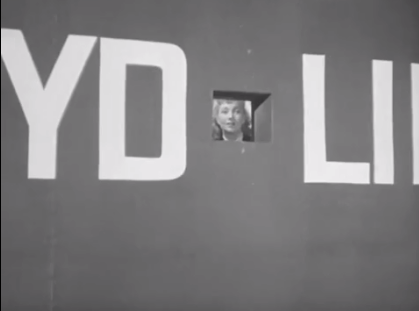
In a somewhat baffling move, the makers of the Maisie film series decided, in the eighth of ten films and at the eleventh hour, to suddenly start paying some lip service to continuity between the comic outings of our beloved Maisie Ravier (Ann Sothern). When we last saw our heroine, she had joined the war effort as a riveter at Victory Air, and this film opens with her still in this job. Sweet Maisie has been burning the candle at both ends, continuing to work her swing shift while volunteering at the nursery to support the mothers working the day shift. Unfortunately for her (and to the comic delight of the audience), this has led her to develop a facial tic, causing her to wink frequently, usually at the most inopportune times. The doctor prescribes her two weeks paid vacation, and as luck would have it, an old friend is passing through on his way to Reno, where they could use a song and dance girl for a two week engagement at his hotel. Last time, we got to see just how far she would go to prevent a patriotic soldier from marrying the wrong woman. This time around, we get to see how willing she is to put herself in danger to stop a woman from divorcing the right patriotic soldier. Specifically, after buying the last plane ticket off of a woman who has rethought her Reno divorce, Maisie meets a young soldier named Bill Fullerton (Tom Drake), whose wife Gloria (Ava Gardner) has gone to Nevada under the mistaken belief that Bill married her for her vast family fortune, when the boy didn’t know anything about it until after the marriage. Maisie agrees to personally deliver a letter to Gloria, and sets out west for adventure (again). 

Shortly after arriving, Maisie meets this film’s love interest, “Flip” Hennahan (John Hodiak, who would star in Alfred Hitchcock’s Lifeboat the following year), a blackjack dealer at the hotel where they are both employed. Flip agrees to take Maisie to the ranch where Gloria Fullerton is staying, and although the reception Maisie meets there is cold, she feels satisfied in having done her duty. When she realizes she’s accidentally made off with Mrs. Fullerton’s matchbox, she asks to go back, but Flip admits that she can meet her basically any time, as the hotel’s manager is serving as the legal witness to Mrs. Fullerton’s residency for her divorce proceedings, and as such she comes to the hotel daily for lunch. Maisie’s quite taken with Flip’s willingness to sacrifice his gasoline rations on a frivolity just to spend the day with her, but the plot takes a turn when she recognizes “Gloria Fullerton” the next day. The woman in question is actually the real Gloria’s traitorous secretary Wini Ashbourne, who is in league with Gloria’s business manager Pelham (Paul Cavanagh, who previously played the largely absent patriarch in Maisie Was a Lady) to get Bill out of the picture so that they can embezzle Gloria out of house and home. To that end, they’ve employed master forger Clave, who’s staying across the hall from Maisie in the hotel. Rounding out the supporting cast is a truly charming performance by nascent choreographer (and future model for Disney’s Peter Pan) Roland Dupree, as a bellboy whose infatuation with Maisie leads him to play sidekick for her, even as she goes to increasingly extreme measures to stop the Fullertons from divorcing. Oh, and if you were worried about what happened to Breezy from Swing Shift Maisie, for once we also find out what happened to Maisie’s last boyfriend; specifically, “He got a little too interested in the native dancers … of Dallas.” 

This has all the hallmarks we’ve come to expect of a Maisie picture. Once again, her love interest is a man with a silly nickname (“Slim” in Maisie, “Skeets” in Ringside Maisie, “Hap” in Maisie Gets Her Man, and “Breezy” last time around). Maisie herself is brassy, funny, and occasionally pouty. She gets to do a big song and dance number, entitled “Panhandle Pete,” in which she pretends to make trick revolver shots and is pulled into and out of the performance area on a wheeled pony, to show off Ann Sothern’s talents at both. But there’s also some great novelty in this go-round as well. Flip is a different kind of love interest for Maisie, one that she’s interested in but doesn’t have to protect from the wiles of any other women, and Hodiak plays him as both quite taken with Maisie while also being frequently frustrated by her, and it’s a nice dynamic. He’s occasionally flustered by her endless questions, although “Are you married?” and “Are you a draft dodger?” are fairly reasonable ones to ask, all things considered. I was slightly disappointed that Swing Shift Maisie didn’t decide to go all in and have an espionage plot, but the filmmakers make up for that this time around. Although the scheme to defraud and embezzle Gloria isn’t exactly a spy thriller, it plays like one, so much so that when the three co-conspirators corner Maisie in her hotel room and hold her at gunpoint, it feels for the first time that Maisie is in real, actual danger. Pelham even slaps her across the face to shut her up, and I gasped aloud at this sudden intrusion of realistic violence into a series of films that, the potential starvation of the dust bowl migrants in Gold Rush Maisie aside, has had stakes about as high as an episode of my beloved I Love Lucy

The ending is high octane and slapstick in equal measure. Maisie has allowed Jerry the bellboy to come to believe that she’s working for the FBI after he catches her getting Clave drunk in order to get a confession out of him. Flip has become completely convinced that Maisie’s accusations of massive fraud and potential identity theft are the results of a breakdown; it’s patronizing, but the fact that Maisie was given leave from war work due to a nervous condition means that he has some decent grounds to believe that Maisie just needs help. With no evidence other than her word, Maisie enlists Jerry to help her kidnap Gloria from the courthouse before her divorce proceedings can begin, just to hold her long enough for Bill to arrive, as he’s finally been granted leave from the army, but won’t be in Reno until the afternoon. When they accidentally also abduct Wini, who was posing as Gloria to divert the paparazzi, all four of them are taken to the jailhouse by a traffic officer. There, Maisie must plead her case, while Flip arrives with a psychologist to try and convince the board to release Maisie into his care rather than be imprisoned. Maisie feigns a fainting spell and pretends to be completely out of it, which drops everyone’s guard long enough for her to escape custody, find Bill, and sprint to the courthouse to stop Gloria before it’s too late. In the end, they all end up locked in the judge’s chambers with dozens of looky-loos and court reporters trying to break the doors down. It’s terrific stuff, and I’m starting to feel a little disappointed that the end of the Maisie series is approaching, with only two features left. This one is definitely in the top three so far, and they’ve only gotten better as the movies have gone along. Nevertheless, the next time we see Maisie, the war will be over, and I can’t wait to see what our heroine is getting up to then. 

-Mark “Boomer” Redmond

Swing Shift Maisie (1943)

We’ve met Maisie, seen her take a misguided detour on the Congo River, watched her riff on Grapes of Wrath and Knockout, get paired off with Red Skelton, and even be a proper lady. At last, in 1943, we get to see Maisie (Ann Sothern) join the war effort in a film that could alternately be titled Maisie the Riveter. We once again find our heroine at the foot of her Sisyphean mountain: broke, single, and working a lousy showbiz job. This time, she’s in a dog circus, although she gets let go from this when test pilot “Breezy” McLaughlin (James Craig) gets into an argument over the phone with his employer about Breezy’s voluntary enlistment in the air force. The repartee that follows Breezy and Maisie’s meet-cute leads her to decide she’s going to go get a job at Victory Air Co., declaring that “if [he] can fly planes, then brother [Maisie] can build ‘em.” 

Maisie hits a snag early on when she’s unable to present her birth certificate (“You can see I was born,” she says, “There’s not much doubt it was in Brooklyn”), but she convinces a man to perjure himself by swearing an affidavit that he’s known her all his life and can vouch for her citizenship. She also settles into a boarding house run by matronly Maw (Connie Gilchrist), where she meets former Abilene beauty queen Iris Reed (Jean Rogers) in the process of trying to suffocate herself with an open gas pipe after failing to find acting work. Maisie encourages Iris to get a job at Victory Air with her, and to leave her private room and share one with Maisie, to help her money stretch further. Iris agrees, and initially the two of them hit it off rather well, before Iris meets Breezy and begins to make designs to steal Maisie’s man. Before he’s sent out for training maneuvers, she’s succeeded, and the two of them confess to Maisie that they’re planning to wed. Maisie has no hard feelings, and even promises to look after Iris on Breezy’s behalf while he’s away, but this ends up proving more difficult than expected when it turns out Iris has no intention of remaining true to Breezy in his absence. 

Rogers plays Iris as a hell of a vamp, and having a true heel to play against makes for a very strong comedic outing this time around. Maisie’s attempts to keep Iris from wandering astray by trying to get her involved in several of the social clubs in the boarding house and the surrounding neighborhood make for a humorous, if not uproarious, montage. Iris has to be dragged away from the photography club because the teacher is a little too eager to take her into the darkroom for private instruction; Iris surreptitiously sneaks away from the lady’s singing club during a high note; Iris lies in order to leave a meeting of the virtuous wives and girlfriends’ club. When Maisie catches her in the last of these, Iris claims she’s simply going for more knitting wool, to which Maisie retorts, “To pull over whose eyes?” All of Maisie’s ministrations of morality come to naught, however. Iris’s consistent refusal to wear her safety scarf results in her hair getting caught in machinery, and when she explodes at the foreperson afterwards, she’s fired, but quickly accepts an offer from one of the men in the factory to let him pay for a room for her in his building. She makes sure to shake down Maisie one last time on the way out. 

When Maisie first talks to Iris about the factory job, there’s a bit of a to-do about Iris’s birth certificate, and at first I thought that this might be leading up to the revelation that Iris was a spy, which would have been a very bold direction for a Maisie picture to take. Instead, it comes back around in a different fashion, and puts Maisie in some of the worst real danger she’s been in. After a series of misunderstandings, including being caught slipping encouraging notes into the cockpits of planes she’s working on and being observed reuniting with some German expatriate acrobats of her acquaintance (and doing a poorly considered old routine with them), Iris decides to rid herself of the nuisance that is Maisie Ravier. When Breezy lets the girls know that he’s taking leave in order to come back and get married to Iris sooner than later, Iris throws up as many roadblocks between Maisie and Breezy as possible, including telling the authorities about Maisie’s forged affidavit letter in order to paint Maisie as an enemy infiltrator, which leads to her detention by the authorities. Maisie, caring more about making sure that Breezy doesn’t marry an unfaithful woman, falsely confesses to this in order to get the police to stop Breezy and Iris from leaving town by claiming that they are co-conspirators. 

I do think it would have been more fun if Iris had been a Nazi spy, but it’s still a blast to see Maisie with such a strong foil for once. Jean Rogers brings a bit of prestige to the piece, and her breathy, narcissistic performance as Iris is a delight. The elements of war pictures that you’re more likely to associate with the time—intrigue, pining women who long for the return of their brave soldiers, the duty of sacrifice—are pretty absent here. Instead, we get a bit of a propaganda piece about staying true to the men who are over there sticking blades in Nazi guts, with the audience of virtuous women seeing themselves represented on screen as steadfast and loyal, those who are too cowardly to break things off or are using the men for their own ends get to be told off by Maisie through an on-screen avatar, and our boys over there can rest assured that Maisie’s keeping their girls back home in line. It’s not as emotionally honest as, say, To Be or Not To Be or Trouble in Paradise, but it’s great to see Maisie really go toe-to-toe with someone who can hold their own against her. Definitely a top tier outing for our girl. 

-Mark “Boomer” Redmond

Maisie Gets Her Man (1942)

May is getting far behind us, but in my heart, it’s still Maisie May. It’s once again time to check in with our favorite perpetually down-on-her-luck showgirl, Maisie Ravier. Not since Maisie has Ann Sothern shared equal billing with anyone (where she was, bizarrely, credited behind co-star Robert Young). This time, it’s presumably because her co-lead was an honest-to-goodness star. 

Maisie’s Sisyphean existence continues, in which she finds herself beginning every film in dire straits with no mention of her past loves or fortunes. This time, she’s the living target for a knife-throwing stage act, but when the great Professor Orco allows his recent break-up to influence how he feels about women and how careful he is with his act, nearly killing her, she once again finds herself pounding pavement. Maisie takes an offer from a man who operates a strange kind of boarding house. Like Gold Rush Maisie, Maisie Gets Her Man draws on then-current events, with a contemporary review of the film from The New York Times citing that the place Maisie finds herself is a “background that seems to have been suggested by A. J. Liebling’s Jollity Building series in the New Yorker.” (That A.J. Liebling was already writing pieces about boxing for the New Yorker which would eventually lead to the publication of The Sweet Science is also probably not a coincidence.) Pappy Goodring (Allen Jenkins) owns a building where he rents out office spaces, although many of them are also currently occupied by people who can’t afford real lodgings. Everyone there has fallen on hard times; basement cafe operator Jasper is hypervigilant about potential dining and dashing, Ears Coffin (Rags Ragland) is a former wrestler who has become a talent agent who couldn’t book St. Paul on TBN, and Pappy himself is staring down bankruptcy, in no small part because of his soft heart for his tenants and their hot checks. The operation gets a cash injection with the arrival of Marshall Denningham (Lloyd Corrigan), who has come to the city to market his new mineral water. 

You may have noticed that Red Skelton isn’t mentioned at all in that paragraph. Frankly, this movie would almost be better without him. Skelton plays Hap Hixby, a wannabe comedian who’s come to the city from the sticks to try and peddle his particular brand of annoying prop comedy. He and Maisie first meet each other in Ears Coffin’s office, and he’s extremely obnoxious right out of the gate. Maisie seems exasperated with him from the first scene that they share, which leads me to believe that he’s supposed to be unpleasant, but the comedy of that only works if a character is annoying to the other characters and funny to us in the audience, which Hap is decidedly not. Luckily, we only have to put up with this for a little while, since the first time that he actually goes on in front of an audience (with Maisie as his plant), he freezes with such stage fright that he drops most of his more exhausting bits for the rest of the film. After a bunch of rigmarole, Hap ends up as vice president of Denningham’s Sapphire River Tonic, and the success of the business means that Pappy is able to fend off the bankruptcy proceedings of his creditors, a process that is helped along by Maisie accidentally getting drunk with said creditor on Denningham’s Sparkling Tonic (which is just tap water and hard liquor) and giving him the old Maisie speech. 

She and Hap confess their love for one another, but the following morning, his fiance from back home arrives in Chicago, and Maisie once again leaves without saying goodbye. As with Maisie, she finds out later that her former beau has gotten himself into legal trouble, namely that Denningham’s con has been found out and that he had taken on Hap as his partner so that he could leave him behind to face the ramifications while he skipped town. Unlike last time this happened, however, she has a much more active role in the action. Having joined a traveling song and dance troupe, she finds Denningham in the midst of his next scam and is able to trick him into telling her all the details while she sends for the police. She next sees Hap when her group performs a USO-style revue at the camp where he’s enlisted, which is the first time that any of these films have alluded to WWII at all; she does a patriotic number entitled “Cooking with Gas,” and the end card encourages the audience to buy war bonds and stamps in that very theater. It’s a strange tonal dissonance that seems to come out of nowhere, but at least the music is lively and the film ends on an upbeat note. 

This film has some of my favorite Maisie-isms so far. When she manages to fend off an apoplectic Professor Orco, she commands the men who intervene to “Let him loose boys, so [she] can claim self-defense.” After Ringside Maisie’s lamentation asking what kind of stars must have been over Brooklyn when she was born, Maisie this time says that “They must have repealed the law of averages when [she] was born.” She’s able to really give it to Hap a few times, too, with my favorite line being “Go ahead and open it; they don’t mail summonses, honey.” Unfortunately, this does very little to counterbalance the extremely unfunny third of the film that features Red Skelton trying and failing to find the line between annoying to Maisie and annoying to the audience. As that aforementioned 1942 NYT review said it best: “Maisie, no doubt, will recover. She will dismiss her failure with a shrug, then brighten up for her next adventure. We like her, cheap tinsel and all. We hope she gets her break next time.”

-Mark “Boomer” Redmond

Ringside Maisie (1941)

Ringside Maisie is a film in one of my least favorite genres: a sports comedy. Despite this, it manages to be pretty good. Considering that most of the sports films that I do end up liking generally tend to be ones about boxing or martial arts (like Creed), I suppose this shouldn’t come as a surprise. 

Once again, Maisie Ravier is en route to another job, and she’s run out of money, which prompts her to be ejected from the train on which she has stowed away. Why she needs to work after falling in love with a rich bachelor who was ready to settle down at the end of Maisie Was a Lady is unknown, just as we never hear why she never went back to the Bar-O Ranch that she inherited at the end of Maisie, or if/why things didn’t work out with Slim, her love interest in that film. Walking along the tracks, Maisie gets picked up by a young boxer named Terry Dolan (Robert Sterling, Ann Sothern’s real-life husband), who takes her back to the training facility. Terry’s manager, “Skeets” Maguire (George Murphy), is immediately suspicious of Maisie, assuming that she’s an athlete chaser of some kind, but he softens to her as the two get to know one another better. Terry admits to Maisie that he and his girlfriend Cissy (Natalie Thompson) are currently lying to Terry’s mother (Margaret Moffatt) about Terry’s line of work. When Maisie is fired from her job as a dancer for refusing to put out for her boss, she finds work as Mrs. Dolan’s companion, which gives her more time to develop a fondness for Skeets. When she learns that Terry wants to quit boxing and open a grocery store like the one his father ran before they lost their savings, Maisie encourages him to tell Skeets, insisting that the manager will understand, but Skeets instead insists that Terry must finish out his contract. When his next bout results in Terry being blinded, perhaps permanently, Maisie once again delivers an impassioned speech that makes everything right. 

Despite this being the longest Maisie picture so far, clocking in at 95 minutes, there’s not much more substantial to say about this one than any of the others. That having been said, I enjoyed this one immensely. I didn’t really buy the budding romance between Maisie and Skeets (perhaps because she has, naturally, more chemistry with Terry), but I did like the sweet relationship that forms between Maisie and Mrs. Dolan. Maisie is a woman for whom her forthrightness is a virtue, and she can’t be relied upon to be dishonest for very long. I was also shocked by the late-in-the-film sudden change in Cissy, who had theretofore seemed like she really and truly loved Terry, but who was ready to ditch him immediately. Watching Maisie tear into her for her fairweather love was as fun as it was watching her give Skeets a talking-to about his treatment of Terry. The tension continues to build throughout, especially once a specialist is brought in from Boston to perform a hail mary operation on Terry to reduce the swelling in his brain and restore his eyesight, which has the most immediate stakes of any of these films. It’s a fun watch, perhaps second only to Maisie Was a Lady so far. Will this love between Maisie and Skeets last? I doubt it, given that the next film is titled Maisie Gets Her Man. We’ll find out together, next time. 

-Mark “Boomer” Redmond

Maisie Was a Lady (1941)

For the first time, we open a Maisie picture (this is the fourth) with our leading lady already employed. It’s not very dignified, unfortunately; she’s in a carnival sideshow set up in a contraption with a mirror that makes her appear headless. When troublemaking wealthy alcoholic Bob Rawlston (Lew Ayres) tickles her on stage and costs her the job, he allows her to borrow his car to get into town. Maisie takes him up on this offer but ends up spending the night in jail after being pulled over on suspicion of stealing the vehicle. When the judge lets her off per Bob’s admission of complicity in Maisie’s firing and his permission to use the car, he also requires Bob to pay Maisie the amount that she was supposed to receive for the remainder of her sideshow contract, Maisie refuses to take money for nothing, and it all shakes out that Bob will keep her on for the two months of her contract at the sprawling Rawlston manse as a maid. Maisie is taken to the house and introduced to family butler Walpole (C. Aubrey Smith). 

On her first day, she meets Bob’s sister Abigail (Maureen O’Sullivan) as well as her fiancé, Link Phillips (Edward Ashley), but is not aware of their relationship until after Link has tried (and failed) to make a pass at her. The house is full of guests who will be in attendance at the upcoming engagement party for Link and Abigail. They’re all rather hoity-toity and rude to Maisie, embarrassing Abigail so thoroughly that she asks Maisie to be her personal maid, to which our heroine agrees. We get to spend some time with Abigail and learn that, despite all her wealth and finery, the Rawlston family is in disarray; after Mrs. Rawlston’s death, the family patriarch, “Cap,” has become a largely absent presence, sending jewelry that Abigail never wears or cares about in lieu of being present in her (or Bob’s) life. We learn about most of this from Abigail herself, while Walpole relates the same is true for Bob, who won a scholarship for some kind of aviation innovation, but for whom a lack of fatherly interest meant that he abandoned all of his ambitions. Tensions in the house reach a boiling point with the arrival of Diana Webley, a woman Link Phillips previously spurned; he doesn’t see any reason that his money marriage to Abigail should spoil all of the fun that they could have together, and it’s up to Maisie to, once again, save the day. 

Maisie Was a Lady is the best of the Maisie series by a decent margin. Maisie wasn’t terrible, of course, but it wasn’t all that memorable, either, whereas this one hits the ground running right out of the gate. Maisie is still independent, witty, and vivacious, and as the series goes along, she’s simply dropped into place until she gets the chance to observe everyone’s foibles, then deliver a no-nonsense monologue to give them the what-for that sets everything right. For the first time since Maisie, she also gets a love interest in the form of Bob Rawlston, even if their sudden affection for each other comes out of left field in the film’s final moments. With peace restored to the Rawlston household, Abigail asks Maisie to go to Honolulu with the family and to stay on as her companion. Maisie’s eyes light up as she considers it, possibly considering what adventures she might get up to in Honolulu Maisie, but then asks Walpole what kind of woman he foresees for Bob, prompting the old butler to rattle off a description of old money gentility that causes those lights to dim. After the leading men in Congo Maisie and Gold Rush Maisie both turned out to be false flag romantic leads, perhaps I should have seen it coming that Bob was going to win Maisie’s heart in the final moments even if there was no indication of that kind of affection between them in the film’s first hour. It almost feels like this was hastily added at the end to give Maisie a happy ending, should this be the last time that we saw Ann Sothern in this role. 

The screenplay for this one is credited to Betty Reinhardt and Mary C. McCall, Jr., just as the previous films were, but this is the first time that there’s no credit given for Wilson Collison, other than “characters created by.” Reinhardt shares story credit with frequent Frank Capra collaborator Myles Connolly, which may be why this one soars out of all the Maisies so far. It’s almost an obvious choice to have Maisie play “downstairs” in a rich family’s home; this gives her the opportunity to have comic friction with both the guests and the other servants, who are accustomed to the kind of bowing and scraping that it never even occurs to Maisie to consider. It’s all in good fun, although it takes a melodramatic turn in the final act that’s very similar to the one that set up the final events of Maisie. Since these films are all essentially self-contained, it really doesn’t matter if you decide to pick one up at random and give it a chance, and this one is the best so far and doesn’t really require you to know anything about the previous; you could treat this as a standalone picture and have just as much fun (if not more) than if you didn’t know who Maisie was in the first place. 

The film has its old-timey moments, of course. When Mr. Rawlston finally returns to the manor after the one-two punch of his absence and the revelation of Link’s gold-digging nature sends poor Abigail over the edge, Maisie reads him the riot act. Notably, she compares him unfavorably to the abusive fathers of her Brooklyn neighborhood, because at least they knew their children, and, according to Maisie, “Givin’ em the flat of your hand stacks up against giving them nothing.” It’s the only noteworthy tone-deaf moment in an otherwise blistering scorcher of a dressing down, so it gets a pass. Maisie Was a Lady gives us a heaping helping of the gal we love, and, though predictable in the extreme, is worth the eighty minutes it’ll cost you.

-Mark “Boomer” Redmond

Gold Rush Maisie (1940)

After her little outing to Africa, Maisie Ravier is back stateside. She’s not headed to check out the ranch she’s supposed to have inherited at the end of Maisie, though. Instead, we find her once again trying and failing to get to her next cabaret job, this time in Tucson. A car that she bought for a bargain to get her the rest of the way breaks down in the desert at night, and she finds her way to a ghost town whose two sole inhabitants are a gruff, hostile young recluse named Bill Anders (Lee Bowman) and his ornery hired hand, Fred Gubbins (Slim Summerville). Bill warms up to Maisie enough to pitch some woo her way, but she won’t have any of it, and the two men are less than receptive to her friendly overtures the following morning. When her car still won’t start after Bill takes a look at it, Maisie sets out on foot, finally arriving at her destination, a few days too late; the cafe owner has already hired different talent when Maisie didn’t arrive as expected. While ruminating on her next move, Maisie learns that there’s a gold rush boomtown developing near Anders’s property. Her kindness to a young girl whose family are following the gold rush earns her a place in their car, and she returns to get her car back and set out for her next adventure, but ends up invested in the future of the Davis family. 

The Davises are bargain bin Joads, former tenant farmers from Arkansas who lost everything in the Dust Bowl. Patriarch Bert remains cheerful and appreciative of his wife Sarah (Mary Nash)’s long-suffering patience, and Sarah herself is the kind of sweetheart who goes hungry so that her family can eat. The family has three children including a baby; the other two are played by notable child actors of the era. “Jubie” Davis was portrayed by Virginia Weidler, who appeared as Katherine Hepburn’s younger sister in The Philadelphia Story the same year as this film, and the perpetually hungry Harold was played by former Little Rascal Scotty Beckett, whose Rascal career as Spanky’s best friend came to an abrupt end once Alfalfa appeared on the scene. Overall, the Davis clan is likable and charming, and it’s easy to believe that Maisie would be willing to spend her last few dollars getting them some groceries and helping them stake out their claim. Of course, there has to be something to keep her present in Arizona to give her rough charms time to thaw Bill Anders’s stony heart so that he offers up his land for the disenfranchised farmers to homestead on when the gold in the area turns out to be so low in concentration that it’s not worth the effort of mining. It’s even less of a romance story this time around, too, since there’s no indication that Maisie has any designs on Anders, other than to get him to warm up a little. 

The format of these movies is starting to emerge, with Maisie as a kind of folk hero who goes from place to place, gets involved in people’s lives, and then moves on like Charlie Kale in Poker Face or Huckleberry Finn. There’s no real continuity to speak of, but one imagines that the studio must have been conscious that people would remember Slim from the first film and Maisie’s relationship with him even if he goes unmentioned, as Maisie’s further adventures are largely free of romance. She pretended to be into the male lead of Congo Maisie only so long as it helped her save another woman’s marriage by demonstrating how poorly suited the man was for love. One would expect that Maisie and Bill would have some romantic entanglement here based on their positioning in the film’s poster, but other than a couple of quick, chaste kisses, there’s nothing to indicate that Maisie reciprocates the tender feelings that she inspires in Bill. If anything, it feels like the first two films were aiming for that Ernst Lubitsch adultery comedy and missing the mark a bit, and decided to drop that entirely to just have Maisie wander the earth like David Banner (ironically, Scotty Beckett would go on to portray the child version of Don Ameche’s character in Lubitsch’s Heaven Can Wait just a few years later). 

Wilson Collison is credited with the story on this one, just as he was for Maisie (which was based on his novel Dark Dame) and for Congo Maisie (which was based on his non-Maisie novel Congo Landing). I’m not entirely sure that’s a worthy credit, however, given that the screenplay was actually pinned by two women, Mary C. McCall Jr. (credited for eight of the ten Maisie pictures) and Betty Reinhardt (who would later co-write Otto Preminger’s Laura and Give My Regards to Broadway). I’m not sure how much credit Collison really deserves for grafting the character of Maisie into a riff on The Grapes of Wrath, which would have been a hot commodity at the time, as John Steinbeck’s novel was published only the year before and the John Ford film adaptation reaching theaters only four months and 11 days before Gold Rush Maisie. That’s important context, since it also means that the somewhat corny-sounding dialogue of the Dust Bowl Okies (ex: “Tarnation, it’s nigh on to supper already”) is actually contemporary. 

Ann Sothern continues to shine in these, and while a lot of her non-comedy dialogue in the first two films had the ring of melodrama about them, her indomitable spirit comes through most clearly here. There’s a real sense of gravitas in her voice as she explains to Bill that the would-be miners have learned that the ore is useless and are holding a meeting about where each is going to go, since they can’t all try to go work the same temporary farm jobs. They’ve got to part for various different destinations, “spreading the starvation around a couple of states and not bringing it on each other,” and it’s quite good stuff. And this time, we get to see Maisie drive off into the sunset, off to spread barbs and charm elsewhere, the next time we see her in Maisie Was a Lady

-Mark “Boomer” Redmond

Congo Maisie (1940)

I’m pleased to report that Congo Maisie is not as racist as I had feared. Make no mistake; it’s still racist as fuck, presenting every African with whom the white characters interact as a pidgin-speaking stereotype, universally superstitious and fearful of local witch doctors, and very quick to both bow and scrape. Even the film’s only noteworthy highlight—the finale in which Maisie puts on a performance for the attacking natives to convince them that she’s more powerful than the witch doctors—is still infantilizing and insulting. It’s deeply unpleasant, but at least we don’t hear our hero use any slurs (other than, of course, the ubiquitous use of “boy” to refer to grown men). 

When we last saw Maisie, she had just received the happy news that the late Mr. Ames had left his fortune, including the Bar-O Ranch, to her, and she planned to run it with her newfound love interest Slim. Despite this, when we catch up with her in Congo Maisie, all indication that this was where we left her has vanished. She’s once again a showgirl on the lookout for the next big opportunity, which is what has brought her to Africa in the first place. She runs out on her hotel bill in (fictional) Kurmala, West Africa, and stows away on a riverboat that she believes is bound for Lagos, where her next engagement is, but turns out to be headed elsewhere. She’s discovered hiding in one of the cabins by Dr. Michael Shane (New Orleans native John Carroll), the foul-tempered manager of a rubber plantation. He’s journeying up the river to his place, but when the boiler on the boat overheats and explodes, all passengers are put ashore. Shane was previously the physician in residence at a different colonial plantation that’s nearby, and he and Maisie make the trek to it in order to find a place to stay until the boat can be repaired. 

The new plantation hospital doctor, McWade (Shepperd Strudwick) and his wife Kay (Rita Johnson), welcome them, and the cracks in their relationship are evident immediately. Kay is lonely and misses home, friends, and family, while Dr. McWade’s devotion to researching a cure for sleeping sickness drives him to work for long hours, and his own health is worsening as a result. Shane’s reunion with a local with whom he had become friends is marred by the revelation that the man’s son is very sick and he is afraid to bring him to McWade for fear of reprisals against his family from the local witch doctors, who act as the villains of the film who stir up fear and discontent against McWade, Shane, and the other settlers, who are our protagonists. Somehow, in all of this, Shane also finds the time to try and woo Kay, and she’s a receptive party given her isolation from familiar people or sights. Maisie, perhaps having learned something from Sybil Ames in Maisie, then allows Kay to witness as she herself flirts with Shane, who has no loyalty to anyone. In the final act, the locals, at the behest of the witch doctors, arrive at the plantation hospital mere minutes after Shane has completed successfully removing McWade’s appendix with Maisie acting as nurse and begin trying to tear the place to the ground. Maisie, thinking fast, dons one of the costumes from her act and does some stage magic, stalling long enough for an inbound thunderstorm to break and for rain to fall so that she can pretend that this was her doing, and turn the locals back on the witch doctors. 

The only reason any of this works is because of Ann Sothern’s performance as Maisie. Even when the movie itself is grossly colonialist and imperial, Maisie herself remains an undaunted, lovable figure. This is based on a totally unrelated book entitled Congo Landing, which I’ve been able to find very little information about other than a contemporary NYT book blurb that names the main character as Dolly, and describes her thus: “Her savoir faire is undisturbed by the deadly tropical heat, the pestiferous mosquitos, or the explosion of the boiler on the rotten little Congo River boat. Under a hardboiled exterior she has really a heart of gold and a shrewd, intelligent mind.” That also describes Maisie, and it’s clear why someone reading Congo Landing might see this as a perfect vehicle to quickly develop into a sequel to Maisie, with Congo Maisie appearing on screens a mere seven months after the character debuted in the previous film. There’s only a singular rating of the novel on GoodReads, although there are a few very low star ratings for Das Haus am Kongo, which appears to be the German translation; the one review for Das Haus cites that the reader “found the casual racism referring to all of the [B]lack characters unbearable.” I imagine it probably is worse in the book, but that doesn’t make this film any good. Utterly unworth preservation. 

-Mark “Boomer” Redmond

Maisie (1939)

Last year, after watching The Blue Gardenia and being particularly taken with Ann Sothern in it, I looked her up and discovered that, over the course of eight years, she had starred in ten(!) films as a character named Maisie Ravier, a misadventuring showgirl. Those ten films are largely forgotten now, but I found all of them on Russia’s YouTube equivalent as uploaded VHS rips from Turner Classic Movies airings, and I dutifully archived them for this year with the intent of watching them all and writing about them for something I intended to call “Maisie May.” Then, almost halfway through this month, as a result of working on a fiction project, I realized I had spent almost half of May in writing mode instead of movie mode. Will I be able to finish all ten Maisie films before the end of the month? Let’s find out together. 

The film opens as Maisie (Sothern) arrives in Big Horn, Wyoming to discover that the stage show for which she left New York has folded after a single performance. With only a nickel to her name, she convinces a carny to let her work the shooting gallery, which sets up her meet cute with “Slim” Martin (Robert Young, a few years after his appearance in Hitchcock’s Secret Agent), the manager of Bar-O Ranch. When his wallet gets lifted, Maisie ends up arrested for the theft, and although she’s cleared of the charges, she stows away in the back of his pick-up truck to avoid being arrested again for vagrancy should she remain in town. Slim is less than enthused to discover this, but allows her to stay overnight with the intention of sending her off on the train the next morning, as one of the ranch hands is already going into town to pick up the ranch’s owner, Cliff Ames, and his wife Sybil (Ruth Hussey), whom he has spirited away from New York to put some distance between her and the man with whom she’s been carrying on an affair. Maisie again latches on to an opportunity and presents herself as a maid that Slim has hired for Sybil for the summer. She comes clean to Mr. Ames once they get back to the ranch, who is impressed with her gumption and allows her to stay. 

Sybil asks Slim to show her where the “old ranch house” is, and she latches onto it immediately as a place where she can have her lover come and meet her discreetly. Maisie also manages to break through Slim’s resistance and learn that his unfriendliness is the result of previous heartbreak; the two start to fall in love. One day, while touring the ranch in his car with Maisie, Mr. Ames gets into an accident and his arm is pinned in the overturned car. Maisie, believing that she will find Slim and the other ranch hands at the old ranch house because they are on a cattle drive, and instead finds Sybil in flagrante delicto with her lover. Once Mr. Ames is safely back at the ranch, Maisie gives Sybil a dressing down about her behavior and her treatment of her loving husband, and Sybil is able to manipulate her words in conversation with Slim to convince the ranchman that Maisie has spent the summer trying to lure Mr. Ames away. Slim sends Maisie away, and shortly thereafter, Mr. Ames sends a letter to his lawyers in New York and then kills himself. Unfortunately, as Slim discovers the body first and is found standing over the body with the gun Ames used, he is arrested for murder. When Maisie learns of this, she must make her way to the trial to try and save him. 

This is a fun enough little seventy-five minute romp, and it practically breezes by. It’s also a bit of a genre-bender, as it starts out as a contemporary Western romcom before the dark twist of Mr. Ames’s suicide and a final act that turns into a courtroom drama. It’s also fairly unconventional in the sense that it plays with certain character stereotypes. Maisie’s a big city showgirl, so one expects there to be some kind of culture clash between her and the simpler Wyoming ranch hands and their employer, but instead of her being brassy and bossy, it’s instead she who is almost immediately taken advantage of by the podunks and conmen of the west, although she manages to turn things around for herself by conning her way into a job at Bar-O Ranch. Once that development occurs, one then expects that there’s going to be some comic hijinks about her not being suited for rural living, but she actually adjusts fairly quickly and does quite well for herself, coming to be adored by both Mr. Ames and Slim’s right hand man, Shorty (musician Cliff Edwards, who would be immortalized the following year as the voice of Jiminy Cricket in Disney’s Pinocchio). The conflicts aren’t at all what one would expect, and I appreciated that I never really knew where the plot was going to go next, even if the stakes are relatively low throughout, at least until Slim’s trial. 

As a movie of a bygone era, it has its detriments, most notably in its casual racism. Even our beloved hero refers to a Black train porter as “boy,” and there’s occasional fun being had at the expense of ranch cook Lee, who is referred to more than once as “the China boy.” It’s a relief that he’s played by an actual Chinese-American actor, Willie Fung, rather than a white actor in yellowface, but he’s also played as a “humorous” stereotype; it’s a mercy that his scenes are few and brief. This was, unfortunately, the exact role that Fung was often funneled into during this more (overtly and openly) racist period in Hollywood history. He has seven films in his 120+ feature filmography where he’s an uncredited “Chinese Cook,” six as “Chinese Waiter,” then “Chinese Bartender,” “Chinese Tailor,” “Chinese Laundryman,” and so on. It’s an unfortunate legacy for a man who came to the U.S. following the collapse of his uncle’s peanut business and made a name for himself as the owner and operator of East Hollywood’s New Moon Café in addition to appearing in 125 films. 

There is already trouble on the horizon for Maisie May. The very next film starring Sothern in one of her defining roles is the 1940 picture Congo Maisie, which from the title alone I expect is likely to be unconscionably racist (although I’ll eat crow if Maisie ends up communicating with a mountain gorilla). The synopsis for that one includes both mentions of a rubber plantation and Maisie having to save it from a “native attack.” This could be so awful it derails the entire thing. Stay tuned to find out. 

-Mark “Boomer” Redmond