
It’s 1946, the war is over, and like so many women of her generation, our beloved Maisie Ravier finds herself out of work now that the men have come back from Over There and resumed their civilian work. After finishing a secretarial program, Maisie starts applying to various suitable jobs all over the city, but finds that everywhere she goes, the wolfish men who interview her are only interested in her as an object of their carnal desire. She finally finds a position with Joe Morton (George Murphy) when she goes into his office dressed “frumpily” (which, in classic Hollywood fashion, does nothing to hide Ann Sothern’s beauty). When he discovers that she has deceived him, he initially believes that she’s a corporate spy sent to uncover the secrets of a prototype helicopter that he’s developing, but he warms to her when he realizes that she built the very same model of aircraft that he flew overseas. She gets to work as both his secretary and assisting in the construction of the copter, alongside Mitch O’Hara and Bill Stuart, whom Joe met in the service, and his college buddy Tim Kingby (Stephen McNally). This soon blossoms into love, and the two become engaged, although Joe can only afford a ring and not a stone to put in it, at least until the helicopter prototype is sold.
Maisie’s hiring throws a wrench into the plans of Mr. Nuboult (Paul Harvey), who is posing as a kind of angel investor in Joe’s prototype while secretly working on stealing the designs for himself. He’s assisted in this by his lovely daughter Barbara (Hillary Brooke, who appeared two years earlier as the fake psychic medium in Ministry of Fear) as well as Tim, who is operating as Nuboult’s man on the inside. When Maisie discovers a discrepancy in Tim’s receipts that show that he’s ordered twice the number of a specific part, she’s insistent on reviewing all of the back invoices to make sure that they haven’t been double-billed in the past. When Tim relays his gaffe to Nuboult, the older man sends Barbara to town, ostensibly to take Maisie out for an engagement party with some of her high society friends. Maisie, feeling pressured by Barbara’s premonitions of a life of social obligations as a wealthy inventor’s wife, admits that she feels out of place among the wealthy women, given her lack of social class and education (she claims she “set a record for the mile running from the truant officer”). Despite a lifetime of teetotaling as a result of her father’s alcoholism, Maisie allows Barbara to pressure her into taking one drink to toast with, which Barbara has drugged. This results in Maisie making a bit of a spectacle of herself in front of what the following morning’s paper refers to as “hundreds of socialites,” which culminates in Maisie taking a dive into the hotel pool fully dressed. When she comes out of it, Barbara convinces her to save Joe from public humiliation and disappear, and Maisie agrees. Will she uncover the deception in time to save Joe’s patent?
After Swing Shift Maisie played with the possibility of international intrigue before settling on a more down to earth conflict and then Maisie Goes to Reno sent our heroine to the desert in order to get mixed up in shady, complex legal shenanigans, the filmmakers behind Up Goes Maisie finally decided to go all-in on an espionage plot. It’s corporate espionage, of course, but it counts. It’s also a striking example of a thriller in which the MacGuffin isn’t a McGuffin at all, but is integral to the plot; the duplicate helicopter parts are used to swap out a partially completed version with the real deal, and the conspirators burn the storage facility down. Maisie puts the pieces together and ultimately ends up at the controls of the copter, which she is able to pilot due to having transcribed all of the directions in her secretary role. It’s a perfectly constructed Maisie plot: our favorite down on her luck showgirl shows a lot of pluck, gives several lying rats just what she thinks of them, and has a few zany set pieces, but it’s all wrapped around a pretty tightly plotted conspiracy narrative. If it weren’t for Maisie coming along, their plan would have gone off without a hitch; first, she welds Joe’s air medal into the frame of the helicopter as a good luck charm, and the object’s absence from the supposed burned out wreckage reveals the switch. Her discovery of the fudged invoices starts the ball rolling on the revelation that Tim is planning to sell Joe out, and if she hadn’t happened to be serving a couple of cops as a carhop when the report of the fire came in over the radio, no one would have been the wiser. They would have gotten away with it, if it weren’t for that meddling Maisie!
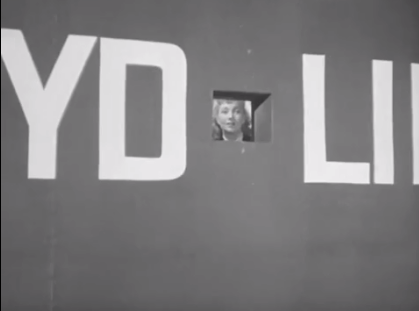
Visually, this is a standout picture as well. Director Harry Beaumont was born in 1888 and performed as an actor in silent films before taking the reins, directing MGM’s first talkie musical, The Broadway Melody, a 1929 release that won Best Picture that year (Beaumont lost best director to Frank Lloyd for The Divine Lady). This was his second Maisie picture, after having helmed the aforementioned Maisie Goes to Reno; the tight plotting and visual flourishes of both bode well for our final outing in Undercover Maisie, which was his penultimate credit. There’s a particularly beautifully composed shot of Maisie, Mitch, and Bill sneaking into the factory where the real copter has been taken by the corporate spies; the darker plot also allows Beaumont to add in some noir touches. It’s not just a good use of light that sets this one apart, however, as the camera has some fun with framing; my favorite is the scene in which Maisie, fugitive from love, observing his test flight at the Rose Bowl through a tiny little window in the scoreboard that’s just barely big enough to see her face:
As for the helicopter itself, it’s a silver lozenge with two horizontal rotors, and it’s a charmingly perfect vision of atomic age futurism that looks great when the actors are interacting with it. The cheat to fake takeoffs and landings is obvious, but very easy to play along with. When Maisie pilots it in the climax, the chopper is represented by an utterly adorable miniature with a completely static figurine of Maisie inside. Before you know it, Maisie’s hovering outside of an office building, where she startles a woman who then uses a vertical flagpole to get Maisie a telephone, and while it’s very funny, it’s also tense. It’s worth noting that all of this is happening while Maisie is clad in her carhop uniform, which includes a heart-shaped bib with ruffles, puffed sleeves, an oversized sash bow on the rear, and petticoats; it’s her cutest look yet, and she makes it looks effortless. And she even gets to have a brief catfight with Barbara while wearing it!
The Maisie series, here at the very end, is on a real upward trajectory, no pun intended. It’s unfortunate that we only have one more outing with her before we bid her farewell, but at least we have that to look forward to.
-Mark “Boomer” Redmond


Pingback: Undercover Maisie (1947) | Swampflix
Pingback: Programming Maisie | Swampflix