

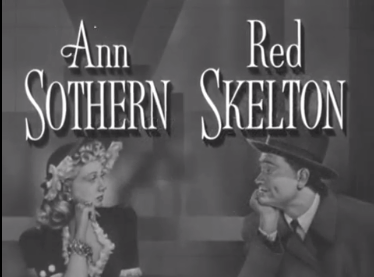
May is getting far behind us, but in my heart, it’s still Maisie May. It’s once again time to check in with our favorite perpetually down-on-her-luck showgirl, Maisie Ravier. Not since Maisie has Ann Sothern shared equal billing with anyone (where she was, bizarrely, credited behind co-star Robert Young). This time, it’s presumably because her co-lead was an honest-to-goodness star.
Maisie’s Sisyphean existence continues, in which she finds herself beginning every film in dire straits with no mention of her past loves or fortunes. This time, she’s the living target for a knife-throwing stage act, but when the great Professor Orco allows his recent break-up to influence how he feels about women and how careful he is with his act, nearly killing her, she once again finds herself pounding pavement. Maisie takes an offer from a man who operates a strange kind of boarding house. Like Gold Rush Maisie, Maisie Gets Her Man draws on then-current events, with a contemporary review of the film from The New York Times citing that the place Maisie finds herself is a “background that seems to have been suggested by A. J. Liebling’s Jollity Building series in the New Yorker.” (That A.J. Liebling was already writing pieces about boxing for the New Yorker which would eventually lead to the publication of The Sweet Science is also probably not a coincidence.) Pappy Goodring (Allen Jenkins) owns a building where he rents out office spaces, although many of them are also currently occupied by people who can’t afford real lodgings. Everyone there has fallen on hard times; basement cafe operator Jasper is hypervigilant about potential dining and dashing, Ears Coffin (Rags Ragland) is a former wrestler who has become a talent agent who couldn’t book St. Paul on TBN, and Pappy himself is staring down bankruptcy, in no small part because of his soft heart for his tenants and their hot checks. The operation gets a cash injection with the arrival of Marshall Denningham (Lloyd Corrigan), who has come to the city to market his new mineral water.
You may have noticed that Red Skelton isn’t mentioned at all in that paragraph. Frankly, this movie would almost be better without him. Skelton plays Hap Hixby, a wannabe comedian who’s come to the city from the sticks to try and peddle his particular brand of annoying prop comedy. He and Maisie first meet each other in Ears Coffin’s office, and he’s extremely obnoxious right out of the gate. Maisie seems exasperated with him from the first scene that they share, which leads me to believe that he’s supposed to be unpleasant, but the comedy of that only works if a character is annoying to the other characters and funny to us in the audience, which Hap is decidedly not. Luckily, we only have to put up with this for a little while, since the first time that he actually goes on in front of an audience (with Maisie as his plant), he freezes with such stage fright that he drops most of his more exhausting bits for the rest of the film. After a bunch of rigmarole, Hap ends up as vice president of Denningham’s Sapphire River Tonic, and the success of the business means that Pappy is able to fend off the bankruptcy proceedings of his creditors, a process that is helped along by Maisie accidentally getting drunk with said creditor on Denningham’s Sparkling Tonic (which is just tap water and hard liquor) and giving him the old Maisie speech.
She and Hap confess their love for one another, but the following morning, his fiance from back home arrives in Chicago, and Maisie once again leaves without saying goodbye. As with Maisie, she finds out later that her former beau has gotten himself into legal trouble, namely that Denningham’s con has been found out and that he had taken on Hap as his partner so that he could leave him behind to face the ramifications while he skipped town. Unlike last time this happened, however, she has a much more active role in the action. Having joined a traveling song and dance troupe, she finds Denningham in the midst of his next scam and is able to trick him into telling her all the details while she sends for the police. She next sees Hap when her group performs a USO-style revue at the camp where he’s enlisted, which is the first time that any of these films have alluded to WWII at all; she does a patriotic number entitled “Cooking with Gas,” and the end card encourages the audience to buy war bonds and stamps in that very theater. It’s a strange tonal dissonance that seems to come out of nowhere, but at least the music is lively and the film ends on an upbeat note.
This film has some of my favorite Maisie-isms so far. When she manages to fend off an apoplectic Professor Orco, she commands the men who intervene to “Let him loose boys, so [she] can claim self-defense.” After Ringside Maisie’s lamentation asking what kind of stars must have been over Brooklyn when she was born, Maisie this time says that “They must have repealed the law of averages when [she] was born.” She’s able to really give it to Hap a few times, too, with my favorite line being “Go ahead and open it; they don’t mail summonses, honey.” Unfortunately, this does very little to counterbalance the extremely unfunny third of the film that features Red Skelton trying and failing to find the line between annoying to Maisie and annoying to the audience. As that aforementioned 1942 NYT review said it best: “Maisie, no doubt, will recover. She will dismiss her failure with a shrug, then brighten up for her next adventure. We like her, cheap tinsel and all. We hope she gets her break next time.”
-Mark “Boomer” Redmond


Pingback: Swing Shift Maisie (1943) | Swampflix
Pingback: Maisie Goes to Reno (1944) | Swampflix
Pingback: Programming Maisie | Swampflix