Rabbit Trap (2025)

“Listen,” speak-sings Daphne Davenport (Rosy McEwen) into her microphone over ambient nature sounds that she and her husband Darcy (Dev Patel) have been recording. “Noise … the oldest of gods. Before language, before flesh, before name, she was here.” It’s 1976, and the two of them have moved from London to the Welsh countryside with reel to reel recorders and state of the art microphones, which they traipse around the forest with, capturing the sounds of squelching marshes, nightbirds chirping as they move through the air in bloblike flocks, skittering feet of bugs across leaves, and the distant song of unseen fauna, or at least one hopes it’s something so natural. Later, the couple meets a mysterious androgynous child (actress Jade Croot, although The Child is only ever referred to as “he”), and when the boy asks if he can sing Daphne a lullaby that his mother used to sing him as a child, she records him as well. Listening back to it later, Darcy says it “sounds like a spell.” Rabbit Trap traffics in this idea, of sound as song, noise as god, voice as spellcraft, in a beautiful little folk horror from director Bryn Chainey, who has heretofore mostly worked in short film. 

There are points of comparison that it would be easy to go to when describing the film’s atmosphere. The sudden presence of a creepy child who brings with him portents of folkloric truth calls The Killing of a Sacred Deer to mind, and although this is set in Wales rather than on the Cornish coast, the atmosphere of isolation, hallucination, and lost time invokes Enys Men. There’s a sequence in which The Child leads Daphne to a series of tunnels and trenches that seem neither manmade nor natural and lures her through them by whistling a tune that she whistles back to him, and for a moment I felt I was watching Jessie Buckley harmonize with her own echo in Men. Despite these intentional homages or simple similarities, Rabbit Trap feels fresh despite being familiar. Even the way that this film goes to horror media’s most frequently visited well of late (grief and trauma are the real monsters) doesn’t feel like the cliché that it is. For one thing, the film never feels the need to dwell on what’s causing Darcy’s sleep paralysis. We see him experiencing strange dreams of the windows of the house being covered in goop and a spectral figure that may represent his father, with Daphne being quick to record his sleeptalking in the hopes that it might help him remember something when he wakes. Later, those dreams recur after he has broken a fairy circle, and in the end of the film, we find him standing in a beautiful vista recording his truth so that he can play it for Daphne later, since it’s too hard for him to say to her face. We can really only speculate what it is that’s caused Darcy to see himself as the source of an emotional “rot,” because it’s important only in its implications, not in its specifics. 

The plot kicks off when Darcy accidentally wanders into a ring of mushrooms, which folklore calls a “fairy ring,” and to break one invites the wrath of the Tylwyth Teg, fae from another world. Shortly thereafter, The Child appears outside of their cabin. Playing off Darcy’s concerns that he might be a burglar, he instead calls himself a hunter, taking Darcy to see the traps that he lays out for rabbits, taking special care to note that the bait has to be offered with honest and meaningful intention in order for the trap to work. The Child grows closer to both of them, taking an active interest in Daphne’s previous musical work (he asks if she’s famous, to which Darcy replies “You can’t really be famous with her kind of music. She’s more… influential”) and enjoying his and Darcy’s excursions into the marshes to record nature noise. As he becomes more and more of a surrogate child to the couple, his affection for Daphne grows to the point that he asks her to pretend to be his mother, as he claims his died long ago. Darcy, with his unspoken and only vaguely defined issues surrounding fatherhood, starts to get a little creeped out by this, and The Child’s behavior becomes more invasive and presumptuous. What little we do know about Darcy’s past is revealed to us not explicitly but in the way that he talks about sound—that god, that ghost, calling it a “Vibration of an event, an energy shadow, memory carved into the air, a scared lost creature desperate for somewhere to hide before it fades away. When you hear a sound,” he says, “you become its home, and your body is the house it haunts.” Darcy’s body is keeping an unknown score, and The Child has come to find a new family, one way or another. 

Much is left up to interpretation here. My personal reading is that the story The Child tells early in the story, about a baby brother that wandered into the Tylwyth Teg circle and disappeared, is actually about him, and that he grew up parentless in the fae realm, or that he was otherwise a kind of inverse changeling. Now that the ring has been disturbed again, he has the opportunity to go back out into our world and try to reestablish some kind of family, which would explain his quiet (and later loud) desperation on this front. This would also make his introduction of himself as a “hunter,” rather than the more accurate descriptor of “trapper,” a bit of foreshadowing despite the metaphorical, psychedelic rabbit trap that Daphne and Darcy must pass through at the end. Of course, this is a film that leaves a great deal up to your imagination, one that is more a visual and sonic experience than it is a narrative one. Its brisk runtime, coming in at under 90 minutes, means that this tone over text ethos never wears out its welcome. It’s unlikely that, at this late date, many people are still considering new entries onto their end of the year lists, and although this one was stellar, it’s one that will be waiting for you when you’re ready for it, but it’s an inexpensive rental if you’re still doing your 2025 end of the year cramming. 

-Mark “Boomer” Redmond

Lagniappe Podcast: The Tales of Hoffmann (1951)

For this lagniappe episode of The Swampflix Podcast, Boomer & Brandon discuss Powell & Pressburger’s Technicolor opera The Tales of Hoffmann (1951).

00:00 Welcome

01:15 The Suspect (1944)
06:18 The King of Comedy (1982)
15:38 Marty Supreme (2025)
22:31 For Your Consideration (2006)
29:00 Abigail (2024)
37:12 Rabbit Trap (2025)
44:00 The Headless Woman (2008)
48:36 The Asphalt Jungle (1950)
52:24 America – Everything You’ve Ever Dreamed Of (1973)
56:51 Black Narcissus (1947)

59:50 The Tales of Hoffmann (1951)

You can stay up to date with our podcast through SoundCloudSpotifyiTunesTuneIn, or by following the links on this page.

– The Lagniappe Podcast Crew

My Christmas Wish: Treat Yourself to All That Heaven Allows (1955) This Year

Last year, Douglas Sirk’s All That Heaven Allows made it to number 24 on Swampflix’s Top 100 films, so naturally I spent the evening of last Christmas Eve closing that blind spot. If you’re a weirdo like I/we am/are (and if you’re on this site, that’s probably the case), you’ll likely find yourself recognizing the plot from its contours, because what Star Wars is to Spaceballs, this movie is to John Waters’s Polyester. Since Brandon had already written a review years earlier, I repurposed the review I couldn’t stop myself from writing to save for this year as an earnest recommendation to spend some part of your Christmas season with Sirk too, on the 70th anniversary of Heaven’s release. 

Cary Scott (Jane Wyman) is a well-off widow in New England. Her life is quiet, with visits from her two college-aged children Kay (Gloria Talbott) and Ned (William Reynolds) growing fewer and further between. Her best friend, Sara Warren (Agnes Moorhead), takes her out socially; attempts to get her to pair off with older widowers in their social circle are unsuccessful, as she feels no spark with any of them. One day, she realizes that some new hunk is tending to her landscaping, and he introduces himself as Ron Kirby (Rock Hudson), the son of the late Mr. Kirby who was previously engaged as the Scott family’s arborist. When she visits him at his home, she learns that he sleeps on a cot in a room attached to the greenhouse, and when he mentions planning to tear down the old mill on the property, she cajoles him into giving her a tour of the long-abandoned building, and she encourages him to convert it into a livable home instead. As their romance burgeons, their love is represented in ongoing changes to the mill house, which comes to resemble a livable home more and more. Ron takes Cary to meet some of his friends, a couple who have given up on the lifestyle of trying to keep up with the Joneses in New York and now instead tend a tree farm. As the night goes on, a party erupts, and the couple introduces Cary to their bohemian friends: birdwatchers, beekeepers/artists, cornbread masters, and lobster-catchers. 

Cary has a wonderful, uninhibited time, but there’s trouble around the corner; her high society friends are rather snooty about her relationship, as are her children. When she mentions selling the house and moving in with Ron (post nuptials, of course), Ned becomes quite upset about his mother selling his childhood home and tells her that the “scandal” she’s bringing upon the family by dating someone who’s merely (upper) middle class could jeopardize his career options. The local gossip hound starts a rumor that Cary and Ron had been an item since before her husband died, which deeply upsets Kay, as she begs her mother to break things off with Ron. Everyone also seems to be utterly scandalized by their dramatically different ages. (Hudson was 30 and Wyman 38 at the time, and those are the ages that they appear to be to me, but the film may be trying to imply a greater disparity.) She acquiesces to the demands of her fairweather socialite friends and her ungrateful children, only to learn some months later that her sacrifice was in vain. Both of her children delay their Christmastime return to their hometown, and when they arrive, they reveal their own new life plans; Kay will be getting married to her beau in February when he graduates, and Ned will be leaving straight from his own graduation to take a position in Europe that will last, at minimum, a year. They present her with a Christmas gift that she doesn’t want (more on that in a minute), and Ned even suggests that they sell the house, since the kids won’t be needing it as their “home” any longer. Via a simple misunderstanding, Cary comes to believe that Ron is getting married to another woman, and the melodrama only unfolds further from there. 

Sirk is a Technicolor artist, and this is a gorgeous movie, and a very funny one at that. One of the things that I really loved about this cast was the opportunity to see Agnes Moorhead play a kinder, more sympathetic role. Just a couple days after watching this one I caught her name in the opening credits of Dark Passage and thought to myself, aloud, “That woman was working.” And, wouldn’t you know it, I tuned into the New Year’s Twilight Zone marathon on H&I just in time to catch her episode of that: 

Moorhead’s Sara Warren is the only real friend that Cary has, as she’s the one who encourages her to get back together with Ron when she sees just how heartbroken her friend is. We learn this in a scene that’s perfectly framed and is one of many pointed social critiques that the film makes. We cut to a shot of a housekeeper vacuuming a carpet, as the camera dollies backward through the doorway to the room in which Sara and Cary are talking, and Sara closes the door to shut out the noise so that the two women can converse. It’s a neat gag, but it plays into the overall social critique of the movie, in which even the most sympathetic member of the bourgeoisie is still an aristocrat shutting out her social inferiors, despite her softening her heart towards her friend’s desire to date a blue collar business owner. There’s also a great contrast between the country club cocktail party that Cary attends near the film’s opening scene and the lobsterfest that happens at Ron’s friends’ house, where the upper class is presented undesirably. A married man makes a pass at Cary, kissing her; a potential romantic interest tells her that there’s little need for passion at their age, to which she (rightfully) takes some offense; the town gossip queen is there to do her thing. Ron’s group’s party is a lively place, where he plays the piano and sings boisterously, and people dance with great fervor. It’s never commented upon, but it is present throughout. 

Another fun little tidbit about this one is its distaste for television. Early on in the film, Sara suggests that Cary get a television to keep her company now that the house is empty, which Cary finds to be a contemptible suggestion. When a television salesman sent by Sara calls upon the Scott household, Cary shoos him away in a huff. In the final insult, however, Cary receives a television set as a gift from her children for Christmas. Ned even reiterates that Cary will be lonely and unfulfilled without her children and should have something in the house to distract her from her pitiful solitude, as if he and his sister hadn’t done everything in their power to sabotage her relationship with Ron. After the children have gone off to do their own things, their mother is left alone in the house, lit only by the lights of the Christmas tree and a duplicate fire: one in the hearth and its mirror in the flat TV screen — the giver of warmth and its cold reflected image. It’s striking and memorable, and the relatively tiny window that the TV might give of the world is visually contrasted with the vivid Technicolor world just on the other side of the panoramic windows that Ron has installed into the home he built to share with Cary. It’s good stuff. 

The film doesn’t demand a winter or Christmas time frame to be viewed, but I think it works best in that context. I’m getting the word out now so you can put it on the calendar before we all get Christmas brained. And, while you’re at it, when was the last time you watched Polyester?

-Mark “Boomer” Redmond

The Suspect (1944)

After finally seeing The Spiral Staircase earlier this year, I’ve been working on watching as many other films from director Robert Siodmak as I can get my hands on, having since also seen and quite enjoyed both The Dark Mirror and Phantom Lady. The calendar year 1944 was a big one for Siodmak releases, as Phantom Lady premiered in late January before being followed by adventure film Cobra Woman in May, Christmas Holiday at (bizarrely) the end of July, and closing out the year with the West Coast premiere of The Suspect on December 22. It’s unclear to me why Universal would release a picture with “Christmas” in the title in the dog days of summer, but The Suspect does fit nicely into the winter holiday season, as the inciting death that occurs in the film happens on Christmas Eve. If you’re looking for a little noir with your eggnog, this one is a breezy, memorable watch that also happens to include the kindly image of Charles Laughton decorating a Christmas tree. 

The film opens with on-screen text announcing the film’s time and place as London in 1902. After a long day as manager of Frazer & Nicholson, a tobacconist’s shop that proudly announces on their windowfront that they are the supplier of tobacco to the British royal family, Philip Marshall (Laughton) returns home to find his wife Cora (Rosalind Ivan) in a tizzy. It seems that Cora has finally gone too far with her continuous torment of their only child, son John (Dean Harens), nagging him to fix the kitchen sink and, when he failed to do so because he was doing overtime work in hopes of a promotion, threw a week’s worth of his calculations into the fire. With John out of the house, Philip announces his intention to move into the boy’s vacated room, telling Cora that there’s no longer a need to keep up their pretense of marital satisfaction now that their captive audience has departed. Cora is incensed, but powerless. 

Thus enters the lovely young Mary Gray (Ella Raines) into Philip’s life. Although he rejects her application to work as a stenographer for Frazer & Nicholson as they are fully staffed, she is nonetheless charmed by his firm-but-gentle remonstrations of the shop’s errand boy, Merridew, for his pilfering of pennies for sweets and to give to the organ grinder’s monkey. When Philip finds her crying on a park bench later, he takes her out for dinner to cheer her up. After a montage of the two of them growing closer over learning to use chopsticks, attending circuses and plays, and generally getting along pleasantly, we learn that he has helped her find a job. Their non-physical love affair must come to an end, however, as Cora refuses to give him a divorce despite their mutual unhappiness, and she extorts him into remaining with her by promising to ruin him socially if he does, and he breaks things off with Mary before going home and putting up a Christmas tree. His hopes that they might be able to find some peace during the holidays even if they have come to hate each other are dashed when Cora announces that she’s discovered Mary’s identity and plans to tell Philip’s employers and friends of his (dubious) infidelity, and that he’ll destroy Mary and leave her penniless and ruined as well. After she heads to bed, we see Philip lift his walking cane from its place beside the entry door, feeling the heft of it in his hands, and we fade to black. 

Ivan’s Cora is admirably loathsome, a truly horrid person with no redeeming qualities. This is made clear in no uncertain terms the moment that she first appears on screen, as her husband can barely make it inside before she starts to hassle him about his work hours and his light-handed treatment of their son, just before we learn about her jeopardization of the boy’s career over a minor household chore. She’s cruel, miserly, and brings nothing but misery to everyone around her, a sociopathically bitter person who manipulates every kind word and attempt at compromise and twists them into something that she can take offense to and escalate through overreaction to perceived slights. It’s frankly a relief when she dies, and virtually everyone is better off for her absence. Her sudden departure from the narrative necessitates the introduction of additional antagonists, who take the form of Scotland Yard Inspector Huxley (Stanley Ridges), who is investigating Cora’s death despite the coroner’s rule that her fatal tumble down the stairs was an accident, and the Marshalls’ slimy neighbor Gilbert (Henry Daniell). Gilbert is established in his first appearances as a perpetually inebriated snob, scion to a formerly wealthy British family of no current notability, who looks down upon his middle class neighbors with great disdain; further, he mistreats his wife from the start and we later even see her bruised from his abuse. It’s based on the activities of the first, Huxley, that the latter, Gilbert, decides to threaten to make up a story about having heard Philip and Cora fighting the night of her death, announcing his attention to blackmail Philip and to go on extorting him for more money in the future. With Philip once again in an untenable position, what can he do? 

With the Hays Code at the front of my mind, I was distracted as the film started to wind down, as The Suspect seemed to fly in the face of its strictures in both spirit and text. According to IMDb, the film was passed by the National Board of Review (certificate #10564, although I have no way of verifying that), but the poster on the film’s Wikipedia page has a “not suitable for general exhibition” notation, so it was definitely reviewed and released. The film was headed for what seemed like a happy ending with scant few minutes left to pull the old Code-accommodating switcheroo that sees our criminal protagonist find himself clapped in irons and sent off to pay for his misdeeds (or dead). John gets that promotion despite his mother’s petulant sabotage and is being sent to the Canadian office, and Philip proposes to Mary (by this time his wife) that they join him, and he makes it all the way onboard their departing ship and even has a final conversation with Huxley that absolves him of all of his (legal) guilt. Of course, it doesn’t absolve him of his (moral) guilt, as he learns that Gilbert’s widow is to be tried for her husband’s apparent murder. Alas, despite being a killer, Philip would never let his kind neighbor go to the gallows for a crime that she didn’t commit, but we still never see him delivered into police custody; he disembarks the ship as Huxley watches, confirming his suspicions. “He’s getting away,” Huxley’s partner says, to which he replies:

“No, he isn’t. He thinks he’s done a pretty big thing. Let’s leave him alone; he’ll come to us when he’s ready. Just keep an eye on him in the meantime.” 

And there we leave Philip, standing in the fog, still a free man. This flew in the face of conventional wisdom, or at least what I thought I know, about the Hays Code. Didn’t it require the death or arrest of the killer, no matter how sympathetic he or she was, in order to be approved for screening? Is that not why James Cagney gets gunned down at the end of The Roaring Twenties? Is that not why Carolyn Jones kills Mickey Rooney at the end of Baby Face Nelson, and why Jean Simmons drives herself and Robert Mitchum over a cliff in Angel Face? Isn’t that why Rebecca’s dramatic reveal is different in Hitchcock’s film from the du Maurier novel? If Hitch couldn’t skirt it when adapting a literary text, then how did Siodmak get away with leaving this film so ambiguous? So I went and re-read the code, for probably the first time in over a decade, and there’s nothing explicit in its guidelines that says a film must show the guilty face consequences. Instead, it states under “Principles of Plot” that “no plot theme should definitively side with evil against good” or “throw the sympathy of the audience with sin, crime, wrong-doing, or evil,” and that “the question of right or wrong [should never be] in doubt or fogged.” 

As such, The Suspect doesn’t break any of the rules by letting Philip walk away to (presumably eventually) turn himself over to Scotland Yard, but it is rather successful in subverting the spirit of the Hays Code. Specifically, when it comes to the treatment of murder, the code states that “technique[s] of murder must be presented in a way that will not inspire imitation” and that criminals must not seem justified. As to the first case, we don’t see Philip kill Cora. In fact, that the act is not depicted is enough to inject reasonable doubt on the part of the audience, and although we get a pretty good idea of how he did it since Huxley acts out, in detail, what he believes Philip did that night, it skirts the “inspire imitation” language by presenting it this way. Regarding whether or not the killing of Cora is justified, that’s left to the determination of the audience, but we’re certainly never treated to a drop of humanity in her that might make us consider the sanctity of her life. Overall, however, the impression that the code gives is one of complete and utter moral absolutism; the law can never be seen as unjust, adultery can never be justified, obscenity of word or gesture is forbidden, the law is good and everything else is evil. The Suspect makes its moral relativism clear in the scene in which we find Gilbert and Philip at odds with one another, as we find ourselves, like Philip, repulsed by the man who “merely” abuses his wife, while we empathize with Philip, who murdered his (probably). It’s not a very flashy picture, but its subtle undermining of blanket moralizing of the time seems almost radical in retrospect. 

I’ve already cited Ivan’s performance as Cora as a standout, but I was also rather taken with Molly Lamont as Gilbert’s unfortunate wife. She brings a lot of warmth and light into a role that could easily be underserved in another feature. Ella Raines, who had been the protagonist of Phantom Lady earlier that year, is lovely here, even if she’s not given much to do other than fawn over Philip; her chemistry with both Laughton and Harens makes up for the relative lack of development. Laughton is himself in quite fine form here, playing a kind, gentle man pushed to the edge and forced to take matters into his own hands. His deftness is shown in the early scene with the errand boy to establish that his interest in cheering up Mary, aside from one slightly leering glance that comes later, is on the up-and-up. By the film’s end, we’re excited for him to start his new life in Canada, far away from all of his bad memories, but his conscience stops him from finding that freedom. It’s poignant, the perfect film to add to your Christmas watchlist if you like your holiday season a little bittersweet. 

-Mark “Boomer” Redmond

Podcast #253: Oldboy (2003) & Old Movies, New Directors

Welcome to Episode #253 of The Swampflix Podcast. For this episode, Brandon & Boomer catch up with older movies from some of this year’s best directors, starting with Park Chan-wook’s infamous gross-out revenge thriller Oldboy (2003).

00:00 The year in review
39:18 The Colors Within (2025)
50:14 Resurrection (2025)
55:38 Hamnet (2025)

1:03:05 Oldboy (2003)
1:31:00 The Twentieth Century (2019)
1:49:00 Straight Up (2019)
2:13:33 Liz and the Blue Bird (2018)

You can stay up to date with our podcast through SoundCloudSpotifyiTunesTuneIn, or by following the links on this page.

– The Podcast Crew

Angel’s Egg (1985)

Angel’s Egg, a 1985 film from director Mamoru Oshii of Ghost in the Shell fame, is currently screening in limited runs with a 4K remaster, and I was lucky enough to catch it at my local arthouse. It’s stunning. A beautifully rendered monochrome world with only two living beings within it, the film is one that resists most attempts to interpret its metaphors, with Oshii himself admitting that there are parts of it that he does not understand. As such, it feels like a long, strange dream, full of images that feel pregnant with symbolism but too ephemeral to achieve any truly coherent exegesis. 

In a waterlogged and abandoned city, an unnamed girl protects a large egg, while she forages for canned food and collects jugs of water. A giant machine rolls through the town, and an unnamed man bearing a cross-shaped weapon clambers down from it. They resemble one another, both being porcelain pale with platinum hair, but the girl flees from the man initially, and when he asks her for her name, it’s unclear if she fears him, can’t remember her name, or if she perhaps never even had one in the first place. The man briefly steals the egg and then returns it to her, retelling the story of Noah’s Ark but changing the ending so that the dove never returned, and that everyone on the ark simply forgot about their pasts. This leads the girl to take the man to a sort of sanctuary where she has been bringing her collected jugs of water, numbering in the thousands, and placed them all around the fossilized skeleton of an angel. The man, who has said that the only way to know what is inside of an egg is to break it, does so one night while the girl sleeps, and her screams the following morning when she discovers the bits of shell are heartbreaking. She runs and falls into the churning sea, where she drowns. 

That’s a very rough sketch of what barely constitutes the “plot” of the film. This isn’t a story so much as it is a series of surreal images strung together as flimsily as the sluggish narrative of a dream in which you’re exploring a seemingly endless, empty city beneath a gray sky. (These are positive qualities that the film possesses despite “flimsy” and “sluggish” having derogatory connotations.) None of it really seems to mean much of anything. My favorite images from the film are completely tertiary to the above synopsis. The city seems to be filled with statues of fishermen, which the girl is startled by and avoids the presence of. Later, the city suddenly becomes filled with shadows of giant fish, silhouettes cast upon the streets and the sides of buildings, and the fishermen spring into action in an attempt to catch them, firing harpoons into the road and through streetlamps and into windows and empty houses. When I was still trying to understand the film and not simply experience it, I thought of them as automatons from the derelict city’s ancient past, left running in order to catch fish which had been hunted to death. That didn’t at all explain where the shadows came from, and now I see the sequence as two different kinds of ghosts, memories of two extinct parties that are both now long gone, physical husks that hunt long-dead prey, and the shadows of the flesh long since transcended. Is that accurate? Does any of it mean anything? I’m not sure, but it definitely doesn’t really matter. 

Angel’s Egg is filled with Biblical imagery, with occasional glimpses of what appears to be the (or an) actual ark, sitting on a cliff as rain falls. Noah’s Ark is thematically central, and the film’s final image implies that all of what we have seen transpire occurred on the upturned hull of a giant ark-style vessel. The man’s use of a weapon in the shape of a cross is likewise open to many interpretations, but I remain convinced that attempting to puzzle all of that out is utterly the wrong way to engage with the film. There’s a giant mechanical sun that’s also an eyeball, and it’s covered in statues. What does it mean? Who cares? Enjoy the ride.

-Mark “Boomer” Redmond

No Other Choice (2025)

“No other choice,” the new, American corporate overlords of Solar Paper say to Yoo Man-su (Lee Byung-hun) when he attempts to confront them about their mass lay-offs at the company where he has worked for decades. “No other choice,” Goo Beom-mo (Lee Sung-min) says to his wife when she asks why he can’t get a job in another industry; “Paper has fed me for 25 years, honey. It’s how I’m meant to be.” “No other choice,” say Man Su’s interviewers at Moon Paper as they describe their company’s movement to more automation and the removal of all human labor from their process. “No other choice,” Man Su murmurs to himself over and over again, taking the mantra-repeating practice taught in his lay-off exit group counseling session and applying it not to positive affirmations but to reassurances that his increasingly violent actions are justifiable. It’s the refrain of the past as it overshadows the present, a soundbite of self-flagellation about the impossibility of changing the future while actively creating that future in the same moment. 

If you’ve seen the trailers for No Other Choice, then you probably think you know what the film will be about, and to an extent, you’re going to get some of what you’re expecting. That’s the Park Chan-Wook special! I’ve still never seen Oldboy, the film he’s probably best known for, but I have seen (and loved) The Handmaiden, Lady Vengeance, Decision to Leave, and Stoker, and No Other Choice can now be added to that list of Park’s great achievements. If you’ve seen any of those films, you’ll also likely remember that they all feature a major upheaval right around the middle of the runtime to the expectations regarding all the ways that the plot could branch and pivot, based on what you’ve become accustomed to from other films in the same genre. No Other Choice presents itself as a film about a man who loses his job and, desperate to cling to the status and lifestyle that his former position offered, turns to murderous ends to eliminate his competitors for a position with a paper company that has “cracked the Japanese market.” That’s true, but in classic Park style, the director manages to take unexpected but plausible turns, with that mid-film sharp turn taking things in entirely unexpected directions. 

In narratives of this type, the protagonist’s family is often left on the margins of the story, treated as merely branches upon which some extensions of the male lead’s drama can hang. Most often, the wife leaves, taking the kids with her, if there are any. Sometimes, she leaves with blackmail material so that her husband must keep his distance. Other films that have a superficially happy ending, as this one does, see the family shunted to the side until the final moments reunite them before the credits roll. Man Su, his wife, stepson, and daughter are all once again ensconced in their home again at the end of the film, but the victory feels temporary. For one, Man Su’s wife Miri (Son Ye-Jin) doesn’t know the width and breadth of her husband’s activities, but she knows enough to know that he’s killed, and she not only keeps this secret, but also lies to her son about her husband’s nocturnal adventures to cover for him, so as to prevent him from fearing Man Su. For the rest of her life (or at least the rest of her marriage), she will be forced to maintain a facade of normalcy while compartmentalizing her deception of her son and of her husband, from whom she keeps the knowledge that she had seen one of the bodies he buried. Miri and Man Su have also kept the fact that their boy is not his son, acknowledging between themselves that they promised to tell him once he was old enough to shave, but they decide to maintain that lie as well. For Man Su, it’s also clear to the audience that although he may have wormed his way back into the world of paper manufacturing, this position is even less solid than the one he had before, and it’s likely only a matter of time before he’s laid off again, and then this whole violent cycle may begin anew. 

If I had to treat this review like a middle school book report and identify its theme, I would highlight that this film is about the fickle nature of independence. Man Su and Miri’s daughter is a nonverbal cello prodigy who refuses to play for the family, and even when the characters forego a lot of their costlier possessions—selling both of the family’s luxury cars and consolidating to a singular utilitarian sedan, giving their beloved dogs to Miri’s parents to care for, cancelling their tennis lessons and Netflix subscriptions, and even slowly selling off their furniture and electronics—the one thing that they ensure continues to be paid for are her cello lessons. When she reaches a point when her tutor is no longer able to teach her anything and refers the family to a music professor, the parents replay a conversation that they had earlier in which they talked about how the most important thing that they could do for their daughter would be to ensure that she is able to be independent, which they only see being possible if she becomes a musician. Their son also attempts to attain his own minor financial independence, in a poorly thought out cell phone reselling scheme that almost ends in tragedy, but offers Man Su the opportunity to show off his new, tough attitude in front of Miri when facing off against the owner of the shop, whose son is their son’s best friend and co-conspirator. 

Independence is good for one but not the other, and it’s unclear where Miri lies in all of this. Strangely, almost all of the wives of the four men in competition with one another are unemployed women of leisure; Miri’s life consists of ferrying her children about between their academic and extracurricular activities between tennis bouts, Beom-mo’s wife is an actress who can’t seem to get a part and has so much free time she still manages to carry on an affair in a house with a laid-off husband, second victim Ko Si-jo (Cha Seung-won)’s wife is unmentioned, and his final victim Choi Seon-chul (Park Hee-soon) is recently divorced and seems to still be supporting his ex. All of them are literally dependent, and what independence they do achieve undermines their respective husbands’ masculinity, through adultery, the perception of infidelity, or something completely different. Man Su’s suspicions about his wife are unfounded, with his overall hypocrisy highlighted by the fact that what he’s done is much, much worse than being unfaithful. Every man here tells himself that he has no other choice, and they’re all wrong, to their respective downfalls. 

This is a beautifully shot film, with fantastic and imaginative use of color. That’s never been something that Park has been afraid of, but it makes this combination of his uniquely unforgiving style and a (new to me) almost slapstick sense of comedy synthesize into something unique, and the almost Technicolor landscape makes it all the more special. The film is also full of seeming mundanities that might be metaphors for us to puzzle out over multiple viewings. A great deal is made out of Man Su’s tooth pain, as he has a molar that’s rotting away but he can’t do anything about it, until he finally pries the thing out in a primal rage in the film’s final half hour. There’s also time spent on the backstory of the house, that it was the house he grew up in and it stood on the edge of his father’s pig farm, but the farm went bust when a couple hundred pigs had to be put down due to a disease and were buried in a mass grave that still exists under part of the property. It’s grim stuff, and I’m looking forward to reading other critics’ analyses and interpretations in the coming months just as much as I’m looking forward to a rewatch. 

-Mark “Boomer” Redmond

Wake Up Dead Man: A Knives Out Mystery (2025)

“His flock has not only begun to shrink, but to calcify,” Bishop Langstron (Jeffrey Wright) warns young Reverend Jud Duplenticy (Josh O’Connor) about his reassignment to serve under Monsignor Jefferson Wicks (Josh Brolin) at Our Lady of Perpetual Fortitude in upstate New York. Jud has just faced a committee of three upper-level members of the church for punching a fellow priest in the face, and he recounts the story of his turn to Christ, one of redemption not achieved but ongoing. Jud was a boxer in his youth before he found salvation, and for large parts of the film, the driving conflict is between Jud’s willingness to sacrifice, his sincere desire to bring others closer to Christ, and his testament to Christ’s love, versus Wicks’s egotistical self-martyrdom, his drive to consolidate his power at the expense of eroding his flock’s faith, and his heretical performance of his own prejudices as if they were God’s words. If Glass Onion could be (rightly) criticized for being a little too on-the-nose with its depiction of an Elon Musk-like richer-than-sin weenie loser villain, Wake Up Dead Man instead goes for a less specific target with the same ostentation by taking on all of the sins of modern right wing nationalism that cloak their evil under a banner of faith, and those who put darkness for light. Like me, director Rian Johnson had a profoundly religious upbringing, and although we both have left the churches in which we were raised, this film demonstrates a deep and abiding admiration for and fondness of true believers who practice God’s love, and I both respect and was moved by the approach. Johnson may have, intentionally or unintentionally, created one of the best pieces of Christian propaganda since Chronicles of Narnia or “Sinners in the Hands of an Angry God,” and he did it showing the apotheosis of contemporary American Christian Nationalism tending to a church that was literally without Christ. 

When I was young, one of the oft-repeated sermons that I witnessed (through countless Thursday chapel sessions at the fundamentalist Christian school that I attended, Sunday School sermons, Children’s Church ministries, and Wednesday Youth Pastor recitations) was one about the Christ-shaped hole in everyone’s being. Sometimes the hole was in your soul, and sometimes it was in your heart; if it was in your latter, they would occasionally use a piece of wood cut into a heart, with a lower-case-t-shaped void in the middle, into which a conveniently sized cross could slot as a visual representation. (Presumably, the more ambiguous nature of the soul prevented it from being carved out of scrap wood for these performances). I get the feeling that Johnson likely sat through some of these same services, and he transposes that metaphor in this film to a literal void in the shape of a crucifix on the walls of Our Lady of Perpetual Fortitude. We learn the reason for this in a story related by Martha Delacroix (Glenn Close), who witnessed the destruction of the temple as a child; the monsignor’s grandfather Prentice was a widower with a daughter, Grace, when he became the shepherd of the town’s flock, and the daughter was a girl of “loose morals” who ended up a pregnant teen. Prentice promised her his fortune if she remained under his roof and didn’t embarrass him by going into the town, and she honored her end of the bargain until his dying day, watching as Prentice poisoned her own son against her and groomed him into becoming the next in a line of men who disguise their hatred behind their vestments. She found his bank accounts empty, and destroyed much of the church, supposedly out of rage, before dying while pounding on the outside of his “Lazarus tomb,” which can only be opened from the outside by construction equipment but which can be opened from within with only a light push. Ever since, Grace has been characterized as “The Harlot Whore,” and has become a key figure in Monsignor Jefferson’s fiery sermons.

It’s to this lost flock, not only shrinking but calcifying, that Jud arrives. That sounds like a coldly analytical way to describe it, but it’s with that same clinicality that Jud diagnoses the rot at the heart of Perpetual Fortitude, metaphorically calling it a cancer that must be cut out. This raises suspicions, of course, when Jefferson Wicks dies, seemingly impossibly. He entered a small cubby near the pulpit with no apparent exit, in full view of all witnesses, and collapsed before a knife was found in his back. Those in attendance that day other than Jud were a select few extremely devoted followers, who form our cast of suspects and witnesses. Martha was there, as was her husband Samson (Thomas Haden Church), the church groundskeeper who has found the strength to maintain his own sobriety because of his respect for the Monsignor’s own dubious overcoming of his addictions. Town doctor Nat Sharp (Jeremy Renner), whose wife recently left him for someone she met on a Phish message board and took the kids with him, is present, as is concert cellist Simone Vivane (Cailee Spaeny), who is currently funneling all of her savings into Perpetual Fortitude in the hopes that the Monsignor will be able to cure her of her painful, disabling neuropathy. The town has also become home to Lee Ross (Andrew Scott), a former pulp sci-fi novelist of some (niche) renown whose pivot into libertarianism has made him an outcast in the elite literary circles he envies and left him with only a small but devoted fandom of survivalists who, in his words, “all look like John Goodman in The Big Lebowski.” Ross hopes to make his way back into polite society by publishing a book of Wicks’s sermons and his own accompanying essays and commentary, and as such is one of the Monsignor’s sycophants. Rounding out the group is Vera Draven (Kerry Washington), who is carrying on the family tradition of acting as the Wicks family’s lawyer, following in her father’s footsteps, as well as Cy (Daryl McCormack), the son her father forced her to adopt when she was still a student and the boy was already old enough to be in school. Cy has returned to Perpetual Fortitude, tail between his legs, after a failed attempt at breaking into politics. 

Most of the film’s political satire revolves around Cy. I mentioned before that the satire in this one is less about mocking a specific individual than about painting a broader picture, but Cy seems like a deliberate invocation of Christian Walker, at least if I’m reading Cy as being as closeted (which I am). When Cy complains to Jud that he failed to make his political ambitions come true, it was in spite of the fact that he hit every single right-wing talking point, listing them one by one in a screed that lasts for over a minute of the film’s runtime. He describes his playbook as, to paraphrase, “making people think about something that they hate and then make them afraid it will take away something that they love,” which is an encapsulation of the go-to method of reactionary appeals to perceived attacks on normalcy. Wicks is clearly not a technically adept person, a member of an older generation, but Cy’s incessant need to constantly curate his existence for his online following means that Wicks’s ideas work their way out to Cy’s followers, a genealogy of intolerance. It works thematically while also justifying why there’s footage of a very important meeting that reveals every participant’s motivation. 

We’ve gotten pretty far into this without ever mentioning Benoit Blanc (Daniel Craig), the gentleman detective who is ostensibly the star of this series. He enters the film fairly late as well, but it’s a damned good entrance, as he finds himself inside Perpetual Fortitude and face to face with Jud, who has provided the narration to this point, and finds it difficult to find something nice to say about the church and can only bring himself to compliment the architecture. Blanc has been brought in by the local sheriff (Mila Kunis), and he’s fascinated by the opportunity to solve what is, despite the lack of a door, a locked-room mystery. It turns out that the church reading group has all read multiple examples of the genre, including The Murder of Roger Ackroyd and The Hollow Man, which means that any one of them could have drawn inspiration from them. It was here that I first suspected that we were being led to the inevitable conclusion that Jud had committed the crime and was merely an unreliable narrator, as is the case in Roger Ackroyd (um, spoiler alert for a book that turns one hundred next year, I suppose); after all, his name sounds like someone trying to say the word “duplicity” after too many drinks. As it turns out, the presence of Roger Ackroyd is a clue, but not the one that I thought. 

Blanc, despite a slightly smaller presence here, is nonetheless excellent when he’s on screen. As with the previous two installments in this series, there’s much to laugh at and be puzzled by here, and the audience for my screening had a delightful time. You will too. 

-Mark “Boomer” Redmond

Lagniappe Podcast: Sister Midnight (2025)

For this lagniappe episode of The Swampflix Podcast, Boomer & Brandon discuss the deadpan arranged-marriage horror comedy Sister Midnight (2025).

00:00 New Orleans Bookfair
02:40 Star Trek
06:06 Went the Day Well? (1942)
09:00 Black Angel (1946)
11:04 Angel’s Egg (1985)
15:00 Universal Language (2025)
23:00 Wicked: For Good (2025)
29:45 Friendship (2025)
34:11 The Running Man (2025)
40:30 Boys Go to Jupiter (2025)
46:06 Die My Love (2025)
50:35 Wake Up Dead Man (2025)
58:17 No Other Choice (2025)
1:08:22 Downton Abbey: The Grand Finale (2025)
1:10:51 Keeper (2025)
1:15:27 Sentimental Value (2025)
1:19:10 Alpha (2025)
1:24:46 Dracula (2025)
1:28:20 Arco (2025)
1:32:07 Lurker (2025)
1:38:48 If I Had Legs I’d Kick You (2025)

1:44:22 Sister Midnight (2025)

You can stay up to date with our podcast through SoundCloudSpotifyiTunesTuneIn, or by following the links on this page.

– The Lagniappe Podcast Crew

Black Angel (1946)

The morning of the day on which I’m writing this, Brandon texted me to let me know that our most recent streak of daily posting was coming to an end after forty consecutive days (starting on October 20th). If only I had been productive last night, as I intended, alas! Then I remembered that these streaks are fairly exclusively interesting to us and stopped beating myself up about it. And then I got in an under-the-wire review of Went the Day Well?, which kept the streak alive. What I did instead of being productive last night was—realizing that I had gotten all the way to the end of the month without following up at all on the goal I had announced in my Blue Gardenia review, to celebrate “Noirvember”—I checked out another one of the films featured on the recent Criterion service’s “Black Out Noir” list. I hadn’t realized until watching both The Blue Gardenia and Black Angel that the “black out” referenced in the collection title isn’t just a reference to these being films noir but to actual periods of drunken or drugged lost time that characters experience within the text. In the case of Black Angel, however, it’s almost a bit of a spoiler. 

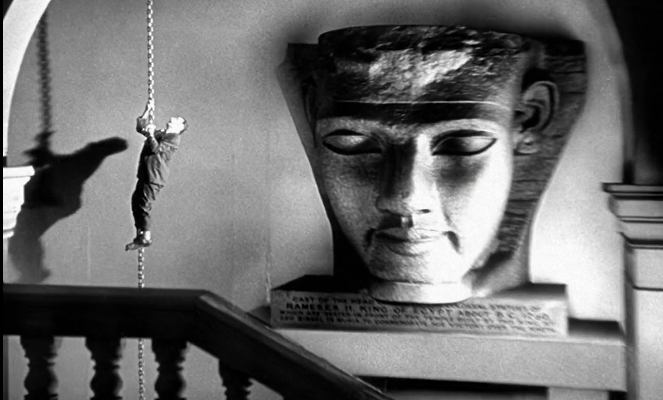
Mavis Marlowe (Constance Dowling) is a torch song singer living in luxury in Los Angeles. Her somewhat estranged, alcoholic husband Marty Blair (Dan Duryea) comes to visit her on their anniversary, but she leaves strict instructions with her doorman that he’s to be prevented from entering the building. Rousted from the lobby, Marty watches as another man (Peter Lorre) approaches and is allowed in to visit her. Sometime later, Kirk Bennet (John Phillips) comes to Mavis’s apartment and finds her dead; a recording of her biggest song “Heartbreak,” composed by Barry, plays on repeat. Kirk lifts the phone to call the police when he hears a noise in the other room and returns to find that a notable piece of jewelry, a heart-shaped ruby brooch, has been taken from her body, before he’s startled by the return of Mavis’s maid, who identifies him to police. Kirk is quickly convicted and sentenced to execution, and it falls to his wife Catherine (June Vincent) to try and clear his name. To that end, she and Marty team up, posing as a musical duo act and infiltrating the club of Lorre’s character, whom we learn is named Marko. They’re convinced that, if they can get into his safe, they’ll find the missing brooch and be able to clear Kirk’s name, but time is quickly running out. 

If certain parts of that plot summary sound as familiar to you as they did to me, then you’re probably noticing the similarities in structure to The Phantom Lady, a noir directed by Robert Siodmak that came out just two years prior. The wrongfully convicted killer in Phantom Lady was accused of murdering his wife, with his secretary being the only one to believe in his innocence, while Black Angel’s dead man walking is put away for killing his blackmailer (and perhaps mistress) and only his wife has faith in him. Other than that, the schematic of the film is much the same, with Catherine/Kansas finding her respective police investigators mostly unhelpful until she does his job for him by finding exonerating evidence. Each woman is assisted in this endeavor by someone who seems to fall in love with her a little and who (spoiler alert) turns out to be the actual killer. Each woman successfully manages to secure her husband’s release, just in the nick of time, and everything ends happily ever after. Why are they so similar? 

One might assume that the whiff of Black Angel feeling like an off-brand Phantom Lady can be attributed to the fact that both are adaptations of novels by Cornell Woolrich. Black Angel, in particular, was a re-working of a couple of earlier short stories into a longer work, something Woolrich did consistently throughout his career, so it would be logical to assume that this was just one of his variations on a theme. The summaries I have found of the Black Angel novel, however, paint a different picture about its source material, namely that Alberta (as she is named in the text) ends up ruining the lives of the other four male suspects and is changed internally by the lengths that she went to in order to save her husband and the things she saw that she can never forget. That’s not the structure of the film(s), which see the true culprits of the relative plot-instigating murders meet different ends but are identical in their happy reunion between the freed innocent men and the women who saved them. Black Angel the novel is more melancholy and bittersweet. From that, we have to assume that the film was produced with the directive that it ape Phantom Lady as closely as possible while keeping the characters and relationships from Black Angel’s source text, and while that might make this film more enjoyable in isolation, seeing it so soon after the superior Phantom Lady causes this one to suffer in comparison. 

What this film does feature in its favor is yet another deliciously slimy performance from Peter Lorre, who is wonderful here as the villainous Marko. He’s got a great scene partner in the form of his “heavy,” Lucky (former boxer Freddie Steele), and the two of them have utterly watchable chemistry as the mastermind and his lunkhead enforcer. As Marko is ultimately revealed to have had no hand in Mavis’s death, one could criticize the narrative cul-de-sac in which Catherine and Marty infiltrate his nightclub as pointless, but despite the amount of screen time that it occupies, the breathless pace of this eighty-minute feature means that the red herring doesn’t feel like time wasted. If Marko were played by an actor with less magnetism than Lorre, it might be a different story. June Vincent is also quite good, but it’s not enough to really carry this one across the finish line. I’m more intrigued now to read the novel than I am to give this one another watch. It’s competent, but not exciting. 

-Mark “Boomer” Redmond