Black Widow (2021)

About every 1.6 weeks, someone gets on Twitter and asks some variation of “What’s the best tweet of all time?” There is always of course, the trotting out of the greats, like this one, this one, this classic, this jab, this burn, this zing, mockery of the New York Post, a personal favorite, someone who presumed the universality of a ludicrous idiosyncratic belief and chooses to dickishly ignore that they’re completely wrong, and of course, the truly greatest tweet of all time (and these two, which go out to my friends back home). But what’s “best” anyway? For me, all of these pale in comparison to this tweet, which I think about at least once a week: 
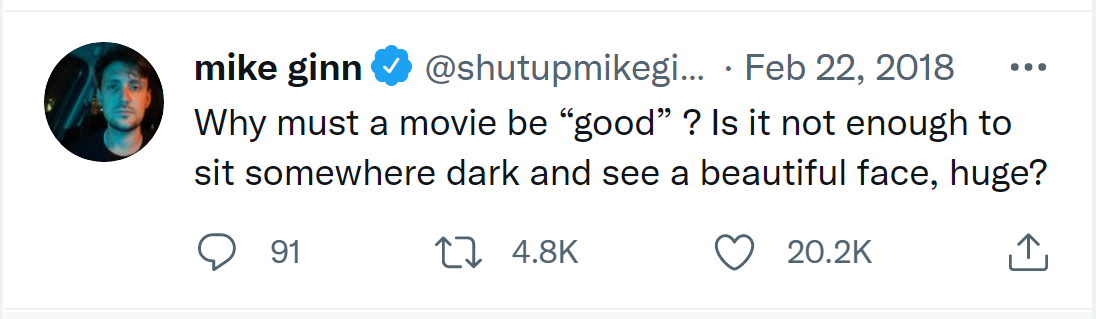
It came to mind again most recently yesterday, as I sat in a movie theater for the first time since Emma., watching Scarlett Johansson and Florence Pugh engage in a car/motorcycle/tank chase through the streets of Budapest and into the city’s subway, exchanging quippy dialogue all the while. In that moment, I flashed back to the similar car chase sequences in Berlin in Civil War, Seoul in Black Panther, San Francisco in Ant-Man and the Wasp, and [Cleveland as D.C.] in Winter Soldier, as well as probably others that I’m forgetting. And although this was another movie that largely stuck to the tried-and-true Marvel formula, I thought to myself, Why must a movie be “novel’? Is it not enough to sit somewhere dark and see a thrilling car chase through a metropolitan area, huge? After all, although this isn’t the first MCU film all about one of our lady heroes, it’s leaps and bounds better than Captain Marvel, which I gave a high star rating to upon release but was largely tepid about it in the review proper (I literally wrote “I’m hot and cold on this one”) and which I look back on now mostly with contempt, as its imperial Yvan eht Nioj underpinnings have only become clearer with the passing of time. 

I’ll admit here that, by and large, it’s pretty easy for a film to manipulate me emotionally (the people would like to enter into evidence my likewise high star rating for 2016’s Ghostbusters), and it’s also not just films that do it. The Alamo Drafthouse has, for the past few years, used the same simple animated introduction before new releases where several colored circles appear, then overlap, then space out to mimic planets orbiting a star, then come back together to embody the six circular cut-outs of the classic film reel canister. My description is overselling the complexity, I think, but I can’t find it online anywhere so forgive me. The sound design of it is fairly simple as well, but this time, after the theater darkened and the traditional Alamo font appeared on screen saying “We missed you,” the pre-show included a montage of clips of characters from the movies at the movies: Amélie, Taxi Driver, Cinema Paradiso, etc., and then the bonging tones of that intro came together, and I was overcome. It felt like coming home, and if I’m warmer to Black Widow than it truly deserves because of it, well, maybe the people will have to enter this review into evidence one day, too, but for now, I have to say, I really liked it. Even my best friend, who is generally apathetic to Marvel movies, thoroughly enjoyed it; immediately afterward, she said she would be willing to pay to see it again, and when we were considering watching another movie back home last night, she said she’d rather just watch television than another movie because she enjoyed Black Widow so thoroughly that she wanted to “marinate” in it a while before another cinematic experience watered it down. Take from that what you will. 

We open in Ohio in 1995, where a young Natasha (Ever Anderson, daughter of Milla Jovovich and Paul W. S. Anderson) rides her bike through suburban streets and into her backyard, where she plays with her younger sister, Yelena (Violet McGraw). When Yelena skins her knee, their mother Melina (Rachel Weisz) attends to her, and there appears to be some tension between Natasha and dear old mom. As night falls, Yelena notes the appearance of fireflies in their backyard, and Melina gives her daughters a little science lesson about bioluminescence. While they set the table, father Alexei (David Harbour) returns home, agitated. He shows Melina a 3.5’’ floppy and notes that “it” is “finally happening.” As Melina whispers a meaningful apology to Natasha at the dinner table, Alexei grabs a rifle and the entire family hops into their SUV and makes haste toward a small airstrip, with S.H.I.E.L.D. agents in pursuit shortly. After a tense shootout, the family manages to make their getaway in a prop plane and land in Cuba, where we learn that the “family” is comprised entirely of Russian agents, even the two children, and that the past three years in America have been part of a long term operation at a secret S.H.I.E.L.D. facility. Natasha attempts to prevent her separation from Yelena, citing that the younger girl is only six years old and too young for training, but Alexei notes that Natasha herself was even younger when she first began, and the two of them are forced apart on the orders of General Dreykov (Ray Winstone). 

After an opening montage (set to a downbeat cover of “Smells Like Teen Spirit”) gives us the general impression of what constitutes a Black Widow’s training in the “Red Room” (it’s not fun!) we move forward to 2016. The rest of the film is set parallel to the events of the aforementioned Captain America: Civil War, following Natasha (Johansson) in hiding after siding with Cap against Tony re: The Sokovia Accords. Elsewhere, Yelena (Pugh) and a team of fellow Black Widows tracks down and ultimately kills a rogue Widow, but not before her former ally exposes her to a red dust that acts as a counteragent to Yelena’s Black Widow programming, which we learn has grown beyond conditioning and brutal training to literal mind control. Natasha makes her way to a safe house in Norway with help from her friend Mason (O-T Fagbenle), who also delivers some things left behind at her last safe house in Budapest, which includes a package from Yelena that contains several vials of the red dust; the dust, in turn ends up drawing the attention of Taskmaster, Dreykov’s right hand killer, who has the ability to mimic the fighting styles of anyone from merely watching a video. Yelena and Natasha reunite and decide to destroy the Red Room once and for all. In order to do so, they must first rescue their “father” from the Siberian gulag to which he has been sent; the former “Red Guardian,” the only successful supersoldier equivalent of Captain America who was produced by the Soviet Union not relives his glory days in stories told to his fellow inmates and is mocked by his guards. He, in turn, leads them to their “mother,” who reveals that she was the scientist who worked on the beginnings of the mind control project. But can any members of this reunited not-really-a-family trust one another long enough to stop Dreykov? 

Look, this is a Disney’s Marvel Cinematic Universe consumable product. You’ve already decided if you’re going to see it or not, and if you’re going to see it, whether you’ll do so on a big screen, fork over an exorbitant amount of money to watch it on Disney+, or wait for a more affordable at-home option. It exists to sell toys, costumes, and trips to theme parks while continuing to build the Disney monopoly that we should all be more worried about since the overseers of antitrust laws are asleep at the wheel, and probably would be more worried about if we weren’t all (a) contemplating our insignificance and powerlessness to stave off the climate disaster that will boil, drown, bury, burn, smother, etc. us all alive, or (b) living in a state of denial of said looming extinction event. Its emotional beats are rote, its storytelling checkpoints are familiar, and the forward thrust of its characters is largely moot considering that, as of 2019, Natasha Romanoff is dead. For what it’s worth, at least Disney isn’t trying to insultingly push Black Widow as “empowering for girls/women” (one can read the text that way, but it’s not part of the metatext for once, and the film itself calls attention to the fact that Natasha’s dark past as an assassin renders her “hero” status among “little girls” problematic, to say the least). This film is also decidedly Not For Children, given its use of the visual language we associate with human trafficking to illustrate the horrors of the Red Room as well as the higher-than-normal profanity and a fairly graphic verbal description of the Red Room’s sterilization procedure. 

I’m sure that there will be some reviews that cite the film’s “heart,” although I would warn readers to take that with a grain of salt. The “reunited family that was really composed of spies but who could be a found family” element is present, and all of the cast (Pugh in particular) sell this angle in their performances, but how much it will resonate with you as a viewer will depend on a lot of factors that are external to the film proper. I wasn’t sold on it, but I still had a blast, and the setpieces here are some of the best that this franchise has brought to the table. Pugh is great in this first entry for her into the MCU, and Harbour brings an effortlessly comedic touch to the proceedings. Weisz has never given a bad performance ever, and her Russian accent here is a delight. It’s a shame that Johansson is finally given a vehicle in this series that is hers and hers alone and it must be an interquel due to the choices made in other films, but she’s been carrying films on her back since she was a literal child, so it’s no surprise that she delivers here in her postscript swan song. If you’re going to see it, see it, before we’re all dead.

-Mark “Boomer” Redmond

Movie of the Month: Starstruck (1982)

Every month one of us makes the rest of the crew watch a movie they’ve never seen before and we discuss it afterwards. This month Brandon made HannaBoomer, and Britnee watch Starstruck (1982).

Brandon: I’ve been thinking a lot about movie musicals lately.  Not only are the releases of Lin-Manuel Miranda’s In the Heights and Steven Spielberg’s West Side Story remake threatening to dominate online film discourse all the way through next Oscars season, but we also recently discussed the grim, reality-grounded stage musical London Road as a Movie of the Month selection.  In his intro to London Road, Boomer mentioned a few reasons why the movie musical is a medium he struggles to connect with as an audience—its awkward rhyme schemes, its Declared Feelings, its emotional artificiality, etc.—a few of which I bristle at myself.  The real reason I struggle with most musical theatre, though, is that I often just don’t care for its music.  The singing-for-the-back-row emotional projection of most traditional, stagey musicals strikes me as a kind of false, strained earnestness that takes me out of the promised fantasy of the artform.  When I think of movie musicals I do love—Rocky Horror, Velvet Goldmine, Hedwig, The Lure, etc.—they’re often the ones that indulge in the punk, glam, synthpop, and new wave musical tones I already listen to in my idle time.

In that respect, the 1980s new wave extravaganza Starstruck is perfectly suited for my movie musical tastes.  Not only does it operate like a rough prototype for 90s Australian gems like Strictly Ballroom, Muriel’s Wedding, and The Adventures of Priscilla, Queen of the Desertall huge tastemaking discoveries for me as a young film nerd—but it also plays like a jukebox musical adaptation of Cyndi Lauper’s landmark debut She’s So Unusual, one of the greatest pop albums of all time.  If you’ve ever found yourself watching a marathon of Cyndi Lauper music videos on YouTube (if you haven’t, who are you?) you’ll notice that there’s a vaguely defined storyline from that She’s So Unusual album cycle wherein Lauper is a bubbly, working class teen desperate to escape her restrictive household to find other artsy weirdos like her in the big city outside her reach.  Starstruck was released at least a full year before that album but follows a remarkably similar storyline: a bubbly teen who’s tired of working the counter at her family’s local pub maneuvers her way into fronting a new wave punk band, then a Top 40s pop career (thanks largely to collaborating with her younger, manically ambitious cousin) where she excels as her So Unusual self.  There’s some indulgences in record industry satire, let’s-save-the-pub community rallying, and television broadcast heists along the way, but largely the film is a fantasy-fulfillment for the same sheltered, artsy kids who saw their ideal selves blooming in Lauper’s avatar a year later.  And it’s just as satisfying here as it is in those videos.

Speaking of music videos, I think the main reason Starstruck works so well for me as a movie musical is that its break-from-reality performances are presented in the visual language of early MTV broadcasts.  Given how much of my idle time is still spent YouTubing videos from 80s icons like Lauper, Kate Bush, and Madonna, that MTV-specific version of fantasy-fulfillment cinema speaks to me in a way most musical theatre can’t.  The new wave music & fashion of Starstruck is pitched exactly to my tastes, and the movie only strays from those modernized music video pleasures to (lovingly) mock the traditional movie musical as outdated kitsch (most notably in a Busby Berkeley synchronized swimming sequence featuring a pool packed with oiled-up muscle boys).  It’s my ideal version of its genre, and I can’t believe it’s not more routinely cited as an all-time classic.

Boomer, was Starstruck able to sneak past your own genre biases, or did its new wave-ification of the artfrom still fall flat in the face of your general movie musical skepticism?

Boomer: I was initially resistant to giving in to Starstruck‘s allure in much the same way that the first time I saw God Help the Girl; despite my absolute and utter adoration for all things Belle & Sebastian (a close friend gave me a copy of The Life Pursuit for my recent birthday and it hasn’t left the turntable yet), I had a hard time surrendering to Stuart Murdoch’s twee vision until the first non-title musical number well and truly won me over. With regards to Starstruck, I had the same hesitancy, and was also immediately set a bit off-kilter by its odd opening that dispensed with the normal film structure–there’s no studio or distributor logo, we’re simply thrust straight into the opening credits. From there, we meet our two leads in a brief intro scene that’s mostly taken up by a phone call that obscures both of their faces. Before the film even hits the three minute mark, Phil Judd from The Swingers is staring straight into the camera and singing “Gimme Love,” and by the seven minute mark, Jackie Mullens (Jo Kennedy) is doing her own musical number, singing “Temper Temper.” And I … wasn’t really having a great time, if we’re being honest. As I’ve noted before, the two things that I dislike most about typical Western musicals are the artificially earnest “musical voice” that’s a hallmark of “classically” trained singers and the belabored nature of musical lyrics, as plot points and exposition are beaten into submission in order to match a rhyme scheme and rhythm. As to the former, I much prefer the raw earnestness of your average local garage band to the operatic diaphragming of the university, and although Kennedy’s untrained and—frankly—confrontational vocals certainly aligns with my preferences, the strong-armed rhyming lyrics are very much in the style of those of traditional musicals: So trigger happy you get vicious / Also getting malicious / And you throw the dishes. I know that those are real lyrics because The Swingers were a real band, but they’re painful.

But then … as soon as “Temper Temper” ends at about 8.5 minutes in, the “musical” part of this musical dries up for nearly 30 minutes, and we just get to enjoy the antics of Angus (Ross O’Donovan) and Jackie as they try to make Jackie famous. When Jackie first starts to tightrope walk in the family pub, the film was giving such strong The New Adventures of Pippi Longstocking vibes that I couldn’t help but enjoy myself, because I realized that what I had initially interpreted as just another “teenager wants to be a star” narrative, with all of its well-worn waypoints that we know from previous films in the genre, was actually a fantasy for children (the nudity, swearing, and smoking notwithstanding). The elaborate set piece that follows, in which Jackie dangles precariously from a wire between two buildings, was a genuine thrill in which there’s no real danger, unless you put yourself into the accepting mindset of a child who thinks Jackie may actually plummet to her death. That this is prelude to “Body and Soul,” which was the best and most energizing musical number to that point, only makes it that much more fun. The song itself wasn’t necessarily better than the dead-in-the-water tracks that frontloaded the picture, but that it’s not framed as an on-stage performance lends itself to a feeling of genuine spontaneity, and the frenetic energy of the family and the ever-present barflies as they dance around and sing is infectious, and the backing band gives it an effervescent quality that was lacking in the first two numbers. It’s genuinely catchy! 

And then we have our first (and only) song that’s a showpiece for Angus, and even though Angus is by far the most fascinating and magnetic character in this movie, it’s also … not very good. However, as musical producer/host Terry (John O’May) says to Jackie at one point after she botches a show, “There’s only boring and interesting, and you certainly weren’t boring;” and Angus is never boring. This is about the point where the movie really started to lose my interest: Angus’s number, “I Want To Live In a House,” fun as it was, ends at 55:05, and it’s less than two minutes before Jackie does her disastrous rendition of “My Belief in You,” which lasts over three minutes of screen time (56:45-59:48), and then it’s less than ninety seconds before Terry and Jackie perform “Tough,” which itself clocks in at five long minutes (60:07-65:07). Five minutes later, we’re in another musical number (“It’s Not Enough”), this time a sappy ballad, but it’s mercifully short. When looping back to take notes about those time codes, I think that “I Want to Live in a House” works fairly well in isolation and suffers primarily from its proximity to several consecutive stinkers, and although it’s not a good track, I was thoroughly charmed by the performances and dancing of Donovan and the backing band (mostly comprised of members of The Swingers minus Phil Judd, but also our love interest Robbie, as played by Ned Lander). It’s interesting, not boring, like the tracks that follow it. After this overstuffed middle section, we head into our final act, in which we spend a goodly amount of time with the Mullens family, as they have what may be their last Christmas together in their apartments above the pub and commiserate about the possibility of losing their business and home. After that, the last performances at the opera house are pretty fun, counterposed with the Mullens et al watching the performance and doing their little old people dances, and I was pleased in spite of myself. 

So I would have to say that, yeah, the New Wave nature of the music did do some of the legwork of making the musical part of this musical more palatable. The lyrics of the songs were still very much in line with what annoys me about the traditional musical—It’s the monkey in me that makes me want to do it / It’s the monkey in me that makes me want to chew it is a lyric written by an alien trying to imitate human music after only having heard “Rock Lobster”—but the energy and unadulterated, unpolished performances really made up for it. The musical sequences would perhaps be better served from being more spaced out, rather than happening in multiple clumps, but there’s an argument to be made that putting all of the worst ones in the middle and lumping them together helps you get through them more efficiently. 

Britnee, a few weeks back my best friend and I were sitting around and watching Cyndi Lauper videos (as one does), and she asked me if I thought a woman with Lauper’s lack of “traditional” talent would be able to make it in the current musical market. I’m of the mind that it’s possible, since it’s more difficult for most people to sing along with a classically trained vocalist as opposed to someone whose range is “whatever range the listener is in” (Lindsay Ellis once made this comparison between Christina Aguilera, who is inarguably a better vocalist, and Britney Spears, who is the better performer; Aguilera has something in the range of four octaves that she can dance between, while Spears has a broader appeal because it’s a lot easier to keep step with “Toxic” than, say, “Beautiful”). I have no interest in shaming Jo Kennedy, but she’s in the latter camp, with a sound that’s very similar to Lauper’s high, nasally own. Do you think that if Jackie were a real person, she would have had a real chance to make it big in 1982? Do you think she would have a chance now?

Britnee: I honestly never made the Cyndi Lauper connection with Jackie, but that definitely makes sense. I don’t think that Jackie would have made it big in the world of mainstream pop in 80s though. She’s too cool for any of that nonsense. She reminded me a lot of Kate Fagan (especially with Kate’s hit “I Don’t Wanna Be Too Cool”), but with a little more quirkiness. At most, she would have been more on the popular side of underground 80s pop/punk. I actually think she would find more mainstream success today. With social media being a huge component to the success of musicians, especially in the world of Pop, she would be a hit! If nothing else, her tightrope stunt would be all over TikTok and the Gram, reaching millions around the globe. 

I do agree that Jackie’s strength lies more in her performance than her voice, but my god, this soundtrack is so damn good. I love pretty much every song, especially “I Want to Live In A House” and “Body and Soul”.  And all of the outrageous performances that go along with the songs are chef’s-kiss spectacular. That’s something that musicals don’t always do as well as Starstruck. The wacky hijinks and action constantly happening around the musical numbers add to the entire feel of the movie. It’s so high energy and fun without falling into any boring slumps. 

Other than the fabulous tunes, I think the other component of this movie that blows it out of the water is the eccentric pub crowd. The lady covered in leopard print, her Lifetime movie mom, Nana, the bird, and the rest of the gang could have had their own TV show that I would have watched without a doubt. Not to mention the gorgeous pub décor and tiling. While that part of the film was a huge win for me, I did have some difficulty following along with some part of the plot. Especially the drama in her family. I knew that Angus was Jackie’s cousin, but I was so confused by the dynamics between her mother, father, and uncle. I honestly thought that her uncle was her widowed/divorced mother’s boyfriend for a bit. It was just hard for me to keep track of that story while focusing on Jackie’s journey to stardom. 

Hanna, what do you think about Jackie’s family drama happening in the background? Was it necessary or added anything extra to the movie? 

Hanna: I also had a hard time understanding the family dynamics; I consistently mixed up brothers, cousins, uncles, and romantic partners up until the very end of the film. I definitely thought Pearl was having a fling with her brother for a minute. I have pretty terrible hearing, so I would blame 80% of my confusion on the thick, wondrous Aussie accents. I wasn’t that invested in the particular relationships as a result, but I think the haze of confusion actually complemented everything I liked about the film; it added another little another little layer of chaos over the dance numbers and bare-breasted publicity stunts. On top of that, I enjoyed each family member so much (Nanna is a sweetie, Pearl’s outfits are A+, and I’m a sucker for Uncle Reg’s cockatoo) that I was happy to watch them saunter around Sydney and Pearl’s beautiful pub without quite knowing what was going on.

Besides, the film with or without the drama is absolutely delightful. I was totally charmed by Jackie, Robbie, and the weird little pub community. There are so many delicious visuals that have stuck in my mind: the seafoam barmaid dress! The pool boys with their big inflatable sharks! The big red kangaroo outfit! Jo Kennedy’s performance alone makes Starstruck worth the watch; she carries her plucky new-wave energy with an effortless joy, and her rabid determination to stardom give the film a fantastic backbone. Basically, Starstruck is a whole lot of fun, and you should watch it; I love watching musicals when I’m in the mood for a visual feast with a bare minimum of conflict, but I never dreamed that the pop-punk version of musical escapism was out there waiting for me.

Lagniappe

Hanna: I am completely in love with the sweeping curved bar and the splashes of tile Pearl’s pub, which was filmed in the Harbour View Hotel in Sydney. It’s one of the most unique locations I’ve seen in a long time (Hilly Blue’s mansion in Trouble in Mind gets second place; I would love to go on a Swampflix MOTM location tour). It looks like the bar was renovated with wood paneling, and all of the beautiful colorful tile is gone. It’s still gorgeous, but I’m crushed that I’ll never be able to see the pub in its kitschy prime. 

Britnee: Jackie’s cousin Angus had a look that reminded me a lot of AC/DC’s guitarist Angus Young. They both wore blazers with shorts, both were named Angus, and they both were Australian. I don’t think this means anything, but I thought it was interesting and worth mentioning!

Boomer: It’s worth noting that the lead singer of The Swingers, Phil Judd, was much more handsome than Ned Lander, who plays the love interest, Robbie (for what it’s worth, I think Lander looks much cuter now in his older age). I can only imagine two reasons why they didn’t use him in the film outside of his appearances at the beginning and end during the “Gimme Love” and “Starstruck” musical numbers, respectively: (a) at nearly 30, it was too creepy to have him act as love interest to the supposedly teenaged Jackie, or (b), he refused to stoop to doing the “litter box” choreography for the “I Want to Live in a House” segment.

Also, if you’re a sci-fi fan and saw the name “Melissa Jaffer” in the credits and recognized Mrs. Booth and weren’t sure from where, it’s because she’s Noranti! From Farscape!  

Brandon: While Jackie’s fashion sense and persona both strongly resemble Cyndi Lauper’s, I think her vocal style lands much closer to Lene Lovich’s, especially in the song “Temper, Temper”.  If Jackie were a real-life performer in the 1980s, I think she could have easily “made it” on the level of Lovich’s minor-league version of success: a few decent new wave albums on a mid-card record label like Stiff, followed by decades of obscurity in the shadow of more memorable performers of the same ilk like Kate Bush, Nina Hagen, and Siouxsie Sioux.  As an eternal sucker for new wave kitsch who owns most of Lene Lovich’s output on vinyl, I can almost guarantee I’d have Jackie Mullins records on my shelf right now if they existed.  I’m actually frustrated that I don’t own the Starstruck soundtrack, as it’s wonderful from start to end (contrary to some outrageous claims made elsewhere in this conversation).

Upcoming Movies of the Month
August: Boomer presents Sneakers (1992)
September: Britnee presents Hello Again (1987)
October: Hanna presents Lisa and the Devil (1973)

-The Swampflix Crew

Lagniappe Podcast: Bacurau (2020)

For this lagniappe episode of the podcast, BoomerBrandon, and Alli discuss the radical sci-fi parable Bacurau, one of Swampflix’s favorite films of 2020.

00:00 Welcome

02:30 The X-Files
09:45 Sasquatch (2021)
12:00 Scream, Queen! My Nightmare on Elm Street (2020)
13:00 Bo Burnham: Inside (2021)
15:05 Saint Maud (2021)
17:30 Memories of a Murder (2003)
20:30 The World to Come (2021)
23:30 Wojnarowicz (2021)

25:52 Bacurau (2020)

You can stay up to date with our podcast through SoundCloudSpotifyiTunesStitcherTuneIn, or by following the links on this page.

– The Lagniappe Podcast Crew

Lagniappe Podcast: Godzilla vs. Hedorah (1971)

For this lagniappe episode of the podcast, BoomerBrandon, and Alli discuss the psychedelic kaiju classic Godzilla vs Hedorah (aka Godzilla vs The Smog Monster, 1971).

00:00 Welcome

01:20 Guy Maddin
02:30 White Rock (1977)
04:28 Ariel (1988)
07:10 Return to Oz (1985)
09:55 Logan Lucky (2017)
10:50 The New Mutants (2020)
14:40 Mr. Roosevelt (2017)
20:25 Starstruck (1982)
32:30 Voyage of the Rock Aliens (1984)
36:22 Willy’s Wonderland (2021)

41:20 Godzilla vs Hedorah (1971)

You can stay up to date with our podcast through SoundCloudSpotifyiTunesStitcherTuneIn, or by following the links on this page.

– The Lagniappe Podcast Crew

Lagniappe Podcast: Eating Raoul (1982)

For this lagniappe episode of the podcast, BoomerBrandon, and Alli discuss Paul Bartel’s swinger-culture sex comedy Eating Raoul (1982).

00:00 Welcome

03:40 Thoroughbreds (2017)
04:20 Free Fire (2016)
08:20 Crazy People (1990)
10:25 The Lost Boys (1987)
12:00 Little Joe (2019)
15:20 The Stuff (1985)

18:30 Eating Raoul (1982)

You can stay up to date with our podcast through SoundCloudSpotifyiTunesStitcherTuneIn, or by following the links on this page.

– The Lagniappe Podcast Crew

Movie of the Month: Chicken People (2016)

Every month one of us makes the rest of the crew watch a movie they’ve never seen before and we discuss it afterwards. This month Hanna made BrandonBoomer, and Britnee watch Chicken People (2016).

Hanna: The United States loves to kill chickens. It’s the most popular meat in a country of meat-lovers, and we produce more than any other country in the world; in 2019, the US slaughtered and sold about 9 billion chickens. Between 50–90% of them were raised on large industrial farms called Concentrated Animal Feeding Operations (CAFOs), which are famous for imposing physical and genetic misery on their animals for the sake of efficiency. It’s hard to get a clear picture of the standard conditions in the poultry industry, but at worst, broiler chickens (raised only for meat) are packed into dark, cramped pens for the entirety of their lives, crippled by their own weight, and repeatedly exposed to infection. In short, the key stakeholders in the industrial agricultural complex do not care about the lives and fates of their number one meat product.

Chicken People, a documentary directed by Nicole Lucas Haimes and distributed by CMT, follows the small and intense community of competitive poultry shows – a community that cares very much for the lives of their chickens. The documentary focuses on the lives of three competitors in particular—Brian Caraker, Brian Knox, and Shari McCollough—in the months leading up to the Ohio National Poultry Show, which is the largest of approximately 300 poultry shows in the United States. Chicken People makes it clear that competitors take the circuit seriously: they rigorously study The American Standard of Perfection (the chicken equivalent of the American Kennel Club’s standard dog breed guide) and meticulously breed their chickens for just the right waddle hue and feather clarity. Brian Knox is the Gregor Mendel of the group; he’s raised thousands of chickens, and his systematic breeding program tracks each individual lineage so he can pair chickens with complimentary traits. Brian Caraker, a musical theatre performer, treats The Standard like a Bible and sprays his chickens’ feathers with a glossy polishing spray, which “changes a farm chicken into a show chicken.” Shari McCollough spends multiple hours a day grooming her little Silkies into puffy white clouds.

Obviously, the chickens are the stars of Chicken People; these birds are masterpieces. All kinds of chicken breeds and varieties—Silkies, Wyandottes, Brahmas, Sultans, etc.—are represented in the chicken exhibitions, and some of them are shockingly strange and beautiful. I could stare at those vivid, high-contrast chicken shots with the black background for hours. I’m also totally fascinated by this subsection of American pageantry that honors, glamorizes, and obsesses over the cheapest, blandest staple of the industrial agricultural complex. The documentary is interspersed with mini interviews à la When Harry Met Sally, which mostly involve other contestants gushing about their beautiful chickens, and their unassailable love for these dumb birds that we eat every day fills my heart with joy.

The part of this documentary that I struggle with the most is the treatment of the subjects. I thought Haimes focused a little too much on the personal problems of the three main competitors to emphasize that “Chicken People” are a fringe group, especially when they went into detail on Shari’s history of addiction. It didn’t feel exploitative, exactly, maybe a little condescending. I also just wish it had focused a little more on the history of poultry and agricultural shows in the United States, and I wanted 1000% more chicken content. Britnee, how do you think the documentary treated the “Chicken People” as subjects? Do you think she was fair to the competitors? Is there anything you would have changed about her focus?

Britnee: Chicken People does a great job of highlighting the uniqueness and quirkiness of its three human subjects without feeling exploitive. Documentaries that are similar in subject are typically gross for how they make fun of how “weird” the stars of the show are, and I was concerned this one would go that route. I love that it remains focused on the chicken people’s passion and dedication to their feathery friends. It’s so endearing. Haimes also manages to do a fantastic job of balancing the focus on each of them without making one seem more important or entertaining than the other. They each had their own individual journeys, but all somehow felt equal. 

However, I do agree with you, Hanna. I wish there was more chicken content. I love the parts of the film where pages from The American Standard of Perfection took over the screen, explaining what made certain breeds of chicken perfect, and I especially enjoyed learning about how they are dolled up for competitions. I never really saw chickens as being beautiful before. I thought they were cute, but never really truly beautiful. After watching them so closely, I was truly stunned by so many of them. I’m definitely not going to be a chicken person or chicken owner anytime soon, but I have a newfound appreciation for their beauty and grace.

Boomer, I’m not sure what your experience is with chickens, but do you feel different towards chickens after watching Chicken People? Did the documentary spark an interest in the chicken universe?

Boomer: There’s a moment in Chicken People in which Brian Caraker says of his parents, “[They’re] not chicken people. I’m chicken people.” Well, dear readers, I’m not chicken people. But my mother is. 

Growing up, we had chickens for almost as long as I can remember. Every couple of years, once the last generation stopped laying, Mom would put in an order for a new dozen at the co-op for the coming spring, and when April came, the new chicks would come home. For the first few weeks of life, they resided under a heat lamp in a box that had a dedicated spot on top of the dryer in the trailer, and then atop the freezer chest once we built and moved into the house. At that stage of life, their downy chickfeathers were so soft that they seemed more mammalian than avian. The first group were Rhode Island Reds; the following generation was a mix of Plymouth Rocks and Orpingtons. Later still we even had an Ameraucana or two (the most common chicken that lays green-tinted eggs). As soon as they were able, they were moved to the coop; it was my job to let them out of it every day after school so that they could roam and eat the various insects of the field, collect their eggs, feed them their pellets, and clean and refill their water fountains. When recalling my childhood (to call it a “reminisce” would be remiss), it’s impossible to extricate those memories from their accompanying odors and the tactile sensation of the squish of chicken shit between my toes. And that’s not even getting into the eggs. I was 16 when I went off to boarding school, and it was a solid decade before I would again consume an egg with anything other than revulsion. As a result, the people with whom I felt the most sympathy or identification in Chicken People were not any of the competitors; while watching the elder Carakers miserably wash a chicken fountain, I had a full on Proust Remembrance. I tell you the truth: Orpington roosters are such fucking assholes

Well, that’s not entirely true. We lived—and my parents still live—in a place that was, paradoxically, deep country but not so rural that it was too far for city folk (for a given definition of both “city” and “folk”) to drop their old, unloved, or merely mutty hounds on our road. Near the end of Chicken People, recovering alcoholic Shari talks with a fellow competitor about the latter’s loving, gentle turkey that was killed by the neighbor’s dogs. Most of the time, when people came to abandon their animals, it was usually about a half mile away, at the bridge across the nameless finger of Redwood Creek that intersected our road. As such, there was never a lack of new, hungry, lost dogs in search of a meal. There was no love lost between me and those chickens, but it sure did break my mother’s heart to lose one, and no matter how much we fortified that coop and the pen, every few years, there was a massacre, throwing Mom into a depression for weeks, or even months. She grew up on a dairy farm and although our long, skinny 5 acres didn’t allow for even one cow, those chickens meant a lot to her, just like their fellow foul did to the Brians and Shari. 

I guess that’s where I have to part ways with the consensus so far; although both Britnee and Hanna wanted more chicken info, I was much more interested in the people who were drawn to chickens and driven by their love of them. I was particularly interested in Shari’s family, especially since we clearly saw them over a period of time, given that one of her daughters leaves home for college and is seen visiting later in the film, although I guess that’s just my personal biases at play. We learned a lot about the families of both of the Brians, but solely through the eyes of their parents and grandparents, as neither has children or a wife/husband (Brian Knox at least had a lady friend at one point, and they’re still friendly, which is nice), who are surprisingly supportive and kind, perhaps because of their own hobbies, like drag racing and miniature trains. If this were fiction, I’d expect to see more ambivalence or mixed feelings on the part of Shari’s kids, given that becoming a chicken lady helped their mother with her drinking problem, but her sober crutch also meant less room for them in her daily life, one would think. 

Personally, I’m generally distrustful of any media that ascribes human emotions, morality, and ideologies to animals. There’s a lot of anthropomorphization happening here on the part of the participants, who characterize their birds as “preparing to fight for [their] mate[s]” or  taking pride in their appearance, etc. On a recent episode of the Lagniappe podcast, I expressed my annoyance at the filmmaker behind My Octopus Teacher for his similar narrative actions; the interesting thing that’s happening there isn’t that the octopus has become his friend, but that he sees the action of the octopus and perceives it as being of a kind with his own complex emotions. For its part, Chicken People doesn’t have that same kind of anthrocentric understanding of animal intelligence, but I wouldn’t have minded seeing more of it, as that’s where one gets the insight into the people, who are more interesting to me than the chickens. Brandon, what are your thoughts? Did you think there was sufficient time spent with the competitors? Were there any of the competitors who participated in the shorter “talking head” sections that you would have liked to see more of in the body of the film proper?

Brandon: Like Hanna and Britnee, I also found the exquisitely bred & manicured show-chickens to be more fascinating than their imperfect human masters.  The most outright cinematic touches to the film are in the fine-art photography shoots set against a black void, where various chickens are examined uncomfortably close-up in high definition.  If there was any further narration or talking-head interview footage missing for me, it’s in the film’s potentially amazing Werner Herzog commentary track.  Herzog has a great talent for un-anthropomorphizing nature’s most peculiar beasts, and I’d love to hear him expand on his already stellar 2012 monologue about the disturbing nature of chickens into a feature-length philosophical rant.  I was particularly thinking about his horrified, abstracted reaction to chickens in the final sequence at the Ohio National Poultry Show, wherein a massive convention space echoes the continuous screams of hundreds of chickens for hours of unrelenting cacophony.  It’s a bizarrely hideous sound that no one in the room thinks to acknowledge, because they’re just used to being submerged in it.  Herzog’s always great for pointing out the strangeness of those kinds of horrifying experiences that have become normalized & familiar only through repetition.

Otherwise, I’m mostly satisfied with the balance of talking-heads-to-chicken-heads screentime ratio here.  As a Country Music Television production, Chicken People is closer to reality TV than it is to more hoity-toity docs like Gates of Heaven, and it does a decent job of constructing a narrative for each of its three main subjects within that template.  If it had been stretched out into multiple seasons of television, there would’ve been plenty enough room for more insight into the lives of its color-commentary interviewees, but at just 83min I think it was smart to limit its scope to just a few competitors.  My only real complaint with that balance is the way it’s squeamish about elaborating on Brian Caraker’s romantic life, a critique I also saw echoed in Julius Kassendorf’s review of the film for The Solute.  While the other two contestants talk about their heterosexual romantic partners at length, Caraker is only allowed to make vague hints that he is gay without every actually speaking the word out loud or making direct references to his past relationships.  I don’t know if that was Caraker’s personal decision or a mandate from the Conservative-leaning higher-ups at CMT Docs, but it’s a glaring omission all the same.  I wish we could’ve gotten to know Caraker better without having to tiptoe around the concrete details of his personal life, especially in contrast to how his competitors are treated.

Then again, Caraker was also the most compelling of the three contestants to me in almost every way.  He’s the only one of the titular chicken people who could rival the actual chickens for pure entertainment value – especially in those cutaways to his otherworldly stage performances in Branson, MO.  I could have watched an entire movie about him without the other two contestants ever butting in and left just as satisfied.

Lagniappe

Hanna: I’m SO glad that Brandon brought up Herzog’s wonderful monologue on the barbaric stupidity of chickens. My second favorite chicken quote is from Joshue Oppenheimer, who directed The Act of Killing: “Chickens are living manifestations of death, bred only to be domesticated and killed. When we look into their eyes, we see the part of ourselves of which we are most afraid – our ultimate destination. Death.” Such sweet little feathery canvases to project our mortal fears upon!

Britnee: The Modern Game Bantams may be my favorite breed of chicken featured here. They have long supermodel legs and it looks like they’re wearing little bike shorts. They make me so uncomfortable, but I can’t stop looking at them! I want a farm full of these little creeps.

Boomer: Orpington roosters are such assholes. I’d also like to note that Shari is missing a word in one of her interviews; she says (roughly) that “People think of chickens as dirty, smelly creatures, but that’s not true,” followed by a statement that “[she] spends 4 or 5 hours a day grooming her chickens.” There’s a big because missing right there in the middle. Chickens are dirty, at least from a certain perspective, as they do clean themselves in dirt, like a lot of birds. They absolutely do shit positively everywhere as well; look no further than the fact that so many talking head interviewees have extensive diapering systems for their chickens as proof.

Finally, it seems like Brian may have gotten his wish to open a farm, if this Facebook page for Caraker Farms is any indication (according to the info panel, they are “very responsive” to messages). He also has a Twitter account, although it appears to be largely inactive, given that his last tweet was from 2014, in which he expressed interest in a Mitt Romney candidacy in 2016.   

Brandon: As sweetly quaint as this documentary is, I do think Chicken People would also make a great title for a horror film, like the poultry version of Alligator People.  We’ve seen a horror take on humanoid chicken people before in films like Tod Browning’s Freaks and Troma’s Poultrygeist: Night of the Chicken Dead, so it’s not that far outside the realm of possibility.  Even in their pampered beauty-contest version here, the little edible dinosaurs are just as creepy as they are oddly beautiful, and I think that imagery could easily be mined for more creature-feature monstrosities.

Upcoming Movies of the Month
July: Brandon presents Starstruck (1982)
August: Boomer presents Sneakers (1992)
September: Britnee presents Hello Again (1987)

-The Swampflix Crew

Lagniappe Podcast: Castle Freak (1995)

For this lagniappe episode of the podcast, BoomerBrandon, and Alli discuss the Full Moon creature feature gross-out Castle Freak (1995), directed by Stuart “Re-Animator” Gordon.

00:00 Welcome

02:00 The Miracle of Morgan’s Creek (1944)
03:23 Mr. Arkadin (1955)
04:05 The Queen of Black Magic (1981)
07:00 My Octopus Teacher (2020)
07:55 Death of Me (2020)
10:28 We Summon the Darkness (2020)
11:34 Mary Shelley’s Frankenstein (1994)
13:20 Speed Cubers (2020)
16:25 Save Yourselves! (2020)
17:33 Dating Amber (2020)
19:55 Christine (2016)
23:42 Madame (2021)
27:47 Beast Beast (2021)

32:15 Castle Freak (1995)

You can stay up to date with our podcast through SoundCloudSpotifyiTunesStitcherTuneIn, or by following the links on this page.

– The Lagniappe Podcast Crew

Lagniappe Podcast: The Secret of Roan Inish (1994)

For this lagniappe episode of the podcast, BoomerBrandon, and Alli discuss the children’s fantasy film The Secret of Roan Inish (1994), a gently magical folktale about selkies from director John Sayles.

00:00 Welcome

01:00 Beastly (2011)
01:40 House of the Witch (2017)
02:22 The Eagle (2011)
03:28 Jurassic World: Fallen Kingdom (2018)
05:51 The Core (2003)
06:51 Deadcon (2019)
08:30 The Wretched (2019)
09:50 Death Machine (1994)
12:00 The Hidden (1987)
13:55 The New Adventures of Pippi Longstocking (1988)
15:00 Over the Garden Wall (2014)
15:45 The Exorcist (1973)
18:22 Candyman (1992)
20:17 Promising Young Woman (2020)
22:23 Teeth (2007)
25:25 The Power (2021)

27:43 The Secret of Roan Inish (1994)

You can stay up to date with our podcast through SoundCloudSpotifyiTunesStitcherTuneIn, or by following the links on this page.

– The Lagniappe Podcast Crew

Movie of the Month: Trouble in Mind (1985)

Every month one of us makes the rest of the crew watch a movie they’ve never seen before and we discuss it afterwards. This month Britnee made BrandonBoomer, and Hanna watch Trouble in Mind (1985).

Britnee: Director Alan Rudolph’s 1985 film Trouble in Mind is truly a one-of-a-kind classic. It’s a neo-noir that blends in 80s new wave kitsch, creating its own genre that I like to call New Wave Noir. I’m not sure there are any other movies that would fall into that genre. Maybe Cool World or Who Framed Roger Rabbit? could qualify, but they’re way more on the fantasy side. I didn’t get around to watching Trouble in Mind until a few years ago when I was obsessing over Marianne Faithfull. After reading Faithfull: An Autobiography, I was constantly listening to her music, and that’s when I came across her rendition of the blues classic “Trouble in Mind”. I discovered that it was used in a film with the same title starring Kris Kristofferson, Lori Singer, and an out-of-drag Divine. That was more than enough to draw me to the movie, and it turned out to be such a hidden gem.

In the fictional Rain City (it’s basically Seattle), an ex-cop/ex-con with the most neo-noir name ever, Hawk (Kris Kristofferson), becomes entangled in the lives of a young couple from out in the country. Coop (Keith Carradine) and Georgia (Lori Singer) drive into Rain City in their beat-up camper to build a better life for themselves and their baby named Spike. Hawk, Coop, and Georgia are all brought together by a diner owned by Hawk’s ex-lover Wanda (Geneviève Bujold). Coop gets involved in selling knockoff watches and quickly gets pulled into Rain City’s criminal underworld, run by Hilly Blue (Divine). Coop’s fashion choices become progressively more cartoonish as he sinks deeper and deeper into the world of crime. His hair becomes a growing new wave pompadour, his face becomes paler, his outfits get wilder, and his makeup becomes increasingly intense. It’s my favorite thing about this movie. He literally becomes a new wave monster. While Coop is out and about being a criminal, Hawk sets his eyes on Georgia. He gets the hots for her and becomes her “protector”, even though I find him to be pretty creepy when it comes to how he forces himself into her life.

One major aspect of Trouble in Mind that really didn’t make much sense and was completely unnecessary is that Rain City is under militia patrol and some of the characters randomly go from speaking Korean to English. The state of the city is never really explained and doesn’t add much to the story. Brandon, what did you think about Rain City’s militia and random Korean lingo? Would the film be any different if that component just didn’t exist?

Brandon: If I had to guess what they were going for with the militia patrols and American/Korean cross-culture, I’d say they were borrowing a little New Wave Noir finesse from Ridley Scott’s 1982 game-changer Blade Runner.  Trouble in Mind may take production notes from Seoul instead of Hong Kong, but its retro-futurization of Seattle feels like a direct echo of Blade Runner‘s retro-future Los Angeles.  The difference is that Blade Runner is explicitly set in the future (2019, to be exact), updating the familiar tropes & fashions of noir with a sci-fi bent.  Trouble in Mind, by contrast, doesn’t really subvert the noir genre template in any overt ways.  It’s not a parody or an homage.  It’s the real deal: a noir that just happens to be made in the 1980s (which makes the influence of Blade Runner near-impossible to avoid).

Personally, I was really into the characterization of Rain City as a setting.  It’s an intricately detailed, lived-in alternate reality that makes the movie feel as if it were adapted from a long-running comic book series.  I loved the “fictional” city’s clash of 1940s nostalgia with intensely 1980s fashion trends, and I was tickled by the scene set in the Space Needle restaurant, acknowledging that we’re basically just running around present-day Seattle.  I was much less in love with the characterization of Kris Kristofferson’s gruffly macho ex-cop.  Hawk is not so much of an enigmatic anti-hero as he is a boring loser, which is maybe the film’s one miscalculation in its low-key version of 1980s noir revival.  When Divine’s degenerate mobster villain looks Kristofferson dead in the eyes to snarl, “You have nothing but bad qualities,” I couldn’t help but agree.  What a pathetic asshole.

Hanna, did Hawk’s anti-hero status lean a little too hard into “anti” territory for you as well?  If so, were the other citizens of Rain City charismatic enough to save the movie from that misstep?

Hanna: I love a good anti-hero, and I’m a cursed sucker for a gruff neo-noir cop/PI character, even when their behavior is problematic or despicable. Unfortunately, Hawk embodies all of the worst aspects of macho authority—including possessiveness and that special type of sexual aggression that somehow eludes the label of assault—and none of the appealing qualities (e.g., smoldering charisma). On top of everything, his relationship with Georgia was totally baffling and uncomfortable. I kept holding out for Hawk to develop some humility and self-reflection, but I was foiled at every turn. Will Hawk stop stalking Georgia outside of her trailer (a moment that reminded me of that scene in Smooth Talk where Arnold Friend tries to coax teenage Connie out of her house)? No? Okay, well maybe he’ll realize that he can care about a beautiful woman without having a sexual relationship with them? No again! Well, maybe he’ll care for her in a loving, non-controlling – oh, he’s demanding total ownership of her in exchange for saving her New-Wave pompadour’ed ex-thing. I guess he’s a changed man because he asks her out for dinner?

Fortunately, the world of Trouble in Mind has more than enough splendors to enjoy apart from Hawk and Georgia, especially in the vibrant criminal underground. Coop was actually one of my favorite characters; he’s a huge creep for the majority of the film, but he shows at least a semblance of self-reflection towards the end, and his transformation into an 80s glamour criminal is indeed a glorious surprise. Just when I thought his pompadour couldn’t get more delicious, a little curl would spring up at the top, or the tips would be touched with a kiss of red. Divine was totally captivating as Hilly Blue, and I even liked Nate (John Considine), the crazed criminal that Coop accidentally robs. I found myself wishing I could spend just more time amongst the various fiends of Rain City; I sighed every time the film cut from Coop slinking around in oversaturated suits to Hawk eating his dumb eggs. If nothing else, I would have loved to see a version of Trouble in Mind without Hawk where Wanda helps Georgia leave Coop while he goes off to crime it up with Solo and Hilly.

Boomer, what did you think of the balance between the two worlds of Rain City (the Diner and Hilly’s criminal cabal)? Do you think there were more interesting depths to plumb in the criminal underworld? Are there aspects of Rain City do you wish had been more developed, or developed differently?

Boomer: I’m torn on this question. On the one hand, this movie felt very loooong to me, to the point where I had to research whether a runtime of this magnitude was normal for film noir. I was convinced that they must normally be shorter than Trouble in Mind‘s 111 minutes, but reviewing the classics, it looks like this is pretty standard, with The Maltese Falcon clocking in at 101 minutes, Double Indemnity at 107, and Touch of Evil matching Trouble exactly at 111. Those movies don’t feel their length to me the way that this one does, and although Geneviève Bujold is giving the performance here that I like the most and she only occupies the diner and its adjacent rooms, I would have liked to see more of the criminal underworld. By having the audience experience the seedy underbelly of not-Seattle mostly through the eyes of Coop, who is the least interesting character, it hinders our ability to fully realize both this city and its criminal element. On the other hand, part of the appeal is that Hilly Blue is a figure that exists outside of the characters’ day-to-day lives for a long time, building him up as a figure of great influence and prominence among the denizens of Rain City’s underclass, before we finally meet him. So while I want to see that world fully, I also think that seeing more would mean cherishing less, and any increase to the film’s runtime would be to its detriment as a piece of media overall. 

What I think we could have benefitted from seeing more of without the risk of diminishing returns was exactly what was going on with all of the fascist goose-steppers constantly breaking up rallies. Every time Georgia gets more than two blocks from the diner, she doesn’t actually seem to be all that imperiled, but she’s certainly overstimulated to the point of losing her mind (and her baby!) histrionically. What I liked about the film’s aspirations to be more noirpunk than it succeeds in achieving is the unspoken acceptance of all of the odd little futurisms that pop up throughout and how they go uncommented upon, but that doesn’t mean I’m not curious and wouldn’t have liked to understand more. Their iconography is clearly aping that of the fascism of the day—red and black, harsh angles—and they appear throughout and people are tolerant of (if not necessarily deferential to) them, and I think that drawing a comparison between a fascist force and Hawk’s need to be the ultimate authority in the lives of the women he seeks to dominate and control was an opportunity that was missed. I don’t need to know the whole genealogy of their rise to prominence (if not power), but a few hints would have been nice. 

Lagniappe

Boomer: I want to make sure that it isn’t overlooked that this is our second Movie of the Month featuring Geneviève Bujold, after Last NightAlso, as always, it’s worth mentioning that although Hawk is awful, Kris Kristofferson is a real goddamn hero

Brandon: Of course, for degenerates like us the main draw of this film is going to be the novelty of seeing Divine play a male villain outside the context of one-off gags in John Waters classics like Hairspray & Female Trouble. To that end, I’ll just share a quick piece of trivia I picked up from a recent rewatch of the documentary I Am Divine . . . The gigantic diamond earring Hilly Blue rocks in this film was not provided by wardrobe but by Divine himself. He was super proud of saving up for that piece of jewelry (after a fabulously delinquent life funded mostly by shoplifting) and paraded it around in public as much as possible in his later years as a status symbol. It totally fits the mafioso character he’s playing, to the point where you might not even notice it, but I still love that Divine got to immortalize that obnoxious gem he was so proud of onscreen.

Britnee: The big shootout scene at Hilly Blue’s mansion is amazing. The Seattle Asian Art Museum was transformed into the unforgettable residence of Rain City’s big mob boss, and I find so much comfort in knowing that this wasn’t just a set build. The fact that I can someday visit Hilly Blue’s mansion (minus Divine and all the guns and stuff) lifts my spirits. I guess I have to pay a visit to the real-life Rain City soon!

Hanna: Whoever scouted locations for Trouble in Mind did a fantastic job. Every setting—Wanda’s lonely-heart diner, the Chinatown restaurant, the villainous mansion, etc. etc.—was the perfect version of itself in the cyber-noir/dystopian film landscape. Also, I was shocked to find out that this movie somehow only made $19,632 at the box office on a budget of $3 million! Thank you to Britnee for unearthing this gem of a financial flop.

Upcoming Movies of the Month
June: Hanna presents Chicken People (2016)
July: Brandon presents Starstruck (1982)
August: Boomer presents Sneakers (1992)

-The Swampflix Crew

Lagniappe Podcast: The Secret of NIMH (1982)

For this lagniappe episode of the podcast, BoomerBrandon, and Alli discuss the animated fantasy film The Secret of NIMH (1982), the directorial debut of Disney defector Don Bluth.

00:00 Welcome

01:56 Big (1988)
04:40 Avengers Grimm (2015)
06:52 247°F (2011)
07:41 Jacob’s Ladder (2019)
08:30 Fracture (2007)
09:45 The Net (1995)
11:26 The 6th Day (2000)
12:25 The Block Island Sound (2021)
13:50 The Indian in the Cupboard (1995)
18:29 Love & Monsters (2020)
23:15 Pinocchio (2020)

25:45 The Secret of NIMH (1982)

You can stay up to date with our podcast through SoundCloudSpotifyiTunesStitcherTuneIn, or by following the links on this page.

– The Lagniappe Podcast Crew