Thor: Ragnarok (2017)

Thor: Ragnarok marks the third Marvel release of the year that focused on fun and adventure, and all for the best. After last year’s kinda-dreary Civil War and the visually arresting but narratively empty Doctor Strange, the film branch of the House of Ideas was in top form this year, churning out an equal sequel with Guardians of the Galaxy 2 and the delightful Spider-Man: Homecoming. Although Guardians 2 may have leaned a little hard on the beats with its humor (kind of like your friend who tells great jokes but is also a little desperate and always ends up laughing too hard at himself) and Homecoming was an out-and-out comedy with intermittent superheroing, Marvel brought it home with a good balance of strong character moments, spaceships flying around and pewpewing at each other, new and returning cast members with great chemistry, and a hearty helping of the magic that is Jeff Goldblum.

After visiting the fire realm ruled by Suftur (voiced by Clancy Brown), Thor (Chris Hemsworth) returns to Asgard after a few years galavanting about and looking for the Infinity McGuffins, only to find Loki (Tom Hiddleston) still disguised as Odin (Anthony Hopkins) and ineffectually ruling Asgard while propping up the myth of the “dead” “hero” following Loki’s supposed sacrifice at the end of The Dark World. Thor enlists Loki in helping him seek out the real Odin on Midgard (Earth), but events conspire to release the long-imprisoned (and forgotten) Asgardian Goddess of Death, Hela (Cate Blanchett).

Her return to Asgard to take the throne leaves Thor and Loki stuck on the planet Sakaar, ruled by the Grandmaster (Goldblum), who offers the space- and time-lost denizens of the planet their proverbial bread and literal circuses in the form of massive gladatorial games. As it turns out, this is where our old buddy the Hulk (Mark Ruffalo) ended up after his exit at the end of Age of Ultron, and he’s the champion of the arena after having stayed in his big green form since we last saw him on screen. Also present is Scrapper 142 (Tessa Thompson), a former Asgardian Valkyrie who likewise found herself on this bizarre planet after being defeated by Hela before her imprisonment. Meanwhile, Heimdall (Idris Elba) is hard at work putting together a resistance and biding his time until Thor and company can return to Asgard, stop Hela and her new lieutenant Skurge (Karl Urban), and prevent Ragnarok.

Despite apparently being no one’s favorite Avenger and being overshadowed in virtually every installment by inexplicable (to me) fan favorite Loki, Thor has experienced a lot of growth in the past six years since he was first embodied by Hemsworth, and so have his films. The Dark World was, in many ways, the nadir of the MCU franchise as a whole (until Doctor Strange came along), where it felt like everyone was just going through the motions after having a lot more fun with the surprisingly pleasant balance between the fish-out-of-water humor and royal family drama of the first film. I quite like Natalie Portman, personally, and I would have loved to see her continuing to have a role in these films, but she was sleepwalking through that last film with so much apathy that she made Felicity Jones look like an actress.

Here, however, everyone is totally committed to the job, which is probably easier under the guiding hand of the bombastic and colorful Taika Waititi, who seems to be the embodiment of Mr. Fun, than it was in a film helmed by Alan Taylor, whose work tends to be more grim, if not outright melancholy. This is a movie with setpiece after setpiece, all in different realms and on various planets with their own palettes and aesthetic principles, which lends the film a verisimilitude of scope, even though each conflict (other than the opening fight sequence) comes down to something much more intimate and personal: the friction between selfishness and the responsibility to something greater than oneself. The wayward Valkyrie forsakes her desire to drink herself to death while running from the past in order to defend her home once again, Bruce Banner risks being completely and permanently subsumed by the Hulk in order to lend a hand when Asgard calls for aid, Skurge finds a strength he didn’t know he had when faced with the extermination of his people, and even Loki ends up making a decision that helps others with no apparent direct or indirect benefits to himself. The oldest being in the film, Hela, has never learned this lesson despite having nearly an eternity to do so, and it is her ultimate undoing (maybe), and it’s a strong thematic element that comes across clearly in a way that a lot of films from the MCU do not.

There are some mitigating factors, as there always are. Those of you hoping for a Planet Hulk adaptation are going to be mightily disappointed, although you should definitely check out Marvel’s direct-to-video animated version, which is not only the only unequivocally good animated film Marvel produced before ceding that realm to DC, but also has a starring role for my boy Beta Ray Bill, who has a blink-and-you’ll-miss-it cameo as one of the faces carved into the Grandmaster’s tower. There are also some character deaths earlier in the film that I think are supposed to be shocking in a meaningful way, but come on so suddenly and have so little effect on the plot that it feels kind of tasteless. I would have loved to see more of Sakaar’s arenas as well; it’s hard not to feel cheated when a movie promises some gladiatorial combat and ends up giving you only one match-up.

I’ll save the rest of my thoughts for our Agents of S.W.A.M.P.F.L.I.X. review, but I’ll say this for now: this is a fun summertime Thor movie that somehow ended up being released in November, but it’s nonetheless a delight. Check it out while it’s still in theaters, as you should never pass up the opportunity to see a live action depiction of that ol’ Kirby crackle on the big screen.

-Mark “Boomer” Redmond

Spider-Man: Homecoming (2017)

Spider-Man: Homecoming is a delightful movie. Featuring baby-faced Brit Tom Holland reprising his role from Captain America: Civil War as the eponymous arachno-person, the film has already met with widespread approval from most critics and fans. It’s not difficult to see why; even when playing an exasperatingly ebullient modern teenager complete with inappropriately timed self-videoing, Holland has a magnetic screen presence and brings a lot of charm to the role, not to mention that he actually looks like a teenager and not just Tobey Maguire in his late twenties wearing a backpack. This newfound verisimilitude when it comes to casting young people as young characters is reflected in the rest of the cast who portray Parker’s classmates, including Laura Harrier (27 but looks younger) as Peter’s love interest Liz, Jacob Batalon as his best friend and confidante Ned, Grand Budapest Hotel‘s Tony Revolori as bully Flash Thompson, and Disney debutante Zendaya as Michelle alongside others.

While recently watching The 3% on Netflix with my roommate, he remarked that he found the show to be “effortlessly Tumblr friendly,” which is also true of this film. One thing you may notice about the cast list above is that, other than Holland, all of the actors listed are people of color. This is a great step forward as far as diversity goes in the Marvel Cinematic Universe, which is something that I have written about here before, especially in regards to the largely white-washed and underwhelming Doctor Strange. More admirable than that, however, is the fact that the film has largely cast actors with strong comedic ability beyond any arguable (or marketable) “tokenism”  in what is probably the funniest film that the MCU has produced outside of the Guardians movies so far. Other notable comedians in the adult cast include comedic actors like Hannibal Buress as Coach Wilson (who has some of the film’s best lines), my beloved Donald Glover as two-scene wonder Aaron Davis, and Orange is the New Black‘s (admittedly underutilized) Selenis Levya, making her the second actress to break free from that program into a superhero film after Elizabeth Rodriguez’s appearance in Logan earlier this year.

Rounding out the adult cast are Marisa Tomei as Peter Parker’s Aunt May, Robert Downey Jr. as Iron Man (yet again), and Michael Keaton as the Vulture. Downey is essentially the same in this appearance as he is in all of his appearances as this (and frankly every) character, the rich asshole who is less charismatic than he thinks he is. Those of you who were wondering if he would express any regret or mixed feelings about his role in drafting what is essentially a child soldier into his personal grievance with Captain America in last year’s Civil War are bound to be disappointed, although probably not surprised. It’s still a nice touch that the film acknowledges in its text, if not in its characters’ self-awareness, that (once again) the film’s villains are created by Tony Stark and his lack of foresight. Keaton’s Vulture, nee Adrian Toomes, is a blue-collar Salvage worker whose contract with the city is rendered null when Tony Stark creates a new government agency to deal with the cleanup of the Battle of New York, forcing Toomes and his associates to find a new line of work. As is so often the case in the real world, these working-class men have no choice but to turn to crime, in this situation the theft and customization of advanced technology into weapons, in order to support themselves and their families.

This creates the backdrop of the film, which tells a much more grounded story than more excessive, loftier films like The Avengers. The stakes are largely personal, especially in one particular story beat that is obvious in retrospect but I didn’t see coming and won’t spoil here. Of course, just because the fate of the world isn’t on the line, that does not mean that the stakes are small. One could be easily forgiven for assuming that this movie would be a cliche teenage film that just happens to be filtered through a superhero lens, especially given the film’s subtitle of “homecoming,” but everything feels like it is awarded the dramatic weight that is warranted and appropriate given the setting and the tone. I’m hesitant to say more in this review as I want to save some of my insights for our Agents of S.W.A.M.P.F.L.I.X. review, but I can say that this is one of my favorite films of the year so far and definitely worth the price of admission. I may be any easy sell (especially anytime a film uses “Space Age Love Song,” aka the best thing Flock of Seagulls ever made), but I’ll admit there are a few jokes and nods to the source material that don’t quite land, and I can confess that I had a fairly unpleasant viewing experience due to the loudness and phone usage of the film’s target audience (which is probably what I deserve for going to a screening on opening weekend that was not at the Alamo Drafthouse). All in all, however, I can all but guarantee you’ll have a good time.

-Mark “Boomer” Redmond

Guardians of the Galaxy Vol. 2 (2017)

The gang is back with a few new faces this time around in Guardians of the Galaxy Volume 2, with director James Gunn returning to the helm of the weirdest series in the MCU franchise. Although there are a few missteps this outing, including a lack of screentime for some of your old favorites, violence that is at turns disturbingly unexamined in its brutality when it’s not cartoonish, and hit-or-miss emotional resonance, this second installment reminds us that Guardians is still the funniest and most charming Marvel property currently being produced.

After a flashback opening sequence that shows a CGI de-aged Kurt Russell planting a strange alien plant on Earth in 1980s Missouri while romancing Peter Quill’s (Chris Pratt) mother, the film finds the team performing a mission to protect the extremely powerful batteries of a race known as the Sovereign from theft by a gross, fleshy tentacle monster (its essentially Caucasian flesh tones and stubble make the thing quite nauseating to gaze upon, as it looks like a scrotum come to life). This first action sequence felt a little off to me, as the obsession Rocket (Bradley Cooper) has with getting Peter Quill’s (Chris Pratt) music ready before they fight seemed a rather on-the-nose tip of the hat to the popularity of the first movie’s soundtrack. As the action primarily occurs in the background, the camera follows Baby Groot (Vin Diesel) around the platform in a one-shot that’s impressive despite being largely CGI.

We then meet our decoy antgonist, the High Priestess of the Sovereign (Elizabeth Debicki), as she presents the Guardians with their payment for the successful defense of their batteries, a captured Nebula (Karen Gillam), who is to be taken back to Xandar by her sister Gamora (Zoe Saldana) for the bounty on her head. The team is pursued by the Sovereign as Rocket, unable to control his kleptomania, made off with Sovereign tech; as a result, the team is forced to crash land in a forest after taking heavy damage and ultimately being rescued by Ego (Russell) and his servant Mantis (Pom Klementieff), an empath who helps the powerful being sleep. After revealing his familiar connection to Peter, Ego offers to take him, Gamora, and Drax (Dave Bautista) to his planet to explain his abnormal existence, and present Peter with a unique opportunity.

Elsewhere, Yondu (Michael Rooker) faces an existential dilemma when it is revealed that he and his squad are outcasts in the greater Ravager community, in a way that ties back to his essentially having raised Peter after abducting him, moments after the boy watched his mother die. He accepts a bounty for the Guardians from the Sovereign, but when his crew learns that he did so in order to protect them rather than hunt them, they mutiny, taking over his ship and freeing Nebula, who goes after Gamora in pursuit of revenge. Rocket, Groot, and Yondu must then attempt escape, with a little help from everybody’s favorite Stars Hollow weirdo (Sean Gunn, whose character’s name is irrelevant, and we all know it).

There’s no Infinity Stone MacGuffin here, and it’s a real break from the MCU’s usual storytelling machine that the narrative of GotG 2 isn’t motivated by set pieces, action sequences, or even plot, but by character. The only real example of this in the franchise thus far has been Winter Soldier, which was motivated by Cap’s desires to save one friend and avenge another, but even that film was organized around the plot of a conspiracy thriller as much as (if not more than) character motivation. Here, however, every choice and conflict is about character. The conflict between Peter and Rocket centers around Rocket’s insecurities about whether or not he deserves to be part of a family, even if that family is a group of outlaws who found each other. The violence Nebula seeks against Gamora comes from an obsession with besting her sister out of misplaced jealousy and rage, without realizing that they are both survivors of the same abuse but who have allowed that past to push them in different directions. The interaction between Peter and his father gives rise to the film’s climax (although it feels the weakest to me, despite being the primary conflict). Yondu’s desire to right the moral failings of his past give him the longest character arc of the film, and even the comedy bits between Mantis and Drax, both fish out of water but from very different worlds, is display of character, rather than the needs of pushing the narrative forward.

This is an elegantly constructed movie, and it moves with such precision and humor that you’ll never feel bored. Still, it is odd that this is a movie with a protagonist character who readily admits to a lust not only for violence, but specifically of killing others, and he’s never really called out on it. I’m not necessarily opposed to the whimsical way one particular scene of what’s essentially a mass murder is treated, since this is a James Gunn movie that we’re talking about, but it feels odd, if not exactly wrong. The fact that this sequence follows another that has a distinct Looney Tunes feel to the violence simply makes it feel like something is out of place.

I’ll save my thoughts on the more spoilery content and the way that this film interacts with the rest of the MCU for our Agents of S.W.A.M.P.F.L.I.X. review, but Guardians 2 gets an endorsement from me. It’s still the weird sci-fi comedy that you can recommend to your friend who doesn’t like superheroes. Also, be on the lookout for a cameo from Ben Browder, who portrayed the protagonist of Farscape (which was mentioned as a spiritual predecessor of Guardians in our Agents review), playing a member of the Sovereign and using his best Peacekeeper voice.

-Mark “Boomer” Redmond

Doctor Strange (2016)

EPSON MFP image

twohalfstar

Earlier this year Boomer wrote a wonderfully incisive piece on the political reasons he’d be abstaining from watching Doctor Strange until he could conveniently view it for free, thus decidedly not contributing to its already massive profits. So much ink has already been spilled here & elsewhere on the myriad of ways the film fumbled the issue of racial representation in its casting, particularly in the controversy of awarding Tilda Swinton the role The Ancient One, a character that traditionally would be played by an Asian man. Director Scott Derrickson has since admitted in interviews that in trying to avoid the “Fu Manchu” stereotype pitfalls of that character’s source material he had made an even bigger mistake in whitewashing the role, a transgression that many Hollywood productions have been indulging in lately. As Boomer & many others have already covered in their thoughts on Doctor Strange‘s insensitivity to whitewashing & cultural appropriation (not to mention its intenional omission of references to Tibet), including Derrickson himself, it’s no surprise that the film had several glaring problems in the cultural mindfulness department. What has been surprising, though, is that Doctor Strange has been earning very high critical marks outside of that controversy context. Some have even called it one of the best films of the MCU, comparing its wide appeal to the first Avengers film & Guardians of the Galaxy. I personally don’t understand the praise, as its storytelling structure dialed the franchise all the way back to the first Iron Man, with almost a decade of MCU creativity & innovation lost in the process.

The one thing that really worked for me in Doctor Strange was the exact selling point that put my butt in the seat in the first place: the visuals. The film has a kaleidoscopic, Inception-inspired way of folding space & time in on itself to create a psychedelic viewing experience unrivaled in most straightforward action adventures of its ilk. Even within Marvel’s own ranks only the microscopic & subatomic shenanigans of Ant-Man come close. Entire cities geometrically fold over like complicated origami. Galaxies expand, contract, and implode as characters’ astral projections tunnel through them. Time inverts, changes direction, and ties itself in knots as both complications and solutions to the Good vs Evil plot. And yet, for all of Doctor Strange‘s mind-bending, gorgeous, playfully surreal visual treats, the story they support is one of the laziest, most simplistic stabs at hacky comedy & unearned redemption narratives since the lifestyle porn beginnings of this franchise in Jon Favreau’s original Iron Man feature. It’s a dispiriting backslide into the worst corner of the MCU, where an egomaniacal monster is celebrated for his immense skill & wit instead of being shamed as the villainous shit that he so obviously is. I don’t regret catching this film in its IMAX 3D format while it’s still screening at every conceivable cineplex, as it gave me the best possible shot at enjoying what was truly a beautiful application of CG psychedelia. I just left the theater feeling more than a little let down by the story that technology was wasted on.

Heartless ass Stephen Strange is the Western world’s foremost neurosurgeon, a fame-obsessed brute who plays pop music trivia during intense surgical procedures, lives in a fabulously expensive apartment the audience is meant to envy, and scoffs at any philosophical ideas that cannot be explained through logic & modern science. His hubris is temporarily put in check after a violent car wreck destroys his most precious assets: his hands. It’s a classic tale of ironic tragedy that dates back to horror cinema as old as The Monster Maker & The Hands of Orlac, if not further, and Strange intends to right this universal wrong by traveling to Nepal and getting himself some of that good old-fashioned Far East mysticism. He’s shamed & trained into momentary submission by the aforementioned Ancient One, who, while dressed in the garb of a Tibetan monk, is actually a centuries-old Celtic woman, for what little it’s worth. We’re then bombarded with a whole lotta Marvel bloat: two(!) new-to-the-franchise villains, a loyal crew of underserved sidekicks, astral projections, alternate dimensions, space-time continuums, all kinds of nonsense. Before you know it, two post-credits stingers later, the whole thing has blown over without leaving much of anything in its wake.

At the center of all this and, apparently, all things in the Universe is the film’s main problem, Stephen Strange himself. The movie asks, “Who are you in this vast multiverse, Mr. Strange?” with the intent to humble him, but the answer the story gives is that he is Everything. No other character is afforded a second of importance that isn’t in some way tied to Strange’s magnificence. His unconvincing turnaround from badboy heel to crowd favorite babyface is made more important than the potential collapse of the Universe. He immediately masters an ancient art others have been steadily studying for decades, yet his rich white man in the East vacation is supposed to be a humbling spiritual journey. Much like with the irredeemable blowhard cad Tony Stark, the audience is asked to sympathize & laugh along with a jokester bully here, buying into a reformed badboy storyline at a moment’s notice, with no significant behavioral or personality change and a very brief loss of wealth & social status. In my recent dive into the entirety of the MCU, I’ve found that I connect with truly good, sincere superhero archetypes like Captain America much more easily than I do with sarcastic anti-hero villains in superheroes’ clothing like Stark, so my distaste for Dr. Strange as a character is certainly the result of a personal bias. I enjoyed this film well enough on a purely sensory level, but was overall soured by its narrative return to an Iron Man aesthetic. Given the immense popularity of the Iron Man franchise & this film’s early critical praise, I expect to be in the minority on that point, but I’m okay with that.

It’s easy to see on a strategic, Kevin Feige level why Marvel felt the need to bring in Dr. Strange as connective tissue in its ever-expanding universe (well, “multiverse” now, I guess). The psychedelia, witchcraft, and real world magic Strange brings to the table easily makes room for Feige & company to tie in the outer space reaches of Thor, Thanos, and the Guardians with the Earthbound characters of the Avengers and the inner space microverse Ant-Man antics. Why tie all of that narrative glue to a character who both closely resembles a protagonist you’ve already built your franchise around and whose origins are so hopelessly backwards in their racist depictions of Eastern stereotypes that you have to rewrite & whitewash them into a barely more acceptable compromise? There are more Marvel characters than I could ever care to count and surely somewhere in there one of them could’ve been a less problematic and more narratively distinct franchise-unifier. Off the top of my head, my two favorite characters in the Marvel pantheon could’ve easily done the job: Howard the Duck & The Son of Satan. I’d understand how past financial performance would set a bad precedent for Howard’s inclusion (despite his outer space origins & the casual disruption of the rules of reality in his often magical villains), but The Son of Satan could surely carry all of Strange’s multiverse-spanning psychedelia without any of the cultural baggage inherent to his origin story. And these are just two characters I know about, not being at all well-read in the vastness of Marvel folklore.

The point is that if Doctor Strange was such a difficult work to adapt with a culturally sensitive eye, there’s really no reason that it should‘ve been adapted at all. There must have been other, better options. This feels especially true once the cookie cutter mediocrity of the story sinks in. For all of the film’s reality-shifting visual creativity, it winds up feeling like so many Marvel origin stories we’ve already seen in the past, never justifying a necessity for its existence as an isolated property instead of as a connective piece for a franchise, which is a total shame & one of Marvel’s most frequent blunders. Maybe if I had any particular affinity for (the eternally forgettable charisma void) Benedict Cumberbatch as an actor I might be singing a different tune, but even my beloved Tilda Swinton couldn’t save this film from banality and she was backed by some of the most beautifully disorienting imagery I’ve ever seen put to use in action cinema. Doctor Strange is a feast for the eyes, but fails to nourish on any comedic, narrative, spiritual, philosophical, or emotional level. For a work that’s inspired over a year of think piece controversy and a few weeks of hyperbolic Best of the MCU praise, it mostly exists as a flashy, but disappointing hunk of Nothing Special.

-Brandon Ledet

Agents of S.W.A.M.P.F.L.I.X.: Captain America 3 – Civil War (2016)

EPSON MFP image

Superhero Watching: Alternating Marvel Perspectives, Fresh and Longterm, Ignoring X-Men, or S.W.A.M.P.F.L.I.X., is a feature in which Boomer (who reads superhero comics & is well versed in the MCU) & Brandon (who reads alternative comics & had, at the start of this project, seen less than 25% of the MCU’s output) revisit the films that make up the Marvel Cinematic Universe from the perspective of someone who knows what they’re talking about & someone who doesn’t have the slightest clue.

Boomer: After the success of Winter Soldier, the Russo brothers were invited back to direct the next Captain America sequel, confirming their involvement in March of 2014. Christopher Markus and Stephen McFeely, who had previously drafted the scripts for both First Avenger and Thor 2 in addition to Winter Soldier, presented the Russos with the script for Civil War around the same time. Early reports featured the production team stating that they saw the film as more of a direct follow up to Winter Soldier, and that the intent was to further pursue the Bucky/Steve relationship in this flick.

There were mixed reactions to the announcement that the film would adapt (however loosely) the basic plotline of the Marvel Civil War plot from the comics. I’ve mentioned how I feel about this particular storyline in a few of our earlier reviews, but it’s worth outlining here and seeing how it stacks up against the plot of the film. One thing to bear in mind is that the Marvel comics universe is full to the gills with super-powered people. Mutants, Inhumans, actual alien refugees and expatriates, mystics and magicians, survivors of experimentation, people who were involved in chemical/radiation accidents: there are a lot of them. A decade or so back, the company tried to cull its ranks by reducing the number of mutants– just mutants– to less than 200, and there were still too many to allow time for each to be sufficiently developed. It’s also important to bear in mind that the books had spent the past few decades showing bigoted human legislators attempting to pass a Congressional Act that would require all mutants to register with the government. Marvel took the correct stance on this issue, demonstrating that (a) such a thing would be utterly unconstitutional and (b) that the advocates of this act were unequivocally in the wrong from a moral and ethical standpoint.

The plot of the comic Civil War opens with a team of third-tier superheroes, called the New Warriors, filming an episode of the reality show in which they were participating in exchange for funding of their operations. The group finds themselves involved in an altercation with a few villains; though they realize that they are out of their depth they press on, and their interaction with the villain Nitro results in an explosion that incinerates 612 people, including 60 schoolchildren. In the film, the circumstances are different: it’s the new Avengers team (minus War Machine and Vision) taking on a mission in Lagos that is successful but not without collateral damage, mitigated by but blamed upon the heroes. In the comics, Tony Stark is confronted by the mother of one of the children who died in the “Stamford Incident” (here he is confronted by a woman whose adult son died in Sokovia, which was a separate incident from the Lagos mission that opened the film). As a result of this shaming, Comics!Tony works with the U.S. Government to draft the Superhuman Registration Act, which would require all Americans with enhanced abilities to report their nature to the government without complaint.

It’s immediately obvious how questionable this is, especially when readers had been taught to expect (and, it bears mentioning again, rightfully so) that proponents of these types of laws—laws that require vulnerable minorities to essentially surrender not only their right to privacy but also the expectation of protection from hate violence—are villains. Comics!Tony may have had a point in that there should be a system of accountability in place for superpowered people, but the methods by which this was introduced resulted in a fandom backlash that Marvel should really have expected but seemed to be utterly surprised by. The miniseries later further added that not only did the SRA require powered people to register, but it also made them part of a de facto superhuman draft; people who registered (and remember: not registering is not a choice) could be called upon to act as agents of the government at any time, even in conflict with their own political and moral ideals. For a miniseries that was very much born of the paranoia of the War on Terror and the global politick of the Bush Administration, Marvel seemed shockingly out of touch with how its readership felt about that administration and its policies.

Worse, Marvel doubled down on the idea that they wanted readers to be on Team Iron Man instead of Team Cap, who was the much more reasonable figure, voicing the logical issues that come from drafting unwilling innocents to participate in missions that could be in violation of their beliefs in the name of political agendas.

Film!Tony’s proposition, that the Avengers act only when called upon to do so by a U.N. Accord, is much more sensible as an act that isn’t in violation of anyone’s civil rights or political autonomy. It has its own problems, some of which Cap points out (like the potential for the Avengers to be called upon to act against the greater good or their own consciences in the name of someone’s agenda) and some of which he doesn’t (there’s no way that an emergency session of the U.N. could be called together quickly enough to confer and vote upon deploying the Avengers in time to save anyone if, for instance, Thanos’s fleet appears in the skies above earth with the intent of burning all living things to ash). Overall, however, it strikes enough of a compromise between freelance vigilantism and wholesale surrendering of one’s right to forced government employment that one can feel conflicted about which side to choose, instead of everyone being Team Cap by default.

Back on the production side of things, the Russos acknowledged the difficulty of referencing this much-contested miniseries in their films, but stated that they were confident that they had found the right balance. It was announced early in production that Chadwick Boseman had joined the cast of the film as Black Panther and that Daniel Brühl of Goodbye, Lenin and The Edukators had been cast in an undisclosed role, although early internet speculation that he would be playing a version of Baron Zemo turned out to be correct. Other speculations, such as the much-touted fan belief that Mark Ruffalo’s Hulk would appear in the film, turned out to be unfounded, although virtually every other superpowered person who had previously appeared in the MCU films was back (so no Thor and no TV-only characters like Jessica Jones or Quake). Other returning characters included Emily VanCamp’s Sharon “Agent 13” Carter, who ends up reciting a remixed version of one of Comics!Cap’s speeches in her eulogy for her Aunt Peggy, and William Hurt’s General-cum-SecDef “Thunderbolt” Ross, who was last scene in the Norton Incredible Hulk film.

Other new characters announced included Martin Freeman’s forgettable Everett Ross (no relation) and, the big news, Brit newcomer Tom Holland as Peter Parker. In a recent interview with ScreenJunkies, the Russos admitted that they always intended for Spider-Man to inhabit the role that he plays in the final film; it was their insistence that this story would not work without the character that eventually led to the Sony-Disney deal that allows for crossovers. The two never considered for a moment presenting Marvel with a script that included a different character in that role. As a result, we also get our youngest Aunt May to date, played by Marisa Tomei.

Brandon, what did you think of Civil War?

EPSON MFP image

fourstar

Brandon: In the current media landscape where the borders between cinema & television have become increasingly blurred, I’ve found myself becoming most attracted to films that buck the trend. Formally bizarre titles like Under the Skin, The Duke of Burgundy, Upstream Color, and Beyond the Black Rainbow are so magnetic to me because they remind audiences that there are still things film can achieve that television can’t. As a franchise, the MCU has gone in the exact opposite direction. After a dozen films’ (and a difficult to calculate amount of supplementary televised content’s) worth of worldbuilding, the MCU can’t help but function as the cinematic equivalent of televised fiction. Each individual movie in the series, sans maybe the origin stories, is starting to feel like a compact season of absurdly well-funded television. With Civil War, the MCU seems to be hitting its stride the same way the Fast & Furious franchise did around its fifth installment. I enjoyed the film thoroughly, but felt as if I were enjoying it more as one small piece to a much larger whole than as a standalone property. I can’t even say for sure if Captain America was the star of his own movie here, despite his name being slapped on the title, since the series has adapted the sprawling cast format of a long-running television show. As much as this film seems willing to break nearly every rule of avoiding superhero conventionality, however, I couldn’t help but to enjoy every loud, bloated minute of it.

My most hopeful expectation about Civil War going in was that Tony Stark would essentially do what pro wrestlers call a “heel turn” and finally reveal himself to be the villainous prick I’ve taken him for since movie one. I would still love to see that dynamic play out (and I vaguely understand that it works that way in the comics), but Civil War goes a whole other route that may be an even better take on what superhero movies can be. A dull take on this story would be to have Cap & Tony fight for a minute, realize they have a bigger enemy at hand, and eventually team up to fight the film’s true baddy. If this sounds especially familiar at this moment it might be that it sounds awfully parallel to the way Batman v Superman: Dawn of Justice structured its d.o.a. conflict. Despite the two movies’ striking thematic similarities, however, Civil War makes a much bolder, stranger turn. The film threatens to back out of its central hook of having its franchise’s two most popular heroes feud, but instead doubles down & gets murderously vicious in its brutal, climactic battle. Sticking to its guns in this way is a brilliant move, as was keeping the film’s true villain, (expertly portrayed by the always-welcome Daniel Brühl) a small pawn in the larger chess game who can stealthily cause a lot of damage. This is a superhero movie where the bad guy wins, which is not something I can’t remember on this large of a scale since, what, The Dark Knight? Because Civil War is just one puzzle piece/stepping stone/drop in the bucket in regards to its massive franchise, that aspect can feel a little drowned out. You know for a fact that the discord will eventually be undone, but for now it feels refreshingly pessimistic considering the supposed sameness of the superhero movie as a medium.

The most impressive thing Civil War did for me was revive my giddiness in the novelty of seeing all of its various “superpeople” sharing the screen in its titular centerpiece action sequence. It’s been at least since the first Avengers film hitting the theaters that I got this excited watching superheroes battle each other. Ant-Man going kaiju, Falcon toying with drones, Spidey geeking out, and Black Widow kicking close range ass (Remind me again why she doesn’t have her own movie yet?) were all touches of pure joy for me, as was the premiere of the fierce feline Kitty Cat Man, er, Black Panther. You could point to so many similarities Civil War shares with Dawn of Justice, not least of all its fretting over superheroes’ dead mommies & the collateral damage incurred while saving the world from an Apocalyptic threat, but the DC films so far seem to entirely miss the point of what makes the MCU so enjoyable. Civil War may wring its hands over concepts like “Victory at the expense of the innocent is no victory at all” & the necessity of “doing what has to be done to stave off something worse”, but it’s nowhere near the dour mess delivered by Batman v Superman just a couple months ago. Even early glimpses of the as-yet-unreleased Suicide Squad movie look like the cinematic equivalent of a sad sack’s depressive trip through a Hot Topic lingerie section and that film’s actively trying to ape some of the MCU’s Joss Whedon jokeyness in a conscious effort to lighten the fuck up. It took a lot of work to get there, but the MCU can now have its heroes beat each other into near-death, paralytic submission and somehow have the audience walk away thinking, “That was fun.”

I don’t know exactly how to rank this movie. Did I enjoy it on its own merits or as yet another chapter in a much larger story? These divisions are getting much more difficult to define as I become something closer to an in-the-know fan with these characters’ particular trajectories. Realistically, Civil War is probably just as good as The Winter Soldier or the first Avengers film, both of which I ranked slightly lower, but my enthusiasm has been raised merely through longterm familiarity. I’ve become too entrenched in the Marvel mindset to really look at these films with that outsider perspective anymore. If I end up reading the comic book source material as the next step (and I’ve already broken the seal with the first run of Howard the Duck), I’m in danger of losing total perspective of where I fit in here, except maybe as a Johnny Come Lately. Either that or Civil War did a fantastic job of encapsulating the totality of what makes the MCU a continuously entertaining product, even if its structure is more television-adjacent than it is cinematic. All I know for sure is that I’m enjoying what I’m seeing.

EPSON MFP image

fourhalfstar

Boomer: I put my non-spoilery notes in the individual review of this film, so please note that here there be spoilers.

I’ll be honest right out of the gate and admit that I never really fully bought into the relationship between Bucky and Steve as something that would be so all-consuming for Cap. I know it’s a popular pairing in the fandom and that the film franchise spends a lot of time telling us about how important they are to each other, but it’s hampered by the fact that Chris Evans and Sebastian Stan share fairly limited screen time in The First Avenger. After Bucky goes off to war, he disappears from the narrative for the entirety of Steve’s training and transformation, only reappearing when Steve, now Captain America, shows up to rescue him from Hydra captivity.

Then they have a montage about all their victories against the Axis, and go on a mission where Bucky “dies.” Everything that happens after that is about the two trying to reunite, and the framing of this relationship as the most important in Steve’s life never really “read” for me in the way that his relationships with Peggy, Natasha, and even Howard Stark did. Winter Soldier is the best movie that this franchise has churned out to date as far as I am concerned, but my affection for it is completely independent of any particular affection for the Steve/Bucky bromance.

Of course, Howard Stark is dead, and we even get to see how in this film (confirming a long-held film-specific fan theory that’s been circulating for a while). Also dead is Tommy Lee Jones’s character from First Avenger, and everyone else that was a part of Steve’s life before he went into the ice, except for Peggy… until the end of Act I. Peggy Carter, the best character in the MCU, dies offscreen in Civil War, passing painlessly in her sleep. And, yeah, I cried. It was an ugly cry. Rest in peace, Agent Carter. May your televised adventures carry you on forever in our hearts (oh no). Regardless, the fact that Bucky is now the last anchor to the life that Steve had before the 21st century, and in fact the only connection that he has to a time before his life was a never-ending war, strengthens the connection between the two. For the first time, I buy the relationship and its importance as much as Marvel wants me to.

The movie does fail to wring sufficient pathos out of the relationship between Cap and Black Widow this time around. I’m much more invested in their friendship, which we got to see grow and change over the course of Winter Soldier, than the relationship between Steve and Tony, who are barely friends and really only tolerate each other because of Howard’s hero-worship of the former, which was a source of contention for the latter. That tension isn’t fully explored here, especially in comparison to how well Winter Soldier addressed the points of contention between Natasha’s espionage-oriented worldview and Steve’s point of view as a lifelong soldier. As Age of Ultron showed us, Cap fears the end of war (probably because he can’t imagine having a place in a world of peace), which would have been an interesting point to explore here but is ultimately left out.

I’ve been a big fan of Brühl’s work since I was in high school (where the German club hosted a screening of Goodbye, Lenin), and I’m glad that his appearance as a hero of the Nazi army in Tarantino’s Inglorious Basterds has brought him more exposure in the U.S., but his presence on screen here doesn’t quite measure up. To be fair, a lot of that may have to do with the fact that Civil War has two major plotlines that aren’t happening concurrently so much as intermittently. The framing of Bucky for the bombing of the Sikovia Accord ratification conference sets the stage for conflict between Iron Man and Cap that then takes over the narrative, in a plot that is somehow more light-hearted than the more Winter Soldier-esque plotline involving Zemo and the Winter Soldier Squad. It’s tonally inconsistent, but this is one of those productions that shows having tonal changes in a film doesn’t necessarily mean failure, as the brightly-colored, quippy airport battle brings some much-needed levity to the film before we go back to Siberia (and a quick side trip to an undersea Guantanamo) for the finale. It doesn’t break the seriousness, it just keeps the film from being too dark. Winter Soldier excels because of the consistent grittiness that characterized that picture, but Civil War benefits from mixing it up a bit. Overall, however, any complaints that I have pale in comparison to how much I enjoyed the film.

EPSON MFP image

Lagniappe

Brandon: Something that’s difficult to pin down here is the film’s sense of humor This was one of the quieter trips to the theater I’ve had with an MCU picture in terms of audience laughter. A one-liner or two landed here or there, but for the most part that typical Joss Whedon-type yuck-em-up humor was more than a little muted. Ant-Man & Spidey felt like necessary injections of silliness into the two sides of level-headed pondering on the balance between ignoring terrorism & combating it with outsized, unchecked aggression. I had a ton of fun watching this film, but my giddiness was less “That’s hilarious!” and more “That’s so cool!” In the absence of the Whedon-esque humor I found myself reaching for jokes that might not have actually been there. Was the line “Help me, Wanda” a subtle Traci Rearden reference? Did I actually see the Bluth family stair car hiding in the background of that epic airport battle? Was Spidey shooting little web wads in his teen boy bedroom subversively spermy for anyone but me? I can’t tell how far I’m reaching for these.

It seems like Captain America as its own isolated series (as much as it’s allowed to be one) has become more of a political thriller than a joke-a-minute action comedy, despite the lighter tone that made The First Avenger a franchise favorite for me. The next Thor movie is being billed as a road trip buddy comedy helmed by the almighty Taika Waititi, so the MCU is obviously not done with humor altogether. It’s just becoming increasingly unlikely that we’ll ever get my dream title of Captain America: The 100 Year Old Virgin off the ground (especially if Cap’s uncomfortable relationship with the unceremoniously dispensed-with Peggy Carter’s niece continues on its current, inevitably, oddly slimy path; Yikes!).

Boomer: If you’re looking for a basic introduction to the Black Panther mythos, I found the Black Panther animated series created by BET a few years back to be pretty good. It features Djimon Honsou (who appeared in the MCU proper as one of the Kree in Guardians) as the voice of T-Chaka, and features cameos from Captain America, Nightcrawler, and the Juggernaut as well as a recurring role for Storm, as voiced by R&B artist Jill Scott. I never loved the Storm/Black Panther pairing in the comics (it always came off as Marvel curtailing their individual, separate story arcs in order to create a “tokenistic” pairing; admittedly, I might be a bit biased since I always preferred Ororo’s relationship with Forge and hated how their breakup was handled), but it works in that series.

As for how this film relates to the MCU at large, the impact of this film on Agents of S.H.I.E.L.D. was not as immediate as the fall of S.H.I.E.L.D. in Winter Soldier. Agents has been focusing on more Inhuman-related plotlines in the past season and a half, and there was much speculation that the MCU would be using the Inhumans in place of mutants in the franchise, featuring a mass-empowering that would require more government oversight and lead into Civil War. Although that ended up not being the case, the events of Civil War did lead up to an argument between Director Coulson and General Glenn Talbott over the merits of the Sokovia Accords vis-à- vis Inhumans, with Coulson obviously being Team Cap (surprisingly, Agent May was as well, perhaps because the showrunners already used up their May vs. Coulson chip last season with the “Real S.H.I.E.L.D.” arc and felt it would be too early to go back to that well). Talbott is eventually brought around to Team Cap, too, but it remains to be seen whether or not the show can recreate the strong endings that characterized the respective finales of Seasons 1 and 2.

And what of the man who can do whatever a spider can? The new Sony-produced flick starring Tom Holland will be titled Homecoming, which was one of the words that was used to activate the Winter Soldier’s sleeper programs. There’s also been news that the new film will include Tony Stark in a key role, possible revisiting the Iron Spider arc from the comics (which led up to Civil War on the page). It remains to be seen how these will become further connected. There are still many other connections that have yet to be followed up on even now (like the fact that the first season of Daredevil revealed that Matt Murdock grew up in the same orphanage as Skye/Daisy, which hasn’t been mentioned since), so it’s unclear what the future holds for the MCU.

In conclusion, this will be the last Agents review for a while. I’ve already written up a piece detailing why we won’t be performing a review of Doctor Strange while it is in theaters, so you can expect to see that review only once it becomes possible for me to watch the movie without contributing to it financially, maybe in early 2017. The next MCU flick that I’m excited for is the sequel to Guardians, which is set to premiere in about a year, so be on the lookout for us then!

EPSON MFP image

Combined S.W.A.M.P.F.L.I.X. Rating for Captain America 3 – Civil War (2016)

fourhalfstar

-Agents of S.W.A.M.P.F.L.I.X.
 

Dr. Strange, Marvel’s Race Problem, and Conscientious Objection

EPSON MFP image

Marvel has a race problem. There’s really no arguing with that, unless you’re just not paying attention. So far, black men in the MCU have largely been relegated to secondary roles; Anthony Mackie’s Falcon and Don Cheadle’s James “Rhodey” Rhodes are great characters who play important roles in their respective films, but they’re still essentially sidekicks for the white main characters. Even in Age of Ultron, white newcomers Wanda and Pietro get more screentime than Falcon or War Machine; the two black characters are stuck on the second string. Idris Elba is awesome in the Thor films, but he’s still consigned to staying out of the action and isn’t treated with the same kind of importance in the rest of the MCU as other members of Thor’s supporting cast (like Stellan Skarsgård’s scientist or Loki, both of whom appeared in Avengers, with Dr. Selvig even making his way back to the action for Age of Ultron*). I understand that Gamora is green in the comics, but that doesn’t change the fact that Guardians of the Galaxy featured the biggest role so far for a black woman in this franchise but also saw her ethnicity being erased in the most literal sense imaginable. The problem isn’t that they kept Gamora green, it’s that it  took that long for a black actress to feature so prominently in one of these films. How many Asian characters can you count in the films? There’s Hogun, whose appearances in the Thor films maybe add up to ten minutes of screentime, and there’s Helen Cho, the doctor from Age of Ultron. But that’s pretty much it, isn’t it?

Frankly, it’s kind of pathetic that Agents of S.H.I.E.L.D. has managed to have more POC in major roles than the MCU proper has (with superpowered characters like Daisy, Jiaying, Giyera, Joey, Yo-Yo, and Raina along with non-powered people like Mack, Mike Peterson, Melinda May, Blair Underwood’s Andrew, Edward James Olmos’s interim SHIELD director, and others). It would be easy to say that, for instance, Jessica Jones has thirteen episodes a season and thus more time to develop the character of Luke Cage, or that Daredevil has more time to focus on Rosario Dawson’s Claire Temple, but that’s essentially making the argument that white characters are of primary import, and non-white characters need only be included “if there’s time.” I can already hear the objection that there’s a Black Panther movie coming out soon, so can’t I just be happy about that? And, hey, I am! But I can’t ignore that it took over a dozen films to get to the point where Marvel was willing to “take a risk” on developing a film about a black superhero. This is especially ironic given that the MCU wouldn’t exist were it not for the surprise success of Blade, which we’ve been talking about over in Agents for a while now (it’s not surprising that Blade’s importance has been largely erased from film history; how many articles have you read talking about how Deadpool is “the first R-rated comic book movie”?).

All of this is a long-winded introduction to say that Brandon and I will not be doing an Agents of S.W.A.M.P.F.L.I.X. feature for Doctor Strange while the film is in theatres. He might take the opportunity to review the film independently, but I can’t in good conscience contribute to the box office for this movie. Batman v Superman was not a good film (rants from defensive fans aside), but there will be sequels because of what a financial success it was. Even though the contribution that I made to that success with my ticket fare is largely negligible, I cannot divest myself of some sense of responsibility. Doctor Strange’s whitewashing of the source material, and the blatant monetary reasons for doing so, are not something that I can condone or participate in, so I will not be seeing the film in theatres. Brandon may view the film in order to review it, but readers should not expect an Agents point/counterpoint review until after I have the opportunity to view the film without contributing to it financially.

If you’re upset about this, decrying that Doctor Strange has never been depicted as a POC in the mainstream Marvel continuity and therefore the MCU is not beholden to make him non-white in the adaptation, then my guess is that you are already in the comments section letting everyone in the world know that you’re a low-key racist. But if you’re still with me, here are a few things to bear in mind. First, the argument that characters who are white in the comics should remain so in any and all adaptations because it stays “true” to the original vision of the creators ignores the history of representation (and the lack thereof) in entertainment history. The reason that there aren’t that many black or Asian or Latinx characters in comics isn’t because this is a natural result of reader interest. The reason that the Jay Garrick and Barry Allen Flash characters aren’t white in the comics is because they are of a different era, when accepting that white maleness was the default was the status quo; we live in the future, and it’s time to accept that. When you’re looking at a medium that is 95% white characters, expanding the number of characters who are non-white from 5% to 10%, 15%, or 20% is barely progress, and yet there are people who will fight tooth and nail to keep Johnny Storm, Wally West, and Stephen Strange white.

Secondly, it’s important to look at who is being left behind. Stephen Strange and Danny Rand (of the upcoming Netflix Iron Fist series) in particular are characters that would benefit from solidifying their ties to the Asian cultures that are relevant in their narratives (or, in Iron Fist’s case, connecting the character to something real rather than a fantasized fictionalized Asian culture). Iron Fist exists as a character because Marvel writer Roy Thomas caught a kung fu movie and thought it would be fun to do a kung fu storyline in the comics; Danny Rand’s basically a character that exists because of seventies films that reduced all cultures of the East into a single monoculture for the purposes of exploitation, just as Luke Cage was born out of the popularity of blaxploitation flicks. Yes, the character of Danny Rand is a white guy who is trained by the inhabitants of fictional K’un L’un, but he’s such an obvious choice to diversify the MCU that it boggles the mind that the powers that be chose to cast white actor Finn Jones instead of an Asian actor (off the top of my head Osric Chau comes to mind, or Godfrey Gao if you want to skew a little older). The Netflix adaptations up to this point had actually been somewhat radical in that they focused on characters who exist in marginalized spaces: the handicapped (Daredevil), women in general and abuse survivors specifically (Jessica Jones), and African American men (the upcoming Luke Cage). Casting a white actor as Iron Fist is a total fumble and isn’t even internally consistent with the other Defenders programs.

But when it comes to Doctor Strange, it’s not just a matter of severing ties to an exoticized and fetishized “Orientalism” that was the ground from which Iron Fist sprang. Stephen Strange, in all adaptations, is a conceited surgeon whose fine motor control is lost due to an accident resulting from his hubris, ending his medical career. Confronted by his limitations, he must be apprenticed to the Ancient One, a centuries-old magic user who trains young sorcerers; he is drawn to Strange because he believes that the younger man will one day become the new Sorcerer Supreme, the most powerful wielder of magic of this generation. The history of the Ancient One is that he was born in a Himalayan community known as Kamar-Taj, in what is now Tibet. And that’s where Marvel runs into a problem.

It’s a natural end result of globalization (and cultural colonialism as American  media is distributed around the world) that the international market be taken into consideration with regards to marketing and distribution. Films can live or die these days on the international box office, and China is one of the largest consumers of American film as a consumer good outside of the domestic sphere. As much as we hear complaints these days from regressive pedants about media “pandering” to “SJWs” because of the inclusion of gay, trans*, queer, and POC characters (you know, like people who live in the real world), the most obvious example of pandering in film is the way that films set themselves up to play to the Chinese market. For the most obvious example, just look at the most recent Transformers film, which relocates its action to China in the final third of the film’s runtime, including product placement for Chinese companies that have no foothold in the U.S. You don’t have to pay that much attention to the news to know that Chinese citizens live under an information embargo, with strict censorship laws and an inarguably totalitarian government (unlike the U.S., where we live under a totalitarian economy that controls the government, but the internet is open enough that even flat earthers and anti-vaxxers can voice their absurd beliefs). Transformers 4 went so far as to actually prop up the Chinese government, which is, frankly, amoral. Can you imagine if The Beast from 20,000 Fathoms was made in 1940 instead of 1953 and featured a 40 minute finale sequence set in Germany, with characters asking if they should contact Der Fuhrer for help fighting off a monster, because he’s such a good leader? Yeah, mull that over for a minute.

What does that have to do with Doctor Strange? Well, sweet summer children, the mythos of the comic is strongly tied to Tibet, which was annexed by China and placed under the control of the Chinese People’s Liberation Army in 1951. Ostensibly, the PLA wanted to leave Tibet to operate autonomously, even guaranteeing the people of Tibet the right to religious freedom, but this was a colossal falsehood (the PLA was particularly anti-religious, and the Tibetan monks’ willingness to provide asylum and safe haven for rebels fighting against the oppression of the PLA made them particularly vilified). Tibetan sovereignty essentially died with the Cultural Revolution (1966-1976), when Chinese officials destroyed monasteries, temples, and religious icons in an act of inarguable cultural genocide. Religious leaders and highly educated people were forced to undergo re-education, and exposure of these atrocities to the public eye (most notably with the famous photo of the protestor in Tienanmen Square) brought some attention to the plight of the Tibetan people, but the fervor of Western support was shallow and ultimately short-lived.

References to Tibet in media are, obviously, strictly censored in China. The government bans pretty much any person or piece of media that mentions Tibet at all; the possession of a Tibetan flag is a criminal offense in China. The Communist Party of China (CPC) has effectively destroyed an entire culture and is actively working to erase the history of their atrocity and the people affected by it from the face of the earth, which is sickening. My problem with Doctor Strange is not merely that Marvel cast Benedict Cumberbatch instead of a non-white actor, or that they cast Tilda Swinton as the Tibetan Ancient One, which is basic whitewashing of the character and problematic in its own right. My major issue is that, in doing so, Disney/Marvel is actively participating in the erasure and cover-up of a cultural genocide against the Tibetan people, all for the sake of ensuring that they can continue to see high profit margins on the international (and specifically Chinese) market. Marvel has changed their source material not to keep up with the times, but in order to cowtow to a regime. I am but one man, and a very privileged one at that, but I can recognize that this is amoral at best, and as such I will not be purchasing a ticket to see Doctor Strange. I hope that you will stand with me and do the same.

*I didn’t forget that Idris Elba is also in Ultron, but only in a dream sequence Thor has, which hardly counts.

-Mark “Boomer” Redmond

Agents of S.W.A.M.P.F.L.I.X.: Guardians of the Galaxy (2014)

EPSON MFP image

Superhero Watching: Alternating Marvel Perspectives, Fresh and Longterm, Ignoring X-Men, or S.W.A.M.P.F.L.I.X., is a feature in which Boomer (who reads superhero comics & is well versed in the MCU) & Brandon (who reads alternative comics & had, at the start of this project, seen less than 25% of the MCU’s output) revisit the films that make up the Marvel Cinematic Universe from the perspective of someone who knows what they’re talking about & someone who doesn’t have the slightest clue.

Boomer: There was a great deal of consternation in the nerd and mainstream communities when Guardians of the Galaxy was first announced. Eagle-eyed viewers (and readers of Wizard) had already spotted an appearance by the Infinity Gauntlet in Odin’s weapons locker in Thor, and many had correctly guessed that the Tesseract that appeared in Captain America was one of the Infinity Gems, meaning that an adaptation or re-imagining of Marvel’s Infinity War storyline would eventually be on its way. With that in mind, there had to be a way to incorporate more of Marvel’s cosmic mythology into the MCU, but no one was certain which form this would take. Within the comics, space-based plotlines generally revolved around either the Shi’ar Empire or the Kree-Skrull War; neither of these two elements lent themselves to the MCU, however, because of the rights issues surrounding each. The Shi’ar are mostly linked to the mythology of the Phoenix Force (and thus the X-Men) and the Skrulls were a longtime recurring enemy of the Fantastic Four; with the film rights for both of those teams tied up at Twentieth Century Fox, there was much debate as to how the MCU would be able to address interstellar plots. Notably, Avengers had taken the Skrull stand-ins from the Ultimate books, the Chitauri, and made them the alien invaders in that film. Ultimately (no pun intended), the Kree play a role in this film, although the Skrulls go unmentioned.

Kevin Feige hinted in 2010 that a film bearing this title could be on its way, and confirmed in 2012 that the film was in production. Initial announcements named Peyton Reed as the director, although at that point his biggest successes were over ten years behind him, having helmed a few episodes of the last season of HBO’s terrific Mr. Show with Bob and David and 2000’s underrated Bring It On. Writing/Directing duo Ryan Fleck and Anna Boden (the team behind Ryan Gosling vehicle Half Nelson) were also in talks to create the film and its world, but the project eventually found its way into the capable hands of James Gunn. Gunn only had two features under his belt as director, horror satire Slither and Rainn Wilson’s superhero pastiche dramedy Super, but the majority of his work was in writing, including the 2004 Dawn of the Dead remake. Joss Whedon, director of The Avengers, was kept on by Marvel as a consultant for the films leading up to the (then untitled) sequel to the team-up film, and he was vocal in his excitement about Gunn’s hiring, citing the director’s enthusiasm and cinematic eye.

A virtual unknown, Nicole Perlman, was later announced as the film’s screenwriter. She had previously acted as an uncredited script doctor on a draft of Thor, and she was given free reign to choose which Marvel property she wanted to draft a script for, choosing Guardians because of her fondness for space opera. Although Disney’s screenwriting program no longer exists, Perlman was one of the last to graduate from it, and her script for Guardians was the only reason the film ended up being made, according to Variety in 2012; Senior Editor Marc Graser wrote at the time that Marvel “was high on” her initial script treatment. Since then, Perlman has admitted that she’s also written a draft of a potential Black Widow script that has yet to see the light of day, and she has also been announced as the screenwriter for the upcoming Captain Marvel film due out in 2019. Perlman’s name is also frequently banded about as the potential writer of a rumored reboot of Jim Henson cult classic Labyrinth (although talk of a reboot has largely died down in the wake of David Bowie’s recent passing). In the meantime, however, she has not one single IMDb entry that does not relate to the MCU, which is heartening considering what a boys club the franchise can seem to be at times.

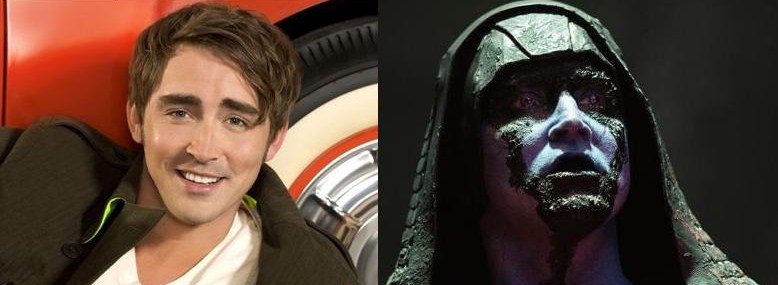
Casting for the film’s default lead, Star Lord, began in September 2012, with a laundry list of people who tested or read for the role: Eddie Redmayne, Joseph Gordon-Levitt, Joel Edgerton, Jack Huston, Michael Rosenbaum, and many, many others. Lee Pace also auditioned for the role, ending up instead slotted into the role of Ronan, the film’s main antagonist. Five months later, Marvel finally announced that they had found their man in Chris Pratt. Jason Momoa auditioned for the role of Drax, but he was passed over in favor of Dave Bautista (Momoa, of course, is slated to appear as Aquaman in DC’s upcoming attempted franchise). The nature of this new film meant that none of the MCU’s previously appearing characters could not reasonably make cameos in this film, although Buffyverse alum Alexis Denisof reprised his role as The Other, Thanos’s emissary who gave Loki his marching orders in Avengers. There was little publication surrounding other roles and testing for them, but the film’s cast was finalized by mid-2013 (minus Vin Diesel, whose vocal acting for Groot was only confirmed after the end of principal photography), and filming began in July of that year.

For those of you who have forgotten everything about the film except for a wisecracking raccoon and freshly-buff Chris Pratt being hosed down while flouncing about in underwear, a quick refresher: Young Peter Quill fled the hospital where his mother was dying in 1988 and was picked up by an alien ship. Years later, Quill (Pratt) acts as a scavenger in a fleet led by Yondu (Michael Rooker), a blue alien with an inexplicable Southern accent; he finds and takes a valuable item from a space tomb and ends up on the run from Kree radical Ronan (Pace). Multiple bounty hunters are sent to apprehend Quill, including Rocket Raccoon (voiced by Bradley Cooper) and his partner Groot (Diesel) and assassin Gamora (Zoe Saldana), who was kidnapped from her home by intergalactic warlord Thanos (Josh Brolin) and trained as a killer. These four untethered people are eventually captured and detained in a space prison; when they escape, they are joined by fellow inmate Drax (Bautista), who has his own axe to grind with Ronan and Thanos. They are opposed by Ronan and Gamora’s warrior “sister” Nebula (Karen Gillan) and the police-like Nova Corps, led by Nova Prime (Glenn Close). These decidedly-not-team-players reluctantly accept that no one else is in a position to save the galaxy from total annihilation and rise to the challenge.

Brandon, what did you think about Guardians of the Galaxy? If I remember correctly, this was one of the MCU flicks that you had seen before starting this project; does it fare better or worse now with more of a background in this world? Or, given that this film that lies outside of the MCU’s reach for the most part, does that context change your opinion at all?

EPSON MFP image

fourhalfstar

Brandon: I’m starting to feel extremely foolish about how I received Guardians of the Galaxy at the time of its release a couple years ago. I liked the film well enough as a loud, vibrant action comedy that provided a much-deserved starring role for America’s affable older brother (or boy toy sex symbol, depending who you are) Chris Pratt. However, I remember buying into the idea that the Marvel “house style” had significantly put a damper on the over-the-top exuberance of madman schlock director James Gunn. Gunn was familiar to me as the dark soul behind depraved camp titles like Slither and Tromeo & Juliet, so it was weird to see his style somewhat homogenized into a Luc Besson-style space epic. The truth is, though, that Gunn’s version of an uninhibited MCU entry probably would’ve turned out more like the grotesquely asinine Deadpool film I’ve spent the last month brooding over. In fact, Gunn already directed a nastily misanthropic superhero film, simply titled Super, that I generally enjoyed, but also found difficult to stomach at times due to the lighthearted way it depicts sexual assault. I don’t know if this is me getting increasingly sensitive with age, but another The Fifth Element, Star Wars-style space epic with Kevin Feige & company keeping Gunn’s sadistic id in check actually sounds preferable now to what might’ve been delivered otherwise. It might also be the case that the act of catching up with the rest of the MCU’s output in recent months has helped me realize just how unique Guardians is as a modern superhero popcorn flick & just how much of Gunn’s personality is noticeably present on the screen.

In any case, returning to Guardians of the Galaxy with fresh eyes was a revelation. This is a fantastic work of crowd-pleasing action cinema, the exact kind of delirious spectacle I look for in blockbusters. In that respect, the only film that might‘ve topped it in the year or so since its release is Mad Max: Fury Road & I mean that with full sincerity. The film’s detailed, lived-in version of space opera is literally worlds away from the rest of the MCU. Its superheroes aren’t truly heroic or even all that super. They’re mostly thieves, murderers, aliens, and the bi-products of cruel science experiments. Something that largely got by me the first time I watched Guardians of the Galaxy was just how emotionally damaged its central crew of space pirates are. Their families are dead. They’ve never known true friendship. They’re sometimes prone to drunkenly curse their own very existence. The film’s tendency for 80s nostalgia & crowd-pleasing action set pieces are really fun in an overwhelming way that I think often distract from just how devastatingly sad its emotional core can be. I never knew an anthropomorphic raccoon grimly complaining, “I didn’t ask to get made!” could make me so teary-eyed, but Guardians has a way of making the emotional pain of its damaged, nonhuman non-heroes feel just as real as the physical space they populate looks. That’s no small feat.

That’s obviously not to say that all of Guardians is deep-seated emotional pain. The film is mostly a riotously fun action comedy with broken hearts & bruised egos only peppering its blockbuster thrills. I love how inane its outer space worldbuilding is. Blue people, green people, purple people, and purple people eaters all roam about as if they are on a silly 60s sci-fi television show. Villains are known to say absurd things like “Nebula, go to Xandar and get me the Orb.” The MCU’s ultimate MacGuffin, the Infinity Stones, actually feel at home in this kind of space age gobbledy gook. It’s also fun to watch this atmosphere clash with Pratt’s womanizing bro humor as Star Lord, as I feel like I’ve lived in this kind of space adventure before, but I’ve never met anyone I could describe as a “space bro” as comfortably as Star Lord. I particularly enjoyed the line when describing the filth of his space ship/bachelor pad he confesses, “If I had a black light these walls would look like a Jackson Pollock painting.” The kicker is that Guardians not only has the most successful humor of the MCU’s output so far; it also has some of the most exhilarating action sequences in the franchise. The Kyln prison break in particular is a beaut & watching Rocket Raccoon operate his homemade weaponry gives me the same thrill I caught watching primates operate automatic machine guns in 2014’s Dawn of the Planet of the Apes.

4120537-7008853704-kclkd

the-brew-buzz-19

I could probably prattle on about how my favorite two MCU entries so far, Guardians of the Galaxy & Captain America: The First Avenger, thrive on their own strengths by distancing themselves from the rest of the franchise, but I don’t believe that best captures what makes Guardians so special. Honestly, the film’s own mixtape gimmick is a better access point to understanding its wide appeal. A mix of crowd-pleasing songs like “I Want You Back” & Escape (The Piña Colada Song)” and offbeat essentials like “Cherry Bomb” & “Moonage Daydream“, the film’s mixtape soundtrack mirrors its larger mashup of action comedy marketability & cult film tendencies. In retrospect the marriage of James Gunn’s mean nerd exuberance & the MCU’s action comedy accessibility is a match made in blockbuster heaven. It delights me to no end that you can actually purchase a copy of Star Lord’s beloved mixtape cassette. That piece of comic book movie ephemera actually seems more to the heart of the film’s appeal than a Rocket Raccoon figurine or even a Blu-ray copy of the film could ever be.

EPSON MFP image

fourstar

Boomer: Last time we were here, I mentioned how much Captain America: Winter Soldier reminded me of Star Trek VI and how that only made me love the former all the more. I have to admit that I was one of the naysayers with little hope for Guardians. By the time it came out, I was sick to death of the endless stream of advertisements for the movie; in every commercial break and before every YouTube there was a clip of Chris Pratt slowly flipping off John C. Reilly. But what I found when I saw the film was that I actually loved it, but mostly because it was the closest I felt we would ever come to having a Farscape feature.

The parallels don’t track perfectly, but they are obvious. We have the wise-cracking American thrust into an interstellar society made up of various societies and factions (Peter Quill/John Crichton), who has a relationship with a woman who was taken at birth and trained to be a deadly soldier and assassin (Gamora/Aeryn Sun). They’re joined by a large warrior with ritual scarrification and tattoos (Drax/D’Argo), a pint-sized wiseass (Rocket Racoon/Rygel), and a living plant (Groot/Zhaan). Farscape’s premiere episode even involves a prison break in which many of the main characters escape captivity, and both ragtag crews eventually find themselves drawn into the greater war going on around them in spite of their individual desires to simply overcome the traumas of their past. Both Drax and D’Argo have lost their wife and child (although D’Argo’s son is still alive, albeit enslaved), and both Gamora and Aeryn slowly warm to the human crewmate that helps them feel closer to their (in)humanity. The sequence in which the titular Guardians visit a mining colony inside of a once-living giant is even reminiscent of the episode in which the crew of Moya find a mining colony inside of the budong, an ancient spacefaring being of humongous proportions.

For the most part, the similarities end there, however. Although Groot and Zhaan are both plant people, the former lacks the metaphysical wisdom and spirituality of the latter. Although Rocket is full of himself, he lacks the imperial pomposity of the dethroned Rygel. Still, once can’t help but feel that Guardians is a spiritual sequel to Farscape, and that greatly contributes to my enjoyment of the film. I have to admit, however, that this rewatch wasn’t the thrill ride that I remembered fro my first few viewings. Guardians is undoubtedly the coolest of the MCU flicks so far, but the repetition of the jokes from the film in the real world has stolen some of the luster from their enjoyment. There’s still a lot to enjoy here, but Guardians doesn’t hold the endless rewatchability for me that Winter Soldier does, despite being much more fun than the comparably dour Captain America sequel. It was a smart move on Marvel’s part to follow up a somber MCU installment with a film that was exhilarating in a different way and for different reasons, but Guardians has a problem that the other films don’t have.Whereas the previous ensemble in The Avengers had the luxury of multiple individual films to flesh out the members of the team (minus the characters who were supporting players in previous installments, with Hawkeye never being fully realized as a character until Age of Ultron), Guardians has the unenviable task of introducing all five of its mains as well as their world and the ramifications thereof in a very short amount of time. The script is excellent in that the film doesn’t feel overloaded, but reflection upon the movie does lead to some questions that feel unanswered. We know that the Kree and the Xandarians have recently reached a peace accord, but what was their relationship beforehand? Are many of the Kree fanatics like Ronan, or is he an outlier, and, if so, why does Nova Prime have such difficulty getting the Kree ambassador(?) that she contacts late in the film to make a political statement decrying Ronan? And why wouldn’t the Kree condemn a terrorist anyway? This scene and others blow past so quickly that viewers may not realize just how much information is needed, but scenes like this have a way of niggling the subconscious.

Still, Guardians is a lot of fun. When I first saw it in theatres, I would have given it five stars, but time and distance have made me a bit more critical of it. Maybe I just wasn’t in the right frame of mind this time around, but the film just doesn’t have the magic for me that it did in 2014.

EPSON MFP image

Lagniappe

Brandon: It’s impossible to talk about Guardians‘ likability without addressing the absurd strength of its cast. Besides the appeal of Chris Pratt’s affable bro humor & “pelvic sorcery”, watching James Gunn regulars like Michael Rooker & Lloyd Kaufman appear among Hollywood heavyweights like Benicio Del Toro & Josh Brolin is a strange delight. Goofball comedic actor John C. Reilly interacting with Glenn Close is equally enjoyable as novelty. Bradley Cooper appears as a CG raccoon wearing people clothes. Vin Diesel outs himself as a huge D&D-oriented nerd as a talking tree. Bautista & the much-hated (among cinephiles, anyway) comic book prankster Howard the Duck both make a massive impact, which combine to make it feel as if this film were aimed to please my own particular nerdy obsessions: bad movies & pro wrestling.

The only complaint I might have about Guardians‘ insanely stacked cast of always welcome faces is the way it largely wastes the eternally-underutilized Lee Pace. I enjoyed Pace’s turn as impossibly cruel Ronan the Accuser more than I did the first time around but I do still think it was a huge mistake to cover up his luscious eyebrows with the alien makeup. Those might be the most handsome eyebrows in Hollywood. They deserve to run free.

tumblr_na2ozpjnfv1rfbi2jo1_1280

Boomer: For anyone reading this who is still mourning the loss of Farscape, I recommend current sci-fi series Dark Matter. It has fewer obvious commonalities with Farscape than Guardians, but its tone is the closest thing to Farscape’s that I’ve been able to find in a long time, even if it lacks the older series’s humor.

When joking in our earlier review about the fact that the Ninth Doctor appeared in Thor 2 and that the Tenth Doctor had played the villain of Jessica Jones, I had completely forgotten about the fact that Karen Gillam, who played the Eleventh Doctor’s companion Amy Pond, played Nebula in this film. There’s also the fact that Tobey Jones, who portrayed a nightmare version of the Doctor a few years back in “Amy’s Choice,” portrayed the evil Doctor Zola in both Cap flicks. Were it not that Jenna Coleman (who portrayed Clara Oswald, companion to the Eleventh and Twelfth Doctors) played a minor role in Captain America, all the Doctor Who alums who have thus far appeared in the MCU would have portrayed villains.

Regarding how the film plays into the larger mythos of the franchise, the plot elements from Guardians have largely only been important in how they affect Agents of S.H.I.E.L.D. Just as one of the main characters on the program was revealed to be a Hydra mole near the end of the first season, the second season featured major developments in the form of the revelation of the existence of the Inhumans and that another member of the squad was one such being. The Inhumans, for those who understandably gave up on Agents early on, are a subspecies of humanity who possess abnormal physiological traits as the result of a Kree genetic engineering campaign in Earth’s distant past. It’s also an easy way for the MCU to introduce large numbers of super-powered individuals despite not having the right to use the term “mutant,” what with the rights to the X-Men franchise still tied up at Fox. For those of you playing along at home, there is also a planned Inhumans film slated for release in 2019.

EPSON MFP image

Combined S.W.A.M.P.F.L.I.X. Rating for Guardians of the Galaxy (2014)

fourhalfstar

-Agents of S.W.A.M.P.F.L.I.X.

Agents of S.W.A.M.P.F.L.I.X.: Captain America 2 – The Winter Soldier (2014)

EPSON MFP image

Superhero Watching: Alternating Marvel Perspectives, Fresh and Longterm, Ignoring X-Men, or S.W.A.M.P.F.L.I.X., is a feature in which Boomer (who reads superhero comics & is well versed in the MCU) & Brandon (who reads alternative comics & had, at the start of this project, seen less than 25% of the MCU’s output) revisit the films that make up the Marvel Cinematic Universe from the perspective of someone who knows what they’re talking about & someone who doesn’t have the slightest clue.

Boomer: Captain America: The Winter Soldier was very nearly a different kind of movie. Christopher Markus & Stephen McFeely announced before the premier of the first Cap that they had already been hired to draft the sequel’s script, and there were three choices for direction: George Nolfi, F. Gary Gray, and sibling directorial team Anthony and Joseph Russo. Gray would certainly have been the most interesting choice, as he would have been the first person of color to helm an MCU film and have helped with Marvel’s ongoing diversity problem (as demonstrated just in the past week by the announcement that Danny Rand would be portrayed in the upcoming Netflix Iron Fist series by white Game of Thrones alum Finn Jones). To date, only two films based on Marvel properties have been directed by non-white directors, Hulk (Ang Lee) and Blade II (Guillermo del Toro), and only one has been directed by a woman, Lexi Alexander’s Punisher: War Zone. At present, Black Panther is set to break this white streak with director Ryan Coogler (Fruitvale Station, Creed), although the revolving door of directors (with Selma’s Ava Duvernay and Gray himself having been attached to production at different points) makes one wonder if there will be any more upsets between now and when production actually begins. Ultimately, Gray passed on the project in order to direct last year’s Straight Outta Compton, and the reins to the film were handed over to the Russo brothers, best known for their work on the early (good) years of NBC’s Community.

Those who are only familiar with the movies may be unaware, but S.H.I.E.L.D.’s contribution to the primary Marvel Comic universe took place largely outside of the context of superheroics. In fact, one could read comic books for several years without ever finding out that such an organization exists within that world; I certainly did. When interest in strong men and Amazons waned in the mid-Twentieth Century while the popularity of western, detective, and horror comics grew, S.H.I.E.L.D. took on prominence as a vehicle for telling stories about war and espionage, with books like Sgt. Fury and His Howling Commandos. The idea that S.H.I.E.L.D. should play a role in the founding of a superhero team is taken wholly from the Ultimate Marvel comics, a sub-imprint launched in the early 2000s to provide an entry into the comics world for new readers whose interest in the medium came as the result of the success of the Spider-Man and X-Men films. Forsaking the moniker “Avengers,” the equivalent team in the Ultimate books was known as “The Ultimates,” featuring a line-up of heroes that were brought together by Ultimate Nick Fury, who was consciously drawn to resemble Samuel L. Jackson in the hopes that he would be interested in the role should a film adaptation ever come to fruition. Many of the ideas that made their way into the MCU found their origins in the Ultimate imprint, with some scenes in the films even shot to be evocative of similar scenes in the comics (Thor’s visit from Loki, who lies that Odin has died in the first Thor film, is probably the most direct lift). The MCU has so far managed to mix stories from both the main books and the Ultimate line with new ideas to make sure that even comic book readers can never quite predict what twists the narrative will take. For instance, in the Ultimate Universe, Black Widow is revealed to be a double agent who turns on the rest of the team; non-readers who see Winter Soldier won’t have this knowledge and thus don’t know whether Natasha can be trusted, while readers who love the MCU Romanoff will constantly be anxious, wondering if she’ll follow in her ink counterpart’s footsteps, adding an edge to the movie.

Writing duo Markus & McFeely initially wanted to do an adaptation of Ed Brubaker’s Winter Soldier storyline (from the mainstream Marvel books) but were hesitant to commit to that idea, unsure if they would be able to make the story fit into the MCU while also doing it justice. Ultimately, with encouragement from MCU coordinator Kevin Feige, the two drafted the script as a political conspiracy thriller that incorporated elements of that plot but that also included S.H.I.E.L.D. in a larger role than in Brubaker’s story, given the greater prominence of the agency in the film franchise. Feige was quoted as saying that stories about Cap dealing with the fearmongering and political unrest of the seventies and eighties was “a hell of a journey” for the character. Although they couldn’t do stories set in that time period due to the fact that this version of Cap was frozen during that era, they “wanted to force him to confront that kind of moral conundrum, something with that ’70s flavor.” As such, the script was written with the intention of incorporating elements from political conspiracy thrillers of that era, like Three Days of the Condor and All the President’s Men.

To cement that connection, Robert Redford, who had appeared in both of those films, was cast to portray Alexander Pierce, the man to whom Nick Fury reports. Another new face in the cast was Anthony Mackie, who plays Sam Wilson, a character from the comics codenamed the Falcon. Cap and Falcon have had a long working relationship in the comics, with the Captain America comic even being retitled Captain America and the Falcon for 88 issues from 1971 to 1978, as the two duplicated the two-buddies-travel-the-world-and-have-different-social-perspectives narrative of the groundbreaking 1970-1972 Green Lantern/Green Arrow books. Emily van Camp was eventually cast as Agent 13, a longtime Cap love interest from the comics (originally introduced as Peggy Carter’s younger sister then later retconned as her niece given the nature of comic books’ static timelines) after beating out Alison Brie, Emilia Clarke, and Imogen Poots (among others) for the role. The film also introduced Crossbones in his civilian identity as a S.H.I.E.L.D. footsoldier revealed as a Hydra interloper; in the film, he is portrayed by Frank Grillo.

The nature of the time jump at the end of Captain America meant that most of Cap’s supporting cast would not be able to reappear in this film, although there is a heartbreaking cameo by Hayley Atwell as a very old Peggy Carter, and Sebastian Stan’s Bucky Barnes plays a prominent role. Scarlett Johansson, Samuel L. Jackson, and Cobie Smulders reprise their roles from other MCU features as Black Widow, Nick Fury, and Maria Hill respectively. Maximiliano Hernández, who had previously appeared as S.H.I.E.L.D. agent Jasper Sitwell in Thor, The Avengers, and ABC’s Agents of S.H.I.E.L.D., also appears in the film as a turncoat, as does Garry Shandling’s senator character from Iron Man 2 (it’s a good thing that Stark managed to keep the senator’s hands off the Iron Man suit, then). Toby Jones also reprised his role as Hydra scientist Arnim Zola, both in flashback and as an electronic ghost.

So, what did you think, Brandon? Captain America got high praise from you; how does this one fare?

EPSON MFP image

threehalfstar

Brandon: I was head over heels for the first Captain America film, which played like a retroactively-perfected version of The Rocketeer. Captain Steve Rogers’ bully-hating, Nazi-punching earnestness was a much welcome antidote to the sarcastic, megalomaniacs like Deadpool & Iron Man who often test my completist patience. I was, of course, stoked to catch up with the second installment in the Captain America series not only because I found the found The First Avenger so perfectly sincere, but also because ever since this project began The Winter Soldier has been sold to me as the height of what the MCU has to offer. I don’t want to say that I was exactly disappointed by the film that was delivered after all that hype, but I will say that the burden of expectation definitely colored my experience in a negative way. From the outside looking in, Captain America: The Winter Soldier is a fine action film, a perfectly entertaining superhero movie that does a great job of tying the Marvel mythology in with real-life political intrigue. However, I think the film stands as a dividing line between the franchise’s die hard fans who greedily eat up the ins & outs of the Marvel lore (particularly the narrative arc of S.H.I.E.L.D.) and the more casual observers such as myself who are mostly looking for an escapist spectacle with a cool hero in a kooky costume (which is more in line with what The First Avenger delivered). Fans who love the MCU enough to devotedly follow all of its short film bonus material & televised spin-offs are likely to love The WInter Soldier. The more detached devotees will enjoy the film’s action sequences & cool cat protagonists, but perhaps with less hyperbolic rapture.

Freshly unfrozen in the modern world, Captain Steve Rogers is simultaneously dealing with the post-Battle of NYC PTSD issues that Tony Stark wrestled with in Iron Man 3 & the same kind of fish out of water awkwardness as his Norse god buddy/fellow beefcake model Thor eternally suffers. Besides having to catch up with cultural markers like Marvin Gaye & Star Wars that he missed while taking an extensive nap on ice, Rogers also has to deal with the fact that his one true love (and ABC star) Peggy Carter lived a full life without him & is now spending her last days alone in a hospital bed. Friends & colleagues pressure Rogers to ask someone less geriatric for a date, but he refuses to move on. Of course, these small personal concerns are dwarfed by an evil world domination scheme Rogers has to put to a swift end. The Nazi offshoot Hydra from the first Captain America film is apparently alive & thriving, having successfully infiltrated S.H.I.E.L.D. & subtly influenced all of the world’s war & unrest from behind the scenes in the decades since the second World War. Can Rogers stop the Hydra from hijacking an advanced weapons system & using a sinister algorithm to destroy every one of its potential enemies in one fell swoop before it’s too late? Of course he can. He is The Greatest Soldier in History, after all (having now graduated from comic book hero status to living museum exhibit in his own lifetime).

What’s most interesting about The Winter Soldier is the way it complicates who & what is Captain America’s enemy. Rogers joined S.H.I.E.L.D. because it was partly founded by his one true love & he finds great value in reliving his wartime specialty: rescue missions. S.H.I.E.L.D. is too powerful to trust, however, especially since its participation in a worldwide (& maybe even intergalactic) arms race is what provides the weapon that Hydra intends to use the wipe out its enemies wholesale. By showing the faults of our modern day surveillance state by attaching a gun to each camera, The Winter Soldier approaches the most biting political commentary the MCU has offered yet, especially when Rogers criticizes his S.H.I.E.L.D. overlords for “holding a gun to everyone in the world & calling it protection” (a theme that will later be repeated in Age of Ultron). I don’t think the film’s political themes are ever explored any deeper or more thoroughly than they’d be in any other high budget, explosion-heavy action film, though. For MCU die hards who’ve been following every Agents of S.H.I.E.L.D. episode & tangentially-related S.H.I.E.L.D. mythology-related media, the film’s big reveal that the organization has been hijacked by Hydra might’ve landed with massive impact, but the betrayal never feels too significant from an outsider perspective. It’s mostly a political thriller springboard for a cool action movie with a lovable hero & some of the best fight choreography in the MCU outside the Avengers films (including increasingly inventive uses of Captain’s shield in its hand-to0-hand brutality).

It feels almost like a betrayal to nerdom at large to say I really liked this movie but didn’t love it, but that kinda points to the way Marvel Studios have spread their properties so, so very thin. In the greater, 10,000+ hour span of MCU content, The Winter Soldier is a major turning point & a fulfilling payoff for irons that have been in the fire for years. As a standalone property surviving on its on isolated merits, its a very solid picture, but far from the pinnacle of any of its various genres: political thrillers, action flicks, superhero media, etc.

EPSON MFP image

fivestar

Boomer: I love this movie. It’s the MCU picture that I’ve watched and rewatched the most and the one that I find the most enduring, thoughtful, and well-paced; for my money, it’s the best of them all. It’s a testament to Winter Soldier’s excellence that, despite the fact that I got dumped two hours after I walked out the theatre on that 2014 afternoon, it wasn’t ruined for me (like so, so many things were in the wake of that breakup). I can look back on that day and say, “Hey, that was one of the worst days of my life, but I also saw Winter Soldier.”

I’m not ever sure where to start with all the things that make this film work for me. I’m a sucker for a good conspiracy flick (and even some bad ones), and the tonal similarities between Winter Soldier and things like Enemy of the State, The Manchurian Candidate, and most obviously (and explicitly) Three Days of the Condor hit all the right buttons for me. It brings Black Widow into the foreground in a way that the previous films attempted with mixed success and introduces a great new hero character to the mythos in Falcon, and both Johannson and Mackie bring a lot of energy into the mix that harmonizes well with Evans’s leading man charisma. Redford is perfect in his role as the turncoat leader of the World Security Council, and the film puts a lot of work into including and subtly commenting on contemporary issues of security, privacy, and systemic violence. Evans was serviceable in his previous appearances as Cap, but he clearly understands the role better here than in the earlier outings: Cap is a man who fought a brutal war that history has painted as a righteous one, and as such is best suited to remind those around him when they are repeating the mistakes of the past.

The film draws a clear line between itself and other films of the same genre that came before, both within the text (most notably with Natasha quoting War Games) and metatextually, especially with the casting of Redford. Although his most notable contributions to political thrillers were his roles in All the President’s Men and Three Days of the Condor, I also have a fondness for Sneakers, which shares plot elements like computer algorithms and heisty shenanigans with Winter Soldier. Of course, the movie to which I feel this film is most tonally similar isn’t your standard contemporary political thriller like your Sneakers or even your classics like The Parallax View: it’s Star Trek VI: The Undiscovered Country.

I’ll keep this as brief as I possibly can, given that I have a (deserved) reputation of making everything about Star Trek, despite any obstacles. The Star Trek franchise was always about creating the rhetorical space that science fiction inhabits when it’s at its best: commenting upon contemporary social mores through a lens that provides the viewer or reader with enough metaphorical distance that he or she can see the absurdity and beauty of the human experience. (Last year’s Hugo Awards were undermined by a small group of rabid people who fail to realize that this is and always has been the purpose of the genre.) As such, the classic 1960s series created by Gene Roddenberry featured groundbreaking elements like people of color and women being treated as colleagues and equals by their white and male crewmen while also exploring the relationship between different earth cultures by projecting them onto extraterrestrial confederations.

Most notably, this was demonstrated by the way in which the Klingon Empire was a clear stand-in for the Soviet Union, and this was made all the more textual in The Undiscovered Country, which opened with a Chernobyl-esque disaster that places the Federation (the society in which Kirk and Spock abide) in a position to finally hammer their swords into plowshares… or bring their enemies to their knees. In the midst of all this is Kirk, who has fought the Klingons all his life and even lost his son to them; still, the Federation believes that, just as only Nixon could go to China, only Kirk can present the Klingons with a metaphorical olive branch. Unfortunately, Kirk ends up being framed for the assassination of the Klingon Chancellor and is assigned to a Siberia-esque gulag, while Spock works out the mystery. Working from opposite ends toward the middle, the two find a peace-endangering conspiracy that has wound its way around the heart of the seemingly-utopian Federation, fueled by long-stewing grudges, cultural fascism, and speciesist (read: racist) attitudes.

The Undiscovered Country is a fantastic movie, and although it’s not the best entry in the film franchise (Wrath of Khan is the undisputed champion), it’s a viable contender for runner-up. The Winter Soldier plays out similarly with its revelation that Hydra was never destroyed, but that it was instead reborn by planting its monstrous seeds within S.H.I.E.L.D. from its conception. Like ST6, this film also features the great and historical hero who finds himself framed and caught up in political machinations, dealing with strategic espionage maneuvering which is far outside of his control but in which he has a vested personal stake. Both films take the tropes and traits of the conspiracy narrative and add them to their respective genres, elevating both films to increased notability outside of their franchises.

And Natasha! Romanoff is back, baby, taking on heavier narrative lifting here than ever before and not only rising to the challenge, but killing it. Natasha never comes off as a sidekick here, instead acting as the perfect foil to Rogers. He’s the perfect soldier, and she’s the perfect spy: the focus on the ways that their respective skills and worldviews inscribe, complement, and conflict contributes to the film’s constant momentum. Johannson nails the small moments of vulnerability and the fact that Widow is always a few steps ahead of everyone else, like she’s accustomed to always being the smartest person in the room. This is just as much a story about her as it is about Cap, despite how much of the plot is devoted to his feelings of having failed Bucky. The film also does a better job of displaying professional respect and friendship between the two than most films are able to with a male-female friendship, and their emotional arc is perfect, forsaking the easy road of creating a romantic relationship between the two.

If anything, the titular Winter Soldier is the weakest link for me here. Part of that may be that his true identity as a brainwashed Bucky is no secret to comic fans (and it kind of surprises me that it was a shock to film-goers, given how recognizable Stan’s face is even with a mask on). It provides a counterpart to Cap’s friendship with Natasha, but it’s not as emotionally satisfying to me. Cap and Bucky’s friendship was built up in the first film, but it never quite clicked for me; I’m not as invested in the two of them as the franchise wants me to be, mostly because we actually see the two of them interact with each other much less than we see Cap interact with Natasha or even Tommy Lee Jones’s General in the first film. His involvement raises the stakes for Cap personally, but not for me.

That doesn’t make me any less invested in loving this movie, however. It hits the sweet spot for many in virtually every way, and I can hardly thing of a disparaging thing to say about it. Every few months, we see a new thinkpiece being published that asks if this genre is on its way out. Although I haven’t really seen any signs of slowing or stopping at this point, I’d wager that Winter Soldier will long outlive its peers in the public consciousness even if the MCU draws to a close.

EPSON MFP image

Lagniappe

Brandon: One thing that has been super impressive over the last few MCU features is how they’ve turned around my frustration with one-line cameos & half-assed tie-ins. I think that The Avengers, while not the height of the franchise, was an entirely necessary step in bringing this whole mess of a universe into an increasingly sharp focus & The Winter Soldier in particular is a great collaborative effort that directly reflects that shift. It’s doubtful that Nick Fury or Black Widow will ever star in their own standalone vehicles, but they’re both given way more to do in The Winter Soldier than ever before. Black Widow has already had ample time to show off her badassery in previous pictures, but her extended presence is always a welcome asset. This is really Nick Fury’s big break as a major player, though, and it’s fantastic to see him elevated form a walk-through cameo in a stinger to a fully-realized character. It’s also incredible how characters like Falcon & Bucky are shoehorned in there (even if I spoiled their individual reveals for myself by watching MCU content out of order) without ever cluttering up the film’s proceedings. Again, The Winter Soldier is a well made political thriller-leaning action flick that covers a lot of ground in its massive 2 1/2 hour runtime. I’m not sure that each of its characters & themes are given enough room to properly breathe & resonate, but there’s an impressive juggling act in how many personalities & plotlines get involved in the first place and the film delivers a wealth of entertainment in its genre-based treats alone.

Boomer: The furthest-reaching repercussions of this film on the franchise is the revelation that S.H.I.E.L.D. has been infected by Hydra from its very inception. For me personally, S.H.I.E.L.D. has always been a non-essential element of the MCU; sure, most of the stories would be different without their involvement, but not by much and not necessarily detrimentally. This reveal did end up creating more plotlines for Agents of S.H.I.E.L.D., with that series finally developing into something worth following in the wake of Winter Soldier, but it also annoys me. The rest of the MCU must now pay lip service to this development constantly, with references to Hydra showing up in shows and films that don’t really relate to S.H.I.E.L.D., if as nothing more than a bogeyman. Other than films where it wouldn’t make sense (such as Guardians of the Galaxy), all the villains relate back to Hydra now, if only tangentially. It makes me like past, unrelated villains like Jeff Bridges’s Obadiah Stane more in retrospect, since they weren’t required to tie in as heavily. It’s not that I feel the franchise is hamstrung by this revelation, but I find it weakens a plot when everything has to tie back into one evil mastermind or organization, limiting storytelling possibilities.

EPSON MFP image

Combined S.W.A.M.P.F.L.I.X. Rating for Captain America 2 – The Winter Soldier (2013)

fourhalfstar

-Agents of S.W.A.M.P.F.L.I.X.

Agents of S.W.A.M.P.F.L.I.X.: Thor 2 – The Dark World (2013)

EPSON MFP image

Superhero Watching: Alternating Marvel Perspectives, Fresh and Longterm, Ignoring X-Men, or S.W.A.M.P.F.L.I.X., is a feature in which Boomer (who reads superhero comics & is well versed in the MCU) & Brandon (who reads alternative comics & had, at the start of this project, seen less than 25% of the MCU’s output) revisit the films that make up the Marvel Cinematic Universe from the perspective of someone who knows what they’re talking about & someone who doesn’t have the slightest clue.

Boomer: It seems silly now to think that the ongoing existence of the Thor franchise was not a given. Prior to the first film’s release, Kevin Feige announced that there would be a second Thor following the release of The Avengers, but Kenneth Branagh wasn’t so sure. In fact, his response to the news seems almost pessimistic, as he stated that he felt the audience would have to decide. At the time, there was gossip that this was a response to what must have been seen more and more by the individual directors as executive influence. Although our culture has a tendency to think of studio influence as an inherently negative contributor to a film’s overall quality (probably because its impact is negative in most cases), but there are examples of this kind of oversight working. Two prominent examples in this same genre are Star Wars and Star Trek: The Next Generation: in both cases, once the creator had full creative control the content took a nosedive, and the material itself vastly improved when the property was returned to more corporate oversight. Although this would later (famously) be the reason that Edgar Wright would leave the Ant-Man project, Branagh’s stated reasons for leaving Thor 2 were that he was hesitant to get straight back into production so shortly after the first film was completed, given the long lead times that effects-heavy films like the Marvel spectacles have.

Branagh’s successor was originally slated to be Brian Kirk, and the film would have been his feature debut after working as a frequent director on Game of Thrones. He entered negotiations for the project in August 2011, but ultimately backed out, citing contractual issues. Patty Jenkins, who had previously directed the biopic Monster and who is slated to direct the upcoming Wonder Woman, was brought on to direct, although she too left the project in December of 2011; this time, the cited reasons were creative differences. Ultimately, Alan Taylor, who had also previously worked on Game of Thrones as well as Mad Men, was brought on to helm the picture. Don Payne, who had a hand in the script for the first film, was brought in to draft the script. Payne lost his battle with bone cancer in March of 2013, and it can be assumed that he may not have been able to contribute in the creative process after his initial script treatment. Whether or not his declining health took him off the project, Robert Rodat was brought on to give it another pass. Rodat was most well known at the time for his scripts for Saving Private Ryan and The Patriot, and there’s a darker text to this film than the first that can be attributed to his influence.

On the casting side, Mads Mikkelsen was in talks to portray a villain in the film (presumably Malekith) but was was offered Hannibal and took that opportunity instead. The role of the Malekith ultimately went to Christopher Eccleston, a British actor known for his portrayal of the Ninth Doctor in the Doctor Who franchise and who is currently starring in HBO’s series The Leftovers. All major cast members were set to return, as well as virtually all of the minor characters. One of Thor’s buddies, Fendral, was recast; ironically, Zachary Levi was set to play him in the first film but had to back out due to commitment to Chuck, but he replaced Joshua Dallas in the role when the latter was pulled away by his obligations to Once Upon A Time. Adewale Akinnuoye-Agbaje was cast as Algrim, an elf supersoldier (yeah) who takes on the name “Kursed.”

For those of you who saw the movie once and then kind of forgot about it while waiting for the next Marvel movie, the plot is this: Once upon a time, Thor (Chris Hemsworth)’s grandfather Bor took a magical liquid McGuffin known as the Aether from the leader of a race of “dark elves.” These elves existed before there was light in the universe and who, as a result, hate lightness, goodness, and pretty much life itself. In the present day, an interdimensional alignment is occurring where all the different “realms” that Thor talked about in the first film will line up and physics will be a little wonky. Luckily for him, Jane Foster (Natalie Portman) is on the scene investigating these strange phenomena. The alignment allows her to get lost inside another realm, where she stumbles upon Bor’s hiding place for the Aether, and she becomes infected by it. The plot contrives to trap Thor in Asgard, so he must enlist the help of Loki (Tom Hiddeston) to cross over to Earth and save the day from the villain who keeps trying to kidnap his girlfriend so she can help him destroy the universe itself.

Brandon, what did you think?

EPSON MFP image

three star

Brandon: There seems to have been a monumental shift in the Thor franchise here. If you boil the series down to its most basic parts there’s exactly two contrasting realms where the narrative operates (although its internal folklore is heavily tied to their being nine realms, the rest of which are mostly relegated for brief visits): Earth (or some kind of variation of Earth that has seen modern contact with gods, aliens, and supermen) & Asgard, some kind of golden city of the gods that rests somewhere across the dimensions & can only be reached by a rainbow bridge. The first Thor film staged a familial, Shakespearean drama on the mighty purty Asgard, (which was a perfect fit for director Kenneth Branagh’s background), but for the most part it was a fish out of water comedy set on Earth. Although an near-immortal god, Thor was buffoonish in his attempts to adapt to Earth life & spent most of his MCU debut acting like a profoundly handsome & powerful Mr. Bean. Thor 2 takes a wildly different approach to its superheroics, borrowing a little Chris Nolan gloom to dampen down the good mood (right down to the wormhole fascination & the emphasis on the “Dark” aspect of its title). One of the things I enjoyed most about the first Thor film was that it lightened the mood of the MCU in a sincerely wholesome way. It felt like the start of what many people consider Marvel Studios’ “house style”. The Dark World ditches that bright outlook for a much gloomier aesthetic, but I ended up enjoying the film well enough anyway. After seven un-Nolan superhero movies the MCU can easily afford to go angsty for a single picture.

Completely ditching the fish out of water comedy of the original Thor film, The Dark World instead delves deeper into the distant world of Asgard. There are some comedic elements to the film (mostly in Kat Dennings’ strait -out-a-CBS-sitcom comic relief goof Darcy), but the plot is for the most part dead serious. A lot of the same Asgardian concerns about who will take the throne when it’s left vacant by an aging Odin (played again by an even-more-game-than-last -time Anthony Hopkins) & who exactly The Gatekeeper of Asgard (an equally more-engaged Idris Elba) is faithful to play out exactly like they did in the previous film, just with enough time & attention to take the main focus. Thor is still gleefully oblivious of his obligations to the throne. Loki is still an evil, manipulative weasel who teases playing nice before he pulls the rug form under his gullible brother. Aliens from other realms are still trying to cut deals with Loki to take over the Universe. All is right in the world(s). Instead of dragging Thor back to Earth to make more of a fool of himself, it’s Natalie Portman’s scientist hottie Jane’s turn to make a fool of herself on his world. While investigating a “gravitational anomaly” (the aforementioned wormholes) Jane is infected with something called The Ether, which is essentially purely-concentrated space evil. This is no run of the mill space evil, either. It’s an “ancient force of infinite deconstruction” that turns matter into dark matter or some such hooey. Some alien baddies seek to reclaim & harness the space evil & there you have the basic makings of a ludicrously overstuffed Marvel Studios movie plot.

By far the best aspect of The Dark World is the film’s visual treats. If I weren’t watching the film for the purpose of this review it’d be the exact kind of thing I’d zone out for just to drool over the imagery in isolation. It’s the exact way I interact with (don’t shoot!) the Lord of the Rings franchise. I’ve seen Jackson’s adaptations countless times, but can name you only a few of the characters’ names without Google’s help & know very little of the plot outside the endless walking & the quest to destroy The Ring. I treated The Dark World much of the same way. It’s a feast for the eyes, a gloomy trudge through so many alien bests, war ships, and swirling storm clouds that any given farm outside of the Earth scenes could easily pas as a heavy metal album cover. I didn’t evoke that Lord of the Rings comparison lightly, either. As soon as the film opens with Hopkins intoning the Epic Tale of the Dark Elves & warning of the One Ether to Rule Them All, Jackson’s work was already at the forefront of my mind. I was prepared to space out & maybe confirm some plot details on Wikipedia after the end credits. Honestly, that’ s probably something I should still work on. The details are a little fuzzy, but I really enjoyed what I saw.

EPSON MFP image

twohalfstar

Boomer: I forgot about everything that happened in this movie pretty much the moment I walked out of the theatre in 2013. I remember enjoying it as a pleasant diversion, but it’s apparent that this movie is spinning its wheels. The number of different directors who were at one point attached to the property makes one feel that there is a lot of welding between different ideas for the film, and not all the of the connections work. There’s also the fact that there are parts of this film that feel like the first Thor in tone but are out of place in this darker overall film. It also feels like there was a lot cut out of the movie, especially with regards to the motivations of the villains. Loki’s motives are the same as they always are, and his arc (such as it is) feels largely like a retread of everything we’ve already seen. They even have him reprise his “you must be truly desperate…” line from The Avengers, which feels less like an echo and more like a cynical cut-and-paste from one script to the next. Eccleston is particularly underutilized, as he has virtually no distinguishing features that separate him from all of the other generic genocidal dictators that make their home in this genre. The man is probably the best actor to portray a villain in this franchise since Jeff Bridges, and he’s utterly wasted in a role that a mannequin could play.

The tone is too dissimilar from the first film as well. Thor took place almost entirely in New Mexico and Asgard (give or take a couple of field trips to Jotunheim), and the bright sun of the former and the boisterous lighting of the latter gave that film a warm quality, and the gray overcast skies of the British Isles are a stark contrast. That dissonance characterizes The Dark World from its predecessor, and the tonal shifts within the film itself, along with the handing off of writing duties from Payne to Rotan, leads me to infer a few things. There may have been a hesitation to throw out too much of a dying man’s work, but Rotan’s tendency toward darker storytelling highlights the scenes that retain Payne’s lighter take from the first film and makes them stand out even more. There’s an argument to be made that, should you find yourself watching A.I., you can see the moment when Kubrick died and Spielberg took over to complete the film, because their individual visions conflict with more than complement each other. There’s an element of that here, where you can see Rotan take over from Payne, and the end result is a bit of a mish-mash of ideas.

The women in Thor’s life take it the worst this time around. Although Jane’s scientific knowledge comes through at the end of the film to save the day, she spends most of the movie in near catatonia, saying few lines and having to be protected constantly. The MCU has largely avoided the damsel-in-distress routine that seemed to be the standard in comic book film (give or take your Pfeiffer Catwoman) up to this point, but this is an all but a textbook example. Rene Russo’s Frigga has the best scene in the film (when she protects Jane from the invading elves), and her funeral is the closest the film comes to having a tone that works both as an amalgam of Payne and Rotan’s approaches and to a compelling feeling overall, but it’s not enough. Kat Dennings gets more to do this time out and, although I find her screen presence enjoyable, it didn’t do more to expand our understanding of Darcy, instead simply repeating character beats from the last time we saw her. In no other film is it more apparent that the MCU is killing time. Kevin Feige likely made a mistake by committing the film to a 2013 release date before locking in a creative team, because the final product feels somehow both rushed and overproduced. I think the upcoming third Thor film, Ragnarok, will be a step up, but only time will tell.

Lagniappe

Brandon: It wasn’t entirely intentional, but I’ve mostly relegated my thoughts on the MCU’s post-credits stingers to these “Lagniappe” segments so that they’ve become sort of a meta post-review stinger in a weird way. So, I guess I should touch on the two that occur here. One is a teaser for the (then) upcoming Guardians of the Galaxy movie that worked perfectly well by accomplishing two succinct missions: introducing Benicio del Toro’s weirdo “collector” character & relegating talk of the Infinity Stones MacGuffin to the credits, both of which were fine by me. Even more innocuous was a second stinger that served as one last romantic beat for the Me Thor You Jane relationship, which, again, was fine. I’m usually a lot more likely to be annoyed when the stingers are the sole tie to other properties in the MCU through a quick two-line cameo. That quick cameo actually occurs much earlier in The Dark World in a scene where Loki mocks the ultra-wholesome (and all-around best Avenger) Captain America in a one-off goof. I don’t know if it’s just that I like Cap so much or what, but that gag was actually quite amusing for me. It was at least funny to watch Chris Evans mime Loki’s sardonic version of himself.

Speaking of Loki, The Dark World really turned me around on that little scamp. I wasn’t particularly invested in his character as anything more than a pissant weasel before, but things took a much more interesting turn here: he reveals himself to be hurt & emotionally vulnerable in a way that never felt quite as convincing before. This turn toward the occasionally sympathetic makes his acerbic brutality all the more interesting when he inevitably changes his mind & commits himself to evil. Not that his Kylo Ren emo tantrums weren’t still amusing. I got a particularly good giggle out of the exchange where Thor confesses “I wish I could trust you” & Loki responds “Trust my rage.” That’s some high quality angst right there.

Boomer: Now that we’ve had Chris Eccleston play a villain in this film and David Tennant as Kilgrave on Jessica Jones, I guess it’s only a matter of time before we see Matt Smith in this franchise. Also, it’s such a bummer that they killed off Frigga in this film, but I am hopeful that they may find a way to bring her back for Ragnarok. A trip to the afterlife isn’t entirely out of the question for this franchise, right?

Combined S.W.A.M.P.F.L.I.X. Rating for Thor 2 – The Dark World (2013)

EPSON MFP image

three star

-Agents of S.W.A.M.P.F.L.I.X.

Agents of S.W.A.M.P.F.L.I.X.: Iron Man 3 (2013)

EPSON MFP image

Superhero Watching: Alternating Marvel Perspectives, Fresh and Longterm, Ignoring X-Men, or S.W.A.M.P.F.L.I.X., is a feature in which Boomer (who reads superhero comics & is well versed in the MCU) & Brandon (who reads alternative comics & had, at the start of this project, seen less than 25% of the MCU’s output) revisit the films that make up the Marvel Cinematic Universe from the perspective of someone who knows what they’re talking about & someone who doesn’t have the slightest clue.

Boomer: In 2014, director Jon Favreau released the indie critical darling Chef, in which he appeared as a man who tired of the world of elite haute cuisine that values style over substance, a man who forsakes that world to fix up an old food truck and take a more “back to basics” approach to food. As has been pointed out by other critics, this can be seen as a metaphor for Favreau’s fatigue with the Iron Man franchise, as he bowed out of directing the third film, although he reprised his role as Hogan (if spending 80% of the film comatose can be considered a reprisal). Instead, the reins were handed over to Shane Black, whose resume as a writer includes Lethal Weapon, Monster Squad, and The Long Kiss Goodnight, and as such was already well-regarded before he began directing with 2005’s Kiss Kiss Bang Bang.

In 2007, British TV producer Drew Pearce created the cult hit No Heroics, a sitcom focusing on the downtime of troubled British superheroes, and the series aired in late 2008. The surprise cult following of the show led to some interest in an American adaptation during the shaky post-Heroes years in which many stations were looking to ride the superhero wave to the top. An American No Heroics pilot was shot, but ABC ultimately passed on the project (although they greenlit No Ordinary Family, a show that should have gotten a hard pass, just a few years later). Still, this had been enough to bring him to the attention of stateside production companies, and Pearce was initially hired to write the film adaptation of Marvel series Runaways. Although that film’s production stalled out, he was invited to co-write IM3 with Black. The resulting story took large chunks from Warren Ellis’s work on the popular “Extremis” arc from the Iron Man comics (homage is paid in the film by naming the president, played by William Sadler, after Ellis).

Robert Downey, Jr., Gwyneth Paltrow, Don Cheadle, and Paul Bettany(‘s voice) reprise their roles from previous films, and the post-credits gag features a cameo from Mark Ruffalo as Dr. Bruce Banner. New faces include Ben Kingsley as Mandarin, Guy Pearce as Aldrich Killian, and Rebecca Hall as Maya Hansen. As the lead-in to what Marvel Studios called “Phase Two,” IM3 follows up on the events of The Avengers, showing a Tony Stark who is traumatized and living with the aftereffects of the Battle of New York. And, since Shane Black is involved, the film is set at Christmastime for no real reason.

Brandon, what did you think?

EPSON MFP image

twohalfstar

Brandon: Because I had heard that director Shane Black had taken over Jon Favreau’s directoral duties for the third Iron Man installment, I had gotten my hopes up that it might be the turning point where I started liking the Iron Man franchise at large. Black’s darkly comic work on properties like Lethal Weapon, The Last Action Hero, and The Monster Squad seemed to position him as a perfect fit for taking the Iron Man films into a new, more purposeful direction. I can recognize flashes of that newfound sense of purpose straining to break through this feature’s bogged down mess of a narrative, but ultimately Iron Man 3 felt like just as much of a mixed bag as Iron Man 2.

The film opens with America’s Favorite D-Bag Tony Stark tooting his own horn to Eiffel 65’s “I’m Blue” & referring to the absolute worst era in popular culture (the late 90s, *shudder*) as “the [good] old days” (which, appropriately enough, is when his bad boy schtick & awful facial hair might’ve actually felt fresh). Things get worse from there. The film’s completely-besides-the-point Christmastime setting allows Stark to move on from his previous soundtrack of AC/DC dad jams to dance club remixes of Yuletide carols, which is, musically speaking, my worst nightmare. Tony’s snarkiness has also gotten worse, since the success of the character had apparently lead Feige & company to believe that what the world wanted more of was exchanges like [from a pretty lady] “Where are we going?” “To town on each other,” [to a lady on fire] “I’ve dated hotter chicks than you,” and [to a boy who’s been abandoned by his father] “Guys leave. No need to be a pussy about it.” There are other ways in which the Iron Man franchise has improved in a general sense, but its billionaire playboy protagonist might be a bigger piece of shit than ever here and the worst part is it still feels like the movies are asking its audience to celebrate him for it.

The frustrating thing is that there’s so much of Iron Man 3 that does work, especially elsewhere in the cast. I was a little dubious at first about the series’s return to its War on Terror roots, but Don Cheadle’s transition from toeing the water as The War Machine to full-blown superhero status as The Iron Patriot was encouraging to see. Ben Kingsely’s villain, who I’m pretty sure he was told was supposed to be named Osama Bin Nixon instead of The Mandarin, also has some entertaining moments in the film. I particularly enjoyed the following monologue that accompanied one of his terrorist-funded propaganda films: “True story about fortune cookies – They look Chinese. They sound Chinese. But they’re actually an American invention, which is why they’re hollow, full of lies, and leave a bad taste in the mouth.” The MVP for me, though, believe it or not, was Gwyneth Paltrow as the surprisingly endearing Pepper Potts. I don’t have any particularly strong opinions about Paltrow as an actress, but get the sense that her performances in these films aren’t especially popular among diehard MCU fans, which is a shame. Iron Man 3 allows Potts the opportunity to try on one of Stark’s mech suits, which made for a kinda awesome (and on a personal note, oddly sexy) moment when she gets to save the day for a change. Better yet is her climactic freakout moment, which releases a feral side to Paltrow’s screen presence I didn’t know she had in her (although it was teased in her line-reading of “Are you out of your mind?!” in Iron Man 2).

Speaking of the suit-sharing, Iron Man 3 features more Iron Man suits than ever, which, when combined with remote-controlled automation, makes for some absolutely killer action sequences involving an Iron Man army, some ludicrously complicated suit-hopping/exploding choreography, and a sublimely corny, parachuteless freefall rescue that played nicely into the film’s comic book origins. It’s a shame that none of these charming moments or character beats ever amount to a satisfying whole, though. Repeating the exact same mistakes of Iron Man 2, the film splits its time between two villains, a formula that bogs down its plot, only to make a third act decision to follow the least interesting of the pair to the conclusion. Iron Man 3 even takes this mistake a step further and retroactively ruins its most interesting threat, reducing Kingley’s monstrous terrorist from an Osama bin Nixon to a buffoonish Russell Brand archetype. What a waste. And to think, they casually kick him aside in favor of a fire-breathing version of Val Kilmer’s generic Dieter Von Cunth villain from MacGruber. It’s not a good sign when your film’s lead antagonist most closely resembles a character meant to spoof the genre you’re working in.

Once that shift occurs, Iron Man 3 devolves into generic superhero action cinema. The last 40 minutes of the film feel like a total waste, despite the suit-hopping heroics & Pepper Potts silliness mentioned above. Every now & then Iron Man 3 would throw out a fistpump-worthy moment or two (Stark taking out a helicopter by hurling a grand piano comes to mind), but for the most part the film felt like a mess of compromises & disappointments with half-cooked references to A Christmas Carol that went more or less nowhere & an entirely unnecessary performance by series-vet Jon Favreau as The World’s Shittiest Comic Relief. At best, it’s a generic mixed bag of an action film that almost gets its shit together before completely losing track of what makes it special. At worst, it’s a disappointingly low entry to Shane Black’s catalog, whether or not it helped him gain some notoriety for the strange body of work he had quietly put together prior.

EPSON MFP image

fourstar

Boomer: A lot of people really disliked this movie when it came out, citing the appearance of a kid sidekick character and the purported ruination of The Mandarin. Personally, however, I have to say that this is probably my favorite of the Iron Man flicks. I’ll admit that the kid sidekick character doesn’t really bother me in the slightest (and he appears onscreen for such a short period of time that his presence is virtually negligible). As for the way that the film used The Mandarin… I actually think that it was a bit of an ingenious move. I understand that this is a character into whom a lot of people have invested time and emotional energy, and I can understand the outrage because I felt much the same way when Star Trek Into Darkness sprang a whitewashed terrible Khan on the audience. The difference, however, is that the fact that Benedict Cumberbatch’s character is Khan contributes nothing to the film other than a familiar name, whereas the Mandarin reveal in Iron Man 3 actually serves to further the plot in an interesting way, and the film does well to play that reveal close to the chest up to the point where we finally meet Trevor Slattery. This was a neat twist that played on expectations of comic book fans and mainstream filmgoers alike, and I think a lot of people were simply caught off guard by the revelation and overreacted to it.

As for other issues viewers took with the film, I don’t really lend a lot of credence to what could be called the Avengers Problem, or, more loosely, the Shared Universe Problem. For some, once a shared universe is established or canonized, there is a need to ask why such-and-such character doesn’t appear in so-and-so’s film. I don’t really understand this impulse on the part of the audience to criticize this element of a work; it’s not as if every character spends all of their downtime together, nor is it a far-fetched idea that a person like Tony Stark who is accustomed to self-reliance would, in a period of self-doubt, try to fix all of his problems without calling on his superfriends. It’s not a problem for me that Banner shows up after the fact and only for a chat, and I feel that a lot of people were looking for elements of the film to complain about, as the honeymoon patina of the MCU was starting to wear thin. All of this is to say: this is a movie about a man who is pried loose from his moorings and forced to confront both his mortality and his potential for failure, and ends up being the least cliche of the Iron Man movies as a result.

There are problems, of course. The film is smart to focus on Tony and his one-man journey, but Paltrow and Cheadle end up underutilized this time around as a matter of consequence. Although Kingsley’s performance as both Slattery and The Mandarin is fantastic, Hall’s botanist character ends up feeling underdeveloped, and we never get a real feeling for her motivations. Pearce’s motivations are also less than perfectly defined, but he stands out as still being a better villain than either Hammer or Whiplash from Tony’s last solo outing. The deus ex machina elements of Pepper’s superheroics at the end of the film are a little on-the-nose, but it was nice to see her get to have more agency this time around, especially since her appearance early in the film painted her in a less than stellar light.

Still, I liked this one. The film largely restrains its elaborate set-pieces to the film’s back half, instead focusing the first half on character building and establishing the new relationships between all the characters, new and old, and the film benefits greatly from this structure. The humor here isn’t derived solely from trying to elicit envy of the Tony Stark way of life, which is a refreshing change of pace. Furthermore, making Stark more vulnerable provides Downey with additional ways to approach the character, which makes both actor and character come off as more likable than in previous installments. It’s a different approach, and the non-standard format of the film’s narrative sets a good example for the way that this film and the five that followed it would change the tone of the MCU at large.

Lagniappe

Boomer: It’s super weird to me that the MCU has a white president. It’s something that felt strange the first time I saw it; normally, I wouldn’t bring it up, but with recent news that Marvel bigwig Ike Perlmutter donated a hefty chunk of money to the Trump campaign, it does raise some questions. Also, it’s a bummer that we don’t hear about Extremis or see any of the fallout in the films that follow. Pepper’s newfound superherodom doesn’t even get a line of dialogue in Age of Ultron, even though she is mentioned. It’s strange, given the fact that the movie seems to set her up as a new power player–not that we needed another character in Ultron gumming up the works.

Brandon: Here’s where I praise Iron Man 3 for what it gets exactly right. Part of what’s been bugging me about the MCU as a cohesive unit of films is that outside of the Avengers crossovers the individual properties haven’t interacted with each other in any significant way. Iron Man 2 was better than most MCU properties on that front, mostly in the way that it gave outside characters Black Widow & Nick Fury something more significant to do besides popping up for a post-credits cameo. Iron Man 3 finally works the Marvel Universe at large into its core narrative, though, which posits it as the most well-integrated MCU property yet (well, outside The Avengers, which is integration by nature).

In the film, Tony Stark is suffering from PTSD after the “gods, aliens, other dimensions,” and robots caused so much mayhem at the climax of The Avengers. He confesses to Potts, “Nothing’s been the same since New York” and in a nice change of pace his ego is put into check by nightmares & panic attacks that can occasionally become life-threatening, especially once he begins operating mech suits in his sleep. I love this sense of progression. It finally feels like a standalone MCU property is actually, significantly affected by the preceding films outside its realm. I look forward to seeing more of the franchise function this way.

Curiously, although Iron Man 3 is the most well-integrated, non-Avengers MCU film so far, it feels like it brings its narrative to a close by the end credits. Everything feels thoroughly wrapped up, finite, as if Tony STark’s time with the franchise were over. If I didn’t know any better, I’d believe that “I am Iron Man” would be Starks’s final word to tie a neat little ribbon on his entire d-bag story arc. What’s even weirder is that after all this finality & integration, the film reverts back to a meaningless post-credits cameo for Mark Ruffalo’s Bruce Banner. Again, the film is the definition of a mixed bag.

Side note: Did anybody else find it strange that this film found time for references to Joan Rivers, Downton Abbey, and the Home Shopping Network? I don’t know what to make of those nods other than to say they felt bizarre in this context.

Combined S.W.A.M.P.F.L.I.X. Rating for Iron Man 3 (2013)

EPSON MFP image

three star

-Agents of S.W.A.M.P.F.L.I.X.