Feels Good Man (2020)

The first few weeks of Donald Trump’s second presidential term have surprisingly been defined more by the daily stunts & shenanigans of unelected government official Elon Musk than they have been by the actions of the president himself. Sure, Trump is signing a relentless barrage of hateful, unconstitutional Executive Orders that are threatening to crumble decades of social & economic progress in a matter of days. That was fully expected, though, especially if you paid any attention to the “Project 2025” agenda advertised during his election campaign. Musk’s overt, oligarchic influence on these Executive Branch actions have been just as nefarious but much more bizarre, especially as an extension of the failed meme humor of his current reign as the Villain King of Twitter. It’s not enough that Trump & Musk are wielding institutional power to reshape America with a straight-up Nazi agenda; they’re also irony-washing that Nazi ideology through several layers of internet meme humor, so that their above-board, bought-and-paid-for coup is read as a humorous prank meant to “trigger the libs,” not to welcome in a new, shameless era of American fascism. Between Musk’s “DOGE” branding, his juvenile obsession with the numbers 69 & 420, and the bar now being so low that his executing a Nazi salute at Trump’s inauguration now qualifies as a “dog whistle,” it’s clear that we’re living through America’s first 4chan presidency. Evil has never been so inane.

If you catch yourself wondering how, exactly, we got here over the last few years, I’ve seen no better explainer than the 2020 documentary Feels Good Man. A 90-minute history lesson on the memeification of a cartoon stoner frog may sound trivial in the context of America’s Nazi takeover, but Feels Good Man somehow does a better job explaining & contextualizing that far-right political shift than any other film I’ve seen – predating and overriding all of those QAnon docs that auto-populated on every streaming service in the years following the January 6 coup attempt of 2021. The stoner frog in question is, of course, Pepe the Frog, the breakout character from alt-comics artist Matt Furie’s cult series Boys Club. A soft-spoken San Francisco stoner who’s been drawing goofy frog doodles his entire life, Furie confides that Pepe is the Boys Club character he most personally identifies with . . . which is a brave thing to admit given the character’s eventual perversion and radicalization in the Hell pits of 4chan once it escaped the pages of his comic book. A single frame of Boys Club in which Pepe explains to his burnout roommates that he urinates with his pants completely lowered to his ankles because it “feels good man” was a funny enough image that it started getting shared on the internet outside the context of its source material and, as the movie argues, somehow snowballed into Donald Trump becoming the 45th President of the United States.

I have a general affection for Anthropology of the Internet documentaries that immortalize disposable online ephemera for cinematic prosperity, especially when they capture the sinister atmosphere of the Internet’s dankest dungeons (see also: the Russian dashcam compilation The Road Movie, the evil-clown sightings doc Wrinkles the Clown, and Jane Schoenbrun’s Slenderman doc A Self-Induced Hallucination). Even so, Feels Good Man does a better job than most at explaining how its own subject’s online virality led to real-world consequences outside niche meme forums. It chronicles Pepe the Frog’s transformation in the hellfires of 4chan from loveable frog to “the new swastika”, explaining how users who identified with Pepe as much as its creator had to force the frog to “go dark” to protect him from “normies” (i.e., women) who might identify with him as well. Because 4chan is an attention-economy culture that mostly traffics in “ironic” racism, this effort manifested as Pepe becoming a mouthpiece for Nazi rhetoric and an online dog whistle for alt-right C.H.U.D.s. Making Pepe as bigoted as possible became a kind of online game, and it gave real-world Right Wing ghouls a way to signal to the keyboard Nazis at home that the Trump-led establishment shared their values without abandoning their more buttoned-up, traditional voter base. That co-opting seems a little quaint now that Elon Musk is Sieg Heiling on an official government stage, but it was a major stepping stone that led us here.

The half of Feels Good Man that explains how 4chan memes created a new Nazi America is populated with all the expected demons of 2010s alt-right ascension. Pepe’s Nazi radicalization was directly inspired by Steve Bannon’s political strategy to “flood the zone with shit,” which has become the go-to playbook for the Trump-led Republican Party. During the infamous street interview when Richard Spencer is punched in the face by a protester, he’s explaining his Pepe the Frog lapel pin to a reporter at the moment the fist connects with his jaw (which the movie graciously repeats in several loops for our viewing pleasure). Pepe is even transformed into a direct stand-in for Trump himself, outfitted with a new smug facial expression and a Trumpian wig. Most critically, former Infowars blowhard Alex Jones is sued for copyright infringement by Matt Furie after using Pepe’s image on a fundraising campaign poster, marking Furie’s too-little-too-late attempt to reclaim his intellectual property from the worst people alive. The half of the film that’s about Furie’s astonishment & unpreparedness for the Internet’s hateful perversion of Pepe is adorably naive and populated with fellow alt-comics artists who are sad to see their friend suffer in this exponentially shitty shithole of a world: Lisa Hanawalt, Johnny Ryan, Aiyana Udesen, etc. Their attempt to reclaim Pepe and save his reputation was heavily outgunned, though, since the opposition included literal White House occupants.

It’s easy to roll your eyes at the twee preciousness of Furie’s pleas for good vibes and kindness as opposition against the hateful scum who’ve stolen & desecrated his art, but I appreciate the sentiment. I could not have sat through an exhaustive recounting of how 4chan “elected a meme as a president” and ushered in a Fourth Reich for the LOLs without a little kindness & levity. Being reminded that there are still sweet, reasonable people in the world who are oblivious to the deep well of evil on the other side of their computer screens was a calming counterbalance to the infuriating co-opting of meme culture to enact real-world fascism detailed elsewhere in the film. Five years later, it’s clear which side of that divide is winning the Culture War, but it’s also clear that they cannot create anything substantial themselves worthy of sharing & celebrating; they can only pervert, corrupt, and drain the humor & life out of previously existing art & language (which explains their more recent fondness for generative A.I.). As evidenced by the interstitial animations that imagine what it might be like if Boys Club had been adapted into a psychedelic Adult Swim sitcom instead of a Nazi dog whistle, Pepe deserved so much better than the hell-world we live in. He’s a cool frog.

-Brandon Ledet

Keep On Morbin in the Free World

I saw Morbius opening weekend at the behest of a very sweet, very misguided coworker who thinks Jared Leto is hot.  It was a bore.  I struggled to remain awake through our 10 a.m. screening, the details of which linger only as a fuzzy grey mold at the edges of my brain.  There is no camp value to Morbius.  There’s nothing of value to the film at all, except maybe as a cool-down reminder that Jared Leto is a tedious drip after he accidentally delivered his first entertaining performance in House of Gucci.  And yet, Morbius has been resurrected as an unlikely meme in recent weeks.  Ironic shitposting of phrases like “It’s Morbin time” and “You got Morbed” have raised the profile of this flavorless gruel as if it were a so-bad-it’s-good delicacy worthy of re-evaluation.  As a result, online knuckleheads around the world are tricking themselves into watching Morbius for hatewatching kicks, and it’s difficult to feel anything but pity for them.  There’s nothing there.  Morbius is not interesting enough to be funny or entertaining, even “ironically”; it’s barely interesting enough to keep you awake.

I can’t be too harsh on the irony-seeking looky-loos who’ve been tricked into watching Morbius by a few well-timed memes.  I, too, am a recent victim of grassroots meme marketing, and my mistake also falls under the ever-expanding umbrella of Spider-Man Content.  After years of seeing it .gifed & memed into oblivion, I somehow became convinced that Sam Raimi’s Spider-Man 3 had potential as an unsung camp classic with misleading nerdboy rage souring its critical reputation.  One library loan later, I feel like I’ve been Morbed.  Based on the memes, I assumed Spider-Man 3 was entirely about Peter Parker going dark-sided goth.  I pictured the Venom symbiote rotting his brain by brushing greasy bangs in front of his eyes and transforming him into the toxic indie scene boyfriend of your nightmares.  I was only partly right.  All of the fun images of Emo Parker strutting, shooting finger guns, and dancing the roof off his favorite jazz club were from a brief fifteen-minute stretch of the film.  The rest of it is just a typical, bloated superhero actioner.  There it not nearly enough Spider-Bangs content to make Spider-Man 3 stand out as a novelty, no matter how fun it looks from a digital distance.

There’s probably a lesson here about how a movie’s meme potential does not directly translate into entertainment value, but I’m refusing to learn it.  As frustrating as Spider-Man 3 is for withholding its novelty goth content for a brief stretch in its second act, I wasn’t mad that I watched it.  There’s enough goofy retro Saturday Morning Cartoon charm to the Sam Raimi Spider-Man cycle that its worst entry is still passably entertaining.  If nothing else, there was plenty of surreally dated CG action to go around, and Danny Elfman’s score kept the mood light.  I doubt that the poor souls who are allowing Mighty Morbin memes to trick them into watching Morbius are coming out the other end equally unscathed.  If they’re somehow convincing themselves that joking with friends over that filmic void is more fun than joking around while staring at a blank wall, though, I’m not here to spoil their good time.  Morb on, you crazy diamonds.  There’s an endless supply of much more vibrantly entertaining, so-bad-it’s-good novelties out there they could be genuinely enjoying instead, but the indulgence is only going to hurt themselves.  It’s pretty harmless otherwise.

The only potential harm in ironic Morbius “enjoyment” is that it might convince Sony there’s an appetite for a Morbius 2 out there, but that result would be much funnier than even the mediocre memes that inspire it.  The worst-case scenario is that the studio pays Jared Leto a grotesque amount of money to say “It’s morbin time” on camera, and just as few people show up in theaters to hear it; I’m not going to lose any sleep over Morbius 2 bombing.  It would actually be nice to have a reason to laugh at Morbius content for the very first time.  The best-case scenario is the unlikely possibility that a Morbius 2 is actually as fun as people are pretending Morbius 1 is, which can only be a boon.  Even Spider-Man 3 earned some retroactive appreciation after the recent Spider-Man: Oops! All Spider-Men free-for-all that brought Toby McGuire back to the franchise for a victory lap.  The memes can only make Morbius more fun, even if it has a much steeper uphill battle ahead of it than Sam Raimi’s Spider-Meme did. Sony’s just now testing the waters with a theatrical “reissue” of Morbius, and I’m already laughing.

-Brandon Ledet

The Unbearable Weight of Massive Talent (2022)

Do you remember the great Bacon Craze of the early 2010s, when it was considered hilarious to burden your friends with bacon-scented candles and bacon-flavored chewing gum as novelty gifts?  Do you remember further back, in the mid-aughts, when you could buy “Vote for Pedro” t-shirts at practically any gas station?  How about “Mr. T in Your Pocket” talking keychains?  “Git-R-Done” trucker hats?  Big Mouth Billy Bass? 

Imagine someone handing you one of these ancient totems and expecting a full-bellied laugh in return, as if it were the darndest thing you’ve never seen.  The Unbearable Weight of Massive Talent is a decade-old Nicolas Cage meme with nothing novel to say about his unique talents or celebrity.  It’s a faint but direct echo of the “Not the bees!” YouTube clip that kickstarted the massively talented actor’s meme era in the first place.  It offers nothing that Andy Samberg didn’t already accomplish with his “Get in the Cage” segments on SNL an entire decade ago, including bringing in Nicolas Cage as himself to emphasize that he’s in on the bit.  It might as well be an I Can Has Cheezburger? coffee table book or Chuck Norris Facts: The Movie; it is that outdated, that useless.

Nicolas Cage stars as two versions of himself: a has-been who can’t land a decent role & an imaginary-friend version of his younger, more successful self that occasionally swoops in for pep talks. Admittedly, it’s fun to watch these two Nic Cages make out in one of the only instant-classic Cagian stunts anyone will remember from this film after the next few months (thanks to its potential for “Not the bees!” style memeage).  The problem is that only one of those versions of Nic Cage ever existed in the real world: the imaginary one. He was a genuine Hollywood movie star in his youth; that is undeniable. It’s the positioning of the “real”, modern Nic Cage as a total loser who hasn’t been doing anything worthy of his talents since the action-blockbuster heyday of movies like Face/Off, The Rock, and Con Air that rings embarrassingly false.  While a lot of dismissive cynics consider Cage more meme than actor at this point, anyone who’s regularly engaging with his output knows he’s in his full-on auteur period, putting in consistently great, idiosyncratic work for smaller, more niche audiences that are always happy to see him. 

Pedro Pascal plays a true believer, a proud member of that niche audience who challenges Cage’s total-loser narrative.  His claim that “Mandy is a masterpiece” is the only acknowledgement that the Nicolas Cage brand is still going strong.  Most of the other references to his acting work are stuck in his 80s & 90s heyday, citing Guarding Tess & Captain Corelli’s Mandolin as Nic Cage deep cuts.  Pascal’s enthusiasm for Cage’s talents makes the film mildly affable, especially as Cage gradually bonds with his #1 fan as a genuine, cherished friend.  There’s a plot in which the real-life Nic Cage gets recruited by the CIA for a covert spy mission on Pascal’s remote island compound (again, covering territory already run into the ground by Samberg on Weekend Update), but the movie’s at its sweetest & most recommendable when it focuses on the two dudes just being good buds, talking about movies & enjoying each other’s company.  It’s too bad the premise is so outdated and the jokes are such a constant eyeroll.  When it’s not commenting on Cage’s memeability or lost celebrity, it’s halfway cute.

I will credit The Unbearable Weight of Massive Talent with this: it got me thinking about Nic Cage’s Hollywood celebrity heyday in a way I haven’t engaged with much in recent years.  There was once a time when he could play Normal Guys in films like The Family Man & It Could Happen to You without raising an eyebrow.  That era has decisively come to an end and is likely worth revisiting, but that doesn’t mean he hasn’t been doing anything worthwhile in recent years.  Nicolas Cage is not a loser.  He is not a stale, stagnant meme.  He is our best working actor, and he gets more fascinating every year.  I likely should have looked to Keith Phipps’s new book Age of Cage for a more nuanced summation of where Cage is currently at (and where he’s already been) instead of expecting that kind of up-to-date critical analysis from a best-bros comedy about the CIA.  Still, it’s hard to laugh at a joke you’ve already heard a thousand times before, especially when the setup to the punchlines is no longer anchored to the modern world.

-Brandon Ledet

The Mitchells vs The Machines (2021)

On a recent episode of the podcast, I found myself derailing a discussion of Toy Story 3 to complain about the bland, unimaginative sheen of mainstream computer animation, as pioneered by Pixar.  No matter how much admiration I could muster for the daringly morbid themes Toy Story 3 injected into the mold of a modern children’s film, I couldn’t help but be distracted by its autopilot visual aesthetic.  In the wake of Pixar’s resounding success with the Toy Story franchise (the first entirely computer-animated feature films in wide release), we’ve traded in the tactile charm of stop-motion animation and the expressive zeal of hand-drawn 2D illustrations (outside the few anime blockbusters that sneak into American distribution every year) for the least imaginative form of animation possible.  There are scenes in that Toy Story sequel where two characters are talking in close-up that are literally just a loose collection of vague colorful orbs and googly eyes, arranged in a shot/reverse-shot configuration.  It’s depressing to watch as an animation fan, especially since there are so few alternatives to the 3D computer animation approach Pixar has solidified as an industry standard.

During that tangent of old-man grumblings, I forgot to mention that there was a recent computer animated film that I found encouragingly expressive, turning my stubborn mind around about the general uselessness of the medium:  Spider-Man: Into the Spider-Verse.  The offset screenprint aesthetic & psychedelic strobe light effects of Into the Spider-Verse were outright dazzling in the theater, whereas most modern children’s films just deploy their expressionless 3D orbs as vessels for hack jokes in celebrity voiceover.  I was reminded of my oversight in failing to single out Into the Spider-Verse as a sign of hope in an otherwise dire mainstream animation landscape while watching the newest release from the same animation wing at Sony, The Mitchells vs The Machines.  Also produced by beloved comedy nerds Phil Lord & Chris Miller (with major contributions from some of the folks behind Gravity Falls), The Mitchells vs The Machines repeats a lot of the same visual techniques that made Into the Spider-Verse such an industry standout in 2018.  It’s more heartwarming & cute than it is blindingly psychedelic, but it’s at least a promising sign that Into the Spider-Verse will not be left behind as a one-of-a-kind anomaly.  The current Pixar standard will not reign supreme forever.

It’s worth noting that The Mitchells vs The Machines meets me more than halfway in trying to work past my CG animation biases.  Not only is its teenage protagonist a nerdy cinephile (something I’m obviously guilty of), but her road trip adventure with her parents orbits around a technophobic distrust in modern, automated tech – falling within the confines of my love for Evil Technology movies that dutifully warn that the Internet is trying to kill us all.  On her way to freshmen orientation at film school, a movie-obsessed dork butts heads with her old-fashioned, tech-sceptical father, while her mother & brother struggle to keep the family’s final days as a unit as memorably pleasant as possible.  That central father-daughter rift is exponentially heightened by a sudden Robot Apocalypse, triggered by an over-ambitious Tech Bro (voiced by Eric Andre) whose willingness to give smartphones power over our daily lives gets way out of hand very quickly.  The movie does its best to temper this humans-vs-technology premise with some counterbalance positivity about the joys of the Internet (mostly in how it connects our cinephile hero to other likeminded weirdos across the country), but it mostly just chronicles a Bob’s Burgers style traditional family’s struggles to adjust to a rapidly automated, synthetic world ruled by laptops & smartphones.

While I’m not as breathlessly enthusiastic about The Mitchells vs The Machines as I was for Into the Spider-Verse, I am tickled that I have an example of a modern computer-animated film that both summates & subverts my skepticism over the technology of the artform.  The Luddite father character isn’t exactly a satirical punching bag in his stubbornness to adapt to modernity, but I did feel as if my unease with an increasingly computerized world (as opposed to the “authentic” world it has replaced) was being openly mocked through that surrogate.  I enjoyed being ribbed like that.  I could go on to complain about how the film’s most expressive, most exciting variations on the CG animation format were the traditional 2D illustrations doodled in its margins, if not only because we used to live in a world where we could have movies entirely animated in that style.  My nostalgia for older formats shouldn’t supersede what’s accomplished here as a shake-up in the medium, though.  This is an energetic, visually imaginative kids’ movie that pushes past the usual limitations of what most CG animated movies of its ilk attempt.  Not for nothing, it also gets online meme humor in a way most mainstream movies would fall on their face trying to emulate.  It’s a film firmly rooted in the language and the humor of a technological world it also thumbs its nose at.

My only real complaint, then, is that it’s a (mildly) technophobic comedy with a Le Tigre song on the soundtrack that’s somehow not “Get Off The Internet”???  Seems like an oversight.

-Brandon Ledet

The Gayest Thing About The Babadook is that He Barely Appears Onscreen

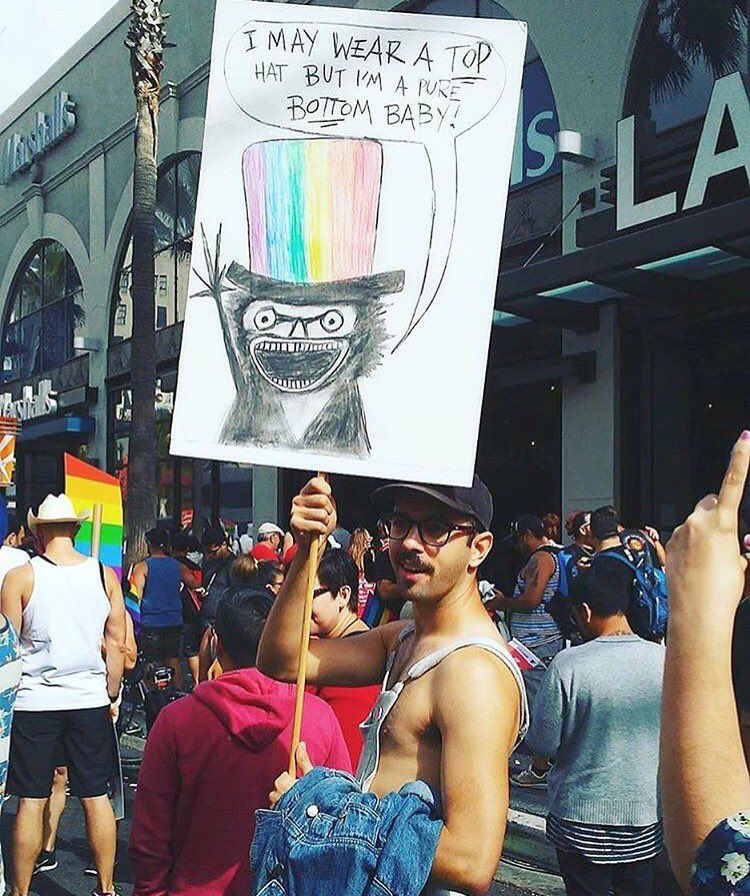
Writing about memes is silly business. By the time I publish this piece, it will have been well over a week since the story of the Babadook’s strange path to becoming an LGBTQ icon peaked, which in internet terms is a relative eternity. It’s still a funny story, though. Reportedly, a Netflix user noticed that the Jennifer Kent-directed instant cult classic horror The Babadook had been mistakenly filed under the LGBTQ Cinema category on the site’s streaming service. Users across social media platforms like Tumblr & Twitter then ran with the mistake, declaring the Babadook to be a gay icon. There has since been an immeasurable flood of memes inserting the Babadook into rainbow flag backdrops, stills from RuPaul’s Drag Race, and any other queer spaces that could easily be ‘Dooked. There have even been in-the-flesh sightings of the Babadook at Pride parades and the filming of the Drag Race finale. It’s been a bizarrely fun way to kick off 2017’s Pride Month​ celebrations and, unlike most memes, I hope this one never dies.

On one of our fist posts as a site, we declared The Babadook to be one of the best films of 2014, a very close second to the South Korean sci-fi epic Snowpiercer. We did not, however, have Netflix’s courage to declare that the film qualifies as LGBTQ content. It’s funny to return to Kent’s film now in search for glimpses of queerness, a context that was presumably far from anyone’s mind, Kent’s or otherwise, when it was first produced. It’s easy to make flippant jokes (and plenty have) about the Babadook’s dramatic presence in the arts (a children’s book about himself), how he’s a fancy dresser (complete with a signature top hat), how he’s kept locked away in a closet (actually, it’s a basement, but whatever), and his tendency to chat at length on the phone (about himself). If you really want to reach for something more substantive, I guess you could find interesting subtext by looking to the scene where the main character is prevented from masturbating with her ancient sex toy as an act of sexual oppression or by considering the fact that the Babadook himself is oppressed but never truly goes away as a kind of metaphorical struggle. The joke, though, is not necessarily that the film The Babadook is gay, but that its titular character is. This is still a film about a parent’s daily struggle with grief, depression, and resentment of their own child. The monstrous manifestation of that struggle, the Babadook, just happens to be a gay character within that story (according to current kayfabe, at least).

Keeping that separation of narrative and character in mind, there is something undeniably gay about the Babadook: he barely appears onscreen. In GLAAD’s recent scathing report on LGBTQ​ representation in major Hollywood productions, the organization took major studios like Disney & Sony to task for the pitifully minuscule amount of screentime they afforded queer characters in 2016. In one of the most absurd (and most damning) factoids from the report, it’s stated that the Lonely Island comedy Popstar: Never Stop Never Stopping accounted for 20% of all LGBTQ representation in major Hollywood productions last year, all because of a single Macklemore-spoofing song that satirizes a “no homo” brand of mainstream queer acceptance. Yet, you’d think that things were getting better than the report suggests, thanks to overblown flashes of queer representation like a suggestive campfire confession in the latest Power Rangers movie or an equally vague hint of LeFou’s homosexuality in the latest Beauty and the Beast. Audiences desperate for queer content will look for same sex romance in slightly suggestive friendships between characters like Poe & Finn in The Force Awakens or Steve & Bucky in the Captain America series, despite there being very little to support it, even in terms of subtext. Fans have to reach for those unspoken romances & declarations of queer identity because there’s nothing explicit to hold onto in most mainstream Hollywood productions. Worse yet, corporations like Disney will encourage this desperation because it sells tickets in certain demographics, yet they will do little to follow through on the promise.

The Babadook knows the struggle between lip service & onscreen representation all too well. His name is often spoken and his 2D image sometimes flashes in the form of his eponymous children’s book, but Babs himself does not appear onscreen until over halfway into the film. He’s relegated to the shadows, mostly locked away from eyesight, and the audience is blocked from getting the ‘Dook they want so badly. If we’re going to establish as a culture that the Babadook is gay, we’re also going to have to accept that the way he’s villainized and minimized in his own damn movie is sadly typical of how queer characters are represented onscreen. As an Australian indie director working on a minor budget, Jennifer Kent is far from a Hollywood big shot (and, breaking kayfabe for a minute, The Babadook is far from an LGBTQ film). It is funny, though, that as her horror genre monster has been gleefully co-opted as a queer icon that his minimized screen presence incidentally mirrors the way LGBTQ characters are typically represented (or not represented) in major Hollywood productions. It’s almost as funny as it is monstrously depressing.

-Brandon Ledet

Grumpy Cat’s Worst Christmas Ever (2014)

EPSON MFP image

three star

campstamp

Do I have a soft spot for talking animal movies or something? Earlier this year I found perverse entertainment in the talking dog pro wrestling movie Russell Madness and then presented the talking-pig-saves-the-day epic Babe 2: Pig in the City for our August Movie of the Month selection. And now I’m here to report that the Lifetime Original Movie Grumpy Cat’s Worst Christmas Ever isn’t actually all that bad. “Not actually all that bad” is far from high praise, I know, but for a made-for-TV movie about an internet meme in which the main character repeatedly breaks the fourth wall to complain about how awful the movie is, it’s a fairly surprising distinction. Grumpy Cat’s Worst Christmas Ever knows exactly what kind of movie it is & doesn’t pretend to be anything more. It self-references its protagonist’s meme fame by adopting I Can Haz Cheezburger font for multiple gags. It willingly points out when it subs a stunt puppet for the real Grumpy. It “jokingly” promotes Grumpy Cat merchandise with little to no pretence. When its self-described “sappy melodrama” plot kicks into high gear, Grumpy complains “Don’t get sappy on me. Oh wait, I forgot. It’s a Lifetime Movie. Go ahead.” Self-deprecation & self-referential humor can sometimes be low hanging fruit, but it kinda works for this movie, given the limited possibilities of its Grumpy Cat: The Movie premise.

I guess a lot of what saves Grumpy Cat’s Worst Christmas Ever from being the worst movie ever is in the casting of Aubrey Plaza as Grumpy Cat’s voice over (and as Aubrey Plaza in a sound booth). Just like when Plaza played a live-action Daria Morgendorffer in a spoof trailer comedy sketch a few summers back, the casting just makes way too much sense. Her comedic persona is basically of a human cat, right? Her wry, detached, disinterested sense of humor sets the bar so underachievingly low here (in a good way!) that it’s always possible for the movie to succeed. The plot involves some kind of depressive Gordy situation where only one grumpy preteen girl can hear Grumpy Cat talk. This girl gets mixed up in a small-time heist situation involving two rock & roll douches & a Peep Beep Meme Creep mall cop dweeb. While she thwarts their evil deeds Grumpy Cat shows zero interest in getting involved in the goings on. She just sorta riffs on the idiocy of the plot, hanging back, essentially life-tweeting/hate-watching her own movie. Imagine a family comedy with its own MST3k commentary built in, but skewing to a younger crowd & you pretty much get the picture.

Even though it aims a younger audience, though, the movie manages to get a few subversive jabs in there. It introduces its shopping mall setting as “a soul-sucking bastion of consumerism which serves to drain people’s bank accounts and alienate them from the true meaning of life.” Plaza also injects a lot of her own comedic persona into the role, especially in the way she calls her costars “terrible human beings” & “witches”. There are plenty of non sequitur asides distracting from the plot, but the most fucked up of all is a brief tangent in which Grumpy Cat is sentenced to prison (the pound) & promptly executed (put down). Quite the light-hearted gag, that. Worse yet is an exchange after the whole botched heist ordeal concludes & Grumpy Cat’s human’s mother asks her formerly-grumpy child, “Those guys didn’t do anything to you, did they?” & Grumpy Cat responds “That’s a different kind of Lifetime Movie.” I know this is a movie about a cat with a mean streak, but yikes. That one’s got bite.

For the most part, though, the moments I enjoyed most about Grumpy Cat’s Worst Christmas Ever weren’t subversive at all. The film works best when it embraces its own hokey stupidity. When Grumpy is propped up in front of a green screen to simulate driving, flying, setting off explosions, or going Rambo with a cat-sized automatic paint gun are dumb & simple enough to get by on their own half-assed charm. My favorite moment of all in Grumpy Cat’s Worst Christmas Ever, though, is Plaza’s line-reading of “We’re in a movie!” during the film’s action-packed climax. It’s a sublimely dumb moment in a thoroughly dumb movie about “the Internet’s biggest cash cat”. In 2014, Grumpy Cat seemed to be doing a lazy, half-hearted victory lap, soaking up the last of her short-term fame in moves like appearing on Monday Night Raw & starring in her own Christmas movie. Anyone tuning in for a dumb made-for-TV Christmas movie about a cantankerous cat should be well-prepared for what’s delivered here, especially considering how the film warns you of its emptiness with early onscreen references to Keyboard Cat & Nyan Cat (come to think of it, Lil Bub was snubbed). Grumpy Cat’s  Worst Christmas Ever doesn’t ask much of itself, which is oddly enough what makes the whole thing work in its own diminutive way. Well, that & Aubrey Plaza, who is delightful in her refusal to be delightful.

-Brandon Ledet