After several false-starts in the build-up to this moment (most of them penned by backpack-rap dork Lin-Manuel Miranda), we have finally arrived at the official return of the mainstream movie musical. The monkey’s paw irony to that triumph is, of course, that neither of the awards-nominated musicals marking that return are any good. If anyone who isn’t already afflicted with a debilitating, life-long case of Oscar Fever is paying attention to this year’s Awards Race, it’s because they’re fans of the pop stars Selena Gomez or Ariana Grande, who are both competing for a Best Supporting Actress statue in their respective movie-musical projects. Gomez struggles to speak-sing Spanish in the operatic French musical Emilia Pérez, which is a strong Oscar frontrunner despite wide critical disdain for its ludicrous misrepresentations of transgender identity & Mexican criminality. For her part, Grande excels as the only successful element of the Wizard of Oz fanfic musical Wicked: Part One, which is a strong Oscar frontrunner despite playing like a color-desaturated Target commercial with exactly one redeemable performance. It’s baffling that either film is in Awards Contention at all, considering their shared artistic anemia, but their dual success is still a healthy sign for the movie industry at large – proving a wide-appeal audience interest in the movie musical format and activating sleeper-cell agents from the pop-girlies Stan Wars to draw wider attention to this year’s Oscars race.
In this world where two of the biggest Awards Season frontrunners are embarrassingly clunky musicals starring pop singers with rabid online fanbases, 2001’s Carmen: A Hip Hopera is a foundational text. Produced for broadcast on MTV, the hip-hop flavored reinterpretation of the classic opera Carmen was propelled entirely by the star power of a young Beyoncé Knowles. Before she tested the limitations of her Movie Star presence in her official debut Austin Powers in Goldmember and the limitations of her rapping skills in the albums leading up to Lemonade, Beyoncé was given the titular role in a made-for-TV feature that asked her to be a rapping Movie Star, hoping that her charm & beauty would overpower her unpreparedness. The gamble mostly worked, if not only because the MTV production team was able to surround her with a talented cast of actors (most significantly Mekhi Phifer) and rappers (most significantly Mos Def) for support. Like Emilia Pérez & Wicked, it was a film younger viewers watched solely for the star presence of their favorite pop singer and supported on principle, so as not to cede ground in the fight to cement their fav on Pop Music Mt. Rushmore. As a result, it’s aged into a fun novelty as an early-aughts time capsule, padded out with performances from names that would only mean something to children raised on daily broadcasts of TRL: Da Brat, Lil Bow Wow, Jermain Dupri, Rah Digga, etc.
Beyoncé enters Carmen wearing a sparkly red Jessica Rabbit gown, turning the head of every Philadelphia cop slamming brewskies in their department’s go-to dive bar (tended by blacksploitation legend Fred Williamson). Even the straightlaced family-man cop played by Mekhi Phifer can’t help but drool over her classic beauty, much to the indignation of his loving fiancé. Instead of seducing any of the already crooked cops on the force who’d sleep with her in a heartbeat, Carmen of course zeroes in on the above-board gentleman in the room as a kind of personal challenge. Phifer resists her advances at first, explaining in Seussian rap verses, “You’re too hot for a guy like me. You and me are unlikely.” They immediately bone anyway, which gives Phifer’s corrupt superior (Mos Def, giving the only genuinely good performance in the film) an excuse to lock the goody-two-shoes up and eventually chase the mismatched lovers out of town. A classic tragedy follows as Carmen gets bored with her new plaything and moves onto the next, as slowly spelled out in a prototype for R. Kelly’s “Tapped in the Closet” narrative style. There’s plenty of humor in the effort to reconfigure Carmen‘s narrative into modern hip-hop rhymes, like in Beyoncé’s warning that “Everything that glitters don’t bling,” or Phifer’s romantic declaration, “Let me tell you how much I care. Man, when I was locked up I couldn’t smell the piss, only the scent of your hair.” It’s all vintage early-aughts camp, as long as you don’t take the inevitable deaths in the final beat too seriously.
Carmen: A Hip Hopera is at its most enjoyable when it drops the pretense of respectability and fully leans into its MTV-flavored novelty. After a brief opening-credits music video wherein Da Brat explains the basic elevator pitch, the movie naturally slips into a kind of low-rent melodrama that happens to be set to a rap beat. Eventually, though, director Robert Townsend (B*A*P*S*, Eddie Murphy: Raw) loosens up and has fun with the premise, introducing green screen illustrations of the rap lyrics in pure music-video kitsch. The MTV branding is noticeable throughout in the choppy Pimp My Ride editing style and in-film references to shows like MTV Cribs, but it isn’t until the second half of the runtime that the music-video aesthetic fully takes over and Carmen becomes something sublimely silly instead of disastrously silly. I’m willing to admit that I am personally biased on this front, as it was produced in the exact era when I would have been glued to MTV myself, so that its vintage music-video touches trigger an easy nostalgia for me. I am also biased since, of all the singers currently vying for positions on Pop Music Mt. Rushmore, Beyoncé is the only one that most appeals to me. As a musician and a stage performer she’s consistently impeccable, so to see her try her hand at something in which she’s merely mediocre only makes her that much more adorable. So, maybe my dismissive opinions on Emilia Pérez & Wicked will cool over the next couple decades as they become cultural artifacts instead of poor excuses for Prestige Cinema, but it’s more likely that I will never warm up to them, since I have unknowingly chosen my own combatant in the War of the Pop Girlies and just hate to see the competition win.
The early-Fall lull between the Summer Blockbuster schlock dump and Awards Season prestige rollouts is always somewhat of a cinematic dead zone, but this year’s has been especially harsh. The ongoing SAG/AFTRA strikes have scared major studios into delaying some of their biggest Fall releases for fear that their marketing would fail without the star power of a Zendaya or a Timmy Chalamet doing traditional promo, leaving very little of note on the new release calendar (until the Studios cave on those actors’ reasonable demands for fair compensation). I’m sure it’s been a strain on movie theaters in the meantime, and I hope that they squirrelled away enough of that sweet Barbenheimer money this summer to survive the drought. Speaking selfishly, though, it’s been awesome for me as a regular moviegoer. Stumbling into this new-release wasteland during Halloween Season inspired local indie theaters to get creative in their respective repertory programming, resulting in what has got to be the greatest month of local film listings I can remember in my lifetime (with the caveat that I grew up in the era when suburban AMC multiplexes strangled the life out of what used to be a much more robust New Orleans indie cinema scene). I spent most of October bouncing and forth between The Broad and The Prytania on the same #9 Broad bus line, frantically catching as many never-seen-on-the-big-screen horror titles as I could while the getting was good. And there were still plenty more I missed that I would’ve loved to see properly projected, including the early Universal Horror all-timer The Black Cat. What a time to be unalive!
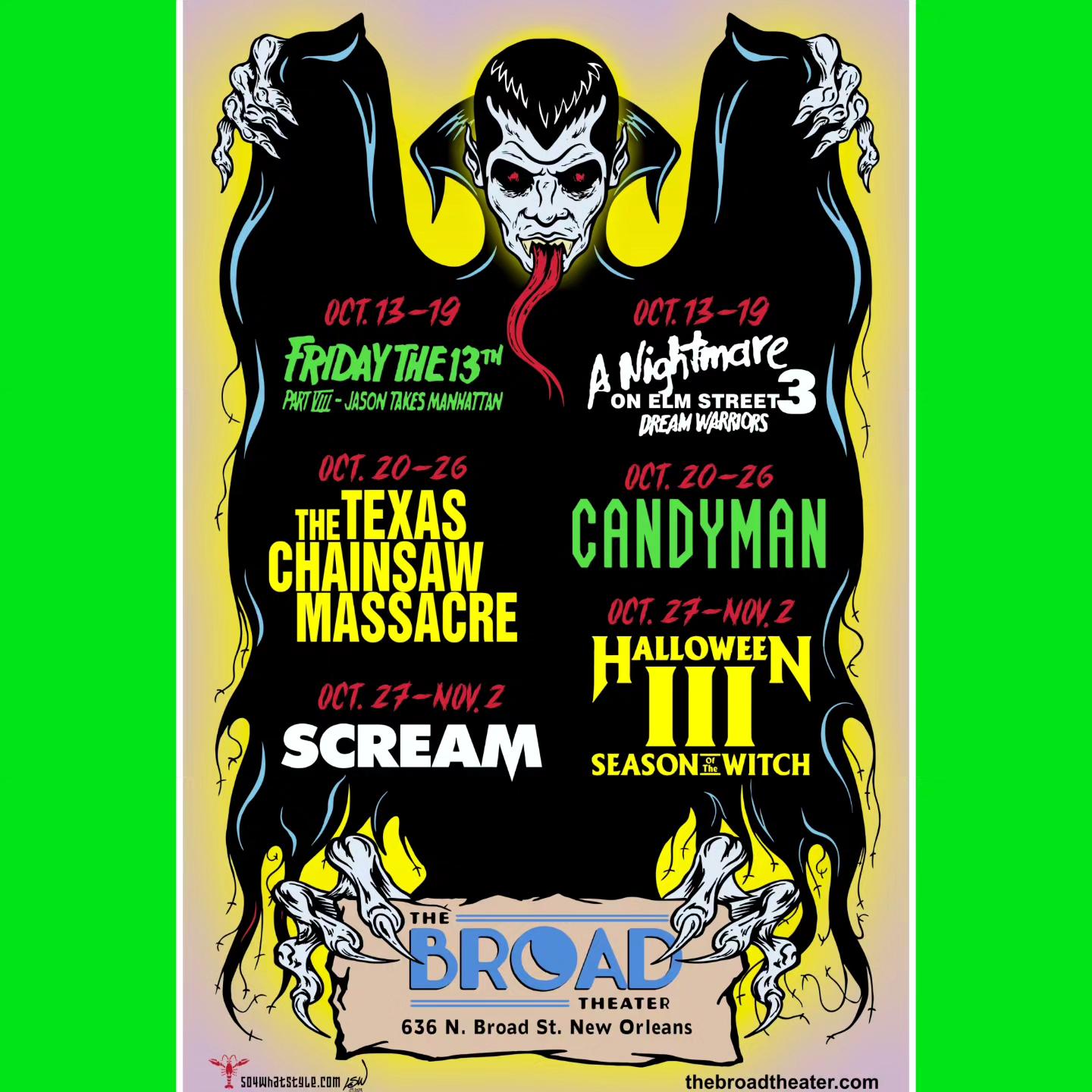
If I were to parse out the two distinct flavors of these theaters’ dueling Spooktober line-ups, I’d say The Prytania offered an older, dustier variety of venerated genre classics while The Broad offered slightly warped cult favorites of the video store era. I personally trekked out to The Prytania to see odds-and-ends obscurities I’d never seen before at all, let alone on the big screen (Dracula’s Daughter, Bell, Book and Candle, The Creeping Flesh), but they also programmed a long list of definitive Hall of Fame horror classics that should be checked off of any genre fan’s personal watchlist (Don’t Look Now, Psycho, The Wicker Man, The Shining, The Exorcist, etc.). Meanwhile, The Broad’s lineup made a few more surprising, left-of-field choices, mostly in straying from the classics to instead screen their most chaotic, divisive sequels. While The Prytania screened the John Carpenter slasher-definer Halloween, The Broad screened its Michael Meyersless sequel Halloween III: Season of the Witch. While The Prytania screened fellow slasher-definer Friday the 13th on Friday the 13th, The Broad screened Friday the 13th, Part VIII: Jason Takes Manhattan, its most over-complained-about sequel. The Prytania’s schedule was so plentiful with exciting horror titles this October that I hardly had time to watch movies anywhere else, but I pushed myself to catch the most esoteric selections in the “Nightmares on Broad Street” program anyway, just to support the iconoclasm, as detailed below. And while I’m comparing the two theaters’ programs here, I should note that the one film they both played last month was Wes Craven’s teen meta-slasher Scream, which I suppose makes it their consensus pick for the greatest horror film of all time.
A Nightmare on Elm Street 3: Dream Warriors (1987)
The most rewarding trip I had to The Broad this October was to revisit Dream Warriors, a movie I mostly remember from late-night cable broadcasts and oft-repeated Blockbuster VHS rentals. The film marks Heather Langenkamps’s return (and shockingly morbid departure) as the series’ Final Girl figurehead, now a young medical student researching violent sleep disorders in order to help suffering teens survive nightly dreamworld visits from Freddy Kreuger. The film’s limited setting in a mental hospital narrows its focus to a small group of traumatized teen insomniacs and their befuddled doctors who can’t quite figure out how they all suffer from the same group delusion that causes them to self-harm; spoiler: it’s because Freddy is real. Dream Warriors has long been a favorite of mine in the series due to the novelty of its imaginative kill scenes, which include Freddy puppeteering one of his victims using their exposed veins as marionette strings and Freddy transforming his finger-knives into hypodermic needles to feed the hungry mouths of another victims’ pulsating track marks. It’s pretty fucked up, especially since it’s combined with Freddy’s early stirrings as a stand-up comedian – crushing one victim’s head with a television while quipping “Welcome to primetime!,” declaring another victim “tongue-tied” after literally tying them to a bedframe with his detachable tongue, and punctuating every misogynist kill with the punchline “Bitch!”.
What will always stick with me about Dream Warriorsnow, though, is that it’s the only Nightmare on Elm Street movie that has managed to make me cry. Maybe I’m getting too soft in my old age, or maybe it was just the theatrical atmosphere replacing the film’s usual brewskies-on-the-couch presentation, but I got unexpectedly emotional watching these kids get disbelieved and blamed for their own illness for so long before finding unexpected strength in solidarity. Every authority-figure adult in their lives is dismissive of their nightly suffering except the one who happened to go through their exact supernatural torture in her own youth, and then she teaches them how to fight against their isolating threats as a collective group through lucid dreaming. It’s oddly sweet, even as it is hideously gruesome. It’s probably no coincidence that the three best-remembered Elm Street movies are the ones Wes Craven had a direct creative hand in—the original, Dream Warriors, and New Nightmare—and, while I might personally prefer New Nightmare in that trio, they’re certainly all worthy of standalone repertory programming. Not many theaters would take a chance on the sequels outside a marathon context, though, so Dream Warriors immediately registered as mandatory viewing, even in such a crowded month.
Friday the 13th Part VIII: Jason Takes Manhattan (1989)
Speaking of slasher sequels no one would usually take a chance on, holy shit. Dream Warriors has plenty of long-running goodwill among horror addicts as one of the best of its franchise, but Jason Takes Manhattan has a long-running reputation of is own as one of its franchise’s worst. Wrongly. The standard-issue complaint about this much-mocked slasher sequel is that it’s flagrantly mistitled, promising that Jason Voorhees will take a grand budget-burning tour of New York City, when in reality he spends most of the runtime killing teens on a boat trip to the city. Given that marketing department disappointment, I wish the film had simply been retitled Jason Takes a Cruise to calm the horror nerds’ nerves. Complaining about the locale of Jason’s tireless teen slayings in this outing three decades after the first-weekend jeers is idiotically shortsighted & petty, since Jason Takes Manhattan is scene-to-scene the most memorably entertaining entry in its franchise, give or take Jason X (which is mostly set on a ship of sorts itself). En route to Manhattan, Jason punishes high school seniors for celebrating graduation with the old-fashioned teen sex, drugs, and rock ‘n’ roll that he loathes so deeply: filming amateur rock videos in the engine room, snorting coke off mirrors in the supply closet, and seducing the uptight principal to get out of completing their science fair projects. It’s a random assemblage of quirky slasher-teen behavior that even on land would be more entertaining than the snoozy cabin-in-the-woods doldrums of earlier Friday the 13th sequels, and then the Manhattan-themed rampage promised in the title is delivered as a sweet novelty dessert.
If anything, there’s something immensely satisfying about the way Jason’s whirlwind Manhattan tourism is delayed for a condensed, climactic payoff instead of being drawn out into urban slasher tedium. An opening credits sequence details the grimy back-alleys of 1980s NYC, particularly focusing on a barrel of toxic sludge that serves as the bathtub for a gigantic rat. We do not return to that alley until the third act, when Jason drowns the film’s most detestable character headfirst in that exact barrel, the rat now dead beside him to emphasize just how gross the sludge truly is. There’s also some great metaphysical character at work here as well, where Jason now appears to be made entirely of toxic sludge himself, having been submerged in the murky waters of Crystal Lake for so long that he’s essentially a hulking collection of sentient goo. His younger, drowned self appears to the film’s Final Girl in frequent, psychedelic hallucinations during the boat trip to Manhattan – underlining the killer’s supernatural constitution, connecting his qualities as an aquatic zombie to the waters that connect Crystal Lake to the Hudson Bay and, frankly, killing time between his actual kills. Mostly, though, his gooey, goopy body is just an extension of the way the movie associates New York City with sludge & grime, painting it as a landscape made entirely of rats, rape, street punks, and shared hypodermics. In a way, you get a little taste of Manhattan on the ride to its shores in Jason himself. More importantly, it’s one of the precious few entries in his franchise where he isn’t a total bore. Too bad so few people get past the misleading title to see that; it was the least well-attended horror screening I saw all month.
Now here’s where things get interesting. The Broad had already filled its schedule with classic horror films at the start of the month, and then Taylor Swift dropped a rushed-to-market concert film that cleared even more room on local marquees, since film studios were scared to compete with the most famous woman alive. I’ve never been a bigger Swiftie. Because Swift’s Eras Tour cleared the weekly release schedule, The Broad added three additional classic horrors to its line-up, all digital restorations of vintage gialli by Dario Argento. And so, I got to see my personal favorite Argento film on the big screen with my friends instead of the way I’ve watched it previously: alone as a fuzzy YouTube rip. Like with my appreciation for Jason Takes Manhattan, Opera is far from the wider consensus pick for Argento’s best; I was genuinely shocked to see it theatrically listed alongside his better respected works Deep Red & The Bird with the Crystal Plumage on The Broad’s marquee. At this point in the month, it was starting to feel like someone was programming a mini horror festival just for me, and it was delightful to see plenty likeminded freaks in the audience instead of the empty seats I was met with at the screening of my favorite Friday the 13th.
Opera finds Argento working in his Inferno mode, putting far more effort into crafting individual images than weaving them into a cohesive story. After being hired to direct a real-life opera of Macbeth and abandoning the project before production, Argento salvaged his scrapbook of ideas for its staging in this loose mystery crime thriller about a gloved killer’s obsession with an opera singer. The killer’s mechanism for torturing his muse is tying her up with pins pointed at her open eyelids so she cannot look away from his violent slayings of her friends, lovers, and collaborators. It’s a double-contrivance of Hitchcockian voyeurism, where the killer obsessively watches the singer from the anonymous crowds of her opera house and, in turn, makes her watch him perform his art backstage. It’s also just an excuse for Argento to indulge in a glorious clash of high & low sensibilities, alternating between operatic vocal performances in the theatre and thrash-metal slashings on the streets. Opera might feature his most overactive, over-stylized camerawork to date, too, most notably in scenes where the camera adopts the POV of the trained ravens on his Macbeth set to directly attack his own audience in murderous swoops & dives. Opera may not be as beautiful as Suspriria, nor as horrifying as Tenebrae, but it’s Argento’s mostly wildly impulsive vision – both his most invigorating and his most incompressible. I loved seeing it get the proper theatrical setting it deserves.
Halloween III: Season of the Witch (1982)
YWhile there may still be some novelty in exalting Opera & Jason Takes Manhattan as the top of their respective classes, I’d say Halloween III: Season of the Witch has been thoroughly reclaimed in the modern discourse to the point where calling it The Best Halloween Movie is almost an online Film Bro cliche. Hell, that thought even occurred to me back when we covered it on the podcast in 2016, when I called it the best Halloween movie. There’s some necessary semantic clarification to make there, though, because I’m not only saying that its infamous Michael Meyersless deviation from the John Carpenter slasher franchise makes it the most interesting movie of its series. I’m saying that it’s the best horror movie in any context that’s specifically about Halloween as a holiday, from the roots of its pagan Samhain traditions to its modern Trick or Treat rituals in the American suburbs. The only films I skipped on the Nightmare on Broad Street roster were the widely beloved horror classics The Texas Chainsaw Massacre, Candyman, and Scream, and I believe the horror nerd community has gotten over Season of the Witch‘s disregard for Michael Meyers slashings well enough that it now registers among that verified pantheon of seasonal greats (in a way they still haven’t gotten over the title of Jason Takes Manhattan). The reason I didn’t skip Season of the Witch, though, is that The Broad happened to screen it on Halloween Night, and I couldn’t fathom a better way to cap off this exquisite month of local repertory moviegoing. It was a hoot, and I’m already excited to see what they pull out of the haunted vault next year.
“Is this Good-Weird or just Weird-Weird?” That nagging question never faded from my mind at any point during Leos Carax’s entertainment-industry rock opera Annette, but I’m not convinced it’s a question that needs an answer. I’m cool with the movie’s low-energy batshittery either way. It at least has a sense of humor about itself, and there’s nothing else quite like it – two qualities that cannot be undervalued in the current Prestige Filmmaking landscape. Originally composed as a concept album by the avant-garde pop group Sparks, Annette feels more like a prank than a proper musical. Every line of dialogue is written as unsubtle, declarative statements about what each character is doing & feeling in the moment, as if that information wasn’t already being illustrated onscreen; they’re also sincerely performed as pure, straight-forward melodrama. And yet the entire film feels as if it’s being conveyed with a tight, self-amused smirk, impressed with its own audacity as a go-for-broke Weird Movie with a legitimate budget & cast. I’m impressed as well, even if I can’t quite match how impressed it seems to be with itself.
Adam Driver stars as a low-effort, hacky stand-up comedian who’s earned rockstar status through his “tells it like it is” abrasiveness, which protects him from having to be vulnerable onstage. His fame skyrockets when he romantically links with a renowned opera singer played by Marion Cotillard, whose contrasting artform is high-effort & devastatingly vulnerable on a nightly basis. The comedian’s ego is threatened by the amount of oxygen his tenor-wife’s career eats up in their life together, especially once her starpower outshines his own. That resentment leads him to explosive, violent fits of anger, as well as the financial exploitation of their child, whose own singing career allows him to vicariously re-live his former professional glories. This all sounds typical enough for a star-studded, festival circuit melodrama with Awards Season ambitions, but Annette‘s wryly operatic line-deliveries & near-future visual mindfuckery abstract all its familiar narrative elements into oblivion. Its Weird-Weird weirdness is concentrated entirely in its execution, not in its premise.
My favorite aspect of Annette is how outright hostile it is towards its audience, mirroring the onstage abrasiveness of its stand-up “comedian” protagonist. Like in Soderbergh’s introduction to the difficult-to-define prank comedy Schizopolis, the movie opens with Carax issuing commands that everyone hold our breath, our farts, and our full attention for the entirety of the screening. We’re instructed to “Shut up and sit” without any distractions for the following 140min, which feels like a tall order considering that it was distributed through Amazon Prime concurrently with its theatrical release. Carax doesn’t want your absent-minded snacking or social media scrolling to compete with his quietly bizarre vision of the modern movie musical. If you grant him your full attention, he promises to treat you to a nightmarish inversion of pop-culture celebrity in a near-future Los Angeles. He mostly delivers. The film’s explicit sex, fairy tale puppetry, late-night motorcycle rides, and surrealist parodies of Entertainment Tonight broadcasts are all incredibly, uniquely eerie deviations from the mainstream-filmmaking norm. I don’t fully know what its intent or purpose are besides achieving that eeriness, but that effect was more than enough to hold my attention (if not my farts).
My only complaint about Annette, really, is that it’s obnoxiously long. I was amused by the blatant emotional declarations of the song lyrics, the absurdist intrusion of the puppet-baby, the surface-level jabs at entertainment media vanity, and all the rest. It’s just that it could have been an entire hour shorter without sacrificing any of those distinguishing details. The movie is Weird, but it is persistently Weird in the exact same way from start to end, with no detectable ebb or flow in its tone. However, as impatient as I could get with the vast ocean of Weird-Weird water-treading between its opening & closing numbers (the only genuinely catchy songs of the bunch), I recognize that obnoxious self-indulgence & self-amusement as exactly what’s endearing about the film in the first place. A movie this hubristic pretty much has to be an hour longer than needed; that’s just part of its nature. And, hey, at least it’s a more singularly entertaining waste of Amazon’s money than the rocket fuel that powers Jeff Bezos’s mid-life crisis.
Stuck between the sincere emotional devastation of Boys Don’t Cry and the over-the-top camp of Desperate Living, the 2014 adaption of Pierrot Lunaire is the story of a trans man’s tragic romance with a cisgender woman like no other filmmaker except Bruce LaBruce could tell it. The legendarily filthy queercore filmmaker first adapted the opera for the stage in 2011, clips of which are incorporated into this short, energetic feature in harsh collage. Filtering the story through a Guy Maddin-style Silent Era throwback, the text of the opera is not translated into English, but conveyed instead in frequently humorous silent film intertitles. The sounds of the opera itself are also interrupted by the pounding rhythms of gay club music, a stark contrast to the Marianne Faithful-esque vocals of the backing track. Vaudevillian pantomiming complicates the genuine raw emotion of a trans man struggling to be accepted as he is in the ancient past of the late 1970s. The titular “butch dandy” will humorously complain about the “foul indignity” of having to squat to piss in one breath of purple prose, then beat his own bound breasts with genuine, devastating pathos in the next. It’s strange; it’s self-contradictory; it’s both flippant & heartfelt. It’s queer as fuck. For better or worse, Pierrot Lunaire is pure Bruce LaBruce.
If Pierrot Lunaire has one Achilles heel it’s that, even at a mere 50 minutes, its narrative concept is too slight to fully support a feature. This is the exact kind of Guy Maddin-type experimental territory that’s typically relegated to the short film medium. Pierrot’s quest to be seen & treated as a man by his unwitting girlfriend & her “fat capitalist pig” father has a kind of inevitable tragedy to it, both due to the narrative structure of most operas & due to the types of gender transition stories that are most often told onscreen. LaBuce may color within those lines narratively, recalling far too many Oscar-thirsty misery tales to leave much of a storytelling impression, but the aggressively queer, expressionist lens he filters it through feels entirely foreign to the genre. Poetic double exposures of the full moon & projections of how Pierrot sees his true self in the mirror clash with over-the-top line deliveries of zingers like “Marlene Dietrich is more man than you’ll ever be,” & “I’m going to get the bottom of this if it’s the last bottom I get to.” Forever the artful pornographer, LaBruce also fills the screen with modern kink iconography: leather-clad masc strippers, strap-on dildos, burlesque routines, S&M gear, etc. The only element of straight-world prestige filmmaking present is that the film’s costumes were designed by Zaldi (costumer for heavyweights like Lady Gaga and RuPaul). The rest of the film is wild, queer, D.I.Y. punk excess with very little concern with taking the shape of mainstream trans tragedy narratives, defiantly so.
The politics of onscreen trans representation has evolved drastically since LaBruce first staged Pierrot Lunaire in 2011. Casting choices in his most recent film The Misandrists even suggests LaBruce has evolved with it. That means this film’s half-flippant, half-tragic tonal clash isn’t going to sit or age well for all audiences, the same way that Hedwig & The Angry Inch has awkwardly mutated over the past decade. As an experiment in avant-garde, genderfucked theatre, however, Pierrot Lunaire is far bolder & more adventurous than even Hedwig was in its own heyday. It’s a film that only concerns itself with extremes. When adapting a tragic trans story into a musical, it has to be a gut-wrenching opera and a vaudevillian Silent Era pastiche. When taking on notes of vintage horror it has to treat gender dysphoria as a self-endangering form of body horror and include sillier indulgences like Franksentein-style sci-fi, zombies, and glory hole guillotines. LaBruce will settle for no less than being a pornographer and a serious artist, a prankster and an emotive auteur, a radical philosopher and a campy provocateur. Pierrot Lunaire might struggle to keep up with the ever-evolving standard of representation politics or justify a feature length runtime, but it satisfies all of those self-contradictory goals with ease – no small feat.
Although I have no problem conceding that the legendary auteur was immensely, distinctly talented as a visual artist, I personally struggle to enjoy Andrei Tarkovsky works like Solaris or Stalkeras genre film entertainment. Josh Gibson’s microbudget sci-fi indie Pig Film (which saw its U.S. premiere at the 2018 New Orleans Film Festival) has cracked that code for me, re-configuring the basic elements of a Tarkovsky genre film into something I wholeheartedly enjoy. An hour-long, black & white sci-fi musical (!) that reinvigorates the Tarkovsky aesthetic by infusing it with the grimy textures of indie genre-film classics like Eraserhead & Tetsuo: The Iron Man, Pig Film indulges in the exact amount of art film pretension I can stomach before I start rolling my eyes. A lean, self-contained industrial nightmare that only disrupts its pensive oceans of silence for moments of ethereal, operatic beauty, Pig Film is Tarkovsky perfected – or, if you’re already a Tarkovsky convert – Tarkovsky streamlined, like a punk rock Stalker.
A mysterious, unnamed woman tends to an industrial pig farm as its only worker and, seemingly, the only person left alive. She sees to the entire life cycle of a farmed pig (from insemination to slaughter & rendering) all by her lonesome, a one-woman factory staff. Her only company is a stockpile of outdated industrial infomercials from the 1950s: real-life propaganda artifacts recorded on celluloid, projector slides, and vinyl records. Her only “spoken” dialogue is privately-sung operatic repetition of word-for-word snippets of text from those industrial artifacts, accompanied by an eerie synth soundtrack. She sings about the importance of pumping pigs full of antibiotics while vacantly executing the daily drudgery of preparing the animals for a likely non-existent post-Apocalyptic market, as if she’s learning the fundamental tenants of language & reality from these industrial ads. Her basic humanity comes into question as the film slips into an unmistakable sci-fi horror tone– until eventually settling for a quiet, alienating drama in a perfect closed-loop.
It’s difficult to report with any certainty whether Pig Film is saying anything concrete about the meat industry or the labor class or pollution or societal collapse or any number of issues that inevitably rise given its setting. These topics mostly inform the proceedings the way anxieties & memories of daily occurrences inform the narratives of our nightmares. The degradation of the picture quality (as it was shot entirely on expired, second-hand film stock) combines with the grimy art-instillation surreality of its pig farm setting to establish an overriding sense of isolation & rot that feels more emotional & subliminal than overtly political. Human or not, our sole on-screen character is the last shred of humanity left stalking the mess of a planet we’ll soon leave behind, emptily mimicking the records of our behavior she finds in our rubble and converting that industrial garbage into beautiful song. It’s a gorgeous, grimy nightmare – a sinister poem.
I’ve already praised November& Annihilationthis year for mutating the Tarkovsky aesthetic I find so frustrating as entertainment media into something I can wholeheartedly embrace. Pig Film might not ever match the distribution reach of those two (already underseen) films, but I’d just as readily recommend it with the same enthusiasm. For a director I struggle to appreciate on his own terms, Tarkovsky’s influence is becoming something I look forward to seeing updated & reinterpreted in other works. Beyond that influence, I’d recommend Pig Film to just about anyone who’d be in the market for a dreamlike, largely silent, post-Apocalyptic sci-fi opera set on a pig farm and filmed through a nauseating black & white; but that’s a much more difficult elevator pitch than “Tarkovsky, but concise,” or “Stalker, but punk.”
There have been countless adaptations of Gaston Leroux’s Turn of the Century novel Le Fantome de l’Opera on stage and screen, but it’s hard to argue that any have been as influential as the 1920s silent film starring Lon Chaney. Along with Chaney’s turn in the silent horror adaptation of The Hunchback of Notre Dame, the 1925 Phantom of the Opera was a massive hit for Universal Pictures, launching a decades-long moneymaker in the studio’s Famous Monster’s brand. Before Lugosi & Karloff would come to define the Universal Monsters look, Chaney was the (hideously disfigured) face of the production company’s horror division. The ripple effect of the silent Phantom of the Opera’s success achieved a far-ranging influence (from Lugosi & Karloff to, disastrously, Dario Argento), not even matched by the name-recognition commanding stage musical from Andrew Lloyd Weber. Not to shatter any illusions to the contrary, but shameless remakes & reissues of lucrative intellectual properties are far from new to Hollywood, so the Lon Chaney Phantom’s success meant it would be a well Universal returned to often – first in a 1933 reissue of the original film with a (since lost) soundtrack that mutated into a talkie, then as this 1943 Technicolor remake. Graduating to sound & color wasn’t the only cinematic adjustments Fantame de l’Opera had to make in those first couple of decades either. As much as the 1940s remake is obviously indebted to the Lon Chaney original, its aesthetic is so current to its time that it rarely shows its silent horror roots – or even resembles horror at all.
The basic plot of a standard Phantom of the Opera adaptation remains intact in this Technicolor remake, with Claude Rains taking over from Chaney as the titular Phantom. Here, the distantly admiring, disfigured creep who haunts the Paris Opera house and promotes the career of his favorite singer under threat of violence to those who might block her way to success starts the film as a violinist in the orchestra before being burned with acid & retreating to the shadows. Most of his subsequent kills in the periphery are lightly handled: off-screen stranglings, attempted poisonings, a recreation of the falling chandelier stunt from the previous version, etc. Even the reveal of the Phantom’s purplish acid burn scars feels delicately handled in comparison to Long Chaney’s genuinely horrific makeup in the original film. Some of the stark silent era horror influences of the original echo in this remake, especially evident in shots where the Phantom appears only as a menacing shadow on the wall. For the most part, however, this remake plays much more like a dramatic “women’s picture” of its era, focusing more on the opera singer’s choice between pursuing operatic career opportunities or a “normal” life as a housewife. It’s like The Red Shoes by way of Douglas Sirk’s Technicolor melodramas in that way, with the Phantom’s role being relegated to a side character in the female lead’s A-plot. This is more of a comedic drama about a woman at a professional crossroads than it is a shock-a-minute monster movie about a crazed, disfigured violinist.
In a 2010s update to this version of the Phantom tale, it’s likely the opera singer herself who would have been driven mad to the point of monstrous transformation, but actor Susanna Foster is never afforded her own proper freak-out in the style of a Red Shoes or a Black Swan or a Perfect Blue (so many colors!). That’s not to say that Claude Rains’s secret, murderous admirer of her work is entirely detached from the themes of her professional/romantic dilemma either. His menacing, pushy presence just out of eyesight in the opera singer’s professional life is in some ways a pitch-perfect representation of how all the men around her apply too plentiful & too intense romantic pressure she doesn’t ask for or need in the early days of her professional career. The Phantom is only one of three men in the singer’s life, joining the ranks of a police officer & a fellow musical performer, both of whom wish to court her into marriage. Just as the Phantom pressures the singer into making bold leaps in her still-early career at the opera house by threatening & murdering higher-ups on her behalf, the two suitors pressure her to choose romance over fame & art, giving up the stage for “a normal life.” The general mood of the film is light & flavored with comedy, especially as the suitors trip over each other in dual proclamations of love, but there’s also an underlying tragedy throughout in this poor woman being pressured to make choices between art & romance instead of being allowed to live as she pleases. It’s a very Sirkian conflict, one that’s handled with appropriate visual beauty & emotional melodrama.
Like with Sirk or The Red Shoes to follow, the Technicolor Phantom remake is at the very least worth seeing for its staging, especially for the intense use of rich, bold color in its costuming & lighting. Even if the trading in of silent era horrors for love triangle humor & one woman’s professional indecision is not what you’re looking for in a Phantom of the Opera adaptation, the film is still worthwhile for the visual pleasures & emotional payoffs therein. Even though it chooses to conclude on a comedic note, its adaption of the Phantom’s lingering, unwanted threats & pressures to its central narrative of a woman stuck between competing men’s designs on her life’s plan is also a new angle on the material that justifies the impulse for a remake in the first place, no matter how light on horror. There would be plenty of pointless Phantom of the Opera remakes to come in the decades following this big studio Technicolor melodrama as filmmakers grappled with the original film’s influence on horror at large. It’s doubtful there are many that are this purposeful in their modernity-minded updates to the source material, however. 1943’s Phantom of the Opera seamlessly incorporates the basic elements & structure of the original silent work into a genuine participation in the “women’s pictures” of its own day, to great artistic & thematic payoff. A brief glance at the disparity in terror between Lon Chaney & Claude Rains’s makeup as the unmasked Phantom is alone enough to indicate the differences in those film’s basic intent, but what the Rains version loses in horror it more than makes up for in another, unexpected genre.
Roger Ebert Film School is a recurring feature in which Brandon attempts to watch & review all 200+ movies referenced in the print & film versions of Roger Ebert’s (auto)biography Life Itself.
Where A Night at the Opera (1935) is referenced in Life Itself: On page 159 of the first edition hardback, Ebert explains his general taste in cinema. He writes, “I am not one of those purists who believes the talkies were perfect and sound ruined everything. To believe that, I would have to be willing to do without Marilyn Monroe signing ‘Diamonds Are a Girl’s Best Friend’ and Groucho Marx saying, ‘This bill is outrageous! I wouldn’t pay it if I were you!'”
What Ebert had to say in his review(s): Roger never officially reviewed the film, but he did reference it in his Great Movies series review of Duck Soup. He wrote, “A Night at the Opera (1935) [the Marx Brothers’] first MGM film, contains some of their best work, yes, but in watching it I fast-forward over the sappy interludes involving Kitty Carlisle and Allan Jones. In Duck Soup there are no sequences I can skip; the movie is funny from beginning to end.”
Like all great comedians, the Marx Brothers were social anarchists. Blatantly disinterested in the pomp & civility of the modern world, the legendary comedic team would only create stuffy, rules-obsessed backdrops for their intensely illogical, confrontationally flippant vaudeville routines to break them down into total chaos. It would be presumable, then, that the self-serious world of the opera would offer one of the most perfect targets for their antics imaginable. The wealth & propriety that surrounds the opera is an inspired choice for a stuffy backdrop for the Marx Brothers’ slobs vs. snobs brand of social anarchy. Unfortunately, A Night of the Opera arrived at a later, transitional period in the Marx Brothers’ cinematic path, just before they became burdened with studio bloat in A Day at the Races, so it never really had a chance to use its conceit to its full anarchic advantage the way they would have in an earlier, freer work like Duck Soup. Luckily Groucho, Chico, and Harpo Marx are some of the funniest people to have ever walked the planet (especially Harpo), so the movie is wildly funny anyway. A Night at the Opera is only vaguely disappointing because it’s very funny, as opposed to being the funniest movie of all time, something that very easily could have been achieved with its exact plot & cast under less studio control.
The first film marking the Marx Brothers’ transition from Paramount Pictures to MGM, A Night at the Opera is somewhat burdened by the limited imagination of its producers. In particular, MGM exec Irving Thalberg made a point to oversee & reshape the comedy troupe’s schtick to make it more palatable to a broader audience. He wanted to enhance the Marx Brothers brand’s appeal by strengthening their movies with more story structure and more sympathy for the three goofball leads. Thalberg aimed to achieve this sympathy by reserving their social terrorism only for “deserving” villains, as opposed to everyone in sight. It’s an impulse that fundamentally misunderstands what people love about the Marx Brothers in the first place, overloading their usual light touch of illogical transgressions with increasingly sprawling plots & runtimes. Every moment dedicated to giving the brothers a reason to drive their victims mad with slapstick & wordplay is wasted time that could just as easily have been replaced with more comedic gags. A Night at the Opera is a story about two opera singers who love each other, but struggle to connect because of the distance created by their disparate levels of success. Instead of tearing down the civility of the opera world, the Marx Brothers’ main function in the film is to bring the two lovers together, across the boundaries of class. That’s their function in the plot, anyway, which despite what Irving Thalberg believed, does not matter in a film like this. Not for a second.
That’s enough obligatory nitpicking from me. This movie is hilarious. Harpo Marx remains the funniest man who ever lived, transforming the art of slapstick humor into a deeply deranged subversion that’s since been unmatched (even appearing briefly in drag for an early gag here). Groucho & Chico are as impressive as ever in the circular logic of their conman wordplay, scamming the rest of the world and each other into a luxurious position just above the poverty line. One elaborate gag even recalls the total chaotic meltdown of a Duck Soup by piling every character possible into a single, cramped state room on an already crowded ship, a bit that comes so naturally to their comedic style that Harpo effectively sleepwalks through it. As always, the Marx Brothers’ quality in comedic craft remains unchanged; it’s just the vessel it’s packaged in that feels questionable. I really enjoy A Night at the Opera as a stately showcase of vaudevillian comedy, even if its focus on plot, romance, and musical interludes greatly distracted from what the Marx Brothers could have achieved in an operatic setting without MGM supervision guiding their work. I mean, even A Day at the Races was an easily lovable MGM-era Marx Brother comedy, and that film was saddled with a bloated, plot-driven runtime & a deeply disappointing blackface gag. Left to their own devices, the Marx Brothers could have made A Night at the Opera an anarchic masterpiece. Under Irving Thalberg’s supervision they made it a very funny, naturally endearing comedy instead, something to still be grateful for.
Widely considered to be the last great Dario Argento film, Opera (promoted in the US under the unwieldy Agatha Christie-esque title Terror at the Opera) is a sharp movie with a fast pace and some great new ideas from the aging director. Argento was invited to La Scala after Phenomena and asked to produce and mount a stage opera; he was happy to do so, but the project never went anywhere due to artistic differences. Instead, he channeled that idea into his 1987 film, which concerns a production of Verdi’s Macbeth staged by a transparent avatar of himself, with heavy influences from the plot structure and recurring images of The Phantom of the Opera.
The film opens with an unseen prima donna diva (this role was to have been played by Vanessa Redgrave, but Argento, hilariously, simply fired Redgrave when she tried to throw her weight around for a higher salary; the role was reworked to be played entirely unseen) being injured after throwing a tantrum and storming out of the the theatre. Her understudy, Betty (Cristina Marsillach), feels unready for the role, but she is encouraged by the director, Marco (Ian Charleson), and her friend and agent, Mira (Daria Nicolodi). Marco is himself a newcomer to this realm, having made his name as a director of shocking horror films. After her first performance, she discovers that she has a fan in Inspector Alan Santini (Urbano Barberini), who is at the opera house to investigate the murder of an usher who was killed during the performance. The usher’s killer begins to stalk Betty, tying her up and taping needles beneath her eyes in order to force her to watch as he murders others: first stage manager Stefano (William McNamara), with whom Betty has a tryst; later, he stabs and slashes costumer Giulia (Coralina Cataldi-Tassoni).
This image, of eyes forced open and surrounded by pins, became the movie poster’s centerpiece, and it’s not hard to see why. It’s haunting, primal, and memorable, much more so than the film as a whole. It’s also hyper-real, like much of the film itself, which is a note in its favor. This is one of Argento’s darker movies, and the violence is visceral in a way that his earlier films, with their limited special effects and beautifully vibrant but utterly unrealistic blood palette, were not. Instead, reality is elevated to emulate the same ultra-aesthetic and slightly histrionic approach that permeates the operatic world, and although this is a much more successful approach to experimental film-making than is present in Argento’s other works, it doesn’t quite work for me. I know that this one is Brandon‘s favorite, but it never gels into a cohesive whole in the way that some of the director’s other films do, despite their more disparate plot structures or occasional tonal dissonance. This movie is certainly good, but it never quite manages to be great; not having seen any of Argento’s movies that followed this one (other than Mother of Tears, which is a very different animal), I’m not ready to say that this is the first evidence of his genius starting to crumble. If anything, this journey has taught me that Argento’s earlier, reputedly greater body of work is a mixed bag. For every Tenebrae, there is a Four Flies on Grey Velvet; for every Suspiria, a The Five Days (maybe the real lesson here is to never use a number in your title).
Despite its opulent and sumptuous visuals and its decision to forego many of Argento’s favorite tricks, Opera is a relative step down from the pedestal that he had largely lived atop in the ten years following Suspiria. Again, the killer is acting out repressed fantasies after something, in this case Betty, reminds him of an earlier, sexually violent experience. The reveal of the killer’s identity and, more importantly, his motivation, works for me not at all, and I feel like Opera is all but daring the audience to feel insulted by its audacious defiance of logic. It’s not illogical, per se, but it feels disingenuous. The killer’s age, upon reveal, is at odds with what we learn about his backstory through Betty’s flashbacks, and it feels more like a “what a twist!” moment than any of Argento’s other sudden, third act plot complications. Misleading clues–not red herrings, but clues that are utterly meaningless in the end–are scattered throughout, the most prominent being the gold bracelet with an engraved date. What’s the importance of the date? What year is engraved on the bracelet? Whose bracelet is it? How did Betty’s mother even die? Did the killer do it? None of these questions are answered.
Perhaps I’m being too hard on Opera. It’s an imperfect film, but that hardly differentiates it from Argento’s other works, even some of his unequivocal classics. Its hyper-realistic energy and frenetic camera work are wonderful, and there are some absolutely beautiful giant spectacles that are a lot of fun. Betty, despite Marsillach’s weak work and tepid screen presence (Argento has been quoted as saying he should have gotten an actress who could sing instead of hiring a singer and trying to force her to act) is much more of a triumphant final girl than his other heroines, excepting Jennifer Corvino. She’s quick on her feet and demonstrates surprising cunning for a character whose primary attribute is meekness. Still, other than the haunting image on the front of the box, there’s not much that gives Opera much staying power. It’s a paradoxically luminous but forgettable gem.












 Swampflix