For this lagniappe episode of The Swampflix Podcast, Brandon & Britnee discuss the drugged-out indie romance High Art (1998), directly following its recent Gap Tooth screening at The Broad.
00:00 Vinegar Syndrome Denver 10:16 Fackham Hall (2025) 14:05 Thank God It’s Friday (1978)
Practically every adult I know socially has either a tattoo or a body piercing, if not both. Even I, a total square, have a few small tattoos myself, which you’ve only ever seen if we’ve hung out in an environment where it was appropriate to not wear socks. It’s increasingly common to see visible tattoos, nose rings, and other low-level body modifications in professional settings, since they’re now so common that they’re no longer transgressive or taboo. It wasn’t too long ago that this wasn’t the case. I remember tattoos & body piercings signaling a much edgier, fringe personality type growing up in the 1990s, whereas they’re now just as casual of a fashion choice as a quirky hat or what color shirt to wear. You can track the timeline of that body-mod culture shift in the new documentary A Body to Live In, which profiles the life, art, and spiritual practice of “modern primitivist” Fakir Musafar. From his early experiments with corset-binding fetish photography in the 1940s through his educational body-piercing and body suspension workshops in the 2010s, Musafar’s entire artistic, spiritual, and professional life was dedicated to the practice of body modification, and he saw that practice evolve from private kink play to public fashion display first-hand, seemingly involved with every major milestone of the journey. So, the documentary doubles as both a portrait of Fakir Musafar and as a broader overview history of body modification in the American mainstream.
I had never heard of Fakir Musafar before seeing this documentary, but he lived such a Forrest Gumpish life across so many various subcultures that I am familiar with that he continually crossed paths with faces that were already familiar to me: fellow self-promoting ritualist Anton LaVey, feminist pornographer Annie Sprinkle, professional Bob Flanagan flogger Sheree Rose, etc. Musafar’s body-mod journey was inspired by pure impulse (charged, at least partially, by unresolved gender dysphoria), and his early photographs were all produced in private, mostly consisting of corseting his body to simulate a female figure and then piercing that figure with needles and heavy ornaments. Once he found likeminded spirits across underground queer subcultures in 1970s California, the practice became much more social & less insular, and he was involved with a seemingly impossible range of extreme subcultures: heavy leather kinksters, Radical Faerie hippies, gallery-scene performance artists, and whoever else would show a sexual or spiritual interest in the ritualistic piercing & contorting of the human body. A lot of ground is covered very quickly as he drifts from subculture to subculture, always positing himself as a kind of mystic elder for the young & uninitiated to up to for guidance. We get to witness the evolution of professional body modification from the very first body-piercing shop opening in 1970s San Francisco to their modern omnipresence in every small town’s strip malls, but it’s always filtered through Musafar’s very particular, singular worldview.
For how impressively influential is subject was in a wide range of hip vintage subcultures, A Body to Live In is surprisingly smart about not devolving into hagiography. Musafar’s most glaring faults & criticisms are out there in the open, including control issues in his private relationships and larger accusations of cultural appropriation. In describing his early, private body-mod practices, Musafar explains that he was often inspired by ethnographic photographs in National Geographic magazines but would not read the accompanying captions, because he did not want the imagery spoiled by journalistic “interpretation.” Later, while promoting his “modern primitivism” philosophy on daytime talk shows, he struggles to articulate the authenticity of his body-mod rituals when confronted by Indigenous audiences who find his pick-and-choose appropriation of their cultures politically offensive. Even the term “primitive” is directly challenged for its political implications in the opening minutes, which might not be expected of a documentary exalting the movement for its positive influence across American subcultures. It’s very thoughtful, measured, and yet sincerely participatory in the body-mod spirituality depicted, making sure to include voices of dissent & discomfort with the practices’ cultural insensitivity while also showing the therapeutic & political good it can do in the right contexts.
Director Angelo Madsen does his best not to personally intrude on the material, except in a brief expression of regret for not asking Musafar a couple clarifying questions while he was alive to answer them. The most stylistic imposition on the material is found in the colorful psychedelia of the photograph development process, which helps transition from still photo to still photo without the clinical rigidness of an art-gallery slideshow. Madsen also arranges individual photos and slides on the screen to deliberately create a frame-within-a-frame distance from the original images, drawing attention to how Musafar’s curation of his photographs pushed his practice further into a fine art sphere than mere personal documentation of religious ritual & sexual kink. Musafar publicized his work through a wide range of artistic mediums, from the still photography he experimented with in his parents’ basement to documentary hosting in 1985’s Dances Sacred and Profane to confrontational performance art in the post-AIDS 1990s. It’s clear that his own body was the medium he was most interested in expressing himself through, though, as evidenced by his decades-long development of his nipples into cylindrical ornaments of great public interest. There’s a range of debate offered by the documentary’s talking heads about whether his primary motivation for that art was sexual, political, intellectual, gendered, or purely spiritual, and it’s to the film’s benefit that no one could definitively answer the question. They’re all partially true.
One of cinema’s greatest virtues is how it functions as a populist access point to art. Not only is the medium itself a collaboration between artists of many talents—photographers, writers, actors, costumers, sculptors, set designers, musicians, make-up artists, etc.—but its documentary branch can also document and distribute fine-art images to the widest audience possible, making fine art objects readily accessible to virtually everyone. While it could be prohibitively expensive to travel the world seeing the great works in person or to collect high-end art books that present them in the best 2D renderings available, it doesn’t cost all that much to watch a movie. With enough patience & a library card, you can even access most documentaries about fine artists for free. There’s obviously something lost in not seeing a large-scale oil painting in person or hearing a world-class musician perform from across the room, but fine-art photography is especially apt for the documentary treatment, since montages of still photographs largely function the same way as catching a photographer’s career-retrospective slideshow in a physical art gallery. Thanks to the movies, I’ve seen hundreds of photographs from the likes of Nan Goldin, Lauren Greenfield, Ernest Cole, and George Dureau that would have cost exorbitant sums of money & time to track down in other venues. Formally, documentaries about photographers don’t need to try very hard to be worthwhile. A feature-length slideshow narrated by talking heads who know the artist personally is already well worth any art-enthusiast’s time, especially if you don’t live the kind of life that allows you to travel to Paris, London, and New York City between shifts at your soul-crushing 9 to 5.
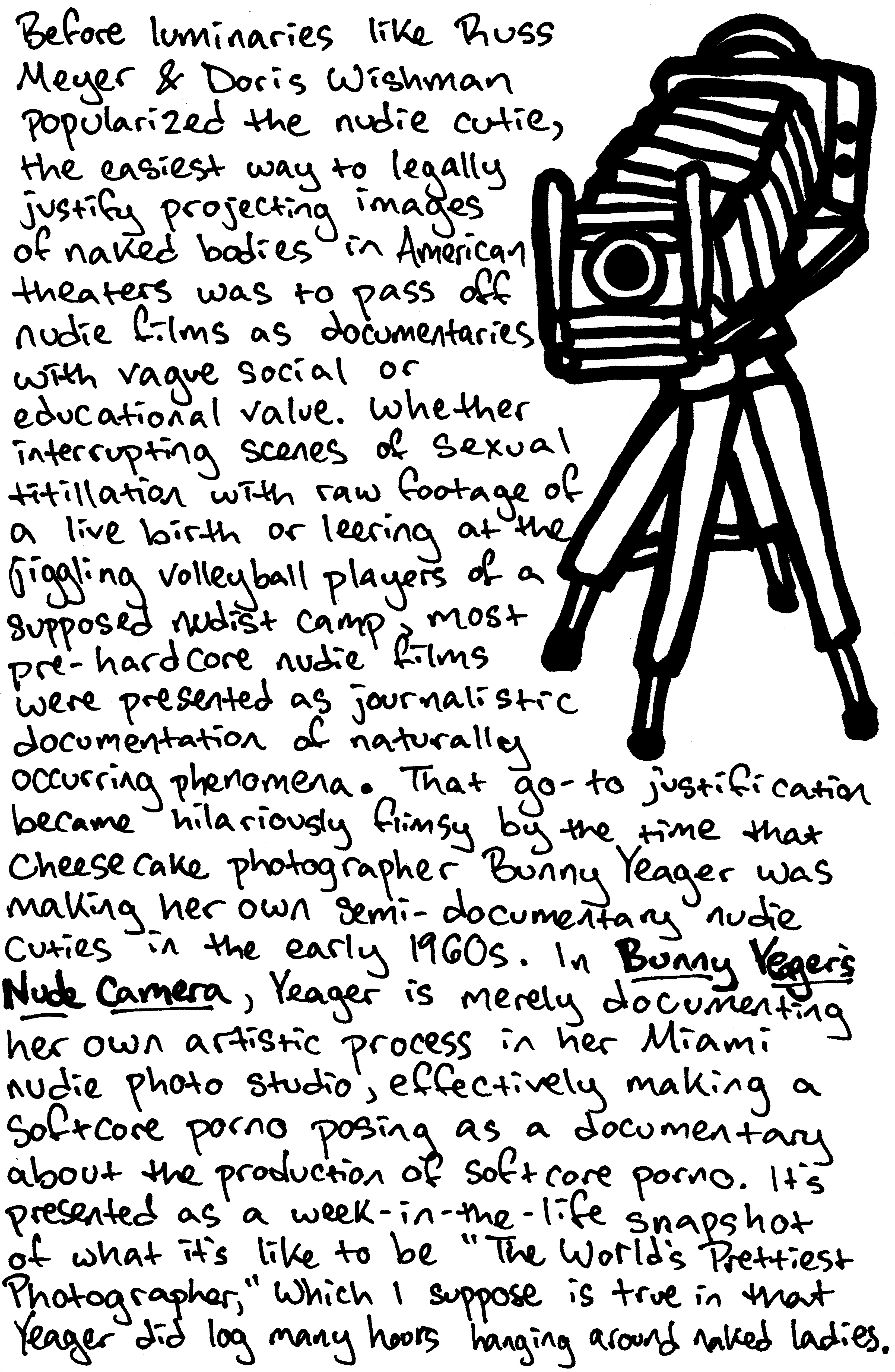
It might seem a little flippant to praise a documentary for providing wide public access to vintage nudie pics as if they were the cultural equal to Guernica or the Mona Lisa, but vintage cheesecake photographer Bunny Yeager has well earned that art-realm prestige. The new documentary Naked Ambition argues that Yeager should be recognized for her artistic & political merit as a skilled portraitist, pushing back against her superficial reputation as the pornographer who made Bettie Page the world’s most famous pin-up model. However, that work has already been done by fine art curators in recent years, who have staged retrospectives of Yeager’s work in legitimizing gallery spaces instead of the nudie mags where her photos were more traditionally exhibited. Even if Bunny Yeager were “just” a pornographer, her contributions to the visual lexicon of American pop art would still be worthy of a career-retrospective gallery show or documentary. Her iconic collaborations with Page and her aesthetic-defining contributions to Playboy‘s early, semi-literary days helped define an entire genre of vintage American smut that has been gradually disseminated & recontextualized enough that her artistic influence is now immeasurable. She also has a great print-the-legend story as “the world’s prettiest photographer,” having started as a pin-up model herself before learning how to operate a camera. As profiled here, Bunny Yeager was just as highly fashionable as she was highly ambitious. Her career as a public spectacle affords the movie more than enough vintage talk show clips, nudie cutie excerpts, and celebrity name-dropping anecdotes to fill its 73-minute runtime, but the real treasure is the access it gives the public to high-quality scans of her photographs. Like Bunny herself, they consistently look fantastic and convey a timeless cool.
If there’s any value to Naked Ambition outside of its function as a Bunny Yeager slideshow, it’s in its peripheral portrait of Miami, Florida sleaze from the 1950s through the 1970s. Alongside young feminist talking heads who link Yeager’s work to modern phenomena like burlesque revues, Insta selfies, and OnlyFans modeling, the doc also drags out a few surviving old-timers from Yeager’s heyday to attest to the grease & sleaze of vintage Miami living. The late, erratic news anchor Larry King is a surprise MVP in that respect, telling wild stories about how easy it was to get laid in his radio broadcast days that have no direct relevance to Yeager’s work except to establish the mise-en-scène in which it was created. There are also brief glimpses into the private lives of Sammy Davis, Jr. and the surprisingly gravel-voiced Bettie Page that happen to appear in anecdotes, but for the most part Yeager’s social life appeared to be more domestic than glamorous. As much as Yeager’s skill & fashionability elevated her work to fine-art quality, it was still produced as commercial material meant to financially provide for her family. Her surviving daughters are in an ongoing dispute about whether to treat the work she’s left behind as archive-worthy art or disposable smut, but they at least appear to agree that they were raised in a loving home with emotionally present parents. If you read between the lines during their opposing interviews, there is some juicy drama to be found here in how Bunny Yeager is being remembered by the people who loved her most, but that domestic conflict isn’t really any of Naked Ambition‘s business. The movie cares most about the work itself, which is presented in constant art-gallery slideshow. Assuming the public display of nude breasts can no longer shock a modern audience, there is nothing especially surprising or daring about that cinematic presentation, but there is something greatly virtuous about its ease of access.
I have been aware of George Dureau’s legacy as a local artist for as long as I have been aware of local art, but until now I’ve only ever seen a toned-down, smoothed-out presentation of his actual work. Dureau was an edgy, confrontational presence in the early decades of his notoriety, but by the time I was old enough to explore local art galleries on my own in the 2000s, he had become a respectable cultural ambassador for the city, delivering commissioned works of public art for institutions like NOMA & Gallier Hall. The only time I’ve ever seen his image outside of self-portraits and still photographs is in a made-for-PBS documentary about the process of constructing Mardi Gras parade-floats, titled From the Ground Up. Introduced to him as a venerated public artist, I assumed his personal work was as safe & kitschy as George Rodrigue’s, but Dureau was much more provocative than that. He had just already gone through the John Waters trajectory of outsider-art iconoclast turned Respected Filth Elder before I was around to see the transformation. Thankfully, the new documentary George Dureau: New Orleans Artist is here to correct the record.
George Dureau: New Orleans Artist is a documentary portrait of a classic French Quarter eccentric, crudely stitched together from the stories & works he left behind. The movie itself is ragged in its construction, seemingly assembled from whatever scraps of interviews with Dureau could be found on YouTube and molding camcorder tapes, with little attention paid to their mismatched sound quality. Despite enjoying an active social & professional life in the city for over eight decades, only eight interviewees are included in this hagiographic portrait, which either feels lazy or cowardly (depending on how divisive other participants might have found his personality or art). The filmmaking team of Sergio Andres Lobo-Navia & Jarret Lofstead are inconsistent in the final edit on when to illustrate those interviewees’ anecdotes with location-specific images captured around the city and when to just repeat triple-exposure shots of oak tree canopies filmed from below as a place-holder background image for the audience to zone out to. Still, no matter the moment-to-moment quibbles I had with the presentation, I left overall grateful for them giving this subject a feature-length treatment in the first place.
As a slideshow of art stills, New Orleans Artist is thrilling. Dureau thought of himself primarily as a painter and was frustrated by the curational attention paid to his photographs instead. Both mediums are presented with equal weight & importance here, drawing a throughline between the macho, muscular models he scouted to photograph in his home studio and the classical figure paintings that resulted from those studies. A homosexual lush with a warm but caustic demeanor, Dureau is portrayed as his own worst professional enemy, self-sabotaging his way through The Art World as he blew easy opportunities in order to maintain a vague personal integrity that only he fully understood. This self-driven conflict is mostly explained in his relationship with infamous NYC photographer Robert Mapplethorpe, whom both the film and Dureau himself argue photocopied all of his best visual ideas in less interesting, crueler works that made a lot more money in a market that thrives on cruelty. Dureau’s own work could cynically be seen as exploitative towards his nonprofessional models, whom he often sought for their differences in race & physical disfigurement. Mapplethorpe is presented at length as both an example of Dureau’s self-sabotaging professional combativeness and as an example of how this same work could be truly exploitative in the wrong hands.
A better movie might have focused entirely on Dureau’s warmly bitchy clashes with Mapplethorpe and the mutual influences of their work as contemporaries. There’s a specificity & purpose to that subject that’s missing in the film’s broader recollections of Dureau’s life in the city, which often devolve into “Ain’t dere no more” nostalgia and understandable-but-rote mourning over the devastation of AIDS & Hurricane Katrina (both of which Dureau survived relatively intact). By the time local art gallery owner Arthur Rogers explains that the French Quarter of the 1970s was different from today because it was full of “true eccentrics” then, I was nauseated by the obliviousness to the city’s ongoing art-scene counterculture; speaking of it purely in the past tense is embarrassing, not validating. Dureau’s work is powerful enough to speak for itself, though, and it loudly speaks over any good-old-days distractions from the film’s few interviewees. His work feels especially alive when compared with Mapplethorpe’s, seeming much cooler & kinder than his more famous frenemy’s (which was blurred at local screenings, presumably due to copyright issues). No one would have hated a side-by-side Dureau/Mapplethorpe documentary more than George Dureau himself, though, so it’s probably for the best that the only feature-length documentary of his work to date is about his relationship with New Orleans instead, something he did have genuine affection for.
Nearly ten years ago, a trove of presumed lost photographic prints and negatives belonging to the late exiled South African photographer Ernest Cole was discovered in several Swiss bank deposit boxes. Cole, born in 1940, was a critical component in the eventual overturning of the policies of apartheid in South Africa, as the 1967 release of his photobook House of Bondage was one of the first pieces of media to expose the inhuman cruelties occurring in South Africa under the hand of Prime Minister Hendrik Verwoerd (the “architect of apartheid”). Exiled as a result of this act of activism, Cole ended up in the United States, where he ultimately died—essentially homeless—in 1990. At the time, much of his work, which he had stored in a boarding house storeroom and had been unable to regain access to, was assumed to have been tossed out and lost forever, until the 2017 Swiss bank discovery. One of Cole’s last living relatives, a nephew, was flown into the country to collect these items, and found himself unable to get any information about why his uncle’s work had ended up in the safe at this bank, who had deposited it, or how they had paid for it.
Ernest Cole: Lost and Found spends some time on this Swiss mystery, and I want to get that out of the way first since it is, to me, the least important aspect of this documentary. When it was first mentioned that Cole’s assumed-lost work had been found intact and preserved in the SEB vault, I considered this a cause for joy, and it didn’t occur to me to presume malice on the part of whoever put it there. Surely, it would have to be someone who wanted to keep that material safe and preserved. If someone wanted to get rid of his documentation of social injustice, they would just destroy it, right? Once we learn later in the documentary that Cole’s mental (and physical) health had degraded to the point that he was unable to regain possession of his work before his death, one could almost imagine some Good Samaritan rescuing the work from being hauled away in the back of a sanitation truck, although this doesn’t explain how it ended up on the other side of the Atlantic. When the doc revealed that there were a remaining 504 photographs that the Swiss government was still fighting for possession of with Cole’s estate, I was a bit more convinced of the possibility of malintent on the part of whomever had spirited away Cole’s work. It was only after I started to write this paragraph that it struck me that I might be failing to inspect the colonialism of the idea altogether since any preservationist instinct that removed art from Africa to “protect” it by storing it in Europe is, well … colonialist by default. We may never know how a collection of Cole’s work ended up there, but its return to Cole’s family prompted filmmaker Raoul Peck to create Lost and Found, and it’s an unequivocal good that this film exists.
Nearly all of the footage within the film is Cole’s own, as are the words; LaKeith Stanfield provides voiceover that is taken from Cole’s correspondence and other writings, weaving together the narrative of a life. Cole talks about where he grew up, how a racist campaign of term-redefinition and expansionist neologisms led to the destruction of homes, communities, and families of native Africans under European rule. He escaped with his negatives and published House of Bondage, and as a result of his political exile, found himself adrift in a world that he had no hand in making and in which he could find little purchase. An attempt to expose the racism of the American South as he had the racism of South Africa was mounted, with Cole being sponsored by publishers to travel, but contemporary critics were less receptive to this work. Whether this is purely a matter of Western tendencies to find depictions of injustice abroad moving and empathy-inspiring while bristling when we see it in the mirror, or if there is some validity to the idea that his artistic eye was less capable of capturing the emotion of his subjects because of the cultural differences between the kind of racism that they experienced, I shall leave to your discretion. Despite the horrors of what he saw at home, his exile had a profoundly depressive effect on Cole, leaving him constantly in search of work and making it nearly impossible for him to keep a residence for long. Changes in leadership at publishing houses would mean that he was only half paid for a job and thus never finished it, and the discrepancies between how Cole would describe himself in his journals (not depressed) versus how his friends remember him to have been at the time (severely affected by depression) reveal a man who was lost, alone, and who never fully recovered from what he witnessed in his youth. Ultimately, he never did return home, although his aged mother was able to be at his bedside in New York when he died on February 19, 1990, just eight days after Nelson Mandela was released from prison in one of the defining moments in the collapse of the apartheid regime within the next few years.
This documentary is deeply felt, wonderfully composed, and unfortunately timely. The portrait of Cole that is created is a warm but not overly sentimental one. The narrative choice to use only Cole’s words is one that means that the voiceover informs but does not contextualize and, thus, requires you to build the story yourself from the juxtaposition and editing rather than having your hand held about what you should be thinking or how you should feel. One feature that stood out to me particularly was the frequent appearance of filmed political speeches and U.N. forums that, for decades, repeated the same tired canards justifying a lack of embargoes or sanctions against South Africa. “It would only harm those we are trying to help” says the U.N. president in grainy black and white footage from the 1960s, and which is said again by his successor in the 1970s, before being repeated almost word-for-word in vibrant color video of Margaret Thatcher and Ronald Reagan. I have to be honest with you; it’s bleak, and the portrait it paints of what’s in store for us in the coming years is even bleaker. When House of Bondage was released, it created a sense of moral outrage in the populace that, even at full force, was completely incapable of causing national and international leadership to take any action to end apartheid. We’ve spent the last 15 months with constant, new images of harrowing, monstrous, evil violence enacted by an apartheid state that currently exists, and the modern American is so inured to this kind of wickedness that the coalition of those who are rightly horrified is mocked, belittled, shouted down, fired, and legally silenced by conmen, grifters, and empowered bigots. If it took two and a half decades for apartheid to fall despite international (citizen-level) support for its abolition, then it does not bode well for the end of any current campaign of government terror, when people are unmoved by the plight of their fellow man. The past is never dead. It is not even the past.
Swampflix just hit its tenth anniversary as a movie blog, which was already a dead medium when we started posting reviews on the site in January of 2015. The longer I stick with this project the more I question what, exactly, I’m getting out of it, which is a question likely best left unanswered. There are some obvious, tangible benefits that come with time. I can look back to the earliest writing & illustrations published on this site ten years ago and have confidence that my basic skills have improved with practice (even though the early drawings are still in active rotations, like the camera pictured above). It’s also beneficial to have an ongoing log of the movies and thoughts that have passed through my brain in that time, since the majority of that memory would be lost otherwise. Not least of all, Swampflix has become a social ritual for me, especially as the entirety of the crew has been assimilated into weekly podcast recordings, so that my friends are routinely obligated to talk to me about my personal favorite small-talk subject: movies. The grand Swampflix project is one of self-fulfillment, operated entirely at a monetary loss, so the question is more about what I get out of publishing the site for public view and less about what I get out of it as a personal hobby.
That difference between internal and external fulfillment in a long-term amateur art project is one of the major tensions at the core of Patricia Rozema’s coming-of-middle-age drama I’ve Heard the Mermaids Singing. Our aimless, thirtysomething protagonist, Polly, is unsure of who she is and what she wants out of life. She does not care about what she does for work, getting by on office temp jobs until she stumbles into a sweet regular gig assisting at a hip Toronto art gallery. She’s disconnected from her own sexual desire, just now discovering in her thirties that she’s attracted to women, thanks to the magnetic allure of that gallery’s erudite curator, Gabrielle. The only thing Polly knows for sure is that she loves taking photographs, and she’s transformed her one-bedroom apartment into an impromptu art gallery of its own, carpeting the walls with photos she’s taken of images that make her happy – mostly urban architecture & candid portraiture. Only, her heart is broken when she anonymously submits these photographs for her employer’s consideration and is eviscerated by dismissive critiques that the artist behind them represents “the trite made flesh.” Before that unknowing betrayal, her photography hobby was the one thing that Polly found personally fulfilling in life. Hearing a negative, outside opinion on her work breaks the spell, and she’s left with little to live for, especially since she’s betrayed by the one person she looks up to.
I’ve Heard the Mermaids Singing finds immense beauty in “the trite,” the twee, the quirky. Polly is a kind of Holy Fool archetype who makes great art (to the audience’s eye, anyway) simply by amusing herself with a camera. Gabrielle is her Art World foil: a cynical materialist who only values art based on its marketability and its relevance to hip New Yorkers’ tastes, which plays as a joke on Torontonian insecurities. Their ideological clash escalates when Gabrielle starts passing off widely beloved “golden” paintings created by her lover, Mary, as her own original work for marketing purposes, which causes Polly to lose even more respect for her idol. Meanwhile, Polly goes on fantastic mental adventures while developing prints in her dark room, living a true artist’s inner life in an over-imaginative dream space of her own making while the more successful Art World team of Gabrielle & Mary waste their time orchestrating much pettier, more lucrative schemes. It’s the same volatile mixture of authentic authorship debates and adventures in self-fulfilling sensuality that Rozema pushed to a further extreme in her follow-up film White Room, except this time it’s framed as a quirky indie romcom instead of a Hitchcockian voyeur thriller.
I’ve only seen a couple of Rozema’s films so far, but she has a distinct eye for fairy tale visuals and an ear for dreamworld tones that make for singular work that could’ve been made by no one else, despite the fact that she’s often shooting commercial-grade video art in a major Canadian city. Still, the major triumph of I’ve Heard the Mermaids Singing is Sheila McCarthy’s adorably insecure performance as Polly. McCarthy approximates what it would be like if the Jim Henson Creature Shop captured the spirit of Ann Magnuson & Pee-wee Herman in a single Muppet. She’s simultaneously a dorky, overgrown child who can’t get through a business lunch at a sushi restaurant without giving herself a milk mustache and the chicest person in every room she enters, largely thanks to her total lack of self-awareness. She might not know what to do with any appendage of her body in any social scenario, but she out-cools all of the Art World poseurs who turn their noses up at her. Polly is proof that the “Adulting!” brand of stunted maturity is not unique to Millennials as a generation, since Rozema’s film was produced when we were mere babies. It’s also evidence that the main reason so many of us are Like That (useless but adorably dorky) is that we’re only suited to be making art for our own pleasure but living in a world that requires us to make money for survival. I can say this for certain: Swampflix would improve greatly if I didn’t spend so much of my time working for a paycheck elsewhere. It would likely also improve if I turned this hobby into my paycheck, but I assume that would zap all of the fun & self-fulfillment out of it, so no thanks.
I recently took a long bus ride uptown to see my very first Antonioni film, projected on the big screen at the Prytania Theatre. I enjoyed Blow-Up well enough but did not love it. However, I do love some more genre-minded pictures that were directly inspired by it—namely Blow Out, Perversion Story, and The Eyes of Laura Mars—all titles I previously understood purely as giallo-era Hitchcock derivatives. In contrast to those later, flashier works, Antonioni’s own perversion of a Hitchcockian murder mystery is a stubbornly arthouse-minded affair. On paper, its story of a horndog fashion photographer in Swinging 60s London who uncovers evidence of a murder (and a larger political conspiracy to cover it up) in his photos reads like a stylish crime thriller. In practice, Blow-Up deliberately withholds all the traditional payoffs of a murder mystery story & a political conspiracy thriller, instead dwelling in frustration & ambiguity. If it’s a straight-up horror film, it’s about the existential horror of asking all your friends & acquaintances “Hey, you guys wanna see a dead body?” and no one taking you up on the offer, leaving you to sit with your own morbid fascination and no outlet for the tension. As a result, it’s the kind of movie that earns measured “That was interesting!” compliments instead of more genuine, swooning enthusiasm.
To be honest, the most rewarding part of the screening was not Blow-Up itself, but its presentation. The film was preceded by a lengthy slideshow lecture about The Beatles’ albums Rubber Soul & Revolver, which had nothing to do with the movie except that it happened to be set in London in the 1960s. It was clear most of the audience was not aware of this deeply nerdy opening act, which pushed the start time a full precious hour later into the weeknight. Every new slide about how well 45″ singles like “Paperback Writer” or “Yellow Submarine” were reviewed in the papers had people audibly groaning in frustration, with a small crowd of younger moviegoers cowering in the lobby, desperate for the rant to end. It was an incredible bonding experience, like surviving a group hostage situation. I don’t know that the lecture sold many Beatles-themed history books as potential Christmas gifts in the lobby, as intended, but it did a lot to restore my personal faith in humanity on both ends; it was good to know that the kids out there are still indignant brats and that the nerds are still oblivious to their audiences’ attention span for rapid-fire niche interest stats. I often go to the theater alone, talk to no one except the box office worker, and leave without even making so much as eye contact with my fellow moviegoers, much less conversation. By contrast, that Blow-Up screening felt like a substantial Community Event.
Somewhere in the lengthy preamble to the feature presentation, I found myself chatting with an employee at the theatre and expressed gratitude that they were adding more repertory classics to their weekly schedule. It turns out the single-screener only had room for this extra rep screening because the Oscar Bait Movie of the Week, She Said, was doing poorly. And while the audience for Blow-Up might have been groaning at the nonstop onslaught of mid-60s #BeatlesFacts before the show, I was encouraged to see them show up & stick it out. There were a few dozen people in attendance, when I’ve gotten used to sharing the room with much smaller crowds on my artsy-fartsy weeknight excursions. After reading so many doomsaying national headlines about the box office disappointments of Awards Season hopefuls like She Said, The Fabelmans, Triangle of Sadness, and Tár, I was starting to worry that my local independent movie theatres might not be able to survive between superhero epics & Top Gun sequels if audiences are just going to wait for everything else on the marquee to hit streaming services. Seeing that crowd show up for Blow-Up (and struggle to stay up for The Beatles) gave me hope that the business might not be dying, just changing. If art-friendly spaces like The Prytania, The Broad, and Zeitgeist have to survive on community events & repertory screenings instead of Avatar-scale CG monstrosities the world may be all the better for it.
Even that night, I had to choose between seeing Blow-Up for the first time uptown at The Prytania or Hitchcock’s North by Northwest for the first time down the street at The Broad. And The Prytania’s new downtown location has been running more regular repertory screenings than either of those locations combined, something I don’t know that I’ve ever seen with any regularity in this city. I may not have fallen totally in love with Blow-Up on this first viewing, but it did feel like I was placing an essential puzzle piece in my larger understanding of genre film history, the same way that I felt seeing big-screen presentations of Ghost in the Shell & The Fog for the first time in recent months. I do want to see the trend of every non-superhero movie struggling to make money continue in this post-COVID, rushed-to-streaming world, because I fear that theatres will not be able to sell enough booze & popcorn to stay afloat. That momentum may be unstoppable at this point, though, and that surprisingly well-attended Blow-Up screening gave me hope that there might be another way to combat audiences’ exponential disinterest in trying new, uncanonized art. I can’t speak for the rest of that crowd, but I’ll sit through a hundred more Beatles lectures if it means I get to keep watching weird, divisive movies projected big & loud. If nothing else, I’m too old & too tired to find a new hobby at this point in my life.
In the opening scene of the Nan Goldin documentary All the Beauty and the Bloodshed, the legendary fine-art photographer is leading a flash-mob protest at a modern art museum, demonstrating against their acceptance of donation money from The Sackler Family. She lays down on the museum floor, pretending to be a corpse alongside dozens of collaborators, and the camera catches glimpse of a “SILENCE = DEATH” tote bag commemorating ACT UP protests of decades past. Later in the film, similar archival footage from the ACT UP era shows Goldin decrying Reaganite Evangelical indifference to the AIDS epidemic, platforming fellow activist artists like David Wojnarowicz to combat institutional cruelty in an art gallery setting. Both protests are personal to Goldin, who has recently become addicted to the Sacklers’ profit-over-people product Oxycontin and has historically lost countless loved ones to the Reagan administration’s deliberate mishandling of AIDS. Both protests earn their screentime thematically, but only one is compelling to look at, having earned a fascinating vintage texture through the technological passage of time. The modern smartphone footage at an overlit Metropolitan Museum exhibit just can’t compete, since it’s near-indistinguishable from disposable one-glance content on a social media feed.
That textural difference between past & present footage weighs heavily on the film throughout. All the Beauty and the Bloodshed is half a career-spanning slideshow from Nan Goldin’s legacy as a fine art photography rock star and half a document of her current mission to deflate The Sackler Family’s tires, at least in the art world. The career-retrospective half can’t help but be more compelling than the current political activism half, since her archives are dense with the most stunning, intimate images of Authentic City Living ever captured. Her personal history in those images and her recent struggles with addiction more than earn her the platform to be heard about whatever she wants to say here, though, especially since the evil pharmaceutical empire she’s most pissed at has trespassed on her home turf. The protest group Goldin helps organize, Prescription Addiction Intervention Now, specifically aims to have the Sackler name and donations removed from fine art museums, attacking the family’s cultural prestige since it is improbable to dismantle their personal wealth. P.A.I.N.’s protests in the film only target museums that feature Goldin’s work in their permanent collection, leveraging her cultural clout in the art world to do as much practical damage to the Sackler name as they can. The only problem is that documentation of these efforts only amounts to Good Politics, not Good Art, which is an unignorable fault in a film that proves it’s possible to achieve both.
Documentarian Laura Poitras was likely excited to make a movie about Nan Goldin precisely because of those modern-day P.A.I.N. protests, since amplifying Goldin’s personal war on the Sacklers fits in so snugly with her past modern-politics documentaries about WikiLeaks, Edward Snowden, and the NSA. I’m grateful she took interest, no matter what her reason, since it’s the closest I’ll ever get to being in the audience for one of Goldin’s classic Ballad of Sexual Dependency slide shows. Setting up a rack of six slide projectors like a guitarist’s Marshall stack, Goldin’s slideshows register as more of a D.I.Y. punk act than a gallery exhibit. Here, she recalls her journey from developing her early drag bar photos at the local pharmacy to earning enough art-world clout that she can convince museums to turn down 7-figure donations from prestige-hungry, life-destroying benefactors. I’m used to seeing Goldin’s photos in isolation, collected as single images among her No-Wave NYC contemporaries’ similarly unpretentious, self-documentary imagery. It’s a treat to be immersed in her work at length here, learning the names & personalities of the recurring “characters” in her photos and getting a better sense of her iconoclastic presence in the larger world of fine art. So, of course, the modern protest footage that presumably drew Poitras to the project often frustrates in its distraction from what drew me to watch it. Goldin’s artwork is hardly a spoonful of sugar to help the medicine go down, though; it’s just more potent, tastier medicine.
Laura Poitras is not using Nan Goldin’s life story as an excuse to score political hits against Purdue Pharma & The Sackler family. If anything, this documentary feels like a fluid collaboration between the two artists, and Poitras is only there to give Goldin as much space as she wants to rant about how the Sacklers have turned fine art galleries into “temples of greed.” If Goldin wanted to tell the story of her life’s work separately from the story of her recent protests, I’m sure she could’ve found an obliging collaborator to film her self-narrated slideshows. She even could have made that movie on her own, since her control over the rhythm, scoring, and storytelling of her slideshows is in itself a kind of improvised filmmaking, a skill she’s been honing for decades. It’s reasonable to assume that the decision to give her modern crusade against the Sacklers equal weight as her bottomless catalog of breathtaking city-life portraits was partly—if not entirely—Goldin’s own. It’s a politically respectable choice, of course, but it’s also an artistically limiting one.
The COVID-era two-hander Good Luck to You, Leo Grande is a little self-conscious & stagebound, but it’s also an admirably thoughtful, vulnerable drama for adults. Despite its obvious production limitations—mostly isolated to two actors verbally sparring in a single hotel room—it feels substantial enough to make you wonder why the Disney subsidiary Searchlight dumped it directly into the Hulu stream instead of giving it a proper theatrical push. Maybe it’s because it’s the rare Nancy Meyers/Nora Ephron style romcom that’s too saucy to watch with your mom, considering how lengthy & girthy its discussions of geriatric sexual pleasure can be. Or maybe the star power of its sole household name, Emma Thompson, wasn’t bright enough to guarantee box office success in America (as opposed to the UK, where it has been in the Top 10 box office chart for weeks). The movie wouldn’t be much without her, though, if it would exist at all. Screenwriter Katy Brand wrote the main role with Thompson in mind, and the actor makes herself incredibly vulnerable for the part as a widow who hires a young, ripped sex worker (Daryl McCormack, the titular Leo Grande) to help her achieve her very first orgasm. Thompson’s commitment & fearlessness in the part are unquestionable, but I do wonder what the film might’ve been like if the lead actor wasn’t so Movie Star beautiful. I don’t want to say that her tightly wound neuroses about her aging body came across as phony, exactly, since low self-esteem can (and does) hit anyone & everyone. I do think the movie plays it safe by hanging those neuroses off such a gorgeous, glamorous lead, though, even when she’s standing naked in the mirror, exposing all her body’s “flaws” for the audience’s scrutiny.
The reason I’m reluctant to call Thompson’s self-esteem struggle in Good Luck to You, Leo Grande “phony” is because I happened to watch a film this week that exemplifies exactly what phoniness would look like in that context. The 1957 Stanley Donen rom-com Funny Face has a lot of glaring faults, not least of all the fact that it’s a musical with exactly one good song (“Think Pink”, a sequence I’ve already seen parodied beautifully in Derek Jarman’s arthouse whatsit The Garden). It’s also packed with so much high-art Technicolor fashion photography—highlighting the artistry of costume designer Edith Head & couturier Hubert de Givenchy—that those faults hardly matter at all. It’s a film built entirely on phoniness, most notably in the preposterous romance between Audrey Hepburn as a bookworm philosopher & the much older Fred Astaire as a Richard Avedon-type fashion photographer. Astaire negs Hepburn throughout the film, mocking her academic interests in the philosophy of “Impracticalism” (a sentiment the movie shares) and, more dubiously, for her looks (a sentiment no one shares). It’s presented as a preposterous prospect that the “mousy,” “boyish,” “Peter Pan”-like Hepburn could become a high-price fashion model. Even the title “Funny Face” is a reference to her “unconventional” attractiveness, when that exact face has since kept the dorm room poster industry afloat for over half a century. Funny Face is enjoyable enough as a proto-Devil Wears Prada fantasy where an unfashionable bookworm accidentally falls upward to the top of the fashion industry (I’ll let you determine where Hepburn getting forcibly stripped out of her homely bookstore clothes by a room full of rabid fashion models fits in that fantasy), but it is unquestionably, 1000% phony, mostly because of who it cast in that central role as the “homely” academic-turned-model.
The age-gap intimacy of Good Luck to You, Leo Grande is much more authentic than the Old Hollywood phoniness of Funny Face. Thompson’s lonely widow is only unattractive in her own mind, where she beats herself up as a hideous troll & a “seedy old pervert” who needs to pay for satisfying sex. Her by-the-hour lover is shown to be similarly self-conscious, despite being a younger, gym-bodied smokeshow. Before & during each of their hotel room trysts, the two main players are shown primping themselves in separate mirrors, nervous about how their physical bodies will be perceived by their sex partners. I just still think there’s something weirdly cautious about casting someone as glamorous as Thompson in that central role. Just as Hepburn did not have anything that could be reasonably called “a funny face”, Thompson meets a high Movie Industry beauty standard that prevents her from coming across as an everyday everywoman. Surely, part of the point of Good Luck to You Leo Grande is about how badly she needs to climb out of her own head, since most of her paid-sex sessions qualify more as talk therapy than they do physical intimacy. I just wonder if the film might’ve had more impact if someone less remarkable had been cast in Thompson’s role, someone the average audience could more closely relate to. Considering how shallow the distribution already was for the film even with a movie star at the helm, though, it’s unlikely that it would’ve ever made it past the festival circuit under those conditions. And, hey, Thompson is a talented actor who can carry a scene with ease, so it’s probably for the best that it was written with her in mind.
As a quick aside, I want to note that phoniness isn’t an automatic dealbreaker. These two movies are hardly comparable, but I will admit that I’m much more likely to rewatch the glaringly flawed, intensely phony Funny Face in the future than I am to revisit the small-stakes, intimate authenticity of Good Luck to You Leo Grande. For all of Funny Face‘s faults, watching Hepburn pose in all those gorgeous Givenchy outfits around Paris reaches momentary heights that no raw, vulnerable intimacy Thompson achieves in that closed-off hotel room set ever could. Hollywood fantasy is a powerful drug, and I’m apparently willing to put up with a lot of phoniness to chase that high.










 Swampflix