David Bradley’s Silent Monsters

The single-screen microcinema Zeitgeist Theatre & Lounge has been hosting weekly silent movie screenings with live piano accompaniment every Sunday afternoon for months now. I know this because I happened to see a flyer for the series while catching another movie there. While other local repertory series like Prytania’s Classic Movies and The Broad’s Gap Tooth program are regularly well attended, Zeitgeist’s Silent Films series feels like an open secret, a kind of backroom speakeasy version of local theatrical programming. The vibe in the room can be electric, as pianist David Bradley’s live, semi-improvised movie scores add an immediacy to century-old relics like Harold Lloyd’s Safety Last! that wouldn’t earn nearly as big of laughs or gasps streaming alone at home with a canned soundtrack. It can also be remarkably intimate, echoing the spirit of a D.I.Y. punk show whenever Bradley finds himself playing to a near empty room, engaging his audience in conversation and asking for help wheeling his instrument into the theatre. These are live concerts after all, even more so than they are movie screenings, with all of the fluctuating charm & chaos that distinction suggests.

The reason I got such a wide sample of live-concert experiences at Zeitgeist’s Silent Films showings is that Bradley’s weekly programming veered hard into my personal interests last month, in a series he titled “Silent Monster May.” In the immediate days after I had fallen in love with the century-old romance horror of Lon Chaney’s Phantom of the Opera (1925), Bradley announced that he’d be exclusively screening silent horror movies that month, including a precursor to Chaney’s Phantom in the 1923 version of The Hunchback of Notre Dame. I hit all three screenings in the “Silent Monster May” series, which varied in attendance & intensity but were consistently high quality. Before live-scoring 1920’s Dr. Jekyll & Mr. Hyde, Bradley mentioned that he hadn’t seen the movie in a while and doesn’t like to overprepare before showtimes, choosing instead to react and respond in real time along with the audience. His silent movie soundtracks are rolling moodsetters that emotionally ebb & flow along with the action onscreen, which in the case of “Silent Monster May” meant accentuating the pitiable romance & tragedy of horror cinema’s earliest monsters.

The most pitiable monsters in the program were also the most famous, both penned by French literary hero Victor Hugo. Lon Chaney’s aforementioned hunchback, Quasimodo, is ugly-cute like a scraggly stray dog. He lusts after the Romani bombshell Esmeralda while playing voyeur from the upper tiers of Notre Dame’s ornate walls, occasionally descending to join in her community’s orgiastic parties so he can watch her dance along with her other, handsomer suitors. The Hunchback of Notre Dame gets a little sleepy in the middle stretch whenever Esmeralda indulges in romantic flings outside of Quasimodo’s’ crooked view, but Chaney is dependably entertaining as the lovelorn monster in every scene which he appears. Not only is “The Man of a Thousand Faces” notoriously talented at transforming himself through rudimentary prosthetics, but he also proves to be an impressive stunt performer here; he crawls all over the church’s exterior walls and hangs upside down from the ropes of its ringing bells like an impish Tom Cruise with wagging tongue & protruding eye. He is, unquestionably, a silent horror movie star, and he carries that burden on his bulging, knotted shoulder with apparent ease.

1928’s The Man Who Laughs also presented a kind of silent-horror celebrity, although one associated less with an actor than with pop-culture IP. Conrad Veidt’s titular laughing man is most famous for having inspired the design for Batman’s arch nemesis, The Joker, which would be immediately apparent to any modern audience who catches a glimpse of his Glasgow smile. Paul Leni’s post-German Expressionist adaptation of Hugo’s novel says less about comic books than it does about the ever-evolving history of Universal horror movies, though. Since they’re no longer considered scary, the modern take on Universal’s famous monsters is that they’re tragic figures, sympathetic victims of society’s ills. The Man Who Laughs didn’t waste any time waiting around for that reclamation; the laughing man’s only monstrous quality is a surgical disfigurement that makes him look extremely friendly, however grotesque. Its circus-carny setting (the only place a permanently smiling abomination could find work) also positions it as a softer, kinder version of Freaks, which Tod Browning would soon direct for MGM. Like every monster in this series, he’s just looking for love, but the world around him is too cruel to allow it. It wouldn’t even qualify as a monster movie at all if it weren’t for the disturbing intensity of Conrad Veidt’s facial contortions, which he intentionally undercuts by reflecting deep wells of pain from behind his watery eyes.

Because the legends of Lon Chaney and The Joker came with their own pre-packaged expectations, I was most impressed by the 1920 adaptation of Dr. Jekyll & Mr. Hyde, which is saddled with a much lighter load of modern scholarship & hype. Admittedly, it’s been several decades since I last read its Robert Louis Stevenson source material, but I don’t remember quite so much of the original Jekyll & Hyde novel being set in a strip club & brothel, so the silent movie version largely took me by surprise. John Barrymore plays the virtuous Dr. Jekyll, whose future father-in-law and other colleagues find unnerving for his high morals and buttoned-up demeanor. So, they drag him to the local house of pleasure to catch a glimpse of the real him and, thus, trigger his first ever crisis of conscience. Jekyll doesn’t especially enjoy feeling adulterous lust for the first time in his life, so he invents the mad-scientist concoction that separates his monstrous impulses into the dastardly doppelganger Mr. Hyde. It’s a continually relatable story about the fact that there’s a lecherous pervert lurking in all of us, desperate to claw its way out at the slightest wayward temptation. As a result, it’s not only a great monster movie but also a great strip club movie, placing its dual nature early in the lineages of both Striptease and The Substance — the full Demi Moore spectrum.

All of these vintage monster flicks are highly demanding on the modern attention span, but well worth the effort. The color-tinted frames that distinguish their interior-exterior settings (like the pink hue of Jekyll’s brothel and the cold blue of Hyde’s moonlight strolls) and the massive scale of their crowd scenes (like the castle-storming sequence of Hunchback, wherein Quasimodo scalds the crowds below with vats of molten lead) are remarkably, inextricably cinematic for an artform that was still working to distinguish itself from the moods & methods of stage theatre. You just have to put down your smartphone long enough to witness them. Even with the distracting sounds of traffic, parties, and general urbanite mayhem occasionally audible through Zeitgeist’s theater walls, it’s much easier to lock into the wavelengths of these cinematic relics than it would be at home, especially with the guiding hand of a live piano score reacting to each scene’s emotional gearshifts in real time. If you have any interest in silent era cinema, there’s no better way to experience its old-world magic in New Orleans than to keep up with David Bradley’s microcinema concerts. I’ll be returning to them soon myself, and I’ll hopefully meet more classic movie monsters along the way.

-Brandon Ledet

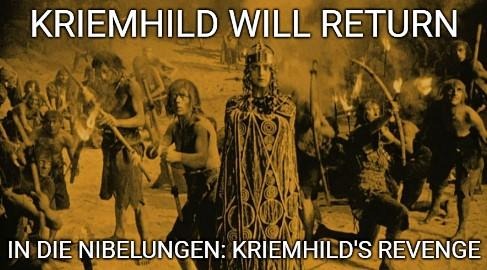
Die Nibelungen: Siegfried’s Death (1924)

I really had no idea what to expect when I put a hold on a library DVD copy of Die Nibelungun. I just wanted to watch some more Fritz Lang. When I opened the case, I found two discs inside and, upon examination, discovered that they were two halves of a single story (or a film and its immediate sequel; I’m sure there is a distinction, but it makes little difference). I remember thinking to myself, “Oh, well, they must be short.” Dear reader, they are not. I haven’t watched the second half yet, but the runtime of Siegfried’s Death alone is 150 minutes, although some portion of that is introductory information about the Kino Lorber restoration and its sources. Sorry about that spoiler title, by the way, but it’s in the text (or this version of it, anyway); but also, this story is so old that it’s referenced tangentially in Beowulf, so don’t blame me. Putting this disc in, hitting play, and seeing that runtime, I admit that I felt a little daunted. And then, two and a half hours later, I was still utterly entranced when it came to an end. 

Even if you think you haven’t heard this story before, you have, if not in the form of all the pieces it shares with more familiar epics that preceded, then in the stories which took inspiration from it, probably most notably The Lord of the Rings. Siegfried (Paul Richter), son of Westphalian King Sigmund (or Sigmonde, if you prefer the spelling from Beowulf), surpasses the forging skills of his teacher, a craven man named Mime. When Sigfried learns of the beauty of Princess Kriemhild of Burgund (Margarete Schön), he decides to seek her hand, and Mime, in a fit of pique, directs him to Burgund through a wood that contains monsters. Siegfried happens upon a dragon, which he slays; a taste of the dragon’s blood gives him the power to understand birdsong, and a nearby bird tells him to bathe in the dragon’s blood to become invincible. Sigmund does so, but a falling leaf lands on his back above his shoulderblades, leaving him with one vulnerable spot. 

Siegfried finds himself in a land of dwarves, and manages to defeat their king, Alberich, despite the latter being invisible. In exchange for his life, he offers Siegfried the sword Balmung, the magical net he has which allows him to be invisible or appear in another form, and a horde of gold. When Alberich tries to kill Siegfried atop the treasure heap, Siegfried easily bests him, and with his dying breath, Alberich curses the treasure and all who might use it. With his newfound wealth, Siegfried is able to present himself at the court of Burgund as a king with several vassals. There, he meets King Gunther (Theodor Loos), Kriemhild’s brother, and his obviously evil vizier, Hagen of Tronje (Hans Adalbert Schlettow). Hagen tells Gunther not to allow Siegfried to woo Kriemhild unless Siegfried agrees to help Gunther win the hand of Icelandic queen Brunhild (Hanna Ralph), a maiden warrior whose suitors must best her in a triple sport competition. Siegfried goes to Brunhild’s castle under the guise of one of Gunther’s bannermen and, using the helm he won from Alberich, becomes invisible and helps Gunther cheat. 

Brunhild returns to Burgund with Gunther, whom she reluctantly marries in a double ceremony with Kriemhild and Siegfried, and Siegfreid and Gunther become blood brothers. Brunhild initially refuses to consummate the marriage, until Gunther convinces Siegfried to “tame” her, disguised as Gunther, which he does by wrestling her. Brunhild, still bristling, antagonizes Kriemhild by insisting that as the queen of Burgund, she should be able to walk into church before Kriemhild, as the wife of a vassal, and the argument leads to Kriemhild revealing Siegfried’s role in Brunhild’s hostile wife-takeover. Brunhild, furious, demands that Gunther kill Siegfried, and lies that Siegfried deflowered her. Gunther is torn by his blood oath, but Hagen convinces him to allow him to do the deed, and likewise tricks Kriemhild into revealing Siegfried’s vulnerable spot, which he uses to kill him during a hunt. Brunhild mocks Gunther for allowing the lie of a woman to trick him into taking his best friend’s life, then takes her own. When Siegfried’s body is returned, Kriemhild demands justice against Hagen, but her family protects him because of their complicity. 

Kriemhild swears vengeance: “Whether you hide behind my family, or upon the altar of God, or beyond the edge of the world, you will not escape my vengeance, Hagen Tronje!”

This movie is so fucking cool. There are images in here that are so potent and so powerful that I’m surprised this film doesn’t have the same broad awareness that Metropolis does. It’s clearly been incredibly influential. There are shots in Die Nibelungen that are recreated almost identically in Dune, Lord of the Rings, and even Star Wars. There are images here that are incredibly powerful: Brunhild brooding, perfectly centered in the frame; Siegfried, holding aloft the sword that he has just forged; Alberich and his cohort turning to stone upon defeat. Kriemhild’s dreams are manifested in beautiful, if crude, animation, and there’s a sequence at the end where Kriemhild looks at the place where Siegfried said his last goodbye to her and the image slowly crossfades into an image of a skull. Siegfried’s fight against the landwyrm in the forest still looks sick as hell, and the framing of Brunhild’s stronghold, bracketed above with the aurora borealis and below with a field of unquenchable flame is an image that I’ll never forget. 

So one must wonder, why exactly has this film been largely forgotten while Metropolis, M, and others endure? Well … this is an adaptation of Germany’s national epic, which I mean in the literary tradition of great poetic works which define, delineate the founding of, and reinforce national identities. The more well known adaptation of this text is Richard Wagner’s operatic The Ring Cycle, which has been accused of carrying over the composer’s own antisemitic views (although his friendship with the racial science codifying historical monster Arthur de Gobineau did not begin until at least half a decade after The Ring Cycle was completed). Die Nibelungen, having Fritz Lang as its director, excludes Wagner’s more regressive choices (notably, Alberich and Mime are largely considered to be anti-Jewish stereotypes in The Ring Cycle, which they are not here, at least as far as I can tell). Still, that doesn’t mean that a film adaptation of Germany’s national epic poem, which was all about the proud traditions of Germanic ancestry and nation building, wasn’t considered fair game by the Nazi propaganda machine. The opening of the film sees Lang dedicating the movie to the “proud German people,” whom he himself would flee less than a decade later after an ominous meeting with Joseph Goebbels, which made it easy for Die Nibelungen to be trotted out at party meetings. 

This becomes the default means for examining any piece of German interbellum art, and it’s valid, but I’m not a sufficiently qualified historian to get into that extensively, and there’s already probably a decent amount of scholarship about that which you can find online (for now, anyway). What I do find interesting, if not surprising, is that the primary conflict of this text is so blatantly patriarchal. Brunhild is treated as a kind of villain here, but to a modern reader/viewer, she’s completely justified. Her unwilling marriage to Gunther makes her, for all practical purposes, a sex slave in a gilded castle, and Siegfried’s use of glamour and magic to deceive her into believing that Gunther has passed the challenges she created to maintain her dominion and anonymity means that, yes, Siegfried is an accessory to her rape. She has every right to demand his death, and Gunther’s, for that matter. Instead, within the narrative itself, she’s a vindictive woman whose manipulations cause her husband’s downfall. 

I’m going to go ahead and disregard authorial intent, which would have us agree that her line about “a kingdom brought down by a woman’s lie” is clearly meant to be taken at face value. I also have a feeling that Kriemhild’s revelation to Hagen about Siegfried’s weakness is also supposed to be more “a woman can bring a nation to ruin” reinforcement of sexist presuppositions. To some, Kriemhild is the Madonna whose naivete creates the possibility for Siegfried to be killed, and Brunhild the Whore whose lies lead to his death. I’m going to reject that paradigm and say that, as a text, Die Nibelungen makes it explicit that Gunther is the root cause of every conflict here, either because of his belief that he deserves Brunhild or because of his craven weakness as a monarch so easily misled by Hagen, who is the other villain of the piece. Helen didn’t start the Trojan War; Paris did. 

A five hour epic in two parts is a hard sell. In ten years, I have convinced fewer than a dozen people to check out Baahubali, and I only have to overcome people’s resistance to subtitles for that; for Die Nibelungen, I’m also fighting their resistance to silent film. And, it’s also entirely possible that the back of this filmic diptych will be awful and I’m setting them (and myself) up for disappointment. I’ll let you know once I’ve engaged with Kriemhild’s Revenge.

-Mark “Boomer” Redmond

Lagniappe Podcast: The Phantom of the Opera (1925)

For this lagniappe episode of The Swampflix Podcast, Boomer & Brandon discuss Universal’s silent-era adaptation of The Phantom of the Opera (1925), starring Lon Chaney as The Phantom.

00:00 Welcome
03:30 Forbidden Planet (1956)
11:34 The Drama (2026)
23:55 Blue Heron (2026)
30:08 Mother Mary (2026)
40:14 Erupcja (2026)
45:22 The Beekeeper (2024)
51:08 Ronin (1998)

58:15 The Phantom of the Opera (1925)

You can stay up to date with our podcast through SoundCloudSpotifyiTunesTuneIn, or by following the links on this page.

– The Lagniappe Podcast Crew

The Doll (1919)

There’s a naive impulse in modern audiences to look back to the early, silent days of cinema as harmless & quaint. Something about the stage-bound sets, for-the-back-rows vaudevillian performances, and hand-cranked camera speeds leads people to dismiss the early decades of cinema as being out of date to the point of total irrelevance. When you actually watch those movies in full, however, you’ll find they often deal in spectacle, politics, and humor with the same sharpness as any modern work (the good ones, anyway). For instance, one of the better Hollywood studio pictures of the year so far is the technophobic horror romcom Companion, starring Sophie Thatcher as an AI sexbot who’s unaware that she’s not a fully autonomous human being. Her artificiality is a major point of attraction for the tech-bro incel who purchased her (for selfish schemes not worth fully outlining here), raising questions about how the misogynist radicalization of young men has corrupted modern gender dynamics to the point where true, genuine love is a cultural impossibility. The political arguments & technological details of that premise may sound like they could only belong to a movie from the 2020s, but they’re also present in Ernst Lubitsch’s silent comedy The Doll, made in Germany over a century ago.

In The Doll, a pampered young man is pressured by his dying baron uncle to get married, so that he can properly claim his noble inheritance. The fop responds to this request with revulsion, as he is both afraid & spiteful of women. After being chased around his little German village—Scooby-Doo style—by every marriageable maiden in shouting distance, he finds sanctuary among monks in a local monastery, where finds the comforts of things he loves almost as much as he loathes women: meat, beer, and men. While in hiding he is handed an advertisement for a mad-scientist dollmaker (named Hilarius) who makes lifelike automatons resembling flesh-and-blood women, marketed to “bachelors, widows, and misogynists.” He answers the ad in a scheme to pass off the automaton as his fiancée and fool his uncle so that he doesn’t have to interact with any actual women. Things immediately go awry when the doll is broken before purchase and replaced with the dollmaker’s anarchically bratty daughter, who’s more prone to misbehave than any of the maidens he was in danger of marrying in the first place. As the dandy misogynist attempts to treat his new, control-operated bride like a piece of furniture, she finds ways to undermine his caddish behavior and stand up for herself as a fellow human being, with her own needs & desires, all while keeping up the ruse that she’s a wind-up doll.

It would be foolish to assume that Lubitsch was somehow unaware of the political or sexual implications in this antique relic, which is just as much of a high-style gender warfare comedy as Companion. True to the sex-positive mayhem of the more famous farces he’d later make in Hollywood (Trouble in Paradise, Design for Living, To Be Or Not to Be, etc.), The Doll‘s human-posing-as-an-automaton conceit leads to a myriad of sex gags in which “the doll” is placed in men’s intimate spaces within the monastery where no proper woman would ever be allowed unsupervised. The comedian playing that doll, Ossi Oswalda, also starred in a Lubitsch picture the previous year titled I Don’t Want to be a Man! that features her in drag, drunkenly making out with a fellow man at an all-night ball in some proto-Victor/Victoria genderfuckery. In both cases, it’s clear to me that sneaking those sex jokes past moralistic censorship was Lubitsch’s primary goal, but he justified those jokes by couching them in the general political gender commentary that afford the films their social value (beyond just being funny). In I Don’t Want to be a Man, that commentary is mostly about how men’s societal privileges come with their own set of stressful societal pressures, while The Doll is about those privileged men’s bone-deep misogyny — identifying it as a rightful target for mockery.

I’m used to Lubitsch’s comedies being sexually & politically pointed in this way, but I’m not used to them being as outright fantastical as The Doll. He’s practically doing a George Méliès impersonation here, leaning into the illusionary magic of early, inventive cinema with color-tinted frames and hand-built fantasy sets. The very first scene features Lubitsch himself constructing a dollhouse set for the audience’s entertainment, which he then populates with two inanimate dolls. From there, we’re immersed inside that artificial dollhouse world, with the dolls from the opening replaced by real-life human actors. Cardboard cutouts of the sun, the moon, trees, and clouds decorate the backdrops of every exterior scene with hand-illustrated detail. Horses are never actually horses; they’re humans in a shared costume, complete with the tacked-on tail of a stuffed animal. This artificiality is wonderfully carried over to Oswalda’s performance as the non-automaton feminist, as she moves in jerky, robotic obedience whenever her husband is looking but immediately switches to wild, animalistic behavior whenever on her own. It’s a gorgeous, imaginative work of visual art that’s been echoed in modern films from directors like Wes Anderson, Michel Gondry, and—in the case of Beau is Afraid—Ari Aster. Once you look past the technical markers of its era, there’s nothing outdated or quaint about it.

-Brandon Ledet

Podcast #164: The Great Dictator (1940) & Charlie Chaplin

Welcome to Episode #164 of The Swampflix Podcast. For this episode, Brandon, James, Britnee, and Hanna discuss four classic comedies directed by Charlie Chaplin, starting with the anti-fascist satire The Great Dictator (1940).

00:00 Welcome

00:57 Elevator to the Gallows (1958)
05:25 Last Night in Soho (2021)
09:45 Bad Day at Black Rock (1955)
13:05 Studio 666 (2022)

18:50 The Great Dictator (1940)
38:30 City Lights (1931)
47:00 Modern Times (1936)
1:01:45 Monsieur Verdoux (1947)

You can stay up to date with our podcast by subscribing on SoundCloudSpotifyiTunesStitcher, or TuneIn.

– The Podcast Crew

Mad God (2022)

By the time Phil Tippett’s stop-motion freak show Mad God closed this year’s Overlook Film Festival, it was up against a towering wall of anticipation – not just from over the weekend but from decades of production delay.  The finished product was very divisive in the room.   It was my favorite movie I saw all festival, while the lovely chap I was chatting with in line on the way in said it was his absolute worst.  Teasing out his reasons for despising it, it sounded like he experienced Mad God purely as a for-its-own sake immersion in scatological mayhem, with no meaning or emotion behind its non-stop, nonsensical gore gags.  He also had no idea what the movie was about or how it was made before the screening started, other than it was one of the more hyped titles on the program.  Knowing Mad God’s backstory as an abandoned project from the early 90s that was recently completed through horror nerd crowdfunding on Kickstarter, I found it to be an oddly touching reflection on the creative process, the indifference of time, and the cruelty of everything.  We’re probably both at least a little bit right.

There’s no spoken dialogue in Mad God, nor is there a discernible narrative.  It’s a movie built entirely on nightmare logic, where one bizarre event mutates into another with no strict reasoning behind the progression. It’s mostly an animated experiment in scale.  A faceless soldier with no discernible personality or inner life follows his mysterious master’s marching orders to explore a post-apocalyptic hellscape populated by specimen-jar freaks of all shapes & sizes.  It’s like the unexplained, awesomely scaled Space Jockey reveal in 1979’s Alien repeated over & over again as our faceless, soulless protagonist explores dank hellpits populated by grotesque monstrosities big & small.  The scale of these hideous creatures’ violence also varies wildly, from petty squabbles over who has to shovel the shit of the bigger monsters that tower above them to real-life footage of nuclear blasts.  Phil Tippett did not work on the special effects for Alien, but he did work on other beloved genre classics like Star Wars, Robocop, and Starship Troopers.  If Mad God is “about” anything in particular, it’s about displaying the full dark magic of what his stop-motion wizardry can do on-screen.  The clay soldier is more of a starting point than a proper protagonist, as the movie has more to say about Tippett’s adventures in the industry than it does that disposable, replaceable explorer.

The story goes that Tippett began working on Mad God while doing the animated effects for Robocop 2 in the early 90s.  When he was subsequently hired for special effects work on Jurassic Park, he was convinced that the stop-motion medium was an inevitable dead end, soon to be replaced by animatronic sculpture & CGI.  The project was then shelved for three decades until younger collaborators in love with his traditionalist techniques convinced Tippett to complete the abandoned project.  Smartly, he appears to have left the original, shot-on-film footage from the project’s early days mostly untouched.  The first half is like a lost artifact from an era when artists like Dave McKean, the Quay Brothers, and Jan Švankmajer ruled over a steampunk hellworld that’s since been paved over by brightly lit computer graphics.  The original footage ends with the clay explorer being decommissioned & dismantled, and we cut to modern digital footage of fellow genre filmmaker Alex Cox (as a wizardly Tippett surrogate) plucking an identical, soulless soldier from his vast, unanimated supply to send on another mission in new dank hellpits with new grotesque monsters haunting them – now in crisp HD.  Tippett marks the passage of time between these bifurcated segments with repeated images of clocks, candles, death, and rebirth.  In the tension between its two parts, it becomes a self-reflective story about the resilience of personal creativity.  As an artist he has no choice but to keep sending his little soldiers out into the cruel world, hoping one of them one day completes their mission.

Mad God is meticulously designed to either delight or irritate.  It’s especially grating in its soundtrack’s relentless use of crying babies & ticking clocks, making a large contingent of the audience wish the term “Silent Cinema” was literal.  You can count me among the awed freaks in the room who never wanted the nightmare to end, though, especially since I doubt I’ll ever have the chance to see it projected on the big screen again.  Catching Mad God at Overlook was vital, even though it will soon be streaming on Shudder in a more accessible, affordable presentation.  I don’t know that I’d have the mental willpower to watch the entire runtime without glancing at my phone when it’s available to stream at home, but in that theater I was outright mesmerized.  It’s a spell that doesn’t work on everyone, but it’s a powerful source of creative dark magic if you can open yourself up to it.  Knowing the backstory of how it was made might be an essential part of that receptiveness, but it’s a stunning work of visual art no matter the context.

-Brandon Ledet

A Woman of the World (1925)

I had a lot of fun revisiting Elvira: Mistress of the Dark this past Halloween, in which everyone’s favorite buxom horror host invades small-town America and freaks out the locals with her cinched waist & sex puns.  It felt like a distinctly 1980s story template, recalling other freaks vs. Reaganites narratives of the era like Polyester & Pee-wee’s Big Adventure.  Imagine my surprise, then, when I recently found a prototype for that exact 80s-comedy template in a pre-Code comedy from the 1920s – just with less boob jokes & cleavage.  Way less. 

A Woman of the World is a silent romcom about a European woman of “loose morals” who shocks close-minded American hicks when she moves to an anonymous small-town (Maple Valley, “any little town in the Mid-West”) and falls in love with the uptight DA who’s supposed to scare her away.  Pola Negri stars as the titular femme fatale, who describes herself as “a woman of the world, yes, but not the world’s woman.”  She arrives in Maple Valley cigarette-first, defiantly indulging in every scandalous vice she finds amusing, much to the outrage of the rocking-chair biddies who act as the town’s morality police.  Everyone’s immediately fascinated by her worldliness as a European countess (visiting her American cousin by marriage, in one of the flimsiest comedy premises around), but they’re scandalized by her libertine behavior and visible tattoo.  The DA feigns to join the mob-justice crowd who wants to send her right back to Europe, but he’s obviously mesmerized by her taboo behavior, and by the end he’s offering her a cigarette from his own case in their wedding carriage.

A Woman of the World is entertaining fluff, as long as you’re easily amused by misbehaved women causing a stir.  It’s got the same femme-fatale allure of other silent genre pictures like A Fool There Was, except it celebrates her flagrant misbehavior instead of condemning it.  The most the film is willing to wag its finger at her transgressions is when she scars her new boyfriend’s face with a leather whip in a fit of revenge, like an ill-tempered dominatrix.  Even then, the dude deserves it for being a cowardly worm, and she looks sexy committing the crime.  Even her scandalous tattoo is endeared to the audience when her mild-mannered, small-town cousin reveals his even bigger tattoo of a train across his chest & arms, which he makes undulate for the camera in a classic vaudeville routine.  She may be inked up, drunk on champagne, and smoking like a chimney, but she’s good company and the movie knows it.

I loved Mistress of the Dark as a prankish nose-thumbing at the puritanical attitudes towards sex in Reagan’s America. A Woman of the World feels like it was hitting the exact same satirical targets in a rambunctious era of Hollywood filmmaking that would soon be defanged by the Hays Code.  Given how morally sanitized most mainstream filmmaking is becoming in our current Disney-sponsored hellscape, I’d say we can use another revitalization of this century-old comedy template.  We should send more loose-moraled weirdo women into the uptight, small-town American public to shake them out of their sex-phobic moral panics.  It’s always funny.

-Brandon Ledet

A Fool There Was (1915)

How can it be that “the first-ever vampire movie” was not a proper horror film and didn’t even feature a vampire? Misogyny, that’s how. Silent Era sex symbol Theda Bara stars in 1915’s A Fool There Was as a villainous character billed simply as “The Vampire.” The film itself is an adaptation of the Rudyard Kipling poem titled “The Vampire,” which is quoted on title cards throughout (and was performed in-full by in-the-flesh actors hired for the film’s initial screenings). The poem is meant as a cautionary screed about the dangers of sexually promiscuous women who drain good men of their money & energy, as if they were real-world vampires. Of course, the literary moralizing of the source material did not chastely translate to cinema, which is a visually titillating medium by default. Theda Bara’s portrayal of a scandalous woman who drains wealthy family men of their life & resources for her own pleasure & amusement was not met as a villainous offense. If anything, it established Bara as one of cinema’s earliest femme fatales, directly inspiring the term “vamp” to describe a dangerously sexy woman. A Fool There Was is an age-old cinematic cliché in that way; it’s ostensibly intended to wave a righteous finger the in face of moral transgressions, but only as an excuse to indulge in depicting those transgressions in the first place. The Rudyard Kipling poem it’s adapted from uses the term “vampire” to play into a misogynist trope, only for audiences to fall in love with Bara as the ultimate sexy vamp. You gotta love the movies.

A Fool There Was opens with a heavenly ideal of wealth-class domesticity. A wealthy baker enjoys a day out in the garden with his loving wife & daughter, taking in the full tranquil pleasures offered by Nature & familial love (yuck!). This squeaky-clean reverie is thankfully broken up by Theda Bara’s homewrecking vamp, who’s just getting bored with her latest victim and is looking for her next plaything. At first, her reputation as a dangerous sex symbol is only subtly detectable. She arrives dressed like an old-timey goth on their way to the beach, complete with black lipstick & a Beetlejuice-striped skirt. She shows a little ankle as she lifts her skirt to get into her former lover’s car, but she’s far from a sexual bombshell in this initial introduction. Soon, however, she’s shown in her private bedroom, bending over at exaggerated angles to rummage through her lover’s things and, more importantly, to give the audience a peak down her scandalously loose nightgown. When she reads in the newspaper that the wealthy family-man banker will soon be going on a business trip overseas (unaccompanied by his wife, who is tending to an ill sister), she sets her sights on this new victim and the audience gets to see how the vampire works in action. The seduction part is easy, as the banker gives into her charms before their ship even reaches Europe. His moral & physical decline under her spell is a much more gruesome, gradual process; the banker seems to age 100 years after just a few months with his new life-sucking mistress, while his idyllic family looks on in horror, helpless.

As A Fool There Was is over a century old, most if its tawdry sexuality & filmmaking craft has lost its initial potency. Its early-cinema unsureness of how to fully exploit the medium can be charming – like in early shots where characters appear to be in a black box theater void or in endless title card character introductions that recall the sitcom-parody Too Many Cooks. It can also be off-putting, such as in the depictions of broad racial stereotypes among the film’s vast army of domestic servants. The value of its once-shocking sexuality has also faded in some ways, like the scandalous reveal of a bare ankle in public and the effect of the once-risqué title card “Kiss me, my fool!” Still, Bara makes the film perversely fun to watch. She’s essentially playing a dominatrix who is too good at her job, so that men are eager to implode their lives to serve her. The Vampire laughs openly as she leaves a trail of broken men behind her, unphased by their suicide attempts & the desperate pleas of their families. It’s a misogynist archetype that Bara turns into a femdom fantasy, merely because the camera loves her. Most of Theda Bara’s early pictures were lost in a Fox Studio vault fire in 1937, but her legend as the ultimate vamp persisted anyways, long after the Kipling source material was forgotten. A Fool There Was is a grotesquely regressive literary trope transformed into a perversely fun sexual fantasy through the power of cinema. Instead of waiting to drive a stake through the vampire’s heart, audiences fell hopelessly under her spell, dominated by the allure of the femme fatale.

-Brandon Ledet

Parisian Love (1925)

If you ignore the Hollywood Babylon-type tabloid coverage of her life, the most outstanding thing about Old Hollywood starlet Clara Bow is the sheer volume of work she managed to produce in the 20s & 30s. Starring in nearly 60 pictures total, as one of the few performers who successfully transitioned from the Silent Era to talkies, Bow was often locked in a Roger Corman-type schedule of filming several projects at once. As such, it’s a little difficult to determine which titles are worth your time. In 1925 alone, Clara Bow starred in 14 feature films, making nondescript titles like Parisian Love seem like they’re worth slightly less than a dime-a-dozen. Her career-making performance in 1927’s It inspired the term “it girl;” her early-career fashion choices in films like Poisoned Paradise & Daughters of Pleasure helped inspire the character design for Betty Boop (along with singer Helen Kane). By comparison, Parisian Love is just another face in the crowd; it wasn’t even the most significant film of that year for Bow, not in when compared to commercial hits like The Plastic Age. Still, as an hour-long taste of the boundary-testing, plucky sexuality that made Bow such a magnet for public fascination, it feels like a significantly risqué, defiant work.

Clara Bow stars as a street-tough “Apache” – an early 20th Century hooligan running wild in the streets of Belle Époque France. Working small-level con jobs, dressing in male drag, staging bar fights, and openly mocking police & social elites, she’s a Turn of the Century punk – one who only cares about her fellow Apache lover. Most of Parisian Love concerns a revenge mission to win this lover back when a member of the wealthy Parisian elite effectively “steals her man” by making him into a proper gentleman. After a botched burglary of the house of an upstanding science professor, their intended mark takes a liking to her injured lover and takes him under his wing, much to Bow’s jealousy. The queer implications of this love triangle are not subtle. The professor is obviously in love with his Apache ward – using the sexual surrogate of wealthy women worthier of his class to make-out with the injured thief while he looks on intently. Bow’s lovesick scamp also witnesses these commissioned kisses and enacts her revenge by seducing & marrying the professor to effectively rob him blind while rousing the jealousy of their shared rags-to-riches lover. It’s a story that would traditionally end in tragedy, but instead plays out here in straightforward romantic melodrama.

The queer implications of its love triangle feel slightly risqué for its time and the story is refreshingly reluctant to punish its criminal Parisian street punks for their transgressions the way it would have under the soon-to-come Hays Code, but that’s not what makes the movie a joy to watch. Parisian Love is mostly enjoyable for allowing Bow to play a lying, stealing, punch-throwing, crossdressing badass on a mission. She kicks wealthy old men who sexually corner “the help” at parties. Her tendency to dress in drag on her heist jobs gives the appearance of two “men” kissing onscreen. Her confidence in rallying other Apache toughies to aid in her revenge mission (with promises to share the professor’s stolen wealth, of course) is refreshingly non-“ladylike” for an Old Hollywood sex symbol. I watched Parisian Love the same day that the racetrack near my house opened for its first race of the season. It’s a Thanksgiving tradition, where young New Orleans punks & weirdos dress up like the social elite in a kind of wealth-drag for early afternoon cocktails before dispersing for family meals. I got the same sense from Clara Bow in Parisian Love – a snotty punk gone undercover among socialites, dressed in their garb but not in their values. I can’t pretend to have seen enough Clara Bow pictures to know how that image fits into her massive catalog, but it did feel incredibly, defiantly punk in a 1920s context – making it clear to me why people fell in love with her so thoroughly in her heyday.

-Brandon Ledet

Wonderstruck (2017)

I seem to be at odds with most audiences on how we as a culture enjoy our Todd Haynes. Most people seem to prefer Haynes when he’s well-behaved, heaping ecstatic praise on his most straight-forward works like Far from Heaven & Carol. I’m much more into Haynes when he gets messy & experimental, like in the multimedia freakouts Poison & Velvet Goldmine. Considering that dissonance, I should have known better than to let the muted critical response to Haynes’s latest release deter me from seeing it big & loud when I had the chance, instead of sheepishly catching up with it months later upon its quiet streaming-platform release. Adapted from a children’s book by Brian Selznick (who also penned the source material for Scorsese’s Hugo, speaking of undervalued experiments from established auteurs), Wonderstruck is a deceptively well-mannered film that appeals to a younger audience in its tone, but formally sprawls into countless, ambitious directions. This film is just as fractured & mischievous as any of Haynes’s most out-there works, yet is thematically eager-to-please enough that its total lack of Academy Awards nominations feels like a deliberate injustice more than a harmless oversight (at the very least, it’s tied with mother! for being most over-looked in the Best Sound Editing category). I’d even argue it’s Haynes’s most impressive, satisfying work since Velvet Goldmine, which would make it his second-best film to date. If there’s one title I’m embarrassed to have not seen before filing my Best of 2017 list, it’s Wonderstruck, which only makes it all the more baffling why it was met with a series of yawns & shrugs instead of the rapturous adoration that was showered on the much more subdued Carol.

Two children, separated by 50 years and hundreds of miles, appear to be mysteriously linked in a shared destiny. They are both deaf, but do not speak sign language. Their parents are absent, but for wildly different reasons. They run away from home and are both drawn to the NYC Museum of Natural History for refuge. Their lives are temporally & geographically disparate, but supernaturally in sync, a mystery that untangles itself in intricate, multi-faceted ways as their stories converge in an unexpected (for them) shared space & time. In the stretch leading up to that convergence, the film busies itself contrasting the two adult worlds these out-on-their-own children perilously navigate. 1920s New York is framed with a traditionalist, black & white silent film palette, poisoning touchstones of Old Hollywood glamour with a distinct sense of NYC meanness. 1970s New York is a warm, sprawling mix of vibrant sounds & colors, even directly challenging the white hegemony of the earlier timeline by flooding the screen with PoC. Perhaps the reason I’m personally drawn to Wonderstruck is because the types of spaces that remain constant in both timelines & unite the two stories are the exact building blocks I’d use to construct an ideal universe: theaters, museums, libraries, bookstores, miniatures, etc. By the time the two deaf children’s parallel narratives converge in a whimsical, minutes-long stop motion sequence staged inside a meticulous miniature model of New York City, I was just completely broken down into pieces by the gorgeous, used book store universe Haynes (and Selznick) had constructed. It was only a kindness on his part to build me back up with the awe-inspiring tenderness of the film’s impossibly satisfying climax, a sweeping, meticulously calculated convergence of worlds that tied so many ethereal narrative threads together so concisely that it left me . . . well, you know the title.

Wonderstruck is far from the first film to attempt to revise & modernize “silent” filmmaking on an epic scale. Where it departs from past works like The Artist & Singin’ in the Rain, however, is in Haynes’s deliberately messy style as a collage artist. The sound design in this film is incredible, weaving effortlessly from immersion in the deaf children’s aural POV’s to the glam rock tapestries of Velvet Goldmine to the piano-accompanied silent era when the deaf & people with functional hearing had much more in common in their shared experiences at the movies. Haynes gleefully indulges in the most obviously attractive aspects of constructing a silent-era throwback, especially in scenes where he films & photographs his long-favorite collaborator Julianne Moore as a classic Old Hollywood starlet. The “silence” in the film’s choices of medium is much more than a question of aesthetic, however, as it’s distinctly, inextricably a part of its narrative DNA. For obvious reasons, Wonderstruck details at length the array of communication breakdowns that can cause havoc in a variety of interpersonal relationships once sound is removed from the communicators’ toolbox. The modes of communication the children and their friends & family must employ to get around their sound/language barrier are almost as varied as the visual media Haynes employs to communicate with his own audience: stop-motion, 3D models, silence, monologue, intensely colored lighting, black & white filmmaking, rapid fire montage, calm children’s film hangouts, etc. He even cast a deaf actress for the film’s lead to aid in the accuracy & immersion in the fractured narrative (Millicent Simmonds, who is also scheduled to appear in the upcoming horror film A Quiet Place). The movie’s silent era throwback vibe is far from empty nostalgia feel-goodery, even if it’s just as openly celebratory of the medium as simpler, more joyful works.

My favorite review of Wonderstruck I’ve seen so far was a blurb from John Waters’s Best of 2017 list, where he recommends parents show it to their kids as a kind of intelligence test, explaining “If your small-fry like the film, they’re smart. If they don’t, they’re stupid.” It’s a glib review that flippantly disregards questions of preference & taste, but it’s one I can’t help but agree with. In fact, I’d expand that uncalled-for insult to the adults who are bored or unmoved by the film as well. Complains that Wonderstruck is emotionless or “gets lost” in the Museum of Natural History baffle me. I can’t imagine a scenario where this many people don’t fall under the spell of Hayne’s kaleidoscopic mix of New York City models made entirely out of 1920s glamour magazines, Guy Maddin-style nightmare imagery of layered wolves, glam rock daydreams about stargazing, and so on. It’s unfair to fault anyone for not emotionally connecting with Wonderstruck’s children’s film tone or its narrative about deaf, fearless children who refuse to be treated like inconveniences by their reluctant adult guardians. That kind of subjective response is obviously personal, but people understanding the film as anything less than a technical marvel in fractured, multi-media storytelling makes me question what planet I’m living on.

To be fair, though no response to Wonderstruck could possibly be as idiotic as the one it’s getting from its own distributors. Amazon Studios is making no plans to release Wonderstruck on physical media, which is tragically ironic, considering the film’s obsession with the archival & preservation of physical objects. Todd Haynes’s latest work of ambitiously sprawling genius may be obsessed with libraries & museums, but Amazon’s going out of its way to make sure it never arrives in any such collections. Given the muted critical response to the film over the last few months, I’m afraid it might be lost in time to digital rot, which makes me want to cry over its delicate, misunderstood beauty all over again.

-Brandon Ledet