Welcome to Episode #260 of The Swampflix Podcast. For this episode, Boomer & Brandon discuss a sampling of espionage thrillers Alfred Hitchcock directed in his early British period, starting with The 39 Steps (1935).
Remember when 90s action movies like Hard Target & Rumble in the Bronx would import Hong Kong martial arts filmmaking sensibilities to American cities like New Orleans & NYC (or, at least, Toronto cosplaying as NYC)? The new Italo crime thriller The Forbidden City plays like a nostalgic throwback to that cross-cultural moment, except it’s set in Rome and takes its duties as a mafia melodrama just as seriously as its elaborate fight sequences. Stunt performer Yaxi Liu stuns in her first lead role, playing a Chinese martial artist on an international revenge mission to retrieve her lost sister, whom she suspects has been sold into sexual slavery in Roman brothels. Enrico Borello co-leads as a dopey local, whose Italian heritage is so important to his characterization that he literally makes pasta all day in a restaurant indebted to mobsters. The physical proximity of that restaurant to the Chinese brothel down the street proves to be important to the two leads’ shaky connection, as the chef’s father and the fighter’s sister were violently “disappeared” by the same violent thugs. They team up to get their dual revenge, combining their respective skills for bone-crunching violence and mouth-watering cuisine to take down the older, corrupt men who have broken up their families. And maybe, just maybe, they find love along the way.
The funny thing about this particular action-drama mashup is that its two genres mix like oil & water. Its dual modes as a Chinese martial arts revenger and an Italo family drama remain entirely separate, with their own beginning & ending. We start in China, detailing how the nation’s recent-history One Child Policy could make children invisible to the system and, thus, vulnerable to human trafficking. In that grimy storyline, every Roman backroom is a potential sex-traffic hotspot, including the upstairs portion of family restaurants where customers dine totally unaware of the crimes being committed above their heads. Yaxi Liu’s wronged woman makes quick work of punishing the ghouls who run those backroom brothels, relentlessly beating the life out of them with whatever makeshift weapons she can reach for on-site: knitting needles, Compact Discs, slabs of beef, dead fish, flowers, whatever. When she makes an uneasy connection the pasta chef down the street, she finds there are other skills that can be used to bring powerful men to their knees, such as Catholic guilt and a well-cooked meal. Both combatants find their own satisfaction in their dual revenge mission through two separate endings with their own respective Big Bads. Their stories only meaningfully intertwine in an unexpected romance plot, which feels semi-incestuous by the time you realize their missing relatives also indulged a romantic fling of their own, which is why they’re missing in the first place.
Director Gabriele Mainetti previously made a name for himself as an off-kilter genre masher in 2021’s Freaks vs. The Reich, which combined the superhero team-up picture with the vintage sideshow horrors of Todd Browning’s Freaks. Here, he hits all of the exact genre markers you’d want to see in both of his oil-and-water ingredients. The action set pieces feature some of the most elaborate & legible fight choreography around today, and the Old-World setting makes the whole thing feel surprisingly romantic despite its frequent bursts of violence. It’s impossible not to swoon at the gallery-style nocturnal lighting of ancient Roman architecture, so much so that you frequently forget just how sordid & absurd the details of the central romance are in context. If the doomed lovers’ clashing cultures are convincingly explored in any way, it’s through the assessment of a villainous gangster who muses that in Rome, “Nothing is important, and everything is permitted,” while in China the exact opposite is true: “Everything is important, and nothing is permitted.” Within that framework, emigration to Rome is both a liberating lifesaver and a soul-corrupting death sentence, which proves true in the fates of its characters’ families and fellow immigrant communities. The emotional impact of its interpersonal character drama never hits as hard as the sequences of Yaxi Liu throwing punches & kicks at Dutch angles, but Mainetti appears to be displaying his heart on his sleave throughout, and his dramatic sincerity is just as charming as it is quintessentially Italian.
How do you feel about performance art? Interpretive dance? Experimental theatre? Poetry? If you walked into an art gallery and were confronted with a live performer pretending to inhabit the persona of a piece of furniture or an animal or an abstract concept, would you be repulsed or intrigued? Amanda Kramer does not make movies for audiences who recoil from earnest theatricality; she makes high-artifice headscratchers for the intrigued. Her latest stars Juliette Lewis as a tragically bored woman who inexplicably trades identities with a designer chair, leaving her human body behind as a lifeless piece of furniture. A large portion of By Design‘s audience will be immediately repulsed by its self-aware, mannered tone, which engages with big-picture abstract concepts through absurdist artifice and practiced affectation. Miranda July & Peter Strickland haters, stay away. Everyone else who can tune into its wavelength will find a wryly funny meditation on how we all socially function as objects, assessed & valued more as physical presences than as human beings.
Camille (Juliette Lewis) trudges through punishingly boring, repetitive days shopping & brunching with her gal pals in a life “devoid of ideas” . . . until she finally discovers something that arouses true desire in her: the perfect designer chair. Only, by the time she gathers the money needed to make the “perfect purchase,” the chair has already been sold and gifted to a lonely man (Mamoudou Athie). The heartbreak of not being able to own this “object of desire” shatters Camille’s sense of self, so instead of parting ways with the chair she makes a desperate, magical wish to become it, to be the object that is desired. Her essence leaves her body behind for the new, curvaceous body of the chair, and her old body collapses onto the floor, catatonic. From there, she is split into two separate selves: Camille The Chair, who comfortably basks in her newfound sense of purpose & desirability, and Camille The Human, who continues to have an active social life even though she has effectively become an inanimate object. Her friends and family continue to interact with her as if she were alert & responsive while she remains motionless, painting all person-to-person social interaction as a kind of one-sided narcissism where the other participant is more of a sounding board then a fellow human being.
Lewis is one of several actresses in the cast whose careers peaked in the 1990s. Her small friend group is rounded out by Robin Tunney (Empire Records, The Craft) & Samantha Mathis (Little Women, Super Mario Bros.), and the trio’s petty conflicts are narrated by the honey-voiced Melanie Griffith, who lands most of the best laugh lines about how all women are already treated (and, eventually, discarded) like furniture — not just Camille. There’s such a stilted, dazed affect to each performance that any one of these women could’ve been substituted with Jennifer Coolidge without significantly changing the meaning or tone of the overall picture, but through them Kramer still manages to work out some sincerely heady ideas about gendered objectification and how women’s friendships are often corrupted by competition & envy. Maybe it’s all one big, elaborate “Women be shoppin'” joke, but it’s one that takes the existential crisis of its literal chairwoman seriously. Camille has been societally reduced to a physical, purchased product, and the abstract meaning of that is just as horrific as the physical mechanics of it are amusingly absurd.
Aesthetically, Kramer leaves behind the disco & leather-kink nightclub fantasia of Give Me Pity! & Please Baby Please for a more clinical, brighter-lit art gallery feel. The frame is sparsely decorated with individual, identifiable objects (both Camilles included) as if to leave space for blocks of ad copy in a designer furniture catalog. That stylistic choice is announced as early as the opening credits, which are designed to resemble a fussy luxury brand catalog, setting the mood for the film’s high-end, inhuman shopping trips. It’s a visual sparseness that echoes Camille’s feared life “devoid of ideas” without distracting from the icy, abstracted zingers in the script, like Griffith’s intonation of “Wherever she goes, there she is — a lifetime horror” or a character answering the question “Who doesn’t like women?” with “Most men, most women.” If you’re at all allergic to camp, whimsy, or art-gallery pretentiousness, you already knew this movie is not for you as soon as you read the logline “A woman swaps bodies with a char, and everyone likes her better as a chair,” no review needed. It’s an odd, thorny little delight for everyone else, as all of Kramer’s films to date have been.
Once in a while, one must turn to Tubi, The People’s Streaming Service, and check out what bizarre oddities are hiding in its servers. While attempting to track down a watchable version of Alfred Hitchcock’s Number Seventeen recently, I clicked on the Tubi link and couldn’t find the movie, even in my “to watch” list, before I realized it was because I had neglected to turn off my VPN and was only being shown films that were available in Mexico. One of the films that was accessible both from the U.S. and our neighbor to the south was the 1988 no-budget horror comedy Flesh Eating Mothers, made by a group of Baltimore locals. The film’s descriptions across different film-oriented websites vary, but all manage to touch on the major plot elements: across a small suburb, a series of women are all having affairs with the town horndog, eventually contracting sexually transmitted cannibalism, which the kids in the town must then try to cure. What that undersells is that this “cannibalism” is sentient, self-aware zombism in all but name, and also that the “kids” are, politely, not very convincing as high schoolers.
For a movie that was clearly shot on weekends and around the full-time, adult work schedules of its actors, there’s a lot that feels more professional than amateur here. By the late eighties, there had been dozens of books about special effects that enabled anyone who had access to those texts and sufficient pocket money to acquire rubber cement and foam latex to at least attempt mounting their own Evil Dead with their friends. The gore is impressive, but it’s also not really the most interesting thing that happens visually. The film’s opening title sequence consists entirely of a slow pan all around what must have been a very large, time-consuming image of the town done in crayon. It’s inexpensive, but a less savvy amateur filmmaker would have had this play out over a series of smaller, static images rather than keeping the audience’s point of view in constant motion. It makes for a more interesting visual and maintains the film’s energy.
The attention to detail is likewise striking; at one point, we see a couple of kids hanging out outside of a business that features an advertisement for barbecue chicken; later in the film, two of the “high schoolers” meet in front of this business, directly below the BBQ poultry sign. I was surprised by that level of attentiveness, especially given other places, especially in the musical score, which didn’t work at all. Most excitingly, every time the audience gets a peak at what’s under the microscope that the town’s only two responsible scientists are using to research a cure for the virus, what we actually see are very cute animations of slightly anthropomorphized cells and whatnot bouncing off of and fighting with each other. It’s not the C.S.I. zoom-in on fibers and flagella that one might expect, but more like a very basic educational short you might watch in a third-grade science class. That’s not to say that this is the kind of PG/PG-13 horror fodder that one could show to a child, however, unless you want to frighten them, as this film is utterly unsentimental about the lives of kids, with one scene memorably depicting the horndog’s “teen” daughter returning home to find her mother having eaten her baby brother.
The plot’s fairly simple. Randy Roddy Douglas is sleeping with the proverbial town bicycle, deliciously named Booty Bernett, and even talks to his wife about having an open marriage, which doesn’t interest her. He hooks up with a couple of other women in the town, notably the mother of his daughter’s best friend, the mother of a different random “high schooler,” and eventually even “comforts” the abused wife of a local alcoholic, who also happens to be the mother of the town heartthrob. Meanwhile, Roddy keeps getting the all clear from the greasy doctor at the local sexual health clinic despite said doctor’s statuesque blonde nurse continuously asking him to review potential viral venereal diseases rather than just bacterial ones. Eventually, she teams up with the comically short, nebbish, effeminate coroner (imagine Corky St. Clair, then shave off half a foot), and the two make for a delightful mismatch every time they appear on screen with one another to try and develop a cure. A gaggle of kids who have gathered after seeing their mothers eating human flesh eventually collide with them, and they work together to try to save the day.
I mentioned the school heartthrob above, and wanted to note that he is confusingly identified by his full-ish name “Jeff Nathan” in his intro scene. Later, he’s called “Jeffrey” by his mother and “Nathan” by his male classmates, leading one of my viewing companions to frustratedly interject “Who is Nathan?” at one point; this is a perfectly legitimate thing to quibble about, though, because where this film suffers is in an abundance of characters. There’s an entire additional plot line I haven’t even mentioned about the one-armed chief of police covering up the evidence that the mombies leave behind because he believes that the spreading disease is God’s punishment for his having committed adultery, which infected his wife who then ate his arm off before he killed her in self-defense. It’s not really narratively necessary and contributes greatly to the film’s overall muddled plot, which has too many different storylines happening, all featuring white brunet Baltimorians, such that it can become difficult to differentiate between them (one character dons a bandana at one point, and I was very grateful, since to that point I hadn’t realized he and the horny ice cream guy were different people).
But the plot’s not what you’re here for, is it? You didn’t choose to watch something called Flesh Eating Mothers with the belief that you might stumble upon undiscovered poetry. The film delivers exactly what you expect it will from the title: moms eating flesh.
In the documentary Horror Noire, legendary cinematographer-turned-director Ernest Dickerson claims that his 2001 film Bones failed at the box office because distributor New Line Cinema insisted on marketing it as “a Black horror film” instead of just “a horror film,” emphasizing its cultural stereotypes instead of what makes it an oddball genre exercise in its own right. Having since caught up with Bones myself, I think that philosophical divide started long before New Line got involved. The film’s two white screenwriters, Adam Simon & Tim Metcalfe, originally pitched Bones as a kind of prototype for Black Dynamite: a 2000s era spoof of 1970s Blaxploitation relics, with a supernatural revenge premise borrowed from J.D.’s Revenge and in-dialogue references to titles like Three the Hard Way (when one character offers the conspiracy theory that fast-food fried chicken batter has been chemically altered to make Black men sterile). The movie got greenlit as soon as they attached Snoop Dogg to star, since he does look remarkably good modeling 70s hustler fashions as a walking-talking homage to classics like SuperFly & The Mack. Watching through the DVD’s bonus-feature interviews, I get the sense that Dickerson’s hiring changed the tenor of the project dramatically. While everyone else gushes about what a dream it was to work with Blaxploitation superstar Pam Grier in a throwback to that genre’s heyday (including a blushing Snoop Dogg, who was shy to kiss her on-camera), Dickerson instead goes on tangents about how excited he was to make a modern version of Mario Bava’s bug-nuts haunted castle movies like The Whip and the Body. The producers were thinking Blacula while the director was thinking Blood and Black Lace, muddling the central conceit beyond easy marketability.
Personally, I think the Bones marketing campaign failed because the title Ghost Dog was already claimed by Jim Jarmusch. The closest the film gets to a clear logline concept is in the earliest stretch when a hell hound with glowing red eyes is seemingly possessed by the undead spirit of a 1970s street hustler named Bones, played by Snoop Dogg in Blaxploitation-tinted flashbacks. It’s an easily digestible conceit that plays right into its star’s rap persona, and you can easily imagine how good it’d look on a poster if the core idea stopped there. Only, it turns out that Bones’s ghost isn’t only piloting the body of a rabid street dog; it’s also haunting an Old Dark House in the middle of the city, anchored there by the literal bones left behind after his murder in the 1970s. When the children of the traitors who stabbed him to death happen to discover this spooky mansion and plot to transform it into a hip nightclub, Bones is resurrected by feeding on their bodies one at a time, via his ghost-dog surrogate. However, even that conceit gets muddled by the time the house’s ghostly presence molests a sleeping teenager the audience knows to be Bones’s daughter. Is this a supernatural act of incest? Or is that heinous act carried out by one of the dozens of souls Bones has trapped in the house with him by adding them to his writhing, Cronenbergian flesh wall? Speaking of which, if he was only betrayed by several close friends, where did all of those extra souls come from to build that wall? And why is the dog still around after he gets his old body back? And what does it mean when that dog pukes a never-ending flood of maggots on the patrons of the underground nightclub that wakes him from his slumber? How does any of this work?
The answer to those questions might have mattered in pitch meetings and marketing strategies, but since Dickerson was pulling most of his inspiration from Bava-era Italo horror, no internal logic is required to propel the picture from scene to scene. Simon & Metcalfe establish a sturdily familiar structure to hang the film’s more impulsive ideas off of, marrying ghostly haunted-house revenge plots to a 70s Blaxploitation trope about the hero hustler who fights to keep hard drugs out of his community (seen both in classic titles like Disco Godfather and contemporary spoofs like Black Dynamite). Bones was murdered because he rejected a corrupt pig’s business pitch to poison his neighborhood with crack cocaine. So, when he gets his revenge from beyond the grave, he’s also fighting for the lost dignity of the community his former partners sold out for personal profit. What I don’t get the sense of here is that Dickerson cared about any of that while making the movie. He treats that familiar genre territory as a open playground where he can just try whatever surrealistic horror image comes to mind. In the earliest stretch, when Bones is still a disembodied spirit, Dickerson portrays him as a Nosferatu-style shadow creeping up the haunted nightclub walls in early-aughts CGI. Later, when he feeds on unsuspecting victims during that nightclub’s disastrous opening night, his body is rebuilt one layer of muscle at a time in grotesque stop-motion animation reminiscent of The Evil Dead. Once fully formed and walking around in his retro pimp gear, Bones starts making groaner quips about how he doesn’t need drugs because he’s enjoying “a natural high . . . a supernatural high.” There’s a uniform flatness to those one-liners’ delivery that again suggests the director was checked out from the written material, but you can also clearly see him having fun with Bones literally collecting heads during his quippy revenge mission, keeping his victims’ disembodied noggins alive & talking until they can be added to the flesh-wall soul collection in his inner sanctum.
There’s a glaring discordance between the playfulness of Bones‘s imagery and the going-through-the-motions drudgery of its dialogue, and that discordance is never more glaring than when we leave the haunted-house antics of the present to revisit the Blaxploitation homage of the past. The screenwriters had exactly one idea: casting Snoop Dogg as a vengeful ghost of a Blaxploitation hustler archetype. Inspired by free-for-all Italo horrors like Black Sunday, Suspiria, Burial Ground, Demons, Cemetery Man, and The Beyond, Dickerson put no limitations on his own ideas, throwing as many visual tricks and for-their-own-sake indulgences at the screen as the budget would allow. As a former cinematographer, you can tell he was having way more fun running around shooting the haunted house set from Bones’s ghost-cam POV than he was listening to anything Bones had to say. The movie would be a by-the-numbers bore without that gonzo anything-goes approach, but it is funny in retrospect to hear him complain that his distributor didn’t know how to market the resulting mess it left behind.
There’s a new low-budget horror film in theaters right now that’s main mission is to recall the vintage grindhouse grime of 70s horror classics like Tobe Hooper’s Texas Chainsaw Massacre. That statement has been more or less constantly true since at least as far back as when Rob Zombie’s House of 1000 Corpses hit theaters two decades ago; there’s always a new horror film in theaters that aims to recall the vintage grindhouse grime of Texas Chainsaw Massacre, as surely as the Sun rises in the East and sets in the West. Even so, the new film Dolly is grimier than most, torturing its audience with the squirmiest discomforts any Texas Chainsaw knockoff has delivered in a long while. Our Leatherface figure in this instance is the titular Dolly, a childlike behemoth who wears a porcelain babydoll mask and collects victims to play house with her in the woods of Tennessee. Like 1973’s The Baby, it toddles across the fine line between shock-value horror and age-regression fetish content, having its towering killer spank, bottle-feed, burp, and diaper her victims in-between her gory kills. It has its contemporaries in that particular mode of discomfort (most notably Zach Cregger’s Barbarian and the straight-to-Tubi stunner Match), but it decides to frame its fucked up found-family horror story within an older grindhouse tradition by shooting on 16mm film, instantly adding a layer of grime on top of its forced-dollification imagery. That choice elevates Dolly‘s sense of mise-en-scène, especially in sequences set outdoors in a woodland babydoll art-instillation piece reminiscent of Georgia’s Doll’s Head Trail. It’s also a somewhat safe, expected choice, though, since it excuses some of its budgetary shortcomings by hiding them behind a faux-vintage appeal instead of fully embracing the modernity of the ABDL horror story it tells.
Dolly‘s distribution rights were purchased by the online streaming service Shudder, so its accompanying theatrical release has been relatively small. In New Orleans, that means it is exclusively playing at the AMC multiplexes of the suburbs, since those venues tend to have more screens to fill than the smaller, choosier independent theaters in the city proper. Specifically, I saw Dolly at the AMC Palace 20 in Elmwood, which regularly offers the city’s widest selection of new-release titles . . . in the shittiest presentation imaginable. Outside its two “premium” (i.e., price-gouging) Dolby & IMAX screens, the other 18 theaters at the Elmwood Palace have been allowed to steadily decline into disrepair. The projector bulbs are all well past end-of-life, so that every movie is blurred behind a dark, purplish bruise hue that your eyes never fully adjust to. The bathroom floors are eternally gummy with piss, and every time you touch a handle with your bare hands it feels like you’re risking a life-threatening skin infection. I’m used to all of this, and I occasionally put up with it because of the unmatched breadth of the venue’s marquee offerings, ranging from woodland slasher throwbacks to niche-interest anime to Indian action epics to the latest Dinesh D’Souza doc about how Hilary Clinton is the antichrist; they have everything. My trip out there to see Dolly hit a new all-time low, though, in pure technical terms. Not only was the projection as darkly bruised as ever, but now the sound was equally muddled. Either the mixing in my theater was way out of balance or multiple sound channels were fully switched off, so that all dialogue was clearly legible but the accompanying music and foley effects were so muffled it sounded as if they were playing in another room. That’s a big deal for a horror film, since the genre relies heavily on music for tension and loud sound-effect stingers for jump scares. It’s a credit to the novelty of Dolly‘s costume & production design that I found anything to enjoy about the experience, since the theater stripped away everything else it had to offer.
Oddly enough, that abysmal theatrical presentation was historically authentic to the retro grindhouse experience modern horrors like Dolly aim to evoke. Grindhouses were a quantity-over-quality business, running exploitation films with shortened runtimes at a breakneck pace with little regard to the building collapsing around the projector. Anyone who’s ever waxed nostalgic about catching some vintage slasher or porno relic at a grindhouse cinema on 42nd Street always includes some anecdote about how the film was interrupted by rats crawling across their feet, or a public blowjob, or a projectionist who nodded off mid-film and had to be woken up to change the reels. The only thing that’s changed is that these used to be decidedly urban experiences, often adjacent to strip clubs & brothels in the center of a morally & physically decaying city. Now, that geographic dynamic has flipped. I get grindhouse-quality projections out in the decaying AMC Palaces of the suburbs, who could not give less of a shit about what they’re screening or how it looks & sounds, as long as they can grind through as many titles as possible. Meanwhile, the urban cinemas of New Orleans proper have been putting much more thoughtful care into their programming & presentation. The same week I saw Dolly in theaters I also attended a repertory screening of Sam Raimi’s 1987 splatstick classic Evil Dead II at The Broad, programmed by ScreamFest NOLA. In some ways, the original Evil Dead movies are the exact kind of high-style, low-budget woodland horrors Dolly attempts to emulate, with the major exception that Sam Raimi moves his camera like no other horror schlockteur before or since. In Evil Dead II, he escalates the cartoonish violence of his calling-card indie debut to a bigger, slicker production scale—beating Hollywood studios to the punch in effectively remaking his own film—but it’s still the kind of low-brow screen filler that used to be left to the drive-ins and grindhouses of old and is now lovingly presented in crisp, clean quality in urban cultural epicenters like The Broad, restored & reclaimed.
Even New Orleans’s dive bars are putting more thought & effort into their movie screenings than the AMCs of the suburbs, even though they’re not technically in the theatrical exhibition business. Siberia is primarily a music venue but has recently experimented with screening vintage genre classics with live music accompaniment. Typically, this means projecting the nu-metal relic Queen of the Damned behind unrelated live performances from local metal bands, but last week it meant presenting Mamoru Oshii’s surreal anime classic Angel’s Egg with an all-new, feature-length live score. Angel’s Egg is already the kind of inscrutable arthouse experience that offers gorgeous, evocative images that its audience can’t fully make sense of but continuously pulls emotional reactions out of us anyway. Rewatching it with live accompaniment from spooky, droning synths helped physicalize that emotional response, vibrating the audience’s bodies with crushing waves of sound while confusing our minds with haunting, post-apocalyptic imagery. The projection itself admittedly did not look especially great, to the point where half the audience were craning their necks at painful angles to read the more legible subtitles off the TV hanging over the bar (despite that dialogue doing very little to clear up what’s actually happening on screen). The sound was phenomenal, though, with a lot of care paid to matching each action onscreen to appropriate musical cues. Those communal screenings of Angel’s Egg and Evil Dead II felt extremely passionate & personal for the people who programmed them. In contrast, the AMC theaters just outside the city offer outright hostile moviegoing experiences, punishing their audiences with headache-inducing ad packages and the shittiest projection quality ever suffered by the human eye. When the AMC Palaces opened here in the 1990s, they put local independent cinemas out of business by crushing them under corporate-sponsored grandeur. They’re now a callous quantity-over-quantity business, the new American grindhouse. I can’t say I’m exactly grateful to have seen Dolly in that modern grindhouse context, but it was at least textually appropriate.
I have never been more creatively or spiritually fulfilled than I was for the few brief years when my biggest weekly priority was an academically rigorous poetry workshop. Still, I gave up the practice as soon as I graduated college, realizing that sticking with it would mean a life-long professional dedication to academia, something I had no interest in pursuing. I was fondly reminded of those days while watching the documentary A Litany for Survival, though, which features several scenes of its subject—activist-poet Audre Lorde—running a poetry workshop at Hunter College in New York City. She’s tough on her students’ work in a productive, fully engaged way that you can see improving their art in real time. Other formidable poets like Adrienne Rich & Sonia Sanchez appear in interviews to reminisce about how Lorde improved their own work through a similar kind of collaborative criticism, pushing them to sharpen their ideas through revision. It’s difficult to write meaningfully without that kind of peer-to-peer friction, which is largely why I gave up on the medium of poetry entirely to work on this silly movie blog instead. And that’s not even taking into account how increasingly niche & insular the world of poetry has continued to become in recent decades. Anyone who’s still out there making a full life out of that kind of work is superheroic, since this 90s-era documentary already feels like a time machine trip back to the last moment it was considered societally Important in any way.
Audre Lorde was tough on everyone: her students, her colleagues, her children, her nation, herself. Which is to say that she continuously fought for a better world the entire time she was alive, applying her skill for ruthless revision to societal structures the same way she applied it to her own poetry, through political activism causes like Civil Rights, Gay Rights, and Feminism. She billed herself as a “Black, lesbian, feminist, socialist, mother, warrior, poet,” rising to prominence in the literary world in the 1960s & 70s, when those identity markers had a real-life chance to either get you killed or change the world. Her writing and her activism were both heavily fixated on Intersectionality, drilling down into the particulars of what made her a distinct social outsider while also seeking commonality among comrades who were fighting similar struggles. By the time documentarians Michelle Parkerson & Ada Gay Griffin told her life story in the 1990s, she had shifted to fighting a very different fight: battling cancer instead of oppression. A Litany for Survival is a very straight-forward, made-for-PBS style production, but it took nearly a decade to complete, so a significant chunk of the footage features Lorde wheezing through her final days while suffering from lung cancer, no longer able to perform her poems with her usual fierceness. Thankfully, they were around for her healthier days too, when she could still provoke & incite with the best of ’em.
In both form & content, the movie Litany most reminded me of was the more recent documentary Going to Mars: The Nikki Giovanni Project. Giovanni occupied such a similar place in American literature that Litany only passingly references her by her first name, “Nikki”, since you presumably already know who she is if you’re watching this profile of her contemporary. Both films exceed their limitations as PBS-style documentary profiles of activist-poets by drifting through different phases of their lives instead of strictly following a linear birth-to-death biography. We meet Lorde in her final years of illness, when she can barely speak. Earlier, more forceful interviews about her life story then mix with audiobook readings of her prose autobiography Zami, live readings of her most iconic poems, and candid domestic scenes shared with loved ones in the final decade of her life. None of these conversations or monologues feel complete in representation; the edit crossfades between them like overlapping waves, illustrating the images evoked by Lorde’s past with still photographs from her personal albums and vintage NYC stock footage. It’s a full life retold in out-of-context snippets, with the only incomplete element being that we never see the world through Lorde’s own handheld camcorder, which she points around her home garden in her final days as a new way to capture images for her art.
A newly restored version of A Litany for Survival recently saw its local premiere at the Patois Film Festival, screening at the Joan Mitchell Center instead of the fest’s usual home at The Broad. That venue choice was . . . suboptimal for appreciating what the new scan might have offered as a pure sensory experience, but it did contribute to my personal nostalgia for college-level poetry workshops. It was projected onto a scuffed-up screen that unrolled from the ceiling; every shifting body in the packed room’s hard-backed chairs could be acutely heard & felt; and the presentation concluded with a panel discussion about how Lorde’s work was an effective form of political activism. It was a perfect simulation of a college classroom environment, like a VR headset experience of what it might be like to have Audre Lorde sit across a workshop table from you, pushing you to do better work and to make a better world. I’m still not convinced that I should quit my desk job and enroll in grad school just because I miss participating in those workshops for real (if not only because the guaranteed outcome would be me getting another desk job after graduating, with only more debt to show for it), but it was a pure pleasure to return to that headspace, and it made for an easy argument that Lorde improved the life & work of everyone she ever collaborated with.
Like many New Orleanians, I spent Ash Wednesday hung over at church. For most people, that would mean getting your forehead smeared with ashes at St. Louis Cathedral (often while still wearing tattered remnants of a Mardi Gras costume), but for me it meant taking off work to cool down at The Movies. I made a rare trip out to the AMC Palaces of the suburbs for a discordant double feature of Scarlet & Nirvanna the Band the Show the Movie, easing a mild headache by enjoying junk food & soda in the dark. It was a restorative experience, as always, but it was also a reminder of how much more pleasant & casual of a ritual it is to visit independent theaters like The Prytania & The Broad closer to home. In particular, the AMC pre-show is especially uncomfortable & draining if you’re not used to visiting that chain on a regular basis and forget that it’s custom to deliberately show up late. Before the trailers begin, you’re bombarded with advertisements hosted by Maria Menounos, who only occasionally pops in to reframe the experience as a trivia game instead of a bigger, louder TV ad break. Then, at the announced start time, the actual previews begin, and they’re also bookended with TV-style advertisements for products like Coca-Cola, M&Ms, and luxury cars. That thirty-minute(!) trailer package then concludes with additional advertisements for AMC itself (an experience you’ve already purchased and are seated for), including the infamous Nicole Kidman “We come to this place for magic” commercial which has now been chopped up and streamlined to the point of total incoherence. The entire experience is exhausting and, seemingly, designed to be avoided rather than engaged with. I can’t believe I did it twice in one day. It’s possible my hangover wasn’t even a result of the previous day’s partying; it was at least partly an AMC A-List branded headache.
I had completely forgotten about my Ash Wednesday pre-show woes until my next discordant double feature experience a few weeks later, when I caught two classic movies at two independent theaters in New Orleans proper. I spent a recent Sunday morning watching Sidney Lumet’s 1976 classic Network in The Prytania’s Classic Movies series, then hopped over to Zeitgeist in Arabi for an afternoon screening of Harold Lloyd’s 1923 career-maker Safety Last!, presented with live piano accompaniment. Those two movies have very little to say about each other in their themes or methods, despite both being riotously funny comedies from the American studio system. If they share a common theme, it’s about rat-race Capitalism. Network posits itself as a vicious blow in the great war between cinema & television for mass media supremacy, then openly acknowledges that the distinction between the two mediums ultimately doesn’t matter because it’s all just corporate sludge anyway. The pursuit of profits in its fictional TV broadcast newsrooms quickly leads to manic, lethal decision making that gets people killed — live, on-air, for ratings. For its part, Safety Last! asks “Why climb the corporate ladder when you can just climb the corporation itself?” In an effort to earn enough money to marry his small-town sweetheart, Harold Lloyd climbs the department store that employs him as a sales clerk to drum up publicity for sales, nearly killing himself in the process — for our delight & entertainment. You know what, maybe they aren’t so different after all. They’re both New York City stories about violent publicity stunts, and both of their most iconic moments (Network‘s “I’m mad as Hell, and I’m not going to take it anymore!” monologue and Safety Lasts!‘s death-defying climb up the side of a skyscraper) are decorated with ticking clocks. Not for nothing, they’re also two widely revered classics, so I have less to report about how great they are than I do about how they were presented.
Most of the Prytania Classic Movies I’ve attended recently have been preceded by a classic cartoon. There are no trailers or TV commercials in the pre-roll, just a brief in-person intro from the series’ programmer, followed by classic shorts of Popeye & Bugs Bunny doing bits. It’s wonderful, as it’s just about as close as you’ll ever get to experiencing the pre-show packages of Old Hollywood. Their presentation of Network indulged a slight deviation from the usual format, as they substituted the Looney Tunes short for a different kind of old-system pre-show: the newsreel. Network was preceded by an old MGM short titled “Beautiful Banff and Lake Louise,” produced for the studio’s TravelTalks travelogue series. There’s no apparent reason why that exact TravelTalks short was chosen out of the hundreds that MGM produced from the 1930s through the 1950s, as it transports the viewers in the theater to the Canadian Rockies, thousands of miles away from Network‘s NYC skyscrapers. However, it did serve as sharp contrast against the more contemporary version of news coverage that Network depicts, as well as the more contemporary movie-studio culture that got Network greenlit. The inciting incident of Network is the firing of an alcoholic TV news anchor (Peter Finch), who quickly becomes famous by threatening to kill himself on air and declaring that all TV news is “bullshit.” You won’t find a more exemplary example of vintage news-reporting bullshit than TravelTalks, which is functionally an advertisement for distant vacation resorts while pretending to offer the public documentary footage of Nature. It’s especially jarring to hear the short’s narrator boast about the gorgeous Canadian vistas which had been unseen by “the white race” until recent years, previously guarded from intruders by indigenous “Indian” combatants but now available to serve as a postcard backdrop for your next hotel stay. As a piece of filmmaking, it’s as boring and artless as the AMC pre-show commercials of today, but it was also a useful snapshot of the world Network later attempted to shake up with its more cynical, radical politics.
Zeitgeist’s pre-show selection for Safety Last! was more of a no-brainer. To warm the audience up for Lloyd’s building-scaling antics, in-house pianist David Bradley also live-scored a previous short from the same Criterion disc titled “His Royal Slyness.” Instead of being set in modern NYC, “His Royal Slyness” takes place in the fictional European kingdom of Thermosa, where Lloyd’s vaudevillian antics upset the propriety of a royal court. Much like in Safety Last!, Lloyd woos his love interest by pretending to be above his station — in this case a noble prince instead of a department store bigwig. Antics ensue, but notably it’s the same kind of antics that followed in the feature presentation. Both films depict Lloyd mindlessly plucking at the accoutrement of a fellow bystander when nervous (flower petals in Safety Last!, war metals in “His Royal Slyness”), covering the heads of nuisances he doesn’t want to deal with (with a fabric sample in Safety Last! and a king’s robe in “His Royal Slyness”), and evading the capture of authorities through increasingly elaborate schemes (vengeful cops in Safety Last!, insurrectionist mobs in “His Royal Slyness”). In a better world where movie theaters didn’t have to constantly squeeze more pennies out of every aspect of the moviegoing experience just to keep the lights on, this would be the perfect formula for a pre-show package: a feature-relevant short film that expands the context of the main presentation for audiences who made it to their seats on time but still helpfully delays the show by a few minutes for anyone who happens to be running late. I only mention the running late bit because I caught a passing train and a raised bridge on my drive out to Arabi that afternoon, and it eased my mind knowing that even if I missed the start time, the listed pre-show short would ensure I wouldn’t miss a minute of Safety Last!.
Safety Last! is over a century old now, Network has been around for half that time, and both still kill with modern audiences. Even if you’re already familiar with their most iconic moments—the “Mad as hell!” speech and the clock hanging, respectively—the rest of the runtime around those moments still hits with full, fresh impact. Network was infinitely more heightened & insane that I imagined it would be, since the crazed-news-anchor-holds-a-TV-station-hostage premise I was familiar with only accounts for the first act, and things get exponentially out of control from there, presenting a major-studio escalation of Putney Swope. Safety Last! also has a strikingly modern anti-cop sentiment in its own heightened politics, with the hapless hero of the piece only put in danger because his best bud is being chased by a pig who can’t take a joke. Even without a live piano punctuating the room’s constant laughs & gasps, it would still be an electric communal experience. Some small part of that communality, I think, is attributable to the pre-show. Instead of being held hostage by a corporate ad package that buried us in our seats under a mountain of Coca-Cola slogans, we were all acclimating to the same wavelength with pre-feature mood-setters. Even the pre-show advertisements for concessions were more pleasant at the neighborhood spots, with The Prytania rolling its usual “Let’s all go to the lobby!” jingle and Zeitgeist pausing briefly for a snack-purchasing intermission between short & feature because that just happened to be the mood of the room. The pre-show is ultimately a small, trivial aspect of the movie-going experience, but I wouldn’t say it’s totally inconsequential. It can greatly affect the mood of the room, mostly by signaling the levels of hostility or solidarity theaters hold for their audience.
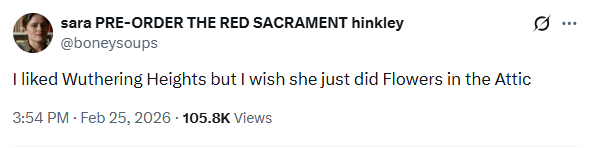
Before I got a chance to see Emerald Fennell’s recent “adaptation” “Wuthering Heights,” I stumbled across this social media post in the wild:
I had just recently completed my own most recent rewatch of 1987’s Flowers in the Attic, and I became fixated on this idea. I’ve been down the Flowers in the Attic rabbit hole more times than I’d care to remember, but at its core, I’ve always been fascinated by the connection between Emily Brontë’s and V.C. Andrews’s novels. I don’t know if there’s any academic discussion of this out there, but I have no doubt in my mind that Andrews drew inspiration from Wuthering Heights, from naming her protagonist “Cathy” to making the implied, sublimated incest of Heights (I’ve always subscribed to the theory that Heathcliff is Earnshaw’s bastard son, meaning he and Catherine are half-siblings) explicit and pervasive in Flowers in the Attic and its sequels.
When I did get around to seeing “Wuthering Heights,” my major criticism of it ended up being that it doesn’t need to, and in fact shouldn’t, be Wuthering Heights at all. The most interesting characters in that film are Alison Oliver’s Isabella and Hong Chau’s Nelly, and one could have done a Rosaline style film about the former or even gone full-tilt into the “Nelly is the villain” concept and made a Cruella style picture about the latter, and either one of them would have been infinitely more interesting than watching “Wuthering Heights” bash two sexy Australian Barbie dolls at each other while reenacting a half-remembered SparkNote. In essence, both Flowers in the Attic and “Wuthering Heights” are both unfaithful mutations of the same source material, which means that Fennell might actually be the perfect person to make a Flowers in the Attic adaptation. Right?
I don’t think so… however, I do think that she would be the ideal person to adapt the first follow-up novel, Petals on the Wind. It would be incorrect to say that Petals is an easier novel to read than Flowers. While it may eschew most of the more taboo elements that made Flowers so salacious, adult Cathy finds herself in just as dire straits in Petals, where she is constantly subject to sexual danger regardless of which of her husbands is exerting force over her. Based on the overall negative reaction to Fennell’s Promising Young Woman (which I didn’t share), I don’t think that she has the sensitivity needed to present Flowers. This is, after all, a director who looked at the same source text that Andrews did and, where Andrews saw both the tenderness and the danger of Heathcliff and Cathy together and the way that it would affect future generations, instead got horned up by imagining them getting off to voyeuristic observation of a couple of servants going at it in a barn. But also, don’t worry, in this version Cathy and Heathcliff definitely aren’t half-siblings, so don’t worry, it’s okay if you get aroused!
For those who are interested, Flowers in the Attic (the novel) doesn’t end in the same way that the ‘87 film does. The latter includes a hastily-shot death scene for Corrine Dollanganger after being confronted by her children during her wedding to Bart Winslow, her late father’s lawyer, as producers felt that the book’s ending, which occurs when the children simply escape the house after learning that their grandfather is dead and Bart and Corrine have been married for over a year. This big confrontation scene seems like it would be right up Fennell’s alley, and the equivalent scene, in which Cathy crashes the Winslow family’s Christmas party at Foxworth Hall to reveal to Corrine that she has (a) seduced Bart and (b) is pregnant by him, is the climax of Petals on the Wind. Of course, this is between her first marriage to an abusive narcissist and her second marriage to the doctor who fostered the children following their escape. Petals also borrows from Brontë, although it’s Charlotte this time, as Paul, the aforementioned doctor, initially pretends that his wife is dead before revealing that she’s actually in an institution, such that his initial overtures toward Cathy when she is of age are much like Rochester’s towards the title character in Jane Eyre. It’s all very, very messy, a true soap opera, and that’s the wheelhouse that Fennell would most bloom in if she took that opportunity.