Who Is Fiona?

A young, passionate musician will stop at nothing until she fulfills her dream of becoming a rock star.  This sounds a lot like Molly McGuire, played by leading lady Fiona Flanagan in November’s Movie of the Month, Hearts of Fire, but this is also Fiona’s story in real life. Flanagan was a young girl from New Jersey with a dream of becoming a rock singer. After hearing Aerosmith for the first time at the age of 15, she fell in love with Steven Tyler’s vocals and decided she would stop at nothing until she was a successful vocalist herself. In the early 80s, an 18-year-old Fiona moved to New York City to pursue her dream of becoming a famous singer. She played shows in small clubs until she landed a record deal in 1985. Her debut album, self-titled Fiona, contained her first hit single, “Talk to Me,”  and the album’s sixth track, “Love Makes You Blind” was featured in the soundtrack for the film No Small Affair (a lesser known film starring Demi Moore and Jon Cryer).  She may not have gained mainstream success with her first album, but she was definitely off to a good start considering how difficult the 80s music scene was. Pop-rock musicians were a dime a dozen, and one hit wonders were more abundant than ever.

Her second album, Beyond the Pale, came shortly after, and it achieved mediocre success. My favorite Fiona song, “Living in a Boys World,” is featured on this album, but most importantly, the music video for the album’s second track, “Hopelessly Love You,” is probably the strangest 80s music video I’ve ever seen. In the video, Fiona models several outrageous outfits, smashes cake before grabbing a goldfish with her bare hands, and bites a taillight on a pink car (among a number of other bizarre acts).  At this point, Fiona was really making a name for herself, so it’s no surprise that she was scooped up to star in 1987’s Hearts of Fire.

Brandon explored Bob Dylan’s feelings (or lack thereof) about his role in Hearts of Fire in his article, Bob Dylan’s Indifference towards Hearts of Fire (1987), The Press, and Life in General, and I thought it would be interesting to know how Fiona felt about the movie. Of course, she was far more enthusiastic about her involvement with the film than Dylan, but she, like most people, overall thinks Hearts of Fire was a terrible film. In a 1998 interview with Bob’s Metal Show, she refers to Hearts of Fire as “that movie” in an attempt to avoid discussing her involvement in the box office flop, but eventually makes a couple of positive comments about the film. She even owns several copies! Her first try at acting involved a small role in a Miami Vice episode, but Hearts of Fire was her first major acting gig. She admits in the Bob’s Metal Show interview that she was very unprepared for such a huge role, but honestly, she was hands-down the most talented actor in the movie.  In another interview with Jen Dan of Adequacy.net , she stated “Rupert, I think, hated me.” referring to Rupert Everett, her love interest (other than Dylan) in the film. That statement broke my heart a little since she seems like such a sweet, down-to-Earth person, but Everett has a reputation for being a douche bag, so it’s his loss if anything.

Her most successful album, 1989’s Heart Like A Gun, was released post-Hearts of Fire, so thankfully, the film’s reputation did not impact her music career. She would go on to release one more album, Squeeze, three years later before taking a break from the music world.  She received a degree in accounting at UCLA and had a very short career with PricewaterhouseCoopers before taking some time off to start a family.  But because music runs through her veins, Fiona jumped back into the music scene with her 2011 album, Unbroken. I listened to a few tracks, and they were all pretty good! She sounds like she’s singing what she wants to sing, how she wants to sing it. Even though she’s currently active in the music scene, it’s highly unlikely that she’ll give acting another shot. Although I enjoyed her performance in Hearts of Fire, this seems like a wise choice.

Fun Fact: Fiona did background vocals for Roger Daltrey’s cover of Elton John’s “Don’t Let the Sun Go Down on Me,” which was featured on The Lost Boys movie soundtrack. Interestingly enough, Timmy Cappello, the “Sexy Sax Man” who appears in one of the early scenes of The Lost Boys performing “I Still Believe,” plays Nico, one of Rupert Everett’s band members in Hearts of Fire!

For more on November’s Movie of the Month, the Bob Dylan rock n’ roll disaster Hearts of Fire, check out our Swampchat discussion of the film and last week’s look at Dylan’s behind-the-scenes apathy.

-Britnee Lombas

Justice League (2017)

Look! Up on the screen! It’s big! It’s dumb! It’s loud! It’s Justice League!

And it mostly works. Mostly.

The very first scene of Justice League does some good work walking back the problems—and they are problems, not merely criticisms—of the first few non-Wonder Woman films in this universe. We see Superman as children see him, which is also the way that this franchise keeps trying to retroactively force its audience into reconceptualizing him: as a true-blue (literally, given the lightening of his costume) hero and symbol of hope. He’s kind, sympathetic, and, you know, Superman, as he’s supposed to be. And then, just as his life was, the video is cut short. This leads into a beautiful opening credits montage, a strength of Zack Snyder’s as a director (even those who hate his Watchmen adaptation, which I surprisingly don’t, are all but universally pleased with its Dylan-composed credits sequence).

This sequence is not without contentious issues, of course. First, there’s a headline seen in a newspaper box mourning the loss of David Bowie, Prince, and Superman, but not Leonard Cohen, which is pretty disrespectful given that the whole thing is set to a really, really terrible cover of “Everybody Knows.” There’s also the issue that we’re supposed to be seeing a world in mourning for the space god who showed them some truths about themselves, but if you’re going to enjoy anything about this movie, you’re just going to have to accept this retcon.

Consider the speech from Marlon Brando’s Jor-El in the first Richard Donner Superman film (and later repurposed for the trailer for Superman Returns): “They can be a great people, Kal-El; they wish to be. They only lack the light to show the way. For this reason above all, their capacity for good, I have sent them you… my only son.” This same speech was actually echoed by Russell Crowe in his turn as Papa El in Man of Steel: “You will give the people of Earth an ideal to strive towards. They will race behind you, they will stumble, they will fall. But in time, they will join you in the sun, Kal. In time, you will help them accomplish wonders.” Unfortunately, this franchise has made zero effort to actually follow through on these lofty ideals of the Superman-is-Messiah beyond paying lip service and a couple of “subtle” images in Man of Steel. The problem is that this was never present in the actual text of the film, which presented us with a broody, angry, super-powered alien whose only affection for the beings of his adopted world were his love for his mother and an office romance. He was more Tyler Hoechlin’s Derek Hale in Teen Wolf than Tyler Hoechlin’s Clark Kent in Supergirl (he’s killing it, by the way), and that absence has been sorely lacking in this film series so far.

But. But. Justice League, for all the baggage that its carrying from three bad movies and one spectacular one, actually works if you ignore all that needless, pointless, and out-of-place GRIMDARK nonsense that preceded it in the earlier installments. And it’s not just with Superman either; the scene that immediately follows the opening montage shows Batman out and about being Batman, and even uses some passages from Danny Elfman’s previous work on Tim Burton’s 1989 film adaptation (but which will always be a keystone for me as the theme music for the Batman animated series).

This first Batman scene is both good and bad. Your standard Gotham City burglar is exiting onto a roof at night, sees Batman, attacks the Bat, gets his ass handed to him, and is dangled over the side of a building to attract a Parademon (the foot soldiers of the film’s villain), which can apparently smell fear. Bats traps the Parademon in a net, tests out a series of sonic disruptions on it, and it dies, leaving behind a clue about the three Mother Boxes. It’s so, so dumb, but the combination of the old Elfman theme and the absurdity of the whole thing makes it feel like the cold open of an episode of the animated Justice League, where Kevin Conroy’s Batman would do something just like this: lure, trap, find weird clue that matches something he’s already investigating, detective it up. It shouldn’t (and for most people won’t) work in a feature film with live actors that is supposedly trying to take itself seriously, but that narrative works for me on a certain level. On the other hand, there are other elements of this scene that are inarguably bad story choices, like Batman just kind of grappling away from the scene to do detective stuff, completely disregarding the theft he just interrupted and leaving the burglar to his own devices.

The overarching plot of the film concerns the arrival of Steppenwolf, one of the members of Jack Kirby’s cosmic DC creations The New Gods, on earth. Millennia ago, he attempted to invade the planet and turn it into a “primordial hellscape,” but he was repelled by an alliance of Amazons, Atlanteans, the tribes of Man, and a couple of others that we’ll explore in a minute. Steppenwolf carrier with him three Mother Boxes, pieces of advanced technology that, when combined, create the terraforming effect that will make the earth his new home (yes, this was the exact same desire of the villains of Man of Steel). Now, after several millennia, he has returned in the wake of Superman’s death because mankind’s mourning of that great symbol of hope has made it ripe pickings for the invader’s crusade, and Batman has to recruit five superheroes with attitude to repel his forces (yes, this is essentially the same plot as the Mighty Morphing Power Rangers, and yes, I would love to see the trailer for JL recut with the opening narration of MMPR).

I’m not going to lie to you: this movie is clearly half-baked and it makes a lot of mistakes. Beyond the fact that Bats uses a street level criminal as bait and then ditching him without even notifying the police, there are other mistakes both big and small. For instance: the janitor working at Star Labs is seen bidding Dr. Stone good night, and it’s obvious (at least on the big screen) that the ID he’s wearing is for a different person, as he has dark hair and is clean-shaven, while the picture on the ID is of a man with a big bushy head of white hair and a glorious Mark Twain mustache. You can imagine sitting in the movie theater and thinking, like me: “Oh, he must be a spy who stole this ID, that’s a neat clue.” But no, it’s just a mistake; later, after said innocent janitor has been kidnapped by the villain, we see his belongings left behind in a pile, including an ID with an accurate photo. That’s this movie in a microcosm: when you think that it’s being clever, it’s actually just a goof.

When I was a kid, the DC comics characters were much dearer to me than Marvel’s. Although becoming an adult and becoming more socially aware has meant that I’m less inclined to love Batman uncritically (i.e., he’s kind of a fascist who spends most of his time attacking poor people out of his own sense of morality, rarely actually inspecting the causes of poverty and crime and trying to correct the problem at the root, although some of the best Batman writers have taken note of this and written him accordingly), he’s still the first character I think of when I think of superhero comics. The aforementioned Batman animated series was a defining piece of media for young Boomer, as were reruns of Superfriends, and I loved visiting the one aunt whose cable package included FX, as that meant I would get to see an episode of the Adam West Batman and, if I was very lucky, Lynda Carter in Wonder Woman. It’s for this reason, and not because I am a “Marvel fanboy,” that I’ve been pained to see this franchise handled so, so poorly in the past few years. Wonder Woman was not just a step in the right direction, but a wholehearted plunge into how to to this whole thing right (Alli may have given it a mere 3.5 stars, but that was a 5 star movie for me personally).

Justice League is having a harder time straddling that fence, seeing as it has to undo the immense damage done to the franchise as a whole by Man of Steel and Batman v. Superman. Sure, Suicide Squad was a terrible movie on the whole, but at its core it was a C-grade movie dressed up as a blockbuster, which is an aesthetic that I’m always a little bit on board for in spite of myself, especially when the actors really commit to the nonsense; additionally, the backstory and arc of Jay Hernandez’s Diablo contain far and away the most effective emotional beats of the first three films. It certainly didn’t fracture the fans in the same way as BvS, which some people are still defending for reasons that are unclear to me. Still, JL is trying hard to course correct, and the job that it’s doing is admirable, even if it stumbles every ten minutes or so. It works as a cartoon about the Justice League that just happens to be live action and have a tonally dissonant visual aesthetic from the text of the actions on screen.

The most important thing I can tell you if I’m trying to give you an idea as to whether or not you should see this film is this: Justice League works, if you accept it not as part of this franchise, but as an entry into the larger cultural understanding of Superman specifically and DC in general. What I mean by this is that the story it’s trying to tell, about a world without a Superman, does not work as a piece of the DCEU divorced from the context of the DC animated universes, or comic books, or even the earlier Donner and Burton films. But within that larger conversation, in which we do have a Superman who is a beacon of hope, truth, and justice, it does.

Additional notes:

  • I, too, saw all of the photos of Henry Cavill’s uncanny valley face online before I went to the theater, but I never noticed it when actually watching the movie. Maybe it says something about how my brain works that I completely overlooked it, but I’d wager it has more to do with the fact that if this were real life, Superman would have had to keep telling me “My weird face thing is up here.” You know what I’m talking about.
  • This has been addressed in other reviews that I’ve read and heard, but it is super weird that no one is at all concerned about maintaining their own or other’s secret identities in this movie. Aquaman calls Bruce Wayne “Batman” in front of a whole bunch of villagers, and Lois calls the newly awakened Superman “Clark” in front of several Metropolis police officers, which is only going to make it more obvious when he shows back up at work after having disappeared and reappeared at the exact same time as Supes did.
  • Ezra Miller’s Flash is charming, and I liked him a lot. A lot of his jokes fell flat, but I liked that they were overlooked in universe as well. I think that he’s probably the best addition to this universe since Wonder Woman.
  • Ray Fisher’s Cyborg is given almost nothing to do other than to be the machina that the deus exes.
  • All the stuff that you heard about Wonder Woman being more sexualized in this film is true, as I noticed the lingering shot of her rear, but she’s still Wonder Woman and still the best thing about this movie. I can’t wait for WW2.
  • The design for Steppenwolf is terrible. A stop-motion Starro would have been better, and would have made for a better villain overall anyway. Can you imagine a film where Starro the Conqueror appeared and tried to terraform the world into something more suitable to himself (i.e. covering the whole earth with the ocean)? There would be no need for the cliche sky beams, and instead there could have been the opportunity to discuss the rising oceans that are the result of climate change and Starro’s need to barely push humans into doing his will. The insistence on doing the New Gods stuff right out of the gate, especially after the imagery and ideas of Jack Kirby were so much better utilized in Guardians 2 and Thor: Ragnarok earlier this year, was a bad decision.

-Mark “Boomer” Redmond

The Disaster Artist (2017)

Recent theatrical releases of movies are sometimes accompanied by short intros from casts or directors thanking the audience for coming out to see the picture. Edgar Wright recorded a really snooty one for the release of Baby Driver where he took an unnecessary potshot at the concept of Video on Demand distribution. The casts of X-Men: Apocalypse & Resident Evil: The Final Chapter recorded damage control intros that made a point to put human faces on what felt from the outside to be soulless, corporate products. James Franco’s highest-profile directing gig to date, The Disaster Artist, breaks new ground by making this cloying, self-congratulating mode of introduction an actual part of the picture, not just a tagalong video package. The Disaster Artist opens with Franco’s famous friends ironically praising Tommy Wiseau’s toxic trashterpiece The Room as if it were the most important picture ever made. The tone of this intro feels more fitting for the opening notes of an SNL sketch than a feature film, as does Franco’s lead performance as the enigmatic, vaguely European monster Wiseau. Later, there are isolated comedic bits and moments of genuine drama that transcend the tackiness of this intro, but then the movie slips right back into that mode in its final moments, featuring real-life footage of book signings & The Room screenings with Wiseau beaming over his own ironic adoration. In a way, these bookends are a welcome warning that although The Disaster Artist is Franco’s most legitimate, respectable work as a filmmaker to date, it still allows him to indulge at length in his worst impulses, which includes advertising for his own movie as you’re watching it.

If you’re unfamiliar with the amusingly bizarre/misshapen cult classic The Room or the excellent book that details its production (also titled The Disaster Artist), it’s unclear how appealing Franco’s film will be to you. Although The Room is a deeply misogynistic, poorly crafted mess, it has a strange allure to it that invites multiple re-watches, as evidenced by its regular midnight movie circuit screenings, complete with Rocky Horror-style call & response rituals. The book The Disaster Artist only makes The Room more fascinating as a found object, leaving you with more questions than answers about the strangely vampiric millionaire who wrote, financed, “directed”, and starred in it: Tommy Wiseau. Wiseau claims to be “from” my hometown of Chalmette, Louisiana, but has a heavily slurred, Eastern European accent that defies that explanation. He also claims to be decades younger than he very visibly is and skirts all inquiries into how he came to make millions selling counterfeit blue jeans in San Francisco. The more you dig into who Wiseau is as a historical figure and what The Room reveals about his psyche as person, the more fascinating he becomes as an enigma. With his big screen adaptation of The Disaster Artist, it’s unclear exactly how interested Franco is in these mysteries. He breezily skims over many themes & details of The Room’s backstory that could be rewarding if explored at length, but instead fail to register as anything significant as they fly by in a rapid procession. It’s like trying to get to know a popular band through their Greatest Hits collection instead of diving into their album cuts.

Without a strong thematic foundation or point of view, The Disaster Artist plays a little like its worst possible self: an excuse for famous people to play dress-up as a funny looking weirdo who made an infamously bad movie. The good news is that if anyone deserves to be mocked by famous people for their moral & artistic shortcomings, it’s Tommy Wiseau. James Franco’s impersonation of Wiseau may be more fitting of a Celebrity Family Feud sketch on SNL than a feature that supposedly has Oscar-contender ambitions, but he does (occasionally) make a point to highlight his subject’s dark, abusive streak. Hostile temper tantrums that selfishly drag people down to his level and deeply unsettling attitudes towards women & sexuality surface as Wiseau becomes frustrated with his own shortcomings as an artist & a friend. Much like the film’s better comedic bits (an extended sequence where Tommy forgets his own line for so many takes the entire crew knows it better than he does comes to mind), however, these moments of darkness & drama feel isolated & ultimately lead nowhere substantial. This is especially frustrating in a spark of critical thought where the movie highlights how hurtful it is to laugh at an undeveloped artist’s passionate work while also being honest about The Room’s enjoyability solely being a “so-bad-it’s-good” proposition. It’s a thought that’s floated only for an isolated scene or two before Franco quickly moves on to the next Spark Notes-style bullet point on The Room’s legacy, trying to make room for as many of the film’s touchstone details as he can without exploring any in particular at length. I’m not sure that finding a part for every host of the How Did This Get Made? podcast or playing exact recreations of scenes from The Room side by side with their source material was more important than critically or thematically engaging with Wiseau as a toxic enigma, but Franco often slips into that kind of indulgence, to the film’s detriment.

As insane as it is that people are comparing The Disaster Artist to the triumph of Tim Burton’s Ed Wood, it does occasionally impress or delight in the same way that classic celebrates the minor victories of an artist ill-equipped. Because Franco doesn’t dive much deeper than that in his blink-and-you’ll-miss-it engagement with the darkness of Wiseau’s psyche, there isn’t much more to the movie than that simple idea and the minor pleasures of watching famous comedians mock the failings of a deeply flawed, aggressively amateur auteur. Brigsby Bear is the superior 2017 release that explores the darkness of an emotionally wounded, amusingly eccentric amateur filmmaker creating art directly from the depths of their subconscious. Lady Bird better details the follies of a selfish brat making constant mistakes in an early 00s period piece. Any meticulous recreations of specific scenes from The Room are far more amusing when experienced in the source material. Any questions of Wiseau’s history & character are more thoroughly, thoughtfully explored in Greg Sestero’s book by the same name. So, what exactly does Franco’s The Disaster Artist offer as a work on its own terms? I suppose there are enough successful comedic bits & dramatic moments that feel impactful enough in isolation to be worth your time, but ultimately don’t lead anywhere significant. And since the movie is bookended highlighting Franco’s worst impulses as an artist & a storyteller (the concluding side-by-side recreations from The Room are especially self-indulgent), its best moments aren’t even the first impression that comes to mind.

-Brandon Ledet

Lady Bird (2017)

Greta Gerwig’s debut feature as a writer-director (after several notable collaborations with eternal sourpuss Noah Baumbach) has quickly become something of a smash hit, even though it’s only screening in a few hundred theaters in its initial, slowly expanding release. Lady Bird currently has the highest per-theater average attendance for any film in 2017, which is remarkable for a work so formally & tonally unassuming. Essentially telling the story of a deeply flawed teen brat navigating her own newly-forming identity & impulses towards selfishness over the course of a single year, there isn’t much on the surface of Lady Bird that would suggest why it’s being watched & rewatched with such veracity and topping so many early drafts of Best of the Year lists. It’s when you get into the details of the picture that its resonation & mass appeal makes more sense. Having graduated from a Catholic high school my parents could barely afford in the early 00s, I felt as if the picture were made specifically for me. Growing up in Sacramento, California before moving away to the opposite end of the country at a young age, the person I watched the movie with more or less felt the same: Lady Bird was made specifically for them. I’ve been reading similar accounts in many of the film’s early, elated reviews as well. Obviously, not every single person who watches the picture is going to be able to personally relate to its characters & setting in that way, but Gerwig packs the picture with enough meticulously distinctive details that when you see a familiar location or sign of financial struggle or complicated relationship that reflects something in your own life, you’ll feel as if she made a film for you alone and no one else. I have to assume that personal recognition of individual details has to directly affect its apparent universality, as self-contradictory as that may sound.

Saoirse Ronan stars as a disenchanted high school senior “with a performative streak” who dreams of moving far away from her suburban home town of Sacramento as soon as she graduates. Like in many coming of age stories told in that framework, she mostly struggles with her self-identity and what horrors or pleasures her future might hold. She gives herself the alias “Lady Bird” as a pretentious expression of independence. She daydreams along with her theater kid peers of futures in romantic locales like Paris & New York. Her reality is much more limited than that fantasy suggests, a conflict that weighs heaviest on her relationship with her mother, an overworked psychiatric nurse played by Laurie Metcalf. Lady Bird rebels unnecessarily against many people & institutions who don’t deserve it: caring nuns, her best friend, her older brother, Sacramento as a concept. None are as giving or as frustrated with her as her mother, though, and the movie is just as much about the intricacies of their uneasy bond as it is about Lady Bird learning empathy & autonomy. The way they can argue bitterly about how money & class affect their status in the community in one breath and mutually break down over an audiobook in the next feels true to life, so it’s rewarding that there are no easy solutions or revelations within their dynamic as the movie wraps up its year-in-the-life plot. Lady Bird barrels through her final year under her mother’s & her Catholic high school’s roofs, hurting everyone in her path to escape like the clumsy teenage monster that she is (and we all were). Sometimes these wounds can be repaired. Sometimes the relationships remain fractured, but endure anyway. Mostly, Lady Bird dares to test every boundary she’s fenced within and (hopefully) learns who she is as a newly-formed person in the process of making many, many mistakes.

It’s initially difficult to pinpoint exactly what distinguishes Lady Bird as a high school comedy and Gerwig as a filmmaker, considering how many times this narrative has been told before. The recent coming of age sleeper The Edge of Seventeen already re-invigorated the high school teen comedy by being honest about how unlikable & flawed most people are at that age. There’s also major echoes of works like Rushmore & Ghost World that were actually released when Lady Bird was set in the early 00s (although with significantly cooler soundtracks; Lady Bird has a much worse taste in music than Enid or Max Fischer, hilariously so). Not all of Gerwig’s strengths as a filmmaker result from the intimate specificity of her writing, however. What’s most formally impressive about Lady Bird is not necessarily that it captures so many intimately specific moments of early 00s teen rites of passage (getting stoned & microwaving junk food to third wave ska, awkwardly slow dancing to Bone Thugs-N-Harmony at a high school dance, ungodly awful theater auditions/exercises, etc.), but that they hit the screen so rapidly & with such confidence. Lady Bird is a feat in editing room craft, summarizing an entire, pivotal year in its protagonist’s life through deftly-detailed montage. The movie is resonating personally with so many individual audience members because it is so tightly packed with isolated images & exchanges in an onslaught of free flowing montages. The way time passes in these stretches plays both as a laugh-a-minute comedy and an emotionally devastating drama, especially when moments are unexpectedly cut short or drastically extended for emphasis. In one of the film’s more defining exchanges, Lady Bird pleads with her mother to break her angry silence in what feels like a scene pulled from a harshly acidic stage play, but is caught between two much lighter, brighter sequences of small-scale triumph. Lady Bird’s editing techniques are deceptively simplistic, but immensely impactful in summarizing an entire year in a life not yet fully-defined.

It’s by no means one of the flashier filmmaking feats of the year, but there’s a pretty solid chance that something (if not everything) in Lady Bird will resonate with you on a personal level. Although a massive number of people respond to the picture by insisting Gerwig made it specifically for them, they can’t all be wrong. She’s speaking to her audience on a distinctively personal level, especially on issues of teen identity exploration and familial struggles with selfishness & class. The rapid fire editing and believably genuine performances from Ronan & Metcalf only serve to drive that vision home and make room for a memorable, personalized emotional response. Lady Bird initially appears to be a continuation of a well-worn type of story we’ve all seen before, but once you’re immersed in its defining details, there’s something remarkably individualistic about it that worms its way into whatever’s left of your frustrated teenage heart.

-Brandon Ledet

Wexford Plaza (2017)

Sometimes, the best a small-scale indie can do is surprise you. It’s always impressive that any film ever gets made at all, so when a micro budget indie feature with an ambling narrative & blatantly non-professional actors even makes it to a festival run in a completed form, it’s impressive to me than it even exists. The stories told on that scale can be predictable & routine at best, though, which is understandable when considering the limited means that produced them. What I most appreciated about the micro budget indie Wexford Plaza is the way it surprises its audience by playing directly into that predictability and then completely subverting expectation. It’s not an impressive feat of slick, hyper stylized filmmaking craft, but it is an impressive act of small-scale storytelling made fresh.

A young, bored 20something white girl picks up a go-nowhere security guard job at a desolated strip mall. Listless, she drifts through the endless summertime doldrums of the job in the exact way you’d expect someone just leaving their teens to: wolfing junk food, playing on her phone, drinking, smoking pot, masturbating, wasting time. A misinterpreted sexual pass from a coworker eats up a lot of her time on the job, as she fails to flirt back and eventually ends up making herself vulnerable & hurt. This all sounds like a typical no budget indie comedy narrative, except that the same story is then inverted & retold from the perspective of the older, PoC coworker our listless antihero failed to flirt with in the first half. Things get much darker from there, shifting from a small-scale stoner comedy to a smartly calibrated gut punch focused on the tension between privilege & economic desperation.

At its heart, Wexford Plaza is a dark comedy about the difference between treating menial service labor as a consequence-free playground in your 20s and the way it becomes an escape-free economic rut you depend on for sustenance in your 30s & beyond. The movie can be frivolously funny in the aimless stoner comedy moments of its opening half, but evolves into a much more surprising, rewarding watch as its story unfolds onscreen. There are probably more stylistically impressive examples of this humorous service labor drama to be found out there (Patti Cake$ & Party Down come to mind). The movie’s absence of a proper budget also shows at the seams (especially when the blatantly green actors are tasked with comically playing drunk or high), but the movie does manage to surprise & subvert expectation, which is no small feat given the scale of its production.

-Brandon Ledet

Geostorm (2017)

I was saddened to hear from early critical response that the ludicrous environmental thriller Geostorm does not contain nearly as much geostorming as the marketing promised. Indeed, Geostorm features an official “Countown to Geostorm” at its climax that Gerard Butler’s alpha male hero cuts off early all by his lonesome to save the world from the titular global disaster, thus blocking the audience from receiving the payoff promised. There’s plenty of cheap CGI simulations of extreme weather leading up to that anticlimax, however, so it’s not like Geostorm cheats its audience on climate change action entirely. What most surprised me when I finally caught up with the movie, though, was that its over-the-top fretting over extreme weather was not at all what made it entertaining. Geostorm‘s entertainment value doesn’t lie in its titular threat at all, but rather in its Info Wars/Alex Jones style paranoia about governmental control over the daily lives of self-sufficient macho men.

From Geostorm‘s opening vision of a climate change-riddled 2019 in which the world is nearly destroyed by a series of floods, droughts, landslides, and so on, you might expect the film to be a kind of left-leaning warning to change our ways along the lines of a The Day After Tomorrow or 2012. Instead, this “extreme weather” dystopia is more in line with the Individualist, Conservative fantasy of Michael Bay’s Armageddon. An international team of scientists & a UN type coalition of governments are reported to have worked together to invent a satellite network that can control the weather to prevent this global crisis. Geostorm has no interest in celebrating this international collaboration & governmental triumph. Instead, it pits a tough guy American badass (played by a sleepwalking Butler) against the Big Bad Government, who he suspects of weaponizing the satellite system to create extreme weather events in a bid for world domination. Butler barges in to take over command of the international crew, stopping at nothing to get to the bottom of which US government entity (because America is all that matters) is threatening to destroy the world. Skepticism of surveillance, beaurocracy, and even the President of the United States swirls to such a ludicrous crescendo of Info Wars/Coast to Coast AM-style, conspiracy-minded paranoia that you almost forget the main draw of the film was supposed to be video game-level CGI simulations of manmade “Natural” disasters.

As amusing as Geostorm‘s Armageddon-style politics can be, the film is desperately lacking the collective charisma of Armageddon‘s cast, which featured outsized personalities as wide ranging as Bruce Willis, Steve Buscemi, Owen Wilson, Michael Clarke Duncan, Peter Stormare, Ben Affleck, Live Tyler, William Fichtner, etc., etc., etc. By contrast, Gerard Butler is a cardboard cutout of a leading man action hero, with exactly none of the charisma needed to carry the film on his back. The rest of the cast has a kind of CSI Miami vibe in their aggressive forgettability, underselling what could potentially be some fun, over the top dialogue. The space alien wording of “That I am calling bullshit on,” & the understandably incredulous “Hold on, what now?” response to the first utterance of the term “geostorm” (which is then amusingly defined at length) tickled me in particular, but could have been much more fun in sillier hands. Gerard Butler’s black hole of a personality is far more damaging to the entertainment potential of Geostorm than its deficiency of geostorms. The movie could have been a much better time with an action star like Schwarzenegger or Stallone in the lead role.

Butler is undeniably a bore as the film’s leading man and there certainly could have been more onscreen global disaster to help pass the time, but I still found Geostorm to be an adequately silly time at the movies. Its right-wing political paranoia, scenes of scientists dodging fireballs in Smart Cars, and basic premise of a weaponized, weather-controlling satellite network all help cover up the boredom threatened by its cast of non-characters. Watching Geostorm in New Orleans, where it was filmed, even has its own built-in entertainment value. The exact two buildings where I work being passed off as Washington, DC and the Superdome being blurred out in the background of a sequence set in “Orlando” were pleasant distractions from the placeholder dialogue they were decorating between whatever paranoid rants or monumental disasters bookended them. “Cheaper, dumber Armageddon” obviously isn’t everyone’s idea of a fun time at the movies, but I was at least moderately sated by the oddly geostorm-deficient Geostorm, Butler warts and all.

-Brandon Ledet

Thor: Ragnarok (2017)

Thor: Ragnarok marks the third Marvel release of the year that focused on fun and adventure, and all for the best. After last year’s kinda-dreary Civil War and the visually arresting but narratively empty Doctor Strange, the film branch of the House of Ideas was in top form this year, churning out an equal sequel with Guardians of the Galaxy 2 and the delightful Spider-Man: Homecoming. Although Guardians 2 may have leaned a little hard on the beats with its humor (kind of like your friend who tells great jokes but is also a little desperate and always ends up laughing too hard at himself) and Homecoming was an out-and-out comedy with intermittent superheroing, Marvel brought it home with a good balance of strong character moments, spaceships flying around and pewpewing at each other, new and returning cast members with great chemistry, and a hearty helping of the magic that is Jeff Goldblum.

After visiting the fire realm ruled by Suftur (voiced by Clancy Brown), Thor (Chris Hemsworth) returns to Asgard after a few years galavanting about and looking for the Infinity McGuffins, only to find Loki (Tom Hiddleston) still disguised as Odin (Anthony Hopkins) and ineffectually ruling Asgard while propping up the myth of the “dead” “hero” following Loki’s supposed sacrifice at the end of The Dark World. Thor enlists Loki in helping him seek out the real Odin on Midgard (Earth), but events conspire to release the long-imprisoned (and forgotten) Asgardian Goddess of Death, Hela (Cate Blanchett).

Her return to Asgard to take the throne leaves Thor and Loki stuck on the planet Sakaar, ruled by the Grandmaster (Goldblum), who offers the space- and time-lost denizens of the planet their proverbial bread and literal circuses in the form of massive gladatorial games. As it turns out, this is where our old buddy the Hulk (Mark Ruffalo) ended up after his exit at the end of Age of Ultron, and he’s the champion of the arena after having stayed in his big green form since we last saw him on screen. Also present is Scrapper 142 (Tessa Thompson), a former Asgardian Valkyrie who likewise found herself on this bizarre planet after being defeated by Hela before her imprisonment. Meanwhile, Heimdall (Idris Elba) is hard at work putting together a resistance and biding his time until Thor and company can return to Asgard, stop Hela and her new lieutenant Skurge (Karl Urban), and prevent Ragnarok.

Despite apparently being no one’s favorite Avenger and being overshadowed in virtually every installment by inexplicable (to me) fan favorite Loki, Thor has experienced a lot of growth in the past six years since he was first embodied by Hemsworth, and so have his films. The Dark World was, in many ways, the nadir of the MCU franchise as a whole (until Doctor Strange came along), where it felt like everyone was just going through the motions after having a lot more fun with the surprisingly pleasant balance between the fish-out-of-water humor and royal family drama of the first film. I quite like Natalie Portman, personally, and I would have loved to see her continuing to have a role in these films, but she was sleepwalking through that last film with so much apathy that she made Felicity Jones look like an actress.

Here, however, everyone is totally committed to the job, which is probably easier under the guiding hand of the bombastic and colorful Taika Waititi, who seems to be the embodiment of Mr. Fun, than it was in a film helmed by Alan Taylor, whose work tends to be more grim, if not outright melancholy. This is a movie with setpiece after setpiece, all in different realms and on various planets with their own palettes and aesthetic principles, which lends the film a verisimilitude of scope, even though each conflict (other than the opening fight sequence) comes down to something much more intimate and personal: the friction between selfishness and the responsibility to something greater than oneself. The wayward Valkyrie forsakes her desire to drink herself to death while running from the past in order to defend her home once again, Bruce Banner risks being completely and permanently subsumed by the Hulk in order to lend a hand when Asgard calls for aid, Skurge finds a strength he didn’t know he had when faced with the extermination of his people, and even Loki ends up making a decision that helps others with no apparent direct or indirect benefits to himself. The oldest being in the film, Hela, has never learned this lesson despite having nearly an eternity to do so, and it is her ultimate undoing (maybe), and it’s a strong thematic element that comes across clearly in a way that a lot of films from the MCU do not.

There are some mitigating factors, as there always are. Those of you hoping for a Planet Hulk adaptation are going to be mightily disappointed, although you should definitely check out Marvel’s direct-to-video animated version, which is not only the only unequivocally good animated film Marvel produced before ceding that realm to DC, but also has a starring role for my boy Beta Ray Bill, who has a blink-and-you’ll-miss-it cameo as one of the faces carved into the Grandmaster’s tower. There are also some character deaths earlier in the film that I think are supposed to be shocking in a meaningful way, but come on so suddenly and have so little effect on the plot that it feels kind of tasteless. I would have loved to see more of Sakaar’s arenas as well; it’s hard not to feel cheated when a movie promises some gladiatorial combat and ends up giving you only one match-up.

I’ll save the rest of my thoughts for our Agents of S.W.A.M.P.F.L.I.X. review, but I’ll say this for now: this is a fun summertime Thor movie that somehow ended up being released in November, but it’s nonetheless a delight. Check it out while it’s still in theaters, as you should never pass up the opportunity to see a live action depiction of that ol’ Kirby crackle on the big screen.

-Mark “Boomer” Redmond

Tom of Finland (2017)

I can probably count on one hand the number of biopics that have struck me as phenomenal, formally impressive cinema. Stray examples like Ed Wood & Kinsey leap to mind as I attempt to recall biopics I’ve instantly fallen in love with, but for the most part the genre feels like an endless line of passable-but-unremarkable exercises in filmmaking tedium. Tom of Finland has joined the ranks of biopics that have transcended that mediocrity for me. Depicting the adult life of the Finnish illustrator/pornographer Touko Valio Laaksonen as he drew his way into queer culture infamy, Tom of Finland excels as a kind of filmmaking alchemy that turns an unlikely tonal mashup of Cruising & Carol into the feel-good queer drama of the year. Its high class sense of style & lyrical looseness in narrative structure feels like the best aspects of Tom Ford’s features, but without his goofy storytelling shortcomings. While its sexuality isn’t quite as transgressive as the leather daddy-inspiring art of its subject, it’s still a passionate, celebratory work that sidesteps the typical pitfalls of queer misery porn dramas, yet still manages to feel truthful, dangerous, and at times genuinely erotic. It’s hard to believe the film is half as wonderful as it is, given the visual trappings of its subject & genre, but its leather & disco lyricism lifts the spirit and defies expectation. The only disappointment I have with Tom of Finland is that most audiences don’t seem to be on its wavelength, dragging my enthusiasm down with bafflingly unenthused reviews.

Part of the reason Tom of Finland is so impressive in its transcendence of biopic tedium is that it entirely forgoes the birth-to-death trajectory of that genre’s traditional narrative structure. Glimpses of the artist as a successful older man, a reluctant young soldier, a closeted adman living with his sister, and a smitten middle age romantic who happens to generate pornography, mix in a cyclical, sublimely lit intersection of vignettes that play like sardonically funny paintings in motion. The domestic softness of Laaksonen’s home life mix with the transgressive, leather-clad brutes of masculine sexuality that define his pornographic artwork and invade his daydreams as horny, in-the-flesh hallucinations. War-related PTSD becomes inextricable from the erotic, as he fetishizes a handsome soldier he killed in battle as a young man. Orchestral sweeps find divine beauty in the danger of cruising men in public & producing illegal, sexually charged art. Tom of Finland jumps time & skims consequences, trusting its audience to follow along without being held by the hand. It’s a delicately sweet portrait of an artist that’s often interrupted by queer disco reveries & seas of hairy men posing in the leather getups that turned Laaksonen on so much that his depictions of them inspired an entire spectrum of sexual fetish. If arranged in a linear order or stripped of its playfully hallucinatory erotic fantasies, Tom of Finland could easily be the middling biopic its critical consensus reports it to be. Instead, it’s a gorgeous, dreamlike drift through the life of an artist with one of the mostly highly dedicated, specialized cult audiences imaginable.

I might understand the complaint that Tom of Finland isn’t brutish or sexy enough to fully convey the transgressive spirit of its subject’s work if it at all seemed like Laaksonen was as wildly over the top as his drawings. The tension between his mild-mannered demeanor and the over-sexed aggression of his art is one of the film’s more rewarding charms. He’s far from a sexless character, shamelessly flirting with men and discussing his work in blatantly honest terms like, “My cock is the boss. If I have a hard-on I know it’s good.” Like most people, though, Laaksonen is portrayed to be not nearly as wild as his sexual fantasies might suggest, which makes it all the more amusing when he’s delighted/dazed to see his work come to life in the “heavy leather” queer kink communities they inspired in New York City & San Francisco. The sudden deluge of this dedicated fandom hits the audience with the same jolt of surprise, its accompanying disco soundtrack feeling just as surreally out of place as the imagined sexual fantasies that intrude on the physical spaces of his daydreams. The contrast between this playfulness and the high art cinematography & production design make for one of the more exquisite biopic experiences I can ever remember having in my lifetime. Normally, I’d worry if the fact that I saw this at a New Orleans Film Fest screening made me more enthusiastic because of the excitement of the environment, but a faulty stop & start projection and a fussy late night audience was actually more of a distraction than an enhancement. Given the less than ideal screening where I watched this beautiful film, it’s a miracle I enjoyed at all, much less instantly fell in love. Now I just need to figure out exactly why so few people seem to be on the same wavelength.

-Brandon Ledet

Get Excited! Swampflix is Returning to NOCAZ Fest This Weekend

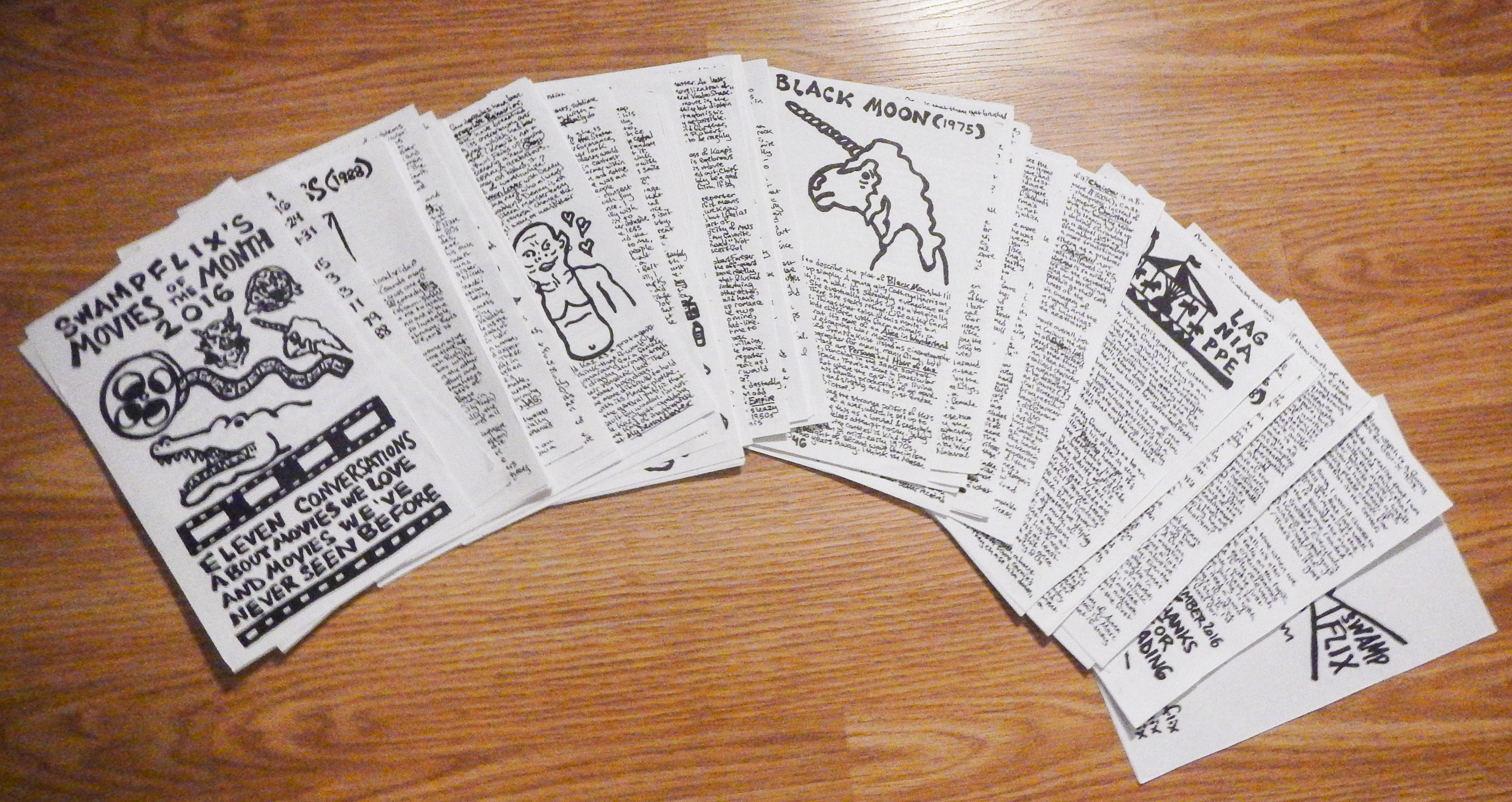
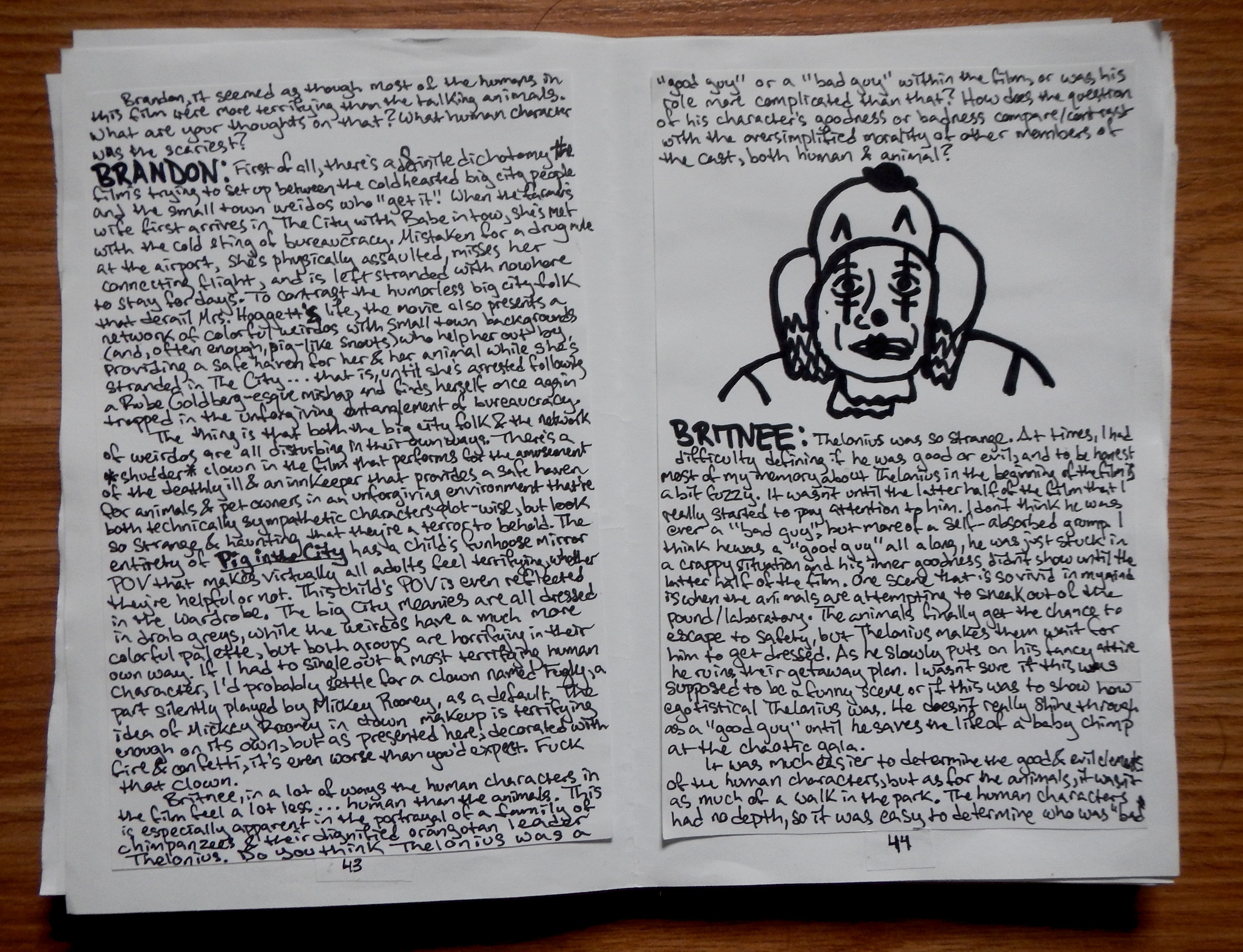
Attention, Swampflix readers in the New Orleans area! We will be exhibiting this Saturday (November 18th) & Sunday (November 19th) at the fourth annual New Orleans Comics & Zines Festival along with a bunch of other super cool comics & zines exhibitors. For this year’s festival we made a massive print version of the entirety of last year’s Movie of the Month conversations.

We will be also selling print versions of our “Marabunta Cinema“, “Lugosi Vs. Karloff“, “Agents of S.W.A.M.P.F.L.I.X.” and “Wrestling Cinema” pieces, as well as 2015’s Movie of the Month conversations in their entirety. They all feature dozens of new illustrations & hand-transcribed text from the site and the two Movies of the Month zines are ~90 page whoppers featuring work from everyone who contributed to the site those two years.

We will be tabling from 11am-4pm on Saturday & 12pm-4pm Sunday at the Main Branch of the Orleans Public Library on Loyola Ave. For more info on the festival, check out their website at Nocazfest.com & refer to the poster below.

We hope to see y’all there!

-The Swampflix Crew

Bob Dylan’s Indifference towards Hearts of Fire (1987), The Press, and Life in General

The only reason to ever dig up our current Movie of the Month, the 1987 rock n’ roll melodrama Hearts of Fire, from its VHS format burial ground is to gawk at how baffling Bob Dylan’s presence is in the film. Cast as a washed up rock n’ roller with an attitude problem & Bad Boy sex appeal, Dylan is insanely wrong for the role. Every mumbling line reading of flirtatious cynicism & every moment of tough guy macho posturing plays like an unintended joke. Dylan consistently fails at the basic task of pretending like he cares about the young woman he’s meant to seduce or the hotel room furniture he lazily smashes as he sleepwalks through the whole ordeal as if he were a man twice his age. It appears as if Dylan’s presence in Hearts of Fire was entirely a marketing decision cooked up by his agent and the music industry legend himself had zero interest in fulfilling the project’s basic requirements. Dylan needed an image rejuvenation after his 80s gospel period pleased no one, but was entirely indifferent to any opportunities presented to accomplish that turnaround. He simply didn’t give a shit.

If you need any confirmation of Bob Dylan’s indifference to Hearts of Fire, there’s a BBC-produced documentary about the making of the film, titled Getting to Dylan, that should make his total lack of interest in the film crystal clear. 1980s press organizations were just as baffled by Dylan’s decision to star in the film as we are now, looking back. It had been decades since Dylan had appeared in weirdo art movies like Don’t Look Back and Renaldo & Clara, so no one could parse out why he chose to revive his nonstarter cinema career with a love triangle music drama where he plays a washed up rocker archetype clearly written for Mick Jagger. Determining the answer to this question was no easy task, since Dylan’s indifference to Hearts of Fire extended to his feelings on speaking to the press and, seemingly, being a living human being. It takes producers of Getting to Dylan almost halfway into their hour-long runtime to get their subject to even speak on what drew him to the project. His answers are, to be expected, mostly a series of cryptic mumbles. When asked what his favorite scenes in the movie involve, he shrugs, “I don’t even know the scenes in the movie, to tell you the truth. They’re all good, I guess.” The only time he seems like he cares about or even knows what’s going on in the movie is when he jokes that he’s being standoffish with reporters because he’s “getting into character.”

As easy as it is to have a laugh at Dylan’s indifference towards the press & his craft as a dramatic actor, Getting to Dylan does offer some insight into why he feels that way. The cynics & sycophants of pop media journalism are grotesque monsters in the BBC doc. First of all, although they’re professionally tasked to ask Bob Dylan questions about Hearts of Fire, they care even less about the movie than he does. While he’s sitting directly next to a stone-faced Fiona (the actual star of the film) he’s asked why he’s debasing himself with such lowly pop culture material when a writer of his talents could presumably have penned a better movie himself. Journalists use Hearts of Fire as an excuse to get close enough to the notoriously reclusive Dylan to ask questions about what the really want to know: the details of his heyday in the 60s & 70s folk scene. Dylan shrugs off the praise heaped on him by music journalists in the film, shyly making self-deprecating nonsense like, “I just write [songs] because nobody tells me I can’t write ‘em.” He shoots down grandiose statements about his work with mumbled repetitions of “Not really,” until the reporters who’ve desperately tried to get him on the mic the entire film ask questions that have nothing to do with his work at all, searching for tabloidish info about his family life & potential assassination attempts. The press is just as gross in their coverage of Hearts of Fire as Bob Dylan is aloof.

There’s nothing especially significant or revelatory about Getting to Dylan. The short-form TV doc is mostly amusing for watching the BBC attempt to cull together scraps of interviews & promotional clips for a movie its subject has less than zero interest in promoting. They have to meet Dylan more than halfway to produce something that resembles a finished product, which is more or less just desserts considering the way they chose to cover his involvement in the film. The most animated Dylan becomes in the doc is in an out of nowhere tangent where he (idiotically) complains that modern, synthesized pop music has “no roots” & “no foundation.” For that brief moment real life old fart Bob Dylan resembles the old fart he was hired to play in Hearts of Fire, a character who similarly turned up his nose at 80s pop & new wave. It’s kind of a shame he couldn’t translate that passionate distaste for modern music into an authentic performance in the film, but it’s still entertaining in its own way to watch him half-heartedly trash a hotel room & seduce a woman half his age with nearly inaudible mumbles and a profoundly stupid earring.

For more on November’s Movie of the Month, the Bob Dylan rock n’ roll disaster Hearts of Fire, check out our Swampchat discussion of the film.

-Brandon Ledet