In the Candyman Sequels Atmosphere Isn’t Evoked, It’s Appropriated

spiritbee

Director Bernard Rose started his career off strong with a couple of deeply creepy works that evoke most of their strange horror thrills from a mood & a tone rather than explicit bursts of violence. Rose’s debut film Paperhouse, which we recently covered as a Movie of the Month feature, was especially striking in this regard, chilling me to the bone with its sparse dreamworld sets & Hans Zimmer score, despite its story more or less framing the film as a kids’ fantasy piece. I was so struck by Paperhouse that I immediately sought out Rose’s most recognizable work, Candyman (1992), to see how effective that same chilling  atmosphere could be when applied to a legitimate horror film. Candyman did not disappoint in that regard, deploying a lot of Paperhouse‘s same spooky sounds (now provided by Phillip Glass) & dreamworld settings to a bloody supernatural slasher about a murdered slave’s ghost with a hook for a hand who exists in a mirror dimension and is comprised entirely of bees. It was fascinating, one of the stranger horror films I’ve seen all year. It was so fascinating, in fact, that I was compelled to watch both of the film’s less-than-stellar sequels over the course of that same weekend, despite their dire adherence to the law of diminishing returns. Without Rose’s guiding hand the Candyman sequels tended to rely more on shocking violence and false alarm jump scares than genuine mood to evoke their genre thrills, which I suppose is to be expected. A trend they followed that did surprise me, though, was the way they continued to attempt the specificity of Rose’s atmospheric horror not through imagination in the screenplay process, but through borrowing from cultures that already had a mood-evoking atmosphere ready to go.

In the case of the first sequel, I found the atmosphere appropriation to be hilarious, because it happened to be set amidst a culture I live with daily. Candyman 2: Farewell to the Flesh (1995) is set entirely in New Orleans, the French Quarter specifically, and it bends over backwards to remind you of that setting every chance it gets. References to gumbo, chicory, voodoo, and hurricanes color every line of dialogue that can make room for them. A Dr. John-esque radio DJ archetype narrates the film with local turns of phrase absolutely no one will identify with like, “The banks of the mighty Mississippi are ready to spill their seed” in reference to potential flooding, and (I swear this is true) taunts the titular killer with the line, “This goes out to the man with the hook. Man, chill. Relax. Have some gumbo or something.” The film also can’t resist staging its slashings during Mardi Gras, of course, providing a colorful backdrop of weirdos in costumes to heighten the atmosphere of its bee-filled mirror realm killer’s less than seemly past time. As I tried to explain in my review of Les Blank’s wonderful documentary Always for Pleasure, the spirit of Mardi Gras is an elusive beast, one that’s frustratingly difficult to accurately capture on film. Much to my surprise, Farewell to the Flesh didn’t do all that bad of a job capturing Carnival, at least not as bad as I’ve seen it done in the past. Yes, the whole thing feels very sound-stagey and the festivities are set mostly at night instead of the daylight, which are common mistakes, but the film at the very least captures some of the puke-splattered grotesqueness & disoriented debauchery of the world’s best holiday in fleeting moments, so I’m willing to give it a pass there. What really makes me laugh about its New Orleans themed cultural markers is in the non-Mardi Gras details. For instance, the protagonist & Candyman’s blonde victim du jour at one point visits a snowball stand (which are typically housed in dirt cheap roadside shacks for those unfamiliar) that’s located blocks away from the St. Louis Cathedral in one of the most expensive-looking buildings in the Quarter. And, of course, behind a fake wall in this snowball stand, its apparent billionaire proprietor stocks a bunch of voodoo paraphernalia and information on the Candyman (who is revealed to be a local) that conveniently expands his backstory between the increasingly violent kills. It’s this kind of reliance on and misunderstanding of local color that provides atmosphere in Bernard Rose’s absence in these damned things that make the Candyman sequels such a misguided hoot.

The problem gets much worse in Candyman 3: Day of the Dead (1999). As you can likely guess from the direct-to-DVD sequel’s not-so-coy title, the film is set during a Día de Muertos celebration in Los Angeles. Farewell to the Flesh made a conscious effort to tie the Candyman’s lore into New Orleans’s slave trade history to justify its appropriation of Mardi Gras atmosphere. Day of the Dead just makes shit up as it goes along. The young girl from the last scene of the second film ages decades in a four year span and funds her adult artist’s life by collecting the paintings Candyman made while a living slave (paintings that look suspiciously like large department store prints of family portraits) and leasing them to galleries. Moving the story from New Orleans to the L.A. arts scene does little for the story except to provide excuses for setting the murders against a Latino community’s Día de Muertos celebration. The film’s depiction of that celebration looks an awful lot like the sound stage Mardi Gras of Farewell to the Flesh, except with sugar skulls and piñatas substituted for that work’s parade floats & plastic beads. The only attempt to tie it into the Candyman’s established lore is when the holiday is explained to be valuable because it “reminds us that death is sweet,” which is meant to recall the ghost killer’s cryptic catchphrase “Sweets to the sweet.” Otherwise, Day of the Dead‘s titular setting is just a shameless pilfering of atmosphere that it couldn’t create on its own, so it outsourced it from a culture where its story didn’t naturally belong. The local color of Candyman 3 is more or less a background afterthought, setting the stage for the film’s true bread & butter: ludicrous jump scares & gratuitous gore. The film was good for some occasional laughs: the goth gang that kidnaps the pouty supermodel artist protagonist is guilty of some of the worst acting I’ve ever seen in a film; when slamming back tequila, a Hispanic man shouts, “Oooh chihuahua!”; there’s a sequence where a nameless art groupie slathers her tits with honey as foreplay and is immediately swarmed by the Candyman’s killer bee army. It’s a far cry from the atmospheric horror Rose established in the first film, though, and it’s weird to think they’re at all connected.

Not much stays consistent in the Candyman franchise except Candyman himself. Actor Tony Todd portrays the titular killer in each film (it must be bittersweet to headline your own franchise and then be required to let bees crawl in your mouth every damn movie) and although his backstory expands, he largely remains consistent. By the third film, the spooky sounds of Phillip Glass and stylistic supervision of writer Clive Barker were long gone from the series, given way to soft, bargain bin hip-hop & nu-metal slasher cheapness. The Candyman continues to gaslight his prime victims by framing them for  horrific murders and I guess you could thematically tie them together by saying each entry follows an academic type who’s punished for skeptically investigating cultural superstitions in urban POC communities. Otherwise, the setting-hopping plays like novelty backdrops for the film’s increasing indulgence in shameless gore and an easy distraction from its decreasing interest in atmosphere. Personally, I found the Mardi Gras set shenanigans of Candyman 2: Farewell to the Flesh to be a campy delight, especially as the film tried to cram as many New Orleans-specific references as it could in dialogue where it most definitely did not belong. You’d have to ask someone who regularly celebrates Día de Muertos in L.A. if Candyman 3′s mishandling of that cultural setting is just as hilariously off (I’d be willing to bet it is), but what’s vividly clear is that both sequels traded the genuine terror of its initial atmosphere, provided by Paperhouse’s Bernard Rose, for the novelty of cultural atmosphere shoehorned into places where its story didn’t really belong. According to the Candyman sequels, when atmosphere can’t be sincerely evoked, it’s best (or at least easiest) to just borrow it from elsewhere.

-Brandon Ledet

Movie of the Month: Last Night (1999)

EPSON MFP image

Every month one of us makes the rest of the crew watch a movie they’ve never seen before & we discuss it afterwards. This month Alli made Brandon, Boomer, and Britnee watch Last Night (1999).

Alli: Primarily an actor, this is the first feature film Don McKellar directed. When approached by a film project about the Y2K scare, he became inspired to make a movie about the end of the world. Last Night is about the end of the world, but it’s not about explosions, catastrophic earthquakes, super volcanoes, global climate change, or even about the physical mechanism causing it at all. Told in loosely interconnected vignettes, It’s a movie about how people would react to the last moments they have left.

McKellar plays Patrick Wheeler, a sarcastic, neurotic loner, who just wants to enjoy some solitude on his last night, much to the dismay of his parents. As he comes back home from an awkward “Christmas” dinner with his family, he meets Sandra (Sandra Oh), who wants to get home to her husband (David Cronenberg) before the world ends.  In between, Jennifer (Sarah Polley), Patrick’s sister parties in the street, Donna (Tracy Wright) works in an office by herself dancing to the oldies, Craig (Callum Keith Rennie) hooks up with everyone, and Patrick’s family watches home videos. Slowly the movie counts down to midnight when the world will end.

Britnee, did you like the premise of an apocalyptic movie focusing on just the people, or were you missing the cause of it all?

Britnee: The idea of an apocalyptic movie focusing on human life rather than extreme environmental events seems like something that I would really enjoy, but I didn’t have the most pleasurable experience watching Last Night. I was so frustrated with just about every single character throughout the entire movie, especially Sandra. She was such a robot, and although this was more than likely purposefully done, I wanted to pull my hair out watching her unsuccessfully make her journey home to her husband before the world ends. Just watching her choose between two bottles of wine in the looted convenience store drove me crazy! Her last hours of human life were wasted by her lollygagging around the city, and the sad part is that she didn’t even seem as though she was happy or at peace with the fact that the world is ending. The only characters who were not total disappointments were Jennifer and Craig because they made the most out of their last few hours on Earth when compared to everyone else. I get that this film took a more comical approach to the end of the world, and it may seem as though I’m taking the film a bit to seriously, but my nerves were completely shot by the end.

Speaking of the ending, I was really shocked at the way the film concluded. As Patrick and Sandra each have a pistol romantically pressed against each other’s skulls, one would expect their brain juice to be splatter all over the place as the countdown to the world’s end get in the single digits. Of course, a film as unpredictable as Last Night would not end in such an expected way. They both pull the guns away from each other after the countdown is over, and instead of bursting into flames (or whatever is supposed to happen to humans when the world ends), they start making out. It wasn’t a disappointing ending at all, but it just didn’t feel very satisfying. I think I wasn’t satisfied with the ending because I didn’t vibe with Patrick and Sandra’s nonchalant characters.

Boomer, were you satisfied by the not-so-morbid ending of Last Night? Were you bored by Patrick and Sandra’s relationship?

Boomer: Usually, you and I are pretty in-sync when it comes to MotM flicks, Britnee. This time, though, it looks like we had contrary opinions. I loved this movie much more than I expected to, and while I thought that the relationship between Patrick and Sandra was one of the less compelling elements in the larger, more engaging gestalt, it certainly didn’t rub me the wrong way in the way that it seems to have affected you. With regards to the ending, however, I have to admit that I found it more sad than expected (not even counting the death of Cronenberg’s Duncan); for the entire film, I kept expecting the other shoe to drop, for some last minute miracle to fend off the end of the world. The general atmosphere of the nineties hung so low and thick over the ambiance of the film that I kept expecting all the Sturm und Drang about the end of the world to be a lot of sound and fury that signified nothing, much like the Y2K bug (which, to be fair, could have been as disastrous a technological issue as was advertised were it not for the efforts of computer engineers to prevent the “crash”). It wasn’t until sometime around the 10 PM chyron that I realized that night wasn’t falling and began to accept that the end of the world might be legitimate.

I did find Sandra and Patrick to be compelling, although I felt a greater empathy for Sandra, especially as her quiet desperation to die with agency, instead of falling victim to the indifferent vicissitudes of fate, escalated as that agency slipped through her fingers.  Patrick’s initial scenes painted him somewhat unsympathetically; though we later got some insight into his past that informed this behavior, that poor first impression never quite left me. Overall, although we spend most of the film with these two, I was more captivated by the quieter moments that we spent with other characters, and the human condition demonstrated therein. I was particularly captivated by the woman on the trolley whose existential crisis has left her in a state of near catatonia, as well as the silent acceptance of death that played out as Geneviève Bujold’s Mme. Carlton spends her final hour in a mostly empty music hall.

So, here’s the part where I make a confession. I wrote the above paragraph on the day before the night of the election, and today is the day after. There’s a lot of anxiety in the air today, especially among and on behalf of LGBTQIA folk, people of color, and those of non-Christian faiths. The number of hate crimes against the historically disenfranchised has skyrocketed already, and many among us are afraid of what’s to come. Whether or not a societal collapse is inevitable (as it is in this film) or avertable (as Y2K was), Last Night speaks to me more strongly now than it did just a week ago when I first saw it. Will we have an initial outburst of rabblerousing and violence that peaks and dies as we all accept, and perhaps embrace, the end as it comes? Only time will tell.

Brandon, did you find that particular premise, of a society that panics and then accepts its death with dignity (for the most part) believable? As a concept, it mostly exists to set the table for the human drama to unfold in a world that mostly reflects ours, with focus on the subtle apprehension thereof rather than having characters deal with the fallout of a radically different social environment (as is usually the case in films with this subject matter). If it is believable, why? If not, why does it work anyway?

Brandon: I think the major reason Last Night works as well as it does for me might be the very reason it frustrated Britnee. There’s a defeatist resignation to most of the characters that I found fascinating from scene to scene, whether it manifested in strong convictions like Sandra’s determined quest for a romantic suicide or the more delusional avoidance of unpleasant thoughts from folks like Patrick’s nostalgic parents and the woman on the go-nowhere bus. There are no non-believers in this world. Everyone has accepted that The End is nigh, from the mentally deranged, self-appointed town crier to the well-tailored business man with a wealthy homestead. And yet, although there’s no real point for society to continue to carry on, the gas company makes sure their utilities keep flowing, news broadcasts continue to air, sex work still thrives, and so on. I think the major reason this all resonates as realistic to me is that the panic before the calm, much like the exact cause for the impending Apocalypse, occurs two whole months before the film begins. We aren’t privy to the moment when the world accepts its doomed fate. We only witness their mental unraveling once the dust of the initial panic has settled. They’ve had two months to come to terms with their collective ruin and although everything is calm on the surface (like when Sandra is picking out her last bottle of wine in the decimated grocery store), mental anguish finds its own way to disrupt the facade: a nihilistic approach to sexual experimentation, a choreographed romantic suicide, a dissent into meaningless acts of violence & vandalism, etc.

Like Boomer said, it’s difficult to discuss this particular film this particular week without relating it to the doom & gloom of the disastrous election that’s just behind us. The idea that as inauguration day approaches in the next two months, this End of the World feeling we’re enduring will become normalized & emotionally dulling is a nightmare, but a realistic one. With all national travesties I’ve witnessed in my lifetime (9/11, Hurricane Katrina, recent years’ recordings of consequence-free police brutality/murder, etc.) there’s always an immediate, media-covered mass mania that’s then followed by a more subtle, muted aftereffect that’s far more damaging to the collective psyche, yet typically ignored as complacency sets in. Last Night pictures an entire society (Toronto, to be specific) with a shared PTSD, a collective mental anguish that expresses itself in a variety of quietly dysfunctional ways. This is far more realistic to me than what an End of the World scenario usually looks like in cinema (consider, for instance, Last Night‘s contemporary, Armageddon) and I think beginning & ending the film within that post-acceptance existential crisis was a brilliant move on McKellar’s part. Trying to capture the initial panic might not have rang nearly as true and I’ve only seen a couple films in the years before or since that approach The End in the same way (Seeking a Friend for the End of the World being the most immediate example that comes to mind). It’s feeling especially likely this week that we might get a chance within our own lifetimes to see exactly how realistic that actually is, so maybe time will tell.

The only thing that McKellar didn’t get exactly right for me (and I’m sensing this same complaint coming from both Boomer & Britnee) is his own performance in the lead role. There’s a lot of 90s genre convention in this movie that I’m totally on board with: the laid back Gen-X vibe, the all-in-one-day temporal setting, the everyone-is-connected vignette structure. I just can’t get past parts of McKellar’s performance as Patrick. He seems to believe that the character he wrote for himself is more likable than he really is, as if his 90s-specific cynicism is something to be celebrated in the face of so many deluded phonies who don’t “get it” the way he does. It’s true that Patrick gradually becomes more sympathetic as the film goes on, but a lot of his dialogue felt like the early efforts of a first-time writer-director, while other, better actors in the film did a much more artful job with the material. It reminded me a lot of the sore-thumb performances Tarantino sometimes delivers in his own films, despite the apparent fact that acting really isn’t his forte. Alli, do you think McKellar’s performance is a detriment to his own movie? I find myself wondering if Last Night (which I should stress that I really enjoyed on the whole) might’ve been improved if he were merely a side character, replaced by another actor, or removed completely, but that might just be my personal desire for Cronenberg, Oh, and Polley to grab more of a spotlight clouding my judgement.

Alli: I didn’t expect the timing of us watching this to be so apt. Sorry for being such a downer, everyone. I actually chose it because I think the countdown makes it a good New Year’s Eve movie, which I guess is still being a downer in a different way.

The first time I watched this movie I was definitely uncomfortable with Patrick as a character. At first he’s just rude and unpleasant. After that, he’s detached and sarcastic. I would say that McKellar’s performance in the role is very stiff and awkward. I think he fell less into the Tarantino and more into a Woody Allen trap, playing the “lovable” asshole. “Lovable” here defined as intolerable. I’m glad he doesn’t stay that way for the whole movie, but I think if more of his tragic story could have been revealed earlier on it would have made me more sympathetic.

A movie with more from Duncan (Cronenberg) would be great. I really do want to know how he ended up getting home even though Sandra was having a hell of a time.  Actually I would be really curious to see this movie with any of the other characters having a bigger role. It’s really compelling to have a movie full of characters where all of them, for me anyway, are interesting. They all have their sad goals and just barely hidden animosity for how unfair it all is. I think one of the things this movie does really well is showing all kinds of coping, which basically boils down to what kind of weird jerk are you in a crisis. I think I understand where Britnee is coming from in that they’re all very narcissistic in their own way, with the exception of Jennifer and her boyfriend, who are just along for the ride.  It’s all about their personal expectations at the end, letting themselves down seems like a bigger concern than imminent death.

Speaking of expectations, something really interesting to me about this movie is the soundtrack. It feels so personal to every character and setting. Everyone is concerned with setting just the right atmosphere. There’s a DJ committed to playing his favorite top 500 songs of all time with no requests, which is an eclectic blend of oldies. Patrick’s parents are continuing the Christmas tunes. Craig has his 70’s funk. Patrick himself seems preoccupied with finding the perfect end of the world music debating on various classical composers. It ends on Pete Seeger’s rendition of “Guantanamera“, which when I looked it up was also used in the Godfather Part II in the New Years scene in Havana.  I don’t know if that was an intentional coincidence with the New Year’s imagery or just an exercise of what is the strangest song you could go out on.

Britnee, what do you make of the soundtrack? Is it all just as big of a disappointment as everything else everyone is doing? I think another thing this movie invites is the question of how we would personally choose to spend our last hours. Do you have  a song in mind?

Britnee: I actually thought the soundtrack was pretty entertaining, especially Craig’s sex music. I’m pretty sure that Craig had the same sexy funk song on repeat for each encounter, and I let out a ton of good laughs each time the song came on. Honestly, Craig is probably my favorite character in the movie, and maybe his own personal “soundtrack” has more to do with this than I thought. I also completely forgot about the radio DJ and his personal music countdown until you mentioned it. That guy was living his best life, even though he only had a couple of hours left of the best life he was living. The film’s soundtrack really does play a bigger role in Last Night than in most films because everyone’s own personal soundtrack really represents their personalities. This would explain why Patrick got on my nerves too. He just couldn’t pick a damn song!

If I could have my end of the world song, I would hands down pick “Cloudbusting” by Kate Bush. I would need a song that would make me feel as though the end of the world is not truly the end of everything. The lyrics “I just know that something good is going to happen. And I don’t know when, but just saying it could even make it happen” reminds me of having hope in the most dire situations, and I would definitely need that reassurance while waiting for the world to end.

Boomer, If you had to spend your final hours on Earth with just one character from this movie, who would it be and why?

Boomer: Hands down, I would spend my last day with Craig. I was inordinately excited when I saw Callum “Canada’s Brad Pitt” Rennie’s name in the opening crawl, and found myself a little disappointed that Patrick didn’t take him up on his offer. Regardless of sexual orientation, who could turn down an end of days romp in the hay with 1998 vintage Rennie? I certainly couldn’t. On a less shallow note, I think that Donna and I would have a good time together as the curtain fell on our world. Between her unrestrained dancing to the music on the radio (more on that in a moment), her secret drinking (in moderation) and the relative reasonableness of her final desires (knock shit off desks, get plowed), she seems like an agreeable and pleasant person to know, end of the world or not. I also can’t stop thinking about Jessica Booker’s Rose: her restrained indignation about people’s misplaced priorities and her resignation to spending her last hours with a family to which she doesn’t technically belong, watching their home movies. You can be my granny anytime, Rose.

Speaking of music, I appreciate this discussion pointing out how each person approaches the preparation of a soundtrack for the end of the world; what should be a relatively effortless task is treated by various characters with varying degrees of solemnity and gravitas. It’s a lot easier to make a playlist that suits your mood and activities in 2016 than it was in 1998, but I don’t think that I’d find it any easier to choose the musical arrangement of my transcendence to oblivion with Spotify or Grooveshark than it would be with a stack of CDs or records (other than to say I would definitely not be in attendance at Menzies’s show). I find myself in disagreement with Britnee again, however (why is this movie tearing us apart?!); I didn’t care for the soundtrack overall. As a longtime DJ at KNWD and KLSU and former Chief Announcer at the latter, I appreciate the prominence of the unseen man whose voice touches different scenes. I won’t deny that a bittersweet smile broke across my face when he threw his playlog to the wind and broadcast what he wanted, but the movie truly revealed the narrowness of its budget when it came to the music selection. The final song was fine, given the way that it was woven into the narrative, but I would think that I’d recognize more than one or two tracks on the countdown of the “greatest songs of all time.”

To backtrack a little to our nihilism in the face of the gestating sea-to-shining-sea fascist regime, I’ve always prided myself on my belief that my worldview would more or less mirror Patrick’s: quiet acceptance of the end. When my friends would compare plans to bug out in the face of viral epidemics, bunker down against the nuclear song of fire and ice, or imagine themselves as the one who fought off a crazy with an assault rifle, I never wanted to participate; I instead pointed out that the majority of people would die in the first wave and that I accepted without complaint that I would be one of them. Who knows where any of us will be a year from now (history tells us that they come for artists, writers, and teachers first, and the registry for the last of these is already slouching toward Megiddo, DC, waiting to be born), but I can say that I never expected that the end would come with whispery goose-stepping past the Lincoln Memorial and Tila Tequila declaring “sig heil.” I’ve been less self-assured of late. Like Britnee, I am afraid: afraid for myself, afraid for my Muslim neighbors, afraid for every person with flesh that errs on the far side of ochre, afraid for my queer brothers and sisters, afraid of a bleak future that extends to the horizon and afraid of how far that future might extend beyond the rim of my sight. All I know is that I’ve been getting a lot of mileage out of Patrick’s final scene in recent days: “ln a way, l feel kind of privileged. I mean, it’s the biggest thing that ever happened, and we’re gonna be there. I mean, no one was there to witness the beginning, but we’re gonna be there at the end.”

Brandon, it seems I’ve gone a little maudlin, although no more so than is called for in these dark days, I’m afraid. Let me ask: which character’s final moments do you feel best reflect how you would imagine you’d face your last day? Whose final moments resonate with you most, on a personal level?

Brandon: It’s much easier for me to answer that question than I’d care to admit, since I’ve already thought about it a lot. Like Boomer, I always pictured myself just sort of accepting immediate demise in a Doomsday scenario. I’m deeply creeped out by “doomsday preppers” who stockpile weapons & escape plans for a possible Apocalypse, since it seems like they’re actually looking forward to humanity’s final moments in an exceedingly unseemly way (with John Goodman’s recent performance as a prepper type in 10 Cloverfield Lane being a great illustration of what I mean by that). My own final day in a planned-ahead-of-time Apocalypse would likely fall on one of the two sides of Patrick’s family, depending on what kind of endgame scenario we’re talking about. If we’re talking a real life Trumpian death by nuclear holocaust (or whatever other kind of holocaust our president-elect could easily trigger in office), I’d probably go out like Patrick’s parents. I’d spend my final hours glumly going through my things, eating a nice meal with loved ones, and (although I don’t particularly care about Christmas) staging one final run-through of a favorite holiday or activity: Halloween, Mardi Gras, my birthday, a film marathon, something like that. On the other hand, if we’re talking a natural or supernatural event like the one hinted at in Last Night, a demise far outside humanity’s control, I’d like to think I’d go out like Patrick’s sister, Jennifer, played by Sarah Polley. I’d love to spend my final minutes strapping on a stupid party hat, raising a bottle of champagne to the soon-to-disappear sky, and yelling drunkenly with a bunch of other doomed idiots celebrating their own final moments on this garbage planet. There’s a the-band-keeps-playing-as-the-ship-sinks vibe to that mentality that I’ve always closely identified with (which is probably why one last Mardi Gras ranks so high on my list of wishes & wants).

Speaking of that partying until the bitter end mentality, I’d be remiss if I didn’t mention my favorite gag of the entire film in this conversation. There’s a very brief scene in which a news report details the world’s largest guitar jam taking place in humanity’s hour of crisis. The song the doomed souls decide to play & sing together? Bachman-Turner Overdrive’s “Taking Care of Business,” one of the most inane pop songs I could imagine given the severity of the setting and, like Boomer pointed out, one of the only songs of any cultural significance the film shelled out money for. We’ve been pretty dour as we talk over this film’s themes & tone, which is to be expected given the total shit show 2016 has been on the whole and the imminent doom we’re staring down ourselves, but it’d be a shame if we didn’t make it clear that it’s successfully funny as a comedy as well. Although understandably bleak, Last Night is consistently humorous throughout and there’s a brilliance to the brevity of that “Taking Care of Business” gag that sums up the believable way the film portrays mass mania in the face of humanity’s impending extinction.

EPSON MFP image

Lagniappe

Brandon: I think it’s worth repeating that although this film was framed and marketed as a Y2K movie, it doesn’t need or rely on that cultural context for longevity in its significance. Even if he wasn’t particularly smart about casting himself as the lead role, McKellar was dead on in completely avoiding direct mention of the machinations of the Apocalypse in the story and instead focusing on humanity’s reaction to the crisis. Besides straining the limitations of the budget, any kind of asteroid or Y2K bug or killer spiders or what have you threatening the world might’ve reduced Last Night to a novelty (again, just look to Michael Bay’s Armageddon for context there). By avoiding the narrative gratification of knowing exactly what’s going on globally and instead focusing on the small details of interpersonal drama within that crisis, McKellar made something a lot more significant and potentially timeless, which is a funny thing to say about a work that feels so Gen-X 90s in its resigned shrug of a tone.

Britnee: Last Night and the conversation we had about the movie has made me realize that I am super scared about the end of the world. I think that may be why I didn’t vibe well with the movie. I wasn’t able to connect with any character because no one was screaming and freaking out like I would have been. If no one hears from me for a few weeks, please check for me in my closet. I’ll probably be in the fetal position in the corner.

Boomer: I don’t know what song I would choose to be my doomsday knell, but I can tell you that last week at karaoke there was only one song on my mind: the late Leonard’s “Everybody Knows.” It seemed the most apropos (well, actually, “Democracy” seemed most suited for the situation, but I wasn’t prepared to be on stage for eight straight minutes): “Everybody knows that the dice are loaded / Everybody rolls with their fingers crossed / Everybody knows the war is over / Everybody knows the good guys lost / Everybody knows the fight was fixed / The poor stay poor, the rich get rich / That’s how it goes / Everybody knows.”

Alli: It’s interesting to be living in a time that we sort of have to think about the end of it all. It’s also interesting to watch a quiet, personal take. While we’re not exactly in the same circumstances as Patrick and co, Last Night feels eerily relevant. I guess while we’re making plans and if we’re just looking at the current situation, I think I have to regretfully inform everyone that I’d be joining in with the hooligans and smashing stuff up. I need a good primal scream and to smash some things.  If we’re talking about a natural event though, I think I’d have a big party and make a lot of food for anyone who wants to come.

Upcoming Movies of the Month
January: The Top Films of 2016
February: Brandon presents Society (1992)

-The Swampflix Crew

Paperhouse (1988)’s Thunderous Echo in MirrorMask (2005) and the Assorted Works of Neil Gaiman

One of the most easily accessible ways to explore the themes, nuances, and techniques of a work of art is finding a contrast & compare reference point in another work to bounce ideas off of. November’s Movie of the Month, the lucid dreaming fantasy drama Paperhouse, is an interesting case in this regard, as it hovers between so many different genres (horror, fairy tale, melodrama, children’s adventure), without ever firmly landing under any of those categories. After looking to director Bernard Rose’s subsequent horror masterpiece Candyman and the genre-defiant melodrama that spooked me most as a child, Lady in White, I still can’t shake the idea that Paperhouse only has one true 1:1 companion film. A 2005 feature film collaboration between visual artist Dave McKean & his frequent writing partner Neil Gaiman, MirrorMask is a clear contrast & compare reference point for Paperhouse in many surprising, improbable ways. If Rose’s film wasn’t a direct influence on its 2005 counterpart, it’s at least somewhat safe to assume that it had a subconscious, maybe even cultural influence. You can clearly hear Paperhouse‘s echo in MirrorMask‘s story & tone, as well as in the basic fabric of the fiction-writing career of its much beloved author, Gaiman.

In Paperhouse, a young girl who is frustrated with her mother’s parenting & her father’s chronic absence falls ill with an intense fever and enters her own crayon drawings of a sparsely decorated house every time she falls asleep. In MirrorMask, a girl has an argument with her mother the day the parent falls into a coma. Tormented with guilt for treating her mother cruelly the last time they spoke, she cries herself to sleep and awakes inside the expansive drawing she has posted on her bedroom wall. Both films follow their young protagonists as they work through their complicated feelings for their parents in a fantasy space of their own artistic design. In Paperhouse it means living through the fear of an absent father who has become abstracted & monstrous in his child’s mind (so much so that much of our conversation on the film was an attempt to rationalize whether or not he was a physically abusive drunk). In both works changes in the art-bound fantasy world & the lonely, declining health “real” world affect each other in massive, often catastrophic ways. This comes to a head in both instances when the world-containing artworks in question are partially destroyed, leaving vast rubble in their wake. I’m not sure how many children’s art therapy-themed lucid dreaming fantasy dramas about familial strife & crises of poor health are out there in the world, but these are two British productions that echo each other in undeniably significant ways.

When I mentioned these MirrorMask comparisons in our original conversation on Paperhouse, Alli seconded the connection, but added “I also thought of MirrorMask and its terrifying dreamworld, but another Neil Gaiman creation came to mind as well, Coraline, which is another story about a girl upset at her parents entering a dreamworld with duplicate parents.” She also wrote, “The terrifying Other Mother [of Coraline] is reminiscent of the faceless dad [of Paperhouse],” which is certainly true. Here’s where I make a full confession: I was never especially interested in reading Neil Gaiman’s fiction until after I fell in love with MirrorMask in the mid 00s, at which point I read several of his novels in a row. They were all well-written and interesting (and he seemed like an exceedingly charming guy when I briefly met him at a signing in 2006), but I couldn’t shake a certain sameness in the types of stories he tended to tell. Neverwhere, Coraline, MirrorMask, and so on all play like a “down the rabbit hole” story  where a character in the “real” world slips into a fantasy space to work out personal & emotional issues they struggled dealing with otherwise. Alli was right to point out the similarities in Coraline, which was written long before MirrorMask, despite its film adaptation arriving at theaters years after that forgotten Dave McKean gem. As Paperhouse was released just a couple years before Neil Gaiman transitioned into his since-steady career as a prolific (if slightly repetitive) novelist, I have to wonder if that film had any direct influence on the kinds of stories he likes to tell.

Are the thematic similarities in Coraline & MirrorMask in particular an echo of what Gaiman found fascinating in Paperhouse or is that connection entirely incidental, a result of two independent minds coming to a similar conclusion on their own? Gaiman once compared MirrorMask to “such films as Labyrinth, Spirited Away, and Paperhouse” in an interview promoting the film, describing them as “films of a certain kind of genre in which a girl gets to go somewhere and search something out.” I guess I should take that admission as a vindicating acknowledgement of the film’s influence on the writer’s work, but I’m not satisfied to leave it there. If I ever find myself in another Q&A-type scenario with Gaiman, I’d have to ask him about his relationship with Paperhouse & how it may have influenced not only MirrorMask, but the types of stories he likes to tell in general. Until that ever comes up in an interview, though, the best I can say is that Gaiman devotees & MirrorMask‘s small cult of lonely fans owe it to themselves to give Paperhouse a look. Its far-reaching influence might surprise them, as it did with me, considering how little recognition it gets as a significant work in its own right.

For more on November’s Movie of the Month, the lucid dreaming fantasy drama Paperhouse, check out our Swampchat discussion of the film, this look at director Bernard Rose’s best known work, Candyman, and last week’s comparison with its 1988 childhood horror contemporary Lady in White.

-Brandon Ledet

Roger Ebert Film School, Lesson 21: Bonnie & Clyde (1967)

EPSON MFP image

Roger Ebert Film School is a recurring feature in which Brandon attempts to watch & review all 200+ movies referenced in the print & film versions of Roger Ebert’s (auto)biography Life Itself.

Where Bonnie & Clyde (1967) is referenced in Life Itself: On page 153 of the first edition hardback, Ebert gushes about the wealth of great cinema that he was lucky to cover at the beginning of his career as a critic. He writes, “The big events of that period were movies like Bonnie and Clyde, The Graduate, and 2001: A Space Odyssey. The French New Wave had reached America. TIME magazine put ‘The Film Generation’ on its cover. A few months later they did a piece about me in their Press section, headlined ‘Populist at the Movies.’ Pauline Kael had started at the New Yorker, and movie critics were hot. It was a honey of a job to have at that age.”

What Ebert had to say in his review:Bonnie and Clyde is a milestone in the history of American movies, a work of truth and brilliance. It is also pitilessly cruel, filled with sympathy, nauseating, funny, heartbreaking, and astonishingly beautiful. If it does not seem that those words should be strung together, perhaps that is because movies do not very often reflect the full range of human life. […] Years from now it is quite possible that Bonnie and Clyde will be seen as the definitive film of the 1960s, showing with sadness, humor and unforgiving detail what one society had come to.” – from his 1967 review for The Chicago Sun-Times

EPSON MFP image

A lot of people tend to think of critics, especially the higher profile examples, as self-important blowhards, but, just like with all generalizations, that’s often not the case. Roger Ebert, for example, made a point to be a populist at the cinema, a contrast to stuffy, self-important counterpoints like his colleague & good friend Gene Siskel. As much as Ebert loved to talk about himself in reporting his experiences at the cinema, he often took on an air of self-deprecation that would diffuse any claims that he was a pompous blowhard. One of his most often repeated claims to humility was his contention that his success as a writer was mostly due to the blind luck opportunity presented by becoming a film critic during one of cinema’s most exciting & creatively rewarding eras, a period known now as New Hollywood. I’d argue that Roger was an immensely talented writer who would’ve found a high-profile outlet for his work no matter when or where he was working, but it’s at least somewhat true that he benefited from happening to come into his own during the era of fresh names like Scorsese, Coppola, Friedkin, De Palma, and Bogdanovich. Ebert was on the ground floor with a lot of auteurs we still consider The Greats & the rise of New Hollywood was extremely fortuitous for his career. And it was an industry upheaval that many credit starting with 1967’s Bonnie & Clyde.

Looking back in a modern context, it might not be instantly recognizable why Bonnie & Clyde was such a big deal. After the oppressive censorship of the long-running Hays Code, however, the film’s unapologetic sex & violence was downright revolutionary, tapping into the youthful rebellion that would soon swell into a fever pitch in the form of race riots & hippie counterculture. An oddly loving account of the real-life bank robbers of its namesake, the film gleefully indulges in portraying beautiful people behaving badly, signaling the return of the antihero to American cinemas, something that had been largely missing since the heyday of noir. As with most New Hollywood fare, and keeping in line with its real-life source material, Bonnie & Clyde doesn’t provide a happy ending for its band of ramshackle misfits. However, it does seem to celebrate its Hollywood-beautiful characters played by in-their-prime Faye Dunaway & Warren Beatty as they goof off, shoot people in the face, go to the movies, and steal from The Man. There’s an undeniable sense of fun in the film’s violence & chaos that may be lost or dulled in this post-Tarantino world we’re living in, but was striking enough in 1967 to spark a filmmaking revolution.

One thing that certainly hasn’t faded with time is the triumphant feeling of getting one over on the evil of predatory banks. This summer’s surprise critical hit Hell or High Water alone proves that audiences are still hungry for this time of revenge-on-the-system thriller. Bonnie & Clyde is much lighter & narratively slighter than that film, however (and to its benefit, in my opinion), as the story of its characters’ demise is historically predetermined. There’s some grappled-with issues & consequences like Bonnie’s familial guilt & Clyde’s apparent asexuality, as well as a rising tension when The Barrow Gang expands its ranks (and, thus, dilutes its profits), but for the most part the story is remarkably straightforward & light on its feet. I imagine the reason the film resonated with young folks of its time was less to do with its dramatic deft & more tied to its depictions of beautiful people eating burgers, sharing Cokes, robbing banks, murdering comps, and making out in the getaway car to a frantic banjo soundtrack. You know, typical teen stuff. In retrospect, the film’s shenanigans might not play as especially radical, but in the context of its time it’s a total game-changer that shaped the course of cinema for the decades of anti-hero narratives that followed.

This most recent watch was my second viewing of Bonnie & Clyde. Not much changed for me in the revisitation, other than knowing where the story & tone were going freed me to focus a little more on the strength of its performances. Beatty & Dunaway are radiant in their lead roles and they find great counterparts in smaller roles filled by actors like Gene Hackman & Michael J. Pollard. It’s near impossible to discuss the film at this particular moment in time, however, without at least mentioning the debut performance of the recently departed, irreplaceable talent Gene Wilder. Even in his screen presence’s infancy Wilder has an incredibly intense nervousness & mania that’s just barely contained by its falsely calm surface. If you’re looking for a title to return to in mourning the one-of-a-kind actor and have already exhausted obvious titles like Willy Wonka & Young Frankenstein, there’s enough promise & energy in his bit role as a temporary hostage in Bonnie & Clyde to justify a look, however brief. Wilder’s youth is just one seed of rebellious cinema to come lurking in Bonnie & Clyde’s arsenal. The film is well deserving of its status as a New Hollywood instigator & an act of cinematic defiance. Roger Ebert was indeed lucky to start his career as a critic on such creatively fertile ground.

EPSON MFP image

Roger’s Rating: (4/4, 100%)

fourstar

Brandon’s Rating (4/5, 80%)

fourstar

Next Lesson: The Graduate (1967)

-Brandon Ledet

1988 Was a Scary Time to Be a Child with a VCR: Paperhouse & Lady in White

In our initial conversation about November’s Movie of the Month, the lucid dreaming fantasy drama Paperhouse, Boomer mentioned discovering the film when it used to play regularly on IFC in the early 2000s. This surprised me, because it felt exactly like the kind of thing that kids would’ve grown up remembering (in horror) through countless late night viewings on a home-taped VHS. Specifically, Paperhouse reminded me of a film I watched repeatedly on VHS as a child, Lady in White. Both works are from 1988 and occupy a strange space where they feel like they’re made for young children, but are much more traumatizing than traditional kids’ media tends to be (with Paperhouse earning a PG-13 rating and Lady in White landing a solid R). Despite both films scoring high with populist critics like Roger Ebert, they didn’t make much of a splash financially (in fact, Lady in White only made 1/3rd of its modest budget back at the box office), so their cult status notoriety had to be maintained by the children who happened to catch them at the right age, growing up with anxieties inspired by their nightmarish details. Speaking personally, I can say that I think about and reference Lady in White constantly as an adult even though I hadn’t watched it since the early 90s until this week (and despite the fact that, unlike Paperhouse, it’s actually not very good).

Set during Halloween in a 1962 suburbia, Lady in White is narrated by a Steven King-esque writerly archetype reminiscing about a childhood trauma, a time when his entire East Coast town was wrapped up in a serial child killer murder mystery and he found himself at the center of it. I remembered the beginning of this film vividly. As a young boy the protagonist (played by late 80s mainstay Lukas Haas) is locked in his school’s coatroom by racist bullies after hours, where he encounters two terrifying figures: the ghost of a young girl and the real life presence of a menacing man (later revealed to be the serial child murderer) who nearly chokes him to death. In my scared child’s mind most of the film was confined to that coatroom and that’s what reminded me of its contemporary, the kids’ horror Paperhouse. A young child makes friends with a not-quite-real member of the opposite gender in an attic-sparse space, coldly lit, haunted by a menacing adult figure with an obscured face who threatens their lives: this plot could potentially describe either Lady in White or Paperhouse. The problem is that my childhood memories distorted the details of the former and I had forgotten the murder mystery melodrama about the dangers of racism & mov mentality that eats up most of Lady in White’s runtime in favor of the Paperhouse-like moments of horror the film was able to construct only in fleeting moments & specific scenes. The truth is that although Lady in White manages to evoke Paperhouse’s effective late 80s horror tone in brief stretches, it can’t in any way compare to its full artistic effectiveness & magnitude.

I think a lot of the divide in terms of artistic success in both works derives from the strong guiding hand of director Bernard Rose. With Candyman, Rose proved that the menacing tone evoked in Paperhouse was no fluke and could be used for an even more distinct, horrifying effect at will. Lady in White has great moments & specific images that nearly match Rose’s eerie tone, but the film falls short when considered as a whole. When locked in the school coatroom, the film’s protagonist rocks a distinct, doll-like look in his plastic Dracula mask, suffers a psychedelic vision of his own death as his astral projection barrels towards the sun, and revisits the resonating horror of attending his mother’s funeral at an even younger age. He’s also, of course, visited by a ghost (one of two in the film) and nearly dies several times in a misty wooded area that recalls the strangely artificial set of the TV show Dinosaurs. Lady in White has a lot of the same spooky material to work with as Paperhouse, including both a near-death crisis at the edge of a cliff & a child suffering crippling anxieties over a parental absence, but it fails to sustain that film’s effectiveness for any significant stretch of time.

There are so many ways that Paperhouse trounces Lady in White in terms of quality, especially when you consider the way the latter film spreads itself so thin over so many narratives & the way it continuously plays Italian caricatures that would make Mario blush for comedic relief to undercut its own spooky mood. One of the most glaring ways Lady in White shoots itself in the foot is in the carefree, child-friendly tone of its score, which directly contrasts with the horrifying atmosphere Hans Zimmer sets in Paperhouse (a trick Bernard Rose would later repeat by hiring Phillip Glass to soundtrack Candyman). For all of these two film’s resounding differences, though, they represent to me a very specific time in VHS media where it was okay, if not openly encouraged, to scare the living shit out of children. 1988 was a scary year to be a child with a VCR. In films like Paperhouse & Lady in White, bone-chilling supernatural horror had a way of seeping into film genres where you wouldn’t expect them: familial drama, fantasy epics, crime story melodrama, tone-confused comedy about Italian stereotypes, etc. Paperhouse managed to turn that bleed-over into a wonderfully balanced work of deeply effective art. Lady in White could only hold onto that effectiveness in fleeting moments & isolated images, but together the two films paint a strange, horrifying picture, one that could haunt your imagination forever if you caught them at the right age & the right year with the right home entertainment gear. 

For more on November’s Movie of the Month, the lucid dreaming fantasy drama Paperhouse, check out our Swampchat discussion of the film and last week’s look at director Bernard Rose’s best known work, Candyman.

-Brandon Ledet

Get Excited! Swampflix is Returning to NOCAZ Fest This Weekend

EPSON MFP image

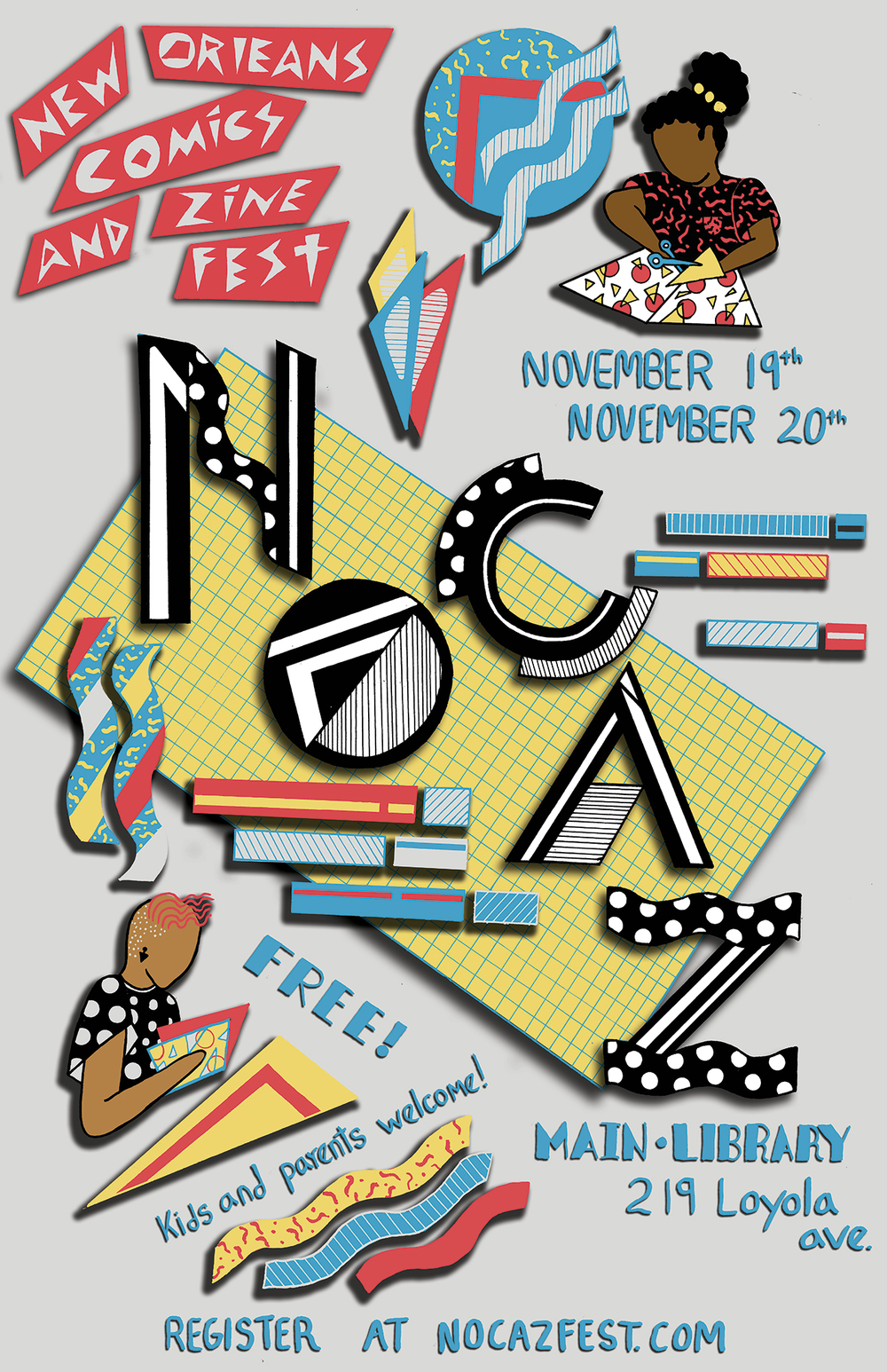
Attention, Swampflix readers in the New Orleans area! We will be exhibiting this Saturday (November 19th) & Sunday (November 20th) at the third annual New Orleans Comics & Zines Festival along with a bunch of other super cool comics & zines exhibitors. For this year’s festival we made print versions of Boomer & Brandon’s Agents of S.W.A.M.P.F.L.I.X. conversations, spanning the first two “phases” of the MCU in just two zines.

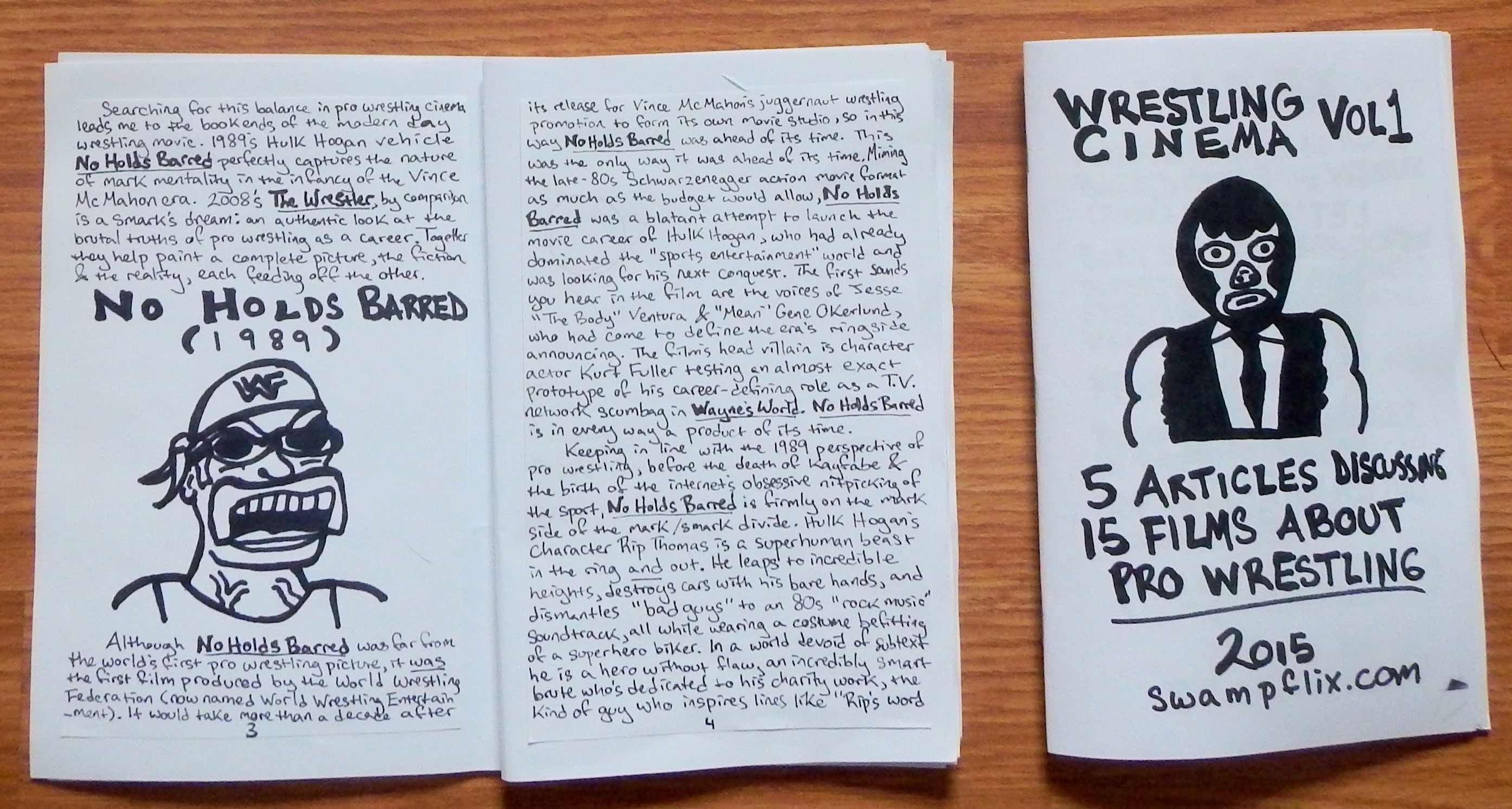
We will be also selling print versions of our “Marabunta Cinema“, “Lugosi Vs. Karloff“, and “Wrestling Cinema” pieces, as well as 2015’s Movie of the Month conversations in their entirety. They all feature dozens of new illustrations & hand-transcribed text from the site and the Movies of the Month zine is a ~90 page whopper featuring work from everyone who contributed to the site last year.

DSCN1455 (Modified (2))DSCN1456 (Modified (2))dscn1460-modified-2

We will be tabling from 11am-4pm on Saturday & 1pm-4pm Sunday at the Main Branch of the Orleans Public Library on Loyola Ave. For more info on the festival, check out their website at Nocazfest.com & refer to the poster below.

1469476243835

We hope to see y’all there!

-The Swampflix Crew


Mad Max: Fury Road (2015)’s Black & Chrome Makeover

When I first reviewed George Miller’s high octane action spectacle Mad Max: Fury Road last summer, I was a little late to the table and the film had already been relegated to cult classic status, earning high marks from fans & critics, but failing to beat out less memorable films like Tomorrowland & San Andreas at the box office. Before reviewing the film I watched it twice in the theater in two different formats, 2D & 3D, and contextualized it by plowing through Miller’s entire catalog for perspective (for the record, it was just slightly bested by Babe 2: Pig in the City & The Witches of Eastwick as a career high for me). Despite all of that effort I floundered to find anything new or interesting to say about the film that wasn’t a mere echo of the praise it was already lauded with. Over a year later, I’ve now seen Fury Road reach its third theatrical format, the colorless Black & Chrome edition, and I still have nothing significant to add outside an echo of how wonderfully bizarre & overwhelmingly kinetic this film is. It’s still one of the best action films in recent memory. Immorten Joe is still a total fucking nightmare. Not much has changed in this most recent theatrical release but the color, so don’t beat yourself up if you couldn’t catch it in theaters (especially since there’s a Black & Chrome release on BluRay & VOD currently available for the still curious).

All that being said, I absolutely loved returning to the theater to witness this bizarre work unfold for a third time. Catching Fury Road in three distinct formats has been illuminating in that it allowed me to appreciate different aspects of the film in each run, while I still don’t believe I’ve seen it enough times to fully take it all in. While the campy, drive-in spectacle of watching it in 3D was my personal favorite way of experiencing the film, there was a definite novelty to the Black & Chrome version that highlighted aspects of what Miller accomplished I don’t remember noticing before. The story goes that while screening a work print of Fury Road without a score & without color, Miller found his preferred version of the film. The studio obviously rejected the idea of releasing the film in that state for fear of scaring off general audiences, but a year later a home video & brief theatrical release has made its way into the world after this production anecdote piqued fans’ interest (although with the score intact). As the title suggests, the black & chrome Fury Road is a little shinier and higher contrast than a traditional colorless film is presented, particularly in details like when Immorten Joe’s “war boys” spray that mysterious chrome substance across their teeth as a pick-me-up. This aspect of the print is emphasized in-film by lines like “Look at that! So shiny! So chrome!” and “You will ride eternal, shiny & chrome.” Although the color change doesn’t entirely alter the film’s DNA (how could it?), it is a shift that’s often justified & accentuated by the script.

I caught the black & chrome Fury Road at the only theater in Louisiana (and one of only a few dozen in the nation) that was screening a print. A little dazed by catching Moonlight earlier that afternoon & enjoying a few cocktails downtown in the meantime, I was confronted with two major annoyances at the cinema: a very talkative older couple who were brazen in their interruptions since there were only three of us “witnessing” Miller’s glory & a loud, hideous whine emanating from the projector. In an attempt to escape both distractions, I moved to the very front row of the tiny theater, completely immersed in the black & chrome madness blasting before me. Although I was mostly annoyed by the talking, I was a little amused when, after the glorious dust storm finish to the first chase scene, a man exclaimed, “Son of a bitch. I’m worn out! That was fucking genius.” As long as I’m echoing already-expressed sentiments here, I guess I have to whole-heartedly agree with that drunk man-child. Fury Road wore me out every single time I’ve seen it long before the end credits rolled. And, despite my exhaustion, it was indeed “fucking genius”. There’s an undeniable, infectious “how did this get made?” quality to Fury Road (as if it’s something Miller got away with, not just something he filmed), that strikes me every time no matter what row I’m sitting in, how disruptive the audience is, or in what state it’s being projected. There was something especially cool about watching it a few feet away from the screen, though. I’ll readily admit that, even if it wasn’t my first choice.

Overall, I am saying that the Black & Chrome edition of Fury Road isn’t an entirely unique experience, but that doesn’t mean nothing changed for me in that format. In a lot of ways, the black & white digital grain makes the film feel more 90s, recalling Aronofsky’s π or, once the supermodels appear, the world’s craziest perfume ad. A lack of color also called attention to the film’s dust & grit, as if it were a feature length adaptation of a White Zombie music video (the Russ Meyer-inspired “Thunderkiss ’65,” specifically). The horror of the zombie-like war boys popped off the screen more in the opening capture & detainment sequence. A little of the CGI is clouded without the color, making it play like a forgotten relic, maybe along the lines of Hardware or, hell, even Metropolis. All of these elements were already lurking in Fury Road to begin with, though. All switching formats does is make them more obvious. Some would even argue that the original version of the movie is near-monochromatic to begin with, so the difference is negligible at best. Personally, I would miss the bright reds & purples of details like the dust storm or the guitar goblin if this were the only version of the movie available, but thankfully it’s not. There’s now three versions of Fury Road out there waiting to impress & confound you as to how something so goddamn insane was ever made in the first place. I’m lucky to have seen it even once, let alone from so many angles & shifted perspectives. If nothing else, the black & chrome flavored Fury Road is at least worth seeking out to add that extra layer of appreciation to something we all already knew was wonderful. When you seek it out, though, just try to avoid the whining projectors & talkative drunks out there aiming to distract from it. There are many roadblocks to avoid on the path to Valhalla.

-Brandon Ledet

Paperhouse (1988) as a Warning Shot for the Atmospheric Horror of Candyman (1992)

When we were first discussing November’s Movie of the Month, the lucid dreaming fantasy drama Paperhouse, we were very adamant that the film didn’t entirely fall under the horror genre, despite the way it carried itself with a horror atmosphere. The film’s alternating dream world vs reality dichotomy lent itself to some horror genre hallmarks: an eerie score, a mutilated villain, an overwhelming sense of dread. Yet, the story was about a young girl exuding godlike control in a self-created dream space as a means of bucking against the health & home life helplessness she suffered in the “real world,” sometimes with the two realms meeting in unexpected ways. That’s not exactly the blueprint for the ghost stories, slashers, and monster movies we usually pin under the horror umbrella. Four years after Paperhouse, however, director Bernard Rose repurposed a lot of the dread-stirring techniques of the children’s film for something entirely different: Candyman. The supernatural slasher Candyman is certainly Rose’s most infamous film to date, but a lot of what makes it work as a bone-chilling, reality-disrupting horror can easily be traced back to the familial drama nightmare of Paperhouse.

Just like how Paperhouse distinguises between the natural world and the dream world of its protagonist’s crayon drawing, Candyman exists in two distinct spaces: in front of & behind the mirror. The killer from this Clive Barker-penned story is summoned in a mix of Beetlejuice lore & “Bloody Mary” urban legend shenanigans. After someone/anyone says “Candyman” five times in the mirror, the spirit of a brutally murdered slave with a hook for a hand and a body full of bees materializes to murder them. What’s brilliant about the way Candyman’s mirror realm is presented onscreen is that it partly exists as a physical space characters/victims can climb into through the back of medicine cabinets. This space exists both as a physical part of the building and as a dream world where the Candyman can hold hostages, sometimes infants, as bait to lure his more prized victims into full cooperation with his evil plans. The fantasy realm in Paperhouse works likewise. It’s physically represented in a crayon drawing the protagonist can manipulate while awake and as a dream realm she can only enter while asleep. The way one realm can affect the other in Paperhouse is also reflected in the way the Candyman frames his victims for murder while they’re under his spell, enacting a physical change in the “real” world while the protagonist is helplessly trapped in a supernatural one.

Besides their established dichotomies between “real” and fantasy spaces & the occasional crossovers that disrupt them, Paperhouse and Candyman also share a general sense of fairy tale storytelling. Paperhouse most notably feels like a classic fairy tale, following a young girl who can enter & change the world through her own drawings. Candyman, however, is specifically about the power of urban legends & myth making. It’s not too difficult to draw a line between traditional fairy tale folklore and the modern urban legend, particularly in the case of the Candyman’s legend, which includes supernatural detail in its mirror realms & its Biblically massive swarms of bees. The Candyman himself is desperately concerned with the strength and prominence of his own legend, focusing as much effort as possible on making sure people still believe in his fairy tale folklore as if his (after)life depends on it. As the series continues in its campier, less effective sequels, the Candyman even begins to somewhat reflect the intention of the eyes-scratched-out dream Dad of Paperhouse, specifically tormenting the living members of his family as part of his revenge strategy. By the third film in the series, his supernatural power is also revealed to be tied to a work of art, a self-portrait, which is even more of an encroachment on Paperhouse territory. Bernard Rose had no discernible influence on those diminishing returns ventures, but the fairy tale aesthetic & power he established in both Paperhouse & Candyman mirror each other close enough even without that connection.

There’s a lot to dissect in Paperhouse & Candyman‘s shared fairy tale narratives about dueling reality & fantasy realms, but it’s the way director Bernard Rose establishes a distressing mood in both films that truly ties them together. The menacing score from Hans Zimmer that makes so much of Paperhouse feel like a nightmare is recognizably echoed in Phillip Glass’s masterfully eerie work in Candyman. Both films turn cheap, cold sets into assets, distorting reality by making everything feel tactile, but off. The disorientation in how the two works distinguish between fantasy & reality similarly put the audience on edge. Paperhouse sets the table for a lot of the horror genre thrills Rose later pulled off in Candyman. Even though that latter work’s sequels pushed it into more traditional slasher territory, the film itself doesn’t ever feel like a strict horror narrative. Clive Barker’s writing style surely had an influence there, as his works like Hellraiser & Nightbreed never exactly fit into the traditional Jason Voorhees-type slasher box (despite Pinhead often being referenced in that context). Anyone who’s looking for standardized Candyman thrills where atmosphere is made secondary to violence & gore would likely find the most solace in that film’s less-than-stellar sequels. On the other hand, if the atmosphere & surrealism is what made Candyman feel special to you in the first place, Paperhouse demonstrates just how effective Rose can make that tone feel even with most of the horror removed. Paperhouse is remarkable in many ways that has nothing to do with Rose’s latter work in Candyman, but the film is still noteworthy as proof that his best known effort would still be horrifying even if it were completely removed from the horror genre.

For more on November’s Movie of the Month, the lucid dreaming fantasy drama Paperhouse, check out our Swampchat discussion of the film.

-Brandon Ledet

Movie of the Month: Paperhouse (1988)

EPSON MFP image

Every month one of us makes the rest of the crew watch a movie they’ve never seen before & we discuss it afterwards. This month Boomer made Brandon, Alli, and Britnee watch Paperhouse (1988).

Boomer: Paperhouse is an odd little film. Helmed by Brit director Bernard Rose, the film follows the frenzied dreams of an artistic young girl, Anna (Charlotte Burke), as she finds herself flipping back and forth between the real world (where she is suffering from a glandular fever) and the fantasy world that is home to the titular paper house of her design. The lines between reality and unreality start to blur as she strikes up a friendship with Marc (Elliott Spiers), a disabled boy living in the otherworldly house and with no memory of life outside of it; when she learns from her physician (Gemma Jones) that Marc is real, things start to get more surreal and bizarre.

This wasn’t Rose’s directorial debut; he had previously worked in various roles on the last season of The Muppet Show and on The Dark Crystal before a short stint making music videos, most notably for Frankie Goes to Hollywood’s “Relax.” After two smaller films that are largely forgotten, Rose directed Paperhouse, which was a perennial favorite on IFC in the early 2000s, before moving on to direct cult classic (and his only other truly great film) Candyman, released in 1992. Candyman is undeniably a horror film, and Paperhouse was largely lumped in with the horror genre upon home video release as well, despite not strictly deserving that distinction. It’s much more of a mood piece, with a relatively simple story elevated by striking visuals and a moodily beautiful score by Stanley Myers and Hans Zimmer (Rose certainly knows how to choose composers; Candyman’s Philip Glass soundtrack is so haunting that Glass apparently still makes royalties from it each year, no doubt helped by the fact that “Helen’s Theme” continues to appear in other genre works, most recently American Horror Story).

I love this film, and have seen it at least a half dozen times, but there is always enough time between each viewing that I forget that the film has a longer ending than I expect. For me, the film reaches its narrative conclusion when [spoiler alert] Anna learns that Marc has died. Although I’m not opposed to the resolution of Anna and her family (including her father, whose notable absence informs much of the psychological underpinnings of the film) returning to the seaside and revisiting a happier time, there is something about the ending that seems as little too pat, especially in light of the mildly silly scene in which Marc reappears to Anna. What do you think, Brandon? Did the ending seem out of place to you, or am I being too critical? Would you suggest a different conclusion?

Brandon: If I had to fault Paperhouse for anything it’d be the muddled nature of its central metaphor. The film operates in a spooky 80s kids’ movie headspace that I’m always a huge sucker for and the dream logic of both its set design & its eerie score is wonderfully chilling. There’s just something a little off in its dreamworld narrative that makes it difficult for me to track its overriding metaphor (not that I mind the ambiguity). Two sick children meet in the shared dreamworld set of a hand-drawn house and their recovery in the real world is dependent upon their progress in that fantasy space. Marc, who is unaware of this dichotomy despite Anna’s frequent explanations, suffers a fairly straightforward narrative where he slowly dies due to complications that arise through his muscular dystrophy. As Boomer points out, his death in the real world seems like a logical place for the story to end, but I do believe that the seaside resort epilogue was a necessary addition to the story, because Anna’s own struggle was at that point still largely unresolved.

Anna’s near-death experience with a glandular fever is what puts her in contact with the paperhouse fantasy where she meets Marc, but her true conflict is a mental health struggle related to her anxieties over an absent, alcoholic father. When Marc dies he rides a helicopter to heaven that relieves the real world pains of his body. In the seaside epilogue Anna tempted to leave behind her own pain by joining Marc in the helicopter, a moment that’s coded as a suicide attempt at the edge of a cliff. This last minute crisis might not make much sense in a typical three act story structure, but I do think Anna flirting with the relief of death is a powerful idea that Paperhouse would be lacking without, especially in its indication that her mental health struggle wasn’t instantly wiped away upon her father’s return.

Where I stumble a little in my reading of this conflict is in understanding the exact relationship between Anna & her father. Paperhouse explains the father figure to be a drunk & an abandoner in the real world, which is meant to explain Anna’s anxiety, lashing-out rebelliousness, and eventual disinterest in continuing to live. In the dreamworld, however, her father is far more abusive than that. Blinded by rage (both Anna’s & his own), Dream Dad strikes a terrifying nightmare of an image, destroying the physical objects Anna created & cherished with a hammer and physically beating her in the chest nearly to the point of death. No mention is ever made in the real world of Anna being physically abused by her father, but the brutality & specificity of the hammer & the chest-beating in the dreamworld at least makes it plausible that Anna was afraid that such abuse was a possibility. Coming back to Boomer’s original question, if there’s anything lacking in the ending for me it’s how easy Anna & her father’s seaside reconciliation feels after the brutality of their altercation in the dreamworld. Anna gets in the cathartic zinger, “You don’t have to be invisible to disappear, Dad,” but she does eventually forgive him after the helicopter/suicide crisis and the family is again made whole, which might be a little too neat & tidy of a conclusion given Anna’s near-fatal parental anxieties.

Britnee, how literal did you take the physical abuse in the dreamworld to be? Do you think it was intended as a reflection of something that happened in the real world or simply an amplification of Anna’s anxieties over her father’s alcoholism?

Britnee: One of the many mysteries in Paperhouse is the relationship between Anna and her father. Part of me feels as though the abuse in the dreamworld was more of a reflection of something Anna witnessed rather than something she experienced herself. If her father did indeed abuse her, I feel as though she would have been much more fearful of him in her dreams, but she wasn’t very scared of him considering how creepy the whole situation was. I really think she witnessed her father abusing her mother. Anna’s dreams allowed her to see the potential of her father’s alcoholism, and it really seemed like a big eye opener for her in the real world. There was something about the mannerisms of her mother that makes me believe she had a traumatizing experience with her husband. She seemed a bit shaky when she would light up her cigarettes, and she seemed to be in an entirely different world herself (perhaps Anna’s real world was her paperhouse?). I do agree with Brandon’s frustration with the very simple reunion at the end of the film. It actually made me a little nervous for Anna’s well-being; however, I’ve also been watching a lot of Dr. Phil lately, so that may have something to do with my uneasy thoughts about Anna and Drunk Dad.

What I found most interesting about Paperhouse was the confusing soundtrack. Brilliant, but so confusing. During the film’s opening credits, I was waiting for a dead body to fall out into the school hallway. I kept waiting for a gruesome, terrifying scene, but by the latter half of the film, I just gave up. There were a handful of scenes that were spooky, especially when Drunk Dad captures Anna in her dreamworld, but nothing was half as scary as the tunes in the background. Needless to say, I was surprised to find that the film fell way more on the drama side than on the horror.

Alli, did you feel as though the film’s score was out of place? Did the music add to the creepiness of Anna’s dreamworld? Did you get more horror vibes or fantasy vibes from that world?

Alli: Initially the score felt very spooky and out of place to me and definitely made me feel like more bad things were going to happen; but once in the dreamworld, it felt really appropriate. The low ominous synth sounds seem to enhance the vast emptiness you see around the house. What especially made the score work in the dreamworld was that at some points it became diegetic with the talking radio. While the idea of a talking mumbling radio seems reminiscent of Pee-wee’s Playhouse, here it was very creepy, as the nightmare dad seemed to be talking through it a little bit.

The dreamworld to me was very much a fantasy and an escape from the fact that she’s lonely at school and at home. While it starts off as something she can control very quickly it functions on it’s own bizarre logic, where some of the things she draws turn up very realistically and other things just are crooked and funny. It’s not until the faceless dad that it gets into nightmare zone, and even then he feels more like an intruder than an aspect of the dreamworld. In Anna’s life he is sort of an intruder, showing up whenever he feels like it both emotionally and physically.

But as much as the dad seems like a dark figure in Anna’s life, her mom is really not better at all. It’s no wonder she acts out with a mother who is as unsupportive as we see on screen. She criticizes Anna’s drawings very rudely and isn’t really nurturing at all until Anna is extremely ill, in a sort of trying to make it up to her way. Both parents seem to just make up for the lack of love with material things like riding lessons and manufactured happy trips to the seashore, which I think makes the ending more depressing and bitter.

Boomer, what did you think of the mom’s role? Is she just as bad as the dad or is she just a single mother at the end of her leash?

BoomerI feel like we’re being more critical of both parents here than is called for, at least based on my reading of the film. Multiple times, we see how the dreamworld of the paperhouse is influenced by things that Anna sees or vaguely recalls, or by her physical circumstances in the real world. The reason that Anna feels like she is being beaten in the dreamworld is because, in the waking world, the paramedics are giving her compressions to keep her alive. The reason that her father appears as a backlit creepy shadow is because she encouraged her mother to let the photo of him at the beach develop for too long, until he becomes a dark figure in the image, and thus in her mind. The father doesn’t seem abusive to me, either to his wife or to Anna, so much as he is an unknowable being, his absence making him a figure that is half-remembered and half-imagined, larger than life but imposing.

The mother, for her part, reads more as a woman who’s been run ragged by holding down a household with a misbehaving young girl, suddenly stricken with illness. She has artistic pursuits of her own, as evidenced by her home dark room, and likely has had to sublimate her interest into being both breadwinner and full time caretaker to Anna due to her husband’s chronic and prolonged absence.

One of the things I like most about the film is the fact that no character is a paragon. As a heroine, Anna is a surprisingly postmodern. She’s a girl, but not feminized. She’s not stereotyped as drawing a dream house that’s reminiscent of the kind of future home girls are encouraged to imagine, but a strikingly dull building instead. She tries on make-up, but not to impress a boy; she just wants to try it for herself. Usually, female protagonists can only avoid being sexualized if they are infantilized (and, unfortunately, not even then), and although Anna is young, she’s not treated as an idealized perfect child. She lies, she throws tantrums, she skips school, and, most importantly, she’s not demonized for this either. These are just aspects of her character, not flaws that need to be corrected with external discipline, but that make up the gestalt that is Anna. Her mother, though her screentime is shorter than Anna’s, makes her seem fully-fleshed in her own way as well. She even seems genuinely loving, going so far as to dig through the whole building’s trash to placate what she must assume is some feverish madness.

Am I giving the film too much credit, Brandon? Am I making excuses for the movie because I like it, or have I convinced you that there’s more going on at the character level than there first appears?

Brandon: Please forgive me for the banality of this answer, but I think a lot of that ambiguity falls under the umbrella of personal interpretation. Paperhouse is in the most basic sense a story about lucid dreaming. Dream logic always comes with a certain level of impenetrable surrealism to it and there’s been an entire industry full of psychologist “experts” built around the therapeutic benefits of dream interpretation. Then there’s the film’s art therapy element, in which Anna creates a personal space for herself where she can exude total control as an omnipotent (and highly fallible) god. Both the weird dream logic & the art therapy surrealism of the film’s basic plot leave Paperhouse with a lot of room for personal interpretation in its symbolism, especially once Anna’s drawings start affecting real world change in Marc’s medical condition. Personally, I see a drunk dad who scares Anna (who points out his alcoholism in the darkroom scene) and a mother who may be frazzled, but is not at all abusive (as evidenced in the manic trash-digging scene). I also read a third act suicide attempt at the edge of the cliff, but I’ll willingly admit that I’m reaching for a solid explanation for an intentionally lyrical moment there, which may be the wrong way to go about things in this movie.

So much of this movie is literally in Anna’s head that it’s near impossible to tell what’s “really” happening from minute to minute. How much of our darker interpretations of the parents’ behavior is being influenced by the horror film dread of Myers & Zimmer’s score? How much of the dreamworld content is merely, as Boomer suggests, reflections of images Anna encounters throughout the day, as many dreams tend to be? There’s no “true” answers to these questions, as the film intentionally deals in ambiguity. There’s evidence that Anna’s dreamworld surrogate was truly communicating with Marc’s, a boy she never met in a physical space, but everything else is left open-ended. The film kind of works like a coloring book: it provides a basic outline of how its world works and invites its audience to color in the details. Maybe we’ve been coloring a little outside the lines in our personal interpretations here, but I think the movie invites that kind misbehavior. I also don’t believe that misbehavior is a detriment to either of the central characters, though, as I never felt like I lost track of Marc or Anna as complex, multifaceted human beings. It’s their own personal interpretations of the adults in their lives that throw off our perception as an audience & complicate some of the film’s intent & metaphor.

Britnee, I’m getting some flashbacks to our Movie of the Month conversation about Black Moon here, particularly in our attempts to parse out what the film specifically “means.” Instead of picking apart an intentionally inscrutable art film, though, we’re discussing a movie that was ostensibly made with a very young audience in mind. Do you think the darkness & ambiguity helps the film in this case, considering the flexible imaginations of the children intended to see it? As adults, are we reading more solid, static interpretations of the film’s metaphor than we might have as kids, when Paperhouse could possibly have survived purely on mood instead of concrete symbolism?

Britnee:  While I was in college, I took a history class that focused on the 1960s, and most of that course involved watching films, such as Go Tell the Spartans and Easy Rider, and writing about them. Before viewing each film, my professor would say, “Remember, every detail, whether major or minor, in a film means something. There is symbolism everywhere.” That really stuck with me, and since then I always feel somewhat guilty if I don’t search for meaning behind every little detail in a movie. I’m glad that Brandon brought up the point that this is a film intended for a younger audience. I need to remind myself every now and then that sometimes (maybe even most of the time), films are created solely for the purpose of pleasure and entertainment.

Ignoring the interpretations we made of Anna’s dreamworld as well as her relationship with her parents (Drunk Dad in particular) and viewing the film through the eyes of a child, Paperhouse seems a bit more whimsical. A film about drawings that come to life in dreams and a magical friendship that only exists in the dreamworld seems a lot better than a film about a girl with neglectful and abusive parents. Paperhouse becomes another film entirely. Even the darker elements of the film take on a new meaning. Anna’s scary dream father becomes a product of a mistake in her magical drawing instead of an abusive parent turned villain. As for the darkness and ambiguity of the film, I think it actually contributes to the film’s fantasy elements and makes it much more exciting for the intended adolescent audience. If I was eight years old watching Paperhouse for the first time, my imagination would be running wild during those scenes in Anna’s dreamworld.

Alli, I was really irritated by the mystery between Anna and Marc’s friendship. If only we were able to know if Marc was having his own recurring dream with Anna. What if they were possibly sharing the same dream? The fact that we will never know just kills me. What are your thoughts on the telepathic connection between Anna and Marc? Would you have enjoyed seeing Marc’s side of things?

Alli: I think the interesting thing about Anna and Marc’s friendship is that he has no knowledge of the world outside the dream, which leads me to believe that he was kind of subconsciously called there. Not to try to make too much technical sense of dream logic, it seems like they are sharing a dream, but since he’s less in control of it he is much more wrapped up in the dream state. Like Brandon said Paperhouse seems to be about lucid dreaming. It would be a lot harder for Marc’s dream-self to be aware what’s going on. For him, this is probably just a really crappy dream where instead of being a fantastic escape he’s still sick and unable to walk and there’s this girl urging him to be happy. As we’ve already said, we’re very sympathetic with Anna though and it’s hard to fault a girl for accidentally summoning a sick boy into her dream. I think not knowing Marc’s side of things gives us an opportunity to watch Anna grow more from her perspective. Not seeing Marc’s side, we’re figuring him out as she is. By doing that this film really captures the vulnerability of making friends as kids with kid emotions. They’re so tumultuous and dramatic, because kids are still figuring out themselves and their own boundaries.

I’m going to dare to interpret the dream logic more and say that a lot of these volatile, underdeveloped emotions are mirrored in the dreams. Her dream house is bare. The dreams themselves go from just having a conversation to terrifying faceless dream dad pretty quickly.  As traumatic as they were, the dream conflicts help Anna find more of herself. These dreams are so hard and scary because figuring out yourself is hard and scary. She learns more how to honestly interact with people and to take responsibility for her actions. She learns empathy, which is really hard for kids to learn, by talking to Marc. As she learns more about herself and matures, the dreams become more fleshed out and less bleak. 

EPSON MFP image

Lagniappe

Brandon: Paperhouse reminds me of a very specific time in 80s children media where stories were allowed to be dark & ambiguous in a way that a lot of the more sanitized kids’ movies of late wouldn’t dare. Titles like The NeverEnding Story, Lady in White, and Return to Oz all specifically came to mind while watching the film, but I have to admit I think it’s closest comparison point was released in 2005. The Dave McKean & Neil Gaiman collaboration MirrorMask is a children’s fantasy film in which a young girl feels immense guilt over fighting with her mother before they’re separated by a sudden illness. She wrestles with this anxiety during an extended dream in which she enters & explores a world she drew by hand in her own bedroom. Sound familiar? MirrorMask is a little more obvious & blunt in its central metaphor & a lot more expansive in its dream space, but otherwise the pair make interesting companion pieces.I think if you really enjoyed one, it’d be more than worthwhile to seek out the other.

Alli: I also thought of MirrorMask, and its terrifying dreamworld, but another Neil Gaiman creation came to mind as well, Coraline, which is another story about a girl upset at her parents entering a dreamworld with duplicate parents. The terrifying Other Mother is reminiscent of faceless dad. But there’s another similarity for me. One disappointing thing the Coraline movie did that deviated from the book was to add in the male character, Wybie, that besides being a sidekick also seems to have an unnecessary crush on Coraline. And that kind of touches on my one gripe with Paperhouse. I kind of wished that Anna and Marc hadn’t become crushes and just remained friends. You so rarely see male-female friendships in movies.

Britnee: I feel really bad for being so rough on Anna’s father. He was probably just a really nice, hardworking man that has to sacrifice spending time with his family to make a decent living. Instead of seeing that initially, I jumped to conclusions and labeled him as an alcoholic and abusive father. Shame on me.

Boomer: I don’t think there’s anything wrong with reading the father as an alcoholic, as there is certainly reference to his drinking in the text. That having been said, the mind of our main character (and perhaps all children) has a tendency to exaggerate the real world, as evidenced in the way that things become larger than life in the dreaming, and that’s how I interpret that particular nuance. Still, although that’s my reading of the text, the other readings are certainly valid as well.

Upcoming Movies of the Month
December: Alli presents Last Night (1999)

January: The Top Films of 2016

-The Swampflix Crew

The Funhouse (1981) as an Ideal, Forgotten Midpoint Between Tobe Hooper’s Texas Chainsaw Massacres (1974, 1986)

EPSON MFP image

We’ve been scratching our heads all month trying to figure out why Tobe Hooper’s grimy carnival slasher The Funhouse isn’t more of a household name. One of my theories was that Hooper had already changed the game years earlier with his weirdo slasher opus The Texas Chainsaw Massacre, inspiring so many similar oddball horror entries in its wake (Tourist Trap, for instance) that The Funhouse had a little too much company to stand out on its own as anything radical or idiosyncratic. By the time of its release the Tobe Hooper grime of The Funhouse was just a drop in really strange, hideously dirty bucket. Maybe that’s why Hooper’s next return to the slasher genre in The Texas Chainsaw Massacre 2 strived for a much campier, more colorful aesthetic than the original. It was a decision that (intentionally) pissed off a lot of fans at the time of its release, but led to a much more infamous work that’s still regularly discussed today, despite The Funhouse being the better movie overall.

The Funhouse was released more or less at the temporal midpoint between Tobe Hooper’s Texas Chainsaw Massacre films, which were separated by twelve years and a few wildly varied experiments from the director. 1974’s The Texas Chainsaw Massacre details a backwoods Texas family of chainsaw-wielding cannibals with a weird collection of skeleton art & Ed Gein-inspired modes of improving their self image. 1986’s The Texas Chainsaw Massacre 2 follows a very similar narrative structure, sometimes recreating exact scenes from the original, but punches them up with hideously shrill humor, jaw-dropping gore effects, and color-soaked camp spectacle. The Funhouse splits the difference, offering a more colorfully surreal setting for its cold-blooded violence than The Texas Chainsaw Massacre without aiming for the full-goof absurdism of The Texas Chainsaw Massacre 2.

Hooper’s career is wildly chaotic, haunted by ghosts, Martian invaders, sexy space vampires, and all kinds of other horror genre eccentricities that are worlds away from standard slasher fare. The Funhouse serves as a great, typifying middle ground for his difficult to pinpoint work that somehow captured the spirit of both of his violently disparate Texas Chainsaw Massacre films, while still pointing to the otherworldly quality of his non-slasher work. It doesn’t ever bring in the supernatural funhouse goofery of Ghoulies II, but The Texas Chainsaw Massacre 2 also remains grounded in the real world and that film stands as a strange slasher genre outlier in its own right.

It makes total sense that the original Texas Chainsaw Massacre film would have the biggest cultural impact in this trio. Not only was it the earliest & most financially successful title of the bunch, its humans-as-meat slaughterhouse horror is also more darkly humorous than it’s often given credit for. I do believe The Funhouse deserves a closer look than that film’s sequel, though. The gory kills and the cartoon energy of The Texas Chainsaw Massacre 2 have earned it an easy cult following in recent years (not to mention that it seemingly laid out the blueprint for Rob Zombie’s entire directorial career), but I think The Funhouse is more deserving of the attention. Instead of punching up and altering his original outlier slasher like in the sequel, Hooper found new, colorfully surreal ways to repurpose The Texas Chainsaw Massacre‘s energy in The Funhouse that should be regularly celebrated, but is instead largely forgotten. A month after watching it for the first time, I still can’t pinpoint exactly why.

For more on October’s Movie of the Month, Tobe Hooper’s grimy carnival slasher The Funhouse, check out our Swampchat discussion of the film, this comparison of its carnival-setting horrors with those of Ghoulies II (1988), and last week’s look at its unexpected companion in Tourist Trap (1978).

-Brandon Ledet