Movie of the Month: Blow Out (1981)

EPSON MFP image

Every month one of us makes the other two watch a movie they’ve never seen before & we discuss it afterwards. This month James made Britnee & Brandon watch Blow Out (1981).

James: Brian De Palma’s political thriller Blow Out is our May Movie of the Month and I’m pretty stoked to revisit this hidden gem from one of my all-time favorite directors. Based on the 1966 film Blow Up about a fashion photographer who accidentally films a murder, Blow Out tweaks that premise, focusing on Jack Terry, a sound engineer for B horror movies, who gets entangled in a conspiracy after capturing the audio of a fatal car crash that kills a presidential candidate.

Putting his stylistic chops on full display, De Palma doesn’t pull any punches. Split screens, long tracking shots, dizzying angles; Hitchcock would be proud. It’s mind boggling that even with a star studded cast (including John Travolta, Nancy Allen, John Lithgow, and Dennis Franz) and gushing reviews from critics, Blow Out was a box office flop when it premiered in 1981. That’s a shame because everyone gives great performances, especially Lithgow as a cold blooded psychopath (what else) and Travolta as the sound engineer always looking for “the perfect scream”. Thankfully, Blow Out has gained popularity through the years and earned a reputation as a quintessential De Palma. I think it’s his best film.

What really blew me away re-watching Blow Out was how strongly the film holds up as a homage to the medium of film itself. It is a movie about making movies. As Jack puts together the audio and video of the fatal wreck, we are viewing the process of film making itself, the melding of sight and sound.

Brandon, do you feel like I do about Blow Out being a “movie about making movies”? Do you think this is why De Palma chose to focus on a movie sound engineer instead of a fashion photographer?

Brandon: I did find that approach interesting here, because normally films will interact with their own medium by showing members of a theater audience. This is even true in horror films, such as the monsters-break-the-fourth-wall classics Demons & The Ring or the throwaway gag in Gremlins where an entire theatrical audience is made of unruly, cackling monsters. There’s a little bit of audience-acknowledgement in the opening minutes of Blow Out, which features a few men in a screening room enjoying a hilariously tawdry, violent slasher movie. It adds whole other layer of specificity that the men are actually working on the film they’re watching, specifically on its sound effects. As James just noted, it’s not interacting with film as a medium from a consumer’s point of view, but rather from an active participant’s. Of course, the movie maker’s perspective isn’t entirely unique either, but the sound engineer angle has a very precise specificity to it, since most films about filmmakers would approach the story from the perspective of a writer or a director. It gets even more specific from there, given that these are men that only make cheap slasher flicks. At one point a character asks Jack if he works on “big” movies and he responds, “No. Just bad ones.”

That specificity turns out to be a very important distinction, especially the sound engineer detail. As James points out, Travolta’s protagonist, Jack, spends most of Blow Out’s run time attempting to construct a film version of a car crash he witnessed. Although film is a mostly visual medium, it’s Jack’s work with sound that dominates this process. He obsesses over the audio recording of the crash that he captured, using it as a cornerstone in his reconstruction of the crime scene. Yes, Blow Out is in some ways a movie about making movies, but more specifically it’s a movie about how essential sound is to film. It boils the medium down to one of its more intangible elements. In that way it’s much more unique than a lot of other movies about movies, arriving more than three decades before the film it most closely resembles in this approach (that I can recall, anyway), Peter Strickland’s Berberian Sound Studio.

Britnee, how do you think De Palma’s focus on sound in Blow Out shaped the film as a final product? Did its sound obsession have a big effect on you as a viewer, as opposed to how you normally watch movies?

Britnee: De Palma’s focus on sound really makes Blow Out a standout film and turns what could’ve been a run-of-the-mill thriller into a milestone in cinema. Of course, there are many other elements that make this film unique, but I think its obsession with sound is really what differentiated it from others. I have watched quite a few movies in my lifetime, but I’ve never come across or heard of a film that offers a behind-the-scenes look at the importance of sound in movies. Prior to viewing Blow Out, I never gave much thought to any of the sounds that occur during a movie, and now that I’ve seen the film, it’s all that I think about. In the final scene of Blow Out, Jack uses the screams from Sally’s murder for the bad movie he’s working on (his “perfect scream”), and I found this to be very unsettling. When I now hear a scream in a movie, I can’t help but think of the possibility of it being from an actual murder. What if there are psychotic sound technicians that go around killing people for authentic screams? It’s just something to think about.

The film’s camerawork is definitely something that stood out to me as well. Many of the angles were creative and voyeuristic with similarities to those in Blood and Black Lace, but there were a few that were way over the top, almost to the point of being ridiculous. The one that stands out the most to me is the merry-go-round shot that occurs in the scene where Jack is searching through his studio like a mad man looking for the missing tape. The camera must have spun around 100 times without stopping. It was like being on a Tilt-A-Whirl but not in a good way. Other than his theme park inspired camerashots, there were many others that were very innovative and enjoyable.

James, what are your feelings about De Palma’s imaginative cinematography? Were some of the shots a little absurd? Were they necessary for the film’s success?

James: A self-professed De Palma devotee, I love his unique approach to cinematography but I can understand how some viewers might scratch their heads at his more show-offy, “I went to film school” shots in Blow Out. Like the long tracking shot at the beginning of his1998 film Snake Eyes, many of these grandiose shots aren’t necessary, definitely a little absurd, but totally awesome. In fact, I probably wouldn’t have ejoyed Blow Out nearly as much if it didn’t included close up of owls and dizzying trips around Jack’s office. It reminds me of previous Movie of the Month directors like Mario Bava and Ken Russell who seem to take a similar delight in playing with their audience’s perspective

On a different note, I have to bring up the ending to Blow Out. As I addressed in my first question, Blow Out did not perform well in the bow office, and I wonder if the film’s bleak ending was the reason. With Jon Lithgow in full on psychopath mode and the Fourth of July festivities in full swing, we assume that that Jack will reach the girl in time but De Palma pulls the rug out from under us and the backrop of patriotism and freedom takes on a more ominous tone. Is this punishment for Jack’s participation in exploitation films? Is it a statement on American politics?

Brandon, what are your thoughts on Blow Out‘s ending? Why do you think De Palma chose to end the film in such an unconventional, bleak manner?

Brandon: I think the movie’s pessimistic conclusion is best understood in the context of De Palma’s status as one of the voices of New Hollywood. New Hollywood was already at least a decade old by Blow Out’s release, often cited as beginning with the release of Arthur Penn’s Bonnie & Clyde in 1967, but De Palma’s aesthetic & tone was very much rooted in the movement. In addition to other genre-defining traits, notable New Hollywood films like Easy Rider, Chinatown, The French Connection, and Harold & Maude had a tendency to subvert audience’s expectations by concluding on bleak & unresolved notes. I suppose the idea was that this approach was more realistic & honest because conflicts in “real” life don’t always end on the definitive & upbeat terms that often accompanied more escapist Old Hollywood fare.

I think De Palma goes even a step further than some of his peers in this case by falsely promising a grandiose, happy conclusion. When Travolta’s protagonist Jack first rushes to save the day, he disruptively drives directly into a Liberty Day parade in a grand gesture that normally would end with him victorious & Lithgow’s antagonist in jail. Instead, he crashes & burns. Literally. The “happy ending” subversion in Blow Out is so deliberate & well-teased that it plays like a hilarious prank before it takes an even darker turn. Despite the violence & grim political intrigue of the film’s story, De Palma still found a way to let his darkly playful sense of humor shine through.

Britnee, were there any other ways you found Blow Out oddly humorous outside the slasher-movie & hero-saves-the-day fake-outs that began & closed the film? What made you laugh in-between those moments?

Britnee: There was a whole lot to laugh at between the opening and closing of the film. While Blow Out was a serious thriller, there were a good bit of ridiculous moments and scenes that got a few chuckles out of me. Particularly, the scene when Jack first meets Sally in the hospital. Sally basically has a concussion after being in a fatal car crash, but Jack is so set on dragging her out of her hospital bed and getting her to a bar. He does succeed with getting her out of the hospital while she’s still in need of medical attention, but ends up having a hard time getting her to the bar for a couple of drinks (go figure). As Brandon mentioned previously, De Palma does have a dark sense of humor, and this is a pretty good example of it. Also, I’m just now realizing that the lovers in Blow Out, Jack and Sally, just so happen to share the same name as the famous couple from Tim Burton’s The Nightmare Before Christmas. Interesting.

Most of the other comical occurrences in the film were minor, but still pretty damn hilarious. Jack’s over-the-top dramatic facial expressions, Sally’s quirky dialogue, and Manny Karp’s dirty wife-beater really stick out in my mind as little things that were humorous in the film.

Lagniappe

Brandon: One thing I think that has gotten somewhat lost in the mix here is the performance by Nancy Allen as Sally. Known to most as “That Lady from Robocop” and known to Blow Out director Brian De Palma at the time of filming Blow Out as “My Wife” (feel free to read that in the Borat vernacular if you need to), is an actress who doesn’t necessarily get a chance to shine often. She’s extremely charming here as the love-interest-who-isn’t-quite-what-she-seems noir archetype, recalling performances like Dotty in Pee Wee’s Big Adventure & the secretary from Twin Peaks. It’s not entirely surprising that Allen’s performance is overwhelmed by the likes of John Travolta, John Lithgow, and the impressively sleazy Dennis Franz, but I do feel like deserves more recognition for bringing a certain heart, authenticity, and (as Britnee mentioned) humor to a film that may have felt like a (exceedingly technically proficient) cold cinematic exercise without her.

Britnee: Blow Out is such an unrecognized treasure. What I liked the most about this movie were the many twists and turns that occurred from beginning to end. After the first half-hour or so, I thought that I had the film figured out; an average Joe solves a murder and gets the girl in the end. It turns out that I’m a terrible guesser.

James: Blow Out is essential De Palma and arguably his masterwork. With its mix of intrigue, nail biting suspense, and dark humor, the film transcends genres and feels as fresh as it must have in 1981. Showcasing De Palma’s formidable skill behind the camera, Blow Out is also a great homage to the process of film making from a modern master.

Upcoming Movie of the Months:
July: Britnee presents Highway to Hell (1991)
August: Brandon presents Babe: Pig in the City (1998)

-The Swampflix Crew

The Threat of Masculine Entitlement in Crimes of Passion (1984)

EPSON MFP image

In our coverage of Ken Russell’s acidic sex farce Crimes of Passion, there’s been a very essential bait & switch that we have not yet touched upon. In our Swampchat discussion of the film we claimed that its central message was almost entirely restricted to the simple idea that monogamy = bad. Upon further reflection, I think that might be a little disingenuous, as it doesn’t entirely account for the relationships formed between the film’s three central characters: fashion-designer-by-day-prostitute-by-night Joanna Crane/China Blue, adulterous private investigator Bobby Grady, and type-casted-Anthony-Perkins-psycho Rev. Peter Shayne. When viewed as a group, this unlikely trio reveals that Russell had a little more on his mind than just tearing down heterosexual monogamy through satirical pop music & tawdry sex jokes. He also had another target in mind: masculine romantic entitlement.

If you’re going to make the case that monogamy is not the film’s main villainous conflict (although it almost certainly is), that leaves Anthony Perkins’ reverend, with his amyl nitrite-fueled sermons & killer vibrators, to fill the role as antagonist. Indeed, Reverend Peter Shayne does fill the role of blood-thirsty villain quite well, acting almost as a sex-obsessed Jason Voorhees or Michael Myers. In his obsessive stalking of sex worker China Blue, Rev. Shayne invades her personal space, questions her self-esteem & moral fortitude, and although he doesn’t know her beyond a few brief encounters, claims that he knows her more than anyone else, going so far as to say “I am you.” The subversion at work here is that Rev. Shayne is not the same as China Blue, as he suggests, but rather is the same as Bobby Grady. Bobby also invades Joanna’s personal space, spying on her at work & showing up unwanted at her apartment, just as the reverend does. He calls into question her self-worth & sense of morality, shaming her into leaving the sex trade, something she clearly has fun doing. He even claims that the two of them belong together after one passionate, but brief sexual tryst that instantly sours their relationship. Despite what the Rev. Shayne suggests, he is not the same as China Blue. He’s just a more honest & straight-forward Bobby Grady. While Shayne poses his obsession with China Blue as religious piety, Grady conceals his own emotional manipulation & sense of entitlement under the guise of “true love”. Either way you slice it, they’re the same threat to her self-worth & happiness.

The thing is that the Blue-Grady-Shayne love triangle is not a separate conflict from Crimes of Passion’s fear of the evils of monogamy. In fact, it’s just a more honed-in aspect of the same idea. The reason that heterosexual monogamy is bad (according to the film anyway), is that entitled, inflated, fragile male egos like Rev. Shayne’s & Bobby Grady’s are not content to merely spend time & connect with the Joanna Cranes & China Blues of the world. Instead, they feel a need to possess & claim them for their own individual purposes. Two sides of the same monster, Shayne & Grady are the idea of masculine romance personified & skewered. There is a feminine side to the Crimes of Passion’s monogamy-bashing, like in Mrs. Grady’s eternal grumpiness & Joanna’s self-hatred, but it’s the masculine possessiveness of Shayne & Grady that turn something as sweet & fun as sex into something sour & destructive. In other words, their passion for China Blue is a crime in itself.

For more on May’s Movie of the Month, 1984’s Crimes of Passion, visit our Swampchat, our list of tawdry sex jokes from the film, and last week’s note on the film’s maddeningly repetitive soundtrack.

-Brandon Ledet

A Note on the Repetition of “It’s a Lovely Life” in Crimes of Passion (1984)

EPSON MFP image

In our Swampchat on May’s Movie of the Month, Ken Russell’s acidic sex farce Crimes of Passion, I asked a question I did not yet have an answer to. I said, “I wasn’t keeping a tally, but I want to say that the not-so-subtly sarcastic, anti-monogamy ditty ‘It’s a Lovely Life’ plays more often in this film than ‘That Thing You Do!’ plays in That Thing You Do! Every time I thought they were finally playing a new tune, a stray bar from the chorus of ‘It’s a Lovely Life’ would interrupt and remind me that there really is only one song on the soundtrack, like the movie was one overlong, salacious music video for a parody of a rock song. I’m definitely willing to chalk up that effect to Russell being a ‘prankster provocateur.’” I later decided to revisit the film to take a more accurate tally of how many times the song actually plays in the film.

If you only include the times the song plays in full, lyrics & all, “It’s a Lovely Life” only plays three times in Crimes of Passion. If you count every time the notes of the chorus are echoed in the film’s score, however, the tally is well over 30 instances. Now, according to the IMDb trivia page for That Thing You Do!, “Including full versions, alternate versions, live versions and snippets, the song “That Thing You Do!” is heard eleven times in the movie.” By the time “It’s a Lovely Life” properly plays 20min into Crime of Passion (in music video form), its theme has already been referenced in the score over two dozen times, twice the amount of times “That Thing You Do!” plays in the entirety of That Thing You Do!. The only way you could say that Crimes of Passion isn’t more aurally repetitive than That Thing You Do! is if you consider that, like I said, maybe the song never really stops and the entire film is like an extended music video.

Of course, this maddening repetition and music video aesthetic was most likely a deliberate decision on Russell’s part. As Kenny put it in our Swampchat, “This movie couldn’t be more MTV if it had a Billy Idol music set in the middle.” Well, it practically did. Released just a few years after the inordinately successful launch of MTV, it’s far from a stretch to imagine that the film was influenced by the music video format. And what’s more MTV that repeating the same song 30 times in a two hour period? Nothing, really. Nothing at all.

For more on May’s Movie of the Month, 1984’s Crimes of Passion, visit our Swampchat & last week’s list of tawdry sex jokes from the film.

-Brandon Ledet

A Dozen Tawdry Sex Jokes from Crimes of Passion (1984)

EPSON MFP image

It wasn’t until after I selected Ken Russell’s acidic sex farce Crimes of Passion as our Movie of the Month that I realized just how unavailable the movie is nowadays. Not currently streaming on any major services and never making the jump from DVD to Blu Ray, used copies of the film have reached absurd second-hand prices. Convincing folks to track down a film with that inflated of a price tag is a tough proposition nowadays, especially since video rental stores have essentially gone extinct and Netflix doesn’t seem to have it stocked on DVD.

To help convince you that Crimes of Passion is worth the effort, I’ve listed below a dozen tawdry sex jokes from the film. As we noted in last week’s Swampchat, Russell’s high art meets low trash aesthetic is in full swing here and any highfaluting ideas the movie explores about the pitfalls of monogamy are severely undercut by the endless onslaught of cheap sex jokes. Of course, cheap sex jokes have their own kind of inherent draw, and I feel like I could share a dozen choice one-liners here without spoiling any of the film’s more artistic merits (or even a fraction of its abundant sex humor, really). Also, even out of context, I believe these jokes reveal a great deal about the combative nature of the film’s view of heterosexual monogamy.

Anyway, here’s a dozen dirty jokes from Crimes of Passion:

1. “I’d rather get fucked by a vibrator than your cock any day; it’s honest, loving, and I don’t have to make breakfast for it in the morning.”

2. “Getting her to make love is like asking her to run the Boston Marathon. And in those times that we actually go through with it, I don’t know whether to embrace or embalm her.”

3. “The secretary says to the boss, ‘Could I use your Dictaphone?’ And he says, “No! Use your finger like everybody else.”

4. “If you think you’re getting back in my panties, forget it. There’s one asshole in there already.”

5. “I never forget a face. Especially when I’ve sat on it.”

6. “I happen to be a very giving lover.” “Yeah, you’re giving alright. You’ve given half the city the clap.”

7. “You’re the head of your class, or is it the class of your head?”

8. “Why don’t you assume the missionary position, Reverend?”

9. “I make a great Joan of Arc, can’t you tell?” “I imagine you do spend a lot of time on your knees.”

10. “Cathy just got a new video recorder. It cost her $1,000. She says it’ll do anything she wants.” “Well, for that price, it should go down on her.”

11. “Fuck you, Hopper.” “I do. Every night. Me & my jar of Vaseline.”

12. “Adam & Eve had just had sex, right? And God says to Adam, ‘Where’s Eve?’ So Adam says, ‘She’s down at the stream washing off.’ And God says, ‘Damn, now I’ll never get that smell out of those fish.’”

For more on May’s Movie of the Month, 1984’s Crimes of Passion, visit last week’s Swampchat on the film.

-Brandon Ledet

Movie of the Month: Crimes of Passion (1984)

EPSON MFP image
Every month
one of us makes the other two watch a movie they’ve never seen before & we discuss it afterwards. This month Brandon made James, Britnee, and (our newest contributor) Kenny watch Crimes of Passion (1984).

Brandon: Director Ken Russell was a madman. Whether exploring the farthest reaches of his twisted psyche in projects like Altered States & Lair of the White Worm or making more commercial projects like the musical film Tommy, Russell had a knack for finding the surreal in the mundane. His films would reach for cinematic mindfuckery that audiences would expect in dignified art films, but his particular brand of on-screen madness was typically grounded in a mundane, often tawdry context. For instance, both Tommy & Altered States are overflowing with bizarre, dreamlike imagery but one is essentially a glorified The Who music video and the other is (reductively speaking) about a dude on drugs in a bathtub. Russell’s films are simultaneously both artful & cheap, an unholy marriage of high & lowbrow art and that’s partly why I love his work so much

In some ways Crimes of Passion, a 1984 sex thriller starring Kathleen “Serial Mom” Turner as a fashion designer by day & prostitute by night, is the prime example of Russell’s self-conflicting nature. It’s a visually stunning work that uses a Bava-esque attention to lighting to create an otherworldly playground of sexual fantasy & escapism, but it’s also just pure smut. It occasionally attempts to laud the virtues of sex work, but also uses the profession as a means to leer at naked bodies. It reads like an intentionally cruel vilification of marriage & monogamy that also has a lot to say about the hypocrisy of self-righteous religious piety, but it’s also just a long string of dirty one-liners like “Don’t think you’re getting back in these panties; there’s already one asshole in there.” Crimes of Passion is thoroughly bewildering in its refusal to be engaged with as either high art or low trash, but instead insists that audiences simultaneously appreciate it as both. In other words, it’s pure Ken Russell.

Kenny, what did you make of the film’s tonal mix of art house solemnity and tawdry sex jokes? How did its leering salaciousness interact with its more sincere views on monogamy & religious faith for you?

Kenny: “A Priest, a hooker and a husband walk into a motel…” This sounds like all the makings of a bad joke, but instead these are the ingredients to a perfectly balanced portion of 80’s cinema. The film walks a very tight line, carefully trying to not be cast as weighty or absurd. Without question, the director maintains a perfect tonal balance with the film’s mix of the “sacred against the profane.” However, the thing to marvel in is how Russell frames the context. What is sacred is absurd (ex. “holy sex toy”). What would be filth, the viewer comes to recognize as sacramental. I love the way it flips the norms on the viewer.

Speaking of flipping societal norms, how cool is Russel’s vision of China Blue? She has all of the makings of a kick-ass comic book anti-heroine. A successful woman in fashion, who finds herself trapped by the dated expectations of how “normal” people should behave, escapes to her seedy lair in the underbelly of the city to find a safe haven among the deviant. I love how she is placed in a position of power throughout the film, and how her independence as a woman is never compromised.

Did anyone else care for Ken Russell’s reversal of traditional gender roles? What are your thoughts on the dynamic of the strong female and the meek male character in need of saving?

Britnee: China Blue (aka Joanna) is the definition of an independent woman. Kathleen Turner is a total goddess that is known for portraying strong women in film, so she was perfect for this role. Russell really did an excellent job switching up traditional gender roles in Crimes of Passion by giving China Blue the power to create and control her own world while both major male characters, Reverend Peter Shayne and Bobby Grady, are both pretty weak and cannot function without their China Blue fix. The Reverend is the scariest, most unstable individual that one could ever imagine, and I was really shocked at how she wasn’t intimidated by him whatsoever. She didn’t run and hide from him, but instead fought him at his own game. Also, I think it’s important to mention that Russell didn’t end the film in a traditional way by giving China and Bobby an over-the-top wedding that leads to a happily-ever-after marriage. China didn’t need to marry Bobby in order to make a better life for herself; she already had her shit on lock.

One thing that really stuck out to me when we watched Crimes of Passion was how it seemed like two different movies mixed into one. The beginning was like an insane fever dream, but the second half of the film had a much more mild tone and was more on the serious side. It’s known as an erotic thriller, but it didn’t really feel like a thriller in the beginning. If there were any elements of a thriller in the beginning, they were definitely overshadowed by the all the peculiar incidents.

James, do you think that there was a significant change in the style of the film towards the latter half? If so, what are some of your thoughts/opinions of why Russell would do this?

James: Besides the completely bonkers ending, I agree that Crimes of Passion shifts to a subtler, more character driven direction in its second half, but tonal shifts are kind of a Russel trademark. As Brandon addressed in his opening remarks, Russell loves to have trash coexist with highbrow art and all of his films have done this with varying degrees of success. (Crimes of Passion is definitely up there). For me, the real heart of Crimes of Passion lies in its subdued second half, as these deeply damaged characters come more into focus.

The scenes of Bobby and Amy’s crumbling marriage and China Blue meeting with a dying man, in particular, are outstanding and it’s refreshing to see Russell, whose stylistic tendencies can sometimes overpower his actors, give them center stage and let their performances drive the movie. Turner, Laughlin, and especially Perkins pull out all the stops (he apparently huffed real nitrous between takes), putting in more effort than maybe the film deserves. I say this because, in the end, I am skeptical that Russell had a clear message he was trying to convey with Crimes of Passion. Much of the film feels like Russell being a prankster provocateur, which is not to diminish the visceral, surreal experience of watching it.

Brandon, what do you think Ken Russell set out to do with Crimes of Passion? Was he trying to make a genuine statement about relationships and sex or is he merely being a “prankster provocateur”?

Brandon: My short answer would be that he’s doing a little bit of both. There is an undeniable central message to Crimes of Passion, it’s just not a particularly deep one. The film essentially boils down to the thesis that monogamy = bad. There’s a vivid contrast between the miserably drab home life of the central married couple and the wild escapist fantasies of China Blue’s sex work that intentionally makes seedy, New York City prostitution feel divine in comparison to the straight life’s cruel bickering. China Blue has fun with her stable of johns’ perversions, never arguing with them until the minute she has a truthfully passionate impulse and falls in love. That moment is what tips the film to the slower, more grounded second half, so in a way monogamous love even has the gall to spoil the fun of the film itself.

And then there’s Russell’s prankster sensibilities running rampant in details like Anthony Perkins’ deadly “superman” vibrator and a nameless john’s terrifying bait & switch rape fantasy mined for dark humor. Russell was nothing if not a series of absurd contradictions and the contrasting anti-monogamy message & sex-obsessed pranks of Crimes of Passion can best be observed in harmony in the film’s soundtrack. I wasn’t keeping a tally, but I want to say that the not-so-subtly sarcastic, anti-monogamy ditty “It’s a Lovely Life” plays more often in this film than “That Thing You Do!” plays in That Thing You Do! Every time I thought they were finally playing a new tune, a stray bar from the chorus of “It’s a Lovely Life” would interrupt and remind me that there really is only one song on the soundtrack, like the movie was one overlong, salacious music video for a parody of a rock song. I’m definitely willing to chalk up that effect to Russell being a “prankster provocateur” (nice descriptor for him, by the way).

Kenny, considering that Crimes of Passion was released just a few years after the launch of MTV, can you see ways in which it was influenced by the music video as a media format?

Kenny: This movie couldn’t be more MTV if it had a Billy Idol music set in the middle. The cinematographer’s love of neon had to be the envy of any 80’s music video director. Sharing what I like to call an “80’s noir” look with other films such as Nightmare on Elm Street, Weird Science and Bill and Ted’s Excellent Adventure, I can certainly see how the director would use the look of the film to amplify the fever dream feeling Britnee spoke of. However, nothing in the movie seemed more 80s than the performance from Tony Perkins.

Britnee, did you find Russell’s decision to cast Perkins to be a bit of type casting at play?

Britnee: Absolutely! Type casting is definitely something that I get annoyed with from time to time, but I’ll let it slide for this one because Perkins was disturbingly perfect as The Reverend; he was a complete psycho, so who would be better for this role than the original “Psycho“? As crazy as this may sound, I find Perkins much more terrifying in Crimes of Passion than he is in Psycho. He’s just as demented as Norman Bates, except he’s got a sick religious obsession with a hooker and a bag of dangerous sex toys.

Crimes of Passion is not a very popular film. Even just in the group of Ken Russell films, it’s still more unknown than others. I don’t understand why it’s so underrated because it’s actually an amazing film with a star studded cast. It doesn’t even have that much of a cult following, which absolutely blows my mind. This movie is perfect for elaborate midnight showings. Picture it, a crowd full of fans dressed as China Blue singing along to “It’s a Lovely Life”; it’s just meant to be.

James, why do you think Crimes of Passion wasn’t a a bigger hit? Why doesn’t it have a large cult following?

James: I totally agree that Crimes of Passion should have a much bigger cult following but I think the film’s bizarre mixture of sex, violence, and humor was probably a turn off to mainstream audiences in 1984 who were expecting a more straight forward erotic thriller. This is also the exact reason that I enjoyed the film so much and why I think the film would play better for audiences today who have a more ironic, postmodern sensibility.

Lagniappe

Brandon: In some ways “should’ve been more popular” feels like the story of not only Crimes of Passion, but of Ken Russell’s entire career. Sure, he had a huge hit on his hands with his The Who musical Tommy and I know he has his die-hard fans, but his name is not one you typically hear when weirdo auteur names like Cronenberg & Lynch get tossed around. His films The Devils, Lair of the White Worm, and Altered States are just as arresting & cerebral as anything in those directors’ repertoires. Crimes of Passion has a little bit of a lighter hand than these titles, but its affinity for cheap sex jokes makes it even more of an anomaly than some of his other works. Sex sells, after all. Russell should’ve been more of a household name and the playful sex-obsession of Crimes of Passion should’ve been his foot in the door.

Kenny: Crimes of Passion is a must see for any 80s film buff. The lighting, the set pieces and art design, along with the acting, will give any film fan the nostalgic feeling of watching the dream sequences of A Nightmare on Elm Street combined with the eroticism of The Red Shoe Diaries.

Britnee: Crimes of Passion was a hoot! It’s been well over a month since we all sat down to watch it, and I still catch myself singing “It’s a Lovely Life” while reminiscing about all the insanity that occurred in the film. Also, I’m just realizing how China Blue kind of looks like a sassier version of Disney’s Cinderella. I’m not sure if Russell did this for any reason whatsoever, but it’s just something to think about.

James: Overall, the film is nuts, features memorable performances, and deserves a rightful place among Ken Russell’s best work.

Upcoming Movie of the Months:
June: James presents Blow Out (1981)
July: Britnee presents Highway to Hell (1991)

A Commentary to Die For: Blood and Black Lace (1964)

EPSON MFP image

Watching a film with the commentary on can sometimes be a tedious experience, but that is not the case when it comes to Tim Lucas’ commentary on the 2005 2-disc DVD release of April’s Movie of the MonthBlood and Black Lace. Lucas is known as a highly respected film critic and founder of Video Watchdog magazine, but he’s also a fountain of knowledge when it comes to everything Mario Bava. After spending over 30 years researching Bava’s life and films, he wrote the acclaimed book Mario Bava: All Colors of the Dark, which, at over a thousand pages long, is pretty much a Bava Bible. I’m not sure who decided to have Lucas participate in the Blood and Black Lace commentary, but that individual deserves a big pat on the back for making such an excellent choice.

Lucas talks about so many different things in the commentary, but most of the information he shares deals with the background of the film’s actors. I’m definitely not going to mention everything he discusses in this article because I’m more interested in the fun facts and quirky incidents that occurred behind the scenes during production. Here are my top three favorite facts/comments from the commentary:

1. In the beginning of the film during the fashion show (before the diary fiasco occurs), there is a pretty long shot that stretches on for about a minute or so where the camera is effortlessly gliding from one end of the room to the other. According to Lucas, Bava did not have very much funding for fancy camera equipment, so he propped up the camera on a child’s wagon for this scene. Actually, the budget for the film was less than $125,000, so Bava needed to be as creative as possible. I was pretty surprised by this information. I expected Bava to have had access to the latest and greatest camera equipment during the production of Blood and Black Lace simply because the film is known for its impressive camera work, so it’s completely mind-blowing to know that this wasn’t the case.

2. As I briefly mentioned in the Blood and Black Lace Swampchat, there seems to be a color theme going on in the film. Lucas does mention this a few times in the commentary as well. He examines Isabella’s relationship with the color red (red raincoat, red diary, etc.), and he really draws attention to the color black’s connection with death, especially when it comes to Nicole. She wears a black gown at the fashion show, carries a black purse, and while the majority of telephones in the film are red, the phone that she uses has a black receiver. Spooky!

3. Mary Dawne Arden is the actress that played the role of Peggy, the beautiful model that was burned and tortured before meeting her maker. According to Lucas, she had the worst luck during the film’s production. She spent over 5 days acting as a dead body, and at one point, she almost ended up being an actual dead body. During the scene when she falls out of the car trunk, the trunk’s lid partially opened and then immediately slammed back down. When it slammed down on her, the sharp trunk lock was inches away from stabbing her in the eye. She was in such a state of trauma and shock that Bava stopped shooting to come to her aid. What a gentleman! Thankfully, she only received a wound and small scar from the episode. I have such a huge amount of respect for Arden because not only did she continue to finish her scenes after almost being blinded, but she was apparently never paid for acting in the film.

Bava was so passionate about his art. To produce a film that would become such an influential landmark in cinema with such a small budget is not something that just any director could do. I definitely respected Bava prior to listening to Lucas’ commentary, but I now value his work on Blood and Black Lace more than ever.

For more on April’s Movie of the Month, 1964’s Blood and Black Lace, visit our Swampchat on the film, a look at its Bollywood brethren, Veerana (1988), and last week’s fan art ode to the poetry of giallo film titles.

-Britnee Lombas

How to Play the Miss Meadows (2014) Drinking Game

EPSON MFP image

As I mentioned in my review for last year’s Miss Meadows, a vigilante justice head-scratcher starring Katie Holmes, the movie works a lot better as a surreally campy oddity than a straightforward moral tale about crime & the failings of the justice system. I said, “There is a moral grey area in Miss Meadows’ worldview. According to Miss Meadows herself, ‘There are bad people in the world and they shouldn’t be around the good people.’ She means that people are either wholly ‘good’ or wholly ‘bad’ with little to no further nuance in their worth as human beings. […] Judging Miss Meadows on its merits as a moral tale is a tricky proposition, one that doesn’t flatter its likeability. However, as a detached-from-reality vigilante story with a campy mean streak (and an admittedly low body count, in case that’s what you’re looking for), it’s quite pleasant.”

There’s enough bizarre tonal juxtapositions in both its images & narrative that Miss Meadows has the potential to gradually cultivate a cult following despite (or maybe even because of) its muddled moralizing. Who wouldn’t love a stark clash of aesthetics that could be described under the range of Pulp Fiction Mary Poppins, Cinderella Death Wish, Serial Mom: The Early Years, or Batman in Pretty Dresses? It’s best to approach Miss Meadows as goofy pulp in this way, as it will most certainly be a more satisfying experience than if you took its musings on vigilante justice & mental illness at face value.

To encourage this playful approach to enjoying Miss Meadows, I’d like to suggest a drinking game. It’s a real simple one that should be easy to get a grip on, much unlike the central moral to the film itself. Here’s your drinking prompt if you want to play along from home:

1) Drink every time someone says “Toodaloo”

This prompt is a perfect distillation of the film in a few ways. Not only does it reflect the central character’s antiquated, genteel personality (when she’s not murdering people she deems not worthy to live), but it also is effective for the purposes of a drinking game, as the word is repeated often within the film. “Toodaloo” is Miss Meadows’ calling card (one she learned from her controlling, not-all-there mother), a catchphrase that amplifies her comic book character personality to an absurd extent. Approach the film with armed with this drinking prompt and campy expectations and you might just enjoy yourself.

As always, play safe. Toodaloo!

-Brandon Ledet

Fan Art: Giallo Poetry

EPSON MFP image

As I mentioned in last week’s article on April’s Movie of the Month, Mario Bava’s Blood and Black Lace, there’s a finesse to gaillo movie titles that was somewhat lacking in the genre’s Bollywood equivalent Veerana (a title that roughly translates to “Creepy Forrest”). The giallo title is a beautiful, needlessly complicated art form that requires at least six or seven syllables to properly breathe. As the genre’s pioneer, Mario Bava was prescient in many ways and the beauty of his films’ titles is certainly among them. There’s no denying the inherent draw of movies with names like Blood and Black Lace, The Body and the Whip, Planet of the Vampires, and Knives of the Avenger. That’s not to say that longer, more complicated titles always indicate higher quality giallo movies. My favorite films by Dario Argento are Opera & Suspiria, not Four Flies on Grey Velvet & The Bird with the Crystal Plumage. There’s just an undeniable poetry & sense of one-upsmanship with the more complicated titles that feel unique to the genre.

Keeping the poetry of these titles in mind, I attempted compile a poem composed almost entirely of titles of giallo films I have never seen, but admire for their names alone. I have added a few words here or there to make some sort of sense out of madness, but most of the words are drawn directly from the titles in the sequence they appear. Enjoy!

Giallo Poetry

Your vice is a locked room
and only I have the key. We kill
the fatted calf and roast it in the black
belly of the tarantula, my sweet. So perverse, my lizard
in a woman’s skin. Strip nude for your killer. Bring
a hatchet for the honeymoon, a dragonfly
for each corpse, a black veil for Lisa.

The bloodsucker leads the dance
in the house of the yellow carpet. Death walks
on high heels in the house with laughing
windows. The Devil has seven faces, seven blood
stained orchids. The flower with the petals of steel, the twitch
of the death nerve, forbidden photos of a lady above suspicion.

The night Evelyn came out of the grave, the young,
the evil and the savage committed the crimes of the black
cat. It was on the short night of the glass dolls, five dolls
for an august moon. The weapon, the hour, and the motive
cast a bloodstained shadow on all the colors of the dark.
The case of the bloody iris was cracked by the perfume
of the lady in black, who asked that we don’t torture

a duckling. Can I get you anything, my nine
guests for a crime, my iguana with the tongue
of fire, my man with icy eyes? No thanks,
coffee makes me nervous. Now smile
before death & watch me when I kill. Naked,
you die, reflections in black, nothing
underneath. The killer reserved nine seats.

For more on April’s Movie of the Month, 1964’s Blood and Black Lace, visit our Swampchat on the film & last week’s article on its Bollywood brethren, Veerana (1988).

-Brandon Ledet

French Quarter (Film) Festival 2015

EPSON MFP image

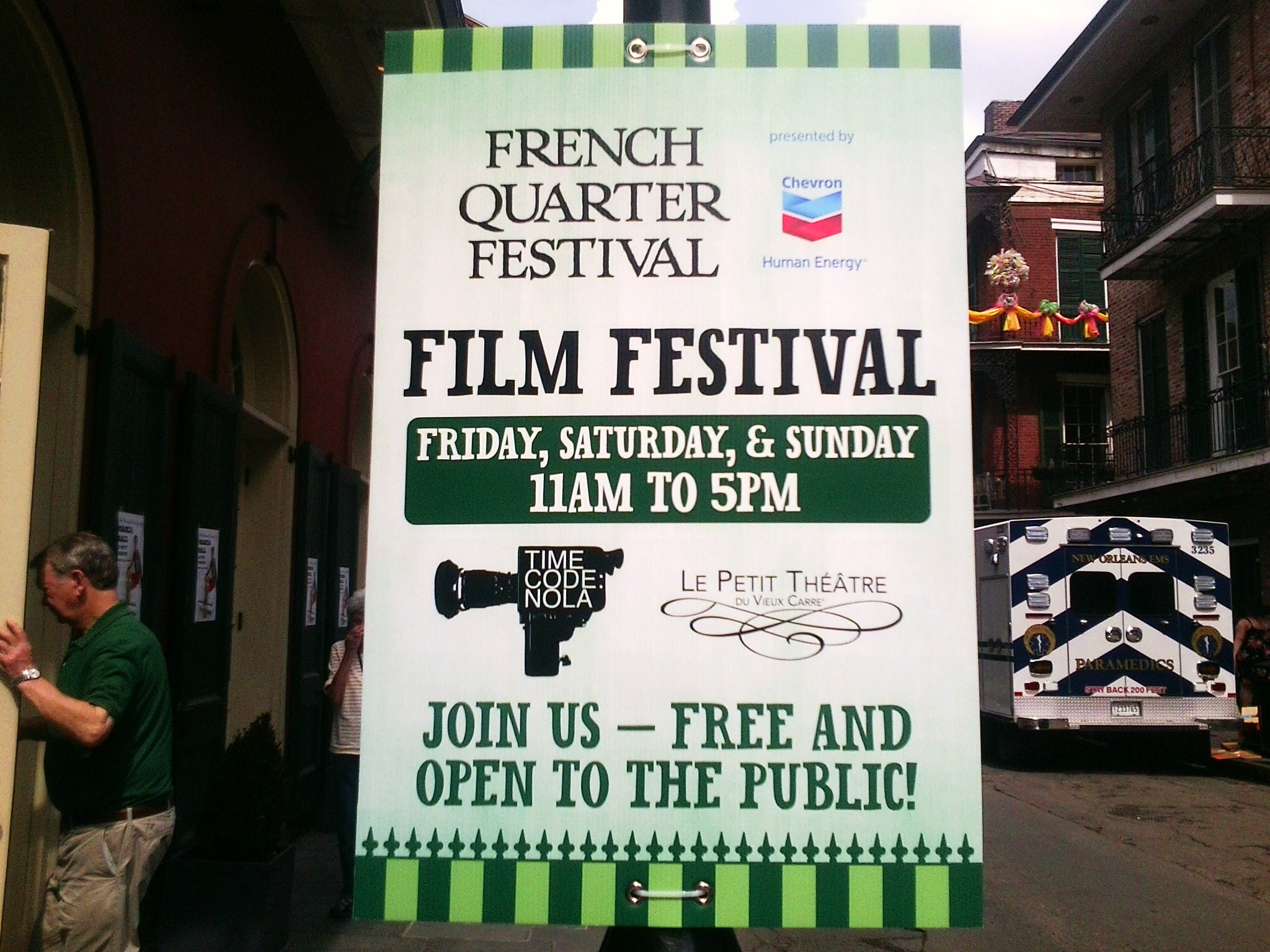
It’s usually around Mardi Gras when the city wakes up from its winter slumber, suddenly coming to life after months of hibernation. Tourists start to arrive in town to drink in the streets & enjoy the sunshine while their friends & loved ones freeze in the snow back home. Locals stop acting like total babies about what passes for “the cold” down here and venture at least as far as their front porches to enjoy the second lines & boiled crawfish. Mardi Gras is only the start to this Spring awakening, however, and the spirit to excess rolls right on into our festival season, which stretches on as long as it can before it’s too hot too drink gallons of beer in the daylight and visitors abandon us for the summer. Jazz Fest stands tall as the most obvious pinnacle of the season, but French Quarter Fest has recently been giving that juggernaut a run for its money. What used to essentially be “Jazz Fest for Locals” is now ballooning to be its own feature attraction, drawing thousands downtown for deliciously cheap local food & free music. To my recent discovery & surprise, it also features a free film festival.

I’ve been to French Quarter Fest a few times over the years, but this year was the first I’d ever heard of a film festival accompanying the better advertised attractions of food, drink, and local brass. Located just outside Jacskon Square at Le Petit Theatre, a venue that traditionally stages live drama, the film festival is a cocoon-like respite in the center of madness, the eye of a drunken storm. After wandering from stage to stage, drinking like a madman & downing hot sauce-soaked poboys in the heat (and unfortunately this year, the rain) it’s difficult to describe just how much of a relief it was to sit in a darkened, air conditioned room and watch movies. Presented by the folks behind Timecode: NOLA, the offerings at the French Quarter Film Fest are a well-curated group of documentaries seemingly selected to make the city look good for visitors. It featured several documentaries I had never seen before as well as ones I already know intimately, essentially upper crust of the kind of New Orleans-praising fare you’d expect to catch on late night PBS.

0410151108

I attempted to catch one film a day at the festival to get a decent sampling of its offerings, but my Friday afternoon plans got derailed when I coincidentally ran into a friend at a live performance on Royal Street and ended up missing the classic, doc Always for Pleasure. There pretty much is no substitution for the all-encompassing sampling of New Orleans culture in Always for Pleasure, but it’s a film I already know well (and one that’s currently available on Hulu), so I had no qualms with missing it for a chance to enjoy French Quarter Fest’s more traditional offerings of booze & live music. Actually, I feel like it was even more in the spirit of the movie to miss it. Filmed in the 1970s, the Criterion-approved Les Blank documentary truly is the best introduction to local culture that I could possibly imagine. Where else are you going to find soul legend Irma Thomas sharing her red beans & rice recipe and Allen Toussaint explaining the significance of jazz funerals & second lines. There’s also glimpses of crawfish boils, Mardi Gras Indians, St. Patty’s Day celebrations in the Irish Channel, and what essentially amounts to music videos for Wild Thcopitoulas & Professor Longhair. An interviewee in Always for Pleasure describes New Orleans as “The City that Care Forgot” & “The last city in American where you can feel free to live,” and the supporting images that surround those claims make it feel like he might be onto something.

On Saturday, I not only made it to the screening I wanted to catch; I desperately needed to. After sweating it out in the drunken, downtown masses, it was a life-saving sensation to watch the documentary He’s the Prettiest: A Salute to Big Chief Allison “Tootie” Montana’s 50 Years of Mardi Gras Indian Suiting. He’s the Prettiest obviously has a much more focused subject than Always for Pleasure, choosing to narrow in solely on a profile of Mardi Gras Indian Chief Tootie as he dressed for his final outing. Tootie is not only a significant chief because of his 50 consecutive years of suiting, but in the innovative artistry he brought to the practice. Instead of merely continuing the traditional Mardi Gras Indian beading he inherited, Tootie introduced the concept of 3-D designs to his suits, elevating the painstaking bead work to unparalleled levels of intricate design. He’s the Prettiest is less interested in the history of Mardi Gras Indian culture than it is providing a platform for Tootie’s work to shine. It’s essentially a moving art gallery for beautiful designs, a constant tribal soundtrack of thumping tambourines & rhythmic chants providing a rich texture for bead work that would already be dazzling in a silent, still image. It’s an important profile of a brilliant, unfortunately deceased artist whose work doesn’t receive as much formal fine art praise as it should.

On Sunday afternoon, once the rain died off, we caught the final film of the festival, Faubourg Tremé: The Untold Story of Black New Orleans. Initially conceived as a history lesson reviving a forgotten storyline in which New Orleans was a historical forerunner in racial equality & integration, providing then unheard of freedoms for people of color long before the 1960s Civil Rights movement (freedoms sadly poisoned by the years of Jim Crow), the documentary about the historic district of Faubourg Tremé was derailed by a little storm called Hurricane Katrina. The final third of the film captured a time I rarely care to revisit, a time in which most people couldn’t afford to return to the city they knew & loved and the ones that could struggled to piece their lives (and families) back together from the wreckage. It was an emotionally crippling note to end the festival on, but once I stepped back onto the city streets and watched a nameless group of ten-to-fifteen year olds playing traditional brass music draw a lively crowd outside the French Market (most likely the best set I saw all festival) I realized that Faubourg Tremé was for the most part a depressing story because it was an incomplete one. It captured the city’s incomprehensible lows (right down to the storm’s irrevocable psychological damage & a beyond troubled history of race relations), but did not have the time to capture the resiliency that brought the city back to life in the years following the broken levees. We all went through Hell to get here, but there’s plenty of our culture left to make the struggle worthwhile.

The couple of screenings I successfully made it to at this year’s French Quarter Film Festival were surprisingly well-attended, but also decidedly low-key. It seemed to be mostly older couples who, like my lame-ass self, needed a break from the external madness of drunken tourists and admittedly overpriced drinks (hey, at least they pay for the music). More importantly, the films selected had the kind of celebratory quality that gets you genuinely excited about your own city & culture in a heartfelt way, especially in the last minute acknowledgment that we’ve been through Hell together. There were plenty of opportunities for me to fall in love with New Orleans all over again at this year’s French Quarter Festival, like trying my first ever alcoholic snowball (which honestly wasn’t all that different from a daiquiri) or listening to any brass band you can name jamming outside the US Mint or overhearing a cop explain to a couple of passed out crust punks, “Look, if you want to sleep out here, you gotta do it by the river.” That sense of civic & cultural pride was surprisingly just as potent in the mid-afternoon darkness of Le Petit Theater as it was on the busy streets surrounding it; and it was just as simple as watching a couple of movies in the dark with a few strangers/neighbors.

-Brandon Ledet

Bava Goes Bollywood: Veerana (1988)

EPSON MFP image

There’s no denying the widespread influence Mari Bava has had on cinema, especially horror. Bava’s masterful 1964 crime thriller Blood & Black Lace, April’s Movie of the Month, has been credited as ground zero for not only giallo as a film gene, but also body count slasher films at large. Its influence can also be detected in unexpected places, such as William Friedkin’s controversial Cruising and essentially any film ever directed by Brian DePalma. Even these connections are less surprising to me, however, than the influence Blood & Black Lace had on the 1988 Bollywood horror film Veerana.

Admittedly, I have a limited knowledge of Bollywood films as a genre, having only seen a couple titles here or there, so there was plenty of room for Veerana to surprise me. It was most certainly the very first Bollywood horror film I had ever seen, so there was an almost complete lack of genre expectations I may have had if I’d seen, say, any other film produced by the infamous Ramsay Brothers before. What I found the most surprising was how easily the film gets easily distracted. At a whopping 145 minutes, Veerana is undeniably overstuffed, having no qualms with putting its horror movie plot on hold for extended song & dance sequences, underwhelming martial arts, and painfully corny stabs at humor. However, if you re-cut the film with about 45 min less of the dillydallying (about a third of the run-time), I honestly believe you’d have a verifiable masterpiece on your hands.

The horror movie at the heart of Veerana is a beautiful work of art. Smoke, bats, black magic, Satanic statues, cartoon lightning, humanoid rocks, telepathy, ghosts, witches & warlocks all haunt the screen in a dazzling display. The film wastes no time getting there either. The opening scene & credits plunder the Mario Bava aesthetic immediately, attacking the viewer with strangely colored lights, intense sound design, and ludicrous camera angles. The synths that accompany these images sound like they could be an experimental side-project from giallo soundtrack legends Goblin where they tried to incorporate more Eastern influences in their work. The film is downright overwhelming in these stretches, but in an admirably eccentric way. The juxtaposition with the horror segments with the more traditional Bollywood tropes in the humor & dance numbers is fascinating (and somewhat of a relief), but it’s in the depictions of black magic & evil deeds that the film truly shines as a unique work.

Produced over two decades after Blood & Black Lace, Veerana helps to solidify Bava’s classic whodunit as a seminal work with a stylistic influence that was felt literally across the world. There are some basic genre tropes that the Bollywood version gets wrong about giallo, especially in its tendency to over-explain why everything looks & sounds the way it does. An opening warning urges the audience to “watch this film only for entertainment,” explaining, “This film has no connection to reality,” but is instead “influenced by old folklores.” There’s also the push to blame the visual witchcraft on straight-forward Satan worship (or “evil god” worship), which leads to truly beautiful imagery like a towering demon statue on fire, but feels oddly old-fashioned when compared to more eccentric, detached-from-reality giallo like Argento’s Phenomena or the much more recent The Strange Color of Your Body’s Tears.

It’s interesting what Veerana did & did not pick up from the genre Bava inadvertently birthed with Blood & Black Lace. In addition to the stylistic tropes mentioned above, it also borrowed ideas like site-specific kills (in this case a lumber yard) and a general air of mysticism. However, it also missed the mark a bit on where that mysticism originates as well as an opportunity to give itself the obnoxiously long, complicated titles that accompany giallo movies (“Veerana” is translated as “Creepy Forrest”; not all that awe-inspiring when other genre titles include Black Belly of the Tarantula & The Devil Has Seven Faces). Veerana is an interesting film for giallo fans to see where it lines up with its Bava ancestry as well as where it deviates. It 100% delivers on the premise of Bava Meets Bollywood, displaying a healthy dose of both seemingly irreconcilable genres. Sometimes they mix perfectly and other times they sit side by side, confusing the audience thoroughly, but it’s a fascinating clash even when it doesn’t work.

For more on April’s Movie of the Month, 1964’s Blood & Black Lace, visit our Swampchat discussion of the film.

-Brandon Ledet