Wes Craven’s Crown Jewel: New Nightmare (1994)

EPSON MFP image

Just two weeks ago, we lost a cinematic great who was often overlooked for his accomplishments as an auteur, perhaps due to his extensive work in genre films. Wes Craven may have made an occasional goofy trifle like a Shocker or a Swamp Thing, but his more accomplished films have unmistakably reshaped the horror landscape in a significant way. I don’t have much of a stomach for them myself, but his early works The Hills Have Eyes & The Last House on the Left rang out like the enraged, too-believable battle cries of a deeply disturbed mind eager to unleash its violent cravings upon the world at large. Honing in that anger for something more purposeful & universally palatable, Craven later scared the every living shit out of mainstream audiences with A Nightmare on Elm Street, which did for the simple act of falling asleep what Jaws did for nightswimming. Craven’s instantly infamous Freddy Krueger creation, brought to disturbingly vivid life by actor Robert Englund, would’ve been enough to coast on for the rest of the director’s life, but instead Craven broke out into more surreal territory with The Serpent & The Rainbow, political satire in The People Under the Stairs, and the very nature of horror as a genre in the meta franchise Scream, among other projects. Craven was an inventive fella, to put it mildly. He was enthusiastic about exploring new, strange ideas that would allow his demented id to escape from his mild-mannered exterior, scaring his audience while simultaneously challenging them in unexpectedly intellectual ways, the latter being something a lot of horror peddlers don’t bother with often enough.

My personal favorite Wes Craven film is 1994’s New Nightmare. It’s not his scariest, nor his most tightly-controlled work, but it is an incredibly smart picture that manages to bridge the gap between the dream-logic horror of A Nightmare on Elm Street with the meta genre reflection of the soon-to-come Scream franchise. Wes Craven’s New Nightmare is a perfect way to remember the filmmaker for all he accomplished, not only because it marries those two defining moments of his career in a single picture, but also because he plays a role in the film as a fictionalized version of himself. The Scream franchise introduces its meta context by having the typical bonehead slasher victims be atypically self-aware of classic horror film tropes that usually lead to violent deaths, allowing for them to make commentary on the very film that they populate (eventually with their lifeless bodies). However, thanks to the dream logic of A Nightmare on Elm Street, New Nightmare allows itself even more free rein with its meta context. The movie itself is about the making of another Freddy Kruger picture, a cursed production that blurs the lines between reality & nightmare and free will & scripted fiction to the point where it’s near impossible to tell the difference between a character being awake, getting trapped in Freddy’s playground of the subconscious, or, worse yet, living out one of Wes Craven’s screenplays.

Set on the 10th anniversary of the original Freddy Krueger picture, New Nightmare stars Heather Langenkamp, who played the protagonist Nancy in the original Nightmare on Elm Street, as Heather Langenkamp, who played the protagonist Nancy in the original Nightmare on Elm Street. As the anniversary of the film draws near, threatening phonecalls (often accompanied by Earthquakes) that impossibly seem to be from Freddy Krueger himself torment the poor actress, establishing a mood of dread very early in the picture. The strange thing is that Langenkamp is good friends with Robert Englund, her colleague who portrays Krueger in the movies. Englund, playing himself (and Freddy, of course), is portrayed as a genteel dude here, spending his days idly painting in the sun room of a mansion undoubtedly funded by the success of the Elm Street films, a far cry from the undead homicidal maniac he embodies with Freddy. As mentioned above, Wes Craven also plays himself in New Nightmare. He explains to Heather that he’s been working on a script (or a “nightmare in progress” as he calls it) for a new Elm Street picture as a means to stop Krueger from becoming “real”. According to Craven, because Freddy was killed off in the 6th installment of the franchise (Freddy’s Dead: The “Final” Nightmare), he has been set free like a genie from a bottle, now able to manifest in real life, causing real havoc. The only way to stop Freddy, Craven explains, is to make another picture, an ordeal Heather is very reluctant to suffer.

There is so much to enjoy in New Nightmare & the film really does at times feel like all of the best elements of Wes Craven’s aesthetic conveniently gathered in one package. Striking an unnerving artificiality from the get go, the whole film feels like a constant dream state, a feeling that’s only amplified as the walls between the conscious & the subconscious, as well as the walls between the movie & the movie within the movie, begin to break down into a mess of Freddy Krueger themed chaos. As for Krueger himself, he actually doesn’t appear in his full form for much of the film. He’s more of a disembodied idea than a physical threat, often appearing solely as a clawed glove & at one point literally becoming larger than life by appearing in the clouds above a freeway. Heather’s horrified reaction to Krueger’s new, true-life form & his adoring fans’ gushing at his publicity appearances call into question Craven’s own thoughts on his creations & their fandom, particularly with the rougher work of films like The Last House on the Left. Otherworldly landscapes of bedsheets & subconscious dungeons recall the POV of a child’s imagination Craven so well captured in The People Under the Stairs. Although the dream state reflections of The Serpent & The Rainbow and the original Elm Street as well as the meta reflections of the Scream movies may have been more thoroughly solidfied in his other pictures, it’s nice to see those two worlds bounce off each other in such a satisfying way here.

Wes Craven’s New Nightmare might not be his most technically accomplished film & it’s doubtful that it’ll be the one he’s most remembered for, but it holds a special place in my heart as a sum of the accomplishments of a director I grew up loving & fearing. When I heard the recent news that the incredibly gifted director had died, it was the first film I thought to revisit as a means of remembrance. It only helps that the director himself makes an appearance in the film to weigh in on the magical nature of filmmaking, directly referencing his personal compulsions to create, the often hellish compulsions that drive anyone to create, and the ways art can take on a life of its own outside its creator’s will or control. Besides being a great film as well as a reflection on the nature of horror as a genre & art as an enterprise, New Nightmare is a solid means to commemorating the accomplishments of a great director who is unfortunately no longer with us. He will undoubtedly be missed, but we’ll always have great films like New Nightmare to remember him by. Much like his creation Freddy Krueger, Craven lives on.

-Brandon Ledet

Introducing: The Swampflix Canon

EPSON MFP image

Although we’ve fairly easy critics (especially when it comes to trash cinema) & have reviewed hundred of films since we first launched in January, it’s been interesting to see how few & how disparate our selections have been that exceed a four star rating. Over the last eight months we’ve given only two dozen films a rating of 4.5 of 5 stars, and they’re as wildly varied as a mindless 80s slasher flick, a Paul Rudd superhero movie, a pro wrestling action comedy starring famous monsters, and a Björk concert film. We’re turning out to be a wildly goofy & oddly dissonant bunch and it’s starting to show in the movies we profess our love for.

In light of this growing list of targets for our critical gushing, we’ve begun to collect our reviews that exceed a four star rating on a page we’re calling The Swampflix Canon. All 24 reviews that have met this one criteria so far are listed in alphabetical order on the new page for easy access & I’m certain more will be added shortly. If you’re interested in a starting point for where to dive in, here’s the list of the nine titles that we have awarded a five star rating so far: Beyond the Black RainbowThe Duke of Burgundy, Monster Brawl, Paris Is Burning, Peeping Tom, Pieces, Possession, Profondo rosso (aka Deep Red), and What We Do in the ShadowsThe rest of the list can be found here.

As always, Enjoy!

-Brandon Ledet

Movie of the Month: The Boyfriend School (1990)

EPSON MFP image

Every month one of us makes the rest of the crew watch a movie they’ve never seen before & we discuss it afterwards. This month Britnee made Brandon and (newcomers) Erin & Boomer watch The Boyfriend School (1990).

Britnee: As a fan of uncomfortably terrible films, I was more than excited to select The Boyfriend School (aka Don’t Tell Her It’s Me) for September’s Movie of the Month. This is a film that was washed away with the other thousands of unsuccessful romantic comedies of the late 1980’s and early 1990’s, but it’s truly a diamond in the rough. What makes The Boyfriend School stand out from the rest is, well, just about everything. The film’s cast includes the crème de la crème of chintzy actors: Steve Guttenberg, Shelley Long, Jami Gertz, and Kyle MacLachlan. Who can resist a line-up like that? Throw in a crap ton of cringe worthy, knee-slapping moments, and you have one hell of a movie.

The film follows the sad, sad life of Gus Kubicek (Guttenberg), a depressed cartoon artist that just won a battle against Hodgkin’s disease. His overbearing sister, Lizzie (Long), is a romance novelist, and she is disturbingly obsessed with getting him a girlfriend. She decides to prey on a young journalist, Emily (Gertz), and attempts to force Emily and Gus to become a couple. It’s extremely difficult to sit through the first half of this film without doing a couple of facepalms. Every ounce of Gus’s embarrassment and humiliation seeps from the screen and into your soul, and just when you think it can’t get any worse, it does. Lizzie creates a persona for Gus, and he morphs from a chubby, hairless Average Joe into a hunky biker from New Zealand named Lobo Marunga. Guttenberg ends up looking like Mad Max and George Michael’s love child, and it’s absolutely amazing.

Brandon, what are your feelings on the love story between Gus and Emily? Should she have ran after him or away from him?

Brandon: Discomfort is certainly the story at the heart of this film & Emily The Love Interest had so, so many discomforting reasons to run away from Gus that the movie was honestly pretty gutsy to go for the traditional romcom ending at the airport than the much more appropriate option of a murder-suicide. At the risk of spoiling a decades old Steve Guttenberg vehicle for anyone who could possibly care, let’s get this out of the way: Gus violated Emily. He doesn’t come clean about not being Lobo until the morning after they slept together. That’s pretty fucked. The only time Emily met Gus as himself he was in full Uncle Fester cosplay (because of the cancer, God help our souls) and the two of them were force-fed jellyfish salad (a dish Emily humorously describes as “chewy tears”) in a scene that makes Shelley Long’s character out to be less of a romance novelist & more of a torturer whose techniques rival those of Vlad the Impaler or the Holy Inquisition. Even if Emily saw something in Gus through the façade of Lobo Marunga, she should at least have ran far away to escape his sister’s evil clutches.

The strange thing is that even though Gus is a certifiable monster for not coming clean before doing the deed, it’s still difficult not to feel bad for him because he starts the film as a visible monster. In the opening scenes Gus is a Hunchback of Notre Dame type who’s locked himself away in his seaside cabin to draw cartoons & die alone so his Jack Russell terrier can pick at his bones. It very well may have been his sister that motivated him to win his battle with cancer, but she uses his extra time on Earth to remind him of how sad & ugly the disease has made him as a means to try to whip him back into shape & “get himself out there”. No one comes across looking good in this exchange. Gus is is a horrifying shell of a man. His sister is a Type A sociopath who takes great glee in playing God. Emily is an astute journalist who can’t figure out that this dude (that she has met before) who is most definitely not from New Zealand is not from New Zealand. There are very few traces of dignity or humanity to be found in this film & the resulting cringe fest is oddly fascinating.

Erin, am I exaggerating here? Is this kind of absence of dignity or recognizable humanity normal for a romcom or does The Boyfriend School push the pained awkwardness into unusually morbid territory?

Erin: I have got to agree that this movie definitely pushed the boundaries of taste, even for a self-consciously cheesy romcom.  I’d almost categorize it as a cringe comedy, instead.  I can only hope that the actors protested their roles in this wreck of a movie.  It’s set in a strange and unrealistic world, a caricature of a reality populated by caricatures.  Yes.  Undignified and inhuman and inhumane.  The most real character is Annabelle, Gus’s toddler niece, who has a speech delay and has somehow survived Lizzie’s negligent and neurotic parenting.

Maybe we’re missing something with this movie, or there was a disagreement between the editing team and the director.  If the movie as watched is the intended product, then The Boyfriend School might be a comprehensible work if the watcher forgets the romantic comedy genre and watches it as an exploration of the universe of romance novels.  It has all of the hallmarks of a trashy novel: unrealistic universe mechanics, tragic back stories, completely unbelievable plot turns, romantically picturesque settings, unethical sexual encounters . . .

Boomer, what do you think? Were we mislead by marketing?  Is there any redeeming quality to be found at all in this movie?

Boomer: It took me nearly a week to track down a copy of this movie, and the copy that I did find was the kind of bare-bones affair rushed onto the market in the early days of  DVD to fluff up home video collections; in fact, it has one solitary “special” feature: the theatrical trailer, which I watched before the movie, out of habit. I’m not sure if it was the American market trailer, since it features the alternate title, Don’t Tell Her It’s Me, but the narrative outlined in the promo recapitulates the film’s plot fairly well: unlucky man is made over into a precognitive Dog the Bounty Hunter cosplayer by his sister in order to win the heart of the girl of his dreams. The trailer does make Kyle McLachlan’s Trout character out to be more of an innocent in the end of his relationship, rather than the two dimensional cuckolder that he is in the film, and it fails to show that Gus will end up, as Brandon notes, violating Emily; the marketing is pretty straightforward in broad strokes and (mostly) in the details. At the end of the movie, I thought to myself, “Yes, that was certainly a movie.” The 1990s were the decade of the romcom, a short period in which so many films of the genre were made that the concept itself was subject to so much dilution and derivativeness that Meg Ryan went from starring in such straightforward love stories as falling for a rival storeowner in a remake of The Shop Around the Corner to being swept off her feet by angels and handsome timelost scientific pioneers (that was actually 2001, but you get the picture). As a cultural artifact, The Boyfriend School is charming in its simplicity and straightforwardness, if not necessarily in its subject matter.

As Emily says to Lizzie near the end of the film, the former hates the latter in the abstract, but can’t hate her in the flesh. I would wager that this is true of virtually any character played by Shelley Long; she’s just an intensely likable actress with a great sense of comic timing, and it’s hard to be certain that the enjoyment I got out of this movie would have been present without her. Long brings an effervescent effusiveness to a role that would likely play as more malicious had Lizzie been portrayed by another actress. Jami Gertz is also quite charming here, despite the fact that her character is paper-thin. During the time it takes Gus to grow a full head of hair, learn to poorly impersonate a Kiwi, lose those horrible face prosthetics that are supposed to simulate illness, and sweat off all the cotton stuffed around his waistline, what do we see Emily doing? Shaving her legs. We don’t see anything of her relationship with Trout, or her working on a different story (at one point Gus does read an article of hers about snakehandling, the first paragraph of which is actually about that religious practice, while the rest is advertising copy about desktop publishing software–great job there, propmaster), and yet I felt her character was likable in her sweetness, if a bit obtuse, even before the film felt the need to go full Liz Lemon with her mud-sprayed, torn dress airport run. Even Gus, a handsome creep played with discomfiting ease by Guttenberg, comes off as hatable in the abstract but not the flesh, and, to his credit, Gus is only at Emily’s the night of the violation to come clean about his double identity, although he stops putting forth an effort on this front almost immediately, for the sake of plot contrivance.

If anything, it was the tight plotting of this movie that struck me as a pleasant surprise, especially in a film with such low stakes, so to speak. In contrast to a lot of the romcoms that followed in the next ten or so years, there’s not a single wasted line or moment, and there are a lot of subtle touches and ironies that I found to be inspired, or at least novel. The film introduces the “Unkow” clue and the fact that Lizzie’s dog only likes Gus early in the movie, with a kind of deft subtlety that belies the over-the-top facade of a somewhat high concept story. Lizzie is constantly trying to impress upon Anabelle the potential consequences of her adorable but dangerous random childlike actions, but she fails to foresee the consequences of her own meddling in things that she shouldn’t. She even mentions that she has to get Gus to the metaphorical last page of the bodice-ripping romance she’s constructing in her mind; for her, what matters is getting to that final paragraph of sexual conquest, and what happens afterwards is irrelevant because, in her novels, nothing happens next. It’s a formulaic, cookie-cutter movie, but with the kind of foreshadowing and payoff that you wouldn’t expect from a movie sharing shelf space with other forgettable fare like Something to Talk About, Addicted to Love, or Simply Irresistible (why were so many of these movies named after songs, anyway?).

Anyway, I’ve rambled long enough about a movie that’s, by and large, pretty inconsequential, despite featuring a brief scene between Beth Grant and a life-size demonstration doll with questionably accurate anatomy. What about you, Britnee? How do you see this film fitting into the milieu that was the romcom ocean of last millennium’s last years? Is it a precursor, a relic, or a non-starter?


Britnee:
Even though I really enjoy this film (for all the wrong reasons), I would have to say that when compared to the romcom scene of the 90s, it’s nothing more than a dud. The film does try hard to be great by playing on the popular “don’t judge a book by its cover” love story, where the nerd gets the hot girl in the end, but as we all know, it leans more towards being a psycho in disguise horror-type film. What really hurt this film (among other things) and caused it to be a romcom failure was the hard-to-believe romance between Gus and Emily. You can’t have a solid romantic comedy without the romance. When she initially meets Gus as himself, she has no romantic or friendly feelings for him, and Gus merely makes a few compliments on her “playboy model” looks. What causes him to go after Emily is his twisted sister, who pushes him to win Emily’s heart for her own sick pleasure. A couple of heartfelt exchanges after Lizzie’s disastrous dinner would’ve made all the difference. Even when Gus becomes Lobo, there still doesn’t seem to be much going on between the two. None of Gus’s personality shines through in his Lobo character. He does have a couple of vocal slipups, but he doesn’t give Emily a reason to fall for him, which really ruins the creditability of the “romantic” ending scene. He violated her and she didn’t really care for him to begin with, so why is she going after him? Big mistake. Huge.

I first came across this film on late-night cable, and the main reason I tuned in was because I noticed that Shelley Long’s name was in the TV Guide description. I’m a huge Shelley Long fan, so I wasn’t going to miss this one. Strangely enough, it wasn’t Shelley that won me over; it was Guttenberg’s horrible New Zealander caricature. In real life, Guttenberg looks, sounds, and acts like someone who would own a candy shop or run a summer camp, so seeing him head to toe in leather, whispering to himself, “I am Lobo. I hunt alone. I need no one,” is beyond hilarious. Even when he’s plain old Gus, there’s just something about his signature Guttenberg mannerisms that make the character unforgettable.

Brandon, do you think Guttenberg did well in his role as Lobo/Gus? Does he contribute this film’s failure or is he without blame?

Brandon: Here’s where I have to cop to genuinely enjoying Steve Guttenberg. It helps that I am just a few years too young to remember a time when he was this unlikely, but oddly ubiquitous leading man that was legally required to star in every movie offered to him no matter the quality. I have the fortunate position of remembering The Gutte as an odd cultural footnote. It’s fascinating to me to see him play parts like the mayor with a secret on Veronica Mars or the pot-smoking DJ in the Village People movie or even his own charming self on Party Down. He’s not a particularly versatile actor, but he is a pleasantly goofy one. Somewhere along the line, I’ve somehow learned to love The Gutte, God help me.

I think that’s why it hurts so damn much to see him in the cancer survivor Uncle Fester make-up, the embarrassing leather daddy New Zealander chaps, and the lowly position of Shelley Long’s whipping boy in The Boyfriend School. I felt as if the film were a punishment someone was putting Guttenberg through to atone for the sins of his mid 80s omnipresence. Throughout the endless parade of embarrassments (especially in the first half of the film), my brain was screaming “This is Hell! This is Hell! Set him free!” The Gutte may not have been exactly deserving of his ludicrously overblown success, but surely this punishment was a little rough for even him. Y’all were right to call The Boyfriend School out for being more of a cringe comedy or a psycho in disguise horror than a romcom, but I find it also plays like an act of penance. Even in the film’s trailer, which Boomer mentioned earlier, where the Gutte is talking directly to the camera (looking like his normal, healthy, non-Kiwi self for longer than he does in the entire film), I can feel the menacing presence of someone slightly off-screen holding a gun to his head & pointing at the cue cards.

Erin, do you think it’s time that we as a society let Steve Guttenberg back into our hearts? Now that he’s served his time in the squalid prison of The Boyfriend School, what kinds of roles (if any) would you like to see him play?

Erin: I can understand how The Gutte earned his spot in the limelight – his completely non-threatening, boy-next-door good looks, his passable skill with goofy comedy, and his string of not-too-terrible 80s movies.  Not to discredit what I’m sure was lots of work, but it seems like The Gutte benefited a bit from right-place-right-time syndrome.

His current career has been hit and miss . . . well, actually, after appearing in Veronica Mars ten years ago, mostly miss.  His latest credit seems to be for Lavalantula.  If you are thinking that this is a move about giant and horrifying lava spewing tarantulas, then you are absolutely correct.  Could it be a hidden gem in the land of self-aware, poorly produced B movies?  Could it be the movie we’ve all been waiting for to watch at 3:00 am while eating a whole bag of pizza rolls?  Maybe.  But probably not.

I’d love to see Steve Guttenberg reclaim his career with a well produced family comedy (The Gutte as a slightly befuddled dad? Sure!), then maybe take on slightly more adult dark comedy roles that explore the world of the aging baby-boomers as they navigate a world vastly different from their heyday.  The Gutte takes on Tinder and deals with the death of his close friends?  Is that past The Gutte’s range?  I’d like to think not.

Boomer, do you see any room in our current movie environment for a Gutte-back?  Are his current roles due to some fault in talent, natural Hollywood career trajectory, or are we simply seeing a man taking the projects that make him happy?

Boomer: There is something to be said for Guttenberg’s natural charm. I, too, remember his sinister turn on Veronica Mars as yet another in a long line of adults who couldn’t be trusted, a wealthy man whose privilege made him feel above morality; somehow, this role felt well suited for him, despite his charm in movies like Police Academy, the Three Men and a Little X flicks and even, God help me, Cocoon. As an actor, he has a charisma that helps him sell characters that are despicable, either intentionally (as on Mars) or unintentionally (as in The Boyfriend School). Earlier, I praised Long, saying that another actress in the role would have made Lizzie seem more sinister, but that dubious accolade could be ascribed to Guttenberg just as easily, and his contribution to making Gus likable in spite of the character’s flaws can’t really be ignored.

Which is not to say that I’m suffering from a lack of Guttenberg in my life, at least not in the way that I miss seeing Shelley Long in vehicles that show off her charm (her occasional appearances on Modern Family notwithstanding). But I could stand to see him in something new. He could put in an appearance as relatively obscure character given new prominence in an upcoming Marvel film, for instance; there’s no dearth of those coming out, and it could give him the visibility he needs to resurrect his career. Personally, I think I’d like to see him in a role more like Michael Keaton’s in Birdman, where he tackles a thinly veiled version of one of his former characters in a serious, postmodern way. The Boyfriend Academy, perhaps? Or maybe Three Men and a Divorcee? If the Vacation movies aren’t sacred, perhaps nothing is.

Lagniappe

Brandon: When I said earlier that there’s very little humanity for the audience to identify with in this film, I may have been selling Gus’ aforementioned, nonverbal niece Annabelle a little short.  Known to her mother by the hideously cruel nickname “Piglet”, Annabelle is a bizarre collection of quirks just like every other character in the film, but she does have the very relatable impulse to escape the confines of The Boyfriend School‘s sadistic universe (and the evil clutches of Shelley Long) by ending her own life. Whether she’s shoving metal into electrical sockets or ingesting toxic household products, I totally understand Piglet’s desire to leave a world that can be this unkind to a man as simple and as goofy as The Gutte. Thank you for speaking up for the audience, Piglet, (even if you couldn’t use your words) when you repeatedly asked that they shuffle off this cruelest of mortal coils.

Britnee: Something I forgot to mention in the Swampchat was the short, strange appearance of zydeco music in the film. Shortly after Gus enrolls in Lizzie’s “boyfriend school” and starts getting into shape, all the fun 80s film pop is set aside to allow a few minutes of zydeco. Watching Guttenberg run to zydeco made my little Cajun heart very happy, but it really threw me for a loop. It was such a weird choice of music for a running scene, but I guess I shouldn’t be all that surprised because, afterall, this is a weird movie. A weird movie with a little heart and loads of discomfort.

Boomer: I was surprised to learn that the screenwriter of The Boyfriend School, Sara Bird, was also the author of the book on which the film was based, and she was named by The Austin Statesman as Austin’s best author in 2011. It’s hard to conceptualize that this accolade could be applied when School is, overall, a fairly mediocre movie, but I can see that the tight plotting of the film probably mirrors a more complex structure in the original novel. That having been said, this film gave us Beth Grant tonguing a lifesize mannequin, so it’s not without some value. I probably never would have seen this movie were it not for this Swampchat, and I can’t say that it changed my life, but it did give me a new perspective on the genre, so I’d have to say I appreciated the opportunity to view this little oddity.

Erin:  The Boyfriend School is definitely a strange movie.  I think that it definitely seems like a novel in the characterization and pacing.  Purely speculation, but I think that some of the creepiness would be mitigated if presented in written form since we would be able to understand some of the thought processes of the characters.  It’s actually pretty interesting for a self-referential trashy movie.

Upcoming Movie of the Months
October: Erin presents Innocent Blood (1992)
November: Boomer presents The Class of 1999 (1989)
December: Brandon presents The Independent (2000)

-The Swampflix Crew

An Ill-Advised Journey through All Craptastic Four Fantastic 4 Adaptations

EPSON MFP image

It’s gradually becoming conventional wisdom that you simply cannot make a watchable Fantastic 4 movie. For two decades running Hollywood has failed rather miserably to adapt Stan Lee’s/Jack Kirby’s half-goofy/half-gritty characters into a successful feature film, despite having much better luck with other Lee/Kirby designs such as Iron Man & The X-Men. It’s hard to pinpoint exactly what it is about Fantastic 4 specifically that is so difficult to competently capture on film, despite the wild commercial success of other superhero properties. What is certain, though, is that despite the disparate variety of approaches, no adaptation has won over fans of the comics or even casual movie goers looking for mindless escapism. And it’s somehow still likely that there will be even more shoddy attempts to adapt this property in the future, despite the four already-raised red flags. Listed below is a brief review of every Fantastic 4 feature released so far, hopefully to serve as a guide for the morbidly curious.

The Fantastic Four (1994)

EPSON MFP image

three star

Perhaps the most infamously troubled Fantastic 4 adaptation of all also happens to be the one I enjoyed the most. A Roger Corman production from the mid-90s, the original Fantastic 4 movie is often rumored to have been made solely so that co-producer Bernd Eichinger could retain the film rights that he eventually put to grander use over a decade later with the 2005 adaptation. As a result to these backscene shenanigans the Corman picture never saw an official release. To this day, the film can only be viewed through bootleg VHS copies & less-than-legal YouTube uploads. There’s even a documentary in works called DOOMED!: The Untold Story of Roger Corman’s Fantastic Four (which I’m dying to see) that’s supposed to recount the entire troubled production & intentionally bungled release, which are, in short, a jumbled mess.

What’s most surprising about this mucked-up non-release is that it’s actually a really fun picture, much unlike the three adaptations that followed. Corman’s production ignores the insanely popular trend of Burton’s Batman pictures & intentionally reverts to a time when comic book movies were still made for children. 1994’s The Fantastic Four plays like a live-action Saturday morning cartoon. Even Dr. Doom’s surveillance setup & pack of obedient goons recalls the evil Dr. Claw from Inspector Gadget more than it does any other villain I can name. Sure, the costumes & effects employed here were way behind the times even for 1994 & the film was easily distracted by subplots that involved not one, but two will-they-won’t-they love stories as well as some less than compelling & entirely tangential jewel thief goblins that must’ve wandered from the set of Ernest Scared Stupid by mistake, but that’s all part of the movie’s hokey charms.

When viewed as a children’s movie instead of how we think of modern superhero fare, Corman’s The Fantastic Four is a fun little modestly-budgeted movie. There are some great cheesy lines like “Hello, Mrs. Storm. Can Johnny & Susan go out into space with us?” & [flying a spaceship] “Using turn signal. Turning right.” The cheapness of some of the effects can be fun in a campy way, especially in the psychedelic outer space transformation scene where the group gains their powers (where the background looks like something you’d expect to be projected behind The Doors) & in Doom’s hand-drawn space palace. There’s also some really awkward twists on the Fantastic 4’s core members’ group dynamics, like in the revelation that Reed “Mr. Fantastic” Richards knew Susan “The Invisible Woman” Storm as a little girl who she had a crush on him (gross!), Ben “The Thing” Grimm’s self-hating depression cycles turning him into a silent film bum, and in an over-explained monologue that reveals that each of the 4’s powers are reflections of their personalities, (something that’s much more subtly hinted at or assumed in the films to follow). Corman’s stab at adapting The Fantastic 4 is far from a perfect picture, but it is at the very least a mildly enjoyable slice of mid-90s children’s media with a fascinating context given its troubled production & lack of an official release. That’s more than you can say for any of the other films listed here.

Fantastic 4 (2005)

EPSON MFP image

onehalfstar

If Corman’s goofy adaptation sorta worked in its decision to chase the goofy, kids’ media bent of the Fantastic 4 universe, the 2005 adaptation that it made possible fails miserably because it makes no decisions at all. The mid-00’s Fantastic 4 is remarkably bad, just awful. Even more-so, it’s a prime example of what’s terrible about Hollywood’s chase for the PG-13 movie, a grey blob of un-creativity meant more to hit every possible demographic in their wallets more than it is meant to entertain. It tries to mimic the childlike goofery of the Corman film in lines like “Why the long face?” (directed at a stretched-out Mr. Fantastic, of course) & “That’s my nose. This is my face, genius,” (in a scene where an invisible Sue Storm is being sloppily kissed, of course), but also attempts to appeal to salacious old men in a gag where Sue (played here by 00’s sexy symbol Jessica Alba) is left publicly embarrassed in her underwear, ripe for the oggling. The 2005 adptation has its foot one in, one out, trying to juggle Corman’s children’s movie with the adult Burton Batman aesthetic; it drops the ball on both ends.

One of the strangest aspects of the film is that even though it arrived with an outrageously larger budget more than a decade after Corman’s picture, its effects were not nearly as impressive. Corman’s The Fantastic Four may have looked cheap, but at least it looked cool. The only practical effects used in the 2005 film are in The Thing’s prosthetic costume, which I gotta admit I thought was kinda cool-looking in a hand-made way (although the awfulness of Michael Chiklis’ labored voice work ruined that effect). Everything else looked stuck in the late 90s, especially in the transformation scene where the crew mutates into their newly powerful bodies, where the CGI was barely a step above an old-school screensaver.

The CGI wasn’t the only thing stuck in the late 90s, either. Further solidifying the movie’s cynical grabs at the perfect PG-13 market, Fantastic 4 is crawling with dirt bikes, snowboards, pop punk, and antiquated rap rock, gasping its final breaths here in the twilight years of its heyday. Johnny “The Human Torch” Storm is essentially a live-action Poochie in his 2005 incarnation, appealing to all of the cool, radical kids out there who are too X-treme for the establishment. The movie also indulges in some X-treme marketing in a single, extended scene that finds room for ad placement for ESPN, The X Games, Red Bull, Burger King, Pepsi, Sobe, Mountain Dew, Dos Equis, and I’m sure I’m missing a few. It was dizzying. There’s something very telling in that sequence’s love for X-treme branding as nearly every minute of the movie that surrounds it feels just as hollow & desperate to make a buck.

Fantastic 4: Rise of the Silver Surfer (2007)

EPSON MFP image

onestar

Despite the mixed reviews, narrative bankruptcy, and all-around awfulness of 2005’s Fantastic 4, it was still financially successful enough to garner a sequel. X-treme marketing really works, y’all! There’s a reason studios are chasing those sweet, sweet PG-13 bucks. Two years after Johnny Storm won The X-Games, Fantastic 4 returned to the silver screen, this time with a Silver Surfer in tow. The sequel is somehow even more awful & empty than the first, its narrative hinged on a much-delayed wedding between Mr. Fantastic & Sue Storm that no one could possibly care about. The Silver Surfer is an interesting character (voiced here by Lawrence Fishburn) who threatens to shake things up with his space alien aesthetics & threats of world destruction, but the movie is largely uninterested in this line of thought.

What it is interested in is repeating itself. Rather than trying to tell a worthwhile story about its titular villain , Rise of the Silver Surfer aims to tell more goofy jokes (with even fewer that land) and make room for more nonsensical asides, like in a sequence where Mr. Fantastic & The Thing both bust moves on the dance floor at a bachelor party for that all-important wedding, making me question the value of living another day . . . or at the very least watching another Fantastic 4 movie ever again. Besides some surprise cameos from folks like Brian Posehn & Kerry Washington (not to mention a not so surprise cameo from Stan Lee as himself, even though he played a mail man in the first film), Lawrence Fishburn’s competent voice work, and a needless sideplot where the 4’s powers are switched around in a gag that felt hokey even for Scooby-Doo (2002), there’s just really not much to distinguish this film from the first. It feels like an exact repeat of the not-at-all satisfying formula that came two years before, complete with yet another gag where Jessica Alba is left naked in public, complaining “Why does this always happen to me?” It’s a moment almost existential in its pleading desperationg, prompting me to ask it of myself as a member of the movie-going public. Why?, indeed Jessica. Why?

Fant4stic (2015)

EPSON MFP image

twostar

Although Corman’s Fantastic 4 film is the adaptation most widely known for its troubled production, the version that’s currently running in the theater may one day give it a run for its money. Although director Josh Trank won a lot of superhero fans over with his debut film Chronicle, they’ve quickly abandoned ship with the release of his much higher profile follow-up. To give you some perspective on just how much critical abuse the latest Fantastic 4 film is receiving, just take into consideration that it currently boasts a dismal 8% score on Rotten Tomatoes, while the much more infamously reviled (and not even officially released) Corman movie is carrying a 33% on the same site. According to Trank, the film’s problems could mostly be blamed on studio interference after 20th Century Fox reportedly hijacked the production in order to, in their eyes at least, limit damages & save face. It’s difficult to say if the final product would have been more successful if it were left completely in Trank’s hands, but there’s definitely enough going for it that indicates a decent Fantastic 4 film was at some point in the works here before it was hideously derailed. Trank claims that his original, unaltered cut of the film was a much better product than what was delivered, but that remains to be seen.

What actually reached theaters is not an entirely shoddy film, however. At least not in the first half. The beginnings of 2015’s Fant4stic (hey, if they’re going to spell their shit that way on the ads, they have to live with it) feels like a kids’ movie in a way very much unlike how Corman’s film did. The idea of children getting in over their heads while building teleportation devices in their garage using stacks of N64s and other dated electronics calls to mind a wonder-struck Spieldbergian kids’s flick or maybe Joe Dante’s Explorers or JJ Abrams’ Super 8. Much like with a lot of recent non-MCU superhero films, though, Trank’s Fant4stic succumbs to the mood-spoiling temptations of post-Dark Knight grittiness. During an early scene, The Thing’s family name “Grimm” flashes in neon, serving as an early warning of the Nolanisms to come. It might as well have read “Gloomm” or “Broodd”.

As the Spieldbergian tykes transform into disgruntled teenage nerds, the film gradually became a slog of very sciency lab montages, who-cares struggles with military figureheads, and knowing looks of teenage lust & self-hatred. This transformation wouldn’t be so bad if it actually built to something significant, but the film completely derails after the 4’s superpower-gaining transformation scene and never really gets started in any significant way. In short, it’s a total nonstarter. By the end credits, reminders of flashes of promise in the film’s cast, which included Miles Teller, Tim Heidecker and (voice of Homer Simpson) Dan Castanella feel so distant that they’re almost unbelievable. I was left in the darkened theater with one all-consuming thought: “What happened?”

The two characters that are seemingly hardest to get right on film are The Thing & Dr. Doom. Part of what makes the newest Fantastic 4 film so frustrating is that it gets them both so horribly wrong. The Thing’s 100% CGI body is much more of a yawn than his practical effects looks in the earlier films & his silly/infamous “It’s clobbering time!” catchphrase is one of the Nolan-spoiled elements in play, as it is delivered by a physically abusive family member (whereas in the other film’s it’s first heard as a cheeky action movie one-liner or through the speakerbox of an action figure). Also bungled here is Doom. In all craptastic four films listed here, Doom is burdened by the prolonged build of the origin story format and, thus, afforded very little time to rock his metal face & hooded cape look. He gets the most screentime in Corman’s film, but even then he’s often obscured by that behind-the-chair Dr. Claw angle. In the 2015 version, since Doom isn’t shown in his full glory until very late in the film, audiences mostly know him as an angry Redditter type, the kind who rarely bathes & is very concerned with the “ethics in gaming journalism” or whatever. He’s grotesquely misused.

Perhaps the absurdity of Stan Lee’s & Jack Kirby’s collaborative aesthetics are just too at-war with our current Dark Knight gloominess. The most enjoyable moments of the latest Fantastic 4 film are when it reverts back to the childlike wonder wholeheartedly embraced in Corman’s adaptation. There’s even a couple full-on goofy moments, like with Johnny Storm’s X-treme love of Fast & Furious style street racing, or the way Sue Storm’s energy shield is at one point employed as a Hamster Ball of Justice. For the most part, though, the movie is sank by a crushing lack of imagination despite its high concept & well known characters. Watching the Fantastic 4 waste their time in the alternate greenscreen universe of Planet Zero or buck against the tedium of government interference is way more of a chore than it should be, very far removed from the unhinged silliness that made Corman’s film mostly enjoyable. I don’t think the 8% score on the Tomatometer is accurately indicative of the film’s overall quality, as it was a much better picture than the X-Treme branding of 2005’s picture & its weak echo of a sequel, but it does reflect a frustration I personally felt. The first half held so much promise. The second delivered so, so little.

-Brandon Ledet

Babe is the Undisputed King of Cinematic Talking Pigs, but Who are the Pretenders to His Throne?

EPSON MFP image

It’s fairly well established that the Babe franchise is height of live-action, talking-pig children’s media. If you ask someone, “Hey, what was that movie with the talking pig?” it’s highly likely that Babe will be the response. The technical achievements of the first Babe film alone (which include animatronic puppets designed by Jim Henson’s Creature Shop & an Academy Award win for Best Visual Effects), mark it as the height of quality in talking pig media. That sense of movie magic wonder is backed up by a fantastic, effortlessly affecting script (adapted from a 1983 novel called The Sheep-Pig), as well as a intense fever dream of a sequel, our current Movie of the Month, George Miller’s Pig in the City. Babe is an impossibly cute little swine with an angel’s singing voice & a heart of gold that unites even the most disparate of beasts across species lines. In short, he is talking pig perfection.

Of course, being the king of any genre is going to attract some pretenders & Babe has more than his fair share. Starting as soon as the first Babe film’s 1995 release date, there have been multiple live-action piggies looking to wean off some of its swine-adoring audience. I’ve found four pretenders to the Babe throne, all of varying quality. None were fit to shine the king’s hooves, but a couple were at least mildly enjoyable.

The four Babe pretenders are listed below in order of their release dates, hopefully serving as a guide for which ones to avoid in the case that two perfect Babe features weren’t enough to satiate your talking pig needs.

Gordy (1995)

EPSON MFP image

twostar

Gordy, the original pretender, is a movie so slick in its Babe-usurping ambitions that it even beat the first Babe film to the theaters by a few months in 1995. Considering the length of Babe‘s production & the high-profile nature of its visual effects vs. the all-around lackluster quality of Gordy, I feel it’s pretty safe to assume that the latter was a mockbuster rushed into production in order to beat Babe to the punch, delivering shoddily-constructed cute pig antics before the true king arrived. Gordy is the most blatant Babe imitator & also one of the least enjoyable. It’s just an absurdly empty picture, relying on a cutesy, seemingly made-for-TV farm life aesthetic complete with line dancing & a honky tonk soundtrack. Even Gordy‘s visual effects pale in comparison to Babe‘s, relying on an ancient, possibly peanut butter-aided Mr. Ed effect to simulate its talking farm animals.

The best thing Gordy has got going for it is its titular piggy, which I’ll admit is a cute little bugger. As the film awards Gordy front-page publicity as a “hero pig” (for saving some rich dude’s grandson from drowning in a swimming pool of all things) & dresses him up in adorable costumes for a photoshoot (as a scuba diver, a professor, a surfer, etc.) it become increasingly apparent that the pig’s natural cuteness is all the film had in mind. As I mentioned in my exploration of the horror film Pigs, there’s a narrative focus on makeshift families that feels oddly ubiquitous in all pig media (perhaps due to the inherent domesticity of farm life) and both Gordy & Babe participate in that angle. Like with everything else, Gordy’s journey to unite two single parent families (including one headed by an uncomfortably creepy country singer) is much less satisfying than Babe’s struggle to fit in on his own farm. The only entertaining aspects you’re likely to find here is a couple chuckles in seeing Gordy in the scuba gear & in scenes where he teaches human children to understand pig talk, which apparently is a talent reserved for “people who take the time to understand animals, especially the pure of heart.” Blech.

My Brother the Pig (1999)

EPSON MFP image

onestar

As thoroughly empty as Gordy is, it still doesn’t represent the depths of live-action pig cinema. Things get much worse. The straight-to-DVD 1999 comedy (in name only) My Brother the Pig offers even less than Gordy in the way of entertainment and calls into question exactly how films this terrible make it to completion, especially considering the volume of them that are made for pint-sized audiences. Do we really hate children this much? The movie’s only saving graces are in the odd sensation of watching a teen Scarlett Johansson & Eva Mendes starting their careers in hopelessly mindless dreck.

In My Brother the Pig a 13 year old ScarJo struggles to live with her rascal little brother & pristine co-ed nanny, all the time believing that she doesn’t get the love & attention that she deserves. In all honesty, she deserves shit. Her brother may be annoying but at least he does mildly interesting things from time to time (like hosting food fights set to late-90s ska) instead of endlessly complaining like a spoiled brat. Anyway, the mischievous little bro activates some magic crystals through some kind of spilled ice cream spell and is unexpectedly transformed into a pig. This prompts a road trip to Mexico in order to visit Mendes’ family, who happen to be “keepers of the animal spirits.” I promise you it’s a lot less exciting than it sounds. My Brother the Pig only barely even reaches the basic “talking pig” requirements of this genre thanks to the transformation (which “amusingly” leaves him with a pig’s tail) and a particularly silly rendition of “Old MacDonald Had a Farm”. It’d be more than forgivable if you skip this one entirely.

Animal Farm (1999)

EPSON MFP image

three star

Just one month after My Brother the Pig‘s home video release, 1999’s Hallmark adaptation of Animal Farm aired on cable television. Unlike Gordy & My Brother the Pig, Animal Farm is actually pretty decent. It’s far from the technical achievement of Babe, but it does feature a nice mix of talking animal techniques, including all three approaches in the genre: animatronics, CGI, and the good, old-fashioned Mr. Ed trick. Just like with Babe, the animatronic puppets featured in Animal Farm were provided by Jim Henson’s Creature Shop. And they look pretty great, especially for a made-for-TV production. The sheep, collies, pigs, geese, and horses also call into mind a similar scenario as Babe, but it’s a more-than forgivable similarity, especially considering those animal’s real-life ties to farm life as well as the fact that Animal Farm‘s source material outdates The Sheep-Pig by nearly four decades.

One of the immediate differences you’ll notice between Babe‘s talking pig & those of Animal Farm is that George Orwell’s creations are much more grotesque & realistic than cute. Instead of the adorable voice work provided by the immensely talented (and, unfortunately, recently deceased) Christine Cavanaugh in Babe, the pigs in Animal Farm boast intense, booming voices. They pose themselves as intellectuals, authority figures, and (as the story goes) cruel bullies that are worlds away from Babe’s loveable personality. The kind wisdom of Kelsey Grammar’s voice work softens the portrayal of swine just a tad in the picture, but for the most part pigs are terrifying monsters here with their own authoritarian brutality as well as black & white propaganda footage. I’ll give Hallmark a lot of credit there: they actually put a lot of effort into preserving Orwell’s well-known story for the screen, not at all softening its violent edges for young audiences. For instance this is the only film in the genre where threatened trips to the butcher’s block for pigs are actually fulfilled. Overall, Animal Farm‘s a pretty decent adaptation of an important, but perhaps too-familiar work, far better than what I was expecting based on its pedigree.

Charlotte’s Web (2006)

EPSON MFP image

threehalfstar

Speaking of surprisingly well-executed adaptations with source material that predates Babe’s The Sheep-Pig origins, Nickelodeon’s 2006 take on E.B. White’s novel Charlotte’s Web is actually pretty great as well. It’s hard to say exactly why this version of Charlotte’s Web works so well on its own, but it does feel the most distinguished from Babe in terms of the talking-pig genre, so it at the very least it sidesteps a lot of comparative scrutiny. Even the state-of-the-art puppetry of Babe is entirely avoided here, replaced by the omnipresent use of CGI that has dominated children’s media in the past decade. I am usually turned off by this kind of CGI-dependent kids’ media, but I still ended up finding Charlotte’s Web to be the most enjoyable live-action, talking-pig film that didn’t feature Babe, the genre’s undisputed king.

I’m willing to attribute Charlotte’s Web success to the casting just as much as the inherent charm of the source material. Dakota Fanning plays Fern competently & the “humble”, “terrific”, “radiant” piggy Wilbur was voiced by relative unknown Dominic Scott Kay. It’s the rest of the animal personalities that really makes the movie work. Julia Roberts is greatly cast as the gentle, titular spider, as is John Cleese as a pompous sheep. Other voices include Oprah Winfrey, Robert Redford, Reba McEntire, Kathy Bates, Andre 3000 & Cedric the Entertainer. That’s quite a ridiculous crew. What really holds the film down, though, is the all-too-perfect decision in hiring Steve Buscemi to voice Templeton the Rat. There’s some corny “children are better listeners” bullshit echoed from Gordy here (which most likely borrowed that sentiment from White’s novel) as well as some lame humor in the film’s repetitive fart jokes & lines like “What the hay?!” & “I guess the yolk’s on me”, but Buscemi’s turn as Templeton as well as the decision to remain faithful to the source material made the film an enjoyable little diversion, just barely more entertaining & distinct than 1999’s Animal Farm. And a lot less creepy.

There might be something to be said about the fact that the best three live-action, talking pig films were all adaptations of pre-existing novels. The narrative slightness of Gordy & My Brother the Pig at the very least prove that a cute pig alone is not enough to carry a film (duh). Still, there’s something special about Babe & Pig in the City that the other two enjoyable adaptations listed here don’t even come close to touching in terms of quality & rewatchability. Babe is the king. No matter how enjoyable, the film versions of Charlotte’s Web & Animal Farm are merely the best among the pretenders to his throne.

For more on August’s Movie of the Month, George Miller’s Babe 2: Pig in the City, check out our Swampchat discussion of the film, our exploration of how it serves as a key to understanding Miller’s strange oeuvre, and last week’s look at its companion in live-action, pig-themed horror, Pigs (1972).

-Brandon Ledet

Babe 2: Pig in the City (1998) as a Key to Understanding George Miller’s Oeuvre as a Cohesive Whole

EPSON MFP image

At first it might seem strange that the same dude who brought this summer’s intense fever dream Mad Max: Fury Road to the screen also directed August’s Movie of the Month, Babe 2: Pig in the City. In fact, any quick glance at George Miller’s list of feature films could leave you scratching your head, but his range of work is not nearly as disparate as it may initially seem & there’s something special about Babe 2: Pig in the City in particular that helps make the connections between his films all the clearer. Much like how Babe was an unlikely choice for a prize sheep herder in the first film that bares his name, Pig in the City is an unlikely, but oddly effective gateway to understanding Miller’s oeuvre as a cohesive whole.

It’s probably safe to say that the Mad Max franchise is the property most closely associated with Miller’s name. It’s at the very least where Miller started the strange path of his career. The first Mad Max film created a charmingly handmade & genuinely dangerous-feeling post-Apocalyptic universe that’s been retooled, reinvented, and redefined in each of its three subsequent sequels. Pig in the City may not immediately resemble the Australian wasteland depicted in the original Mad Max film, but its decidedly urban landscape is populated with the same kind of wild, frothing-at-the-mouth cretins that terrorize what remains of Mad Max‘s small town victims. The world of Pig in the City is similarly lawless & cruel, with its own uncaring authority figures & gang leaders holding their boots to the necks of the poor & defenceless.

The similarities in their world-building aside, it’s not until the second Mad Max film that the franchises connections to the Babe sequel become explicit. Just as Miller tossed out the “That’ll do” philosophy of the first Babe film out the window when he made its off-the-wall sequel, he abandoned much of the first Mad Max film’s aesthetic with Road Warrior & each subsequent entry to the point where their only connective tissue was a titular performance by Mel Gibson. And even that connection was severed with Tom Hardy’s headlining performance in Fury Road. The sequels also link up closer to Babe 2‘s central idea that solidarity & communal sharing are the only way to survive life’s seemingly pointless onslaught of cruelty. The hippie dippie gasoline hoarders of Road Warrior, the feral tribe of children in Beyond Thunderdome, and the runaway sex slaves of Fury Road are all echoed in the gang of talking animals Babe assembles in Pig in the City simply by being pure of heart & wanting to share the wealth.

Of the Mad Max sequels, it’s fairly safe to say that the one that most readily resembles Pig in the City would be Beyond Thunderdome. Beyond Thunderdome is a strange bird of a film, initially creating a strange corporal-punishment based society (headed by Tina Turner, because why not?) whose titular thunderdome arena is used to settle any & all major disputes. That world is largely left behind when the film goes beyond those Tina Turner-ruled boundaries (for some ungodly reason) and devolves into a version of a Peter Pan & the Lost Boys dynamic much more closely related to Spieldberg’s Hook than it is to any of the preceding Mad Max content. Pig in the City somehow touches on both halves of Beyond Thunderdome, both recreating the bungee chord-aided thunderdome battles in its climactic ballroom scene & further easing Miller’s catalog into the realm of children’s media. On a less superficial, but also less easily-recognizable level, Babe 2 is echoed in the unhinged, live-action cartoon of Fury Road. Both films have a fevering, relentless intensity to them that not only compliment each other, but combine to exemplify the detached-from-reality heights that tinge nearly all of Miller’s film, even when that absurdity is relegated to the margins.

It’s a little more difficult to pinpoint Pig in the City‘s similarities to the films Lorenzo’s Oil & The Witches of Eastwick, but far from impossible. Both Lorenzo’s Oil & The Witches of Eastwick are at the very least filtered through the visually wild eye Miller overindulged in with Fury Road & Babe 2. They look especially strange for their genres (the medical drama & the rom-com, respectively) and they both have a relentless never-look-back-or-question-the-rules pacing to them that takes the audience hostage for their intensely eccentric runtimes. This lack of restraint is wicked fun in The Witches of Eastwick, a surprisingly cruel mix of black magic & sexual energy that always catches me off guard as one of my favorite movie-watching experiences. However, that same manic energy is absolutely brutal in Lorenzo’s Oil.

A drama about a child dying of ALD, a disorder that devastates his mind & body, Lorenzo’s Oil is a deeply angry film that bucks the bureaucracy of scientific research that slows down the chances of survival for individual patients in favor of longterm studies that could potentially help future generations. This is not at all unlike the cold, heartless bureaucracies that keep Babe’s gang & owner down, but it’s all the more depressing in that the movie is based on a true story & the on-screen pain has more readily recognizable real-life pain attached. Babe 2 may be occasionally depressing in an arresting way, but it has nothing on the relentless emotional wrecking ball of Lorenzo’s Oil’s dissent into the madness that strangles the parents of a child dying of ALD. Pig in the City‘s connections to The Witches of Eastwick are much more fun; both films feature magical worlds that play like distorted versions of our own and, more artificially, fill their screens with brightly colored balloons in their more surreal moments- pink in Witches & blue in Pig the City. Lorenzo’s Oil offers very little in means of escape, instead using its surreal undercurrent to create a hard to stomach look at the real-life devastation.

On the opposite end of the silly-serious spectrum, George Miller’s Happy Feet films could not be further from the emotional destruction of Lorenzo’s Oil. Pure, unadulterated candy, the Happy Feet franchise can, however, feel just as difficult to stomach. From the first film’s opening scene, when a CGI penguin seductively performs a karaoke version of a Prince song with a come-hither look in her eyes, I wanted to puke, or at the very least give up on watching the two films to come. I instead bravely soldiered on through both Happy Feet pictures, finding very little respite from the sexy penguin karaoke Hell that persistently broke my spirit in both. For every pleasant element in play (Matt Damon & Brad Pitt’s domestic partnership as a pair of krill, for instance) there was twice as much content to hate (Robin William’s politically uncomfortable caricature of a Hispanic penguin immediately comes to mind).

You would expect that the only other children’s media Miller was involved in would most closely resemble his Babe sequel but there really isn’t much else connecting the films outside genre & vague political overtones.  In both the Happy Feet films & Pig in the City, Miller takes a spoonful of sugar approach to political philosophizing. Just as Babe 2 sneaks a positive representation of communism in action in its talking animal adventure plot, Happy Feet (much less covertly) hides its environmental activism behind a shroud of cute animated penguins & some of the worst karaoke ever committed to film. Besides the political Trojan-horsing I don’t see much else connecting Happy Feet to Pig in the City. Even more so, I find Happy Feet to be an outlier in Miller’s ouevre at large, both in terms of quality & content. It’s a pretty terrible stain on an otherwise perfect record.

George Miller is a strange success story in terms of typical auteur career paths. His films wildly vary in terms of genre to the point that he initially seems to exist outside the auteur theory entirely, but once you squint a little closer, his personal touch shines through in each disparate property. As unlikely as it sounds, Babe 2: Pig in the City not only serves as a Rosetta’s Stone of understanding Miller’s career in its glorious entirety, but it also exemplifies the dreamlike intensity he’s still bringing to his films in his 70s. Fury Road felt like the energetic work of a director attempting to prove his worth, but that same energy has somehow been consistent since his 1979 Mad Max debut & already reached its fever pitch in Pig in the City. Let’s hope the runaway train of his imagination leads to a ton more of completed projects in his remaining years, even if that means suffering through the pain of another Lorenzo’s Oil or (more painful yet) Happy Feet one more time around. He’s given us more than enough joy to earn a few of our tears.

For more on August’s Movie of the Month, George Miller’s Babe 2: Pig in the City, check out last week’s Swampchat discussion of the film.

-Brandon Ledet

Movie of the Month: Babe 2 – Pig in the City (1998)

EPSON MFP image

Every month one of us makes the others watch a movie they’ve never seen before & we discuss it afterwards. This month Brandon made Britnee watch Babe 2: Pig in the City (1998).

Brandon: Nearly four decades into his beyond bizarre career as a director, George Miller recently wowed audiences by breathing new, absurdly energetic life into the long dead Mad Max franchise with the film Fury Road. When I reviewed Fury Road in June I echoed the praise of its “surprisingly satisfying feminist bent for something so thoroughly violent” and called it “one of the best action films released in years” & “an incredible technical feat stuffed to the gills with impressive practical stunts & confident art design”. Although the idea of a rebooted 80s franchise is generally a dreadful proposition these days, Miller was smart enough to throw out nearly everything he had already accomplished with Mad Max & start over with renewed enthusiasm, creating one of the defining films of his career. This shouldn’t be surprising, though, since Miller had already pulled off this very same trick twice before: once with The Road Warrior and, much more surprisingly, once with Babe 2: Pig in the City.

The first Babe film is a perfect, small-scale children’s media charmer in which a clever pig is raised by farm dogs to herd sheep, much to his delightful owner’s surprise. In the words of the farmer (played deftly by James Cromwell), “That’ll do.” Miller was a producer & screenwriter for the first film, leaving the director duties to a largely unknown Christopher Noonan. With the sequel Pig in the City, Miller takes over the director’s chair & furiously tosses the “That’ll do” attitude to the wayside. Pig in the City is a bizarre fever dream of a film, a terrifying spectacle populated by nightmarish clowns, talking animals, cops, pig people, and all sorts of various creeps & reprobates. Leaving the quiet farm of the first film far behind, Babe ventures into the cold bureaucracy & literal dog-eat-dog viciousness of the big city and through the sheer virtue of his pure little pig heart becomes the de facto leader of a small band of abandoned animals starving for affection . . . and a decent meal. The world Babe navigates here is cruel & unusual. An over-the-top set design & constant barrage of heartless obstacles never stops twisting the knife on just how out of his element & against the odds our little swine hero is in The Big City (a strange amalgamation of every big city imaginable contained in a single, impossible metropolis).

Britnee, I’m 28 years old and I’m petrified of this movie; I can’t possibly imagine what it’d be like if I had seen it 20 years ago, when I was in the range of what I assume the target audience would’ve been. Do any moments stand out to you as particularly nightmarish or does the entirety of Pig in the City just sort of all blur together as one extended scare?

Britnee: I watched the first Babe film in theaters back in 1995, so all I could remember was that it starred a talking pig that humans couldn’t understand. As a die-hard Charlotte’s Web fan, I didn’t get into the Babe craze all that much. This allowed me to watch Babe 2: Pig in the City with a fresh mind, and it was, in fact, a horrifying experience (in a good way). Pig in the City was such a strange film that I didn’t expect to be all that outlandish. Yes, it’s based on talking animals, but that’s not something unusual for children and family films. It’s everything else about the film that makes it a huge magical nightmare. The city streets’ whimsical buildings (sort of like Paris meets the Shire), the vulgar attitudes of the city’s animals, and the warped, bizarre human characters are examples of why this nightmare is so “magical.”

There were a couple of standout parts that were particularly terrifying for me, such as the farmer’s brutal near death experience in the well, the dirty old clown with his thieving gang of talking monkeys, and the junkyard dog hanging and drowning from a cobblestone bridge. The film was really like a mild horror film for adults that kids could enjoy as well.

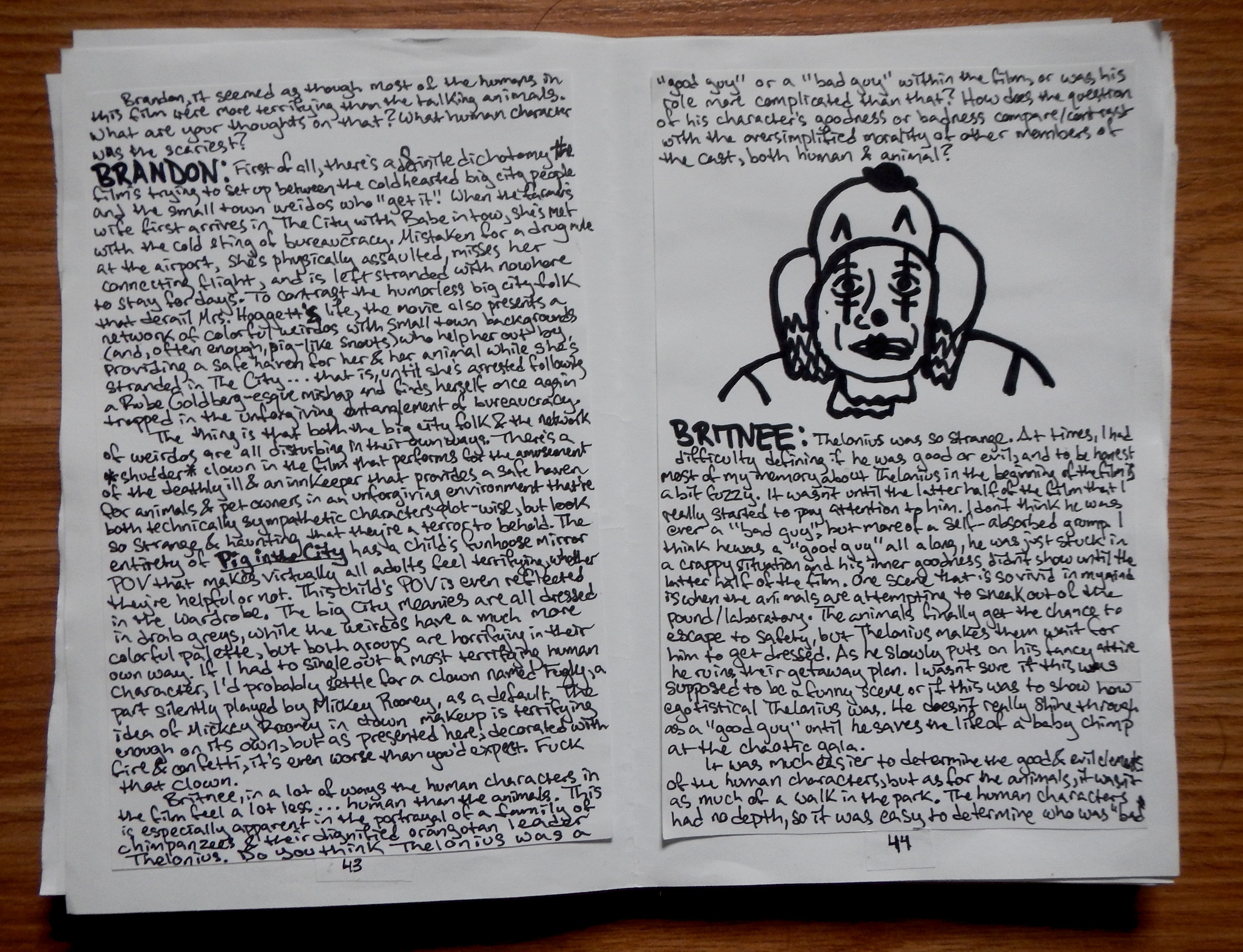
Brandon, it seemed as though most of the humans in this film were more terrifying than the talking animals. What are your thoughts on that? What human character was the scariest?

Brandon: First of all, there’s a definite dichotomy the film’s trying to set up between the coldhearted big city people and the small town weirdos who “get it”. When the farmer’s wife first arrives in The City with Babe in tow, she’s met with the cold sting of bureaucracy. Mistaken for a drug dealer at the airport, she’s physically assaulted, misses her connecting flight, and is left stranded with nowhere to stay for days. To contrast the humorless big city folk that derail Mrs. Hoggett’s life, the movie also presents a network of colorful weirdos with small town backgrounds (and, often enough, pig-like snouts) who help her out by providing a safe haven for her & her animal while she’s stranded in The City . . . that is, until she’s arrested following a Rube Goldberg-esque mishap and finds herself once again trapped in the unforgiving entanglement of bureaucracy.

The thing is that both the big city folk & the network of weirdos are all disturbing in their own ways. There’s a *shudder* clown in the film that performs for the amusement of the deathly ill & an innkeeper that provides a safe haven for animals & pet owners in an unforgiving environment that are both technically sympathetic characters plot-wise, but look so strange & daunting that they’re a terror to behold. The entirety of Pig in the City has a child’s funhouse mirror POV that makes virtually all adults feel terrifying, whether they’re helpful or not. This child’s POV is even reflected in the wardrobe. The big city meanies are all dressed in drab greys, while the weirdos have a much more colorful palette, but both groups are horrifying in their own way. If I had to single out a most terrifying human character, I’d probably settle for a clown named Fugly, a part silently played by Mickey Rooney, as a default. The idea of Mickey Rooney in clown makeup is terrifying enough on its own, but as presented here, decorated with fire & confetti, it’s even worse than you’d expect. Fuck that clown.

Britnee, in a lot of ways the human characters in the film feel a lot less . . . human than the animals. This is especially apparent in the portrayal of a family of chimpanzees & their dignified orangutan leader Thelonius. Do you think Thelonius was a “good guy” or a “bad guy” within the film, or was his role more complicated than that? How does the question of his character’s goodness or badness compare/contrast with the oversimplified morality of other members of the cast, both human & animal?

Britnee: Thelonius was so strange. At times, I had difficulty deciding if he was good or evil, and to be honest, most of my memory about Thelonius in the beginning of the film is a bit fuzzy. It wasn’t until the latter half of the film that I really started to pay attention to him. I don’t think he was ever a “bad guy,” but more of a self-absorbed grump. I think that he was a “good guy” all along, he was just stuck in a crappy situation and his inner goodness didn’t show until the latter half of the film. One scene that is so vivid in my mind is when the animals are attempting to sneak out of the pound/laboratory. The animals finally get the chance to escape to safety, but Thelonius makes them wait for him to get dressed. As he slowly puts on his fancy attire, he ruins their getaway plan. I wasn’t sure if this was supposed to be a funny scene or if this was to show how egotistical Thelonius was. He doesn’t really shine through as a “good guy” until he saves the life of a baby chimp at the chaotic gala.

It was much easier to determine the good and evil elements of the human characters, but as for the animals, it wasn’t as much of a walk in the park. The human characters had no depth, so it was easy to determine who was “bad” and who was “good.” The animal characters were much more confusing, like Thelonius. The wheelchair pup and a couple of other animals at the hotel were pretty rude, and the street animals were pretty heartless (especially that horrible pink poodle); however, they are all viewed as “good” when compared to the humans.

Brandon, I’m having a hard time with remembering details about all of the animals because the amount of important animal characters was a bit overwhelming. Do you feel that the film focused on too many animal characters? Would the film be better with a tighter focus on only a couple of animals?

Brandon: I actually think it’s the depth of the animal cast that makes this film so rewatchable. I’ll admit that on the first run through, I was a little overwhelmed by the endless parade of personalities. There’s the wheelchair bound Jack Russell, the queer dog couple in the matching sweaters, the operatic room of cats, the reformed bully bull terrier, the tragic Southern belle poodle, the Steven Wright-voiced chimp that strangely reminded me of Michael Shannon for no apparent reason, and the list goes on. The thing is, though, that as exhausting as this list can be in the abstract, the movie deftly makes time for each character to have their “moment”. The Jack Russell terrier has his brief trip to the afterlife. The bull terrier has a turnaround in personality after Babe saves his hide. The queer couple literally comes out of the closet during a police raid, etc. I feel like Thelonius was the most well-developed animal personality in the film in that he had so many moments like this that complicated his character, but the rest of the animal cast helped color the world around him that the movie would be all-too-thin without.

The difference between our views on this aspect might be that I found the animal characters much more empathetic than you seemed to. I think it’s interesting, for instance, that you call the pink poodle character heartless, when I think of her as a tragic Blanche DuBois type whose heart is way too big, if anything. Also, the “gag” where Thelonius’ need to dress before escaping the lab didn’t play for me like a jab at his ego that had made him out to be a cold-hearted figure earlier in the film. It was more or a quietly sad deflation of his dignity to me & helped flesh out just how much pained effort he was putting into keep his chimp & clown family together. I think that’s a lot of what Miller was aiming to say with the film. Each animal may seem cruel or selfish on the surface, but they’re all disenfranchised & down on their luck, essentially fighting over scraps (like a stolen jar of candy, for instance) for survival. It isn’t until Babe teaches them that if they’re kind to one another & learn to share their scraps evenly as a community they all have a better chance of survival that the animals let their defensive guards down & start being kind to one another.

Britnee, how effective do you think Miller’s message about the importance of community over the strength of the individual was in Pig in the City? Do you think the alternating scary & goofy strangeness of the film completely overshadowed the film’s message of the importance of solidarity?

Britnee: Honestly, I think the film’s bizarre nature definitely overshadowed any sort of message that Miller was attempting to put out. Even during scenes where the animals began to be more compassionate, I couldn’t help but focus on all of the twisted happenings. You’ve seen this film multiple times, and I think this could be a reason as to why our opinions differ. Because the film’s strangeness was so overwhelming, I had a difficult time paying attention to anything else. Watching Pig in the City for a second time would probably change a lot of my current thoughts about the film.

You do make an interesting point about how the animal characters were struggling to survive, and Babe was a beacon of light in their hard knock lives. Actually, I don’t think I ever noticed how great Babe was until now. He was just a little pig leaving his simple farm life for the very first time, and even though he was put into tons of terrifying and unfortunate situations, he remained brave. His courage and compassion had an impact on just about every character, and this is more than apparent in the film’s final scenes. Of all the great pigs in film, I think Babe is up there with the best of them.

Lagniappe

Brandon: Although George Miller is generally associated with the wanton mayhem of the Mad Max franchise, Pig in the City isn’t nearly as out of touch with the rest of his catalog as you’d expect. There are traces of many of his films lingering in this one, from the bungee chord battle of Beyond Thunderdome to the surreal balloon drop of The Witches of Eastwick to the childish goofery & political ponderings of the Happy Feet films. I’ve slowly come to realize that Pig in the City is far from an outlier in Miller’s career, but more of a gateway film that serves as an unlikely combination of all of his achievements in one aggressively strange package.

Britnee: After reflecting on this Swampchat, I believe there is a lot of heart in this film that I ignorantly overlooked, which is why I really need and want to watch Babe 2: Pig in the City again. It seems that this movie has a reputation for being a little too dark to be considered a children’s film, but I think that it’s a perfect film for children. Real life is nothing like a fairytale, and sometimes you have to make the most of your situation and create your own happy ending. That’s a message that people of all ages can benefit from.

Upcoming Movies of the Month
September: Britnee presents The Boyfriend School (1990)
October: Erin presents Innocent Blood (1992)

-The Swampflix Crew

A Latecomer’s Journey through the Mission: Impossible Franchise

EPSON MFP image

A few months ago I was so blown away by the ridiculous spectacle of the trailers for Furious 7  that I doubled back & watched all seven Fast & Furious movies for the first time ever just to see what it was all about. What I found was a franchise that I had rightly ignored as a teen for being a mindlessly excessive reflection of what has to be one of the trashiest eras of pop culture to date: that nasty little transition from the late 90s to the early 00s. Over the years, though, I’ve developed an affinity for mindless excess & hopelessly dated trash cinema, so 2015 proved to be the perfect time to watch the Fast & Furious movies from front to end. As expected, they started as a disconnected mess of car porn & Corona soaked machismo, but by the fifth film in the series, something intangible clicked & the movies suddenly pulled their shit together, forming a cohesive action universe built on the tenets of “family”, rapper-of-the-minute cameos, and hot, nasty speed.

I can’t say I was equally blown away by the trailers for the latest Mission: Impossible film, Rogue Nation, as I was by Furious 7‘s more over-the-top flourishes, but there was a similar feeling of being left out there. Rogue Nation was to be the fifth installment of a franchise that’s been around for nearly two decades. Despite the ubiquitousness of the image of Tom Cruise suspended from a ceiling in a white room in 1996, I couldn’t remember ever seeing a single scene from the Mission: Impossible films. The Rogue Nation ads suggested a similar trajectory for the franchise as the Fast & Furious films. It seemed like something along the way had finally clicked for the series, like it now had its own mythology & core philosophy, which is a feeling I’ve never gotten before from the outside looking in. My mission, should I choose to accept it (that’ll be the last time I make that awful joke, I promise) was to come to know & understand the series from the beginning, to figure out exactly what’s going on in its corny super spy mind, the same way I became part of Vin Diesel’s “family”. It turns out that  the story of the Mission: Impossible series is the story of five wildly different directors adopting five wildly different plans of attack on a franchise that didn’t really come into its own until at least three films in.  It’s also, to an even greater extent, the story of Tom Cruise’s fluctuating hair length.

Listed below, in chronological order, are all five feature films in the Mission: Impossible franchise as seen through my fresh, previously uninitiated eyes. Each entry is accompanied by brief re-caps of its faults & charms, but also has its own individual full-length review, which you can find by clicking on the links in the titles themselves. If you are also looking to get initiated into the Mission: Impossible world yourself, but wanted to skip the franchise’s classy-trashy beginnings, I highly recommend starting with the third installment & only doubling back to the first two films if your curiosity is piqued by the heights of the most recent three.

Mission: Impossible (1996)
EPSON MFP imagethree star

What I found at the beginning of the Mission: Impossible saga was unexpectedly classy. This was a retro action movie starring (a pre-Scientology-fueled couch-jumper) Tom Cruise when he still defined what it meant to be Movie Star Handsome. This was 1996, a beautifully naive stretch of the decade before we let rap rock ruin America. This was a dumb action movie with a classic score by Danny Freakin’ Elfman, for God’s sake. These days it’s difficult not to meet news of an old TV show getting a big screen adaptation with a pained groan, but back in its day Mission: Impossible was kind to its source material (despite fans of the original series grousing at its initial release), obviously holding immense respect for the era it came from, while still updating it with a certain amount of mid-90s badassery. Mission: Impossible is essentially a mere three ridiculous action sequences & some much less exciting connective tissue, but there’s plenty of camp value to be found at the very least in its super spy gadgetry. For instance, despite the obviously technically proficient world of international super spies detailed here, they’re all fighting over possession of a floppy disk, a very era-specific MacGuffin that really takes me back. Besides this goofery, there’s also a truly ludicrous scene where a helicopter chases a train into a tunnel, there’s a lot of mileage squeezed out of the high tech masks that allow characters to rip off their faces & become other people, and the infamous Tom Cruise hanging from the rafters sequence features a lot more puke than people typically mention. All of this and Ving Rhames. I cannot stress how much Ving Rhames’ mere presence brings to the table, camp wise.

In the director’s chair: Movie of the Month veteran Brian De Palma, who can be credited for elevating this film above the typical 90s action flick through his ludicrously excessive camera work & lack of visual restraint.
A note on Tom Cruise’s hair: Short, conservative, handsome. This may not seem important yet, but I swear it will be soon enough.

Mission: Impossible 2 (2000)

EPSON MFP imageonehalfstar

It turns out that the rap rock garbage fire I was expecting from the first film was actually alive & well in the the second installment of the series, Mission: Impossible 2. M:I-2 ditches the Brian De Palma sense of 60s chic for a laughably bad excess of X-treme 90s bad taste. Almost everything pleasant about the first Mission: Impossible film is absent in the second. De Palma’s over-the-top abuse of camera trickery is replaced by straight-faced action movie blandness accompanied by non-sarcastic record scratches. Any enjoyment derived from the removal of faces in the first film is ruined here by an unrestrained overuse of the gimmick. The Danny Elfman score from the first film was supplanted by (I’m not kidding, here) a goddamn Limp Bizkit cover of the series’ original theme. Even Tom Cruise’s wardrobe was downgraded. He traded in his tux for a leather jacket that he shows off on his super cool motor bike while shooting his gun with wild abandon. God, I hate this movie. Pretty much the only element of the first film that comes through unscathed is Ving Rhames, who remains a delight in every scene he’s afforded.

In the director’s chair: John Woo, who takes such a strong grip on the franchise’s throat that it feels a lot more likely that this is a spiritual sequel to his Nic Cage trashterpiece Face/Off than it having anything to do with Brian De Palma’s film at all.
A note on Tom Cruise’s hair:  Along with Cruise’s douchier wardrobe, he also adopts a much less respectable hair length that allows his greasy locks to flow in the wind as he slides around on his motorbike & jams to Limp Bizkit. Blech.

Mission: Impossible 3 (2006)

EPSON MFP imagethreehalfstar

It’s difficult to imagine a better corrective for John Woo’s rap rock shit show than the third installment that followed it a whopping six years later. Mission: Impossible 3 opens with a beyond terrifying Phillip Seymour Hoffman moving Tom Cruise’s super spy hero Ethan Hunt to tears while torturing him for information. This moment of intense vulnerability is a far cry from the second film, which was more or less a chance for Cruise to pose as a late 90s badass so X-treme that even his sunglasses exploded. In Mission: Impossible 3, Ethan Hunt becomes a real person for the first time. He’s not Tom Cruise dressed up like a handsome super spy like in the first film or a irredeemable hard rock douchebag like in the second. He’s a vulnerable human being locking horns with a nightmare-inducing Hoffman, who knows how to exploit his weaknesses to get what he wants. Like when the fifth Fast & Furious film discovered its heart in Vin Diesel’s longwinded ramblings about “family”, Mission: Impossible 3 finally pushes the series into a sense of cohesion by reducing its protagonist from an action movie god to a regular dude with a dangerous job. It’s clear how much Mission: Impossible 3 is trying to return to its roots & find itself as early as the opening credits, which bring back the original arrangement of the movie’s theme (as opposed to the Limp Bizkit abomination). What ups the ante here, though, is a one-for-the-record-books performance from Hoffman that elevates the material just as much as Werner Herzog did for that other super soldier Cruise flick Jack Reacher. Hoffman is pure terror here & the movie knows how to put that element to great use. There’s even a scene where, thanks to face-ripping-offing technology, two Phillip Seymour Hoffmans engage in a fist fight in a bathroom. Two Hoffmans! I wasn’t even expecting one, so that was a genuine treat. Bonus points: this film features the most Ving Rhames content of any Mission: Impossible film to date.

In the director’s chair: JJ Abrams, who had only worked in television before rescuing this troubled project from developmental Hell (at one point David Fincher was attached to direct!?). Abrams not only pulled this series’ shit together against the odds, but he also found a way to make the film’s escapist, popcorn movie action clash effectively with its more disturbing elements, specifically Hoffman’s personification of terror.
A note on Tom Cruise’s hair: Much like the movie as a whole, Cruise’s hairdo ditches the embarrassing crudeness of the second film & returns to the handsome tastefulness of the first. I’m telling you; this hair stuff is important.

Mission: Impossible – Ghost Protocol (2011)

EPSON MFP imagethreehalfstar

The Mystery Behind the Highway to Hell (1991) Soundtrack

EPSON MFP image
As I previously mentioned in the Highway to Hell Swampchat, the film’s soundtrack is bananas, and I’ve never heard anything quite like it. The best way to describe the sound is r&b vocals with 80’s pop/rock music, but the vocals are more like soulful grunts instead of actual words. The group responsible for all of this insanity is Hidden Faces, and this group is just as mysterious as their music. Researching Hidden Faces wasn’t so easy because there’s virtually nothing out there about this group, but I was able to find some interesting information.

Frank Fitzpatrick founded Hidden Faces in 1989, and the group strictly did soundtracks and scores for movies. Highway to Hell, Nuns on the Run, Breaking the Rules, Friday, Under the Hula Moon, The Player’s Club, and Soul Man are all films that feature Hidden Faces tunes. Nuns on the Run seems fantastic, so I have Hidden Faces to thank for bringing it to my attention. In the film, Eric Idle is a criminal disguised as a nun, and that’s all it took for it to make it onto my watchlist. Come to think of it, the only film that I’ve seen from this eclectic film collection is Friday, and if I recall correctly, the music was totally different from the music in Highway to Hell. I guess that’s common for artists in the film score/soundtrack business. Unfortunately, Hidden Faces called it quits in the late 90s, so it’s doubtful that they’ll be doing any movie soundtracks again.

It turns out that Hidden Faces has a connection to New Orleans, though. Not only is Fitzpatrick a songwriter, producer, and certified yoga instructor, he is also a major social entrepreneur that raised funds and awareness for Hurricane Katrina victims. In particular, he produced a song called “Be On Our Way” with Van Hunt, Supervision, Buku Wise, and Hidden Faces for the film Hurricane Season, a film that follows the story of John Ehret High School’s basketball championship journey post-Katrina. All of the proceeds made by the song were donated to the Make It Right Foundation.

I’m actually pretty surprised to find that Hidden Faces is more than just a growling man and a drum machine. They actually have a very interesting history that’s much lengthier than I expected. This is all the more reason to pay close attention to film credits, even the ones in horrible movies.

For more on July’s Movie of the Month, Ate De Jong’s 1991 action comedy Highway to Hell, check out our Swampchat discussion of the film, our look at De Jong’s other (more successful) 1991 cult classic Drop Dead Fred, and last week’s query of exactly why Jerry Stiller’s entire family appeared in the film (their only full-family appearance outside The Independent).

-Britnee Lombas

Marabunta Cinema: Eight Feature Films & Eight Television Episodes about Killer Ants (2nd Ed.)

EPSON MFP image

When I first reviewed the 1974 oddity Phase IV, I noted that the film was very different from what I would have expected from a sci-fi movie about killer ants. When I pictured the film in my mind I imagined the gigantic monster insect movies from the 1950s, when everything from leeches to adorable bunny rabbits were blown out of proportion by atomic radiation and turned into Godzilla-type suburban threats. Phase IV turned out to be a much stranger film than I pictured, but my hunch wasn’t far off. The 1954 creature feature Them! is widely credited as the very first of the 1950s nuclear monster movies as well as the first “big bug” movie ever. Them!, like Phase IV, also happens to be about murderous ants. It turns out that the tiny pests have served as an endless source of cinematic fascination over the past 60 years, racking up eight feature films and several television episodes since Them!’s initial release. There are definite patterns & tropes common to the way killer ants, often called “marabunta,” are portrayed in cinema, but the quality of the tactics & results vary greatly from film to film. Them! & Phase IV certainly represent the apex of the killer ants genre, but they don’t capture the full extent of its capabilities.

Them! (1954) EPSON MFP imagefourhalfstar

If Them! is the very first nuclear monster & big bug movie of the 1950s, it was an impressively prescient one. So many of the films that followed borrow so much from its essential elements that it basically serves as a Rosetta Stone for the marabunta genre. For instance, the film opens with a child in danger. A young girl, newly orphaned, roams the desert alone, in a state of shock after witnessing her family being murdered by “Them! Them! Them!” (a titular line she shrieks in horror when prodded for details). Children in danger is a surprisingly common theme for a lot of the marabunta films to come, along with the desert setting, and their roots are established in Them!’s opening minutes. Other tropes, like attempting to destroy the hive by attacking the Queen’s chamber, the use of nature footage as a scientific lecture on ant behavior, the ants’ high-pitch squeaks, and the blaming of pollution (in this case nuclear fallout) as the cause of the ants’ size & behavior would be frequently echoed in the 60 years that followed. What was most prescient of all, however, was just the basic concept: killer ants. No killer bug movies (as we know them) preceded it, but plenty followed and Them! is truly the pioneer of them all.

When I first imagined what Phase IV might be like, I was actually imagining Them! I pictured late night, black & white schlock (in the same vein as The Brainiac or Frankestein Meets the Space Monster) about giant killer bugs with an atomic age metaphor attempting to justify its true purpose: giant ant models, hairy like gorillas & eager to kill. When a scientist opines in the final scene, “When Man entered the Atomic Age, he opened the door to a new world. What we may eventually find in that new world, nobody can predict,” it feels more like an afterthought than anything else. The gigantic ant models were obviously a point of focus for the filmmakers and it paid off well. They look fantastic, never to truly be topped by the killer ant films that followed. It’s also a testament to Them!’s quality that the tension building atmosphere in its first act is still strikingly effective despite modern audiences knowing what the “they” in Them! are long before they grace the screen. Them! may be the standard execution of what a killer ants movie would look like, but it’s extremely well crafted for its pedigree and deserves to be respected as a pioneer in the natural horror genre at large, much less marabunta cinema.

Ant size: “They” are gigantic.
Fire delivery method: In almost all of the marabunta movies, the ants are attacked with fire through various methods. This practice, like many other tropes mentioned, can be traced back even to the original marabunta movie, Them! In Them!, fire is initially delivered to the giant ants through bullets & rocket launchers, but it’s the use of flame throwers that ultimately save the day, as will become a popular choice as the genre marches on.

The Naked Jungle (1954) EPSON MFP imagethree star

If Them! is the Rosetta Stone of marabunta cinema, The Naked Jungle is its furthest outlier, the most difficult film to read in the context of the genre. Released the same year as Them!, The Naked Jungle refuses to play along with its killer ants compatriots even in the most basic terms of genre. Instead of working within a horror context, The Naked Jungle is an old-fashioned big studio romance epic where the killer ants are a natural disaster not very distinct from a flood or a landslide. The movie is mostly a vehicle for (a mostly shirtless) Charlton Heston & (a similarly undressed) Elanor Parker, who star as a South American cocoa plantation owner and his mail order bride (shipped to him via New Orleans!) whose personalities are too big & too stubborn to mix cohesively. Their initial hatred of one another is palpable in quips like “I’m trying not to irritate you.” “I noticed that. I find it irritating,” and in a key exchange when Heston is upset that his new bride is a widow instead of the virgin he requested and she retorts “If you knew more about music, you’d know that a piano is better when it’s played.” This dynamic, of course, gradually shifts from hostile to sensual and the sweaty (it is South America, after all) tension between the two drives a lot of the movie’s runtime.

Then, in the last third of the film, the ants arrive. Millions of ants. Not the gigantic, atomic ants of Them!, but rather a hoard of regular army ants, marabunta. They’re described in the film as “40 square miles of agonizing death” that operates as an organized, trained army. The initial horror of the ants picking a skeleton clean is a bit goofy & melodramatic, but once you get to the real shots of real insects crawling all over actors’ very real skin, it actually gets pretty disturbing. Some of the painted backdrops & dialogue in The Naked Jungle are unfortunate. Its depictions of native savages that depend on Heston’s white man knowledge to survive are especially disappointing. However, it’s a mostly enjoyable movie that, thanks to Heston & Parker’s love/hate dynamic, feels like a Tennessee Williams play drowning in marabunta, which distinguishes it from every other film in the genre.

Ant size: Regular.
Fire delivery method: There’s some torch tossing & explosives use, but the fire that matters the most in The Naked Jungle is the fire burning in the two leads’ loins.

Outer Limits: “The Zanti Misfits” (1963)

EPSON MFP imagethreehalfstar

As if murderous insects made gigantic by nuclear fallout weren’t strange enough, this is where the marabunta genre takes a bizarre left turn. In its inaugural season of television, The Outer Limits tried to prove itself to be more than just a hard-sci-fi answer to the much looser The Twilight Zone. Its hour long episodes often had enough big ideas & practical effects to support a decent feature-length B-picture if they had just been stretched a little further. The episode “The Zanti Misfits” certainly had potential to support a longer runtime based on the scope of its ideas alone. At the very least, it came up with a creative reason as to why its killer ants would be so murderous & destructive in the first place. No other marabunta picture I’ve seen put nearly as much thought as to the ants’ motivation for killing.

Well, “ant” is a little bit of a misnomer in this case. As the story goes, a superior extraterrestrial race named The Zanti demands that Earth host a penal colony for its most undesirable criminal population, in other words, its misfits. The Zanti are very much ant-like in their appearance, but with the enlarged size of an average rodent & the horrifying detail of their humanoid faces. Most of the Zanti population are supposedly a peaceful group, but what arrives on Earth is their criminal throwaways, so, of course, chaos ensues as they attempt a prison break & the U.S. military guns them down. Discontent to merely thank Eathlings for doing them a favor, Zanti officials instead gloat that they’re far superior to our bloodthirsty nature as “practiced executioners” and any gratitude that could be detected is severely muddled. With its stop-motion animated humanoid ants, hand-made UFO models, and oldschool sci-fi moralizing, “The Zanti Misfits” is a neat little addition to the marabunta genre, as well as one of its strangest concoctions.

Ant size: About the size of a rat.
Fire delivery method: Liberally tossed hand grenades.

Phase IV (1974)EPSON MFP imagefourstar

I’ve already dropped almost 700 words on Phase IV, so I’ll try to keep it brief here. It’s almost as much of an marabunta outlier as The Naked Jungle due to its reluctance to adhere to a traditional monster movie format. However, instead of framing itself as a romance epic, Phase IV is posited as psychedelic sci-fi. Droning, loopy synths accompany the movie’s expertly manipulated nature footage to create a strange world where ants evolve at astounding rates, learning to systematically destroy their predators (including humans, of course), dismantle electronics and weaponize reflected light. In most films listed here, the nature footage is less-than-seamlessly integrated into the plot by means of scientific lectures or Ed Wood-esque asides, but in Phase IV it’s integral to the film’s narrative. The extensive, close-up ant footage provides a disturbing authenticity to the film’s story of an insect takeover. In a lot of ways the ants in Phase IV are much more convincing actors than their human co-stars.

There’s some campy appeal to the pseudo-science of Phase IV’s bleep bloop machines and (its somewhat prescient) hazmat suit aesthetic, but the film is for the most part genuinely successful in being a sci-fi creep-out. The killer, droning synths are a large part of this success, as they add an otherworldly atmosphere to the already alien-looking close-ups of the marabunta. Also unnerving is the film’s somewhat open ending, which was cut short by the film studio for its pessimism & psychedelia. The threat of the ants in Phase IV feels truly insurmountable and, well, it very well may be.

Ant size: Regular.
Fire delivery method: No fire at all, which very well might explain the pessimism of the conclusion. In fact, the ants deliver fire of their own when they all-too-wisely convert a pick-up truck into a homemade bomb.

Empire of the Ants (1977) EPSON MFP imagetwohalfstar

If Them! & Phase IV are the prime examples of the heights marabunta cinema, Empire of the Ants is an entertaining sample of its depths. With production, direction, and visual effects all provided by shlock peddler Burt I. Gordon, Empire of the Ants shares a lot with the (much more fun) killer rabbits movie Night of the Lepus, both good & bad. For example, the exact dimensions of the ants fluctuate from scene to scene, depending on the technique used to make them appear large (which includes over-sized props and rear projection trick photography). That variation in the ants’ exact size & shape does wonders for the film’s camp value, but the dialogue that surrounds it (including a performance from why-are-you-here? Joan Collins) deflates a lot of its charms. It also doesn’t help that there are no killer ants in the first third of the film, so the dialogue is all you have to chew on. Much like with Night of the Lepus, Empire of the Ants has a disturbing habit of playing into old-fashioned genre clichés, but in this case it tips the film firmly in the direction of pure boredom. It’s incredible that Empire of the Ants was released three years after the much more experimental Phase IV, as it feels like an ancient dinosaur by comparison.

As far as hitting the marabunta genre touchstones goes, Empire of the Ants is fairly sufficient. It gets the nature footage requirement out of the way as soon as the opening prologue, with an off-screen narrator warning the audience, “This is the ant. Treat it with respect, for it may very well be the next dominant lifeform on our planet.” Much like with other marabunta movies, the ants were mutated into their monstrous form through radioactive waste, there’s a reliance on a hazmat suit aesthetic to lend the film sci-fi authenticity, and there are a multiple shots taken from the ants’ perspective, or “ant cam” if you will. In this film, the ant cam is represented as concentric circles, as opposed to the honeycomb look employed in Phase IV, but the effect is more or less the same. There are even some innovations to the marabunta genre in the plot’s focus on the queen ant’s obedience-inducing hormones that command humans to do her evil bidding. I also appreciated Empire’s pedigree as a shameless Jaws knock-off, with not so subtle nods to the Spielberg film’s infamous score in its soundtrack. Despite how entertaining all that sounds, however, Empire of the Ants mostly feels like a slog, struggling to recover from the opening segment where the dialogue endlessly drones on about valuable real estate and all kinds of other who-cares nonsense. As a collection of alternately impressive & inept practical effects, it’s an entertaining mess; as a feature-length film it’s a chore.

Ant size: Gigantic, but seemingly fluctuating from scene to scene due to the varied methods of Gordon’s visual effects.
Fire delivery method: Explosives used to blow up the sugar mill where the ant queen prefers to dine. Pretty smart.

Ants! (1977) EPSON MFP imagethree star

Ants! (also known as It Happened at Lakewood Manor & Panic At Lakewood Manor) marks the beginning of the killer ants’ genre being tethered to the small screen, a format they’ve been unable to escape for nearly 40 years running. A made-for-TV movie starring Suzanne Somors, Ants! is an admittedly awful film, but one with enough melodrama and laughably bad acting to make it work as a campy pleasure. It plays like a Lifetime Original Movie about a family struggling to hold onto their hotel resort in the modern business word (with swarms of killer ants playing mostly as an afterthought). In addition to the new made-for-TV-movie format, Ants! also introduces the marabunta genre to a new plot structure, framing its story as more of a disaster movie (like Towering Inferno or Airport 1975) than a creature feature (like Them!). The ants that plague Lakewood Manor are treated collectively as a natural disaster (something only hinted at before in The Naked Jungle), not an aggressive hoard of tiny monsters. As explained by a mid-film science lecture (again, with accompanying nature footage) this widespread disaster was created by the ants’ exposure to increasingly strong pesticides. According to the film’s resident killer ants expert, “We’re the ones that forced them to live in a toxic world,” which prompted the ants to absorb our pesticides and weaponize them as their own poisons. His audience’s horrified reaction to this news? “I don’t like it.” The film’s ridiculous dialogue saves it from the doldrums of Empire of the Ants, even though Empire had much better practical effects for its marabunta. If only they had combined those two elements, we’d have a veritable cult classic on our hands.

As cheesy as the dialogue is in Ants!, the sheer swarms of insects that accumulate actually make for an unnerving climax. The characters’ plan to survive the natural marabunta disaster is to remain motionless, allowing the bugs to crawl all over their skin. It’s legitimately terrifying (and more than a little gross) and I hope the actors were well compensated, even if those were sugar ants. There was also a return to endangered (and, for the first time, harmed) children in Ants!, something that’s rare in any horror film and hadn’t graced the marabunta screen since the likes of Them! On the cultural relic front, there’s an unexpected appearance from Brian Dennehy and it’s surprisingly entertaining to watch ants crawl all over Susanne Somers. Ants! is far from the most memorable film in its genre, but it does have its own corny charms as a made-for-TV trifle that features bugs crawling over a Three’s Company castmember’s half-dressed body. Blech.

Ant size: Regular
Fire delivery method: A flaming, hand-dug pool of gasoline meant to keep the ants at bay.

MacGyver: “Trumbo’s World” (1985) EPSON MFP imagetwostar

What can I say? I’ve never seen a MacGyver episode before “Trumbo’s World” so I have no idea how its quality compares to others. MacGyver’s preposterous, makeshift gadgets were amusing, there was some hilarious pseudo-science in lines like one describing a substance as nitroglycerin’s “chemical kissing cousin”, I genuinely loved the nifty soft synth soundtrack, and there were a couple great one liners like when MacGyver drowns a gang of “bad guys” and quips, “Chances are, those guys are all washed up.” For the most part, though, I still consider myself more of a MacGruber guy at heart. There just wasn’t much here worth going out of your way for, especially since the episode plays like a cover version of The Naked Jungle.

At first I thought the similarities to The Naked Jungle were incidental, due to the shared setting of a South American wilderness and, of course, the swarms of killer ants, but as the coincidental resemblance started to build I began to notice exact images borrowed wholesale from the Heston-Parker romance epic. The plantation-owner-refuses-to-leave-without-a-fight plot, the fleeing animals, the increasingly uncomfortable (still, 30 years later) depictions of native savages were all way to close to The Naked Jungle to be pure coincidence, but then exact footage lifted from the film, including both ant attacks and action shots of Heston-from-behind, sealed their connection. I’m not sure if all MacGyver episodes are cover versions of old movies hardly anyone remembers, but I’ve definitely seen the likes of “Trumbo’s World” before—and not that long ago.

Ant size: Regular, same as The Naked Jungle.
Fire delivery method: Flame thrower. Solid choice.

Skysurfer Strike Force: “Killer Ants” (1995) EPSON MFP imagethree star

In sharp contrast with the I’ve-seen-this-all-before familiarity of “Trumbo’s World”, the animated television show Skysurfer Strike Force plays like nothing I’ve ever encountered in my life. Its 1990s Saturday morning cartoon aesthetic is certainly familiar to me, especially as a decorated survivor of such dire properties of that era as Street Sharks and Captain Simian & The Space Monkeys, but there’s still something special about Skysurfer Strike Force’s lunacy in comparison. It’s one of those total shit-shows whose basic concept is difficult to capture in critical description so I’ll just urge you to see it for yourself in the YouTube clip of its intro and this Wikipedia-provided plot description: “The show featured five heroes, named the Skysurfers, which protected the world from the vile Cybron and his bio-borgs. The Skysurfers used technologically advanced watches that transformed them from their casual clothing to their battle attire and weapons, similar to the Choujin Sentai Jetman. During the transformations, their cars transform into rocket-powered surfboards that they can ride in the air.” It’s wickedly entertaining in its unnecessarily complicated mythology & complete detachment from reality.

As promised in its succinct title, the episode “Killer Ants” finds Skysurfer Strike Force joining the marabunta genre. Early in the episode gigantic ants (as in the size of dogs, not elephants) attack an unsuspecting truck driver on a mysterious late night highway, foreshadowing the evil Cybron’s world-domination-scheme-of-the-week. You’ve got to hand it to Cybron; for a cyborg supervillain he’s got some fresh ideas. Must be the stolen computer-brain. His plot to rule us all with killer ants was conceived as the perfect crime, as everyone would assume the ants were a natural disaster that he himself could not be blamed for. Pretty smart, as well as a wholly unique approach in the marabunta genre. The episode adds other unique details like the ants communicating through vibrations (instead of the usual pheromone route in other titles) and that instead of being killed when eventually conquered, they’re made to perform as circus animals. Skysurfer Strike Force may on the surface seem to be a half-assed children’s show bankrupt of any nourishing value, but it’s actually packing an excess of ideas & face-value virtues that add a surprising amount of new developments to both the marabunta & half-baked 90s children’s cartoon genres.

Ant size: Gigantic, but not too gigantic. Mid-sized giant ants.
Fire delivery method: Rocket launchers & tanks.

Goosebumps: “Awesome Ants” (1998) EPSON MFP imagetwohalfstar

Goosebumps gets by on charm more than it does on fresh ideas, bucking the unexpected quality jump in Skysurfer Strike Force. A live action television show based on the popular children’s book series, Goosebumps fits snuggly among the ranks of several sub-X Files monster of the week children’s properties of the 90s—shows like Eerie, Indiana & Are You Afraid of the Dark? In the episode titled “Awesome Ants” the monster of the week is, you guessed it, gigantic killer ants.

Ordered through the mail from a nefarious back-of-a-magazine company, a child’s ant farm science project gets out of control when he overfeeds his population (despite a pamphlet’s specific warnings not to, of course). The resulting killer ants are surprisingly well visualized, using a multi-faceted, Empire of the Ants kind of approach that combines over-sized props and green screen gimmicks to create the menace. This is all mildly amusing here or there, but what really sets this episode apart from any other installment in the marabunta genre is its wicked, Twilight Zone conclusion where (spoiler) the kid wakes to find himself as part of a human farm run by even larger ants, the tables having been turned. I gotta admit, that’s pretty “awesome”.

Ant size: Gigantic, and then even more gigantic.
Fire delivery method: None, which again might explain why the ants won.

Legion of Fire: Killer Ants! (1998) EPSON MFP imageonehalfstar

Starting with the Suzanne Somers melodrama Ants!, marabunta cinema has seemingly been banished to television purgatory for its sins of repetition. Not helping the case for the genre at all is the made-for-TV snoozer Legion of Fire: Killer Ants! (also known simply as Marabunta). Legion of Fire was not made for just any TV, mind you; it was made for late-90s Fox, which has to be the most tasteless era of television in this writer’s (admittedly limited) memory. Getting some of that trademark Fox Attitude (as well as the nature footage trope) out of the way early, the film opens with the gall to claim that “This is not science fiction. This is science fact. The story you are about to see could happen tomorrow.” It could. It most likely never will, but I guess it could. It already takes some considerable hubris to posit a made-for-TV monster movie starring “Skinner” from X-Files & “that dude” from Caroline in the City as “science fact”, but the claim becomes even more preposterous as soon as the first kill, which features a newlywed couple on a hike being physically dragged into the depths of an over-sized ant pile. Nice. Even in its opening minutes Legions of Fire can’t decide if it wants to be a believable scare film about South American ants (likened to the era’s similarly-feared “Africanized bees”) or an absurd sci-fi monster movie. Frankly it fails to be entertaining as either.

Legion of Fire’s dialogue is mostly of the dull, Empire of the Ants variety, with a couple isolated gems like “I never met a bug I didn’t like,” and “And my mom used to say that being an etymologist would be boring . . .” There’s also some limited camp value in a few action scenes like when an (endangered!) child is dragged into a hive or a pilot thrashes about as if the film’s CGI ants are actually eating his face, leading to one of the most slowly-progressing helicopter crashes I’ve ever seen in a movie. Speaking of the CGI, Legion of Fire’s most depressing development is that the golden era of practical effects is firmly in the rearview, giving way to shoddy CGI ants carrying even faker-looking human body parts on their not-real-at-all backs. It’s no surprise, then, that the most fun the film has with its premise is in the practical effects when the killer ants drag people into the gasoline filled holes meant to set the colony ablaze, followed promptly by explosions. If I could pick out one thing Legion of Fire needed more of, it’s people being dragged into holes and then exploding, not Windows screensaver-quality insects “crawling” all over some nobody’s horrified face. Legion of Fire is a disheartening low point for the marabunta genre, easily the most unimaginative feature film in the bunch—even if it is “science fact”.

Ant size: Regular, but seemingly fluctuating from scene to scene due to the cheap CGI.
Fire delivery method: Flame throwers & exploding, gasoline-filled holes.

The Bone Snatcher (2003) EPSON MFP imagetwohalfstar

The Bone Snatcher was a promising improvement from the dire viewing experience of Legion of Fire (which is one I hope to never repeat), but it’s an ultimately disappointing film when considered in its own right. It was the first & only marabunta movie not made for television in the near-three decades since Empire of the Ants, but since it was released straight-to-DVD it’s somewhat of a hollow victory. The Bone Snatcher is an Alien-esque creature feature that opts more for tension building than it does for a body count, which is a frequent mistake for low-budget horror. Look, everyone loves Alien, but there’s a reason why it’s one of the most memorable horror/sci-fi films of all time. It’s an extremely well made and handsomely budgeted film that a lot of independent horror movies just aren’t going to be able to replicate. The Bone Snatcher’s failed attempt at Alien-levels of tension instead of a high body count gore fest is particularly disappointing because the film’s creature looked so cool and was obviously cheap to film (thanks to CGI). There just wasn’t enough of it onscreen to make the film recommendable.

The creature in question here is a gigantic sasquatch-looking specter that, upon closer inspection, reveals itself to be a collection of highly-organized killer ants that collect to form a single gestalt being, a “bone snatcher” if you will. The title of “bone snatcher” is afforded to this ants-monster through its affinity for using the remains of its victims as a structural support for its gigantic, undulating body. Sometimes the bone snatcher even wears the face of its victims (literally), which is disturbing enough even when that face isn’t spitting out a stream of ants. The unnerving & clever physical attributes of the bone snatcher itself made want to love the film that surrounded it, but there’s just not much there to love. Borrowing some of the hazmat suit & militaristic desertscape aesthetic from marabunta pioneers like Phase IV, the film has a little bit of spooky atmosphere to work with, just not enough to carry the film on its own.

There are also some new touches added to well-established marabunta tropes, like picked-clean bones (common as far back as The Naked Jungle) now being stained red from blood and the ant cam POV (offered in Empire of the Ants & Phase IV), now looking like a sepia-tone brethren of the Vin Diesel sleeper Pitch Black. There’s also some disturbing gore that arrives with the appearance of the bone snatcher, including skin being carried off by endless floods of ants and muscle melted off the bone by their toxins. The problem is that it’s too little too late and much of the film’s action is pushed off until the final half hour of the runtime. The tension-building atmosphere is competent, but not nearly entertaining enough to carry a film whose best quality is its creature design. If the film had let its freak flag fly and given the titular bone snatcher more time in the sun it could’ve been something really special. Instead it was mostly a well-intentioned bore with a few admirably disturbing ideas.

Ant size: Regular, but coming together to form a gigantic gestalt creature.
Fire delivery system: None. The bone snatcher’s victims opted for stabbing instead, probably due to limited resources.

Atomic Betty: “Atomic Betty Vs the Giant Killer Ants” (2004) EPSON MFP imageonestar

If Legion of Fire is the moment when CGI unfortunately makes for lazy live-action filmmaking in the marabunta genre, Atomic Betty is where it similarly sinks animation. Taken at face value, I appreciate that there’s a children’s show (and we’re talking super-young children) within which a female moppet of a superhero periodically saves the world from 50s style B-movie plots, taking her assignments from a talking fish. If there were an actual 1950s movie called Atomic Betty Vs the Giant Killer Ants you’d be safe to bet I’d be eating that schlock up greedily. As a lazily-animated, mid-2000s cartoon the prospect is less tantalizing. There’s really nothing of interest added to the marabunta genre here. Betty is told by her fish boss that there are some killer ants on the loose (made gigantic by “multi-plasma nectar”), she flies over, and then puts a stop to the threat post haste. I hope it was riveting for its pint-sized target audience, but for our purposes here it doesn’t have much to add to the marabunta genre, outside of maybe the “multi-plasma nectar”. I’ve never heard that one before.

Ant size: Gigantic, duh. It’s right there in the title.
Fire delivery method: None. Nothing of interest here at all.

The Hive (2008) EPSON MFP imagethreehalfstar

There was a truly disheartening quality to the arrival of the CGI slog Legion of Fire. It felt in a lot of ways like the party was over, like it was the end of an era where campy practical effects can save an otherwise hopeless affair like Empire of the Ants from devolving into sheer boredom. The Bone Snatcher teased the possibility that the marabunta party was indeed still raging on, putting the CGI to good use by creating a physically impossible gestalt monster out of millions of computer-generated insects. There just wasn’t enough of the monster on screen to fully make it an essential piece of marabunta cinema. Made just five years later, The Hive seemingly learned from that mistake, pushing the ridiculousness allowed by CGI to its full limits, throwing out as many ridiculous ideas as it can, given the time & budget. Where The Bone Snatcher held back on the on-screen ants and mistakenly attempted atmospheric tension, The Hive knows its limits and offers as many cheap thrills as it possibly can while it lasts.

The most surprising thing about The Hive’s likeability is that it was not only made-for-TV, but it was made specifically for the Syfy Channel, which has a long record of offering bland, empty CGI schlock that features long stretches of boring dialogue and a few short scenes of sci-fi action. The Hive, by contrast, bends over backwards to entertain. It might not be the most unique film listed here, but it borrows so much from so many sources that it’s a very fun experience, one that feels well informed of its marabunta ancestry. For example, just like in other marabunta films, The Hive features children in danger, but it goes a step further by featuring the youngest endangered child yet: a baby. In the opening scene a baby is successfully eaten by a swarm of killer ants. It’s quite the introduction. The movie also plays off of the hazmat suit trope and includes the genre’s required nature footage (this time with mixed with news reports about rampaging swarms of killer ants). Best of all, it returns to the collective, gestalt creature of The Bone Snatcher, but this time the ants form all sorts of shapes: tentacles, constellations, functioning computers, and most entertaining of all, a gigantic ant made of tiny ants.

The Hive survives on the charms of its excess. It just has so many dumb ideas: liquid nitrogen cannons, ants controlling people’s minds, an evil corporation called Thorax Industries, and the idea that the marabunta are controlled by an insect spirit from outer space (seriously). Most important of all, though, it has an excess of ants, easily the most ants out of any film listed here, so many ants that they just fall from the sky in solid blankets of ant rain. Legion of Fire felt like the death of marabunta cinema, while The Hive felt like its unexpected (and so far unanswered) rebirth. It was the rare occurrence in cheap horror where CGI allows the film to push itself do so much more, instead of getting by on doing less.

Ant size: Regular, except for that gigantic one made of regular ones.
Fire delivery method: Flame throwers & a suicide bombing

Phineas & Ferb: “Gi-Ants” (2012) EPSON MFP imagetwohalfstar

Just as formally inconsequential as Atomic Betty, Phineas & Ferb at least one-ups the computer animated competition in the freshness of its ideas. In the episode “Gi-ants” the titular stepbrothers gather their neighborhood cronies (I really know so little about this show) together to come check out their latest quixotic scheme (again, so little): a gigantic ant farm that the kids can tour as a sort of museum. The purposefully-created “gi-ants” in this ant farm never become murderous despite their incredible size. Instead, their presence is menacing only because they mutate at an alarming rate, evolving from a hunter-gatherer society to an agricultural one to their own Industrial Revolution to the information age to total transcendent enlightenment (which I doubt is what’s next for us), all in the space of a single afternoon. The episode just barely qualifies as part of the marabunta genre if you squint at it the right way, but it’s a mostly harmless, cute diversion with a couple unique ideas within marabunta cinema. I especially appreciated how far they pushed the idea of rapidly evolving ants, first introduced in Phase IV, to a ludicrous point where the insects transcended space-time. That was nifty.

Ant size: Gigantic. Giant. Giant ants. Gi-ants. Oh, I get it.
Fire delivery method: Not necessary; the ants have evolved past the stage of petty human wars, instead opting to travel to the next dimension or outer space or something along those lines.

American Dad!: “The Shrink” (2015)

EPSON MFP imageonehalfstar
I may have been a little too eager to poke fun at the Phineas & Ferb wordplay with “Gi-ant”. It was at the very least more clever than the pun in the title of the American Dad! episode “The Shrink”.  In the episode, the protagonist Sam Smith is assigned to see “a shrink” in order to deal with his anxiety, but he finds a much more satisfying therapy in “a shrink ray” that allows him to trap his family in a homemade miniature that he believes he can exert better control over. Shrink, shrink ray, haha. Ha. After his extraterrestrial housemate spills some red wine (in an exhaustingly aimless B-plot) some ants are attracted to the miniature, where they terrorize Smith & his family in the episode’s third act. There’s really no reason to track this episode down unless you find Seth MacFarlane’s brand of humor particularly funny (God help you), but it was the most recent example of marabunta cinema I could find & it was mostly harmless outside of being desperately unfunny.

Ant size: Normal, but with even tinier victims to terrorize.
Fire delivery method: This time they opted for water, something that hadn’t been done since “Trumbo’s World” (a.k.a. The Naked Jungle Jr.)

LagniappeEPSON MFP image

It would be fair to assume that over eight feature films and six television episodes the marabunta genre would be exhausted for new ideas, but there are some glimmers of hope for unexplored territory in projects like The Hive and The Bone Snatcher. If anyone’s looking for a fresh angle for their own killer ants movie, I’m going to offer you an idea on the house: humans transforming into ants once bitten, like the pseudo-zombie transformations in films like Black Sheep (2006) & Zombeavers. There were at least three films on this list (Phase IV, The Bone Snatcher, and The Hive) where I suspected that a poisoned human was going to make the full transition into humanoid ant, but they never reached their full marabunta potential.

In the wonderful 1993 Joe Dante picture Matinee, John Goodman plays a William Castle type who is peddling a B-movie called Mant! As a movie within a movie, Mant! unfortunately didn’t quite make for a proper entry on this list, but it does deserve a mention at the very least for exploring the ant transformation teased in The Hive & The Bone Snatcher. Utilizing gimmicks like Atomovision & Rumble Rama as well as taglines like “Half man, half ant, all terror” & the same fluctuating ant size as Empire of the Ants, the clips of Mant! featured in Matinee feel like a blueprint for the ant transformation film that the marabunta lovers of the world need & deserve. For those who would claim that there’s no fresh territory left for marabunta cinema, I offer that concept as the next frontier, with Joe Dante already having penciled in most of the details.

I also would like to note that I did not include Antie from 1989’s Honey I Shrunk the Kids on this list because Antie was a true hero whose name shouldn’t be soiled by the likes of killer marabunta. For a full length eulogy recognizing Antie’s bravery & accomplishments, I suggest reading the “Remembering Antie” piece from MTV.com. Similarly, in this year’s MCU action comedy Ant-Man there are swarms of heroic ants that help save the world from certain doom, but none deserve nearly as much praise as Ant-Man’s flying sidekick Antony, who gave everything he had so that we could live in peace, bless his insect heart.

The only other film I can think of with marabunta content that wasn’t included here was Indiana Jones & The Kingdom of the Crystal Skull. There is a very brief sequence about 90min into the movie where some killer ants disintegrate a few Soviet baddies in the heat of an extended car & foot chase. Amongst all the other mindless spectacles of the film (which includes some space alien silliness & the infamously laughable scene where Indy survives a nuclear blast by chilling in a refrigerator), the marabunta aren’t much more than a brief diversion. Honestly, the whole film is sort of a bland wash of difficult-to-remember action, so even if the whole movie were crawling with killer ants, I probably still would’ve forgotten to give it a proper listing above.

If there are any other killer ants you think I’ve missed, please let me know and I’ll be sure to hunt them down.

-Brandon Ledet