Saturday Night (2010)

EPSON MFP image

three star

One of my all-time favorite pop culture documents is Live From New York, the oral history of Saturday Night Live. It’s an impressively thorough work that traces the grueling writer’s room structure of the sketch comedy institution back to the coked-out shenanigans of the 1970s. The absurdly late hours & rapid-fire turnaround that give the show’s more gloriously inane moments their loopy, “Why would someone even write that?” absurdity seem like a very peculiar business practice, but make total sense when considered in the context of their 1970s origins. Over the three decades of SNL covered in the book, not much changes institutionally. The show is like a river that only gradually shifts its course as a constant supply of fresh faces flow through it.

In case you are interested in how SNL functions, but can’t be bothered with the ~700 page task of Live From New York, James Franco has your back. His 2010 documentary Saturday Night was seven years behind the definitive oral history, but is much more easily digestible and covers much of the same territory. The premise is simple: Franco films the one-week cycle of the production a single SNL episode. On the starting Monday, the writers & cast cram into Lorne Michaels’ office to pitch seeds of ideas for sketches that could possibly be developed that week. As the days roll on the crew develops around 50 sketches that get torn down & rebuilt through a series of table readings, producers’ meetings and live rehearsals. They frantically grasp at sketch comedy straws & avoid sleep like the plague with only the faint promise that something they develop makes the live broadcast. After a single day of rest it’s Monday again and they’re pitching sketch ideas for the next SNL host. It’s a punishing/fascinating creative process that may be a hangover of the 70s party scene when rampant drug use could get you through the ordeal, but it’s one that pays off with some of the more bizarre realized ideas on broadcast television for four decades running.

Saturday Night starts with its most amusing moments. It’s genuinely delightful to watch the wheels turn in writers’ & performers’ heads when they’re excited about getting to work on an infant sketch idea. The fun fades a bit as the work gets more difficult, the frustration involved with the detailed logistics of developing a sketch on full display for the camera. Franco’s choice to film a week John Malkovich hosted pays dividends, as his subject is an endlessly fascinating personality even when just standing around idling as the SNL machine swirls around him. Cast members like Bill Hader & Will Forte also carry the film a long way, especially early in the creative process when they’re frantically riffing or selecting fart noises from a sound board. There are a few moments when Franco’s personality becomes intrusive, like a frustratingly useless scene involving Hader’s dressing room mirror & the intentionally conspicuous absence of Amy Poehler, but for the most part he pulls the film off with a calm, low-key tone that benefits the laborious process he documents. Saturday Night is a great companion piece to the more definitive Live From New York book. There are less mind-blowing anecdotes & juicy gossip than in the whopping oral history, but the film brings the day-to-day logistics of the pop culture institution’s unfathomable workload into vivid focus.

Saturday Night is currently streaming on Hulu.

-Brandon Ledet

Carnival Revelry: The Intergalactic Krewe of Chewbacchus in 2015

EPSON MFP image

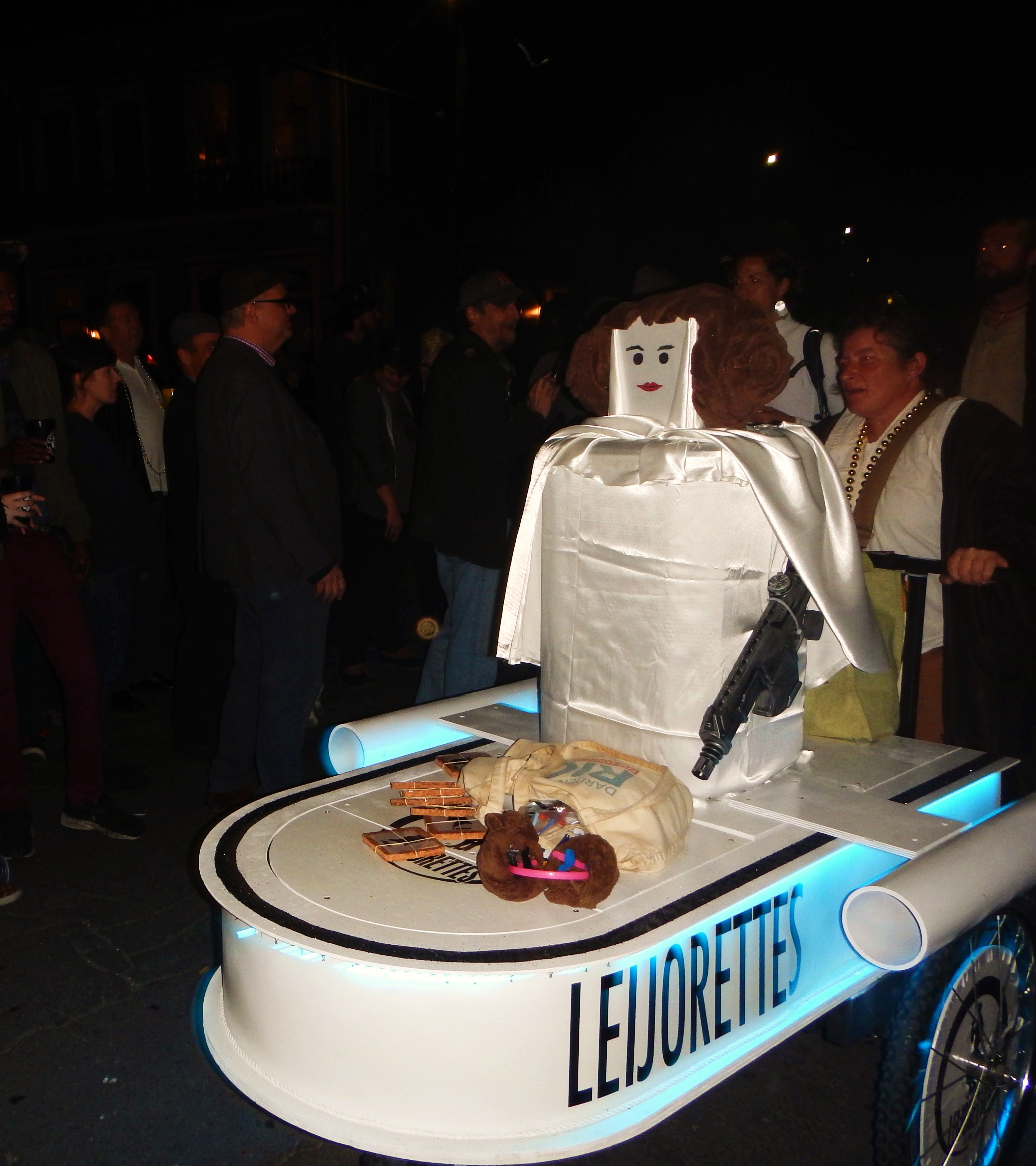
This past Saturday was the annual turning point for me when Mardi Gras stops being a vague concept I hear about on the radio & Facebook feeds and becomes an experience I’m living. Although the Phunny Phorty Phellows’ annual streetcar ride on Twelfth Night is the official start to Carnival season, it’s one I typically miss. Mardi Gras never feels real until I’m finally misbehaving in the thick of it & Krewe du Vieux is my usual starting point for the revelry, but I missed that parade this year as well. 2015’s Chewbacchus celebration was that magical moment when everything clicked and I thought “This is it. This is Mardi Gras.”

The Intergalactic Krewe of Chewbacchus is a relatively young parade that rolls hand-made, people-powered contraptions through the French Quarter & Marigny while the larger, gas-powered floats roll elsewhere across town. Although their nerdy umbrella has expanded to include all kinds of sci-fi goofiness, they’re the only parade I can think of that’s specifically designed to celebrate a movie franchise: Star Wars. Despite the inclusion of other sci-fi properties like Doctor Who, Star Trek, E.T. and (most recently) Guardians of the Galaxy, it’s still a mostly Star Wars-themed affair, one that lauds the “drunken Wookie” Chewbacca as its monarch. Real-life Chewbacca Peter Mayhew himself has even lorded over the parade the past couple of years, revelers treating him like nerdy royalty. The parade’s haphazard, DIY aesthetic perfectly matches the DIY practical effects of the original Star Wars trilogy. Star Wars’ endless parade of odd-looking weirdos and handmade sets & costumes serves as a fitting platform for New Orleans’ own endless parade of odd-looking weirdos & their personal creations, even if they’ve come to incorporate other fandoms as the years march on.

Wasting away a drunken afternoon in the Quarter and then capping off the night with Chewbacchus’ Imperial Stormtroopers & Jedi Knights was my personal introduction to the 2015 Carnival season. It was a great feeling to ring in my favorite time of the year while celebrating one of my other favorite activities: watching movies. Here are a few pics to help solidify the memory.

DSCN0999

DSCN1000

DSCN1001

DSCN1003

DSCN1004

DSCN1005

Have a great, safe Mardi Gras, y’all! And may the Force be etc, etc.

-Brandon Ledet

In a World . . . (2013)

inaworld

threehalfstar

In a World . . . is a traditional, by-the-books comedy about the niche movie trailer voiceover industry and overstuffed with niche comedians, but it’s one that attempts to make a universal point in its sucker punch ending. Writer/director/star Lake Bell creates a lived-in world that feels authentic in its portrayal of the insider humor of what movie-trailer narrators call “The Industry”, but also feels totally bogus in the way that all comedies do. The list of inspirational sources she manages to pull from while maintaining this balance is impressive: traces of 70s & 80s ensemble comedies; more modern, flat, bickering anti-humor; and professional competition Spencer-Tracy rom-coms like Adam’s Rib & Woman of the Year run throughout. There’s a confidence & ease to In a World . . . that makes Bell seem like either a natural or a great student of the Hollywood comedy as an art-form who’s been cooking this particular idea for a long while.

The plot centers on voiceover artists scrambling to fill the void left by the death of real-life movie trailer colossus Don LaFontaine, the infamous voice behind ads that begin with the phrase “In a world . . .” As portrayed here, “The Industry” is a cutthroat, tight-knit community overrun by white men who have dominated it since its inception. Lake Bell’s protagonist, Carol, attempts to shake up the old guard by infiltrating their ranks. Every success she achieves in “The Industry” on her own merits is regarded by her competition as her stealing their jobs and she quickly earns the moniker “The Thief”. Bullheaded men treat the idea of a woman in the business like an unwanted intrusion and the worst offender of all is Carol’s father, a legend in “The Industry”. He actively tries to limit her professional opportunities, championing a male voiceover artist as his protege instead of his own daughter and spouting unchallenged, sexist drivel that feels like a hangover of the boys-club era that’s slipping through his fingers. Early in the film he encourages Carol to abandon her dreams of becoming the next Don LaFontaine, telling her “The Industry does not crave a female sound. I’m not being sexist; it’s just true.” It’s true to him, at least. Because he’s sexist.

As mentioned above, In a World . . . gets very didactic & cruel in its last ten minutes, but the mood shift doesn’t feel unearned. There’s a consistent mean streak running throughout that telegraphs the bitter, cynical worldview of the climactic scene long before it arrives. It’s an ending that most likely won’t sit right with some viewers not only because it’s cruel, but because it muddles both the general vibe of the film as well as its central message. I believe the muddling was intentional, as it reflects the way a woman’s professional accomplishments & missteps can often feel muddled by the politics that surround them. Either way, it’s a conclusion that’s ultimately up for debate, since it refuses to be fully explained, instead opting to leave you on an oddly sour note.

There’s plenty of other great elements to praise, even if the ending doesn’t work for you. The film boasts the same reverence for sound employed in the likes of Berberian Sound Studio & Electrick Children, except more intensely focused on the sound of the human voice. There are great one-off gags involving “The Industry”, especially in fake movie titles like Welcome to the Jungle Gym. Perhaps the biggest strength of all is the stacked comedic cast mentioned earlier. Ken Marino plays a perfect 80s cad here and is backed up by names like Rob Corddry, Tig Notaro, Nick Offerman, Demitiri Martin and Geena F’n Davis. Lake Bell herself carries the central role as well as she carries the daunting tasks of a first-time writer/director. As a mission statement, Bell’s first feature suggests that she has a lot of great films in her just waiting to get made and, judging by In a World . . .’s bitter ending, they’re movies that aren’t going to play nice.

In a World . . . is currently streaming on Netflix.

-Brandon Ledet

Hercules (2014)

EPSON MFP image

twohalfstar

campstamp

Dwayne “The Rock” Johnson is the great WWE success story. When the juggernaut wrestling promotion tried its best to launch Hulk Hogan’s movie career with its first foray into film production, 1989’s No Holds Barred, the results were mixed. Hogan remains the most widely known household name in wrestling, but his movie career, which featured long-forgotten titles like Suburban Commando & Mr. Nanny, didn’t exactly pan out as planned. The Rock, on the other hand, basically launched WWE’s movie-making division all by his lonesome. His first three starring roles in The Scorpion King, The Rundown, and Walking Tall basically built WWE Studios from the ground up. The Rock’s world-class shit-talking skills & excessive mugging in his wrestling promos translated well to action stardom & he’s been the sole wrestler who’s been able to make a long-term career for himself on the big screen (though Bautista may be next in line).

The secret to Johnson’s success? He’s actually a damn good actor. He has a lot of weird, mostly untapped energy that can reach far beyond the limited roles he’s been landing. With early parts in action shlock like Doom & The Scorpion King, he’s proven himself to be one of the last Schwarzenegger-type muscle gods who manage to look convincing while kicking ass & dispensing pun-heavy quips indiscriminately. He’s perfectly suited for action movie roles, but he’s also being underserved in them. Riskier projects, like the more unhinged Southland Tales and Pain & Gain, have unleashed a different Dwayne Johnson altogether, one completely independent of the Schwarzeneggers & Van Dammes before him. He has a manic beast lurking under that confident exterior, just waiting to out-weird any other action star in the world, Stallone & Cage included.

Unfortunately, Hercules does not employ the offbeat wild-man Dwayne Johnson, but instead opts for the cookie-cutter action star The Rock. He’s in full Scorpion King mode here, hitting so many familiar Schwarzenegger beats that I assumed it was secretly a Conan the Barbarian remake that couldn’t secure the rights. Hercules’ opening narration plays like a trailer to a much better film, The Rock slaying a succession of giant, mystical beasts with ease. It slows down from there, limiting the action to a single episode of Hercules and his rag-tag crew of super-warriors leading an army into an epic battle, the exact kind of narrative you’d expect from vintage Conan the Barbarian story record. The movie has a sort of charm in its limited scope, especially in its lighthearted approach to mass violence and in The Rock’s natural magnetism. Most of Hercules’ best moments arise from The Rock’s inherent coolness. He just looks like a total badass as he wears a lion’s head as a crown, defeats wolves & charging horses with just his bare hands, and smashes a hooded executioner to pulp with a smaller, less talkative rock. Hercules makes for a much more convincing, enjoyable superhero adaptation/reboot than the similarly reductionist films I, Frankenstein & Dracula Untold, but in the end a lot of your enjoyment will hinge on how much you enjoy spending time with The Rock, as opposed to how much room Dwayne Johnson is given to be his enchanting self.

The transition from babyface wrestler to action hero makes total sense. Both roles require a convincing “good guy” to put the world’s depthless “bad guys” in their place. The Rock has had a few great action roles over the past decade or so, and with the exception of a couple missteps like The Tooth Fairy, he’s managed to avoid the pitfalls of Hulk Hogan’s career path. It’s just that after watching what a stranger, more nuanced Dwayne Johnson can do, it’s worrisome that he’s still making something this close to The Scorpion King at this point in time. Hercules can be a fun, one-time viewing for the audience, but let’s hope it’s not a damning career-trajectory indicator for Johnson. He can do so much more when given the chance.

-Brandon Ledet

Teenage Mutant Ninja Turtles (2014)

EPSON MFP image

fourstar

campstamp

One of the best aspects of the ancient art of recording television on VHS tapes was the commercials that you’d incidentally gather as a byproduct. A VHS recording of an old Sifl & Olly episode or Lifetime Original Movie may have been made irrelevant by the advent of YouTube, but the much trashier, more disposable art of a television ad is for the most part lost in the process. There’s a reason websites like Everything Is Terrible go back and dig up this garbage. An advertisement can serve as a time capsule of the era in which it was made. Even something as mundane as a car commercial feels strangely foreign 20 years later. A VHS recording of a pan & scan Jurassic Park isn’t particularly useful in 2015, but if you read between the dinosaurs there’s some useful glimpses into the world that was watching it: what the people were wearing, what hacky jokes they halfheartedly chuckled at, what bullshit later haunted their attics & dumps. Advertising is a low form of art, but it’s art that can later serve as a cultural relic.

Bad movies can work the same way. Mac & Me has just as much to say about where our culture was in 1988 as Cinema Paradiso, if not more. What kind of a sense of 1959 would you get if you only watched North by Northwest & The 400 Blows and completely avoided the likes of Attack of the Giant Leeches & Plan 9 from Outer Space? An incomplete one. We are not sophisticated people at heart. Our garbage has a lot more to say about who we are than our fine art ever will. When we create fine art we transcend our true natures and achieve greatness beyond our limitations. When we create garbage we’re being honest about the ridiculous fools we are at heart. A bad movie is a mirror to our worst, most banal impulses. A great bad movie makes us love those impulses. A great bad movie makes us love being a dumb, simple people.

I’ve said it before and I’ll say it again: Michael Bay’s production of Teenage Mutant Ninja Turtles was The Best Bad Movie of 2014. It deserves to have great longevity as a cultural relic, as it somehow captures the entire zeitgeist of our worst cinematic impulses in one ridiculous package. I’m talking lens flairs, found footage, product placement, inclusion of viral videos, over-reliance on CGI, shaky cam, action confused by quick cuts, large-scale destruction of a major city, a phony third act death crisis, and a dubstep beat for the rap song that plays over the credits. The film itself is an example our greatest, most frequent sin of recent years: the reboot. More specifically, it’s a gritty reboot, the most ludicrous gritty reboot of the post-Dark Knight era (although the peculiarly humorless I, Frankenstein certainly gave it a run for its money there). To top it all off, it boasts an above-it-all sense of irony that compels the movie to periodically point out how inherently silly its premise is. Characters poke fun at one another for “doing the Batman voice” and frequently mock the idea of talking humanoid turtles. Teenage Mutant Ninja Turtles is the last five years of bad taste in a nutshell. Or, if you will, on a half shell.

Despite its self-aware irony, there are still glorious moments when the film loses itself in its own ridiculousness. A few action set pieces, particularly a downhill slide and a rooftop battle, are the kind of far-fetched, detached-from-physics kind of fun that you’d expect in franchises like Fast & Furious and, less effectively, Transformers. The movie’s villains, a mech soldier Shredder & a corporate prick William Fichtner, are genuinely terrifying figures worthy of the film’s dark tone. There’s a “beating up the bad guys” vibe in the way the villains are dealt with that feels more like a sincere kids-playing-with-action-figures kind of storytelling than some of the film’s more ironic detachment. The found footage sequence briefly mentioned above, however, finds the film losing itself in its own ridiculousness more than any other. In this scene investigative reporter April O’Neil is digging through her childhood camcorder recordings only to discover that she herself raised the Ninja Turtles as pets in her father’s laboratory. April O’Neil is the source of the Turtles’ affinity for Pizza Hut® pizza; she is the one who named them after Renaissance painters; she is the one that saved their lives by casting them to the sewer. It’s a highly unlikely connection that the film makes & one I greatly appreciate for its lunacy.

There’s even a sense of purpose to the film’s hideous creature design. After April saves the infant Turtles by sending them underground they go through a strange transformation. Through a brief stop-animation effect & training montage, the cute-as-a-button Turtles morph into the ugly, alien-looking things that have been derided since the movie was first advertised. It was only until actually watching the film (as opposed to the ads) that I realized their ugliness had a purpose (even if it wasn’t intentional): puberty. The “Teenage” part of the characters’ namesake is stressed heavily in this incarnation. Their awkward, not-at-all-right appearance is only the tip of the pubescent iceberg. The teenage Turtles are hormonally violent, potentially dangerous young men who dream about running away from home as soon as they’re old enough and spend way too much money on their vehicle in the meantime. They struggle with creaky voices, fart openly, listen to loud music, get coked out on high doses of adrenalin, and have to answer to an angry rodent father figure when they miss their curfew. The most off-putting detail of all is the way they constantly hit on a nonplussed April O’Neil, calling “dibs” on her & whispering “She’s so hot I can feel my shell tightening” in moments of unearned, unseemly bravado, but also excitedly freaking out when she actually responds to them, bragging “I totally talked to a girl!” The Turtles are just as much teenagers as they are ninjas in the film and it’s just as awkward & disgusting as teenagers are in real life.

There are a few other bright spots to praise, like a legitimately cool animation effect that opens & closes the film (in a look that tips its hat to the characters’ comic book roots) as well as the decision to shroud the iffy CGI in darkness, which I think always benefits the format (as opposed to brighter looks like Avatar’s). The casting also shines here. Faces like Whoopi Goldberg, Taran Killam, and Will Arnett keep the mood light as physical reminders not to take the film too seriously. Arnett’s particularly funny as the flustered butt of throwaway gags, like when a Turtle calls him a “human nerd” or when he’s cooking alone to “Careless Whisper” in his apartment. Megan Fox is serviceable, not too distracting in her portrayal of April O’Neil, but not adding much either. I like to think of her here as the human Michael Bay calling card, as if the superfluous explosions weren’t enough on their own. As mentioned above, William Fichtner’s villain is as chilling as always; it’s a performance that honestly feels like it belongs in a much better film. The movie’s tone may be self-contradictory in places, but it ultimately is successful in being both a cheap thrills type of fun at face value as well as a comprehensive cultural relic when considered in the context of its place in time.

The worst part about Teenage Mutant Ninja Turtles is that I have so much fun watching it. I eat this garbage up. I first saw the film alone in a theater on a Friday night, drunk, and lightly surrounded exclusively by groupings of young dads & sons. I felt like a total goofball to be the only one chuckling as they watched in respectful (or bored) silence. C’mon, dads! It’s a fun movie! Tony Shalhoub totally plays a gigantic, scrotum-esque rat! C’mon kids! Shredder totally has badass knives for hands! My enthusiasm was unreciprocated long after I left the theater as well. No one was interested in even talking about the movie, much less watching it. I still can’t convince people to watch it, even for a goof. My love for 2014’s Teenage Mutant Ninja Turtles is a dirty secret only because no one cares to hear it. I believe the problem is that my timing is too soon. That 1993 Chrysler commercial incidentally archived on a VHS cassette during an X-Files episode wasn’t culturally significant until at least 2000. In a few more years the gritty Teenage Mutant Ninja Turtles reboot will cease being a fresh, undistinguished wound and earn its rightful status as a precious artifact, a prime specimen of our modern blunders, a more valuable cultural marker than all of the Boyhoods & Birdmans in the world. As a shoddy product so distinctly of its time, its value will only increase as the years soldier on.

-Brandon Ledet

Get Excited! What We Do in the Shadows is Looking to Fund an American Theatrical Release

EPSON MFP image

A few years ago I was ready to concede that the vampire & zombie genres had reached their saturation points. In the mad rush to capitalize off of the successes of viable commodities like Twilight & The Walking Dead, the market has just been flooded with untold piles of subpar schlock like Vampires Suck & Zombeavers. Every now & then, however, a movie proves me wrong. I found the zom-coms Life After Beth & Warm Bodies to be surprisingly sweet and compassionate. The unfairly ignored Vamps was a return to form for Clueless-guru Amy Heckerling’s particular brand of social satire. I have yet to see Jim Jarmusch’s Only Lovers Left Alive, but from the advertising it seems to bring the 80’s classic The Hunger’s vampiric ennui into the 21st Century, an aesthetic I hadn’t considered would return. The endless implications & metaphors swirling around the undead have proved the genres endlessly adaptable, even if the final product isn’t always solid.

That’s why I’m hopeful for the New Zealand horror comedy What We Do in the Shadows. It promises to take the same ennui employed by Only Lovers Left Alive into the satiric comedy territory of Vamps. Posed as a Christopher Guest-style mockumentary, the film follows modern day vampires as they navigate mundane activities like nightlife, dealing with roommates, and searching for a bite to eat. They clash with the likes of witches, zombies, werewolves, and plain-old humans in a loosely-plotted slice of (undead) life comedy. From the looks of the trailer, it could be quite funny as well as a fresh take on a genre I once thought hopelessly stale.

What We Do in the Shadows is currently looking to fund an American theatrical release through a Kickstarter campaign. The Kickstarter’s page is helmed by the filmmakers themselves, Jemaine Clement & Taika Waititi, two of the creative minds behind the cult-classic comedy series Flight of the Conchords (as well as the films Boy & Eagle vs Shark). Clement is also a major player in one my favorite dumb comedies, Gentlemen Broncos. He’s a very funny & talented performer that I wish didn’t have to beg for funding like this, but the worst part is that the campaign is barely more than halfway funded with just a week left to go.

Even if you are not in a position to donate to the film’s American distribution, at least visit the Kickstarter page for a humorous promo featuring Clement & Waititi themselves or maybe help spread it elsewhere on the internet. It would be great if more people could see this promising, self-funded comedy and it was rewarded for bringing undead concepts into unexpectedly fresh territory.

2/14/15 UPDATE: The project was a success!

-Brandon Ledet

It’s Okay that Dan Aykroyd Isn’t Writing a Ghostbusters Sequel, Because He’s Already Living One

EPSON MFP image

The recent announcement of the cast for the upcoming Ghostbusters reboot was met with the usual flood of overblown internet outrage that accompanies nearly everything these days. Most of the objections seem to be centered on the idea that Hollywood shouldn’t have unearthed the franchise at all. Personally, I’ve resigned to compromising with what Hollywood productions are going to offer. Nostalgia is big money right now. In a time when it’s becoming increasingly difficult to get people to the cinema, producers will take the guaranteed, built-in audience every time. The best you can hope for is that somewhere in the process someone’s going to try to make these reboots interesting, because they aren’t going away. Paul Feig’s all-female approach to a Ghostbusters reboot is honestly just about the only one I could imagine that wouldn’t be completely pointless. The recent casting announcement make the idea even more promising, since it included four eccentric, boisterous personalities (Kristen Wiig, Leslie Jones, Kate McKinnon, and Melissa McCarthy) that have the potential to bring enough weird, idiosyncratic energy to the reboot to distance it from its source material in both style & tone. Feig’s Ghostbusters might just be the rare kind of reboot that can justify an existence on its own.

It at least beats the alternative. For years O.G. Ghostbuster Dan Aykroyd has been trying to get his own sequel to the franchise off the ground. Bill Murray’s resistance to reprising his role as Peter Venkman in Ghosbusters 3 was the long-time thorn in Aykroyd’s side, but Harold Ramis’ devastating passing last year was the final blow to the prospect. Admittedly, Aykroyd’s long-in-development script sounds like it had some promise. For instance, he dropped hints that the plot would somehow relate to recent advances in particle physics & the role he had written for Murray would’ve involved Venkman’s wisecracking ghost. The problem is more that Aykroyd cannot be trusted when left to his own devices. His sole director’s credit, Nothing But Trouble, which he also wrote & stars in, is one of the most bizarrely terrible movies I’ve ever seen. It’s a thoroughly unlikeable & unfathomable work that is the direct result of Aykroyd’s ego going unchecked. Similarly, his decision to write a Blues Brothers sequel more than a decade after costar John Belushi’s death was a total disaster and a detriment to the reputation of the original. Nothing But Trouble & Blues Brothers 2000 were the last two screenplays penned by Aykroyd, so it might be best that his version of a third Ghostbusters film never saw completion.

Aykroyd has publicly given his blessing to Feig’s Ghostbusters reboot and I hope that he’s sincere when he says he’s “delighted” by the casting. Ayroyd doesn’t need to write a Ghostbusters sequel because he is actually living one. In the press release where he gives his blessing to Feig’s cast he goes on to say “My great grandfather, Dr. Sam Aykroyd, the original Ghostbuster, was a man who empowered women in his day, and this is a beautiful development in the legacy of our family business.” Aykroyd’s real-life great grandfather was a dentist by trade, but he was also a spiritualist & a paranormal investigator. Ayrkoyd has claimed that his great grandfather would put on séances as a form of entertainment, which is not far from the spirit of the Ghostbusters franchise. Indeed, his family’s interest in the paranormal was passed down to him generationally & served as the basis of the original Ghostbuster’s film: to combine the “real” science of ghosts & spirits with old-fashioned ghost-themed comedies. With the first two installments of Ghostbusters, Aykroyd had achieved his goal of bringing his real-life obsession with the paranormal to the big screen. As he had continued his pursuit of infusing paranormal concepts into his work after the second film, a third installment seems redundant. He’s living Ghostbusters 3 on a daily basis.

The tactic Aykroyd employs to incorporate the paranormal in his professional life is an unlikely one, almost just as unlikely as a giant, city-destroying marshmallow or a painting come to life. He sells vodka. In an ancient (internet-wise) viral commercial for his Crystal Head Vodka, Aykroyd explains his interest in the paranormal while trying to sell you alcohol. He says things like “Since childhood I have been fascinated with the invisible world,” “There is more to life than mere material reality,” and “No one will show us the bodies from Roswell” in the same matter-of-fact tone that made him perfect for his roles in Coneheads & Dragnet. There are hours & hours of interview footage in which Aykroyd expounds upon his belief in the otherworldly like a particularly talkative caller on Coast to Coast AM, but the Crystal Head Vodka commercial is a perfect encapsulation of his worldview in an easily consumable 8min runtime. He’s so cheerful & confident in his explanations of the physical powers of positive thinking and the extraterrestrial origins of thirteen mysterious crystal heads that you can tell he really loves what he’s doing. He even encourages people who don’t share his beliefs to buy his product anyway, saying if nothing else it’s a “a luxury vodka in a cool bottle”. I can get behind that kind of honesty.

In one of his interviews about the possibility of a Ghostbusters 3, Aykroyd claimed “I’m about the future, not the past. I don’t reminisce.” Indeed, his idea of a particle physics themed Ghostbusters did sound like a somewhat fresh take on the franchise, but bringing back the old guard of actors & characters for the project doesn’t exactly sound like treading new ground. In a cinematic climate where reboots are inevitable and a new Ghostbusters will arrive in theaters, justified or not, I think Paul Feig’s approach is the best one possible for the franchise. The recent casting announcement gives the reboot a chance to stand out on its own as a unique work, even if it isn’t based on an original idea. Instead of Aykroyd giving the third installment the Ghost Brothers 2000 treatment, he gets to continue his great grandfather’s work by philosophically expounding on the existence of ghosts & extraterrestrials and filtering water through diamonds for a vodka pure in spirit. This way everyone wins.

-Brandon Ledet

Riding the Bus with My Sister (2005)

EPSON MFP image

onehalfstar

campstamp

“I’m not stupid, I’m just different.”

When I first learned that Riding the Bus with My Sister existed, I was both fascinated and frightened. Rosie O’Donnell playing a mentally challenged person whose main hobbies include riding the city bus and buying toilet seat covers held promise for sheer what-the-fuckness, but I knew that so-bad-it’s-good can end up being so-bad-it’s-really-bad real quick.

My worst fears were confirmed, unfortunately, in the opening credits as the words “Lifetime” and “Hallmark Hall of Fame” scrolled across the screen and were further solidified when Beth, waking from her disabled slumber, smiles into the mirror and in a loud, grating voice shouts, “Good Morning!” From that point forward, the WTF factor of seeing Rosie O’ Donnell play a mentally “retarded” woman with a heart of gold diminished every time she was on the screen.

Now I know it’s not politically correct to use the term “retarded” but it’s inexplicably used throughout Riding the Bus with My Sister, its negativity undermining many of the positive messages the film is trying to convey. One character even asks early on, “They still use that word?” It also doesn’t help that Beth is treated like crap the entire movie. In the first five minutes she is called a “hippo” by a downstairs neighbor, glared at with disgust by her fellow bus riders, and openly insulted for being lazy & living off the government. It would have been just as effective if director Anjelica Huston (Why?) flashed “People hate the handicapped” in bold red letters. For a simple woman who only wants to ride the bus, drink discount brand cola, and one day go to Disney World, she is treated as a drain on society.

The person who treats her the worst is her sister Rachel, a career woman living in New York who must leave behind her fashion photography business to take care of Beth after their father passes away. In a wholly unlikable performance, Andie MacDowell phones it in as the self-absorbed Rachel. MacDowell’s only job in the movie is to look nice & be annoyed by Beth’s antics. Rachel moves in with Beth to help her adapt to life on her own, but soon regrets it as Beth irritates her with conversation-starters like “Hey Rachael, I put seven red fishies inside of this can, do you think they can swim in cola? I sure hope so. I would hate to drown them.” Rachel’s characters arc (and the arc of the entire movie) amounts to the realization, “Hey, I’m kind of a piece of shit because I never really accepted my mentally challenged sister.” We learn this through a tedious parade of at least ten flashbacks of the sisters eating dirt, painting, even suffering seizures; all accompanied by sparse, acoustic guitar. This goes on for two hours.

The most frustrating thing about Riding the Bus With My Sister is that Beth is looked down on by Rachel but she seems to have life more figured out than her developmentally “superior” sister. She has her own place, lots of friends, and a routine she enjoys. She even has a similarly disabled boyfriend, Jessie, who treats her well, takes her out on dates, and has hobbies of his own like karate & riding his bike. Of course, in one of the many ways the movie manipulates viewers’ sentimentality, Jessie is beaten by a group of thugs towards the end of the film.

Kudos should be given to Rosie O’Donnell, though. While her performance mostly consists of rocking back and forth, shouting, and contorting her face, she does succeed in coming across as genuinely handicapped. In one of the film’s best scenes, Beth mourns the loss of her father by sobbing uncontrollably on a bench outside the hospital while eating a doughnut, drinking a cola, and wearing a kitty cat t-shirt. In another she talks about boning Will Smith. There are a few memorable moments like that in Riding the Bus with My Sister but with minimal plot development and a near-absence of likable characters the film falls apart. What could have been a heartfelt drama with camp value fails because the story doesn’t go anywhere. In the end, the viewer is left feeling as confused & unfairly abused as Beth is in the film.

-James Cohn

We Found a Dozen Nice Things to Say About Left Behind (2014)

EPSON MFP image

Watching the 2014 version of Left Behind was one of those epiphany moments where a movie is bad (not a fun bad, just bad) but why were we expecting anything different? A reboot of a humorless Christian franchise trying its little, judgmental heart out to save our doomed, sinful souls from the definitely-going-to-happen-any-day-now Biblical Rapture doesn’t exactly sound like a laugh riot. The inclusion of human enigma Nicolas Cage gave the series the promise of campy appeal, but he was in quick-paycheck mode and did little for the film’s lifeless, dour tone. Similarly, any weird potential in the idea of a worldwide, supernatural, people-erasing event is severely undercut by the film being the first in a planned series and the budgetary decision of bottling most of the action on a single airplane. Instead of the amused chuckling we naively expected, we met most of the film with irritated silence.

It’s a little unfair to beat up on a film based on our off-base expectations, though, so instead of giving Left Behind a negative review, we decided to catalog the things we actually liked about the movie. It took some careful deliberation but between the two of us we came up with an even dozen nice (or at least entertaining) things to say about Left Behind.

1. Although the movie doesn’t include any patented Nic Cage Freak-Outs™, it does feature Cage delivering the following line to his Atheist daughter: “If your mother was going to leave me for another man, it might as well have been Jesus.” A calm, collected Cage isn’t exactly the shot in the arm this movie needed, but we really liked that line.

2. Cage has exactly one more entertaining moment later in the film. As the passengers on the airplane he’s piloting are freaking out, confused about their Raptured loved ones, he utilizes his National Treasure puzzle-solving skills and gets to the bottom of what’s going on. The clues that lead him to discovering the phenomenon’s Biblical source: one missing passenger’s watch reads “John 3:16” and another’s datebook has a scheduled Bible study penciled in.

3. The Rapture itself was kind of interesting (even if by default), especially the image of disappeared children’s clothes falling to the floor while the balloons they were holding float toward the heavens.

4. We may have unfairly described the film as humorless above. It does attempt an embarrassing, mildly reprehensible line of comic relief involving an angry dwarf character. Most of the gags are misfires politically & morally, but there is one that is just genuine, wholesome fun. As the passengers are trying to figure out if the Raptured have actually disappeared or are just invisible, the dwarf tries to give one of the missing a wet willy. It’s pretty funny.

5. Speaking of morally reprehensible, the same dwarf character mentioned above is unceremoniously tossed out of the airplane once it lands by a Muslim man he’d been bickering with for most of the runtime. It’s a gag that’s transgressive in its complete disregard for decency, but it’s still entertaining in its own deplorable way.

6. Nic Cage’s daughter is just as frustrated with her mother’s newfound Christian faith as Cage is. When she discovers that her mother’s warnings of The Rapture have come true she angrily smashes the disappeared woman’s Bible through window glass. It’s a great image & one that would befit the most melodramatic Lifetime Movie blowup.

7. Speaking of Nic Cage’s daughter, she looks eerily similar to his mistress in some ways. It’s cool that he has a type.

8. Cage’s totally happy, not at all depressing family unit is only shown in one place in a single image: a hilariously awkward family portrait that makes two separate appearances in the film. The shoddy Photoshop on the picture is an embarrassment, Cage himself looking like he was airbrushed into the picture. It’s one of the film’s only interesting images because it’s so jarringly fabricated and it’s totally bizarre that they felt the need to feature it twice.

9. In yet another bizarrely fake image, there’s a CGI plane that’s crash-landing looks like it was borrowed from a PowerPoint presentation. It’s ridiculous.

10. Just in case you don’t know how to feel at any point during the movie’s consistently over-sentimental, maudlin proceedings there’s an oppressive, violin-heavy soundtrack there to remind you how to feel at every moment. It would be annoying if it weren’t so over-the-top in its persistence.

11. The same way the violins never let you forget exactly how to feel, there’s a character that contantly reminds everyone around him that he’s an “investigative journalist”, which would be a ludicrous, ill-advised thing for a real-life investigative journalist to do, but it is pretty funny in this context.

12. All joking & sarcastic derision aside, there are a couple decent shots in the film. Exactly a couple. One image of Cage’s daughter backing up a truck & one of her running across a bridge at night felt like glimpses into a drastically different, frankly much better film. Combined together, they amount to maybe 5 seconds of footage, but they do look fairly nice in comparison to the artistic void that surrounds them. As with every other item on this list, we were deeply grateful for the fleeting flashes of vitality in a movie that was severely lacking both in life and personality.

-James Cohn & Brandon Ledet

Movie of the Month: The Masque of the Red Death (1964)

masque
Every month one of us makes the other two watch a movie they’ve never seen before & we discuss it afterwards. This month Brandon made James & Britnee watch The Masque of the Red Death (1964).

Brandon:
The Masque of The Red Death is one of eight films in the Corman-Poe cycle: a series of Edgar Allan Poe adaptations directed by B-movie legend Roger Corman for American International Pictures. The Masque is widely considered the best of the Poe cycle as well as one of Corman’s best films overall, a sentiment I wholeheartedly agree with. There’s so much about The Masque that’s firmly in my wheelhouse: over-the-top set design, an early glimpse of 60’s era Satanic psychedelia, Vincent Price taking effete delight in his own cruelty, a fatalistic ending that doesn’t stray from the pessimism of Poe’s story, Corman pushing the limits of what he can get away with visually on a shoestring budget. I love it all.

What struck me most on this recent viewing of The Masque is how well it’s suited for the Carnival season. With Fat Tuesday looming around the corner, it was impossible not to see aspects of Carnival in the masquerade ball hosted by Prince Prospero (Vincent Price). The cheap costumes & mockery of opulence is very much reminiscent of Mardi Gras parades. There’s even a scene where Prospero literally throws beads from a balcony shouting “Gifts! Gifts!” and scoffs at the greed of the people below. As the threat of The Red Death plague becomes increasingly severe, the masquerade takes on a “party while the ship is sinking” vibe New Orleans knows all too well. Horror films are usually tied to Halloween, but The Masque of the Red Death is distinctly akin to Mardi Gras in my mind.

James, do you also see Carnival in The Masque’s decadence, or does the Satan worship overpower that influence?

James:
Man, The Masque of the Red Death was awesome. The bold stylistic choices that Corman made on a limited budget and limited time (the final masquerade scene was filmed in a day) are astonishing. Some of the images in the film (The Red Death himself being the starkest) are mesmerizing. I think the film should also be noted for its pitch-perfect tone. Despite its macabre images, philosophical discussions of Satanism, and Prince Prospero’s nastiness, what could have been a dreary chore is instead a blast throughout.

In regards to the presence of Carnival in the film, I do think the masquerade ball scenes in particular have a very Mardi Gras feel to them. Masks with feathered beaks, gorilla suits, and a child masquerading as a little person don’t feel too far removed from the typical Carnival season debauchery. The Carnival feel also deepened a central theme of the film: lost souls celebrating a kind of momentary victory over Death. Ultimately, the film seems to have a nihilistic attitude towards Death, implying that the celebration is indeed a momentary victory and whether Christian, Satanist, or Atheist, we will all have to eventually confront an indifferent Death. But it also seems to find solace in our ability to shape our own existence while we are alive. This is echoed The Red Death’s climactic statement “Each man creates his own God for himself – his own Heaven, his own Hell.”

Britnee, what was your interpretation of the film’s philosophy on Death? Is it wholly negative?

Britnee:
This was my first time viewing The Masque of Red Death, and I have to say that I was blown away. Vincent Price as Prince Prospero was dynamite. I was so close to hiding under the covers during the close-ups of his signature evil stare, but seconds later, I was imagining what it would be like to have a conversation & afternoon tea with him in one of those seven colored rooms. Also, one of my favorite things about the film was the set and costumes. I know the look was supposed to have a Medieval vibe, but I really felt that I was at a Satanic drug dealer’s mansion party in the early 60s. All that was missing was the orange shag carpet.

As for my interpretation of the film’s philosophy on Death, I’m honestly not 100% sure. Death has always terrified/interested me, and I caught myself really falling into some deep thoughts about it while watching this film. The Christians and Satanists in Masque both experienced violent deaths, and neither of their higher powers swooped in to save them or give them a miraculous second chance. I guess the film is trying to show that Death cannot be avoided, regardless of power or faith. In the end when The Red Death states “Sic transit gloria mundi,” which literally means “Thus passes the glory of this world,” everything sort of hit me. Life can be very short & leave without warning, whether you’re a Christian villager living in poverty or a wealthy Satanic prince; it’s coming for us all!

Something else that stuck out was the interesting relationship between Prospero and Francesca. After sparing Francesca’s life, Prospero brings her to his castle to make her his consort and gives her a taste of his world. He becomes very intrigued with Francesca’s innocence and faith. As for Francesca, there are times where it seems as though she is giving in to temptation, but simultaneously she is in constant focus on her escape.

Brandon, what themes do the relationship between Prospero and Francesca bring to the film?

Brandon:
It’s reasonable to assume that Prospero wasn’t always the cruel tyrant we meet in the picture. He didn’t emerge from the womb executing peasants and cursing God. Prospero’s poisonous personality was likely the result of a gradual corruption of his soul, an evil born of his prosperous upbringing. Raised with untold wealth & influence, he came to rule over his fellow human beings like an unforgiving deity. Unsatisfied with the power his privilege as Earthly nobility affords him, he reaches even further beyond this realm and makes a deal with Satan in an attempt to overcome Death. Yet, there’s a little speck of good left in Prospero’s heart, which I think is what we see in his treatment of Francesca. At times he tries to prove that even her innocence can be corrupted because he wants to be assured that his own wickedness can be found in every person’s heart. He even asks her to join him in mocking the greed & decay in the guests at the masque, because he believes all people to be as amoral as he is. At other times, he goes out of his way to protect her and spare her life, an instinct that surprises even The Red Death. The only other glimpse of good we see in Prospero is when he asks his guards to spare a baby’s life at the gates. Although he is beyond redemption, (not that redemption matters in the eyes of Death,) Francesca affords Prospero his last chance to act like a true human being.

Then there’s the fact that the actress who plays Francesca, Jane Asher, was just achingly beautiful. So beautiful, in fact, that she was in a relationship with & at one time engaged to Sir Paul McCartney in the 60s. She was attractive enough to snare a Beatle during the fever pitch of Beatlemania, so surely a demented prince who can’t even cheat Death wouldn’t stand a chance against her charms. Perhaps simple lust spares her life. I think Francesca stands out here as a hip youngster (maybe it’s all in those bangs?) and helps add to that 60s drug dealer mansion party vibe mentioned above. So much of the film feels rebellious in an anachronistic way. Prospero’s philandering is out of control. Lines like “Satan rules the universe!” and “Each man creates his own god for himself” are pretty edgy for 1964, even coming from the villains. Keep in mind this is still years before the New Hollywood, a movement Roger Corman cannot be praised enough for influencing.

James, how do you see the balance between the movie’s setting and the era in which it was filmed?

James:
The movie definitely has an edge that makes it still creepy and blasphemous over 40 years later. I wonder how much Corman was in tune with the counterculture of the time because, despite it being a British production, the film feels more like a deranged product of the 60’s San Fransisco hippie movement, like a horror version of Beyond the Valley of the Dolls; its macabre decadence fueled by lust and greed. It’s also most likely no coincidence that the epicenter of the hippie movement was the same place that the Anton Lavey established the Church of Satan in 1966. Themes like the destruction of social norms and an openness to sexual and spiritual experiences seem to be shared by The Masque of the Red Death, Satanists, and the hippies; “Each man creates his own god for himself” is THE basic philosophical statement of Satanism. I also think this is reflected in the dark, psychedelic imagery that The Masque of the Red Death and Satanist rituals share. (Photo for example)

satanist

Britnee, How strongly do you think the psychedelic aesthetic of the 60’s influenced The Masque of the Red Death? Any specific examples that stick out to you?

Britnee:
I think that The Masque of the Red Death was as psychedelic as it gets, at least for a horror film based in Medieval times. An example that really sticks out to me is the colors used throughout the film, most importantly, the use of red. Red usually represents blood, gore, and all the good stuff horror movies are made of, but when I also think of the term “psychedelic,” red is usually the color that comes to mind. After doing a little research, I found that the color red has a pretty long wavelength and very low vibration; this pretty much explains how the red tint that is present in multiple scenes really gives off this warm, draining feeling. Sounds a bit like the feeling you get after taking a hallucinogen or two, right? Also, all of those gaudy colors in the castle & clothing of Prospero and his pals can’t go without mention. While I’m not a Middle Ages expert or enthusiast, I’m almost positive that the colors of clothing and décor weren’t as bright and vibrant during that era as they are in the film. It’s obvious that the 60’s psychedelic aesthetic heavily influenced those hues.

Lagniappe

Brandon:
I’d just like to point out one last time just how early this film was released. A lot of what we think of as the hippie-dippie 60s came very late in the decade. The era-defining Summer of Love was in 1967, the same year Roger Corman dropped acid for the first time and fictionalized his experience in the film The Trip. The Masque‘s 1964 release positions the film as years ahead of its time. Corman was pulling off the Satanic psychedelia vibe the same year that Mary Poppins & My Fair Lady were huge cultural hits. I’m not saying Masque was particularly a major influence on the countercultural swell that was to come, but it at least was somewhat visually intuitive. And Corman himself did have direct influence on the later films that typified that counterculture, films like Easy Rider and Bonnie & Clyde. Even back then, when “don’t trust anyone over 30” was a motto to live by, he was the hippest geezer in the room and a filmmaking rebel.

Britnee:
After the discussion with The Swampflix Crew, so many ideas and thoughts about The Masque of the Red Death were brought to the surface. It gave me an excuse to watch the film a couple more times, and I fell in love with it more each viewing. The movie also got me hooked on the Corman-Poe films, so I’m currently trying to get my hands on all of them. The Masque of the Red Death was just a great balance of horror, suspense, and drama that gave me some really unsettling thoughts & a case of the willies. Great job, Corman!

James:
Really enjoyed the discussion of The Masque of the Red Death. Watching the film a second time and taking into account all the points you guys made deepened my appreciation and understanding of the film. Definitely want to see more Corman, especially the Poe films. As Brandon pointed out, Corman seemed to have his hand on the pulse of the counterculture and was always one step ahead of mainstream Hollywood. Truly a filmmaker ahead of his time.

-The Swampflix Crew

Upcoming Movie of the Months
March: James presents The Seventh Seal (1957)
April: Britnee presents Blood & Black Lace (1964)