Atomic Blonde (2017)

There’s been some extensive discussion lately about how nostalgic media had gone too far with its Remember This? relics & references to 80s & 90s pop culture. Titles like Stranger Things & Ready Player One have proven popular with mass audiences, but have also drawn eyerolls from plenty critical outlets for their easy nostalgia bait. One of the more bizarre aspects of the Charlize Theron action vehicle Atomic Blonde is the way it hops on that same 80s nostalgia train, yet somehow its pop culture throwbacks feel oddly curated and not quite part of the trend. Set on both sides of The Berlin Wall in the few days leading to it being torn down in 1989, the film’s pop culture references include things like David Hasselhoff, Tetris, skateboarding, grafitti, neon lights, etc. In one indicative scene, Theron beats up a horde of faceless goons in front of a movie screen at a cinema that happens to be projecting Andrei Tarkovsky’s Stalker. Atomic Blonde is a weird little nerd pretending to fit in with the popular kids. Its blatant nostalgia for 80s pop culture should make it a widely accessible work, but there’s something off-kilter about its reference points that immediately single it out as a sore thumb outsider.

As nerdy as Atomic Blonde‘s 80s pop culture references can be, its basic pleasures are lizard brain simple. This is a summertime popcorn picture that banks on the central hook that its audience will never tire of watching Charlize Theron beat down men while wearing slick fashion creations & listening to synthpop. Its central mystery about double/triple agents jockeying to get the upper hand at the fever pitch of the Cold War is never nearly as significant as a David Bowie needledrop or a panning shot detailing Theron’s complicated underwear as she gears up for another day of crushing dude’s throats. Costume designer Cindy Evans deserves just as much credit as ex-stuntman director David Leitch or Theron herself for making the movie feel at all distinctive or memorable. The brutality of the action choreography (much of which Theron performed herself) & the immediate pleasures of the soundtrack (which includes acts as varied as New Order, Public Enemy, George Michael, Ministry, and Siouxsie & The Banshees) are entertaining enough as post-Tarantino/Scorsese pop cinema diversions. It’s the fashion design set against the Crimes of Passion-esque neon lighting that helps distinguish the film as its own idiosyncratic work, however, which should give you an idea of how surface level & visual its merits are on the whole.

Although the feeling wouldn’t last long, I was actually very much excited for Atomic Blonde‘s narrative structure when Theron’s ass-kicking protagonist was first introduced. She begins the film already icing her wounds in a freezing cold bath, recovering from a spy mission to the Eastern side of The Berlin Wall. This decision reminded me so much of the archetypal JCVD & Schwarzenegger action pics of the 80s & 90s, which usually introduce the hero at the tail end of one adventure before beginning the one that will command the plot. Instead, this opening is soon revealed to be a feature-length flashback, wherein the story is told in an investigative interview with British & American intelligence agencies. A needlessly complicated plot about double agent assassinations & a McGuffin referenced to as The List gradually emerges, but is told in such sweeping, summarizing swaths that any in-the-moment suspense over the central mystery is left muted at best, incomprehensible at worst. Instead of trying to figure out which of her collaborators has sold her out to the KGB (James McAcoy? John Goodman? Toby Jones?), the audience is better off letting go of narrative completely & indulging in the image of Theron kicking ass to kick-ass synthpop. The flashback structure undercuts a lot of the immediacy of that simple pleasure (with the major exception of an extended stairwell sequence that wisely slows down to allow the sheer brutality to fully sink in), but the strengths of the fashion design, the soundtrack curation, and Theron’s physical presence are enough for the film to persevere.

Atomic Blonde‘s origins as a graphic novel adaptation and a pet project from one of the minds behind the John Wick franchise are blatantly apparent. Its reliance on the slickness of its imagery and the Hey Remember This? quality of its off-kilter 80s nostalgia are much more firmly in its wheelhouse than the complex double/triple crossings of its Gotcha! mystery plot. Now that Theron’s rock solid protagonist had emerged as a high fashion, animalistically brutal James Bond type, despite the lackluster plot that surrounded her, the world is primed for that Just Another Adventure, JCVD-style sequel. She’s got a killer look, a signature drink (Stoli on the rocks), an established bisexual flair for bedding other agents, and, most importantly, is damn convincing as a physical threat to faceless baddies. Since the movie leaves off at the dawn of the 1990s, she even has a whole new era of odd duck nostalgia bait to milk on her next mission. I enjoyed Atomic Blonde for what it is, but it has some glaring narrative issues I feel could easily be course-corrected in an Atomic Blonde 2. I fear this picture’s box office returns will be too slight to generate a sequel, but at least its sense of fashion has left us with a killer lookbook as consolation.

-Brandon Ledet

War for the Planet of the Apes (2017)

After Kong: Skull Island, War for the Planet of the Apes is the second time this year I attempted to put my boredom with cinematic war narratives aside to feed my hunger for eccentric creature features. The results were moderately better on this second go. Matt Reeves’s conclusion to his Apes prequel trilogy felt like a sincerity antidote to Skull Island‘s disingenuous SyFy Channel genre film throwback, which was far more conventional than its What If King Kong Fought In The Vietnam War? premise should have allowed. Not only does War for the Planet of the Apes cover similar territory in a more satisfying way; it also adds shades of World War POW camps, the Holocaust, American slavery, and the Malcolm X/Martin Luther King Jr philosophy divide to deepen the context of its Apes vs Humans war for the planet. It takes its wartime primates premise far more seriously than Kong: Skull Island attempts to, yet somehow emerges as a notably better example of summertime blockbuster spectacle, despite the season’s usual penchant for dumb fun. Its superiority to that overpriced B-movie aside, I can’t honestly say much else in praise of War for the Planet of the Apes. It’s an interesting film & a welcome excuse to escape the heat in a dark, air-conditioned room for two hours; but its nature as a straightforward war movie & a CG spectacle franchise cornerstone never allows it to amount to anything more substantial than that.

We rejoin the talking ape Caesar, played by eternal mo-cap prisoner Andy Serkis, as he attempts to maintain peace & order among his primate followers through simple credos like “Apes together strong,” and “Ape no kill ape.” Their plans to live peacefully in the woods are disrupted by a human militia headed by Woody Harrelson, who plays a warmonger who’s seen either Platoon or Full Metal Jacket one too many times in his life. This rogue colonel refuses to accept the apes’ peaceful request to be left alone in the wilderness. He slaughters large numbers from their ranks and eventually imprisons the survivors in an isolated stronghold he converts into a primate labor camp. Caesar and the colonel grimace at each other and trade gruff lines about who started/escalated the war and who they’ve both lost along the way for as long as the movie can put off two inevitabilities: an escape plan hatched by the ape prisoners & an all-out fire fight initiated by the humans. Somewhere during this grudge match two new characters introduce themselves to the fold: a mute child who’s clumsily coded as an archetype of Innocence & a Steve Zahn-esque buffoon played by sub-David Arquette buffoon Steve Zahn. As the war rages on, the developing details of the virus engineered in the first film are gradually revealed, opening the door for a kind of decisive finality to the series. The events of the film are tightly contained to a singular conflict, but dialogue hints that the struggle is linked to a more significant global crisis we never get to see.

I’m not sure that if you swapped out the apes with a more plausible rebel group like, say, Anarchists or Socialists, that I would find that same plot all that interesting, given my general aversion to this dour wartime end of cinema. That’s not the only issue making War for the Planet of the Apes feel like a moderate-at-best success, though. The apes look great; they’re believably animated in an eerie, modern CGI rendering that recalls the Disney-funded majesty of last year’s live action Jungle Book remake. The problem is that kind of CG spectacle isn’t all that interesting in the long run. As realistic as the apes look, they’re still just slightly off in a way that’s more distracting than it likely would have been if their image were more stylized. I’m not sure there was any point during the picture where I wasn’t thinking about the quality of the special effects, which isn’t anywhere near the top of my list of cinematic priorities. That kind of summertime special effects showcase typically comes with a long line of normalizing, Major Studio requirements too. There’s an oddly conspicuous Coca-Cola ad placement involving an abandoned 18-wheeler the camera lingers on for an eternity. The movie opens with a labored text scroll that attempts to walk the audience through the plot points & the “Rise/Dawn” title confusion of its two predecessors. It attempts to head off critics’ readymade puns like “Ape-ocalypse Now” & “The Great Esc-Ape” by making those allusions itself, which feels like a Major Studio brand attempting to control the conversation instead of allowing the film to be its own weird self. The whole ordeal just feels meticulously calculated & restrained.

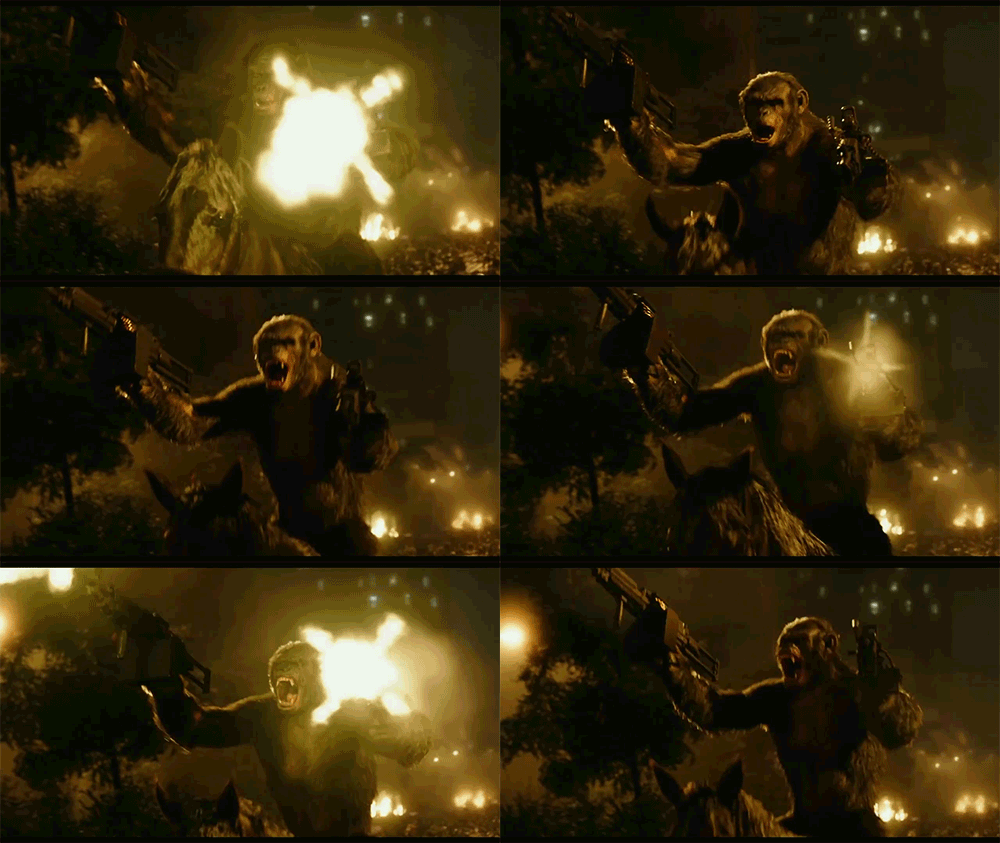
 Without question, the second entry in the Apes trilogy, Dawn of the Planet of the Apes, remains my favorite film in the franchise. There was something oddly wild & unpredictable about that film, which gifted the world one of my all-time favorite action movie images: the ape on horseback simultaneously operating two machine guns. I’m not sure there’s anything to be found in this follow-up that’s half as exciting as that image. Even Woody Harrelson’s character, who’s clearly supposed to echo Brando’s Colonel Kurtz performance from Apocalypse Now, feels fairly run of the mill for a crazed war movie villain. He nonchalantly shaves his head with a straight razor, wears sunglasses at inappropriate times, and eats apple slices off a combat knife; all of that macho posturing feels cinematically overfamiliar. By the time a Jimi Hendrix needle drop finds him listening to Vietnam War era rock alone at his boozy command station I felt as if I had already met this character a thousand times before. It was a beat that made me roll my eyes just as hard as any of Steve Zahn’s attempts to resurrect Pauly Shore humor or his silent little girl companion’s similarly cliché visual representations of Wartime Innocence (complete with tenderly earnest offers of a single flower). If it weren’t for the presence of CG apes in its central roles or the movie’s lengthy, silent stretches of sign language communication, War for the Planet of the Apes wouldn’t feel much different from any number of big budget war movies or grim franchise-closers. It’s competently made and visually impressive. It’s got a strikingly sorrowful brutality to it that helps distinguish it slightly from the other bombastic works of calculated studio bloat floating out there in the summertime blockbuster heat. Still, titles like Dawn or, better yet, Okja are exciting reminders that CG spectacle can be something much more idiosyncratic, more passionate, and more memorable than that. At least Kong: Skull Island is a fresh-on-the-mind counterpoint signaling that it also could’ve been much worse.

-Brandon Ledet

Baby Driver (2017)

In the few days since watching Edgar Wright’s latest at the theater, starting almost immediately after the screening, I’ve been suffering a very annoying case of swimmer’s ear. I can’t hear very well from the affected appendage, which is ringing slightly & swollen to the point of discomfort. I also can’t help but think that this sudden affliction is somehow cosmic retribution for not especially caring about Baby Driver, a film everyone seems to love without reservation, but only stirred apathy in me. In the film, a young twenty-something getaway driver with a heart of gold (named Baby, naturally) suffers from a near lifelong affliction of severe tinnitus. To ease the constant ringing in his ears, he choreographs his day around an endless stack of carefully-curated iPod classics, each loaded with just the right song selection to drown out the noise in his head & get him through his reluctant life in crime. Given how (mostly) great the soundtrack Baby selects for himself is (including tracks from artists as varied as T. Rex, Young MC, and The Damned) and the immediately apparent exuberance Wright shows behind the wheel, it’s downright sinful that I couldn’t manage to have fun watching this summertime exercise in action & style. Do not worry, though. My ear seems to have been struck down for the offense.

I don’t want to waste too much server space shitting on Baby Driver, since it’s bringing a lot of people a lot of joy. It’s easy to recognize what they see in it: stylized car chases, a killer soundtrack, playful action movie dialogue, etc. It’s just frustrating to me that a film with such an exciting premise (a babyfaced criminal timing his bank robbery getaways to pop music) ultimately feels so conventional & uninspired. It starts off sublimely committed to its central conceit too. Baby (played by real-life babyface Ansel Elgort) draws attention to himself by drumming on the steering wheel & lipsycing for his life to a blues rock diddy outside an in-progress robbery. His irreverence is immediately infectious. After establishing Baby’s skills behind the wheel in a show-off’s getaway, the movie establishes its main hook up front in the opening credits. While Baby strolls to a local coffee shop to cap off the heist, the music in his earbuds syncs up to the imagery onscreen, to the point where graffiti & street signs echo lyrics from the soundtrack. In this opening adrenaline rush, it’s easy to be seduced into thinking you’re watching a high octane, pop music-driven modernization of The Umbrellas of Cherbourg, a visually complex musical where every meticulously crafted detail in play is just an extension of the song developing in your ear. That’s why it’s such a letdown when the movie then reveals itself to be a much more conventional, instantly-familiar heist picture.

That’s not to say that a conventional heist picture can’t be a worthwhile mode of entertainment. Even while disappointing in ambition, Baby Driver features some exceptional performances from its actors. Lily James is absurdly sweet in her role as a diner waitress, feeling like a cartoolishly pure distillation of wholesome Americana. Jamie Foxx also steals attention whenever he’s allowed the opportunity in his role as the loose cannon criminal who can’t be trusted not to blow every heist apart into a bloodsoaked catastrophe, an unpredictable element of danger that helps the film’s “one last job” plot feel at least somewhat distinctive instead of mind-numbingly cliché. I’m a lot less hot on what Jon Hamm & Kevin Spacey are doing as Foxx’s criminal cohorts, which might get to the core of why I was underwhelmed by the movie as a whole. It’s not necessarily a fault with the performances, but more to do with Wright’s screenplay. Spacey & Hamm are tasked with delivering deliberately over-stylized, insincerely quippy dialogue that makes Baby Driver feel overall like a return to that deluge of mediocre mid-to-late 90s sardonic crime movies that followed in the wake of Pulp Fiction & Reservoir Dogs. Even back then those overly-jokey, scripted-to-death crime pictures were already exhaustingly redundant & flat. In a 2017 context the effect is even worse, feeling about as try-hard & unfunny as Deadpool.

It’s possible my mood was soured before Baby Driver even began, given Edgar Wright’s snooty pre-screening PSA about how going to the theater is an essential cinematic experience, as opposed to to the slackjawed dimwit slobs who watch Netflix on the couch (i.e. everyone alive). Mostly, though, I just felt let down that Wright abandoned his central Action Movie Cherbourg concept so quickly after following it to its furthest end in the opening credits. Whenever stray gunfire or gearshifts sync to the music in later scenes, it just feels like a distant echo of a better movie that could’ve been. Without its defining gimmick commanding every moment, Baby Driver feels alternately like post-Tarantino slick action runoff & a made-for-TV mockbuster version of the equally mythic, but infinitely more stylish Drive. I probably shouldn’t be saying these things aloud, though, just in case it’s risking hearing loss in my currently uninfected ear. I hope you, Wright, and the pop music gods in charge of my hearing will eventually forgive me for the transgression, lest I need to start shopping on eBay for some secondhand mp3 players.

-Brandon Ledet

RoboCop (2014)

One of the stranger trends to emerge from major studios scrambling to remake every past success has been the push to re-imagine Paul Verhoeven films as PG-13 commodities. The recent announcement of an upcoming Starship Troopers re-imagining makes three Verhoeven remakes in the past few years that seemingly are determined to strip the iconic director’s work of all the satirical cruelty that made it successful in the first place. Did the world really need a version of Total Recall with no Schwarzenegger and no trips to Mars? It’s doubtful. I can’t imagine a modern version of Starship Troopers’s war propaganda satire will fare much better and it’s starting to feel like only a matter of time before we get an updated version of Verhoeven’s Showgirls with all of the camp and the nudity surgically removed. The biggest disappointment in this trend so far, though, might just be the 2014 remake of Verhoeven’s privatized police force satire RoboCop, arguably one of the greatest films ever made. The PG-13 RoboCop reboot is especially frustrating in the context of modern, sanitized Verhoeven remakes because it threatens to actually be a decent film with its own interesting ideas for its opening half hour. No other Verhoeven bastardization so far has ever had a chance of being half as interesting as the recent Robo-reboot did, which makes it all the more tragic that the film crashes and burns in such a dull, uninspired manner.

I’d forgive anyone for being fooled that the 2010 RoboCop “gets it” based on its opening sequence. Samuel L. Jackson kicks off the film as the host of a primetime news shoe that’s half CNN, half Dianetics DVD. There are no comedy sketches interrupting this opener as “commercial breaks” like in the Verhoeven film, but the satire in the sequence is still palpable. Jackson’s fake news show profiles a private American company that makes billions of dollars selling weaponry to the military. In demonstration of the power & efficiency of the company’s military-grade robots, which include past RoboCop villain ED-209 working in tandem with Star Wars prequel-type droids, a Middle Eastern terrorist cell is dismantled by American troops. The raid bleakly concludes with the execution of a child, a detail the news program conveniently cuts from its live feed. Jackson’s host then asks his audience why a “robo-phobic” America is so cautious about bringing these private sector androids into urban law enforcement, needling, “What’s more important than the safety of the American people?” This opening efficiently conjures modern concerns of trading freedom for safety, the morality of drone warfare & the surveillance state, and the terrifying business practices of privatized military & police forces, all while maintaining at least some of the sly humor of Verhoeven’s source material. Unfortunately, its minor successes are short-lived. There’s a national debate about the ethics of a roboticized police force that, of course, eventually leads to the titular cyborg solution of a half-man/half-machine (all cop) compromise. The movie remains mildly interesting as RoboCop is built by a futuristic prosthetics company and adjusts to his new Robo-body, but immediately crashes into a wall of modern PG-13 action tedium as soon as he blossoms onto his complete Robo-self. It never recovers.

The hard-R violence of the 1980’s RoboCop feature meant that each bullet, every blow delivered by RoboCop or his supercriminal enemies were significantly brutal. In the remake, the violence is much less impactful, much easier to shake off. The film’s CGI-aided fantasy violence doesn’t help that point much either. RoboCop leaps weightlessly like a superhero in this version, sharply contrasted with the limited mobility in his heavy hydraulic systems of the past. Outside of a couple production details like RoboCop having one human hand and one Robo-hand to accentuate his dual, self-conflicted nature, the film more or less runs out of ideas as soon as its titular hero is actualized. It’s an aggressively conventional work that fully loses track of why it even exists, to the point where callbacks to the Verhoeven classic in lines like “I wouldn’t buy that for a dollar,” feel absurdly out of place. With the violence muted and the satire almost completely drained, this RoboCop rehash feels entirely devoid of a sense of purpose, as if it were a down-the-line sequel of a Jason Statham or JCVD property that surfaced on VOD long after its origins had been forgotten. You can feel it reaching to reclaim its opening spark in its political mockery, which posits old-timey Republicans as the opposition to the RoboCop initiative and forward thinking leftists, including Michael Keaton in full Steve Jobs mode, as the ones pushing for the innovation. By the time Sam Jackson’s news anchor returns to usher in the end credits, though, the game had already been lost and nearly everything in-between feels like a generic 2010s shoot-em-up. Something about that wasted potential feels even more dispiriting than it would if the movie were just bland from the very beginning.

RoboCop is one of those remakes where you could change just the title and a couple minor plot details and avoid purchasing the rights to the intellectual property altogether. That, of course, would have hurt ticket sales, but it would also have lowered expectations of the quality comparisons to the original Verhoeven film, which it seems disinterested in matching in tone or content. The worst part about RoboCop is that the idea it initially presents it is interested in continuing & adopting Verhoeven’s weird vision to a modern context. Ultimately, though, I’m not sure it was interested in saying anything in particular at all, a distressing attribute seemingly shared by all of these unimaginative “re-imaginings” of this great director’s greatest hits.

-Brandon Ledet

The Fate of the Furious (2017)

The premise of the eighth entry in the Fast & Furious franchise is that Vin Diesel’s long-time ringleader/paterfamilias Dominic Toretto (or, Daddy Dom, if you will) betrays his street racing brethren and turns his back on Family. Now, if you’ve been paying any attention to the first seven installments of the series, God help you, you already know that Family is all that matters to the speed demon lug. He won’t shut up about it. That’s why the betrayal is so cold and so out of character. Worse yet, in this most recent episode the franchise itself turns its back in its own long-time partners, ice cold bottles of Corona. The film betrays over fifteen years of brand loyalty by nonchalantly switching the Fast Family’s beer preference to Bud heavies as if we wouldn’t notice. It also brings back an old villain, played by Jason Statham, who is responsible for the deaths of past Family members as a Good Guy who’s just welcomed to the team with mostly open arms, few questions asked. The Fate of the Furious also breaks format by featuring a couple brutal, non-driving related deaths (including a propeller-aided one that even involves a touch of blood splatter) and by shifting focus from Familial drama to bombastic comedy, where jokes are given far more breathing room than the overstuffed dramatic beats. It’s not just Dom that turns his back on long-established alliances and moral codes in The Fate of the Furious. F. Gary Gray’s contribution to the series also betrays everything that’s come before it in terms of narrative and tone. In a way, though, that kind of blasphemy is perfectly at home with the spirit of the series.

The Fast and the Furious is a universe without a center. It’s a series that continually retcons stories, characters, and even deaths to serve the plot du jour. The first four films in the franchise in particular are a total mess, continuity-wise. It wasn’t until Fast Five that it even found its voice: Vin Diesel endlessly mumbling about Family. The series may be Fast and Amnesious with its various narrative threads on the whole, but Dominic Toretto had always been there to keep the Family together, even in the franchise’s furthest outlier, the under-appreciated Tokyo Drift. That’s why it’s a brilliant move to shake up the sense of normalcy that’s been in-groove since the fifth installment by giving Daddy Dom a reason to walk away from his Family, whom he loves so dearly. At the starting line of The Fate of the Furious, Dominic Toretto is a Christ-like figure, a Man of the People, a Hero to Children Everywhere. He takes a quick break from his honeymoon in Havana with series regular Letty (Michelle Rodriguez) to shame a predatory loan shark in front of the very people he bullies by beating him in an old-fashioned street race while driving backwards & on fire. Every last person in Cuba cheers and we’re all quickly reminded exactly why Daddy Dom is the Greatest Man Alive. This street racing reverie is disrupted by a late 90s holdover Super Hacker played by Charlize Theron. Theron’s newbie baddy preys on Dom’s infamous devotion to Family and mysteriously blackmails him into “going rogue,” stealing EMP devices & “nuclear footballs” to support her Evil Hacker cause. This betrayal of what is Right and Just leads to a global car chase where Dom’s long list of Family members (Rodriguez, The Rock, Ludacris, apparently Statham, etc.) try to steal him away from Theron, who pushes Dom to “abandon his code” and “shatter his Family.” It’s all very silly, but it’s also a welcome departure from the typical Fast & Furious dynamic.

Of course, The Fate of the Furious was never going to survive on its tonal consistency or the strength of its plot. What really matters here is the action movie spectacle. F. Gary Gray brings the same sense of monstrously explosive fun to this franchise entry as he did to the exceptional N.W.A. biopic Straight Outta Compton. The Rock is a real life superhero, particularly shining in a music video-esque prison riot sequence where he manually destroys an entire building full of lowlifes (including local pro wrestler Luke Hawx, who also briefly appeared in Logan earlier this year). At one point, Charlize Theron’s Ultimate Hacker gives the ridiculous command “Hack ’em all,” and remotely takes control of virtually every vehicle in NYC, giving rise to literal floods & waterfalls made of cars. Vin Diesel rocks a heavy metal welding mask & oversized chainsaw combo that makes him look like the villain from a dystopian slasher. Even more ridiculously, the Fast Family is asked to race and battle a nuclear-armed submarine that attacks them from under the Russian ice they drive flimsy sports cars across. And (mild spoilers, I guess) they win! As far as The Fate of the Furious might stray from past tonal choices and character traits, it ultimately sticks to he core of the only thing that has remained consistent in the series (now that Dom’s had his opportunity to Go Rogue): there’s no problem in the world that can’t be solved by a deadly, explosion-heavy street race and even the most horrific of Familial tragedies can be undone by a backyard barbeque, where grace is said before every meal and Coronas, um, I mean Budweisers are proudly lifted into the air for a communal toast. There’s something beautiful about that (and also something sublimely silly).

Besides the narrative ways in which The Fate of the Furious breaks format, the film also marks a shift where the franchise functions as an outright, intentional comedy. F. Gary Gray openly shows his roots in the Friday series with the way humor overtakes Family drama in this entry. Vin Diesel starts off the film with the same “Ain’t I a stinker?” mugging he used to anchor xXx: Return of Xander Cage earlier this year. Ludacris’s nerd archetype is in constant verbal sparring with Tyrese Gibson’s womanizing ham. Dick jokes, Taylor Swift references, and meta humor about The Rock’s past life as Hercules all seem to be afforded more heft than the mood-killing dramatic beats, which breeze by no matter how shocking or tragic. The series also seems to have moved on from stunt casting rappers to enlisting well-respected actors for over-the-top cameos, this time none other than Helen Mirren. Despite rumors about an on-set rivalry between Vin Diesel & The Rock and a few drastic shakeups to the franchise’s central Family dynamic, F. Gary Gray manages to keep the mood in The Fate of the Furious just about as light as its explosions are frequent & loud.

If I have any complaints about this most recent entry to the series, it’s that it wasn’t quite blasphemous enough. The Fast & Furious franchise is overdue for another Tokyo Drift-style shakeup that completely disrupts the rules of its universe. Why not take this carnival to space? Why not have the Family get caught up in A Race Through Time? Why not have them travel to Hell and win back the life of a fallen member by beating The Devil Himself in a street race? If the series continues down its current path, I have no doubt it’ll remain a fun, absurd source of racing-themed entertainment. There’s just so much potential for it to jump a new shark in every franchise entry, though, (including literally jumping sharks!) and I think it’s more than ready to both make the leap and stick the landing.

-Brandon Ledet

Power Rangers (2017)

I cried during a Power Rangers movie. I’m not sure if that’s something to be proud of or embarrassed by, but it’s true regardless. The last thing I would have expected from a superhero origin story that’s simultaneously a reboot of a 90s nostalgia property and a long-form Krispy Kreme commercial is that would bring a tear to my eye, but it happened several times throughout the latest Power Rangers film. Long before Power Rangers is overrun with alien sorcery, robot dinosaurs, and corporate-made donuts, it shines as a measured, well-constructed character study for a group of teenage outsiders longing for a sense of camaraderie, whether terrestrial or otherwise. Isolated by their sexuality, their position “on the spectrum,” their responsibility of caring for ailing parents​, and their past bone-headed mistakes, the teens who eventually morph into the titular Power Rangers are a broken, lonely lot. Their gradually-earned cohesion as a team of superheroes who sport what look like full-body bike helmets & drive robo-dinos through the streets of their home town looks an awful lot like nearly every generic action thriller released in the wake of the ongoing MCU & Transformers franchises, but it means so much more here than it does in the similar, but lesser work of its contemporaries. Just thinking about the film’s, “Together we are more” tagline gets me a little emotional. The only way you can earn that kind of genuine outsiders-vs.-the-world pathos is by investing real time & genuine effort in character work before your teen heroes suit up & kick alien ass, which is exactly what makes Power Rangers such an overwhelming success.

Now that I’ve gotten that confession about my idiotic blubbering out of the way, it’s time to admit that this is still a deeply silly film adapted from even sillier source material. It takes a long while before the audience gets to see fully-costumed Power Rangers battling their sworn enemy Rita Repulsa and her rock monster army of “puddies,” but the film announces the silliness at its core right out the gate. The very first scene in Power Rangers involves a prank that escalates to one teen jerking off a bull and another crashing into several cop cars. Off-handed references to cramming crayons into assholes & masturbating in the shower similarly cut through the heavy-handed teen drama, despite its team-building training montages and its campfire confessions about what’s been getting the poor lot down. From there, Power Rangers embarks on a daring journey of cobbling together several genre-disparate films from cinema past: The Breakfast Club (where a group of alienated teens on weekend detention struggle to relate to peers outside their respective social circles), Explorers (where kids stumble into an out-of-this-world adventure after discovering a real-life space ship), Chronicle (I have no idea what that one’s about; it just sounds right), and so on. Just about the only movie Power Rangers doesn’t resemble in some way is the 1995 feature Mighty Morphin Power Rangers: The Movie, which arrived during a very specific era of ooze-obsessed children’s media. Instead of that film’s purple slime, you have to settle for a little post-Dark Knight grim & grime, but the 2017 version does find its fair share of heightened camp within its few recognizable actors: Elizabeth Banks as a drag routine version of Suicide Squad‘s The Enchantress, Bill Hader as a pot-bellied robot named Alpha 5, and Bryan Cranston as an all-knowing, floating alien head named Zordon (not to be confused with Zardoz), who more than vaguely resembles the Engineer aliens from Prometheus. And by the time the whole thing reveals itself to be a feature-length ad for Krispy Kreme donuts, the emotional resonance of its character-driven build-up is an absurd thing to have to reconcile with its campier tendencies.

The machinations necessary to set the cookie cutter plot in motion aren’t all that interesting to recount. Five teens gather at an operational gold mine for various personal reasons, discover color-coded Infinity Stones/Coins, board a buried space ship, and wind up staging a battle against a 65 million year old mummified alien and her gigantic, liquid gold prometheus. It’s all simple enough. Much like how Lucas Black spent the entirety of Tokyo Drift searching inside himself for the ability to drive sideways, these teens come together to look inside themselves for the ability to “morph” into their inner Power Rangers & form Voltron to defeat the evil, donut-eating space alien. If I were a little more academic and a lot more frivolous I’m sure I could mount an argument about how the team of horny teens’ initial failure to morph is metaphorically related to their frustrated inability to achieve orgasm. This subtext almost becomes explicit in a transition where the Yellow Ranger’s campfire confession of her closeted queer identity is immediately followed by Rita Repulsa appearing under her sheets and roughing her up in her bedroom. The truth is, however, that the gang’s transformation into an ancient, transferable line of intergalactic superheroes isn’t nearly as well thought-out or thematically rich as the various revelations of their troubled home lives, nor does it need to be. Beating up giant golden monsters in dinosaur-shaped mech suits is rad enough on its own not to require any such justification. This is a superhero origin story about a group of teens saving the world by learning to perform a communal, pro wrestling-style suplex on a giant space alien baddy. How much more plot do you really need?

I’m of two minds about the 2017 Power Rangers movie. On the one hand, I was totally on the hook for its emotional character work where isolated teens console each other with lines like, “You did an awful thing. That does not make you an awful person,” and discover a newfound sense of community among themselves. At the same time, I was tickled stupid by its robo-dino battles, donut-flavored ad placement, thrash metal Tai Chi, and self-deflating meta humor, like when Hader’s pudgy robot declares, “Different colors, different kids, different color kids!” Overall, this is a nostalgia-minded camp fest that’s not at all above cheap pops like briefly playing the 90s “Go Go Power Rangers” theme during its climactic battle. In the long run, it’ll likely lead to nothing more than a handful of forgettable, diminishing returns sequels. I still bought right into what it was selling, though, just like I greedily ate up every other recent reboot of similar bullshit media I loved as a kid: Ghostbusters, GoosebumpsTeenage Mutant Ninja Turtles, etc. Maybe that makes me a sucker & a rube, but this rube had a good laugh and a good cry at a kids’ movie this past weekend, which is more than anyone should have been able to ask for out of a property this old & this inane.

-Brandon Ledet

Kong: Skull Island (2017)

The big risk in me venturing out to see the latest King Kong reboot was that my love for loud & dumb movies about giant monsters might be crushed by my ever-growing boredom with war narratives. Kong: Skull Island made no secret of its Vietnam War cinema aesthetic in its advertising, promising to be something like an Apocalypse Now With Kaiju Primates genre mashup. The actual film is something more like Platoon With Kaiju Primates, but the effect is still the same. Skull Island‘s main hook is that it uses the traditional King Kong narrative as a thin metaphor for U.S. involvement in Vietnam (and other unwinnable, imperialistic conflicts of world-policing), declaring things like “Sometimes the enemy doesn’t exist until you’re looking for them.” It’s the same exact themes that are hammered to death across nearly all Vietnam War movies with the exact same Love The Smell of Napalm imagery (ever seen an explosion reflected in aviator sunglasses before?) and more or less the same needle drops (don’t worry if they don’t immediately play CCR; it’ll eventually happen twice). As an audience, I’m missing an essential Dad Gene that enables people to care about a very specific end of Macho Genre Cinema (including war films, submarine pictures, Westerns, and, oddly enough, the James Bond franchise). If there’s anyone out there with that Dad Gene who still enjoys the occasional Vietnam War film, they’d likely have a lot more fun with Kong: Skull Island than I did. For me, it was like someone mixed jelly into my peanut butter jar because they didn’t bother cleaning their spoon.

Perhaps the biggest disappointment about Kong: Skull Island is that it amounts to less than the sum of its parts. The cast alone is a testament to a staggering waste of potential: Samuel L. Jackson, John Goodman, Tom Hiddleston, recent Oscar-winner Brie Larson, all wasted. The movie is stacked with onscreen talent, but just about the only memorable performances delivered are from a fully committed Shea Whigham & John C. Reilly, who both pull off a tragic/comic balance in their respective roles as shell-shocked war veterans. Reilly is (rightly) getting a lot of attention in this film as a shipwrecked soldier who’s been stranded on Skull Island since WWII and is deliriously relieved to see people who share his language & culture for the first time in decades. The biggest laugh I got out of the film, though, was in watching Whigham chow down on a can of beans and casually describe his first battle with a skyscraper-sized ape as “an unconventional encounter.” The sense of wasted potential extends far beyond the immense talent of its dispassionate cast, however. Even its central hook of attempting a Vietnam Movie With A Giant Ape seems like it was handled in the blandest, least interesting way possible. Instead of writing a revisionist history where Kong is transported to Vietnam and intermingles with the soldiers on the ground, the soldiers are transported to his home, the titular Skull Island. This sets up an echo of the exact same narrative we’ve seen in nearly every version of a Kong picture. Peter Jackson’s (infinitely more passionate) version of King Kong was released just a little over a decade ago. All this one does to update it is toss in some helicopters & flamethrowers and increase the size of the titular ape.

I’m not sure a full plot description is necessary here, so I’ll try to make it quick. The day after the U.S. declares its withdrawal from Vietnam in 1973, a military troop is ordered to secretly escort a geological mission to survey the once mythical Skull Island. [Scene missing: soldiers complaining that they’re being deployed instead of going home.] There’s a lengthy assembling-the-team sequence where everyone’s various motives & vulnerabilities are revealed for future significance, but no one character gets enough screentime to make any of it count for anything. Do we really need to know Brie Larson’s background as a hippie anti-war photographer to watch her blankly stare at monsters & the Northern Lights for the next 90min? Doubtful. The “geological” expedition, of course, is a betrayal, a cover-up for finding proof of a two-fold conspiracy theory: that the Earth is hollow and that giant monsters live inside it. Once discovered, King Kong is initially seen as a threat, as he attacks the military crew that bombs his home in an attempt to prove those (correct) theories. Eventually, however, it’s revealed that the gigantic ape is the protector of the island and, by extension, the world at large. He fights off & keeps at bay the other monsters that threaten to crawl out of the hollow Earth to terrorize mankind: giant spiders, squids, something John C. Reilly’s freaked out war vet calls “skull crawlers,” etc. This dynamic of Kong as a protector doesn’t really do much for the film’s central Vietnam War metaphor. It mostly just hangs in the air as a naked setup for a M.U.T.O. (Massive Unidentified Terrestrial Organism, no C.H.U.D. that) cinematic universe, which is eventually supposed to link up with the most recent American Godzilla property (as opposed to the far superior Japanese one) for a pre-planned crossover film. And there you have yet another passionless blockbuster that’s a mere placeholder for a future film franchise payoff.

If I haven’t talked enough about Kong himself so far, it’s because the movie doesn’t give me much to work with. There isn’t too much new or different about the infamous beast in his most recent form. The quality of the CGI hasn’t advanced all that significantly since Jackson last tackled the property in ’05, which is kind of a big deal in the King Kong genre, going all the way back to its stop-motion animation roots in the 1930s. The ape’s gotten a lot bigger in scale (likely in preparation for his upcoming kaiju battles) and modern 3D made for an occasional moment of action cinema eye candy, but I couldn’t work up much awe or horror for the misunderstood monster, which is a problem. His inner anguish is always secondary to the soldiers’, never being afforded much of an onscreen emotional narrative outside John C. Reilly plainly informing us that he’s the last of his kind. Sacrificing the ape’s inner life for some killer kaiju battles might’ve made that thin emotional groundwork forgivable, but the giant monster violence of Kong: Skull Island is also a little lacking. In old school kaiju movies (and in more faithful throwbacks like Pacific Rim) the monsters would fight for minutes at a time, establishing pro wrestling-style narratives through the physical language of their battle sequences. Here, the fights only last for seconds at a time as we follow the human characters who navigate their paths of their destruction. Again, my disinterest with that end of the dynamic might have a lot to do with my general boredom with war movie plotting, so mileage may vary on that point. It just feels strange to me that a movie that boasts Kong’s name in the title would be so disinterested in the ape himself.

None of this is to say that Kong: Skull Island is a total disaster and an entirely joyless affair. There are some moments of monster movie mayhem that work well enough as eye candy and both John C. Reilly & Shea Whigham do their best to boost the spirit of the proceedings with some much-needed levity & camp. (I think my ideal, streamlined version of the film just be those two characters alone in a Swiss Army Man-style romance adventure on the same kaiju-infested island.) Overall, though, the movie feels like a well-funded version of a SyFy Channel mockbuster that can afford to hire legitimate actors instead of Ian Ziering or Steve Guttenberg or whoever’s up for it that particular weekend. Unlike the recent genre film rehash Death Race 2050, which applies that SyFy style of direct-to-VOD CG cheapie energy to something uniquely bizarre, Kong: Skull Island lacks any distinguishing sense of passion. I guess you could point to a smash-cut of Kong eating a human to a human eating a sandwich or the basic novelty of a giant ape fighting a giant squid as holding some kind of camp value, but that’s a bit of a stretch, given how much the movie focuses on its stale Vietnam War themes. The silliest Skull Island film gets in its basic DNA (outside Reilly & Whigham’s respective quirks) is in its shameless shots of muscular Kong ass, but even that line of putting-it-all-out-there ape anatomy could’ve been more over the top, #GiveKongADong2017. Maybe audiences more in tune with the basic thrills of war movies as a genre will feel differently, but I struggled to find anything in the film worth holding onto. Its stray stabs at silliness didn’t push hard enough to save it from self-serious tedium and its Vietnam War metaphor wasn’t strong enough to support that tonal gravity. Everything else in-between was passable as a passive form of entertainment, but nothing worth getting excited over, much less building a franchise on.

-Brandon Ledet

Transformers (2007)

onehalfstar

Two cataclysmic events in my life have lead me to this desperate hour, where I’m considering watching the entirety of the live action Transformers franchise for the very first time. First, I found myself intrigued by the convoluted mythology and grave, self-obsessed tone of the trailer for the upcoming fifth entry, The Last Knight, which is being reported as the final directorial contribution to the series from explosion fetishist Michael Bay. Secondly, I recently fell in love with Bay’s 1998 disaster pic Armageddon as the beautifully constructed, spiritually corrupt Conservative fantasy piece that it truly is. These freaky, reality-shattering occurrences have lead me astray, tempted me into a den of sin. I knew it was wrong to watch Transformers, a transgression I’ve avoided for an entire decade until now, but I did so anyway. I was rightly punished for crossing that line.

Transformers
matches Armageddon‘s massive runtime and occasionally approaches its attention to heightened visual craft, but it is in no way in the same league as that morally deficient masterwork. At one point a single-scene character shouts, I kid you not, “This is a hundred times better than Armageddon, I swear to God!” They are the worst of liars. The reason that one-liner is worth mentioning is that Transformers is in many ways not an action fantasy piece, but instead the absolute worst designation any film can achieve: a failed comedy. After kicking things off with a little jingoistic Army worship, the film gleefully launches into its true bread & butter: a torrent of shitty, often offensively unfunny “jokes.” Bernie Mac plays a sleazy car salesman who repeatedly yells “Mammy!” in the broadest delivery possible. Characters are made fun of merely for speaking Spanish or Hindi as their first language. Half of the bloated runtime is dedicated to the hilarious idea that the film’s protagonist is interested in fucking Megan Fox, a pursuit the leering camera very apparently identifies with. Once the titular transforming robots show up, they join right in with both the racial caricature and the Megan Fox Is A Total Babe lines of humor. They even add a little scatilogical flavor to the painfully unfunny comedy by pissing on one of the antagonistic G-men who slow down the plot. I’d like to claim that the jokes in Transformers would only appeal to ten year old boys who don’t know any better, but the film pulled in $700 million at the box office, so I guess the joke is ultimately on me for not laughing along.

As someone who regularly enjoys and promotes the sillier, campier end of genre cinema, it goes against everything I believe to say this, but I think Transformers would have been a much better film if it actually took its own ridiculous premise seriously. As a film built around a series of Hasboro toys (shape-shifting robots from a war-ridden planet that hide among us as common automobiles), the film is already wildly goofy enough in its basic DNA that there’s no need to lighten the material with constant, insensitive bro humor. By turning every single narrative beat in the first two hours of the film into a stale joke (Heh, heh. I like it when the black robot says, “This looks like a cool place to kick it.” Heh, heh.) and opting to center its story on the human characters who encounter the robots instead of the titular alien beings everyone paid a ticket to see in the first place, it’s as if Transformers is constantly apologizing for its own existence. Assuming the audience couldn’t possibly want to actually watch the talking robots film advertised on its poster, Transformers dedicates about two thirds of its runtime to watching Shia LaBeouf feebly try to charm the (short) pants off Megan Fox. LaBeouf is convincing as a high school con man here (just as he’s convincing as an adult con man drifter in American Honey), but for some reason we’re asked to identify with his sleazy, insincere ways and laugh at his slimy, immature humor. Megan Fox is . . . less convincing as a small town high school student, but it’s not really her fault that she was cast merely to look supermodel beautiful so Michael Bay could drool at her consistently exposed midriff. Did I mention that she’s hot and a gear head? It doesn’t matter, because she’s not a talking robot alien, which is what most people paid to see.

Full disclosure: I did attempt to watch this Transformers franchise-starter when it was first released about a decade ago, but I couldn’t make it all the way through. The first 50min of the film bored me to tears and when the robots started talking I just found it too goofy and had to abandon ship. I now see how wrong I was. The first hour of Transformers is indeed still a boring humor vacuum, but the talking robots honestly aren’t all that bad. A straightforward sci-fi action film about two Cybertronic races (the Autobots and the Deceptions) fighting for possession of an intergalactic MacGuffin known simply as The Cube and debating in grave, heavy-handed speeches about whether humanity is worth saving (“Humans don’t deserve to live,” “They deserve to choose for themselves!”) doesn’t exactly sound like anything new or unique. In fact, after the Marvel takeover that’s unfolded in the years since this film’s release, it sounds like par for the course for the modern, bloated blockbuster. However, when Transformers leaves LaBeouf & Fox’s “hilarious” nonstarter romance behind for its concluding half hour of nonstop robot battles, it starts to feel like a passable slice of Hollywood entertainment. Careless destruction of property & faceless casualties pile up while Bay matches his robo explosions with a soaring, almost religious orchestral score. I’ve heard the robots’ ever-shifting, impossible transformations in these films described as a form of Cubist art before, which is a little lofty of a critical claim, but actually starts to make sense once the battle gets out of hand. Then, when it’s all over, LaBeouf & Fox make out on the hood of a robot car (which, it’s with noting, is a sentient being), reminding the audience that the film wasn’t always entertaining. In fact, most of it focused on these two dweebs for no discernible reason.

I’d be a liar if I said I didn’t enjoy any of Transformers before that concluding robo-battle. The film’s 80s-obsessed music cues were often pretty funny, especially in comparison to the jokes in the dialogue. The actress who played Shia LaBeouf’s mother, Julie White, was a total charmer in her all-too-brief performance, especially when she joins in in oggling Megan Fox’s hot bod. I even got a laugh out of two (!) Shia LaBeouf one-liners: one where he describes the Autobots as “robots, but like super advanced robots,” and another where he answers his parents’ question, “Why are you so dirty and sweaty?” with “I’m a child.” My biggest laugh in the film, though, was when a cop abruptly tells LaBeouf to shut up, since it’s exactly what I had been thinking for at least the first hour of the runtime. If all the humans of Transformers had just shut up and let the robots do the talking/battling, the film might have actually been entertaining, or at least less painfully embarrassing (it’s especially difficult not to feel bad for Jon Tuturo & Tyrese Gibson here). It’s in the climactic battle when Michael Bay really lets loose. Hundreds of human lives are squashed within minutes without a stray, momentary thought given to their loss. A steering wheel comes to life and eats a Stuck Up Rich Brat’s face. Everything explodes and is ground to dust in a lovingly shot cacophony. It’s too bad that the two hours preceding that cathartic release is embarrassed of its own nature as a Transformers film and buries its talking robots under an insurmountable mountain of ill-considered “comedy.” I can’t believe I’m saying this, but I hope future entries in the franchise take their robo-alien folklore a lot more seriously.

-Brandon Ledet

Roger Ebert Film School, Lesson 23: Hellfighters (1968)

EPSON MFP image

Roger Ebert Film School is a recurring feature in which Brandon attempts to watch & review all 200+ movies referenced in the print & film versions of Roger Ebert’s (auto)biography Life Itself.

Where Hellfighters (1968) is referenced in Life Itself: On page 153 of the first edition hardback, Ebert gloats about how great being a professional critic was in his glory days. He writes, “It was a honey of a job to have at that age. I had no office hours; it was understood that I would see the movies and meet the deadlines. I loved getting up from my desk and announcing, ‘I’m going to the movies.’ A lot of my writing was done at night and on the weekends. I saw about half of the movies in theaters with paying audiences, sinking into the gloom to watch John Wayne fighting flaming oil wells in Hellfighters at the Roosevelt, or Pam Grier inventing blaxploitation at the Chicago.”

What Ebert had to say in his review: “Out in front of the Roosevelt Theater there’s a big photo of John Wayne and this quote, attributed to him: ‘I’ve made a lot of action pictures but never one as exciting as this.’ I doubt that Wayne volunteered this information; it sounds more like a studio publicity idea. The fact is, Wayne has made a lot of action pictures, and over the years he has gotten to be about as good at it as anybody. He must have been miserable during the filming of Hellfighters, which is a slow moving, talkative, badly plotted bore.” – from his 1968 review for The Chicago Sun-Times

EPSON MFP image

When praising the young, energetic talent that reignited American art cinema in the late 60s’ so called New Hollywood movement, it’s all too easy to overlook the undeniable virtues of the system those films were bucking against. The John Wayne action epic Hellfighters is a perfect snapshot of Big Studio glut when compared to its more forward-thinking contemporaries like Bonnie & Clyde and The Graduate. While these smaller New Hollywood upstarts were pulling influence from still-exciting sources like the French New Wave, the lumbering, old-fashioned Hellfighters more closely resembles instantly outdated modes of entertainment like Earthquake, Airport, and The Towering Inferno. Ebert was right to praise those smaller, more experimental works in his reviews while labeling Hellfighters “a slow moving, talkative, badly plotted bore.” I can’t disagree with a word of that. The dirty secret, though, is that although formally & thematically outdated in the face of smaller, more passionate films being made around them, Old Hollywood ghosts like Hellfighters effortlessly pulled off mesmerizing visual spectacles that were never truly touched by the likes of a Bogdanovich or a Friedkin or a De Palma. Even if its superiority was simply a question of budget, there’s an immense beauty to the costume designs, sets, framing, and rich colors of Hellfighters that could’ve been transcendent if were applied passionately instead of with workmanlike competence.

As with all John Wayne movies, whether or not they’re set in the dusty West, Hellfighters is often classified as a Western. This makes even less sense here than it does with the London-set cop drama Brannigan, since Wayne’s tuxedo’d firefighter lead doesn’t even carry a gun. Loosely based off the real world personality Red Adair, Wayne plays infamous oil field firefighter Chance Buckman (man, I love that stupid name) as he travels across the globe putting out dangerous oil well fires with barrels full of dynamite. Real manly stuff. Based on that description, you might think that the art film version of Hellfighters might be Sorcerer or its predecessor Wages of Fear, but it actually more closely resembles a film from the late 90s. Much like Bruce Willis’s tough guy hero in Armageddon, Chance Buckman is an oil industry legend who bullheadedly infantilizes his adult daughter by attempting to protect her from a twofold danger: the physical danger of his industry & the emotional danger of the womanizing men who work within it. It’s not at all difficult to imagine Michael Bay growing up fond of Hellfighters, thanks to its hyper-masculine self-delusion & over-indulgence in practical effects explosions. The John Wayne film often mirrors Armageddon‘s bullshit romanticization of the hard working men who risk their lives for oil & the worried women who love them, despite the constant danger of loss. Where Armageddon employs this ludicrous narrative & attention to visual craft for a punishingly kinetic live action fantasy, however, Hellfighters is content to lie still & talk its audience to death. It’s an entire movie built around the idea that large spouts of fire look cool. It’s not exactly wrong, just too long to justify that thin of a premise and too lethargic to fully command its audience’s attention, even as beautifully decorated it’s production design can be. If Hellfighters could’ve operated with Michael Bay’s punishing sense of immediacy it might’ve been an all-time classic. At the very least, it could’ve shot John Wayne into space to fist fight an asteroid the size of Texas. There’s pretty much no one who wouldn’t pay to see that.

A large part of what makes Hellfighters feel desperately old-fashioned is its constant glorification of traditionalist masculinity. So many bare knuckle punches are thrown without any real consequence in bar rooms, brothels, gambling holes, and hospitals that they start to register more like a handshake between bros than an act of violence. News reporters are whiny little wimps who can only get in the way while Real Men do the Important Work, the kind that requires muscles & explosives. The women of Hellfighters are wives, daughters, and secretaries, completely extraneous to the plot outside a fresh-from-The Graduate Katherine Ross, whose virtue & emotional well-being Chance Buckman is tasked to protect. The closest the movie comes to passing the Bechdel Test is a single scene where Buckman’s wife & daughter are golfing alone together, but their entire conversation centers on whether or not it’s worth the worry to love an oil field firefighter. Buckman himself is a stoic emotional void, only budging in his rock solid confidence to express annoyed frustration & mild worry with the women in his life who needlessly complicate his profession. Otherwise he just does what he does best: exploding fires into oblivion & unconvincingly delivering oil-themed one-liners like “If you’re coming to me for advice, I’m a dry hole” with a distinct lack of passion.

In the years since the New Hollywood takeover, directors have learned (and have been better funded) to apply Hellfighters‘s workman sense of extravagant spectacle to the energetic narratives that deserve it. Instead of overtalking its virtues between this piece, my initial review, and a subsequent podcast episode, I do believe Michael Bay’s Armageddon is a perfect example o how well that visual craft could be utilized with just a little creative gusto, even while holding onto its idolization of toxic masculinity. Hellfighters was an overlabored, undercooked movie industry dinosaur when compared to the more exciting, artier New Hollywood films that upended its place in the world, but that doesn’t mean it’s a film without value. When gazing into the rich color, impeccable costuming, gorgeous sets, and mesmerizing explosions that Hellfighters wastes on a going-through-the-motions John Wayne action epic, there’s an undeniable sense of missed opportunity. The film could’ve been something truly memorable if its better aspects weren’t helmed by a sleepwalking studio system that misread what its audience was interested in seeing. I can’t recommend Hellfighters as an entertaining work to anyone other than the most diligent John Wayne completist imaginable. However, I do think it works as a valuable reminder that there was a lot of untold merit in the bloated studio system that the late 60s broke apart with its scruffy batch of babyface auteurs.

EPSON MFP image

Roger’s Rating (1.5/4, 38%)

onehalfstar

Brandon’s Rating (2.5/5, 50%)

twohalfstar

Next Lesson: Camelot (1967)

-Brandon Ledet

Resident Evil: The Final Chapter (2017)

???????

twostar

campstamp

And so it goes that Paul WS Anderson’s Resident Evil franchise dies with a pathetic whimper . . . if, in fact, it dies at all. Resident Evil: The Final Chapter makes a hefty promise in its title to decisively conclude what has been a wildly uneven series of futuristic zombie shoot-em-ups. Yet, this sixth installment fails to deliver on that promise of finality, leaving the door wide open for a sequel the way each of its predecessors have in the past. Worse yet, The Final Chapter eases up on the mutated giants, virtual reality scenarios, and cloning-run-wild shenanigans that have made past Resident Evil films such an odd, unexpected delight. Instead of going for broke in its over-the-top CG fantasy violence and convoluted high-concept sci-fi plots, this series “finale” makes the mistake of aiming for genuine dread (a mark it falls far short of) & providing a legitimate backstory for its barely sketched-out characters. If the exact, clearly-defined origins of its heroes & villains were a necessity for Resident Evil‘s entertainment value, the series would not have gotten six films deep without them. These films’ mild popularity (in America at least; they’re wildly popular in foreign markets) depends on the ridiculousness of their zombie-themed action spectacle, something The Final Chapter brings no passion, attention, or inventiveness for. There’s nothing new here that hasn’t been done better in previous films in the series, except for that precious backstory for its protagonist, which, who cares? If this truly is the last Resident Evil film, the franchise has concluded with its worst, least exciting entry, a lazy shrug before its final bow, followed by a winking tease for an encore.

The end of Retribution, the fifth and possibly best entry to the franchise, leaves Project Alice (Milla Jovovich) stranded at the White House with the Agent Smith motherfucker that’s been the Bugs Bunny to her Elmer Fudd for the back half of the series. Surrounded by zombie hordes & some mutated dragon beasts, Not Agent Smith stabs Alice in the neck with a serum that supposedly restores her powers. The beginning of The Final Chapter throws all of the potential entertainment value of that setup in the trash. JK, everyone. Alice doesn’t really have her telekinetic supersoldier powers back. Also, there will be no showdown at the White House, since Not Agent Smith and his zombie buddies have cleared DC by the time Alice wakes up. Instead, we get another retelling of the franchise’s entire story arc, this time with a revisionist history that explains the backstory for the Umbrella Corporation’s evil intent for instigating a zombie outbreak in the first place. Game of Thrones actor Iain Glenn returns as the wicked corporate stooge behind all of the evildoing. Nevermind the fact that in the third film in the series, Extinction, his character was frustrated with his lack of power, having to answer to higher-ups in holographic boardroom meetings. He’s apparently been the head honcho for the Umbrella Corporation all along and the versions of him Alice has destroyed in the past have all been insignificant clones of the real thing. Okay. Now Alice must race back to the place where it all began, the underground Hive facility beneath Raccoon City, to retrieve an antidote to the zombie virus “before it’s too late,” in effect saving the world (or at least the few thousand uninfected humans who still inhabit it). It’s there that she learns who she truly is and where she comes from, a revelation I would have traded for any number of CG creatures, motorcycle stunts, or virtual reality freak-outs.

The Final Chapter completely misinterprets Resident Evil‘s inherent style over substance appeal and bends over backwards to retroactively inject gravitas into a flimsy premise that can’t support it. As a newly-converted fan to the series (Extinction & Retribution are both fun at least), I can’t speak for the majority of Resident Evil‘s dedicated audience, but I can say say that no amount of reformist backstory & clearly defined character motives could raise my own esteem for the long-running video game adaptation. I’ve made it five films into the franchise, somewhat happily, without that kind of clear-headed storytelling, so why start now? Ideally, a Resident Evil franchise-ender would get even more convoluted in its ill-considered sci-fi premise and go for broke in a nonsensical spectacle that would attempt to top the ridiculous places it went in the previous entry instead of crashing the whole thing down to the grounded, generic familiarity of the series’ origins. The closest we get to that here is some weird dragon hybrids teased at the end of the last film & a couple shots of a waterfall made of fire that melts a few zombies in a brief moment of victory. That should’ve been the starting point, not the conclusion. The rest of The Final Chapter is cheap jump scares, confusingly rapid action photography, a grounding backstory the series never needed, and the threat of a sequel despite the finality blatantly promised upfront in the title. The movie even misreads the room by aiming for action cinema legitimacy in a John Carpenter-inspired synth score instead of sticking with its usual nu metal tunage. I don’t look to Resident Evil films for legitimacy. I want them to be over-the-top & tacky. By failing to embrace its own tackiness the way past entries have and in eagerly searching for a more standardized mode of action cinema competency & logical storytelling, The Final Chapter had ended the Resident Evil franchise on its least worthwhile picture to date. It doesn’t exactly sour the memory of the series’ heights in Extinction & Retribution, but it does leave you walking away with a much blander taste in your mouth, which is the ultimate bummer.

-Brandon Ledet