Lust in the Dust (1985)

Now that Criterion has given Multiple Maniacs a restorative spit shine for a recent BluRay release, there aren’t many unsung movies left featuring a performance from Divine, the greatest drag queen who ever lived. Starring roles from Divine are especially scarce, particularly ones outside the John Waters oeuvre. That’s what makes Lust in the Dust so tempting as a potential off-road gem. Divine stars in a comedy directed by the ever-charming Paul Bartel (Eating Raul, Death Race 2000, Scenes from the Class Struggle in Beverly Hills) and no one ever talks about it? How could that be? The answer, obviously, is that the movie is a bit of a stinker and would likely have been forgotten by time completely if it weren’t for Divine’s name on the poster. Worse yet, it feels like a dilution & cheapening of the John Waters brand, which already suffers from being treated like ironic kitsch instead of what it truly is: a collection of the greatest films ever made. Waters was asked to direct Lust in the Dust, but declined because he did not pen the script. Frequent Waters collaborator Edith Massey was cast as a sleazy bartender (not a stretch for her) but died before filming began. Divine stars opposite Tab Hunter, her onscreen rival/lover in Waters’s Polyester. The film also arrived in the seven-year gap between Polyester & Hairspray, which makes me wonder if Divine’s departure from the Dreamlanders crew to pursue projects like Lust in the Dust & her disco career means there were other John Waters projects in the works that were derailed in the meantime. Lust in the Dust isn’t without its occasional charms, but it feels like a huge roadblock that likely prevented better art from seeing the light of day.

Speaking of daylight, Lust in the Dust is a textbook demonstration of the horrors of day drag. Shot in the sun-drenched California desert, the film is a bawdy comedy masquerading as a cheapie Western. Divine is tasked to flop sweat her way through dust-coated comedy routines as stale as the cowboy backdrop that flavors them. A thin story about buried treasure, bandits, and bar fights drags its corpse across the desert sand as playful music continually elbows the audience as a reminder that “This is fun! So funny!” A few of the gags do work, but they’re the rare exception to the rule. I was particularly tickled by Divine’s tendency to crush the head of any man that goes down on her. Her costar Lannie Kazan (of My Big Fat Greek Wedding fame) also gets in a few great one-liners like, “Freeze, hombre, or I’ll be wearing your asshole like a garter,” that remind you that Bartel is usually a super sharp, crass wit. Most of the bits fall dead flat, though. Divine drunkenly falling off a donkey, the small town they raise hell in being called Chile Verde, Divine bashfully pretending she doesn’t want to be gang raped: Lust in the Dust’s major failure is that it isn’t nearly funny enough to justify its own indulgences as an irreverent comedy. Waters was smart to decline the opportunity to direct the picture himself and I’d never want to see my favorite filmmaker tackle something as tired & pedestrian as a Western, but you could bet that if he did the result would be far more energetic & genuinely humorous. Here, the zaniness feels forced and Divine feels weighed down by being tied to an unfunny script instead of being let loose to cause havoc as the no-holds-barred filth monster she truly was.

Lust in the Dust is only a must-see for Divine completists & the morbidly curious. It’s difficult to imagine Western-friendly audiences getting anything more out of it than I did, coming from the perspective of a Waters devotee. Unless you desperately need to see Divine & Tab Hunter share the screen one last time and your copy of Polyester is damaged or missing, I’d advise you to stay as far away as you can manage. It’s best to keep the better memories of Divine alive in our minds than to dilute them with this labored, unfunny dreck. The same goes with the typically wonderful Paul Bartel, really, but it hurts much less to see a dilution of his divinity.

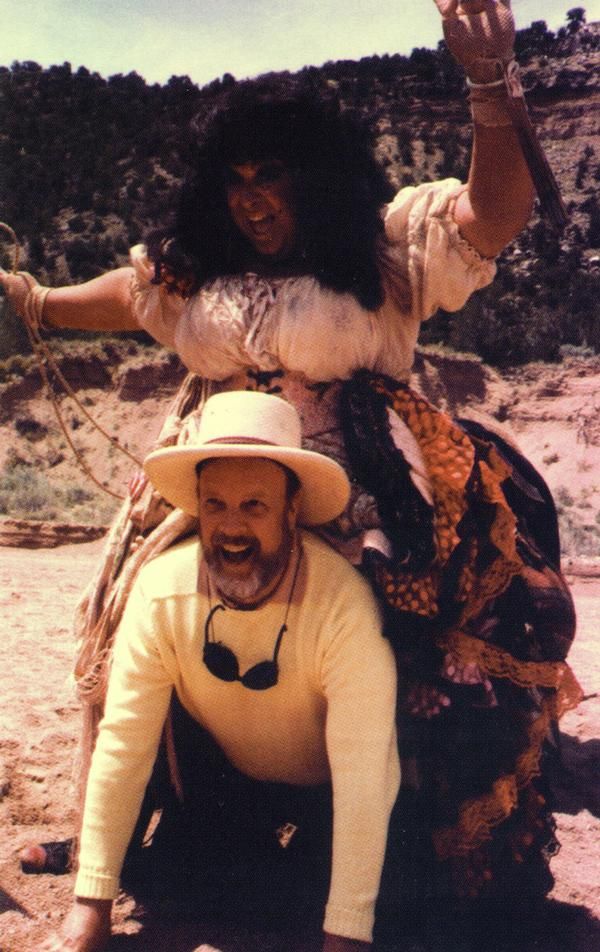
And just so this isn’t a total waste of time, let’s all smile in wonder at the only good thing that came out of this picture: this picture.
-Brandon Ledet

Holiday Heart (2000)

The best way to sell the immediate appeal of the film Holiday Heart is likely to announce up front what it is in basic terms: an R-rated, made-for-TV Christmas movie starring Ving Rhames as a street tough drag queen. By now you’ve already decided if you’d ever be interested in watching such a thing, which gives me the freedom to admit that the film is unfortunately not as riotously fun as it could be, considering the potential of its premise. For all of the visual excitement of such a large, muscular man as Rhames playing far against type as a booming-voiced drag queen, Holdiay Heart goes out of its way to normalize & de-sex his character. Off-stage, Holiday Heart is a gay man, but his lover dies before the film begins and only exists in photographs, so the film’s intended Christian audience never has to actually see him expressing queer desire. He’s also introduced as a musician dedicated to worship at his local church before we ever see him perform under his drag persona, reassuring the audience up front that he is a deeply Christrian man and his sexual orientation does not define his relationship with God. Rhames makes for a fascinating appearance as a lumbering brute delicately holding telephones with his fingertips so as not to break a nail, but as a character his titular drag queen protagonist has no inner life outside faith in God and an emotionally vulnerable readiness to cry at the drop of a hat. He has all of the character nuance of Barney the Dinosaur and functions in the film mostly as a Magical Gay Man who can fix straight Christians’ problems through his (literally & figuratively) giant heart. The movie is still enjoyable as a novelty melodrama & Rhames’s few drag performances are aces, but that (lack of) characterization is such a bummer.

Holiday Heart is not just any lumbering, muscular drag queen; she’s the most popular one in town. Making a name for herself by lip-syncing to Supremes hits in a pageant queen tradition, Holiday is nightclub royalty, but still feels rawly empty after the loss of a long-term life partner. This family-sized hole in his heart is filled when he stumbles into a father figure role for the daughter of a near-destitute drug addict. The setup is awkward & messy, but Holiday essentially takes in a mother-daughter duo from the streets to protect them from the domestic abuse & homelessness that threatens their lives. The film is a strict melodrama from there (even name-checking Douglas Sirk’s Imitation of Life several times throughout to clue you into its tone), with many repetitive fallouts between Holiday & the mother he chooses to shelter as she slips in & out of relapses and flings homophobic slurs in his face to hurt his feelings (which is surprisingly easy). The fate of the little girl they’re both reluctantly tasked to raise hangs in the balance as they struggle between selfishness & self-preservation and The Christian Thing to Do. Obviously, this setup does not lead to a nonstop laugh riot, but the melodrama can often be over-the-top enough to elicit a chuckle or two. The earliest drug relapse is a depraved lighting of a microscopic roach found at the bottom of the mother’s purse. A flashback shows Holiday being shunned at his romantic partner’s funeral while weeping & singing “Baby Love” in full widow drag. A mild hip-hop beat plays over three cliché dramatic orchestral music that scores its more self-serious moments. And then, of course, the whole thing swerves at the last second to justify its pun title by staging its emotional climax on Christmas, a holiday that otherwise plays no part in the plot.

Overall, Holiday Heart is a lot more Christian and a lot less Christmas than it would have to be to satisfy as an over-the-top camp spectacle. The film’s super serious focus on Faith cuts down a lot of its sillier eccentricities and makes the majority of the experience feel more like a bummer than a party. Still, it has the dorky energy of a kids’ movie that just happens to feature a ton of F-bombs & homophobic slurs. It also can’t be over-stated how much the novelty of seeing Ving Rhames in traditional pageant queen drag can carry its less exciting melodrama slumps. The thing about drag, too, is that it’s performative & uncomfortable; most queens can’t wait to de-glamor after a performance, but Holiday lounges around in her stage garb as if it were a comfy bathrobe. He’s not at all coded as transgender, so that bizarre choice just registers as lagniappe opportunities to soak up the Ving-Rhames-as-a-drag-queen novelty, since the lip-sync performances themselves are too few & far between. Much of Holiday Heart registers as goofy & embarrassing, especially in its indulgences in gospel music & erotic slam poetry, but Rhames’s performance as the titular drag queen is genuinely mesmerizing. It’s just a shame they stripped his character of sexual desire & potential for society-disrupting chaos to better mold the film into a Christian-family melodrama about fatherhood. It’s a fun-enough movie as is, but it could have been an all-time with a little more personality.

-Brandon Ledet

Funeral Parade of Roses (1969)

One of the most frustrating deficiencies in queer cinema, besides there just not being enough of it in general, is that much of it is far too tame. Bomb-throwers like John Waters, Jonathan Cameron-Mitchell, and early-career Todd Haynes are too few & far between (a direct result of a heteronormative industry that’s stingy with its funding, no doubt), so most queer cinema is typified by safe-feeling, Oscar-minded dramas about death & oppression. It’s always refreshing to find a film that breaks tradition in that way, while also breaking the rules of cinema in general. We need to see more queer artists given the funding needed to push the boundaries of the art form, lest the only onscreen representation of queer identity be restricted to sappy, depressing, sexless bores. I can probably count on one hand the films that have satisfied that hunger we’ve covered since starting this site over two years ago. Tangerine, Paris is Burning, and Vegas in Space all come to mind, but feel like rare exceptions to the rule. That’s why it was so refreshing to see a queer film as wild & unconcerned with cinematic convention as Funeral Parade of Roses restored & projected on the big screen. Even half a century after its initial release, it feels daring & transgressive in a way a lot of modern queer cinema unfortunately pales in comparison to.

Part French New Wave, part Benny Hill, and part gore-soaked horror, Funeral Parade of Roses is a rebellious amalgamation of wildly varied styles & tones all synthesized into an aesthetically cohesive, undeniably punk energy. Shot in a stark black & white that simultaneously recalls both Goddard & Multiple Maniacs, the film approximates a portrait of queer youth culture in late-60s Japan. Referred to in the film’s English translation as “gay boys,” its cast is mostly trans women & drag queens who survive as sex workers & drug dealers in Tokyo. Their story is told through techniques as wide ranging as documentary style “interviews” that include meta commentary on the film itself & high fantasy fables that pull influence from Oedipus Rex. Although there is no traditional plot, the character of Eddie (played by Pîtâ) becomes our de facto protagonist as we watch her rise above the ranks of her fellow sex workers to become the Madamme of the Genet (a lovely Our Lady of the Flowers reference, that). Becoming the figurehead of a queer brothel obviously invites its own set of unwanted attentions & potentials for violence, which ultimately does give Funeral Parade of Roses an unfortunately tragic air. So much of the film is a nonstop psychedelic party, however, that this classic “road to ruin” structure never really registers. All shocks of horrific violence & dramatic tension are entirely offset by an irreverently celebratory energy that carries the audience home in a damn good mood, no matter what Oedipal fate Eddie is made to suffer.

Plot is just about the last thing that matters in this kind of deliberately-fractured art film, though. Much like the Czech classic Daisies, Funeral Parade of Roses finds all of its power in the strength of its imagery and the political transgression in its flippant acts of rebellious pranksterism. Eddie & her sex worker crew hand out with pot-smoking beatniks (whom Eddie deals pot to, conveniently), whose soirees often devolve into psychedelic dance parties staged before an almighty Beatles poster. They admire performance art war protests in the streets. Their out-of-character interviews & in-the-moment narratives are often disrupted by dissociative images like a rose squeezed between ass cheeks or cigarette ash emerging from a family portrait photograph. Whether picking girl gang fights with other groups of women at the mall or simply applying false eyelashes & lipstick in mirrors, everything Eddie & the girls get into is treated as an artful, politically subversive act. In a way, their mere existence was politically subversive too, just as the public presence of transgender people is still somehow a hot button political topic today. Funeral Parade of Roses often undercuts its own visual experimentation by laughing at the culture of Art Film pretension trough nonsensical asides or by using the tune of “The More We Stick Together” to score its pranks & transgressions. Its most far out visual flourishes or most horrific moments of gore will often be interrupted by a shrugging “I don’t get it” interjection from a narrator or side character. It’s consistently just as funny as it is erotic, horrific, and visually stunning, never daring to take itself too seriously.

The only real bummer with Funeral Parade of Roses is that the exploitation film morality of its era means that Eddie must suffer some kind of downfall by the film’s final act. The movie undercuts that classic-tragic trajectory by marrying it to Oedipal narratives & interrupting it with tongue-in-cheek tangents of meta commentary, but it still gets increasingly exhausting over the decades that nearly all queer films have to end with that kind of tragic downfall, as if it were punishment for social or moral transgressions. It’s likely an unfair expectation for Eddie to come out on top as the Madame of the Genet in the context of its era. You can feel a progressive rebelliousness in its street interviews where trans women dodge aggressive, eyeroll-worthy questions with lines like, “I was born that way,” or “I’m really enjoying myself right now.” What’s even more forward-thinking are the film’s lengthy, sensuous depictions of queer sex. The film’s sexual content doesn’t do much to push the boundaries of R-rating eroticism, but its quiet passion & sensuality erase ideas of gender or sexual orientation, instead becoming simple depictions of flesh on flesh intimacy. Both this genuinely erotic eye for queer intimacy and topical references to still-relevant issues like street harassment, teenage homelessness, parental abuse, and transgender identity make Funeral Parade of Roses feel excitingly modern & cutting edge, despite its aggressively flippant attitude & last minute tragic downfall.

Funeral Parade of Roses starts with a wigged female figure softly, appreciatively kissing its way up a naked man’s body. Somewhere in its second act it captures a psychedelic dance party initiated by an LSD dropper, seemingly mounted to the camera. It ends in a bloodbath, the chocolate syrup density of black & white stage blood running thick across the screen. Everything in-between is a nonstop flood of 1960s queer cool, from political activism to Free Love sexual liberation to flippant approximation of Art Cinema aesthetic. I wish more movies being made in the 2010s, queer or otherwise, were half as adventurous or as unapologetic as this transgressive masterwork. It’s not only the best possible version of itself, but also a welcome glimpse of a convention -defiant realm most films would benefit by exploring. To say Funeral Parade of Roses was ahead of its time is a given. In fact, I’m not sure its time has even arrived to this date. I hope it will soon, because I could happily watch a thousand more pictures just like it.

-Brandon Ledet

Hurricane Bianca (2016)

EPSON MFP image

three star

campstamp

It’s honestly not at all fair for me to make this comparison, since Bianca Del Rio (the drag persona of local boy-made-good Roy Haylock) was already a success long before she appeared on the show, but the campy drag queen comedy Hurricane Bianca feels like a sketch from RuPaul’s Drag Race stretched to a feature length film. The comedy sketches have never been the highlight of that show, which is more about fashion artistry & reality show competition than drag-themed SNL skits, but every now & then the right performer can make them worthwhile. Bianca Del Rio was already a fully developed talent by the time she arrived at (and won) Drag Race, so selling the comedy in the show’s aggressively corny bits was second nature to her. She actually might be the most over-qualified queen in the history of the show to helm a feature length broad comedy like Hurricane Bianca, which is even below such prestige-free ventures as SNL‘s Superstar & It’s Pat! movies in terms of production quality. Cameos & bit roles from Drag Race standouts like Willam, Alyssa Edwards, and RuPaul himself (out of drag, as a weatherman) only reinforce the film’s general expanded Drag Race sketch vibe and your enjoyment in (and patience with) Hurricane Bianca might depend largely on how much fun you have with that aspect of the show.

Presented as a storybook fairy tale (or, in the film’s terms, the tale of a fairy), Hurricane Bianca stars Haylock as a queer high school teacher from NYC who’s forced to find work in rural Texas to make do. Headed by an unusually hateful Rachel Dratch (applying her trademark SNL-style mugging to her role as a bigoted bully), the group of Conservative Texans this hopeless nerd science teacher/failed stand-up comedian interlopes reject him outright as a pariah (“There’s something queer about him. I just can’t put my finger on it.”) and our put-upon hero once again finds himself jobless. Then, in a plot straight out of an aborted Adam Sandler screenplay, the teacher gets re-hired at the same school as a woman, adopting his meant-to-be Bianca Del Rio persona almost 2/3rds into the runtime. Del Rio presents a dichotomy where drag equals confidence and the teacher transforms from a timid nerd to an instant queen bitch. Her Don Rickles insult-clown routine destroys the false superiority of Dratch’s evil bigot antagonist and the teen bullies who do such delightful things as take “Smear the queer” selfies with the one openly gay student in their school, whom they abuse daily. Strangely mirroring the third act of The Dressmaker, Hurricane Bianca gradually transforms into an absurd revenge fantasy in which drag queens have their day and the evil Texan Christians are put in their place by such cartoonish weapons as Bugs Bunny gags & surprise swarms of bees.

It’s difficult to say if Hurricane Bianca works as a starmaker for Del Rio, since it is such a for-fans-only proposition. The film is so cartoonishly silly & unapologetically queer that it’s bound to appeal to a very limited subset of camp-minded dorks, likely the exact crowd who would have followed Bianca’s career closely enough to hear about this very minor release in the first place. It very much feels like a SNL movie or a WWE Studios production in that way and, as a trash-gobbling dork myself, I would love nothing more than for Drag Race as a brand to keep making small scale movies that appeal only to its own insular audience (starting with Alyssa Edwards’s Ambrosia Salad character from this film, preferably). Within that limited scope framework, Hurricane Bianca is a resounding success. It provides Del Rio with a larger platform for her insult comedy, gives Haylock an excuse to appear out of drag to hopefully expand his familiarity, and actually has a surprisingly political bent to it between its sillier moments, especially in the way it spoofs the bigotry of Texan Christianity & attempts to provide hope for queer high school students who are continually bullied by their peers. I can’t say that if you aren’t already on board with Del Rio that you will be surprised & won over by what Hurricane Bianca provides. If you’re already a fan & you don’t often find yourself fast-forwarding through the sketch comedy bits on RuPaul’s Drag Race, however, you’ll likely have a gay ol’ time.

-Brandon Ledet

Jackie (2016)

EPSON MFP image

threehalfstar

I was recently praising Jeff Nichols’s muted drama Loving for putting a realistic, knowable face on history & not chasing the broad showiness of typical Oscar bait productions. In a lot of ways Jackie upstages Loving at its own game. An intimate portrait of Jackie Kennedy in the days immediately following her husband’s assassination, Jackie is a loose, dreamy indulgence in sights, sounds, and character quirks instead of the broad dramatic beats we usually associate with our historical fiction. The quiet grief Natalie Portman brings to the titular role is supported by the fuzzed out color saturation of Carol and an unnerving score by Mica Levi (of Under the Skin & Micachu and the Shapes) to subvert what you’d typically expect from an Oscar season costume drama profiling one of history’s most important First Ladies. Here’s where I get hypocritical, though. As much as I admire Jackie‘s search for small character beats over broad dramatization, I think it could have benefited from the campy touch of a drag queen in the lead role. Jackie is delicately beautiful & caustically funny as is, but I’m convinced that with a drag queen in the lead (I’m thinking specifically of Jinkx Monsoon) it could have been an all-time classic.

Natalie Portman is perfectly suited for the lead role as Jacqueline Kennedy. She brings the exact kind of delicate caution & building anger to the role that she used to convincingly sell a difficult to balance performance in Black Swan, except now with a quietly crazed confidence that only comes with age. I don’t mean to detract from her performance in any dismissive way. I just think this is the exact kind of material that needs a drag queen’s touch. Jackie is a conversational work, a disjointed story told through various interviews: one with a reporter, one with a priest, one with her brother-in-law, and the famous televised one where she gives a tour of the White House. As Jackie navigates these multiple lines of inquiry, especially in the ones where “the whole country would like to know what she’s going to do next,” she’s trying desperately to control her own image, keeping a cool face during her First Lady PR duties, even when speaking her mind. This kind of detached personal caricature, where a woman intentionally creates a fictionalized, cartoonishly genteel version of herself, is already a sort of a drag routine. Imagining Jinkx Monsoon in the role, reviving the heavy East Coast accent she brought to her impersonation of Grey Gardens‘s Little Edie on RuPaul’s Drag Race, adds a whole other layer to that poised style of self caricature. While Jackie drinks, smokes, cries, and verbally jabs her way through the painful days following her husband’s death, I felt as if I were watching a delicate carbon copy of a low-key drag routine, when in all honesty I would have preferred to see the real thing.

I greatly respect a lot of Jackie‘s stylistic choices, especially when they push the film into unfamiliar art house territory. Its nonlinear format (in which you hear gruesome detail about the assassination before you ever see it), combines with its hazy digital photography (designed to match America’s memory of the televised footage of the events depicted) to amount to a singular aesthetic-over-accuracy experience I found fascinating & consistently striking. I just think this portrait of an image-conscious woman defiantly refusing to hide from the public in the days following her husband’s death could have been vastly improved by drag queen artistry, particularly of the Jinkx Monsoon variety. Drag queens doing Jackie O routines date at least as far back as Divine in 1968’s Eat Your Makeup (just five years after the assassination, yikes) and I feel like Jackie is only going to fuel that fire more once some modern & future queens get a chance to absorb what Natalie Portman’s doing in the role. I honestly don’t think it’s too late to make a second cut of the film with a drag queen shoehorned in, either. Jackie makes a point to Forrest Gump its star into some archival television footage from the real life events and after the CG actors brought back to life in Rogue One: A Star Wars Story, we’re officially living in a post The Congress society where we can plug whatever actor we damn well please into films they never even signed up for. I nominate Jinkx Monsoon to be digitally imposed into the titular role in Jackie: The Redux. I like the film a lot as is, but there’s no way that minor alteration wouldn’t make for a much more memorable picture.

-Brandon Ledet

Vegas in Space (1991)

EPSON MFP image

threehalfstar

campstamp

Vegas in Space is an early 90s sci-fi cheapie distributed by Troma in which all characters are played by either drag queens or women. It took almost a decade to complete, was partially fueled by sex work & meth, and was filmed entirely in its star performer’s San Francisco apartment. You can feel all of those qualities in every shoddy fiber of what’s essentially a glorified home movie and, yet, there’s enough artistry in the film’s set & costume design and its central B-movie sendup gimmick to make for a fun, fascinating watch. Filmed in full glory Glamourama & staged on entirely hand-built sets, Vegas in Space looks the way a B-52s song sounds (“Planet Claire”, especially) & recalls a drag routine version of either Corman’s unreleased Fantastic Four adaptation or the cult television series Pee-wee’s Playhouse. It’s very rough around the edges, but it has style to spare as it lives by its pronounced motto “Glamour first, glamour last, glamor always!”

An all-male (including women in male drag) crew fly their space ship to the Planet Clitoris in The Beaver System in order to help solve a diamond heist caper. This proves to be a dangerous mission since “No males are allowed to touch down on Clitoris”, so the men disguise their gender by taking sex change pills, a transformation process that looks & sounds a lot like the female orgasm. Newly feminized & disguised as 20th Century showgirls, the men infiltrate the city of Vegas on the Planet Clitoris, “an oasis of glamor in a Universe of mediocrity.” They set themselves on saving the planet by entertaining for a slumber party and keeping their eyes peeled for a jewel thief who has stolen a precious object that keeps Clitoris from suffering dangerous earthquakes. The whole plot feels like something out of erotic fiction, but does serve as a loving tribute to real-life titles of 1950s space epics like Cat-Women of the Moon. There’s no sexual energy to its women-only “pleasure planet’ premise, despite what you might expect from a film written & performed by drag queens & there’s really no point to the space crew starting the film as men at all, really, except for pointing to its own central drag queen gimmick, since they readily adapt to the change & suffer no conflict because of it. For the most part, even the sci-fi aspect of the story doesn’t feel all-that necessary or fully-explored. Outside some cardboard spaceship & a few goofy ideas (like swapping out the term “warp speed” for “ultra space jumps”), the sci-fi setting is mostly an excuse for the film’s true bread & butter: outrageous costume & set design. Those aspects far outweigh any petty concerns like plot structure or a command of pacing, so you have to love their charms to ignore the film’s blindspots & land yourself on its wavelength.

Obviously, it would help if you love drag as an artform for you to appreciate Vegas in Space as art. Starring San Francisco personalities like Doris Fish, Miss X, and Ginger Quest, the film is billed as being “based on the party by Ginger Quest” in its opening credits and “the first ever all-drag queen sci-fi musical” in its liner notes. Now that latter point is up for debate, not only because it might not be the first ever, but because it features cis women among its many drag performers and doesn’t feel at all like a musical besides the fact that it does feature some music (as most films do), most notably the deliciously cheesy lounge number “Love Theme from Vegas in Space.” It may very well be, however, the first film adapted from a drag queen’s party theme (can you name another?), which is much more of an accomplishment in my book anyway. Vegas in Space mostly serves as a Doris Fish showcase, as the performer wrote, co-produced, starred, built the sets (including the miniature outer space cityscapes), did the makeup for her fellow crew members, and (if director Phillip R Ford is to be believed) partially funding the picture by turning tricks. Fish is a delightful personality to helm the picture as the once-male space crew’s captain, but I actually think she’s upstaged by fellow drag queen Miss X, who boasts a kind a gothy, bitchy, Violet Chachki vibe as the film’s would-be villain, The Queen of Police. Miss X‘s cruelty in forcing imprisoned shoplifters to harvest cotton candy and her palace on ”The dark side of the planet” show in glorious black & white) a choice that feels truer to the film’s drive-in era source of inspiration) are where Vegas in Space finds its groove, even if those moments were birthed by Fish’s work on the page. The film features some classic moments of painfully corny drag queen humor, like when The Queen of Police answers the question “Are there crimes here?” with a deadpan “Only crimes of fashion,” or when Doris Fish comments on the mission at hand “sounds like a cinch.” The all-female pleasure planet setting also affords the film plenty of opportunities to do what drag does best in the first place (besides showcasing killer costuming & makeup): poke fun at femininity as a social construct. In this particular case, it helps that here are “real” woman there who are in on the joke, too, especially at sillier moments like when the crew war using their “feminine intuition” to navigate their ship. In some ways Vegas in Space plays its premise a little too, for lack of a better word, straight, (I really cannot believe there is no lesbianism or any sexuality at all in this film), but it’s still delightfully corny & transgressive in the way most drag performances are by nature.

In a lot of ways Vegas in Space feels like what might happen if I tried to make a movie, from its dedication to bad taste to its overwhelming cheapness to its painfully troubled production history. Even if the film sounds exhausting to you or just not really your thing, I’d still encourage you to read director Phillip R. Ford’s lengthy making-of account of this film’s production, because it’s a fascinating mess. Vegas in Space required two years of filming & seven years of post-production, meaning Ford & his drag scene buddies more or less worked on the film for the entirety of the 1980s. Besides the behind-the scenes meth & sex work that color the film’s already plenty colorful aesthetic, there’s also a tragic air to its history as many of the performers involved didn’t live to see the final product due to its lengthy post-production period & the horror of the AIDS crisis in the gay community of that era. As a director, Ford brings a few interesting ideas to the table I especially appreciated: an opening credits scroll that mixed B-movie worthy shots of outer space with Vegas strip light bulbs, a psychedelic dream sequence that intentionally evokes the early stirrings of MTV, and his inclusion of earthquakes in the film’s central crisis that reflected the San Francisco scene where the film was produced (although I suspect that Doris Fish had enough input on all three points to deserve a co-director credit among her endless list of other duties). However, I think Ford’s greatest accomplishment here is in completing the project in the first place. As indicated in his account of the film’s production, this was a sprawling mess of a collaboration that’s nothing short of miracle to ever have been released at all (even if it means suffering through a disturbingly transphobic “bit” from Troma madman/cretin Lloyd Kaufman in its intro). I could see Vegas in Space maybe gaining traction as a cult-adored object or maybe a RuPauls’ Drag Race runway category (Vegas in Space Realness does have certain ring to it), but I think the film’s greatest accomplishment might be that it simply exists in the first place. Well, that and the glorious makeup & costume designs, especially the ones sported by one Miss X. They’re the film’s true artistry, as it should be in what’s essentially a drag queen’s unusually expensive home movie.

-Brandon Ledet

Drag Becomes Him (2015)

EPSON MFP image

fourstar

One of my favorite aspects of the drag queen reality show competition RuPaul’s Drag Race is that the system works. A lot of viewers believe a (completely believable) conspiracy that the show’s winners are predetermined & cherry picked for success (yet another theory that supports my contention that drag & pro wrestling are essentially the same thing), but I don’t really care if that’s true. My favorite contestants on the show are generally the queens crowned America’s Next Drag Superstar (except maybe in the recent case of Kim Chi), which is good enough for me, no matter what mechanism produces that result. I was curious, then, when I discovered a documentary on Jinkx Monsoon, the winner of season 4, lurking on Amazon Prime, as they were my favorite contestant on their season of the show. Truth be told, Drag Becomes Him is an interesting doc whether or not you watch RuPaul’s Drag Race with any regularity. It’s essentially a portrait of an artist who happens to make it big in a crowded field of similar talents. Although ostensibly a vanity project, the film has very little vanity as it mostly shows drag performer Jinkx Monsoon in various stages of undress & overwhelming stress. It’s a low-key document of a significant time in the unglamorous life of a performer embedded in one of America’s most glamorous & most underappreciated art forms. And even as a standalone film divorced from Monsoon’s celebrity, Drag Becomes Him still commands an interesting, unique vision & narrative, a surprising feat for a film obviously crowdfunded & cheaply made.

Jinkx Monsoon states nakedly, both in a figurative & a literal sense, that they desire “to be known as an artist, not just a female impersonator”. A Seattle queen from a very artsy, performance-based scene (as opposed to the appearance-obsessed world of “pageant queens”), Monsoon has a kind of put-on, Old Hollywood demeanor that makes it difficult to differentiate between performer & character. A theater kid type who’s always “on”, Monsoon might be a bit much to have around as close friend, but they’re a joy to watch onscreen & seem to be very sweetly sincere in an art scene that seems prone to very jaded personalities. The film is structured around Jinkx explaining the basics of drag as an art form as they slowly apply makeup & accessories, making that awkward transition from looking like a Buffalo Bill-type psychopath while in half drag to becoming a larger than life persona. Simultaneously, a narrative emerges of both Monsoon’s personal life in a broken home & their professional career from performing at the age of 15 to cutting their teeth at local clubs to becoming an enterprise with several dedicated employees. Drag Becomes Him has the benefit of a wealth of footage from every stage of Monsoon’s career, but the way it juggles all of those narratives without seeming overburdened or reading like an A-B linear Wikipedia article points to a surprisingly adept team in terms of directing & editing. This is a small scale, low stakes documentary, but it’s one done exceedingly well.

One thing I did not expect form Drag Becomes Him was how wild Jinkx Monsoon would come across in their personal life. On RuPaul’s Drag Race they were kind of pigeonholed as a relatively tame personality in contrast with their competitors. Here, Jinkx does sex, drugs, and rock n’ roll as convincingly as any queen, getting stoned & partying in celebration in a newfound high point of their career (and deservedly so). The film has a completely different tone from Drag Race, skewing kinder & more gently sincere, but it does traffic in the same unapologetically gay headspace. The way it openly leers at masculine bodies is refreshing, since this kind of content can often be phonily de-sexed in order to put a wider audience at ease. Still, Monsoon’s life is far from one continuous, glamorous party and the film finds humor & fascination with the inconveniences of the logistics of drag: the indignity & discomfort of tucking, the machinations of taking a piss while buried under layers of clothing, typing while wearing cartoonishly long nails, etc. The only aspect of Monsoon’s life the film skips over is the narcolepsy revealed during their reign on television, which seems like a curious detail to avoid. Everything else is laid bare.

I don’t think you have to be a fan of RuPaul’s Drag Race to enjoy Drag Becomes Him. The film carves out its own space entirely separate from the show’s very particular camp aesthetic. I was especially surprised by how it establishes a sort of digital pastel look all of its own that both serves its subject’s personality & helps distinguish the film as a work of art. I do think, however, that you’d be hard pressed to finish the doc without being at least somewhat a fan of Monsoon. They bare so much of their vulnerabilities as a real-life personality & their artistic sensibilities as a drag performer that it’s difficult to leave the film without feeling intimately connected. I entered Drag Becomes Him as a previous convert to all things Monsoon & I left as an even bigger, more dedicated fan. Jinkx is a talented artist & Drag Becomes Him makes a convincing, intimate case for how significant their art form can be.

-Brandon Ledet

Roger Ebert Film School, Lesson 19: Tootsie (1982)

EPSON MFP image

Roger Ebert Film School is a recurring feature in which Brandon attempts to watch & review all 200+ movies referenced in the print & film versions of Roger Ebert’s (auto)biography Life Itself.

Where Tootsie (1982) is referenced in Life Itself: On page 147 of the first edition hardback, Ebert recalls a time when his eccentric newspaperman colleague Paul Galloway hired professionals to dress him up like Tootsie at the height of the film’s popularity. It didn’t quite elicit the desired effect. According to Roger, Galloway wasn’t offended that no one mistook him for a woman. He was upset that no one recognized him as Tootsie.

What Ebert had to say in his review:Tootsie is the kind of Movie with a capital ‘M’ that they used to make in the 1940s, when they weren’t afraid to mix up absurdity with seriousness, social comment with farce, and a little heartfelt tenderness right in there with the laughs. This movie gets you coming and going.” – from his 1982 review for The Chicago Sun-Times

EPSON MFP image

There’s a lot of pressure for Tootsie to perform for a modern audience for two entirely different reasons: 1) it’s often lauded as one of the greatest comedies of all time & 2) gender identity politics have shifted drastically in the three decades since the film’s release. I think it helps both of the film’s expectation problems if you consider it more in the context of over-the-top farces like Some Like It Hot & (maybe to a lesser degree) Mrs. Doubtfire, where deeply flawed men learn a lesson about humility & empathy by surrendering their gender-based privilege instead of a joke-a-minute laugh riot with pointed things to say about gender politics, something the film pretends to be in brief, fleeting moments. Tootsie’s cultural significance can be a little puzzling when you consider that it was nominated for ten Academy Awards & still makes the cut on a lot of Best Films of All Time lists, since to be honest, it’s not all that funny on a minute to minute basis, something that should probably be a requirement for a great comedy. As an intricately woven farce, however, it’s a fun screenplay to watch unravel as the walls separating its protagonist’s Victor Victoria-type double life crumble and his lies amount to a total shit show of bruised egos & hurt feelings. Instead of watching Dustin Hoffman’s total jerk protagonist get his much-deserved comeuppance, we see him realize how much of an asshole he truly is once he trips up on his own tangle of deceits. It’s a surprisingly sweet trajectory for a film that can be nastily bitter in its early goings-on & the farcical fever pitch of its third act is a lot of what makes Tootsie such a pleasant memory overall.

A top-of-his-game Dustin Hoffman stars as an unemployed theater actor who is talented, but notoriously difficult to work with due to an oversized hubris. Unable to land a job due to his tarnished name, the unrepentant asshole channels his frustration into an indignant female character with a ludicrous, high-pitched voice and lands a major role on a televised soap opera as his in-drag persona, unbeknownst to the cast & crew. This dynamic allows both for some delicious mockery of soap opera melodrama (seen also in less respected comedies like Joy & Delirious) and for some occasional pointed criticism about gendered work place politics, something the actor was blind to as a man. As much as he now has a soap box for complaints about how power makes a woman be unfairly perceived as “masculine” or “ugly”, a voice that inspires other women to speak up for themselves in a hostile work environment, donning a dress doesn’t instantly make him a better person. Tootsie is smart to hold onto the idea that its protagonist is a deceitful, selfish ass, allowing very little room for him to be excused for his manipulative transgressions, especially when it comes to his two love interests: a supposedly dear friend & an unsuspecting coworker. Watching this film as a kid I had never picked up on how much of an asshole Dustin Hoffman’s character is in this film; watching it now it’s the only thing I can focus on at all. Luckily, the film feels the same way & deals with his actions accordingly.

There’s not a lot going on in Tootsie formally that would really justify its inclusion on a Best Films of All Time list outside the weird imagery in a montage that includes a surreally out-of-place Andy Warhol cameo and a shot of Tootsie saluting before a Patton-esque American flag backdrop. The film’s performances are mostly serviceable, with very few moments allowed for a standout actor-centric showcase. I was especially bummed over  Bill Murray’s performance as a wisecracking bitter artist roommate, who was even more of an ass as the film’s starring role, as his entire part boils down to vocal discomfort with the idea of crossdressing (in what I’m afraid was supposed to function partly as an audience surrogate). If there’s anything impressive about how this film was made it’s in the efficiency of its screenplay. Not only does the mass confusion & chaos of the climax amount to a complex web of hurt feelings; the lead-up to that moment is also surprisingly effective. I especially liked the way the film bravely jumps into the drag persona conceit without an initial dressup montage and the way line readings from its fictional soap opera mixes with its protagonist’s true sentiments as well as the way the protagonist’s identity becomes confused as he starts making decisions based on the desires of his female avatar. Besides, you have to somewhat respect a film that can effortlessly work in a line as convoluted as, “I was a better man with you as a woman than I ever was with a woman as a man, you know?” and make it count for something. Some of Tootsie’s gender-identity politics are as outdated in a modern context as its total garbage “Go Tootsie go! Roll Tootsie roll!” pop music theme song, but it’s still a well written film with a timeless message: don’t be an asshole.

EPSON MFP image

Roger’s Rating: (4/4, 100%)

fourstar

Brandon’s Rating (3.5/5, 70%)

threehalfstar

Next Lesson: Help! (1965)

-Brandon Ledet

Paris Is Burning (1990)

EPSON MFP image

fivestar

Although the subject of the 1990 documentary Paris Is Burning (ball culture) is unmistakably NYC-specific, it’s not difficult to see its connection to a more recent New Orleans trend: sissy bounce. There’s very little connecting the two geographically-disparate movements in the decade or so that separates them, but there’s still a similarly effortless punk spirit & vibrant defiance that binds them in my mind, a superficial connection or not. NYC ball culture was a fashion-minded escape fantasy for the city’s POC, queer, transgendered, and often homeless youth who used the platform to feel empowered instead of disenfranchised. Where sissy bounce offers New Orleans’ queer & transgendered POC youth access to the largely homophobic & hyper-masculine world of hip-hop, ball culture offered that same minority access to wealth & the world at large. That access may have been to more of a fantasy than a reality, but it was a transgressive fantasy that was so goddamn fabulously punk that there’s really nothing else like it, sissy bounce included.

We don’t have a worthy documentary about New Orleans’ sissy bounce culture yet, but there is a more than worthy NYC ball culture doc to be found in Paris Is Burning. As a culture, the film’s subject has everything necessary for a great film: sights (in the homemade fashion), sounds (in the music & dancing that accompanies the runway “voguing”), and narrative (in its long history as told through the eyes of old-timers who had occupied the scene decades before the film’s camera crew arrived in 1987). Part of what makes the film so arresting is its combination of both surface pleasures & much deeper, more meaningful aspects. Sure the film is stuffed with lush, beautiful fashion and the absurd hyroglypics-inspired dance moves of voguing, but there’s a lot of real heartbreak at the center of the culture’s need for escape.

These are marginalized people who’ve been abandoned by their families & society at large; they depend mostly on petty theft & sex work to get by. Although there is an aggressive, competitive aspect to ball culture, there’s also an intense comradery that includes makeshift families called “houses”. Ball competitors are seeking to better one another for a chance at a “legendary status” or at least a trophy for their troubles that night, but they also serve as their own support network, giving each other a place to go and something to look forward to when practically everything else has been stripped away. As the MC at one ball puts it to the more “vicious motherfuckers” in the crowd, “We’re not going to be shady, just fierce.” There’s a catty atmosphere on the surface of ball culture, but it’s a thin veneer on something much more thoughtful & fulfilling.

It’s a little sad, then, that the isolated act of voguing was assimilated & diluted into a much larger, uncaring pop culture by enterprising folks like Madonna the same way New Orleans’ bounce maneuver twerking was assimilated (poorly) by folks like Miley Cyrus. It’s sad that such a rich, complex culture had been boiled down to such a singular, somewhat superficial detail, but that’s often how mainstream success works. Part of what makes Paris is Burning so rewarding is that it arrived in time to capture that culture before it was exposed to the public at large. There’s still time for sissy bounce to receive the same reverent treatment , but not much. The recent national fetishization of twerking makes it feel like the moment has already passed. Of course, I may be oversimplifying both sissy bounce & ball culture by linking them with such a concrete tether, but I’m certainly not the first one to do so. There was even a huge event thrown last year celebrating their spiritual sisterhood. Although one had voguing & the other twerking and one was stationed in Harlem & the other in New Orleans, there’s still a rebellious, punk spirit of inclusivity for groups of young people who are normally excluded from everything. As one of the ball culture’s old timers puts it, “If more people went to balls and did less drugs the world would be a better place, wouldn’t it?” If balls were anything like the way they’re represented in the near-perfect Paris Is Burning, I’m inclined to agree.

-Brandon Ledet