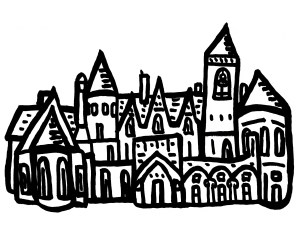
The Haunting (1963)

The 1963 adaptation of Shirley Jackson’s novel The Haunting of Hill House is, in a word, a masterpiece. Even with its sterling reputation preceding it, I was shocked to immediately recognize it as such, as its genre and its source material are so overly familiar half a century later that I assumed I’d be numb to its wonders. Jackson’s novel has been both directly adapted and mined for indirect inspiration so many times over that I was skeptical there was anything left to discover in its pages. This MGM-distributed realization of that well-tread source material is also a by-the-books participation in the Old Dark House tradition that was intensely oversaturated in its own era even beyond adaptations of Jackson’s work. And yet I was impressed, captivated, and chilled from start to end – even more reenergized by this traditionalist approach to Jackson’s milieu than I was by Josephine Decker’s revisionist biopic Shirley earlier this year, something I did not at all expect.

It helps that former Val Lewton-collaborator Robert Wise directs the absolute shit out of this movie. The Haunting is shot in early Panavision on what had to be intimidatingly clunky equipment, but you wouldn’t know that judging by how incredibly active the camera is. Even in the opening sequence that explains the history of how the central haunted house “was born bad”, Wise pummels the audience with overachieving visuals. The camera swoops in ghostly, seemingly handheld maneuvers. It tumbles down the stairs in dizzying thuds. It emphasizes its format’s already drastically wide aspect ratio with fish-eye lenses out of a 1990s skateboarding video, drinking in as much ornate detail of the haunted house set as it can possibly cram down its gullet. Much of the in-the-moment action of The Haunting consists of people calmly talking in chilly, hollow rooms, but the film’s visual language is explosively alive throughout – matching the way the environment itself is quiet but teeming with ghosts.

I’m surprised this film isn’t brought up more often when people are heaping praise on classics like Psycho & Carnival of Souls in particular. It could be that its bulked-up budget scale obscures the common ground it shares with those leaner works, but it achieves a similarly eerie mood, especially in mapping out the inner life of its central, doomed protagonist, Eleanore. In a lot of ways, The Haunting is a seduction story. Eleanore is wooed by Hill House both in a romantic sense (its ghosts often play matchmaker between her and other visiting guests of various genders & vital stats) and in a residential sense. She begins the film haunted by her own mediocrity and her lack of a place in the world—dismissed by everyone around her (give or take her lesbian roommate) as a nervous, difficult woman—but the house accepts her flaws and all, beckoning for her to become a permanent fixture among the resident ghosts. It’s an unusually internal, intangible struggle for a genre built around haunted house scares – a delicate, elegant approach to horror that matches the care Wise takes with the film’s visual delights.

The Haunting is impressively smart, funny, and direct about even its touchiest themes (lesbian desire, generational depression, suicidal ideation) while remaining consistently gorgeous & creepy throughout. I’d be shocked to learn that there’s a more effectively scary G-rated horror film out there; and if there were, I doubt it’s this visually imaginative or exquisitely staged. This is clearly the pinnacle of the Old Dark House tradition. The only question is how many other Best Of __ horror lists it belongs at the top of.

-Brandon Ledet

Impetigore (2020)

The Indonesian ghost story Impetigore shocked me, chilled me, and left me guessing where its story was headed until its very last minute. That’s an extremely rare quality to find in a modern horror film, especially one that sticks this close to the tones & conventions of its genre. In an ideal, perfectly-functioning movie industry, Impetigore would be the kind of well-funded horror flick that hits wide theatrical release regularly: handsomely staged, efficiently creepy beyond the traumatizing shock of its imagery, and complicated enough in its mythology that it’s not just a simple morality play. Instead, it’s an international export that premiered to mildly positive reviews at this year’s Sundance before quietly finding its way to streaming on Shudder with little fanfare. Impetigore should be an industry norm. Instead, it’s a minor miracle.

It starts with a concise, conceptually brilliant cold open in which a highway tollbooth employee is stalked and eventually hunted in her glass cuboid prison by a machete-wielding maniac. Before he raises his weapon for the deathblow, the crazed killer complains in a reasonable, weary tone, “We don’t want what your family left behind. Please take it away.” That short-story slasher intro then opens up to a much wider, richer tale of an intergenerational curse. A young, desperate woman treks back to her seemingly well-to-do family’s isolated village, hoping to reclaim any generational wealth she may have left behind when she was whisked away to the big city as a child. It turns out her family’s domineering presence in the village is represented by more than just a large house & a fear-inciting name. It also lingers in the form of a vicious curse that torments & disfigures each new generation of the community, so that whatever exploitative evils they committed in the past continue to haunt the present in an active, malicious cycle.

Reductively speaking, Impetigore offers an on-the-surface metaphor about the persistent evils of communal betrayal & inherited wealth. However, the rules & origins of its ghostly curse mutate & self-complicate often enough that it doesn’t feel lazily considered or over-simplified. That’s rare in a modern horror film, where each plot development is typically expected to hold some metaphorical Meaning in a 1:1 allegory. Impetigore’s relationship with Extreme Gore freak-outs is similarly distinctive in the modern horror landscape – walking a difficult balance of being gradually, severely fucked up without rubbing your face in the grotesque details of its cruelty. This is a film that weaponizes your imagination against you for maximum dread, then somehow exceeds the worst-case-scenario imagery you conjure instead of shying away from the discomfort (often by depicting horrific violence against children in particular, it should be said). It’s also a movie that features several traditional Indonesian puppet shows, just in case you’re not already thoroughly entertained.

I very much wish Impetigore weren’t exceptional, that its handsomely executed but appropriately bleak grotesqueries were just another shock-of-the-day horror. As is, it feels like a role model for how well-funded modern horror should look & operate – offering a glimpse of a better, more fucked-up cinematic landscape. It is exceptional, and it should be celebrated as such.

-Brandon Ledet

Lagniappe Podcast: A Tale of Two Sisters (2003)

For this lagniappe episode of the podcast, Boomer and Brandon discuss the haunted house creeper A Tale of Two Sisters (2003) and where it fits in with the modern wave of internationally exported Korean genre films.

You can stay up to date with our podcast through SoundCloudSpotifyiTunesStitcherYouTubeTuneIn, or by following the links below.

– Mark “Boomer” Redmond & Brandon Ledet

Host (2020)

I’ve already spilled gallons of digital ink praising high-concept horror films about The Evils of The Internet and how technology is going to kill us all. I promise it’s not a bit. I’m genuinely enamored with movies that fully commit to an Online Horror gimmick, especially the ones that hone in on a specific app or social media platform for a temporal anchor (Skype in Unfriended, OnlyFans in Cam, CandyCrush in #horror, Snapchat in Sickhouse, Facebook timelines in Friend Request, etc.). The argument against the Online Horror gimmick is that it makes these films feel instantly dated, which I’d contend is more of a virtue than a fault. We spend so much of our modern lives online, navigating virtual spaces, that it feels outright dishonest that contemporary cinema would not reflect that digitized reality. Yet, it seems only gimmicky horror films are the ones brave enough to truthfully document & preserve our daily “lived” experience. They’re no more dated than Citizen Kane was for capturing the media mogul megalomania of contemporary figures like William Randolph Hearst or Casablanca was for reflecting America’s selfish isolationism in the earliest days of WWII. Evil Internet novelty horrors capture the moods & textures of our current era, where most of our lives play out in the eerie spaces beyond touchscreens & keyboards.

In that context, the new Shudder original Host is likely to remain one of the most vital, honest films released this year. Written, filmed, edited, and released in the months since the world went into lockdown for the current COVID-19 pandemic, Host is an instantly dated horror film and damn proud of it. Like the real-time Skype session gimmick of Unfriended (and plenty of other online found footage horrors besides), the film is staged as a fictional hour-long Zoom meeting. It’s a digital space many of us have had to become quickly acquainted with in recent months as working remotely has become more of a norm. Host smartly builds a lot of its scares around Zoom-specific quirks like the eeriness of lag time, the obscured view of pixilation, the uncanny-valley creepiness of artificial backgrounds & facial-recognition filters, and the feedback echo of a user logging into the same meeting on two separate devices. Its end credits are even scrolled through as a Zoom Participants list, which is a wonderfully thorough commitment to the premise. Other COVID-era details like a character scrambling to put on a face mask before fleeing out of their apartment or a young couple in quarantine becoming increasingly frustrated with each other’s constant presence drives home the nowness of the film even further for a shockingly unnerving experience. A decade from now (assuming we’re all alive a decade from now), this will be a priceless cultural time capsule of what life has been like this incredibly bizarre year. Of course, watching it while those wounds are still fresh only makes it more perversely fun & horrific in the interim.

Story-wise, there’s not much going on here that hasn’t already been accomplished in Unfriended (or Unfriended 2: Dark Web or Searching or The Den or so on). If anything, this is basically just a kinder, gentler Unfriended with genuinely likeable characters. That doesn’t necessarily make it an improvement on the formula, but it at least opens it up to a different flavor palate. A group of college-age women gather in a Zoom meeting for an online séance led by a spiritual guide who becomes disconnected mid-call, leaving them vulnerable to whatever ghosts or demons they may have conjured in the process. They’re generally likeable kids, and their only sin, really, is not taking the idea of an online séance very seriously (a sentiment likely shared by most of the film’s audience), which results in supernatural backlash from spirits on the other side of barrier between realms. Once the spirits start punishing these women for their careless indulgences in sarcasm & edgelord humor (they seem to be particularly miffed about a tasteless suicide joke), the movie mostly devolves into a series of haunted house gags where each Zoom participant is snuffed out one by one. The scares are impressively staged, combining practical & computerized effects to really stretch how much can be collaboratively achieved in a social-distance lockdown. And, honestly, it’s impressive that anything was achieved at all, considering how difficult it’s been to complete simple tasks and function as a human being in recent months.

Perhaps the most COVID-aware aspect of Host is that it’s only an hour long, which graciously accommodates how scattered & limited our attention spans have been since the world stopped in its tracks. Even if you’re not fully convinced that this kind of high-gimmick novelty horror about The Evils of The Internet is worthy of your attention, that hour-long commitment is such a small ask. It’s unlikely that we’ll see another feature film this year that so directly, accurately captures what life is like right now, and I’m honestly not shocked that my beloved Online Horror subgenre was the engine that got us there. It’s perfectly suited for that kind of of-the-moment documentation, with plenty of other entertaining payoffs besides.

-Brandon Ledet

Extra Ordinary (2020)

It was only a matter of time before Taika Waititi’s brand of sweet, understated humor started registering as a direct influence on other comedic media. I already felt that influence last year on the minor Kiwi comedy The Breaker Upperers (which was produced by Waititi and featured several of his regular collaborators), but this year’s Extra Ordinary feels like evidence that it’s now reaching out even further into the ether. Borrowing a humble, reserved approach to the horror comedy genre that Waititi previously explored in What We Do in the Shadows, Extra Ordinary is an absurdly polite, underplayed farce about ghost hunters in small-town Ireland. It’s not quite as comedically successful as Waititi’s modern-day vampire comedy (nor the What We Do in the Shadows TV show, nor its closest competitor Los Espookys), but it does nail the lowkey charm that made it such a success. This is an adorably sweet, character-driven comedy about relatable people dealing with a seemingly insurmountable crisis they don’t deserve to suffer; that crisis just happens to involve demons, ghosts, and other supernatural phenomena.

A meek, reclusive driving instructor with a past as a paranormal medium (Maeve Higgins) is drawn out of her shell to help stop a washed-up rock star (Will Forte) from completing a Satanic sacrifice that would revive his career. The ghosts she encounters along the way are mostly pretty mundane, taking the shape of animated electrical appliances, squawking birds, and a domestically abusive, chain-smoking housewife. She reluctantly gets back into the rhythm of interacting with these apparitions for the sake of saving her nemesis’s intended virgin sacrifice. That sounds like a heroic cause in the abstract, but the process mostly involves making her equally shy love interest vomit up a semen-like ectoplasm after briefly engaging each ghost in a polite chat. Even the Satanic ritual at the climax is undercut from achieving anything genuinely Cool or Horrific by mundane interruptions like minor traffic accidents, bickering couples, and Chinese food delivery. It’s an extremely silly, absurd movie when considered in totality, but in the moment everything is so aggressively pleasant that its cartoonish qualities don’t immediately register.

It takes a minute for Extra Ordinary’s sense of humor to fully heat up, by which I mean that it takes the audience a minute to adjust to its characters’ peculiarly muted wavelengths. The film is plenty funny once it builds that momentum, though, and it eventually stages a hugely satisfying farcical payoff in its final Satanic showdown that makes everything that preceded feel like a movie-long setup to a remarkably solid punchline. It traffics in grotesque, horrific scenarios involving demonic possessions, domestic abuse, and paranormal sex fluids, but the characters who navigate them are so quietly sweet that you hardly notice how harsh or over-the-top the whole thing feels from afar. It’s close enough to the Waititi formula that you recognize the influence, but specific enough in its own characterizations that it succeeds at being its own distinct thing. It’s also the kind of comedy that likely rewards repeat viewings, since it centers remarkably sweet characters you can’t help but want to spend more time with once you get to know them.

-Brandon Ledet

Kung Fu Zombie (1981)

As bottomless as my hunger for low-grade genre trash can be in general, I do have a limited appetite for particular cheap-o subgenres that I never developed a proper palate for. One of my most glaring shortcomings as a B-movie enthusiast is a dulled, limited appreciation for the martial arts film. I’m not talking about artily psychedelic wuxia epics or the 1980s heyday of Hong Kong visionaries like John Woo. I mean the real cheap stuff, the kind of public domain outliers that pad out local broadcast television schedules. While I grew up watching tons of sci-fi & horror schlock on TV, I don’t remember martial arts cheapies ever being part of that diet. As a result, I have a hard time brushing off my annoyances with the genre’s worst idiosyncrasies—mainly the inert sense of pacing and the repetitive fight choreography sound effects from its near-universally shoddy English dubs—things I’d likely find more charming had I been indoctrinated with this stuff at an earlier age.

In an effort to meet martial arts schlock halfway as a latecomer to genre, I’ve been seeking out fringe titles where it overlaps with the horror tropes I’m more accustomed to. The “boutique” bargain bin Blu-ray label Gold Ninja Video has been an excellent resource in this endeavor, releasing such horror-tinged martial arts titles as the post-modern Brucesploitation castoff The Dragon Lives Again and the delightfully amateurish wuxia nightmare Wolf Devil Woman in the past year, both of which I enjoyed immensely. While I wasn’t quite as enamored with their recent selection Kung-Fu Zombie as those other two titles, it did help further drag me into an appreciation for horror-themed martial arts schlock in a couple key ways. Firstly, it includes an excellent video essay from critic (and label-runner) Justin Decloux titled “Punch a Ghost: A Beginner’s Guide to Hong Kong Horror” that highlighted the charm & historical context of the subgenre (along with a 90-minute “Hong Kong Horror Trailer Reel” packed with recommendations for what to watch next). More importantly, Kung-Fu Zombie itself was one of the quickest-paced films I have ever seen in any genre, which sidestepped one of my usual sticking points with martial arts schlock in particular.

Kung Fu Zombie is a public domain Taiwanese martial arts horror cheapie that’s very light on spooks & gore but plentiful in broad comedy & breakneck fight choreography. It mostly concerns a father-son duo who’re haunted by criminal nemeses from their past. The son’s petty dispute is with a thief whose robbery he interrupted, landing the scoundrel in jail. Once released, the thief hires a Taoist priest to reanimate a small militia of corpses to attack his foil as retribution, fearing the young hero’s superior fighting skills in one-on-one combat. Through a series of mishaps, the thief & the priest manage to resurrect a vicious murderer with a heartless vendetta against the hero’s father (and martial arts trainer) as well, a much more formidable foe our hero has unknowingly been training to defeat his entire life. The title is something of a misnomer. This really isn’t a Romero-style zombie invasion picture with fight choreography interludes as much as it is a full-on martial arts picture that happens to feature a grab bag of generically Spooky archetypes: a couple zombies, a ghost, occultist rituals, etc. It’s all played more for broad humor than genuine horror atmosphere, which is fine, except that the jokes aren’t especially funny (and often backslide into juvenile sexual assault humor at women’s expense).

While the horror elements of this genre-hybrid cheapie didn’t deliver anything especially memorable, the kung-fu sequences are plentiful and plenty entertaining on their own. The movie is insanely shrewd in its editing – speeding up & trimming down everything surrounding those fights until all that’s left is a lean 78-minute whirlwind. Kung-Fu Zombie isn’t nearly as funny nor as innovative as the Peter Jackson classic, but the way it delivers broad jokes & a wide range of classic spooks at a breakneck pace makes it feel like the martial arts equivalent of Dead Alive. I won’t say that it was a mind-blowing revelation that cracked open the martial arts genre for me as an outsider or anything, but its rapid-fire looniness made for an amusing enough novelty, one I likely should have enjoyed with friends & beers instead of alone on the couch as a midnight snack. I plan to continue seeking out these cheap-o titles where horror & martial arts schlock overlap just to expand my appreciation of everything low-end genre filmmaking has to offer. Even if this particular film didn’t fully hit the spot, its Gold Ninja Video release gifted me with dozens of other titles in its same vicinity that look even more promising. It’s more of a breezy genre primer than it is its genre’s artistic pinnacle.

-Brandon Ledet

Impossible Horror (2017)

I purchased a Blu-ray copy of Impossible Horror mostly as a means of contributing financial support to a podcaster I admire. The film’s director, Justin Decloux, cohosts The Important Cinema Club out of Toronto, where he also programs repertory genre screenings under the Laser Blast Film Society brand. The film arrived with an endearing thank-you note from Decloux’s creative partner Emily Milling, who scored, co-produced, and contributed sound editing on the film (likely among other duties). I’m mentioning all of this to note that Impossible Horror is very much a microbudget backyard production, a modern entry in the Regional Horror canon with all the charms & limitations that descriptor implies. Decloux & Milling briefly appear in the film themselves as side characters among a local community of friends & collaborators (including Important Cinema Club’s other cohost, Will Sloan) as their film’s “backyard” setting expands into the late-night urban streets of Toronto. Taking a gamble on these kinds of no-budget horror cheapies is always a tough sell for anyone outside the local social circles who appear on the screen in that way, but Impossible Horror is overflowing with enough creative ideas & genuine genre fandom that it’s well worth the effort. A 76min, dialogue-light sampler of a wide range of well-staged scares (ghost possessions, cursed VHS tapes, evil dolls, suicide cults, etc.), the film is very careful to not test its audience’s patience. Decloux & Milling are clearly fans of this D.I.Y. end of genre filmmaking themselves. Along with co-writer Nate Wilson, they energetically flood the screen with the ideas & imagery they love to see in these kinds of movies, conscious of just how easily the exercise could slip into tedium if they eased off the gas pedal. The result is surprisingly effective considering the limitations of their means, even if there are instances where they have to prompt the audience to [imagine a bigger budget here].

All this talk of backyard D.I.Y. art productions would normally be extratextual, but Impossible Horror is largely a film about outsider art & for-its-own-sake creativity. Sinking into the emotional slump that follows a devastating romantic breakup, our protagonist finds herself unsure what to do with her sudden influx of alone time beside throwing herself back into long-abandoned creative projects – drawing comics & making films. She first picks up her old video camera out of spite for The Asshole who left it behind in the breakup, but soon finds herself supernaturally compelled to see her new filmmaking project through. Unable to sleep through her heartache & her resentment of The Asshole, she finds herself going on late-night walks in those eerie post-midnight hours when, as Whodini would say, The Freaks come out. Suddenly, the absence of dialogue that comes with living alone is supplanted by a torrent of mysterious, paranoid ramblings from a newfound friend discovered on those late-night walks. From there, our once-lonely protagonist spends the rest of the film sinking further into her new friend’s own creative project: investigating a phenomenon of ghostly screams that routinely echo in the night and are always accompanied by mysteriously materialized objects – typewriters, VHS cassettes, dildos, hammers, etc. Solving the origin, meaning, and answer to this paranormal puzzle can often feel like trying to work your way through the storyline of a video game after skipping all of the dialogue screens that explain everything. What’s more important is that our protagonist reacts to this confounding experience by obsessively documenting it for an amateur film at the risk of her own safety & sanity. It can be difficult to track what the story is logically doing from minute to minute, but it all ultimately adds up to a Lovecraftian splatter comedy about amateur artists being driven mad by their own creativity. That’s a fitting theme for a no-budget movie made among friends that’s so ambitious in how it doles out its synths, gore, and ghosts that even this long-winded paragraph is only scratching the surface of its full narrative.

It does feel like a little bit of a betrayal to reduce Impossible Horror to its value as a backyard horror production & a nightmare-logic splatter comedy. Usually, horror films on this scale apologize for their limited means by leaning into their camp value, intentionally playing up their “so-bad-it’s good” humor. The earnestness of Impossible Horror is something much braver; its scares, jokes, and practical effects are all genuine attempts to make the best movie possible under the circumstances, all with a surprising success rate. The most poignant scene in the film is a voiceover performance from the protagonist as she shows her new ghost-hunter friend an old short film she made, continually apologizing for its quality in cruel self-deprecation. Every theme explored in the film is on display in full potency in that moment: how we’re haunted by our own past, the never-ending ways we self-harm, the insuppressible urge to keep making outsider amateur art even though putting your own work out in the world is fucking embarrassing. As fans of the microbudget horror genre on its own terms, Decloux & Milling instinctively understand the need to deliver the goods elsewhere, filling the screen with plenty gross-out gore & slapstick gags to entertain fellow fans of the Regional Horror tradition. What sets Impossible Horror apart from most of those self-published films, however, is its earnest, ambitious reach for something greater than a winking-at-the-camera joke. It’s wiling to comment at length about its own limited means, but only in a genuine exploration of how making art on this scale walks a fine line between partying with friends & overworking yourself into a lethal mania. Not everything it hurls at the screen to entertain the audience (and the creators) works, especially not all in tandem, but it does all amount to a genuinely satisfying reflection on the nature of loneliness & self-published art in the 2010s. It’s the kind of D.I.Y. art project that’ll make you want to seek out & support more outsider films on its scale & budget, if not make some of your own – perhaps to your own peril.

-Brandon Ledet

The Haunting in Connecticut (2009)

Nothing gets me more hyped up than when a “based on true events” title card appears at the start of a horror movie, so when those words graced the screen at the beginning of The Haunting in Connecticut, I had a slight adrenaline rush. I watched the film for the first time this past weekend during a horror movie marathon with friends, and it was the first title on our watch list. I would later learn that it was wise to watch this one first since it was surprisingly boring for a horror movie “based on true events.”

In the film, the Campbell family moves into a home to be closer to the hospital where their teenage son, Matthew (Kyle Gallner), is receiving cancer treatment in the form of a clinical trial. They soon discover that the home was once a funeral home, so surprise, surprise, the house is totally haunted. Matthew is the first member of the family to witness supernatural occurrences in the home, but his family thinks it’s a side effect of the clinical trial. They are all eventually forced to face the reality that Matthew is in his right mind.

The Haunting in Connecticut is based on the Snedeker family’s supernatural experiences in home in Southington, Connecticut. The Snedekers really did move into a house that was previously a funeral home run by morticians who were, supposedly, also necromancers. Necromancers in Connecticut, imagine that! The idea of necromancy occurring in a small, all-American town is absolutely terrifying, but the film doesn’t really get into the necromancy aspect of the story all that much, which is completely bonkers to me. This is what makes the story so unique! Now don’t get me wrong, there are some creepy moments that are necromancy related (e.g., box of human eyelids is discovered under an attic floorboard), but there’s just not enough to make the film worthwhile. Instead, it follows the basic haunted house story line: family moves into house with a dark past, one of the family members starts to see ghosts while the rest of the family thinks they’re crazy, the haunting gets more intense as time goes by, and it all comes to a close in a fast-paced, extravagant ending.

There’s really nothing that special about The Haunting in Connecticut. It’s doomed to be lost in the realm of average, not-so-great haunted house movies like The Conjuring and An American Haunting.

-Britnee Lombas

Death Spa (1989)

Within the opening two minutes of Death Spa I was already aware that I was in the presence of trash cinema greatness. The only other film I had previously seen from director Michael Fischer was the uninspired Teen Wolf knockoff My Mom’s a Werewolf (one of three releases he completed in ’89, along with something titled Crack House), so I didn’t expect to fall in love here so easily. Everything there is to love about this deranged supernatural horror is succinctly represented in the opening credits, though, immediately setting a very high expectation for over-the-top schlock being married to intense attention to craft, a dynamic I was delighted to discover the film lives up to. Death Spa is essentially what would happen if Chopping Mall were given the full arthouse, Suspiria treatment, the exact low premise/high execution dichotomy I look for in all my genre cinema. The film opens with an exterior shot of a Los Angeles gym with a lit neon sign that reads “Starbody Health Spa.” Lightning strikes the sign, leaving only the title “d ea th Spa” lit as the camera travels into the cursed building in an ominous tracking shot. Spooky synths & neon lights overwhelm the senses as the camera finds the only soul alive in the gym, a woman dancing alone to rhythmic music that we cannot hear. One gratuitous nudity scene later and she’s being cooked alive by a sauna gone haywire, activated by an off-screen killer. It’s immediately apparent in this opening sequence that Death Spa is exploitative sleaze. It’s also just as apparent that it’s fine art worthy of any pop culture museum that would house it.

The gym is a creepy place, presumably doubly so for women who’re working out alone after hours. Early in its runtime, Death Spa appears to be a shrewd exploration of that common fear, exploiting the vulnerability of publicly navigating a space designed to intensively focus on the human body among a wealth of potentially dangerous strangers. The camera takes on the first-person POV of a slasher film or a giallo, stalking vulnerable women in its neon & spandex health club setting. It even teases potential personal & financial reasons why several suspects would be committing the rampant murders (framed as accidental deaths) that start plaguing the gym. I was totally onboard with the grounded killer-on-the-loose horror teased in Death Spa’s earliest motions, but even more pleased by the deranged absurdity that unfolded instead. It turns out Death Spa isn’t about a psychopathic killer at all, but rather one of my very favorite genre film subjects: Evil Technology. In the film, a vengeful ghost hacks the computer systems of automated gym equipment as a means of real-world vengeance. This is more of a haunted house movie than a slasher, except that the house in question is a health spa with very specific methods for causing lethal damage: rogue weightlifting machines, loose diving boards, flying shower tiles, the aforementioned sauna steam, etc. It even telegraphs a Chekov’s blender gag at the gym’s smoothie bar later echoed in one of my most beloved Evil Technology horrors: Unfriended. There’s very little thought given to the inherent vulnerability of gymnasiums & voyeurism, something that plays like an afterthought at best in the movie’s true mission statement of staging a supernatural horror at a novelty fad location specific to its era. Instead of playing off real-world dread or having its characters at least figure out that a gym with lethally faulty equipment might not be worth their patronage, the movie instead gradually intensifies its computer-ghost mayhem as it builds to a climactic event where many patrons can be locked inside & slaughtered at once: a “Mardi Gras” costume party. In Los Angeles. At a health spa. At night. Insane, but adorably so.

In addition to the lunacy of a ghost hacking automated gym equipment, Death Spa also chooses to reveal the identity of the undead spirit/real world terror through a recurring nightmare of a disabled woman on fire, adding to the film’s menacingly surreal vibe. That nightmare logic is matched by overactive camera work that puts much more care into its movement, angles, and lighting than what’s typically afforded trash cinema of this caliber. That high art cinematography clashes harshly with the bargain bin quality of acting on-hand, with cult cinema vet Ken Foree standing out as the only notable performer. The spooky synth soundtrack also occasionally gives way to an incredibly misguided mouth harp sound effect, turning potentially effective scare scenes into total jokes. While the cast & the soundtrack occasionally show the seams of Death Spa’s budget, though, the film’s commitment to practical gore effects & the sheer lunacy of its plot is more than enough to carry it through. When the ghost hacks a shower head or a blender or romantically whispers to their victim, “Come with me into the inferno. Let’s die together and live forever in Hell,” it’s all but impossible to resist Death Spa’s delirious, over-the-top charms. It didn’t take much for the movie to win me over as an instant fan. Its swirling mix of synths, neon, and self-amused gore was more than enough to steal my trash-gobbling heart at first sight. The true joy of Death Spa, though, is that its cheap thrills don’t stop there. The movie pushes its evil health spa premise to the most ridiculous extreme it can manage on a straight-to-VHS 80s budget, a dedication in effort & craft I wish Fischer had also poured into My Mom’s a Werewolf. In fact, all movies in all genres could stand to be a little more like the heightened absurdity achieved in Death Spa, not just the ones about health craze fads & pissed-off computer-ghosts.

-Brandon Ledet