Billy the Kid Versus Dracula (1966)

I don’t know why I’m suddenly fascinated by the schlocky career of William Beaudine. The only two films I’ve previously seen from the professionaly subpar director, The Ape Man & Bela Lugosi Meets a Brooklyn Gorilla, both tested my usual unending patience for poverty row garbage starring Bela Lugosi, who I love dearly. Yet, there’s an undeniable draw to Beaudine’s schlocky frivolity, no matter how often the promise of his films’ premises fail to pay off. Take, for instance, his final two productions before retirement/death. Filming both titles in just eight days on the same Californian ranch, Beaudine capped off his career with the “Weird West” double bill of Billy the Kid Versus Dracula and Jesse James Meets Frankenstein’s Daughter. There’s no way either film could live up to the full schlock potential of their titles, thanks to Beaudine’s passionless workman sense of craft. Just the mere fact that films exist on the market with such preposterous titles is enough to draw me in as an audience, though, no matter how many times I’ve been burned before. In that way William Beaudine may just have been a movie/money-making genius.

Perhaps the most surprising thing about Billy the Kid Versus Dracula is that it was filmed in 1960s color instead of 1950s black & white. Otherwise, it’s the exact unimpressive mashup of supernatural action & lackluster romance you might expect from the title. Billy the Kid is a real life historical figure, placing the prestige & plausibility of this work somewhere around the heights of Abraham Lincoln: Vampire Hunter. In the film, he’s posited as a retired gunfighter, an outlaw made good. His determination to live a quiet life is jeapordized when his young fiancee is hypnotized and quarantined by a vampire (never once referred to as Dracula in the script) who arrives in their small Old West town posing as her uncle. Everyone else seems to ignore the improbability that this oddly incestuous European man would be this teenage woman’s uncle and accepts him as her new guardian after he drains her parents of their blood. Only Billy the Kid senses that something is afoul and must murder the vampire invader in a way that both doesn’t arouse suspicion from the law and trades in his pistol-shooting tactics for a traditional heart-staking. It’s all very silly.

Unfortunately, the silliness at the core of Billy the Kid Versus Dracula has all the urgency of a Halloween-themed episode of Bonanza or Gunsmoke. When the vampire hypnotizes women he glows red and closely resembles an illustration of Satan. His bat form is also adorably shoddy, like a Party City decoration, and is used as silhouetted screen wipes during the opening credits. The rest of the movie is on the most boring end of cheap Western media, however, and it’s not at all surprising that this “Weird West” double bill was financed by television producers. I’m much more in tune with the campy pleasures of cheap horror than whatever people see in cheap Westerns, so maybe the Cowboys & Indians gunplay of Billy the Kid Versus Dracula would play better for audiences who never tire of grizzled men with six shooters who uniformly refer to Native Americans as “savages.” I guess since my interest in watching the film was only piqued during its few stray vampire attacks, I might have been better off watching a different Dracula film altogether, but I will admit the absurdity of the setting has an endearing novelty to it that a 70min feature can easily sustain while remaining moderately charming.

As tickled as I am by the Billy the Kid Versus Dracula‘s titular premise, the movie has no excuse to be as dull or as uninventive as it is, especially considering its mid-60s release date. I like to imagine an alternate universe where William Beaudine were more passionate about his absurdist schlock. A version of this film made in the 1950s by a fired up Ed Wood could easily have been an all-time​ cult classic, maybe even with Bela Lugosi in the villainous lead. Beaudine manages to reduce something so wonderfully outlandish to a by the numbers, television-esque work of supernatural tedium. I was only moderately entertained by it for a few isolated stretches, but I still can’t resist the urge to watch its sister film, Jesse James Meets Frankenstein‘s Daughter anyway. Who could pass up a title like that, no matter who’s behind the camera? I am my own worst enemy.

-Brandon Ledet

Office Killer (1997)

I’ve been singing the praises of the directorial debut of art world “it girl” Tara Subkoff, #horror, for at least a year now, but the film seems to have, um, limited appeal. A tongue-in-cheek art horror with a cartoonish hook in its premise (social media is killing our children!), #horror premiered at MoMA in NYC before being quietly dumped onto VOD platforms (including Netflix, eventually) to a tepid-at-best critical response. This is not the first time the directorial debut of an art world darling has been treated this way. In the mid 90s, visual artist Cindy Sherman joined in the then-blossoming indie film industry with her own cartoonish art horror. Like with Subkoff’s debut, Sherman’s Office Killer was trashed by critics, tanked financially, and was eyerolled quietly into home video oblivion. Sherman made a fun, visually gorgeous, sardonically humorous genre film that should have launched a whole new phase of her career, but instead was shrugged off & swept away.

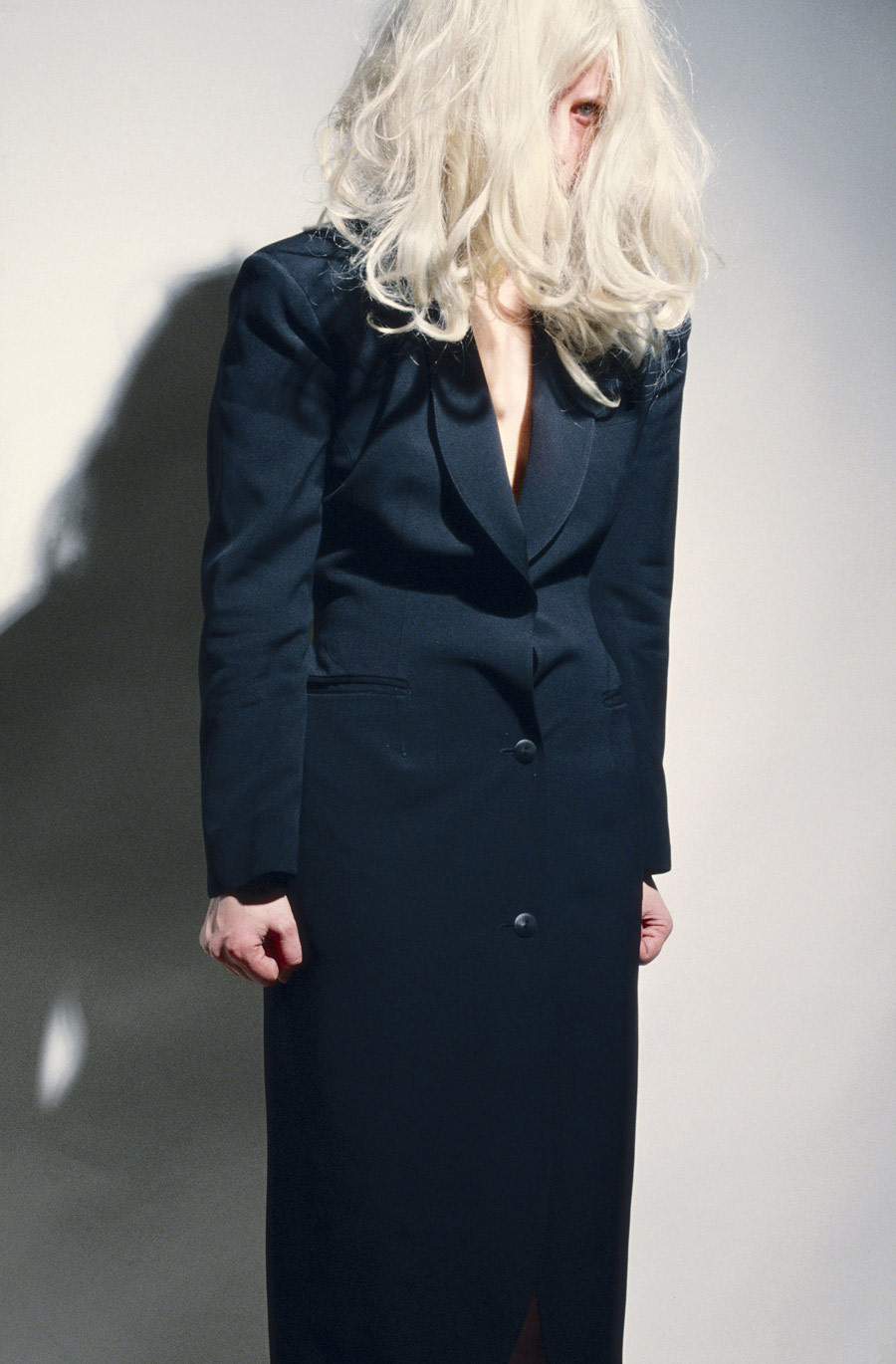
One of the more infamous Cindy Sherman photography series (in my mind, anyway) was her early 80s collection of “fashion” photographs, which depicted women (often herself) wearing clothing that supposedly made them powerful, looking miserable, squirming under the microscope of the camera lens. The picture numbered #122 in this series finds Sherman disheveled, wearing one of those monstrous shoulder pad power suits, and grimacing under the harsh florescent light of what appears to be an office. This one image almost seems to be the roadmap for where her film Office Killer would go over a decade later. The harsh lighting, the visible discomfort, and the disruption of disorder eeking out from within the rigid business world containment of the clothing feel like the stirrings of what Office Killer would eventually come to be. The only pronounced difference is that Sherman would bring in a sense of absurdist humor from her other works into the project.

Although Office Killer has Cindy Sherman’s eye crawling over every inch of the film, the real highlight is Carol Kane’s lead performance. Starting off as the exact uncomfortable-in-her-designated-role archetype depicted in the above referenced Sherman series, Kane’s titular killer is a mousy homebody who cannot suffer the intense scrutiny of being a young woman in the modern workplace. Her murder spree begins by accident, but then develops into a conscious, cold-blooded effort to make herself comfortable in a more domestic work environment. Carol Kane is usually relegated​ to minor supporting roles in her career, like her violent fairy in Scrooged or her crazed landlord in Unbreakable Kimmy Schmidt, but in Office Killer she’s allowed to command the screen whole-heartedly. What’s even better is that she’s given a chance to do so in a quietly campy, increasingly violent lead role that recalls Kathleen Turner’s performance in the John Waters classic Serial Mom, a comparison I evoke only as the highest of compliments.

Serving as a lowly, nobody office girl at a magazine publication, Kane’s anti-hero protagonist is an awkward ball of nervous energy. With a uniform of tightly-bunned hair, ratty sweaters, wire-framed glasses, and drawn-on eyebrows, she’s a sore thumb in the workplace, where more traditional Modern Women (including Molly Ringwald) poke fun at her discomfort & reclusiveness. The pressure of caring for her invalid mother (Alice Drummond of Ghostbusters fame) at home and fighting off the unwanted sexual advances of men at work tear her mind in half and she snaps. After accidentally killing a coworker after-hours, she takes the body home to her basement and finds them much easier to deal with that now that they’re lifelessly compliant with being manipulated and she’s in command. That’s when the killings become an intense obsession. She converts her basement into a “home office,” forgiving errands from her not at all alive victims to stave off search parties (in the same very early in the game Internet Age paranoia) and setting them up like mannequins at computers & typewriters. This is all in service of directly evoking a long simmering punchline about how she’s now able to “work from home.” It’s a deranged premise, but it’s all in good fun.

It took me a little while to get on the same wavelength as Office Killer. It’s the kind of film that improves exponentially each scene until it concludes at its most ridiculous point, so it makes sense to me that a contemporary audience in the 90s would turn on it early and never be able to land back on the same page as the film. Sherman has explained in interviews that the initial plan was for the film’s kills to be much bloodier & more gore-focused, but she scaled the violence back to focus on how Kane’s protagonist disposed (or doesn’t dispose) of the bodies instead of the actual acts of violence. I think this was ultimately the right decision, since it allows the film’s campy, Serial Mom vibe to play out much more brightly. The initial kills, which include electrocution, strangulations, and deaths by asthma inhaler, may not be bloody, but the softness of their initial impact makes way for a much more shocking, grotesque reveal once you get to see the full, gory scope of the killer’s self-made “home office” (which recalls John Landis’s “Family” episode of Masters of Horror). The dead bodies held together by scotch tape & Windex, including children, gives Office Killer the violent edge horror audiences may have been looking for throughout its runtime. Sherman chooses to save that mayhem for a morbid punchline that allows Carol Kane to shine in full Norman Bates glory before it hits. It may have been a decision that turned off audiences at the time, but plays in retrospect like an act of genius.

Cindy Sherman delivers exactly what I want from my genre films here, the exact formula that won me over in Tara Subkoff’s #horror. She mixes lowbrow camp with highbrow art production in an earnest, gleeful work that values both ends of that divide. As faintly silly as Carol Kane’s performance can be as a deranged killer, Sherman colors her background with a genuinely horrific history of sexual assault, where she constantly has to hear praise for her abuser in a work environment. She employs infamous provocateur Todd Haynes to provide “additional dialogue” to make sure that discomfort seeps in. The sickly, flickering florescent lights of her film’s office setting afford it a horror aesthetic long before the kills begin, especially when she focuses on the harsh, moving light of a copier running in the dark. Even the opening credits, which glides as projections across still, office environment objects, have an artfulness to them missing from a lot of tongue-in-cheek horror. Maybe some audiences don’t know what to do with that tonal clash and assumed Sherman similarly didn’t know what she was doing when she created it. Maybe it’s that exact attitude that also sank #horror before it really had a chance. All I can say for sure is that Office Killer deserved a much better response than the one it got and it’s criminal that Sherman hasn’t had a chance to make a follow-up to her near-perfect debut.

-Brandon Ledet

Don’t Kill It (2017)

The first ten minutes of Don’t Kill It promise a wonderfully executed modern B-picture: a return to form from former action star Dolph Lundgren and a pointedly satirical takedown of modern Southern Conservativism by way of gory supernatural violence. Unfortunately, that film never arrives. Director Mike Mendez, who was also responsible for the moderately entertaining but gloriously titled Big Ass Spider!, seems to be far too comfortable with settling into an easy groove of direct-to-VOD schlock.  Don’t Kill It distinguishes itself from made-for-SyFy dreck only through the R-rating freedom of its gore, tits, and cusses. Mendez directs Lundgren as a world-weary demon hunter who has to save a small Mississippi town from a demon that hops from body to body as its human hosts are destroyed (hence the title). Along the way, he stumbles into what’s very nearly a brilliant social satire on a Get Out-level of gleeful transgression, seemingly entirely on accident. That’s why it’s a huge letdown, then, that any and all satirical elements fade into distant memories and the movie plays like It Follows by way of Walker Texas Ranger (yet not nearly as fun as that combination sounds).

Don’t Kill It opens with its best ideas on its sleeve. A camo-wearing white man hunts deer in the Mississippi woods where he’s possessed by a mysterious demonic force. With pitch black eyes and a hellish scream he returns from his hunting trip to murder his entire family with a shotgun. When he’s eventually taken down the demon that possesses him jumps to the body of another white man, who in turn kills a black family that lives nearby. Mendez establishes a modern nightmare in this way, one where Southern Conservative White Men are literal demons who must be stopped at all costs. The man tasked with stopping them, the hilariously named Jebediah Woodley (Lundgren) is introduced pounding liquor in a dive bar where a nearby bro won’t take “No.” for an answer from a young woman. Woodley kicks the jerk’s ass, teaches him the meaning of the word “consent,” and then follows the girl home himself for a sexual rendezvous. She rides him like a mechanical bull in a Refn-like, neon-lit bedroom until he hallucinates that their encounter was a demonic, evil exchange and the whole ordeal devolves into a nightmare. It’s quite an opening.

The movie immediately tanks from there. A grotesquely macho punchline about sex work cheapens the “consent” exchange from the previous sequence. Woodley then gets wrapped up in convincing an FBI investigator that demons have been behind the recent string of small town murders and, because she’s a woman in a for-the-boys action horror, eventually seduces her with his old man masculinity (between commands to shut up and wait in the car). Similarly, the film itself gets wrapped up in its own mythology and largely forgets what initially made it interesting. The rules of the demon’s body-hopping antics as well as unnecessary details about angels & alternate dimensions dilute the initial impact of the film’s political satire. The idea of scary white men snapping and going on killing sprees is somewhat echoed in later sequences, like when a Tea Party-type town hall meeting devolves into a chaotic bloodbath or when a man is impaled on taxidermy deer antlers. The movie just never calcifies or weaponizes that mode of satire in any significant way. It seems much more concerned with making Dolph Lundgren: Demon Hunter appear to be a late-in-life badass. I know the actor has his dedicated fans, but his persona is never big enough here to justify that loss of interest in the initial conceit. It’s a letdown.

If you’re only looking to Don’t Kill It for a light mood and moments of over the top violence, it delivers in a lot of ways VOD cheapies tend not to. Bodies are slashed, shot, exploded, and boiled as the It Follows-style demon hops from host to host. The problem is that the stretches between those bursts of violence are painfully dull when they really don’t have to be. Don’t Kill It sets itself up with a brilliant central metaphor and sense of purpose in its first few scenes, only to immediately drop them to make room for more Dolph Lundgren hero worship and unnecessary world-building. It’s an okay, goofy-enough film that feels like it was one or two rewrites away from being something truly great.

-Brandon Ledet

The Ape Man (1943)

When looking back to the heights of Old Hollywood, what we’re really getting nostalgic for is the glut & extravagance of the old studio system. The high production values & workman sense of craft that went into each studio production in that era are missing from modern cinema’s more routine, mundane releases. For a brief, glorious time, even horror had its day in the sun during that studio era, particularly thanks to Universal’s Famous Monsters brand. This, of course, birthed the iconic career if Bela Lugosi, who starred in prestigious horror productions like The Black Cat & Todd Browning’s Dracula early in his career. Horror was treated as a flash-in-the-pan trend by the Hollywood studio system, however, and Lugosi’s leading man work eventually dried up. Shortly after putting in his final top-bill performance for a major studio in Columbia Pictures’ Return of the Vampire (which is widely considered to be an unofficial sequel to Dracula), Lugosi was nudged out of the major studio system and into B-picture work in the less nostalgia-worthy territory of Old Hollywood’s so-called “poverty row” studios, purveyors of schlock. The step down from Universal horror to poverty row B-pictures was exactly as drastic as it sounds and Lugosi’s first work for Monogram Pictures, The Ape Man, was clearly the actor’s first major “Oh, how the mighty have fallen” moment.

Although far from the worst, The Ape Man may be the first major embarrassment of Bela Lugosi’s career. It was also one of the few instances of his earlier works where he wasn’t asked to play a vampire. Instead, the Hungarian-born icon plays the titular ape man, the monstrous result of a failed experiment by the other horror movie staple he was often typecast as: a mad scientist. Weirdly enough, the film begins after the scientist has already transformed to his hideous ape man visage (which just looks like an especially hairy member of The Monkees). In later works like Alligator People or The Fly, that kind of introduction would mean that his failed experiment downfall would then be portrayed in a longform flashback. Instead, we’re simply told that he was once fully human and are asked to watch in horror as he hunts down innocent victims for their spinal fluid, which he shoots directly into his arm like heroin as a makeshift, temporary cure for his ape-ificiation (an image that would be just as shocking in the 40s as it is now, given heroin addiction’s prominence at the time). The ape man scientist dresses like a typical gangster when venturing out for these kills, equipped with a fedora and a cape. The difference is that instead of using a gun to slay his spinal fluid-providing victims, he uses his accomplice, an actual ape. The film’s main conflict is in following two news reporters as they get to the bottom of these mysterious killings, increasingly getting hot on the ape & ape man’s metaphorical tails. (Apes don’t have tails.)

The basic plot of The Ape Man has promise to it as a Bela Lugosi cheapie, but the film itself is a total embarrassment. The score is punishingly repetitive; Lugosi’s given nothing interesting to do outside donning the ape make-up; his primate accomplice is clearly just a dude in a costume shop gorilla suit; and the two reporters who chase them down cynically poke fun at the frivolity of the film’s premise, since horror had become something of a derided fad by the time of the film’s production. It probably doesn’t help that Monogram Pictures allowed The Ape Man to fall into public domain status, so the only commercially available prints are horrifically shoddy DVD transfers with nearly incomprehensible visual & aural clarity. I might’ve been better off streaming the film from YouTube than watching my bargain bin physical copy (purchased from a yard sale), but at least I got to exercise my rudimentary lip-reading skills?

The worst part about all of this is knowing that things only got worse for Bela Lugosi’s career. He might’ve had a couple decent Universal productions left in him as second fiddle to rival Boris Karloff (1945’s The Body Snatcher is especially great), but the rest of his career as a leading man would be relegated to works exactly like this slice of poverty row dreck. Even though The Ape Man was a nothing of a film, that wouldn’t stop Lugosi & Monogram from teaming up again for its sequel, Return of the Ape Man. Lugosi would even work again with The Ape Man director William Beaudine, whose prestigious credits include titles like Billy the Kid Versus Dracula & Jesse James Meets Frankenstein’s Daughter, on the infamously terrible Martin & Lewis knockoff Bela Lugosi Meets a Brooklyn Gorilla. At least that poorly-remembered gem is notably terrible, though. It’s possibly the most shrill & aggressively unfunny film I’ve ever seen, but The Ape Man is an even worse kind of awful: the unforgivably bland kind. It’s the first truly sour note in a career that had outworn its welcome in the Old Hollywood studio system, even if that career persisted endearingly in horror fans’ hearts in the more forgiving decades since. Yet, its worst offense is in being an entirely forgettable bore.

-Brandon Ledet

The Space Children (1958)

There’s nothing more admirable in genre film production than basic efficiency. Cheaply made sci-fi and horror can often transcend its limited means by way of an over the top premise or an inspired knack for production design, but those virtues can be dulled so easily by a labored pace or runtime. At just under 70 minutes, the sci-fi cheapie The Space Children never had time to outlive the novelty of its basic premise. Although director Jack Arnold had previously made a fine example of artful prestige horror with The Creature from the Black Lagoon (which is stunning in its moments of underwater cinematography), The Space Children is nothing but a bare bones sci-fi yarn made to fill out a double bill with the similarly slight, but impressive The Colossus of New York. Those limiting factors of microscopic budget & necessity for a brief runtime only amplify & enhance its charms as a scrappy little horror oddity with a strange plot & an even stranger alien menace. Whenever catching up with these efficient examples of bizarre, but slight genre films from the drive-in era, it’s tempting to wish that our modern PG-13 horrors & superhero epics would stick to that exact kind of length & scale.

The Space Children is a message movie about the horrors of nuclear war, nakedly so. While its heavy-handed lesson about how it’s probably not super cool to get into a worldwide arms race that could very quickly destroy the planet isn’t exactly a revolutionary thought for a 1950s genre picture, it is handled in a way that somewhat subverts its genre expectations. This is an alien invasion picture where neither the Thing From Another World that challenges our military, nor the army of creepy children it hypnotizes are the villain. In a variation from the Children of the Damned standard, it’s the parents, adult humans, who are the enemy. Scientists & military families are contracted by the American military to live in an isolated community while developing The Thunderer, a hydrogen bomb that can be readily launched from an orbiting satellite instead of a fixed physical location. Concerned, a glowing, telepathic brain from outer space lands on a beach nearby the military base and hypnotizes the scientists’ children to do its evil bidding: preventing nuclear holocaust by dismantling The Thunderer. Short story shorter, its galactic mission is a success and the evil space brain (with a little help from its ragtag group if telepathic juvenile slaves) saves Earth from blowing itself apart.

The Space Children never had a chance to be as iconic or as memorable as other nuclear horrors of its time like Them! or The Day The Earth Stood Still, even though it concludes with the exact same kind of moralizing rant about the dangers of nuclear war (this time with a Bible verse printed over an outer space backdrop to drive the point home). It was too cheap & lean of a production to aspire to those genre film heights. The movie does a great job of working within the boundaries of its scale & budget, though, suggesting worldwide implications of its central crisis despite never leaving its artificial studio lot locations. Although not likely a conscious choice, the artificiality of those sets, which are supposed to feel like natural outdoors environments, only adds to the movie’s charming surreality. Seemingly, the entire budget of The Space Children was sunk into the look of its space alien brain, which was a smart choice. When the alien first arrives, it appears to be a glowing jellyfish that washed up on the beach. As it pulsates, expands, and glows brighter while psychically linking to its child mind-slaves that same brain gradually grows to be the size of a small, glowing hippo. The logistics of constructing such a thing seemingly zapped most of the production money, leaving only room for cheap-to-film horror movie touches like telepathy, teleportation, telekinesis, and (scariest of all) Disney Channel levels of goofy child acting. It’s an expense that pays off nicely, though, and the brain is just as memorable for its physical presence as it is for somehow not being the villain.

The Space Children is a cheap, goofy sci-fi horror with nothing especially novel to say about the perils of nuclear war, bit still manages to feel like a fairly rewarding entry in its genre. Its efficiency in delivering the goods of its space alien brain special effects & its anti-war morality play in just over an hour of drive-in era absurdist fun is an impressive feat in itself. Backing up that efficiency is another excellent score from Twilight Zone vet Van Cleave (who also scored The Colossus of New York). As soon as the opening credits, which superimposes children’s heads over telescopic photos of outer space, Van Cleave’s organ & theremin arrangement elevates the material considerably. That Twilight Zone connection feels true to this movie’s overall spirit too, as that show was excellent at delivering the goods in a similarly lean time & budget. Something you won’t see on many Twilight Zone episodes, though, is a hippo-sized brain that glows, pulsates, hypnotizes children, and forces them to rebel against their war hungry parents. The Space Children wasn’t even the best movie on its own double bill at the drive-in (The Colossus of New York is so good), but it knew exactly how to milk its few saving virtues for all they were worth and, in some cases, how to make them glow.

-Brandon Ledet

The Colossus of New York (1958)

EPSON MFP image

fourstar

Written by hoaxter parapsychologist Thelma Moss & released on a double bill with something called The Space Children, you’d be forgiven for assuming that The Colossus of New York was an unworthy throwaway sci-fi picture only notable because it somehow wasn’t featured on an episode of Mystery Science Theater 3000. You’d be wrong, though. Although the film is only a breezy 70min long, pads itself out with a little airport stock footage and is undeniably goofy in some of its special effects details, The Colossus of New York deserves way more respect than you might expect from its drive-in schlock pedigree. Unexpectedly serving as a bridge between Mary Shelly’s Frankenstein & Paul Verhoeven’s RoboCop, I found the film far more inventive & thematically well-considered than I would have initially assumed. It looks from the outside to be just one of many cheap 1950s Frankenstein bastardizations, but the film pushes way past a simple brain transplant horror story into something that feels anachronistically forward-thinking. A lot of The Colossus of New York‘s initial appeal rests in its drive-in era charm & unique creature design, but it somehow amounts to far more than the sum of its parts.

The film starts with two sibling scientists watching footage of automated assembly line technology that the far more successful of the pair is pioneering. His jealous brother, tired of competing for their father’s praise, jokes that the invention will “put the human race out of business.” After hearing his father brag to the press that his son is one of the all-time great human minds, comparable to the likes of Einstein & Darwin, we watch the scientist die in a horrific car accident while retrieving his child’s toy airplane. The father is driven mad by this “foolish, wasteful” death and starts raving about the shame of the human body’s inferiority to the power of the mind and some slippery slope philosophy about the brain vs the soul. Long story short, the father resurrects his favorite son by implanting his brain in a more durable cyborg body, while the lesser, more alive brother starts making moves on the scientist’s widow. The experiment works at first, with the scientist’s new cyborg body finally matching the immense power of his mind. He’s essentially a gigantic, metal version of Frankenstein’s monster, with the added bonus of light-up eyes that shoot deadly lasers. Of course, the father’s meddling with the laws of God & Nature means that the creation’s temporary success doesn’t last forever. Eventually, the titular cyborg colossus uses his newfound strength to exact his brutal revenge, first on his wife-stealing brother and then on the world at large.

What’s most striking about The Colossus of New York is what happens when it ventures into the uncanny. Most drive-in schlock would’ve stopped at the Metal Frankenstein aspect of the premise, but this film pushes itself into much stranger, more adventurous territory. When the colossus is first switched on, we see the world through his POV, a television static-inspired technique that recalls the similarly shot birth of RoboCop. When he first sees himself in the mirror as a cyborg he squeals in horror, pleading to his father, “You want to help me? Then destroy me,” in a pathetic mechanical voice. He curses his “flesh that cannot feel,” pines to reconnect with his wife (who the father initially reports to be dead), and repeatedly visits the grave for his old human body. Things get even stranger from there as the scientist’s mind begins to push beyond normal human capacity. He’s tortured by “meaningless images,” visions that are later revealed to be premonitions of future events. He also becomes more erratic in his thoughts by the day, even discovering a new talent for hypnotism, which he immediately employs for evil. This escalates to the once great, humanitarian mind declaring the poor & hungry to be “human trash” and deciding to wage a one-cyborg war on world peace, starting with a massacre at a UN conference. What was once a standard black & white horror cheapie starts to feel much stranger, much more special, and by the end The Colossus of New York starts to feel like a long buried gem.

Even if my praise of the film’s adventurous sci-fi themes sounds a little hyperbolic, I believe it’s a work that could easily be enjoyed for the simple pleasures of its sights & sounds. Lack of facial expressiveness is usually not a plus in a monster movie mask, but the cyborg colossus uses that awkward stoicism quite well as an essential part of his self-tortured inhumanity. The movie also pulls a lot of great visual play out of terrified victims being lit solely by the monster’s light-up brain & eyes in the moment before he zaps them to death. Besides boasting a cool-looking monster who eats up a lot of screentime in a refreshing change from the genre’s status quo, the film also employs a minimalist piano score from frequent Twilight Zone musician Van Cleave that affords it a classic silent horror vibe in its simplicity. If you’re ever in the mood for a Universal Monster-type classic, but you’re feeling exhausted with endless rewatches of Frankenstein or The Black Cat, I highly recommend giving The Colossus of New York a shot. It just might surprise you.

-Brandon Ledet

Alien: Covenant (2017)

Of all the wacky, scary, goofy, gory follow-ups to Ridley Scott’s space horror masterpiece Alien, it’s Scott’s own 2010s prequel Prometheus that stands as my clear favorite. Aesthetically, Prometheus is on the exact wavelength of arty pulp I crave in my genre cinema, the same gorgeous-imagery-meets-dime-store-novel-idiocy dynamic that wins me over in titles like Interstellar & The Neon Demon. I also love that film on a basic thematic level, though. The idea of human beings asking Big, Important philosophical questions about our origins & purpose to literal gods and receiving only brutal, wordless violence in response is such a killer concept, one that’s both morbidly funny & surprisingly truthful to the human condition. Alien: Covenant, also directed by Scott, picks up ten years after that Prometheus timeline, positioning itself as a sequel to a prequel (what a time to be alive). In some ways it attempts to continue those exact questions of Who We Are & Where We Come From, as if they’re the only things that matter. Humanity is once again punished for the hubris of trying to prove that its existence is no random accident, but rather a deliberate design from gods beyond our solar system. The results & significance of that query are severely downplayed in this second run-through, however. Instead of aiming for the arty pulp of Prometheus, Covenant drags these themes down to the level of a pure Roger Corman creature feature. This prequel-sequel is much more of a paint-by-numbers space horror genre picture than its predecessor, but that’s not necessarily a quality that ruins its premise. Through horrific cruelty, striking production design, and the strangest villainous performance to hit a mainstream movie in years, Covenant easily gets by as a memorably entertaining entry in its series, only middling because the Alien franchise has a better hit-to-miss ratio than seemingly any other decades-old horror brand typically has eight films into its catalog.

Alien: Covenant is, above all else, a Michael Fassbender showcase. Reprising his role as the A.I. robot David & appearing simultaneously as a second A.I. named Walter, Fassbender delivers his strangest onscreen performance going at least as far back as Frank. In the context of how Covenant fits into the Alien franchise at large, it could maybe be understood as a Jason Takes Manhattan-type eccentric outlier, if only retitled as Michael Fassbender: Sex Robot. A whole new crew of intergalactic colonists find themselves stranded on an alien planet with only one non-xenomorph related resident: David, Fassbender’s chilling A.I. robot from Prometheus. Among the crew is Fassbender’s Walter, who David takes a special liking to while the disposable human characters are picked off one by one by xenomorph teens (they’re less evolved, less “perfect” offshoots of the typical alien species). There’s a strange sexual tension between these two Fassbender bots that only gets stranger as they spend more time alone together. In the movie’s best moment there are no killer xenomorphs to be seen, no on-screen bloodbath to placate anyone looking for a straightforward body count horror. It’s a quiet moment in David’s art studio (which could easily pass for HR Geiger’s masturbatorium) where he teaches Walter how to play the flute, openly bringing any unspoken sexual tension to the surface by directly hitting on his A.I. brethren. Lines like, “Watch me, I’ll do the fingering,” & “Put gentle pressure on the holes” are almost enough to push Covenant solidly into outright camp and their relationship only gets more perverse from there. Fassbender does a mesmerizing job of differentiating between his two characters: one is a spooky robot with barely-secretive agendas and one’s a tough guy soldier with mommy issues involving his mothership. You never forget which character you’re watching, even when the plot should probably ask you to, and that kind of dramatic craft confidently carries a lot of scenes that could easily devolve into absurd inanity, like the seductive flute blowing or a brief foray into kung fu. Regardless of your thoughts on Prometheus or the collection of Alien sequels as a whole (which each seem to be individually divisive), Covenant is worth seeing for the Fassbender weirdness alone.

David & Walter aren’t the only romantic couple in Covenant, but they are the only one that matters. The titular space mission in the title references Abraham & Noah’s covenants with with God, setting up the spaceship, Mother, as a kind of Ark meant to rebuild humanity on an alien terrain. Every crew member is married in pairs and responsible for the transportation of thousands of future citizens meant to populate a distant world with human seed. Mostly, these human characters have no more personalities or purpose than the drawers full of human embryos they’re being paid to transport across the universe. Katherine Waterson does a decent job of physically emoting as she watches her crew members die at the hands(?) of the film’s teenomorphs. Billy Crudup is believably off-putting as a captain who’s in way over his head commanding a crew who doesn’t respect him because he’s a Kirk Cameron-style “man of faith.” Danny McBride never truly disappears into his role in any detectable way, but he somehow isn’t the most distracting celebrity presence in the film, against all odds (there’s a celebrity death that needs to be seen to be believed; it’s essentially a prank). None of these characters matter. Unlike in Prometheus, the questions of Faith & the Meaning of Life don’t matter here either. Only Fassbender’s Cruella De Vil levels of villainous camp & the teenomorph (and eventually straight up xenomorph) creature attacks register as memorable, worthwhile aspects of Covenant, but they’re both effective enough to save the picture from from horror film tedium, even individually. The moments of horrific monster movie gore are both plentiful & plenty fucked up. Fassbender’s weirdo characters are given plenty of screen time to warp the picture into a strange dual character study, correcting the one frequently cited Prometheus complaint I can truthfully echo. As with a lot of post-Corman creature features, the monsters & kills are exciting enough to cover up the shortcomings of the film’s basic philosophy & humanity. In fact, the human aspect of the film is so weak that it almost directly supports its own villainous arguments about the superiority of other, “perfected” beings.

I’m never really sure what audiences want from Alien sequels. Prometheus & Resurrection are my favorite follow-ups to the original film because they push its imagery & mythology into unexpected directions – goofy, gorgeous, or otherwise. They’re also both frequently cited as the worst of the franchise because they deliberately stray from a more-of-the-same horror sequel ethos, so what do I know? I can see Covenant eliciting a similar polarizing reaction from Alien devotees, as it dabbles both in the goofiness of Resurrection and the overreaching philosophy of Prometheus without ever landing convincingly on either side. I ultimately find that split a little middling in the grand scheme of the series, but the film is brutal enough in its sequel-by-numbers gore & campy enough in its Fassbender weirdness to survive as yet another entertaining entry into an increasingly trashy, but eternally mesmerizing horror franchise that’s likely the most consistently rewarding one we’ve got running.

-Brandon Ledet

Don’t Knock Twice (2017)

I’m not sure it’s always necessary for a horror film to justify the surface pleasures of its scares & thrills by linking them to a dramatic metaphor. However, it can be frustrating when one comes close to achieving that dynamic without fully following through. The recent British ghost story Don’t Knock Twice enters into the modern tradition of horror flicks with clear metaphors specifically centering on the anxieties of motherhood: The Babadook, Goodnight Mommy, most of XX, We Need to Talk About Kevin, etc. The frustrating thing is that it nearly succeeds in joining those incredible ranks with an entirely​ new angle on motherhood terror its peers had not yet represented, but falls just short of hitting that target. Ultimately, its demonic scares & familial drama hang separately in the spooky air, never joining forces to drive home its significance as an individual work. That kind if strength in metaphor is not entirely necessary for a modern horror film to feel worthwhile, but without it Don’t Knock Twice struggles to feel substantial in any memorable way.

The always welcome Katee Sackhoff (Oculus, Battlestar Galactica) stars as an American sculptor and recovering drug addict who struggles to reconnect with her teenage daughter (Sing Street‘s Lucy “Riddle of the Model” Boynton) who she gave up for adoption in the British foster system. The daughter is reluctant for obvious reasons to welcome her mother, now essentially a stranger, back into her life, but finds herself in dire need of shelter from a supernatural threat. She & a fellow teen disturb a small, haunted shack near an interstate overpass where a witch’s ghost was rumored to live, knocking on the door twice (hence the title) after being told there would be urban legend-style consequences. The legend turns out to be exactly true and the teen girl finds herself haunted by a demonic witch that follows her from home to home to avenge the transgression. The monster itself (an aged, lanky, inhuman variation on the little girl from The Ring) and the film’s flashy over the top camera work make for plenty of effectively creepy moments: the witch climbing out of a kitchen sink, s ghost slitting its own throat, an Unfriended-style murder witnessed on Skype. The question of what the monster represents and how its terror communicates with the ex-addict mother’s suddenly possessive love for her estranged daughter, however, is much less effective.

There’s a distinct, nightmarish terror in this film’s teen victim being told that her parent, who has hurt her before, is now completely rehabilitated & worthy of trusting forgiveness. The vulnerability of welcoming that parent back into her life and not having her reservations for that forgiveness being taken seriously is not unlike being haunted by a literal ghost from the past that no one but she believes exists. If the demonic witch ghost that causes havoc in the film is supposed to somehow represent the mother’s past as an addict, however, Don’t Knock Twice doesn’t do much to help the metaphor along. A couple major plot twists that bring in murder mystery dynamics outside that central mother-daughter relationship suggest a mixed metaphor where the ghost also represents some kind of abusive evil in the foster system or, more likely yet, represents nothing specific at all. It’s not at all fair to burden Don’t Knock Twice with the expectation of a strong metaphor to support the presence of its demon witch antagonist, but the film comes too close to saying something freshly insightful about parental anxiety & the cycles of addiction not often depicted in horror cinema for the frustration in the shortcomings of its metaphorical potential to be ignored. When that aspect of its story doesn’t land, there’s not much left of its familial drama to hold onto and the film ultimately plays like a more visually striking version of mainstream horror titles like Lights Out & The Darkness. There’s nothing especially wrong with that distinction, but Don’t Knock Twice comes very close to being much greater than that limited ambition suggests.

-Brandon Ledet

The Void (2017)

I often tout the importance of practical effects in genre filmmaking, even claiming that it saves otherwise dire tongue-in-cheek properties like Zombeavers and Stung from total tedium. The recent horror fantasy picture The Void made me question that devotion to my practical-effects-above-all-else ethos. At every turn, The Void disappoints as a feature film & a genre exercise, except that its classic, tactile 80s gore is gorgeous to behold. I left the film positive overall due to its visual artistry, but just barely. I was so close to souring on The Void from a scene to scene basis that I almost wish I had watched the movie on mute while folding the laundry & making phone calls. It was only worthwhile for its imagery.

A sort of Stranger Things cocktail of 80s-specific genre nostalgia, The Void stages a John Carpenter-style single location thriller at a small town hospital and tortures its characters within by way of a Clive Barker-style threat of otherworldly hedonism. Every character bottled up in this promising, go-nowhere plot can be boiled down to a single defining characteristic: The Cop, The Pregnant One, The Old Timer, etc. Their flat, emotionless line delivery, snarky post-Joss Whedon riffing, and dispiriting lack of character depth made me expect a twist that never came where the hospital setting would be exposed as an artificial environment, like in Southbound or Cabin in the Woods. No such luck. The only thing that opens up their hospital-set imprisonment is that one of them is some kind of occultist figurehead with access to hideous, beastly mutations and a titular realm of otherworldly horrors. Instead of playing like a threat, though, this villain is the audience’s only salvation from a bland group of inhuman forgettables, more of whom survive than I would have liked.

As bland as The Void is to listen to & absorb on a narrative level, it sure is pretty to gander at. It’s got everything: the impossible to define monstrosities of The Thing, the triangle-reverent mysticism of Beyond the Black Rainbow, the wooded threat of The Witch, the heavy metal hellscapes of Thor 2: The Dark World, the home invasion brutes of You’re Next, the personal nightmare visualizations of Event Horizon (just without the pesky outer space setting classing up the joint), etc. Just about the only thing The Void doesn’t have is an original bone in its body, getting by mostly as a Frankenfilm composed entirely from pieces-parts of horror cinema past. I frequently didn’t care about that nostalgia-baiting nature of the imagery, though, especially when it came to the Cronenbergian creature designs & Hellraiser 2: Hellbound visage of exposed muscle & nerve. The Void may borrow heavily from seemingly every movie that came before it, the reference points that comprise its feature length mixtape aren’t the easiest visual feats to pull off and the film ultimately gets by on the strength of its grotesque visual artistry, even if just barely.

I usually don’t require much, if any, verisimilitude from my practical effects-heavy gore fests about mutant beasts & alternate dimensions, but something about The Void’s detachment from reality bothered me. When an in-over-his-head sheriff from a small industrial town sees someone he’s presumably known his entire life shave off their own face & melt into an alien-looking creature, I expect at least a little bit of an emotional freakout, if not a violent puking & fainting combo. Since The Void is disinterested in that kind of recognizable humanity, its best bet would’ve been a reason or explanation why everyone was acting so oddly, even if a comically outlandish, campy one. As is, the human interactions feel like dead space placeholders between the film’s admittedly righteous horror film homages to past practical effects monstrosities. These visual achievements were enough on their own to make the film feel at least worthwhile, but not nearly enough to elicit any kind of genuine enthusiasm. If the characters within the film don’t care all that much about having their ranks torn apart by mutated beasts, why should I?

-Brandon Ledet

Prevenge (2017)

Actress Alice Lowe is best known as a feature player in Edgar Wright productions like Hot Fuzz and The World’s End. Her debut feature as a writer and director is notable not only for bringing that Edgar Wright-friendly sense of humor into the realm of a high-concept slasher, but for also being a Herculean feat of physicality & filmmaking efficiency. Lowe directs and stars in Prevenge herself while seven months pregnant, filming all of the project’s principal photography in just eleven days. I’d usually find that kind of microbudget production efficiency impressive in a Roger Corman kind of way no matter what, but Lowe’s very visible late-pregnancy state and dual roles on either side of the camera raises the bar on that already inherent filmmaking badassery. Lowe’s real life pregnancy also affords Prevenge an amusing sense of authenticity you don’t typically see in high concept horror comedies. Pregnancy anxiety drives a lot of the humor and the terror at work in Prevenge and there’s something transgressive about Lowe’s pouring so much of herself into that central driving force, especially once it accumulates a body count.

Lowe stars as a single mother who murders total strangers at the command of the voice in her head, a high-pitched, cartoony presence that seems to be broadcasting from the fetus growing inside her. As a tag team, the mother & her unborn, bloodthirsty daughter initially seem to be on a vigilante mission against modern culture, like in the Katie Holmes comedy Miss Meadows or the excellent psychological horror Felt. The mother slits the throats of the creepy men who hit on her and the women who systematically keep her down (including a heartless business executive played by The Witch‘s Kate Dickie) in what appears to acts of moral vigilantism. The familial pair of killers aren’t choosing their victims at random, however, and the source of the perceived wrong they strive to correct through bloodshed (almost always by knife) is gradually revealed through a series of flashbacks. This sets up two parallel races against the clock that might prevent their revenge mission from being fulfilled: the impending birth of the child and the possibility of someone discovering the connection between the victims before they’re all disposed of.

Prevenge is strongest in its first act, when it takes satirical aim at the ways we discuss the nature of pregnancy. When doctors assure the pregnant mother/ruthless killer, “Baby knows what to do. Baby will tell you what to do,” it’s doubtful they mean that a literal voice will come from the fetus with demands to stab strangers to death in their own living rooms. There’s some real-life tension seated in that dynamic too, which includes lines like, “It’s like the baby’s driving and I’m just the vehicle.” Prevenge can feel delightfully transgressive in these moments, but once it pulls away from natal care satire and settles more into a traditional slasher formula, its tone begins to soften, meander, and fade. The mystery of the absent father and the connection between the seemingly unrelated victims isn’t nearly as interesting as the more pointed critiques lobbed against the ways modern medicine treats pregnancy as well as legitimate anxieties over forfeiting your mind and body to the wants and needs of a new being growing inside you, possibly with murderous intent.

As a filmmaker, Alice Lowe shows immense promise here. There’s great specificity in the imagery of her various set pieces, from the reptile predators of a pet shop to a sparsely attended disco night at a dive bar to the fancy dress costumes of a Halloween party. Her screenplay is wickedly funny in its best moments as well, like when the foul-mouthed fetus comments on her mother’s nextdoor neighbors loudly fucking, “Listen, Mommy! That’s how I was made,” or when Kate Dickie’s heartless business executive explains, “We’ve had to make some really harsh cuts. It’s a cutthroat world.” She also, smartly, refuses to turn away from the brutality of her staged mother-daughter kills, making for a very bloody version of a modern horror comedy. I do think Prevenge loses some focus once it shifts from satirical pregnancy horror to psychological murder mystery, but I was mostly impressed here by how Lowe pulled off such a successfully slick, icily funny picture on such a miniscule budget and so late in her own pregnancy. She managed to make a no-budget horror comedy into a strikingly personal, visually memorable work, which is no small feat for a first time filmmaker.

-Brandon Ledet