Welcome to Episode #25 of The Swampflix Podcast! For our twenty-fifth episode, James & Brandon discuss Alfred Hitchcock’s iconic proto-slasher Psycho (1960) and its too faithful Gus Van Sant remake from 1998. Also, James makes Brandon watch the similarly-remade comedy Death at a Funeral (2007) for the first time. Enjoy!
Although they’re often (rightly) called out for their inherent misogyny, there’s a popular reading of slasher films that claims they’re subversively, politically progressive because they ask a traditionally male audience to identify & empathize with a female victim’s POV. Aligning horror nerds’ sympathies with a Final Girl archetype might not seem like the height of radical discourse, especially considering what typically happens to those characters on-screen, but it does have a cultural value to it that might not be the first thing that comes to mind when discussing sleazy 80s slashers. The directorial debut of comedian Jordan Peele recognizes this function of horror audience sympathies and shifts its culturally critical eye from feminism to racial politics. Instead of a virginal, scantily clad blonde running from a masked killer with an explicitly phallic weapon, Get Out aligns its audience with a young black man put on constant defense by tone deaf, subtly applied racism. Part horror comedy, part racial satire, and part mind-bending sci-fi, Peele’s debut feature not only openly displays an encyclopedic knowledge of horror as an art form (directly recalling works as varied as Rosemary’s Baby, The Stepford Wives, Under the Skin, and any number of Wes Craven titles), it also applies that knowledge to a purposeful, newly exciting variation on those past accomplishments. Get Out knows what makes horror effective as a genre and finds new avenues of cultural criticism to apply that effect to instead of just mirroring what came before, no small feat for a debut feature.
Our de facto Final Girl protagonist is a young, hip photographer visiting his white girlfriend’s family home for the first time. Isolated in a secluded, wealthy suburb, he’s faced with the outnumbered, paranoid feeling of being the only black man in a sea of white, smiling faces. The only other POC in his hosts’ community are “the help”, who have an unnatural, creepily robotic way of acting (assumedly in a direct nod to The Stepford Wives). Instead of tackling the blatant, violently hateful kind of racism that would more typically be skewered in this kind of movie, however, Get Out finds horror in racism’s much subtler, more difficult to pin down forms. The girlfriend’s family is initially very cordial with our Final Boy, but in an awkward, discomforting way, plagued with a wide variety of micro-aggressions he awkwardly smiles through to avoid confrontation. By using phrases like “my man,” “thang,” and “Sup, fam?” in an attempt to make him feel welcome and at ease, the family only makes his presence feel all the more alien. They declare proudly that they can’t possibly be racist, since they enthusiastically voted for Obama. Twice! The girlfriend, in turn, makes a big show of pointing out every subtle slight in an attempt to seem cool & above it all. Nothing about the scenario is cool. Through eerie atmosphere, mood-setting jump scares, and surreal nightmare imagery, Peele slowly, steadily reveals the ugly spirit lurking under this try-hard liberalism that reduces a human being into a cultural specimen. And when the corrupt, corrosive nature of that sentiment comes violently crashing to the surface, it’s exposed to be just as cruel & terrifying as the kind of racism usually depicted through white hoods & burning crosses.
Get Out is a good, well made genre film that then becomes spectacularly great in its violent, no fucks given third act. Peele’s well-rounded screenplay brings every stray theme, from the racial discomfort to the main character’s guilt over past inaction to metaphorical motifs as small as roadkill deer, back around for a glorious, purposeful conclusion. The seemingly well-meaning, casual racism that had been lurking under the surface like a paranoid delusion is exposed as a horrifically grotesque monster that reduces black men to physical objects, targets for the white & wealthy’s fascination & possessive entitlement. Additionally, Peele filters this thinly veiled maliciousness through a surreal nightmare where reality is warped by perception-shifting hypnosis. If I had one complaint about Get Out it’d be that it could’ve spent a lot more time diving into the otherworldly imagery & paralyzing implications of its hypnotic dream-space, known in-film as The Sunken Place, instead of chasing tension-cutting meta humor with the film’s comic relief character. The Final Boy’s best friend phones in periodically to act as an audience surrogate, asking questions like, “How are you not scared right now?” & directly calling out the girlfriend’s family as the creeps they so obviously are. He’s an amusing presence in the film, but he’s one that pushes Get Out away from the more unique touches of its modern horror surrealism into a more overly familiar horror/sketch comedy tone. However, Peele still gets the most he can out of his subtle nightmare plot’s moment to moment creepiness, especially from always-welcome character actors Catherine Keener & Stephen Root, and you can tell he made this passion project from the perspective of a life-long horror fan who knows exactly how the format works most efficiently. From Get Out‘s cultural criticism to its play with Final Girl tropes to the gloriously bizarre territory of its third act reveals & Sunken Place surrealism, it’s an impressive, striking debut feature, a great first go for a filmmaker who hopefully has a long career of these horrific, satirical mind-benders ahead of him.
When I went over to a friend’s house to watch a movie, he presented me with several recent rentals and let me pick one. “What’s this one?” “An early anti-western.” “And this one?” “Oh, that one’s really good, but I need to wait to watch that one with my girlfriend.” “What’s The Skin I Live In?” “It’s a horror film by Pedro Almodóvar.” So in.
Of course, my only real experiences with Almodóvar came over ten years ago, when I saw Todo sobre mi madre (All About My Mother) and La mala educación (Bad Education) in my freshman year of college, and a few years later when I saw ¡Átame! (Tie Me Up, Tie Me Down) and was displeased with the film’s overall themes. Still, although the former two films have faded in my memory like paper flowers left in the sun, I was excited to see his approach to a straight-up horror flick. That’s not really what The Skin I Live In was, but it was all the better for it.
The film follows Roberto Ledgard (Antonio Banderas), a plastic surgeon who has tragically lost both his wife and daughter to suicide, the former after she catches sight of the reflection of her badly burned face following extensive reconstructive surgery, and the latter after a lifetime of mental illness resulting from witnessing her mother’s fateful leap to her death. As a result, he keeps a mysterious woman named Vera (Elena Anaya) locked away in a (metaphorical) gilded cage in his palatial home and experiments on her to create a skin that is resistant to fire. Vera’s only connection to the outside world besides Roberto and a few television channels is Marilia (Marisa Paredes), a domestic servant of Roberto’s who has been with his family since before his birth. When Roberto is away, Marilia’s son Zeca (Roberto Álamo) reappears during Carnival and discovers the imprisoned Vera and believes that she is actually Roberto’s dead wife, with whom he had an affair.
While Zeca forces himself on the woman he believes to be his lost love, Roberto returns and kills him to protect the fact that he has secreted Vera away. Vera’s offer to stay with Roberto, ostensibly out of love for him, elevates her from captivity to his bed, where dreams relate the tale of the fateful night that drove Roberto’s daughter Norma (Blanca Suárez) to her final throes of madness. Six years prior, Roberto took Norma from the sanitarium that has been her home for many years to attend a wedding, where she meets Vicente (Jan Cornet). Vicente is a sensitive young man who works in his mother’s vintage boutique, but who is nevertheless too fond of recreational drugs– so much so that when he hits it off with Norma at the wedding, he is too pilled-out to recognize that she is mentally unwell. As various young couples in the same garden engage in sexual acts, Norma objects to Vicente’s physical advances; as he disengages, she bites him and he strikes her before fleeing the scene. Roberto comes upon Norma lying near the tree as Vicente speeds away on his motorcycle, leaving the surgeon to assume the worst.
That’s already spoiler-heavy enough that I’m hesitant to say more, as I encourage you to seek the film out and form your own opinion, especially given some of the more controversial elements. As a trigger warning, it is imperative to understand before viewing that there is at least one rape scene in this film. Perhaps there are more, but given the film’s various and occasionally conflicting points of view on agency, consent, deception, gender, mental health, and overall sexual politics, you as a viewer will find yourself questioning the motivations and preconceptions not only of the characters but also yourself. (Also, unlike Tie Me Up, Tie Me Down, the sexual violence is treated respectfully, rather than as erotic or titillating, which it s a valid criticism of Almodóvar’s earlier work.)
At turns provocative and disquieting, The Skin I Live In is relentless in the way that its unfolding narrative forces the viewer to re-evaluate every previous scene with each new revelation. Do our sympathies for Roberto outweigh the fact that the well of his monstrosity is deeper and darker? His ultimate fate is a consequence of his inability to accept the reality of his life (which is related to his being a plastic surgeon, which is conventionally considered a position that exists solely due to society’s vanity) and let go of that which has been lost (which is more reflective of his well-intentioned scientific drive to build a better human skin through unethical experimentation, as well as his activities as a reconstructive, restorative plastic surgeon). It’s a film that rewards close attention and empathy; as each fleshy layer is peeled away, the viewer finds him- or herself challenged, but the experience is ultimately fruitful.
I’m a huge sucker for throwaway details from internet-specific visual palettes being employed in my cheap genre cinema. Titles like Unfriended, Nerve, #horror, and Beware the Slenderman have all incorporated bullshit, disposable internet imagery in their visual aesthetic to terrorize audiences with social media alarmism in a way that feels fresh & fascinating to me, making for some of my favorite cinematic experiences in the past few years. I honestly believe that these films, although instantly dated, will serve as a great time capsule of where our culture is currently at mentally & spiritually a few decades down the line, the way slashers defined the 80s & torture porn ruled the 00s. The dirt cheap, smart phone-filmed found footage horror Sickhouse joins the recent trend of social media-obsessed genre cinema by pushing its premise even further into verisimilitude. Released over three days last Spring via a series of posts on the Snapchat app, this hour-long cheapie actively participates in the social media platform it openly condemns. By adopting the format of its critical target right down to its mode of release, Sickhouse emerges feeling like a newly exciting filmmaking innovation, despite easy complaints that could be lobbed its way in terms of narrative ambition. Admittedly, the film doesn’t stray too far from its Blair Witch But With Snapchat premise in any narrative sense, but as an experiment in genre film technique, that formula was more than enough to generate some interesting results, especially for those as enamored as I am with films like Unfriended and Nerve.
“Have you ever seen The Blair Witch Project?” A character bluntly asks his fellow teens this blatantly silly question over a campfire, knowing full well that they’ve already been living the exact plot of that late-90s milestone. A handful of young, overconfident fools venture into the woods to investigate an urban legend about a haunted house, documenting their every move with an ever-present smartphone. Like with Blair Witch, their dialogue is mostly improvised, one character is blamed for getting the whole crew hopelessly lost, and there’s an excess of extratextual material backing up the central folklore to make it feel legitimate (visitsickhouse.com). According to that smokescreen website’s account of the True Events, the titular Sickhouse has three defining rules: 1) Don’t make any noise, 2) Don’t go inside, 3) Leave a gift on the porch. Like with Blair Witch, our dumb teen protagonists turn their noses up at genuine engagement with the local legend, laughing off the danger of the scenario and breaking every single rule set before them. Also like Blair Witch, they’re punished within the house they clearly should have avoided venturing inside in the first place, but there is no gore or violent end shown onscreen. Anyone looking for more than a brief flash of a face or a hand from the teens’ supernatural tormentors is going to be disappointed by what’s delivered. The film instead attempts to creep the audience out through pure folklore & mythology. Have I mentioned The Blair Witch Project enough to get the general vibe & narrative of the film across? Because it’s exactly like Blair Witch.
What’s most important here is form, not content. Sickhouse is shot entirely through the rectangular aspect ratio of a vertical smartphone video. Onscreen text & MS Paint quality doodles overlay the imagery in the way most Snapchat videos would be hastily edited. Because shots cannot extend past 10 seconds in length due to Snapchat’s formatting, the film finds kinetic energy in a never-ending series of rapid fire shots. Characters philosophize about the nature of Snapchat and social media at large at length. When our smartphone-toting protagonist is admonished for posting too often, she’s told, “Snapchat’s not a documentary. It’s just . . . stuff.” As an audience, we all know that it’s carefully curated “stuff,” though. Even when the two girls that drive the plot are sleeping, camping, or running for their lives in a haunted house, they’re always wearing make-up and always attempting to choose the most flattering angles for their omni-present faces. One of those two girls is played by *shudder* “YouTube personality” Andrea Russet, who brings a kind of authentically false persona to the role of a narcissistic brat who obsessively cultivates online fans, but will also chide friends for using their phones too often. Russet’s real life YouTube Channel features bafflingly popular videos with inane titles like, “Dying My Hair Purple,” “Cuddling With My Ex-Boyfriend,” and “My Morning Routine,” so her onscreen presence, as painfully inauthentic as it feels, actually has a lot of credibility to it that makes Sickhouse feels as close to the genuine thing as possible.
I’m not convinced writer-director Hannah MacPherson knows exactly what to do with all of this internet age narcissism & over-sharing except to represent it onscreen. There’s nothing to Sickhouse‘s social media themes that are explored too far beyond maybe a character ironically declaring, “Social media is a plague” while obsessively uploading short-form videos to Snapchat or a few online “followers” becoming stalker-level followers in a much more literal, physical sense. Still, the way MacPherson applies the visual & narrative techniques of broadcasting a curated personal aesthetic on social media to a standard obnoxious teens getting punished for smoking weed & having sex horror structure make for some really exciting results. I have my own stray complaints about some of her individual choices (the ending could’ve been more jarring, the third act body horror of the teens becoming ill could’ve been pushed further, there really was no need for any non-diegetic music), but for the most part I was delighted & energized by what she pulls off here. Many will brush off Sickhouse as a gimmick, an act of frivolity, but I think it’s secretly a doorway to the future of filmmaking. Not the long-term future, mind you, but certainly what’s soon to come. Even Sickhouse‘s phone screen aspect ratio makes it feel as if you’re peeking in on the film through a doorway and that space-conscious tension allows for an unnerving feeling in images like a mangled deer or a well-arranged still life of “gifts” left on the titular house’s porch. That won’t be enough of a payoff for everyone who tunes in, but I at the very least found it to be an entertaining experiment.
One of the few minor details that bugged me about Brian Yuzna’s otherwise satisfying class politics body horror Society was that it left its abrupt conclusion open for a sequel instead of chasing a more logical narrative end. It’s now been over two decades since Society‘s initial release and, although the idea of expanding the original film’s scope to include other shunting-obsessed wealthy circles like Hollywood or Washington DC sounds promising, there still has yet to be a proper sequel. Leaving Society open in that way, then, has only weakened its own fortitude as a standalone film. Yuzna would have to look elsewhere to establish a horror franchise all of his own the way Nightmare on Elm Street is closely associated with Wes Craven and Alien is associated with Ridley Scott. Yuzna directed two Re-Animator sequels, Bride of Re-Animator & Beyond Re-Animator, and served as a producer on the first, but that series truly belongs to Stuart Gordon. He also directed two sequels for the Christmas-themed slasher series Silent Night, Deadly Night, but that franchise is way too loose & haphazard to claim an authorial voice. Brian Yuzna’s very own horror franchise wouldn’t be found in completing works others had started, but in staking his own ground as the director of both The Dentist (1996) & The Dentist 2 (1998). The Dentist may not have the cult classic staying power of Society as a continually referenced horror work, but its effect is just as equally, brutally fucked up, and it’s easy to see how a single madman could be responsible for both acts of cinematic sadism.
Usually when you rewatch a movie that scared you as a kid, it turns out that it wasn’t so traumatizing after all. That wasn’t my experience with Yuzna’s 1996 body horror slasher The Dentist. If anything, The Dentist felt ten times more nightmarish than it did to me as a kid on this most recent watch. It’s a deeply, almost unforgivably upsetting work, playing as if the shunting sequence from Society were stretched out to feature length instead of capping off an otherwise conventional late 80s horror. Co-written by Yuzna & Re-Animator‘s Stuart Gordon, The Dentist stars Corbin Bernsen as a killer dentist eventually known as Dr. Caine, who on the surface wouldn’t be all that different from any other cliché of a refined sadist who listens to classical music while slaying/mutilating his victims, except that he hurts them through the delicate nerve centers of their mouths. Some people have a difficult time stomaching on-screen violence directed towards eyeballs or fingernails or groins or any number of specific locations on the body because of a physical aversion to witnessing its depiction. I’m that way with dental-themed gore. The visual of a tooth being pulled or a tongue being split physically hurts me every time, so The Dentist wouldn’t have to do much to make me sweat in fear & anxiety. In fact, it’s likely that catching this film on HBO at a young age is partly why I’m that particular kind of squeamish in the first place. With the first The Dentist film, however, Yuzna & Gordon found a way to make the premise even creepier by aligning the audience POV with the mind of the deranged killer who would inflict that kind of pain in the first place. It is, on every conceivable level, a deeply uncomfortable experience.
In what’s essentially a slasher film take on Falling Down, The Dentist aligns the audience’s perspective with that of a hateful, Conservative monster who has a total meltdown once his marriage starts to fall apart. After wrestling with paranoid suspicions that his wife is sleeping with the pool boy, Dr. Caine does some sleuthing & catches the two lovers in the act (on their anniversary, no less) and suffers a full-blown psychotic break. In his pitch black misogynist fantasy, he confronts the pair mid-fellatio and forces his wife to bite the pool boy’s cock at gunpoint in a moment to so hateful against women as a species it would make even Russ Meyer blush. This is the exact seething anger lens we see the world through in this film. We already know Dr. Caine is evil because he fantasizes about hurting his own wife and obsesses over the state of every one he meets’ teeth, but even that isn’t enough for Yuzna, who doesn’t traffic in subtlety. Enraged by the witnessed infidelity, Dr. Caine shoots a dog out of spite, goes to work at his dental practice to mutilate multiple victims (mostly women & children) during sadistic oral procedures, and eventually cuts out his own wife’s tongue as a gift on their big anniversary date. It’s deeply, spiritually upsetting stuff, misanthropic violence paired with creepy internal monologues about how, “Nothing, no matter how good or pure is free of decay. Once the decay gets started, it can only lead to rot, filth, and corruption.” Divorced from Dr. Caine’s hateful paranoia about a “lack of respect in a world that goes on ignoring dental hygiene” and his personal hangups about how sex = filth, The Dentist is still a horror show. In close-up, medical detail, gums are punctured by hooked teeth scrapers, teeth are violently yanked from their grooves, tongues are stabbed with high-pitched drills, molars are ground into white powder, etc. Yuzna shoots these nightmare visuals through an unflinching fish-eye lens, something usually reserved for a children’s Saturday morning TV show, a music video, or a comedy, but it’s impossible to take the gore lightly. Still, it’s in marrying that visual terror to an even uglier, more difficult to stomach world view and never allowing a second of escape from either that Yuzna found a way to sustain the abject disgust of Society‘s shunting sequence for the entirety of a feature film.
The Dentist 2 (1998) would not be able to repeat that trick. Leaving behind the philosophical monologues on tooth & soul decay that made the first one so especially unnerving, this sequel follows the same pattern of a lot of horror follow-ups and focuses instead on increasing the gore. Yuzna even brings in Society collaborator Screaming Mad George to contribute to the film’s horrific special effects (one of ten shared projects between the two sick bastards), tipping his hat to the fact that gore had become a priority over writing. Escaping from the pristine, dream space psych ward where he had been locked up at the conclusion of the first film, Dr. Caine hides under a false identity in a small, isolated town where he’s now the only qualified dentist (after brutally murdering the one already operating there, of course). The first The Dentist film already stretches audience belief of how long Dr. Caine could possibly get away with killing & mutilating patients before being stopped either by law or by mob rule, but the second one really has no concern for anything resembling reality. The plot isn’t anything to speak of, other than that the dentist is made to feel jealous by a new woman’s sexual desires in a new locale while his mutilated wife from the first film hires a PI to track down his whereabouts. Instead of philosophical diatribes about filth & decay, the film signifies its killer’s murderous insanity through his constant hallucinations of rotting teeth, roaches crawling in his parents’ mouths, and non-existent demons with cartoonishly long tongues (who would’ve fit right in with members of Society). Dr. Caine periodically cuts his arm to relieve these hallucinations, at one point giving himself a crimson mask once they become unbearable in their persistence. There are a couple noteworthy moments, like Dr. Caine joking that “Pulling teeth is like, well, pulling teeth!” during an interrogation, a single-scene cameo from Clint Howard, and the wife from the first film finger fucking the dentist’s mouth to tease out his tongue for a fitting act of revenge, but for the most part The Dentist 2 is all gore! gore! gore! And you know what? It kinda works. I was sweating in fear during the oral horror scenes as much in the sequel as I was with the first film, despite logically knowing that it was a desperately inferior work.
Diminishing returns and forgotten thematic nuance is a large part of the nature of horror franchises as an art form, though, and it’s fitting that Brian Yuzna’s only franchise all to his own got to see that roundabout way of success. The Dentist 2 left its conclusion just as open-ended as Society‘s for a sequel that likewise never came, but Yuzna had already succeeded in scoring his very own franchise just by getting two films deeo. You can feel it as soon as Dr. Caine delivers the first film’s declaration, “I am the instrument of hygiene, the enemy of decay and corruption, The Dentist. And I have a lot of work to do.” Unfortunately, I don’t believe The Dentist has been treated with the same cult classic longevity as Society, a film it rivals at the very least in pure shock value. It’s so overlooked that its entire “Production History” section on Wikipedia reads, “The Dentist was shot in Los Angeles in a residential home.” That can always change, though. Maybe Society‘s Trump-era cultural resurgence will inspire more people to look back to The Dentist the way I just have or maybe people will dig up the first one just to see Baby Mark Ruffalo make an appearance in a few brief scenes. Either way, whether it remains obscure or not, Brian Yuzna has succeeded in creating a horror franchise in the way Society never became. It’s a damn disturbing one too.
Sometimes a movie is only useful in illuminating what makes its better version so successful. Last December, I was so floored by the unexpected greatness of The Vampire and the Ballerina that I immediately sought out another title in its general vicinity in a desperate search for a similar gem. Both The Playgirls and the Vampire & The Vampire and the Ballerina are 1960 Italian horror erotica about a group of oversexed professional dancers being terrorized by vampires in an isolated, crypt-like castle. Only one of those films is at all entertaining or artfully constructed, though. The Playgirls and the Vampire is the exact kind of deflated trash I expected to watch when I was surprised by the startlingly artful The Vampire and the Ballerina. It’s a thoughtlessly tossed-off cheapie with all the naked skin & bloodshed of its superior contemporary, but none of the eroticism or sense of style.
I had high hopes for The Playgirls and the Vampire after its opening shot: a long, quiet pan over a drastically lit crypt that ends when a hand moved the lid to a coffin from within. This is more or less when the film’s interest in thoughtful cinematography ends. A bus load of exotic dancers are derailed on the way to their performance due to a storm. The master of the castle where they take refuge shows a peculiarly intense interest in one of the girls, who looks suspiciously like a painting of an ancient woman on one of the walls. Long vampire cliché short, this girl is converted into his vampire queen and her fellow dancers are hunted individually over the film’s short, slight runtime. Nothing in the plot matters nearly as much as finding excuses to show skin. Girls sleep corseted, there’s some leering shots of their stocking-clad gams, and when the playgirl vampire appears in the dark to drain her former manager’s blood there’s a brief glimpse of her bare breasts (which I guess was risque in 1960, even for European genre cinema). In that last scene, the vampire playgirl is lit interestingly to initially obscure her naked body and the film concludes with an amazing practical effect where the castle’s master ages Dorian Gray-style over an animated series of mat paintings. Everything else is forgettably bland, though, even when the girls are stripping to dance for the camera, and those two moments would be better served as .gifs than as parts of the larger, less interesting whole.
I wanted to find some kind of camp value in The Playgirls and the Vampire, but the film was stingy even with that potential mode of entertainment. I guess I was amused by the way the goofball manager’s English dub included such classic Italian phrases as “Wassa matter?” & “Wassa matter you?” and the way the dancers roamed the castle chasing kittens or unlocking secret doors by suggestively stroking axe handles could be occasionally amusing, but those moments weren’t nearly enough to turn me around on the film’s overall limp sense of style, humor, and sexuality. The only real value I found in The Playgirls and the Vampire was personal validation that The Vampire and the Ballerina really was that good and I wasn’t exaggerating its accomplishments. If anyone ever questions my love for that movie I now have a perfect point of contrast to show them how the exact same formula could be executed disastrously wrong.
It was a little difficult for me discuss Anna Biller’s recent camp cinema triumph The Love Witch in full detail, at least partly because I don’t have the full mental library of reference points she was pulling from for the film’s psychedelic goth erotica pastiche. There’s an endless sea of cheap, sexed-up, psychedelic horror from the late 60s & early 70s that I don’t know nearly enough about to speak with any kind of critical authority. The Velvet Vampire easily fits that bill, though, and as soon as I saw the trailer my mind went straight back to Anna Biller’s The Love Witch. The interesting thing about watching The Velvet Vampire in this context is that because it’s a Free Love era horror picture directed by a woman, Roger Corman protigee Stephanie Rothman, it already has some of the feminist underpinnings foreign to the genre that Biller would later bring crashing to the surface in such a pointedly satirical way. The Velvet Vampire is by no means a forgotten pillar of fiercely feminist cinema; it’s just as much of a compromise between thoughtful art house horror & sexploitation smut as anything you’d expect to see from its spooky erotica peers. Its feminine gaze & dreamlike tone within that genre framework did help me better understand where The Love Witch was coming from culturally, though, a quality I expect to find in plenty more titles as I slowly catch up with Biller’s encyclopedic knowledge of this corner of schlock.
This dirt cheap, Corman-produced horror (alternately titled Cemetery Girls) starts by following a female vampire’s POV, an odd choice for a protagonist, as she’s threatened with sexual assault and stabs her would-be attacker, a nobody biker, to death in public. She calmly washes her bloody hands clean in a fountain while blues singer Johnny Shines wails onscreen about how she’s an Evil Woman (another odd choice). Later, we see our “Evil Woman” scouting potential victims at an art gallery and convincing a young married couple to visit her place in the desert for the weekend. The horny dolt husband (Beyond the Valley of the Dolls‘s Michael Blodgett) drags his perpetually annoyed wife out of the hellish desertscape just so he can ignore her and openly flirt with their vampiric host. They don’t even try to hide it either. While sitting down for dinner, the titular vampire describes her dune buggies to the lout right in front of his not-having-it wife, “It’s slow getting started. At first it takes a little manipulation. But once it’s warmed up it really comes alive. And you have to watch out. It’s really hard to control.” Subtle stuff. During the day she takes the couple sight-seeing to such exotic locations as a desert shack and an abandoned mine (fun!). At night she calmly watches them sleep & fuck from behind a false mirror and invades their dreams to seduce them individually with her feminine wiles. She’s not harvesting their blood for her own sake, though. She merely needs it to sustain the mummified, undead body of her husband, whose open coffin she visits often.
The frustrating thing about The Velvet Vampire is that it’s almost something truly great. The dreamscape seduction scenes have a surreal Altered States quality to them that makes them immensely exciting and there’s a few stray moments of cinematic beauty elsewhere in shots of the titular vampire eating raw liver in her lingerie or lying naked in her husband’s coffin. The film’s also slightly transgressive in its third act shift toward lesbian seduction once the husband is no longer interesting as a plaything, especially in the vampire’s monologue about men’s envy over the power of female sexual pleasure. The film doesn’t follow through on any of its genuine art film impulses, though, so it’s much easier to take delight in its campier touches like its rubber bats, loosely defined vampire rules (sunlight’s apparently not a problem), and inane dialogue (listening to a man scream in pain, the dolt husband shrugs it off with, “It’s probably just a coyote.”). Because The Velvet Vampire is so beholden to the slow & stoned hippie energy of its era (as opposed to the much more alive go-go erotica of The Vampire and the Ballerina), though, it’s difficult to get too excited about the film’s occasional pleasures that languidly float by onscreen. However, as some insight into the kind of territory Biller might’ve been mining for The Love Witch, it was invaluable, especially since it clued me in that female filmmakers have been working in the genre as long as it’s been around. Their work is just a lot harder to come by.
There’s a lot to be shocked about in February’s Movie of the Month, Brian Yuzna’s satirical class politics body horror Society, but long before the incestuous, gore-soaked surrealism of the film’s climactic shunting began I found one of my biggest shocks in a very minor casting choice. The protagonist’s Valley Girl brat girlfriend was a very much unexpected face, the same actress who played the drummer in one of my favorite discoveries last year: Slumber Party Massacre II. Heidi Kozak has a tidy little career as a television actor to her name, most notable from her arc on the long-defunct drama series Dr. Quinn, Medicine Woman. Her feature film career, however, is much more limited. After a single scene debut as a street tough in the Sharon Stone/Adam Ant cop thriller Cold Steel, Kozak enjoyed a brief run as an undersung scream queen in three 80s horror classics: Slumber Party Massacre II, Friday the 13th Part VII – The New Blood, and, of course, Society. Her respective roles as Sally, Sandra, and Shauna in these films were never big enough to snag top bill or make her anything close to a household name, but Kozak did find a way to leave a huge impression on horror schlock as an art form in just a few years’ time.
Sally
I ran through the entirety of the Slumber Party Massacre trilogy twice last year, not because each entry in the series blew my mind, but because the second film in particular was a life changer. Slumber Party Massacre II is an MTV-inspired fever dream of slain teenagers & nightmarish hallucinations that completely reinterpreted its straightforward slasher predecessor as a kind of surreal live action cartoon. All four girls in the film’s central garage rock band (a surprisingly decent The Go-Go’s knockoff) who embark on the titular doomed slumber party road trip are exciting to watch as performers. Courtney’s got the Final Girl timidity, Amy’s got the Best Friend sincerity, Sheila’s got the Rock Star sex appeal: each are entertaining in their own right. Still, I’d argue that Heidi Kozak’s performance as the band’s drummer, Sally, is a definitive show stealer. She not only features prominently in the movie’s most stomach-churning practical effects showcase (just one of her two onscreen deaths in the film), but she also brings a distinct Valley Girl cheese to the character that would make the actor so easily recognizable in her later horror works.
We don’t know much about Sally as a character except that she’s boy-crazy and she’s a drummer. The drumming part is something Kozak sells hilariously unconvincingly, endlessly miming the same repetitive motions with her drumsticks while the soundtrack does its best to make her seem competent. She does sell the character’s boy-crazy delirium quite well, though, chiming in as often as she can with announcements like, “I met this outrageous guy! He was such a babe,” and “I know what Courtney’s getting for her birthday . . . a boyfriend!” Sally seems to be her social group’s air headed cut-up, prone to shouting half-formed thoughts like, “Someday we’re going to be in movies and rock videos and everything,” and “Do anything you want to! Good times!” It’s easily the most dialogue Kozak is afforded in any of her works as a minor scream queen and she makes Sally out to be such a fun, bubbly character that every moment she’s onscreen is a gift. This is especially true of the first of her two onscreen deaths in the film, when Courtney hallucinates that a pimple Sally’s been worried about all weekend grows to encompass the entirety of her face and explodes all over the bathroom. It’s hideous, highly effective gore work and a much more memorable moment than when she’s later impaled by the killer’s phallic guitar drill. Poor Sally.
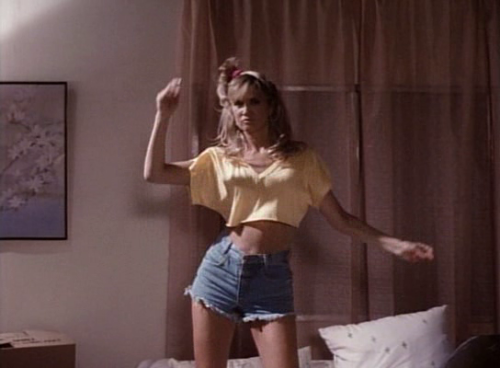
Most Killer Outfit: In the pillow fight scene, Sally sports a yellow crop top with Daisy Duke cutoffs and an asymmetrical ponytail. It’s the perfect outfit for any summertime sleepover, but it’s especially sporty for when you might need to flee from a demonic sex monster and his giant, guitar-shaped drill.
Sandra
A year after her scream queen debut in Slumber Party Massacre II, Kozak hit it big time (as far as mainstream horror franchises go). Friday the 13th Part VII: The New Blood practically lifted the Sally character wholesale from her previous film, only leaving behind her beloved drum kit. I can’t say that I especially enjoy this late-in-the-game franchise entry, but I do appreciate that it occupies the sillier end of Jason Voorhees lore that makes movies like Jason X and Jason Takes Manhattan, some of my favorites of the series. In this loosely sketched out version of Crystal Lake mythology, Jason’s dead body is reanimated & freed from its watery grave when a troubled young teen accidentally exercises her Carrie-like telepathic abilities in his general vicinity. Unfortunately, the film finds a way to make this ludicrous premise punishingly dull, despite some promising ideas about Jason functioning as a supernatural curse. There’s only two worthwhile aspects to The New Blood once the plot gets stuck in its by the books slasher rut: an inventive kill in which Jason smashes a girl zipped up in a sleeping bag against a tree (a kill later satirized to even greater effect in Jason X) and the casting of Heidi Kozak as inevitable victim Sandra.
Again, there isn’t much difference between Sandra & Sally in terms of character work, except that Sandra actually gets to act on her boy-crazy teen horniness while Sally only got to gush about it. In her introductory scene, Sandra is shown sunbathing and ogling a nearby hunk. In her second scene, she’s screwing a different boy, her boyfriend, in the back of a van, essentially marking herself as ineligible for Final Girl status, a surefire victim for Jason’s swinging machete. It’s in this romantic pairing that we get to see a different side of Kozak that wasn’t already covered in Slumber Party Massacre II. Because her wealthy boyfriend is hosting a teen party at his uncle’s Crystal Lake cabin, Sally winds up playing party mom during a large portion of the film’s first act. She’s still operating within her usual ditzy Valley Girl caricature, but now with a flustered sense of responsibility that has to negotiate between her oversensitive boytoy and some rowdy teens who just want to get drunk & screw. She makes no show of hiding why she’s with the wealthy dipshit either, answering his question, “When did you fall in love with me?” with a teasing, “The first time I saw the enormous size of your beautiful . . . wallet. The bulge in your pants was calling my name. Sandra, Sandra!” Unfortunately, Sandra’s life on this Earth is cut short when she gets the idea to go skinny dipping in Crystal Lake, one of Jason’s biggest pet peeves. She watches in horror as her boyfriend is decapitated on the shore and her naked body double is subsequently drowned. It’s a shame too, because she was one of the few compelling characters in a film that desperately needed more of them, yet she was one of the first to go.
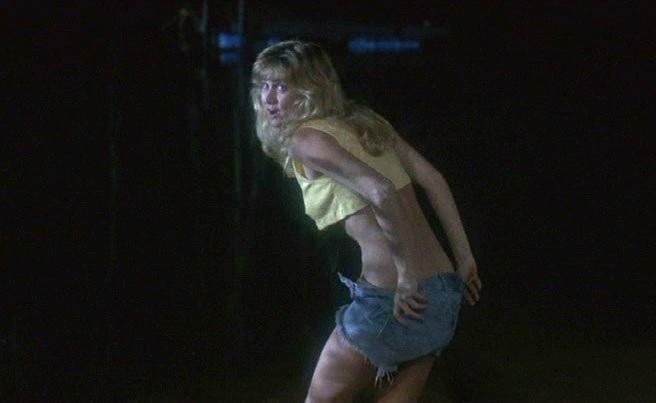
Most Killer Outfit: In accordance with her status as a more horned-up replica of Sally, Sandra sports a skimpier version of the yellow crop top & short jorts outfit from the previously mentioned pillow fight in her big skinny dipping scene. This time, however, it’s paired with a nude body double instead of an asymmetrical ponytail.
Shauna
Society is easily the strangest film in Kozak’s trio of horror outliers, depite each work being uniquely goofy in their own unique ways. Kozak reprises her Valley Girl routine for one final go-round in Brian Yuzna’s cult classic body horror, but not as a participant in the gore-soaked “shunting” climax, neither as a victim nor as a wealthy mutant “sucking off” the life force of the lower class. Instead, Shauna is a total outsider to the entirety of the plot. She’s just as clueless as the film’s protagonist as to what supernatural evils lie under the surface of the film’s well-to-do Society, but instead of investigating the Truth, she spends the entire film trying to join the ranks of a ruling class that has no use for her. Her character traits aren’t much different than Sally’s or Sandra’s, but Shauna’s ditzy, boy-obsessed teen routine is put to a much stranger use, likely because Society itself is much less structurally formulaic than the two straightforward slashers she worked on previously.
Shauna has exactly one goal in Society: to earn an invitation to rich cad Ted Ferguson’s party. She does not succeed. The high school cheerleader schemer pretends to be so into and in love with the protagonist, Bill, but her interest in him seems to be a political move based on his football star social status and potential election as senior class president. When Bill finds himself entangled with a potential love interest that actually wants to have sex, Shauna is incensed not because she’s jealous of the affair, but because she wasted so much emotional work with Bill and never earned that Ted Ferguson invite she wanted so badly. Once their romance is fully dissolved, Shauna’s storyline is left by the wayside and she disappears before the climactic shunting, forever an outsider, never to be heard from again.
As an actor, Heidi Kozak similarly disappeared. Her work as a minor scream queen dissipated within three glorious, but short years and it’s doubtful she’d be remembered for any other popular media contributions, except maybe by the most dedicated Dr. Quinn, Medicine Woman fans. I’d say she fully deserves to be remembered now, though. All three of her horror projects have proven to be such strange genre outliers with unexpected cult status longevity and she makes a striking presence in each instance. She’ll never enjoy the status of a Neve Campbell or a Jamie Lee Curtis, but she’ll always be a cherished scream queen to me.
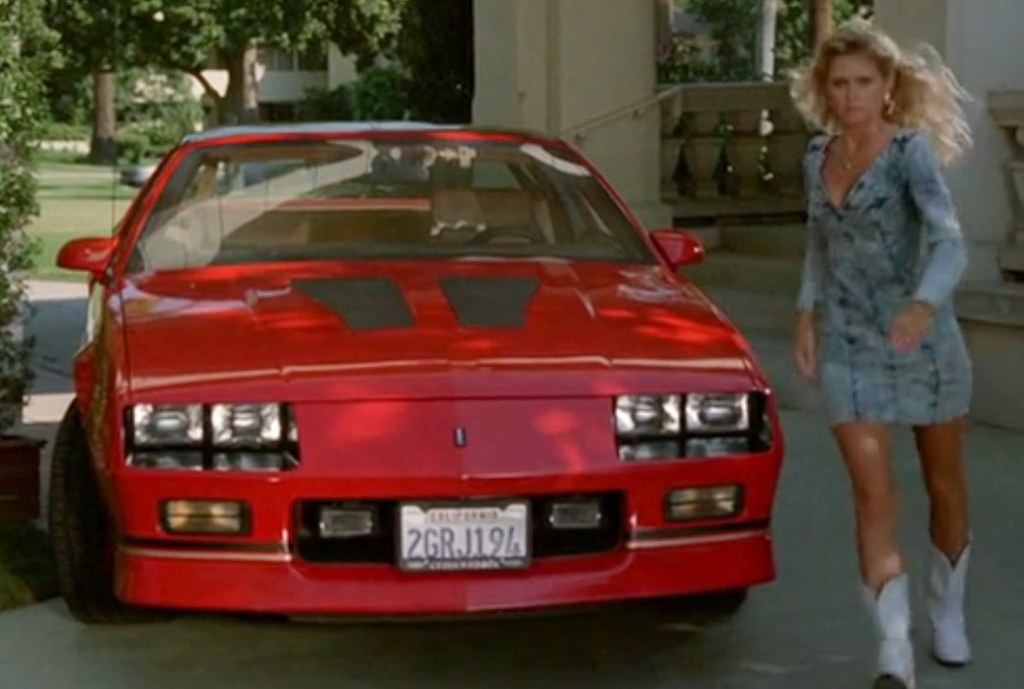
Most Killer Outfit: In the scene when Shauna confronts Bill for his cheating ways, she shows up at his house in a skin tight denim dress, paired with a candy red sports car. She looks incredibly powerful in that getup and Bill was a fool to let her go in his pursuit of the truth about the shunt, especially since his eventual fate was entirely unavoidable.
After a few decades in which the film fell into the public domain as a recobbled, poorly transferred, discolored, nigh-unwatchable piece of garbage, a restoration and Blu-ray release from Severin Films means a whole new generation can see Cathy’s Curse (aka Cauchemars, literally “nightmares,” the film’s original/French title) in all of its… glory?
The 1970s were banner years for the burgeoning Canuxploitation film industry, as our neighbor to the north saw a boom in production due to an increase in the Capital Cost Allowance (CCA) due to new tax shelter laws instituted to encourage Canadian filmmakers. Theretofore, most of these funds had gone toward producing documentaries, an influence which is evident in the observational, cinéma vérité nature of many of the films that followed regardless of genre; beginning in 1971, the Canadian Film Development Corporation pushed filmmakers to focus on those films that were more commercially viable in an attempt to recoup some of this funding. From this push we got the early films of our dearly beloved David Cronenberg, as well as great work from Bob Clark, who was recruited from Florida to lend his experience to the Canadian industry.
Of course, the exploitation of tax shelters is nothing new, and the availability of public funding has doubtlessly led to the implementation of various Producers-style bombs quickly slap-dashed together to take advantage of available funding. Cathy’s Curse is notably a tax shelter baby, although it’s much better than many other films that were created for similarly inartistic reasons.
The film opens on Mr. Gimble in 1947, who returns to his home to learn that his elementary-aged daughter Laura has been left alone by her mother, who absconded with Laura’s younger brother George. Mr. Gimble tells the little girl that her mother is a bitch, and that she will pay for what she did to Laura; I’m noting this here because, even in the remastered director’s cut, we never learn exactly what Mrs. Gimble did or why Mr. Gimble is so bitter about it. The two race away, and when the car swerves to avoid a rabbit in the road, both Mr. Gimble and young Laura are burned alive in the resultant crash.
Some thirty years later, George (Alan Scarfe, who played not one but two Romulans in Star Trek: The Next Generation) returns to the still-pristine house with his wife Vivian (Beverly Murray) and daughter Cathy (Randi Allen). Vivian has recently lost the couple’s second child and suffered a nervous breakdown as a result, lending her character a kind of otherworldly removal from the events at hand and planting the seeds for George to shrug off her concerns as the result of an inscrutable mental illness later in the film. Upon arrival, the family is greeted by housekeeper Mary (Dorothy Davis) and repairman Paul (Roy Witham), and Cathy befriends some neighboring children.
On the day of a pre-arranged play date, Cathy goes upstairs to get some rest beforehand, but is drawn to the home’s spacious attic, where she discovers a portrait of her dead aunt as well as a rag doll with sewn-shut eyes. The portrait’s eyes glow an eerie green, and so begins Cathy’s possession. While playing with the other children, she uses them to re-enact the night of Laura’s death, including urging one of the boys to say “All women are bitches!” The mother of these children, meanwhile, has tea with Vivian and another friend (Mary Morter), who identifies herself as a medium and has a full on psychic freakout after holding a picture of Laura and George’s father, complete with deep-voiced recitations and lots of Garth Marenghi’s Dark Place-style rapid cuts. This is interrupted when one of the children cries out after Cathy cuts her.
The connection between Cathy and the doll deepens, as she sees Laura reflected in her mirror instead of herself, and poor Mary is killed, as is Paul’s dog. Vivian is sent to a sanitarium for a while and Paul is tasked with watching Cathy during the day while George attends to unspecified business at a construction site. Paul himself is subjected to hallucinations and suddenly-manifesting lesions, but Cathy keeps him around (and drunk) apparently for her own amusement and perhaps in recognition that she needs to keep at least one person alive to take care of her while George is away. The medium returns more than once to the house and is continuously rebuffed by Cathy and a drunken Paul when she asks for Vivian, before a nightmare hallucination sends her out of the house and out of the film for good (she’s set up as almost like a Father Merrin type, but her appearances end up contributing nothing to the film).
Vivian returns home, and her protestations that something is deeply wrong with Cathy are dismissed by George with increasing irritation and accusations that her mental illness is tearing the family apart. Not helping is the fact that Cathy is a perfect angel when in her father’s presence, and her truly innocent nature seems to be, at times, attempting to exert itself. After a final confrontation, George ultimately sees the truth and Vivian saves her daughter’s soul by removing the stitches from the doll’s eyes, forcing the evil presence out of the house and their daughter.
For a low-budget attempt to cash in on the success of The Exorcist with some overtones from The Omen (complete with a nanny dying from a fall from an upper floor, although even a woman Mary’s age would probably survive a fall from the second story), Cathy’s Curse is decent, but nothing exciting or terribly special. There are plenty of laughs to be had, but it’s unclear which, if any, are intentional; my favorite is in the scene where the newly-possessed Cathy throws her cereal bowl across the room and Mary, thinking this was an accident, picks up approximately four pieces of broken china from a pile of dozens of shards and cheerfully declares “There, all better!” There’s also some humor gleaned from the possessed Cathy’s dirty mouth, where attempts to mimic the truly revolting and soul-crushing diatribes voiced by Regan in The Exorcist come across as distinctly Canadian in the script’s unwillingness to go too far.
Still, the film isn’t lacking in mid-budget charm. The restoration of the film may not be worth spending time to track down and watch, but if it happens to fall into your lap, there’s a moderately good time to be had.
One of the most common complaints that documentaries suffer is the accusation that they exploit their human subjects for artistic (and financial) gain. It’d be difficult to argue against that accusation in regards to the recent HBO Docs release Beware the Slenderman, which turns the real-life stabbing of a twelve year old girl into a midnight movie creepshow & a jumping point for internet age fear mongering. Although I could comfortably call Beware the Slenderman exploitative, it’s exploitation cinema done exceedingly well. The first hour of the documentary is highly effective as bone-chilling horror, opening with a Blair Witch-style dramatization of the titular “creepy pasta” the Slenderman in a heavily pixelated version of the woods. As the film tracks the legend of the Slenderman from online fiction to amateur video games to Tumblr fan art to YouTube mainstay, it makes some really interesting and genuinely unnerving points about the evolution of memes as a collective “virus of the mind” and the function of online folklore as “digital fairy tales.” It’s when the film instead focuses on the 2014 stabbing of a young Wisconsin girl that it veers into the more exploitative True Crime territory and loses track of its Candyman-esque fascination with the nature of urban legends. I definitely found one side of that divide far more satisfying than the other, but watching Beware the Slenderman navigate this confusing tonal clash and gleefully cross some ethical lines to get its point across made for a unique documentary experience.
Two twelve year old girls are taken into custody and tried as adults for stabbing their friend 19 times in the woods of Wisconsin suburbia. As there has been no decision made in their first-degree attempted murder trial to this date, a charge that could possibly earn them each 65 years in prison, the two girls’ story has, by design, no conclusion. All we know upfront about the stabbing is that the victim thankfully survived and that the accused have made no attempt to hide the fact that they are guilty. The crime is introduced in-film through media coverage montage and long-form interviews with the accused’s parents, which tells their entire life story to a backdrop of home video footage. The parents describe mostly normal childhoods outside stray sociopathic reactions to pop culture media (specifically the infamously devastating scene from the beginning of Bambi) and a gothy tinge to their daughters’ online activity. There’s a lot of frustration and empathy in those interviews as the parents struggle to make sense of children they thought they knew, an internet culture they completely underestimated, and the earliest signs of mental illness in otherwise normal-seeming childhoods. The problem is that they aren’t the only interviews the documentary is structured around. In a much sleazier line of inquiry, Beware the Slenderman integrates long stretches of the two girls’ confessions/police interrogations from mere hours after the stabbing. Watching two children describe the stabbing of a third child in cold-blooded terms is just about the most exploitative thing I’ve ever seen in True Crime media, but it serves the material well, especially in the way it deepens the creepiness of the film’s titular monster, the Slenderman.
Originally penned as a creepy pasta, but earning a full-blown urban legend status through online folklore, the Slenderman is a tall, lanky being with long arms, claws, and retractable tendrils. He is faceless, always wears a suit & tie, and is naturally drawn to young children. Adults see his attraction to children as a threat of harm, but children (especially bullied outsiders) see it as welcoming & protective. As one interviewee puts it, “Often in the adult world, we can forget how much it sucks to be a kid.” This modernized version of the Boogeyman or the Pied Piper offers alienated children the promise of protection & community. The scary part is that some kids truly believe he’s real, real enough for them to stab a friend 19 times to “prove themselves worthy” and to “prove the skeptics wrong.” By their logic they had no choice but to slay a human sacrifice for the Slenderman, explaining, “I didn’t want to do this, but I was afraid of what would happen if I didn’t.” Richard Dawkins is brought in as an evolution expert on the way memes spread & adapt. Brothers Grimm scholars attempt to contextualize the phenomenon in the tradition of fairy tale folklore. None of the talking heads are nearly as effective as seeing for yourself how the Slenderman is represented in online multimedia art and hearing what the fictional character’s devotees are willing to do “for him” in the real world. It may be a question of my general genre preferences with all media, but I think this documentary works best when it pursues this type of urban legend horror aesthetic instead of playing with the ethics of True Crime narratives.
I’ll admit that as an audience, my biggest hurdle with Beware the Slenderman was its length, not its ethical dilemmas. At two full hours, the film outwears its welcome a bit by the concluding 30min stretch, which started to feel as pedestrian as an episode of Dateline NBC. I’m always advocating for my horror cinema to limit its runtime, though, and it’s that genre distinction that allowed me to enjoy the documentary despite its occasionally objectionable sense of morality. Using the near-murder of a young girl by her peers for shock value or an audience hook is certainly questionable, especially if the ultimate purpose of your works to creep adults out with technophobic warnings about what children are getting into online. That’s not even to mention that the film liberally appropriates artwork from those same children for its imagery without pay or credit. I expect that kind of unethical alarmism in my horror media, though, and I really like the way Beware the Slenderman tried to make phenomena like the Ice Bucket Challenge, planking, and YouTube reaction videos into just as sinister of a force as CandyCrush is in #horror and Skype is in Unfriended. Before the easy fact checking days of the internet, people used to believe films like The Blair Witch Project, The Texas Chainsaw Massacre, and Cannibal Holocaust were genuine documentaries, real life recordings of actual incidents. Beware the Slenderman works best as a continuation of that horror tradition by actually filling that role as a document of a real-life event. It’s a little overlong, a tad sensationalist, and mundanely sleazy in some of its True Crime touches, but it’s also a great horror film, especially for a documentary.









 Swampflix