Wake Up Dead Man: A Knives Out Mystery (2025)

“His flock has not only begun to shrink, but to calcify,” Bishop Langstron (Jeffrey Wright) warns young Reverend Jud Duplenticy (Josh O’Connor) about his reassignment to serve under Monsignor Jefferson Wicks (Josh Brolin) at Our Lady of Perpetual Fortitude in upstate New York. Jud has just faced a committee of three upper-level members of the church for punching a fellow priest in the face, and he recounts the story of his turn to Christ, one of redemption not achieved but ongoing. Jud was a boxer in his youth before he found salvation, and for large parts of the film, the driving conflict is between Jud’s willingness to sacrifice, his sincere desire to bring others closer to Christ, and his testament to Christ’s love, versus Wicks’s egotistical self-martyrdom, his drive to consolidate his power at the expense of eroding his flock’s faith, and his heretical performance of his own prejudices as if they were God’s words. If Glass Onion could be (rightly) criticized for being a little too on-the-nose with its depiction of an Elon Musk-like richer-than-sin weenie loser villain, Wake Up Dead Man instead goes for a less specific target with the same ostentation by taking on all of the sins of modern right wing nationalism that cloak their evil under a banner of faith, and those who put darkness for light. Like me, director Rian Johnson had a profoundly religious upbringing, and although we both have left the churches in which we were raised, this film demonstrates a deep and abiding admiration for and fondness of true believers who practice God’s love, and I both respect and was moved by the approach. Johnson may have, intentionally or unintentionally, created one of the best pieces of Christian propaganda since Chronicles of Narnia or “Sinners in the Hands of an Angry God,” and he did it showing the apotheosis of contemporary American Christian Nationalism tending to a church that was literally without Christ. 

When I was young, one of the oft-repeated sermons that I witnessed (through countless Thursday chapel sessions at the fundamentalist Christian school that I attended, Sunday School sermons, Children’s Church ministries, and Wednesday Youth Pastor recitations) was one about the Christ-shaped hole in everyone’s being. Sometimes the hole was in your soul, and sometimes it was in your heart; if it was in your latter, they would occasionally use a piece of wood cut into a heart, with a lower-case-t-shaped void in the middle, into which a conveniently sized cross could slot as a visual representation. (Presumably, the more ambiguous nature of the soul prevented it from being carved out of scrap wood for these performances). I get the feeling that Johnson likely sat through some of these same services, and he transposes that metaphor in this film to a literal void in the shape of a crucifix on the walls of Our Lady of Perpetual Fortitude. We learn the reason for this in a story related by Martha Delacroix (Glenn Close), who witnessed the destruction of the temple as a child; the monsignor’s grandfather Prentice was a widower with a daughter, Grace, when he became the shepherd of the town’s flock, and the daughter was a girl of “loose morals” who ended up a pregnant teen. Prentice promised her his fortune if she remained under his roof and didn’t embarrass him by going into the town, and she honored her end of the bargain until his dying day, watching as Prentice poisoned her own son against her and groomed him into becoming the next in a line of men who disguise their hatred behind their vestments. She found his bank accounts empty, and destroyed much of the church, supposedly out of rage, before dying while pounding on the outside of his “Lazarus tomb,” which can only be opened from the outside by construction equipment but which can be opened from within with only a light push. Ever since, Grace has been characterized as “The Harlot Whore,” and has become a key figure in Monsignor Jefferson’s fiery sermons.

It’s to this lost flock, not only shrinking but calcifying, that Jud arrives. That sounds like a coldly analytical way to describe it, but it’s with that same clinicality that Jud diagnoses the rot at the heart of Perpetual Fortitude, metaphorically calling it a cancer that must be cut out. This raises suspicions, of course, when Jefferson Wicks dies, seemingly impossibly. He entered a small cubby near the pulpit with no apparent exit, in full view of all witnesses, and collapsed before a knife was found in his back. Those in attendance that day other than Jud were a select few extremely devoted followers, who form our cast of suspects and witnesses. Martha was there, as was her husband Samson (Thomas Haden Church), the church groundskeeper who has found the strength to maintain his own sobriety because of his respect for the Monsignor’s own dubious overcoming of his addictions. Town doctor Nat Sharp (Jeremy Renner), whose wife recently left him for someone she met on a Phish message board and took the kids with him, is present, as is concert cellist Simone Vivane (Cailee Spaeny), who is currently funneling all of her savings into Perpetual Fortitude in the hopes that the Monsignor will be able to cure her of her painful, disabling neuropathy. The town has also become home to Lee Ross (Andrew Scott), a former pulp sci-fi novelist of some (niche) renown whose pivot into libertarianism has made him an outcast in the elite literary circles he envies and left him with only a small but devoted fandom of survivalists who, in his words, “all look like John Goodman in The Big Lebowski.” Ross hopes to make his way back into polite society by publishing a book of Wicks’s sermons and his own accompanying essays and commentary, and as such is one of the Monsignor’s sycophants. Rounding out the group is Vera Draven (Kerry Washington), who is carrying on the family tradition of acting as the Wicks family’s lawyer, following in her father’s footsteps, as well as Cy (Daryl McCormack), the son her father forced her to adopt when she was still a student and the boy was already old enough to be in school. Cy has returned to Perpetual Fortitude, tail between his legs, after a failed attempt at breaking into politics. 

Most of the film’s political satire revolves around Cy. I mentioned before that the satire in this one is less about mocking a specific individual than about painting a broader picture, but Cy seems like a deliberate invocation of Christian Walker, at least if I’m reading Cy as being as closeted (which I am). When Cy complains to Jud that he failed to make his political ambitions come true, it was in spite of the fact that he hit every single right-wing talking point, listing them one by one in a screed that lasts for over a minute of the film’s runtime. He describes his playbook as, to paraphrase, “making people think about something that they hate and then make them afraid it will take away something that they love,” which is an encapsulation of the go-to method of reactionary appeals to perceived attacks on normalcy. Wicks is clearly not a technically adept person, a member of an older generation, but Cy’s incessant need to constantly curate his existence for his online following means that Wicks’s ideas work their way out to Cy’s followers, a genealogy of intolerance. It works thematically while also justifying why there’s footage of a very important meeting that reveals every participant’s motivation. 

We’ve gotten pretty far into this without ever mentioning Benoit Blanc (Daniel Craig), the gentleman detective who is ostensibly the star of this series. He enters the film fairly late as well, but it’s a damned good entrance, as he finds himself inside Perpetual Fortitude and face to face with Jud, who has provided the narration to this point, and finds it difficult to find something nice to say about the church and can only bring himself to compliment the architecture. Blanc has been brought in by the local sheriff (Mila Kunis), and he’s fascinated by the opportunity to solve what is, despite the lack of a door, a locked-room mystery. It turns out that the church reading group has all read multiple examples of the genre, including The Murder of Roger Ackroyd and The Hollow Man, which means that any one of them could have drawn inspiration from them. It was here that I first suspected that we were being led to the inevitable conclusion that Jud had committed the crime and was merely an unreliable narrator, as is the case in Roger Ackroyd (um, spoiler alert for a book that turns one hundred next year, I suppose); after all, his name sounds like someone trying to say the word “duplicity” after too many drinks. As it turns out, the presence of Roger Ackroyd is a clue, but not the one that I thought. 

Blanc, despite a slightly smaller presence here, is nonetheless excellent when he’s on screen. As with the previous two installments in this series, there’s much to laugh at and be puzzled by here, and the audience for my screening had a delightful time. You will too. 

-Mark “Boomer” Redmond

Glass Onion (2022)

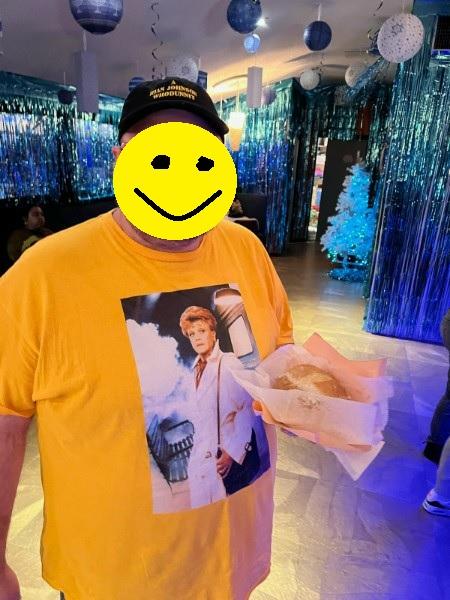
“It hides not behind complexity but behind mind numbing, obvious clarity!” So Daniel Craig’s Glass Onion character Benoit Blanc, called by Google “the world’s greatest detective,” says to much-vaunted “inventor” Miles Bron (Edward Norton) toward the end of this Knives Out sequel. I was a big fan of Knives Out when it premiered a few years ago. Brandon got a screener copy of its sequel along with some fun swag, and he was kind enough to both let me wait until the film fell into my greedy little clutches to publish a review, but also send along some of said swag, which includes the fantastic “A Rian Johnson Whodunnit” hat which you can see me wearing below while also clothed in one of my Angela Lansbury shirts: 

For Glass Onion, Benoit Blanc once again finds himself insulated from the world among a smaller world of morons, ingrates, and moronic ingrates as well as hucksters, snake oil salesman, and politicians. This time, he has ostensibly received an invitation to a murder mystery weekend at the home of the aforementioned Bron, who is an amalgamation of various rich douchebag stereotypes (and truths) but who most closely resembles Elon Musk due to his involvement in various companies and businesses which work together to create an impression of a wise ubermensch, when he is in fact a little weirdo who obsesses over getting approval from others. Also invited to the island were several of Bron’s friends, each of whom received a puzzle box that required them to work together to solve and receive their invitation. There’s Birdie (Kate Hudson), the ignorant socialite whose put-upon assistant Peg (Jessica Henwick) has the full time responsibility of not letting her tweet something racist and dumb that could get her cancelled for good; there’s also sad MRA Duke (Dave Bautista) who lives in his mother’s basement while hawking various products that promise to make his viewers “alphas” like he presents himself to be, while his social-climber girlfriend Whiskey (Madelyn Cline) plays along with his internet image. On the smarter end of the scale of Bron’s friends is Lionel Toussaint (Leslie Odom, Jr.), one of the lead scientists at Alpha who liaises with upper management about Bron’s ideas; and the gang is rounded out by Claire Debella (Kathryn Hahn), former governor of Connecticut who is now campaigning for a senatorial run. Finally and apparently unexpectedly, also in attendance is Andi Brand (Janelle Monáe), a former business partner of Bron’s who was unsuccessful in preventing him from pushing her out of the business and exposing his questionable business practices. It’s May 2020, and they have gathered at Bron’s Grecian estate, which is topped with an ostentatious lúkovichnaya glava made of transparent glass, from which the film partially takes its name. 

Of course, the title could mean a lot of things. For instance, it’s the name of the bar where all of the main characters (sans Blanc) gathered in their pre-wealth days, when Andi first brought them all together and before they all stabbed her in the back. It’s also, famously, the title of a track from what we colloquially call The White Album, although it’s properly titled The Beatles. Following all of the fan speculation about the meanings of some of the more psychedelic and impenetrable lyrics on their 1967 album Sgt. Pepper’s Lonely Hearts Club Band, John Lennon opted to pen a song that was intentionally antagonistic to anyone attempting to find a deeper meaning in the words; even if you don’t know the song title, you’re familiar with the Paul is dead conspiracy theory that’s now 55 years strong because of the lyrics “the Walrus is Paul.” Or, as Blanc says at one point: “I like the glass onion as a metaphor, an object that seems densely layered, but in reality the center is in plain sight.” From title to exposition, everything is a clue here, just as it was in Knives Out in 2019, and although the social criticism is a little shallower and more obvious than it was last time, I’m still here for the very fun ride. 

Of course, that’s one of the things that makes films this elegantly constructed difficult to write about. You’re either going to end up recapitulating all of the fun and foreshadowing how it pays off, which ruins the ride for first-time viewers (hell, I’m already worried I might have given away who the killer is just from my little gags in this review so far) or you’re stuck trying to explicate on something in which the pleasure of the viewer lies in running alongside the narrative and having the revelations to the audience coincide with those to the characters. It’s tricky to pull off, and I’ve often cited how I feel comedy and mystery exist in and evoke neurochemical pleasure in the same parts of the mind: it’s all very specific planting and payoff, and if your audience gets to the solution/punchline too far in advance of the flow of the narrative, it can be death for both genres. Melding them together is a perfect idea (I’ve got more than one work in progress right now that does precisely that) that also doubles the potential for the film to crash and burn like, I don’t know, a SpaceX Falcon 1 launch. Both the previous Knives Out film and this one manage to pull it off. Every reveal makes total sense and falls perfectly in line with what we’ve already seen and what we already know while still allowing us to feel some sense of accomplishment in “figuring it out” along with the characters. It’s an effect you can only find in great examples of the genre, like Murder, She Wrote, which gets a loving reference here in the form of several celebrity cameos playing Among Us with Blanc during his quarantine blues before his invitation to the Onion, most notably and most wonderfully the divine, magical Dame Lansbury.

If I have any complaints about the film, they are few and far between. Blanc is bigger and bolder here than he was in the last film, which matches the zanier plot of this one but also makes it feel like the character isn’t quite consistent. This one doesn’t straddle the line of mocking conservatism and neoliberalism from a slightly left position as well as the last one did, which makes this one feel more “Hollywood” than the last one as well, despite both featuring a cast full of legitimate movie stars. It has a little bit of the Trump SNL taint on it (alternatively we could call it the There’s Someone Inside Your House problem), where just because something happens to align with my belief system doesn’t mean that it automatically makes it a better or more worthwhile piece of art. Most of its barbs are sharp, though. In particular, I love the detail that Birdie, who has already been shown to have zero concern about hosting a superspreader event in her apartment, arrives to the dock on the way to Bron’s island in what the script describes as a “fashionable but totally useless lace mask”. Some of them land a little more loudly or call more attention to themselves than they should, when I don’t remember the first film having any issues with this at all, but maybe that’s the nature of political satire now. There are elements of the plot, setting, and choices here that seem eerily prescient given how long the film took to make, like that it was in theaters at the time that Elon Musk had his bluff legally called and was forced to complete his purchase of Twitter, or that there is a giant mural in Bron’s house depicting Kanye West as Jesus Christ, which is both funny and depressing given the nature of West’s current public persona entirely revolving around spouting Anti-Semitic rhetoric with his whole chest. It recalls how there was an entire garden industry on the internet for a while of pointing out things that The Simpsons “predicted,” when the simpler and more depressing reality is that, with a few notable exceptions, there hasn’t been much of an improvement in most people’s lives since 1989. Glass Onion didn’t predict anything either, but it certainly has a talent to reflect how bleak things are at the moment. 

At the end of the day, this is the kind of movie that I can only recommend you watch it or not, given that saying more than I’ve already said runs the risk of spoiling too much. If you’ve already got Netflix, you really have no reason not to, and I think that you’ll really enjoy the twists and turns along the way if you have the patience. And you’re at home, where you can pause and create your own intermission to go to the bathroom or make a cocktail, so why not? If nothing else, every person who watches this movie pushes Ben Shapiro closer and closer to having an epiphanic moment about what his actual place in the world is, and isn’t that a dream we should all strive towards? 

-Mark “Boomer” Redmond

The Swampflix Guide to the Oscars, 2020

There are 38 feature films nominated for the 2020 Academy Awards ceremony. We here at Swampflix are conspicuously more attracted to the lowbrow & genre-minded than we are to stuffy Awards Season releases, so as usual we have reviewed fewer than half of the films nominated (so far!). We’re still happy to see so many movies we enjoyed listed among the nominees, though, including four titles from our own Top 10 Films of 2019 list. The Academy rarely gets these things right when actually choosing the winners, but as a list this isn’t too shabby in terms of representing what 2019 cinema had to offer.

Listed below are the 16 Oscar-Nominated films from 2019 that we covered for the site, ranked from best to . . . least-best, based on our star ratings. Each entry is accompanied by a blurb, a link to our corresponding review, and a mention of the awards the films were nominated for.

1. Parasite, nominated for Best Picture, Best Director, Best Original Screenplay, Best Editing, Best International Feature Film, and Best Production Design

“Money is an iron. For the Parks, it is the metaphorical iron that makes life smooth and effortless, and the iron strength of the walls that separate them from the riffraff below. For the Kims, it is the iron of prison bars that keep them in a metaphorical prison of society and, perhaps, a literal one; it is the weight that drags them down, a millstone to prevent them from ever escaping the trap of stratified social classes.”  – Boomer

2. Avengers: Endgame, nominated for Best Visual Effects

“This is the perfect capstone for this franchise. If there were never another MCU film, it would be totally fine, because as a finale, this is pitch perfect. Every important and semi-important character gets a moment to shine, as the Snap is undone (come on, you knew it would be). There’s even a moment where every living lady hero from the entire MCU is onscreen at once, and it is delightful, although I’m sure the internet is already full of comments about how it was ‘forced’ or ‘cheesy,’ but I don’t feed trolls and I try not to cross the bridges that they live under, so I wouldn’t know.” – Boomer

3. Knives Out, nominated for Best Original Screenplay

“I’ve long been a fan of comedy pastiches and homages of genres that function perfectly as examples of those genres despite humorous overtones; my go-to example is Hot Fuzz, which I always tout as having a more sophisticated murder mystery plot than most films than most straightforward criminal investigation media (our lead comes to a logical conclusion that fits all of the clues, but still turns out to be wrong). Knives Out is another rare gem of this type, a whodunnit comedy in the mold of Clue that has a sophisticated and winding plot.” – Boomer

4. Little Women, nominated for Best Picture, Best Actress (Saiorse Ronan), Best Supporting Actress (Florence Pugh), Best Adapted Screenplay, Best Costume Design, and Best Original Score

“This is a beautiful film, a timeless piece of literature made fresh once more with a cast overbrimming with talent and filmed with an eye for chromatic storytelling and such beautiful Northeast scenery that when I tell you I was there, I was there. This is also such a talented cast that they breathe a new life into characters that, in the original text and in previous film incarnations, were at times sullen, unlikable, or intolerable.” – Boomer

5. The Lighthouse, nominated for Best Cinematography

“Packed to the walls with more sex, violence, and broad toilet humor than you’d typically expect from high-brow Cinema. If you can push past the initial barriers of Eggers’s patient pacing & period-specific dialogue, the movie is a riot.” – Brandon

6. I Lost My Body, nominated for Best Animated Feature Film

“This is two films for the price of one. And it’s a very low price at that, considering its 80min runtime. As with all two-for-one bargains, however, one of the two complimentary films on this simultaneous double bill is far more satisfying & impressive than the other. To fully appreciate I Lost My Body, then, you have to appreciate its two dueling narratives as a package deal. The stronger movie in this combo pack carries the lesser, even if just by the virtue of their pairing.” – Brandon

7. Marriage Story, nominated for Best Picture, Best Actor (Adam Driver), Best Actress (Scarlett Johannson), Best Supporting Actress (Laura Dern), Best Original Screenplay, and Best Original Score

“A superb breakup story about how you can love somebody so much, and create a life with them that you love, and it still has to dissolve. It specifically illustrates how hard it can be for parents when their child arbitrarily prefers one over the other. The way those formative childhood phases affect permanent legal repercussions is devastating, as is the realization that you might not actually be best parent for your own child.” – The Podcast Crew

8. Joker, nominated for Best Picture, Best Director, Best Actor (Joaquin Phoenix), Best Adapted Screenplay, Best Cinematography, Best Costume Design, Best Editing, Best Makeup and Hairstyling, Best Original Score, Best Sound Editing, and Best Sound Mixing

“None of the endless months of vitriolic complaints against its honor resonated with me in the theater, where I mostly just saw a creepy character study anchored by an effectively chilling performance. If anything, the fact that a movie this unassuming and, frankly, this trashy was somehow causing chaos in the Oscars discourse only made it more perversely amusing.” – Brandon

9. Missing Link, nominated for Best Animated Feature Film

“Very cute in its slapstick humor, and often stunning in its visual artistry. It’s about on par with The Boxtrolls all told, which is to say it’s mediocre by Laika standards but still on a level far above most modern children’s cinema.” – Brandon

10. 1917, nominated for Best Picture, Best Director, Best Original Screenplay, Best Cinematography, Best Makeup and Hairstyling, Best Original Score, Best Production Design, Best Sound Editing and Sound Mixing, and Best Visual Effects

“The video game mission plot might not make for especially complex drama between its solider protagonists, but the way those babyfaced boys contrast against the unearthly gore, rot, and decay of the war-torn earth beneath them is viscerally upsetting. There are many ways in which the long-take gimmick is a distracting technical exercise, but it does force you to stew in that discomfort for long, uninterrupted stretches. It’s surprisingly brutal in that way.” – Brandon

11. Once Upon a Time . . . In Hollywood, nominated for Best Picture, Best Director, Best Actor (Leonard Dicaprio), Best Supporting Actor (Brad Pitt), Best Original Screenplay, Best Cinematography, Best Costume Design, Best Production Design, Best Sound Editing, and Best Sound Mixing

“I appreciate this movie most as a passionate argument for a sentiment I could not agree with less. I have no love for the traditional machismo & endless parade of cheap-o Westerns that clogged up Los Angeles in these twilight hours of the Studio Era. Still, it was entertaining to watch an idiosyncratic filmmaker with niche interests wax nostalgic about the slimy, uncool bullshit only he cares about.” – Brandon

12. The Irishman, nominated for Best Picture, Best Director, Best Supporting Actor (Al Pacino and Joe Pesci), Best Adapted Screenplay, Best Cinematography, Best Costume Design, Best Editing, Best Production Design, and Best Visual Effects

“Finds plenty more to say about the corruption & violence of organized crime that Scorsese has not addressed in previous efforts. Unfortunately, it allows that new material to be drowned out by an overwhelming flood of the same-old-same-old.” – Brandon

13. Jojo Rabbit, nominated for Best Picture, Best Actress (Scarlett Johannson), Best Adapted Screenplay, Best Costume Design, Best Editing, and Best Production Design

“Works best as a maternal parallel to the paternal drama of Boy. The difference is that I left Boy marveling at how he pulled off such a delicate tonal balance with such confident poise, whereas I left Jojo Rabbit wondering if I had just seen him lose his balance entirely and tumble to the floor for the first time.” – Brandon

14. Star Wars: The Rise of Skywalker, nominated for Best Original Score, Best Sound Editing, Best Visual Effects

“Look, Rise of Skywalker is good. It’s not great like The Force Awakens or passable like The Last Jedi, but it’s also not that spectacular either. It doesn’t take the chances that TLJ took, and I was glad that the return of JJ Abrams meant that we went back to mostly practical FX for the aliens (those stupid chihuahua horses from TLJ will haunt me to my goddamned grave) even if the resultant film felt like he was trying to railroad the ending back to his original concepts after not liking how another director played with his toys.” – Boomer

15. Ad Astra, nominated for Best Sound Mixing

“Has all the building blocks needed to achieve something great; they’re just arranged in a confoundingly dull configuration. Worse, there’s literally not one thing about its combination of vintage sci-fi pulp & faux-philosophical melodrama that Interstellar didn’t already achieve to greater success, so there’s constantly a better viewing option hanging over its head.” – Brandon

16. Rocketman, nominated for Best Original Song

“The narration continually reassures the audience that Elton John’s life was ravaged by sex, drugs, and rock n’ roll, but everything we see onscreen is musical theatre kids playing dress-up in squeaky clean sound stage environments.” – Brandon

-Brandon Ledet & Mark “Boomer” Redmond

Swampflix’s Top 10 Films of 2019

1. Midsommar A cathartic breakup drama disguised as a gruesome daytime horror. This traumatic nightmare-comedy about a toxic romance that’s far outstayed its welcome is distinguished by its morbid sense of humor, its detailed costume & production design, its preference for atmospheric dread over traditional jump scares, and its continuation of occultist, Wicker Man-style folk horror into a new generation of genre nerdom.

2. Parasite Bong Joon-ho’s masterpiece is a twisty, crowd-pleasing thriller about class resentment, with a particular focus on how Capitalism forces its lowliest casualties to fight over the crumbs that fall from on high. It’s a genuine phenomenon that such a savage commentary on class politics has become so universally popular, earning sold-out screenings & ecstatic critical praise for months on end as its distribution exponentially spreads. When was the last time such a wide audience embraced a movie that features *gasp* subtitles, much less such a tonally explosive expression of economic anger?

3. Knife+Heart This is fantastic smut, especially if you happen to enjoy classic slashers & gialli. Picture Dario Argento’s Cruising. Set against a gay porno shoot in 1970s Paris, it really turns the usual male gaze & female victim empathy of those genres on their head in a fascinating way. And it only improves on repeat viewings as its psychedelic flashback imagery and its Goblin-inspired synth soundtrack from M83 sink further into your subconscious.

4. In Fabric A tongue-in-cheek anthology horror about a sentient killer dress. Fully indulging in the Theatre of the Absurd, it’s a fun watch, but it also makes fashion photography, corporate employment, and romantic loneliness legitimately menacing. Especially recommended for anyone who’d be enticed by an arthouse remake of Death Bed: The Bed That Eats, as it could easily be read as both over-the-top camp and a deadly serious creep-out.

5. Knives Out A modernized Agatha Christie-style whodunnit comedy in the mold of Clue that manages to deliver both a sophisticated, winding plot and pointed class politics. Like Get Out before it, it mocks a specifically Left version of political ignorance vis-à-vis latent and uninspected racism among the privileged class. Stumbling upon something this fun and this fiercely political feels like finding a rare gem in the cinematic wilderness.

6. The Lighthouse Willem Dafoe & Robert Pattinson costar as a lighthouse-keeper odd couple who gradually grow insane with hate & lust for each other. A black & white period drama crammed into a squared-off aspect ratio, this functions as an unholy, horned-up mashup of Guy Maddin & HP Lovecraft as well as a seafaring, swashbuckling mutation of Persona. It pushes the basic tenets of traditional masculinity and macho bonding rituals into the realm of a hallucinatory fever dream.

7. Us A surreal reimagining of C.H.U.D. that reflects & refracts ugly, discomforting truths about modern American class divides – mostly in the way that escaping the darkness of poverty is often impossible, and that those who manage to somehow embody the mythological idea of social mobility must do so at the expense of others. It also commands a nightmare-logic looseness throughout that was only hinted at in Peele’s debut, leaning heavily into the horror of The Uncanny. It’s like getting an extra hour to poke around in The Sunken Place.

8. The Beach Bum An abrasive stoner-bummer in which Matthew McConaughey plays a Florida-famous poet named Moondog. Harmony Korine always works best when he reins his indulgences in with a little guiding structure, and this one does so by riffing on 90s Major Studio Comedy tropes to hideous success. It’s basically Korine staging Billy Madison on the lower decks of a Jimmy Buffett pleasure cruise, a perfect continuation of the Floridian hellscape he previously sketched out in Spring Breakers.

9. Uncut Gems Another Good Time-style panic attack from the Safdie Brothers, in which New York City is just as loud, chaotic, and crowded as it feels irl. Adam Sandler’s manic performance of gambling addiction & familial regret toys with audiences’ empathy, and its larger story of international jewelry trade emphasizes upsetting truths about the exploitation & suffering that’s behind all the world’s beautiful stones.

10. The Irishman A late-career mafia epic from Martin Scorsese, the undisputed master of that genre. It’s a beautiful yet tragic story about obsoletion and the emptiness of a life spent mired in sensationalist violence, one with a metatextual significance in the life of its aging, self-reflective filmmaker.

Read Boomer’s picks here.
Read Brandon’s picks here.
Read Britnee’s picks here.
Read CC’s picks here.
See Hanna’s picks here.
Hear James’s picks here.

-The Swampflix Crew

Knives Out (2019)

“Physical evidence can tell a clear story with a forked tongue,” Daniel Craig’s Knives Out character Benoit Blanc, “last of the gentleman sleuths,” says to Lieutenant Elliott (Lakeith Stanfield) upon being told that all the physical evidence surrounding the death of publishing magnate Harlan Thrombey (Christopher Plummer) points to suicide. This is not the first or last of a series of surprisingly well delivered bon mots from Blanc as he doggedly pursues the truth of what happened the night of Thrombey’s 85th birthday.

All the family gathered that night: Thrombey’s eldest daughter Linda (Jamie Lee Curtis), who describes her real estate business as “self-made,” in spite of actually starting out with a million dollar loan from the family patriarch; widowed daughter-in-law Joni (Toni Colette), a self-described lifestyle guru/entrepreneur and would-be influencer whose knowledge of current events comes from reading tweets about New Yorker articles; and, finally, son Walt (Michael Shannon), who runs Blood Like Wine Publishing, his father’s business. Each has their own family and hangers-on, as well; Linda is married to the largely useless and unfaithful Richard (Don Johnson), and their son Ransom (Chris Evans) is likewise a rootless gadabout and playboy of the Tom Buchanan mold; the delightful Riki Lindhome is given little to do other than spout Trump-era rhetoric about “good immigrants” and “bad immigrants” in her role as Walt’s wife Donna, and their son Jacob (Jaeden Lieberher) is a smartphone-addicted teen described as a “literal Nazi” who allegedly masturbates to images of dead deer; Joni is accompanied by daughter Meg (Katherine Langford), who is attending a prestigious liberal arts college and serves as the closest thing to a good person this family has, although she is not without her flaws. There’s also Greatnana, Thrombey’s elderly mother of unknown age, played by onetime Martha Kent K Callan, who I was surprised to learn was still alive. Also in the house that night are Thrombey’s nurse, Marta (Ana de Armas), and pothead housekeeper Fran (Edi Patterson, taking a break from killing it on The Righteous Gemstones). When Ransom storms out early after a heated discussion, suspicion initially falls on him, but every member of the family has a motive, as Thrombey had announced to each of them that very night that he was cutting off their individual paths of access to his wealth. And then, 33 minutes into the film’s 130 minute runtime, writer-director Rian Johnson tells you who did it. And then things get interesting.

I’ve long been a fan of comedy pastiches and homages of genres that function perfectly as examples of those genres despite humorous overtones; my go-to example is Hot Fuzz, which I always tout as having a more sophisticated murder mystery plot than most films than most straightforward criminal investigation media (our lead comes to a logical conclusion that fits all of the clues, but still turns out to be wrong). Knives Out is another rare gem of this type, a whodunnit comedy in the mold of Clue that has a sophisticated and winding plot. Despite the big names in that cast list above, Marta is our real hero here, although to say more than that would be to give away too much of the plot–both the film’s and Harlan’s. I’m not generally a fan of Daniel Craig, but in this opportunity to play against type, his turn as a kind of Southern Hercule Poirot here is surprisingly charming, first appearing to be somewhat bumbling and ignorant in his pursuit of the truth but ultimately proving to have a sharp deductive mind. His affected drawl also helps take many of Blanc’s lines, some of the best one-liners ever committed to a movie script, and elevates them into true comedic art. From the quote at the top of the review to his description of a will reading (“You think it’ll be like a game show. No. Imagine a community theater performance of a tax return.”) to his reference to Jacob in his Sherlockian summation of the evidence near the film’s end (“What were the overheard words by the Nazi child masturbating in the bathroom?”), all are rendered hilarious in their Southern gentility. It’s a sight to behold.

The film is surprisingly political, as well, and not just in a “Communism was a red herring” way. Like Get Out before it, Knives Out mocks the occasional ignorance of the political left vis-a-vis latent and uninspected racism on the part of Joni and Meg, who profess progressive values while being, respectively, a largely uninformed buffoon and an easily corrupted intellectual. On the other side of the aisle, the fact that all of the Thrombey children and grandchildren consider themselves to be “self-made” despite succeeding only due to the generosity of their wealthy patriarch calls to mind certain statements about a “small loan” of a million dollars that a certain political figure has made. Likewise, Rian Johnson has claimed that Jacob’s character is based on blowback he received from some of the darker corners of the internet following (what some would consider to be) the mismanagement of the Star Wars franchise while helming The Last Jedi. In particular, the entirety of the wealthy white family seems completely ignorant of Marta’s country of origin, with each of them calling her a different nationality; after a few glasses of champagne, they devolve into an ugly debate about the current supposed immigration “crisis,” citing well-worn neocon talking points about “America [being] for Americans” and “millions of Mexicans” undermining American culture, as well as the purported illegality of seeking asylum. All of this is done in front of Marta, who is specifically called out as an model member of a minority group and then asked to speak to this experience, exotifying her and speaking over her (that the most useless member of this crew, Richard, does so while absentmindedly handing her his dessert plate—like one would with a server or a domestic servant—is a particularly nice detail). It comes across as rather toothless in the moment, especially given that Jacob is largely held unaccountable for his political ideology (other than Richard’s accusation that the boy spent Harlan’s party in the bathroom “Joylessly masturbating to pictures of dead deer”), but the white New England family’s desperation to hold onto property that they consider rightfully theirs despite having had no hand in building the family’s financial success is ultimately revealed to be a core part of the film’s thesis, as evinced in the film’s final frame. That having been said, there are moments when I wish that the family was a little less charming and a little more clearly depicted as being in the wrong; at one point at the screening I attended, there was a rather loud laugh when Jacob called Marta an “anchor baby,” and the effusive reaction to that line in particular chilled my blood a bit.

The first time I saw the trailer for this film was before The Farewell, and the friend with whom I saw that flick had no interest in Knives Out, asking only that I text him after I left the theater and tell him who the killer was. I initially assented, but after my screening, I texted him and told him that the movie was too clever to be spoiled that way, and I meant it. This is a movie that should be seen without as little foreknowledge as possible, and as soon as you can.

-Mark “Boomer” Redmond