Every month one of us makes the rest of the crew watch a movie they’ve never seen before & we discuss it afterwards. This month Britnee made Boomer & Brandon watch Alligator (1980).
Britnee: There’s a popular urban legend about alligator sightings in the streets of major U.S. cities. It’s said that city dwellers would bring back baby alligators as souvenirs from trips to Louisiana and Florida, and once they grew tired of the baby gators, they would flush them down the toilet. The baby alligators would then grow up in city sewers and become giant mutant gators. Lewis Teague brings this myth to life in his 1980 sci-fi horror flick Alligator.
Campy creature features were a hot commodity around the time Alligator was released (Piranha, Humanoids from the Deep, C.H.U.D., etc.), and usually the film gets thrown into that group. Yes, there are many campy moments in Alligator, but it’s actually an excellent, well-rounded film. I would go as far as to say it’s close to being on the same level as Jaws.
Upon recently re-watching the film, I found myself to be really let down by the fact that our leading lady, Marisa (Robin Ryker), didn’t have even the smallest emotional connection with the star of the film, an alligator named Ramón. In the beginning of the film, a young Marisa has baby Ramón as a pet in a pretty lame reptile tank setup (crappy neon pebbles included). Her douchebag of a father flushes Ramón down the toilet, sending him to live a horrible life in the disgusting garbage-filled sewers of Chicago. The film then flashes forward to 20 years later, and Marisa is a reptile expert that assists a police officer, David (Robert Forester), in hunting down Ramón, who has become a giant, mutated alligator that is terrorizing the city. Marisa never realizes that the mutant gator is in fact her childhood pet Ramón, and that just didn’t sit well with me. I’m all about a good human-animal connection in film, and I think just a small moment where Marisa sees a spark in Ramón’s eye and realizes who he is would make this film so much better.
Brandon, were you also a little let down by the lack of a connection between Marisa and Ramón? What did you ultimately think of Ramón? Was he really the film’s villain?
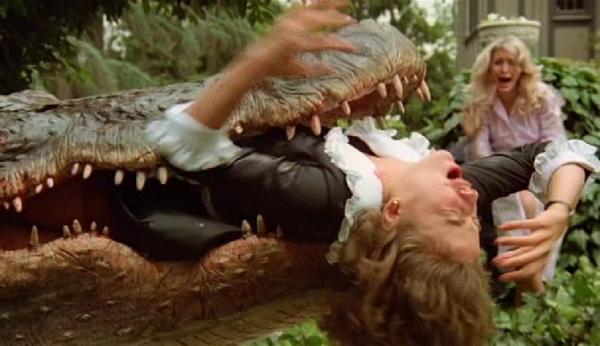
Brandon: Okay, I am stoked that we’re getting into this question of Ramón‘s morality this early, because there’s a lot more to unpack there than you might expect. As a mythically gigantic, bloodthirsty reptile you might expect that Ramón was pure evil (or at the very least a chaotic neutral force of Nature). However, there’s a spirit of moralistic vigilantism to some of his kills that makes him more akin to the nuanced antiheroism of folks like your Bruce Waynes or your Don Drapers or your Walter Whites. We are unclear as to who Ramón‘s first victim is, as all the police discover is a severed limb in a Chicago sewer. His second victim is a wicked pet store owner who kidnaps neighborhood dogs, sells them to a crooked science lab, and disposes of their bodies in Ramón‘s underground home. Later, in one of the film’s most spectacular scenes of alligator mayhem, Ramón also hunts down & dismantles the science lab employees that cruelly abused these discarded animals in the first place at a stuffy wedding party. There’s also a tangent where Ramón gets payback on a sleazeball big game hunter meant to take him out.
If Ramón is the hero of Alligator the proof is in these moments, which position him as some sort of sewer-dwelling vigilante who punishes evil Chicagoans who flush their pets down the toilet. It’s only when police & news reporter investigations drive Ramón out of the sewers & disrupt his shit-stained habitat that he resorts to killing innocents, including cops & children. As these are the exact kinds of victims people tend not to forgive, this greatly complicates the question of Ramón‘s moral compass.
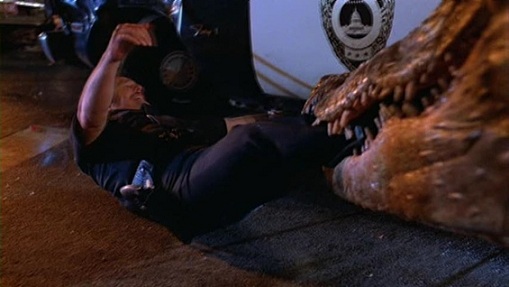
Another thing that complicates how we see Ramón as a misunderstood friend or a murderous foe is in the surprising high quality of Alligator‘s special effects. He’s just too spectacularly terrifying to take lightly. I think the effects also cloud the issue of whether or not Alligator qualifies as camp cinema, as Britnee was concerned with above. There are some larger-than-life caricatures in this film, not least of all the sentient sausage/cigar hybrid police chief & the nastily creepy pet store owner that make Alligator feel far short of Jaws (a movie it openly riffs on) in terms of quality, no doubt. However, on a technical note, the combination of real-life gators & gigantic gator puppets are near seamless. As many times as I was tempted to scoff at certain moments (the spinning toilet cam when baby Ramón is first flushed comes to mind), I was also just as impressed with some technical achievements in Ramón‘s gator attacks, especially once he emerges above ground. Watching the mutant gator smash through city streets, destroy cars with its massive tail, swallow victims whole, and completely raise hell at the aforementioned wedding party were all more visually impressive moments than I what I expected from this film, given its sillier flourishes. The movie wastes no time opening with a gator attack, so I expected it to be violent, but I didn’t expect the violence to be so well crafted on a technical (or budgetary) level.
There were also ways Alligator could’ve gone even further in a campier direction, such as a more formal, on-the-nose reunion with Ramón & the adult Marissa or more attention paid to the evil science lab that made Ramón so large in the first place. I would’ve loved to see Ramón & Marissa have their moment of recognition or the results some of the experiment’s other failed test subjects, but either detail would’ve undoubtedly played as a silly indulgence. The resulting tone, then, is somewhere in the middle. Alligator is at times very silly, and at times well-crafted & darkly grotesque.
I have a hard time imagining one of us reviewing this film & not slapping a “Camp Stamp” on it, but I’m also the mostly likely contributor around here to apply that label to any movie. What do you think, Boomer? Where does Alligator fall in or outside the spectrum of camp cinema?
Boomer: I don’t know that I would call this a camp film, actually. It has its fair share of campy ideas, but the general seriousness of the situation and the brutality of the onscreen deaths (particularly that of the child who is killed at some kind of costume party) make up for the sillier elements. There are certainly some deranged elements that threaten to push the film over the edge into full on camp, like Marisa’s excitable and possibly crazy mother and the archetypal irascible police chief’s Mentat-style eyebrows, but Alligator has something that a lot of genre satires don’t: respect for the source material that is being referenced. The Jaws parallels mentioned above are the most obvious, as the film is unabashedly aping that film’s style and plotline right down to mayoral corruption, here the result of the unnamed mayor’s relationship with the pharmaceutical chief whose company’s experiments indirectly led to the alligator’s mutation rather than an attempt to preserve the summer tourism economy boom. There’s a lot here that’s played for laughs, but the film manages to do so without irrevocably breaking the tension, which is a refreshing change of pace from other pastiche parodies. Even if we disregard contemporary rubbish parodies like Date Movie or Meet the Spartans and only consider genre classics, great movies like Airplane! and The Naked Gun don’t really work as legitimate examples of disaster film or cop drama when divested of their parodic elements; in contrast, even if you were to somehow never seen or heard of Jaws, Alligator would still hold up as a surprisingly decent example of the “giant animal” horror subgenre.
I also particularly liked that there was a reason given for why Ramón was so large, and that this reason tied this mutation back to human involvement. There’s nothing about Jaws that makes him a victim at all, but Ramón is surprisingly sympathetic for a swamp monster that’s literally a dinosaur. We see that the environment he was born into would have eventually led to him being wrestled by humans regardless of whether or not your Marisa had taken him as a pet; he was displaced from his natural habitat and transplanted to a city sewer, where the only food he was able to find consisted of castoff, hormone-injected puppy corpses. Everything that mankind reaps in this movie is, as Brandon points out, sown by them, even though a few innocent people get caught up in the midst of his vengeful rampage. Jaws, on the other hand, never explains how the titular shark managed to grow to such an absurd size (ten feet longer than the average male Great White) or why he has such an insatiable hunger for human flesh; this doesn’t make this a better film than Jaws at all, as that movie is at least partially about the terror of the unknown, but it does add a different element to Alligator that differentiates it from being a straightforward rip-off. It’s not clear how or why Ramón knows to go to the Slade mansion and devour guests (or why he knows to specifically target the lead scientist and Slade), but that doesn’t matter. At least the film didn’t take the same approach as the novelization of Jaws: The Revenge, which indirectly gave us the term “Voodoo Shark.”
One of the things that amused me most about this movie was the way that everyone, hero and villain alike, had nothing but disdain for the journalistic community, and the primary antagonistic reporter, Kemp, obliged them by being as weaselly as possible. What did you make of this element, Britnee? And, further, were you creeped out by the relationship between Robert Forster and Robin Riker, given that he is supposed to be roughly 40 and her character is at most 26?
Britnee: Before getting into the ridiculousness that is Kemp’s character, I just want to point out how insane his eyebrows are. Of course, Kemp wasn’t the only person in this movie with giant caterpillar eyebrows. As Boomer pointed out, Chief Clark had crazy eyebrows too! Maybe I’m overthinking this similarity, but there could be a possible good versus evil eyebrow battle occurring deep within the film. If so, it’s obvious that Chief Clark takes the cake.
Kemp’s character serves as the stereotypical reporter that would do anything to get a good story, even if it means exploiting someone’s personal tragedy. Of course, we know that not every journalist is as savage as Kemp, but I feel as though the film was attempting to convey some sort of message to the audience in regards to the authenticity of mass media. I can’t help but think of the title of one of my favorite Barbra Streisand songs, “Don’t Believe What You Read.” Not all media outlets are necessarily reliable, and Kemp is a representation of the deceitful side of the world of journalism.
As for the intimate relationship between Robert Forester and Robin Ryker’s characters, it did throw me a little off-guard at first. Mainly because Robert Forester gives off some really intense dad vibes. Marisa’s dad was a total jerk that flushed Ramón down the toilet, so she obviously had some underlying daddy issues. If David’s character was played by another actor, such as Harrison Ford, I think their love affair would have sat better with me. Honestly, I love a good age-gap relationship in movies. Harold and Maude and White Palace are two fantastic, unconventional romantic films that come to mind, and Alligator could’ve been on their level if Robert Forester wasn’t so dad-like.
Brandon, watching the film again recently got me to focus a little more on the terror that is Colonel Brock (Henry Silva). While he is definitely one of the film’s villains, he is probably one of the funniest characters in the movie. The scene in which he is awkwardly flirting with the television reporter was by far one of the funniest scenes in Alligator. Did you find Colonel Brock to be as comedic as I did? If so, did his unique brand of humor add value to the film? Would a more serious character have been a better choice?
Brandon: I love the cartoonish cad energy the dastardly hunter Colonel Brock brings to the film. He struck me as an odd combination of Jumanji‘s safari hunter Van Pelt & Empire Records‘s Neil Diamond surrogate Rex Manning, a sleazeball dandy plucked directly from either a children’s film or a 50s big studio epic. I also love the transparency of his presence within the film. Once Ramón dispenses with the crooked pet store owner & the evil science lab technicians, there aren’t many potential victims for his vengeful reptilian chomping. Colonel Brock is a perfectly calibrated last minute injection for the film because he gives the audience one more sleazebag to want to see dead. Ramón, of course, wastes no time obliging that bloodthirst and swallows the self-important goon whole in spectacular fashion. I could see how someone treating the film with a more serious tone could want more significant villainy that what Brock delivers, but I’m perfectly happy with his whole silly ass deal.
As much as I’m willing to view this movie through the trashy goofery of a camp cinema lens, there’s no denying that it’s a largely grotesque, hateful work. The alligator attacks start immediately from the outset & upon watching a man’s limbs ripped to shreds in the opening seconds a little girl wants to take one of the little beasts home. Once flushed down the toilet, Ramón‘s newfound home is a disgusting lair of trash & human filth somehow made worse by a greedy scientist lab willing to abuse & discard puppies in the most heartless way imaginable. At one point a mentally unstable suicide bomber is ridiculed & turned into a police station punchline. At some points it’s even difficult to rejoice in Ramón‘s revenge on the wicked because his means are so brutal (see: him devouring a child). I love the film’s more cartoonish, sillier moments (there’s a genuine star wipe transition between shots at one point, for God’s sake), but there’s so much ugliness mixed in that the clashing tones are downright jarring.
Boomer, is there an particular moment of shocking alligator mayhem or cruel human folly that sticks out to you as especially ugly that we haven’t covered here yet? There was so much nastiness going around that we surely haven’t touched on it all.
Boomer: We’ve already talked about the devoured child, which was the big violent moment that I didn’t expect. For the most part, Ramón was sticking to either enacting vengeance on his oppressors in a way that was, conceptually, more human than animal, or against people foolish enough to wander into his lair, which is a very animalistic and understandable reaction (RIP Officer Rookie, we hardly knew ye). And Brandon really has a point with his notation that the people in the film are cruel and hateful, like the police officers who mock the erstwhile suicide bomber; in fact, the general lack of empathy among the human characters in this film is what stood out to me more than Ramón‘s appetite and the things he did to sate it.
What stood out to me were the vendors who appear at the site of a mangling where police officers are tossing depth charges into a small body of water while trying to get the gator’s attention. It seems that, in universe, the peddlers of cheap wares have named Ramón “Alexander the Alligator” and arrive at the scene of a horrible tragedy in an attempt to capitalize on it with foam hats and plastic gator trinkets. It’s been a long time since I rewatched Jaws, so I’m not sure whether or not this particular element was included there or not, but this capitalistic opportunism in the face of human misery shocked me much more than the casual violence of Ramón, whose swathe of killings are motivated more or less by base instinct. It’s merely one more layer on this film, reminding us that people are the real monsters.
Lagniappe

Boomer: I notice that we mentioned that this film takes place in Chicago, and the Wikipedia page for the film also states that this is the case. This is never mentioned in the film, however; I kept trying to figure out where the film was set, and even googled “Marquette Place” when a sign with that name showed up on screen. Apparently, we only know this because it is mentioned in the director’s commentary. Before seeing the movie, I always assumed it was set in New York, which is probably the result of having long ago seen the Growing Pains episode in which Ben makes a movie that is, essentially, Alligator.
Britnee: During the scenes in David’s apartment, there are prints on the wall by Ramón Santiago (obvious inspiration for the alligator’s name). I was unaware of Santiago’s work prior to noticing the prints in the film, and I have to say that this guy has some phenomenal art. Not only is his art featured in the background of Alligator, but his art can also be found in the insanity that is the 1981 film Tattoo. According to Santiago’s website, he stated, “my paintings are what dreams are made of.” I would say that’s a pretty accurate description of his work. Unfortunately, I haven’t stumbled across an Santiago gator paintings yet.
Brandon: Alligator is a near-perfect slice of nasty 70s schlock (despite its early 80s release date) that begs to be loved for its faults instead of in spite of them. However, I do think that Britnee was onto something when she was wishing for a rewrite where a more solid connection between the now-monstrously large Ramón & the adult Marissa was established. However, instead of them sharing a moment of recognition at the film’s climax, I would’ve somehow implied that the body parts first discovered in the sewer belonged to Marissa’s father. Instead of an unidentified victim kicking off the police investigation that drives Ramón out of the sewers, Ramón killing Marissa’s father would both help explain her mother’s deranged state & add another name to Ramón‘s revenge list. One of the most fascinating concepts at work in Alligator is the idea of its titular monster intentionally seeking revenge on those who’ve wronged him, so it would’ve been incredible to see him devour the wicked brute that flushed him down the toilet as a baby. I enjoy the movie’s misshapen, incomplete feeling in general, but I do think that detail alteration would’ve improved the significance of Ramón‘s first recorded kill, however on-the-nose it would’ve been.
Upcoming Movies of the Month:
July: Boomer presents Citizen Ruth (1996)
August: Alli presents Black Moon (1975)
September: Brandon presents The Box (2009)
-The Swampflix Crew