I never tire of watching Steven Soderbergh play around with celebrities and camera tech. It’s like babysitting a little kid who’s toying around in a playroom where each dolly & gadget cost millions of dollars. I usually prefer to see Soderbergh’s playtime sessions projected on the big screen, and I like them best when they overlap with genres I’m already in love with – which is to say that it’s going to be hard to top the experience of seeing his iPhone-shot psych horror Unsaneat the shopping mall multiplex. Still, it’s been continually fun to watch a long-established director who’s remained excited by his job fuck around with Prestige Cable TV money as if he’s still figuring out the basic elements & limitations of his medium.
The big-picture details of Soderbergh’s latest direct-to-cable effort, No Sudden Move, sound like they belong to the pilot episode of a standard-issue HBO crime drama series. Don Cheadle, Benicio Del Toro, and Kieran Culkin star as three low-level lackeys who’re hired to hold a business man’s family hostage in exchange for a confidential document of great political import. The job goes horrifically wrong, and the bottom-rung gangsters find themselves scheming across 1950s Detroit to hold onto the top-secret document as a bargaining chip for their lives . . . and an exponential amount of cash. It’s a standard heist-gone-wrong plot, styled like a spin-off series about the crime-world decades following Boardwalk Empire. And yet, it never feels boring or unsurprising thanks to Soderbergh’s flair for wryly funny stunt casting and behind-the-camera mischief.
The biggest hurdle most audiences have to clear to enjoy No Sudden Move is how absolutely fucking bizarre it looks. While the set & costume design resemble the usual HBO crime series, Soderbergh shoots the entire movie with an extreme wide-angle fisheye lens, often backlit. Whenever your eye momentarily adjusts to its skateboard video framing and chiaroscuro lighting, the camera pans or glides to make the whole thing look warped again. I have to imagine it has a lot of unsuspecting audiences scrambling to adjust the picture settings on their TV, but I was personally delighted by that clash of modern camera tech against a vintage setting. When the cowardly businessman mark, played by David Harbour, complains into a telephone “Everything is so weird right now” I felt like I knew exactly what he meant. The film never stops looking strange, even if it’s narratively well behaved.
Beyond that extreme fisheye effect, I was mostly just tickled by No Sudden Move’s casting choices. From the winking, referential casting of Jon Hamm in Mad Men-style G-man suits and Ray Liotta in pistol-whipped Goodfellas mobster mode to the chaotic screen presence of Uncut Gems’s Julia Fox as a bored, pouty moll (recalling Paz de la Huerta in the Boardwalk Empire pilot, come to think of it), you can tell Soderbergh and casting director Carmen Cuba are having a ball. Otherwise, I can’t say the film really did much for me, at least not as much as the campier, more acidic Behind the Candelabra – the most recent example I’ve seen of Soderbergh playing around in HBO’s toy chest. If these same fisheye lens or movie star stunt casting experiments had been applied to something more my speed—like a morally queasy horror movie or something draggy like Liberace—I could have fully fallen in love with it. Knowing Soderbergh, I’ll probably only have to wait a few weeks before that next experiment in craft arrives.
“They sure don’t make [X] like they used to” is something that I either never tire of hearing or can’t stand to hear someone say, depending upon who’s making the statement and what they’re complaining about. “They sure don’t make gender theory like they used to” is a statement that could go either way, varying wildly depending on whether it’s a radical person at your local DSA meeting or a talking head on any news outlet. “They sure don’t make Confederate monuments like they used to” is a delight to hear if the person saying it is pleased, but would be a huge red (and treasonous) flag if the speaker is wistful for the days when they could indulge in their Lost Cause nonsense without inspection. Nothing in life is ever really stable, but one thing that they’re still making just like they used to are contemporary(ish) medium-to-hard sci-fi dramas about Things Going Wrong in Space.
Medical researcher Zoe Levenson (Anna Kendrick) originally applied for a position with space exploration agency Hyperion because she thought that “I was rejected by Hyperion” would be a funny story to tell at parties. To her surprise, she was accepted for a position for a two-year Mars mission, alongside biologist David Kim (Daniel Dae Kim), whose work revolves around the possibility of using algae as a feasible atmosphere conversion medium. Leading the mission is Commander Marina Barnett (Toni Collette), for whom this is a bittersweet journey, as it marks her third and final interplanetary trip. Their ship, the MTS-42, has an interesting configuration: the upper stage booster remains attached to the ship proper by a tether, and using centrifugal interia, provides artificial gravity for the crew. After a bumpy takeoff, the astronauts get down to the business of making the journey to Mars, but it turns out that this was no run-of-the-mill shaky departure: the ship’s weight is off due to the presence of Michael Adams (Shamier Anderson), a support engineer working as part of Hyperion’s ground crew, who was caught between two modules and trapped aboard the vessel. Worse still, his presence has inadvertently damaged the ship’s carbon dioxide scrubbers, which are needed to ensure a breathable atmosphere for the astronauts and their accidental stowaway for the entirety of their journey.
Although Stowaway is set in the not-too-distant future, as evidenced by the way that a trip to Mars is treated as a semi-regular aeroscience practice and the lack of a NASA presence (Hyperion is never identified as a government agency or a private corporation; its international crew implies the latter but the genuine concern that home base demonstrates regarding the lives of its astronauts implies the former). It’s still part of the genealogy of films that can trace their ancestry back to The Right Stuff but were defined as a genre by Apollo 13: realistic space dangers. Stowaway doesn’t break the mold that also created The Martian and Gravity, but it’s also not really breaking the mold of Tom Godwin’s 1954 short story “The Cold Equations,” from which it draws its primary dilemma. “Equations,” which itself draws inspiration from works going back to the nineteenth century, takes its title from the calculations needed when a starfaring vessel whose margins of error are very small finds those margins exceeded by a stowaway (an intentional one in that text), in order to determine if there’s a way for both pilot and passenger to survive. There isn’t; the stowaway passenger in “Equations” makes the ultimate sacrifice upon realizing that her actions, however well-intentioned if poorly-informed, threaten the lives of an entire colony.
That it fails to break that mold isn’t necessarily a bad thing, however. “The Cold Equations” is considered a classic sci-fi story with values that resonate across time for a reason. Stowaway also circumvents two potential problems with updates to the central conflict of “Equations” as well: the ship in “Equations” is pretty clearly in violation of common sense safety standards (it was published 16 years before OSHA went into effect, after all) by failing to provide for even the smallest margin of error, and the teenaged stowaway intentionally boarded the vessel to see her brother. In Stowaway, we instead have an engineer who was accidentally injured and knocked unconscious before being sealed behind a panel prior to liftoff, meaning that he is an innocent in this situation; secondly, it’s not merely a matter that the ship can’t support more than three people, but that the scrubbers that are the safety precaution and could enable them to make it to Mars with an extra person on board are damaged. Every attempt is made to find another solution, including using the algae from Kim’s experiment to try and produce sufficient oxygen to make the rest of the flight, and a daring and thrilling climb across the tether to the second stage booster to collect any remaining oxygen from its tanks in an attempt to extend MTS-42’s atmospheric supply until they reach Mars, but ultimately, just as in “Equations,” not everyone will make it out alive.
Stowaway isn’t likely to blow the average audience member away. Its appeal lies largely in its similarity to what’s come before in the Things Going Wrong in Space genre and applying hard contemporary science to its familiar plot, but therein lies its weakness; there’s nothing here that you haven’t seen before. The minimal cast is strongly composed, but although no one’s phoning it in, everyone involved knows that this isn’t their opus, so it’s no one’s career best performance either. Anderson is a standout, given that he’s the least seasoned cast member, and Kendrick manages charm and gravitas in equal measures in a rare non-comedic role. I have a feeling that this would play better on the big screen; I certainly remember being captivated by Gravity and Interstellarwhile watching them in theaters, and Stowaway has sequences that feel stifled on my TV at home. Hopefully, we’ll see writer-director Joe Penna’s next feature large and beautiful, but in the meantime, this one’s on Netflix if you’re itching for a near-future sci-fi tragedy.
In March 2020, I started reading Marie NDiaye’s novel My Heart Hemmed In about a week before Texas went into its first lockdown. It was a stunning book, beautiful and discomfiting, about a woman, Nadia, who suddenly and inexplicably becomes othered by her community. Friends, neighbors, amenable ex-lovers, strangers, her pupils: overnight, she becomes a pariah to them, something different and perhaps even obscene. As I was on the bus on the way home from work, not realizing that it would be the last time I would be taking that route, I was reading through a passage about Nadia also taking public transportation, and her growing awareness of being watched and observed, and that paranoid feeling surged through me as the eyes of my fellow commuters began to dart from face to face, seeking any sign of illness or contagion. It was a distinctly surreal experience that I do not recall fondly. NDiaye’s writings seemed, based on my own admittedly limited cultural knowledge, very French; Heart focused heavily not just on the feeling of being ostracized, but also on the confusion of it, and through narrative sleight of hand managed to let the reader know that there was something about her situation that Nadia unconsciously understood but forced beneath the surface of her conscious mind. Despite her constant claims that she couldn’t imagine the reason for her situation, the reader always knew that she was more aware than she let on. Although the novel upon which A Perfect Enemy is based, Cosmétique de l’ennemi, is Belgian (albeit written in French), the summaries of it which I’ve managed to locate indicate a similar self-deception at the original novel’s core, which does not (forgive the pun) translate to the big screen, nor am I certain it could have translated.
Successful and renowned Polish architect Jeremiasz Angust (Tomasz Kot) has just finished giving a lecture in Paris about his philosophy of design. In so doing, he quotes Antoine de Saint-Exupéry (probably best known in the Western Hemisphere as the author of The Little Prince): “Perfection is achieved, not when there is nothing more to add, but when there is nothing left to take away.” This is tied into his desire to design spaces which are to the benefit not of an aristocratic class, but to the societal underclasses, who deserve beauty as much as their supposed betters. En route to the airport to return home, he offers to share a cab with a rain-soaked young Dutch woman who gives her name as Texel Textor (Athena Strates). Despite the objections of the cab driver, they also turn back to retrieve Texel’s suitcase, which causes both of them to miss their flights. As they each wait for the next available flight, Jeremiasz politely attempts to rebuff Texel’s attempts to engage him in further conversation, especially once her interest in him is further aroused by the fact that he had designed the very airport in which they are currently stranded. He finally gives in to her begging to hear her out as she tells him stories about her childhood, promising one such tale about how she killed a classmate in her youth. As they adjourn to a very nice lounge, the miniature diorama of the airport shows two tiny figures inside painted to look just like Jeremiasz and Texel, in an otherwise monochromatic white sea.
Texel tells three stories. The first is about her disgust with the sound of her stepfather’s eating as a child and how her own rejection of food due to textural issues led to her being punished by mixing up offal and other unappetizing food remnants to feed to the family’s cats, but forced herself to eat that mixture and discovered she loved it. The second story is about her friendship with another girl from school, who was much more well-off and of whom the poor Texel was deeply envious, even going so far as to destroy the wealthier girl’s toys out of spite. One night she prayed for the girl to die while stabbing a doll, and learned the following day at school that she had died in the night. Between these stories, Texel asks Jeremiasz about his wife, noting his wedding band, but he reveals nothing other than to say that he still loves her, which Texel doubts, noting that when someone loves another person, they can’t help but talk about them more than Jeremiasz is willing to speak of his bride. Jeremiasz says that Texel can’t possibly think that her prayers killed her classmate, but Texel tells her final story, about seeing a beautiful woman in a French cemetery, standing over a sculpture of a mourning woman that looks almost just like her. She falls madly in love with the woman instantly and pursues her, much to the woman’s dismay, and although Texel catches up with the woman and even knocks her down, the mourner manages to get away. Texel spends years trying to find her again, and when she does and realizes the woman does not recognize her from that day in the graveyard, she weasels her way into the woman’s home, only for the woman to eventually recognize Texel’s mad laughter, and then a tragedy occurs.
Although there’s not much to spoil here for a first time viewer and I’m not giving this film a recommendation, I’ll still refrain from sharing too much about how Texel and Jeremiasz were connected prior to their “chance” meeting, although an astute reader may have already figured it out. That’s by far the least interesting part of the film. Maybe I’m simply still haunted by Hereditary, but I had really hoped that the recurring image of the tiny figures of Texel and Jeremiasz appearing in the model airport in the transitions between scenes would be a larger and more literal factor in the plot, and that perhaps Texel was some kind of avenging spirit or witch come to force Jeremiasz to confront or reckon with something from his past. I’m not saying that’s not what happens in the movie, but, again, I don’t want to ruin the ending or the journey should you find yourself with access to this film and time to kill. The twist isn’t telegraphed necessarily, but it is foreshadowed heavily enough that you’ll probably stay a few steps ahead of the reveal. Even if that doesn’t work, what does work in the “long conversation” part of Act II are Texel’s interruptions of her own stories to ask Jeremiasz what he’s imagining when she talks about childhood poverty or elementary school buildings, and corrects his mental images, which draw on his own experiences, with clearer and more specific ones that accurately reflect her past. I love movies about memory, and this is an interesting and dynamic way to confront, inspect, and visualize the imperfections of memory and imagination in a visual way. There’s also a striking scene in the final act of the film that’s evoked by the movie’s poster image, but to say more about it would give too much away.
Unfortunately, where A Perfect Enemy falls flat is in the performances. Although there’s something indescribably “off” about Marta Nieto, who plays the object of Texel’s affections, it’s Kot who delivers one of the strangest performances I’ve ever seen here, and not in a good way. At first I thought it might have been a language barrier issue and was fully prepared to, on this film’s behalf, argue that it might have been better to allow Kot to speak his native Polish and subtitle the movie instead of forcing him to speak English throughout, but I watched an English-language interview with him, and he speaks the language fluently. I cannot imagine what prompted the acting choice to deliver every line of Jeremiasz’s dialogue so stiltedly; as a result of it, Kot delivers a performance that is—and I hesitate to use this term without sufficient reason but there are truly no other or more accurate descriptors—Wiseaunian. I don’t think that Kot is a bad actor necessarily, but it’s such a huge distraction that one could almost (but not quite) overlook what an amazing performance Strates is bringing to the table. She manages to portray innocence, madness, and clarity of purpose in what could have easily been a textbook standard manic pixie nightmare girl, and I really look forward to seeing her in future roles. I’m also fascinated by director Kike Maíllo’s cinematic eye; there are a lot of breathtaking images here (most of which were included in the film’s extremely well-crafted trailer), and I can’t wait to see him take the helm of another thriller that’s less hampered by a familiar narrative twist and a wooden performance from its lead.
I am a man who loves a haunted doll movie, as long as it doesn’t involve acting like the Warrens were anything other than scam artists. You can imagine my disappointment upon the realization that The Unholy, which I thought would center around a possessed toy, turned out to be something different entirely. That disappointment was tempered by the realization that, although I wouldn’t see an ancient doll wielding a knife against Papa Winchester, at least this would be a possession horror, which is another genre that I’m rather fond of. It’s pretty rote and paint-by-numbers, unfortunately, but the ending was sufficiently unconventional that I can’t say it’s the worst of its kind. Spoiler alert, I guess?
Following a prologue set in 1845, in which a woman is hanged for practicing witchcraft and her soul bound to a doll, we find disgraced journalist Gerald Finn (Jeffrey Dean Morgan) travelling to rural Massachusetts to photograph a supposed cattle mutilation. Disappointed but not surprised to find nothing more than a teen prank on a farm adjacent to a church, Finn notices the gnarled tree from the prologue and, within its hollowed base, the “kern” doll. Seizing the opportunity to spruce up his underwhelming story, he breaks the doll’s china head and takes its photo, unwittingly releasing the spirit of the witch. While intoxicated later that night, he’s driven off of the road by the appearance of a local girl, Alice (Cricket Brown), in front of his vehicle. He tails her back to the tree, where she speaks in tongues and collapses. When relaying this to the girl’s uncle, Father William Hagan (William Sadler), both he and Dr. Natalie Gates (Katie Aselton) express surprise; Alice has been both deaf and mute since birth. Soon, however, Alice demonstrates that she can not only speak but has gained the ability to hear, and says that “Mary” is speaking to her, and has healed her.
This attracts the attention of the local diocese, including Bishop Gyles (Cary Elwes) and Monsignor Delgarde (Diogo Morgado). Before long, Alice garners national and international attention, as she heals a boy who could not walk as well as Father Hagan’s terminal lung cancer, and the small town of Banfield becomes an epicenter of pilgrimages. Also rehabilitated is Finn’s journalistic career, as he’s soon fielding calls from his former editor Monica Slade (Christine Adams), who mere days before was dodging his calls while citing Finn’s previous career-ending lapse of journalistic integrity. When Father Hagan discovers the truth about the “Mary” with whom Alice is communing, and that she is in fact the spirit of the executed nineteenth century witch Mary Elnor, this revelation costs him his life, but puts Finn and Dr. Gates on the right track to stop Mary’s ascension on the night of the Feast of the Immaculate Conception.
There’s a fair amount of water-treading going on in this 99 minute budget horror, which could easily have been trimmed to a tight 80 and gone straight to streaming, perhaps as a surprisingly star-studded episode of Into the Dark or some other horror anthology. First time director Evan Spiliotopoulos has been working in the industry for over two decades now, with some noteworthy (if not praiseworthy) writing credits under his belt: the live action Beauty and the Beast, for instance, as well as The Huntsman: Winter’s War and the 2007 CGI animated Battle for Terra, which I don’t think anyone has ever heard of except for those of us who’ve seen the unskippable trailer on every single Wolverine and the X-Men DVD more times than are reasonable to admit. One wouldn’t think that the man who penned Tinker Bell and the Lost Treasure, The Little Mermaid: Ariel’s Beginning, and Pooh’s Heffalump Halloween Movie would be up for the reinvention of possession horror, and that assumption would be correct. This is a script full of dialogue that you’ve heard a million times before (Slade: “I know you; you would sell your soul for a story.” Finn: “I’m pretty sure I already did.”) as well as some painfully embarrassing attempts at being hip. For instance, when Finn makes a mix for Alice, he cites Tupac as “old school” but mentions cites Billie Eilish as contemporary youth music in the same breath as The Smashing Pumpkins, as if Mellon Collie and the Infinite Sadness came out in 2019 and not 1995 (sandwiched directly between Me Against the World and All Eyez on Me). It doesn’t strike me as being intentionally ironic, either, as Morgan is a fine actor and could have easily delivered a wry lack of self-awareness if that had been appropriate.
Of course, that Spiliotopoulos wrote Tinker Bell and the Lost Treasure may actually be important to this movie’s ending. After reviewing various plot synopses of the novel from which the film is adapted online, I can’t determine if this is new to the adaptation or within the book, but Mary’s ultimate defeat isn’t the result of an exorcism. Instead, Finn wields his sullied reputation to sow doubt about Alice’s supposed miracles among the mass of congregants who have made their way to Banfield, preventing Mary from sucking up their souls and sealing her infernal pact. Mary, like Tinkerbell, has the “clap if you believe in fairies” limitation that requires faith in order to fuel her return, and by inverting this, Finn and Gates are able to weaken Mary’s hold over Alice and the populace. Of course, since this is a movie, the demands of the modern viewer require that we still be subjected to a show-stopping climax in which Mary appears in the burned flesh and her worshippers flee before her, but I was still pleasantly surprised by the fact that the narrative, which was theretofore about as canonical as a film of this kind could be, took a bit of a left turn into using skepticism as a weapon. It’s still not great, but if you’re stuck with limited options, there are worse possession retreads to spend some time with.
CW/TW: Discussion of rape culture as a source of anxiety and sexual assault.
Cami (Jordan Hayes) is not having a good day. She’s en route to see her father (James McGowan), and since her flight touches down at 2 AM due to delays, she tells her dad she’ll take a rideshare to his place instead of expecting him to pick her up. Her mood does not improve when her driver, Spencer (Max Topplin), makes awkward attempts at small talk that tend toward the sinister; he reveals that he’s a bowhunter and, when asked what he hunts, includes “humans” on the list as a bad joke. Or is it? Cami’s suspicions are further aroused when Spencer attempts to take a turn onto a rural road that Cami doesn’t recognize, and she is not assuaged to see that the turn is indicated on the rideshare app’s navigation screen. As their path takes them through a deeply wooded area, Spencer’s car suddenly breaks down, stranding the two of them alone . . .
A few years ago, I looked up the reader reviews for Neil Gaiman’s The Ocean at the End of the Lane, a book that I read on a flight in 2014, beginning my trip to New York with a good, hearty cry as the plane touched down at JFK. I was surprised by the negative reviews of it, until I dug a little deeper and saw that most of them were centered around the book’s length (178 pages) versus its cost (MSRP of $16.95 at the time). I had picked it up at the airport on my way out, so I knew exactly how much I was getting and at what cost, but it struck me as an immature (and grossly capitalistic) way to evaluate a piece of art. In fairness, during my more economically insecure (and less mature) days, I sometimes was affected by the same kind of thinking: “How can [band] charge full price for an EP that’s only 8 tracks?!” was a thought that passed through my brain more than once, and it fills me with shame to look back on it. It’s a toxic way of thinking, and from time to time I still have to remind myself of this, especially when it comes to movies. When I was a kid, movies (and of course books) were the only way I could escape an unhappy home environment for a little while, and when I was allowed to rent something from our local video store or borrow only one tape from the library, I felt cheated when it ended up being shorter than I expected. The anguish of wasting the one rental I was allowed that month in 1996 on a 45 minute tape of Carrotblanca that contained shorts I had already seen irrevocably changed my interaction with movies for the rest of my life; I still can’t pick up any form of physical media without immediately checking the run-time before I look at anything else. To me, the purported ongoing “bloat” of films to lengths greater than three hours isn’t a turnoff the way that it is for others; if anything, every time I see that a film is 150+ minutes, my interest is piqued like that Stan Kelly image that became a meme. This is decidedly not how Swampflix at large operates, where the “tight ninety” (™ Alli) is the preferred vision.
All of that is (as is my wont) a needlessly and pointlessly indulgent digression and lead-in to the fact that I loved this 80 minute(!) thriller. Like Lucky, The Toll is a recent thriller that taps into —and unfortunately necessary—anxieties about existing in public spaces as a woman. In this month alone, my best friend expressed her concerns about parking in a pay garage so that we could meet her family downtown to watch the Independence Day fireworks; days later, she mentioned how fraught with danger it would have been for her to take the bus alone instead, and I have seen enough with my own eyes to know that her hesitancy is valid. Even without the benefit of hearing about the day to day horrors from countless first and secondary sources, as a man, I know how other men talk about women when they’re not around, and it’s terrifying. It’s easy to immediately sympathize and empathize with Cami, trapped alone in the woods with a stranger, even before things get “really” scary.
Where The Toll plays with expectations is in what happens after the breakdown, which coincides with Spencer’s phone glitching and Cami’s dying. The audience watched as Spencer selected Cami specifically from a list of riders and this, along with our knowledge about the general shitshow that is patriarchal entitlement, primes us for where this story is presumably headed. However, once the characters are stuck in the woods, as they discover more and more reasons to mistrust one another, the audience is tipped off that something equally as pernicious but more ethereal is afoot. After several false scares, Cami opts to take off on foot towards the main road and leave Spencer behind, but discovers that there are now warning signs in the road that would prevent a vehicle from passing, warning of a road closure and graffiti’d with small notes and smiley faces that warn of the need to pay a toll of some kind. She soldiers on, and although she stays on the path, she finds herself back where she started, with one hiccup: she started walking away from Spencer back towards the main road from which they came, but she approaches him from the front, as if coming from deeper in the dark, dark woods. Spencer makes his own attempt to leave, but is likewise thwarted; in a beautifully underlit scene, he leaves the road altogether and sets off into the woods at a perpendicular angle, only to re-emerge from the forest onto the road from the opposite side.
Other messages begin to appear as well. A warning about “The Toll Man” appears, written in the dust on Spencer’s back windshield. Cami discovers a cache of photos of herself in Spencer’s car, leading her to accuse him of stalking her and orchestrating the evening’s events, while he in turn is dumbfounded by this turn of events and accuses her of planting them; while neither are looking, the pictures disappear as suddenly as they appeared, as if they never existed in the first place. Assuming that someone in the woods is harassing them (The Strangers is mentioned), the two prepare to defend themselves, but they are eventually discovered by an older woman (Canadian treasure Rosemary Dunsmore) on a tractor, who offers to help them. When they relate their experiences, however, she realizes with horror that she will be unable to assist. “It’s been a long time; I’d forgot,” she says. “I’m not where you are. We’re looking at each other like we’re close, but you’re someplace else. You’re in his place. The Toll Man.” Like a malevolent fae, The Toll Man traps wayward travelers who have the scent of death if they should be unlucky enough to find their way onto his road; someone with suicidal ideation or bound for an accident is then diverted into his realm so that he can extract his toll: death.
This has the potential to be more goofy than scary (The Bye Bye Man, anyone?), but in spite of its possible pitfalls, this one manages to work. I’ve recently been watching The X-Files for the first time, and although I know it’s a huge part of the show’s iconic imagery, every time Mulder and Scully go into the woods with their giant flashlights that are all-but-unnecessary simply because of how brightly backlit the trees are, I have to stifle a laugh (while watching the pilot, I turned to my best friend and almost shouted “Is that supposed to be moonlight?!”). That bled into the pop culture landscape a lot, and I’m pleased to say that the darkness that surrounds Spencer and Cami definitively looks like real, arboreal darkness. Their flashlight barely illuminates the first row of trees closest to them, and beyond that lies nothing but dread, inky blackness. The creepiness of it lingers, even after the Toll Man shepherds them away from the car and toward an isolated house, which contains other illusions that aim to warp their perceptions of reality, including images of Spencer’s dead mother (Jana Peck), who taunts her son with the secrets that she took with her to the grave when she killed herself. When the duo is separated, Cami is also confronted with images from her past; a canopy bed appears in the woods, where a younger version of herself is terrified after being assaulted by an “upstanding” young man (Thomas L. Colford); present-day Cami comforts her, but past Cami is in her head, and knows that although the wound is gone, the scar persists. A similar blending of indoor past and outdoor present was part of the visual language in The Ritual, and I loved it there as I do here. There’s something deeply uncanny about it, and as Cami is hounded by visions of the people who were present in the aftermath of her assault (very similarly to Lucky, although no one sings here), the impossible largeness of the darkness just beyond the treeline merges with the impossibly large weight of her past, while also descending on her in a way that can only be described as claustrophobic.
The ending comes at the viewer fast, and I won’t spoil the conclusion here other than to say that the circle is fully closed. What we learn in those final ten minutes paints a new picture of everything that came before it, and this is the first film of 2021 that has made me feel like I’m already ready to rewatch it and see what I missed the first time. Although it feels like a Shudder release, it’s currently only available for rental or purchase, but when it comes to streaming, make sure to check it out.
Unless we’re discussing titans of the medium like Hayao Miyazaki or Satoshi Kon, I’m shamefully unfamiliar with most anime. As the last thriving refuge for traditional hand drawn animation, I respect the artistry of anime greatly. I’m just more of an admirer than I am a “fan,” since claiming that latter designation implies you’re extremely well versed and deeply opinionated about the medium in a way I’ll never be able to match. Saying you’re an Anime Fan is like saying you’re a fan of superhero comics or Star Trek or any other extremely nerdy artform with a decades-spanning history; you better know your obscure, inconsequential trivia down to the last detail, or you’re in for a gatekeeping headache. Case in point: I finally watched the landmark anime series Cowboy Bebop for the first time since it popped up on Hulu last year, over two decades after its initial run. If I were an anime fan, that kind of blindspot would be a source of shame I’d have to hide from my cannibalistic anime nerd friends. Since I’m a casual admirer, though, I get to walk away unscathed — the same as I did when Netflix started streaming Neon Genesis Evangelion a couple years back.
Unsurprisingly, the Cowboy Bebop series is pretty good. A mash-up of neo-noir, neo-Western, and space travel sci-fi tropes, it’s fairly accessible to casual anime admirers with an appreciation for old-fashioned genre filmmaking. I found it to be hit-or-miss by episode, but mostly as a matter of personal taste. The standalone villain-of-the-week episodes were mostly fantastic—especially the ones that veered into my beloved subgenre of spaceship horror—but I was largely indifferent to the show’s overarching Spike vs. Vicious storyline: a prolonged, vague neo-noir plot with no sense of propulsion or purpose. If I were recommending the show to a similarly anime-ignorant friend, I’d try my best to save their time with a Best Of list of standalone episodes to burn through: the ones with the killer fridge mold, the virtual reality cult, the mushroom trip, the annoying cowboy, and the deranged clown. If you haven’t seen Cowboy Bebop by now you likely don’t need to watch all 11 hours of the series; you just need a taste, if not only for general pop culture familiarity. I likely would’ve said the same thing about the monster-of-the-week episodes of The X-Files, though, and I watched that show religiously as it aired, so your mileage may vary.
Luckily, you don’t even have to watch those five Best Of episodes (“Toys in the Attic”, “Brain Scratch”, “Mushroom Samba”, “Cowboy Funk,” “Pierrot le Fou”) to get a proper taste of Cowboy Bebop. The series conveniently concluded with a standalone villain-of-the-week movie that also sidesteps the energy-draining Spike vs. Vicious storyline entirely, allowing for one final ride with your new favorite spacetraveling bounty hunters. Cowboy Bebop: The Movie dials the clock back a few episodes into the series before the bounty hunter crew is disbanded (and partially killed) to offer a taste of the show at its prime. In this extended, posthumous episode, the crew is attempting to capture bio-terrorists on Mars (styled to look suspiciously similar to 1990s NYC) before they release a deadly virus in a densely populated crowd. The viral outbreak is planned to be staged at a jack-o-lantern-themed variation of the Macy’s Day Parade, making the film a low-key Halloween movie of sorts. The crew selfishly bickers among themselves, tries to score the bounty on their own, falters, then reforms at the last minute to save the day. It’s quintessential Cowboy Bebop in that way.
The problem with recommending Cowboy Bebop: The Movie (subtitled Knocking on Heaven’s Door) as a crash course overview of the show is that it’s way too goddamn long. You could watch all five of the Best Of episodes I mentioned in less time than it would take you to watch this one feature film, and it never hits the same highs as the series proper at its best. You’d have to trim 30-40 minutes off this thing to make it an enticing alternative for newcomers, and I imagine even long-time fans of the show had their own patience tested with this two-hour standalone. Cowboy Bebop: The Movie isn’t Cowboy Bebop at its most creative or most exciting. However, it is Cowboy Bebop at its most functional. The main draw of the film is seeing a somewhat scrappy, experimental series funded with proper time & budget to get its details in order. The personal & professional dynamics among the space crew are never as clearly defined on the show as they are in the movie, where even lesser side characters like Ein & Edward are fully integrated into the daily business of intergalactic bountyhunting in a way that finally makes sense. More importantly, the animation itself is afforded way more resources to flourish. On the show, the intrusion of CG animation felt like a budget-cutting measure; here it looks purposefully surreal in a more thoughtfully mapped-out hand drawn backdrop. Whereas most “The Movie” versions of TV shows go big with their plots, locations, and scope to justify the jump from the small screen, Cowboy Bebop: The Movie only goes big on its look.
If I had only watched Cowboy Bebop: The Movie for an overview taste of the show, I might’ve assumed the series was a lot more creatively limited than what the best bounty-of-the-week episodes had to offer. It’s a good episode of the series, but it’s too long and too tame to be a great one. However, I did find it to be a great “What If” illustration of how much more visually spectacular the TV show might’ve been if it had the time & money to luxuriate in production the way the movie did. It’s fun to look back on the production limitations of the five Best Of episodes I mentioned and imagine them even more visually extravagant in their animation, since I now know what that might look like. Regardless of that hypothetical, I very much love them as-is. You might even call me a fan.
I love the 1996 sci-fi comedy film Space Jam, by which I mean I was 10 years old in 1996. Even as an adult, I find the movie fascinating as a corporate cashgrab mash-em-up of two disparate but popular brands—Looney Tunes & Michael Jordan—that accidently stumbled into sublimely silly post-modern absurdism. The contortions Space Jam forces itself into to highlight both a post-baseball, career-reflective Michael Jordan and a hyperviolent, physics-defying cartoon bunny are incredible to watch, both from a place of ironic detachment and as in-the-moment entertainment. Of course, it’s impossible for me to claim that Space Jam is objectively good, considering that anyone who was not a child in the mid-90s seems to despise it as a cultural scourge rather than just a middling, studio-made kids’ film. I just want to confess up-front that I’m a Space Jam apologist; I even prefer it to the Joe Dante Looney Tunes film that supposedly fixed all its faults (according to more respectable tastemakers). That way I can I credibly say I went into Space Jam: A New Legacy genuinely hopeful that I would enjoy the experience. I did not watch this long-delayed sequel just to lazily dunk on it or call it out as the death knell of modern cinema. I thought it might be fun.
Space Jam: A New Legacy is devoid of fun. It succeeds neither as intentional comedy nor as accidental absurdism. It lacks the shameless commitment to its own crass commercialism that the pushed the original Space Jam to the point of post-modern delirium. Like the worst cash-grab sequels, it does its best to retrace the steps of its predecessor while suppressing all its strangest, most exciting ideas to the margins. A New Legacy simply subs out Michael Jordan for his modern-day equivalent in LeBron James, then hangs up the towel. James teams up with Bugs Bunny and other Looney Tunes characters to win a cosmic game of basketball so he can get back to his family . . . except this time the game is staged in a computer server instead of outer space. That venue change allows the new Space Jam to rope in as many background characters as it can from the full library of Warner Bros. Entertainment IP – including blasphemous “cameos” from “cinematic universes” like The Matrix, The Devils, Casablanca, A Clockwork Orange, and What Ever Happened to Baby Jane?. That’s the kind of naked corporate-synergy flexing that has professional critics decrying the film as “an abomination”, “an apocalyptic horror movie”, and a “swirling CGI garbage tornado.” Those layup hit-pieces were preloaded before the movie was actually screened for critics, though. What really holds A New Legacy back is that it keeps its only new, exciting idea—that intrusion of characters from classic films outside the Looney Tunes brand—relegated to the background. King Kong, The Penguin, and Baby Jane Hudson should have been shooting hoops alongside LeBron James and Bugs Bunny, not cheering them on from the sidelines in blurred-out crowd shots.
It’s most widely being compared to Spielberg’s post-apocalyptic VR thriller Ready Player One (which is much more critical of this kind of self-aggrandizing IP worship than it’s given credit for), but the basic premise of Space Jam: A New Legacy actually lands much closer to the underappreciated sci-fi bummer The Congress. In a dystopian vision that only rings truer to out shithole reality every year, The Congress imagines a world where celebrities no longer physically perform in mass-distributed art, but instead are scanned-into a computer system that simulates their screen presence in AI emulations. It’s the ultimate movie studio power grab, one we’ve seen echoed in real-life simulations of deceased performers in films like Rogue One (Peter Cushing), Furious 7 (Paul Walker) and, most recently, the ethically-shaky documentary Roadrunner (Anthony Bordain). In Space Jam: A New Legacy, LeBron James is offered the same opportunity: being scanned into the Warner Bros. “serververse” so his likeness can be plugged into whatever intellectual property the mega-corporation can scoop up before Disney gets to it first. A New Legacy even maintains some of the dystopian undercurrent of Ready Player One & The Congress, with human beings cheering on the Looney Tunes team on one side of the court, fictional-product characters cheering on the opposing team of villains, and Don Cheadle orchestrating the entire event from the center as an evil algorithm MC (the film’s only decent, fully committed performance). No matter how much its pile-on of disparate IPs in a single locale is supposed to register as Fun! and Cool!, the Warner Bros. studio itself is clearly positioned as the main villain of the piece, in direct opposition to its human, terrified audience, which it literally holds captive.
It’s a shame that idea wasn’t pushed further. If the entire point of this movie was for Warner Bros. to show off its extensive collection of intellectual properties, it should have just flooded the screen with them to the point where the audience was crushed under their immensity. Instead, it just sweeps them to the background so LeBron James can cosplay as a late-career Michael Jordan by recreating the exact plot beats & character dynamics of the original SpaceJam in a new locale. At least doubling down on its grotesque display of corporate synergy could’ve been memorable. As is, there’s nothing offered here worth sitting through A New Legacy to see, which I’m saying even as the rare dumdum who loves the original Space Jam, The Congress and, to a lesser extent, Ready Player One. There are technically jokes in this movie, but none of them are funny (save maybe a couple throwback Silent Cinema gags featuring Wile E. Coyote). It’s a full half-hour longer than the original, sacrificing the breakneck pacing that makes it such a breezy watch. LeBron James is too concerned with being lauded as both the greatest basketball player to have ever lived and the ultimate family man to do anything risky or interesting with the material. Even with all those missteps, though, A New Legacy‘s greatest sin is that it doesn’t push its one deviation from the original Space Jam to its furthest possible extreme. Humorless movie nerds were already going to be pissed about it dragging characters from beloved classics down to the level of a Space Jam sequel no matter what, so there’s no reason for the movie to be timid about its shameless Warner Bros. IP promotion. Fuck it. Show Pennywise spin-dunking in Immortan Joe’s face, then high-fiving Free Willy and planting a sloppy kiss on Lego Catwoman’s blocky lips. If you’re going to be blasphemous, at least have fun with it.
I’ve lost track of how we’re supposed to react to Bob Odenkirk as a screen presence. After all the obsessive rewatches of Mr. Show DVD sets in my college years I’m trained to receive Odenkirk as a sight gag, where his very presence is meant to read as a joke. Given the barely stifled laughter that echoed his titular line reading of “My little women!” in my theater screening of Gerwig’s Little Women, I assume I’m not the only one who reacts to him that way. Bob Odenkirk is synonymous with sketch comedy in my mind, making any scene he’s in inherently feel like a bit. What’s confusing about that association is that Odenkirk has been much busier and more widely popular in recent years in a medium I know very little about: Prestige Television. His roles on shows like Breaking Bad, Better Call Saul, and Fargo appear to be occasionally comedic in the way most TV dramas dabble in dark humor from time to time, but for the most part they’re played straight. Bob Odenkirk is just as much of a legitimate actor now as he was a visual punchline in the past, and it’s up to the audience’s personal familiarity with specific pockets of his work to determine how he’s going to register onscreen (the same way I can’t watch Toby Huss in a serious dramatic role without first thinking of Artie, The Strongest Man in the World for at least a half-second).
That muddled screen persona makes for an initially confusing experience in Odenkirk’s post-John Wick action vehicle Nobody. At first glance, it’s absolutely absurd that Odenkirk would be starring in any kind of action movie at all, much less one styled after the bone-crunching ultraviolence of John Wick. You’re not immediately invited to laugh at that casting choice, though, since Nobody plays its John Wick in the Suburbs premise entirely straight. Odenkirk plays a self-identified “nobody”: a suburban dad with severe home invasion anxieties and an exponentially distanced relationship with his nuclear family, who’re bored by his stability. The only early wink towards the absurdism of Odenkirk’s casting is in the brutality of its close-quarters violence. Once a bloodlust is awakened in the milquetoast suburban dad, he over-commits to his role as a macho protector, and it’s absolutely bizarre to see Odenkirk smashing windows and crushing throats as if he were a retired, middle-age Rambo. As that violence escalates and the suburban-America nobody’s list of enemies grows to include the entire Russian mafia, it’s clear that this is very much an intentional action-comedy; it’s just one that’s incredibly patient in paying off the set-up to the punchline. Odenkirk starts the film in his Prestige TV Drama mode but by the end he’s a full-on sketch comedy player.
I had a lot of fun with Nobody once it fully sketched out what it’s doing. Based on its marketing (and the involvement of producer David Leitch), I expected it to be a fish-out-of-water action comedy about suburban dad stumbling into a John Wick plot. By the end, I was more convinced it was a direct parody of every post-Taken Liam Neeson thriller about a dad on the verge. All the signs were there if I had known to look for them. My borrowed library DVD started with a Liam Neeson trailer; Odenkirk grimly refers to his secretive military past, hinting at a “very particular set of skills” that could be deployed to save his family; he breaks into thieves’ apartment to retrieve his daughter’s beloved kittycat bracelet instead of, you know, his entire daughter; etc. The opening montage is even a direct spoof of the morning-routine sequence from The Commuter (aka Taken on a Train, not to be confused with Non-Stop, aka Taken on a Plane). The only way the Neeson spoofing could’ve been more obvious is if Odenkirk were speaking in a gravelly Irish accent, and I still didn’t catch onto what it was doing until about halfway into the runtime. Nobodyis a Mr. Show level parody of the post-Taken dad thriller; it just doesn’t make that satirical target immediately apparent.
The tonal confusion of what eventually turns out to be an over-the-top action comedy here feels both purposeful and effective. Odenkirk’s mid-life macho fantasy of being an untapped protector of his household just waiting for a threat to quash is already funny enough when it’s played straight in the opening act. Watching that fantasy meet the harsh reality of a suburban dad bod being pummeled by Russian mobsters mid-film is even funnier. Then, the whole thing farcically escalates into live-action cartoon mayhem by the finale, boldly underlining the absurdism of its premise to the point where it’s unignorable. If I were more confident on where Odenkirk is in his acting career (basically, if I watched more cable TV dramas) I might’ve caught onto that parodic sense of humor a lot sooner, but it took me a minute to get my footing on the film’s tone. In retrospect, that makes it the perfect Bob Odenkirk vehicle despite the unlikeliness of its genre: a comedy where you’re not initially sure whether you’re supposed to treat the actor as a joke but it’s funny either way.
This is going to sound ironic coming from someone who publishes multiple paragraphs of movie opinions no one asked for on a daily basis, but I’ve been trying my best to avoid Online Film Discourse lately. I still frequently listen to podcasts, lurk in heavily curated Facebook & Twitter circles, and refresh my Activity feed on Letterboxd—mostly looking for new movies to watch—but I’m becoming increasingly reluctant to participate in conversations with strangers online about movies, or about anything at all. Sometime between the reactionary blowback to the Cutiestrailer and the immediate Hot Take apocalypse aftermath of Bo Burnham: Inside, I’ve just lost my taste for engaging with strangers’ opinions online. I’ll read and listen to film criticism, but I have no energy for contributing to the discussion . . . unless that discussion is contained among the half-dozen people who contribute to the Swampflix blog & podcast. That loss of appetite for a more generalized, public form of film discourse is likely Pandemic related. I’m just generally burnt out on the daily chore of basic existence, and having all my social interactions limited to digitally obscured strangers is not helping at all. If anything, spending too much time scrolling my Twitter feed makes me outright misanthropic; I always end up walking away with a few sparse movie recommendations and a thousand reasons to feel worse about the nature of humanity as a species. The tradeoff is not really worth it.
The recent Dutch black comedy The Columnist deeply understands that kind of internet-inspired misanthropy, just as much as it understands how weak I am for succumbing to it. It’s a satirical horror film for our cursed Online Discourse times. It treats the universal truth “Never read the comment section” with the same grave seriousness previous generations’ horror films gravely warned “Never sleep in the woods,” “Never have premarital sex”, and “Never swim on a shark-infested beach.” Katja Herbers stars as a clickbait columnist who reads one too many anonymous sexist tweets about her work and snaps, going on a violent rampage. It starts as a kind of writer’s block thriller, where she cannot focus on her work until her detractors are violently silenced (after she slays them in their homes, confronting them with sexist language from their tweets). By the end, though, she’s totally Jokerfied, losing track of her familial connections and professional duty to create #content in her pursuit to destroy every last misogynist troll who antagonizes her online — of which there is an infinite supply. The biggest red flag that she’s lost to the madness of Online Discourse is when she announces that she’s officially quitting Twitter, then spends more time obsessively checking the notifications on that message than she does writing or enjoying her life. It’s a very familiar kind of horror, one that evokes a humor of recognition and despair rather than anything politically satirical.
The Columnist is smart enough to satirize its antiheroine for her own ideological weaknesses, so as not to entirely rely on The Internet Is Evil fearmongering. She’s at least lightly ribbed for her amorphous neolib politics, as her strongest ideological stances are that blackface is bad (a still-sensitive subject in Holland, at least, thanks to Christmas celebrations involving the figure Black Peter) and that people with differing opinions should be nicer to each other online. Still, it mostly backs her ultraviolent revenge on her much more grotesque right-wing trolls, gleefully indulging in a Fuck Around and Find Out ethos. The Columnist is most fun as a pitch-black counterpoint to all those NPR & Chris Gethard human interest stories where targets of online bullying forgive and make amends with their vilest trolls. Here, internet vitriol is literalized into physical, cartoonish violence and everyone involved is mocked for getting sucked into the pointless ritual of Online Discourse in the first place. It’s just as cathartic as it is sharply observed, especially considering that women in particular take the most shit for daring to have opinions online (apparently even women with benign clickbait-friendly “opinions” of no real consequence).
As an illustration of why I’m losing my appetite for engaging in Online Film Discourse with unmoderated strangers, I’d like to point to the real-world clickbait article “Bizarre Dutch dark comedy film ‘The Columnist’ mocked for showing journalist on a killing spree against online critics“. Much like the reactionary blowback to films like Cuties, Joker, and The Hunt months before they were actually released, The Columnist apparently stirred up minor right-wing vitriol for “endorsing” the murder of lefty journalists’ political opponents. You can’t fault the anonymous right-wing commentariat (and their army of bots) for willfully misconstruing the point of a movie that satirizes the journalist herself as well as her trolls; after all, they were commenting on a movie they hadn’t seen. It’s still a useful affirmation that the kind of aggressively inane Online Discourse that accompanies every last news item (including the release of low-budget Dutch horror comedies, apparently) is enough to make a normal, calm person violently misanthropic — proving the satirical point of The Columnist months before the movie was released. Anyway, I should have known better than to read that comment section round-up in the first place, a mistake I hope I can avoid making again in the future.
A Glitch in the Matrix is a (purported) documentary about people who believe in some form of what’s known as the simulation hypothesis, which essentially postulates that existence—as we perceive, experience, measure, and know it—is an artificially created simulation. The film was directed by Rodney Ascher, and if that name is familiar to you, it’s likely because he also helmed the 2012 documentary Room 237, (a film that purported itself as) an academic and scholarly deconstruction of Stanley Kubrick’s horror classic The Shining, creating a lens through which the film could be viewed as both Kubrick’s confession and his exegesis. Although you may not have seen Room 237, you’ve still probably born witness to its reverberations in the pop culture discourse; for instance, if you’ve ever seen a tweet or a listicle that references Kubrick’s involvement in creating false footage of the moon landing or read an article about how The Shining is really about the collision of American imperialism with Native Americans, you’ve seen the cultural impact of Room 237.
For the first hour of Glitch, the film assumes an editorial tone that could charitably be described as “negligent.” The simulation hypothesis itself is laid out for the presumably unfamiliar viewer using clips from films that feature characters awakening to an understanding that their reality is somehow falsified or otherwise unreal: The Truman Show, Brazil, They Live!, and, of course, The Matrix. Interspersed with this exposition are excised-from-context clips from various respectable (if problematic) academics and intellectuals like Neil DeGrasse Tyson, using soundbytes that overemphasize their concessions about the possibility that the simulation hypothesis reflects an accurate understanding of our reality (for the record, that’s not what he said). For some reason, there are also a lot of longer, non-excised clips of non-scientist and former trust fund kid turned insouciant, nascent Bond villain Elon Musk, in which he talks about his own ideas about the simulation hypothesis, which we will definitely be circling back to. Additionally, there are long clips taken from noted speculative fiction author Philip K. Dick’s infamous appearance at a conference in Metz, France. For the uninitiated, much (if not all) of Dick’s prose focuses upon protagonists whose lives are somehow unreal, either because the character prioritizes a fictive inner life which is demonstrably oppositional to their lived experience, or because the character exists in a fiction within a fiction before realizing the falseness of their presumed reality. In that rare public appearance, a post-psychotic break Dick elaborated on the idea that his novels were not fiction, but were in fact true, and that his writing of them was his way of exploring his “realization” that he had personally experienced multiple different timelines, and in so doing unintentionally elaborated upon and outlined the psychological delusion that we now call the “Mandela effect.”
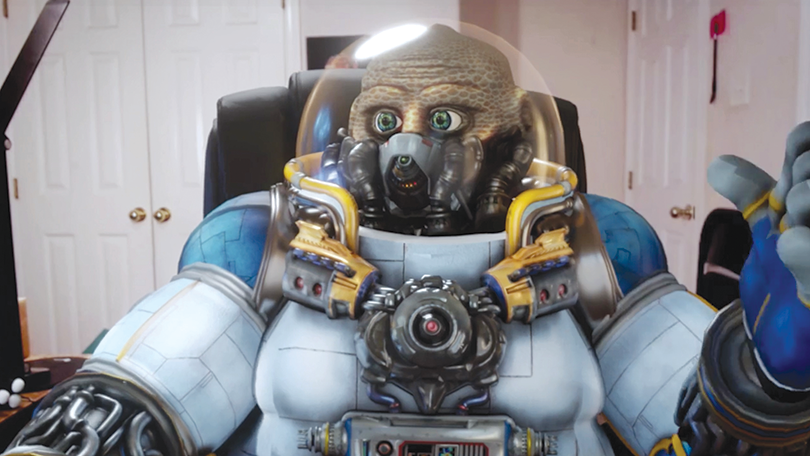
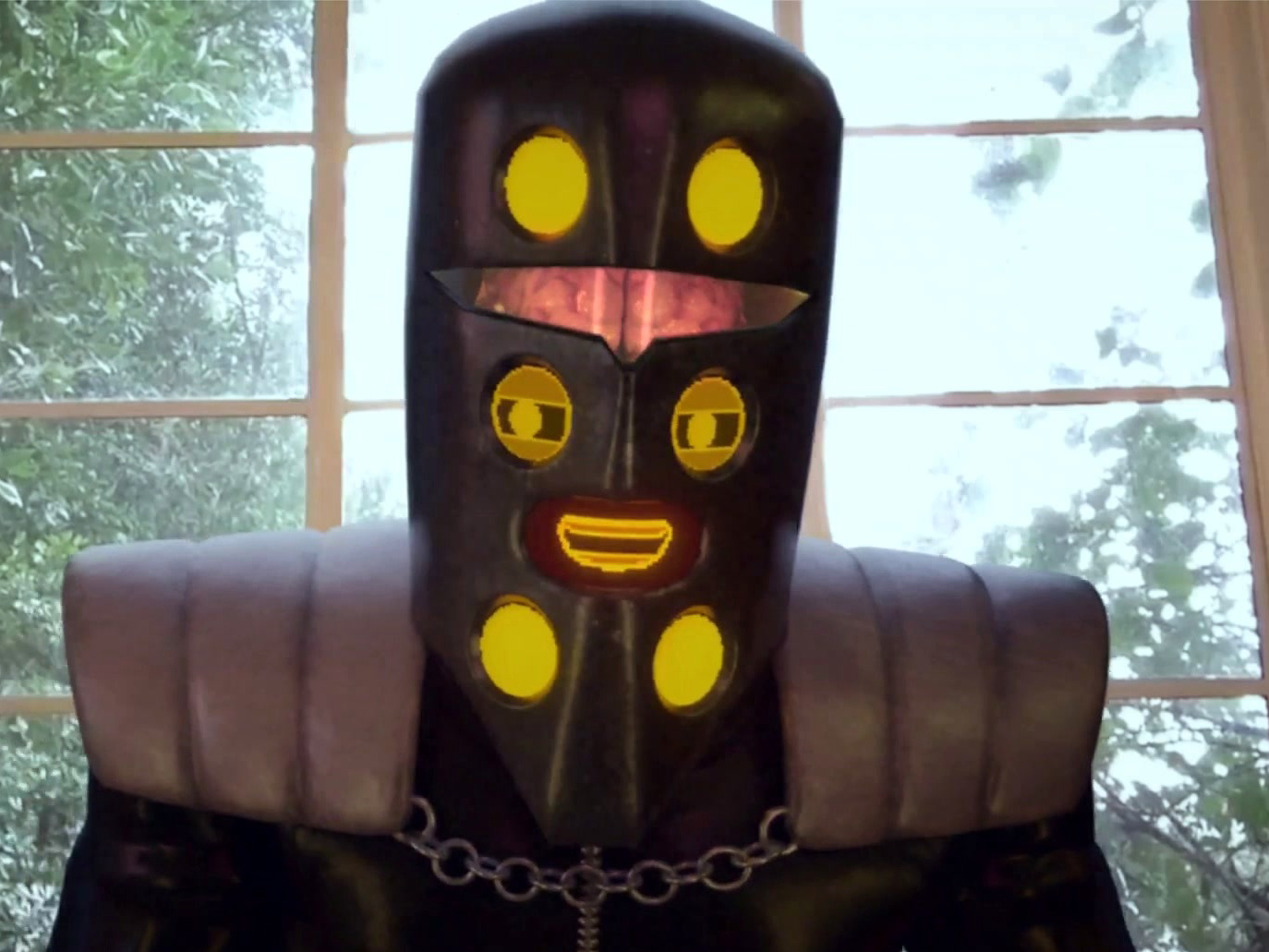
Among these irresponsibly arranged sound bytes and film clips, we also get to meet several of the documentary’s subjects, most of whom were interviewed via some kind of video conference software, and who appear on screen as video game-esque avatars. There’s Jesse Orion, a special education teacher who dreams of being an illustrator full time; we get to see some of his work, which includes a skull drawn in a Mike Mignola style as well as pages from his redrawing of an entire volume of Jean “Moebius” Giraud’s work using characters from the Peanuts comic strip. There’s also Leao Mystwood, who appears as a kind of high-tech Anubis; his time spent in a sensory deprivation chamber convinced him that his perception of himself as having or being a physical form is false, and that he is instead composed of code. There’s Alex Levine, whose avatar looks like a cross between the classic “brain in a jar” image that accompanies many discussions of simulation hypothesis and 790 from Lexx. But the interviewee we spend the most time with, and who in fact the film opens on and who deliberately “set[s] the tenor” of the piece as a whole is Paul Gude, who portrays (and perhaps perceives) himself as leonine. Paul opens with a story about attending a lecture while at university, in which his instructor discussed the genealogy of neurological epistemology as understood by theorists who were bound by the horizons of their knowledge; that is to say, when the highest level of technology was the aqueduct, the human understanding of neuroscience was perceived as and delineated through the use of fluids/humors, and then the rise of telegraphy altered that perception and description to instead treat the nervous system as a series of wires and impulses. From there, the rise of sophisticated computing technology lead to the contemporary understanding of the mind as a kind of CPU informs our current understanding of reality and the perception thereof; Gude then posits that since we now have technology capable of replicating reality virtually, we should then not only have the ability to conceive of our perception of reality as virtual, but to an extent, we must concede that it is so.
Gude notes that he was adopted, and that his adoptive father was a clergyman, and talks at length about his childhood proddings at the concepts of what constitutes reality. Some of this is familiar to me, although I wouldn’t go so far as to presume the universality of those experiences. One anecdote revolves around his childhood move to an area with a much smaller population than the city in which he previously resided, and his internal mental justification of this was that this was the result of the need for “them” to use less processing power to render fewer people and objects; the long drive to and from other areas was therefore the result of the need for “them” to change the surroundings and set up the next location. Although he doesn’t come straight out and use this analogy, it could be more simply explained that he conceived of car trips with his father as the equivalent of a loading screen between sections of a video game that show up while the next area is rendered. Another instance of his worldview being altered occurs while he is sitting in church, listening to his fellow congregants sing a hymn in unison, and his subsequent “realization” that what he is perceiving as a musical harmony and the assumption that it is produced by air forced through internal human flesh must be false, that it in fact could not possibly be the case. His story is presented without commentary, creating (through the language of documentary filmmaking) the impression that the documentarian concurs with this analysis and sees no issue with arriving at the conclusion that reality is a simulation because it’s “impossible” that the sounds of people singing are created by the vibration of larynxes. This is what I’m talking about when I say that the editorial tone is questionable; these are not intercut with psychologists elaborating upon common delusions and their physiological origins, but are simply presented as completely rational ideas.
Gude is not the only subject here for whom a history of teleological theology clearly underpins their perception (and associative distrust of the parameters) of reality. Leao Mystwood, whose introductory chyron provides the appellation “Brother,” also notes that he himself is an ordained minister. Textually, the film itself draws a comparison between the simulation hypothesis and many religious teachings, specifically citing Luke 7:21, in which Jesus, upon being asked about the Kingdom of Heaven, notes that the kingdom is “within” the questioners, existing both inside and outside of them. For someone for whom the concept that we reside in a simulation is an a priori assumption about the nature of existence, this statement, taken through that lens, seems to be that of an Avatar (defined traditionally, e.g., a divine being made flesh in our world) describing an external, “truer” world to beings who can only perceive the simulation that is “housed” within that truer world. And, despite the fact that Jesus also described the Kingdom of Heaven as a place of feasting with Abraham, Isaac and Jacob, a man who sowed good seed in his field, treasure hidden in a field, a net, and yeast, I think that interpreting the concept of “heaven” as a “truer” outer world within which our world is but a shadow on a wall is completely legitimate—and therein lies the rub of this film as a whole. After all, what is the simulation hypothesis if not a kind of creationism? I put “them” in quotations earlier when discussing Paul Gude’s ideas because he never names these actors and artificers who are exterior to the simulation, and neither does anyone else who was interviewed for this documentary; who are “they?” What could “they” possibly be other than the divine, or some secularized recontextualization of the concept of divine beings?
I find A Glitch in the Matrix troubling. That’s not because its “revelations” shock me to my core or make me re-evaluate the reality of, well, my reality. To be quite frank, the “simulation hypothesis” is essentially what I was raised to believe, as elaborated upon here, simply with a different name and an overlayment of scientific buzzwords and bizarre fetishization of Elon Musk (I haven’t forgotten about that part) over it to make it seem not only plausible but undeniable, when in reality it comes down to one of the oldest human concepts of them all: faith. One of the core tenets of faith is that this mortal, decaying flesh is not all that we are. That there is something external, that there is something higher, that there is a consciousness or consciousnesses which supersede and exist beyond ourselves which exert authority over our existence. Regardless of whether or not I personally think that interpretation of existence is valid, whether that concept comes in the form of a deity in heaven above or a programmer of the simulation, both require the same rejection of empirical reality as it can be measured, tasted, and observed and embrace an unfalsifiable concept of existence. That’s fine! But to present a text that defines existence this way as a documentary, to treat the belief system as fact instead of a chronicle about the people who believe it as fact isn’t documentation at all; it’s proselytization. It’s the same as when the VHS box for Future Tenseproclaims that it’s a “true story” that just “hasn’t happened… yet,” except that, unlike that production, this one doesn’t advertise itself as an evangelical tool. This presents itself as a factual document of record, which is both disingenuous and dangerous.
To give credit where it’s due, the second half of the film delves further into the dark potential of this way of thinking. In the first half, more than one of the interview subjects notes that there are people with whom they have interacted whose personal tendencies toward antisocial behavior and violence were only curbed by the belief that reality is real and therefore there are consequences to violence. This smacks of the logical fallacy that many people express, that we must maintain a society-wide belief in a higher power/metaphysical consequence in order for the populace to inhibit their darker impulses; you see this in the way that many people can’t wrap their heads around the proven validity of redistributing police and carceral punishment funds to preventative social safety nets as a method of preventing (instead of punishing) crime. There are a great many people (including, in my opinion, most of the people who appear in this movie) who need psychological therapy and/or pharmaceutical assistance to reach a baseline of empathetic civility. That the belief that others are less “real” than oneself creates a space for violence in its very core; it’s the foundational basis of white supremacy and other forms of antisocial ideologies that often result in violence in the public and private spheres. The film does denounce this potentiality, at least, and does so through a recorded phone call with Joshua Cooke.
That name, too, may sound familiar; nearly two decades ago, Cooke murdered his parents in the basement of their home with a shotgun. Infamously, his lawyers considered pleading insanity on his behalf, citing that Cooke “harbored a bona fide belief that he was living in [a] virtual reality,” which became known as the “Matrix defense” (Cooke eventually pled guilty). The possibility that the rejection of the fundamentals of reality could lead to violence is also referred to as the “school shooter” mentality within the film, but the film fails to provide a truly robust condemnation of violence within its text, and I think that’s rather telling. The proliferation of a multitude of people who take to the internet to share photoshopped images of cereal boxes and TV Guide typos to use as visual aids to the recapitulation of their experience of the so-called Mandela Effect isn’t just harmless shenaniganry; it’s a demonstration of the larger parts of society’s growing unwillingness to reexamine their precepts and beliefs, even in the face of evidence against it. We are living in an era in which people are more likely to believe that they’re sliding through parallel universes like Quinn Mallory rather than consider that their memory might fail to be 100% accurate, simply because Reddit told them so; we’re seeing the consequences of that now, politically and globally. To paraphrase another giant of speculative fiction, Isaac Asimov, there is a growing contingent of Americans who legitimately believe that their ignorance (and misremembrance) is just as valid as scientific knowledge and evidence, and it’s that which I find truly deplorable about A Glitch in the Matrix’s text—it will only add more fuel to that fire which threatens to consume our world. Blink and you’ll miss it, but one of the interviewees notes that they think large scale disasters, including those like recent California wildfires that are exacerbated by climate change, are the result of programming errors; every day in every way they’re coming up with new reasons to denigrate the need for immediate action to mitigate and prepare for climate change.
Although the second portion of the film attempts to cover the failures of the film’s first hour, its bizarre fetishization of Musk extends beyond the questionable first half into the second. And make no mistake—some of these people come within a hair’s breadth of literally worshipping Musk. Taking into consideration that the simulation hypothesis is just creationism with extra steps, at least one of the interviewees essentially likens Musk to a god. While explicating on the idea that some people are player characters and others are non-player/playable characters (or NPCs), one of the interviewees speculates that Musk might be not only a player character, but someone from outside the simulation who “descended” into our reality as an avatar in order to try and awaken us and to a recognition that the simulation as false. That is to say: this person believes that it’s possible Musk is an extra-simulation messiah. At the risk of editorializing, I’ll say this: if god were one of us, I’d accept that they were a slob like one of us or a stranger on the bus, but they sure as hell wouldn’t be a guest on Joe fucking Rogan’s podcast. I get that for many neurodivergent people, Musk’s accomplishments (such as they are) are encouraging and demonstrate that people with Asperger’s shouldn’t be dismissed out of hand, but I won’t make any apologies for failing to be impressed that the heir to an apartheid emerald mine leveraged obscene and objectively amoral wealth into a business empire that’s largely dysfunctional. You’d be hard pressed to find someone more interested in living on the moon than I am, but I’m not gonna work for Mr. Grimes’s scrip and I’m not going to live in one of his lunar debtor’s prisons/company towns; you can fucking forget that.
I mean no disrespect to those who work in the service industry, but when someone says “For two years, all I did was work at Chili’s and then come home and play video games,” and then uses that as the basis for their claim that they then “realized” that reality was also just a video game, that’s a person who needs counseling and therapy to manage their addiction. I’m not mocking this guy: addiction is a disease, it takes many forms, and it warps your reality. What it doesn’t do is make you an expert on that reality. The two works that this most reminded me of were the film What the #$*! Do We Know!? and the book Supergods by Grant Morrison. In the case of the former, Glitch is similar in that it presents pseudoscientific ideas not as a possible interpretation of existence, but as decidedly true (and, although I am aware that this verges on ad hominem, it’s worth noting that it was created by NXIVM cultists). In the case of the latter, I find the use of footage from Philip K. Dick’s mental breakdown to be both heartbreaking and cruel; it reminded me of Morrison’s book, which for the first 2/3rds is a loving, jubilant history of superhero comics and that artform’s various wonders, before the final third descends into a bizarre scripture of Morrison’s personal beliefs. I won’t try to summarize them here, but here’s a sample (from p. 277 of the 2012 Spiegel & Grau paperback edition): “The interior of our skulls contains a portal to infinity [….] Could fertile wet planets like our Earth really be nurseries where omni-anemones fed and grew to become quicksilver angels in a timeless AllNow?” For the sake of my future hypothetical political career I won’t get into specifics, but I’ve personally spent a not-insignificant amount of time communing with the fractals, if you catch my drift; that doesn’t mean that I would ever consider that experience to be revelatory about the nature of reality, and if I did, and I tried to start spreading the Gospel of Boomer, and that Gospel also incorporated depersonalization that is analogous to that which is part of evil ideologies, I’d hope no one would follow me. I also hope no one takes this documentary to heart, and in the meantime I’ll be looking forward to a different documentary about the simulation hypothesis someday, one which is more scientifically, spiritually, and ethically considered.