Chappie (2015)

EPSON MFP image

three star

campstamp

As a sci-fi action thriller with prodding questions about private sector weapons production, the drone/surveillance state, and the nature of consciousness and personal identity, Chappie is an utter failure and deserves all of the vitriol that’s it’s been drowning in. As a feature-length Die Antwoord music video, however, it’s a winning success. I’m honestly happy to report that the distinguished pedigree of pop-music movie vehicles like Cool as Ice, Crossroads, Glitter, Spice World, and KISS Meets the Phantom of the Park is alive & well in 2015. Honestly. I’m happy with Chappie for what it is: a two hour long commercial for a South African “rap-rave group”, a living, breathing internet meme that scored a surprise one-hit wonder status five years ago.

Although Die Antwoord has released three full-length albums and nearly a dozen music videos at this point, it’s still tempting to categorize them as a one hit wonder. Hell, pop star Tiffany has eight full-length albums and a documentary and she’s still defined by the success of “I Think We’re Alone Now”. Die Antwoord’s own “I Think We’re Alone Now” is a 2010 trash pop oddity called “Enter The Ninja.” Unlike a lot of Die Antwoord’s more repetitive, rave-friendly songs, it’s a real ear-worm in its own bizarre way and it had the added benefit of introducing a their then-fresh world of graffiti-soaked visual art in an eye-popping music video that went “viral”. In the five years since the release of “Enter The Ninja” their act has worn a little thin on me (as one-hit wonders often do), but they’ve developed a devoted niche audience for their version of the South African “zef” aesthetic, an audience that takes their music & visual art very seriously. If Die Antwoord was conceived as a joke or a meme, it’s impressive how committed they are to the gag, seemingly integrating it into their personal lives & physical appearances to the point where it doesn’t matter whether they’re “for real” or not.

It’s no surprise, then, that Die Antwoord’s singular hit “Enter the Ninja” plays over the final shot & end credits of Chappie. When I first spotted them in the trailer for the film, I assumed their role was a severely limited one, a glorified cameo. I was wrong. Die Antwoord are to Chappie what Vanilla Ice was to Cool as Ice, what Eminem was to 8 Mile, what The Village People were to Can’t Stop the Music. This is their vehicle. They play themselves. Their music dominates the soundtrack. They flaunt their own merch. Their visual aesthetic (crude phalluses, expletives, and all) is drawn all over every inch of the set. What outfits vocalists Ninja & Yolandi Visser are going to wear from scene to scene are vastly more interesting choices than what their far more famous co-stars Hugh Jackman or Sigourney Weaver are going to do or say. Even the basic appeal of the titular robot Chappie revolves around the duo, since they raise him like their baby and teach him to walk & talk their brand of zef culture. This is unmistakably Die Antwoord’s movie.

The movie vehicle for flash in the pan one hit wonders was an artform I had assumed long dead, but Chappie brings it back to life with the modern update that the group in question started essentially as a meme. Director Neil Blomkamp (District 9, Elysium) tried to elevate the material with questions like “Where is our privatization of military weapons production & law enforcement headed?”, “Why are we so cruel to what we don’t understand?”, “What is a soul?” and blah, blah, blah. In this line of questioning, Chappie is nowhere near as insightful as its robot movie ancestors, like the near-30 years old (and near perfect) RoboCop or, hell, even the severely flawed Short Circuit. It is, however, particularly exciting as a return to form for fans of campy vehicles for pop music icons and one-trick ponies. In this case, Die Antwoord. If you’re looking for a thought-provoking sci-fi action flick with well-considered themes explored to their full potential, you will hate Chappie. If you like (or are amused by) Die Antwoord and wonder what a trashy action movie about armed robots & roving gangs ransacking Johannesburg that Ninja & Yolandi would imagine themselves starring in would possibly look like, you have a pretty good chance of enjoying yourself. The only thing it was missing on that end was a live performance.

-Brandon Ledet

The Congress (2014)

EPSON MFP image

fourstar

It’s difficult for a film to blend animation with live action in a credible way. It’s been more than 25 years since the release of Who Framed Roger Rabbit? and I can’t think of a single picture since that does half as good of a job combining the two techniques. Last year’s The Congress sidesteps this problem by keeping its live-action & animation segments almost entirely separate. There’s a purpose to its partitioning of its separate halves, though. The front, live-action end of The Congress depicts a drab, near-future full of anxieties, disease, fears, and oppressive commercialism. The animated second half is an escapist fantasy that offers sanctuary from that depressing world, its own crippling faults buried deep underground. There’s a vibrant world of possibility (both elating & horrifying) offered by The Congress’ choice to animate its outlandish, dystopian future. It was a wise decision that saved the film from being a decent sci-fi exercise and instead made it an engaging cinematic oddity.

The opening, live-action segment of The Congress has an interesting way of providing flat, nonchalant reads of big concepts. Playing off the idea that movie studios literally want to own their talent (like in early Hollywood, if not like now), the not-quite-fictional powerhouse Miramount Pictures offers Robin “Princess Bride” Wright (playing herself here) a life-changing professional opportunity. They offer her a large sum of money to “hermetically scan” her likeness using a futuristic technology that would allow them to insert her digital self into any film project they want. The contract would prevent her from ever acting in the flesh again, but if she doesn’t sign it she’s also risking the studio erasing her work from the screen forever. It’s an interesting concept that brings to question a lot of notions we have as an audience about celebrities (real-life, breathing human beings) as consumable products. In addition to her contract negotiations with Miramount (she eventually signs the contract, of course) the film also interweaves some half-baked, purple prose musings about her son’s deteriorating health and obsession with kites & airplanes. The overreaching sentimentality of these scenes reminds me a lot of the soft sci-fi of the over-the-top camp fest Upside Down and a lesser movie would’ve stopped there and not pushed its crackpot ideas any further (like in Upside Down). The Congress, thankfully, keeps pushing.

After Wright allows herself to be “hermetically scanned” the film jumps 20 years further into the future into a world where people escape from the shackles of an unfulfilling reality by snorting a chemical that allows them to live in a vibrant, animated fantasy world. The “Animation Zone” is a complicated mess of art influences; like an art deco take on Dr. Suess’ wavy line landscapes with whales, dragons, constellations, rainbows, and genitals-shaped fish populating its blinding, neon color palette. It’s stunning. From this point on, it is difficult to tell exactly how much of the film is “real” and how much of it is happening only in Wright’s mind. As one character puts it, “Ultimately everything makes sense and everything is in our minds.” Playing off the celebrities-as-commodities concept of the first half, film studios in the animated future have found a way to convert actors into chemical compounds that can be eaten, drank, and ultimately copied. Instead of watching your favorite celebrities act out fantasies onscreen, you can now become them, so the world is littered with endless copies of familiar faces like Tom Cruise, Ron Jeremy, Jesus Christ, Michael Jackson, Zeus, Marilyn Monroe, Frida Kahlo, and Muhammad Ali. It’s terrifying.

The animated back end of The Congress is by far the more impressive half of the film, but its slow introduction through the “technophobic”, soft sci-fi of the first half is partly what makes it work. There have been a lot of recent films that attempt to tackle the emptiness of celebrity culture (Birdman & Maps to the Stars, for example), but none push their concepts to such a far, overreaching end as The Congress. The film isn’t entirely successful. The significance of the kite & airplane metaphors, while serving as a decent through line between the two segments, were difficult to grasp as a viewer; there’s an uncomfortable line of thought near the climax that risks making the entire film feel like a screed on anti-depressants; the stilted nature of the dialogue on the front end can be alternatingly amusing & frustrating, etc. However, its faults feel trivial in consideration of how ambitious & assertive the film plays as a whole. The Congress may be an overwrought mess in some ways, but it’s a fascinatingly idiosyncratic mess that’s impressive in its aspirations of pushing its musings on celebrity culture to the most far-reaching ends possible, putting good taste & tact aside in favor of a thorough, bizarrely unrestrained exploration of its themes. It’s the exact kind of mess I like.

-Brandon Ledet

Space Station 76 (2014)

EPSON MFP image

fourstar

The most surprising thing about Space Station 76 is the giant black hole in the movie’s heart. The film’s retro, space-age aesthetic has been tapped for comedy before in titles like Galaxy Quest & Mars Attacks!, but rarely for such a dark effect. Among the film’s inherent “Hey! Remember the 70s?” gags there is some really twisted humor about subjects like substance abuse, adultery, and suicide. Space Station 76 has its cake and it eats it too, displaying both the cheerful 70s vibes you’d catch from TV shows like The Brady Bunch and The Love Boat and the devastating, real-life problems of the audience that used to watch them.

On the “Hey! Remember the 70s?” side of the equation we have details like roller-skates, crayons, tracksuits, bellbottoms, Farrah Fawcett hair-dos, porn mustaches, luaus, Betamax, viewfinder toys, wood paneling, Muzak, marijuana, children named “Sunshine”, and repressed homosexuality . . . in space! On the depressing side we have two dysfunctional marriages, a woman who despises her body because she can’t conceive, a child who is ignored seemingly by everyone, petty jealousies, overreliance on Valium, and repressed homosexuality . . . in space! There’s some real pain in exchanges like when the infertile woman is told “You can have a baby. Anyone can have a baby. What are you talking about?” and the seething hatred that poisons the crew’s personal relationships is overbearingly intensified by the confined nature of the space station setting. As social etiquette deteriorates and the hatred bubbles to the surface in bursts of unusual honesty, the film becomes one of my favorite types of stories, “The Party Out of Bounds”.

It’s a testament to the cast that the movie is both funny and depressing. Patrick Wilson is amusing as the uptight captain, Jerry O’Connell is perfect as a disco-clad cad, and few people could sell emotional fragility like Liv Tyler does here, but none of those actors are the stand-out star of Space Station 76. The most essential character in the film is a retro robot psychiatrist that dispenses empty, monotone, ready-made advice like “You can’t be everything to everyone until you are something to yourself” as freely as it dispenses prescriptions to Valium. The robot psychiatrist is the film in a nutshell: an image of 70s nostalgia that inspires both genuine laughs & genuine pain in its explorations of clinical depression, familial structure, and self-denial. It’s one hell of a robot in one hell of a black comedy . . . in space!

-Brandon Ledet

Frankenstein Meets the Space Monster (1965)

EPSON MFP image

fourstar

campstamp

Frankenstein Meets the Space Monster is of the rare breed of old school shlock that lives up to the promise in its ridiculous title & premise. That’s no small feat. As I noted in my review of the similarly surprising in quality camp fest The Brainiac, “Like with all art forms, it’s difficult to find a great ‘bad movie’. For every transcendently awful Plan 9 or Troll 2 you have to sift through a hundred mind-numbingly dull Hobgoblins”, but on the other hand “When a B movie is firing on all cylinders, enthusiastically exploring every weird idea it has to their full potential, there’s really nothing like it.” Frankenstein Meets the Space Monster, (which is also known by the titles Frankenstein Meets the Space Men, Mars Attacks Puerto Rico, Mars Invades Puerto Rico, and Operation San Juan) is firing on all its batshit crazy cylinders, squeezing a surprising amount of camp value out of its limited premise & budget.

Let’s get the film’s most peculiar detail out of the way: neither Dr. Frankenstein nor his monster appear in the flesh. The “Frankenstein” in the title is instead a government-created bionic astronaut that is horrifically scarred in a botched space launch. As his circuitry goes awry, he turns from ideal soldier to confused monster and haunts the coast of California, murdering its inhabitants indiscreetly. Although the interpretation of “a Frankenstein” is loose here, the practical effects in the gore surrounding the monster are pretty chilling. In an early scene his scalp is peeled back so scientists can tweak his malfunctioning circuitry. Later, the make-up on his disfiguring facial scars are a lot more horrifying than you’d expect based on the precedent of, say, Lobo in Bride of the Atom or the astronaut gorilla in Robot Monster. The other monsters in the film are only slightly less terrifying, including the titular “Space Monster” (who looks like a member of GWAR) and the space alien Dr. Nadir (who looks an awful lot like Bat Boy all growed up). Dr. Nadir may not be as physically threatening as his fellow monsters, but he steals the show with his effete love of his own cruelty, like a dime store Vincent Price.

The film is surprisingly technically proficient considering its circumstances. It boasts a similar premise and overreliance on stock footage as the camp classic Plan 9 from Outer Space, but thoroughly succeeds on both fronts, as opposed to Plan 9’s thorough failures. When the evil space princess that commands Dr. Nadir announces that they are to proceed with “Phase 2 of our Plan: capture of the Earth women” (a.k.a. “bikini babes”) it’s more amusing than embarrassing. You can feel the crew having a fun time making this thing, which is reflected in its music cues, among other things. Almost all of its outer space scenes are accompanied by a spooky theremin score, but its Earth scenes (whether a dance party, a murder, or an alien abduction) are almost all accompanied by a surf rock soundtrack, which gives the film a beach party vibe. The title of the film itself sounds like a ready-made name for a surf rock song and I’m surprised no one’s jumped on that opportunity in the 50 years since the film’s release.

I could go on, but describing what makes the movie work on a technical level is somewhat futile. I doubt I can mount a sales pitch that match the just-the-facts plot summary from the film’s Wikipedia page, so here it is in full: “All of the women on the planet Mars have died in an atomic war, except for Martian Princess Marcuzan. Marcuzan and her right-hand man, Dr. Nadir, decide they will travel to Earth and steal all of the women on the planet in order to continue the Martian race. The Martians shoot down a space capsule manned by the android Colonel Frank Saunders, causing it to crash in Puerto Rico. Frank’s electronic brain and the left half of his face are damaged after encountering a trigger-happy Martian and his ray gun. Frank, now ‘Frankenstein’, described by his creator as an ‘astro-robot without a control system’ proceeds to terrorize the island. A subplot involves the Martians abducting bikini clad women.” If that description alone doesn’t sell you on watching an ancient, goofy sci-fi horror I’m not sure what will. Also we are very different people.

-Brandon Ledet

Ghosts of Mars (2001)

ghostofmars

twostar

campstamp

In 1965 Italian horror mastermind Mario Bava released the eerie, way-ahead-of-its-time Planet of the Vampires. In 1979 directorial enigma Ridley Scott drew major influence from the atmospheric elements of Planet of the Vampires and reworked them into Alien, one of the scariest, most striking creature features of all time. In 2001 former-genius-turned-shlock-peddler John Carpenter borrowed Planet of the Vampires’ most superficial plot points and turned them into a nu-metal shootout in space that nobody asked for.

Told through the unnecessary framing device of a criminal hearing in a Martian mining colony of a future matriarchal society (we know this detail because of a title card that helpfully reads “Society: Matriarchal”), the bare bones story of Ghosts of Mars is awfully similar to that of Planet of the Vampires. While digging under Mars’ surface, miners mistakenly release disembodied Martian spirits (or “ghosts” if you will) who are none too pleased with the planet’s new human inhabitants. As one character puts it, “As far as they’re concerned, we are the invaders.” Yep. The ghosts of Mars exact their revenge on the Earth invaders by inhabiting their bodies, then causing them to self-mutilate & murder each other indiscriminately. The ghosts are essentially impossible to kill, because when one of their bodily vehicles dies they simply move on to the next.

Instead of properly utilizing the horrific potential of this premise, Carpenter mistakenly aims for a late-90s cool, the same effect he attempted in his 1998 misfire Vampires. Characters saunter around in black leather trench coats, getting high on space drugs, piloting steampunk hot air balloons, and trading we’re-so-cool quips like “Maybe I’d sleep with you if you were the last man on Earth. But we’re not on Earth.” If it weren’t for the ghosts, the Martian community could be mistaken for an especially dour year at Burning Man. Despite that, the ghosts themselves are menacing enough. Even though the cheapness of their costumes suggests Mad Max cosplay or a GWAR cover band, they have a distinct affinity for decapiation that makes them viable as a real threat. The problem is that any threat they pose is severely undercut by the nu-metal riffage that obnoxiously drones on in the background, trying (but failing) to portray them as super cool instead of super creepy.

Ghosts of Mars isn’t a total loss, but it is a disappointment. The cast is surprisingly decent, considering the quality of the film: Clea DuVall, Jason Statham, Natasha Henstridge, and Pam Grier are always welcome faces (although, how there are two Pam-Grier-In-Space movies and they both suck is beyond me). Ice Cube steals the show, firmly operating in angry NWA mode and not his more recent milquetoast-family-man mode. Although it’s a disappointment that the film’s genuinely cool ghosts-in-space concept devolves into a generic nu-metal shootout film, watching Ice Cube (and Clea DuVall for that matter) run around like a shoot-em-up action star is a draw in itself. Carpenter failed to utilize the body possession aspects of the premise to its full Planet of the Vampires potential & lazily used storytelling devices like flashbacks within the central flashback to get its point across and he paid the price for it. Ghosts of Mars was a huge flop, earning only half of its $28 million back at the box office. The most frustrating thing about the film is that you can see elements in play that could swing it either in the direction of an actually decent horror flick or at least a ridiculous camp fest if exploited properly. It instead mires itself in self-mutilating, nu-metal-soaked mediocrity.

-Brandon Ledet

The Adventures of Pluto Nash (2002)

EPSON MFP image

onehalfstar

campstamp

I’ve been curious about The Adventures of Pluto Nash for over a decade now. It’s widely accepted that Eddie Murphy has been putting in subpar work since at least the late 90s & Pluto Nash seemed to be one of those early signs that his best days were well behind him. With a $100 million budget and a mere $7 million dollar return, the movie was one of the top ten biggest box office flops of all time. While I didn’t expect it to be a particularly great movie, I though it did have potential as a trashy gem (à la Leonard Part 6 or Howard the Duck) because of its sci-fi premise. I suspected that Pluto Nash had potential as a fun bad movie because it was a Bad Movie in Space, which gave it a distinct advantage over the appeal of the Klumps & Norbits of Muprhy’s career. Unfortunately, it instead committed the number one sin in the Bad Movie Bible: it was boring.

When I pictured a Shitty Eddie-Murphy-in-Space Movie with a $100 Million Budget, I naively expected all kinds of goofy adventures featuring Murphy exploring improbable planets & cracking wise at the expense of goofy-looking aliens. Instead, Pluto Nash bottled all of its action on the Earth’s moon and supplanted madcap adventure with run-of-the-mill gunfights & a staggering surplus of jokes about horny robots. Murphy’s Nash is a retired smuggler struggling to run a clean nightclub business where oddly costumed weirdos can line dance to Outkast songs in a futuristic version of doing the robot. His wholesome nightclub is threatened by mafia types who want to turn the moon into a tacky outer space Atlantic City and he risks his life to stop them. The movie could’ve been set on Earth in the present and not lost much in the translation.

In the rare moments when the movie is in full gear the screen is littered with cheap-looking gunfights & car chases crippled with mediocrity. When it slows down Nash literally goes into hiding and essentially watches the Moon’s version of Netflix, which has to be one of the most boring approaches to a space adventure ever conceived. Imagine if The Fifth Element were adapted as a hackneyed UPN sitcom that frivolously wasted its entire budget on huge explosions & cameos that no one asked for and you’d have a pretty good idea of Pluto Nash’s style. Even the movie’s sole set outside on the Moon’s surface is embarrassingly cheap looking, faker than even 1969’s “real” Moon landing.

It’s hard to imagine where the film’s budget went outside the cast (and the gratuitous explosions). The list of supporting players is beyond impressive: B-Movie legend Pam Grier plays Nash’s gun-toting mother; the beautiful Rosario Dawson is his unlikely love interest; Peter Boyle is his partner in crime; Jay Mohr is a pop star that narrowly avoids drinking battery acid; John Cleese is some kind of AI butler. That’s not even including the appearances of Alec Baldwin, James Rebhorn, Joe Pantoliano, Illeana Douglas and Randy Quaid (as the aforementioned horny robot). Unfortunately, this ungodly stockpile of talent is put to waste and everyone seems to be in full paycheck mode. Even Murphy himself is dead weight here, keeping the antics to a minimum & surrounding himself with a script seemingly designed to massage his ego by constantly reminding everyone how awesome he is. The only actor that has any fun with the film is the always-dependable Luis Guzmán, but Guzmán is about as consistent as they come, so it’s a fairly hollow victory.

The Adventures of Pluto Nash is an action comedy that fails both in its action and its comedy. Jokes about Hilary Clinton’s face on future money (har har) and robots desperately trying to get laid (hee hee) aren’t funny the first time around and are downright painful in their repetition. The film even unironically uses a record scratch sound effect to punctuate its action gags, lest the audience forget to laugh. It’s that dire. As I’ve pointed out before in reviews of Exit to Eden & 2014’s Teenage Mutant Ninja Turtles, it’s possible for failed comedies or action movies to still be interesting as cultural time capsules or complete train wrecks. There’s a miniscule amount of early 2000’s charm in Pluto Nash’s shoddy rap versions of corny songs like “Blue Moon” & “Dancing in the Moonlight”, its semi-futuristic nightclub attire, and its use of Space Jam-inspired font, but it’s not enough to save the film from its own self-crushing blandness. In this case the schlock is both unfunny and boring, which is a brutal combination for any audience. I should’ve left Pluto Nash where it belongs: forgotten in the past, in hiding on the Moon, watching Moonflix (or whatever) in its pajamas, and trading tired quips with oversexed robots.

-Brandon Ledet

Upside Down (2013)

EPSON MFP image

fourstar

campstamp

It’s probably safe to say that by the end of its whopping seven minutes of opening narration you’ll be prepared to tell if you’re game for where Upside Down wants to take you. In heavy, overreaching breaths the protagonist coos about pink bees, forbidden love, flying pancakes, and “the three basic laws of double gravity” in a stunningly over-explanation of the film’s ludicrous premise. It’s as if Romeo & Juliet were retold through the half-mad kaleidoscope of Richard Kelly’s Southland Tales. The line “Once love was stronger than gravity” best sums up the tone, distinctly warning the audience that this is a fairy tale and a love story, not a crowd-pleaser for discerning sci-fi types.

As is common with fairy tales (and sci-fi for that matter), the film sets up a very simple haves-vs-have-nots dichotomy. Two worlds are connected by opposing gravitational pulls, so that inhabitants of one are always looking upside down at the inhabitants of the other. The world on top is rich. The world on bottom is poor. It’s about as simple of an allegory as you’ll get outside the front & back of the train in Snowpiercer. The fun is in the film’s more fantastic elements, like the aforementioned pink bees that pollinate flowers from both worlds and improbably make an interplanetary romance possible. Besides a few grim details in the wealth disparity and interplanetary oil trade, Upside Down is mostly light fare. If you have the ability (or desire) to turn off your brain and enjoy a sappy against-all-odds love story that involves distant planets and magical pink nectar, it’s a truly fun film.

Even though the movie requires a complete absence of cynicism, it does boast visually thoughtful rewards as well. The spaces where the two worlds meet (particularly in offices & ballrooms that stretch on like two mirrors facing each other) are just straight up nifty. There’s an effortless cool to watching Kirsten Dunst sip a martini out of an upside down glass or watching her love interest hop around on floating platforms like a video game character. After the film’s opening Richard Kelly-style rant, it slows way down to tell a simple love story that will sound awfully familiar to most, but it’s a cliché that’s substantially boosted by its outlandish setting. The romantic fairy tale Upside Down tells is trite, but it’s also timelessly cute and backed up by a puzzling visual landscape that’s deliciously stubborn to even the most basic logic.

Upside Down is currently streaming on Netflix.

-Brandon Ledet

Carnival Revelry: The Intergalactic Krewe of Chewbacchus in 2015

EPSON MFP image

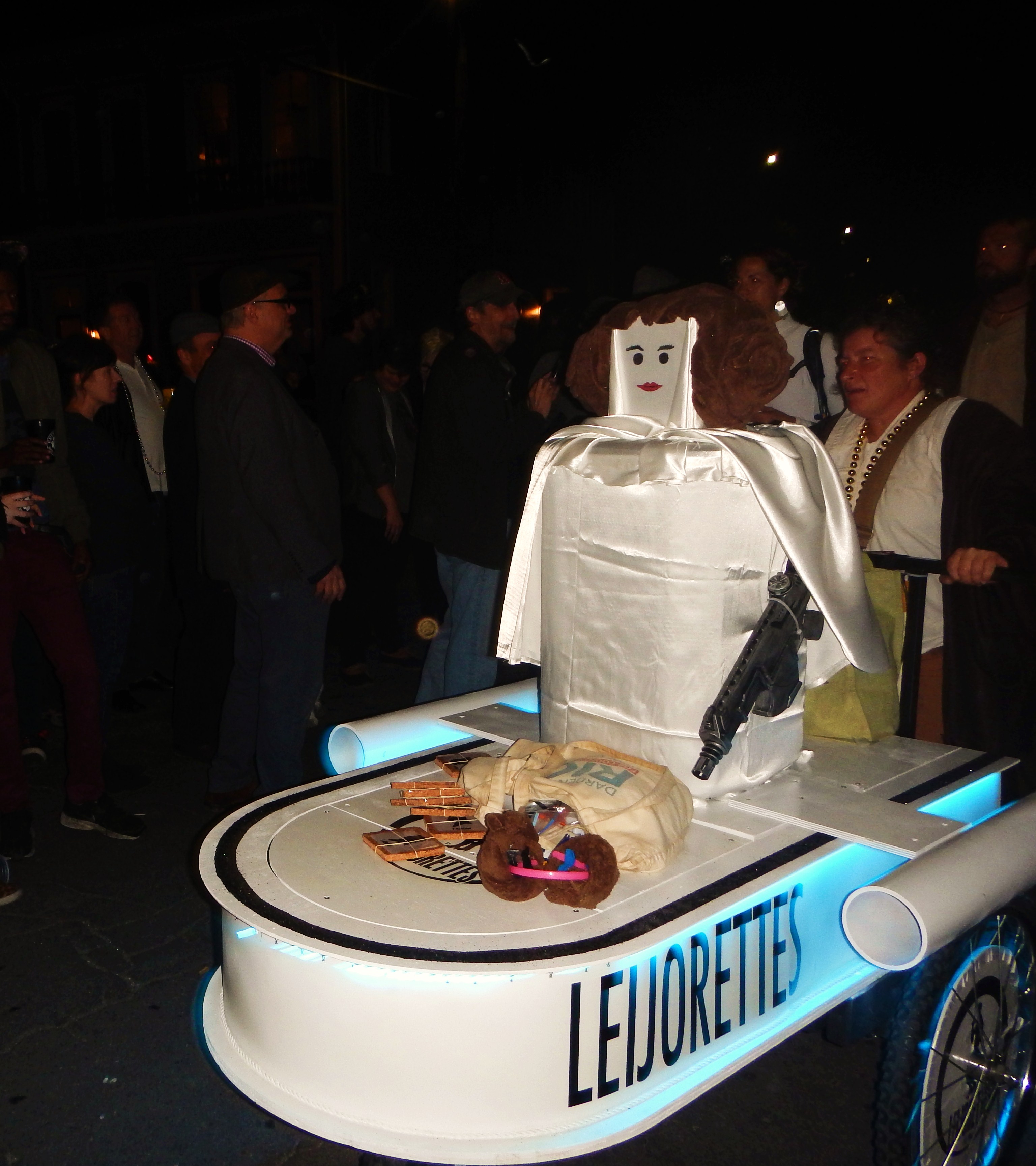
This past Saturday was the annual turning point for me when Mardi Gras stops being a vague concept I hear about on the radio & Facebook feeds and becomes an experience I’m living. Although the Phunny Phorty Phellows’ annual streetcar ride on Twelfth Night is the official start to Carnival season, it’s one I typically miss. Mardi Gras never feels real until I’m finally misbehaving in the thick of it & Krewe du Vieux is my usual starting point for the revelry, but I missed that parade this year as well. 2015’s Chewbacchus celebration was that magical moment when everything clicked and I thought “This is it. This is Mardi Gras.”

The Intergalactic Krewe of Chewbacchus is a relatively young parade that rolls hand-made, people-powered contraptions through the French Quarter & Marigny while the larger, gas-powered floats roll elsewhere across town. Although their nerdy umbrella has expanded to include all kinds of sci-fi goofiness, they’re the only parade I can think of that’s specifically designed to celebrate a movie franchise: Star Wars. Despite the inclusion of other sci-fi properties like Doctor Who, Star Trek, E.T. and (most recently) Guardians of the Galaxy, it’s still a mostly Star Wars-themed affair, one that lauds the “drunken Wookie” Chewbacca as its monarch. Real-life Chewbacca Peter Mayhew himself has even lorded over the parade the past couple of years, revelers treating him like nerdy royalty. The parade’s haphazard, DIY aesthetic perfectly matches the DIY practical effects of the original Star Wars trilogy. Star Wars’ endless parade of odd-looking weirdos and handmade sets & costumes serves as a fitting platform for New Orleans’ own endless parade of odd-looking weirdos & their personal creations, even if they’ve come to incorporate other fandoms as the years march on.

Wasting away a drunken afternoon in the Quarter and then capping off the night with Chewbacchus’ Imperial Stormtroopers & Jedi Knights was my personal introduction to the 2015 Carnival season. It was a great feeling to ring in my favorite time of the year while celebrating one of my other favorite activities: watching movies. Here are a few pics to help solidify the memory.

DSCN0999

DSCN1000

DSCN1001

DSCN1003

DSCN1004

DSCN1005

Have a great, safe Mardi Gras, y’all! And may the Force be etc, etc.

-Brandon Ledet