Movie of the Month: Batman – Under the Red Hood (2010)

Every month one of us makes the rest of the crew watch a movie they’ve never seen before & we discuss it afterwards. This month Boomer made Brandon , Alli, and Britnee watch Batman: Under the Red Hood (2010).

Boomer: Cards on the table: Under the Red Hood is my favorite Batman movie. Obviously I prefer it over Zack Snyder’s take on the character, but I also find it superior to both Tim Burton and Christopher Nolan’s respective series, although there are elements of both that work well and that I quite enjoy. This may not be my favorite version of Batman (that honor always has been and presumably forever shall be the Bats of Batman: The Animated Series), but it’s the best self-contained feature that both feels like a true standalone while also addressing the character’s long history. There’s no origin story, no belabored backstory showing how and why Bruce Wayne came to be the Batman, no attempts to make the character feel like he fits in a modern context or make the gadgets and gizmos seem “realistic,” and no damned pearls in an alley (note, even Batman v Superman did this, two years after the linked video pointed out that it was a cliche). I said it two years ago and I’ll say it again: Batman has the second most famous origin story in the world, surpassed only by the birth of Christ; we don’t need to see it on screen ever again. Instead, this film jumps in at a point in time pretty far into the detective’s career.

Under the Red Hood opens in Sarajevo, where The Joker (John DiMaggio playing against type) has savagely beaten Jason Todd (Jensen Ackles), the second of Batman’s sidekicks/apprentices to bear the codename “Robin,” nearly to death with a crowbar. Batman (Bruce Greenwood) races to the scene, but arrives too late, as a bomb destroys the warehouse in which Jason was left behind. Years later, The Joker is safely locked away and the majority of Gotham City’s criminal element reports to the Black Mask (Wade Wilson), but the leaders of various crime families are confronted by a new player: The Red Hood. The Hood has knocked off several of the families’ top players to demonstrate his prowess, and his hijacking of a major weapon brings him to the attention of Batman and Dick Grayson/Nightwing (Neil Patrick Harris), the first Robin. Batman realizes early on that The Red Hood knows his true identity and is haunted by his past mistakes and failures, the worst of which was his inability to save Jason. The crime war between Red Hood and Black Mask escalates to the point that the Mask is so desperate he breaks The Joker out to take down his rival, leading to a confrontation that forces Batman to confront his mistakes, morality, and the nature of his war on crime.

This is a grim story, with a bleak ending that gives me chills every time. I’ll not bother with the spoiler alert as this movie is over ten years old and the comic on which it was based was published five years before that, and the film itself does little to disguise the reveal that The Red Hood is, in fact, Jason. This is a departure from the comic, which preserved this mystery for as long as possible, which makes for a richer story as it allows for a deeper rumination on the ways that devotion to an absolute moral code can have unforeseen consequences, and how a bad seed can take root in the soul despite the best attempts to provide a moral compass. As Bruce says in one of his introspective moments, the responsibility for the life and death of Jason Todd falls on his shoulders: “My partner. My soldier. My fault.” How Jason came to be The Red Hood and his motivations are instead the crux of the film’s mystery, and it’s all the more poignant for it. I find myself thinking about the emotional gut punch of the final scene fairly frequently: after the apparent death of Jason (again), violently and pointlessly, we return to the cave and a memory of Jason’s first day as Robin, as he excitedly dashes around with the kind of effortless exuberance that only a child can have, before declaring that it’s the “best day of [his] life.” And we fade out on that image of the hopeful, blindingly optimistic beginning of a journey that we as the audience have just seen come to a brutal, bitterly violent end; it’s a closed, nihilistic loop that gets me every single time.

Comparisons to Winter Soldier were common thirteen years ago when Judd Winick was writing the comic on which the film was based, titled simply Under the Hood. It was a common joke for decades that “no one in comics [stayed] dead except for Bucky (killed in action in 1945, as revealed in Avengers #4 in 1964), Jason Todd (killed in 1988’s Death in the Family storyline by Jim Starlin), and Uncle Ben (killed in the first appearance of Spider-Man, Amazing Fantasy #15 in August 1962).” Winick started building his mystery in late 2004; in early 2005, Ed Brubaker was helming the fifth volume of Captain America, and he, like Winick, introduced a new enemy who proved to be a long-dead supporting character brought back to life. Both have since been adapted, although 2014’s Captain America: Winter Soldier obviously has the higher profile, being a part of the MCU. In that film, however, directors Anthony and Joe Russo preserved the revelation that The Winter Soldier was Bucky until the end of the second act, although given the fact that Sebastian Stan has a memorable face and comic book fans already knew the identity of The Winter Soldier, your mileage may vary based as to how successful that reveal is. Brandon, given that you’ve seen both films and aren’t really a devotee of superhero comics, which approach do you think works better? My money is on Under the Red Hood, but I can’t quite imagine what it would be like to be a first time viewer of either film without the knowledge that comes from the source material. Is it better to not attempt to preserve the mystery? Do you think that one approach or the other is geared towards a different kind of fan?

Brandon: One of my very favorite aspects of Under the Red Hood was, indeed, that the reveal of Jason’s vigilante resurrection as The Red Hood was not saved for a last-minute shock. In my mind, there wasn’t anyone the Red Hood could have been but Jason that would have been satisfying, considering that the movie opens with a lengthy depiction of his murder at the hands of The Joker. Ebert even coined a name for that scenario in his Glossary of Movie Terms. He describes it as “The Law of Economy of Characters”, writing, “Movie budgets make it impossible for any film to contain unnecessary characters. Therefore, all characters in a movie are necessary to the story— even those who do not seem to be. Sophisticated viewers can use this Law to deduce the identity of a person being kept secret by the movie’s plot. This ‘mystery’ person is always the only character in the move who seems to be otherwise extraneous.” As a direct-to-video, animated feature, Under the Red Hood may have had more freedom to play around with extraneous characters than a megacorporate, every-minute-wasted-is-money-lost production like The Winter Soldier, but it would still be odd to waste so much screentime on Jason’s demise at the top of the film if it weren’t going to become significant to The Red Hood’s identity later.

I’d be lying if I said I could exactly remember how that relates to my reaction to the very similar Bucky reveal in The Winter Soldier, since we reviewed that film over two years and nine MCU entries ago. In our Agents of S.W.A.M.P.F.L.I.X. piece, I only mentioned Bucky once, saying that I had spoiled the mystery of his identity for myself by watching the MCU films late & out of order before we had started the project. I can say, though, that on principle I believe revealing the twist early was the smarter move, to Under the Red Hood’s credit. Ebert’s being a little snobbish when he says “sophisticated” viewers will be the ones to see through this kind of mystery before the reveal; I’d be more likely to use the word “seasoned.” I can’t speak for how shocking the Bucky or Red Hood reveals were in the comics, since those characters had ostensibly been dead for decades in the canon. However, anyone who’s seen more than a few movies, which require a much stricter storytelling economy, should see through the “mystery” almost right away. In a cinematic context, I’d say the Winter Soldier approach of withholding the character’s true identity until as late as possible will likely work best for younger fans who haven’t already puzzled their way through similar mystery plots in other works. By contrast, Under the Red Hood benefits seasoned vets who’ve been there too many times before and are eager to move onto the next story beat.

Part of what’s so wonderful about the early reveal of The Red Hood’s past life as Robin the Boy Wonder 2.0 is that it raises questions instead of answering one. Jason’s death at the start of the film is brutal, with a distinct finality to it. The Joker mercilessly beats the poor boy with a crowbar, splattering PG-13 blood & gore around the room. Jason is then subjected to a close-range bomb explosion, with Batman personally carrying his charred body from the rubble. The movie does a decent job of justifying his choice to reemerge as the Red Hood persona, which is explained to be a communal, anonymous part played by many villains in the past, including The Joker himself. It also uses The Red Hood’s predilection for gun violence (he’s essentially a less “Ain’t I a stinker?” version of Deadpool in tactics & design) to establish the classic vigilante conundrum that plagues most superheroes: How far is too far to keep citizens safe? What really separates these masked fighters from their violent opposition.? The questions that remain, then, are not why Robin 2.0 reemerged as The Red Hood, but how. He was established to be very, very dead— a mystery that confounded Batman himself, one of fiction’s great detectives, to the point that he excavates the unfortunate child’s grave for clues. Answering that question is much more complicated & dramatically fruitful than merely waiting for his hood to be pulled off in a climactic confrontation to reveal a character that other movies have trained us to expect.

In general, I agree with Boomer that more live-action adaptations of the Batman comics could learn from Under the Red Hood’s avoidance of an origin-story narrative in favor of a just-another-episode approach. Still, dropping into this particular scenario in medias res was especially jarring to me. There are not only a near-century of Batman comics I’m unfamiliar with, but now also decades of animated DC movies this entry could have been a part of in series that I would have been completely blind to. The Joker beating Robin to death at the top of the film felt like a “Previously on. . .” catch-up reel. Learning later that the dead Robin was actually the second Boy Wonder in a continued lineage was also news to me, since it has yet to come up in the live-action adaptations despite being what I assume is common knowledge to well-read comic book folks. In one way, constantly resetting the rotary dial back to Batman’s origin story is preventing the character’s live-action movies form moving onto fresh, lesser known storylines like Under the Red Hood’s. At the same time, though, the endless soap opera quality of comic book storytelling risks leaving the uninitiated behind by requiring too much knowledge of decades of backstory to get all viewers on the same page. Britnee, how do you feel about the balance Under the Red Hood strikes in giving comic book fans an opportunity to see something other than Batman’s origin story for a change and catching outsiders up on the info they need to understand its basic plot? Were you more baffled or delighted by being dropped midway into a Batman storyline you were wholly unfamiliar with?

Britnee: I don’t really watch many superhero movies or read many superhero comics (I stay within the Elf Quest realm for the most part), so I’m generally unfamiliar with the storylines of Batman, Superman, Captain America, etc. Straight-to-video animated superhero films like Under the Red Hood have always intimidated me a little, as it seems like they are made strictly for the super-fans. There are no big name actors or any substantial marketing behind them like with the live-action superhero films, so there’s really nothing to drive the non-superhero fans to grab a copy.

Under the Red Hood has disproved my assumptions of animated straight-to-video superhero films. It was fantastic! Initially, I felt like I was a little late to the party as the beginning of the film was so fast paced, but it turns out that I wasn’t. I got caught up in trying to figure everything out within the first 5 minutes because I assumed that this was specifically made for those with intense Batman knowledge, but it turns out that the beginning of the film would eventually be thoroughly explained later on. All I needed was a little patience. The film didn’t feel like a dumbed-down version of a Batman story either, as it wasn’t really focused on Batman all that much. This movie was about the origin of Red Hood, so it does offer something exciting to even the biggest Batman fans. It mustn’t have been easy to “get the balance right” *wink to Depeche Mode fans*, so I truly appreciate the thought and work that went into this story.

I love that Red Hood is an antivillain, so his story is much more complex than one of a hero or villain. It’s never obvious which side he’s on or if his next move will be good or bad. The mystery of it all is just so thrilling. Alli, I’m not sure if you’re a Batman fan or not, but do you consider Red Hood to be an antivillain, antihero, villain, or hero? And why?

Alli: I know just enough about Batman to know that I’m not a fan of his persona. I’ll get to that later.

I think of The Red Hood as a hero. I was rooting for him from the very beginning when he commanded that The Black Mask not sell drugs to children. He knew how to better the city of Gotham. He knew how to turn the true criminals against each other and how to control them in general. His plan to save the city was sophisticated, strategic, and effective. In a single crime spree, he totally changed the power structure of Gotham’s criminal element, got major drug lords off the street, and nearly killed The Joker. That’s more than Batman has ever done is his long, long life of “fighting crime.” Jason was a street kid with street-smarts saving his own streets, and he was doing a damn good job of it. The only thing that got in the way was his sentimental, burgeoning on codependent need for his father figure Bruce Wayne to accept his philosophy. Had The Red Hood kept going, crime would be down and there’d be an actual sense of community in this city plagued by extreme class disparity and fear.

On that note, let’s get right down to my dislike of Bruce Wayne. This is a rich, rich guy, rich enough to afford endless gadgets, cars, helicopters, and a literal man cave. Instead of using his money (inherited and presumably acquired through exploitation of underpaid workers) to help end poverty on a mass scale, he just finds an orphaned little boy here and there that just happens to remind him of his younger self, puts the kid in a costume, and trains him to fight crime too. Batman is the neoliberal of superheroes. Honestly, I wouldn’t be surprised to learn that some of these crooks who have chosen a life of crime are working class folks underpaid by one of Wayne Enterprise’s many ventures. He’s a rich guy who takes to streets he’s not even that familiar with to throw people into a prison system that seems even less effective and ethical than the real life American one. He approaches crime fighting like a man drunk with power playing god, which is probably exactly how the heads of his family before him conducted business. He may refuse to kill people or wield a gun, but that doesn’t mean he’s not also just constantly feeding into the cycle of crime. It’s no shocker to me that this capitalistic, neoliberal masked crusader is squared up against a foe of his own making under the moniker “The Red Hood,” a name that brings to mind “The Red Scare.”

Boomer, I’m going to admit upfront that I only have peripheral knowledge of Batman coming from a childhood of weekend cartoons and an adulthood being friends with comic book nerds. Is my characterization of Batman unfair? Do you think The Red Hood’s plan would have worked?

Boomer: I love this question! Your description pretty perfectly encapsulates my mixed feelings both about Batman as a character and as a cultural icon. It’s interesting to me, however, that you mention weekend cartoons; in my opinion at least, Batman: The Animated Series is the default Batman that I think of and is the best version of the character, even more than in the original comic texts. This is a Batman who was born of a perfect confluence of events: the popularity of a darker, more metatextually introspective Batman of the 1980s embodied by (for better or worse) Frank Miller’s 1986 opus The Dark Knight Returns and Tim Burton’s 1989 Batman theatrical release; the rise of merchandise-driven children’s television programming in the 1980s (think TransformersG.I. Joe, and Rainbow Brite) after Reagan and his raging hard-on for so-called free-market capitalism abolished the regulations from the 1960s that were intended to decrease commercial interest and increase educational content in children’s programming; and the backlash against this deregulation. In 1990, Congress approved legislation to give TV industry officials an antitrust exemption to permit joint meetings to delineate guidelines on TV violence, confirmed in 1992 (the year that Batman TAS premiered). Violence must be “relevant to the development of character, or the advancement of theme or plot”, while it must not be glamorized, excessive, easily imitated by children, or used merely for shock value. As a result, we ended up with a perfect Batman adaptation, one in which the villains were psychologically complex and they were rarely defeated through violence. Instead, more often than not, Bats dealt with his nemeses through the revolutionary idea of talking to them, understanding their reasons for doing what they do (think of the Mad Hatter or Baby Doll) and talking them down from their activities before ensuring that they got the help they needed, not just breaking mentally ill people’s bones and then sticking them into the prison system.

Contrast this to my least favorite Batman adaptation: The Dark Knight Rises. I despise this movie, although not for the reasons that most people do. I think Batman Begins is good, and The Dark Knight is pretty great, but Rises feels like a personal affront. It came out at the height of the Occupy movement, and the first trailer made it seem like the film was poised to directly address the problem of Bruce’s millions, with Anne Hathaway’s Selina Kyle giving a pretty great little speech: “You think this [abundance] can last… there’s a storm coming, and you and your friends better batten down the hatches because when it hits, you’re all going to wonder how you thought you could live so large and leave so little for the rest of us.” I was pumped for this kind of deconstruction, because this was following a few years after my own realization that, as a character, Batman was kind of the worst. You are absolutely correct that there is something not-quite-right about idolizing a man who is the “World’s Greatest Detective” but also has a child’s understanding of crime and criminality. The question of why so much low-level crime exists (that is to say, economic inequality and the often insurmountable barriers to any kind of upward mobility) is rarely addressed in any kind of media, but Batman became a particularly problematic fave as I got older and became more socially aware. His adventures are, after all, those of a wealthy-beyond-measure man who takes to the streets and beats up poor people instead of, as Alli notes, investing in infrastructure or addressing the ways that intense stratification of wealth and the accumulation of great wealth in the hands of the elite are the primary factors in creating the inequality that breeds crime in the first place. And I really thought that Rises was going to tackle that conversation head on! How fucking naive of me.

Instead, Rises is a movie that not only treats the people associated with Occupy as simpletons who would willingly (and in fact gleefully) submit to the will of a terrorist because he gave them what they want, or rather what screenwriter David S. Goyer thought they wanted. Selina’s little friend is perfectly happy nearly starving in what is essentially post-apocalyptic Gotham in that film, content with having nothing, because no one has anything. No doubt Goyer is completely blind to the irony of the fact that, like Batman and his immature understanding of criminality, he outed himself as someone who not only had no clue what Occupy’s purpose and desire was and is while making himself come off as a smug jerk (his net worth is $12M, by the way). He’s not just an asshole, he’s a stupid asshole whose ego is so bloated he has no desire to entertain the possibility that those who disagree with him politically may have valid points; he’d rather just paint them as terrorist collaborators. This not only makes Rises a bad movie, but also morally reprehensible and socially dangerous.

So we have our great Batmen and our terrible Batmen, with decades of storytelling lying in between, with various men (and too few women) articulating a variety of worldviews using the dark knight as their mouthpiece. Sometimes there is a self-awareness of the problematic nature of the character and we end up with something like Batman TAS or even The Brave and the Bold (which is a delight), and sometimes you have an actual monster at the helm and end up with a blindingly ironic situation. Most of the stories fall somewhere in between, and some writers have actually addressed this directly (on more than one occasion, Bats deprived an enemy of his henchmen by referring all of them to Wayne Industries and promising them jobs), but Alli’s point of view is completely valid. I think that part of the appeal of Under the Red Hood for me, and I’m only just realizing this as I write it, is that Jason Todd represents my own personal journey as a Batfan. As I grew up I bucked more and more against his worldview, until part of me wanted nothing more to do with him, but he was still one of my first heroes and thus too important for me to let go of completely. And when I look back at the youngest version of myself, watching Batman TAS every day after school starting from kindergarten and going forward, I see that optimistic little Robin, ready for his first mission, with so, so far to fall ahead of him.

For what it’s worth, I don’t think that Red Hood’s plan would have done much to make Gotham a better place; by wiping out entire crime families and eliminating drug cartels, all that would be left would be a bunch of desperate people and a massive power vacuum. The first few days, when addicts wouldn’t be able to get their fix, would be madness as violence erupted across the city. On The Wire, there’s mention that one corner could pull in $5000 a day, and those slingers are selling heroin at $10 a pop, so that’s 100 people a neighborhood; conservatively, if there’s 500 junkies in just a few of Gotham’s neighborhoods all going through withdrawal at the same time, that’s going to be a disaster. Someone is going to swoop in and take advantage of that to build their own criminal empire. It might seem like a good plan in the short term, but the only real long-term solution is what you previously mentioned: infrastructure improvement. I cou moral quandry he presents feels so at hould be wrong, though.

Brandon, how do you feel that this film’s thesis holds up, especially in comparison to other Batman films, which are much less self-aware and critical of the hero? I’m pretty critical of The Dark Knight Rises, but are there other Batflicks that you’ve seen that you would argue have worse moral or ethical problems?

Brandon: I honestly didn’t dwell for too long on the political ethics at the heart of Under the Red Hood, because they didn’t stick out to me as especially unique within the superhero genre. Now that there are roughly a dozen major superhero releases annually, the stories are more varied, but for a while it felt as if the majority of them were hinged on the moral conflict of what, exactly, separates the masked vigilantes from the masked criminals. The Red Hood is an interesting foil because his Bad Guy status is a grey area, but the “What if Batman, but too much?” moral quandary he presents feels so at home in a superhero storytelling context it would be safe to call it a cliche. As for Batman’s own ethics, it was initially jarring to hear Alli describe him as a neoliberal fantasy figure, since I’m so used to his politics being criticized for their undertones of right-wing fascism. That subtext is likely a stain left on the Batman brand by the Christopher Nolan trilogy (which, as Boomer points out, really went out on a wet fart with The Dark Knight Rises). As perversely fun as Heath Leger’s performance as The Joker can be and as welcome as it was to see Anne Hathaway challenge her usual typecasting as Catwoman, that trilogy has left a sour taste in its wake, especially in the way its been adopted as gospel by the more Conservative, Reddit-flavored corners of the internet. I don’t think the political stance Batman takes in Under the Red Hood is nearly that well-defined and the movie’s moral dilemma is more about the opposing virtues between extremism & moderation than it is about arguing any specific ideology.

I personally don’t need a specific, clearly defined political ideology to enjoy my Batman media, though. My favorite interpretations of the character are when he’s defined mostly as the ringmaster werido at the center of a fetishistic freakshow. Tim Burton & Michael Keaton’s collaborations are the pinnacle of that horned-up werido-pervert version of Batman (which is why Batman Returns has long been my favorite episode in Caped Crusader cinema), but it’s something you can see echoed in plenty kinky Batman interpretations (and real life kink play) elsewhere. I suspect it’s partly why I enjoy the over-the-top Joel Schumacher monstrosity Batman & Robin so much, since it shifts that kinkiness closer to a queer spectrum (while also subversively doubling down on the Saturday morning cartoon kids’ fluff aspects of the material). I didn’t think much about the political quandary at the center of Under the Red Hood, since my own experience with Batman is more as a kinky psychosexual id. As such, I found myself instead fixating on the two former Robins’ relationships with Batman and how they resembled spurned romantic exes. It’s probably best to ignore the usual insinuations about Batman & Robin’s power dynamics as master & ward (though I will say that scenes of a teen Robin running around in little green panties did make me very uncomfortable), but the way the two Robins shed their former identities to don wholly new personas, Nightwing & The Red Hood respectively, felt like watching someone experiment with a drastic haircut or a cross-country move to shake themselves out of the emotional fallout of a nasty breakup. They both still desperately need Batman’s attention & approval, too, despite trying to appear aloof in his presence. There’s always an undercurrent of romantic & sexual power dynamics lurking under Batman’s interactions with other masked weridos, whether friend or foe, and I found his relationships with his ex-Robins here to be a more complex expression of that than most. The movie intends for their relationships to play as entirely paternal, but my growing up with Batman as a horned-up kinkster makes it impossible not to see it through that lens.

Britnee, feel free to ignore my fixation on Batman’s function as a romantic kink icon, but I am curious what you thought of the character’s relationships with his ex-Robins here. Is there anything especially unique about the Batman & Robin dynamic in Under the Red Hood, besides there being more Robins than usual? What do you make of Nightwing & Red Hood’s compulsion to continue to be around a crime-fighting loner weirdo who doesn’t seem to share that enthusiasm?

Britnee: I love that we were introduced to two Robins in this movie. Bringing in Nightwing added so much more to this short, action-packed animated flick. Even though Nightwing has a bigger personality than Batman, their crime fighting guidelines are quite similar. Catch the bad guy without killing him, and let the incompetent justice system take over at that point. Red Hood is the rebel in this unusual family. Sick and tired of the endless cycle of catching a bad guy only to have him escape his confinements, Red Hood kicks it up a notch when it comes to crime fighting. Nightwing and Red Hood have a relationship similar to siblings that are close in age. One always seems to be the goody two-shoes while the other is angsty and misunderstood.

Batman is meant to be seen as their paternal figure, but he comes off more as a “daddy” than an actual father. What I found interesting about Under the Red Hood‘s unconventional family dynamic was Nightwing’s and Red Hood’s need for Batman’s approval. Both were just waiting for a pat on the back or an “I’m proud of you” to come from Batman, but of course, that never happened. I’m not sure if this is a result of great mentorship or abuse. Speaking of abuse, I have to admit that I too was very disturbed by pre-teen/teen Robin running around in green panties in front of Batman, who does have a bit of a leather daddy vibe. Thankfully, Robin eventually earns a pair of tights to cover up his bare legs, but I’m not sure exactly what he had to do to earn them. This may all be innocent, but if we flip Robin’s gender for a minute, a young girl running around in the bat cave with green panties would 100% make Batman look like a pedophile. I know that this is just a cartoon, but I really disliked those young Robin scenes. This also makes me wonder why he gets a new Robin when one leaves the nest (or the cave). What’s preventing him from keeping a Robin around to assist him with fighting crime? It could be that Batman wants to work alone once his Robins are ready to fight crime on their own, which is ridiculous because two crime fighters working together is always better than one, or it could be that Batman wants to have a younger partner at his side.

Alli, why is it that Batman just can’t hold on to his Robins? Would you prefer a duo with Batman and one Robin until the end of time? Or do you enjoy the process of Robins becoming their own superheros and new Robins filling in their place?

Alli: Gosh, here we get into more of my dislike of Batman, but this time it’s his personality. (And I know the personal is political, but I’ll try to stay on-topic.)

Batman has got to be hard to live with. He broods all day in his batcave. He holds onto a decades-old trauma to the point of exacting revenge on criminals who weren’t responsible for it. He’s incapable of forming any personal bonds out of emotion or affection. And as you said, nothing is ever good enough to warrant praise from him. Of course, as a young sidekick gets older they’re going to figure out how messed up all of this is and, while it’s permanently changed their life, leave to be on their own.

I think this is a lot like the standard idea of parenthood in general. Batman may be a freak in a leather suit with a broody man cave, but by God, he’ll be portrayed as going through at least one of the normal processes of parenthood by having the kids move out. It seems to be a lesson to the audience, of children, that one day they too will have to move out, even if their parents have a massive mansion with more than enough room to accommodate their need for privacy.

Seeking out new Robbins seems like an another aspect of Batman dealing with his trauma. It’s what psychologists call “trauma compulsion,” which is when you repeat the traumatic circumstances over and over again. He relives secondhand the act of losing his parents through these kids over and over again, which explains his actions pushing them away once they become adults as well. He’s stuck in this stage, permanently stunted. Instead of growing and fixing himself, he just gets new boy toy after new boy toy, replaying his fears over and over again. That’s pretty messed up.

So yeah, I like the idea of all the various Robins going out on their own. I think they need to find a new path and learn to appreciate themselves & their own strengths unlike their surrogate father figure. Until Batman grows up, I don’t think he can properly work with anyone who is an independent adult. Two heroes are better than one, but no Batman is also better than one.

Lagniappe

Alli: I was super impressed with the quality of animation and how well this film was made! Usually your expectations of a cartoon Batman movie don’t include well-animated smoke plumes and amazing sound design. I was really blown away by that. This was a technically amazing piece of animation, and it bears being said since we didn’t get to it.

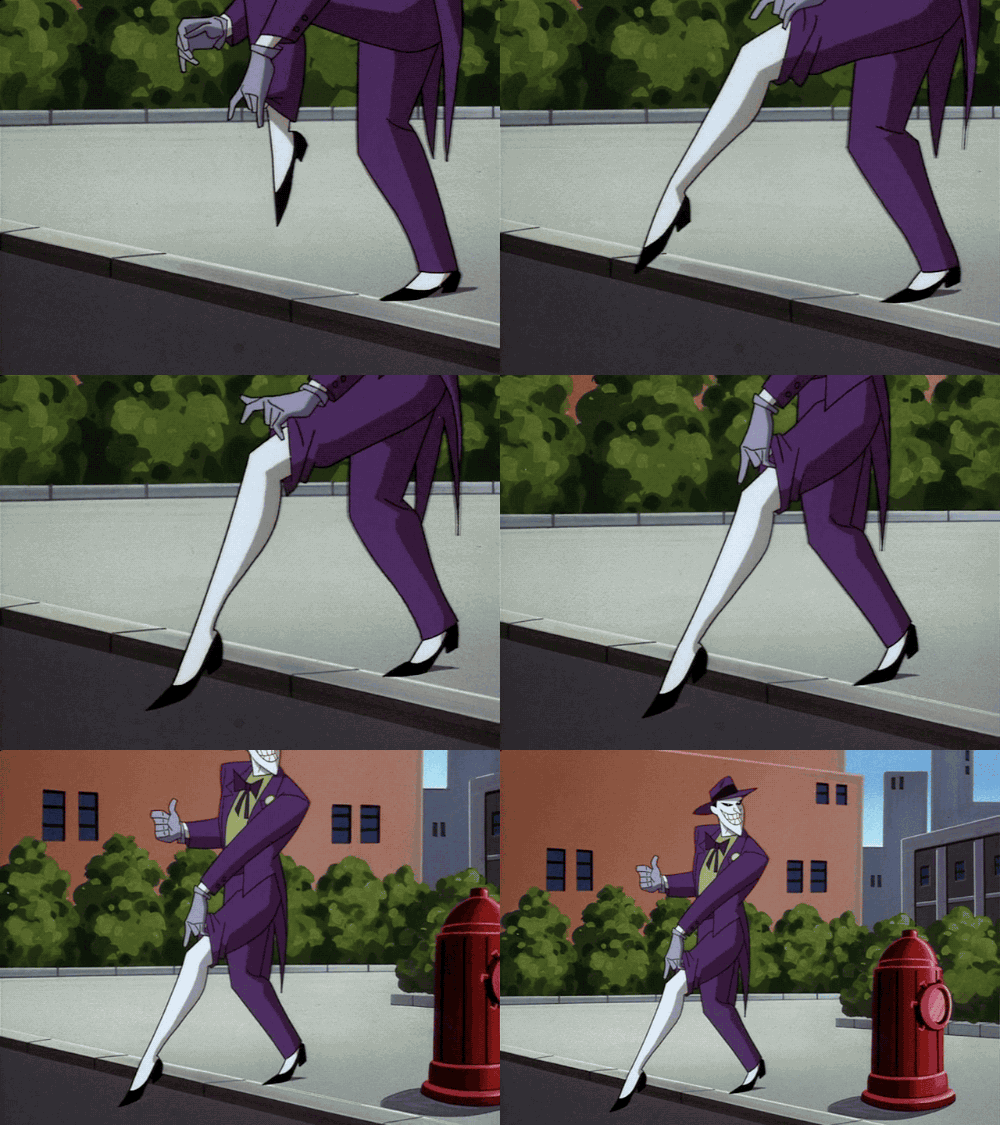
Britnee: Under the Red Hood has sparked my interest in animated superhero films and television series. In an episode of Superman: The Animated Series, Batman and The Joker are present for whatever reason, and there’s a scene where the Joker is hitchhiking and shows a little leg. That image is the first thing that comes to my mind when I think of Batman, and it’s one of my favorite things in the world. If that was just one scene from one episode, imagine all the other funky stuff that is just waiting for my discovery.
Boomer: I’m always curious how other people interpret the Batman/Robin relationship, especially with regards to the appropriateness (or not) of the Robin costume in general. In general, the Robins are young, generally getting started at the cusp of adolescence. For me, though, my first and still-primary image of Robin is of the character as played by Burt Ward in the classic, campy 1960s Adam West era. That costume was the classic, hot pants version, although Ward was given a pair of nude hose to wear, and it was an awakening for young Boomer. (It’s worth noting that Yvonne Craig’s Batgirl outfit was far slinkier and more intentionally titillating despite covering the entirety of her body.) The next Robin to come along was in Batman Forever, when I was eight years old, and that one also leaned hard into the “sexy Robin” template, and that was only more of an eye-opener. Robin was rarely present in the animated series when I watched it as a kid, and even his first appearance, in the episode “Fear of Victory” (aired 09/29/92), firmly established him as being a college student. Given that Ward was 21 in 1966 when he donned that cape and those ridiculous elf boots and that Chris O’Donnell was 25 in Forever, I never conceived of Robin as being all that young until I got older and started reading comics, at which point Dick Grayson was already active as Nightwing, Jason Todd was dead, and even Tim Drake was presented as being in his late teens; it wasn’t until Damian Wayne was retconned in that there was ever a child Robin in anything that I read. As such, I never read his costume (or relationship with Batman) as being exploitative until later in life, when thinkpieces about the inappropriateness of Robin went through a period of fad intensity. As someone trapped within the horizon of his experiences with the text, I have to admit that I can see how others would read the mentor/ward hero/sidekick relationship as inappropriate or exploitative, I prefer to reject that interpretation, although I admit that part of that is just to keep my Robin crush, developed in childhood toward older actors, intact— without it getting creepy or weird. On the other hand, if finding the subversiveness in everything is your cup of tea, the Venture Brothers episode “Handsome Ransom” inspects that issue with the creators’ trademark acerbic iconcolasm, with Batman TAS voice actor Kevin Conroy (my Batman) in the role of Captain Sunshine, a Superman expy with… questionable predilections.

Brandon: Alli’s criticism of Batman as “a rich guy who takes to streets he’s not even that familiar with to throw people into a prison system that seems even less effective and ethical than the real life American one.” immediately reminded me of a recent SNL sketch about Bruce Wayne being confronted by the community he supposedly protects. The sketch, titled “Wayne Thanksgiving,” is a quick, hilarious watch that feeds directly into the questions of Batman’s political ethics discussed in the conversation above. I highly recommend giving it a look:

Upcoming Movies of the Month
June: Alli presents Gates of Heaven (1978)
July: Brandon presents Born in Flames (1983)
August: Britnee presents Blood and Donuts (1995)

-The Swampflix Crew

Spider-Man: Homecoming (2017)

Spider-Man: Homecoming is a delightful movie. Featuring baby-faced Brit Tom Holland reprising his role from Captain America: Civil War as the eponymous arachno-person, the film has already met with widespread approval from most critics and fans. It’s not difficult to see why; even when playing an exasperatingly ebullient modern teenager complete with inappropriately timed self-videoing, Holland has a magnetic screen presence and brings a lot of charm to the role, not to mention that he actually looks like a teenager and not just Tobey Maguire in his late twenties wearing a backpack. This newfound verisimilitude when it comes to casting young people as young characters is reflected in the rest of the cast who portray Parker’s classmates, including Laura Harrier (27 but looks younger) as Peter’s love interest Liz, Jacob Batalon as his best friend and confidante Ned, Grand Budapest Hotel‘s Tony Revolori as bully Flash Thompson, and Disney debutante Zendaya as Michelle alongside others.

While recently watching The 3% on Netflix with my roommate, he remarked that he found the show to be “effortlessly Tumblr friendly,” which is also true of this film. One thing you may notice about the cast list above is that, other than Holland, all of the actors listed are people of color. This is a great step forward as far as diversity goes in the Marvel Cinematic Universe, which is something that I have written about here before, especially in regards to the largely white-washed and underwhelming Doctor Strange. More admirable than that, however, is the fact that the film has largely cast actors with strong comedic ability beyond any arguable (or marketable) “tokenism”  in what is probably the funniest film that the MCU has produced outside of the Guardians movies so far. Other notable comedians in the adult cast include comedic actors like Hannibal Buress as Coach Wilson (who has some of the film’s best lines), my beloved Donald Glover as two-scene wonder Aaron Davis, and Orange is the New Black‘s (admittedly underutilized) Selenis Levya, making her the second actress to break free from that program into a superhero film after Elizabeth Rodriguez’s appearance in Logan earlier this year.

Rounding out the adult cast are Marisa Tomei as Peter Parker’s Aunt May, Robert Downey Jr. as Iron Man (yet again), and Michael Keaton as the Vulture. Downey is essentially the same in this appearance as he is in all of his appearances as this (and frankly every) character, the rich asshole who is less charismatic than he thinks he is. Those of you who were wondering if he would express any regret or mixed feelings about his role in drafting what is essentially a child soldier into his personal grievance with Captain America in last year’s Civil War are bound to be disappointed, although probably not surprised. It’s still a nice touch that the film acknowledges in its text, if not in its characters’ self-awareness, that (once again) the film’s villains are created by Tony Stark and his lack of foresight. Keaton’s Vulture, nee Adrian Toomes, is a blue-collar Salvage worker whose contract with the city is rendered null when Tony Stark creates a new government agency to deal with the cleanup of the Battle of New York, forcing Toomes and his associates to find a new line of work. As is so often the case in the real world, these working-class men have no choice but to turn to crime, in this situation the theft and customization of advanced technology into weapons, in order to support themselves and their families.

This creates the backdrop of the film, which tells a much more grounded story than more excessive, loftier films like The Avengers. The stakes are largely personal, especially in one particular story beat that is obvious in retrospect but I didn’t see coming and won’t spoil here. Of course, just because the fate of the world isn’t on the line, that does not mean that the stakes are small. One could be easily forgiven for assuming that this movie would be a cliche teenage film that just happens to be filtered through a superhero lens, especially given the film’s subtitle of “homecoming,” but everything feels like it is awarded the dramatic weight that is warranted and appropriate given the setting and the tone. I’m hesitant to say more in this review as I want to save some of my insights for our Agents of S.W.A.M.P.F.L.I.X. review, but I can say that this is one of my favorite films of the year so far and definitely worth the price of admission. I may be any easy sell (especially anytime a film uses “Space Age Love Song,” aka the best thing Flock of Seagulls ever made), but I’ll admit there are a few jokes and nods to the source material that don’t quite land, and I can confess that I had a fairly unpleasant viewing experience due to the loudness and phone usage of the film’s target audience (which is probably what I deserve for going to a screening on opening weekend that was not at the Alamo Drafthouse). All in all, however, I can all but guarantee you’ll have a good time.

-Mark “Boomer” Redmond

Wonder Woman (2017)

I’m going to admit up front that this movie was not made for me. I have not seen any other entries in the DC Universe other than the first two Christopher Nolan reboots of Batman. I’m not at all part of the superhero movie loving crowd, but in a world where the Dark Knight has at least twelve cinematic appearances, Superman has at least ten, and the Marvel Universe is dominated by male superheroes and small female roles in ensemble casts, it was about damn time we had a movie wholly dedicated to a female superhero. Also, in a world dominated by male directors, it was long overdue for a woman to helm a superhero film. It’s 2017 and Patty Jenkins is the first woman to direct a superhero film. Ever! It’s only fitting for that title to be Wonder Woman: an icon for women and young girls; a tough, no nonsense Amazon princess warrior; and arguably one of the best superheroes of all time. All this alone makes it a movie worth seeing and supporting; and it’s also fun, even for a superhero curmudgeon such as myself.

Wonder Woman starts with Diana’s childhood on the secret Island of the Amazons, Themyscira. Here we get a view of the culture of these women, why they exist, and how their island is eternally preserved and hidden by a veil of storm and fog. The training montages here are pretty cool, but a lot of what happens on the island (repetitive speeches about the gods and reiterations of what Diana is and is not allowed to do) just seems to drag. It’s cool to get a peak into the Amazon lifestyle, but only after so much of that do we finally get the inciting incident. A WWI era British Intelligence spy, Steve Trevor (Chris Pine) manages to crash through the protective field around the island, followed by German troups. After a huge fight on the beach where we get some commentary about the destructive killing power of guns, Diana decides to leave with Trevor and save the world from war. After lots of fish out of water humor and wacky, “Oh my god, you can’t just carry a sword through turn of the century London!” hijinks, they assemble a team of misfits and go straight to the front lines.

For a tale that takes place with WWI as a backdrop, this film’s not that gritty. Thanks goodness for that, because it could have easily been another gray, dull action movie about the horrors of war. That’s not to say that the horrors of war aren’t present here, especially since World War I was a particularly savage example of carnage and loss of life. The main villains are still an evil general and his mad scientist lover/sidekick, who are developing a particularly lethal form of mustard gas. Despite this, there’s a tone of hope. We believe in our seriously scarred and flawed heroes. Diana is a source of justice and light in the darkness. War is still hell, but in the end we know Diana is going to succeed. There’s no way she can’t. She’s Wonder Woman. The movie really sells us on the idea that she can do anything, and that’s not a bad thing at all.

There’s been a lot of talk about the gender politics of Wonder Woman and what it means to finally have a female director on board for a blockbuster this big. The idea of Diana not being a piece of meat and eye candy has been floated around (oh, how our standards are so low). Other ideas I’ve seen have mentioned the design of the Amazonian armor and how it’s not run of the mill female boob armor. Both of those I have to sadly disagree with. Sure the armor isn’t Linda Carter bustier stuff, but there’s still the defined breast shapes, which has been discussed time and time again to be realistically useless except for the purpose of showing off boobs. You would think that an ancient race of warrior women would have figured that out. Also, there were many examples of Diana being presented to the audience as eye candy. In one particular scene she shows up to a gala in a stunning blue dress as Steve Trevor looks on with his jaw dropped. The real triumph as far as gender goes is that she’s allowed to be more than just eye candy. Not only is she presented as a desirable woman, she’s also given a story line with actual character development. The other refreshing thing about the way the film is written is that there’s no competition between women. She’s never given any lines implying how she’s not like the other girls or how the women outside her world are very weak, which was refreshing. Even on Themyscira, there’s a sense of camaraderie rather than oneupmanship. The other interesting catering-to-the-women-in-the-audience bit (though it’s debatable whether or not this is a win at all) is the reversal of the male gaze. Chris Pine is just there to be a handsome face and love interest, and there’s even a nude scene, albeit mostly implied, with a lot of double entendre. His character is not completely a cardboard cut-out, but compared to Diana it’s pretty darn close.

Wonder Woman is still guilty of the same sins as other superhero movies: cliché speeches about justice with nonsensical taglines (“It’s not about ‘deserve’; it’s about what you believe”), excessive slow motion (especially in the form of hair flips), and a cheesy fight sequence soundtrack. For true fans of the genre those aren’t necessarily problems, but more like charming quirks.  It manages to blend the darkness of war with the fun, superhero tone. A woman’s touch isn’t as immediately obvious to me as a lot of people believe, but where I see it I think it’s great. I’m glad the world finally has a female superhero movie, and that it’s living up to the hype and expectations.

-Alli Hobbs

Guardians of the Galaxy Vol. 2 (2017)

The gang is back with a few new faces this time around in Guardians of the Galaxy Volume 2, with director James Gunn returning to the helm of the weirdest series in the MCU franchise. Although there are a few missteps this outing, including a lack of screentime for some of your old favorites, violence that is at turns disturbingly unexamined in its brutality when it’s not cartoonish, and hit-or-miss emotional resonance, this second installment reminds us that Guardians is still the funniest and most charming Marvel property currently being produced.

After a flashback opening sequence that shows a CGI de-aged Kurt Russell planting a strange alien plant on Earth in 1980s Missouri while romancing Peter Quill’s (Chris Pratt) mother, the film finds the team performing a mission to protect the extremely powerful batteries of a race known as the Sovereign from theft by a gross, fleshy tentacle monster (its essentially Caucasian flesh tones and stubble make the thing quite nauseating to gaze upon, as it looks like a scrotum come to life). This first action sequence felt a little off to me, as the obsession Rocket (Bradley Cooper) has with getting Peter Quill’s (Chris Pratt) music ready before they fight seemed a rather on-the-nose tip of the hat to the popularity of the first movie’s soundtrack. As the action primarily occurs in the background, the camera follows Baby Groot (Vin Diesel) around the platform in a one-shot that’s impressive despite being largely CGI.

We then meet our decoy antgonist, the High Priestess of the Sovereign (Elizabeth Debicki), as she presents the Guardians with their payment for the successful defense of their batteries, a captured Nebula (Karen Gillam), who is to be taken back to Xandar by her sister Gamora (Zoe Saldana) for the bounty on her head. The team is pursued by the Sovereign as Rocket, unable to control his kleptomania, made off with Sovereign tech; as a result, the team is forced to crash land in a forest after taking heavy damage and ultimately being rescued by Ego (Russell) and his servant Mantis (Pom Klementieff), an empath who helps the powerful being sleep. After revealing his familiar connection to Peter, Ego offers to take him, Gamora, and Drax (Dave Bautista) to his planet to explain his abnormal existence, and present Peter with a unique opportunity.

Elsewhere, Yondu (Michael Rooker) faces an existential dilemma when it is revealed that he and his squad are outcasts in the greater Ravager community, in a way that ties back to his essentially having raised Peter after abducting him, moments after the boy watched his mother die. He accepts a bounty for the Guardians from the Sovereign, but when his crew learns that he did so in order to protect them rather than hunt them, they mutiny, taking over his ship and freeing Nebula, who goes after Gamora in pursuit of revenge. Rocket, Groot, and Yondu must then attempt escape, with a little help from everybody’s favorite Stars Hollow weirdo (Sean Gunn, whose character’s name is irrelevant, and we all know it).

There’s no Infinity Stone MacGuffin here, and it’s a real break from the MCU’s usual storytelling machine that the narrative of GotG 2 isn’t motivated by set pieces, action sequences, or even plot, but by character. The only real example of this in the franchise thus far has been Winter Soldier, which was motivated by Cap’s desires to save one friend and avenge another, but even that film was organized around the plot of a conspiracy thriller as much as (if not more than) character motivation. Here, however, every choice and conflict is about character. The conflict between Peter and Rocket centers around Rocket’s insecurities about whether or not he deserves to be part of a family, even if that family is a group of outlaws who found each other. The violence Nebula seeks against Gamora comes from an obsession with besting her sister out of misplaced jealousy and rage, without realizing that they are both survivors of the same abuse but who have allowed that past to push them in different directions. The interaction between Peter and his father gives rise to the film’s climax (although it feels the weakest to me, despite being the primary conflict). Yondu’s desire to right the moral failings of his past give him the longest character arc of the film, and even the comedy bits between Mantis and Drax, both fish out of water but from very different worlds, is display of character, rather than the needs of pushing the narrative forward.

This is an elegantly constructed movie, and it moves with such precision and humor that you’ll never feel bored. Still, it is odd that this is a movie with a protagonist character who readily admits to a lust not only for violence, but specifically of killing others, and he’s never really called out on it. I’m not necessarily opposed to the whimsical way one particular scene of what’s essentially a mass murder is treated, since this is a James Gunn movie that we’re talking about, but it feels odd, if not exactly wrong. The fact that this sequence follows another that has a distinct Looney Tunes feel to the violence simply makes it feel like something is out of place.

I’ll save my thoughts on the more spoilery content and the way that this film interacts with the rest of the MCU for our Agents of S.W.A.M.P.F.L.I.X. review, but Guardians 2 gets an endorsement from me. It’s still the weird sci-fi comedy that you can recommend to your friend who doesn’t like superheroes. Also, be on the lookout for a cameo from Ben Browder, who portrayed the protagonist of Farscape (which was mentioned as a spiritual predecessor of Guardians in our Agents review), playing a member of the Sovereign and using his best Peacekeeper voice.

-Mark “Boomer” Redmond

Evil Brain from Outer Space (1964)

EPSON MFP image

threehalfstar

campstamp

After the dispiriting slumps of the third title in the series, Attack from Space, I was starting to worry that I had already mined the Super Giant films for all of the entertainment value they could easily provide. The initial Saturday morning cartoon charm of the superhero Starman and his powers-providing wrist watch, the globe meter, had started to wear a little thin and without a worthwhile villain to thwart, the intergalactic buffoonery felt entirely flat. Thankfully, the concluding film in the series, Evil Brain from Outer Space returned the Starman saga to its batshit insane heights and reminded me of what I found so entertaining in the first place. Evil Brain from Outer Space repeated the formula that proved so effective in the Starman film Invaders from Space (the same formula that makes Batman such a consistently fresh property to adapt): providing Starman with such a wildly entertaining, chaotic villain that the audience is distracted from the fact that the hero is static & unchanging. Instead of Invaders from Space‘s Salamander Men of Planet Kuliman, Evil Brain from Outer Space complicates Starman’s eternal quest to prevent nuclear holocaust by pitting him against, well, an evil brain from outer space. What’s so brilliant about this evil brain is that, like so many Krangs to come, he commands an army of varied, subservient weirdos that keep the film interesting from scene to scene as Starman takes them out one by one.

There really isn’t much to convey here in terms of plot. A council of space alien peacekeepers on the Emerald Planet deploy Starman to prevent nuclear war on Earth . . . but every film in the series literally starts with that exact same premise, even that exact same footage. All that’s different here is the villain. Balazar is an evil genius from the planet Zomar, the most brilliant mind in the universe. He is promptly assassinated, but his brain is kept alive and operating in a transportable briefcase. This briefcase, of course, must be destroyed before the brain takes over Earth, presumably through some kind of nuclear threat. What’s great here is the way Balazar’s brain enlists a wide array of weirdos to exact his evil deeds. This includes eyebrowless alien men who try to throw knives at children, a bunker full of baddies dressed in matching Batman uniforms and constantly doing Nazi salutes, mutants who breathe radioactive vapor, some kind of a humanoid dragon who wears a fiant eyeball belt & multiplies like a Power Rangers villain, a Tom Waits-looking motherfucker with a hook for a hand, and a witch who haunts a ballet studio. Balazar is even so kind as to employ an Earthling in his evil army: a ludicrous-looking mad scientist with a hawk for a pet. Even this widespread of a treat is no match for the interplanetary heroics of Starman, of course, and each foe is dealt with in a tidy, 70+ minute romp. We even get to watch Balazar’s brain die, which is a fun treat, though it’s not nearly as gruesome as the similar conclusion to They Saved Hitler’s Brain. The film concludes as all Super Giant movies do, with Starman waving goodbye to his young child superfans as he flies back to his home planet. This time, however, he wouldn’t be returning to save them again, since the series had officially come to a close.

Evil Brain from Outer Space might be the most objectively entertaining of all the Super Giant films, since most movies in the series were edited down from two Japanese broadcasts in their American TV adaptations while this one was comprised of three: The Space Mutant Appears, The Devil’s Incarnation, and The Poison Moth Kingdom. Cramming three Starman films into a single, paired down vessel makes for an exciting episode in the series, one overstuffed with the one thing that keeps its rigid formula fresh: ridiculous villains. Evil Brain from Outer Space is the Super Giant title that most often winds up on large collections of horror & sci-fi films, despite the entire series being in the public domain, and that extra attention is honestly well deserved. Anyone who gets a kick out of the film should certainly track down Invaders from Space as well, as it boasts just as much cartoonish villainy in its interplanetary threats. Realistically speaking, the series never reaches any sort of mind-blowing heights of cult classic potential, but those two titles are delightfully inane oddities in their own way. Even the first film in the series, Atomic Rulers of the World, is entertaining in its own minor ways and only Attack from Space registers as a thoroughly mundane waste of time, which isn’t such a bad track record for an American superhero series cobbled together from scraps of Japanese television, all things considered.

The Super Giant movies were important when they were first broadcast because Ken Utsui’s portrayal of the interplanetary Superman knockoff Starman (a role he reportedly despised because of the snug costume & stuffed crotch) was the very first Japanese superhero to appear on celluloid. In the years since, after so many similar riffs on that same formula have come to pass, that significance has faded, but Starman has become relevant in a different way. In the era of post-Nolan superhero media “for adults,” I often need to return to a time when Saturday morning cartoon absurdism is the driving creative force in my comic book cinema. I find way more solace in stray properties like Roger Corman’s ill-received Fantastic Four adaptation and last year’s Ninja Turtles sequel Out of the Shadows than I probably should because of that yearning for a goofier time. Starman’s filmography fulfilled that niche nicely. I’d encourage anyone who similarly enjoys a goofy superhero movie with their morning cereal to at least check out Evil Brain from Outer Space or Invaders from Space the next time they’re looking to fill that void. The entire series might not be recommendable to binge on as I have, but Starman is charming & entertaining nonetheless, especially when he has enough goofy baddies to knock down in the face of nuclear destruction.

-Brandon Ledet

Attack from Space (1964)

EPSON MFP image

twohalfstar

campstamp

Three films into the Super Giant series I’m finally starting to feel a little fatigued. Atomic Rulers of the World was a great introduction to the franchise, establishing the bizarre Superman knockoff Starman and placing him in the context of Cold War atomic paranoia. Invaders from Space kept Starman’s world fresh by pitting him against a ludicrous villain, the alien race of The Salamander Men of Planet Kuliman. Attack from Space is where the limitations of Super Giant, a made-for-Japanese-television miniseries that was chopped up & reassembled into four American features, really starts to show at the seams. There’s a sense of monotony & going through the motions in Attack from Space that even Starman, a spandex-clad space alien superhero & intergalactic cop, can’t overcome.

The main problem in Attack from Space is the lack of a compelling villain . The movie begins with the exact footage that begins every entry in the series: an Emerald Place space counsel deciding to prevent nuclear war on Earth by deploying Starman. From there, it’s the villains’ job to keep the to keep the formula interesting. Starman himself, however entertaining in concept, remains as rigidly unchanged as his introduction in each film. The villains of Attack from Space fail to carve out their own niche as a novel Starman foe, as they’re very much reminiscent of the nuclear arms dealers of the first entry in the franchise. The Sapphireans are the baddies du jour in this case, but for convenience’s sake, let’s just call them Space Nazis. They dress like Space Nazis; they salute like Space Nazis; I think even the movie itself has a hard time not referring to them as Space Nazis. There might have been a way to make this villain exciting if they stood out enough from the atomic gangsters of Atomic Rulers, but after the boundless absurdity of the Salamander Men of Planet Kuliman, they play as totally limp onscreen. The Space Nazis kidnap a scientist so he can point his dangerous satellites towards Earth or some scheme that’s just as vague & uninteresting, and the procedure of thwarting their evil Space Nazi deeds leaves little room for surprise & excitement.

There’s very little, if anything, on display in Attack from Space that you can’t see done better before or since in the Starman series, and the exercise ultimately feels pointless because of that lack of novelty. Although it aired in Japan after the broadcast of the titles that made up Invaders from Space (under its own original titles of The Artificial Satellite & the Destruction of Humanity and The Spaceship and the Clash of the Artificial Satellite), American producers placed it directly after the first film in the series, the one it most closely resembles. I think that was a massive mistake, as it would have signaled to me as an audience that Super Giant was a one trick pony. The film transports the atomic strife of Atomic Rulers into space, which makes room for some decent miniatures, explosions, rocket ship designs, and astronaut fashions. If those effects were smashed together with the novelty of Starman’s introduction in Atomic Rulers or with the space alien weirdos of Invaders from Space, it might have been enough for a worthwhile venture. As is, it feels like watching Space Nazis tread water for 70+ minutes in a punishing void of purpose.

-Brandon Ledet

Doomed!: The Untold Story of Roger Corman’s Fantastic 4 (2016)

“How many movies did Roger Corman make that never got released? One.”

When the last failed attempt to competently adapt the Fantastic 4 comic book series for the big screen hit theaters in 2015, I foolishly decided to give all past attempts a chance and watched all four craptastic Fantastic 4 features that have been produced since the 1990s. The only film of the batch that was at all enjoyable happened to also be the only one that never saw an official release. The notoriously campy, 1994 Roger Corman-produced Fantastic 4 film is rumored to have been made solely so that co-producer Bernd Eichinger could retain the film rights to the intellectual property he later leveraged for a much larger paycheck with the 20th Century Fox Fantastic 4 production in 2005. Although Corman’s goofy $1 million Fantastic 4 production was shot, edited, and printed into a final, marketable product ready to be shipped to movie theaters across the world, it never saw an official commercial release. The details of these backroom shenanigans have always been a little murky, as the Corman film was intended to be dumped quietly into the void by folks behind the scenes, which is a total shame given that it’s a much more enjoyable work than the major studio Fantastic 4 travesties that have been released in its wake. Now, the documentary Doomed!: The Untold Story of Roger Corman’s Fantastic 4 has arrived to promote the very existence of this lost VHS gem and to shed some light on the mysterious forces that sabotaged its would-be theatrical release.

As an informational experience, Doomed! doesn’t accomplish anything that couldn’t be achieved through a longform “oral history” article on a well-funded film blog. It’s more of a Wikipedia-in-motion style of post mortem on a superhero film that never officially saw the light of day than it is a Tickled-style exposé on the dark forces that greenlit the production just to sabotage its release. The interview pull quotes that appear as onscreen text and act as chapter breaks between talking heads awkwardly call into question why this even had to be a movie at all, instead of a series of print interviews & YouTube clips. It’d be foolish to expect anything more than that from a crowd funded documentary about a film only available on VHS bootlegs & less-than-legal YouTube uploads, but keeping those limitations in mind definitely helps soften any major criticism that could be lobbed at Doomed!. Stories about how the movie was fast-tracked into production, passed on by Lloyd Kaufman, filmed at a studio warehouse condemned by the fire marshal, and advertised in theaters with a legitimate trailer despite the apparent conspiracy to never release it all make for interesting anecdotes, but do little to distinguish the documentary as its own work of art. What makes Doomed! worthwhile instead is the pathos it manages to mine from the cast & crew who worked on the film, people who sank immeasurable time, passion, and money into an effort that was conspired to become a meaningless waste by design behind their backs.

In the early 90s most superhero media was considered to be kids’ stuff, with most Marvel films in particular, including early attempts to bring Spider-Man & Captain America to life, not really providing much hope that the landscape would change into the comic book-dominated nerd future we live in today. The success of Tim Burton’s 1989 Batman film changed that perception, however. Although folks working on the 1994 Fantastic 4 might have had reasons to be concerned about the limitations of working within Roger Corman’s direct-to-VHS era, with his quick-paced production schedule & indie-level scale of budget, they also had enough encouragement from the cultural zeitgeist at large that the film might be a huge financial success. A project hundreds of Hollywood nobodies sank all of their hope into as their big break into major A-list success, one that had explicit verbal assurance that it would reach a wide theatrical distribution and a trailer that screened before other major action films, never saw the light of day until it was bootlegged & ridiculed years down the line. The first sign the cast & crew had that the powers that be behind 1994’s Fantastic 4 might not have had total faith in their work was when Marvel legend Stan Lee publicly trashed the film at that year’s Comic-Con before production even wrapped. Everything from that point on is hurt feelings & dashed dreams. Doomed! is most essential as a document when it captures that sense if betrayal from those most hurt by the film’s cancellation. Like with a lot of movies sets, the crew had developed a tight-knit, familial sense of camaraderie during production and it’s a little sad to see them all look back bitterly on sinking together with a ship that was doomed before it even left the port.

If you want to see a great document of the cheap, wild production style of Roger Corman filmmaking, I recommend checking out Corman’s World: Exploits of a Hollywood Rebel instead. If you want to see a great documentary about a passion project that becomes unruly during production and is sabotaged out of existence by sinister film industry types, check out Lost Soul: The Doomed Journey of Richard Stanley’s Island of Dr. Moreau instead. Already-established fans of the Roger Corman Fantastic 4 movie (like myself) are likely to seek out Doomed! for its cool tidbits about how The Thing’s animatronic facial expressions were achieved or how, exactly, copies of the film were ever leaked out. Then again, those fans were likely to be the exact people who funded this documentary on Indigogo in the first place. If you’re already on the hook for Fantastic 4, this film works well enough in tandem with that would-be cult classic as supplementary material. Doomed! aims to achieve more than that, nakedly calling out for an official, decades-late commercial release for Fantastic 4 as a kind of victory for the folks who were wronged in the conspiracy of its initial non-release. Only time will tell if it’s successful in that respect. In the meantime, folks who aren’t already onboard with 1994’s “lost” Fantastic 4 can only look to Doomed! for a small, quietly sad story about a group of hopeful up-and-comers having their dreams built up and immediately crushed by a shared project that’s just beyond their control. Even if just for that one aspect, though, it’s still worth a recommendation.

-Brandon Ledet

Roger Ebert Film School, Lesson 25: Batman (1989)

Roger Ebert Film School is a recurring feature in which Brandon attempts to watch & review all 200+ movies referenced in the print & film versions of Roger Ebert’s (auto)biography Life Itself.

Where Batman (1989) is referenced in Life Itself: On page 155 of the first edition hardback, Ebert describes a notorious, boisterous publicist who worked for Warner Bros. named Frank Casey. In one anecdote about the larger-than-life character, he recounts, “It was of my opinion Casey had never seen a movie all the way through. Unlike other publicists, who mostly used screening rooms, Casey liked to take over a theater like the World Playhouse for the Chicago preview of a big movie like Batman and invite all his friends from the worlds of business and politics. Only at a Warner Bros. movie were you ever likely to see Mayor Daley, several alderman, and various Pritzkers.”

What Ebert had to say in his review: “The Gotham City created in Batman is one of the most distinctive and atmospheric places I’ve seen in the movies. It’s a shame  something more memorable doesn’t happen there. Batman is a triumph of design over story, style over substance – a great-looking movie with a plot you can’t care much about. All of the big moments in the movie are pounded home with ear-shattering sound effects and a jackhammer cutting style, but that just serves to underline the movie’s problem, which is a curious lack of suspense and intrinsic interest. Batman discards the recent cultural history of the Batman character – the camp 1960s TV series, the in-joke comic books – and returns to the mood of the 1940s, the decade of film noir and fascism.” -from his 1989 review for the Chicago Sun-Times

There have been four major live action Batman franchises to hit theaters since the cartoonishly campy days of Adam West in the 1960s. All of them have Tim Burton’s greasy fingerprints all over their basic DNA. Burton’s 1989 Batman adaptation was such a highly stylized smash hit that Gotham has never looked the same onscreen since. His highly specific production style of gothy art deco gloom mixed with subtly campy sadism has shaped everything Schumacher, Nolan, and Snyder have done visually with the Batman property in the decades since, and even launched an entire, highly-acclaimed animated TV series. Every Batman adaptation since Burton’s seems to like have inadvertently mirrored more than just that seminal work’s high-end Hot Topic gloom, however. They’ve also adopted his pattern of when to intensify personal vision instead of bending to corporate-minded marketability with each respective franchise.

Tim Burton’s Batman has a striking visual palette & overall tone to it that’s directly tied to the director’s personal wheelhouse as an auteur. Still, there’s something about the relatively vanilla romance at the film’s center, the shoehorned-in Prince soundtrack, and the blatantly brand-conscious imagery of the bat signal that reeks of movie-by-committee studio interference. Batman ’89 feels like Burton delivering exactly what studios want (with a strong personal spin, of course) so that he can prove himself worthy to fully take the reins in a second, wilder, more personalized feature. 1992’s Batman Returns is pure Tim Burton, an untethered, perverted goth kid rampage that broke free from studio exec influence, a much more striking & idiosyncratic work than its predecessor. Every live action Batman adaptation since has seemed to follow this pattern. Joel Schumacher’s jokey-but-tame Batman Forever isn’t nearly half as memorable as the oversexed camp fest of its far superior Batman and Robin follow-up. (It’s time we all admit that’s a great movie; don’t @ me.) Christopher Nolan’s The Dark Knight is widely recognized as one of the greatest cinematic achievements of the last decade, while its predecessor is a much more muted drama about Batman’s salad days at ninja school. Even recently (and I’m expecting even more flack for this than the Schumacher praise), the Zach Snyder-helmed Batman films got a lot more lively & delightfully weird in Suicide Squad than they started off as in the punishingly dull Dawn of Justice. Burton has laid out a clear blueprint for any & all would-be Batman auteurs arriving in his wake: try to keep it somewhat calm & familiar in the first film, then swing for the fences with the follow-up.

I don’t mean to imply here that Batman ’89 is in any way a bland, forgettable film. It does feel homogenized around the edges to meet major studio blockbuster expectations, but the weird little heart at the center of the film is still unmistakably Burton. The stop motion retractable shields on the Batmobile are pure Burton aesthetic, a visual calling card also matched in the film’s matte paintings & miniatures. He also frames a lot of the film with an excess of Dutch angles, which is not only a natural aspect of adapting a comic book property for the screen, but also consistent with the childlike tone of his then-contemporary works like Beetlejuice & Pee-wee’s Big Adventure. Besides the visual calling cards that let us know as an audience that this is A Tim Burton Joint, you can also feel the director’s personality strongly reflected in the casting. Michael Keaton’s portrayal of Bruce Wayne as a reclusive billionaire weirdo is a smart deviation from the square-jawed, American Hero caricature Adam West (expertly) brought to the screen before him, bringing a calmer version of his demonic Beetlejuice performance to the role. Where Burton really finds his footing in leaving a personal stamp on Batman as a product wouldn’t be with the titular hero at all, however. The director’s talents were much better suited for bringing to life the cartoon cruelty of the Caped Crusader’s sworn enemy, one of superhero comics’ most infamous villains.

Jack Nicholson’s performance as The Joker is the key to understanding Batman ’89 both as a Burton film and as a monolithic influence on the adaptations that would follow. Burton is obviously more interested in the villains of the Batverse than he is in Bruce Wayne himself, except maybe when the billionaire weirdo is exposed to be just another oddly kinky monster terrorizing the city he supposedly protects. A large part of what makes Batman Returns feel more like a pure Burton vision than its predecessor is that the director just fully gives himself into this impulse, wilfully allowing Batman to become a background character while total freaks like Danny DeVito’s Penguin & Michelle Pheiffer’s Catwoman run amok. Nicholson’s The Joker is a great preview of that future Utopia of gothy camp. He is as genuinely terrifying here as he is in his career-making role in The Shining, especially in scenes where he covers his clown-white face with flesh-toned make-up. He turns the character into a sadistic form of clowning, filling the squirting flower of his lapel with a corrosive acid & staging a sinisterly warped version of the Macy’s Day Parade with poison-filled balloons. To do Batman exactly right, you have to mix a little camp theatricality in to lighten the gloomy glowering of an otherwise depressive property. This is exactly why Heath Ledger’s own unhinged Joker performance exalted The Dark Knight and also why the utterly joyless Dawn of Justice put many theater-goers to sleep. Nicholson’s performance as The Joker is the first sign that Burton understood the need for that balance. You can hear it in his half-goofy, half-chilling catchphrase “You ever dance with the Devil in the pale moonlight?” You can feel it in a sequence where he defaces fine art with bathroom-quality graffiti to a funky Prince track and somehow makes the tone fit the film, despite all odds. In a lot of ways Batman ’89 feels like a dry run for better things to come in Returns, but everything Nicholson does onscreen in the mean time is just as timelessly entertaining as the best of what was to follow.

Roger Ebert wasn’t a fan of either of Tim Burton’s Batman productions. He praised the director’s work as “a triumph of design” & atmosphere, but ultimately dismisses it as a style over substance affair. Personally, I always value style over substance. I agree with Ebert on some level that the Bruce Wayne narrative arc never matches the eccentricity of Burton’s vision in Batman, likely due to the homogenizing effect of studio influence, but I can’t dismiss the value of that vision in & of itself. Burton’s mixed media visual accomplishments in Batman are stunning to this day, a distinct personal artistry that doesn’t require a strong narrative to justify its for-its-own-sake pleasures. Although he wouldn’t make his most fully personal Batman film until Returns, you can still feel his own idiosyncrasies creeping in through the influence of Nicholson’s goofy-scary Joker and an overall production design unmistakably of his own. I’ll always hold Returns in higher regard than Batman ’89, but I still greatly respect this landmark work for the ways it fights to be memorably bizarre despite studio influence, the way it envisions an entirely new & instantly definitive look for its hero’s playground, and the way it serves as a basic blueprint for all Batman cinema that followed.

Roger’s Rating: (2/4, 50%)

Brandon’s Rating (4/5, 80%)

Next Lesson: Galia (1966)

-Brandon Ledet

Logan (2017)

I don’t like Wolverine.

This has been a topic of much contention with my fellow comic book nerds for a long time, but there are a host of reasons why he doesn’t appeal to me as a character. First, it’s never made much sense to me that Professor X has a spot on his peace-oriented team for a man whose powers and enhancements make him a perfect assassin or soldier. I’ve also never seen myself reflected in Wolverine the way that I see aspects of myself in Kitty Pryde, Emma Frost (under Joss Whedon’s pen), and (especially) Beast; nor do I see something I could aspire to be in Wolverine the way that I did and do in Storm’s serenity or Nightcrawler’s happiness in spite of a lifetime of abuse. I certainly understand the allure of a character without a past and the desire for redemption (although the importance of this desire was intermittent), but Wolverine never worked for me as a character.

I think that this is mostly because, despite his meager origins, the character of Wolverine evolved into a straight white male power fantasy, especially among the more self-pitying members of the nerd subculture of the eighties and nineties. Macho Wolverine gets the girl, takes no shit, and leaves his enemies shredded to ribbons: he’s the ultimate enviable hero of the platonic nineties nerd before Hollywood came along and turned comic books and superheroes into the hottest trends on Earth. Following this popularity explosion, the character was inescapable, which is probably my foremost issue with him. Don’t like Angel, or Jean Grey, or Psylocke? No problem: there are plenty of Marvel comics without them, including long periods of time in many X-books. Don’t like Wolverine? You’re out of luck, bub: try to find an X-Men comic from 1985 to 2014 where he’s not a presence (give or take an Excalibur here or there), and if you turn to another Marvel book for a Wolverine-free reading experience, you better not want to check out Avengers, or New Avengers, or even Power Pack. It’s essentially the same reason that, despite my long and storied love of Star Trek, I don’t like Data (a crucifiable offense in many circles): both he and Wolverine are such pets of vocal fans and some creators that they become the entire focus of what is supposedly an ensemble, to the detriment and derision of other characters*. You can even see this in the way that he was not only the de facto star of the X-Men films in which he appeared, but also got his own film franchise.

That franchise reaches what claims to be its final film in the recently released Logan, a gritty neo-western masquerading as a superhero film. The plot finds the titular Logan (Hugh Jackman) caring for an aging and increasingly senile Charles Xavier (Patrick Stewart) with the help of Caliban (Stephen Merchant) in the Mexican desert in 2029. The combination of a cataclysmic event and genetic suppression has rendered them among the last mutants on Earth, until Logan is drawn back into the world of heroism by Gabriella (Orange is the New Black‘s Elizabeth Rodriguez), a woman who begs him to help save a child named Laura (Dafne Keen) from Donald Pierce (Boyd Holbrook), a cybernetically enhanced mercenary. Their redemptive road trip also features appearances from Eriq La Salle and Elise Neal as world-weary farmers who provide shelter for the group.

My apathy and weariness about Wolverine aside, this is a good movie. Sure, it makes no logical sense within the confines of the different timelines that the other films in this franchise have provided without a conspiracy theory board of newspaper clippings, post-it notes, and red string, but 20th Century Fox doesn’t care anymore, so why should you? The one problem I’ve never had with the film version of Wolverine is Hugh Jackman’s consistently strong performance regardless of the variable quality of the material available, and this is his best work as the character to date. This is despite (or perhaps because of) the fact that, for once, we’re not reflecting back on his mysterious past as we have in literally every movie in which he appeared in this franchise and are instead seeing a man at the end of his career and, perhaps, his life. Logan deals with the more mundane aspects of growing old, like obsolescence in a changing world, the dementia of an elderly father (figure), and the betrayal of his own aging body and the disease thereof, despite his much-touted healing factor. This is not a character who is obsessed with learning about (or altering) his past, but one for whom the past is prologue to a slow, painful existence in an all-too-real dystopian future.

This is not the Sentinel-ruled technicolor hell of Days of Future Past, nor is it the candy-coated “corrected” timeline in which Jean, Scott, and Hank are alive: this is a dusty, economically depressed future in which life is cheap, crossing the border into Mexico is an ordeal, and Canada provides asylum to those on the run from an authoritarian government that hates them because they are different, all while said government not only condones but supports the imprisonment of and experimentation on children of color and treats Mexico like its dumping ground. This film has been in development for a while and takes a great deal of inspiration from graphic novel Old Man Logan, but it is particularly fascinating that the first X-film released following the election paints such a realistic picture of a dark future in comparison to the optimistic ending of Days of Future Past, which was released solidly in the middle of Obama’s second term, when the tide of freedom and progress seemed to flow ever-forward.

Logan never becomes explicitly political, however, instead allowing this interpretation to emerge from its subtext. This is, first and foremost, a story about a retired, past-his- prime gunbladeslinger who has long since lost what little place he had in the world before being brought back in for one last stand. You’ve seen this movie before, but dressing it up in these clothes puts a spin on the material that is fresher than I expected, in the same way that Winter Soldier was reinvigorating as both a government conspiracy thriller and a superhero flick. I’d love to see more movies like this, to be honest: James T. Kirk and Company as the Magnificent Seven/Seven Samurai, Black Widow having to Die Hard her way out of a building, or, hell, even Steve Rogers trying to save the old community center from being torn down to make way for those awful condominium/shopping center hybrid abominations.

Where the film doesn’t work for me is in its insistence on defining Logan’s little group as a family. The discovery of the genetic connection between Logan and Laura and the latter’s decision to help her does not necessarily an intimate connection make, and Xavier’s “This is what life looks like” moment rings falsely sentimental for the character, given all that we’ve seen him do and accomplish over the course of these films. For such a bloody and violent flick (which, make no mistake, Logan is), a fair amount of the emotional resonance that the film seeks to create works, but the occasional references to Laura and Xavier as Logan’s family work better when they’re subtle (like when he passes them off as his father and daughter) than they do when characters explicitly state that they are family. That aside, however, this serves as a fitting swan song for Hugh Jackman’s contribution to the franchise, especially if you’re  willing to forgive stilted dialogue and the occasionally unearned moments of pathos.

*Here’s the part where I admit that I love the Wolverine and the X-Men animated series, despite my general apathy towards the character; although Wolverine is the title character, WatX was much more of an ensemble piece that gave every character plenty of development and attention. He’s also cast in an unusual role as the reluctant leader with the atypically angsty Cyclops serving as the team’s loner. The show also has one of the darkest storylines ever constructed for what is ostensibly a show for children; it’s definitely worth checking out.

-Mark “Boomer” Redmond

Doctor Strange (2016)

EPSON MFP image

twohalfstar

Earlier this year Boomer wrote a wonderfully incisive piece on the political reasons he’d be abstaining from watching Doctor Strange until he could conveniently view it for free, thus decidedly not contributing to its already massive profits. So much ink has already been spilled here & elsewhere on the myriad of ways the film fumbled the issue of racial representation in its casting, particularly in the controversy of awarding Tilda Swinton the role The Ancient One, a character that traditionally would be played by an Asian man. Director Scott Derrickson has since admitted in interviews that in trying to avoid the “Fu Manchu” stereotype pitfalls of that character’s source material he had made an even bigger mistake in whitewashing the role, a transgression that many Hollywood productions have been indulging in lately. As Boomer & many others have already covered in their thoughts on Doctor Strange‘s insensitivity to whitewashing & cultural appropriation (not to mention its intenional omission of references to Tibet), including Derrickson himself, it’s no surprise that the film had several glaring problems in the cultural mindfulness department. What has been surprising, though, is that Doctor Strange has been earning very high critical marks outside of that controversy context. Some have even called it one of the best films of the MCU, comparing its wide appeal to the first Avengers film & Guardians of the Galaxy. I personally don’t understand the praise, as its storytelling structure dialed the franchise all the way back to the first Iron Man, with almost a decade of MCU creativity & innovation lost in the process.

The one thing that really worked for me in Doctor Strange was the exact selling point that put my butt in the seat in the first place: the visuals. The film has a kaleidoscopic, Inception-inspired way of folding space & time in on itself to create a psychedelic viewing experience unrivaled in most straightforward action adventures of its ilk. Even within Marvel’s own ranks only the microscopic & subatomic shenanigans of Ant-Man come close. Entire cities geometrically fold over like complicated origami. Galaxies expand, contract, and implode as characters’ astral projections tunnel through them. Time inverts, changes direction, and ties itself in knots as both complications and solutions to the Good vs Evil plot. And yet, for all of Doctor Strange‘s mind-bending, gorgeous, playfully surreal visual treats, the story they support is one of the laziest, most simplistic stabs at hacky comedy & unearned redemption narratives since the lifestyle porn beginnings of this franchise in Jon Favreau’s original Iron Man feature. It’s a dispiriting backslide into the worst corner of the MCU, where an egomaniacal monster is celebrated for his immense skill & wit instead of being shamed as the villainous shit that he so obviously is. I don’t regret catching this film in its IMAX 3D format while it’s still screening at every conceivable cineplex, as it gave me the best possible shot at enjoying what was truly a beautiful application of CG psychedelia. I just left the theater feeling more than a little let down by the story that technology was wasted on.

Heartless ass Stephen Strange is the Western world’s foremost neurosurgeon, a fame-obsessed brute who plays pop music trivia during intense surgical procedures, lives in a fabulously expensive apartment the audience is meant to envy, and scoffs at any philosophical ideas that cannot be explained through logic & modern science. His hubris is temporarily put in check after a violent car wreck destroys his most precious assets: his hands. It’s a classic tale of ironic tragedy that dates back to horror cinema as old as The Monster Maker & The Hands of Orlac, if not further, and Strange intends to right this universal wrong by traveling to Nepal and getting himself some of that good old-fashioned Far East mysticism. He’s shamed & trained into momentary submission by the aforementioned Ancient One, who, while dressed in the garb of a Tibetan monk, is actually a centuries-old Celtic woman, for what little it’s worth. We’re then bombarded with a whole lotta Marvel bloat: two(!) new-to-the-franchise villains, a loyal crew of underserved sidekicks, astral projections, alternate dimensions, space-time continuums, all kinds of nonsense. Before you know it, two post-credits stingers later, the whole thing has blown over without leaving much of anything in its wake.

At the center of all this and, apparently, all things in the Universe is the film’s main problem, Stephen Strange himself. The movie asks, “Who are you in this vast multiverse, Mr. Strange?” with the intent to humble him, but the answer the story gives is that he is Everything. No other character is afforded a second of importance that isn’t in some way tied to Strange’s magnificence. His unconvincing turnaround from badboy heel to crowd favorite babyface is made more important than the potential collapse of the Universe. He immediately masters an ancient art others have been steadily studying for decades, yet his rich white man in the East vacation is supposed to be a humbling spiritual journey. Much like with the irredeemable blowhard cad Tony Stark, the audience is asked to sympathize & laugh along with a jokester bully here, buying into a reformed badboy storyline at a moment’s notice, with no significant behavioral or personality change and a very brief loss of wealth & social status. In my recent dive into the entirety of the MCU, I’ve found that I connect with truly good, sincere superhero archetypes like Captain America much more easily than I do with sarcastic anti-hero villains in superheroes’ clothing like Stark, so my distaste for Dr. Strange as a character is certainly the result of a personal bias. I enjoyed this film well enough on a purely sensory level, but was overall soured by its narrative return to an Iron Man aesthetic. Given the immense popularity of the Iron Man franchise & this film’s early critical praise, I expect to be in the minority on that point, but I’m okay with that.

It’s easy to see on a strategic, Kevin Feige level why Marvel felt the need to bring in Dr. Strange as connective tissue in its ever-expanding universe (well, “multiverse” now, I guess). The psychedelia, witchcraft, and real world magic Strange brings to the table easily makes room for Feige & company to tie in the outer space reaches of Thor, Thanos, and the Guardians with the Earthbound characters of the Avengers and the inner space microverse Ant-Man antics. Why tie all of that narrative glue to a character who both closely resembles a protagonist you’ve already built your franchise around and whose origins are so hopelessly backwards in their racist depictions of Eastern stereotypes that you have to rewrite & whitewash them into a barely more acceptable compromise? There are more Marvel characters than I could ever care to count and surely somewhere in there one of them could’ve been a less problematic and more narratively distinct franchise-unifier. Off the top of my head, my two favorite characters in the Marvel pantheon could’ve easily done the job: Howard the Duck & The Son of Satan. I’d understand how past financial performance would set a bad precedent for Howard’s inclusion (despite his outer space origins & the casual disruption of the rules of reality in his often magical villains), but The Son of Satan could surely carry all of Strange’s multiverse-spanning psychedelia without any of the cultural baggage inherent to his origin story. And these are just two characters I know about, not being at all well-read in the vastness of Marvel folklore.

The point is that if Doctor Strange was such a difficult work to adapt with a culturally sensitive eye, there’s really no reason that it should‘ve been adapted at all. There must have been other, better options. This feels especially true once the cookie cutter mediocrity of the story sinks in. For all of the film’s reality-shifting visual creativity, it winds up feeling like so many Marvel origin stories we’ve already seen in the past, never justifying a necessity for its existence as an isolated property instead of as a connective piece for a franchise, which is a total shame & one of Marvel’s most frequent blunders. Maybe if I had any particular affinity for (the eternally forgettable charisma void) Benedict Cumberbatch as an actor I might be singing a different tune, but even my beloved Tilda Swinton couldn’t save this film from banality and she was backed by some of the most beautifully disorienting imagery I’ve ever seen put to use in action cinema. Doctor Strange is a feast for the eyes, but fails to nourish on any comedic, narrative, spiritual, philosophical, or emotional level. For a work that’s inspired over a year of think piece controversy and a few weeks of hyperbolic Best of the MCU praise, it mostly exists as a flashy, but disappointing hunk of Nothing Special.

-Brandon Ledet