For this lagniappe episode of the podcast, Boomer, Brandon, and Alli discuss John Huston’s 1979 adaptation of the Flannery O’Connor novel Wise Blood, starring Brad Dourif as an atheist street preacher.
Both of Wes Craven’s mid-90s meta horrors—Scream & New Nightmare—are modern classics, but I personally find the philosophical crisis of his return to the Nightmare on Elm Street series to be the more rewarding of the pair. While Scream amuses itself with cataloging & emulating the tropes of horror as a pop-art medium, New Nightmare genuinely grapples with the havoc horror wreaks on our minds & souls, digging much deeper than Scream‘s surface-level jolts of recognition & nostalgia. For all of their slashings & bloodshed, the scariest moment in either film is when Craven appears onscreen as himself, tormented by the real-world evil he’s unleashed by creating the fictional character of Freddy Krueger. It’s a jarring moment of self-reflection that helped spark an entire wave of self-aware slashers that defined mainstream horror that decade (most of them penned by Kevin Williamson, screenwriter for Scream). Craven wasn’t the first master of horror to arrive attempt that particular hard stare into the mirror, though. He was beaten to the punch by the much trashier & flashier schlockteur Lucio Fulci in his own 1990 meta-horror, A Cat in the Brain.
With A Cat in the Brain, Lucio Fulci stars in a Lucio Fulci film as “Lucio Fulci” — a horror director who’s tormented by the violence he’s depicted onscreen throughout his career, hallucinating flashes of gore while preparing meals and performing mundane household chores. This torment only worsens once his therapist begins to use those gruesome images as inspiration for his own murders, intending to frame Fulci for real-life reenactments of fictional crimes. A rare moment of introspection from the aging giallo legend, A Cat in the Brain is a really fun, chaotic self-reflection on how the brutality of the horror genre is often flippantly overlooked by cheap-thrill seekers but still takes a toll on our psyches (of which I’m just as guilty as Fulci). We can’t fill our brains with images of chainsaw maniacs, squished eyeballs, cannibals, mutant ghouls, and decapitated children without them having some effect on our mental health. Their immediate effect is an easy trigger for cathartic release, usually through laughter or disgust. Here, Fulci frets over the possibility that there may be a morally, spiritually corrosive effect that lingers after that initial amusement . . . or at least he pretends to.
As much as A Cat in the Brain feels like a crude precursor to the philosophy-of-horror crisis Wes Craven would soon be working through in New Nightmare, it’s also just a convenient excuse for Fulci to let his bad taste run wild on a shoestring budget. Firstly, he gets to indulge in the very thing he’s supposedly condemning, padding out the runtime between obligatory dialogue exchanges with as many gory vignettes as he can get away with while maintaining the vaguest outline of a plot. He also comes up with a pretty great excuse not to go to therapy for his horrific preoccupations, positioning his therapist as the real sicko pervert and his own art as a safer, fantastic form of cathartic release. Mostly, he’s engineered an even greater excuse to recycle gnarly gore gags from his own back catalog, “hallucinating” violent scenes from better-loved, better-funded Lucio Fulci movies as if they were specially produced for this late-career meta crisis. A Cat in the Brain isn’t just Fulci’s rough prototype for Wes Craven’s meta-horror; it also doubles as a Greatest Hits montage of his own past triumphs.
If nothing else, you’ve gotta love Fulci for immediately delivering the violence promised by this film’s title in its opening credits, illustrating his thought process at his screenwriting desk with footage of the black cat inside his skull gnawing on the hamburger meat he calls a brain. You also gotta love that he calls himself out for being an absolute freak, even if the resulting self-critique portrait of the maestro at work is entirely insincere. When Wes Craven toyed with “the boundaries between reality & fantasy” in his 1990s meta-horrors, you could really tell he was taking the philosophy & cultural impact of his own work seriously as a subject. By contrast, Fulci is just having self-indulgent fun, even outdoing Scream‘s nostalgic callbacks to classic horror tropes by showing actual clips from better movies of his own heyday. His approach may not be as heartfelt or meaningful, but it’s still a sickly delight.
Every time there’s news about a new Batman, there’s a new wave of “[Actor] is my Batman” discourse (Kevin Conroy is mine, for the record). For me, a more important question is: Who’s your Final Girl? There are a lot of good contenders, but mine has always been Sidney Prescott, followed very closely by Nancy Thompson. I was so excited to hear about 5cream after it had been so long since Scream 4, and was eagerly looking forward to seeing it as if Sidney were actually an old friend of mine with whom I would be getting the chance to catch up. So, it’s a bit of a disappointment that it takes so long for her to show up here, which is further underlined by the fact that we never get to see the three main characters of this franchise reunite for, well, one last time. Gale Weathers (Courteney Cox) gets scenes with both Dewey (David Arquette) and Sidney (Neve Campbell), and Sidney and Dewey talk briefly on the phone, but the three of them are never on screen together. That’s kind of weird, right?
It’s been twenty-five years since Stu Macher (Matthew Lillard) and Billy Loomis (Skeet Ulrich) killed seven people within a series of peculiar homicides that were modeled after murders in slasher films. In the decade and a half that followed, there were three copycat sprees: one based around the “rules” of sequels, another those rules pertaining to trilogies, and in 2011 at the height of remake mania, a murder bender pertaining to sequels, reboots, and the like. But it’s been a quiet ten years, and all of our favorite characters aren’t where we left them. Dewey and Gale split up and he’s living in a Woodsboro trailer park, mooning over Gale still as she hosts a NY-based morning show. Sidney’s as far as she can be from Colorado, living her best life, presumably, since she has no trouble going for a healthy jog without fear of being watched; and she even answers her phone when she gets a call from an unfamiliar number (I can tell you one thing, if I were Sidney Prescott, I would never have owned or answered a telephone any time after 2002). All of that changes when a young girl named Tara (Jenna Ortega) is attacked in her home by Ghostface, and we’re introduced to our conceit for this time around.
You see, Tara likes scary movies, but only “elevated horror”: things like It Follows, The VVitch, and Hereditary (her favorite, she says, as it’s a “meditation on grief and motherhood”). But Ghostface doesn’t want to talk about that; he’s more interested in what she knows about Stab, the film series within the film series that began life as a “ripped from the headlines” horror flick about the killings in the 1996 original, and which had, by Scream 4, bloated to a seven-movie franchise which had long ago stopped pretending to be based on true stories. Aligning with tradition, Tara is forced to participate under threat of violence to someone she cares about, and she gets through the first couple of questions but gets tripped up by the third. Just as Barrymore’s Casey Becker fumbled and said that Jason was the killer in Friday the 13th (it’s actually Mrs. Voorhees), Tara says that the killer in the original Stab was Billy Loomis, as it’s a trick question—she forgot about Stu. In a break with tradition, Tara actually survives this attack, if barely; this leads to the return of her older sister Sam (Melissa Barrera) to Woodsboro, but as it turns out, that might have been the point. As it turns out, Tara and Sam have a connection to previous killings, and they’re not the only ones. Several people in Tara’s tight-knit group of friends are, as it turns out, with Heather Matarazzo returning for a cameo as Martha Meeks, Randy’s younger sister from Scream 3, now the mother of twins Chad (Mason Gooding) and Mindy (Jasmin Savoy Brown) with whom Tara is friends, as well as a reappearance of Judy Hicks (the always-welcome Marley Shelton), now sheriff of the town after having previously served as Dewey’s deputy in Scream 4, and her son Wes (Dylan Minnette) is also among their group. That’s not all, though, as we also have Amber (Mikey Madison), Tara’s best friend, as well as Chad’s girlfriend Liv (Sonia Ben Ammar).
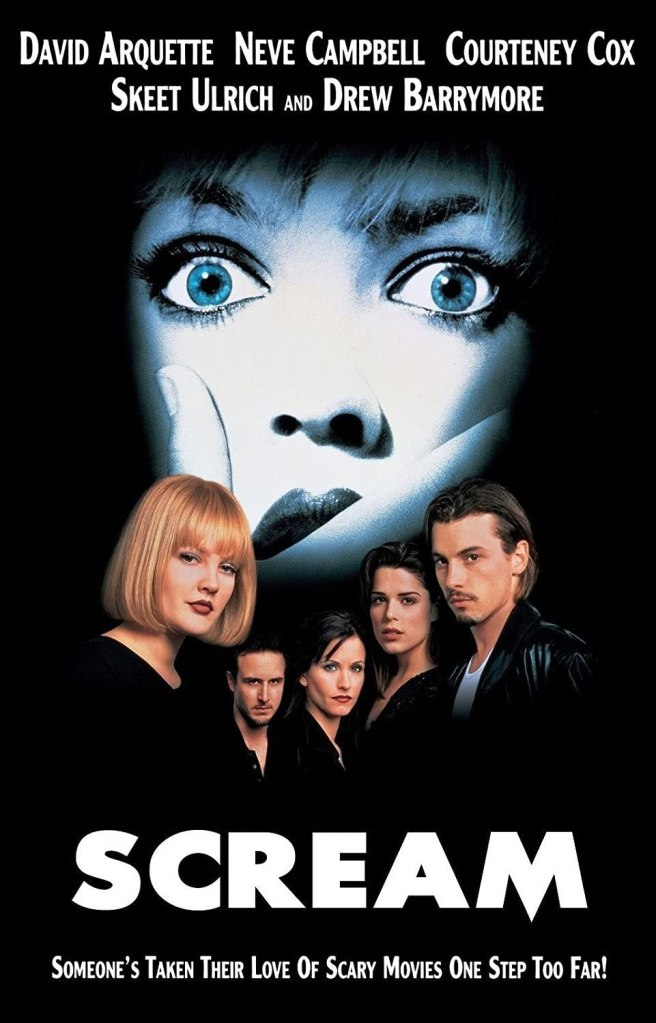
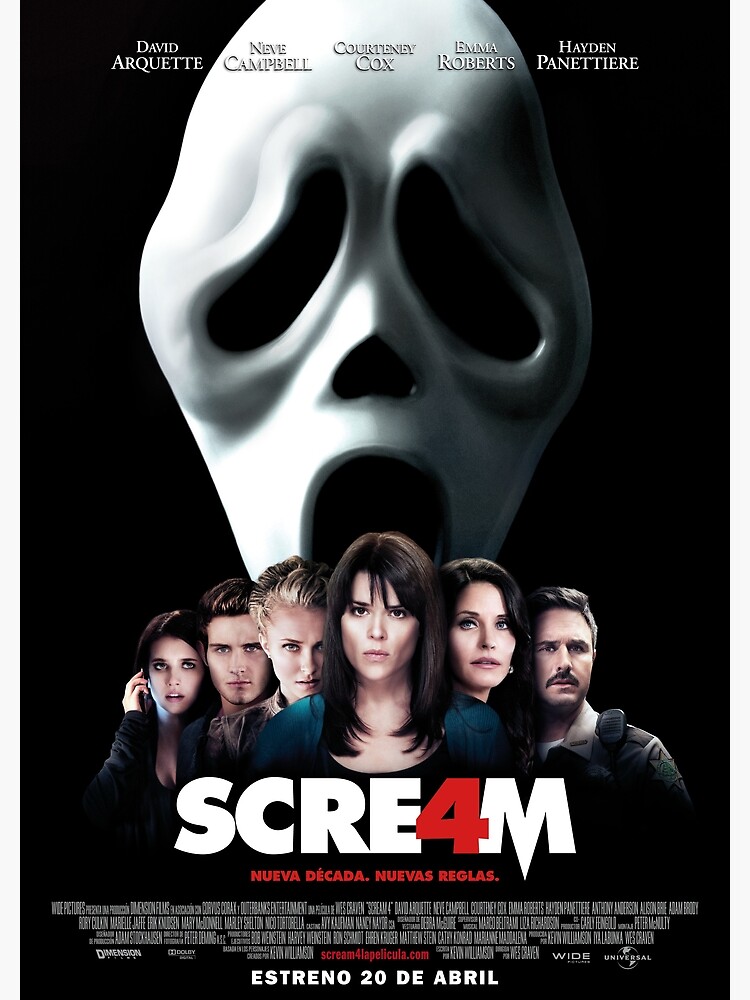
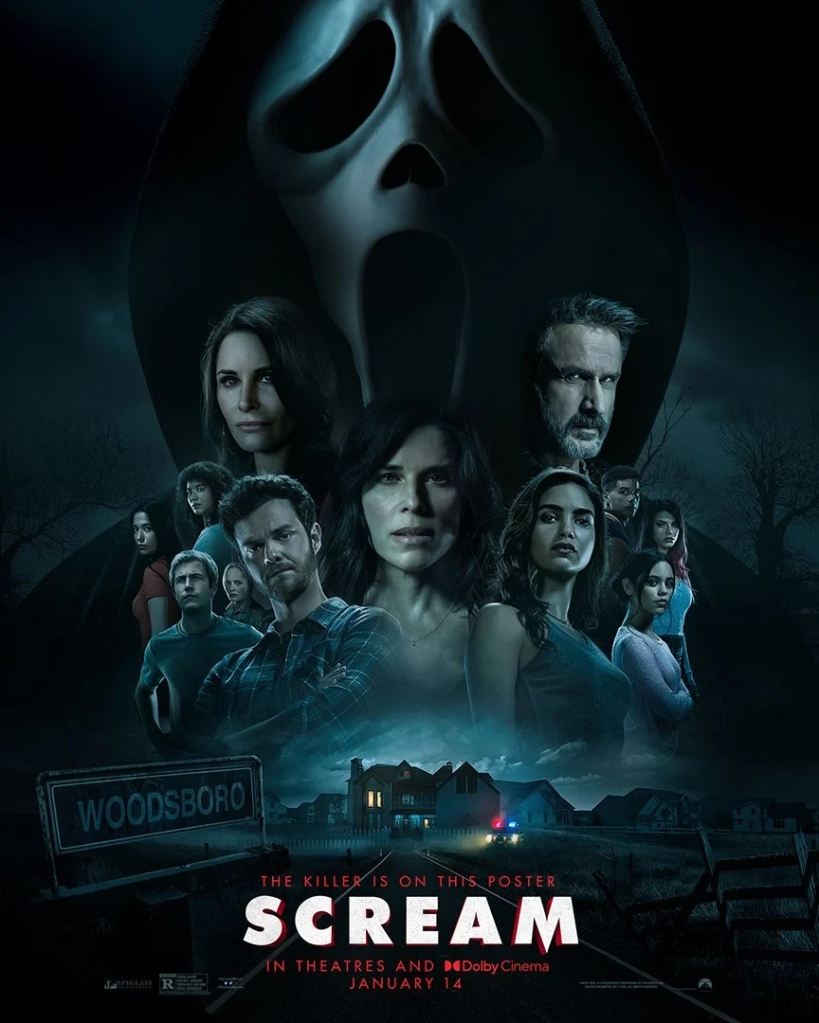
The biggest of the film’s flaws—beyond how little our legacy characters get to do and how late some of them appear in the screenplay (Gale doesn’t appear in person until nearly an hour in)—is that there are simply too many characters, and you can even see it in the poster. Consider the poster for the first Scream, which had five characters in total, including the three we would come to know as our principal characters in this series, but hyping up the appearance of Drew Barrymore, whose pre-titles murder is still the franchise’s defining moment. Then came Scream 2, which likewise limited its poster to five characters: the core three, Sidney’s new boyfriend, and (once again) the decoy lead who is killed off in the film’s opening. Scream 3‘s poster followed this trend with five characters, and then Scream 4 featured the first cast expansion to feature six: the three leads, and the would-be new Sidney, her boyfriend, and the new Randy Meeks. But the poster for this one has a full dozen people on it, and it’s just too many.
I don’t want to be the one to complain that Kyle Gallner is here, since he was in both one of the most original horrors of the aughts and the most derivative remake of the same relevant time period (Jennifer’s Body and the remake of Nightmare on Elm Street, respectively), so he feels like a genre acknowledgement that belongs here; but he’s also the most frivolous presence, existing only to provide cannon fodder for Ghostface and cement the theory that the killers are targeting people connected to the original killings when it’s revealed that he’s the son of Stu’s (I believe) heretofore unmentioned sister. When Dewey recounts “three attacks” at the 30-minute mark, I legitimately turned to my friend and asked if there was an assault I was forgetting other than Tara’s attack and “the one at the hospital,” and had to be reminded that he had been there at all. Liv’s also the worst kind of red herring, in that though it’s true that she always seems to be conveniently elsewhere when a killing occurs, she also is such a non-presence that when she’s not on screen; you forget that she exists. It is a bit of a narrative catch-22, though, since there need to be killings of people outside of this friend group to provide clues about the killer’s selection process, but if you change the story a bit and have, for instance, Dewey gathering potential victims who aren’t as familiar with one another to protect them from Ghostface, then you kinda lose the friend group Screamness of it all. And, despite all of that, the first two people I first and most immediately suspected, which is both satisfying and a little deflating.
It may seem like I have a lot of complaints, but I actually thoroughly enjoyed this one. It vaults over Scream 3 handily and lands just behind Scream 4 in the rankings. The reinvention here may actually be mpre clever, but it doesn’t feel as clever. The opening of Scream 4 alone was a fun, bizarre ride that really shook things up to the point where you weren’t really sure what the rules were anymore. The motive of the killings is fantastic; we learn early on that the previous year saw the release of Stab, which is actually Stab 8 (get it?), and that fans hated it—and from what little of it we see, with good reason. Stab has become a cultural phenomenon in Scream‘s world, and that world has now entered the era of The Snyder Cut, wherein groups of fanboys feel that the media belongs to them, so they want to course correct back to the “original concept” by enacting a new series of murders in Woodsboro to inspire the Stab franchise to return to its roots. It’s not as clever as “movies made us do it,” but it’s just as cohesive, and allows for one of the killers to deliver great lines like “How can fandom be toxic?” while holding a bloody knife.
I was a late joiner to the Bong Joon-ho fan club. I didn’t see any of his films prior to the US release of Snowpiercer(which ended up being Swampflix’s very first pick for Movie of the Year), and I shamefully still—all these years later—have not doubled back to catch up with his early catalog. Now that the runaway success of Parasitehas made him an Oscar-certified sweetheart of the industry, Bong’s early films are easier to access than ever, so I have few remaining excuses to cover those blind spots. It took nine long years for his debut feature, Barking Dogs Never Bite, to land proper American distribution, but now it’s just sitting right there on Hulu waiting to make you laugh & squirm along with the director’s other darkly funny genre pranks. It obviously doesn’t match the budgetary scale of the eye-popping spectacles Bong would later deliver in films like Okja, Snowpiercer, and The Host, but it’s just as worthy of a post-Oscars re-evaluation of his decades-long career. If nothing else, it’s good to be reminded that the adorable man who became a meme by making his Oscars statues kiss also has a deeply fucked up, vicious sense of humor.
Barking Dogs Never Bite feels like Bong Joon-ho’s version of the post-Clerks slacker comedy, complete with a couple of listless corner store clerks among its cast of downtrodden losers. Gen-X apathy & ennui weighs heavy on its central players, a loose collection of near-destitute tenants of a multi-tiered apartment complex, barely earning enough through their entry-level jobs to feed themselves. The title refers to the violent hijinks of an out-of-work academic whose peaceful days lounging around the apartment (which his pregnant wife pays for) are interrupted by a neighbor’s small, yipping dog. The absolute worm of a man takes his frustrations over his stalled career out on various small dogs throughout the building, murdering them in an effort to quiet his own mind. These outbursts of animal cruelty catch the eye of an anonymous notary who lives nearby, daydreaming about earning celebrity through heroic acts of vigilantism. As the would-be vigilante tracks down the pathetic dog killer, the small minds & embarrassments of their daily routines pile up in an increasingly absurd tangling of their lives, somehow amounting to a pitch-black hangout comedy instead of a low-budget crime thriller. It’s the exact kind of ironic slice-of-life slacker tale you’d expect to see at a film festival in the 1990s, except with a much sharper eye for visual gags & splendor than what you’d typically expect from movies on its budget level.
Bong’s debut is hilarious but vicious, which feels consistent with everything he’s done since. Even so, violence against dogs is one of the few remaining taboos that make audiences squeamish, so it still cuts deep. It’s the kind of movie that’s almost pointless to log on the content-warning database Does the Dog Die?, as its entire purpose is to mash that exact taboo button. The dogs that are killed are cute & pathetic. Their murderer waits maybe a scene & a half before deciding to violently shut them up, not even suffering the expected montage where they annoy him for days on end until he snaps. Even as someone with a high tolerance for shocking art, I was thankful that the film opened with an obligatory “No animals were harmed” title card instead of saving it for the end credits. Still, I don’t know that I ever fully believed it, as whatever puppetry, camera trickery, or hidden harness support they used to depict the pups in peril was impressively convincing. I was in love with Bong’s playful camera set-ups, non sequitur ghost stories, sped-up Benny Hill chase sequences, and onslaughts of discordant jazz, but I can’t claim that the puppy violence didn’t upset me. It’s supposed to be upsetting, because Bong Joon-ho is a sick fuck, which is easy to forget as he’s become something of a Film Twitter mascot.
I remember there being a lot of memes at the expense of Chris Evans delivering the teary line “Babies taste best” in Snowpiercer, as if it were funny by accident. I always found that mockery to be odd, as that moment didn’t feel especially over-the-top to me, at least not relative to every other batshit crazy thing that happens in that movie. Having now seen Bong Joon-ho’s debut feature—a feel-bad hangout comedy about a series of dog murders—I’m even more convinced that the Snowpiercer memesters (likely just hungry to dunk on the limitations of Captain America’s acting talents) got it wrong. Given Bong’s larger body of work, I believe that line was both intentionally funny and sincere. It’s both a discomforting moment where a man deals with the guilt of surviving on the nourishment of baby-meat and a darkly humorous punchline that underlines just how depraved the film’s trainbound universe has gotten. I’ve now seen Bong apply that exact discomforting humor to the onscreen death of puppies, so why not the off-screen death of babies? Lots to think about there, lots to consider.
There’s something bittersweet about the early-2000s boom of Japanese & Korean horror films that were imported to the United States through home video labels like Tartan Asia Extreme. On the one hand, it’s wonderful that daring, genre-blurring films like Suicide Club & A Tale of Two Sisters were able to find an audience outside of their respective home countries. On the other hand, those films’ American marketing often perpetuated a reductive, borderline-Orientalist perception of that era in East Asian genre filmmaking as the most “extreme, “fucked-up”, “incredibly strange” movies ever made – as if every film were a variation on the torturous Guinea Pig series. It was a very profitable perception for Tartan, I bet, but I’m not convinced it was an entirely healthy one for the filmmakers they were platforming (not to mention other filmmakers from the region who were working in entirely different modes of cinematic storytelling at the time). I don’t want to complain too much about the way those home video releases were marketed to Americans, though, since those vintage DVD scans are still the only commercially available copies of a lot of those films in the US two decades later. At least they found a path to our eyeballs, imperfect as it was.
I wonder how much the commercial pressures of “extreme J-horror” marketability influenced the production of the 2003 sci-fi comedy Doppelgänger. Director Kiyoshi Kurosawa earned international acclaim among genre fans making that exact kind of Ringu-era J-horror exports (Cure, Pulse, Seance, etc.), but with Doppelgänger you can feel him striving to branch out into other modes of storytelling. He sets the film up as a J-horror update to Jekyll & Hyde in its first act (which landed it an American DVD release on the Tartan Asia Extreme label), but it’s a much sillier film than that early tone implies. Doppelgänger delivers the vicious violence that contemporary American audiences had come to expect from “extreme” Japanese horror cinema, but the further it goes along the more it strays into broad slapstick comedy, gradually escalating to ZAZ-level buffoonery in its final act (including an Indiana Jones spoof involving a boulder-sized disco ball). It’s a darkly funny film, where most of the punchlines are people’s skulls being cracked with the anticlimactic thud of a hammer. Still, it feels like Kurosawa only establishes an eerie sci-fi mood in the opening stretch so he could get away with goofing off once all the usual J-horror boxes were checked.
One reason it’s so tempting to speculate about Kiyoshi Kurosawa’s frustrations with market expectations is that the protagonist of Doppelgänger is also intensely frustrated by his corporate overlords. Kōji Yakusho stars as a meek research scientist who’s developing a kind of mech-suit wheelchair for the physically disabled, providing mechanical arms for paralytics. The profit-obsessed higher-ups at his lab’s parent company continually undermine his careful research, forcing him to conform to unrealistic deadlines that threaten to corrupt the project. This immense corporate pressure coincides with the arrival of the scientist’s doppelgänger (also played by Kōji Yakusho), whose brash, macho confidence creates an exponentially violent competition with the kinder, original scientist. This is the story of a creative genius driven insane by small-minded money men, eventually abandoning his scientific pursuits altogether to instead engage in a pointless war with his own psyche. It concludes with a go-nowhere road trip into total delirium, chasing down a deliberately pointless flavor of comedic absurdism rarely seen outside a Quentin Dupieux film. By the end, Kurosawa is basically just goofing off, whether or not horror-hungry audiences were still along for the ride.
Two decades after its initial release, the biggest hurdle to enjoying Doppelgänger isn’t so much its reluctance to deliver the “extreme” J-horror goods; it’s the film’s early-2000s digi cinematography, which makes it look like cheap TV instead of proper cinema. Even when it’s playing with spooky sci-fi ideas in its early stretch, the film lacks any of the throat-hold atmospheric dread that makes Kurosawa’s actual horror films so intense. That disinterest in establishing an eerie mood is only amplified by the outdated SD scans of the film that are available on DVD & streaming services, to the point where even its indulgences in De Palma-style split screens feel like music video fuckery instead of genuine experiments in form. All that flatness in tone stops mattering once the film reveals its true nature as a farcical comedy, though, starting with the macho doppelgänger copying his source-human’s café order one table over just to fuck with him and quickly escalating to a series of deadpan murders with a hastily wielded hammer. I could see a lot of Western audiences having the exact opposite experience in the aughts, though, popping in a Tartan Asia Extreme DVD and enjoying the early spooky goings-on, only to be baffled by the goofball pranks that followed.
I’m not convinced that Dan Stevens ever fully achieved the movie star dream career he abruptly left Downton Abbey to pursue. Between his career-defining run on that glorified soap opera and the Disney Prince paycheck he cashed after the live-action Beauty and the Beastremake, he’s probably financially set for life. I get the sense that he’s still not creatively fulfilled, though. After a strong start in the weirdo action thrillers The Guest and Legion, he’s mostly been doing anonymous, supporting work that doesn’t draw much attention to his movie-star potential as a leading man. The German sci-fi romcom I’m Your Man is a welcome corrective step in that treadmill career trajectory. In the film, Stevens stars as a perfectly calibrated robot boyfriend, a role that emphasizes both his generic handsomeness and his eerie, inhuman coldness. Instead of running away from his default perception as a dime-a-dozen Ken Doll hunk (the exact reason Stevens fled from Downton Abbey as soon as he could), I’m Your Man leans hard into that quality, pressing both on its charms and its limitations. It’s a perfect encapsulation of what makes him unique as a screen presence, which is something he doesn’t always get to showcase.
In I’m Your Man, robo-Dan Stevens is beta-tested by a recently divorced research scientist (Maren Eggert), who is reluctant to treat him like a potential A.I. life partner instead of a household appliance. She reluctantly agrees to the study in a bargain that will land her own academic research future funding opportunities but finds the implication that a robot boyfriend would fulfill an emotional need in her life insulting. Initially annoyed by his machinelike perfection and his servantile attention to her every need, she gradually learns to love the walking, talking dildo despite herself. Their dynamic feels like a broadcast from a slightly brighter world where heartfelt romcoms get to tackle heady subjects usually reserved for eerie sci-fi chillers like Ex Machina. It’s a very familiar Turing Test story structure that’s not usually played with such a lightness in its doomed human-robot romance. It balances its romcom cuteness with just enough melancholy & heartbreak to feel sophisticated, but not enough to match the dramatic despair of much drearier sci-fi romances like Her and Never Let Me Go. Like robo-Dan Stevens, it’s perfectly calibrated for what it is, with all the charms & limitations implied.
If there’s some larger topical or philosophical statement I’m Your Man is trying to make about humanity’s evolving relationship with technology, I’m not able to fully pinpoint it. It romanticizes the shortcomings & imperfections that distinguish humans from machinery (most starkly in a slow-motion montage of “Epic Fail” YouTube clips). At the same time, it’s also honest about how comforting & safe it feels to interact with machines instead of our fellow fuck-ups (maybe as subtle commentary on the distinctly modern isolation of smartphone addiction). I don’t know that it makes any grand, definitive statements about human nature or technological comforts, though. It instead gently pokes at the boundaries between the natural & the artificial, finding odd moments of peace & romance in their overlap. For me, the movie’s clearest purpose is in highlighting the eerie charms of Dan Stevens as a screen presence, finding his exact sweet spot as a potential leading man. Otherwise, it’s just an above-average romcom with a fun sci-fi spin.
There was much attention paid to the dual achievements of Ridley Scott & Ryusuke Hamaguchi directing two films each in 2021, but I haven’t personally seen any of the four films they released last year (House of Gucci & The Last Duel and Drive My Car & Wheel of Fortune and Fantasy, respectively). However, I have seen the dual directorial debuts of actor-turned-auteur Natalie Morales, Plan B & Language Lessons – both released in 2021. Plan B was the higher-profile release of the pair, boasting a larger budget and a substantial promotional push when it premiered on Hulu. It’s a fun addition to the new wave of teen sex comedies that attempt to de-Porky’s the genre by giving girls’ libidos a spin at the wheel for a change (joining titles like Blockers, Booksmart, The To Do List, and Never Have I Ever). Language Lessons is a much smaller film in scope & cultural impact, both of which were restricted by circumstances of the ongoing COVID-19 pandemic. Filmed on laptops with an onscreen cast of two, Language Lessons finds Morales toying with the screenlife genre the same way she played around with the tropes of the teen sex comedy in Plan B. There’s nothing flashy about her directorial style in either film, but she demonstrates a sharply tuned ear for comedic banter in both, which is especially evident in the film that is pure dialogue with no visual distractions from the script.
Mark Duplass stars as a nouveau riche Oakland hipster whose semi-famous husband buys him 100 Spanish language lessons as a surprise birthday gift. His teacher is played by Morales herself, who’s much more protective of her personal life and is unsure how chummy she wants to be with a stranger she’ll be speaking to on a weekly basis for two solid years. There are many barriers obstructing the mismatched pair’s path to a genuine friendship: their California/Costa Rica locations, their wealth/working class social statuses, their gringo/Latina cultural heritages, etc. Gradually, though, the professional & transactional boundaries of their relationship break down and they become genuine, real-life friends – often through abrupt, shocking events in their lives off-screen. The story is told entirely through Skype calls & video messages but doesn’t do anything remarkably unexpected with the screenlife format. It’s just well written & performed enough to get by as a compelling one-on-one dialogue exchange, no visual embellishments necessary. In comparison to other 2021 releases on similar topics, it doesn’t have quite as much to say about the transactional nature of modern online social life as Pvt Chat, but it’s a better attempt to remold dusty romcom tropes into a sincere story about friendship than Together Together. Plan B is likely the 2021 Morales film that will be remembered & respected over time, but Language Lessons helps reinforce that her excellent dialogue & character work in that better-publicized debut was no fluke.
Sweeping Morales to the side for a second, Language Lessons does feel like a no-brainer Duplass Brothers project for the COVID era. Not only was there a huge uptick in Duolingo users learning new languages in their idle time early in the pandemic (myself included, until Hurricane Ida power outages interrupted my momentum), but the safety protocols of COVID-era productions make for the exact kind of intimate indie dramas that the Duplasses cut their teeth producing. At their best, Duplass productions are exciting reminders that just a couple people & a camera are more than enough resources to slap a decent movie together (as long as the script is strong). Casting Mark as one of those two people in this instance makes Language Lessons feel like a wholesome counterpoint to Creep, a natural evolution of the exact kinds of movies they produce in normal circumstances anyway. Morales is credited as the sole director of this production, but she shares the writing credit with Duplass, marking it as a true collaboration between them. I’m not sure what she plans to accomplish as a filmmaker in the long term, but she had a great start in 2021 with two solidly entertaining, surprisingly political indie comedies released in the same calendar year. Neither one is going to earn the level of attention the decades-established filmmakers Scott & Hamaguchi are enjoying but, again, she’s just getting started.
Welcome to Episode #152 of The Swampflix Podcast. For this episode, Brandon, James, Britnee, and Hanna continue our discussion of the Top Films of 2021 with some honorable mentions, starting with the anti-romantic rock opera Annette. Enjoy!
00:00 Welcome
03:15 Jack and Jill (2011) 07:30 Jack (1996) 11:03 Secrets and Lies (1996) 14:40 I’m Your Man (2021)
1. Titane — Julia Ducournau’s follow-up to Rawis a greasy, Cronenbergian nightmare we didn’t want to wake up from: a darkly comic body horror about a serial killer who’s impregnated by a Cadillac and finds herself hiding out with an aging firefighter, disguising herself amongst his cartoonishly macho employees. It’s a nuclear gender meltdown with no clear sense to be made in its burnt-to-the-ground wreckage, finding unlikely refuge in the violence of pure-masc camaraderie & social ritual. At times overwhelmingly explicit and unflinchingly fixated on its own gory violence, but also a heartwarming tale of unconditional love.
2. Pig — Not at all what you’d expect from a Nic Cage revenge thriller about a disgruntled chef’s John Wick-style mission to recover his stolen truffle pig. An understated execution of a preposterous premise, refusing to behave either as a sober return-to-form showcase for the often-mocked actor or as fodder for his infinite supply of so-bad-its-good YouTube highlight reels. It’s its own uniquely beautiful, tenderly macho thing, with more to say about the beauty of a thoughtfully prepared meal than the peculiar flavors of Cage’s screen presence. Its heart is big, genuine, and forgiving, which is why it’s so moving despite its funhouse mirror reflection of the Portland culinary scene.
3. Barb and Star Go to Vista Del Mar — A delightful throwback to a very specific type of airheaded buddy comedy that rarely gets made anymore (think Romy & Michelle, A Night at the Roxbury, Dude Where’s My Car?, etc.), especially not with this level of grandeur in expensive set pieces and show-stopping musical numbers. And it’s even rarer to see that comedic spotlight shone on middle-aged women: a demographic who don’t often get to enjoy the spotlight in anything, even goofy comedies. We’re already hoping for sequels.
4. Saint Maud — A horrific illustration of how traditional stories of sainthood & martyrdom would play out through a modern, critical lens. An intensely strange character study of a woman of newfound, uninformed, fragmented faith: a personal belief system she obsessively devotes herself to, holding others to the strictures of her singular ideology even though no one on Earth could possibly know what’s going on inside her mind. And what’s in there is fantastical: orgasmic visions of God and the Devil, Heaven and Hell, atheist souls in desperate need of saving, and an attempted act of self-canonization that’s almost too harrowing to look at directly.
5. The Green Knight — A gritty, modernized illustration of an Arthurian quest — one that’s willing to critique the myths of yore, but not so much that the magic is lost. The modern atmospheric horror treatment does wonders for the fantasy genre, apparently; it really sells the tension & dark magic. The moments of onscreen sorcery are dreamlike & metal as fuck, making for an unlikely new Christmas classic.
6. Bo Burnham: Inside — As a “comedy special” this pandemic-era video diary can be hit-or-miss joke by joke. The songs are great, though, and by the time it fully devolves into panicked video art about Internet Age despair it’s undeniably substantial. It perfectly captures the feeling of reality itself crumbling around us as we remain in isolation, unable to tell what’s real and what’s not in our increasingly fake modern world.
7. The French Dispatch — Film nerds often complain about how visually lazy studio comedies are, so here’s a movie packed with Hollywood Celebrities where every scene is overloaded with gorgeous visuals and hilarious jokes. The anthology format affords Wes Anderson carte blanche to cram even more visual details & gags into the frame than usual, making for a texturally rich text. If his previous films are beautifully decorated cakes, this one is a full banquet.
8. The Power of the Dog — Jane Campion’s unnerving take on the Western genre conveys a masterful command of tone & form. And even if Westerns aren’t usually your thing, it’s still a relatable story about that one dipshit bully in your family whose sudden death would instantly improve the lives of everyone you know.
9. Lapsis — A high-concept, low-budget satire about our near-future gig economy dystopia. It doesn’t aim for the laugh-a-minute absurdism of Sorry to Bother You, but it’s maybe even more successful in pinpointing exactly how dispiriting it feels to live & work right now. It’s also incredibly smart in identifying what kind of radical labor movements we need to build to topple the power imbalances workers suffer under, offering a solution instead of just dwelling on the problem.
10. Mandibles— Quentin Dupieux’s absurdist comedy about bumbling criminals who adopt & corrupt a gigantic housefly so it can join them in acts of petty theft. A laugh-out-loud gem that’s smarter and more imaginative than the Dumb & Dumber-era Farrelly Brothers movies it recalls. And yet, it’s somehow just as hopelessly, delightfully stupid.