1. Titane — Julia Ducournau’s follow-up to Rawis a greasy, Cronenbergian nightmare we didn’t want to wake up from: a darkly comic body horror about a serial killer who’s impregnated by a Cadillac and finds herself hiding out with an aging firefighter, disguising herself amongst his cartoonishly macho employees. It’s a nuclear gender meltdown with no clear sense to be made in its burnt-to-the-ground wreckage, finding unlikely refuge in the violence of pure-masc camaraderie & social ritual. At times overwhelmingly explicit and unflinchingly fixated on its own gory violence, but also a heartwarming tale of unconditional love.
2. Pig — Not at all what you’d expect from a Nic Cage revenge thriller about a disgruntled chef’s John Wick-style mission to recover his stolen truffle pig. An understated execution of a preposterous premise, refusing to behave either as a sober return-to-form showcase for the often-mocked actor or as fodder for his infinite supply of so-bad-its-good YouTube highlight reels. It’s its own uniquely beautiful, tenderly macho thing, with more to say about the beauty of a thoughtfully prepared meal than the peculiar flavors of Cage’s screen presence. Its heart is big, genuine, and forgiving, which is why it’s so moving despite its funhouse mirror reflection of the Portland culinary scene.
3. Barb and Star Go to Vista Del Mar — A delightful throwback to a very specific type of airheaded buddy comedy that rarely gets made anymore (think Romy & Michelle, A Night at the Roxbury, Dude Where’s My Car?, etc.), especially not with this level of grandeur in expensive set pieces and show-stopping musical numbers. And it’s even rarer to see that comedic spotlight shone on middle-aged women: a demographic who don’t often get to enjoy the spotlight in anything, even goofy comedies. We’re already hoping for sequels.
4. Saint Maud — A horrific illustration of how traditional stories of sainthood & martyrdom would play out through a modern, critical lens. An intensely strange character study of a woman of newfound, uninformed, fragmented faith: a personal belief system she obsessively devotes herself to, holding others to the strictures of her singular ideology even though no one on Earth could possibly know what’s going on inside her mind. And what’s in there is fantastical: orgasmic visions of God and the Devil, Heaven and Hell, atheist souls in desperate need of saving, and an attempted act of self-canonization that’s almost too harrowing to look at directly.
5. The Green Knight — A gritty, modernized illustration of an Arthurian quest — one that’s willing to critique the myths of yore, but not so much that the magic is lost. The modern atmospheric horror treatment does wonders for the fantasy genre, apparently; it really sells the tension & dark magic. The moments of onscreen sorcery are dreamlike & metal as fuck, making for an unlikely new Christmas classic.
6. Bo Burnham: Inside — As a “comedy special” this pandemic-era video diary can be hit-or-miss joke by joke. The songs are great, though, and by the time it fully devolves into panicked video art about Internet Age despair it’s undeniably substantial. It perfectly captures the feeling of reality itself crumbling around us as we remain in isolation, unable to tell what’s real and what’s not in our increasingly fake modern world.
7. The French Dispatch — Film nerds often complain about how visually lazy studio comedies are, so here’s a movie packed with Hollywood Celebrities where every scene is overloaded with gorgeous visuals and hilarious jokes. The anthology format affords Wes Anderson carte blanche to cram even more visual details & gags into the frame than usual, making for a texturally rich text. If his previous films are beautifully decorated cakes, this one is a full banquet.
8. The Power of the Dog — Jane Campion’s unnerving take on the Western genre conveys a masterful command of tone & form. And even if Westerns aren’t usually your thing, it’s still a relatable story about that one dipshit bully in your family whose sudden death would instantly improve the lives of everyone you know.
9. Lapsis — A high-concept, low-budget satire about our near-future gig economy dystopia. It doesn’t aim for the laugh-a-minute absurdism of Sorry to Bother You, but it’s maybe even more successful in pinpointing exactly how dispiriting it feels to live & work right now. It’s also incredibly smart in identifying what kind of radical labor movements we need to build to topple the power imbalances workers suffer under, offering a solution instead of just dwelling on the problem.
10. Mandibles— Quentin Dupieux’s absurdist comedy about bumbling criminals who adopt & corrupt a gigantic housefly so it can join them in acts of petty theft. A laugh-out-loud gem that’s smarter and more imaginative than the Dumb & Dumber-era Farrelly Brothers movies it recalls. And yet, it’s somehow just as hopelessly, delightfully stupid.
1. Titane – My favorite film of 2021! I’m sure it will end up on everyone’s list in the Swampflix crew because it’s very “Swampy”; it just fits the mold of movies we love. What initially seems to be a wacky film about a homicidal woman who was impregnated by a car turns out to be a movie about gender identity and unconditional love.
2. Willy’s Wonderland– My favorite version of Nic Cage is the silent and violent Nic Cage that gave us Mandy, which I wholeheartedly believe is one of the best films of all time. He does it again in Willy’s Wonderland, but this time, he’s fighting against a crew of Chuck E. Cheese style animatronic characters possessed with the souls of satanic cannibals. It is a high energy ride from beginning to end, and I really dug it.
3. Barb and Star Go to Vista Del Mar – This was one of the funniest movies I’ve seen in a very long time. It felt like a throwback to those late 90s/early 2000s comedies that were just pure stupid fun. Kristen Wiig and Annie Mumolo are my new comedy queens, and I hope that they get to make a ton of sequels. I am forever grateful for having this movie come into my life during this god-awful pandemic.
4. Malignant – A new horror icon is born! This felt like a b-horror movie from the 70s or 80s with a dash of nu metal horror from the aughts. The nightmare that the film opens with morphs into a completely unexpected plot twist that literally made me scream. If you’ve seen it, you’ll know exactly what I’m talking about.
5. The Night House – This is one of the most unique horror films that I’ve ever seen. There are subtle hints dropped here and there that are enough to give you some explanation of all the spooky stuff happening, but nothing prepares you for the ending. It’s so damn smart.
6. Pig– The second Nic Cage movie on my list, but it’s miles away from being in the same bucket as Willy’s Wonderland. He’s such a complex actor! Pig is a very quiet “revenge” film that tugged at all my heart strings and reminded me how beautiful a perfect meal could be.
7. Swan Song – There aren’t many LGBTQ+ films with elderly main characters, which is a pity considering these individuals have been through hell and back in their experiences. Swan Song is a film that focuses strictly on its main character, an elderly gay hairdresser portrayed by Udo Kier. Kier is best known for playing supporting roles, but he is a force to be reckoned with in this lead performance.
8. The Woman in the Window – Yes, the reviews are terrible, but I just couldn’t stop watching this trashy Hitchcockian thriller. It’s a total blast! I had so much fun and found so much comfort watching this movie. It reminds me so much of silly thrillers from the 90s; it’s just missing Michael Douglas.
9. Saint Maud– The ending of Saint Maud had everyone talking, and it was indeed worthy of the attention. However, what really stuck with me was the relationship between Maud and Amanda. I still go back and forth in my mind trying to figure out what it really meant. Such a haunting film for so many reasons.
10. Gaia– The only eco horror film that I watched in 2021. Gaia was so good that I felt satisfied with keeping it that way. It’s an atmospheric masterpiece. Plus, there’s spooky mushroom people!
11. The Power of the Dog – What a wonderful yet unnerving film. I went into this not expecting much, and I was completely blown away. I guess I’m into Westerns now?
12. False Positive – The second-best pregnancy horror of 2021 (the first being Titane). It has a very interesting way of exploring how scary it is to be pregnant with no control over your body. Also, I can’t believe how amazing Pierce Brosnan is at playing a villain.
13. Old– I love trying to figure out the puzzles in M. Night Shyamalan movies, and I wish the world could be blessed with a few of these every year. Old delivers exactly what you’d expect from a Shyamalan movie, and that is 100% a good thing.
14. The Green Knight – My new favorite Christmas movie! It’s a medieval tale with A24 horror stylings that make for a unique work of art.
15. Mandibles– This goofy French buddy comedy about a really cute giant fly is just as fun as it sounds. It’s a total gem of a movie that offers some big laugh out loud moments.
1. TheFrenchDispatch — A delightful, elaborate brunch of a film, offering a little taste of all your favorite flavors: something sweet, something savory, and a well-balanced cocktail to top it all off. The anthology format affords Wes Anderson carte blanche to cram even more visual detail into the frame than usual, making for a texturally rich text. Every chapter has a different approach to costume & set design, sifting through 1950s black & white crime pictures to colorful 1930s New Yorker cartoons to laidback 1960s talk shows. Anderson’s previous films are beautifully decorated cakes; this one is a full banquet.
2. French Exit — Michelle Pfeiffer was my favorite part of mother!, and it’s great to see her playing a similar role in this gem. I was surprised to see so many people turn their nose up at it. I could watch Pfeiffer chew scenery for all eternity, and here she goes as far as chewing up her martini glass, tossing the olive aside. I was also surprised to discover that it was adapted from a novel and not a stage play, although I’m not surprised that it started a literary text. The dialogue is not at all naturalistic, but it is extremely satisfying, like a good Albee or Pinter play. I’ve never experienced the life of the idle rich, but this movie allows you to indulge in their wicked, self-amused humor through a fictional remove. At the very least, it’s comforting to know that they apparently despise cops as much as us commoners, which is something you can’t say about the wealth & property-obsessed capitalists among them.
3. Mandibles— The stupidest comedy of the year, and my favorite. Sometimes I fear that I’m the least intelligent person alive and people are just flattering me by not calling me out on it. It’s reassuring to see two actual idiots on the screen for comparison, then, especially in a comedy that doesn’t have to go overly scatological or sexual to land its jokes the way similar Farrelly Brothers movies would’ve in the 90s. It’s somehow smarter and more imaginative than past examples of its genre like Dumb and Dumber or There’s Something About Mary—building its absurd story around a freakishly gigantic housefly—and yet it’s just as hopelessly stupid.
4. Lapsis — The most impressive sci-fi film of the year, especially in the skillful way it achieves wide-scale worldbuilding on a tiny budget. Its setting is not exactly our current reality, but it does closely mirror what’s happening right now, particularly in modern labor exploitation. It’s also smart about how it combats that exploitation, choosing to radicalize an unremarkable, politically mainstream worker instead of pretending a useful labor movement can be achieved with only leftist academics. It’s rare to see labor movements depicted as they actually are: democratic and beneficial to the common worker.
5. Zola— A “just vibes” movie that somehow has a plot. The vibes are mostly bad, but its mirrorworld fantasy sequences where dancers try on different outfits & personae achieve a kind of high-art serenity you won’t find in many madcap road trip comedies. It’s also an excellent adaptation of its online source material, capturing the breakneck pace of each new update steering its infamous Twitter thread into new, thrilling directions. There aren’t any major examples of how to translate that modern storytelling style to the screen, so this feels like it’s exploring entirely new territory – to the point where the tweet notifications on its soundtrack were instantly iconic.
6. Bo Burnham: Inside— I wanted to not like this for the very same reasons that Burnham mocks himself in it; his admissions that he’s a rich white guy with nothing substantial to contribute to society all ring true. I enjoyed all the songs, though, and his self-criticism ultimately ended up being what won me over. The more he focuses on his own shortcomings, the more this “comedy special” devolves into a relatable madness. It perfectly captures the feeling of reality itself crumbling around us as we remain in isolation, unable to tell what’s real and what’s not in our increasingly fake modern world.
7. Barb and Star Go to Vista Del Mar — This was almost the stupidest comedy of the year, losing that prestigious contest to Mandibles. It’s a type of mainstream comedy that you don’t often see anymore: something that’s incredibly idiotic but still has the grandeur of big musical numbers and expensive set pieces. I especially love that its heroines are unremarkable middle-aged women, a demographic who don’t often get to be the heroines of anything – even goofy comedies.
8. Wojnarowicz— This documentary about artist and political activist David Wojnarovicz made me seethingly, white-hot angry. I was angry at past injustices, but also the injustices of the present: the governmental cruelty that led to Wojnarovicz’s death and the fact that not a lot has changed since. It made me want to ACT UP.
9. The World to Come — Most costume dramas about doomed lesbian romances contain their affairs to fleeting moments and wistful memories. This one pushes the practical impacts of its romance much further, not shying away from the tragic, real-world consequences of expressing queer love in a brutal, patriarchal past.
10. Titane— I don’t feel as strongly about this film as the rest of the Swamplix crew seems to, but I can’t deny that it was one of the best-made films of the year. I watched about fifty movies released in 2021, and this was easily among the most memorable. It takes big swings at issues most movies don’t dare explore, especially in the way male socialization rituals that are often perceived as markers of toxic masculinity are actually important bonding experiences that connect people in a meaningful way, affording them a shared sense of humanity.
I decided to leave Marvel movies off of my list this year. Unusual for me, I know, but this comes after having no superhero movies at all on my list last year and sleeping the sleep of the innocent after separating comic book movies from other films when compiling my respective top 100 movies of the 2010s list vs. the top 15 four superhero flicks of the 2010s. That said, there is a movie on this list that’s technically a comic book movie, although for me it’s mostly on the list because it’s a (gross) James Gunn picture. So, yeah, I’ve already spoiled it. That having been said, I saw both Black Widow and Spider-Man: No Way Home and enjoyed them both quite a lot, so feel free to read my reviews of those.
For Christmas 2021, my best friend also gave me this shirt, which is an in-joke from Jenny Nicholson’s THE Vampire Diaries Video, which would be my favorite film of 2021, measured by any metric that counted said content as cinema. Apparently, in her order, my best friend thanked Jenny for creating the best film of 2021, and Jenny responded “Thanks.” When this was divulged to me, I had a parasocial glee that I can’t describe. I don’t know why I’m even explaining this, since it’s currently sitting at 6.9 million views (up from 5.9 million at Christmas), which means that, statistically, you’ve already watched it (twice). I will not be answering follow up questions about my mathematical process, but this was the best long form video format thing that cannot technically be called a movie.
I also want to say that I really wanted to like Together Together. I absolutely adore Patti Harrison. Although we only know of one planet with sapient life on it, I think Patti would be in the top ten funniest beings from the five funniest orbs. I don’t know why her Funny or Die skits in which she reviewed animals have disappeared from the internet, but at least they were up long enough for me to make some GIFs, like this one. I wish I could have put this in the top list, but while this one would be worth watching for Patti alone (and with appearances from Julio Torres and Rosalind Chao, that should really push it over the top), if you, like me, can’t really get behind a film that has Ed Helms as the leading man, maybe just stick to Patti’s standup.
Honorable mentions for what almost made the list: Rare Beasts (which ended up ranked at 16th), What Lies Below (discussed briefly here shortly after the 18-minute mark), and A Classic Horror Story.
Ok, without further ado!
15. Things Heard and Seen
This slow-burn thriller is the third annual winner of the unofficial “film with the most Shining vibes,” joining 2019’s champ Doctor Sleep and 2020’s winner The Lodge. Read my review here.
14. The Paper Tigers
The perfect movie to watch with your male relatives when you need something to fill the void between you! From my review: “The action here is nothing short of spectacular. It’s always a treat to see martial arts depicted with an emphasis on the arts over the martial, and this is a truly elegant film to behold. […] The comic elements are more grounded in character than we’re accustomed to [and] Paper Tigers doesn’t rely on old stereotypes and tiresome cliches to create a rhetorical space for joke-telling, and the comedy that does recall those dead horses is punching (and kicking, and breaking bricks) up, not down.”
13. We Need to Do Something
From my review: “We Need to Do Something proves that, even if one has to film under pandemic restrictions, some of our old stalwarts [like IFC Midnight] can still get something into the consumer’s home that mostly hits, all while doing more with less. […] I’ll grant that this could be because of some of my own psychological fears and damage contributing to the overall discomfort and anxiety that I felt during the runtime. Just asUnsane ended up as my number three film of 2018 by knowing where all of my fears live, so too does We Need to Do Something effectively and articulately seek out and find all of my weak points.”
12. The Toll
A movie that could easily have fallen into the trap of being kinda dumb, this one ends up being far more interesting than it has any right to be, as it counterposes images of memories with a truly deep, dark forest, within which dwells something truly inhuman. I feel like when I recommend this one to people, I’m like the older woman on the tractor who tells the main characters that it may seem like they’re in the same place but that they are really worlds apart, since it seems like no one else has been as impressed by this one as I have. Still, maybe you’ll like it, dear reader? Read my review here.
11. The French Dispatch
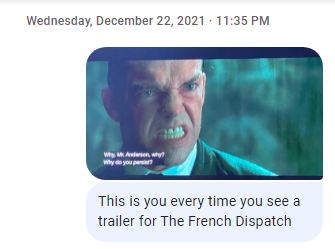
I have a friend who hates Wes Anderson. Like, really, really hates him. Seeing the trailer for The French Dispatch sent him into a rage, so much so that I sent this to him a while back:
I, however, am not a hater. In fact, when I learned from a friend who worked for Vulcan Video (North) that their DOS rental records went back so far that he could even take a look at what Anderson rented when he was a UT student developing the ideas and images that would go on to influence Bottle Rocket, I became obsessed with obtaining this information and possessing it for myself. If you’re reading this, Mr. Anderson, you can rest assured that this information never made its way into my hands, as the good people of Vulcan kept your privacy, and I couldn’t get my FOIA filed in time before that location closed. Even though the computer with that information sat at South Vulcan in order to merge the two databases, I still never managed to get my nerdy little talons on it. I do think that this is a more personal effort than others from the director’s oeuvre, and it’s as much a career inspection (I hesitate to use the term “retrospective,” as it has such a… finality) as it is a film, which means it doesn’t connect with me as a viewer with the same intimacy and immediacy as my favorites from that filmography (which, for the record, are Fantastic Mr. Fox, Royal Tenenbaums, Life Aquatic, and Grand Budapest Hotel). In those, the conceits of the story and framing form less of a barrier for me than they do here, as I didn’t really slide into the world of Dispatch as smoothly, but it’s still effervescent and fun, and I recommend it. Read Brandon’s review here.
10. The Suicide Squad
You know, I just love Starro. I think about every iteration of Starro that I’ve seen over the years and how they’re always kind of … cute. Blue and purple starfish guy; he’s only got one eye but it’s a big Bambi of a peeper, and he’s threatening but not very … gross. I’m a simple man and I like my James Gunn like I like my Cronenberg: again, gross. What The Suicide Squad has going for it in terms of sheer entertainment value is that it’s loud, slippery, fun, bloody, and full of bilge and bile. We all know seastars are gross, right? They have eyes at the ends of their limbs and they move around on gross little tentacles and there are over 2000 species of them in almost every kind of aquatic environment you can name. Here, Starro isn’t an adorable cartoon seastar but a massive, disgusting monster with nauseatingly realistic flesh, and then sometimes it opens up little trypophobia-triggering pores and shoots out more gross little dudes. I know I’m stuck on that point and there’s a lot more going on here than that, but I was very pleased with this one. Read Brandon’s review here.
9. Pig
I’ve been working on this list for a while, and this past week, the internet gifted us with this performatively sneering tweet about people watching “baby food culture” on airplanes, which of course set off a great deal of discourse about what constitutes said baby food, whether an airplane was really the proper space in which to engage with (presumably) richer texts like Schindler’s List or Hereditary. Others raised the point that some people opt for these as they are reasonably certain that they will be free of things that they might be embarrassed for watching in public (although I was plenty embarrassed to watch Ready Player One in 2018 but was reasonably certain that I would never see anyone on that flight again; now that’s baby food culture). There have been times for me when watching a movie on a plane actually contributed to the film, if that can be believed; there’s nothing like being forced to make yourself small as 6’2’’ guy with a shoulder width of 24+ inches sitting in a middle seat and subjecting yourself to Unsane. What I will say is that I watched Pig on an airplane, mostly, and I was still moved by it. Well, I watched the first 70 minutes on the flight from Raleigh to Atlanta, and then watched the rest of it on Hulu at home, and it was still one of the best films (and viewing experiences) I had last year, just as much as the Very Cinematic film that’s next on this list. Read Brandon’s review here.
8. The Green Knight
In what I advised in what I correctly characterized as “more of a summary than a review” of The Green Knight, I recognized that it was “an exercise for myself as much as it is a recommendation.” When talking about Alicia Vikander’s big speech, I asked and answered a question that applies as much to the film as a whole as it does to that scene: “Is it ‘good’? I’m not sure, but it sure was huge.”
7. Saint Maud
Last year during the introductory segment for our podcast about Ginger Snaps, we briefly discussed the film Ghost Stories, and specifically how it does “that thing I like.” We didn’t get into specifics since the specific thing that I like (henceforth TTIL) is always a spoiler, but for a longer discussion of that, feel free to check out our early Lagniappe episode about Housebound, which also does TTIL. All of this is to say that Saint Maudalso does TTIL, and it does so with style and aplomb aplenty. The trailer for this one played before the last film I saw in theaters before the first quarantine, and I had already seen it several times before then, but this was a film that was definitely worth the wait. The relationship between people of fundamentalist faith and those without is a constant source of interest for me, as demonstrated pretty extensively here over the years, not least of all with my Planet Mirth series. Here, our protagonist is a woman of a newfound faith, a belief born more of trauma and recrimination than one with which she was endowed by her parents or arrived at via a winding road of theological research. As such, it’s very personal and fervent while also being wild and piecemeal; despite its fragmentary and uninformed nature, the title character is nonetheless devoted and holds others to the strictures of her ideology, despite the fact that no one on earth could possibly know what’s going on inside her mind. And what’s in there is fantastical: visions of God and the devil, heaven and hell, and all of it finally coming to a head in an attempted act of self-canonization that’s almost too harrowing. Read Brandon’s review here.
6. Psycho Goreman
Brandon was less-than-sold on this one when he reviewed it last year, and I think that his review is fair and reflective of his taste. His opinions aren’t my own (although I would also compare it to Turbo Kid, which was my number three film of 2015), however, and although we align in a lot of ways, this one sat at the top of my list for most of the year, until a few late-in-the-year surprises managed to dethrone it. Although I used “smorgasbord” when describing Turbo Kid in the above-linked 2015 list, it’s been six years, so I feel comfortable using it again. This is a movie about a truly horrible and unlikable little girl, a bully who through nothing more powerful than coincidence comes into possession of a totem that allows her to control an otherwise unstoppable killing machine. Of course, Psycho “PG” Goreman (as she dubs him) isn’t a machine, he’s a living being, albeit one who defies “life” in much the same way as the monsters on the covers of 1980s metal album covers. Against his will, PG undergoes a journey of self-discovery, of a kind at least, as he learns that he has a fondness for hunky boys as well as dealing death. My favorite bits are when he is forced to become the drummer in his young friend(?)’s band, as well as the conversion of poor Alasdair into a big ol’ brain monster, which is never reversed. I got a kick out of this one.
5. Titane
When we recently discussed Titane on the Lagniappe podcast, I confessed to my intense jealousy about the fact that Brandon got to see (and review) the film before I did, especially after I got to see Raw in limited release and got copy on it to editorial within a day, beating a lot of actual media outlets to the punch, which is rare for our Little Swamp Engine that Can. There were many delays, caused first by COVID, then a friend’s school schedule, then COVID again, before I finally got the film through legitimate means (wink) and watched it at home. When I told the friend with whom I shared that viewing experience about how high the film would likely end up ranking on my list, she was shocked, and noted that she thought the film was pretentious. I could hardly agree less, to be honest, as I don’t think that this film is putting on any airs at all. It’s a body horror dark comedy about a serial killer who gets pregnant with a Cadillac’s baby and finds herself hiding out with an aging French firefighter and trying to disguise herself amongst a bunch of his macho employees. That it might be saying something about gender as performance is there, but I think it’s communicating less of a capital-M “Message” than something like Videodrome, which is the film it most reminded me of. It’s a long, strange journey, and I loved it.
4. Plan B
From my review: “[Plan B]’s not just funny, it’s funny in a very intimate way, which matches the subject matter, appropriately interspersed with emotional reminders of the potency of teenage emotion. […] And it does it all with humor that verges-upon-but-does-not-quite-become gross-out comedy, vignetted character portraits of outlandish but somehow instantly familiar personalities, and the warmth of basking in the effortless conversational volley between two best friends who know each other better than anyone else in the world.”
3. Dune
As I summed it up in my review of the film (slash jeremiad about the state of online film discourse and criticism, as is my wont), “Dune is good. See it.”
2. Cryptozoo
The end of the opening pre-title sequence of Cryptozoo may as well have been written by the Magical Realism bot on Twitter: In 1967, a woman wearing a unicorn’s horn around her neck finds a sign warning of dangerous cryptids; the paint is wet. And at that point, we’re only getting started. I was surprised to see only a single director listed on IMDb and Wikipedia for Cryptozoo, because I distinctly remembered seeing a woman’s name in the “A Film By” credit, which is usually reserved for the director(s), and marveling that I had accidentally managed to watch four films directed by women in a row without any intent to do so (following Rare Beasts, Plan B, and Matrix: Resurrections). The film does conclude with “A Film by Jane Samborski and Dash Shaw,” but Shaw is the writer and director, while Samborski is later credited as the film’s Animation Director, which I suppose makes a certain amount of sense, as the animation here is completely integral to the storytelling in a way that advancing animation technology has unintentionally driven creativity to the margins. As digital animation (or more specifically vector-asset based animation) becomes more the norm, a lot has been lost over the years. This can be found everywhere but the particular longevity of The Simpsons allows for an easy reference point: take for instance the way that Marge’s hair moves with character in this GIF of her in the opening credits that The Simpsons had for decades, and compare it to her hair’s stiff, lifeless lack of movement as she turns her head at the same moment in the HD credits which are now 10+ years old at this point. It’s not necessarily a bad thing that there’s now a lower barrier to entry for potential animators, but corporate interests mean that corners are going to be cut when it comes to animation and as a result, we now have stuff like that Red Ape Family cartoon thing that I’m not going to link to. The animation here is stunning, truly one of the most novel things I’ve seen in years, and I was captivated by every moment of this movie. This was released by Magnolia Pictures, and you know you wouldn’t see a film that would be so undisguised in its criticism of neoliberalism’s tendency to act capitalism apologia or attempt to correct social problems by invoking the free market in a wider release from a bigger studio; Disney Studios might let the Red Guardian in Black Widow have “Karl Marx” tattooed across his knuckles, but a monopoly of that size is never going to engage with leftist ideas in a meaningful way. Within Cryptozoo, capitalism will clearly not create a path for social acceptance of The Other. Simply gathering beings into a single location like a reservation zoo and grafting them onto the larger apparatus of capitalism will not forge freedom. Yes, it may possibly save them from greater harm in the outside world, but it also forces them to exist alongside of and engage with an economic system that allows them to subsist but not excel; cryptid keeper Lauren specifically notes that her business partner Joan’s inheritance will not last forever and that there is a profit motive to making Cryptozoo an enterprise and not merely a cryptid sanctuary because it is otherwise unsustainable. This is the best original animated feature I’ve seen in a very long time. Read Brandon’s review here.
1. Promising Young Woman
I kinda do this thing almost every year where I do a whole song and dance about how I feel that films released on or after Christmas don’t really count for that year’s list and should count for the following year’s. In 2016, this was my logic for including Anomalisa; in 2019, I did a whole round-up of films that I missed in 2018 because of my accident. This film, which released as a nasty little present on Christmas Day in 2020, is my holdover for this year, and ended up being my favorite movie of the year. And before you start flogging me for this choice: I understand that this is a Problematic Fave. I’ve read the thinkpieces about how this piece of media is Bad, Actually, and I don’t think any of them are incorrect. This one in particular is often pointed to as a source of the reasons why this movie is bad and you should feel bad for liking it, and I have to say that I don’t disagree with a single one of its points. I’ll try to avoid spoilers about it, but this is a movie about a woman getting revenge “on behalf” of her now-dead friend in a method that ultimately costs her everything and makes her a victim as well. That’s a totally acceptable thing to find objectionable, frankly. In fact, the backlash against this one was so bad that on three separate occasions, I withheld telling people this was my favorite movie of 2021 until pressed, and in each instance, my companion had pretty similar feedback about the ongoing problems with contemporary film discourse revolving around the apparent need for the objet d’art to perfectly align with their personal morals and ethics. I’m not going to pretend that I’ve never fallen into this trap myself (looking back, a one-star review for 4 mosche di veluto grigio is a little harsh, especially since my biggest problem with the film was just how shitty and unlikable the protagonist was), but I don’t think that this is the best way to discuss a piece of art, and certainly shouldn’t be the only way through which we explore the text. There’s a lot going on with our lead Cassandra’s self-destructive behavior and her self-sacrifice, and although the sheer volume of critical writing that takes aim solely or primarily at this aspect of the narrative is demonstrative that it can’t be just a few people for whom this is their primary critical lens, but a large portion of it. For some people, self-sacrifice is noble; for others, it isn’t. For me, something that aligns with my values, or professes to, does not make it a good work of art, and a piece of art does not necessarily become objectionable because it does not share my values. The SNL of the Trump years wasn’t funny just because they (professed to) hate him as much as I did. In fact, that was frequently the least funny satire they ever did; I spent a lot of my youth rewatching SNL in syndication with references to political events that were before my time or outside of my frame of reference, and they could still be funny even without knowledge of the specifics. The lip-service, inoffensively topical social statements in There’s Someone Inside Your House made the film worse, in my opinion, than it would have if it were simply a straightforward slasher. As I write this at this very moment, I have a poster from the Guggenheim’s 2014 Italian Futurism exhibit behind me; most of the participants in that movement were fascists, but Dinamismo di un Ciclista and Lampada ad arco don’t become bad paintings just because Umberto Boccioni and Giacomo Balla were bad people. To me, this was a fascinating piece of art, regardless of whether I thought its morals and values were aligned with my own. I felt its highs and its lows, the dread and the hope and the guilt and the exhilaration, and ultimately the vindication, in spite of itself. Read Brandon’s review here.
When I first learned of the #52FilmsByWomen pledge in late 2016, I was horrified to discover that I hadn’t reached the “challenge’s” quota naturally that year, despite my voracious movie-watching habits. Promoted by the organization Women in Film, #52FilmsByWomen is merely a pledge to watch one movie a week directed by a woman for an entire calendar year. It’s not at all a difficult criterion to fulfill if you watch movies on a regular routine, but so much of the pop culture landscape is dominated by (white) male voices that you’d be surprised by how little media you typically consume is helmed by a female creator until you actually start paying attention to the numbers. Having now taken & fulfilled the #52FilmsByWomen five years in a row, I’ve found that to be the exercise’s greatest benefit: paying attention. I’ve found many new female voices to shape my relationship with cinema through the pledge, but what I most appreciate about the experience is the way it consistently reminds me to pay attention to the creators I’m supporting & affording my time. If we want more diversity in creative voices on the pop media landscape, we need to go out of our way to support the people already out there who work outside the white male hegemony. #52FilmsByWomen is a simple, surprisingly easy to fulfill gesture in that direction.
With this pledge in mind, I watched, reviewed, and podcasted about 52 new-to-me feature films directed by women in 2021. The full inventory of those titles can be found on this convenient Letterboxd list. Each film is also ranked below with a link to a corresponding review, since I was using the pledge to influence not only the media I was consuming myself, but also the media we cover on the site. My hope is that this list will not only function as a helpful recap for a year of purposeful movie-watching, but also provide some heartfelt recommendations for anyone else who might be interested in taking the pledge in 2022.
5 Star Reviews
Starstruck (1982) dir. Gillian Armstrong – A new wave musical that plays both like a rough prototype for 90s Australian gems like Strictly Ballroom & Muriel’s Weddingand a jukebox musical adaptation of Cyndi Lauper’s She’s So Usual. A perfect movie; can’t believe it’s not routinely cited as an all-time classic.
Party Girl (1995) dir. Daisy von Scherler Mayer – The ideal version of a romcom: the romance angle doesn’t really matter and it’s all about the main character Finding Herself while modeling outrageous outfits.
Tank Girl (1995) dir. Rachel Talalay – There is strong proto-Birds of Prey energy running throughout this, right down to Margot Robbie & Lori Petty doing the same Sadistic Betty Boop Voice as their films’ respective antihero leads. It’s a shame neither movie was a hit, since they’re easily the most exciting specimens of superhero media since Burton revamped Batman as a fetishistic horndog.
Freak Orlando (1981) dir. Ulrike Ottinger – I think I got more out of watching Ottinger’s Feminist Alcoholism piece Ticket of No Return last year, but there are individual images in this follow-up that are undeniably sublime. Often feels more like a collection of performance art pieces than an actual Movie (especially in the way scenes defiantly loiter long past their welcome), but I enjoyed being mesmerized and confounded by it.
Bad Girls Go to Hell (1965) dir. Doris Wishman – I’ve slowed way down on my Doris Wishman consumption recently, mostly because the bulk of the remaining ones I haven’t seen yet are roughies, a genre I despise. Glad I held out for this one at least, since it was a novelty to see one of her films all cleaned up on the Criterion Channel, as opposed to hunting down a fuzzy VHS rip of Dildo Heaven on YouTube or a porn streamer. I would have enjoyed the experience a lot more if it were one of her early nudie cuties or late-career whatsits, but it still felt like an Event in its presentation.
1. Titane— Wow. Just wow. This movie has so much to say, and it just shouts it in your face. The explorations of gender performance are grotesque and brutal. The body horror is absolutely disgusting. Julia Ducournau made a greasy, Cronenbergian nightmare that I didn’t want to wake up from. At times it is overwhelmingly explicit and unflinchingly focused on its gory violence, but it leaves enough open to interpretation that it’s not just dumbed down brutality.
2. In the Earth — It’s easy at the beginning to think this movie is just going to be a basic slasher. During a pandemic, a scientist and a park ranger venture into the woods to figure out why no one has heard from a researcher who has isolated herself to study a vast mycorrhizal network. Then, a crazed man obsessed with a photography project gone wrong chases after them with an axe. Yet there’s nothing basic here. This movie dips into psychedelic sci-fi and odd character studies at times, eventually introducing a lady who plays keyboards to trees alone in the woods. A vision of isolation making us crazy; Brandon best described this movie as people taking their COVID hobbies too far. I think I chose the wrong hobbies and should have picked up playing synths in the forest to talk to trees.
3. I Blame Society — To make movies you kind of have to be a horrible person. You have to obsessively craft a story and a vision and believe in it enough to see it through. Also, you have to convince a whole team of people to back you up and let you boss them around. It takes a special kind of self-absorption and narcissism that just gets written off for men who we consider geniuses. What if you’re a woman just starting out?
Gillian Wallace Horvat plays herself as an independent filmmaker that can’t get any support for her films. Instead of giving up she doubles down on a project inspired by a couple of her real-life friends saying that she would make a great serial killer. It quickly spirals out of control, and she becomes an actual serial killer. It’s hilarious. There’s a moment in this movie that will stick with me forever where she’s in the home of a future victim, drinking wine in her underwear, and she says, “I’m living my best life.” This movie is so angry and bratty, and I loved every second of it.
4. Pig— It’s satisfying to watch a movie based in the town where you live and have it get the setting exactly right, especially when it’s in subtle ways. There’s a scene in this movie where Nic Cage’s character sneaks into the backyard of his old house and has an amazing conversation with a child playing a weird instrument, and it’s an absolutely accurate and genuinely Portland moment. The conversation he has with a chef at a pretentious restaurant where the man cannot give a straight answer about his craft is 100% Portland. (Why can no one here deliver unpleasant answers directly?) Forsaking city life and fame to harvest truffles in a rustic cabin in the woods is exactly what someone from Portland would do. It’s not the only thing I liked about this movie, but it’s a special feeling to have my adopted hometown portrayed so accurately and even lovingly for all its many flaws.
Nic Cage gives a heartbreaking performance. Remembering the importance of food—especially a good meal prepared by a talented chef—is something many of us are holding onto right now while we wait for safe time outside the house. The heart of this movie is big, genuine, and forgiving, which is why it’s so beautiful and moving. I cried. A lot.
5. The Medium — This year, I liked a lot of very combative movies. This one is no exception.
A mockumentary/found footage horror about a spiritual medium’s niece becoming possessed is not a hard sell for me. This started out as a sequel to The Wailing, which is a movie I liked enough to do an entire Lagniappe Podcast episode about it. Obviously and thankfully, it became its own thing. A chipper woman becomes possessed, gradually wastes away, and becomes a wraith; her devout shaman aunt starts to question her own belief system and place in the world; and the whole family tries to hold itself together despite decades of cultural and spiritual differences. Ultimately, everyone gets ripped apart, even the film crew.
There’s a lot of questions here about whether filming this family drama is exploitative. The crew is constantly asked, “Do you have to film everything?” Like I said before, to be a filmmaker you kind of have to be awful, so yes, they do continue to film it all, until it’s way too late. The filmmaking itself is even weaponized and used by the demon to up its body count, at one point even beating a woman with a camera. What is more important: family privacy and safety or artistic integrity? Is documenting this event worth it?
Runners-Up!
Saint Maud — Religious devotion gone way too far. Feels like how the actual stories of saints would play out if we looked at them through a modern, critical lens.
Bo Burnham: Inside — I didn’t expect to like this, but for something that starts out as ye olde times YouTube humor, it truly hooks you. By the end, you feel like something vital has been ripped out and put on display for everyone to see.
The Green Knight — A beautiful visualization of an Arthurian quest. Gritty enough to modernize and critique the myths, but not so much that the magic is lost.
1. Titane – A surreally macho, thematically elusive nightmare from Julia Ducournau, the director of Raw. As with the perpetually underseen & underappreciated The Wild Boys (the very best movie of the 2010s), it’s a nuclear gender meltdown with no clear sense to be made in its burnt-to-the-ground wreckage. A thrilling experience in both cases, both of which find unlikely refuge in the violence of pure-masc camaraderie & social ritual.
2. I Blame Society – An incredibly dark comedy about a struggling filmmaker who realizes her skills behind the camera resemble the skills needed to pull off The Perfect Murder, then quickly turns into a serial killer. Feels like it was aimed directly at my tastes, from the no-budget D.I.Y. aesthetic to the transgressive joy of Difficult Women to the flippant meta commentary on movies as an artform. Love to be pandered to bb.
3. French Exit –Leaving Las Vegas for pompous, affluent drag queens. I loved Michelle Pfeiffer’s scenery chewinginmother!and I feel like I’ve been waiting for this exact career resurgence vehicle for her ever since. Just deliciously vicious camp from start to end; easily one of her career best.
4. The French Dispatch– Maybe my favorite Wes Anderson since The Royal Tenenbaums, or at least a perfect encapsulation of everything he’s been playing with since then. People often complain about how visually lazy studio comedies are, so here’s a film packed with Hollywood Celebrities where every scene is overloaded with gorgeous visuals and hilarious jokes.
5.Pig– “A John Wick knockoff about Nic Cage fighting to recover his stolen truffle pig? Sounds like a hoot and a half.” Cut to me struggling to see the screen because crying into my mask is fogging up glasses. An understated execution of a preposterous premise, refusing to behave either as a sober return-to-form showcase for the often-mocked actor or as fodder for his infinite supply of so-bad-its-good YouTube highlight reels. It’s its own uniquely beautiful, tenderly macho thing, with more to say about culinary arts than the peculiar flavors of Cage’s screen presence.
6. Lapsis – A high-concept, low-budget satire about our near-future gig economy dystopia. It doesn’t aim for the laugh-a-minute absurdism of Sorry to Bother You, but it’s maybe even more successful in pinpointing exactly how empty and draining it feels to live & work right now.
7. Beast Beast – Tubi’s bold foray into prestigious festival acquisitions: a very Sundancey teen drama about gun violence, one that’s both horrified by and in reverent awe of the Internet as a creative or destructive tool, depending on who’s wielding it. The ultimate example of the dictum “It’s not what happens but how it happens,” as its hyperkinetic, youthful style entirely overpowers its afternoon-special PSA plotting. Think of it as the Gen-Z version of Elephant.
8. Pvt Chat – A grim internet-age romance starring Uncut Gems‘s Julia Fox as a camgirl dominatrix with the world’s wormiest fuckboy client. Late-night NYC mania & grime de-fanged by the cold isolation of life online. No Wave filmmaking echoed in 1’s & 0’s. Small & intimate, but explicitly about how all modern relationships have been completely drained of their intimacy.
9. Zola– Genius in its costuming & dark humor, but what really struck me is how unbearably tense it is as soon as it embarks on its road trip to Floridian Hell. I hadn’t read its infamous online source material, so I had no idea where it was going (except that @zolamoon lived to tweet about it). Scarier than any horror movie I watched this year.
10. Barb and Star Go to Vista Del Mar – A delightful throwback to a very specific type of absurdist buddy comedy that rarely gets made anymore (Romy & Michelle, Zoolander, Dude Where’s My Car?, etc). Also an underdog contender for the year’s most crowd-pleasing musical.
11. Annette – Leos Carax’s entertainment-industry rock opera, originally composed as a concept album by the avant-garde pop group Sparks. The nagging question of whether it’s Good Weird or just Weird Weird never fades at any point during its unwieldy runtime, but I’m cool with it either way. It has a sense of humor about itself, and there’s nothing else like it: two qualities that can’t be undervalued.
12.The Matrix Resurrections– Lana Wachowski’s New Nightmare: a platform for her to reflect on the core philosophy & romance of her most iconic work while lashing out at a movie industry that seeks to dilute & pervert it for an easy cash-in. I most loved being trolled by the opening fifteen minutes; just the absolute worst-nightmare version of what it could be before it reveals what it’s actually doing. It’s an A+ prank, both on the audience and on the higher-ups at Warner Brothers.
13. Bo Burnham: Inside – When it pretends to be a sketch comedy revue, it’s very hit or miss joke-by-joke, song-by-song. By the time it mutates into full-on video art about Internet Age despair it feels like something substantial, though, meaning it works better as a movie than it does as a comedy special.
14. In the Earth – The exact psychedelic folk horror it’s advertised to be, except with an entire slasher about an axe-wielding maniac piled on top just to push it into full-on excess. As a nightmare reflection of our collective, COVID-era mindset, it’s difficult to pin down exactly what it’s doing except to say that it’s impressively strange, upsetting stuff considering its limited scope & budget. A rare example of COVID Cinema that aims for something intangible and indescribable, something that captures the existential horrors of current life rather than the logistical ones.
15. Benedetta – Part erotic thriller, part body possession horror, part courtroom & political drama, pure Paul Verhoeven. I was fully prepared for its sexual theatrics & religious torments, but completely blindsided by its visions of Jesus as a sword-wielding warrior from a romance novel. My only disappointment is that it backs off from illustrating Benedetta’s visions in the second half in a ludicrous nod to “playing both sides”; would’ve loved to see more fantasies of Jesus as a hunky heavy-metal badass.
16. Saint Maud – Speaks both to my unquenchable thirst for the grotesque as a horror nerd and my unending guilt-horniness-guilt cycle as a lapsed Catholic. I appreciate it more each rewatch for what it actually is (an intensely weird character study) instead of what I wanted it to be (a menacingly erotic sparring match between a religious-zealot nurse and her atheist patient).
17. Lucky– A high-concept home invasion horror about a woman who’s cyclically attacked by the same masked killer night after night after night. Works best as a darkly funny act of audience gaslighting and a surprisingly flexible metaphor about gender politics. Recalls the matter-of-fact absurdism of time-loop thrillers like Timecrimes & Triangle, with a lot of potential to build the same gradual cult following if it finds the right audience.
18. Red Rocket– Another bleak poverty-line comedy from Sean Baker, except this time it’s more of a feel-bad hangout vibe than a nonstop plummet into chaos, and the protagonist is deeply unlikeable instead of charmingly vulgar. It’s like a goofier, laidback version of Good Time, where you feel terrible laughing while a desperate scumbag exploits every poor soul in their path just to keep their own head slightly above water. Really slows down to make you squirm between the punchlines.
19. Mandibles– Quentin Dupieux’s absurdist comedy about bumbling criminals who adopt & corrupt a gigantic housefly so it can join them in acts of petty theft. Last year’s Deerskin felt like a career high for Dupieux, especially in its sharp self-satirical humor about the macho narcissism of filmmaking as an artform. This finds him backsliding into his more typical comedies about Nothing, just two dumb buds being dumb buds who now have a weird pet. He totally gets away with it, though, solely on the virtue of the jokes being very funny.
20. Cryptozoo – Dash Shaw’s mildly psychedelic fantasy comedy about a futuristic zoo for cryptids. Like My Entire High School Sinking into the Sea, it’s a bizarre clash of far-out visual play & laidback aloofness, calling into question how much its internal ethical conflicts are intended to be taken seriously vs how much they’re an ironic joke about the film’s own sprawling, convoluted mythology. Shaw’s work is never boring to look at, though, even if his characters appear to be bored within them. His visual playfulness is a quality that’s increasingly difficult to find in modern animation, questions of sincerity be damned.
Our current Movie of the Month, 1985’s Lifeforce, finds screenwriter Dan O’Bannon returning to the retro sci-fi horror he revived to great success in Ridley Scott’s Alien(and, less famously, in John Carpenter’s Dark Star). Just like in Alien, Lifeforce follows an unprepared crew of astronauts who are lured by a mysterious distress signal to a hostile alien landscape (in this case, on the surface of Halley’s Comet), where they’re hunted by the horrific creatures who inhabit it (in this case, soul-sucking nudist vampires). By the time those creatures become stowaways on the space crew’s return to Earth, it’s clear that O’Bannon was recalling a very specific subgenre of Atomic Age sci-fi from his youth in both films; what’s unclear is what exact retro sci-fi titles he was referencing.
After revisiting Alien and watching Lifeforce for the first time this year, I did find myself curious about what Atomic Age sci-fi cheapies had influenced their shared tropes. What I found was a group of cheap, quaint space travel pictures with a remarkable narrative overlap in O’Bannon’s screenplays. Alien & Lifeforce are both updated to the modern horror tastes of their times, but there were plenty of retro space travel cheapies that mapped out the future details of their shared plot structure. Here are a few recommended titles if you enjoyed our Movie of the Month and want to see the vintage prototypes for its distinctly 1980s mayhem.
It! The Terror from Beyond Space (1958)
You can’t ask for a much more straightforward, no-frills prototype for O’Bannon’s stowaway space alien invasions than It! The Terror from Beyond Space. Even though the film’s rubber-masked pig-man is more adorable than scary, the way it hides in the rafters & crawl spaces of its Earthling victims’ spaceship is pure Alien. It’s the kind of 1950s space travel thriller where the poster declares “$50,000 guaranteed by a renowned insurance company to the first person who can prove It is not on Mars now!” (despite the fact that It spends most of the runtime on a spaceship, not its Martian home planet). It also laid out a roadmap to the kinds of stowaway alien invasion movies that O’Bannon would later emulate in his two biggest productions.
It! The Terror Beyond Space even introduces its Earthling spaceship crew chatting around the dinner table, which is how audiences got familiar with the crew of Nostromo in Alien. The stark difference here is that the women onboard the ship are mostly around to serve the men coffee at that table, and to tend to their wounds after the Martian creature attacks. O’Bannon originally wrote Eleanor Ripley as a man, and his domineering nudist vampire villain in Lifeforce isn’t exactly the personification of Feminism, but you still have to credit him for giving his women characters something more to do than hang around as waitresses & cheerleaders.
Queen of Blood (1966)
In a lot of ways Queen of Blood is the least substantial of these Alien prototypes, if not only because it’s one of those AIP/Corman cheapies that were built out of Americanized scraps of better-funded, more imaginative Soviet sci-fi films — lurking among throwaway titles like Battle Beyond the Sun & Voyage to the Planet of Prehistoric Women. It’s the one that most closely resembles the plot of Lifeforce, though, in that its stowaway alien invader is a wordless, beautiful woman who feeds on the blood of men like a vampire. You’d think that of all the retro sci-fi films of this ilk this would be the one titled Planet of the Vampires—since Mario Bava’s own eerie Alien prototype doesn’t feature any actual vampires—but the title Queen of Blood is just as badass, so we’ll have to let that slide.
It’s hard to know exactly what to praise in Queen of Blood, since so much of its sci-fi spectacle is borrowed wholesale from the Soviet film Mechte Navstrechu, but its titular, green-skinned vampire queen is fabulous; she’s got a whole Juno Birch thing going on and it’s wonderful. Not for nothing, but the film’s space crew also include prominent female scientists who actively save the day as the horndog men around them fall victim to the vampire, which is more than you can say for either Lifeforce or It! The Terror Beyond Space.
The Green Slime (1968)
If you want to see the retro Alien prototype at its goofiest, you likely won’t do any better than 1968’s The Green Slime, a sci-fi creature feature collaboration between MGM and the Japanese studio Toei. From its funky psych-rock theme song to its adorable X from Outer Space-style miniatures, to its slimy rubber monster, The Green Slime is pure kitsch. Many of its plot details overlap with the specifics of Alien, though, despite that goofiness: its stowaway creatures’ lethally corrosive blood, its menacing stockpile of alien eggs, its doomed crew members’ refusal to adhere to proper quarantine protocol, etc. You can practically picture little baby O’Bannon propped in front of his cathode-ray TV scribbling notes on how to tell an alien invasion story.
The Green Slime was mocked on the pilot episode for Mystery Science Theatre 3000, and it’s easy to see why they thought it left enough dead air for the show’s riffing to fill. Its adorable old-school special effects work compensates for its lethargic pacing issues, though, and it’s the only film on this list that even vaguely resembles the batshit goofballery that O’Bannon would later indulge in Lifeforce. It’s a shame that Lifeforce didn’t have its own titular theme song, though, since the one for The Green Slime is such a delight:
I’m becoming increasingly bitter towards the Christmas holiday season in my adult years, which is making traditional Christmas Movies borderline intolerable. In an effort to make this mandatory-cheer Hell Month something to look forward to instead of something to dread, my household has shifted into celebrating Yule as a seasonal alternative. So far, this change has mostly amounted to exchanging gifts & eating festive meals around a small, contained fire, but it has drastically shifted what I think of as seasonally appropriate holiday #content. December is all about ghost stories for me now, a Yuletide tradition most popularly reflected in Dickens’s A Christmas Carol (and made-for-British-TV horrors that rarely get exported to the US). I have no appetite whatsoever for the hundreds of disposable Christmas-schmaltz romances that auto-populate on Hallmark & Lifetime every year. I’ll always have room in my belly for more spooky ghost stories, though, which is my way of saying I wish it could be Halloween year-round.
To that end, this Yule season felt like as good of a time as any to catch up with one of my biggest ghost-story blind spots: the most beloved movie adaptation of Henry James’s The Turn of the Screw. It’s no surprise that 1961’s The Innocents is the exact impeccable classic that it’s lovingly remembered as. I was initially unsure that I’d be able to fully sink into it, since i was initially comparing it to a recent first-time viewing of the similarly styled The Haunting, but the camera trickery & psychosexual discomforts were distinctly their own thing despite the parallels. The Innocents is cold, eerie, beautiful, brutal. After a half-century of cultural familiarity & exultation, it still cuts sharp against the throat, weaponizing a kind of narrative ambiguity that’s been slowly bled out of modern mainstream horror. The only other film I can recall that perverts the traditional atmospheric scares of Gothic horror with such overt sexual menace is Mario Bava’s The Whip and the Body, and even that particular erotic nightmare didn’t dare include young children in its main cast.
The easiest way to highlight The Innocents‘s bravely alienating mood is to contrast it against lesser-loved adaptations of its source material, of which there are dozens to choose from. Take 2020’s The Turning, for instance, which ages up the little-boy protagonist of the story into a teenage Finn Wolfhard and takes a definitive side in the story’s internal debate over whether its ghosts are “real.” There’s something incredibly creepy about a pre-pubescent child hitting on his governess with the sexual drive of a sadistic adult man (possibly due to being possessed by that man’s ghost), hiding behind fake-polite apologies like “What a wicked boy I’ve been.” A teenager hitting on an adult authority figure is also gross & uncomfortable, but it feels more matter-of-course than supernatural. Wolfhard’s casting feels like a deliberate choice to make James’s story more accommodating for today’s simple-morals audience. It also backs The Turning into a corner where it has to make the ghost-possession half of its story more explicit to compensate, saving the question of whether it’s all in the governess’s head for a cheap, last-second twist. Meanwhile, Truman Capote was hired for a script re-write of The Innocents to make its ghost vs. insanity balance even more ambiguous & difficult to pin down.
In all honesty, The Turning isn’t too bad for a modern PG-13 horrorbuster. It just has the misfortune of being contrasted against one of the greatest haunted house movies of all time. It’s also self-sabotaged by one of the sloppiest, most insulting twist endings the genre has seen in a long while (or at least since 2016’s Lights Out). The hilarious thing is that the DVD I borrowed from the library prominently features a fix-it Alternate Ending option on its main menu, and that ending is somehow just as bad as the original. The even more hilarious thing is that the best shot in the entire movie is buried under the end credits, after the gotcha twist has already pissed off everyone in the audience, presumably playing to an empty theater. That shot is of the governess’s hand tracing the illustrative details of the haunted house’s antique wallpaper, set to a heavy industrial drumbeat. It’s the exact kind of eerie, pure-image artistry that The Innocents indulges in feature length. It would be much easier to settle for The Turning‘s cheap-shot jump scares & carefully posed creepy mannequins if I hadn’t already seen The Innocents conveying (a more daringly ambiguous version of) the same story in gorgeous art-photography experiments with double-exposure layering & deep black voids. It’s a shame that the one time The Turning attempts to translate that visual artistry for the 21st Century is in the minutes after it’s already shat the bed.
I’m not covering any new ground here by declaring The Innocents great and The Turning disappointing. These are widely accepted truths. All I can really do here is advocate for more people to think of The Innocents and similar haunted-house stories as Christmas Classics. I’d love to see a cultural shift on this side of the pond where we watch spooky possession stories like this every December instead of stuff like A Christmas Prince VII: Still Princin’.































 Swampflix
