Best in Show (2000)’s Comedic Perversion of Gates of Heaven (1978)

One of the most difficult things to pinpoint about Errol Morris’s landmark documentary Gates of Heaven is the question of its tone. In the 1970s, a feature-length documentary about something as quaint as a pet cemetery was met as an absurd concept (so much so that Werner Herzog ate his own shoe over it), so it would be tempting to read a humorous irony into the interviews Morris conducts for the film. There’s no narration, editorializing, or extratextual context provided for the film’s oral histories of an inter-family dispute over ownership of a pet cemetery. The most of his own personality Morris imposes on the story is in his choices in framing & editing, which have a proto-Wes Anderson flavor in their sense of symmetry & color. When an eccentric pet owner sings to their dog or recounts a long, rambling non-sequitur story about their tragically uninteresting children, it’s presented in such a matter-of-fact delivery that it’s difficult to tell if & when Morris is finding them as humorous as his audience does. This documentation of small-town disputes & niche pet-culture eccentrics later turned out to be a huge, blatant influence on the comedic sensibilities of director Christopher Guest. One of Guest’s improv-heavy mockumentaries, the 2000 comedy Best in Show, even mirrored Gates of Heaven’s documentation of eccentric pet owners & the commercial industries that surround their devotion to their animals. And since Guest’s tone is blatantly comedic, the way his own filmmaking style accentuates the quaint humor of his characters is as an excellent demonstration of just how tonally vague Morris’s own style remains.

It’s hard to believe Best in Show was released almost two whole decades ago. Its cast of Guest-regular performers (Bob Balaban, Eugene Levy, Catherine O’Hara, Parker Posey, Michael McKean, Jennifer Coolidge, Ed Begley Jr, etc.) look so oddly young in retrospect, after watching them age in other projects in the years since. In addition to being a time capsule, Best in Show remains an incredibly endearing comedy, something that’s difficult to achieve in a film that openly (even if gently) mocks the kind of pet-obsessed eccentrics who are more sincerely profiled in works like Gates of Heaven. Errol Morris’s influence on Best in Show is most apparent in the film’s earliest stretch, when these characters are first introduced. Before they converge for a climactic dog show competition, each contestant is individually interviewed in their home environments, which often resemble the 1970s decor of Gates of Heaven’s pet-owner homes (right down to the amateur dog portrait art in the background). Most of the individual contestants are coupled off romantically, except for Christopher Guest’s own bloodhound owner, which is a distinct departure from Errol Morris’s style, which tends to focus on one orator at a time. The bloodhound owner would fit right in with the Morris doc, though, almost recalling the quiet sweetness & tragedy of the lonesome Floyd McClure, the pet cemetery entrepreneur who kicked Gates of Heaven’s entire story into motion. The similarities between the two works becomes less apparent as the contestants coverage for the actual dog show competition, because Best in Show then resembles a traditional sports movie narrative instead of a quaint documentary. In the early, introductory stretch, however, you can detect Morris’s fingerprints all over the picture, something that’s only betrayed by the movement of Christopher Guest’s camera.

Part of Morris’ distancing tone is in how his film captures long uninterrupted oral histories of a pet cemetery dispute in a static camera, only coloring interviewees’ input through the background imagery he chose to frame them with. To establish a more distinctly comedic tone, Guest more often “interviews” two characters at the same time, allowing more improvisational play & establishing a quicker pace. There are more interviewees, more live pets, more location changes, more camera movement, more everything. Instead of framing his characters with Wes Andersonian symmetry & calm, he allows the camera to drift back & forth between speakers to accentuate a ridiculous statement or an incredulous reaction. If there is a blatant sense of humor to Gates of Heaven, it’s to be found in the film’s matter of fact documentation of mundanity. Best in Show runs with that thread, making its characters out to be incredibly boring, in that it’s genuinely incredible how boring they are. As much as anyone can assume what Morris was up to in his work, I don’t think Gates of Heaven is mocking his subjects the way a mockumentary must, by design. Similarly, Christopher Guest’s own characters are played with a kind of sweetness (give or take a high-strung yuppie couple with an unseemly J. Crew catalog addiction), even if their extreme mundanity is supposed to be read as humorous. Guest just makes their screentime quicker, broader, and more dynamic in motion than Morris does, because Guest must establish a comedic rhythm instead of allowing one to arise naturally (if at all).

Again, I’m not sure exactly how much humor or ironic detachment Errol Morris intended his audience to read into Gates of Heaven. All Best of Show can illustrate is how that movie may have looked if it were clearly tipped in that direction, fully committed to establishing a comedic tone in capturing the eccentricity of hopelessly devoted pet owners. The two films do feel oddly complementary, though, even if only because they both find an endearing sweetness in most of their subjects, no matter how distanced they remain from them. Best in Show resembles Gates of Heaven (especially in its earliest, introductory stretch) not necessarily because of its similar subject matter, but because it finds genuine fascination in the eccentric mundanity of the pet industry it depicts.

For more on June’s Movie of the Month, the landmark pet cemetery documentary Gates of Heaven, check out our Swampchat discussion of the film and last week’s look at its resulting promotional-stunt Werner Herzog Eats His Shoe.

-Brandon Ledet

Roger Ebert Film School, Lesson 40: A Night at the Opera (1935)

Roger Ebert Film School is a recurring feature in which Brandon attempts to watch & review all 200+ movies referenced in the print & film versions of Roger Ebert’s (auto)biography Life Itself.

Where A Night at the Opera (1935) is referenced in Life Itself: On page 159 of the first edition hardback, Ebert explains his general taste in cinema. He writes, “I am not one of those purists who believes the talkies were perfect and sound ruined everything. To believe that, I would have to be willing to do without Marilyn Monroe signing ‘Diamonds Are a Girl’s Best Friend’ and Groucho Marx saying, ‘This bill is outrageous! I wouldn’t pay it if I were you!'”

What Ebert had to say in his review(s): Roger never officially reviewed the film, but he did reference it in his Great Movies series review of Duck Soup. He wrote, “A Night at the Opera (1935) [the Marx Brothers’] first MGM film, contains some of their best work, yes, but in watching it I fast-forward over the sappy interludes involving Kitty Carlisle and Allan Jones. In Duck Soup there are no sequences I can skip; the movie is funny from beginning to end.”

Like all great comedians, the Marx Brothers were social anarchists. Blatantly disinterested in the pomp & civility of the modern world, the legendary comedic team would only create stuffy, rules-obsessed backdrops for their intensely illogical, confrontationally flippant vaudeville routines to break them down into total chaos. It would be presumable, then, that the self-serious world of the opera would offer one of the most perfect targets for their antics imaginable. The wealth & propriety that surrounds the opera is an inspired choice for a stuffy backdrop for the Marx Brothers’ slobs vs. snobs brand of social anarchy. Unfortunately, A Night of the Opera arrived at a later, transitional period in the Marx Brothers’ cinematic path, just before they became burdened with studio bloat in A Day at the Races, so it never really had a chance to use its conceit to its full anarchic advantage the way they would have in an earlier, freer work like Duck Soup. Luckily Groucho, Chico, and Harpo Marx are some of the funniest people to have ever walked the planet (especially Harpo), so the movie is wildly funny anyway. A Night at the Opera is only vaguely disappointing because it’s very funny, as opposed to being the funniest movie of all time, something that very easily could have been achieved with its exact plot & cast under less studio control.

The first film marking the Marx Brothers’ transition from Paramount Pictures to MGM, A Night at the Opera is somewhat burdened by the limited imagination of its producers. In particular, MGM exec Irving Thalberg made a point to oversee & reshape the comedy troupe’s schtick to make it more palatable to a broader audience. He wanted to enhance the Marx Brothers brand’s appeal by strengthening their movies with more story structure and more sympathy for the three goofball leads. Thalberg aimed to achieve this sympathy by reserving their social terrorism only for “deserving” villains, as opposed to everyone in sight. It’s an impulse that fundamentally misunderstands what people love about the Marx Brothers in the first place, overloading their usual light touch of illogical transgressions with increasingly sprawling plots & runtimes. Every moment dedicated to giving the brothers a reason to drive their victims mad with slapstick & wordplay is wasted time that could just as easily have been replaced with more comedic gags. A Night at the Opera is a story about two opera singers who love each other, but struggle to connect because of the distance created by their disparate levels of success. Instead of tearing down the civility of the opera world, the Marx Brothers’ main function in the film is to bring the two lovers together, across the boundaries of class. That’s their function in the plot, anyway, which despite what Irving Thalberg believed, does not matter in a film like this. Not for a second.

That’s enough obligatory nitpicking from me. This movie is hilarious. Harpo Marx remains the funniest man who ever lived, transforming the art of slapstick humor into a deeply deranged subversion that’s since been unmatched (even appearing briefly in drag for an early gag here). Groucho & Chico are as impressive as ever in the circular logic of their conman wordplay, scamming the rest of the world and each other into a luxurious position just above the poverty line. One elaborate gag even recalls the total chaotic meltdown of a Duck Soup by piling every character possible into a single, cramped state room on an already crowded ship, a bit that comes so naturally to their comedic style that Harpo effectively sleepwalks through it. As always, the Marx Brothers’ quality in comedic craft remains unchanged; it’s just the vessel it’s packaged in that feels questionable. I really enjoy A Night at the Opera as a stately showcase of vaudevillian comedy, even if its focus on plot, romance, and musical interludes greatly distracted from what the Marx Brothers could have achieved in an operatic setting without MGM supervision guiding their work. I mean, even A Day at the Races was an easily lovable MGM-era Marx Brother comedy, and that film was saddled with a bloated, plot-driven runtime & a deeply disappointing blackface gag. Left to their own devices, the Marx Brothers could have made A Night at the Opera an anarchic masterpiece. Under Irving Thalberg’s supervision they made it a very funny, naturally endearing comedy instead, something to still be grateful for.

Roger’s Rating: N/A

Brandon’s Rating (4/5, 80%)

Next Lesson: My Dinner with Andre (1981)

-Brandon Ledet

Werner Herzog, Gates of Heaven (1978), and the Artistic Value of the Side Show Publicity Stunt

Werner Herzog’s entire public persona is a kind of performance art, the documentation of which has become increasingly crucial to his filmmaking projects in recent decades. A Werner Herzog “documentary,” no matter its subject, is just as much about the filmmaker’s own philosophical worldview as it is about the world outside his mind. This suits the audience just fine, since Herzog is what would classically be described as A Character, someone who’s naturally entertaining and whose mere presence is always a kind of performance. A succinct, early taste of this performance art can be found in the Les Blank short-doc Werner Herzog Eats His Shoe, which takes Herzog’s natural presence as a one-person side show as literally as possible. Staged as a promotion for Errol Morris’s debut feature Gates of Heaven (our current Movie of the Month), Blank & Herzog collaborate to document a blatant publicity stunt in which, as the title suggests, Herzog eats his own shoe in front of a live audience to draw attention to his friend’s work. With clips from Gates of Heaven interspersing with Blank’s Always for Pleasuremode of documenting the labor of food preparation (if you can consider a leather shoe to be food), and Herzog’s signature pontification on the nature of art & humanity, Werner Herzog Eats His Shoe is an essential, one-of-a-kind collaboration between three of the most prestigious voices in documentary filmmaking. That’s an absurd thing to be able to say about what’s essentially a 20min infomercial for another, more substantial work.

Herzog opens this film complaining that television & talk shows are “killing” culture. He ends it confessing that filmmakers are also cheap illusionists & clowns, that his own chosen profession is embarrassing. Werner Herzog Eats His Shoe is self-aware of its participation in the death of culture. Just as its title is a cheap provocation, the event it documents is advertised in circus-style side show posters promising the shoe-eating stunt to a potential live audience. Herzog eating his own shoe is a stupid, pointless act designed to grab public attention for better art he believed deserved it. Supposedly, Herzog first jokingly bet that Errol Morris would never have the courage to complete a feature length documentary on a subject as inconsequential as a pet cemetery business. The story goes that he said if Gates of Heaven were ever completed & screened for an audience, he would eat his own shoe. Morris does not appear onscreen to confirm the terms of the bet in Les Blank’s short, nor is it confirmed whether the shoe Herzog eats is actually the one he was wearing when he made the bet, as he claims. The entire act is performance art born of flippant humor & male bravado, staged without apology as a publicity stunt to draw attention to Gates of Heaven, which had then yet to secure theatrical distribution. Les Blank shows an interest in the preparation of the shoe as it transforms into “food,” carefully documenting the hot sauce, duck fat, garlic, and vegetable stew used to soften & flavor it. Mostly, though, he allows Herzog to ramble on like a carnival barker throughout the stunt, pontificating as much nonsense as you’d likely encounter in a television broadcast or a talk show, yet framing it as art.

The idea that Gates of Heaven’s topic was too inconsequential for a documentary feels so foreign in a 2010s context. Some of my favorite documentaries in recent memory have been on topics as miniscule as erotic tickling, trash harvesting, and a single dead dog (as opposed to cemetery full of them). It’s also arguable that critic Roger Ebert later did much better by promoting Gates of Heaven in his own way, raising its profile by often citing it as one of the greatest films ever made. Herzog’s side show publicity stunt’s own value as a work of art is in making an even smaller film than the one he promoted with it. If Gates of Heaven’s topic was too absurdly thin to justify a documentary (something I doubt Herzog ever said or believed) then Werner Herzog Eats His Shoe is an even more extreme distillation of that same kind of art. This is an advertisement & an awkwardly staged performance art piece that somehow makes for compelling filmmaking thanks to Herzog’s natural charisma & gift for shit-talking. Like Gates of Heaven, it’s proof that you can make a worthy documentary on just about anything, even a frivolous bet that may or may not actually have even been real. In 2018, it likely would only have been presented to the world as a DVD extra. In 1980, it was art.

For more on June’s Movie of the Month, the landmark pet cemetery documentary Gates of Heaven, check out our Swampchat discussion of the film.

-Brandon Ledet

Get Excited! Swampflix is Tabling Zines at the ALA Annual Conference This Year

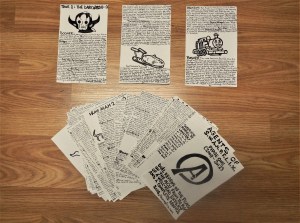
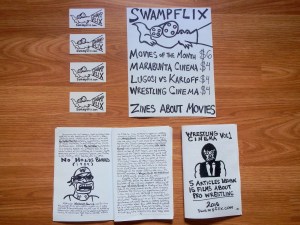
Attention, Swampflix readers in the New Orleans area! We will be exhibiting zines Friday, June 22 through Monday, June 25 at the American Library Association’s Annual Conference’s Zine Pavillion along with a bunch of other super cool comics & zines exhibitors. For this year’s conference we’ve printed a collection of our critical writings on the works of cult filmmaker John Waters.

This slideshow requires JavaScript.

We will be also selling print versions of our “Marabunta Cinema“, “Lugosi Vs. Karloff“, “Agents of S.W.A.M.P.F.L.I.X.” and “Wrestling Cinema” pieces, as well as past years’ Movie of the Month conversations collected in their entirety. All zines feature dozens of new illustrations & hand-transcribed text from the site and the Movies of the Month zines are ~90 page whoppers featuring work from everyone who contributed to the site their respective years.

For more info on the conference, check out the ALA Zine Pavillion’s website at zinepavillion.tumblr.com & refer to the poster below.

-The Swampflix Crew

Star Wars Fans Don’t Love Star Wars, They Love to Complain

Although I’m not quite as enthusiastic of a fan of The Last Jedi at its most fervent defenders, I greatly respected that film’s willingness to burn the Star Wars franchise, one of the most historically lucrative intellectual properties around, to the ground and start anew. Rian Johnson’s entry into the Star Wars canon was a bomb meant to blow up age-old traditions from the inside. It states its intentions in blatant terms by literally burning sacred texts, portraying the franchise’s longest-established hero as a coward who wastes his days drinking grotesque alien goo, and spelling out its mission statement in dialogue like, “Let the past die. Kill it if you have to. It’s the only way to become what you’re meant to be.” I was personally more emotionally invested in the earnest, nostalgic mythmaking of The Force Awakens than anything Johnson’s film accomplished, but I do resect the way his flippant blasphemy attempted to smash the reset button on Star Wars at large, making it more palatable to younger fans without prior attachment to the series. It’s understandable why old school Star Wars fans might feel alienated or even offended by that blasphemy; maybe that reaction was even part of the point. What’s less understandable is why they were also furious with the modern revision JJ Abrams gave A New Hope in The Force Awakens, which was extremely cautious in how it updated series lore (and, in my opinion, was an improvement on the source material). What’s absolutely maddening is their disregard for the latest entry in the canon, Solo: A Star Wars Story, which returns the series back to the sci-fi radio serial swashbuckling of the original trilogy, which should be exactly what old school fans want. Longtime Star Wars devotees have no idea what would actually make them happy, except the mundane activity of complaining on the internet.

I had very little interest in seeing Solo: A Star Wars Story after comedic pranksters Phil Lord & Chris Miller were booted from the project in favor of personality-free workman director Ron Howard. Reports that execs were especially frustrated with Alden Ehrenreich’s talents as an actor were especially alarming, considering that Ehrenreich gave one of the most complexly sweet, funny performances in recent memory in Hail, Caesar! just two years ago. It turned out, of course, that paying attention to this production history in real time, knowing things like the fact that Ehrenreich was given an acting coach and that new ideas from the Lord/Miller crew where being shot down in favor of those from series dinosaur Lawrence Kasdan, was only detrimental to Solo’s entertainment potential. I felt like I had been following complaints about Solo: A Star Wars Story on the internet for a full year before the final product actually hit theaters, to the point that I was too exhausted to really care whether it was a good movie or not. It’s a shame, to, because Solo is a really fun sci-fi adventure movie, even as a compromised finished product. As Boomer points out in his review, the first half-hour or so of the film is a little iffy in its handling of the burdens of telling an origin story for a character we already know. However, once Han Solo meets up with Chewbacca in a prison pit, the movie is all cheesy swashbuckling & space heists and I had way more fun with it than I expected to. The average, longtime Star Wars fan did not have fun, if they saw the film at all. They even relished Solo’s box office underperformance as if it were punishment for Disney’s sins against the brand, despite Solo delivering the exact old school Star Wars tone they supposedly wanted to begin with. The most fun Star Was fans had after Solo’s release was complaining online about how corny the movie was in cataloguing how Han Solo got his name, his ship, his buddies and so on. If you have been complaining about how corny Solo is, let me let you in on an open secret: Star Wars has always been corny. You were once too young to notice it; now you’re too cynical to get over yourself enough to enjoy it.

Of course, it’s worth addressing that at least some aversion to the modern Star Wars canon is born of racist & misogynist politics, not matters of taste. Just this week actor Kelly Marie Tran­­ was chased off her Instagram account by Star Wars “loving” trolls who have been relentlessly bullying her for months because they did not appreciate the perceived progressivism of her character arc as Rose Tico in The Last Jedi. Similar complaints have ben lobbed at Rey, Finn, Vice Admiral Holdo, and pretty much anyone who doesn’t resemble the legion of white men who used to command the spotlight in older entries. It’s grotesque behavior that should be called out for its bigotry, but I really do think that regressive politics is just one motivator for longtime Star Wars Complainers. The more widespread problem among (to use a cursed word) the fandom is that complaint culture is Star Wars culture. The (admittedly, objectively bad) prequels from the early 2000s arrived at a time when complaining on the internet was a fresh, novel activity that kept longtime fans busy whining for over a decade before the Disney era sequels arrived. Its presumable that many Star Wars fans out there were socially raised complaining about The Phantom Menace & its ilk on the internet; it’s part of their DNA. The problem extends even further back than that, however. Young fans who first saw A New Hope in 1977 had enough time to grow cynical in the six years until The Return of the Jedi was released in 1983, which gave them plenty to complain about in the adorable teddy bear space alien Ewoks. That’s not even including the two made-for-TV Ewok movies and the cursed Star Wars Holiday Special that gave “fans“ complaint fodder between proper franchise entries. If, in all these instances, the loudest complainers speak for the hegemony at large, The Old School Star Wars Fandom only enjoys two out of the ten movies in the Star Wars canon: A New Hope & The Empire Strikes Back. Not only is that a dismal percentage for a supposed devotee, but the practice of complaining about everything under the Star Wars umbrella has become such an ingrained routine that when something like Solo actually does recapture the old school sci-fi swashbuckling charm of those two pictures, they’re entirely unsure how to enjoy it without complaining about it.

Usually, intensely dedicated fandoms complain because they have too specific of an idea of what an entry into their pop culture obsession of choice should be, especially in adaptations of pre-existing material, instead of enjoying it for what it is. Star Wars “Fans” certainly suffer that pitfall to an extent, forming concrete *shudder* “headcannons” of what should happen in Star Wars movies based on pre-existing video games, novels, fan theories, and (most disgustingly) regressive race & gender politics. In a roundabout way, though, the recent films are giving them exactly what they want: a reason to complain on the internet. If Solo’s old school swashbuckling cheese isn’t faithful enough to the Star Wars originals’ tone to satisfying these serial complainers, it’s doubtful anything ever will be. I’m only respecting The Last Jedi’s flippant blasphemy more the further I get away from it. Star Wars Complainers deserve to see their sacred texts burn to make room for new, potentially appreciative fans who haven’t spent the last few decades exhaustively complaining about the thing they supposedly love most. New fans at least stand a chance of actually finding joy in what’s projected on the movie screen, instead of finding joy in bitterly abusing its stars & creators on the computer screen.

-Brandon Ledet

Roger Ebert Film School, Lesson 39: Dogfight (1991)

Roger Ebert Film School is a recurring feature in which Brandon attempts to watch & review all 200+ movies referenced in the print & film versions of Roger Ebert’s (auto)biography Life Itself.

Where Dogfight (1991) is referenced in Life Itself: On page 158 of the first edition hardback, Ebert explains his general taste in cinema. He writes, “I don’t care much for movies that get all serious about their love affairs, because I think the actors tend to take it too solemnly and end up silly. I like it better when love simply makes the characters very happy, as when […] Lili Taylor thinks River Phoenix really likes her in Dogfight.”

What Ebert had to say in his review(s): “To fully appreciate Dogfight, it helps to see it as the record of a particular time. In November 1963, John Kennedy was still president, ‘Vietnam’ was not yet a familiar word, hair was short, and the counterculture was still idealistic and tentative – more concerned with realization than revolution. And also, more in 1963 than today, male bonding sometimes consisted of the real or imaginary humiliation of women.” -from his 1991 review for the Chicago Sun-Times

Reductively speaking, it’s always a little counterintuitive to praise a work of art for leaving me heartbroken or otherwise emotionally devastated. Why should I celebrate the accomplishment of a stranger making me feel like shit? There’s always something admirable about witnessing a job done well, though, which is exactly what Lili Taylor’s performance in Dogfight conveys: a wondrous display of craft. As the craft in question is destroying my emotional well-being, you’d think the instinct would be to cower from Taylor’s tragically vulnerable presence in Dogfight, but her work was too magnificent not drink in with every available moment. It helps that Dogfight’s brand of emotional havoc wasn’t akin to the sadism of a provocateur like Lars von Trier. Director Nancy Savoca handles the film with an unmistakable kindness, something that’s apparent as soon as Taylor is introduced sweetly playing folk music on an acoustic guitar in her frumpy diner waitress drag. She isn’t afforded the authorial command of a protagonist’s POV, but rather her kindness & delicate wit is observed from an emotional remove, softening the sadism she encounters in an increasingly hostile, unforgiving world. Sacova & Taylor break hearts in Dogfight, but not with deliberate maliciousness. They do it by contrasting the sadism of modern life with a vulnerable sweetness & optimism for change, a kind of personal resolve that makes you weep for the cruelty of the world surrounding it, threatening to grind it to dust.

The majority of Dogfight is set over the course of a single night in 1963, the day before JFK’s assassination. In their final night of freedom before shipping off to a tour of duty in Vietnam, a rowdy group of boneheaded Marines stage a competition to see who can woo the ugliest date into attending a private party in an underwater-themed tiki bar. The rules of the competition require the men to be polite, never cluing the women in on the fact that they’re being paraded & mocked for their supposed ugliness, but the cruelty of the “dogfight” remains painfully clear throughout. When Lili Taylor’s lonely diner waitress is first charmed by the invitation to party with River Phoenix’s handsome Marine, her pure joy is devastatingly tragic. In an especially telling dress-up montage, her initial bliss devolves into self-deprecating scrutiny as she tries on several unsatisfying outfits to a Woodie Guthrie tune in her bedroom mirror. Her mood drops even lower when she discovers the true, hideous nature of the tiki party, naturally, but she chooses not to recoil from Phoenix’s thoughtless brute entirely. The two embark on an unlikely Before Sunrise-style Linklater romance (years before that much more frequently-praised work), talking through their attractions & differences as they casually roam the late-night streets of 1960s San Francisco. As she pokes at & challenges the baffling displays of toxic, unbridled masculinity barking from her military-man date, her openness to seeing good in the world only becomes more heartbreaking in its optimism & vulnerability. She’s a heartbreaking figure not because anything especially tragic happens to her, but by the way she contrasts with a world that doesn’t deserve her.

There’s a sensual pleasure to Dogfight’s historical tour of San Franciscan nightlife. From the wholesome arcades & second-hand clothing shots to the all-night tattoo parlors & adult theaters running nudie cuties like The Immoral Mr. Teas, the movie covers a wide portion of a city that would later transform dramatically after the Vietnam War inspired the protest culture of the hippies. I even found myself immensely pleased with the tiki bar setting of the titular dogfight; although the circumstances were obviously cruel, it’s easy to mistake that underwater, neon-lit Ugly Women Dance Party for a kind of real world Shangri-La. The meandering, conversational rhythms of the plot allow for small bit players like Elizabeth Daily (“Dottie” from Pee-Wee’s Big Adventure) & Brendan Fraser (in his first big screen role!) to drift through these environments with lasting, even if narratively inconsequential impact. What truly outweighs any of these momentary concerns, however, the philosophical clash between the hopelessly infatuated couple of a brutish, impulsive jarhead with terrifying anger issues & a desperately lonely diner waitress with a delicate passion for political idealism. Because the actor died three years later, still in his early 20s, you’d think that River Phoenix’s performance would the heartbreaker of that pairing, but it’s Lili Taylor’s divinely empathetic presence that overwhelms the film’s pathos. Dogfight is an expertly crafted heartbreaker, but not in any flamboyant or cloying way. Its emotional devastation is as soft & delicate as Lil Taylor quietly playing folk songs on her acoustic guitar, glumly staring out the window. It’s a sadness that corrodes & lingers instead of hammering you with its intent, to the point where you hardly notice how much it hurts.

Roger’s Rating: (3/4, 75%)

Brandon’s Rating (4.5/5, 90%)

Next Lesson: A Night at the Opera (1935)

-Brandon Ledet

Movie of the Month: Gates of Heaven (1978)

Every month one of us makes the rest of the crew watch a movie they’ve never seen before & we discuss it afterwards. This month Alli made Brandon , Boomer, and Britnee watch Gates of Heaven (1978).

Alli: Told in a series of interviews, Gates of Heaven is about pet cemeteries. Two feuding parties fight ideologically and legally for control over the final resting place of people’s beloved animals. Originally, Floyd McClure, a bleeding heart dog lover, is dead set on his belief that pets deserve better than to just be taken to a rendering facility after he was traumatized living near one in his childhood. He is not a business man. Out of the goodness of his heart, he buys a plot of land with the help of investors, and begins to assist in comforting people as they shepherd their pets onto the next life. Of course, not being a business man, and being totally dedicated to the idea of helping people in their grief, his cemetery goes out of business. All the animals get exhumed in a dramatic spectacle, and are moved to Bubbling Well Pet Memorial Park, upsetting many of the pet owners. Bubbling Well is run by the Harberts. The Harberts are intolerable rich people solely in the business for the money, with two down-on-their-luck, basically loser sons who flock back to the nest to get jobs at the cemetery.

The contrast between these two groups results in a documentary not just about pet death and grief, but about human nature. There are those who are earnestly out to help people, and those who don’t believe in the cause. There’s the genuine and the facade, and the poor grieving people stuck in between.

Gates of Heaven is the first documentary I truly fell in love with. It was the first time I watched people being interviewed on screen, and thought, “This is it. This is what I want to do.” I went to film school, probably because of it. It taught me that you don’t need a big budget, fancy equipment, or A-list stars to make a movie about anything. All you need is some chairs, a few eccentrics, and the time to let them talk. I obviously haven’t done much filmmaking or interviewing of eccentrics (YET!) but my strong love of the documentary format lives on.

Werner Herzog famously dared Errol Morris that he couldn’t make a whole documentary about this “unlikely” subject matter, and that if he did, Herzog would eat his shoe. He lost that bet, and the shoe eating is documented in a short shot by Les Blank. To me, since truth is very often stranger than fiction, this doesn’t seem like that wild of a subject to make a feature-length documentary about. I may be viewing this through the lens of the present where there’s a very great documentary, Helvetica, about the history of a font, but to me, the topic of death as a commercial industry in general is full of possibilities.  Britnee, were you impressed that there’s a whole documentary about the conflict between two pet cemeteries? Or do you, like me, believe in the power of film to bring out the weird in the mundane?

Britnee: Other than the spooky Stephen King film, there’s not much out there in the film world about pet cemeteries, at least not that I’m aware of. Gates of Heaven provides a unique view into the world of pet cemeteries while stirring up loads of thought-provoking questions (“Do dogs really go to heaven?,” “Why are there so many assholes in this world?”). It reminded me of Grey Gardens a bit. Not only were the two films from the same time period, but they both focus on eccentric folks disguised as white-bread Americans. Between the middle-aged woman showing off her chubby, black chihuahua’s talking skills and the twenty-something year old playing his guitar outside with the pet cemetery as a backdrop, there’s never a dull moment. It’s sort of like a Wes Anderson film except nothing is scripted. These are real people talking about real things. I love it all so much!  Needless to say, I was very impressed with Gates of Heaven, and it is definitely one of the best documentaries I have ever seen.

Gates of Heaven changed my perspective of what the average American pet owner was like in the late 1970s. When my family members and friends that grew up during the 1960s/1970s share those back-in-the-day stories, I never once heard of a pet being like a member of the family. Pets were never allowed inside of the house, much less given kisses and snuggles. They were referred to as “animals,” and they were so far below the level of the superior human being. When they died, they were never given a proper burial. The image of a dog on a chain in the backyard with a little wooden doghouse and a cat sleeping under the carport is how I imagined most pets during that era. It was heartwarming to see that there were people who looked to their pets as equals and loved them unconditionally.

Brandon, this documentary was made almost 40 years ago. What do you think today’s version of Gates of Heaven would be like?

Brandon: Besides the insight into historical attitudes towards pets, the most distinctly 1970s thing about this film is the way it avoids contextual narration or exposition. The story is linear and not exactly in medias res, but the most editorializing Morris imposes on the film is in the meticulous composition of individual shots (Britnee’s Wes Anderson comparison is dead-on) and whatever footage he chose to excise in editing. Otherwise, the story is told entirely by its subjects, who speak plainly in oral history-style interviews. This feels true to the matter-of-fact documentary style of the era, considering contemporary works like (to call back to already-cited documentarians) the Maysles Brothers’ Grey Gardens or Les Blank’s Always for Pleasure. If Gates of Heaven were made decades later by a different director, I believe the impulse would have been for the filmmaker to impose their own personality & worldview on the interviews in the name of being ”honest” about how their perspective shapes what’s supposedly documented reality. Think of the way modern Werner Herzog “documentaries” are essentially essay films about how Herzog himself sees the world, more than they are a presentation of unaltered facts. I think keeping a personal distance from editorializing about its subjects was a smart move in this case, as it allows Morris to profile these strange, real-world characters with a clear fascination for their quirks without ever quite leaning into his (possibly ironic) amusement with them. His style was later borrowed for outright comedy by mockumentary goof-em-ups like Best in Show (and every other Christopher Guest joint, really) & Documentary Now, but the tone is much more delicate & distant here, avoiding pure “Getta load of this freak show” cruelty. I suspect a more modern, Herzogian approach with Morris’s authorial voice framing the interviews might have tipped it in the wrong direction.

The question isn’t what Gates of Heaven would be like if Herzog made it in 2005 as a follow-up to Grizzly Man, though; the question is what it would be like if it were made today. I think modern filmmakers have learned a lot form Herzog’s embrace of documentaries’ inherent subjectivity (as opposed to earlier films’ embarrassed denial of it), but they’ve taken the art form in an entirely new direction from his This Is Really About Me philosophy pieces. The most exciting modern examples of the medium, the ones that avoid Wikipedia-in-motion tedium, are the ones that mix performed fictions, found footage abstractions ,and multimedia collage structures to guide their tone. Weirdo art projects like Heart of a Dog, Rat Film, Flames, The World is Mine, Swagger, The Nightmare, and Faces Places blur the line that divides the documentary and the essay film as separate mediums. They’re as heavy on first-person editorializing as a typical Herzog doc, but also include blatantly artificial performance & other forms of stylized artistic expression with their “real life” documentation to the point where what’s real and what’s fiction would be totally up for debate. Gates of Heaven was radical in its time for affording an oddball subject a dry, matter-of-fact academic treatment. If it were to be equally radical in 2018, it’d probably include sock puppet reenactments of interviewees’ anecdotes or Morris himself purchasing a plot for his own dead pet or a lengthy visual essay about the process of physical decay for a small animal body and how that relates to some economic us-vs.-them political philosophy. There’s no telling if it would be nearly as good of a film if it were made with a 2010s sensibility, but I can guarantee it wouldn’t be as dry or editorially distanced. Even Errol Morris’s own recent work on the experimental, LSD-influenced documentary Wormwood hints at that cultural shift.

Boomer, Morris’s style here obviously depends on his interview subjects to tell a compelling story (or at least tell a mundane story in a compelling way), but I found it curious which subjects he chose to afford the most attention. Most of my favorite interviewees in the film were the pet owners who employed the services of the cemetery, but it seems Morris was more personally invested in the conflict between the people who maintained its daily operation (for love or for profit). Do you think the movie could have used more (dead) pet owner profiles or would that have risked tipping it too far in the direction of Christopher Guest quirk humor?

Boomer: I actually feel like there was just enough balance between the proprietors and the patrons of the two pet cemeteries to prevent the film from becoming either too maudlin or too tongue-in-cheek. In general, there was a distinct tendency toward sentiment among the (for lack of a better word) mourners, which is sensible but not exactly what I expected. To me, the very idea of an organized pet cemetery seems incredibly bourgeois, although it makes sense in the context of a more urbanized area than the one in which I grew up. When our beloved eighteen-year-old cat Tabitha died in 2003, we were able to bury her in the back field between two trees next to the pond, but those living in an apartment building like I do now, or in suburban areas with overzealous and overreaching HOAs, don’t have that luxury. And while I would consider the more sensible thing to do would be having a memorial in the home (with or without your furbaby’s cremains), I understand the desire for something more traditional.

The couples who were interviewed were interesting, but the MVPs of those who were on the mourning end are those who were interviewed alone. First is Florence Rasmussen, with her long-winded, meandering, unbroken speech about her son (really her grandson) and his car, which she bought for him (really gave him $400 for, or the equivalent of $1,597.15 in 2018), and her desire to get out and do more (even though she also says that she “gets around pretty well”). Hers is a ramble that is mired in contradiction and a narrative of self-promotion and self-interest that effectively demonstrates the depth of her neuroses (and probably dementia). I also loved the feud between Zella Graham (she of the howling chihuahua) and Lucille Billingsley (her nemesis). The differences between how the two are framed, with Graham and her living pet in a welcoming-if-kitschy dining area in her home against Billingsley in her baroque wingback chair beneath a framed portrait of her departed darling, says a lot about each woman, which is only reinforced by the issues that each takes with the other: Billingsley speaks about larger concerns and barely thinks of Graham at all, while Graham’s diatribe is all about Billingsley’s apparent pretentiousness and flaunting of her wealth, like showing up at the graveyard in her luxury car and adorned with furs (a telling detail in how Billingsley sees the “hierarchy” of animals) to complain about the disinterment at McClure’s failed cemetery. Their pettiness lends the whole affair a surreality that elevates the documentary from simple investigation into something more. The interviews with couples may add to this feeling, especially with regards to the woman who appears on the poster and gives a speech about her idiosyncratic conception of the cosmos and the place of humans and animals within it; unlike a Guest film, however, where the two people on screen would be characters and not real people and thus would be intentionally written more comedically to play off of each other, these scenes are more about two people in parallel than in counterpoint.

Overall, I found the Harberts clan and Floyd McClure more compelling than their customers. Forgive me for not using names as much as I would like to under normal circumstances; the lack of identifying information about who all of these people were was a source of frustration for me over the course of the documentary (not that I didn’t love it overall). Among McClure’s friends and contemporaries, I was never quite certain who was who, or if the minister with whom McClure had a handshake deal that from what I could discern was the root cause of his cemetery’s demise was one of those interviewed or not. Even though my sympathies lie with McClure, as his devotion to his collie led him to spend his life trying to create a space in which pets could be mourned, my investment in both parties was split pretty evenly, although for different reasons. I felt like we got very little information about McClure in comparison the Harbertses, despite him being more open about his feelings, as we saw more of their candid lives. The dichotomy between rich and . . . well, not poor, but middle class was an element of the feud between Billingsley and Graham, and we see that writ large in the difference between McClure and the Harbertses. McClure is a man whose interview occurs in a small home with little decoration, while the youngest Harberts son tells the camera that when he wasn’t sure where his life was going, he knew he could come home and have his own house, even if it is the one by the chicken coop. The elder son’s discussion of his previous work as a motivational speaker is largely done from behind a desk full of trophies and in front of a wall of awards as he talks about how he used to use those same trophies and awards to create a rhetorical space with potential clients, droning on almost hypnotically while demonstrating why he was such a success in that arena, apparently with no intentionality informing his “performance.” There’s so much that’s being communicated in these frames: the banality of wealth, the sumptuousness and self-aggrandizement of his office in comparison to his father’s (which is less ornate on the whole but has that ridiculous name plate done up in Old London Gothic typeface that almost seems to dominate the frame despite taking up so little of it), the look of quiet resignation and resentment on his face when relating that he understand and accepts that he is the “third” (read: last) person in the chain of command at the cemetery.

That is true filmic storytelling, which is notable given that documentaries generally attempt to tell the truth from an unbiased perspective (give or take your Michael Moores and your Dinesh D’Souzas). I found myself truly fascinated by the surroundings of the interviewees, none more so than when McClure was speaking from what appeared to be his den. He never mentions a wife or child at all when relating the oral history of his failed endeavor, which makes the pair of bronzed baby booties behind him a total curiosity to me. The same can be said of the yellow document hanging from the doorknob in Graham’s kitchen and the bizarre red fake flower(?) that foreground the interviews with Mrs. Harberts. For me, these were just as intriguing as the stories themselves. Given that Morris’s intention was to present an unbiased account (to the extent that such a thing is possible), I’m not sure how much directorial input was given with regards to placement when giving these interviews, but some of the locations seem too perfect to be anything other than staged. For instance, both of the Harberts men we see in their offices speak directly from behind the desk as if we are meeting with them, while our “meeting” with the manager of the tallow rendering plant frames the plant itself behind him through his window, giving those speeches a more casual vibe. Alli, as you’ve seen this film more than the rest of us have, what insights do you have into this particular rhetoric in this film: the composition of the mise en scène as it applies to homes and offices as meant to evoke a particular response? What speaks to you, and what doesn’t?

Alli: As far as filmmaking goes, I always assume that everything in front of the camera is intentional or an intentionally included accident. Even a more matter-of-fact documentary is still a controlled and directed piece of art, and some of those backgrounds were a little too composed to be just there. They’re made to be an extension of the interviewee’s character. The rendering plant manager is shown with his life’s work, grotesque as it is. There’s no way for him to put on self important airs with the plant in the background. He’s a link to the reality of the world as opposed to McClure’s idealism and the Harbert’s affected manner. If I had to guess about the baby boots behind McClure, they were a subtle hint at his innocence and maybe even infantilizing this naive man. The fake flower behind Mrs. Harberts is a bit on the nose in this reading.

Despite the matter of fact feel, the whole composition and placement of shots show some editorial bias. There’s a shot of a man that’s from uncomfortably crotch height that feels like it’s highlighting his man of the 70’s masculinity. There’s the scene with the younger Harberts son where you can see his pot plants in the background where you know exactly what kind of lifestyle he leads. So much of Morris’s views are hidden in what’s with the subject in the frame and how they’re placed. Even if there’s no voice-over or direct explanations, he’s manipulating you into drawing conclusions about these people. He doesn’t blatantly try to villainize or place judgement on his subjects, but there are subtle hints at how he feels about them. As far as what affected me most this particular viewing, I got to re-experience my negative feelings for the older Harberts son, but his backgrounds seem the most incidental to me, as if Morris let him call the shots a little bit, because of course this man wants to be seen with the backdrop of his achievements and his swimming pool. And it makes the irony of his unexplained failure in the motivational speaker arena all the more delicious.

Britnee, did you have a favorite or least favorite interview subject?

Britnee: Of all the fabulous interviewees in Gates of Heaven, I would have to say my favorite interview subject was Floyd McClure. He brought so much heart and innocence to the screen. It was endearing to see that he was in the pet cemetery business for all the right reasons. I became so invested in his cause just within the few minutes of him speaking, so my heart was completely broken when it was revealed that he lost his business. There’s no doubt in my mind that he was put on this earth to help bring comfort for those who lose their beloved pets, but the greedy world we live in prevented him from fulfilling his purpose. I hope that when it’s time for me to bury/cremate my pets that there will be someone like McClure to assist me with such a difficult process.

Even though McClure was my favorite interview subject, I can’t help but feel as though I would have the best time hanging out with the pet owners. I can talk about my cat and dog for hours, and sometimes people will give me the “Please shut up” look. Thankfully, New Orleans is a city filled with dog lovers, so more often than not, the stranger I’m talking with will share my enthusiasm. The singing dog lady reminds me of the eccentric folks that I always run into at the dog park and feed stores. Singing Dog Lady would understand me, and I would totally schedule some puppy play dates with her and her dog.

Brandon, you mentioned earlier that you enjoyed the pet owners in the documentary. As a pet owner yourself, did you recognize an similarities between yourself and the pet owners being interviewed?

Brandon: If there’s one major commonality I see in myself it’s sentimentality. I never had pets outside a fish tank growing up and my first pet as an adult, a large black cat, simply disappeared when he died (presumably hit by a car). As a result, I’ve never had to truly deal with the physical remains of a beloved animal that couldn’t be swept away with the flush of a toilet and I can only presume I won’t handle that grief especially well when my dog (who is getting relatively old . . .) inevitably dies. Interviewees singing to their animals or treating them with the same respect they’d extend to a human member of their family is relatable in a broad sense, but what’s more idiosyncratically captured here is the sentimentality pets inspire in their owners. I don’t think I would ever pay for my dog to be buried in a proper cemetery, but I could easily see keeping her skull or ashes or taxidermy model around the house as a visual reminder of her. The result is essentially the same: sentimental clutter. I empathize deeply with the sentimentality that could lead an animal lover to pay extraordinary amounts of money to have their pets buried properly, as opposed to the posthumous disrespect of having their remains hauled off to the dump with the rest of our pedestrian trash. The truth is, though, that I don’t think that impulse is a necessarily healthy one, which is partly why it’s so grotesque that there are people on hand so willing to exploit it. To me, the capitalist villains of Gates of Heaven are the ones profiting off the sentimentality of their customers while pretending to share their emotional investment in the pet cemetery business as a sign of respect for the dead, when it’s really just like any another racket to them.

As such, I find the racket chosen by the rendering plant operator to be less blatantly evil than the one of the wealthy couple who usurp Mr. McClure’s business. You’d think that as a pet owner I’d be offended by the business model of selling off animal corpses as raw biproduct materials, but that honestly sounds more useful & practical to me than allowing the emotional clutter of animals (that are never coming back, nor care about how well you treat their remains) to fill up otherwise useful land. Since Gates of Heaven consciously avoids editorializing, it’s difficult to tell where the movie’s POV falls on this secondary dead animals racket, which is just as shrewdly capitalistic as the pet cemetery business, just with cruder honesty. Boomer, where do you think the rendering plant business lands on Gates of Heaven’s moral compass? Does the movie express an opinion on it either way or does it leave that philosophical quandary entirely to its audience?

Boomer: The biggest parallel that I see between participants in this film is between the rendering plant manager and the elder Harberts brother. Both are professional men in that late-thirties/early-forties stage of life, both with an air of authority despite the area of their respective expertises being either physically gross (rendering animals into tallow) or emotionally manipulative (as Alli notes, capitalizing on people’s grief). The difference is that Harberts has the decency to be embarrassed about his station in life, even if his hand-wringing is about the fact that he now reports to his stoner younger brother. Mr. Rendering Plant, on the other hand, grins like Patrick Bateman while describing how people react when they find out about his line of work, going so far as to recall, with great mirth, how a woman who, despite being unable to see the actual process of rendering from anywhere in their office building, was so “bothered in her mind” by what they were doing that she could not tolerate working there. Perhaps this is a rhetorical cheat as we see him counterposed against Floyd McClure, whose greatest sin in life was loving animals too much and being too trusting in people’s good nature; however, there is something truly unsettling about how defensive the rendering plant manager is when discussing his business and his complete and utter inability to understand how someone could be shocked or disgusted by the fact that he boils people’s dogs and horses until they can be used for glue or candles. I’m not a big fan of people who laugh while reminiscing about lying to the public about what became of the local elephant. 

Lagniappe

Britnee: I had no idea what a rendering plant was until watching Gates of Heaven, and I cannot believe that pet owners were bringing their dead pets to such a terrible place to have them disposed of like garbage. What part or parts of a household animals is being rendered and what is it used for? It’s just so sad and disturbing. By the way it was talked about in the documentary, it seems like taking dead pets to rendering plants was the norm, and I really hope this isn’t a thing anymore. 

Alli: I’m a big critic of the death industry as a whole and Americans’ lack of acceptance of death as a personal expererience. People in this country pay exorbitant amounts of money for strangers to handle and dress their dead, such an intimate process. This isn’t as common in other parts of the world as it is here. I love my cats like they’re my children, so I would never leave their burying and handling to people who run what basically feels like a satire of an actual cemetery. It just goes to show that the predatory nature of the funeral industry, much like death, knows no bounds. No matter what your species, people will try to take advantage of your family’s desire to distance themselves from the grief. One thing that’s always struck me about this documentary is the subtle way it examines the psychology of all of this. Premium spots are glorified over different, cheaper areas of the cemetery, subconsciously telling people, “If you really loved your pet, you’d pay for us to do this.” Basically, the commodification of grief is an extremely, grossly American phenomenon and it’s interesting to see it laid out so transparently in the form of pet grief.

Boomer: The thing that I found most fascinating about the interviewees is that even the most out-of-it like Florence and a sweet/simple country bumpkin like Floyd had such a delightfully flexible and voluminous vocabulary. When Florence states that her pet corpses were moved to “that place that commences with a ‘B’,” I was surprised. It’s amazing how even people that could be considered simple-minded, senile, or even stupid engaged in a level of discourse that’s so much higher than the one in which we live now.

Brandon: Before viewing this film, the Errol Morris documentary I was most familiar with was Thin Blue Line, which absolutely bowled me over with its intense Philip Glass score. It’s appropriate, then, that one of the most memorable moments of Gates of Heaven for me was a musical one. When the cemetery owners’ loser son plays arena rock guitar at the edge of the cliff on his family’s shitty, animal corpse-laden property, the gap between the image in his head and the one we’re seeing onscreen is remarkably vast. It’s a perfect microcosm of the movie’s delicately comical, oddly tragic tone at large, an image that’s stuck with me for much longer than I expected it to when I first met it with a light chuckle.

Upcoming Movies of the Month
July: Brandon presents Born in Flames (1983)
August: Britnee presents The Honeymoon Killers (1970)
September: Boomer presents Live Freaky! Die Freaky! (2006)

-The Swampflix Crew

Roger Ebert Film School, Lesson 38: Young at Heart (1954)

Roger Ebert Film School is a recurring feature in which Brandon attempts to watch & review all 200+ movies referenced in the print & film versions of Roger Ebert’s (auto)biography Life Itself.

Where Young at Heart(1954) is referenced in Life Itself: On page 158 of the first edition hardback, Ebert explains his general taste in cinema. He writes, “I don’t care much for movies that get all serious about their love affairs, because I think the actors tend to take it too solemnly and end up silly. I like it better when love simply makes the characters very happy, as when Doris Day first falls for Frank Sinatra in Young at Heart.

What Ebert had to say in his review(s): Ebert never properly reviewed the film, but when reminiscing about Frank Sinatra’s legendary career onscreen, he wrote, “The image that lingers is from Young at Heart, when he pushed back his hat, lit a cigarette, sat down at a piano and sang to Doris Day and broke her heart. He never had the looks to be a matinee idol, but he had a voice – the Voice – and he had a screen presence, and for a time in the 1950s, Frank Sinatra was one of the most interesting and successful actors in American movies.”

The Hays Code had a peculiar way of obscuring intent in older Hollywood fare. Films that superficially appear to be wholesome & chaste can sometimes be subversively disguising much darker, less moralistic themes than what that infamous production code permitted. It’s also tempting to read too much into that subversion in attempting to parse out artists’ intent vs. what Major Studios of the one era would allow. The musical romance Young at Heart operates within this historical grey area, concluding a schmaltzy musical reverie with an absurdly handed tragic conclusion that’s incongruous with the film’s overall tone, then immediately reversed. The film either doesn’t have the heart to follow through on its own devastating implications or was obstructed by Studio heads’ demands for a happy conclusion to a generally happy story. Its ending can be read either way, both literally blissful or figuratively tragic, making it only increasingly, frustratingly bizarre the longer you sit with it.

A remake of a popular 1930s musical titled Four Daughters, Young at Heart functions on the surface as a well-behaved Technicolor romance. Doris Day stars as an eligible bachelorette at the center of a musical family mostly made up of daughters desperate to be married off. With an alarming focus on anxieties of weight loss & living single, the desperately lonely girls (adult women, really) are all awestruck by the arrival of a handsome, overconfident songwriter played by Gig Young. As he’s employed to write songs for the family, the girls all separately pine for his affection, something that’s awarded to Doris Day’s lead, to her sisters’ jealousy. Much of this early stretch of the film is dependent on the simple joy of watching Doris Day sing, a talent that’s dedicated to culturally toxic, marriage-obsessed diddies like “Til My Love Comes for Me,” “Ready, Willing, and Able,” “Hold Me in Your Arms,” and “Make it Soon.” Thankfully this nauseous love fest is disrupted by the arrival of Frank Sinatra as a troubled, dangerous piano player and friend to the songwriter beau. For her sisters’ sake and because she’s genuinely turned on by his talent, Doris Day’s protagonist leaves her dream man for this sad puppy dog of a romantic rival. This much-needed interjection of danger & sexuality opens the film up to an increasingly tense conflict of hurt feelings, romantic betrayals, and declining mental health. This all culminates in a climactic suicide that feels miles & miles away from the sunny, romantic (even if unhealthily marriage & weight obsessed) disposition of the film’s opening stretch.

Or does it? In an incredibly bizarre denouement, the tragic suicide that tears this family apart is undone with an idyllic Easter morning get-together, the attempted death being retconned as a failure. The 1930s version, Four Daughters, stuck to the implications of the suicide while Young at Heart tacks on a happy ending so artificially saccharine it can almost be read as dream of Heaven. As Four Daughter was also produced under the Hays Code, it’s unclear whether the suicide was not allowed by the studio for moral reasons, its actor‘s vanity, or a general preference for romantic musicals to end on a happy note. What’s even more unclear is what director Gordon Douglas (who helmed the horror classic Them! this same year) intended to convey in its ending. Is the final scene supposed to be taken as a literal happy conclusion to a dark chapter in these sisters’ lives or is it a subversive workaround that concludes the story on a more logical beat, subtly indicating that its image of peace & romantic calm is actually a vision of Heaven? I honestly have no idea what to make of it, thanks to more notorious Hays Code & Studio System shenanigans, which almost makes for a more intriguing conclusion than the straightforward approach of Four Daughters.

If you read Young at Heart as a straight, well-behaved Technicolor romance, it’s a kind of unremarkable, modest pleasure. Doris Day & Frank Sinatra are compelling performers, but most of the material is a cookie cutter approach to movie magic. The in-the-moment intensity & absurdly incongruous fallout of the film’s climactic suicide scene is what really makes it interesting as a Studio System relic. It’s impossible to know what Studio Notes or Hays Code adherence might have steered Young at Heart to such a bizarrely artificial conclusion., but it created an interesting tension in the process. Just as Sinatra’s arrival earlier in the film disrupted its chaste, serene romance, Gordon’s return to that chastity after such a tensely bleak suicide sequence feels like just as much of an intrusion, so much so that the scene can be comfortably read as a supernatural broadcast from Heaven above. The censorship of the Hays Code era encourages that kind of skeptical, overreaching reading of what movies are doing on the surface vs. what they’re getting away with beneath it, whether or not that kind of interpretation is warranted here specifically.

Roger’s Rating: N/A

Brandon’s Rating (3/5, 60%)

Next Lesson: Dogfight (1991)

-Brandon Ledet

The Phantasm’s Looming Shadow Over All Animated Batmen

We’ve been singing the praises of the 2010 animated Batman feature Under The Red Hood this month for giving viewers something they’re not used to from most Caped Crusader cinema. Forgoing the obligatory origin story opening that weighs down every other Batman reboot and skipping far enough ahead into the lore that it can support two! Robins the Boys Wonder, Under the Red Hood feels remarkably unique in the modern comic book adaptation zeitgeist for its confidence in viewers’ familiarity with its central characters, allowing it a larger freedom in storytelling. The film feels much less unique, however, when you consider the obvious debt it owes to Batman: The Animated Series, particularly the show’s feature film debut Mask of the Phantasm. I’ve written previously about how Kevin Conroy’s voice work as the Caped Crusader on The Animated Series has been the defining standard for all animated Batmen, leaving Under the Red Hood/Gotham By Gaslight voice actor Bruce Greenwood very little room to leave a distinct mark. (The same could probably be said for Mark Hamill’s deranged voice work for The Joker as well). That’s not where The Animated Series’ looming influence stops, though. For all of Under the Red Hood’s narrative details that feel unique to cinematic Batman storytelling, the broader picture of what it accomplishes more than vaguely resembles Mask of the Phantasm. In fact, it follows Phantasm’s template so closely that you wouldn’t have to change many character details around for it to function as a remake.

To be fair, Under the Red Hood’s story about superhero vigilantism gone too far is a fairly common one within comic book lore. In our initial conversation on Under the Red Hood, I wrote, “Now that there are roughly a dozen major superhero releases annually, the stories are more varied, but for a while it felt as if the majority of them were hinged on the moral conflict of what, exactly, separates the masked vigilantes from the masked criminals.” However, the details of how that story is told onscreen in these two films are similar enough to push Under the Red Hood’s parallels to Mask of the Phantasm beyond general adherence to storytelling cliché. Both the titular Red Hood & Phantasm vigilantes challenge Batman’s moral code by pushing their dedication to crimefighting too far, specifically by assassinating mob bosses that control Gotham’s crime rings. The identities of the mysterious people from Batman’s past who mask as these vigilante personae in both films are also presented as impossibilities, as they are both dead. In Under the Red Hood, we see (the second, younger) Robin murdered brutally at the hands of the Joker in the first scene, but presume that The Red Hood could only be him in disguise, somehow resurrected. Similarly, recognizable voice actor Stacy Keach is obviously voicing The Phantasm in the earlier film, but the character he plays is shown to be dead long before The Phantasm arrives, making it an impossibility. The strange circumstances that make these transformations possible are doled out in staggered flashbacks in both films, one to a story of an early romance and one to Robin’s pre-crimefighting youth. The stories also reach their respective climaxes by deploying The Joker as an outside element of chaos in a last-ditch effort to save mobsters’ lives, creating total chaos that reveals the mysteries of the two vigilantes’ secret identities. Some of the individual characters have been swapped out and the animation style of these productions has changed drastically from the 90s to the 2010s, but in narrative terms The Mask of the Phantasm & Under the Red Hood are practically the same movie.

What’s left to distinguish them, then, is a question of aesthetic, for which I’ll always be biased to affording Mask of the Phantasm the upper hand. The action sequences of Under the Red Hood are an impressively complex mix of traditional and computer animation, but they have nothing on the tactile mat painting backdrops and Art Deco designs of The Animated Series, which is about as gorgeous as crime detective noir ever got. Mask of the Phantasm also drives to a much more distinctive climax than Under the Red Hood, staging the final showdown between Batman and The Joker in a sprawling miniature of Gotham at an abandoned, Atomic Age World’s Fair exhibit. The play with scale in that climactic battle makes the two forever-foes appear to be kaiju-size, which is an absurd effect unmatched by anything mustered in Under the Red Hood (or most live-action Batman flicks for that matter). Mask of the Phantasm is the definitive animated Batman move, its influence looming over every one of its successors. Story-wise, the only notable improvement Under the Red Hood holds over it is in skipping the origin story plotlines for Batman & The Joker, which are told uniquely in Mask of the Phantasm, but likely don’t need to be told at all. Otherwise, it follows a very faithful pattern established by that Animated Series offshoot, which becomes blatantly apparent if you ever watch the two films back to back. I don’t intend to point out these similarities to diminish Under the Red Hood’s significance; I was impressed by the film in a way that’s exceedingly rare for DC animated features. I just continually marvel at how influential The Animated Series and, by extension, Mask of the Phantasm were on the entirety of the animated Batman canon. Even one of the most uniquely independent entries into the franchise is still very closely tied to that series, both structurally and tonally, speaking to its staying power as a foundational work.

For more on May’s Movie of the Month, the animated superhero thriller Batman: Under the Red Hood, check out our Swampchat discussion of the film, this profile of its Caped Crusader voice actor, Bruce Greenwood, and last week’s look at how it uses the voice talents of Neil Patrick Harris.

-Brandon Ledet

Roger Ebert Film School, Lesson 37: Equinox Flower (1958)

Roger Ebert Film School is a recurring feature in which Brandon attempts to watch & review all 200+ movies referenced in the print & film versions of Roger Ebert’s (auto)biography Life Itself.

Where Equinox Flower (1958) is referenced in Life Itself: On page 158 of the first edition hardback, Ebert explains his general taste in cinema. He writes, “Of the other movies I love, some are simply about the joy of physical movement.” One of his examples includes the passage, “In Equinox Flower, a Japanese film by the old master Yasujirō Ozu, there is this sequence of shots: a room with a read teapot in the foreground. Another view of the room. The mother folding clothes. A shot down a corridor with the mother crossing it at an angle, and then a daughter crossing at the back. A reverse shot in a hallway as the arriving father is greeted by the mother and daughter. A shot as the father leaves the frame, then the mother, then the daughter. A shot as the mother and father enter the room, as in the background the daughter picks up the red teapot and leaves the frame. This sequence of timed movement and cutting is as perfect as any music any written, any dance, any poem.”

What Ebert had to say in his review(s): Roger never officially reviewed the film, but he does mention it as evidence in his salute to Ozu as “A Master of the Cinema.” He writes, “To love movies without loving Ozu is an impossibility. When I see his films, I am struck by his presence behind every line, every gesture. Like Shakespeare, he breathes through his characters, and when you have seen several of his films you feel as if you must have known him. What is strange, considering that his films were once considered too Japanese to even be shown in the West, is that you also feel you have known his characters–some of them for all of your life.”

I am beginning to accept that, like Andrei Tarkovsky & Terence Mallick, Yasujirō Ozu is one of those incredibly talented filmmakers I’ll never emotionally connect with. I’m too impatient, too scatterbrained to work my way up to Ozu’s quietly reflective, well-mannered wavelength, no matter how much I admire his attention to craft. With long, pensive features stitched together through meticulously arranged static shots, consciously avoiding camera movement, Ozu’s catalog is diabolically designed to make me feel like an unappreciative dolt in well-versed, patient film nerd circles. The delicate dialogue and stoic architecture that fascinates the filmmaker leave me feeling stubbornly stuck in a slow-sinking mud, praying that I don’t give up and fall asleep. This is especially true in Equinox Flower, a film that’s explicitly about stubbornness and inaction. In Ozu’s more devastating dramas like Tokyo Story, there’s at least a heart-wrenching central conflict with an undeniable emotional hook (in that particular case, the way the elderly are left behind by uncaring, selfish youth). Equinox Flower is a much tougher vibe to engage with, as its own conflict is a pensive shift towards enlightenment & understanding, something that doesn’t necessarily make for compelling drama.

Marking a shift in sympathies from valuing the elderly & tradition over the new-fangled youth to a more modern perspective, Ozu’s first color film wrings its hands for two full hours over the dissolution of the arranged marriage as a social institution. Our central character is a middle-aged father fretting over his conflicting feelings on modern marriage. He’s introduced giving a speech in favor of romantic marriage at a colleague’s daughter’s wedding, disparaging the result of the practical, arranged marriage he has with his own spouse. He then later advises a family friend to disobey her mother’s wishes and marry the man she loves. These expressions are explained to be hypocrisies as his own daughter is revealed to be planning marriage with a coworker, without seeking her parents’ counsel. The father apparently prefers the tradition of arranged marriage in his own household, finding it to be a more stable foundation for a partnership, whereas passion fades. He doubles down on his opposition to his daughter’s choice by essentially imprisoning her in their home, fighting off an encroaching modernity that looks increasingly inevitable. The audience knows this impulse to be toxic, and the movie tracks his stubborn drift towards empathy for his adult daughter’s autonomous decision.

My disconnect with Ozu might boil down to just how stubbornly well-behaved he is as a filmmaker and a persona. It’s how I imagine Scorsese & Bergman’s crises-of-Faith films appear to people who weren’t raised Christian. Ozu tells this story of young women leaving home to choose their own professions & lovers with great empathy for the old men who wish to control & stifle them. Arranged marriages are explained to be in opposition to passionate ones, but here “passion” is expressed through polite & mannered conversation, never physical desire. Much like how his protagonist fights the dissolution of arranged marriage traditions, Ozu fought the transition from silent film to talkies in the 1930s and the transition to color that started with Equinox Flower. In both cases he found that new-fangled way of doing things wasn’t so bad (he never returned to black & white filmmaking), despite his stubborn, teeth-grinding resistance. It’s clear he identified with the mental anguish this film’s patriarch goes through as he comes to terms with is adult daughter’s entitlement to romantic freedom. I never shared in that fretting for one minute, so the film mostly played like watching a stubborn bully gradually decide to not be such a rigidly traditionalist brute. It’s an admirable personality shift, but also one that doesn’t earn the long, self-reflective journey it’s afforded.

I do greatly appreciate the visual arrangements of Ozu’s framing. His biggest fans fawn over how his editing room cuts find a peculiar sense of movement within that beautiful stillness. Ebert gushed in particular about a sequence in Equinox Flower that establishes a poetic domesticity through these cuts, which he describes a being one of the most joyous sequences in all of cinema. I’ve been guilty of finding that same poetic joy in the artificial domesticity of a Douglas Sirk picture or two, but Sirk’s melodramas were informed by an emotional passion Ozu had no interest in exploring. It’s likely this feeling of a well-mannered, well-behaved emotional remove is a culturally-informed one, something I should strive to look past in my appreciation for the director’s formalist achievements. I can’t deny though, that I would have been much more enthusiastic about Equinox Flower if it paired its technical craft with genuinely passionate melodrama. It could have at least told its story through the daughter’s POV instead of her stubborn, traditionalist father’s. That might be the crux of where Ozu & I differ in sensibility & temperament.

Roger’s Rating: N/A

Brandon’s Rating (3/5, 60%)

Next Lesson: Young at Heart (1954)

-Brandon Ledet