One Plot Two Ways: No Man of Her Own (1950) and Mrs. Winterbourne (1996)

I was first introduced to the zany Mrs. Winterbourne by a good friend of mine.  We giggled over the ridiculous plot, the fun overacting of Ricki Lake, the suaveness of Brendan Fraser – all of the things that make Mrs. Winterbourne its fabulous self.  It’s an entertaining, lighthearted, and strange movie.  It’s fun to see Ricki Lake and Brendan Fraser in full 90s getup attempting to set up a plot about unwed mothers, literal train wrecks, domestic abuse, and murder into a screwball comedy.

Years later, I would search Netflix for “noir” and scroll through a list of noir films.  No Man of Her Own caught my eye, a 1950 film starring the ever-moody and beautifully tense Barbara Stanwyck.  It was somewhere around the train accident that I started to experience a strange sense of déjà vu.  Sure enough, the desperate pregnant woman wakes up panicked and decidedly un-pregnant at a hospital, only to find herself misidentified as a dead man’s wife.

What, I thought to myself, is going on here?  Could Mrs. Winterbourne be a remake?!

No, it turns out, it’s not.

Mrs. Winterbourne and No Man of Her Own are both based on the same book, I Married a Dead Man, written by Cornell Woolrich and published in 1948.  This book is firmly described as a drama, appropriate for a story dealing with mistaken identity, blackmail, and murder.  No Man of Her Own definitely sticks more closely to the original spirit of Woolrich’s novel.  [Full disclosure: I haven’t read the novel]

The broad details of the movie are, of course, the same.  An unmarried pregnant woman is rejected by the baby’s father.  She takes a one-way train away from a nasty ex-boyfriend and meets a charming, rich couple.  The female half of the couple is also pregnant, leading to bonding between our protagonist and the other lady.  The charming couple is killed in a terrible train accident, but our protagonist survives and is mis-identified as the other woman .  She gives birth in the hospital while in a coma, and wakes to find that it has been arranged for her and the baby to be taken in by the family of the dead couple.  She and the baby are welcomed into the family’s home as their daughter-in-law, where she meets the brother of the dead man.  As she commits to living a stolen life and she and her “brother-in-law” fall in love, the baby’s real father finds her and starts to blackmail her, leading to a third-act murder mystery.

Despite the broad plot points (and a few smaller similarities, like the maid’s double-bun hairstyle), No Man of Her Own does several important things very differently.  First of all, No Man is firmly a drama.  The atmosphere is one of tension and anxiety, brought beautifully to screen by Stanwyck.  The chemistry between Stanwyck and John Lund is much more natural and less showy than the relationship between Fraser and Lake, which is one of my main complaints about Mrs. Winterbourne.  The focus on the film is much less about blooming relationships and personal growth.  I’m sorry to report that there is no tango scene.  No Man of Her Own is a much darker movie, which is appropriate for the content of the plot.  The pacing is tight and fast, and feels shorter than the hour and 38 minute run time.  There aren’t any scenes that leave you wondering what the hell the director was thinking (I’m looking at you, “On the Sunny Side of the Street”).

The differences that I found the most interesting are some of the more subtle ones.  Helen isn’t happy about the baby, but never has the option to consider keeping the pregnancy or not.  It is a given that she will have the baby as an unwed mother.  She also makes the conscious decision to masquerade as Mrs. Harkness much earlier on, before she leaves the hospital, instead of being browbeaten into by others.  Bill isn’t played as a stiff necked prat, but as a charming sweetheart who calls easily befriends Stanwyck’s Helen.  No Man of Her Own focuses less on the blooming relationship between the protagonist and her ersatz brother-in-law, and is much less interested in the personal growth of the characters. There is less interest in the class difference between Helen and her adoptive family as well, and though she is invested in the luxury of her new life, she is portrayed as polished and classy, running up and down the stairs for the baby’s bottle in heels and speaking in the same beautiful Mid-Atlantic accent as everyone else. Helen’s potential giveaways are about her knowledge of Hugh, her dead “husband”, not her inability to eat dinner without blurting out crude words in a Joisey accent.

There are a few things that Mrs. Winterbourne does better.  Shirley MacLaine’s portrayal of Grace Winterbourne is really lovely, and shifts the heart of the movie to her character in a way that makes sense in the plot as the protagonists in both movies are motivated to protect Bill’s mother from life-threatening stress.  I think that Mrs. Winterbourne does a better job of showing the confusion and heartache of a family that has just lost a loved member.  Grace Winterbourne’s reaction of attempting to drown Connie and the baby in gifts and kindness is portrayed much more strongly and Bill Winterbourne’s suspicion and coldness make sense as reactions to a death in the family.  Mrs. Winterbourne’s Steve, portrayed by Loren Dean, is so perfectly scummy and dramatically sociopathic that he makes Lyle Bettger’s slick and cold Steve look bland.  The charm of Miguel Sandoval as the sassy and wise Paco is missing from No Man of Her Own, and Helen is left to her own devices to figure out a course of action.

No Man of Her Own and Mrs. Winterbourne are on opposite ends of the genre spectrum – noir drama and screwball comedy.  Even so, I think that a comparison can be made between the two movies.  No Man of Her Own is very watchable, and an interesting entry in the noir genre because of its female protagonist.  Stanwyck’s Helen is much more self-determined than Lake’s Connie, taking action for herself and bringing more agency to the screen.  No Man comes across as more comprehensible and cohesive, while Mrs. Winterbourne sometimes leaves the audience incredulous.  Honestly, it’s a better movie than Mrs. Winterbourne, though I concede that it’s less entertaining. No Man might be a more difficult sell for modern audiences as well, and I have to admit that I’m a noir enthusiast to begin with.  Mrs. Winterbourne would probably be my pick for a movie night (and . . . it was, for the Swampflix crew) because of its humor.  It’s interesting to see two such completely different takes on the same plot, and I hope that you get the chance to compare the two for yourself sometime.

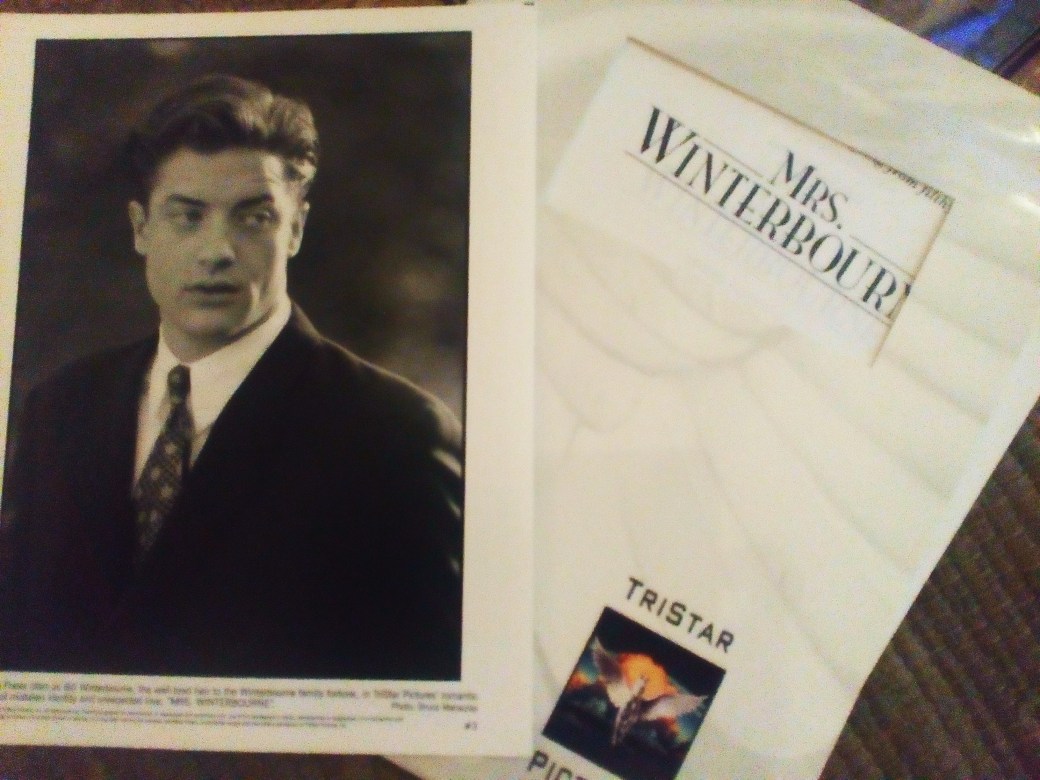
For more on March’s Movie of the Month, 1996’s Mrs. Winterbourne, check out our Swampchat discussion of the film and last week’s peek into the film’s press kit.

-Erin Kinchen

Roger Ebert Film School, Lesson 6: Bwana Devil (1952)

EPSON MFP image

Roger Ebert Film School is a recurring feature in which Brandon attempts to watch & review all 200+ movies referenced in the print & film versions of Roger Ebert’s (auto)biography Life Itself.

Where Bwana Devil (1952) is referenced in Life Itself: On page 28 of the first edition hardback, Ebert recounts a small list of films he remembers seeing at the cinema with his parents. The titles included A Day at the Races, Gentlemen Prefer Blondes, and the world’s first 3D feature, Bwana Devil. He explains that the list is so short because his Aunt Martha was more often the one who would take him to see movies as a child.

What Ebert had to say in his review: Roger never reviewed the film officially, but he does recount seeing it in a blog post in which he slams the resurgence of 3D, a format he generally found distasteful. He said, “Faithful readers will know about my disenchantment with 3-D. My dad took me to see the first 3-D movie, Arch Oboler’s ‘Bwana Devil,’ in 1952. Lots of spears thrown at the audience. Since then I have been attacked by arrows, fists, eels, human livers, and naked legs. I have seen one 3-D process that works, the IMAX process that uses $200 wrap-around glasses with built-in stereo. Apparently that process has been shelved, and we are back to disposable stereoscopic lenses, essentially the same method used in 1952.”

Some films are interesting only in their historical, cultural relevance. Think, for instance, of James Cameron’s lucrative, yet oddly forgettable eco-minded blockbuster Avatar. When Avatar was released it was a wildly successful film, mostly because it was sold as the first major advancement in the IMAX 3D format. That relevant-today-forgotten-tomorrow aspect of Avatar actually has a rich history in 3D’s storied past, apparently. For instance, the first full-length feature film ever released in 3D (and in color no less!) is a forgotten trifle named Bwana Devil, a film only significant for its “Natural Vision” visual gimmick. In a time when there was a palpable fear that television was going to destroy movie ticket sales, gimmicks like 3D were thought to be cinema’s potential savior. Cheaper than formats like Cinerama & Cinemascope that required curved screens & multiple projectors, 3D promised to be the most viable option for keeping movie ticket sales alive & thriving. It seems that in the rush to be the first film to deliver that medium historically, Bwana Devil forgot to put together anything resembling basic filmmaking competence. “Shameless cash grab” is an accusation that gets thrown around fairly often in film criticism, but Bwana Devil wears that distinction proudly on its sleeve.

Reportedly filmed in the Belgian Congo, Kenya, Uganda, and California, Bwana Devil is a pitiful mishmash of stock footage & shoddy narrative connective tissue that makes Ed Wood look like an editing room genius. Depicting the construction of Africa’s first cross-continental railroad, Bwana Devil mimics the grand scale of Africa-set Hollywood epics, but without the funding or talent required to match its oversized ambitions. The main conflict of its plot concerns a series of man-eating lion attacks that delay the railroad’s construction. The story that surrounds the attacks & the hunters determined to stop “these infernal devils” is, honestly, too dull to bother describing here.The visual effect of these attacks is achieved through a mix of trained lion footage & quick shots of lion puppets, which might be the only technique in the film that sorta works. All other non-lion nature footage is achieved by projecting actors filmed in California on top of director/producer Arch Oboler’s vacation footage shot while on safari with his wife in Africa. The safari footage is so poorly lit & grainy that the mix is more of an abomination than a mere distraction. Although the disparity in film quality is laughable, it’s not laughable enough to make Bwana Devil recommendable as so-bad-it’s good camp fest. It is, in every way, a forgettable picture.

Roger Ebert was very vocal about his distaste for 3D cinema as a medium. His biggest gripe was that the format often darkened colors in projections to a distracting degree. Bwana Devil is often cited as a critical failure & an audience favorite, but I think audiences who enjoyed the film more likely enjoyed its novelty more than its content. The most common complaint about Bwana Devil at the time of its release, from audiences & critics alike, echoed Ebert’s exact concerns: that the process rendered the film too dark when viewed through the specialty glasses required to created the 3D effect. Bwana Devil’s advertising famously promised “A lion in your lap! A lover in your arms!”, but the most visually striking image the film produced was the look of its 1950s audience watching it in the theaters. Consider the iconic LIFE Magazine image of the Bwana Devil audience donning their 3D glasses & enjoying the film’s novelty. There’s far more historical significance & interesting visual composition in that single still image than there is in the entirety of Bwana Devil‘s entire 79 minute runtime.

3e02ee91ea5d4cd5ce33d10b8f3b360c

I don’t fully agree with Ebert’s assessment that 3D is an entirely empty gimmick, a needless distraction. I’ve had plenty of fun experiences watching loud, vibrant action movies in 3D that have made pretty great use of the format. Bwana Devil, however, is a clear example of 3D done wrong. It’s an empty exercise that relies entirely on its own novelty for entertainment value. It’s a little sad that Ebert’s first 3D experience was one of the last ones he remembered somewhat fondly (if not only because he experienced the novelty with his father), but it’s also a little funny that a film so shoddily slapped together provided that positive memory.

EPSON MFP image

Roger’s Rating: N/A

Brandon’s Rating: (1.5/5, 30%)

onehalfstar

Next Lesson: (1963)

-Brandon Ledet

Roger Ebert Film School, Lesson 5: Gentlemen Prefer Blondes (1953)

EPSON MFP image

Roger Ebert Film School is a recurring feature in which Brandon attempts to watch & review all 200+ movies referenced in the print & film versions of Roger Ebert’s (auto)biography Life Itself.

Where Gentlemen Prefer Blondes (1953) is referenced in Life Itself: On page 28 of the first edition hardback, Ebert lists films he recalls seeing in the theater with his parents. In that passage he remembers preparing to clap his hands over his eyes during a screening of Gentlemen Prefer Blondes because the local church paper reported that the film was “racy”.

What Ebert had to say in his review:Ebert never officially reviewed the film, but he mentioned in his memorial blog post for director Howard Hawks that “Marilyn Monroe was never more sexy or more vulnerable than she was in Gentlemen Prefer Blondes.”

From what I gather, the common wisdom at the time when Marilyn Monroe was on top of the world was that the actress wasn’t necessarily super-talented, just beautiful enough to get by on looks & charm alone. There’s no denying that the camera loved Monroe. She was a gorgeous woman & it showed in every vivacious frame of celluloid. However, the idea that she was all bosom & no brains is selling her talents insultingly short. Monroe was not an airheaded bimbo of an actress; she was just remarkably adept at playing airheaded bimbos on screen. If she had been offered any other kind of role we might’ve seen a completely different side of her personality, but throughout her career she seemed to be eternally typecast.

In a lot of ways Gentlemen Prefer Blondes‘s gold-digging showgirl Lorelei Lee is the ultimate Marilyn Monroe character. The Howard Hawks musical often positions Lee’s intelligence vs. her breathtaking beauty as the butt of a joke. However, under that airheaded blonde surface lurks a cunning schemer, shrewd in her dealings with men of various levels of wealth. As Lee puts it, “I can be smart when it’s important, but most men don’t like it.” The breathy, aggressively delicate performance Monroe brings to he screen as Lee suggests that the character is a pushover for any “gentleman” with a sizeable wallet, but that stereotype couldn’t be further from the truth. Lorelei Lee might be in desperate search of a sugar daddy throughout Gentlemen Prefer Blondes, but that search is a keenly orchestrated attempt at obtaining lifelong financial stability, a goal she’s willing to manipulate, drug, and seduce an endless procession of male suitors to achieve if necessary (or convenient). Much like Monroe, Lee is a severely underestimated talent with the brains to take full advantage of every opportunity her bosom affords her. They’re a perfect match in terms of Old Hollywood typecasting, whether or not Monroe had been asked to play Lee’s exact role in countless other works.

With all of this talk about Monroe’s particular screen presence,  you’d think that she were the protagonist in Gentlemen Prefer Blondes, hut the truth is that she’s the protagonist’s scene-stealing best friend. From the opening scene were Monroe & Jane Russell enter the film as a Vegas-style showgirl act decked out in Technicolor sequins, it’s all too apparent who the real star is here. Even Monroe knew she as far more than a supporting actress in Gentlemen Prefer Blondes, responding to an interviewer who asked her how she felt not being the film’s star with the retort, “Well, whatever I am I’m still the blonde.” She’s not wrong. If there’s any question who’s in charge in Gentlemen Prefer Blondes, just look to the painfully unfunny scene in which Russell bleaches her hair & impersonates Monroe on the witness stand of a larceny trial. Without Monroe’s inherent magnetism, Lee’s eccentricity is downright annoying. It’s also telling that nearly every scene featuring Russell’s “protagonist” concerns Lorelei Lee’s search for a rich husband. This movie is 100% The Marilyn Monroe Show.

One of my favorite things about Gentlemen Prefer Blondes is that it completely avoids committing the morally bankrupt atrocity I just indulged in all last paragraph: pitting its two female leads against each other. Despite what the film’s title (or even more so the title of its novelized sequel But Gentlemen Marry Brunettes) suggests, the plot of this film does not concern women in competition. One woman chases lust & a good time. The other chases money. They both find true love at the end of their journeys (as all characters in comedy musicals inevitably do) without ever once conspiring against each other. They consistently have each other’s backs in a world where men are looking to take advantage of them at every turn. Plot-wise, its depiction of showgirls scheming to marry rich might not seem like the end-all-be-all of cinematic feminism, but the two leads’ friendly love & support is surprisingly refreshing within that framework.

In his memorial piece for Howard Hawks, Ebert mentions that the writer/director/producer, who had a hand in iconic works as varied as The Thing from Another World & Bringing Up Baby, never consciously aimed for Art in his films & was often surprised when people found it there. The songs aren’t particularly great in Gentlemen Prefer Blondes (which was adapted from the stage musical). The sets can be downright laughably cheap. Characters often fall into pathetic caricature, such as a wealthy diamond mine owner with a monocle who exclaims “By George!” constantly & refers to himself as “Piggy”. Still, despite Hawks’s no frills approach to crowd pleasing cinema, there’s plenty of Art lurking in Gentlemen Prefer Blondes if you know where to look for it. An early musical number featuring a men’s Olympic gymnastics team is like a classic beefcake photo shoot come to vivid life. I appreciated a shot where Lorelei mentally replaces Piggy’s head with a gigantic diamond. Most impressive all is an the film’s centerpiece: Monroe’s iconic rendition of “Diamonds are a Girl’s Best Friend”. This musical number is stunning with or without narrative context. Its stark red backdrop, BDSM-themed chandeliers, suicide humor, and diamond fetishization all amount to a singularly memorable aesthetic that puts the rest of the film’s relatively flat visual representation to shame. Whether or not Hawks was looking for “Art” in his Gentlemen Prefer Blondes adaptation, he found a bottomless wealth of it in that scene alone.

In case you couldn’t tell by now, it’s Monroe’s performance that elevates Gentlemen Prefer Blondes above by-the-numbers musical comedy mundanity. Ebert’s not wrong when he says that she was at her sexiest & most vulnerable in the film. There’s a whole lot of Monroe reflected in Lorelei Lee (both physically & personality wise). Whenever she drops the gold-digging bimbo pretense to reveal her true, shrewd self, there’s something truly personal that plays out on the screen. Lines like “It’s men like you who have made me the way I am. If you loved me at all you’d feel sorry for the terrible trouble I’ve been through instead of holding it against me” cut through her faux airheaded persona like a hot knife through butter. This probably isn’t Monroe’s best picture (for my money, that would be Some Like It Hot), but it very well might be her most personal & that dynamic makes Gentlemen Prefer Blondes much more than the empty trifle it could’ve been without her.

EPSON MFP image

Roger’s Rating: N/A

Brandon’s Rating: (3.5/5, 70%)

threehalfstar

Next Lesson: Bwana Devil (1952)

-Brandon Ledet


9 Mildly Interesting Things I Learned from the Mrs. Winterbourne (1996) Press Kit

The I Luv Video outlet near me on Austin’s Guadalupe Street is closing down and consolidating with their other location. There’s been a sign out front for weeks now advertising that a lot of their old fare is for sale. I went hoping to find some Dario Argento DVDs like Phenomena or Tenebrae, and although the good stuff was all gone (there are two copies of Eldritch abomination Phantom of the Opera and one of Jenifer, for those of you who hate yourselves and have a few dollars rattling around that you would prefer not to have), I did stumble across a small trove of press kits for nineties flicks. And what should I find among them but a folder labeled Mrs. Winterbourne?

IMG_20160305_180240

What’s a press kit? Well, whippersnappers, back in the day before the internet made the acquisition and dissemination of information easy and manageable, production companies would distribute press kits to media outlets. These packets contained information about the production, statements from cast and crew, and glossy photos from the film itself, all ready for inclusion and quotation in previews and reviews. There’s little information in them that can’t be found online these days, but there were a few things in the press kit for Winterbourne that were interesting and that we didn’t know before watching the movie. Look, this isn’t Buzzfeed, I’m not going to tell you that any of these facts with “change the way you look at [x] forever,” or pretend that any of them are “mind blowing.” But they are neat, so without further ado, here are 9 Mildly Interesting Facts I Learned from the Mrs. Winterbourne Press Kit:

1. Brendan Fraser was the last person to join the cast. Ricki Lake was actually first cast, with Shirley MacLaine cast shortly after. According to page 7, Fraser “came into the cast […] only days before rehearsals were scheduled to begin.”

2. Fraser’s casting was at the behest of Lake. From page 8: “Fraser is a friend of Lake’s and was suggested by her.”

3. Fraser was also making a name for himself on stage in the nineties. Fraser’s bio on page 11 delineates a theatre career that includes a B.F.A. in acting from the Actor’s Conservatory as well as performances at Seattle’s Intiman Theater, The Laughing Horse Summer Theater, and “rave reviews for his work as a tortured writer in John Patrick Shanley’s play Four Dogs and a Bone.”

4. Loren Dean (Steve DeCunzo) also worked with Shanley. In addition to winning a Theatre World Award in 1989 (for something called Amulets Against the Dragon Forces, which isn’t underlined or italicized, so it’s unclear what kind of work that is), he also originated roles in the aforementioned Four Dogs and a Bone and Shanley’s other play Beggars in the House of Plenty.

5. Susan Haskell (the real Patricia Winterbourne) is a scientist. From page 13: “A native of Toronto, Canada, Haskell graduated cum laude from Tufts University with a Bachelor of Science degree in Bio-Psychology.”

6. Director Richard Benjamin won the 1975 Golden Globe Award for Best Supporting Actor for his role in The Sunshine Boys.

7. Producer Dale Pollock began his career as a journalist. This phase of his career lasted 12 years, during which he was a film critic and box office analyst for Daily Variety and a writer for the LA Times. He also wrote George Lucas’s biography, Skywalking, which had the good fortune to be released before the Star Wars prequels.

8. Writer Phoef Sutton won a comedy award. Although his main claim to fame was as a writer/producer for Cheers (which earned him a Golden Globe, a Writer’s Guild Award, and two Emmy Awards), he won the Norman Lear Award for Comedy in 1980, and he received a National Endowment for the Arts Playwright’s Fellowship in 1983.

9. Writer Lisa-Maria Radano worked on The Tracey Ullman Show. Radano also founded a small Manhattan theater company called Shadowfax and received a New York Council for the Arts grant for her play The Secret Sits in the Middle in 1988.

IMG_20160305_180202.jpg

For more on March’s Movie of the Month, 1996’s Mrs. Winterbourne, check out our Swampchat discussion of the film.

-Mark “Boomer” Redmond

Agents of S.W.A.M.P.F.L.I.X.: Captain America 2 – The Winter Soldier (2014)

EPSON MFP image

Superhero Watching: Alternating Marvel Perspectives, Fresh and Longterm, Ignoring X-Men, or S.W.A.M.P.F.L.I.X., is a feature in which Boomer (who reads superhero comics & is well versed in the MCU) & Brandon (who reads alternative comics & had, at the start of this project, seen less than 25% of the MCU’s output) revisit the films that make up the Marvel Cinematic Universe from the perspective of someone who knows what they’re talking about & someone who doesn’t have the slightest clue.

Boomer: Captain America: The Winter Soldier was very nearly a different kind of movie. Christopher Markus & Stephen McFeely announced before the premier of the first Cap that they had already been hired to draft the sequel’s script, and there were three choices for direction: George Nolfi, F. Gary Gray, and sibling directorial team Anthony and Joseph Russo. Gray would certainly have been the most interesting choice, as he would have been the first person of color to helm an MCU film and have helped with Marvel’s ongoing diversity problem (as demonstrated just in the past week by the announcement that Danny Rand would be portrayed in the upcoming Netflix Iron Fist series by white Game of Thrones alum Finn Jones). To date, only two films based on Marvel properties have been directed by non-white directors, Hulk (Ang Lee) and Blade II (Guillermo del Toro), and only one has been directed by a woman, Lexi Alexander’s Punisher: War Zone. At present, Black Panther is set to break this white streak with director Ryan Coogler (Fruitvale Station, Creed), although the revolving door of directors (with Selma’s Ava Duvernay and Gray himself having been attached to production at different points) makes one wonder if there will be any more upsets between now and when production actually begins. Ultimately, Gray passed on the project in order to direct last year’s Straight Outta Compton, and the reins to the film were handed over to the Russo brothers, best known for their work on the early (good) years of NBC’s Community.

Those who are only familiar with the movies may be unaware, but S.H.I.E.L.D.’s contribution to the primary Marvel Comic universe took place largely outside of the context of superheroics. In fact, one could read comic books for several years without ever finding out that such an organization exists within that world; I certainly did. When interest in strong men and Amazons waned in the mid-Twentieth Century while the popularity of western, detective, and horror comics grew, S.H.I.E.L.D. took on prominence as a vehicle for telling stories about war and espionage, with books like Sgt. Fury and His Howling Commandos. The idea that S.H.I.E.L.D. should play a role in the founding of a superhero team is taken wholly from the Ultimate Marvel comics, a sub-imprint launched in the early 2000s to provide an entry into the comics world for new readers whose interest in the medium came as the result of the success of the Spider-Man and X-Men films. Forsaking the moniker “Avengers,” the equivalent team in the Ultimate books was known as “The Ultimates,” featuring a line-up of heroes that were brought together by Ultimate Nick Fury, who was consciously drawn to resemble Samuel L. Jackson in the hopes that he would be interested in the role should a film adaptation ever come to fruition. Many of the ideas that made their way into the MCU found their origins in the Ultimate imprint, with some scenes in the films even shot to be evocative of similar scenes in the comics (Thor’s visit from Loki, who lies that Odin has died in the first Thor film, is probably the most direct lift). The MCU has so far managed to mix stories from both the main books and the Ultimate line with new ideas to make sure that even comic book readers can never quite predict what twists the narrative will take. For instance, in the Ultimate Universe, Black Widow is revealed to be a double agent who turns on the rest of the team; non-readers who see Winter Soldier won’t have this knowledge and thus don’t know whether Natasha can be trusted, while readers who love the MCU Romanoff will constantly be anxious, wondering if she’ll follow in her ink counterpart’s footsteps, adding an edge to the movie.

Writing duo Markus & McFeely initially wanted to do an adaptation of Ed Brubaker’s Winter Soldier storyline (from the mainstream Marvel books) but were hesitant to commit to that idea, unsure if they would be able to make the story fit into the MCU while also doing it justice. Ultimately, with encouragement from MCU coordinator Kevin Feige, the two drafted the script as a political conspiracy thriller that incorporated elements of that plot but that also included S.H.I.E.L.D. in a larger role than in Brubaker’s story, given the greater prominence of the agency in the film franchise. Feige was quoted as saying that stories about Cap dealing with the fearmongering and political unrest of the seventies and eighties was “a hell of a journey” for the character. Although they couldn’t do stories set in that time period due to the fact that this version of Cap was frozen during that era, they “wanted to force him to confront that kind of moral conundrum, something with that ’70s flavor.” As such, the script was written with the intention of incorporating elements from political conspiracy thrillers of that era, like Three Days of the Condor and All the President’s Men.

To cement that connection, Robert Redford, who had appeared in both of those films, was cast to portray Alexander Pierce, the man to whom Nick Fury reports. Another new face in the cast was Anthony Mackie, who plays Sam Wilson, a character from the comics codenamed the Falcon. Cap and Falcon have had a long working relationship in the comics, with the Captain America comic even being retitled Captain America and the Falcon for 88 issues from 1971 to 1978, as the two duplicated the two-buddies-travel-the-world-and-have-different-social-perspectives narrative of the groundbreaking 1970-1972 Green Lantern/Green Arrow books. Emily van Camp was eventually cast as Agent 13, a longtime Cap love interest from the comics (originally introduced as Peggy Carter’s younger sister then later retconned as her niece given the nature of comic books’ static timelines) after beating out Alison Brie, Emilia Clarke, and Imogen Poots (among others) for the role. The film also introduced Crossbones in his civilian identity as a S.H.I.E.L.D. footsoldier revealed as a Hydra interloper; in the film, he is portrayed by Frank Grillo.

The nature of the time jump at the end of Captain America meant that most of Cap’s supporting cast would not be able to reappear in this film, although there is a heartbreaking cameo by Hayley Atwell as a very old Peggy Carter, and Sebastian Stan’s Bucky Barnes plays a prominent role. Scarlett Johansson, Samuel L. Jackson, and Cobie Smulders reprise their roles from other MCU features as Black Widow, Nick Fury, and Maria Hill respectively. Maximiliano Hernández, who had previously appeared as S.H.I.E.L.D. agent Jasper Sitwell in Thor, The Avengers, and ABC’s Agents of S.H.I.E.L.D., also appears in the film as a turncoat, as does Garry Shandling’s senator character from Iron Man 2 (it’s a good thing that Stark managed to keep the senator’s hands off the Iron Man suit, then). Toby Jones also reprised his role as Hydra scientist Arnim Zola, both in flashback and as an electronic ghost.

So, what did you think, Brandon? Captain America got high praise from you; how does this one fare?

EPSON MFP image

threehalfstar

Brandon: I was head over heels for the first Captain America film, which played like a retroactively-perfected version of The Rocketeer. Captain Steve Rogers’ bully-hating, Nazi-punching earnestness was a much welcome antidote to the sarcastic, megalomaniacs like Deadpool & Iron Man who often test my completist patience. I was, of course, stoked to catch up with the second installment in the Captain America series not only because I found the found The First Avenger so perfectly sincere, but also because ever since this project began The Winter Soldier has been sold to me as the height of what the MCU has to offer. I don’t want to say that I was exactly disappointed by the film that was delivered after all that hype, but I will say that the burden of expectation definitely colored my experience in a negative way. From the outside looking in, Captain America: The Winter Soldier is a fine action film, a perfectly entertaining superhero movie that does a great job of tying the Marvel mythology in with real-life political intrigue. However, I think the film stands as a dividing line between the franchise’s die hard fans who greedily eat up the ins & outs of the Marvel lore (particularly the narrative arc of S.H.I.E.L.D.) and the more casual observers such as myself who are mostly looking for an escapist spectacle with a cool hero in a kooky costume (which is more in line with what The First Avenger delivered). Fans who love the MCU enough to devotedly follow all of its short film bonus material & televised spin-offs are likely to love The WInter Soldier. The more detached devotees will enjoy the film’s action sequences & cool cat protagonists, but perhaps with less hyperbolic rapture.

Freshly unfrozen in the modern world, Captain Steve Rogers is simultaneously dealing with the post-Battle of NYC PTSD issues that Tony Stark wrestled with in Iron Man 3 & the same kind of fish out of water awkwardness as his Norse god buddy/fellow beefcake model Thor eternally suffers. Besides having to catch up with cultural markers like Marvin Gaye & Star Wars that he missed while taking an extensive nap on ice, Rogers also has to deal with the fact that his one true love (and ABC star) Peggy Carter lived a full life without him & is now spending her last days alone in a hospital bed. Friends & colleagues pressure Rogers to ask someone less geriatric for a date, but he refuses to move on. Of course, these small personal concerns are dwarfed by an evil world domination scheme Rogers has to put to a swift end. The Nazi offshoot Hydra from the first Captain America film is apparently alive & thriving, having successfully infiltrated S.H.I.E.L.D. & subtly influenced all of the world’s war & unrest from behind the scenes in the decades since the second World War. Can Rogers stop the Hydra from hijacking an advanced weapons system & using a sinister algorithm to destroy every one of its potential enemies in one fell swoop before it’s too late? Of course he can. He is The Greatest Soldier in History, after all (having now graduated from comic book hero status to living museum exhibit in his own lifetime).

What’s most interesting about The Winter Soldier is the way it complicates who & what is Captain America’s enemy. Rogers joined S.H.I.E.L.D. because it was partly founded by his one true love & he finds great value in reliving his wartime specialty: rescue missions. S.H.I.E.L.D. is too powerful to trust, however, especially since its participation in a worldwide (& maybe even intergalactic) arms race is what provides the weapon that Hydra intends to use the wipe out its enemies wholesale. By showing the faults of our modern day surveillance state by attaching a gun to each camera, The Winter Soldier approaches the most biting political commentary the MCU has offered yet, especially when Rogers criticizes his S.H.I.E.L.D. overlords for “holding a gun to everyone in the world & calling it protection” (a theme that will later be repeated in Age of Ultron). I don’t think the film’s political themes are ever explored any deeper or more thoroughly than they’d be in any other high budget, explosion-heavy action film, though. For MCU die hards who’ve been following every Agents of S.H.I.E.L.D. episode & tangentially-related S.H.I.E.L.D. mythology-related media, the film’s big reveal that the organization has been hijacked by Hydra might’ve landed with massive impact, but the betrayal never feels too significant from an outsider perspective. It’s mostly a political thriller springboard for a cool action movie with a lovable hero & some of the best fight choreography in the MCU outside the Avengers films (including increasingly inventive uses of Captain’s shield in its hand-to0-hand brutality).

It feels almost like a betrayal to nerdom at large to say I really liked this movie but didn’t love it, but that kinda points to the way Marvel Studios have spread their properties so, so very thin. In the greater, 10,000+ hour span of MCU content, The Winter Soldier is a major turning point & a fulfilling payoff for irons that have been in the fire for years. As a standalone property surviving on its on isolated merits, its a very solid picture, but far from the pinnacle of any of its various genres: political thrillers, action flicks, superhero media, etc.

EPSON MFP image

fivestar

Boomer: I love this movie. It’s the MCU picture that I’ve watched and rewatched the most and the one that I find the most enduring, thoughtful, and well-paced; for my money, it’s the best of them all. It’s a testament to Winter Soldier’s excellence that, despite the fact that I got dumped two hours after I walked out the theatre on that 2014 afternoon, it wasn’t ruined for me (like so, so many things were in the wake of that breakup). I can look back on that day and say, “Hey, that was one of the worst days of my life, but I also saw Winter Soldier.”

I’m not ever sure where to start with all the things that make this film work for me. I’m a sucker for a good conspiracy flick (and even some bad ones), and the tonal similarities between Winter Soldier and things like Enemy of the State, The Manchurian Candidate, and most obviously (and explicitly) Three Days of the Condor hit all the right buttons for me. It brings Black Widow into the foreground in a way that the previous films attempted with mixed success and introduces a great new hero character to the mythos in Falcon, and both Johannson and Mackie bring a lot of energy into the mix that harmonizes well with Evans’s leading man charisma. Redford is perfect in his role as the turncoat leader of the World Security Council, and the film puts a lot of work into including and subtly commenting on contemporary issues of security, privacy, and systemic violence. Evans was serviceable in his previous appearances as Cap, but he clearly understands the role better here than in the earlier outings: Cap is a man who fought a brutal war that history has painted as a righteous one, and as such is best suited to remind those around him when they are repeating the mistakes of the past.

The film draws a clear line between itself and other films of the same genre that came before, both within the text (most notably with Natasha quoting War Games) and metatextually, especially with the casting of Redford. Although his most notable contributions to political thrillers were his roles in All the President’s Men and Three Days of the Condor, I also have a fondness for Sneakers, which shares plot elements like computer algorithms and heisty shenanigans with Winter Soldier. Of course, the movie to which I feel this film is most tonally similar isn’t your standard contemporary political thriller like your Sneakers or even your classics like The Parallax View: it’s Star Trek VI: The Undiscovered Country.

I’ll keep this as brief as I possibly can, given that I have a (deserved) reputation of making everything about Star Trek, despite any obstacles. The Star Trek franchise was always about creating the rhetorical space that science fiction inhabits when it’s at its best: commenting upon contemporary social mores through a lens that provides the viewer or reader with enough metaphorical distance that he or she can see the absurdity and beauty of the human experience. (Last year’s Hugo Awards were undermined by a small group of rabid people who fail to realize that this is and always has been the purpose of the genre.) As such, the classic 1960s series created by Gene Roddenberry featured groundbreaking elements like people of color and women being treated as colleagues and equals by their white and male crewmen while also exploring the relationship between different earth cultures by projecting them onto extraterrestrial confederations.

Most notably, this was demonstrated by the way in which the Klingon Empire was a clear stand-in for the Soviet Union, and this was made all the more textual in The Undiscovered Country, which opened with a Chernobyl-esque disaster that places the Federation (the society in which Kirk and Spock abide) in a position to finally hammer their swords into plowshares… or bring their enemies to their knees. In the midst of all this is Kirk, who has fought the Klingons all his life and even lost his son to them; still, the Federation believes that, just as only Nixon could go to China, only Kirk can present the Klingons with a metaphorical olive branch. Unfortunately, Kirk ends up being framed for the assassination of the Klingon Chancellor and is assigned to a Siberia-esque gulag, while Spock works out the mystery. Working from opposite ends toward the middle, the two find a peace-endangering conspiracy that has wound its way around the heart of the seemingly-utopian Federation, fueled by long-stewing grudges, cultural fascism, and speciesist (read: racist) attitudes.

The Undiscovered Country is a fantastic movie, and although it’s not the best entry in the film franchise (Wrath of Khan is the undisputed champion), it’s a viable contender for runner-up. The Winter Soldier plays out similarly with its revelation that Hydra was never destroyed, but that it was instead reborn by planting its monstrous seeds within S.H.I.E.L.D. from its conception. Like ST6, this film also features the great and historical hero who finds himself framed and caught up in political machinations, dealing with strategic espionage maneuvering which is far outside of his control but in which he has a vested personal stake. Both films take the tropes and traits of the conspiracy narrative and add them to their respective genres, elevating both films to increased notability outside of their franchises.

And Natasha! Romanoff is back, baby, taking on heavier narrative lifting here than ever before and not only rising to the challenge, but killing it. Natasha never comes off as a sidekick here, instead acting as the perfect foil to Rogers. He’s the perfect soldier, and she’s the perfect spy: the focus on the ways that their respective skills and worldviews inscribe, complement, and conflict contributes to the film’s constant momentum. Johannson nails the small moments of vulnerability and the fact that Widow is always a few steps ahead of everyone else, like she’s accustomed to always being the smartest person in the room. This is just as much a story about her as it is about Cap, despite how much of the plot is devoted to his feelings of having failed Bucky. The film also does a better job of displaying professional respect and friendship between the two than most films are able to with a male-female friendship, and their emotional arc is perfect, forsaking the easy road of creating a romantic relationship between the two.

If anything, the titular Winter Soldier is the weakest link for me here. Part of that may be that his true identity as a brainwashed Bucky is no secret to comic fans (and it kind of surprises me that it was a shock to film-goers, given how recognizable Stan’s face is even with a mask on). It provides a counterpart to Cap’s friendship with Natasha, but it’s not as emotionally satisfying to me. Cap and Bucky’s friendship was built up in the first film, but it never quite clicked for me; I’m not as invested in the two of them as the franchise wants me to be, mostly because we actually see the two of them interact with each other much less than we see Cap interact with Natasha or even Tommy Lee Jones’s General in the first film. His involvement raises the stakes for Cap personally, but not for me.

That doesn’t make me any less invested in loving this movie, however. It hits the sweet spot for many in virtually every way, and I can hardly thing of a disparaging thing to say about it. Every few months, we see a new thinkpiece being published that asks if this genre is on its way out. Although I haven’t really seen any signs of slowing or stopping at this point, I’d wager that Winter Soldier will long outlive its peers in the public consciousness even if the MCU draws to a close.

EPSON MFP image

Lagniappe

Brandon: One thing that has been super impressive over the last few MCU features is how they’ve turned around my frustration with one-line cameos & half-assed tie-ins. I think that The Avengers, while not the height of the franchise, was an entirely necessary step in bringing this whole mess of a universe into an increasingly sharp focus & The Winter Soldier in particular is a great collaborative effort that directly reflects that shift. It’s doubtful that Nick Fury or Black Widow will ever star in their own standalone vehicles, but they’re both given way more to do in The Winter Soldier than ever before. Black Widow has already had ample time to show off her badassery in previous pictures, but her extended presence is always a welcome asset. This is really Nick Fury’s big break as a major player, though, and it’s fantastic to see him elevated form a walk-through cameo in a stinger to a fully-realized character. It’s also incredible how characters like Falcon & Bucky are shoehorned in there (even if I spoiled their individual reveals for myself by watching MCU content out of order) without ever cluttering up the film’s proceedings. Again, The Winter Soldier is a well made political thriller-leaning action flick that covers a lot of ground in its massive 2 1/2 hour runtime. I’m not sure that each of its characters & themes are given enough room to properly breathe & resonate, but there’s an impressive juggling act in how many personalities & plotlines get involved in the first place and the film delivers a wealth of entertainment in its genre-based treats alone.

Boomer: The furthest-reaching repercussions of this film on the franchise is the revelation that S.H.I.E.L.D. has been infected by Hydra from its very inception. For me personally, S.H.I.E.L.D. has always been a non-essential element of the MCU; sure, most of the stories would be different without their involvement, but not by much and not necessarily detrimentally. This reveal did end up creating more plotlines for Agents of S.H.I.E.L.D., with that series finally developing into something worth following in the wake of Winter Soldier, but it also annoys me. The rest of the MCU must now pay lip service to this development constantly, with references to Hydra showing up in shows and films that don’t really relate to S.H.I.E.L.D., if as nothing more than a bogeyman. Other than films where it wouldn’t make sense (such as Guardians of the Galaxy), all the villains relate back to Hydra now, if only tangentially. It makes me like past, unrelated villains like Jeff Bridges’s Obadiah Stane more in retrospect, since they weren’t required to tie in as heavily. It’s not that I feel the franchise is hamstrung by this revelation, but I find it weakens a plot when everything has to tie back into one evil mastermind or organization, limiting storytelling possibilities.

EPSON MFP image

Combined S.W.A.M.P.F.L.I.X. Rating for Captain America 2 – The Winter Soldier (2013)

fourhalfstar

-Agents of S.W.A.M.P.F.L.I.X.

Roger Ebert Film School, Lesson 4: A Day at the Races (1937)

EPSON MFP image

Roger Ebert Film School is a recurring feature in which Brandon attempts to watch & review all 200+ movies referenced in the print & film versions of Roger Ebert’s (auto)biography Life Itself.

Where A Day at the Races (1937) is referenced in Life Itself: In the first edition hardback, A Day at the Races is referenced on page 28. Roger remembers the film as his first trip to the cinema. He says he was so young at the time that he had to stand on his seat to see the screen. He also remembers this occasion as the hardest he’s ever heard his father laugh & mentions that his father was a huge Marx Brothers fan, having seen them on the vaudeville stage before they were in motion pictures.

What Ebert had to say in his review: Roger never had the chance to review the film proper, but he does recount the very same anecdote about watching A Day at the Races as a child in his “Great Movies” review of Duck Soup.

The seventh Marx Brothers feature film, A Day at the Races is par for the course in terms of the impossibly talented comedy crew/family’s brand of sublime silliness & rapidfire insanity. I’ve only ever seen a few Marx Brothers titles, leaning towards indisputable classics like A Night at the Opera & (my personal favorite) Duck Soup, but their comedic style is so instantly comfortable & genuinely funny that familiarity with their work is not necessary for enjoying their material. I have no qualms admitting that of all the comedic acts that spilled over from vaudeville to motion pictures, the Marx Brothers are an easy favorite for me, outshining even names like Charlie Chaplin and Abbott & Costello. I’d like to say that this is due to the quick, oddly sophisticated wit of Marx Brothers poster boy Groucho, but the truth is that it’s Harpo who steals my heart in every picture. Taking physical, slapstick comedy to deeply deranged, yet subtly masterful territory, Harpo is a one of a kind talent. Part of the reason I ended up liking the somewhat minor Marx title A Day at the Races so much is that Harpo is so damn funny in it. I was laughing at his madman antics as the criminal horse jockey Stuffy so hard that almost all of the film’s third act problems (of which there are many) ultimately felt meaningless.

The plot of A Day at the Races concerns a young couple in financial crisis. An entrepreneur owner of a sanitarium (a type of health resort) is struggling to keep her business alive & out of the hands of overeager financial vultures. Her bonehead beau is a musician who foolishly decides to get into the horseracing business without knowing thing one about what he’s doing. Groucho, Harpo, and Chico Marx get caught up in both ends of this struggle. Chico & Harpo help the musician doofus evade the law & prepare his horse to race in competition. Chico & Groucho conspire to keep a wealthy hypochondriac, Mrs. Upjohn, enrolled in the sanitarium’s care, luring her into complacency through seduction & encouragement of her groundless worrying. Long story short, they all fail miserably. Groucho is ludicrously incompetent as Dr. Hackenbush (originally named Dr. Quackenbush, but subsequently changed due to fear that the dozen or so real Dr. Quackenbushes in the country might potentially sue), a veterinarian posing as a medical doctor, an easily recognizable hack/quack (it’s right there in the name, after all). When described as “a doctor with peculiar talents”, he retorts that he has “the most peculiar talents of any doctor around.” Harpo is a silent, deranged jockey who sends far more time running from the sheriff that he does wining races. Chico plays both sides of the coin as an eternal huckster who’s always able to scrape by on a quick buck, but rarely able to pull off any large scale schemes. Their collective incompetence brings the whole story down to the fate of both the sanitarium & the potential marriage of the central couple depending on the outcome of a single horse race. Its a tidy conclusion to a very messy farce that largely exists to support the Marx Brothers’ zany comedy antics, which are all top notch even when the film isn’t trying too hard on a formal level.

As I said, there are some major third act problems with A Day at the Races that keep it from being an entirely perfect product. The fact that it boasts the all-time longest Marx Brothers runtime weighs heavily on the proceedings. There’s a definite point towards the end where the laughter starts to die down & it transitions into time-to-constantly-check-your-watch territory. At first it’s endearing that A Day at the Races fits firmly in the kind of Old Hollywood variety show spectacle that tries to have it all: romance, suspense, comedy, musical numbers, etc. It’s the exact kind of expensive mixed bag that Josh Brolin’s overworked producer struggles to hold together in Hail, Caesar!. By the time it reaches its second song & dance number this variety is a little more trying. It’s time for the movie to wrap up its plot, so a sequence where Harpo plays a demonic pied piper to a poor black community who burst into a rendition of “All God’s Chillun’ Got Rhythm”that might normally be a welcome diversion in another context starts to  feel like wasted time. It also doesn’t help that this sequence is played like a long setup for an unfortunate punchline involving the Marx Brothers evading the law by donning blackface to “blend in”. All of this and a singularly terrible performance by an overacting oaf playing an indignant Dr. Steinberg that goes way too broad to remain endearing, perhaps even watchable, which is saying a lot for a comedy this zany.

With or without that mess of a concluding half hour, though, A Day the the Races is a finely tuned comedic act, one that values spotlighting the talents of its three sibling stars over telling a concise, well-rounded story. It’s no wonder that Ebert remembers his first trip to the cinema so vividly as the hardest he’s ever seen his father laugh. The film really is a laugh riot, especially in its early proceedings. Watching Harpo chew & swallow a thermometer (with a chaser clearly marked “POISON”) when Dr. Hackenbush takes his temperature in one scene & turn around to beautifully pluck the strings of a harp in  another is a treat I’ll never forget. Groucho’s proto-Bugs Bunny one-liners & Chico’s slick, smooth-talking scams are also pricelessly amusing, even if I’m heavily biased toward Harpo’s particular brand of comedic madness. A Day at the Races is widely considered the beginning of the end for the Marx Brothers’ cinematic winning streak, but for me the joke never felt stale in this film, just a little overlong & unfocused in the back end.

EPSON MFP image

Roger’s Rating: N/A

Brandon’s Rating: (4/5, 80%)

fourstar

Next Lesson: Gentlemen Prefer Blondes (1953)

-Brandon Ledet


Movie of the Month: Mrs. Winterbourne (1996)

Every month one of us makes the rest of the crew watch a movie they’ve never seen before & we discuss it afterwards. This month Erin made BoomerBrandon, and Britnee watch Mrs. Winterbourne (1996).

Erin:  Picture it:  1996.  Clothes are big, scrunchies are bigger, and a Hollywood team looked at the script for Mrs. Winterbourne and decided that this was the perfect vehicle to launch Ricki Lake into Leading Lady-hood.

The same Hollywood team also thought that the best way to adapt a gritty noir novel about a pregnant woman escaping domestic abuse in the midst of a deadly train wreck and a grieving family was as a lighthearted romcom.

That’s right.  Mrs. Winterbourne is a romantic comedy about a pregnant teenager (Connie, played by Ricki Lake) escaping her scummy, abusive boyfriend, surviving a train wreck that kills another pregnant woman and her kind husband, and being mistakenly taken in by the in-laws (Shirley MacLaine and Bredan Fraser as mother- and brother-in-law) of the dead woman as they attempt to put their hearts back together.  That’s only the first act.  In the second act, just as Connie is starting to connect to the Winterbournes and is struggling with the decision of either revealing her true identity or keeping up the charade indefinitely, her slimy ex-boyfriend comes back to blackmail her. There’s singing! Dancing!  A makeover montage! Murder!

Although I really enjoy Mrs. Winterbourne, the incongruity between the gritty (and bizarre) premise and the lighthearted style in which it is presented makes for a weird movie-watching experience.  There’s a lot of whiplash as the film attempts tell a gritty noir story through the lens of a quirky romcom.

The supporting cast does several things rather well – Shirley MacLaine as the elder Mrs. Winterbourne might be the true heart of the film, and there is real chemistry between her and Lake’s Connie and Fraser’s Bill.  Miguel Sandoval, as the Cuban ex-pat chauffeur, is truly charming as he slings knowing glances and come-to-Jesus talks left and right.  Loren Dean brings a completely awful character to life in Steve DeCunzo, throwing change at a pregnant Connie through his window as she begs for help in pouring rain and stomping around in the baby’s playpen as he threatens blackmail.

Honestly, the least believable thing for me in this movie is the lack of chemistry between Lake and Fraser.  Brendan Fraser had hit his stride in the mid ‘90s, playing hot and goofy leading men after a few years of playing stoner and college roles.  He still had George of the Jungle (1997), Gods and Monsters (1998), and The Mummy (1999) to come.  Ricki Lake, while she never really hit leading lady status outside of Mrs. Winterbourne, was a ‘90s fixture, and would start her talk show in 1998. Despite being in their respective zones in 1996, they just don’t really connect, which is a shame.

Over all, I think that Mrs. Winterbourne is a fun watch.  It’s good natured about its downer plot line, and has a few really funny and touching moments.  I like strange movies, and this one is definitely strange enough to keep my attention.

Brandon, Mrs. Winterbourne is pretty wacky.  What are your first impressions of it? How does well does the romcom genre flesh out the noir bones? What caught your attention about Mrs. Winterbourne?

Brandon: Yeah it’s difficult to write my first impressions on this film without zeroing in on the fact that it’s a fish-out-of-water romcom with a “hilarious” comedic set-up that’s put into motion by a pregnant woman dying in a train wreck. The film’s moody vibe as a neo-noir is in direct conflict with its more lighthearted comedy stylings: a pregnant & homeless Ricki Lake wandering aimlessly in the rain, a butler who escaped homophobic persecution in Cuba through prostitution, a third act murder mystery, the fact that Brendan Fraser’s cad finds himself falling in love with a woman who might be his dead twin’s widow. So much of Mrs. Winterbourne is so darkly fucked up that it’s jarring to watch the film wrap itself in the soft-edge confines of the romcom genre. My favorite moment where these two tones clash is when Ricki Lake’s pregnant/homeless Jersey Girl shouts to her deadbeat baby daddy “I’m about to have your baby out on the street! Wanna come watch?” Uncaring, he tosses a quarter at her feet & shuts his window. Later the baby daddy’s new baby mama recognizes Lake’s protagonist only as “The Bitch Out in the Rain With the Quarter.” I shouldn’t have gotten such a hearty laugh out of that but I shrieked with delight. What a messed up “gag”.

The weirdest part about the film’s compromised tone is how much weight it puts on Ricki Lake’s shoulders. She’s asked to deliver most of the film’s yuck-it-up comedy, which I’d say she accomplishes with just as much bright eyed enthusiasm she brings to John Waters’ (utterly flawless) Serial Mom. At the same time, I’d say that the sole reason the film’s central romance plays like a joke is the very same Ricki Lake performance. Brendan Fraser is entirely believable as the romcom heartthrob, but Lake is too much of a bumbling fool for me to genuinely commit to her end of the romance angle. Maybe it’s all those years of watching her host a Jerry Springer-style talk show that keep me from forgetting the clownish aspects of her screen presence, but I think her making homelessness amusing was an asset, but her making romance funny might’ve been somewhat of a detriment.

Where do you fall on Lake’s performance, Boomer? Is she a sold lead in this role or did the film ask too much of her in too many directions for the performance to be taken seriously?

Boomer: I have a confession to make; I used to hate Ricki Lake. This was through no fault of her own and was based entirely on Baton Rouge NBC affiliate WVLA’s decision in 1997 to replace their daily 4 PM rerun of Star Trek: The Next Generation with her syndicated talk show. In the many years since this great sin was committed, I’ve actually come to like Lake quite a bit, especially as I came to be aware of her partnerships with John Waters in my teenage years. She’s a perfectly serviceable actress, and she’s genuinely likable in this role, which could so easily have not been the case with a plot like this that revolves around deception (although Connie does admirably make every effort to correct misconceptions up to the point where revealing the truth could potentially literally kill a woman). Her weakest acting moments come in the scenes in which she is called upon to be histrionic and melodramatic that she comes across more like one of the sideshow people who populated her television stage. Lake can act; she just can’t overact, and she works best when she’s playing off of MacLaine, who brings a warmth to her performance that Lake can’t help but reflect back at her.

The weakest acting link, frankly, is Fraser, who comes across as a bit of a hack here. He seems to think that “playing rich” requires foppishness that borders on recreating stereotypical portrayals of gay men, up to and including the fey and effete way that he drops his napkin in his lap in affected shock at Connie’s initial appearance at the dinner table. There are many other ways to play a man of privilege who assumes that the new family member in his midst is an interloper, but Fraser read his part and went straight to “dandiest dandy that ever dandied,” and the later scenes that show him as a man with the potential to be more open doesn’t erase his performance in his introduction. In fact, when he first started falling for Connie, my assumption was that the film was leading into his public confession that he had latched onto her in an attempt to disprove his homosexual leanings. But no, it was just that Fraser made poor character choices when filming the earlier sequences in the film, and, admittedly, I came around on his character by the end, even if he is stiff and wooden when confronting Connie about having (he assumes) killed Steve.

The standout performance was MacLaine’s, and I especially liked how I expected the plot to unfold in the opposite direction that it does (i.e., that the rich patrician mother would be slow to warm to the new bride her son took an instant liking to, rather than the other way around). This twist helps the film feel less stale than it otherwise could. What do you think, Britnee? Did MacLaine help make this movie “work” for you, or no?

Britnee: MacLaine’s performance was nothing short of perfection. Every line she spoke and move she made was so effortless. I just couldn’t take my eyes off her! However, she officially stole my heart when she hid a lit cigarette in her mouth. It’s definitely not the kind of behavior one would expect from an elderly socialite, and that’s the kind of shock value that I live for.

When I think of how the film would be if there was no MacLaine, I have to say that I still would have enjoyed it. Of course, it wouldn’t be as pleasurable without her, but it would still be a great film. As a fan of Ricki Lake, I can’t help but feel as though she was the one who stole the show. She brings this sort of ridiculous yet unique style of humor to every film I’ve ever seen her in, and this is especially true with Mrs. Winterbourne. Lake as Connie Doyle was beyond entertaining. She does a good bit of overacting throughout the film, especially when she bring her Jersey Girl sass to the upper-class society of Boston. While overacting is usually viewed as a acting flaw, it’s a huge part of Lake’s comedic style, and it always brings out tons of laughs from me.

It’s interesting how this film and our previous movie of the month, Big Business, share the “poor girl in a rich world” theme. Erin, what are your thoughts on this similarity? Does this theme work better with Mrs. Winterbourne’s style of comedy as opposed to Big Business?

Erin: You know, Britnee, it didn’t occur to me that Mrs. Winterbourne and Big Business are similar in their fish-out-water, mistaken identity plots.  Now that we’re looking at similarities, I think the over all feel of these movies has something else in common – while Big Business feels like an Old Hollywood screwball comedy, Mrs. Winterbourne is based on a 1948 noir novel.  I think that the old camp melodrama present in both movies gives them a feeling of a previous era in which audiences might have had more forgiveness for such silly premises.

I’m not sure if either movie works “better” with the “poor girl in a rich world” theme.  Big Business is a madcap comedy, and hardly touches the ground at all.  It’s a hysterical rush through a farcical plot.  Mrs. Winterbourne attempts to have some soul or grounding in drama, but all in all seems to have trouble straddling the line.  Both movies take that particular plot point, as well as the mistaken identities and old school feel, to push different stories along.

I think that one of the biggest differences between Mrs. Winterbourne and Big Business is something that I only noticed in this viewing.  Big Business holds its main characters as intrinsically subjective within the world of the movies.  The movie starts with something beyond their control, the baby swap, but then only advances with actions of the characters.  The Sadies and the Roses are shown, despite their immersion in a comically out of hand situation, to make the world of their movie theirs.  Connie, despite being the main character of Mrs. Winterbourne, is almost completely an object in her own world. She decides to leave her father’s house in the first minutes of the movie, and then everything else happens to her.  Her attempts to take actions are either preempted by other characters or she is talked or coerced out of decisions.

I’m not sure how to understand or interpret this lack of subjectivity in the main character.  Brandon, what do you think?  Any thoughts on why Connie is so objective in her own story, and what that means for Mrs. Winterbourne?

Brandon: If you’re looking to further solidify Mrs. Winterbourne‘s connection with Big Business, consider that they not only both deal in mistaken identities & fish out of water humor. Their plots also revolve around sets of estranged twins, which is kind of an obscure angle for a comedy. Ricki Lake’s protagonist has no twin in this film, though, which is unfortunate, as it would’ve been fun to see her match the eccentricity of the rest of the cast. She also doesn’t, as Erin points out, ever really enact the changes in her life that transform her from homeless Jersey Girl to wealthy heiress. The film’s events just sort of swirl around her as if her rightful place among the affluent was simply a matter of fate.

I think the passive aspects of Connie’s personality transforms parts of Mrs Winterbourne from a silly romantic comedy to a kind of a fairy tale. And I mean fairy tale in the sense of fantasy wish fulfillment more so than Brothers Grimm. Connie never really learns any lessons or grows as a person throughout the film. She mostly just allows the world to pave the way for her road to happiness in which Brendan Fraser is the closest thing to a prince a modern girl could wish for & a milquetoast life surrounded by immense wealth is the height of happily ever after. Keeping Connie passive & grounded leaves open a hopeful It Could Happen to You interpretation for the audience at home, which is not far from the kind of escapism romcoms aim to sell in general. The details that make this fairy tale angle in Mrs Winterbourne feel tonally bizarre, though, are the film’s darker plot points: a miscarriage, a train wreck, a murder. It seems that, according to the film, happily ever after often comes with a body count on its price tag.

What do you think, Boomer? Is Connnie’s passiveness an intentional choice that allows the viewer to step into her shoes & live out her (somewhat deadly) fairy tale or did the writers merely fail to consider giving their protagonist a sense of agency?

Boomer: I’m glad that Erin brought up the original novel above, because I was shocked to learn when viewing Winterbourne‘s Wikipedia page that it was adapted from a Cornell Woolrich novel. I went through a noir phase in my teens and although I never read the novel from which this film drew inspiration, I did read some of his other works, and this movie is quite dissonant tonally. I recently reviewed the Francois Truffaut film The Bride Wore Black, which was also adapted from a Woolrich novel of the same name, and that film is much more in line with the Woolrich vision. As counterparts to each other, Bride and Winterbourne couldn’t be more dissimilar, because Brandon is right; this flick is essentially a fairy tale of wish fulfillment.

Connie doesn’t exhibit much in the way of agency in any of the directions that her life takes. This makes sense if you think of her as a rags-to-riches fairy tale girl. Cinderella doesn’t do much but have decisions made for her and be lucky enough to have a magical godmother; Rapunzel is stuck away in a tower until the plot finds her; Talia is comatose in a castle until her “hero” comes along. Connie is much the same; she gets conned, kicked out into the street, pushed onto a train that she doesn’t intend to board, and wakes up after it crashes wearing a dead woman’s nightgown and life. The film is smart to counterpose the agency-free Connie with Grace (and even give them both names that are virtues, as we learn “Connie” is short for “Constance” in the final scene). Although Paco and Bill pester her about taking her medication and not drinking or smoking, it’s evident that Grace runs the Winterbourne household. We would normally see a woman like Connie, who is moved about like a chess piece by other people, used to prop up the story of her love interest. Instead, her more static narrative is used to expand Grace’s dynamic story. In a lot of ways, the film ends up being more of a love story between Grace and Connie than Connie and Bill.

The film is also smart to allow Connie time to make multiple attempts to tell others that they have mistaken her for somebody else only to be ignored, and she still considers it up to the point where she realizes that the truth could literally kill the elder Mrs. Winterbourne. It helps keep the audience’s sympathy with Connie instead of against her. I know you said above that you feel Lake’s broader approach to the material helps it play as funnier than it would otherwise. Imagine that Lake was not available; who would you cast in her part, and why? If you could recast one other person, who and why?

Britnee: Ideally, I would love to see a young Barbra Streisand play the role of Connie. Not only is she my favorite “funny lady,” but she knows how to pull off a romcom, which, as much as I adore her, Lake just can’t seem to accomplish. Unfortunately, Streisand would be more suited for the role of Ms. Winterbourne during the time of the film’s release, so this an impractical choice. Being a little more realistic, I would without a doubt cast Natasha Lyonne for the role of Connie. I can’t help but think of how perfect she was as Vivian in Slums of Beverly Hills, and I see a lot of Vivian in Connie. Two sassy, street smart ladies trying to make their way in this big, cruel world.

If I was given the choice to recast another person, it would definitely be Brendan Fraser. He was just so bland and almost robotic. I understand that his character (Bill) is supposed to come off that way for the most part, but when Connie becomes his love interest and he goes through his little personality change, it just doesn’t feel natural. However, I do have to say that he was excellent in George of the Jungle and Airheads, but I’m not sure if that’s necessarily a good thing. When it comes to recasting Bill, I would chose  James Spader because he is perfect for that type of role. He’s great at being a total snob (Pretty in Pink), but he’s even better at being a romantic snob (White Castle). Spader and Lyonne would have been such an iconic romcom couple.

Lagniappe

Erin: It’s a shame that Brendan Fraser and Ricki Lake have such little genuine chemistry.  The plot is already pretty forced, and some real passion between Fraser’s Bill and Lake’s Connie would have given an ounce or two of believability to a storyline that requires a man to fall in love with his twin brother’s widow.

Britnee: Connie’s little “makeover” was so unnecessary. I could understand the need for a makeover scene if she had ratty hair and holes in her clothes, but her hair was gorgeous and her outfits were so on point. All they did was give her shorter hair and a couple of new tops. Lame!

Brandon: One of the more absurdly funny aspects of Mrs. Winterbourne was how undercooked Connie’s baby looked in the film. I’m not sure if they cast an infant that was too young for that kind of physical labor or what, but the way Connie’s child was always helplessly thrusting its little arms in the air as a wide range of actors jostled & played with it was so dangerous looking in a way that made me laugh fairly consistently (through my heartfelt concern, of course) whenever it was being passed around. I’d like to check back in with the now-20 year old Mrs. Winterbourne Baby in 2016 to see how their neck & limbs are doing, because I could swear the camera caught some permanent damage somewhere in there.

Boomer: I didn’t expect that the truth would be revealed by the appearance of Connie’s ex; I was looking for the late Mrs. Hugh Winterbourne’s family to look up their daughter and discover Connie living her life. Given that this never happens, I can’t help but wonder what will occur when they come to visit their grandchild. Further, considering that all their problems were resolved by a stranger murdering the loose ends, I hope they just send letters. It’s bad luck to interfere with the Winterbourne family destiny, apparently.

Upcoming Movies of the Month
March:
Boomer presents My Demon Lover (1987)
April:
Brandon presents Girl Walk//All Day (2011)
May:
Britnee presents Alligator (1980)

-The Swampflix Crew


The Late Great Planet Mirth III – Tribulation (2000)

EPSON MFP image

twohalfstar

Welcome to The Late Great Planet Mirth, an ongoing series in which a reformed survivor of PreMillenialist Dispensationalism explores the often silly, occasionally absurd, and sometimes surprisingly compelling tropes, traits, and treasures of films about the Rapture. Get caught up in it with us!

Hoo boy, this is a weird one. The back of the box for Tribulation, the third film in the Apocalypse series, claims that the film is roughly 101 minutes long, but the movie really clocks in at less than 90, in the low eighties if you discount the overlong opening credits. Revelation also had a similar problem, as that film started with a long pan through Thorold Stone’s house while a cover of Rapture anthem “I Wish We’d All Been Ready.” The difference is that Revelation picks up from there and goes the distance (…mostly), while Tribulation is too down to earth, despite paradoxically also being absolutely bonkers. It takes a risk by crafting (for lack of a better word) a Rapture story that includes elements from sources other than Hal Lindsay’s Premillenial Dispensationalism™, but the more ostentatious features of the movie are at odds tonally with the previous films. It also feels like something you’ve seen in any DTV conspiracy thriller because, despite taking place in the world created by the first two films, Tribulation barely bothers to include the Antichrist, instead playing out like a bargain basement pod people movie interspersed with televangelical talking heads.

Tom Canboro (Gary Busey; yes, that Gary Busey) is a cop in Anytown, USA. His lovely wife Susie (Sherri Miller) is some kind of television producer. Busey says at one point that life isn’t like her show, where she finds “the most romantic angle” for a story; this, combined with the fact that she is friends pre-Rapture with Helen Hannah (returning champ Leigh Lewis), is all the information that we really get about her. Tom has remained close in adulthood with kid brother Calvin and their older sister Eileen (Lois Lane herself Margot Kidder), who’s a bit of an overbearing Bible-thumper. The Canboros also share their home with Susie’s younger brother Jason (Howie Mandel), who is interested in the philosophy of rising European Union figurehead Franco Macalusso (Nick Mancuso).

That’s right! Macalusso is just a minor politician at this point. Tribulation doesn’t start during the Tribulation at all; half of this movie’s runtime takes place pre-Rapture, spending nearly 45 minutes establishing character relationships that won’t matter in the back half. In fact, this film doesn’t feel like it has multiple acts, instead feeling like two parts of a TV two-parter. It is established that Jason is mentally unstable, although it’s apparent that he’s written by someone who has no concept of how mental illness works. Jason is frequently manic, excitedly telling the small family gathering about Macalusso’s idea that if all the people on earth were united in their ideas, man could essentially become like unto a god. Jason is also stated to have a past history of psychological hospitalization and an interest in the occult, which are explicitly linked. He uses a non-copyrighted ouija board, which somehow gives him the clue that Macalusso’s ideas are related to Genesis 11:6, which is in the middle of the story the Tower of Babel. You can look that up in whichever translation suits you, but they’re all essentially a variation on the idea that the builders of the tower could perform any feat they imagined because of their unified language and intention. Don’t let it surprise you that the film ends up having the villains treat this verse like the loophole in a contract with God, but I’m getting ahead of myself. Jason ends up wreaking havoc in the family kitchen while explaining how one group of monkeys spontaneously learned a skill that another monkey group (from which they were isolated) learned independently; this is definitive proof, he says, that Macalusso is right about the boundlessness of human potential. Jason and Eileen argue about their perspective worldviews. I wouldn’t even mention it, but it leads Busey to utter one of the greatest lines ever committed to film while he puts on his badge and gun (I gave the movie an extra star for this alone):

“I gotta go. There’s a whole lotta people in this city who don’t take much comfort in God or a clean banana.”

Elsewhere, a group of Satanists (led by a guy who intentionally looks like Anton LaVey) are standing around under a pentagram, focusing on a model of the Tower of Babel and, well, babbling about how God himself admitted in Genesis 11:6 that mankind is capable of overpowering him. Because the movie needs a scene to drive home how dangerous they are, they possess the sleeping body of a guy who teaches a night course in parapsychology,which is hilarious for a few reasons. First, the fact that the screenwriter specified that this was night school in order to capitalize on the creep factor is adorable. Secondly, after revealing this fact, one of the Laveys hilariously says “This guy’s mind is wiiiide open,” because the Laveys share the same ironically dismissive attitude about New Age concepts that Evangelicals do. The possessed man starts attacking his Christian wife, screaming that she is a “Hater” (thereby establishing that this term for Christians predates the Rapture in this world, answering a question that nobody asked). Tom responds to the domestic disturbance call and confronts the possessed man, who threatens his wife and then leaps through the window of their 14th floor apartment. Intercut (although that word implies a mastery of editing that is not on display here, which I’ll get to in a bit) with this are a couple of scenes showing Jason confronting Susie and demanding to see Eileen, calling her a “hater.” Although we only see the aftermath, Tom is called away to the hospital because Jason also jumped out of a window, but was luckily only on the first floor.

At the hospital, the Canboros learn that Jason will likely be remitted to a psychiatric facility, much to his distress. Lavey Prime astral projects into the room and uses Force Choke on Jason, as he had picked up on broadcasts that weren’t meant for him. Lavey Prime is repelled by the presence of Eileen, like a vampire with the weirdest weakness of all time. While Tom goes to check on the body of the man from the domestic disturbance in the morgue, Susie decides she’s just going to kidnap her brother from the hospital. Eileen is on board because she totally believes his ramblings about the cabal of Laveys and their murderous ways, despite the fact that a psychic Babel cult plays no role in the Hal Lindsey PMD™ beliefs that she is seen to espouse. A couple of minor Laveys brag to each other about having killed the night school instructor, and Tom overhears; he flees the hospital right behind Susie and the others, but the Laveys cause him to crash his car. If this really were a TV two-parter, this is where the ominous “To be continued…” would appear.

We flash-forward to the post-Rapture world established in Revelation, where Tom wakes from a coma in a world he doesn’t understand, presaging similar plot developments from Danny Boyle’s 28 Days Later and The Walking Dead, except that those narratives don’t spend an inordinate amount of time in the pre-crisis world. The hospital room in which he awakes is shared with an amputee, who warns him not to let anyone know that he is awake, as he will then have to put on the VR glasses and choose death or Macalusso’s Mark. Tribulation doubles down on Revelation’s weird ableism (the amputee seems genuinely panicked that he will be forced to don the goggles but acquiesces to take the Mark almost immediately after realizing that doing so will restore his missing arm), and Tom barely escapes detection before taking heart when he sees that one of Macalusso’s broadcasts is interrupted by archive footage from Jack van Impe’s TV show. We learn that these hacks are being perpetrated by Helen and Susie, along with Jake (Patrick Gallagher, who was also a member of Helen’s underground in Revelation), operating out of a broadcast van and staying on the run. We also learn that Thorold Stone was captured and executed between the previous film and this one.

Tom struggles to comprehend the Tribulation in which he has awoken and seeks out Eileen. Every person he encounters turns on him after learning he is not Marked, and the Laveys almost capture him in a disturbing scene in which they murder a group of homeless people hanging out in an alley through which he escapes. Eventually, he makes his way to his and Susie’s old house, where he encounters Calvin, who has taken the Mark and does not remember Eileen; she no longer even appears in photos from their childhood. Calvin attempts to force Tom to take the Mark, but Tom bests him and flees to a sentimental place: a tree that Eileen had designated as a meeting place for them as children should they ever get lost in the woods. There, he finds Jason, who has successfully avoided taking the Mark but still refuses to accept that Eileen’s warnings are playing out exactly as she predicted. Meanwhile, Helen is captured by the Antichrist’s forces after the latest broadcast. Tom sets out to find Susie, hoping that they can reunite before the end of the world.

Tribulation is by far the most bizarre entry in the canon of Rapture flicks, using decidedly non-PMD ideas like the concept that humanity might be capable of defeating God if united in one purpose in an attempt to build a conspiracy thriller. Ultimately, however, it fails to be as engaging as Revelation, which hit the ground running relatively quickly. There’s also a step backward in regards to production value this time around, as the editing in this film is utter garbage. There are splices that are so random that at first I wondered if the DVD was skipping before remembering that I was watching a VHS; in the kitchen scene that establishes character relationships, there is a sudden jump to Jason’s upstairs room, where he is accidentally tapping into the Laveys’ transmissions, a shot that lasts ten seconds before jumping back to the kitchen below. Later, when Tom is confronting the possessed night school instructor, there are similar splices to a seemingly random scene in which Jason is screaming at Susie about his need to find and kill Eileen; we cut back to the domestic disturbance site, see the possessed man leap to his death, and then a quick cut back to the Canboro house, where Jason is lying on the ground outside, seemingly with no cause. It’s only in retrospect that the audience is led to the realization that Jason was receiving the same psychic orders as the dead man. This happens again and again throughout the plot, and it makes for a distinctly disorienting viewing experience. This could be forgiven if it seemed at all to be an intentional ploy to put the audience in the same headspace as Tom, but the only way that could work is if these scenes started after his awakening, which they don’t.

There’s another issue with the narrative, which is what we could call the Problem of Eileen. After Tribulation was released, Margot Kidder famously claimed that she had no idea that the film was meant to be a Christian propaganda piece, and Howie Mandel has made similar statements. Viewing their contributions to the film in isolation, Mandel’s statement is more difficult to believe, given that his character endures the Tribulation and ends up becoming a believer by the end. I’m more inclined to give Kidder some credit, though, for a few reasons. Firstly, her character is taken in the Rapture, meaning that she only appears in the first half of the film and may not have been given a complete script, which lends some credibility to her claims. Secondly, Eileen as presented in the film isn’t the best representation of Christianity; she comes across as obsessive and overbearing, and although these are not uncommon character traits among some believers, Kidder seems to be playing Eileen that way intentionally, as if the viewer is supposed to find her at least somewhat disagreeable. Although her drug use problems have rendered her the butt of insensitive jokes, Kidder’s not a bad actress, and I think that if she had known that Eileen was supposed to be the voice of reason (rather than a fundamentalist with kooky views that she won’t shut up about, the way Kidder plays her), she would have given a more nuanced performance. Finally, given Kidder’s own troubles with mental illness, I doubt she would have agreed to play a character who treats Jason’s instability as something that can be prayed away if she had realized that the filmmakers intended her to be right. Unfortunately, there are a lot of people in Christian families in the real world who do not get the professional help they desperately need for this same reason.

There are myriad problems here above and beyond those noted in the plot synopsis. All of the Laveys dress like Charmed warlocks, which severely undercuts the menace of their presence. Their wanton murder of a dozen homeless people adds some of that villainy back in, but the tone deafness of that scene (which follows the shooting of an unarmed black Christian man named Ronnie by the police) and the film’s apparent lack of consideration for the real world implications lacks social awareness. The film would have been better served to illustrate the parallel between the Tribulation and our present and how both worlds are in need of redemption, but blind support of police and blanket privileging of Christianity in our society are both tools that support and reinforce the status quo, so no criticism of the violence and fascism of contemporary America can be made. As a result, this sequence is nearly as offensive in what it doesn’t say as Apocalypse was in its appropriation of footage of real world violence, just in reverse.

As always, this film is not without redeeming features. Busey gives a good performance here as well. Not for an actor, mind you, but for a Busey, he’s quite good. It’s too bad that what could have been a decent outing for him in the twilight of his career takes place in such a shoddily constructed movie. Lewis continues to outshine the material she is given to work with. The sequence that works best is when, post-capture, she is taken into the VR world to confront Macalusso. Lewis plays the internal war between faith and fear admirably, giving a powerhouse performance, and Mancuso’s Macalusso shines more brightly here than in Apocalypse, despite that he never actually appears, being seen only in the VR world and giving addresses on television. Still, there’s not enough here to make up for the poor scripting, inconsistent performances, and overall feeling of cheapness. This movie is only marginally better than Apocalypse in the end, even once you factor in Lewis’s performance. Skip this one.

EPSON MFP image

Final Thoughts

  •  It’s inconceivable that the Laveys have nothing better to do in this film than spend the entire second half trying to track down one wayward Busey, who isn’t much of a threat. If anything, it only further serves to highlight Tom’s irrelevance to the plot. In Apocalypse, Stone actually had a purpose in the narrative other than to find salvation, since he had the disc that was smuggled to him by the underground; here, it’s Helen who makes the ultimate sacrifice (although she will reappear in Judgment, the final film in the series) in order to get Macalusso’s confession on tape and expose his lies. Tom does nothing to contribute to this plot, as Helen is captured before he even makes contact with the resistance
  • This introduces yet another problem, which is that the ending implies that those with the Mark can somehow overcome their brainwashing, as Macalusso’s television address following the broadcast of his Engineered Public Confession finds him angrily demanding that his flock return to him. Up to this point, those who take the Mark are treated like vampires from Buffy: you are no longer yourself, instead surrendering wholly to a new being that inhabits your body and has your memories but isn’t you. This further cements the fact that this is a body snatcher film, not one about possession.
  • It’s also worth noting that Tom’s escape from the O.N.E.-controlled hospital takes so long that Lavey Prime is notified he has awoken and disappeared but still has time to get to that location before Tom even makes it outside. It’s just one more plotting problem on top of so many that have come before.

-Mark “Boomer” Redmond

The Swampflix Guide to the Oscars, 2016

EPSON MFP image

Including short films, there are 57 movies nominated for the 2016 Oscars. We here at Swampflix have covered less than half of the films nominated (so far!), but we’re still happy to see so many movies we enjoyed listed among the nominees. The Academy rarely gets these things right (last year’s Birdman Best Picture win comes to mind in that regard), but as a list this isn’t too shabby in terms of representing what 2015 had to offer to cinema. Listed below are the 19 Oscar-Nominated films from 2015 that we reviewed for the site, ranked from best to . . . least-best (*cough* Fifty Shades *cough*) based on our star ratings. With each entry we’ve listed a blurb, a link to our corresponding review, and a mention of the awards the films were nominated for.

EPSON MFP image

1) Ex Machina, nominated for Best Original Screenplay, Best Visual Effects

“There’s something about Ex Machina’s straight-forward, no nonsense approach to sci-fi storytelling that struck a real chord in me. It’s not likely to win over folks who are looking to be surprised by every single development in its plot, but for those willing to enjoy the movie on its own stripped-down terms there’s a lot of intense visual rewards & interesting thematic explorations of, among other things, masculine romantic possessiveness that can be deeply satisfying.”

EPSON MFP image

2) Mad Max: Fury Road, nominated for Best Picture, Best Director (George Miller), Best Cinematography, Best Film Editing, Best Production Design, Best Costume Design, Best Makeup and Hairstyling, Best Sound Mixing, Best Sound Editing, Best Visual Effects

“In a time where a lot of movies, such as Zombeavers & WolfCop, intentionally aim for a cult film aesthetic, it’s refreshing when something as authentically bizarre as Fury Road comes along and earns its rabid, isolated fan base naturally. Although the movie is less than a month old, it’s already gathered a cult following so strong that I doubt that there’s any praise I can throw at it that hasn’t already been bested elsewhere. I loved the film. I thought it was fantastic, wonderfully distinct, up there with The Road Warrior, The Witches of Eastwick, and Pig in the City as one of the best things Miller has ever released onto the world. I still feel like that’s merely faint praise when compared to some of the more hyperbolic reactions out there.”

EPSON MFP image

3) Star Wars, Episode VII: The Force Awakens, nominated for Best Film Editing, Best Original Score, Best Sound Mixing, Best Sound Editing, Best Visual Effects

“The overall feeling I got while watching The Force Awakens is “What more could you ask for?” Abrams has successfully walked the Star Wars tightrope & delivered something sure to please both newcomers & skeptics and, more importantly, something that’s deliriously fun to watch when divorced from the burden of expectation.”

EPSON MFP image

4) Straight Outta Compton, nominated for Best Original Screenplay

Straight Outta Compton is not a particularly great example of a historical document, but damn if it didn’t achieve an incredible Cinematic Aesthetic in every scene, somehow managing to squeeze out a great biopic with exactly zero deviations from the format (unlike more experimental films like Love & Mercy). The cinematography, provided by longtime Aronofsky collaborator Matthew Libatique, confidently supported the film’s surface pleasures (including an onslaught of still-great songs & pandering nostalgia) to the point where any & all faults were essentially irrelevant.”

EPSON MFP image

5) Anomalisa, nominated for Best Animated Feature

Anomalisa is a great film that draws you into its headspace with compelling imagery. While the plot may not be as much of a technical masterpiece as its cinematography, its potentially played-out story is sufficiently fleshed out (again, no pun intended) that it will likely remain culturally relevant long after the genre of paint-by-numbers privileged-white-guy-versus-ennui has receded back into the ether from which it came. If not a masterpiece, then the film is definitively a cinematic experience that demands to be seen.”

EPSON MFP image

6) Creed, nominated for Best Supporting Actor (Sylvester Stallone)

“The pugilist protagonist (played by an all-grown-up The Wire vet Michael B. Jordan) of Creed‘s narrative may go through the motions of successes & failures the audience sees coming from miles away, but the movie is visceral enough in its brutal in-the-ring action & tender enough in its out-the-ring romance & familial strife that only the most jaded of audiences are likely to get through its runtime without once pumping a fist or shedding a tear before the end credits.”

EPSON MFP image

7) Carol, nominated for Best Actress (Cate Blanchett), Best Supporting Actress (Rooney Mara), Best Adapted Screenplay, Best Cinematography, Best Original Score, Best Costume Design

Carol is a handsome, but muted drama about homosexual desire in a harsh environment where it can’t be expressed openly. The subtle glances & body language that make the film work as an epic romance are very delicate, sometimes barely perceptible. In fact, if you had no idea what the film’s about going in, it’s possible it’d take you a good 20min or so to piece it together. That kind of quiet grace is in no way detrimental to the film’s quality as a work of art. It’s just that the critical hype surrounding the picture puts an unnecessary amount of pressure of what should be experienced as a collection of small, deeply intimate moments shared between two star-crossed lovers.”

EPSON MFP image

8) Inside Out, nominated for Best Original Screenplay, Best Animated Feature

“The way Inside Out visualizes abstract thoughts like memories, angst, imagination, acceptance, and abstract thought itself is incredibly intricate & well considered. Its central message of the importance of sadness in well-rounded emotional growth is not only admirable, but downright necessary for kids to experience. Even if I downright hated the film’s visual aesthetic (I didn’t; it was just okay), I’d still have to concede that its intent & its world-building were top notch in the context of children’s media.”

EPSON MFP image

9) The Hateful Eight, nominated for Best Supporting Actress (Jennifer Jason Leigh), Best Cinematography, Best Original Score

“At one point in The Hateful Eight, Samuel L. Jackson’s balding, ex-military bounty hunter says, ‘Not so fast. Let’s slow it down. Let’s slow it way down.’ That seems to be the film’s M.O. in general. Tarantino is, of course, known to luxuriate in his own dialogue, but there is something particularly bare bones & talkative about The Hateful Eight. It’d say it’s his most patient & relaxed work yet, one that uses the Western format as a springboard for relying on limited locations & old-fashioned storytelling to propel the plot toward a blood-soaked finale.”

EPSON MFP image

10) Joy, nominated for Best Actress (Jennifer Lawrence)

“Expectation might be to blame for what turned a lot of audiences off from Joy. Based on the advertising, I know a lot of folks expected an organized crime flick about a mob wife, not the deranged biopic about the woman who invented the Miracle Mop that was delivered. Even more so, I believe that audiences expected a lighthearted drama from the guy who made Silver Linings Playbook. Instead, Joy finds Russell exploring the same weirdo impulses that lead him to making I ♥ Huckabees, an absurdist comedy that might be the very definition of “not for everyone”.”

EPSON MFP image

11) Sicario, nominated for Best Cinematography, Best Original Score, Best Sound Editing

“Much like how the recent Johnny Depp vehicle Black Mass gets by purely on the strength of its acting, Sicario might be a mostly predictable film in terms of narrative, but it creates such a violent, foreboding atmosphere that some scenes make you want to step out in the lobby for a breath of fresh air (or to puke, as the cops who discovered the early scenes’ in-the-wall corpses couldn’t help doing).”

12) Steve Jobs, nominated for Best Actor (Michael Fassbender), Supporting Actress (Kate Winslet)

“Between Sorkin & Fassbender’s work here, the myth of Steve Jobs is most certainly an arresting contrast between genius & emotional sadism. He’s a true to form Sorkin protagonist who’s better judged by his work than his persona. I’m not sure I left the film knowing any more about the real Steve Jobs than I did going in, but I’m also not sure that matters in terms of the film’s failure or success.”

EPSON MFP image

13) Room, nominated for Best Picture, Best Director (Lenny Abrahamson), Best Actress (Brie Larson), Best Adapted Screenplay

Room is not all broken spirits & grim yearnings. The film can at times be quite imaginative & uplifting, thanks to young Jack’s warped sense of reality & Jacob Tremblay’s wonderful performance. Room‘s strongest asset is how it adopts a child POV the way films like The Adventures of Baron Mucnchausen, The Fall, and Beasts of the Southern Wild have in the past. Because Jack has only known life inside Room (which he refers to as a proper noun, like a god or a planet), he has a fascinatingly unique/warped perception of how life works & how the universe is structured.”

EPSON MFP image

14) Amy, nominated for Best Documentary (Feature)

“By giving so much attention to a person who obviously did not want it, Winehouse’s unwitting fans made a market out of her gradual death. Again, it’s very similar to what slowly killed Kurt Cobain as well & I’m sure there are to be more examples in the future. A lot of what makes Amy interesting as a documentary is not necessarily the details of Winehouse’s personal life that it turns into a fairly straight-forward narrative, but rather the way it subtly makes you feel like a murderer for wanting those details in the first place.”

bear

15) The Revenant, nominated for Best Picture, Best Director (Alejandro G. Iñárritu), Best Actor (Leonardo DiCaprio), Best Supporting Actor (Tom Hardy), Best Cinematography, Best Film Editing, Best Production Design, Best Costume Design, Best Makeup and Hairstyling, Best Sound Mixing, Best Sound Editing, Best Visual Effects

“At times the film itself feels like DiCaprio’s broken protagonist, crawling & gurgling blood for days on end under the weight of an over-achieving runtime. Shave a good 40 minutes of The Revenant by tightening a few scenes & losing a shot here or there (as precious as Lubezki makes each image) & you might have a masterful man vs. nature (both human & otherwise) revenge pic. As is, there’s an overbearing sense of self-importance that sours the whole ordeal.”

EPSON MFP image

16) The Martian, nominated for Best Picture, Best Actor (Matt Damon), Best Adapted Screenplay, Best Production Design, Best Sound Mixing, Best Sound Editing, Best Visual Effects

“Despite facing almost certain death in The Martian’s first act, Watney logically explains the details of exactly how/why he’s fucked as well as the practical day-to-day details other films would usually skip over, such as the bathroom situation in a Martian space lab. Speaking of the scatological, there’s a surprising amount of poop in this film. You could even say that poop saves the day, which is certainly more interesting than whatever control room shenanigans solve the conflict in Apollo 13 or other similar fare.”

EPSON MFP image

17) Shaun the Sheep, nominated for Best Animated Feature

“As always, Aardman delivers fantastic stop-motion work here, but although their films are consistently entertaining, there’s something particularly special about Shaun the Sheep that makes it feel like their best feature at least since 2005’s Curse of the Were-Rabbit. Because the movie is largely a non-verbal affair, its success relies entirely on visual comedy that feels like a callback to the silent film era & it’s incredible just how much mileage it squeezes out of each individual gag.”

18) Brooklyn, nominated for Best Picture, Best Actress (Saoirse Ronan), Best Adapted Screenplay

“Outside Saoirse Ronan’s effective lead performance, I mostly found Brooklyn entertaining as a visual treat. Its costume & set design are wonderful, particularly in the detail of Eilis’ wardrobe – beach wear, summer dresses, cocktail attire, etc. That’s probably far from the kind of distinction the Brooklyn‘s looking for in terms of accolades, but there’s far worse things a film can be than a traditional, well-dressed romance.”

EPSON MFP image

19) Fifty Shades of Grey, nominated for Best Original Song (“Earned It,” performed by The Weeknd)

“The best-selling erotic novel Fifty Shades of Grey recently made its long-awaited debut on the silver screen and, as a fan of the book series, I was very curious to see how this film could possibly be tame enough for movie theaters. What could have been one of the most iconic movies of the year turned out to be a total snoozefest. Literally. People in my theater were sleeping so hard they were snoring.”

-The Swampflix Crew

Welcome Home, Roxy Carmichael (1990) is to John Hughes’ Oeuvre what Big Business (1988) is to Old Hollywood Comedies

EPSON MFP image

After my discovery that our February Movie of the Month, Big Business, was directed by one third of the ZAZ creative team behind classic genre parodies like Airplane!, Top Secret!, and The Naked Gun, I’ve been trying to make sense of the rest of Jim Abrahams’ catalog. What I found most interesting was that there were only three titles that didn’t fall in line with his genre-defining work in parody comedy. Big Business, as we know, is more of an homage than an outright spoof, but it could’ve easily undergone the typical ZAZ treatment with a couple re-writes. Ruthless People is a much more difficult film to understand in that context. A pitch black comedy inspired by the kidnapping of Patty Hearst (and starring Bette Midler, who steals the show in Big Business), it was made by the full ZAZ team, but never really threatens to be a parody or a spoof of the ransom-driven thriller as a genre. It’s by far the the furthest ZAZ outlier. Much closer in line to what Abrahams achieves in Big Business‘s Old Hollywood pastiche is the Winona Rider comedy Welcome Home, Roxy Carmichael, which feels palpably close to spoofing John Hughes’ work in teen comedies, but ends up functioning much more like a loving tribute.

A moody, gothy Winona Ryder headlines Roxy Carmichael as a fullblown version Aly Sheedy’s dour recluse in The Breakfast Club. Just like Sheedy, she looks like the world’s biggest Robert Smith fan, intentionally  isolates herself from peers, and treats the idea of personal hygiene like the exact kind of afflictions you might acquire if you completely disregarded personal hygiene. The movie pushes her high school “weird kid” attributes to an even more cartoonish degree, though, equipping her with an “ark” of abandoned animals that she adopts like a shanty farm, because that’s apparently what weirdo high schoolers do in their free time. The aching-for-a-boy-out-of-her-league growing pains, poor kid vs. the world class warfare, and uncaring parents all resemble characteristics of Molly Ringwald films like Pretty in Pink and Sixteen Candles, except that they’re all crammed into the same feature. The movie even ends in a Big Dance confrontation, which feels like classic Hughes, and Ryder’s protagonist’s name sounds exactly like what she’d be called if she were the Weird Kid archetype in Not Another 80s Teen Movie: Dinky. Much like with Big Business, the line between homage & spoof feels very thin here & with the right push, Welcome Home, Roxy Carmichael could’ve easily fallen in line with the rest of the ZAZ catalog.

There’s something about working in the John Hughes realm that brings out new territory in Abraham’s work that might’ve been missing in his spoof & pastiche films (and whatever you want to call Ruthless People): genuine heart. It takes an innate understanding of genre tropes to be able to understand how to make an homage or a spoof work as a feature film & here Abrahams recognizes that what distinguishes John Hughes’ brand of 80s teen comedies is their heart on the sleeve sentimentality. It’s possible in this case, though, that he might’ve outdone his source material in creating the homage. Welcome Home, Roxy Carmichael has some brutal character moments, carried by both Winona Ryder & costar Jeff Daniels, who both play broken shells of people who feel cruelly rejected by both the ones they love & the world at large. And instead of bringing the drama to an everything-works-out-fine cinema magic climax, the film instead stages a huge emotional gut punch that feels a little rough for the genre that Abrahams was working in here. It was surprisingly powerful stuff.

It’s difficult to say whether or not a fan of Big Business would necessarily be floored by what’s offered in Welcome Home, Roxy Carmichael. The films are both heavily rooted in 80s fashion & genre convention, so there’s at least a chance that fans would bleed over. What’s far more important, though, is what the two films reveal about Jim Abrahams as a comedy director. It’s tempting to think of the ZAZ team as a sarcastic group of pranksters who simply regurgitate tropes with silly gags added, especially after watching how their comedy style has lead to such creative voids as Fifty Shades of Black, Vampires Suck, and Superfast!. However, what Big Business & Welcome Home, Roxy Carmichael reveal is that Abrahams & his Zucker brother collaborators had a genuine love for the movies they were parodying & a deep understanding of how their tropes could be picked apart, reproduced, and repurposed for a new effect. Whether or not Welcome Home, Roxy Carmichael is just as good as the genuine John Hughes product is debatable (although it’d certainly be an easier case than arguing that Big Business is just as good as the Old Hollywood farces it emulates), but it’s undeniable that Abrahams understood how those films ticked & how they could be replicated for a new effect, a skill he presumably learned as a parody-happy prankster.

For more on February’s Movie of the Month, 1988’s Big Business, check out our Swampchat discussion of the film, a look at its borrowed gag from The Marx Brothers’ Duck Soup, and a reflection on where the film sits in relation to the rest of the Jim Abrahams catalog.

-Brandon Ledet