Swampchat: Can’t Stop the Music (1980)

EPSON MFP image

Sometimes it takes more than one of us to tackle a film. Those are the times when we need a Swampchat.

Brandon:
Britnee, I took your recommendation on watching the Steve Guttenberg/Village People vehicle Can’t Stop The Music for its value as a camp fest and I gotta admit: it was thoroughly insane. The weird-ass costumes people wear to the disco, the Rock & Roll High School dance number at the YMCA, the impromptu backyard disco concerts (which are not a thing), Steve Guttenberg rollerskating to maddeningly repetitious lyrics about “New York, New York, New York”: the movie’s got a lot of weird energy. I’m not saying everyone was on cocaine, but c’mon, everyone was on cocaine. The characters talk incredibly fast, rapidly moving on from task to task like little chatty raccoons. When one character offers Guttenberg’s goofy DJ a joint it seems so out of place because marijuana is most definitely not these people’s drug.

The cocaine use isn’t the only thing that’s swept under the rug either. I find it so strange that The Village People, a pop group so conspicuously catered to fit disco’s gay audience, would star in a movie that pretends to be so fiercely heterosexual. I realize that it’s unrealistic to expect a PG comedy from 1980 to display its homosexuality openly, but this was also the year of Friedkin’s Cruising, so I’d at least expect something a little more than just offhand details like a flaming-baton twirler who proclaims “I’m James and flame’s my game.” I wonder if even the straight audience was rolling its eyes at the central “Are they gonna get together?” heterosexual romance the film didn’t need or deserve. As the story jumps around from one insane, loosely tied together scene to another I got the feeling that I was watching less of a professionally-made movie and more of a coked-out drag show trying its damnedest to come across as the heterosexual dance party it definitely is not.

Britnee, does the movie’s refusal to acknowledge its subject’s inherent homosexuality hold the film back or does it make for a more interesting viewing experience as a time capsule of a 1980 bias?

Britnee:
Prior to my first viewing of Can’t Stop the Music, I really expected it to have a good bit of homosexuality. The Village People were brought together to target the gay disco scene by French disco producer, Jacques Morali (sounds a bit like Jack Morell, right?), so they’ve always been a big deal to the LGBT community. Until this day it’s hard to go into a gay club and not hear “Go West” or “Y.M.C.A.” blaring in the background. Needless to say, I was disappointed by the amount of heterosexual romance in the film. It sort of made certain scenes difficult to watch, knowing that this was the time for homosexuality to shine. I guess the crew behind the film didn’t want to take a chance by going in that direction, which is a complete and utter shame.

The absence of much needed homosexuality really did hold the film back from being almost revolutionary. I have yet to see Cruising, but I remember reading about how much the gay community really disliked the film. If only a film that really celebrated homosexuality would’ve came out around the same time as Cruising, but no, Can’t Stop the Music didn’t have the balls to do so. As we all know, films that are daring and ahead of their time are the most memorable, so I can’t help but think about what the film would be known as today if the producers and writers were braver. I’m not saying that it would have Gone with the Wind status, but it would probably have a much larger cult following like the Rocky Horror Picture Show. Well, maybe not that large, but it would be way much bigger than it is today.

Brandon, do you think that the film is ok as just a campy classic or with better writing, acting, directing, etc., that it would’ve had a chance at being a memorable movie musical?

Brandon:
Honestly, I don’t think the movie ever stood a chance. Its basic premise required two things: rushing into production while both The Village People (and disco in general) were still hot commodities & also offering a product that was appealing to the widest possible audience. There was obviously a lot of pressure to clean up their act for discerning, “wholesome” movie-going families, which is why you get Steve Guttenberg, Bruce Jenner, and a flirtatious party girl eating up the runtime while The Village People themselves take a back seat. The writers still obviously had a little bit of fun sneaking naughty dialogue into the script. Lines like “You rotten pussy,” “Nice box,” “You sure get up quick,” “What were you doing? Cruising down Times Square?” and “Anyone who can swallow two snowballs and a dingdong shouldn’t have trouble with pride” stand out as writer’s room mischief. Then there’s the nudity in the “YMCA” dance-number, which you pointed out in your review. Either the censors were willing to let a lot more slide in 1980 or they fell asleep during the opening “The Sound of the City” number. It’s a shame the writers weren’t set free from the sanitized worldview presented in the film, but the film would never have been made otherwise. Turning The Village People into a cash grab meant making them as commercially-viable as possible & stripping them of any countercultural tendencies.

Another reason why the film was doomed from the start: disco is not suited for the movie musical format. Disco is dance music. You sweat to it, forgetting where you are for long periods of time as the repetition thumps all around you. Musicals need the songs to further the plot line, to flesh out a character’s story arc as they dance out their emotions. The repetition of disco makes a movie feel like it’s treading water. It can be maddening in a musical context. Both Xanadu & Staying Alive suffered from a similar downfall at disco’s repetitious nature in the same era of Can’t Stop the Music’s release.

Britnee, I trust you as a greater authority on both disco & musicals. Are the two formats irreconcilable? Was a truly great disco musical an impossible dream?

Britnee:
Personally, I really do enjoy disco musicals. Disco music is upbeat, catchy, exciting, and fits in perfectly into the musical experience. Of course, disco musicals usually don’t do a great job of having deep, serious story lines, but I think that’s what makes them so much fun. Sometimes it’s nice to watch something just for the entertainment value and nothing more. They may not do very well in the movie format, but when it comes to the stage, they’re much more successful. For instance, the Xanadu film is considered to be a catastrophe, even though I absolutely adore it. I was in love with Xanadu before I developed an interest in reading movie reviews, so I was completely heartbroken when I realized that so many critics disliked it. In recent years, Xanadu has become an award-winning Broadway musical, and although the story was changed up a bit, disco was still present in the production.

I really think the same thing can be done with Can’t Stop the Music. The ingredients for an amazing musical are there, but the recipe is a little off. One of the biggest mistakes in the film was that just about all of the songs were presented in a music video/live performance format and seemed so out of place. They should’ve blended with the scenes and involved other members of the cast participating in the singing. If a couple of brilliant minds would get together and work on remaking Can’t Stop the Music, it has the possibility of being a great musical. The reboot might not do very well on the big screen, but it definitely has the potential to be a Broadway hit. That would be a dream come true!

Lagniappe

Britnee:
Describing Can’t Stop the Music is a difficult task because nothing in the film makes sense, but it’s heaps of fun to watch. I wish I could go back in time to the late 70’s and put a stop to all of the film’s unnecessary heterosexual love. I would also demand more focus on the members of The Village People since the musical was supposed to be about them. If only time travel was more achievable! Maybe all of my wishes will be granted with a reboot in the form of a Broadway production?

Brandon:
I definitely think you’re onto something with the Broadway (or even off-Broadway) idea for a reboot. Hell, live disco musicals worked pretty well for both Mamma Mia! & (more recently) Priscilla, Queen of the Desert. Why not Can’t Stop the Music? I absolutely adore the Xanadu film as well, but I’m not going to pretend it’s not an objectively bad movie and I’m sure a lot of the Broadway audience felt the same way. It’s one of those properties you love for their faults & I could totally see a live performance being the perfect way to celebrate that spirit. Similarly, Can’t Stop the Music could be a blast with a live atmosphere, maybe even with dancefloor breaks so you can groove with the glitter-coated performers and run to the bar for drinks. There’s even a built-in title waiting to go: Can’t Stop the Musical! Talk about a dream come true!

I’m glad the movie version exists as is, though, even if the songs could’ve been incorporated better. In some ways the movie might benefit from having so much subtext covered up with its half-assed heterosexual posturing. Sometimes the transgression of the gay movie under the surface aching to peak its head out makes for interesting energy the film wouldn’t have otherwise. For instance, there’s the scene where The Village People sing “It’s time for liberation!” (in a film where they’re far from liberated) and there are weird details in the set design at their impromptu disco concert (again, not a thing) that look eerily similar to the patio from Friedkin’s other controversial gay movie The Boys in the Band (which you really should see in addition to Cruising; time has been kind to both). I obviously still would’ve wanted to see Can’t Stop the Music if it were more open about its inherent sexuality, but it made for a more complicated, memorable experience in its self-denial. Maybe we’ll one day be able to write a more honest version with a Can’t Stop the Musical, but as a cultural document & a bizarre viewing experience Can’t Stop the Music is engaging enough in its current, compromised state.

-Britnee Lombas & Brandon Ledet

Carnival Revelry: The Intergalactic Krewe of Chewbacchus in 2015

EPSON MFP image

This past Saturday was the annual turning point for me when Mardi Gras stops being a vague concept I hear about on the radio & Facebook feeds and becomes an experience I’m living. Although the Phunny Phorty Phellows’ annual streetcar ride on Twelfth Night is the official start to Carnival season, it’s one I typically miss. Mardi Gras never feels real until I’m finally misbehaving in the thick of it & Krewe du Vieux is my usual starting point for the revelry, but I missed that parade this year as well. 2015’s Chewbacchus celebration was that magical moment when everything clicked and I thought “This is it. This is Mardi Gras.”

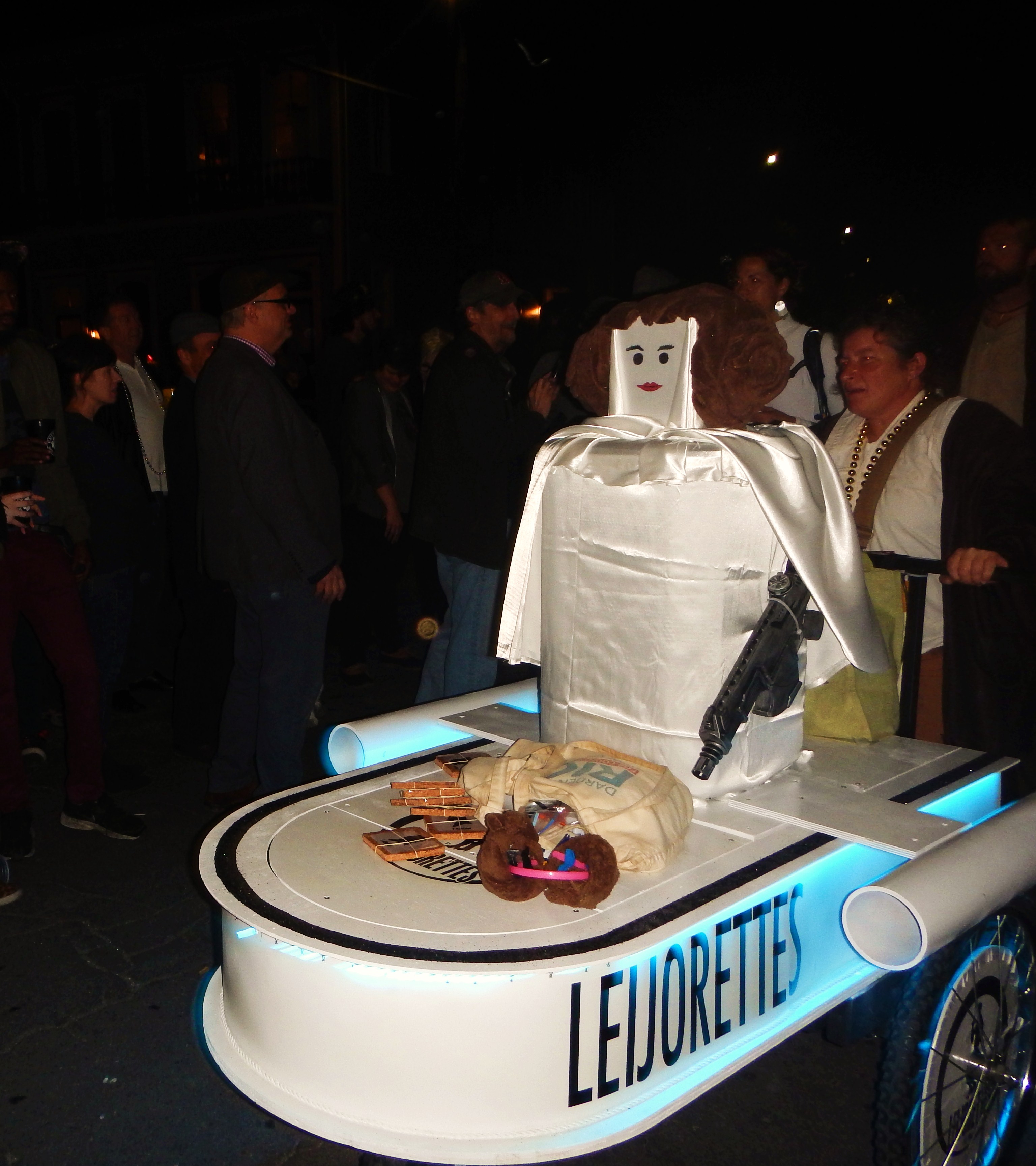
The Intergalactic Krewe of Chewbacchus is a relatively young parade that rolls hand-made, people-powered contraptions through the French Quarter & Marigny while the larger, gas-powered floats roll elsewhere across town. Although their nerdy umbrella has expanded to include all kinds of sci-fi goofiness, they’re the only parade I can think of that’s specifically designed to celebrate a movie franchise: Star Wars. Despite the inclusion of other sci-fi properties like Doctor Who, Star Trek, E.T. and (most recently) Guardians of the Galaxy, it’s still a mostly Star Wars-themed affair, one that lauds the “drunken Wookie” Chewbacca as its monarch. Real-life Chewbacca Peter Mayhew himself has even lorded over the parade the past couple of years, revelers treating him like nerdy royalty. The parade’s haphazard, DIY aesthetic perfectly matches the DIY practical effects of the original Star Wars trilogy. Star Wars’ endless parade of odd-looking weirdos and handmade sets & costumes serves as a fitting platform for New Orleans’ own endless parade of odd-looking weirdos & their personal creations, even if they’ve come to incorporate other fandoms as the years march on.

Wasting away a drunken afternoon in the Quarter and then capping off the night with Chewbacchus’ Imperial Stormtroopers & Jedi Knights was my personal introduction to the 2015 Carnival season. It was a great feeling to ring in my favorite time of the year while celebrating one of my other favorite activities: watching movies. Here are a few pics to help solidify the memory.

DSCN0999

DSCN1000

DSCN1001

DSCN1003

DSCN1004

DSCN1005

Have a great, safe Mardi Gras, y’all! And may the Force be etc, etc.

-Brandon Ledet

Get Excited! What We Do in the Shadows is Looking to Fund an American Theatrical Release

EPSON MFP image

A few years ago I was ready to concede that the vampire & zombie genres had reached their saturation points. In the mad rush to capitalize off of the successes of viable commodities like Twilight & The Walking Dead, the market has just been flooded with untold piles of subpar schlock like Vampires Suck & Zombeavers. Every now & then, however, a movie proves me wrong. I found the zom-coms Life After Beth & Warm Bodies to be surprisingly sweet and compassionate. The unfairly ignored Vamps was a return to form for Clueless-guru Amy Heckerling’s particular brand of social satire. I have yet to see Jim Jarmusch’s Only Lovers Left Alive, but from the advertising it seems to bring the 80’s classic The Hunger’s vampiric ennui into the 21st Century, an aesthetic I hadn’t considered would return. The endless implications & metaphors swirling around the undead have proved the genres endlessly adaptable, even if the final product isn’t always solid.

That’s why I’m hopeful for the New Zealand horror comedy What We Do in the Shadows. It promises to take the same ennui employed by Only Lovers Left Alive into the satiric comedy territory of Vamps. Posed as a Christopher Guest-style mockumentary, the film follows modern day vampires as they navigate mundane activities like nightlife, dealing with roommates, and searching for a bite to eat. They clash with the likes of witches, zombies, werewolves, and plain-old humans in a loosely-plotted slice of (undead) life comedy. From the looks of the trailer, it could be quite funny as well as a fresh take on a genre I once thought hopelessly stale.

What We Do in the Shadows is currently looking to fund an American theatrical release through a Kickstarter campaign. The Kickstarter’s page is helmed by the filmmakers themselves, Jemaine Clement & Taika Waititi, two of the creative minds behind the cult-classic comedy series Flight of the Conchords (as well as the films Boy & Eagle vs Shark). Clement is also a major player in one my favorite dumb comedies, Gentlemen Broncos. He’s a very funny & talented performer that I wish didn’t have to beg for funding like this, but the worst part is that the campaign is barely more than halfway funded with just a week left to go.

Even if you are not in a position to donate to the film’s American distribution, at least visit the Kickstarter page for a humorous promo featuring Clement & Waititi themselves or maybe help spread it elsewhere on the internet. It would be great if more people could see this promising, self-funded comedy and it was rewarded for bringing undead concepts into unexpectedly fresh territory.

2/14/15 UPDATE: The project was a success!

-Brandon Ledet

It’s Okay that Dan Aykroyd Isn’t Writing a Ghostbusters Sequel, Because He’s Already Living One

EPSON MFP image

The recent announcement of the cast for the upcoming Ghostbusters reboot was met with the usual flood of overblown internet outrage that accompanies nearly everything these days. Most of the objections seem to be centered on the idea that Hollywood shouldn’t have unearthed the franchise at all. Personally, I’ve resigned to compromising with what Hollywood productions are going to offer. Nostalgia is big money right now. In a time when it’s becoming increasingly difficult to get people to the cinema, producers will take the guaranteed, built-in audience every time. The best you can hope for is that somewhere in the process someone’s going to try to make these reboots interesting, because they aren’t going away. Paul Feig’s all-female approach to a Ghostbusters reboot is honestly just about the only one I could imagine that wouldn’t be completely pointless. The recent casting announcement make the idea even more promising, since it included four eccentric, boisterous personalities (Kristen Wiig, Leslie Jones, Kate McKinnon, and Melissa McCarthy) that have the potential to bring enough weird, idiosyncratic energy to the reboot to distance it from its source material in both style & tone. Feig’s Ghostbusters might just be the rare kind of reboot that can justify an existence on its own.

It at least beats the alternative. For years O.G. Ghostbuster Dan Aykroyd has been trying to get his own sequel to the franchise off the ground. Bill Murray’s resistance to reprising his role as Peter Venkman in Ghosbusters 3 was the long-time thorn in Aykroyd’s side, but Harold Ramis’ devastating passing last year was the final blow to the prospect. Admittedly, Aykroyd’s long-in-development script sounds like it had some promise. For instance, he dropped hints that the plot would somehow relate to recent advances in particle physics & the role he had written for Murray would’ve involved Venkman’s wisecracking ghost. The problem is more that Aykroyd cannot be trusted when left to his own devices. His sole director’s credit, Nothing But Trouble, which he also wrote & stars in, is one of the most bizarrely terrible movies I’ve ever seen. It’s a thoroughly unlikeable & unfathomable work that is the direct result of Aykroyd’s ego going unchecked. Similarly, his decision to write a Blues Brothers sequel more than a decade after costar John Belushi’s death was a total disaster and a detriment to the reputation of the original. Nothing But Trouble & Blues Brothers 2000 were the last two screenplays penned by Aykroyd, so it might be best that his version of a third Ghostbusters film never saw completion.

Aykroyd has publicly given his blessing to Feig’s Ghostbusters reboot and I hope that he’s sincere when he says he’s “delighted” by the casting. Ayroyd doesn’t need to write a Ghostbusters sequel because he is actually living one. In the press release where he gives his blessing to Feig’s cast he goes on to say “My great grandfather, Dr. Sam Aykroyd, the original Ghostbuster, was a man who empowered women in his day, and this is a beautiful development in the legacy of our family business.” Aykroyd’s real-life great grandfather was a dentist by trade, but he was also a spiritualist & a paranormal investigator. Ayrkoyd has claimed that his great grandfather would put on séances as a form of entertainment, which is not far from the spirit of the Ghostbusters franchise. Indeed, his family’s interest in the paranormal was passed down to him generationally & served as the basis of the original Ghostbuster’s film: to combine the “real” science of ghosts & spirits with old-fashioned ghost-themed comedies. With the first two installments of Ghostbusters, Aykroyd had achieved his goal of bringing his real-life obsession with the paranormal to the big screen. As he had continued his pursuit of infusing paranormal concepts into his work after the second film, a third installment seems redundant. He’s living Ghostbusters 3 on a daily basis.

The tactic Aykroyd employs to incorporate the paranormal in his professional life is an unlikely one, almost just as unlikely as a giant, city-destroying marshmallow or a painting come to life. He sells vodka. In an ancient (internet-wise) viral commercial for his Crystal Head Vodka, Aykroyd explains his interest in the paranormal while trying to sell you alcohol. He says things like “Since childhood I have been fascinated with the invisible world,” “There is more to life than mere material reality,” and “No one will show us the bodies from Roswell” in the same matter-of-fact tone that made him perfect for his roles in Coneheads & Dragnet. There are hours & hours of interview footage in which Aykroyd expounds upon his belief in the otherworldly like a particularly talkative caller on Coast to Coast AM, but the Crystal Head Vodka commercial is a perfect encapsulation of his worldview in an easily consumable 8min runtime. He’s so cheerful & confident in his explanations of the physical powers of positive thinking and the extraterrestrial origins of thirteen mysterious crystal heads that you can tell he really loves what he’s doing. He even encourages people who don’t share his beliefs to buy his product anyway, saying if nothing else it’s a “a luxury vodka in a cool bottle”. I can get behind that kind of honesty.

In one of his interviews about the possibility of a Ghostbusters 3, Aykroyd claimed “I’m about the future, not the past. I don’t reminisce.” Indeed, his idea of a particle physics themed Ghostbusters did sound like a somewhat fresh take on the franchise, but bringing back the old guard of actors & characters for the project doesn’t exactly sound like treading new ground. In a cinematic climate where reboots are inevitable and a new Ghostbusters will arrive in theaters, justified or not, I think Paul Feig’s approach is the best one possible for the franchise. The recent casting announcement gives the reboot a chance to stand out on its own as a unique work, even if it isn’t based on an original idea. Instead of Aykroyd giving the third installment the Ghost Brothers 2000 treatment, he gets to continue his great grandfather’s work by philosophically expounding on the existence of ghosts & extraterrestrials and filtering water through diamonds for a vodka pure in spirit. This way everyone wins.

-Brandon Ledet

We Found a Dozen Nice Things to Say About Left Behind (2014)

EPSON MFP image

Watching the 2014 version of Left Behind was one of those epiphany moments where a movie is bad (not a fun bad, just bad) but why were we expecting anything different? A reboot of a humorless Christian franchise trying its little, judgmental heart out to save our doomed, sinful souls from the definitely-going-to-happen-any-day-now Biblical Rapture doesn’t exactly sound like a laugh riot. The inclusion of human enigma Nicolas Cage gave the series the promise of campy appeal, but he was in quick-paycheck mode and did little for the film’s lifeless, dour tone. Similarly, any weird potential in the idea of a worldwide, supernatural, people-erasing event is severely undercut by the film being the first in a planned series and the budgetary decision of bottling most of the action on a single airplane. Instead of the amused chuckling we naively expected, we met most of the film with irritated silence.

It’s a little unfair to beat up on a film based on our off-base expectations, though, so instead of giving Left Behind a negative review, we decided to catalog the things we actually liked about the movie. It took some careful deliberation but between the two of us we came up with an even dozen nice (or at least entertaining) things to say about Left Behind.

1. Although the movie doesn’t include any patented Nic Cage Freak-Outs™, it does feature Cage delivering the following line to his Atheist daughter: “If your mother was going to leave me for another man, it might as well have been Jesus.” A calm, collected Cage isn’t exactly the shot in the arm this movie needed, but we really liked that line.

2. Cage has exactly one more entertaining moment later in the film. As the passengers on the airplane he’s piloting are freaking out, confused about their Raptured loved ones, he utilizes his National Treasure puzzle-solving skills and gets to the bottom of what’s going on. The clues that lead him to discovering the phenomenon’s Biblical source: one missing passenger’s watch reads “John 3:16” and another’s datebook has a scheduled Bible study penciled in.

3. The Rapture itself was kind of interesting (even if by default), especially the image of disappeared children’s clothes falling to the floor while the balloons they were holding float toward the heavens.

4. We may have unfairly described the film as humorless above. It does attempt an embarrassing, mildly reprehensible line of comic relief involving an angry dwarf character. Most of the gags are misfires politically & morally, but there is one that is just genuine, wholesome fun. As the passengers are trying to figure out if the Raptured have actually disappeared or are just invisible, the dwarf tries to give one of the missing a wet willy. It’s pretty funny.

5. Speaking of morally reprehensible, the same dwarf character mentioned above is unceremoniously tossed out of the airplane once it lands by a Muslim man he’d been bickering with for most of the runtime. It’s a gag that’s transgressive in its complete disregard for decency, but it’s still entertaining in its own deplorable way.

6. Nic Cage’s daughter is just as frustrated with her mother’s newfound Christian faith as Cage is. When she discovers that her mother’s warnings of The Rapture have come true she angrily smashes the disappeared woman’s Bible through window glass. It’s a great image & one that would befit the most melodramatic Lifetime Movie blowup.

7. Speaking of Nic Cage’s daughter, she looks eerily similar to his mistress in some ways. It’s cool that he has a type.

8. Cage’s totally happy, not at all depressing family unit is only shown in one place in a single image: a hilariously awkward family portrait that makes two separate appearances in the film. The shoddy Photoshop on the picture is an embarrassment, Cage himself looking like he was airbrushed into the picture. It’s one of the film’s only interesting images because it’s so jarringly fabricated and it’s totally bizarre that they felt the need to feature it twice.

9. In yet another bizarrely fake image, there’s a CGI plane that’s crash-landing looks like it was borrowed from a PowerPoint presentation. It’s ridiculous.

10. Just in case you don’t know how to feel at any point during the movie’s consistently over-sentimental, maudlin proceedings there’s an oppressive, violin-heavy soundtrack there to remind you how to feel at every moment. It would be annoying if it weren’t so over-the-top in its persistence.

11. The same way the violins never let you forget exactly how to feel, there’s a character that contantly reminds everyone around him that he’s an “investigative journalist”, which would be a ludicrous, ill-advised thing for a real-life investigative journalist to do, but it is pretty funny in this context.

12. All joking & sarcastic derision aside, there are a couple decent shots in the film. Exactly a couple. One image of Cage’s daughter backing up a truck & one of her running across a bridge at night felt like glimpses into a drastically different, frankly much better film. Combined together, they amount to maybe 5 seconds of footage, but they do look fairly nice in comparison to the artistic void that surrounds them. As with every other item on this list, we were deeply grateful for the fleeting flashes of vitality in a movie that was severely lacking both in life and personality.

-James Cohn & Brandon Ledet

Movie of the Month: The Masque of the Red Death (1964)

masque
Every month one of us makes the other two watch a movie they’ve never seen before & we discuss it afterwards. This month Brandon made James & Britnee watch The Masque of the Red Death (1964).

Brandon:
The Masque of The Red Death is one of eight films in the Corman-Poe cycle: a series of Edgar Allan Poe adaptations directed by B-movie legend Roger Corman for American International Pictures. The Masque is widely considered the best of the Poe cycle as well as one of Corman’s best films overall, a sentiment I wholeheartedly agree with. There’s so much about The Masque that’s firmly in my wheelhouse: over-the-top set design, an early glimpse of 60’s era Satanic psychedelia, Vincent Price taking effete delight in his own cruelty, a fatalistic ending that doesn’t stray from the pessimism of Poe’s story, Corman pushing the limits of what he can get away with visually on a shoestring budget. I love it all.

What struck me most on this recent viewing of The Masque is how well it’s suited for the Carnival season. With Fat Tuesday looming around the corner, it was impossible not to see aspects of Carnival in the masquerade ball hosted by Prince Prospero (Vincent Price). The cheap costumes & mockery of opulence is very much reminiscent of Mardi Gras parades. There’s even a scene where Prospero literally throws beads from a balcony shouting “Gifts! Gifts!” and scoffs at the greed of the people below. As the threat of The Red Death plague becomes increasingly severe, the masquerade takes on a “party while the ship is sinking” vibe New Orleans knows all too well. Horror films are usually tied to Halloween, but The Masque of the Red Death is distinctly akin to Mardi Gras in my mind.

James, do you also see Carnival in The Masque’s decadence, or does the Satan worship overpower that influence?

James:
Man, The Masque of the Red Death was awesome. The bold stylistic choices that Corman made on a limited budget and limited time (the final masquerade scene was filmed in a day) are astonishing. Some of the images in the film (The Red Death himself being the starkest) are mesmerizing. I think the film should also be noted for its pitch-perfect tone. Despite its macabre images, philosophical discussions of Satanism, and Prince Prospero’s nastiness, what could have been a dreary chore is instead a blast throughout.

In regards to the presence of Carnival in the film, I do think the masquerade ball scenes in particular have a very Mardi Gras feel to them. Masks with feathered beaks, gorilla suits, and a child masquerading as a little person don’t feel too far removed from the typical Carnival season debauchery. The Carnival feel also deepened a central theme of the film: lost souls celebrating a kind of momentary victory over Death. Ultimately, the film seems to have a nihilistic attitude towards Death, implying that the celebration is indeed a momentary victory and whether Christian, Satanist, or Atheist, we will all have to eventually confront an indifferent Death. But it also seems to find solace in our ability to shape our own existence while we are alive. This is echoed The Red Death’s climactic statement “Each man creates his own God for himself – his own Heaven, his own Hell.”

Britnee, what was your interpretation of the film’s philosophy on Death? Is it wholly negative?

Britnee:
This was my first time viewing The Masque of Red Death, and I have to say that I was blown away. Vincent Price as Prince Prospero was dynamite. I was so close to hiding under the covers during the close-ups of his signature evil stare, but seconds later, I was imagining what it would be like to have a conversation & afternoon tea with him in one of those seven colored rooms. Also, one of my favorite things about the film was the set and costumes. I know the look was supposed to have a Medieval vibe, but I really felt that I was at a Satanic drug dealer’s mansion party in the early 60s. All that was missing was the orange shag carpet.

As for my interpretation of the film’s philosophy on Death, I’m honestly not 100% sure. Death has always terrified/interested me, and I caught myself really falling into some deep thoughts about it while watching this film. The Christians and Satanists in Masque both experienced violent deaths, and neither of their higher powers swooped in to save them or give them a miraculous second chance. I guess the film is trying to show that Death cannot be avoided, regardless of power or faith. In the end when The Red Death states “Sic transit gloria mundi,” which literally means “Thus passes the glory of this world,” everything sort of hit me. Life can be very short & leave without warning, whether you’re a Christian villager living in poverty or a wealthy Satanic prince; it’s coming for us all!

Something else that stuck out was the interesting relationship between Prospero and Francesca. After sparing Francesca’s life, Prospero brings her to his castle to make her his consort and gives her a taste of his world. He becomes very intrigued with Francesca’s innocence and faith. As for Francesca, there are times where it seems as though she is giving in to temptation, but simultaneously she is in constant focus on her escape.

Brandon, what themes do the relationship between Prospero and Francesca bring to the film?

Brandon:
It’s reasonable to assume that Prospero wasn’t always the cruel tyrant we meet in the picture. He didn’t emerge from the womb executing peasants and cursing God. Prospero’s poisonous personality was likely the result of a gradual corruption of his soul, an evil born of his prosperous upbringing. Raised with untold wealth & influence, he came to rule over his fellow human beings like an unforgiving deity. Unsatisfied with the power his privilege as Earthly nobility affords him, he reaches even further beyond this realm and makes a deal with Satan in an attempt to overcome Death. Yet, there’s a little speck of good left in Prospero’s heart, which I think is what we see in his treatment of Francesca. At times he tries to prove that even her innocence can be corrupted because he wants to be assured that his own wickedness can be found in every person’s heart. He even asks her to join him in mocking the greed & decay in the guests at the masque, because he believes all people to be as amoral as he is. At other times, he goes out of his way to protect her and spare her life, an instinct that surprises even The Red Death. The only other glimpse of good we see in Prospero is when he asks his guards to spare a baby’s life at the gates. Although he is beyond redemption, (not that redemption matters in the eyes of Death,) Francesca affords Prospero his last chance to act like a true human being.

Then there’s the fact that the actress who plays Francesca, Jane Asher, was just achingly beautiful. So beautiful, in fact, that she was in a relationship with & at one time engaged to Sir Paul McCartney in the 60s. She was attractive enough to snare a Beatle during the fever pitch of Beatlemania, so surely a demented prince who can’t even cheat Death wouldn’t stand a chance against her charms. Perhaps simple lust spares her life. I think Francesca stands out here as a hip youngster (maybe it’s all in those bangs?) and helps add to that 60s drug dealer mansion party vibe mentioned above. So much of the film feels rebellious in an anachronistic way. Prospero’s philandering is out of control. Lines like “Satan rules the universe!” and “Each man creates his own god for himself” are pretty edgy for 1964, even coming from the villains. Keep in mind this is still years before the New Hollywood, a movement Roger Corman cannot be praised enough for influencing.

James, how do you see the balance between the movie’s setting and the era in which it was filmed?

James:
The movie definitely has an edge that makes it still creepy and blasphemous over 40 years later. I wonder how much Corman was in tune with the counterculture of the time because, despite it being a British production, the film feels more like a deranged product of the 60’s San Fransisco hippie movement, like a horror version of Beyond the Valley of the Dolls; its macabre decadence fueled by lust and greed. It’s also most likely no coincidence that the epicenter of the hippie movement was the same place that the Anton Lavey established the Church of Satan in 1966. Themes like the destruction of social norms and an openness to sexual and spiritual experiences seem to be shared by The Masque of the Red Death, Satanists, and the hippies; “Each man creates his own god for himself” is THE basic philosophical statement of Satanism. I also think this is reflected in the dark, psychedelic imagery that The Masque of the Red Death and Satanist rituals share. (Photo for example)

satanist

Britnee, How strongly do you think the psychedelic aesthetic of the 60’s influenced The Masque of the Red Death? Any specific examples that stick out to you?

Britnee:
I think that The Masque of the Red Death was as psychedelic as it gets, at least for a horror film based in Medieval times. An example that really sticks out to me is the colors used throughout the film, most importantly, the use of red. Red usually represents blood, gore, and all the good stuff horror movies are made of, but when I also think of the term “psychedelic,” red is usually the color that comes to mind. After doing a little research, I found that the color red has a pretty long wavelength and very low vibration; this pretty much explains how the red tint that is present in multiple scenes really gives off this warm, draining feeling. Sounds a bit like the feeling you get after taking a hallucinogen or two, right? Also, all of those gaudy colors in the castle & clothing of Prospero and his pals can’t go without mention. While I’m not a Middle Ages expert or enthusiast, I’m almost positive that the colors of clothing and décor weren’t as bright and vibrant during that era as they are in the film. It’s obvious that the 60’s psychedelic aesthetic heavily influenced those hues.

Lagniappe

Brandon:
I’d just like to point out one last time just how early this film was released. A lot of what we think of as the hippie-dippie 60s came very late in the decade. The era-defining Summer of Love was in 1967, the same year Roger Corman dropped acid for the first time and fictionalized his experience in the film The Trip. The Masque‘s 1964 release positions the film as years ahead of its time. Corman was pulling off the Satanic psychedelia vibe the same year that Mary Poppins & My Fair Lady were huge cultural hits. I’m not saying Masque was particularly a major influence on the countercultural swell that was to come, but it at least was somewhat visually intuitive. And Corman himself did have direct influence on the later films that typified that counterculture, films like Easy Rider and Bonnie & Clyde. Even back then, when “don’t trust anyone over 30” was a motto to live by, he was the hippest geezer in the room and a filmmaking rebel.

Britnee:
After the discussion with The Swampflix Crew, so many ideas and thoughts about The Masque of the Red Death were brought to the surface. It gave me an excuse to watch the film a couple more times, and I fell in love with it more each viewing. The movie also got me hooked on the Corman-Poe films, so I’m currently trying to get my hands on all of them. The Masque of the Red Death was just a great balance of horror, suspense, and drama that gave me some really unsettling thoughts & a case of the willies. Great job, Corman!

James:
Really enjoyed the discussion of The Masque of the Red Death. Watching the film a second time and taking into account all the points you guys made deepened my appreciation and understanding of the film. Definitely want to see more Corman, especially the Poe films. As Brandon pointed out, Corman seemed to have his hand on the pulse of the counterculture and was always one step ahead of mainstream Hollywood. Truly a filmmaker ahead of his time.

-The Swampflix Crew

Upcoming Movie of the Months
March: James presents The Seventh Seal (1957)
April: Britnee presents Blood & Black Lace (1964)

How to Play the See No Evil (2006) Drinking Game

see no evil

One of the earliest (and trashiest) trends we’re developing here in Swampflix’s infancy is a focus on pro wrestling movies. We’ve even designated a Wrestling Cinema page, where you can find all reviews & articles for movies somehow related to pro wrestlers or to “sports entertainment” in general. I expect that over time (if it hasn’t happened already) we’ll end up spending way too much time & energy poring over the details of even the most dire entries in Wrestling Cinema, whether or not they deserve the effort. Spoiler: they typically don’t.

Even this early in our run, we’ve already spilled entirely too much ink on one particular Wrestling Cinema franchise: the pro wrestler Kane’s slasher vehicle See No Evil. Between our reviews of See No Evil (2006) & See No Evil 2 (2014), we’ve written ~1,500 words about a very simple set of films. The “tl;dr” version: the first one is surprisingly fun & nasty; the second one is a waste of your time. Even though we’ve already covered too much ground with the franchise at this point, there is one detail I feel we shouldn’t have skipped over: the See No Evil drinking game.

We’ve previously mentioned the awful dialogue, terrible acting, and “vile, hateful” teenage characters that populate the first See No Evil, but not in great detail. Instead of providing the teens meaningful exchanges or character arcs, most of the film’s dialogue consists of long strings of insults. Characters call each other “sluts” & “assholes” with an alarming frequency. The script’s dependency on insults would be an annoyance if the insults weren’t both so over-the-top in their prevalence and also surprisingly appropriate for the film’s overall nasty look & tone. The insults are so constant, so overwhelming that it becomes difficult to notice anything else (besides, you know, the brutal murders).

Which brings me to the rules of the See No Evil drinking game:
1) Drink whenever a character insults someone.

That’s it. You should have plenty to drink with just this one prompt. There may be some questions to suss out before the game begins like “Does it count if they insult an inanimate object or a building?” and “Does murdering someone count as an insult?” My own thoughts on that second question: in regards to this particular group of degenerates, murder might be more of a favor or a blessing.

Note: We only suggest playing this game with the first See No Evil movie. This is not only because the characters in See No Evil 2 are much kinder to each other, but also because we don’t recommend you watch the sequel at all.

Play safe!

-Brandon Ledet

The Spirit of The Spirit of the Beehive (1973): Horror in Ambiguity & Obscuration

spiritbee

Watching The Spirit of the Beehive for the first time recently, I was struck by how contemporary & effective the film still felt 40 years after its release. Its refusal to tell a complete, lucid story was reminiscent of so many recent art films that I love. What was even more striking was the horror the film found in its obscuration. There was an overwhelming sense of dread that something terrible was sure to happen at every turn, a dread that’s more unsettling than the scariest movie monster or serial slasher, because it could not be seen or completely understood. It’s somehow worse when something catastrophic doesn’t happen in the film, because the dread lives on to the next scene. To help myself better understand the film’s horrific use of ambiguity, I looked back to the film it heavily references: James Whale’s classic Frankenstein, a film 40 years its senior. I also looked to a film 40 years its junior: last year’s Under the Skin, within which director Jonathan Glazer finds his own ambiguous horror, bringing the spirt of The Spirit of the Beehive into his own fresh, unnerving territory.

As an essential part of the classic Universal Monsters era, the 1931 film Frankenstein is a touchstone for horror in cinema. The image of Boris Karloff lumbering around as a pile of sentient dead flesh is beyond iconic. So many of horror’s sub-genres, (with their gross-out creature effects & slow-moving, super strong killers), owe their worlds to the bolted-neck lug. What’s most surprising to me is what influence the film has had on atmospheric horror, particularly The Spirit of the Beehive. Having grown up with the Frankenstein monster’s ugly visage on rubber masks, morning cartoons, a Mel Brooks comedy and Halloween candy, I find that familiarity with the abomination has softened his horrific effect. In fact, I think he’s kinda cute. The film that surrounds him, however, still finds other ways to terrify. The movie’s opening graveyard scene, for instance, is a work of otherworldly terror, mostly due to the effective set design. The sparse set, open sky, and thick, clinging fog feels more akin to Mario Bava’s Planet of the Vampires than it does to Earth. The fact that mysterious men are there to rob graves is only icing on the cake for an already terrifying image. Without familiarity with the source material the reasons why they’re digging up corpses makes the moment even more mysterious. There’s an alien atmosphere at work in images like this graveyard set & the doctor’s laboratory that make the film enduringly unsettling.

Of course, most of Frankenstein is far from the detached ambiguity of 1973’s The Spirit of the Beehive. The doctor’s father, Baron Frankenstein, is the antithesis of ambiguity, stating clearly & loudly what is going on in every moment and providing what I suppose was meant as comic relief & “good sense”. Beehive has no such ambitions of clarity. Instead of being a direct spiritual descendent of Frankenstein, Beehive stretches the uncertainty & terror of the opening graveyard scene across its entire run time. It communicates its unease through its imagery, some of which is borrowed directly from Frankenstein. The film opens with children watching the horror classic in awe & discussing fantasies about the monster’s “spirit” afterwards. There’s also a very similar search party scene shared between both films, both feature characters left mute by trauma, and Karloff’s monster himself makes a cameo during one of Beehive’s more bizarre moments. The most significant aspect Beehive borrows from Frankenstein, however, is the foreboding sense of children in danger. In Frankenstein, there’s a scene where the monster picks flowers with a little girl at the side of a lake, only to mistakenly drown her. The two young female protagonists of The Spirit of the Beehive obsess over this scene afterwards, and discuss the monster & his “spirit” at length. Mimicking this moment almost endlessly, it feels as if there’s a constant threat on the children’s lives (whether they’ll be hit by a train, murdered by a stranger, drowned in a well, etc.) that’s communicated solely through the film’s tense imagery. It turns out that something awful already had happened to the girls: they had been uprooted & displaced by a civil war that stresses & complicates their home life, but is never referred to directly. All of the film’s conflicts are conveyed silently and it’s a silence that tyrannizes the central family & distresses the audience.

Silence & ambiguity are also the channels through which Under the Skin terrifies. Obfuscating the narrative of its source material, Glazer’s sci-fi horror leaves the identity, intentions, and even species of its protagonist up for question as she flirts with Scottish men and lures them back to her apartment. Unlike with Beehive, the violence suggested in Under the Skin’s overwhelming dread is delivered on screen. The unnamed protagonist, played by Scarlett Johansson, is more like Frankenstein’s monster in this way, as opposed to the civil war & familial unrest that plagues The Spirit of the Beehive. Instead of drowning & strangling, however, she lures her victims into a mysterious black liquid that somehow dissolves their bodies in a frightening, confounding spectacle. Under the Skin’s inclination for on-screen horror, no matter how alien, distances the film from being a direct spiritual descendent of Beehive, the same way Beehive’s brand of horror is distanced from Frankenstein’s. It does, however, employ a similar mystique & cryptic atmosphere that makes the film all the more terrifying than if Glazer had made a more literal adaptation of the novel by the same name.

Both Under the Skin & The Spirit of the Beehive reach beyond the typical ways a movie can terrify, beyond the methods pioneered by classic monster movies like Frankenstein. They achieve a transcendental beauty in images like Beehive’s honeycomb lighting & endless doorways and Under The Skin’s liquid void & free-floating flesh. It’s a terrifying beauty, though, as it is a beauty of the unknown. Both films are transfixing, yet horrifying, because they cannot be truly, completely understood, like the graveyard landscape at the beginning of Frankenstein. For the more than 80 years since mysterious men were curiously robbing graves on that foggy, otherworldly set, ambiguity and obscuration have been used to terrify audiences in countless films. The three mentioned here are mere steppingstones in the evolution of cryptic, atmospheric horror, perhaps only loosely connected to one another in terms of genre, but connected all the same in a hauntingly vague, undead spirit.

-Brandon Ledet

Tangerine Dream & the Nightmare Sounds of Sorcerer (1977)

EPSON MFP image

Edgar Froese, the founding member and creative mastermind behind the prolific German band Tangerine Dream, passed away this past Tuesday, January 20th. The news broke yesterday via the band’s Facebook page, with a brief message announcing that his death was sudden & unexpected. Tangerine Dream’s long history dates back almost 50 years, 20 musicians and more than 100 releases. They were an experimental, mostly instrumental band that pioneered the forefront of psychedelia, krautrock, and synthpop, pushing the limits of their music through each new evolution. As the only continuous member of the group, Edgar was there for it all.

Arguably, Tangerine Dream’s most significant contribution to music was their soundtrack work on films in the 70s & 80s. The moody synth scores that are making a comeback in recent films like Drive, The Guest, and Cold In July owe just as much of a debt to the band as they do to John Carpenter, perhaps even more. Their score for Michael Mann’s debut feature Thief perfectly updates the film’s gritty noir for a 1981 aesthetic. Their music gave Ridley Scott’s fantasy epic Legend an otherworldly atmosphere to work in. Their synthpop provided a sense of dangerous fun in Kathryn Bigelow’s vampire Western Near Dark. Tangerine Dream’s scores not only elevate the movies they’re featured in; they become intrinsic to their mood & quality. This is especially true with their score to William Friedkin’s cult classic thriller Sorcerer.

Sorcerer was Friedkin’s loving retelling of the 1953 film (or at least the same novel adapted by) Wages of Fear, a French-Italian thriller about desperate men risking their lives to transport the delicate explosives necessary to snuff an oil well fire. Hot off of his career-high success with The Exorcist, Friedkin allowed his hubris to inflate the film’s budget and shooting schedule. It was a dangerous & expensive film to make, but one Friedkin thought worth the trouble, as he hoped it would be his legacy. That’s not exactly how it worked out. Initial critical reception was mixed and the box office numbers were even worse. It’s been speculated that the film failed because of its unfortunate debut alongside the first modern blockbuster Star Wars. Its commercial failure has also been attributed to audience’s confusion with seeing a film called Sorcerer from the same director as The Exorcist and understandably expecting a supernatural horror instead of the tense, gritty thriller that was delivered. Friedkin was expecting Sorcerer to be his greatest accomplishment, the one he’d be remembered by. Commercially speaking, he failed.

The film has rightfully earned a more long-term success critically, though, gradually earning cult classic status in the decades since its initial release. It was restored for a home & brief theatrical release in early 2014 to commemorate its reappraisal. Sorcerer’s tense sense of impending doom may have not been a surefire commercial venture in the summer of 1977, but remains as potent as ever as the years go on, particularly in the film’s awe-inspiring centerpiece: “the bridge scene”. It’s an unsettling picture that slowly cranks up its existential dread over what’s got to be the most nerve-racking road trip story I’ve ever seen on film. A lot of the film’s achievement in tone is surely do to the forceful, synth-heavy score from Edgar Froese’s Tangerine Dream.

In his memoir The Friedkin Connection, Friedkin tells the following story of how he discovered the band at a show in an abandoned church in their native Black Forest, Germany: “The concert began at midnight and they played long, rhythmic, sensuous chords, somewhere between classical music and the new pop sound. They performed for three hours in darkness, outlined only by the twinkling lights of their own electronic instruments, and along with a large audience of stoned young people, I was mesmerized.” He approached the band after their set to ask if they would collaborate with him on his next film. Working with only the screenplay Friedkin provided them and not a minute of footage, Tangerine Dream sent him two hours of recordings while the film was still in production. Friedkin says he & the film’s editor cut the picture while listening to random passages of the soundtrack for inspiration. Their music had a very significant hand in the shape & the tone of Sorcerer.

Tangerine Dream had a hand in the tone of many films, including ones they didn’t directly work on. Sorcerer, however, is the film that’s most inseparable from their work. It’s undeniable that the movie would not have been the same without them, as their music literally guided the shape of the final product. Edgar Froese’s passing leaves a massive legacy in its wake. Sorcerer is just one note on an extensive list of accomplishments, but it’s a note that deserves to be highlighted.

In the band’s farewell Facebook message Froese is quoted as saying “There is no death, there is just a change of our cosmic address.” Let’s hope that before he made the journey to his new address, he was well aware of the impact he made on this one.

-Brandon Ledet

The Exterminating Angel (1962) and the “Party Out of Bounds” Story

exterminatingangel

One of my favorite types of stories, especially when told on stage or on the screen, is what The B-52s would call the “party gone out of bounds”. I love it when guests at a fictional party stop celebrating and start having a truly shitty, life-changing catastrophe of a time, but decide to stick around and see it through instead of taking the logical step out of the door. It’s a familiar feeling, that late hour biterness that arises when alcohol’s social lubrication takes a toxic turn and the vile, dangerous aspects of human nature start bubbling to the surface. Civility dissolves and our feral natures emerge. The “Party Out of Bounds” story is one I’ve lived many times before, mostly in the drunken hours of early morning when I should’ve gone to bed, but instead felt compelled to stay up and argue “important”, hurtful things I didn’t always mean. I take strange pleasure in seeing these repellent impulses reflected back at me in my entertainment media, particularly in movies & plays.

Part of the allure of “Party Out of Bounds” story is the motivation for sticking around. What compels someone to remain at a party when “situations degenerate, disgusting things you’d never anticipate”? In the genre’s most easily recognizable example, Who’s Afraid of Virginia Woolf?, it’s clear that the central couple George & Martha loathe their marriage and the make-believe required to keep it afloat, so their motivations for destroying each other’s delusions are fairly straightforward. But why do the younger couple, Nick & Honey, stick around once the tone gets sour and focused on destroying them as well? In Cat on a Hot Tin Roof, it’s understandable why Maggie wants Brick to snap out of his sullen state and actively engage with life, but why does Brick allow the evening to go on endlessly, Maggie & his father digging deeper into his painful past? In The Boys In The Band, Michael allows his own self-loathing & alcoholism to tank the birthday party he throws for his friend Harold, but why do the other guests allow themselves to get sucked into his emotional black hole? The instinct to tough it out and see the awful thing through is fascinating to me.

Some “Party Out of Bounds” stories side-step the issue of motivation by confining their characters with literal barriers, some physical and some metaphysical. It’s A Disaster & Coherence are both great recent examples of this tactic, using chemical warfare & a supernatural occurrence to bottle their partygoers at a disastrous brunch & dinner party, respectively. This approach to the genre is more metaphorical than the one detailed above, but belongs all the same. Although an external force is trapping the characters, it’s their internal failings that drive the parties out of bounds. Both situations would have soured with or without the outside help.

Surrealist master Luis Buñuel’s 1962 film The Exterminating Angel plays both sides of this coin beautifully. There is an external force that keeps the film’s aristocratic partygoers trapped in a single cramped room of an expansive mansion, but it is a force than cannot be explained. The characters are compelled to remain in the mansion’s music room as if there were a force field blocking them at the door. At first the guests seem to remain at the dinner party out of nervousness & etiquette, like little kids waiting anxiously for someone to take the first dive at a pool party. Each time someone makes a motion to leave, they find a flimsy excuse to stick around: a forgotten purse, a cup of coffee. As with Coherence & It’s A Disaster there’s an external authority confining the partygoers to the music room, but the fact that this authority cannot be seen or even understood links the movie to the compulsion detailed in the classic examples listed above. The Exterminating Angel is the ultimate “Party Out of Bounds” story: the instinct that coerces its partygoers to see the awful thing through is given tangible power. It is an ugly compulsion materialized, a masochistic urge physically manifested.

As the ultimate “Party Out of Bounds” story, The Exterminating Angel starts with the wealthiest, most civilized party guests and ends with them reaching a feral state, fighting for food & water like wild animals. More than any other film listed above, the party starts at the greatest height of good manners before plummeting into murkiest depths of depravity. Civility more than dissolves here. It’s erased so completely that you begin to question whether it was present in the first place. As the days stretch on in the music room and the guests turn on each other one by one, the opulence & etiquette on display in the early scenes take the shape of a thin veneer, just barely covering the seething vulgarity under the surface. At the film’s beginning, the guests were already full of hatred, already committing adultery, already prone to frivolous cruelty, but were much better at covering up their indiscretions. Getting trapped in the music room merely forces them to display their true natures openly & honestly.

The debasement is gradual. At first guests become fatigued and take cat naps on various chairs & couches, but it’s fatigue that can be attributed to food, alcohol and the late hour of the party. Then they begin to undress from their tuxedos & gowns and clear places to sleep on the floor. As they wake from their makeshift slumber party, they start looking disheveled, unkempt. The reality of their inability to leave slowly dawns on them and they lose their self-control one by one. Those who initially remain calm consider themselves superior to the other guests, but that leverage doesn’t last long. Over time they come to blame each other for getting them in the bizarre predicament, pace at the doorway’s invisible barrier, cry, slip into comas, fight, fuck, commit suicide, hallucinate, insult each other’s hygiene and break into fits of hysterical laughter. When the story begins the characters are embarrassed to be caught acting like human beings. By its end they’re killing sheep with their bare hands and breaking apart furniture & musical instruments for firewood.

Yes, there are sheep roaming the house. There’s also a bear than begins to scale the mansion’s columns as if climbing a tree in plain view of the music room, seemingly mocking the party’s return to nature. The bear and the sheep were acquired for after-dinner entertainment that never arrived. There’s some symbolism to be made of the sheep’s presence (phrases like “mindless sheep” & “like lambs to the slaughter” come to mind), but what are we to make of the bear? And then there’s other details that beg to be picked apart: the vases the guests use as toilets are portals to an open-air outside world, there’s a severed hand that crawls across the floor like The Addams Family’s Thing, the rules of who can and who cannot cross the music room’s barrier becomes increasingly convoluted, the mansion itself is located on Providence Street, etc. It’s all, for a lack of a better word, perfectly surreal. Applying logical analysis to these images is a fool’s errand in my opinion, like the doctor at the party who tries to understand the music room phenomenon through reasoning and ultimately gets nowhere, just like his fellow partygoers.

It’s tempting to read into each of these images separately, but they’re better served when left at face value. Any of the larger ideas that need to get across are fairly plain without too much analysis. The aristocracy is like a gang of helpless infants without its serving staff. The barrier that keeps the affluent trapped in their mansion’s most frivolous room mirrors the way wealth can isolate a person from the “real” world outside and the common people who occupy it. Most importantly, though, civility is really a façade for the snarling beasts lurking within us. As characters begin to violate “the most basic concepts of good etiquette” and fail to “remember their upbringing”, one character calls it “the very end of human dignity.” I say good riddance to that dignity.

Getting back to the B-52s song in question, I’d like to answer the line “Who’s to blame when parties really get out of hand?” Only ourselves, buddy. Just us. Well, maybe us and alcohol. There’s a lot of great “Party Out of Bounds” stories out there and their conflict is always the same: a drunken, joyous celebration is derailed by repressed impulses & inherent, hideous aspects of human nature once civility is no longer there to keep them at bay. Buñuel’s The Exterminating Angel pushes this conflict to unmatched extremes that are somehow just as amusing as they are terrifying. It’s an incredible feat of filmmaking and the crown jewel of a genre I love.

-Brandon Ledet