Yokai Monsters: Spook Warfare (1968)

EPSON MFP image

fourhalfstar

campstamp

If anyone tells you that you need something more than just a few cool monsters to make a great film, they’re spreading lies. Sure, over-the-top creature design works best when it’s paired with an intricate narrative structure, as is the case with John Carpenter’s immortal The Thing. It’s not a necessary combo, though. One of my favorite discoveries this past year, for instance, was the creature-laden Monster Brawl, which was essentially just famous monsters murdering each other in graveyard pro wrestling matches with little to no narrative embellishment. The monsters were impressive enough & the premise was silly enough for the movie to work on that bare bones formula. The sensation of watching Monster Brawl brought me back to the days of banging action figures together on the carpeted floor of my childhood home, imagining epic battles between fantastic monsters & superhuman muscle men.

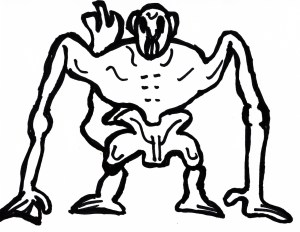
That same childish exuberance for fantastic monsters is what won me over wholeheartedly in the late-60s Japanese film Yokai Monsters: Spook Warfare (aka The Great Yokai War). The second installment in a series of three Yokai Monsters movies released in just one year’s time (alongside One Hundred Monsters & Along With Ghosts), Spook Warfare was the most popular film of its trilogy, as it focused more on the personalities of the fantastic monsters at its core instead of the humans that live in their presence. For Japanese audiences, the film has a built-in historical context for each of its monsters, but for American audiences unfamiliar with the intricacies of Japanese folklore, the film’s oddball collection of “apparitions” read like psychedelic precursors to the work of such luminaries as Jim Henson and Sid & Marty Krofft. Where I see sentient umbrellas, (literally) two-faced women, and a ladies with snake-esque necks that stretch like Mr. Fantastic, native audiences see very specific legends from the jokingly-titled “Apparition Social Registry” with names like Kappa, Futakuchi-onna, and Kasa-obake.

I say “apparitions” instead of “creatures” because the “spooks” in The Great Yokai War are not quite monsters, but the ghosts of ancient monsters, which adds a whole other fascinating level of awesomeness to their peculiarity. To provide a conflict for these apparitions to combat, the film brings to life a “several thousand years old” monster from the ruins of Babylonia named Daimon. Daimon is a bird-like humanoid wizard prone to blowing himself up to kaiju proportions & possessing the minds of local magistrates in order to turn them into godless tyrants. Daimon is pretty bad-ass, but he stands no chance against the water-nymph bird-fish (who could pass for a bassist in the animatronic Chuck E Cheese band), his long-tongued umbrella, and the ghosts of a hundred of their closest friends. Besides the general disruption of peace & order the ghost monsters are insistent on putting a stop to Daimon’s evil deeds post haste because “Shame will be brought upon Japanese apparitions” if they don’t.

Perhaps the strangest detail about the ghost monsters in Spook Warfare is just how kid-friendly they look. I didn’t use the comparison to the soon-to-follow work of Jim Henson and Sid & Marty Krofft lightly. Many of the creature designs are just aching for plushie doll or action figure merchandise, a sensation backed up by the film’s broad physical comedy & the fact that they befriend children in the film. What’s strange about this is that so much of the film would be a nightmare for certain young audiences. Ghosts take shape from magical, colored mists in spooky swamps. Buckets of giallo-crimson stage blood is spilled in the film’s many brawls. Adult language like “damn”, “bastard”, and “hell” are liberally peppered throughout the script. This is all jarring at first, but when I think back to staging action figure battles on the living room carpet, that sort of violent crassness actually makes total sense. Children can often be goofy & violent in the same breath, so then it’s really no surprise that Spook Wars was somewhat of a cultural hit upon its initial release. Even as an (admittedly goofy) adult, the mere sight of the film’s gang of monsters was enough to win me over as a fan, effectively bringing out my inner child enough to sidestep any concerns with plot or general purpose. Sometimes monsters brawling really can alone be enough to make a great film & Spook Warfare stands as a prime example of that maxim.

-Brandon Ledet

Head Over Heels (2001)

EPSON MFP image

fourstar

campstamp

Watching Do You Like Hitchcock? reminded me of one of my favorite guilty pleasures. In much the same way as Britnee discovered The Boyfriend School on cable late one night, so did I stumble upon the nearly-forgotten romcom crime thriller Head Over Heels. Two parts standard turn of the century romcom, one part Rear Window, with just a dash of genderbent Zoolander, this second feature from director Mark Waters (following the darkly comical Parker Posey vehicle House of Yes) was despised by critics and the general public alike. Roger Ebert gave the film a scant 1.5 stars, and the film has an abysmal Rotten Tomatoes score of 10%. To put that in perspective, Dario Argento’s Phantom of the Opera, a movie so bad I would recommend screening it as punishment for unrepentant murderers were that not potentially a war crime, has a 13% approval rating. People hate hate hate this movie. And I love it.

Amanda Pierce (Monica Potter) has a talent for choosing terrible men. Born in Iowa, Amanda now works as a restoration artist in the Renaissance wing of the Metropolitan Museum of Art, where her lesbian best friend Lisa (China Chow) warns her that if she devotes too much of her life to her work, she’ll end up like the three elderly spinsters who work in the same department. When she tries to surprise her boyfriend (a cameo by Timothy Olyphant), she catches him in bed with another woman and leaves him. She finds an unrealistically cheap room in an gorgeous apartment, and although she is initially skeptical of her roommates, a quartet of international fashion models, she bonds with and helps ground them as they help her become more outgoing and engaged with the world. They are: Holly (Tomiko Fraser), the one who skipped a free ride to Stanford to model; Jade (Shalom Harlow), the most approachable one; Candi “with an ‘i'” (Sarah O’Hare), an Australian woman who grew up on a farm under the eye of her creepy uncle and receives various facial surgeries throughout the film; and Roxana Milla Slasnakova (Ivana Miličević), a Russian woman with deadpan delivery.

Amanda has a meet cute with their neighbor, Jim Winston (Freddie Prinze, Jr.), that involves a Great Dane named Hamlet whose rambunctiousness is a recurring joke. Although she is immediately weak-in-the-knees attracted to the young fashion entrepreneur, she and her four roommates spend some time watching him through his windows from their living room, Rear Window style, because she assumes he must have a hidden flaw if she is attracted to him. After several potential negatives turn out to be misunderstandings, the models convince Amanda to crash a party that they see Jim preparing for. The two eventually hit it off, and Amanda returns home to share her experience with Candi (unable to attend after her most recent surgery), only to watch in horror as Jim apparently murders one of his guests after the party is over.

Here’s where the movie really kicks into high gear, as Amanda and her entourage of supermodels must take up their own investigation after the police fail to take them seriously. This includes more Hitchcockian hijinx, including Holly’s frantic attempts to alert the other women that Jim is in the hallway while she watches them search his place for clues, culminating in a scene where Jade, Candi, and Roxana must hide in the shower while Jim takes a really gassy bathroom break. It’s not the highest form of humor, but it’s toilet humor that works somehow. Of course, once Amanda is finally convinced that she can trust Jim, it turns out that he really isn’t who he says he is.

It’s no surprise that Waters would go on to direct Mean Girls just a few years after this, as that film has a similar tone, although the differences in sensibilities between the two make it obvious that one film was written by Tina Fey while the other was initially conceived by the chuckleheads behind There’s Something About Mary. Still, this is a movie about unlikely friendships between women who empower each other as much as it is about a woman who finally finds Mr. Perfect, and there’s a lot to be said for that. The supermodel characters could easily be stereotypical airheads who are always the butt of jokes, and although that description isn’t entirely inaccurate, the film never treats them disrespectfully or cruelly, and their specific knowledge ends up being critical in the solution to the crime at the end of the film. Although they are beautiful, vain, and err on the side of ditziness, they are nonetheless good people who care about Amanda and genuinely want the best for her, and it’s refreshing to see a group of attractive women in a movie written and directed by men who don’t conform to being characterized as catty or combative.

This is also a very witty movie, which I suspect is part of the reason it was so poorly received upon release. The filmmakers have said that they conceived the movie as a deliberate throwback to stylized comedies of yore, with urbane and carefully composed dialogue delivered amidst slapstick visuals and ridiculous setpieces. With regards to the dialogue, Miličević is obviously the MVP here, as her background in stand-up comedy makes her perfect as the punchline spouting Russian sexpot. Potter is a surprise comedian, as she generally plays the straight man against whom the jokester acts out (Patch Adams probably being the best and worst demonstration of this); here, she gets in on the action with her rapid-fire witticisms and her willingness to go all the way with her slapstick. Amanda tumbles down stairs, gets tackled by a giant dog multiple times, and takes a dive from a catwalk, and it’s absolutely hilarious.

The verbal jokes are also great, and I found myself laughing out loud all alone while rewatching this movie, which rarely happens. The models grow very tense when Amanda mentions that her boyfriend was cheating on her with a lingerie model, and their palpable relief upon learning none of them was responsible is great (Jade: “I’m so glad we don’t have to deal with that… again.”). Every character gets to be funny, even the villain’s henchman at the end who is present when the gang realizes that the mafia isn’t laundering money but smuggling diamonds (Jim: “If this had been a rhinestone I could have bitten straight through it instead of chipping my tooth!”), who realizes this is the reason why the mafioso never let him take one of the diamond-encrusted dresses “To give to [his] girlfriend! Or [his] wife!” This is also a surprisingly queer movie, especially for a film from 2001. Beyond Amanda’s teen sweetheart (whom she catches kissing another guy at homecoming) and her friendship with Lisa, there’s also Jim’s building super, who lets the women into his apartment in exchange for Roxana’s leopard print dress, which we see him wear with great delight.

Head Over Heels is not a great movie, but it’s also not nearly as terrible as critical contemporary reception would lead you to believe. It’s a delightful bit of romcom fluff with enough self-awareness and love for Hitchcock to carry you past the wayposts that all romcoms seem to have. In only 86 minutes, Freddie Prinze, Jr. will sweep me off my feet–I mean, sweep Monica Potter off her feet, and you’ll get a fair number of chuckles from it. If you catch it on cable late one night, give it a chance; just try not to wake your housemates with your giggles.

-Mark “Boomer” Redmond

Do You Like Hitchcock? (2005)

EPSON MFP image

twostar

Way back when I first started working my way through the films directed by Dario Argento, I opened my review of The Bird With the Crystal Plumage with a reference to  the early U.S. promotional materials for that film, which banked on the connection between the young Italian director and Alfred Hitchcock. The quotation from Hitchcock cited therein, that he found Argento’s work to be troubling, fascinates me, especially as Argento himself was known at the height of his career as the Italian Hitchcock. As I reach the end of Argento’s C.V., I have to note that this comparison is reductive and does a disservice to both men. Even at their worst, Hitchcock’s stories always made sense, and his reprehensible antihero protagonists were viewed from a distance that was sufficient to allow the audience to have ambivalent feelings about them. For instance, famously, the intent of the scene in which Norman Bates pushes a
car into a bog was designed to elicit an anxious reaction when the vehicle failed to sink, because part of you wants him to succeed. After three and a half decades directing films, Argento was finally able to go full Hitchcock in this tepid made-for-tv picture.

The film opens with an utterly inconsequential sequence in which young Giulio (Elio Germano) is riding his bike in the woods before stumbling upon two women, who make their way to an abandoned shack. He spies on the two through the window as they excitedly slaughter a rooster and dance about in its blood. They discover him peeping and chase him away, screaming after him that they will catch him eventually (they don’t). We then see Giulio in the present day; he’s now a film student working on a thesis about German expressionism, whenever he can tear himself away from peeping on his neighbor, Sasha (Elisabetta Rocchetti), in various states of undress. He also bears witness to Sasha’s frequent altercations with her mother. One day, while visiting his local video rental outlet, he notices Sasha and a blonde woman, Federica (Chiara Conti), both attempting to rent Strangers on a Train. Sasha ultimately rents the movie, but promises to bring it back the very next day so that Federica can have her turn. Giulio befriends the slacker shop owner, Andrea (Ivan Morales). A few nights later, an intruder enters Sasha’s home and kills her mother. Because Giulio had previously seen Federica and Sasha laughing together in the park, he becomes obsessed with the idea that they’ve entered into a murder pact, Strangers on a Train style.

Giulio’s girlfriend Arianna (Cristina Brondo) thinks he’s being absurd, and her mood doesn’t improve when she realizes his evidence gathering technique involves spying on nude women. Giulio begins snooping around Sasha’s apartment while cleaners are there and goes so far as to steal a piece of her mail, which shows how much she stands to inherit from her mother’s death; Sasha realizes Giulio is spying on her. Later, while he is in the shower, an intruder breaks in but is scared off, prompting Giulio to have his locks changed. The next day, he meets up with Andrea, who asks him to mind the shop for a moment; Giulio uses this opportunity to get Federica’s address from the customer database, and to flirt with Sasha when she stops in. Giulio then follows Federica from her home to work one day, where he sees her supervisor behaving inappropriately. He follows the two back to the boss’s apartment, where it is revealed that she stole money from the company and that he is blackmailing her for sexual favors. Before he can force himself upon her, however, he notices Giulio doing what he does best, peeping, and pursues the kid into the street, where he sustains an injury to his foot before absconding on his comical scooter. He’s in full-on Rear Window mode now, with his binoculars and his foot cast, and when evidence starts to mount that he might not be as crazy as was initially suspected, including an attempt on his own life, Arianna joins him in his investigation.

Do You Like Hitchcock? is an unimaginative movie, full of twists that ultimately render the mystery moot and featuring a thoroughly unlikable protagonist. Giulio is a creeping peeping tom, and there’s no way around it; his Harriet the Spy hijinx are not adorable when applied to an adult who only becomes aware of a murder because it interrupts his voyeurism. This is, apparently, the message of the film, given that the final frames are dedicated to reminding the viewer of all the times he spied on people without their knowledge. There’s no denunciation of his activities on the part of the film, and the only person who calls him out on the inappropriateness of this behavior is Arianna, who is presented as an unlikable shrew who lashes out and fails to believe Giulio when he needs her to.

As an Argento product, this is most clearly similar to The Black Cat, except that here the object of emulation is Hitchcock, not Edgar Allan Poe. There are a few reasons why that film worked and this one doesn’t; first and foremost is in the different lengths of the two films. It’s not as if giving Argento a shorter running time will guarantee a great picture (as we’ll see next time), but a lot of Black Cat‘s tautness can be attributed to its abbreviated running time, which ensured the director’s digressions were largely kept to a minimum. Secondly, the characters in the 1990 film were pastiches of ideas and character traits from several different Poe characters, so they felt both familiar and novel, grounded and immortal at the same time; here, it’s impossible not to compare Giulio to both James Stewart’s L. B. Jeffries and Harvey Keitel’s Usher, and where the latter two are consequential, the former is blandly nonpresent, existing only as a cipher through which the plot can happen. And that’s not even getting into the vast difference in acting ability.

There’s also the fact that, in Black Cat, characters couldn’t just walk around saying, “Oh, this killer’s M.O. reminds me of ‘Berenice’,” or “oh, this crime scene is just like ‘The Pit and the Pendulum’.” Hitchcock could have gone all the way with this metatextual reframing of the narrative, making this movie like Scream with Hitchcock films in place of slasher flicks. Instead it falls flat, as Giulio says things like “I thought they were doing Strangers on a Train, but they’re doing Dial M for Murder!” Subtlety has never been Argento’s forte, but this movie has virtually no subtext whatsoever, save for one recurring visual that is probably unintentional. There’s a rather large poster for Il cartaio on the video store door, right next to a poster for Hitchcock’s latter day thriller Marnie, which is largely forgotten or reviled these days, with good reason (if you ever wondered what it would look like if James Bond raped Tippi Hedren, Marnie is the movie for you, you sick bastard). Cartaio and Marnie are very dissimilar films, but they both represent a period in each of their respective directors’ careers where the bloom was off the rose, so to speak; their best works already having been completed and canonized as classics, but neither director was ready to go quietly into obscurity.

The connection to Marnie is further underscored by Federica’s similarity to the title character of that film, as both are blackmailed and assaulted by their employers for having stolen funds. Aside from the obvious references to Strangers and Dial M, there are also a few other appearances of elements from Rear Window, some of which are updated for modernism in a way that I actually enjoyed. If you ever wondered how the finale of Rear Window would have been different if Stewart could have just called Grace Kelly on her cell phone, this is the movie that will answer that question for you, for better or worse. The rooftop pursuit has elements of Vertigo in it while also harkening back to a similar chase sequence in Cat o’ Nine Tails, which is a nice touch. Maybe it’s the inherently small nature of television that held this film back, but all in all, it’s one that’s not really worth bothering with. If you want to see Argento try his hand at Hitchcock and succeed, go back and rewatch the opening of Sleepless again; the train-bound chase sequence that centers around the retrieval of mysterious files and papers is very much a spiritual descendant of similar scenes in North by Northwest and The 39 Steps, and packs more of a punch (and more respect for Hitch and his legacy) into 13 minutes than this film does in its entire runtime.

-Mark “Boomer” Redmond

Desperate Teenage Lovedolls (1984)

EPSON MFP image

onehalfstar

campstamp

Ever encounter a movie so poorly made that you’re not quite sure it even qualifies as a real film? Over a year ago Britnee pressured me to take a couple shady-looking DVDs from the trunk of her car in a NASA parking lot in New Orleans East (true story) & I’m not quite sure that either one qualifies as a “real” film. I stil haven’t forced myself to suffer through whatever Da Hip Hop Witch is (though I plan to soon), but after much procrastination I finally dove into the bargain bin depths of Desperate Teenage Lovedolls. Having now actually watched the movie, I still remain unconvinced of its validity as a feature film. Recorded on super 8 cameras in the 80s California punk scene, the “movie” has the feeling of a goofball group of kids’ backyard home video. As soon as the animated heroin needle on the DVD menu & the horrendously dubbed dialogue of the first scene grace the screen, Desperate Teenage Lovedolls at best feels like a project the Troma kids started, but never bothered to complete. It’s an effortlessly punk production for sure, but it’s the kind of half-assed, sloppily drunk punk that registers as less than endearing.

With direct references to past virgins-in-peril melodramas like Valley of the Dolls, Desperate Teenage Lovedolls is a very straightforward story of two female teen punks navigating a male-dominated world of rock & roll stardom. In their pursuit of fame, the two protagonists find themselves homeless, drug addicted, thieving, and suffering the sexual advances of record label sleazeballs before their band (The Lovedolls, duh) finally hits it big time (in a little over a month). By the time they achieve fame, of course, it’s far too late & their lives are destroyed by heroin, gang violence, and looming murder charges. Since the “movie” can’t even muster up a full hour of running time, these plot points all whiz by at a pace that should benefit what is essentially a genre spoof comedy, but no attempts at humor even come close to landing, despite the charmingly amateur “actors” constantly stifling their girlish laughter. Here’s an example of a typical “joke”: a man in drag plays one of the teen’s pesky mothers, so the teen complains, “Mom, you’re such a drag.” The mother later comes back at her, “I’ve always tried to be a mother & a father to you.” Laughing yet? I couldn’t conjur up a chuckle either. And that’s not even to mention the way the “movie” casually mines homophobic slurs & sexual assault for “humor”. Throw in some pitifully slapped-together costumes & knife fights as well as some obviously uncleared tunes from names like Hendrix, Zepplin, and The Fab Four and you’re still left wondering at the end credits, “Is this a real movie?”

Here’s where I try to say some nice things about Desperate Teenage Lovedolls, whether or not it felt like a legitimate movie. If nothing else, it’s a great historical document of 80s California punks, particularly that of teenage girls. I know many a Tumblr that would salivate over the fashion on display. I also got one genuine laugh from the deadpan exchange “Thanks for killing my mom.” “No problem.” Although the “movie” was missing more outright humor in that vein, it did have the general feeling of kids having fun, just making a movie for kicks. I’m glad they had fun, but a lot of what made it to the screen has the distinct feeling of “highdeas”: things that were probably funny while the writers/performers were stoned, but didn’t hold up to later scrutiny. There’s no way that anyone could actually believe the blurb on the cover that claims Desperate Teenage Lovedolls “rates up there with John Waters’ finest early work” (at least I hope not; those are some of my favorite movies), but you can at least feel some of Waters’ style (as well as that of his early muse Russ Meyer’s) coursing through the film’s veins. I can also say this: the film has an incredible soundtrack, headlined by the big deal punk band Redd Kross, who proved its theme song: “Ballad of a Lovedoll” & a villainous performance from bassist Steve McDonald. Some of the “movie”’s best moments were montages that let the music breathe & the failed humor dissipate. It was also amusing to watch the girls pretend that the were playing Redd Kross’ songs, despite the male lead vocals. There were some other interesting incongruities, like a melodramatic drug freakout that relied on strobe lights & paused VHS tapes as well as the fact that the girls are supposed to be homeless, but still have a place to store & practice on their band equipment.

Still, none of this adds up much in terms of a completed product. Desperate Teenage Lovedolls still feels surreally fake to me, exactly like the kind of movie a friend who usually can stomach the worst media imaginable passes off to you in perplexed defeat. There are enough real movies out there that achieve what Desperate Teenage Lovedolls vaguely attempts (drugged out weirdos having fun being drugged out weirdos on film), ranging from John Waters’ Dreamlanders era all the way to this year’s wonderful Tangerine, that you needn’t bother with this half-assed mess, yet it still exists. It exists & it was well remembered enough to reach the DVD format two decades after its release. Even stranger, this supposed “movie” even spurned a sequel titled Lovedolls Superstar in 1986. That can’t possibly be true, but there it is, existing, being a real thing, even though I remain unconvinced.

-Brandon Ledet

Il cartaio (aka The Card Player, 2004)

EPSON MFP image

twohalfstar

Roughly ten to fifteen years ago, poker was everywhere. The boom of internet-based video poker played a huge role in the game’s rising profile, and as more people got to experience the game and hone their skills in a low-risk environment, suddenly everyone was an expert. The World Series of Poker became must-see television, or else you would be left out of the watercooler conversation the next day; at night, USA Network would force teenagers across the country to wait an interminable thirty minutes to see Strip Poker contestants in their underwear. If you could poker-ify a product, you could sell it, as obsession with the card game brought poker to a point of cultural saturation that normally only your Seinfelds and your Cosbys get to enjoy. It’s not hard to imagine why; poker is like the lovechild of lottery and sport, allowing players (and viewers, by proxy) to experience the pure adrenaline thrill of wagering on something that combines strategy with luck. Like all fads, it eventually faded away, but not before several filmmakers tried to herd gullible people into theatres by making poker a focal point; search Google for “movies about poker,” and you’ll see that most of the results come from 2003-2008. For better or worse, Dario Argento was one of those directors.

The script that would eventually become Il cartaio (The Card Player, 2004) began as an idea about a sadist challenging the police to a game of poker. He also envisioned the film as a sequel to The Stendhal Syndrome, revisiting Inspector Anna Manni (presumably rehabilitated following her psychotic break in that film). When his daughter was not available to reprise her role, Argento reworked the script; since I went into this film with that knowledge, it’s impossible for me to say how much of the narrative is a holdover from its previous incarnation and how much of it merely seems that way because I was subconsciously looking for connections, but those apparent connections, be they real or imagined, fail to make this a standout film. Despite some new ideas, The Card Player feels as if it was dated from the moment of its release, and often plays more like a television procedural than a movie from one of the great living directors.

Inspector Anna Mari (Stefania Rocca) is an investigator who believes in healthy living and keeping her personal and professional lives separate, much to the chagrin of Carlo Sturni (Claudio Santamaria), a fellow officer. Mari begins to receive messages from a serial killer known as the Card Player, who challenges the department to a game of online video poker with the prize being the life of a young woman who is hooked up to a live feed, to be killed or freed, depending on whether or not the police can beat him in three hands. The police commissioner (Adalberto Maria Merli) initially refuses to play along, and the first victim is a British tourist whose murder brings in Irish-born London-detective-in-exile John Brennan (Liam Cunningham, aka Ser Davos the Onion Knight of Game of Thrones). The killer’s second victim dies when Sturni fails to beat the killer’s hand, and Brennan and Mari’s investigation brings them to young student Remo (Silvio Muccino), a poker prodigy whom Mari enlists to help them win against the murderer, or at least keep him online long enough to track. The third victim almost escapes uring the game, but is recaptured and killed. Meanwhile, Mari staves off a home invasion by the killer, which leads to her becoming romantically entangled with Brennan. then the fourth victim turns out to be the commissioner’s daughter (Fiore Argento), can she be saved in time?

The biggest problem with Cartaio is that it’s toothless and small. A contemporary New York Times review dismissively compared the film to CSI, but its focus on a culturally ubiquitous fad reminded me more of one of those tone deaf and out-of-touch episodes of Law & Order, where they try to tackle something like Bronies or Gamergate and completely fail to grasp it as a concept. Aside from Mari, who comes across as vulnerable but competent and self-assured, the characters are flat, and any personality they have is painted in the broadest of strokes. Cunningham tries his best to breathe life into the paper-thin alcoholic disgraced cop cliché with which he’s saddled, but there was only so much he could do with what was on the page. The other cops are virtually indistinguishable from one another, and it’s a testament to how irrelevant the characters are that the actor behind the killer isn’t even credited on the movie’s Wikipedia page. It’s a big step back from the best thing about Sleepless, which is a shame.

The film is not without its merits, however. As mentioned above, Rocca’s Mari leaves a distinct impression, and the sequence that revolves around her fending off the killer in her home is a tense one that calls to mind a similar sequence in Terence Young’s Wait Until Dark, in which blind Audrey Hepburn extinguishes all the lights in her home and puts herself and an invader on equal footing on her terms. Muccino’s Remo is also a likable screen presence, which makes his sudden death (as well as Brennan’s) all the more shocking. That’s not to say that I would have made the same storytelling choices, but it is an effectively sudden change after the first 70% of the film’s murders were displayed in a more distanced fashion, from the other side of a small chat window (again contributing to the film’s sanitized, crime-procedural aesthetic).

Overall, the lukewarm critical response to Cartaio is commensurate to its reheated plot. There’s nothing novel about the motivations of any of the characters, and making video poker the central focus of originality in the film was a mistake. The musical composition is simply terrible in places, and even the characters agree, as Mari eventually shoots and destroys a car stereo that has been playing the electronica score diegetically (you can get a taste of it in the film’s horrible, dialogue-free trailer; now imagine that playing in roughly half of a two hour movie). The romance between Mari and Brennan feels forced, and the plot reveal of “yeah, he’s dead, but she’s pregnant now, so hooray!” is trite and reductive. Sure, the ending, in which the killer chains both himself and Mari to train tracks and forces her to play very slow video poker to save her life, makes sense thematically. That still wouldn’t make for an exciting climax to an episode of the kinds of shows that Cartaio cribs from, let alone a feature. It’s not the worst Argento, but it doesn’t hover very far above the bottom either.

-Mark “Boomer” Redmond

Driving While Black (2015)

EPSON MFP image

fourstar

“As a black man, I have to deal with an extra layer of bullshit on top of regular life.”

The same year the aggressively crass (and surprisingly touching) Tangerine took America on a whirlwind tour through the seedy side of Los Angeles populated by trans sex workers & drug-addled pimps, Driving While Black offers a different perspective of the city rarely seen in cinema: that of the young, black stoner. With its tape warp hiphop/Stones Throw Records-leaning soundtrack (complete with a Charizma & Peanut Butter Wolf ringtone) & graffiti-flavor title cards, Driving While Black poses itself on the surface as a laid-back stoner comedy, but packs a much heftier political punch than what you’d typically expect from that genre. Detailing the public harassment & personal violation of being constantly persecuted by the police on the receiving end of racial profiling, Driving While Black walks an impressive tightrope of feeling like an important movie, but never losing track of being consistently funny. Unlike the way Dear White People softens its political provocation by focusing on the emotional stress of its college student protagonists, Driving While Black never strays from its musings about police brutality & abuse of power, but still somehow mixes that message with goofball gags like the image of its protagonist getting so high that he glides down the street like Dracula. It’s an impressive & often powerful balance in comedic tone.

Here’s the plot of Driving While Black in an over-simplified nutshell: Dimitri, an aspiring artist/overgrown pizza deliver boy, is trying to make it to a job interview at the behest of his girlfriend & mother to better himself, but on his way he is constantly derailed by a historically race-obsessed police force, the LAPD. There’s a depressing sense of routine & ritual in his run-ins with the law, which prompts him to mutter things like “Here we go again with the bullshit” whenever he’s pulled over. With direct references to milestones like the Rodney King riots & our current era of online activism in reaction to police murders of unarmed black youth, the film has a keen sense of history & knowing, hands-on experience with police abuse of power in L.A.’s black community. Establishing that it’s a cradle-to-grave problem, cops are even shown harassing children, calling them “little assholes” & “cum socks” (and then humorously over-explaining the meaning of that latter insult), and accusing them of crimes they obviously didn’t commit. In some encounters, cops lecture the protagonist on how to not look suspicious (because dressing or acting a certain way is likely to get you pulled over). In others, they overstep their authority with statements like “You’re not under arrest, but I am going to handcuff you for your safety and for mine”. There are some surreal scenes, like depictions of Ku Klux Kops (who wear a sort of police uniform, hooded robe hybrid) with glowing eyes & demonic voices, as well as just-as-surreal encounters where cops are surprisingly helpful. There are also some more believable moments where they’re portrayed as real people, however nerdy or unnecessarily aggressive. What really stands out, though, is the fact that Dimitri has to deal with police on (at least) a daily basis, completely against his will, a point hammered home by the fact that the LAPD uses his pizza place as a social meeting ground.

Speaking of Dimitri, actor Dominique Purdy should be given a lot of credit for making sure that the movie never tips too far into a didactic, political downer. He’s just a generally affable, funny guy, something that the movie is smart to exploit. Watching him go about his day, interacting with L.A. weirdos, drug dealers, street performers, and Homes to the Stars tour groups, are some of the film’s most enjoyable moments, which invites the audience to share in his frustration when his day is sidelined by police-related complications. The film is also smart to directly reference Dave Chappelle multiple times, as the comparison to his likeness & stoner-minded sense of political humor is likely to come up time & time again anyway. Since Purdy collaborated with director Paul Sapiano as a writing partner on the film’s script, he has a personal connection with the material that more or less allows him to be his effortlessly funny/charming self. It’s tempting to infer that Driving While Black is a glimpse of his Purdy’s personal Los Angeles, an affable stoner’s guide through the relentless annoyance & potential danger of a racist institution that complicates & threatens his otherwise pleasant, laid-back lifestyle. And because it’s a problem with no clear answer, the film ends that tour on a chillingly ambiguous note, a brave choice in conclusion for a screwball stoner comedy, however political. It’s a rare treat that a movie can be this consistently funny & still leave you with such a provocative feeling once the credits roll. I’m excited to see the rest of the world’s reaction as Driving While Black‘s distribution starts to gain traction. There’s surely to be a good bit of great post-screening lobby talk in the coming year as more people get to experience this gem.

-Brandon Ledet

Dear White People (2014)

EPSON MFP image

threehalfstar

Even in its title the recent campus comedy Dear White People promises to be a sort of intellectual provocation, one that conjures up conversations about contemporary black culture, the ways systemic racism is masked in modern social exchanges, and the current state of identity politics in three simple words. By addressing white people as a social group in a playfully aggressive tone from a black perspective, the movie elicits an intentionally uncomfortable, satiric hyperbole. This is backed up as soon as the “Prologue” segment promises a full-on “race riot” at their film’s conclusion and continues through the disembodied, Warriors-style radio voice of actress Tessa Thompson making blanket statements like “Dear white people, dating a black person to piss off your parents is still an act of racism,” and “Dear white people, stop dancing.” The film even smartly, preemptively responds to the question “How would you feel if I made a Dear Black People?” directly, because it was more than apparent that someone was going to be dumb enough to ask it.

Still, Dear White People subverts what you’d expect from a satiric comedy about modern racial identity & culture clash. It never settles for knee-slapping, go-for-the-jugular jokes at characters’ expenses, but instead strives to achieve a surprising amount of empathy across a wide range of diverse featured personalities, each stretched so thin by social & academic pressure that they seem to be on the verge of a nervous breakdown. Adopting the format of a university campus comedy (one that improbably splits the aesthetic difference between Spike Lee & Wes Anderson), the film allows itself a lot of breathing room for representing an extensive collection of young characters struggling with questions of self-identity. Personal crises of finding a social group where they “belong”, desperately searching for online celebrity, navigating expressions of sexuality, suffering the tightrope of insecurities in code-switching, and sometimes generally provoking chaos due to a youthful, anarchic spirit all weigh heavily on the minds of the film’s collection of stressed out college students. In a lot of ways it’s these acts of soul-searching are more memorable than any of the film’s provocative, laugh out loud humor.

Due to its nature as a provocation, Dear White People really does paint an uncomfortable picture of modern race relations, one that ranges from representations of more subtle transgressions as touching strangers’ hair without consent & comedy writers hiding racist/sexist sentiments under the guise of satire to the more outright horrifying example of blackface being used as a theme for campus parties. And just in case you’re skeptical that things really are as bad as that last example, the film includes several actual, real-life headlines about those parties in its end credits. Provocative or not, Dear White People is playful & nuanced in its humor in a way that I’m sure must’ve inspired some great post-screening lobby talk during its theater run. Still, I suspect what will stick with me most about the movie is the emotional stress of its overachieving college student protagonists straining to find their place in the world & peace within themselves.

Side Note: Snuck in there among other members of the excellent cast is a small-scale Veronica Mars reunion in Tessa Thompson (who played Jackie Cook) & Kyle Gallner (who played Cassidy “Beaver” Cassablancas). Probably far from the most important thing about this movie, but it caught my attention at least.

-Brandon Ledet

The Body Snatcher (1945)

EPSON MFP image

fourstar

By the mid-40s, the decline in popularity of the horror genre had left a gaping hole in the careers of Boris Karloff & Bela Lugosi, two actors who earned legendary status in their respective roles as the Frankenstein monster & Count Dracula in Universal Pictures’ famous monsters classics. This lack of genre work left its mark on the pair, who became increasingly resistant to working with one another & were generally relegated to less-exciting fare like the gangster brain-swap picture Black Friday & the radio play comedy You’ll Find Out whenever they could get their shit together. Thankfully, their eighth & final collaboration was somewhat of a return to form. The Body Snatcher was the first of the spooky duo’s films together to aim for a true horror aesthetic since their early collaborations The Black Cat & The Raven. Although The Body Snatcher would sadly be Lugosi & Karloff’s final joint effort, it would also prove to be one of their best.

In the film, Karloff plays Captain Gray, a boisterous grave robber who sells stolen corpses to a medical facility for a small profit. Decked out in Jack the Ripper garb very similar to his costume in Gift of Gab, Karloff is deliciously cruel in his role as the titular body snatcher. He’s particularly heartless in the way he embarrasses the doctor who serves as his reluctant business partner, throwing his weight around & parading his dealings with the well-respected man of medicine in a way that recalls Michael Gambon’s performance in The Cook, the Thief, His Wife & Her Lover. Gray even blackmails the doctor into performing an experimental spinal surgery on a paralysed little girl simply because he can, creating an immediate need for fresh subjects that drives Gray to cold-blooded murder. All this is told from the perspective of a young medical student eager to learn “the poetry of medicine.” Instead, his mentor teaches him that “a real man & a good doctor” deals in grave robbing & murder in the name of medical research.

Directed by Robert White (who later helmed the classics The Day the Earth Stood Still, West Side Story, Star Trek: The Movie, and Sound of Music, among others), The Body Snatcher has a distinctly well crafted look to it, particularly in the production design of its external settings. Especially spooky is a sort of one-woman Greek chorus, the angelic singing of a street performer who haunts dark alleys in hopes of spare change. When her voice is suddenly silenced the effect is deeply chilling. Gray’s evil lair where he conducts his grave-robbing business & strokes a cat like Dr. Claw in Inspector Gadget (or like Karloff’s former role in The Black Cat, come to think of it) is a beautifully uncomfortable vision of squalor. White brings a quality of production & a cinematic eye to The Body Snatcher that had largely been missing from Karloff & Lugosi’s collaborations since The Black Cat more than a decade before.

As for Lugosi’s contribution to The Body Snatcher, he’s once again relegated to playing Karloff’s second fiddle, but he’s at least afforded a featured part in one of the film’s most memorable scenes. After eavesdropping on the doctor & discovering the exact nature of his partnership with Gray, Lugosi’s lowly assistant foolishly confronts Gray alone & unarmed in the graverobber’s home. He says, “I know you kill people to sell bodies. Give me money or I tell police you murder the subjects,” in a line that has to consist of at least half of Lugosi’s total dialogue in the film. Gray pays the assistant the requested blackmail money, but then gets him drunk & murders him with his bare hands. As far as the ongoing, onscreen meta rivalry between Lugos & Karloff’s characters over the years goes, this display of violence easily ranks among the most brutal & extensive, topped only by Lugosi skinning Karloff alive at the climax of The Black Cat. The Black Cat may surpass the quality & novelty of The Body Snatcher in a few ways, but that’s unfair ideal for a film to have to live up to. The Body Snatcher is surely one of the best of Karloff & Lugosi’s collaborations and a fitting note for the pair to end their work together on. The film’s promotional material promises The Body Snatcher to be, “The screen’s last word in shock sensation!” which might not be true for cinema at large, but is at least literally true in the context of Lugosi & Karloff’s appearances together on film. It was the final word.

-Brandon Ledet

You’ll Find Out (1940)

inaworld

three star

campstamp

I was pretty harsh on the concept of the ensemble cast radio play comedy in my review of The Gift of Gab, the single Bela Lugosi/Boris Karloff collaboration that brought me no joy. Perhaps it was the fact that Lugosi & Karloff were only two of thirty featured Universal Pictures stars fleshing out the vaudevillian vignettes meant to support the Phillip “Gift of Gab” Gabney vehicle. Perhaps I was just too high coming off the glorious heights of the pair’s first & best collaboration, 1934’s The Black Cat, and Gift of Gab was a letdown of a follow-up. Maybe it’s just a terrible movie. Either way, after less awe-inspiring titles like Son of Frankenstein & Black Friday, another Lugosi-Karloff ensemble comedy doesn’t play nearly as disappointingly. You’ll Find Out is far from the most exciting project Karloff & Lugosi worked on together, but since it came from a time after the decline in popularity of Universal’s famous monsters brand that made their careers, it’s about all you can ask for in terms of Karloff-Lugosi content. You’ll Find Out exceeds Gift of Gab both in quality & quantity; what was essentially minuscule cameos in Gab are fleshed out into featured parts as antagonists here. They also threw in a part for Peter Lorre, making this the only instance that he & Lugosi appeared together onscreen despite their shared Hungarian origins & similar career paths. A nice piece of lagniappe, that.

Unfortunately, You’ll Find Out isn’t exactly a Karloff-Lugosi vehicle like The Black Cat or The Raven. Instead, the film was meant to capitalize on the popularity of real-life radio personality Kay Kyser. Kyser was famous for hosting a music quiz called Kay Kyser’s Kollege of Musical Knowledge (oh God, don’t focus on the first three letters of that acronym). On the program, Kyser, often dubbed “The Ol’ Professor” & dressed in a scholar’s cap & gown, asked live audience members for bits of musical trivia and followed up their answers with obnoxious, “humorous” questions like “What’s the difference between a weasel, a measel, and an easel?” (in tandem with a rendition of “Pop Goes the Weasel, of course), much to the delight of an easily-pleased public. Har har. As this was during the height of big band music’s peak popularity, Kyser & his live orchestra rode the success of the craze for all it was worth, including just as many feature films that Lugosi had managed to film together in their unlikely, rivalrous collaboration – eight.

Kyser & his wacky crew are a little shrill & old-fashioned in the outdated comedy shenanigans that threaten to sink You’ll Find Out. If it weren’t for Lorre, Karloff, and Lugosi, the film would be a total wash. In a flimsy plot involving the Kyser clan entertaining an heiress during a part she’s throwing at a spooky castle (“What a beautiful spot for a murder!”) the band ends up saving her life from three oldschool horror creeps (guess who) conspiring to take hold of her inheritance. Karloff plays a seemingly congenial judge & friend of the family who pretends, poorly, that he has the heiress’ best interests in mind, despite being an obvious creep. Lugosi has the much more entertaining role of a turban-wearing mystic named Prince Saliano. Saliano insists that he communicates with the dead & that “The spirits are strongly displeased with the skeptical,” a sentiment that gives him free reign to torture the party guests. Lorre, for his part, plays a supposed “psychic expert”, brought in by Karloff’s corrupt judge to “expose” Saliano as a phoney to the unsuspecting heiress. Lorre is obviously not who he says he is & the three creeps are obviously in creepy cahoots.

The best moments of You’ll Find Out are the mere pleasure of seeing Karloff, Lorre, and Lugosi share a single frame. This happens exactly twice in the film: once when they’re quietly conspiring in a study & again at the climax when they’re holding the entire party hostage at gunpoint. In that second instance, Karloff & Lorre are brandishing pistols while Lugosi, again establishing himself as the ultimate horror movie badass, is sporting a fistful of dynamite. Although Lorre & Karloff are billed before Lugosi, Lugosi delivers what is by far the most interesting performance of the trio. As the same fate also befell him in The Raven, Son of Frankenstein and, arguably, even The Black Cat (although that last one is easily the most well-balanced of his Karloff collaborations in terms of sharing the spotlight), that distinction seemed to be his curse. Not only does Lugosi’s Prince Saliano get his own secret dungeon packed with high-tech gadgetry in You’ll Find Out; he also gets to put all the gadgets to use in the film’s centerpiece – an over-the-top séance in which he plays with Tesla coils, shows the heiress a vision of her dead father, and tries to kill her with a falling chandelier. During this séance, Lugosi delivers the film’s best line: “Presently I shall assume a state of trance in which the outer mind merges with the astral portion of the human ego. The Spirit of Evil is trying to enter this room, but the Fires of Death will guard us.” There’s also a great moment in the climactic scuffle where all of his séance equipment goes off at once, making the mansion look like an automated haunted house on the fritz.

You’d be forgiven for believing that You’ll Find Out is a trfile of an antiquated studio comedy. It most certainly is, especially in early scenes that focus on Kay Kyser’s hokey big band shenanigans. Any oldschool horror fan with a little bit of patience will have plenty of fun with the Lorre-Karloff-Lugosi trio’s dastardly villainy, though. It’s true that Lugosi steals the show in You’ll Find Out (doesn’t he always?), but the image of the three horror greats working together is the rarest of treats, something well worth putting up with a failed vaudeville gag or two depending on how much you love Peter Lorre, Boris Karloff, and -the most loveable of them all- Bela Lugosi.

-Brandon Ledet

Non ho sonno (aka Sleepless, 2001)

fourstar

Like Stendhal Syndrome, this one surprised me. The overwhelming consensus is that Dario Argento’s latter day work is universally abysmal, and after Phantom of the Opera, which is unequivocally one of the worst movies I have ever seen, I had little hope for what lay ahead. Unlike Syndrome, however, this is one that I can recommend without the same kind of reservations about problematic sexpolitik that permeated that film. Non ho sonno (Sleepless) was released in 2001; this is the inaugural Argento giallo of the 21st Century, but its success lies in the way that it revisits the director’s standard bag of tricks, reinventing some while playing others straight.

In 1983, Chief Detective Ulisse Moretti (Max von Sydow) promises young Giacomo Gallo, a boy who just saw his mother murdered, that he will find the killer, even if it takes the rest of his life. The evidence indicates a person of small stature, and horror novelist Vincenzo de Fabritiis (Luca Fagioli), a neighbor who happens to be a little person, is convicted and dies while serving his time. Nearly twenty years later, a prostitute listens one night as an eccentric client babbles in his sleep about having committed the crimes of which Vincenzo was accused. In her haste to escape, she accidentally absconds with the killer’s envelope of newspaper clippings about the “Dwarf Killings,” as they were called; she boards a train and thinks she’s safe, but the killer silences her before she reaches her destination, although not before she tells another passenger about her discovery. He relates this information to the police, led by Inspector Manni (Paolo Maria Scalondro; the character shares a surname with both Asia Argento’s Inspector Anna Manni of Syndrome and the shoplifter whose murder opens Tenebrae which is an oddity worth remarking upon, even if it doesn’t amount to anything).

Manni visits the now-retired Moretti, looking for insight. A former department legend, Moretti’s mind has been clouded by age, and his sole companion on the road to dementia is his pet parrot. At the same time, the now-adult Giacomo (Stefano Dionisi) gets a call from his childhood friend Lorenzo (Roberto Zibetti), who tells him about the murder, prompting Giacomo’s return to Turin. Lorenzo’s father (Gabriele Lavia, who previously portrayed two separate characters named Carlo in Profondo rosso and Inferno) disapproves of Lorenzo’s aimless wanderlust and laziness, and has sent the younger man all over the world to different schools, hoping to ignite some passion in him. Giacomo strikes up a romance with harpist Gloria (Chiara Caselli), also a childhood friend, but he spends most of his time with Moretti; the two team up to find the killer, and an encounter with Laura de Fabritiis (Rosella Falk), the late Vincenzo’s mother, leads the duo to wonder if this copycat murderer is a copycat after all.

The circuitous mystery is secondary to other cinematic elements that Argento rarely explores but are of larger import in this film. His decline in quality as a director is arguable, but the sparsity of the bombastic, provocative, and imaginative use of color, space, and composition in comparison to his older works is empirically evident. Tenebrae and Phenomena were more deliberately monochromatic, setting off a trend; Opera was dominated by shadows and earthtones, but was visually sumptuous and engaging in other ways, with each film that followed being more drab than the last, looking cheaper and shoddier with every passing movie. Sleepless isn’t necessarily a return to form with regards to inventive cinematography, but it does feature several set pieces that effectively ramp up the tension while also being visually dynamic in a way that the director hadn’t shown an aptitude for in the nineties–not even once. The first of such set pieces, the chase aboard the train, stands out as being particularly remarkable, and may be one of the best from the director’s entire career.

More surprising than the upswing in cinematic sensitivity is the focus on character here, an element in which Argento has heretofore never demonstrated much interest. Of course, one of the biggest problems with being an American Argento fan has always been dealing with the dubbings of the film into English, some of which are decent but uninspiring and others of which are simply terrible. When an actor’s body language is inconsistent with the line readings of his or her dialogue, it really spoils the moment for the viewer and makes it that much more difficult to suspend disbelief and immerse oneself in the narrative. It’s more distracting in some films than in others (Phantom is, unsurprisingly, the worst with regards to this phenomenon, especially given that Julian Sands isn’t dubbed, throwing the bad dubbing of others into even starker relief), and it’s a consistent issue that I haven’t really addressed to this point because of its ubiquity, although I do try to make a point of noting when viewers have the better option of subtitles. I point this out because, in many cases, this causes his films that already feature unremarkable characterization and little-to-no subtlety to seemingly have no character development at all. In contrast to other Argento protagonists, Moretti is very well-defined, a man whose best days are behind him and with nothing ahead of him save the slow shuffle toward death; his struggles to remember potentially important details and clues from such an old case are fascinating to watch, and von Sydow sells the hell out of this script like the professional that he is.

His relationship with Dionisi’s Giacomo is also a welcome change, as romantic and/or sexual entanglement has dominated the relationships between characters in every one of Argento’s films since Opera. Like the pairing of Arnò and Giordani in Cat o’ Nine Tails and McGregor and Jennifer in Phenomenon, Giacomo and Moretti are a pair of intergenerational investigators, and their strengths and weaknesses complement each other while their history lends the investigation more emotional weight than it would otherwise. This relationship isn’t the only homage to earlier films, either. There’s a lot of Profondo rosso and Tenebrae in Sleepless‘ DNA. As in Profondo, there is a red herring killer, again played by Gabriele Lavia, and the killer’s leitmotif revolves around nursery rhymes while the killings themselves feature frenetic calliope music of the kind emitted by children’s toys. What’s particularly exciting about the revisitation of older ideas is that it lulls you into a false sense of security with regards to other repeated elements, allowing Argento to play with them. Every clue leads you to believe that there are two killers, as in Tenebrae, but the surprise is that there is only one. Most of Argento’s murderous villains begin to kill only when some repressed memory is awoken; here, the killer is supposedly dormant for seventeen years, leading an audience familiar with these films to assume that some traumatic event has triggered the spree. Instead, the  the captured killer admits at the film’s conclusion that no one considered that he or she could have just been somewhere else.

It would be misleading, however, if I didn’t point out that Sleepless pales in comparison to those two films. There are problems here, most of them revolving around the identity of the killer, whose bad dubbing is notable even in this film, which features some of the more egregiously bad synching outside of Phantom. I also prefer when there is some logic to the selection of victims on the part of the killer, as in Trauma with its revenge list and Profondo, where each death is covering the tracks of an older crime. When the killings are more random or circumstantial, as in Phenomenon and Opera, there’s an added dimension of danger but less emotional investment, and I’ll take the latter over the former any day.

Still, so much of this film works that I ended up enjoying it quite a bit. It’s hard not to see a little bit of Argento in Moretti, an aging genius facing irrelevance and failure in his twilight years, but one whose facilities grow subtly sharper and stronger when he finds himself immersed in his craft once again. Goblin returns to provide the soundtrack for the film (for what is, to date, their last collaboration with Argento), which further gives the movie the feeling of having fallen through a crack in time from an earlier point in the director’s career. There’s also no CGI here (at least any that I can recognize), and the murders are well-done and convincing; as far as practical effects go, the killing of Giacomo’s mother as he watches from his hiding spot is probably one of the best from Argento’s entire oeuvre. It’s worth tracking down, especially as a not-as-good-but-still-noteworthy companion piece to Profondo and Tenebrae.

-Mark “Boomer” Redmond