Mirror Mirror (1990)

EPSON MFP image

three star

campstamp

Every now and then a great celebrity name like a Rip Torn or a Royalty Hightower will jump out at you as a kind of artform unto itself, but I don’t think I’ve ever encountered a name quite like Rainbow Harvest before. Ms. Harvest was an actress & a public figure for a brief stretch in the early 90s, making something of a career out of vaguely resembling Lydia Deetz from Beetlejuice. At least, that’s the most I can gather from Google Image searches & her lead role in the 1990 horror cheapie Mirror Mirror. In a sea of 90s-era pastel prairie dresses & loose, faded blue jeans, Rainbow Harvest stands out vividly as a goth teen who lives every day like it’s Halloween. I can’t say there’s anything particularly exceptional about her performance in Mirror Mirror, but it is exceedingly difficult to take your eyes off her and her name alone ensures you’ll never forget who she is.

If there’s anything especially interesting about Mirror Mirror‘s narrative it’s that it telegraphs the basic elements of two superior horror movies that would follow years after its arrival: Oculus & The Craft. A goth teen arrives in a new town with a dead dad and an excess of angst. Feeling like a total outsider, she finds solace in newfound friends that grant her dangerous witchcraft powers that allow her to enact petty revenge on her bullies. Where Mirror Mirror deviates from The Craft is that this goth teen’s black magic friendships are with an evil antique mirror and the demon who lives inside it, recalling the basic premise of Oculus. Of course, our goth girl antihero’s new powers backfire and her casual evocation of the mirror demon snowballs in a dangerous, deadly way. The only thing that subverts what you might expect from this Oculus vs. The Craft plot mashup is a supernatural twist ending that acts as a last minute rug pull. I guess there’s also a slight novelty to the outsider teen being bullied actually being the real monster in a story like this, but teen girls are punished for transgressing outside the bounds of their limited agency all the time in film, so that aspect ultimately feels like par for the course.

Mirror Mirror is a decidedly minor work despite those narrative prototypes for better horror films to follow, but it’s charming enough in its smaller details to stand out as an entertaining trifle. The very idea of dark mirror realm magic has a dream logic charm to it that leads to some inventive teen bully kills. As the mirror oozes blood & covers itself with flies, its victims similarly bleed and swat away pests. There are plenty of horror films where girls are killed in showers, but this is the first I’ve seen where girls are killed by a shower, not to mention at the hands of an off-screen mirror demon. Speaking of the demon, my favorite scene in Mirror Mirror is a ludicrous moment if morbid teen narcissism where Rainbow Harvest makes out with her own reflection, Neon Demon style, and the devil’s hand extends from behind the glass to feel her up. It’s wildly over-the-top stuff the film could’ve used more of. Mirror Mirror also could’ve used more of actors like Karen Black (extending her horror resume beyond titles like Trilogy of Terror, Burnt Offerings, and Invaders from Mars & curiously trying on a new wig every few scenes) & Steven Tobolowsky (a That Guy! type most recognizable from his insurance salesman role in Groundhog Day) to add an air of legitimacy to what often feels like straight-to-VHS schlock.

I still found the movie enjoyable overall, though. It’s at least 20 minutes overlong for what it accomplishes, but it boasts enough inventive kills, 90s fashion quirks, and trippy plot twists in its goth girl/antique mirror buddy picture premise to remain a delight. I’d be a liar, though, if I didn’t admit that the most memorable aspect of Mirror Mirror was the real-life name of its star. Rainbow Harvest will likely stick with me as a celebrity for far longer than anything she actually did in-character. It’s the kind of name that is a work of art all on its own.

-Brandon Ledet

B.C. Butcher (2016)

It’s generally not the best policy to judge a movie based on its context instead of its content, but it’s nearly impossible to avoid doing so while discussing B.C. Butcher. Written by a 15 year old and directed in her dad’s (beautiful) backyard when she was 17, B.C. Butcher has a distinct teens-goofing-off vibe that makes a huge impact on its production value limitations and reasonable audience expectations. As young as she was, filmmaker Kansas Bowling did talk a big game in her promotional interviews for the film, citing names like Doris Wishman, Herschell Gordon Lewis, and Lloyd Kaufman (who distributed the film under his Troma brand) among her influences, names I didn’t know or care about until I was well into my 20s. Growing up in L.A. will do that for you, I guess, and Bowling is equipped with enough ingrained schlock history to know how to turn a small, unassuming camp film into a minor success. Shot on 16mm and coming in under an hour in length, B.C. Butcher looks & feels authentic to its trashy drive-in roots. This vibe carries over to the advertising’s David Friedman-esque claim that it’s the “world’s first prehistoric slasher film.” This isn’t the type of work that would normally bowl people over with excitement, but given the context of its production its’ difficult to shake the feeling that we may have another budding Anna Biller on our hands in Bowling: a young schlock historian looking back to old modes of B-picture filmmaking for new, interesting takes on since-stale genres.

In the year 1 million B.C., “before dinosaurs took to the skies,” a tribe of young prehistoric women are terrorized by two outside threats: a gross caveman who individually seduces members of the tribe only to cheat on them & an even somehow less gross monster that murders them one by one, slasher film style. The B.C. Butcher at least has a motive for his crimes against the tribe. He kills the girls as retribution for the slaying of his undead bride, who torments his nightmares with commands to kill! kill! kill! The caveman Casanova has no such excuse, driving the girls apart with his grotesque, predatory seduction merely for his own pleasure. The film boasts two “big name” actors: Kato Kaelin of O.J. fame plays the pantsless caveman loverboy and Kadeem Hardison, best known for portraying Dwayne Wayne on A Different World, is the off-screen narrator. The “plot” doesn’t get much more complicated from there, except maybe in the climactic moment where The B.C. Butcher sheds a magical tear, which was one of the film’s biggest laughs. That kind of slight, straightforward storytelling again feels true to Bowling’s schlocky roots and one of the smartest decisions she makes as a filmmaker is in limiting the runtime so that the story never really outwears its welcome. If it were actually released in the 60s or 70s it would’ve been the exact kind of throwaway junk that padded out a double bill at the drive-in. I mean that with love.

As something that shouldn’t be a surprise to anyone who’s seen a modern teen’s Tumblr or Instagram account, what B.C. Butcher excels at most is aesthetic. In the opening credits, girls pose in leopard print dresses, furs, and boas to a Coasters-type novelty song. In-between the film’s lightly gory kills, the same kids goof off while a punk soundtrack that sounds like it was provided by Burger Records, with band names like Vicky and the Vengents and The Ugly Kids, provides a pleasant aural backdrop for a mildly horrific version of playing dress up. These are, honestly, the best moments in the film. My favorite scene overall might be the mid-movie music video where The Ugly Kids mime one of their tunes on watermelon instruments. Bowling has a great eye for pure aesthetic, a saving grace that elevates her debut high above similar micro-budget horrors like Shark Exorcist & Desperate Teenage Lovedolls. She stumbles a little in a few stray decisions (it’s a little alarming that the only to black characters in the film are a killer ogre and a blind mystic), but there’s more than enough solid humor to be found in her gleefully schlocky details: character names like Anna Conda & Neandra, stock footage dream sequences, casual inclusion of plastic water bottles disrupting the prehistoric setting, etc. B.C. Butcher is a delightfully silly debut with a fascinating pedigree and even if the film itself doesn’t wholly satisfy every trash-gobbling viewer, it’s hard to imagine anyone walking away incurious about where its teenage director is headed next.

-Brandon Ledet

Searching for Divine Inspiration at Walt Disney World

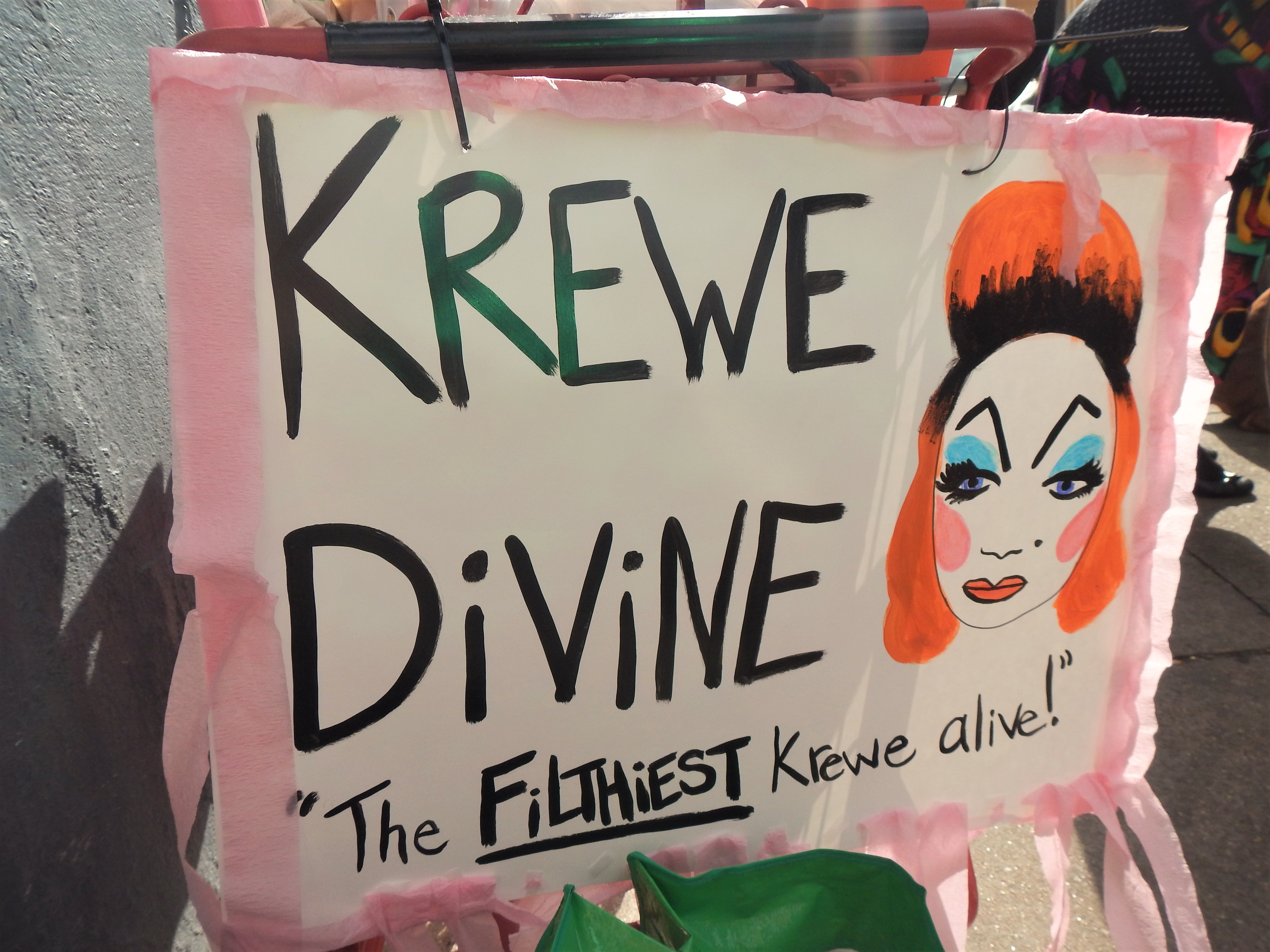
Mere hours after debuting our Divine-inspired, Swampflix-sponsored Mardi Gras krewe this past Fat Tuesday, CC & I found ourselves riding in the back seat of an SUV, exhausted, and headed toward Disney World. An immersive, three day adventure to the Happiest Place on Earth is always going to be a disorienting vacation no matter what mental state you’re in. Yet, there was something especially absurd about diving head first into such a wholesome fantasy space after running rampant through the French Quarter all morning, dressed as famous drag queen and frequent John Waters collaborator Divine in the alcohol-enhanced sunshine. 

At first, I wasn’t sure exactly what I wanted to accomplish while at Disney World besides checking off a few boxes as a film buff. That part was easy. A visit to a Walt Disney memorabilia museum titled One Man’s Dream, a similar Star Wars exhibit, a charmingly outdated 3-D Muppets screening, and a regularly-running “short film festival” of interactive Disney & Pixar selections all satisfied my apparent addiction to sitting in the dark, watching moving images. What was a much more difficult itch to scratch was maintaining our focus on our previously most recent task of keeping Divine’s legacy alive. You’d think that finding anything related to Divine or John Waters at large would be an impossible feat in such an aggressively clean environment, but Divine’s presence can be found in all things. And in Disney World, it can be found in Ursula.

The sea witch Ursula, of course, is the main villain in Disney’s modern animated classic The Little Mermaid. Although the construction of her persona can be attributed to many different influences, including both Elaine Stritch & Joan Collins, Ursula’s physical form was directly modeled after Divine (the top, non-octopus half was, anyway). The Little Mermaid‘s animators scrapped an initial idea to adorn Ursula with a hairstyle similar to the one Divine rocks in Pink Flamingos for being “too over the top,” but they did notably maintain her signature eye makeup & unmistakable body type for Ursula’s final form. The characters’ resemblance isn’t exactly uncanny, but it is blatant.

Ursula’s gigantic presence in The Little Mermaid, both physical & narrative, is a difficult effect to replicate in a kids’ amusement park, not least of all because the park would likely want to avoid scaring the shit out of children. It makes sense, then, that human actors would only be asked to portray Ariel from the film for the park’s rigidly scheduled photo ops & daily Festival of Fantasy parade. That doesn’t mean Ursula (and, by extension, Divine) has been locked out of the park entirely, though. She’s lurking around with her slithering eel accomplices (mostly in the form of large animatronic puppets) if you know where to look for her. Hopefully our search for Divine inspiration within Disney World parks will help expedite others’ in the future, in case anyone finds themselves visiting Orlando while as thirsty for Divine content as we were.


We started with the most obvious place you’d think to find Ursula lurking in the Walt Disney World parks: Magic Kingdom. There is exactly one The Little Mermaid-themed ride in Disney World’s oldest & most iconic park: Under the Sea – Journey of the Little Mermaid. Outside the ride you can wait in line to meet & take pictures with a professional Ariel cosplayer in her “grotto.” In line for the actual ride, Scuttle, the hoarder seagull, tries his best to simplify & recount the film’s plot in a digestible morsel to temper your boredom & distract you from heat exhaustion. Once inside, you’re strapped into a slow-moving clamshell vehicle that glides peacefully by two animatronic Ariels. One sings, “Part of Your World” and the other dances along to the ride’s centerpiece: a colorful, puppet-filled rendition of “Under the Sea” that’s doused with the widest variety of day-glo paint you’re ever likely to see in a single room.

None of that underwater glitz & glamor is our concern here, though. We’re looking for Divine. Ursula arrives in the ride just after the second Ariel in the “Under the Sea” number, isolated all by herself in a dark cove. She is a beautiful, oversized mechanical puppet I can only picture in my memory as cackling maniacally, even though in reality she sings a song. The purple sea witch is a breath of fresh, menacing air in a literal sea of smiling faces. Soak it in, because it will not last for long. After a glorious moment of hearing Ursula belt out the chorus of her show-stopping number “Poor Unfortunate Souls” in front of her giant crystal ball, she fades from the rest of the ride (or at least her inhuman, Divine-inspired form does), never to be heard from again. It was an all-too-brief Ursula encounter, but it fortunately wouldn’t be our last.

The next stop for Ursula content was a little less obvious and just happened to be something we stumbled into. As a park, Disney’s Hollywood Studios (formerly Disney-MGM Studios) is a little less cartoon-heavy than Magic Kingdom. This will be especially true once its current in-progress overhaul bulks up its Star Wars & MCU-themed attractions (for obviou$ rea$on$). The park is intensely focused on live theater, though, with attractions like The Tower of Terror & whatever the monstrously obnoxious Aerosmith rollercoaster is called existing as total outliers in an environment typically dedicated to more traditionally dramatic modes of entertainment. We were already having enough fun in the park being traumatized by the uncanny valley nightmare of the Robert Osbourne-hosted The Great Movie Ride (R.I.P.) and the distinctly Norman Bates theatricality of our server at the 50’s Prime Time Café, but there’s no good time that can’t be improved by a little Divine. Thankfully, the Divine lurking in Hollywood Studios was a large one. Freakishly large, even.

Located in the park’s Animated Courtyard area, the routinely performed indoor show Voyage of the Little Mermaid is very similar in content to the Journey of the Little Mermaid ride at Magic Kingdom (as if you couldn’t tell by their titles). Fish sing “Under the Sea;” Ariel sings “Part of Your World;” Ursula sings “Poor Unfortunate Souls” and then promptly disappears before the happily ever afters. It’s the same tidy retelling of the animated film with one major exception: the puppets. Whereas the Journey of the Little Mermaid ride is all 100% animatronic puppetry, the Voyage of the Little Mermaid is more of a mixed media affair. The fish puppets are all hand-operated by performers working in the stage’s shadows, Ariel & her boy toy Eric are portrayed by live human actors (as is the more degrading role of Eric’s dog), and the whole show is substantially beefed up by projections from the original animated film, laser light displays, and a waterfall curtain that smells authentically like seawater (whether or not the effect is intentional). It’s a totally pleasant, refreshingly cool way to spend 17 minutes of your life in the park, but what’s most impressive is the way the mini-play brings Ursula to life.

While Ariel & her fishy friends are given a new form of representation in Voyage of the Little Mermaid to distinguish them from Journey of the Little Mermaid, Ursula remains animatronic puppet. She’s so much more impressive in the show than she is in the ride, though, as her size is blown up to 12 feet high & 10 feet wide. I already fell in love with the mechanical puppet from the Little Mermaid ride (which is the more strikingly beautiful one in terms of basic visual craft), but it’s just absolutely dwarfed by the intimidatingly gigantic puppet from the show. It’s the kind of scale & magnificence that almost makes you want to fall to your knees in worship. In other words, it’s absolutely Divine.
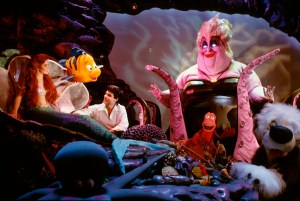
That giant puppet would be the last Divine presence we located at Disney World, but, honestly, her magnificent size would’ve been difficult to top by any other display. Maybe there was an Ursula lurking somewhere in one of the three parks we didn’t have a chance to visit (Animal Kingdom, Typhoon Lagoon, Blizzard Beach), but that seems highly unlikely. The only other places to search for our Divine inspiration, then, would be the park’s other other main attraction besides rides & shows: merchandise.

Disney villains from decades-old cartoons aren’t going to move nearly as much merch as the likes of an Elsa or an Olaf or an, um, Other Thing from Frozen. That doesn’t mean there’s no Ursula merch to be found in the parks, though. You just sometimes have to accept her as a package deal with other characters. For instance, outside the Finding Nemo ride at Epcot (which dumps you into a surprisingly decent aquarium), there’s an underwater-themed gift shop that sells a collection of Little Mermaid “squeeze toy” figurines. Ursula’s included, but you have to buy the whole collection to get her. Similarly, I found (and, of course, purchased) a purple baseball cap that features several of Disney’s more infamous female villains like Maleficent, the Evil Queen from Snow White, and, duh, Ursula. According to a brief search of the term “The Little Mermaid” on Disney World’s creepily helpful Disney Go app, there were some really nice Ursula “couture de force” figurines, art prints, and blouses for sale, but we never laid eyes on them (and they would’ve been far outside our price range anyway).

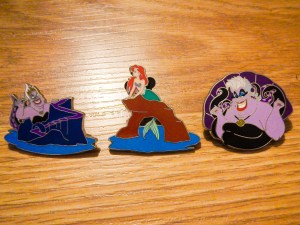
If you really want to take home Ursula’s visage isolated on some affordable merchandise, your only viable option is to find her on an enamel pin. We happened to purchase some Ursula pins at a kiosk located outside Space Mountain, but Disney has a surprisingly strong, park-wide enamel pin culture. You could probably find the damn things in any shop you poke your head into, as a lot of the stores seem to carry overlapping merch. (The same also goes with the squeeze toy figurines we found outside the Finding Nemo ride.) There’s also a lot of annual turnover on the merch that’s sold within the parks, so not only is it possible that we missed out on some sweet Ursula gear when we happened to be there, but you can also likely find excessed deadstock of old Ursula merch at the various Disney outlet malls sprinkled throughout Orlando.
We really have no clue where Krewe Divine’s headed in the future in terms of scale or membership. It’s only a matter of time until one of us dresses as Ursula on Fat Tuesday, though, so it really was a treat to cap off our first year as a microscopic Mardi Gras krewe by treating Walt Disney World like an unofficial Divine scavenger hunt. As the release of The Little Mermaid is already nearly three decades behind us, it’s likely that Ursula’s Divine presence within the amusement park is on borrowed time. As is, she’s seemingly only represented in the form of two (beautiful) animatronic puppets and a few enamel pins already. Even that’s enough representation worth celebrating, though. I was overjoyed to see her there in any form. In a way it’s a kind of a miracle that there was ever any John Waters-adjacent content to be found at Disney World at all. It’s even more of a miracle that it happened to be Divine.
-Brandon Ledet


Cold Steel (1987)

EPSON MFP image

three star

It’s tempting to think of 1995’s Jade as the bargain bin version of William Friedkin’s masterfully sleazy 80s cop thriller To Live and Die in L.A., but maybe the director wasn’t at all imitating past success with that admittedly dire misfire. By the time Friedkin made Jade, the 80s sleaze market he helped shape with his Wang Chung-scored cop thriller masterpiece had formed into its own solid genre, ranging wildly in both content & quality. The Sharon Stone/Adam Ant cop thriller Cold Steel, delivered by the one-time director Dorothy Ann Puzo, is just as sleazy & cheaply made as Jade and could easily be accused of the same claims of To Live and Die in L.A. counterfeiting (heh, heh), but because it doesn’t feature a filmmaker retreading old ground it gets by as a straightforward genre entry. Cold Steel is undeniably of its time in every possibly way. Its clash of 80s pop ballad cheese with extreme stomach-churning violence is only unremarkable because there was so much other tacky, tonally incongruous violence being produced at the time of its release. Considered in isolation and divorced from its peers & influences, Cold Steel is a fairly entertaining picture (which is more than can be said in Jade’s defense, unfortunately).

Released the same year as Lethal Weapon, Cold Steel attempts to navigate the same balance of light humor and intense violence as that much more enduring work, but can’t manage to match the intelligence of Shane Black’s game-changing screenplay. In this scenario, our down on his luck, perpetually drunk cop mixes pills & booze to show his gritty side, but bangs an automated coffee machine with commands like, “C’mon! Squirt!” only to receive a coffee facial to show that he’s also, in effect, a lighthearted clown. This sloppy cut-up finds himself entangled in a never-ending loop of revenge when a vicious gang (including Adam Ant as a smooth-talking goon) murders his father on Christmas Day for a perceived past wrong. The leader of the gang responsible, known only as the Iceman, is a hard drug-shooting creep with a mechanical voice box that allows him to speak through the wound in his throat. It’s at first unclear if this thieving, murderous crew has any clear motive in their violent robberies or if they’re just generic gangster baddies, but as our boozed-out hero chases them down through a series of explosion-heavy car chases, industrial setting confrontations, and heartless double crossings, a much clearer picture starts to unfold. Somewhere in all this chaos he finds the time to woo a young Sharon Stone through the erotic exoticism of eating sushi and that’s how sleazy 80s cop movies are made.

Cold Steel and Jade are both derivative and narratively unambitious in their post-To Live and Die in L.A. genre sleaze, but Cold Steel is entertaining enough to prove that wasn’t Jade’s only problem. Some of its entertainment is pure novelty, especially in its casting of Adam Ant, Sharon Stone, and (in a brief scene) minor scream queen Heidi Kozak. What really struck me, though, was how shocking the film’s violence felt despite the familiarity of its generic narrative. Stuntmen on fire, vicious stabs to the neck, grotesquely detailed drug abuse (another nod to Friedkin?), and overeager sexual leering all give the film a slimy sheen of 80s sleaze that never quite reach the heights of films like To Live and Die in L.A. or Cruising, but are still affecting in their own right. I’ll even admit that a few of Cold Steel’s stray stabs at humor got a laugh out of me. I guffawed especially hard when the hero cop responds to the warning, “He’ll kill you both!” with a casual, “Yeah, I’m planning on not letting that happen.” Movies like Jade prove that following genre convention and searching for easy thrills doesn’t automatically equal entertainment value success, but Cold Steel somehow survives by playing by the rules and getting dirty in the details. It won’t blow your mind, but you could do much worse if this is the type of action picture you’re looking for and you’ve already seen To Live and Die in L.A. one too many times.

-Brandon Ledet

Transformers (2007)

onehalfstar

Two cataclysmic events in my life have lead me to this desperate hour, where I’m considering watching the entirety of the live action Transformers franchise for the very first time. First, I found myself intrigued by the convoluted mythology and grave, self-obsessed tone of the trailer for the upcoming fifth entry, The Last Knight, which is being reported as the final directorial contribution to the series from explosion fetishist Michael Bay. Secondly, I recently fell in love with Bay’s 1998 disaster pic Armageddon as the beautifully constructed, spiritually corrupt Conservative fantasy piece that it truly is. These freaky, reality-shattering occurrences have lead me astray, tempted me into a den of sin. I knew it was wrong to watch Transformers, a transgression I’ve avoided for an entire decade until now, but I did so anyway. I was rightly punished for crossing that line.

Transformers
matches Armageddon‘s massive runtime and occasionally approaches its attention to heightened visual craft, but it is in no way in the same league as that morally deficient masterwork. At one point a single-scene character shouts, I kid you not, “This is a hundred times better than Armageddon, I swear to God!” They are the worst of liars. The reason that one-liner is worth mentioning is that Transformers is in many ways not an action fantasy piece, but instead the absolute worst designation any film can achieve: a failed comedy. After kicking things off with a little jingoistic Army worship, the film gleefully launches into its true bread & butter: a torrent of shitty, often offensively unfunny “jokes.” Bernie Mac plays a sleazy car salesman who repeatedly yells “Mammy!” in the broadest delivery possible. Characters are made fun of merely for speaking Spanish or Hindi as their first language. Half of the bloated runtime is dedicated to the hilarious idea that the film’s protagonist is interested in fucking Megan Fox, a pursuit the leering camera very apparently identifies with. Once the titular transforming robots show up, they join right in with both the racial caricature and the Megan Fox Is A Total Babe lines of humor. They even add a little scatilogical flavor to the painfully unfunny comedy by pissing on one of the antagonistic G-men who slow down the plot. I’d like to claim that the jokes in Transformers would only appeal to ten year old boys who don’t know any better, but the film pulled in $700 million at the box office, so I guess the joke is ultimately on me for not laughing along.

As someone who regularly enjoys and promotes the sillier, campier end of genre cinema, it goes against everything I believe to say this, but I think Transformers would have been a much better film if it actually took its own ridiculous premise seriously. As a film built around a series of Hasboro toys (shape-shifting robots from a war-ridden planet that hide among us as common automobiles), the film is already wildly goofy enough in its basic DNA that there’s no need to lighten the material with constant, insensitive bro humor. By turning every single narrative beat in the first two hours of the film into a stale joke (Heh, heh. I like it when the black robot says, “This looks like a cool place to kick it.” Heh, heh.) and opting to center its story on the human characters who encounter the robots instead of the titular alien beings everyone paid a ticket to see in the first place, it’s as if Transformers is constantly apologizing for its own existence. Assuming the audience couldn’t possibly want to actually watch the talking robots film advertised on its poster, Transformers dedicates about two thirds of its runtime to watching Shia LaBeouf feebly try to charm the (short) pants off Megan Fox. LaBeouf is convincing as a high school con man here (just as he’s convincing as an adult con man drifter in American Honey), but for some reason we’re asked to identify with his sleazy, insincere ways and laugh at his slimy, immature humor. Megan Fox is . . . less convincing as a small town high school student, but it’s not really her fault that she was cast merely to look supermodel beautiful so Michael Bay could drool at her consistently exposed midriff. Did I mention that she’s hot and a gear head? It doesn’t matter, because she’s not a talking robot alien, which is what most people paid to see.

Full disclosure: I did attempt to watch this Transformers franchise-starter when it was first released about a decade ago, but I couldn’t make it all the way through. The first 50min of the film bored me to tears and when the robots started talking I just found it too goofy and had to abandon ship. I now see how wrong I was. The first hour of Transformers is indeed still a boring humor vacuum, but the talking robots honestly aren’t all that bad. A straightforward sci-fi action film about two Cybertronic races (the Autobots and the Deceptions) fighting for possession of an intergalactic MacGuffin known simply as The Cube and debating in grave, heavy-handed speeches about whether humanity is worth saving (“Humans don’t deserve to live,” “They deserve to choose for themselves!”) doesn’t exactly sound like anything new or unique. In fact, after the Marvel takeover that’s unfolded in the years since this film’s release, it sounds like par for the course for the modern, bloated blockbuster. However, when Transformers leaves LaBeouf & Fox’s “hilarious” nonstarter romance behind for its concluding half hour of nonstop robot battles, it starts to feel like a passable slice of Hollywood entertainment. Careless destruction of property & faceless casualties pile up while Bay matches his robo explosions with a soaring, almost religious orchestral score. I’ve heard the robots’ ever-shifting, impossible transformations in these films described as a form of Cubist art before, which is a little lofty of a critical claim, but actually starts to make sense once the battle gets out of hand. Then, when it’s all over, LaBeouf & Fox make out on the hood of a robot car (which, it’s with noting, is a sentient being), reminding the audience that the film wasn’t always entertaining. In fact, most of it focused on these two dweebs for no discernible reason.

I’d be a liar if I said I didn’t enjoy any of Transformers before that concluding robo-battle. The film’s 80s-obsessed music cues were often pretty funny, especially in comparison to the jokes in the dialogue. The actress who played Shia LaBeouf’s mother, Julie White, was a total charmer in her all-too-brief performance, especially when she joins in in oggling Megan Fox’s hot bod. I even got a laugh out of two (!) Shia LaBeouf one-liners: one where he describes the Autobots as “robots, but like super advanced robots,” and another where he answers his parents’ question, “Why are you so dirty and sweaty?” with “I’m a child.” My biggest laugh in the film, though, was when a cop abruptly tells LaBeouf to shut up, since it’s exactly what I had been thinking for at least the first hour of the runtime. If all the humans of Transformers had just shut up and let the robots do the talking/battling, the film might have actually been entertaining, or at least less painfully embarrassing (it’s especially difficult not to feel bad for Jon Tuturo & Tyrese Gibson here). It’s in the climactic battle when Michael Bay really lets loose. Hundreds of human lives are squashed within minutes without a stray, momentary thought given to their loss. A steering wheel comes to life and eats a Stuck Up Rich Brat’s face. Everything explodes and is ground to dust in a lovingly shot cacophony. It’s too bad that the two hours preceding that cathartic release is embarrassed of its own nature as a Transformers film and buries its talking robots under an insurmountable mountain of ill-considered “comedy.” I can’t believe I’m saying this, but I hope future entries in the franchise take their robo-alien folklore a lot more seriously.

-Brandon Ledet

Roger Ebert Film School, Lesson 23: Hellfighters (1968)

EPSON MFP image

Roger Ebert Film School is a recurring feature in which Brandon attempts to watch & review all 200+ movies referenced in the print & film versions of Roger Ebert’s (auto)biography Life Itself.

Where Hellfighters (1968) is referenced in Life Itself: On page 153 of the first edition hardback, Ebert gloats about how great being a professional critic was in his glory days. He writes, “It was a honey of a job to have at that age. I had no office hours; it was understood that I would see the movies and meet the deadlines. I loved getting up from my desk and announcing, ‘I’m going to the movies.’ A lot of my writing was done at night and on the weekends. I saw about half of the movies in theaters with paying audiences, sinking into the gloom to watch John Wayne fighting flaming oil wells in Hellfighters at the Roosevelt, or Pam Grier inventing blaxploitation at the Chicago.”

What Ebert had to say in his review: “Out in front of the Roosevelt Theater there’s a big photo of John Wayne and this quote, attributed to him: ‘I’ve made a lot of action pictures but never one as exciting as this.’ I doubt that Wayne volunteered this information; it sounds more like a studio publicity idea. The fact is, Wayne has made a lot of action pictures, and over the years he has gotten to be about as good at it as anybody. He must have been miserable during the filming of Hellfighters, which is a slow moving, talkative, badly plotted bore.” – from his 1968 review for The Chicago Sun-Times

EPSON MFP image

When praising the young, energetic talent that reignited American art cinema in the late 60s’ so called New Hollywood movement, it’s all too easy to overlook the undeniable virtues of the system those films were bucking against. The John Wayne action epic Hellfighters is a perfect snapshot of Big Studio glut when compared to its more forward-thinking contemporaries like Bonnie & Clyde and The Graduate. While these smaller New Hollywood upstarts were pulling influence from still-exciting sources like the French New Wave, the lumbering, old-fashioned Hellfighters more closely resembles instantly outdated modes of entertainment like Earthquake, Airport, and The Towering Inferno. Ebert was right to praise those smaller, more experimental works in his reviews while labeling Hellfighters “a slow moving, talkative, badly plotted bore.” I can’t disagree with a word of that. The dirty secret, though, is that although formally & thematically outdated in the face of smaller, more passionate films being made around them, Old Hollywood ghosts like Hellfighters effortlessly pulled off mesmerizing visual spectacles that were never truly touched by the likes of a Bogdanovich or a Friedkin or a De Palma. Even if its superiority was simply a question of budget, there’s an immense beauty to the costume designs, sets, framing, and rich colors of Hellfighters that could’ve been transcendent if were applied passionately instead of with workmanlike competence.

As with all John Wayne movies, whether or not they’re set in the dusty West, Hellfighters is often classified as a Western. This makes even less sense here than it does with the London-set cop drama Brannigan, since Wayne’s tuxedo’d firefighter lead doesn’t even carry a gun. Loosely based off the real world personality Red Adair, Wayne plays infamous oil field firefighter Chance Buckman (man, I love that stupid name) as he travels across the globe putting out dangerous oil well fires with barrels full of dynamite. Real manly stuff. Based on that description, you might think that the art film version of Hellfighters might be Sorcerer or its predecessor Wages of Fear, but it actually more closely resembles a film from the late 90s. Much like Bruce Willis’s tough guy hero in Armageddon, Chance Buckman is an oil industry legend who bullheadedly infantilizes his adult daughter by attempting to protect her from a twofold danger: the physical danger of his industry & the emotional danger of the womanizing men who work within it. It’s not at all difficult to imagine Michael Bay growing up fond of Hellfighters, thanks to its hyper-masculine self-delusion & over-indulgence in practical effects explosions. The John Wayne film often mirrors Armageddon‘s bullshit romanticization of the hard working men who risk their lives for oil & the worried women who love them, despite the constant danger of loss. Where Armageddon employs this ludicrous narrative & attention to visual craft for a punishingly kinetic live action fantasy, however, Hellfighters is content to lie still & talk its audience to death. It’s an entire movie built around the idea that large spouts of fire look cool. It’s not exactly wrong, just too long to justify that thin of a premise and too lethargic to fully command its audience’s attention, even as beautifully decorated it’s production design can be. If Hellfighters could’ve operated with Michael Bay’s punishing sense of immediacy it might’ve been an all-time classic. At the very least, it could’ve shot John Wayne into space to fist fight an asteroid the size of Texas. There’s pretty much no one who wouldn’t pay to see that.

A large part of what makes Hellfighters feel desperately old-fashioned is its constant glorification of traditionalist masculinity. So many bare knuckle punches are thrown without any real consequence in bar rooms, brothels, gambling holes, and hospitals that they start to register more like a handshake between bros than an act of violence. News reporters are whiny little wimps who can only get in the way while Real Men do the Important Work, the kind that requires muscles & explosives. The women of Hellfighters are wives, daughters, and secretaries, completely extraneous to the plot outside a fresh-from-The Graduate Katherine Ross, whose virtue & emotional well-being Chance Buckman is tasked to protect. The closest the movie comes to passing the Bechdel Test is a single scene where Buckman’s wife & daughter are golfing alone together, but their entire conversation centers on whether or not it’s worth the worry to love an oil field firefighter. Buckman himself is a stoic emotional void, only budging in his rock solid confidence to express annoyed frustration & mild worry with the women in his life who needlessly complicate his profession. Otherwise he just does what he does best: exploding fires into oblivion & unconvincingly delivering oil-themed one-liners like “If you’re coming to me for advice, I’m a dry hole” with a distinct lack of passion.

In the years since the New Hollywood takeover, directors have learned (and have been better funded) to apply Hellfighters‘s workman sense of extravagant spectacle to the energetic narratives that deserve it. Instead of overtalking its virtues between this piece, my initial review, and a subsequent podcast episode, I do believe Michael Bay’s Armageddon is a perfect example o how well that visual craft could be utilized with just a little creative gusto, even while holding onto its idolization of toxic masculinity. Hellfighters was an overlabored, undercooked movie industry dinosaur when compared to the more exciting, artier New Hollywood films that upended its place in the world, but that doesn’t mean it’s a film without value. When gazing into the rich color, impeccable costuming, gorgeous sets, and mesmerizing explosions that Hellfighters wastes on a going-through-the-motions John Wayne action epic, there’s an undeniable sense of missed opportunity. The film could’ve been something truly memorable if its better aspects weren’t helmed by a sleepwalking studio system that misread what its audience was interested in seeing. I can’t recommend Hellfighters as an entertaining work to anyone other than the most diligent John Wayne completist imaginable. However, I do think it works as a valuable reminder that there was a lot of untold merit in the bloated studio system that the late 60s broke apart with its scruffy batch of babyface auteurs.

EPSON MFP image

Roger’s Rating (1.5/4, 38%)

onehalfstar

Brandon’s Rating (2.5/5, 50%)

twohalfstar

Next Lesson: Camelot (1967)

-Brandon Ledet

Viva (2007)

EPSON MFP image

threehalfstar

One of the more intimidating aspects of discussing Anna Biller’s instant cult classic The Love Witch was coming to terms with the fact that most of its reference points as a pastiche were way beyond my grasp, even as someone who regularly watches schlock. The Love Witch mined old modes of horror-themed erotica, pictures like The Velvet Vampire, for its distinct visual palette & absurdist humor, but repurposed the genre for modernized modes of feminist discourse. I loved the results of that experiment, but have to openly admit that my very basic, surface-level knowledge of the genre & era The Love Witch was evoking was puny in comparison to Biller’s encyclopedic command of the subject. It turns out her debut film, Viva, would be even further outside my grasp as a genre film tourist. Paying homage to the softcore smut of the early 1970s that rode in on the success of Deep Throat and the optimistic promises of The Sexual Revolution (the kinds of films you’d hear detailed on the excellent podcast The Rialto Report), Viva is operating on a whole other level of schlock I have little to no experience with. My limited knowledge of smut peddlers like Russ Meyer & Doris Wishman don’t equip me with the full vocabulary necessary to discuss the ways Viva acts as a love letter to softcore smut past. The film feels very authoritative on the subject, though, and it achieves such a specific image & tone that I have to again put my trust in the fact that Biller knows exactly what she’s doing.

Viva often looks & feels like an early 70s magazine layout. Its bored housewives, swinger couples, and nudist camp vouyerism all read like a Letter to Penthouse, but its iconography is the stuff of that magazine’s advertisement: Scotch, lingerie, deviled eggs, jellos & dips. Emboldened by a newfound sexual freedom afforded to them by the commercial availability of the birth control pill, the Liberated women of Viva take charge of their sex lives by leaving behind the incessant sexual pressures of husbands, neighbors, and bosses to become high class sex workers & “models.” One friend turns to prostitution as a convenient means of making money and finds immediate fulfillment in a wealthy, older men who showers her with gifts: diamonds, horses, fur coats, etc. The other woman, Viva, has a much narrower path to satisfaction. Instead of money, she seeks a genuine emotional connection with a kind, sensitive man. No matter how many supposedly sensitive artist-types her pimp set her up with, though, the results are always the same. Men throw pouty fits whenever Viva doesn’t give them exactly what they want (casual sex) upfront and instead of waiting to meet her on her own terms, they manipulate, drug, and physically force her into copulation. It’s a fucked up plot for a campy genre throwback, but finding feminist themes in these old modes of schlocky smut seems to be Biller’s forte and the basic story structure of Viva feels true to roughies like Lorna, Another Day Another Man, and, I have to presume, the “mainstream” smut that followed in the 1970s.

If Viva has a central problem, it’s that it’s a little too faithful to the films it pays tribute to. At 120 minutes, with multiple extensive musical numbers, the film can often feel as tedious as its source material for once the initial turn-on wore off. It’s also disappointing that its modern feminist criticism wasn’t as fully pronounced in the dialogue & plotting as it was in its more outrageous follow-up. Biller threatens to steer away from genre traditions with some queer plotlines & rape culture criticism that bubble up naturally in Viva‘s era-evoking plot machinations, but imstead decides to follow the old guard and allow the story to play out exactly as it would have four decades ago. However, even though it feels slightly less brave in its willingness to shake up & modernize the formula, Viva is still an impressive feat for a debut feature. Much like with The Love Witch, Biller exudes auteurist control in nearly every aspect of the filmmaking craft – not only writing, directing, editing, and handling the set & costume design herself, but in this case also starring in the titular role. There are some thematic aspects of Viva I wish Biller had pushed a little further (and a few scenes I wish were shaved down to expedite the pace), but there’s an endlessly enjoyable aesthetic in her staging of the film’s lingerie lounging, Scotch swilling, porn-browsing swinger-era softcore smut I can’t help but take delight in. Just the way characters punctuate each of their own lame jokes with unwarranted, maniacal laughter feels both so true to the era & so clearly aligned with what Biller wants to accomplish in her modernization. It’s incredible she was able to figure out her own concrete sense of style as soon as her first feature.

It’s exciting to know that Biller’s best work is likely still ahead of her, but her aesthetic’s beginnings in Viva are worthwhile enough on their own merit that it doesn’t matter that she wasn’t yet fully formed as a filmmaker at the time she made it. If nothing else, the film expresses an incredible knowledge & affection for the past of America’s mainstream erotica. It also helps that Viva can be riotously amusing in stray absurdist moments, never playing like a dry, academic exercise in genre pastiche.

-Brandon Ledet

Another Day Another Man (1966)

EPSON MFP image

three star

campstamp

Something I learned from my career retrospective of sleaze auteurist Russ Meyer is that as far as sexploitation subgenres go, I’m much more wired to enjoy the light-hearted kitsch of nudie cuties than the violent leering of roughies. Two films into Doris Wishman’s catalog, I’m only having my bias reaffirmed. The deliriously inane Nude on the Moon was a perfect intro to the world of Wishman, as it was a sexed-up version of the exact kind of cheap sci-fi dreck I often find myself watching anyway. Her black & white roughie Another Day Another Man was a little more outside of my comfort zone. Arriving soon after her roughies era started with Bad Girls Go to Hell, one of her more infamous works, Wishman’s black & white cheapie Another Day Another Man toys with all the hallmarks of the more disreputable end of sexploitation cinema (domestic abuse, misogyny, rape), but never indulges in them long enough to totally sour the mood. Too much of Another Day Another Man is lopsided in a memorably goofy, tangibly dingy way to completely dismiss the film as misanthropic erotica, but it does often come perilously close.

Two female roommates argue about the moral implications of earning rent money through sex work. One is, unapologetically, a prostitute with a brutish lowlife for a pimp. The other is quitting her reputable job as a secretary to pursue her dream career: housewife. Her newfound dependency on her husband becomes immediately troubling when he’s stricken with sudden illness and the housewife is, no surprise, pressured into sex work under the guiding hand of the same low level pimp. She’s initially shamed for flaunting her sense of moral superiority over former roommate’s head, but that’s only the start of her degradation. She’s roughed up for de-masking her first client, a wealthy politician. She suffers great anxiety over sneaking out nightly to cuckold her husband for “easy” money. Her pimp’s tactics of breaking down his employees’ wills and pressuring them into sex work is given great detail (over the course of a clunky dream sequence, oddly), making her plight as a protagonist out to be nothing special. It’s all very standard roughie territory, which leads to inevitable & predictable tragic end, a plot you could comfortably scribble onto a crumpled up cocktail napkin.

What Wishman excels at that makes this exercise watchable is texture. The camera work & production design in Another Day Another Man isn’t exactly masterful; I’m not even sure I would call it competent. There’s something endearingly dirty & off-center about the whole thing, though, that makes for a memorable picture. The movie gets off to a rocky start with a badly dubbed stroll through Central Park between our soon-to-be-doomed newlyweds, but it picks up as soon as the roomates argue about the respectability of the respective ways they earn a living. Drastically lit like a crime scene, the two women’s magazine spread living room is a kitschy nightmare where the roomates argue, undress, and overstuff ashtrays in furious torrents of chain-smoking. The camera slowly pans up from their high heels to their complicated, lacy underwear to their beehives, careful never to show actual nudity, but coming as hilariously close as it can without going there. Weirdly sultry, off-center rock music is a constant, oppressive presence as the film gets lost in minor, unerotic details like shoes & ashtrays and, in its weirder moments, buries its lens, unfocused, in its characters’ cleavage for multiple consecutive shots. It’s a strangely dizzying, convincingly seedy experience even if it refuses to deliver the goods in terms of actual nudity.

As similar as Doris Wishman’s career trajectory seems to be to Russ Meyer’s in terms of following sexploitation trends from nudie cuties to roughies to auteur weirdness to late-period pornography, it’s funny to see the way their visual calling cards differ. Meyer’s work is typified by a rapid-fire, machine-like montage style that smashes images of women’s bodies against inanimate objects like cars & street signs and somehow makes the juxtaposition oddly erotic through the sheer pervy will of its leering filmmaker’s eye. Wishman’s style, if Another Day Another Man is any indication, is a languid, decidedly unerotic version of the same technique. She cuts away from women undressing to focus on a cigarette butt or a clown painting or a bra discarded on the carpet in an amusingly dispassionate way that puts the audience libido on ice. The technique is a lot sillier & less controlled than Meyer’s, but it makes for some interesting camp cinema auteurism. Unfortunately, the rape-oriented seediness of the roughie genre kept me from falling in love with Another Day Another Man and, oddly enough, the film’s story loses a crucial amount of steam after its protagonist starts hooking that makes the film somewhat of a chore. Wishman’s amateurish, but strangely off-center eye kept its dingy visual palette fascinatingly unerotic despite all odds, though, and I’m curious to see how that dynamic is echoed in the rest of her sexploitation work.

-Brandon Ledet

Roger Ebert Film School, Lesson 22: The Graduate (1967)

EPSON MFP image

Roger Ebert Film School is a recurring feature in which Brandon attempts to watch & review all 200+ movies referenced in the print & film versions of Roger Ebert’s (auto)biography Life Itself.

Where The Graduate (1967) is referenced in Life Itself: On page 153 of the first edition hardback, Ebert gushes about the wealth of great cinema that he was lucky to cover at the beginning of his career as a critic. He writes, “The big events of that period were movies like Bonnie and Clyde, The Graduate, and 2001: A Space Odyssey. The French New Wave had reached America. TIME magazine put ‘The Film Generation’ on its cover. A few months later they did a piece about me in their Press section, headlined ‘Populist at the Movies.’ Pauline Kael had started at the New Yorker, and movie critics were hot. It was a honey of a job to have at that age.”

What Ebert had to say in his review(s): “Nichols stays on top of his material. He never pauses to make sure we’re getting the point. He never explains for the slow-witted. He never apologizes. His only flaw, I believe, is the introduction of limp, wordy Simon and Garfunkel songs and arty camera work to suggest the passage of time between major scenes. Otherwise, The Graduate is a success and Benjamin’s acute honesty and embarrassment are so accurately drawn that we hardly know whether to laugh or to look inside ourselves.” – from his 1967 review for The Chicago Sun-Times

“The Graduate, released in 1967, contains no flower children, no hippies, no dope, no rock music, no political manifestos and no danger. It is a movie about a tiresome bore and his well-meaning parents. The only character in the movie who is alive–who can see through situations, understand motives, and dare to seek her own happiness–is Mrs. Robinson. Seen today, The Graduate is a movie about a young man of limited interest, who gets a chance to sleep with the ranking babe in his neighborhood, and throws it away in order to marry her dorky daughter. […] When the movie was first released, I wrote of the ‘instantly forgettable’ songs by Simon and Garfunkel. History has proven me wrong. They are not forgettable. But what are they telling us? The liberating power of rock and roll is shut out of the soundtrack (‘The Sound of Music’ plays on Muzak at one crucial point). The S&G songs are melodic, sophisticated, safe. They even accommodate the action, halting their lyrics and providing guitar chords to underline key moments. This is Benjamin’s music; Mrs. Robinson, alone with her vodka, would twist the radio dial looking for the Beatles or Chuck Berry.” – from his 1997 review at the time of the film’s 30th Anniversary

EPSON MFP image

The reputation of the New Hollywood staple The Graduate has changed drastically over the years as our culture has evolved slightly in its gender politics, while the film has obviously remained static as its own. I assumed when reading Ebert’s inclusion of the title among the most exciting films of his early career as a critic that this might be the first lesson in this series where we’d have drastically different takes on a film’s merits (as opposed to my minor quibbles with his emphatic takes on stuff like Apocalypse Now and Abbot & Costello Meet Frankenstein). Indeed, Ebert’s 1967 review of The Graduate is the exact glowing, enthusiastic celebration of the film’s minor rebellions I expected. It’s a reading that experiences the film’s central conflict through the eyes of its protagonist, Benjamin (a fresh-faced Dustin Hoffman). On my most recent rewatch of The Graduate I didn’t sympathize with Benjamin at all, but rather with his infamous seductress Mrs. Robinson (the smokily poised Anne Bancroft), a character the film often tosses aside & vilifies despite her having the moral high ground. Ebert, in his admirable life-long pursuit of humility & empathy, had of course reached this conclusion decades before I did, when he revisited this landmark work for its restoration in 1997. In his second review he kicks himself for not recognizing how much of a heartless ass Benjamin had been to the tragic Mrs. Robinson. It’s a revelation that might only come with age & maturity, both for the individual viewer and for the audience as a culture.

The Graduate opens by heavily leaning into Benjamin’s personal crisis of early 20s ennui. Freshly finished with his college degree & unsure of how best to utilize his overabundance of idle time, Benjamin is turned off by every opportunity offered by his parents & their colleagues. When viewed as a young audience, this refusal to play along can feel like an existential dedication to anti-establishment principles, a sort of small scale protest through deliberate inaction. As an adult, watching Benjamin float around a pool & pound cheap beer looks like a lazy, bratty waste of unearned privilege. In the midst of this directionless drift, Benjamin is seduced unapologetically by the much older wife of his dad’s business partner, Mrs. Robinson. Bored, ignored, and underappreciated, Mrs. Robinson is similarly idle in her untapped potential, but it’s a life imposed on her rather than a deliberate choice. She sleeps with Benjamin, whom she watched grow up, over a summer-long affair in an attempt to shake the cobwebs, enacting agency in her own search for pleasure in a way she’s often not allowed. The film’s central conflict, besides Ben’s annoyed desire to be treated like an adult instead of a sex toy, arrises when his parents & her husband pressure the directionless bum to date Mrs. Robinson’s daughter (the beautiful, big-eyed Katherine Ross). When Mrs. Robinson forbids him to sleep with her daughter, Ben is offended that she doesn’t think he’s good enough for her progeny, only serviceable as an older woman’s plaything. His brattiness spirals out from there, causing the two former lovers to inflict vicious harm upon one another as often as they can, ending with Ben stealing his mistress’s daughter away from the altar at a marriage much less . . . complicated in its central dynamics.

If there’s any room for me to disagree with Ebert’s ultimate assessment of The Graduate, which has widely become the critical consensus, it’s in the intent of that final scene, the disrupted wedding. In his 1997 reassessment, Ebert was confused that he had ever celebrated the film’s conclusion, writing “As Benjamin and Elaine escaped in that bus at the end of The Graduate, I cheered, the first time I saw the movie. What was I thinking of? What did the scene celebrate? ‘Doing your own thing,’ I suppose.” My only question about that confusion is whether or not director Mike Nichols ever intended for that scene to be played as celebratory in the first place. As soon as the excitement of escaping the wedding settles & the new fugitive couple settle in the back of the bus to the oft-repeated soundtrack of Simon & Garfunkel’s “Sound of Silence,” The Graduate loops back to the young brat ennui that opens its narrative. The characters are stone-faced, visibly scared about what they’re going to do with themselves. This is exactly why Mrs. Robinson has a point about Ben’s unworthiness to court her daughter (despite the obvious gross-out factor of having slept with her first). It’s possible to argue that, as the adult, she was wrong for pressuring a young man into sleeping with her despite his initial unease. However, she does say to Ben, “If you won’t sleep with me this time, you could call me whenever you want.” Mrs. Robinson vulnerably offers her body to Benjamin for a shared pleasure, a proposition he eventually accepts of his own free will. After a prolonged affair, she learns how directionless & selfishly cruel the overgrown child truly is, which means she’s a pretty great judge of whether or not he’s prepared to be a good suitor for her only child (not that their own shared sex life isn’t enough to shut that down outright). The worst thing Mrs. Robinson does to prevent that doomed coupling is claiming that Benjamin had raped her, which is a lie fittingly portrayed like a cruel betrayal. I’m not convinced, however, that it’s any more cruel than Ben describing the affair with Mrs. Robinson to her face as “the sickest, most perverse thing that’s ever happened” to him. I’m also not convinced that the movie wasn’t aware of that cruelty on both sides, despite it taking most audiences a few decades to catch up to the full implications of its thematic minefield.

The Graduate is far from the masterpiece of auteurist anti-establishment storytelling it was initially misunderstood to be, but it’s still a well-made, memorable film. Its Simon & Garfunkel-soundtracked ennui commands an intentionally minor look & tone that suggests maybe a life played by the rules isn’t the most ideal path for personal fulfillment. When you’re young it’s tempting to seek that lesson in Benjamin’s directionless, impulsive narrative, but if you can learn to empathize with Mrs. Robinson’s tragically unfulfilled character instead, the film is a whole lot more satisfying. I like to think that aspect of The Graduate was its initial intent, but it’s easy to see why Ebert & so many others would disagree, especially since as a collective audience misread the film’s central romantic dynamic so boneheadedly wrong for such a long time.

EPSON MFP image

Roger’s Rating: (3/4, 75%)

three star

Brandon’s Rating (3.5/5, 70%)

threehalfstar

Next Lesson: Hellfighters (1968)

-Brandon Ledet