Point Break (2015) Wasn’t All That Bad . . . As Long As You’ve Never Seen Point Break (1991)

EPSON MFP image

Okay, it’s shameful confession time. I saw the Point Break remake, released just a few weeks before this past Christmas, before I saw Kathryn Bigelow’s 1991 original. It was always a given that I’d see the original Point Break eventually, but twas a task I had been putting off despite the enthusiastic recommendations of friends (& Nick Frost’s bumbling cop in Hot Fuzz) who rank it among their favorite films of all time. A free movie ticket & a convenient showtime, then, lead me to the curious position of having seen the little-loved remake of Point Break weeks before I saw the original (also on the big screen, thanks to Indywood). The shameful part is that I actually enjoyed the remake. As a dumb action movie packed with bad writing, overwrought performances, and over-the-top stunts, it’s  nothing particularly special, but it’s also nothing especially awful either. It’s pretty okay & might’ve even flown under the radar as a half decent genre pic . . . if it hadn’t purported itself to be a remake of Point Break (1991) in the first place. Point Break (1991) & Point Break (2015) are so far apart in terms of style, intent, content, plot, and central philosophy that there’s no reason the 2015 version should’ve bothered calling itself Point Break in the first place. With a couple minor tweaks & a title change it might’ve even been able to sidestep accusations of being a ripoff. The two films are worlds away from one another.

Kathryn Bigelow’s Point Break is a laugh-a-minute action vehicle for Keanu Reeves & Patrick Swayze (not to mention wildcard Gary Busey in unhinged Under Siege mode). The script is overloaded with jokes & the mood is surprisingly light considering that its two most tense action set pieces – a police raid & a bank robbery – are some of the most brutally severe I’ve ever seen. The Point Break remake, on the other hand, is easily recognizable as the post-Dark Knight kind of re-imagining that believes a grim, self-serious mood is what the people want in their over-the-top action cinema. It’s a thoroughly dour affair, especially for a film about bank robbing surfers. Just about the only thing that transferred from the original to the remake were the surfing & the homoeroticism (between an undercover FBI agent & the lead criminal).

What the remake does instead of retracing Bigelow’s steps is focusing on & amplifying particular details of the original & turning those isolated aspects into a feature film. The criminals in the original Point Break are really into surfing, but occasionally dabble in a parachute jump or some beachside football. That’s not X-treme enough for the remake, which makes a point to include every Red Bull-fueled sport you can think of: snowboarding, base jumping, kayaking, whatever. The bigger difference is in the two film’s philosophy, however. The surfer bros in the original may occasionally muse about “the spiritual side of the sea” or how surfing is “a state of mind”, but at heart they’re just thrill seekers & thieves for whom bank robbing is both an adrenaline spike and a source of income. The remake, on the other hand, posits its “extreme poly-athletes” (ugh) as “eco warriors” (double ugh) who steal from “the system” in order to “give back” to a “dying” planet in some 21st Century version of Robin Hood justice. Their thrill seekers as well, but their main concern is achieving nirvana through cutthroat vigilantism . . . and X-treme sports.

Both Point Break films are, admittedly, quite silly. The difference is that you laugh with the original & laugh at the remake. Kathryn Bigelow’s film is loaded with enough snarky one-liners to give any Joss Whedon script a run for its money and, surprisingly enough, they all land. The 2015 version is funny in a different way. Lines like “A tree falls in the forest & no one puts it on YouTube. Did it ever really happen?” & “So, you live off the grid?” “No, we live on it. Just on our own terms,” are downright hilarious, just perhaps not intentionally so. The action sequences in the 1991 Point Break achieve a kind of shocking gravity bucks the film’s humor in an interesting way. The 2015 Point Break‘s action sequences often play directly into the film’s (unintentional) humor. For instance, my first laugh was when a dude bro fell of a cliff while dirt-biking in a bid to earn sponsorships & YouTube hits. I know that’s pretty harsh of me, bro, but the film never truly earns the right to be taken seriously, so I don’t feel too bad about it.

All things told, the 2015 Point Break is a lot more akin to an X-treme sports version of The Edukators than it is to Kathryn Bigelow’s film. If it hadn’t been pitched as a remake it might have never been greenlit or it might’ve been underfunded, but it also would’ve stood a better chance as a critical success. Watching a bunch of bank-robbing anarchists try to achieve nirvana by skateboarding off a yacht to shitty EDM is pretty damn amusing, but it’s nothing in comparison to what any ten minute stretch of the original achieves. If you have any chance of enjoying Point Break (2015) as is, it’d be in seeing it before you check out its far superior source material. Either that, or pretending it has a different title & functioned as a blatant ripoff. As a standalone product, it’s an occasionally fun trifle of mindless action cinema. As a point of comparison, the outlook is much less flattering.

-Brandon Ledet


The Revenant (2015)

bear

threehalfstar

Alejandro González Iñárritu’s latest is a difficult film to pin down in terms of quality. The Revenant is at times an intense spectacle of intricately detailed action choreography, but it’s also a meandering slowburner of a film that constantly reminds you that you’re watching Important Art. Its cinematography (provided by master of the form Emmanuel Lubezki) is gut-wrenchingly beautiful, but is often employed for such an empty purpose that it leaves you feeling cold. It aims for High Art severity in its narrative consequence, but the grotesque savagery of its rape & pillage masculinity feels like a well-constructed exploitation pic from a bygone era. I’m tempted to group it in with other arty, all-dressed-up-with-nowhere-to-go slowburners that were impressive but impossible to connect with (for me, anyway) like Only God Forgives & The Tree of Life, but I enjoyed too much of the film to dismiss it that easily. What is clear is that Iñárritu should at the very least be commended for not following up the critical success of Birdman (a film I was less than kind to) with a carbon copy of his most high profile film to date. I appreciate him sticking his neck out there, even if the results were the ultimate mixed bag of soaring successes & cringe-worthy missteps.

Part of what makes The Revenant so frustrating is its daunting 156 min runtime. The film’s opening battles between white men fur trappers & tribes of Native Americans and Leo DiCaprio’s protagonist & a pissed-off mama bear are breathtakingly savage, epically orchestrated orgies of visually striking violence. At the other end of the film, a  concluding knife fight between DiCaprio’s beaten-to-shit protagonist & Tom Hardy’s selfish brute who wronged him ranks up there with Friedkin’s The Hunted as one of the best hand-to-hand combat scenes ever committed to film. The long stretch between those heart-racing anchors, however, are painfully in need of some shrewd editing. It’s tempting to think of The Revenant as a revenge film floating somewhere between a Western & an exploitation, but a majority of the film is a travelogue. DiCaprio, Hardy, two opposing bands of American & French Fur trappers (one headed by Domnhall Gleeson, who’s been batting a thousand lately), and a revenge-hungry native tribe all slowly trudge toward an inevitable climactic bloodshed (while still recovering from the one that opened the film) in an unnecessarily-detailed step-by-step procession. At times the film itself feels like DiCaprio’s broken protagonist, crawling & gurgling blood for days on end under the weight of an over-achieving runtime.   Shave a good 40 minutes of The Revenant by tightening a few scenes & losing a shot here or there (as precious as Lubezki makes each image) & you might have a masterful man vs. nature (both human & otherwise) revenge pic. As is, there’s an overbearing sense of self-importance that sours the whole ordeal.

For the most part, though, the self-importance on display in The Revenant isn’t nearly as off-putting as it can be in Birdman. For instance, Lubezki’s camerawork is just as showy here as it was in Iñárritu’s Oscar Winner, but it ditches the single-extended-shot gimmick of that film in favor of a more tasteful line of highfalutin action cinematography. There are some gorgeous transitions from intense close-ups to long tracking shots in impossibly smooth single-swoops, but these shots are broken up in a way that Birdman‘s unrelenting gimmick of a structure allow for. Plot wise, The Revenant echoes the loud & obnoxious majority vs. the righteous intelligence of the few in the know that turned me off so sharply in Birdman (with Hardy anchoring the obnoxious brute end of that equation & DiCaprio serving as the righteous), but it’s not quite as much of a turn-off here. At worst, the preciousness & empty philosophy of lines like “As long as you can still breathe, you fight”, “Remember what mother used to say about the wind?”, and endless mutterings of “You are my son, you are my son,” (similar to the way Sean Penn whispers “Mother” into the void for hours in Tree of Life) are worth a hearty eyeroll or two. At best, they’re a nice break from watching DiCaprio gurgle & crawl his way through the snow. The dialogue in Birdman was much more off-putting.

Like I said, there’s too much of The Revenant that resonated with me to dismiss it outright. I’m more than willing to forgive an overwrought image or two (there’s a particularly egregious moment when a white bird emerges from a bullet wound, for instance) in exchange for the film’s more successful flashes of brilliance (like the bear & knife fights). For all of The Revenant‘s try-hard stabs at achieving High Art through hyper-masculine brutality, there’s a hell of a lot of praise-worthy ambition & striking imagery that’s well worth the patience required to make it through the perilous journey of its over-inflated runtime. Shorten some its travel time through montage & soften the cheese factor of its philosophical mumblings & I might even have heralded it as a masterpiece of brutish revenge cinema.

-Brandon Ledet

Brannigan (1975)

EPSON MFP image

fourstar

When you bring up John Wayne, it’s inevitable that his name will conjure images of old-fashioned Westerns. He’s synonymous with the genre, an in-the-flesh embodiment of cowboy cinema. That’s why I was surprised when I sat down at a Christmas party with my grandfather to watch one of his favorite John Wayne pictures to find that it wasn’t a Western at all. It’s not even set in America, let alone the Old West. Brannigan is a fish-out-of-water action comedy about a hard-boiled Chicago detective brandishing pistols in a stuffy, crime-ridden 1970s London. Of course, John Wayne plays the titular police detective with the same worlds-away-from-Chicago cowboy swagger he’s most closely associated with, but the setting is still jarring. In some ways, though, it makes you appreciate Wayne’s screen presence even  more to watching him operate outside of his element.

Besides casting a Western cinema legend in a non-Western role, Brannigan hosts several other glaring self-contradictions. Tonally, its mix of severed-finger, bullethole-ridden, sexual assault-threatening violence pairs ridiculously with its sarcastic, seen-it-all-before humor. This contrast can be best observed in an over-the-top pub brawl when Brannigan punches a goon so hard that he slides across the entire length of a bartop in a surprise tangent into Looney Tunes physics. Genre-wise, the film can’t decide if it wants to be a suspenseful heist film or an outright comedy. It can’t even decide which storyline is its main concern: the plot that has Brannigan chasing after a notorious crime boss being held for ransom or the plot that has Brannigan being chased himself by an assassin prone to using bomb & shotgun booby traps like an especially vicious Kevin McCallister. Or are both of these stories merely a backdrop for a blood-soaked comedy about Old World stuffiness vs. New World cavalier?

My favorite aspect of Brannigan‘s self-contradicting nature is where it sits on exploitation cinema’s temporal landscape. Although it’s a major studio film, it feels like it’s caught somewhere between the welcome-to-the-real-world harshness of New Hollywood, the righteously funky world of blaxploitaion (except with a white man as the lead, of course), and the as-yet-created humorously violent world of 80s action cinema. John Wayne establishes himself here as an early action star. His super-sarcastic, know-it-all one-liners play like a precursor to characters that would later be played by folks like Arnold Schwarzenegger & Sly Stallone. Brannigan doesn’t just burst into a room; he bursts into a room & dryly intones “Knock, knock” while brandishing a pistol. Then there’s the fact that every criminal in the world apparently knows legendary supercop Jim Brannigan by name, even though he works for Chicago’s municipal police department. That detail would be later repeated in every Commando, Cobra, and Hard to Kill to follow. He’s even provided a cute, tiny, foreign sidekick, another staple of the 80s action genre, although this time she’s never threatened to become a love interest despite all of Brannigan’s incessant leering. She does, however, spontaneously reward him with a kiss on the cheek over a dinner for two. Why? She explains, “You’re just so damn solid.” Indeed.

John Wayne badassery aside, Brannigan is a well put together action flick. Its lush shots of drive-bys, gun holsters, and sexy workers showing leg – all the leg – are all surprisingly intricate enough for a film that didn’t have to try too hard to succeed. John Wayne is entertaining enough on his own to carry the film, but a lot of effort still goes into detailing the organized crime end of London’s underbelly. Pubs, saunas, brothels, and late night stakeouts provide a nicely detailed background for Wayne to perform against and the car chases & counterfeit money production play like a precursor to Friedkin’s masterful To Live & Die in L.A.. Even without Wayne, Brannigan would still be a decent, humorous action flick with a great villain & hero, and a satisfying (albeit slow-moving) plot. Wayne’s hard-drinking, gun-toting supercop who calls everyone within earshot “Partner” is 1000% more cowboy than he is Chicago detective, but his performance is still what makes the movie special instead of merely decent. I’m far from a Western fanatic, so this oddly humorous & wildly violent action pic ended up being my favorite performance I’ve ever seen from Wayne. It’s easy to see why my grandfather holds it in such high regard despite it being far outside headlining star’s wheelhouse & being generally regarded as trash.

-Brandon Ledet

The Hateful Eight (2015)

EPSON MFP image

fourstar

One of the first things that will always come to mind with Quentin Tarantino’s latest film, The Hateful Eight, is the William Castle-esque pageantry of its release. Framed as an Old Hollywood-style Road Show, the film was released one week earlier than its digital-version wide release date as a 70mm film print (a strip twice as large as was standard when film prints were standard) complete with an overture, intermission, and a full-color playbill. The Hateful Eight Road Show was a three hour long experience. Purchasing tickets more than a week ahead of time I got the distinct feeling of when you’re anticipating a band you love coming to town instead of a film. To tell the truth, though, the Road Show wasn’t as flashy or as exciting as you would expect, not even as over-the-top as the Grindhouse gimmick attached to Tarantino’s Death Proof release. The overture & intermission were blank spaces accompanied by music. The “extra footage” was, presumably, a collection of extended exterior & detail shots that helped establish mood. Watching the movie unfold on projected film was a nice touch for an homage to old-fashioned Westerns, but it’s a detail that could be forgotten once you’re immersed in its story. The best part of the Road Show was not how it punched the film up & made it more exciting, but how it slowed the proceeding down & let it breathe.

At one point in The Hateful Eight, Samuel L. Jackson’s balding, ex-military bounty hunter says, “Not so fast. Let’s slow it down. Let’s slow it way down.” That seems to be the film’s M.O. in general. Tarantino is, of course, known to luxuriate in his own dialogue, but there is something particularly bare bones & talkative about The Hateful Eight. It’d say it’s his most patient & relaxed work yet, one that uses the Western format as a springboard for relying on limited locations & old-fashioned storytelling to propel the plot toward a blood-soaked finale. Depicting a (jokingly) self-described Bounty Hunter’s Picnic, the film follows the transport of a dangerous criminal (played by an especially feral Jennifer Jason Leigh) in the company of eight potentially dangerous men who are all snowed-in in in a small Wyoming cabin during a blizzard. Among them are Kurt Russell’s weathered bounty hunter, desperate to see her hang; Sam Jackson’s similarly-minded bounty hunter with his own payday to protect; Bruce Dern’s cantankerous Southern Rebel general who refuses to let go of the Civil War; Tim Roth’s “jolly good” rapscallion of a Brit; and the list goes on. As the plot unfolds it becomes apparent that one or more of the strange men are determined to set the prisoner free by leaving behind a trail of dead, which makes for a Western version of a mystery film like Clue or John Carpenter’s The Thing. Tarantino’s no stranger to genre mashups or liberal borrowing, but there’s a relaxed, unrushed pacing that started to emerge in his films sometime around Inglourious Basterds that’s getting its full due in The Hateful Eight.

Watching Tarantino’s films with the general public is always a little nerve-racking for me. The mashup of comedy & violence in his work builds a lot of nervous tension that leads to much-needed laughs, but I find a lot of audiences will laugh at disturbing moments designed to leave you more in abject horror instead of knee-slapping amusement. The Hateful Eight provides a wealth of opportunities for this discomfort. The audience around me laughed during shots of Jennifer Jason Leigh being beaten half to death by the men in charge of her transport. I found that more horrifying than amusing (despite her playing a cruel, heartless character herself), but Leigh’s immediate response to of spitting, shooting snot rockets, and licking up blood with a smirk were all very funny to me in a Jerri Blank kind of way and fell onto a silent room. Similarly, the copious amount of utterances of the word “nigger” in a post-Civil War America setting & an extended fireside tale of a rape & murder left me chilled to the rest of the room’s bizarre reactions. At least we could all agree on the excellent physical comedy gag of a door that wouldn’t stay latched? Tarantino knows exactly what he’s doing with this tension, something he plays up with decisions like ending the rape tale with a silent intermission or having characters puke blood in a grotesque practical effects display that alternates from funny to horrifying to funny to you get the picture.

So many details complicate the background & history of The Hateful Eight that it’s difficult to separate them from the film proper. The film’s screenplay was leaked online prior to production, so an infuriated Tarantino cancelled the film outright, then doubled back & staged a table reading before deciding to actually begin filming due to an overwhelmingly positive response. I mention this backstory because it bleeds into the film not only in its dialogue-heavy vibe, but also in the way Tarantino himself acts as a narrator, reading stage directions aloud during the film. The Thing vibes are inescapable in its snowed-in, no-one-can-be-trusted plot structure, but are also backed up & complicated by unused segments of Ennico Morricone’s score for John Carpenter’s The Thing. Then there’s the experience of the Road Show & the 70mm print, two features I cannot separate from the movie as a finished product. I also found myself thinking of its “Spend the holidays with someone you hate” tagline in the trailers, especially in Michael Madsen’s cowboy’s interrupted plans to spend Christmas with his mother & in a particularly uncomfortable rendition of “Silent Night”. It’s difficult to know when you’re enjoying The Hateful Eight or when you’re enjoying the experience & the lore of watching The Hateful Eight. It’s a confusingly engaging film in that way.

There are a few things that are remarkably clear about The Hateful Eight to me right now, though. It is an incredibly violent, misanthropic, lushly-photographed tale of a collection of vile ruffians murdering each other in such a flippant, nonchalant way that it leaves you with both nervous laughter and total disgust. In that way it’s classic Tarantino, so mileage may vary depending on how you already feel about his work. In this case, though, the pacing is slowed way down to allow the violence & the nervousness to soak in even deeper than before, leaving you with a particularly nasty, hateful feeling at the end credits.

-Brandon Ledet

The Hunger Games: Mockingjay – Parts I & II (2014, 2015)

EPSON MFP image

fourstar

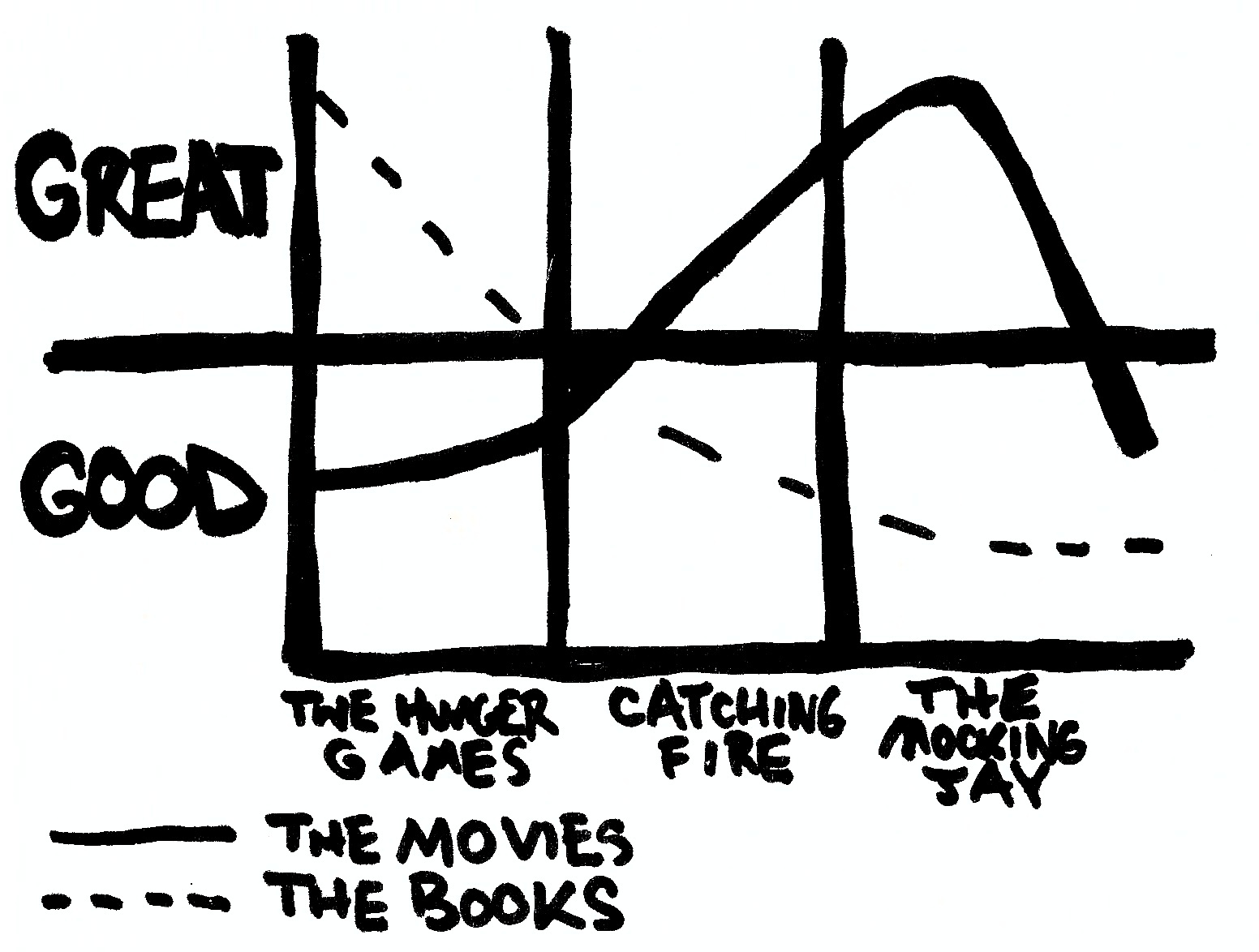
I’ve enjoyed following the Hunger Games saga, both as a series of YA novels & and as a series of dystopian sci-fi film. It’s a pretty grim franchise for something a lot of people consider “kids’ stuff”, one that takes its forcing-to-children-to-fight-to-the-death-for-entertainment premise very seriously. Its haves-vs-have-nots dystopian world-building is nothing particularly new and can especially be seen telegraphed in properties like Battle Royale & The Running Man, but I think it’s a pretty great sci-fi intro for teens, especially refreshing for its strong female protagonist Katniss Everdeen (played by Jennifer Lawrence in the films, duh) & in the way its potentially-corrosive love triangle conflict is handled. One strange aspect for me has been how the film versions of the Hunger Games trilogy have resisted the law of diminishing returns. I felt that Suzanne Collins’ novels started at their strongest point, doing a great job of establishing an in-the-moment intensity in its abysmal future-world by dragging the audience along closely with Katniss’ experience navigating the Hunger Games. The quality dropped off a bit for me in the sequels, though, as the pacing seemed to get away from Collins and large swaths of summarizing overtook the focused intimacy of early scenes. The first movie was pretty great as well, doing a good job of capturing Katniss’ in-the-moment POV, but the film series subsequently seemed to improve from there, knowing exactly what to show & what to ignore in Collins’ sprawling narrative for maximum effect.

EPSON MFP image

Mockingjay – Part I might just be the pinnacle of the Hunger Games movies for me. General consensus has the franchise peaking with the second film, Catching Fire, but I’d say it’s at the very least a close call. the film’s themes of PTSD, regret, powerlessness, and the pressures of being the face of a revolution all hit me pretty hard. I’ve heard friends & family describe the film as boring, saying nothing happened, which is pretty surprising for a film with such a high bodycount & grandscale warfare, but I had a genuinely emotional reaction to its horrors, getting teary-eyed at the film’s hospital bombings, mass graves, and three-fingered solutes. Its murderers’ row of talented actors certainly didn’t hurt: Philip Seymour Hoffman, Julianne Moore, Jeffrey Wright, Natalie Dormer, and Donald Sutehrland are all at the top of their game here, which is really saying something. I also appreciated scenes of Jennifer Lawrence, who is an incredibly gifted actor, pretending to be an incredibly inept actor as Katniss fails miserably to produce convincing propaganda clips to rally support for a revolution. Mockingjay – Part I‘s riots, uprisings, strikes, and rescue missions were all a lot more satisfying to me than expected & Lawrence deserves a lot of credit for anchoring the film’s emotional resonance.

Mockingjay – Part II unfortunately didn’t hold up quite as well for me. I think the issue is that Collins’ summarizing had gotten out of control by the final book, so that the film version struggles to make individual scenes count for much as it chases an exponential momentum of a plot trying to wrap up a widespread political revolution, a small family’s struggle to remain a unit, and a strained, increasingly bitter love triangle in just two hours time. There were a few small moments to enjoy in the chaos — my favorite was when Katniss is called out for the “tacky romance drama” & cliché  “the one” specialness of her mythology at a wedding — but for the most part the films struggles to let its Big Moments properly breathe. Mocking Jay – Part II‘s killer C.H.U.D.s & third act Major Character Death both failed to land with full impact thanks to the runaway momentum of Collins’ plot & pacing. And because director Francis Lawrence did such a great job with Catching Fire & Mockingjay – Part I, I’m willing to give him the benefit of the doubt & suppose that the rushed nature of Mockingjay – Part II was far from his fault. Considering all of the ground that the novel covers (I’m struggling not to go long here just touching on it), Francis Lawrence  could’ve stretched Mockingjay into its own separate trilogy & given each underserved scene its own proper moment to shine.

I can’t imagine impatient fans, who groused about splitting the finale into two parts in the first place, would’ve been receptive to a Mockingjay – Part III,  though. If you consider that Francis Lawrence had no choice but to split the finale into two parts, I think he did a great job of adapting a difficult work of fiction for the screen. Mockingjay – Part I carries the emotional weight the film series as earned over the last few years & Mockingjay – Part II does the necessary work of bringing the whole thing to a close. The two halves function well together as a single, four-hour feature. One picks up exactly where the other leaves off & together they do a satisfactory job of carrying a work that’s spread pretty thin to a convincing conclusion. Although I’d contend that Part I is the far superior picture, they average out to something pretty great in the end, which fairly unusual for the third film in a sci-fi trilogy.

Bonus points: I’d like to take this opportunity to give kudos to the Hunger Games series for being the only action franchise I can think of where fashion as an artform plays a deeply integral part to the films’ central themes. I particularly liked a moment in Mockingjay where Katniss is told she’ll be “the best dressed rebel in history” & it’s a sentiment that actually means something significant. It’s a cool, distinguishing detail, if nothing else.

– Brandon Ledet

Creed (2015)

EPSON MFP image

fourstar

Creed is more of a sequel than a proper reboot, but writer-director Ryan Coogler is more than forgiven for not wanting to title his film Rocky VII: Creed. Following the lead of 2006’s succinctly titled Balboa, Creed keeps it simple in more than ways than just its name. It’s very much a by-the-numbers boxing movie, hitting every familiar beat you’d expect from the genre. After Southpaw‘s helpful example earlier this year of just how poorly that formula can be put to use, though, it’s downright miraculous just how effective Creed manages to be while never coloring outside the lines. As far as Stallone franchises go, I’m typically a much bigger Rambo fan (can’t help myself), but who doesn’t love a good underdog story? The pugilist protagonist (played by an all-grown-up The Wire vet Michael B. Jordan) of Creed‘s narrative may go through the motions of successes & failures the audience sees coming from miles away, but the movie is visceral enough in its brutal in-the-ring action & tender enough in its out-the-ring romance & familial strife that only the most jaded of audiences are likely to get through its runtime without once pumping a fist or shedding a tear before the end credits.

The illegitimate son of Apollo Creed, a father he never met & a boxing legend within the Rocky universe, Adonis Creed is more a child of the foster & juvenile correctional system than he is of the former Carl Weathers character. With that chip weighing heavily on his shoulder, Adonis attempts to walk the tightrope of earning a name for himself as a self-taught boxer while avoiding living his life in Apollo’s massive shadow. It’s hard to tell exactly how serious he is about ducking association with his father, though, since he adopts an elderly Rocky Balboa as his reluctant trainer & makeshift family. Balboa & Creed’s shared history is assimilated into the story expertly, made to feel real by adopting the format of high-end ESPN & HBO sports documentaries & talking heads forums. While Adonis is trying to balance his own career with his father’s legacy, he also struggles to stay connected with a mother figure who doesn’t want him to fight & falls hopelessly in love with a downstairs neighbor (played by an all-grown-up Veronica Mars vet Tessa Thompson) who records a less avant garde FKA twigs style of pop music in her bedroom in hopes of making a name for herself on her own terms.

There are Inspirational Training Montages galore in Creed, but only two proper bouts, a smart choice that not only allows the film’s familial & romantic bonds room to build, but also helps to establish Adonis as an in-over-his-head underdog. There are some fun, updating-the-franchise touches to the movie, such as a scene where a grandmotherly Sylvester Stallone perplexedly contemplates smart phones & “the cloud”, but the best thing Creed accomplishes is acknowledging the past while living firmly in the present. The two main bouts of the film are feats of pure cinematography & choreography, a brutally physical style of storytelling. There’s impressive imagery to be found elsewhere in the film’s smaller moments as well, such as a shot of Balboa & Adonis boxing duel punching bags in unison & a chilling scene where Adonis fights a projection of his dead father’s image. The sexual tension between Tessa Thompson & Michael B Jordon is also remarkably well played, both in the written dialogue & in the body language of the performances. The worst crime the film commits is occasionally functioning as a video form of Philadelphia tourism, an offense that’s more than excusable given that Balboa is now as much a part of the city’s DNA as cheesesteak & the Liberty Bell.

When Creed‘s production was first announced I’ll admit my initial reaction was a yawn & an eyeroll. Coogler’s film somehow completely turned me around on the idea of a non-Stallone-penned Rocky franchise living on in perpetuity, despite never truly deviating from the format. It’s a great example of how a strict genre film feel new & exciting when played with fully-committed earnestness. If Creed II ever makes it to a theater, I’m pretty much guaranteed to be there, which is  a sentiment I didn’t expect to leave the film with before the opening credits.

-Brandon Ledet

Movie of the Month: Class of 1999 (1989)

EPSON MFP image

Every month one of us makes the rest of the crew watch a movie they’ve never seen before & we discuss it afterwards. This month Boomer made Britnee, Brandon and Erin watch Class of 1999 (1989).

Boomer: Class of 1999 is a strange little movie. For readers who haven’t had the pleasure, the film is set in the titular year, less than a full decade after its release date. In this “distant” future, inter-gang violence has become so overwhelming that the areas around high schools have become dystopian free fire zones, but these violent, Mad Maxian teenagers still submit to going to campus every day for some reason. The movie’s protagonist, Cody Culp (Bradley Gregg), is a former gangmember paroled and returned to school. Unbeknownst to the student body, the principal (Malcolm McDowell) has agreed to allow an obviously mad roboticist (Stacy Keach) to install three former military androids (Patrick Kilpatrick, John P. Ryan, and goddess on this earth Pam Grier), “reprogrammed” as educators, as new instructors. Culp tries to stay out of trouble, but his narrative arc is complicated by his romance with the principal’s daughter (Tracy Lind). The androids decide that the best way to create a stable educational environment is to rid the school of violence by creating a war between the two rival gangs, even drawing in Culp due to the false flag death of his brother (Joshua John Miller, who was also the annoying kid brother in Teen Witch). As you would expect, this culminates in the two gangs putting aside their differences to defeat the Terminator. I mean the teachers.

I love this movie. It’s a perfect encapsulation of worst case, slippery slope thinking with regards to teen violence, a misplaced jeremiad warning of dark days to come–won’t someone please, please think of the children? Bradley Gregg, star of many of my adolescent fantasies (and one of the dream warriors from Nightmare on Elm Street 3), parades around in an outfit that manages to be both utterly ridiculous and strangely sexy, featuring skin-tight leather pants emblazoned with the word “war” over and over again and a form-fitting tee under an oversized babydoll jacket. He has nothing on Keach, of course, who struts around in this film with a platinum ponytail and matching (painful looking) contact lenses, while still somehow managing to play this ludicrous role as straight as possible. Throw in the other stars in the cast, like Grier and McDowell, and it’s a surprise that this Terminator ripoff made barely half of its relatively low budget back in ticket sales.

The Keach/Culp dichotomy of seriousness and campiness is one of my favorite things about Class. On the one hand, the film features ridiculous gang warfare with oversized vehicles in one scene, followed by dark domestic trouble in the form of Angel and Cody’s mother’s truly frightening drug addiction in the next (before she completely disappears from the film). Somehow, this intermix works for me, although I can admit it probably shouldn’t. What do you think, Britnee? Is this tonal inconsistency a drawback, or a feature?

Britnee: I think the mix of the film’s outlandish features and serious moments made Class the unique and unforgettable film that it is. If anything, the serious moments of the film, such as the mother and son drug brawl, amplified the film’s campiness, and that’s always a good thing. When serious, dramatic situations are placed in such a ridiculous setting (post-apocalyptic 1999), they bring out this sick and twisted type of humor that makes us all think, “I really shouldn’t be laughing at this.” Being able to successfully pull off this type of humor and create such an uncomfortable mix of emotions is the greatest achievement that a film can accomplish. Unfortunately, Class did not have as many of those wonderful Lifetime movie-like moments as I hoped for, but I think that may be the only complaint I have about the film. It was that good.

Something that I just can’t stop thinking about from Class is the gang warfare between the Blackhearts and the Razorheads. The film’s street gangs are made out to seem like these awful groups of mixed-up teens who will never escape their miserable, violent lifestyle, but under their rough and tough exterior, they’re just a bunch of kids searching for a little bit of love and understanding. This really comes through when the Blackhearts and Razorheads stop killing each other and team up to fight the evil robotic teachers. The bad guys (Razorheads) join the not-as-bad guys (Blackhearts) and ultimately become the good guys. At this point, the gang lifestyle actually seems more acceptable and becomes a little appealing. I mean, if I was stuck in some crazy life-or-death situation where I was forced to join a gang, I would definitely let the Blackhearts jump me in. 80’s new wave couture, Nine Inch Nails dance parties with machine guns, and a gnarly black heart tattoo are enough to win me over.

Erin, what are your thoughts on the two opposing gangs joining forces to fight the evil robotic teachers? Was this one of the few heartwarming parts of the film? Or is it just another cheesy moment to add to the list?

Erin: I thoroughly enjoyed the Class of 1999 experience . . . but I’m not sure that I found the gangs joining forces to be terribly heartwarming.  I think that if they hadn’t been in an automatic-weapon fueled fire-fight, I might be with you.  Had they been engaged in an old fashioned fist-fight-style rumble, I think that I would be more sympathetic to their situation.  As it was, it seemed like the gang side of The Warriors and the terrorist robot side of The Terminator got together and forgot to bring a side helping of the humanity from The Outsiders (I’ll take 1980s movie title conventions for $500, Alex).

I think that Class of 1999 is trying to communicate a series of relationships to the viewers: the difference between the viewers and the post-apocalyptic kids,  the difference between the rival gangs, and the difference between all of the kids and the inhuman robots.  I think that the movie does a great job showing us the first relationship, but stumbles with the second two.  The gangland teens are pretty reprehensible, truly living up to the premise of the movie that youth gangs have turned American urban centers into warzones.  The movie makes a very clear break from reality with its set up and presentation of the its own world.

Cody is really the best glimmer of humanity out of the entire movie, in my opinion.  He’s the only example of a multi-dimensional character, with his dark side trying to survive in a gangland and his sweet side of falling in love with a certified Nice Girl.  We don’t get that multi-dimensionality from other members of the Blackhearts, much less from the punks in the Razorheads.  It’s really hard to root for any of them.  Perhaps Cody is supposed to stand out as the Last Sane Man?

In any case, it’s hard for me to see myself in the gang members as they make a stand against the Teachernators.  Yes, they’re scrappy kids coming together to take on psychotic military robots, but minutes earlier they were trying to kill each other with machine guns! On the other hand, the Roboteachers are out-of-their-minds inhuman, which is made evident early in the movie by their behaviors and later in the movie by their physical transformations into walking weapons.

What do you think, Brandon, does Class of 1999 struggle to humanize the human characters?  Is there a clear enough difference between the terrible actions taken by the gangs and the Teachbots?  Does the audience get an avatar to insert themselves into the movie, or are we just supposed to watch the carnage?

Brandon: Simply by the nature of what it’s trying to portray, I totally have to agree that all basic humanity has been stripped from this movie’s ultraviolent teens. Cartoonishly over-exaggerating adult fears about out of control young adult behavior, Class of 1999 poses a grim, larger than life portrait of teen rebellion that is far beyond anything you’d expect to see in any conceivable human being, young or not, even in a worst case scenario, ten years down the road cyberfuture. Yeah, teens can be perilously obsessive over getting their hands on drugs, beers, sex, and cool cars at times, but usually not in the way Class of 1999‘s teens mix those simple pleasures with guns, bombs, landmines, and missile launchers. The first half or so of the film plays like a particularly paranoid parent’s warped nightmare about what their teen is up to while they’re out with their bonehead friends. A great example of this is the warehouse concert scene. I’ve been to quite a few concerts in my time & while many may have involved industrial music dance parties, I can’t remember ever witnessing a gang beating in the moshpit, machine gun fire set off to the rhythm of the songs being played, or the venue being lit by carefully placed barrel fires. I’m sure that as my parents first let me out of the house to experience live music for the first time, however, their worst fears of what was going on weren’t too far off from that image.

The trick here is that Class of 1999 is smart to spoof both sides of the teen rebellion coin. Because teens are perceived as such violent, out of control animals, authority figures take an automatically adversarial position against them. Late in the film when Principal Malcom McDowell complains about his army of roboteachers, saying, “They’re waging war with my students!”, he’s met with the response, “Isn’t that what all teachers do?” If the film indeed has any specific sort of point it’s trying to make & we’re not supposed to just, as Erin suggests, sit back & “watch the carnage”, I think it’s to be found somewhere in that exchange. Even if real life teens are as bad as portrayed in this film (they’re not), they’re still far more sympathetic than the (robotic) adults that brutally murder them by snapping their necks or forcefeeding them glass vials of superdrugs. There’s an oppressive, prison-like atmosphere in the film’s educational system (complete with “RESPECT”, “OBEY”, “LEARN” commands that could’ve been directly lifted from John Carpenter’s They Live) that feels like a direct indictment of privatized, militarized schooling that treats kids like violent threats instead of young, eager minds. The cyberfuturism of Class of 1999‘s killer robot “tactical education units” may not be readily recognizable in today’s flesh-bound educational units (public school teachers), but they do feel like a blown-up, exaggerated version of the way we systematically tend to treat children as a threat & a nuisance.

Boomer, how much do you think Class of 1999 is a movie of its time? Do you think that there’s a bit of historical, late 80s gang violence context here that would drastically change if there were to be a Class of 2025 released in 2015? Or would the same basic adult fears of teen rebellion & a privatized, militaristic educational system be eligible for lampooning today (with CGI bloodsplatter unfortunately subbed for the practical effects gore, of course)?

Boomer: One of the great truths about western culture is that each generation that reaches the level of becoming “the establishment” seeks out and pontificates about the fatal flaws in the generation that follows. This is nothing new; adults of today are “concerned” about the isolating effects of handheld devices, just as my parents were “concerned” about the isolating effects of the Discman, or their forebears were concerned about the invention of this thing or that thing, going back to concerns that the invention of the phonograph would lead to fewer people being interested in learning to play instruments. There are a lot of sociological and anthropological reasons for this, but most of it boils down to the universal constant that we will only get older, coupled with the fear of obsolescence and fear-mongering about “the youth,” and treating them, as Brandon notes, as a threat or nuisance.

The other major factor in the genesis of 1999 is that the late eighties and early nineties saw a very visible rise in gang violence, something that couldn’t simply be dismissed, so the news media had to address it. However, the “establishment” couldn’t acknowledge that disenfranchised people turn to crime because of systemic problems related to class and privilege, especially not when people were basically walking down the street accidentally poking others with their raging pro-wealth Reaganomics hard-ons. As a result, the majority of Americans, ignorant of the real causes of gang violence and its apparent meteoric rise, had nothing to cling to but their filtered and incorrect understanding of social problems, reinforced by the cyclical nature of youth-blaming.

What’s so interesting to me is how 1999 manages to be both an indictment of that mindset and the apotheosis of it at the same time, and, although I may be giving it too much credit here, I think that this is intentional. The darkness that permeates Culp’s world represents all the things that the parents of 1989 feared about the future, a horribly violent place where those nasty (scary) teenagers with their loud music and their dirty fingernails rule over a scorched suburbia because no one took a stand against teenage skullduggery when there was a chance! But it also holds up a mirror to that absurd frame of mind, pointing out the flaws in that kind of fearful, conservative nightmare by showing how unrealistic and silly such a future would be. Also, there are killer robots, because who doesn’t love that? And, if your kids are running around doing drugs, they probably learned it from watching you, mom or dad!

So, the answer is “yes,” 1999 is a very much a product of its time and of the politico-cultural environment from which it sprung, and there would have to be significant updates to remake this movie, although I could see how it could be done in a couple of different ways, depending upon which of Joann and Cletus’s fears you wish to highlight and mock. Political correctness is often a good place for conservative muckrakers to stir up some passion: “In the future world of 2025, schools no longer teach facts, they teach feelings. They no longer teach science, they teach sensitivity. And they only teach the ‘corrected’ version of history.” And, like, instead of robot teachers, there’s an AI that seeks to “purge” students of their hopefulness or individuality or whatever by teaching them about all of American history, atrocity alongside progress, and by teaching them self-control and tolerance. Cody Culp would be a secret bigot who teaches his androgynous and sexless peers, long having been made soft of mind by those damn SJWs, to fight back against the machine of liberal indoctrination by being politically incorrect and proud, or whatever. To be honest, though, I don’t know that this would be recognized as a satirical interpretation of a conservative’s nightmare of the future; it would be more likely to be seen as a prescient vision of a world to come, ruled by the “libtard.” Or maybe I’m just on a tangent; who knows.

The real truth is this: the way education is enforced in the west is not the best method for schooling, and we all pretty much know that. The priorities are all skewed, and the eight-hour, rigidly-structured schoolday that has been the model for a long time isn’t based on the best pedagogical or psychoeducational practices but on the model of a workday; it forcibly instills in children a willingness to accept the drudgeries of pyramid capitalism, essentially, rather than encouraging critical thought, technical acumen, interest in knowledge for its own sake, or any kind of prioritization of variety in educational forms. You can see that small changes are taking place today, but for the worse; as an educator, I toured a new charter school just a year or two ago that was filled with classrooms that didn’t look like classrooms. They looked like call centers. So even if Class of 2025 were to be made in the way that I poorly pitched above, a Republican nightmare of social justice gone mad, it would still be nothing like the schools of the future, just as my school in 1999 was not a war zone of apocalyptic proportions.

Britnee: What do you think about a Class of 2025? Does your conception of what Class of 1999‘s thesis was differ from mine, and if so, how do you think your interpretation would be updated for a contemporary audience?

Britnee: When watching Class of 1999, I did realize that there was a connection to the large amount of youth gang violence occurring around the time the film was released, but I really didn’t think much of it. I saw the film as being loads of stupid fun without much depth, but your perspective really got me thinking about the whole “youth-blaming” and “conservative nightmare” aspects that the film definitely illustrates. Loud music, fast cars, leather jackets, heavy eyeliner, and funky haircuts were a conservative parent’s nightmare in the late 80s/early 90s, and the teens in 1999 are an explosion of this stereotypical degenerate youth. The whole film actually reminds me of a lost Billy Idol music video. It’s just so “Rebel Yell.” These types of teens were going to cause the world to become a post-apocalyptic cesspool of crime, violence, and pure filth. Unfortunately, the world did not become that exciting by 1999. There were many changes that occurred within those short 10 years, but at the same time, much remained the same.

Now, to think of what my interpretation of 1999 would be for a contemporary audience. 1999 did play on the fear of what the future would be like for the youth of that time, and now it seems as though one of the biggest fears for today’s youth is the lack of importance placed on quality education. A modern 1999, or as Boomer stated, 2025, would deal with the absence of general education and the emphasis on some sort of super strict social class-based structure. Children will be sorted into military, white-collar, or blue-collar positions at birth, like in the movie Antz when newborn ants are assigned to be workers and soldiers. Who knew that such a horrible movie would be so insightful? Each group would have their separate type of school, but they would be more like training academies. Only the elite would receive a quality education, and they would use it to coerce obedience and conformity on the youth. Those that do not have elite status would live in squalor and have all sorts of chemicals in the air and water that dope them up, making them ultra submissive to authority. I feel as though the teen rebellion wouldn’t be as violent as one would expect. They would rely more on outsmarting the authority and only shooting them up from time to time instead of a constant machine gun blowout like in 1999. At this point, weapons would probably have lasers instead of bullets, so the battle scenes would be a little more on the calm side.

Erin, speaking of weapons, did you think that it was strange that the weapons in 1999 weren’t very futuristic? Come to think of it, not much was futuriscitc about this film that was set in the future. Is the budget to blame for this or is it something bigger?

Erin :  Britnee, someone remarked during our viewing of Class of 1999 “Oh no!  They didn’t invent cell phones in the future!” as two characters were forced into a situation with no way of contacting each other.

In some ways, yes, I think that budget has something to do with why the weapons and other parts of the film weren’t very futuristic.  Clearly, the bulk of the effects budget went to the Teachbots and their final set-chewing rampage.  Honestly, I think the bulk of the general budget may have gone to that last scene.

In other ways, I think that a few things inhibited Class of 1999‘s presentation of the future.  First of all, it could make logical sense that the teen gangs in the movie only have access to older, out of date technology and weapons. Teens in 1999 might have had pagers, but in my community were only on the cusp of common cellphone ownership.   Admittedly, this theory falls apart a little in the way that the administrators are not seen using futuristic technology either.

Secondly,  one of the difficulties of setting a movie in the near future is hitting the right pitch for technological advancement.  I think that the rapid development of computer and internet culture, where even impoverished  families have internet access and at least one computer, and the ubiquity of personal electronics such PDAs and cellphones might have been impossible to see from late 1980s.  From where we stand, it seems obvious and inevitable that the future would look like it does (or did, in 1999).  For the writers and audiences at the time, that might have seemed as outlandish as Star Trek’s communicators and tricorders.

And thirdly (and most likely, I think), placing Class of 1999 in the near future is a nice way to hand wave away the complete ridiculousness of the world that the movie inhabits.  The future setting means that the filmmakers have to take much less responsibility for portraying any kind of real life anything, from the physical sets to the interactions of the characters.  Honestly, I think that’s a sloppy use of what can be an effective story-telling tool.  Science Fiction as a genre is also used as a means of giving us the distance needed from reality to discuss difficult issues.  By setting Class of 1999 in the future, the filmmakers were able to explore both the dual fear of out-of-control youth and out-of-control education institutions with removal from the actual educational landscape of 1989-90. (I’ll insert here that I think Class of 1999 is more a fantasy rather than a proper Science Fiction movie.)

The unreality of the movie not withstanding, there are some moments that resonated with me as “real”.  When Cody’s mother and brother fight over drugs, I was reminded that the late 80s had seen crack cocaine strike urban areas like an epidemic.  Many cities were still suffering from botched urban renewal plans and the hemorrhagic flow of residents to suburbs.

What do you think, Brandon, where do you see realism in this movie?  Is searching for reality even relevant?

Brandon: I feel like we’ve already run through a great deal of the film’s startling realism here: the cultural context of 80s gang violence (as portrayed in the media); the broken, unnecessarily adversarial education system; the shocking jolts of harrowing drug addiction & attempted sexual assault that break up the fun, etc. Something that does stand out to me, though, is the budding romantic relationship between our beloved teen protagonists Cody & Traci. Okay, it’s a little ridiculous that that the movie made time for a romantic subplot in the midst of battle droid educational units liberally murdering teenagers in the guise of discipline, but it’s also a somewhat believable ridiculousness. If you combine already heightened teenage libidos with the kind of tumultuous situations that naturally tend to bring people together (say, your gym teacher removing his arm to reveal a subdermal rocket launcher, for instance) it’s only logical that a romantic bond or two will arise. Thankfully, the one delivered here is accompanied with such great exchanges as Cody coolly responding to the question “You gonna call me or what?” with “Yeah. Both.” and hilariously teasing Traci to “Open up those suburban eyes” to the danger they’re facing. I’ll make no guesses as to how realistic that exact dialogue is, but the situation is at the very least more believable than an army of robotic teachers that get away with viciously spanking (not to mention disembowling & setting aflame) their students with out so much as a peep from the PTA.

Lagniappe

Erin: The least believable part of this whole movie is that these kids are still showing up for school.  With the exception of Cody’s probation requirement, there is absolutely no reason for anyone to show up. Why?  Why are they there?

Britnee: Of all the strange yet amazing moments in Class of 1999, the one that I just can’t forget is when Mr. Hardin (John P. Ryan) exposes his claw machine hand for the first time. As he sinks his creepy claw into the skull of an unfortunate teen, he says one of the greatest lines in the film: “I love to mold young minds.” Those obnoxious arcade toy machines will never be the same!

Brandon: One of the oddest details in a movie where they’re in no short supply are the ordinary objects of a banana & glass of milk. Character actor Stacy Keach does an excellent job of chewing scenery as the evil “Megatech robotics specialist” Dr. Robert Forrest, who provides the technology for the evil teacherbots. He gets obvious perverse pleasure from watching his creations discipline their students (which is especially alarming during one particular robospanking), deriving even greater joy when their “discipline” escalates to murder, and he just generally looks like an evil lab rat that killed so many other lab rats that he was honorarily dubbed a scientist because people were afraid to put him down. What I love most about Dr. Forrest, who is an all around great villain, is that on top of these unwholesome characteristics, he seems to enjoy incongruously wholesome snacks. Watching someone so evil & so fake-looking casually chew on a banana & gulp a glass of milk is a hilarious, unsettling sight gag that beautifully complicates his character in a way that’s almost too good to have been scripted. I like to imagine that Keach came up with his own onscreen snack regimen himself, insisting on enjoying his milk & his banana (surely obtained from craft services) on camera in order to give his character a whole other layer of perversity. No matter whose idea it was, though, it totally worked & after the movie I ended up thinking just as much about those snacks as I did about the film’s roboviolence, which is really saying something.

Boomer: The DVD for this movie is as light on special features as you would expect for a niche-but-not-quite-cult classic film such as this, but it amuses me that the DVD cover foregoes the Terminator-esque cover of the VHS in favor of an image that looks like Shaq in Steel. Almost every trailer on the disc, however, is for some film that echoes Terminator in some way, however, which is good enough. Also, nothing tells you more about the film-makers’ misconception of the teaching profession than Traci’s comment that women never buy just a sexy bra or pair of panties, that they treat themselves. Because teachers make soooo much money with which to treat themselves, am I right? That’s why I’m still a teacher–no, wait, I quit because even working a second job didn’t net enough to get by on. Sorry, Traci, not all of our academically employed fathers are getting grant money from crazed scientists.

Upcoming Movies of the Month
December: Brandon presents The Independent (2000)
January: The Best of 2015

-The Swampflix Crew

The Last Witch Hunter (2015)

witch

three star

campstamp

So a witch, a priest, and an assassin walk into a bar . . . And if you want to see the punchline of that joke play out, you’re going to have to lend two hours of your time to The Last Witch Hunter. I guess the question is whether or not the movie is funny enough to be worth that effort. How do you even critique a film like this, really? Do you judge it based on its merits as a self-serious action fantasy ostensibly aiming to build a franchise that certainly isn’t coming? Or do you enjoy it for what it truly is: a trashy throwaway trifle you enjoy once & then immediately forget? I’ll admit to enjoying the film well enough as a one-time-use trifle, but your own personal mileage may vary by how much enjoyment you automatically derive from bloodthirsty witches & an immortal Vin Diesel wielding a flaming sword (an image so inherently metal I could practically hear Slayer playing in my head both times it appeared onscreen). For me, that’s a pretty easy sell.

I will say this much on The Last Witch Hunter‘s behalf: it’s cartoonish inanity is far from half-assed. The movie’s sense of self-mythology is amusingly complex, as if it were trying to squeeze in volumes of source material comic books into a single feature film. In fact, since the movie is flopping hard enough to guarantee that no sequels will follow (despite its desperate wishes), a comic book adaptation might not be the worst future for this property. The story begins in The Dark Days of the Witch where Vin Diesel’s titular witch hunter gets his start by stabbing his flame sword into the chest of The Witch Queen, an evil hag made of tree roots who plans to wipe out the human race with The Black Plague in order to make room on Earth to expand her personal garden (seriously). In her dying breaths, she curses the newly crowned witch hunter to live forever, which eventually leads to a truce between witches & witch killers and the establishment of The Axe & The Cross, a spooky UN-type organization meant to ensure that “The peace endures” (a phrase that serves as the movie’s version of “May the Force be with you.”). Of course, this all leads to Diesel’s witch hunter being Double Axed & Double Crossed in modern day NYC when a strange figure similar to WWE’s Bray Wyatt or an extra from the first season of True Detective upsets the status quo by reintroducing black magic into the world,  a force explained to be “beyond evil.”

I’m getting exhausted trying to capture everything going down here & I haven’t even touched on ideas like “dreamwalkers”, “The Witch’s Council”, “The Witch Prison”, or the fact that folks like Michael Cain & Elijah Wood somehow got involved in this silliness. And I’m pretty sure I’ve mostly just included concepts introduced in the first act. As a whole, the movie has the convoluted mythology of a years-old game of D&D (something Vin Diesel is reportedly a huge fan of). The film also has a somewhat complex visual palette depicting a magical version of NYC with the general ambiance of a metropolis-sized absinthe bar. This is sharply contrasted with the old world witchcraft of insects, tree roots, fire, and endless voids. It’s all too easy to root for the witch’s side of the equation here (as if it’s ever not), since their evil queen’s dream of a worldwide garden is much more appealing than modern magic’s much more frivolous uses of selling cupcakes & promoting witchy fashion shows. Also, when The Witch Queen reminds the witch hunter that since witches pre-date humans, “You are trespassers on our world,” it’s a very convincing argument.

In a way, that’s what’s wrong with The Last Witch Hunter in a nutshell: too much witch hunting, not enough witches. Instead of constantly depicting witchcraft in action, the movie is much more interested in serving as a temple to Vin Diesel’s awesomeness as a mumbly action movie god the same way films like Commando used to do for Schwarzenegger in the past. It’s a lot of fun in this way. Diesel plays the part as a buff, action hero David Blane. He seduces witchy women, winks at curious children, rocks a Cracker Jack decoder ring, and uses MacGyver-esque tools like a glass of water & a floating staple in his leisurely witch hunts. In a lot of ways his cursed immortality undercuts a lot of the film’s potential conflict, but The Last Witch Hunter cheats enough on that detail to make it work. This is a hopelessly dumb film, to be sure, but it’s also complexly, ambitiously dumb, making for a mostly amusing trip to the theater. If you’re into Vin Diesel, wicked witches, D&D, and flaming weaponry, I’d definitely recommend giving it a shot, but I’d also recommend bringing booze.

-Brandon Ledet

Turbo Kid (2015)

EPSON MFP image

fourhalfstar
campstamp

Functioning as an unassuming but surprisingly elegant eighties nostalgia vehicle, Turbo Kid is a New Zealand-Canadian co-production starring Munro Chambers (formerly Eli of Degrassi TNG) as “The Kid,” an otherwise-nameless survivor of a nondescript apocalypse fighting to stay alive in the distant, irradiated future year of 1997. His hero is comic book character Turbo Blaster, master of the Turbo Punch, and he obtains water (which is becoming less drinkable by the day) by trapping and trading mutant rats. His life changes when he meets and reluctantly befriends Apple (Laurence Leboeuf), a strange girl who comes from the other side of the wasteland, and discovers an underground bunker containing the Turbo Blaster’s real armor and weaponry. The master of this domain is the implacable Zeus (Michael Ironside, because of course), a warlord who is attended by his masked lieutenant Skeletron (Edwin Wright), a voiceless monster with a metal skull mask and razor-studded football pads. When Apple, the newly christened Turbo Kid, and renegade cowboy Frederic (Aaron Jeffery) are captured by Zeus to compete in his murderous bloodsports, the trio learns that the water they’ve been drinking is made of the same stuff as Soylent Green; they escape and begin to take the fight to Zeus.

This is an eccentric movie, and it’s definitely not for everyone. Simon Abrams of RogerEbert.com refers to the film’s aesthetic as an “infantilizing vintage fetish,” which isn’t inaccurate but fails to account for how much joy a properly attuned viewer can derive from the film’s strange blend of innocence and gore, born from nostalgia for a time when films like this were more commonplace. The late eighties and early nineties were a strange time, when R-rated films like Robocop, Police Academy, and Rambo were made for adults but marketed to children in the form of action figures and cartoon adaptations, and the peculiarity of that idiosyncratic time acts as a kind of unstated thesis or leitmotif at the core of this film. So much of the movie plays like something that a group of kids would make in their backyard, with the prominence of playground equipment in the areas where Kid spends his time, his eighties kid dream bedroom in the underground station where he has made a home, and the fact that the only apparent mode of transportation is by bicycle (presumably due to a lack of fuel); with this in mind, it would be easy to assume that the movie would feel like it was made for children as well, until the ludicrous blood squibs start popping off.

The film’s darker comedy elements come from the fact that this flick is very, very violent. And bloody. Underneath the primary colors of the Turbo suit and the Punky Brewster by-way-of Caravan of Courage: An Ewok Adventure sartorial choices, there’s gore to satiate even the most bloodthirsty viewer. At one point, a person’s body is blown in half, and his torso and head land atop another person’s shoulders, effectively blinding him and turning the 1.5 men into a human totem pole; it’s so over-the-top that it crosses a line… until the bottom half of said mauled fighter also lands on yet another person’s shoulders, and skips right back across the line to be bloody hilarious once more. Skeletron’s weapon of choice is a gauntlet that shoots saw blades (like the makeshift weapons from Blood Massacre), which provides plenty of opportunities for fountains of blood, and even Turbo Kid’s overpowered gauntlet causes people’s bodies to burst like giant hemoglobin balloons. And I forgot to mention–these are practical effects, at least for the most part. That’s dedication that you don’t see often anymore, and it’s best to appreciate it when the opportunity arises. It’s silly and farcical and oh-so-wonderful, and I can’t recommend it enough.

From the throwback rock & roll music that Kid listens to on his walkman (when he can scavenge some batteries) to the sound effect cues and overall usage of color and depth of frame, this is a movie that made me so happy that I immediately watched it a second time on the day following my first viewing. As noted above, it’s not a movie that everyone can love; you have to be of a certain mindset and have a certain fondness for films of yore. It’s a solid film predicated upon a familiarity with films of the Cold War, featuring homages to Terminator, Star Wars, Mad Max, and everything else your Muppet Babies-loving heart has dreamed of combining into one narrative. The only potential problem that I can foresee for this film is that it could become a surprise indie hit that crosses over into mainstream saturation; check it out now before the Napoleon Dynamite-like hype and inevitable backlash destroys your capacity to love it for what it is.

-Mark “Boomer” Redmond

The Martian (2015)

EPSON MFP image

threehalfstar

I don’t know if it’s just a mood I’m in or a reflection of the kind of studio films that get released this time of year, but The Martian is the third in-the-theater experience I’ve had in a row where I enjoyed what I was watching without ever being super impressed. Black Mass was a serviceable 70s gangster pastiche made entertaining by a long list of great performances from incredible actors putting in above average work. Sicario was a decent war (on drugs) film that survived mostly on the strength of its intense action sequences & striking cinematography. Going for the hat trick, The Martian was pretty good, but nothing out of the ordinary in terms of structure or narrative in the context of hard sci-fi cinema. In this case, what saves the movie from genre-related tedium is a depiction of believable people (read: nerds) engaging in practical problem solving in an impractical scenario: rescuing an astronaut/botanist who’s been stranded on Mars with limited resources for survival. The movie loses a good bit of steam when it gets mired in NASA politics & the logistics of making physical contact with the MIA astro-botanist, but for the most part the recognizable humanity in its extraordinary extraterrestrial situation makes for an interesting watch.

Matt Damon is asked to hold down a lot of the film’s weight as the titular astro-botanist Mark Watney, who might as well be considered a ghost as well as a Martian, as he has been assumed dead by his colleagues (with good reason). I almost hate to say it, but it’s the found footage aspects of his early post-abandonment screentime that holds most of the film’s charms. Despite facing almost certain death in The Martian‘s first act, Watney logically explains the details of exactly how/why he’s fucked as well as the practical day-to-day details other films would usually skip over, such as the bathroom situation in a Martian space lab. Speaking of the scatological, there’s a surprising amount of poop in this film. You could even say that poop saves the day, which is certainly more interesting than whatever control room shenanigans solve the conflict in Apollo 13 or other similar fare. Besides his poop-related resourcefulness, Watney has an entertaining sense of humor that distinguishes him from typical space rescue heroes, exemplified in lines like “Mars will come to fear my botany skills,” “Fuck you, Mars,” “I’m going to have to science the shit out of this”, and constant tirades against his captain’s love of disco that remind me of the iconic “No more fucking ABBA!” line in The Adventures of Priscilla, Queen of the Desert.

The problem with The Martian, if there is one, is that every other actor in the film is completely wasted. Heavyweights Jessica Chastain & Michael Peña are given essentially nothing to do. Kristen Wiig is mostly present to look skeptical. Jeff Daniels is a run-of-the-mill business dick. And so on. Only Donald Glover’s performance stand out among the supporting cast, but not in a good way. Glover’s king nerd is distractingly awful in his attempts to outnerd his nerdy colleagues, providing the film’s sole representation of uncrecognizable human behavior. Glover is an island of falsehood in a film that generally feels believable. If I could ask director Ridley Scott one question about The Martian it would be what the hell was he thinking allowing Glover to embarrass himself/everyone else with that performance. It’s spectacularly awful.

Speaking of Ridley Scott, The Martian often feels as if it were a direct response to the backlash against more fanciful sci-fi like Scott’s own Prometheus & Christopher Nolan’s Interstellar. If that’s the case, my lack of unbridled enthusiasm for the film may be a simple matter of taste. I loved Prometheus. Loved it. Also, Interstellar was my favorite movie last year. The practical problem solving & believably nerdy behavior of The Martian is likely to win over those two films’ naysayers, though, and believe me, they are in no short supply. A lot of people are really going to like this movie, but it lost me a little in the second half once the logical, step-by-step rescue process had larger political implications that extended beyond Watney’s immediate needs, such as growing crops & performing self-surgery. I know it makes me a cinematic philistine, but if The Martian had stuck to its found footage format or introduced some kind of The Angry Red Planet-esque space monsters to its believably human/nerdy aesthetic, I’d probably be singing its praises right now. Instead, I simply think it’s pretty good. Not Prometheus good, but pretty good.

-Brandon Ledet