Buffy the Vampire Slayer (1992)

What is there left to say about Buffy the Vampire Slayer? I got into the franchise after the TV series had ended, but only just, in a roundabout manner. In short, there was a demo for the video game adaptation of the show on a disc that came with the Official XBox Magazine, the subscription to which was bundled with the system when I got it for my fifteenth birthday. This led to obtaining the movie on VHS at a flea market within the following year and finding the DVDs of the first few seasons at the GameStop on Essen Lane shortly thereafter, starting a lifelong love for the slayer and her pals. I’m currently in the midst of a rewatch of the show right now, and even under great duress I could not calculate the number of rewatches I’ve had. Normally, people who enjoy the show don’t care much for the movie (or vice versa), but I love them both; I couldn’t begin to tell you how many times I’ve watched this film any more than I could tell you how many times I’ve watched the show.

We get a brief intro set in “Europe” in “The Dark Ages” that establishes the lore that vampires walk among us and that the only one with the strength and skill to face them is a girl called to be the Slayer, who is guided in her craft by the Watcher. We cross-cut from the medieval Slayer lifting an ornate stake into the air to a pom-pom held aloft by airheaded cheerleader Buffy (Swanson). We find ourselves in Southern California in “The Lite Ages,” where Buffy and her clique are a softer version of the Heathers, whose only concerns are shopping, dances, boyfriends, and curfews. After a chance encounter with a couple of broke mechanics named Benny (David Arquette) and Pike (Luke Perry), Buffy meets Merrick (Donald Sutherland), who introduces himself as her Watcher and tells her of her destiny, much to her “eww.” Elsewhere, sensing that the Slayer has come into her powers, the elder vampire Lothos (Rutger Hauer) arrives in Los Angeles with his flunky Amilyn (Paul Reubens) in tow to begin rebuilding his vampire coven. Amilyn attacks Pike and Benny one night; Pike is rescued by Merrick, but Benny isn’t so lucky, showing up at Pike’s place the following night floating around and attempting to convince Pike to join him, Salem’s Lot style. Meanwhile, Buffy is convinced to accompany Merrick to a graveyard when he knows details of her dreams, which he reveals to be memories of past Slayers. When a vampire emerges from the ground, her instincts kick in and she defeats it with ease. The two begin training, with Merrick warning her that she must keep her identity a secret from the vampires, and Buffy also strikes up an unlikely romance with Pike. Finally being challenged by a father figure while also finding something to love in a man she would have previously been too vapid to consider because of his working class background, Buffy grows as a person without losing the things that make her unique, and it may be just enough to give her the edge over Lothos despite so many previous Slayers dying at his hands. 

In writing about the film as a companion piece to All Cheerleaders Die, Brandon identified Buffy as “Clueless before Clueless, if Clueless were a Hammer Horror,” and that’s spot on. Buffy, like Cher after her, is the perfect 90s heroine: an archetypically ditzy girl with seemingly nothing going on upstairs whose apparent vapidity and cluelessness obscure a kind heart and a healthy intelligence that simply doesn’t present in a traditional, measurable way. When given the chance to see beyond the rim of the literal and metaphorical valley, they demonstrate a wealth of character. Buffy’s relationship with Merrick is quite charming, especially in contrast to the apathetic neglect that her parents demonstrate, and Pike serves as a nice contrast to Buffy’s boyfriend Jeffrey, who, instead of defending Buffy against a sexist remark from one of his friends when he asks to “borrow” her, declines on the grounds that he’d “get her dirty.” 

Although the film and the series are narratively aligned in the broad strokes (the events of the film are basically canon, with the one major change being that the film’s screenplay featured Buffy burning the gym down during her final fight, which was cut from the movie for budget reasons but treated as canonical in the show), they’re very different tonally. Buffy the series is funny, but it’s a supernatural drama first and foremost, with the comedy being an innate part of its charm but not what first comes to mind when one thinks about it. Buffy the film is a comedy from the ground up, starting with the gag that a Valley Girl with a name like “Buffy” might have a serious destiny, fated to slay the vampires that start to spring up all over Los Angeles. This gives the film the chance to tell jokes on several levels, from the lowbrow comedy Buffy cutting the hot dog that Benny uses as a phallus to mock her, to the more conceptual humor that arises from someone like Buffy having a special destiny, to the slapstick of Paul Reubens being staked and dying very, very slowly. One of my favorite jokes features the vapid teens trying to come up with a dance theme that’s socially aware, deciding on environmentalism but having trouble with landing it conceptually, coming up with the catchphrase “don’t tread on me” before realizing that you “kind of have to” tread on the earth. Later, the banner at the dance reads “Hug the World,” which is so comically meaningless that it’s hard not to snort. It’s good stuff all around. 

It’s hard to watch the film now knowing how mentally unwell Swanson has become in recent years, not to mention that a film that’s barely thirty years old has also lost so many members of its cast, with Perry and Hauer passing in 2019, Reubens in 2023, and Donald Sutherland in 2024. I don’t think that any of them were defined by their roles in this film, all having greater success elsewhere, but I still think of Sutherland’s role in this when I picture him in my mind, and I may be the only person on earth who thinks about Amilyn before Pee-Wee Herman when Reubens is mentioned. Nonetheless, that’s not what makes this movie an unintentional period piece, as this is a perfect little time capsule of the 1990s, a snapshot of a time when “Buffy, the vampire slayer” was a conceptual novelty and not a far-reaching media empire (this year’s failed reboot notwithstanding). The film is full of cameos from actors who would go on to have a much bigger cultural footprint: Stephen Root as the principal of Hemery High, Hilary Swank as the scheming Heather Duke to Buffy’s (sweet) Heather Chandler, and even a blink-and-you’ll-miss-it appearance from babyfaced Ben Affleck as a member of a rival school’s basketball team. The best time to have seen this movie was when you were a kid or a teenager and you watched it three times a day for two weeks during summer vacation, but the second-best time to watch it is now.

-Mark “Boomer” Redmond

Bonus Features: All Cheerleaders Die (2013)

Our current Movie of the Month, 2013’s All Cheerleaders Die, is a delightfully vapid, shockingly cruel horror comedy about undead cheerleaders seeking supernatural revenge on their high school’s misogynist football team.  It opens with faux-documentary footage that anthropologizes the cheerleaders’ social rituals as queen-bitch rulers of the school.  Our outsider-goth protagonist intends to infiltrate, expose, and tear down the institution of popular-girl supremacy by joining the squad and sabotaging them from the inside.  Only, once she makes the squad she finds it to be an unexpected, heartfelt bonding experience . . . especially after they’re murdered by the school’s meathead jocks, then rise from the grave to avenge their own deaths.

All Cheerleaders Die is a tonally chaotic mix of campy bitch-sesh dialogue, disturbing jabs of misogynist violence, high-femme lesbianism, vintage zombie gore, and supernatural goofballery involving magic crystals & spells.  Its shocking ultraviolence strikes a sharp contrast against the bubbly cheer squad social setting, touching on a long tradition of playfully violent cheerleader thrillers like Jennifer’s Body, Sugar & Spice, Satan’s Cheerleaders, and the list goes on.  To that end, here are a few recommended titles if you enjoyed our Movie of the Month and want to see more bubbly, morbid films about the deadly art of high school cheerleading.

Cheerleader Camp (1988)

All Cheerleaders Die’s greatest strength is its more-is-more ethos. It’s a shamelessly silly film that’s fearless about piling on more supernatural mayhem than it can possibly manage atop what easily could have been a simple undead-cheerleaders premise.  You can find more of that over-extended hot-mess novelty in the 80s sex-comedy slasher Cheerleader Camp.  Cheerleader Camp relocates the Porky’s sex comedy to Camp Crystal Lake, breaking up the usual rhythms of the summer camp slasher with frat boy gags involving locker room snooping & old-biddy crossdressing in an endless desperation to see cheerleaders topless.  Then, it goes the extra mile with some cheap-o surrealism in sub-Elm Street nightmare sequences starring various school mascots and razor-sharp pom-poms.  Like All Cheerleaders Die, it’s light-hearted, boneheaded novelty trash that reaches a kind of vapid transcendence in its overly complicated genre mashups.

Buffy the Vampire Slayer (1992)

If the meathead Reaganite antics of Cheerleader Camp are an instant turn-off, you’re much likelier to feel at home with the bubbly, Valley Girl cuteness of Buffy the Vampire Slayer.  The original Buffy film is basically Clueless before Clueless, if Clueless were a Hammer Horror.  Kristy Swanson stars as a mallrat cheerleader who’s recruited for her true calling as the modern Van Helsing.  Suddenly her priorities shift from determining which shopping mall multiplex has the best popcorn to learning how to drive stakes into vampires’ hearts without breaking a nail.  I never fully understood the appeal of the Buffy TV show, but the movie was a childhood favorite and remains a total delight.  It’s the exact kind of giggly, high-femme horror comedy that would be a hit at the same baby-goth sleepovers as All Cheerleaders Die, if either film got the respect they both deserve.

The Positively True Adventures of the Alleged Texas Cheerleader-Murdering Mom (1993)

All Cheerleaders Die may belong to a tradition of theatrically released cheerleader horrors, but most deadly cheerleader movies are made-for-TV.  Lifetime, in particular, is overflowing with titles like Cheer for Your Life, Deadly Cheers, Dying to Be a Cheerleader, Death of a Cheerleader, and Pom Poms and Payback, releasing cheerleader thrillers with the same rate most channels release made-for-TV Christmas movies.  The very best straight-to-TV cheerleader thriller I’ve ever seen was made for HBO in the 90s, though.

The Positively True Adventures of the Alleged Texas Cheerleader-Murdering Mom is the scrappy little sister of headlines-riffing black comedies like Serial Mom, To Die For, and Drop Dead Gorgeous.  It can’t quite compete with those 5-star classics, but Holly Hunter is deliciously vicious as the titular cheerleader-murdering mom.  She tears through small-town rubes like an overgrown child pageant queen gone feral.  It’s the exact kind of novelty I was looking for when I watched the much more mundane Denise Richards Lifetime thrillers Killer Cheer Mom and The Secret Lives of Cheerleaders earlier this year, so I’m recommending it as the only title you need to understand the artistry of the made-for-TV cheerleader thriller sungenre.

-Brandon Ledet

Movie of the Month: All Cheerleaders Die (2013)

Every month one of us makes the rest of the crew watch a movie they’ve never seen before, and we discuss it afterwards. This month Brandon made Alli, Boomer, and Britnee watch All Cheerleaders Die (2013).

Brandon: I’m a little baffled by the lack of a visible cult following for Lucky McKee’s 2013 zom-com All Cheerleaders Die – a delightfully vapid, shockingly cruel horror comedy about undead cheerleaders seeking supernatural revenge on their high school’s misogynist football team.  Its reputation and promotional materials make it look like an unwatchable embarrassment only fit for gore-hungry teens who haven’t yet seen the superior titles of the teen-girl-revenge horror cannon.  And yes, the biggest hurdle All Cheerleaders Die has to clear on its path to cult-classic status is that it’s dead last on the list of films of its ilk worth prioritizing before you get to it: Heathers, Drop Dead Gorgeous, The Craft, Ginger Snaps, Jennifer’s Body, Jawbreaker, Sugar & Spice, Buffy, Teeth, Carrie, etc., etc., etc.  That’s great company to be in no matter where you fall in the high school clique hierarchy, though, and I’d love to see this overlooked, over-the-top trash gem cited among those better-respected peers more often.

All Cheerleaders Die starts with faux-documentary footage that anthropologizes the high school cheerleaders’ social rituals as queen-bitch rulers of the school.  Our outsider-goth protagonist intends to infiltrate, expose, and tear down the institution of popular-girl supremacy by joining the squad and sabotaging them from the inside.  Only, once she makes the team, she finds it to be an unexpected heartfelt bonding experience . . . especially after they’re all murdered by the school’s meathead jocks, then collectively rise from the grave to avenge their own deaths.  The film is a tonally chaotic mix of campy bitch-sesh dialogue, disturbing jabs of misogynist violence, high-femme lesbianism, vintage zombie gore, and supernatural goofballery involving magic crystals & spells – all lightyears away from the grimy digicam footage that establishes its early tone.  It’s a riot.

It’s been nearly a decade since All Cheerleaders Die floundered in theaters, and it’s yet to leave much of a cultural footprint among the genre nerds & edgy teens who’d likely love it.  In my ideal world, it would be leaving blood stains on midnight movie screens & sleepover TV sets on a weekly basis.  So, how did it go over with the rest of the Swampflix crew?  Does the cult start here, or did y’all find it to be just as terrible as its marketing suggested? 

Alli: I’m overall feeling pretty lukewarm about it. I don’t think it’s an unwatchable wreck, but it doesn’t quite rise to the level of cult classic for me. It’s convoluted and lacks focus, but there’s a good movie lurking in there somewhere. One thing that caught me off guard is how long it takes to actually get to the undead part of the story. Early on, it concerns itself more with the teen drama than it does with the horror, which is really where it gets interesting. Then, once the cheerleaders die, it feels like all the teen girl bonding has already taken place, except for with Leena the resident witch. I would have liked to see them continue to bond and overcome internalized misogyny together, with the gay goths indoctrinating the cheerleaders in their ways and the cheerleaders teaching the gay goths that sometimes being popular and athletic is both hard work and has its perks, and that as girls they experience the same kinds of harassment and violence that male entitlement brings.

The good parts of this stlightly outweigh the rambling, though. There are some very funny lines peppered throughout. At the beginning, when Leena names her cat Madeline the only thing I could think was “Wow! That’s super gay.” And lo and behold, the movie did deliver the gay. (Also, it made me glad that I can pick up on the secretly-attracted-to-girls teen vibe after living through that awkward time. My experiences were not wasted!) I also appreciated the shallow aesthetic of this movie. It looks very Disney Channel Original at times while also delivering some real dark shit. The floating stones and the cemetery sign immediately come to mind. Who designed that sign? Do they work with Hot Topic as well as making small town graveyard signage? The way the bubblegum twenty teens look clashes with the gory violence really works for me.

For those interested in a very similar story but told in a less messy way, I highly recommend Lily Anderson’s 2018 book Undead Girl Gang. There’s popular girls resurrected, misfits bonding with them, and a murder mystery! I imagine this movie was influential on that book, but I do think it improves on a lot of the ideas in some very fun ways.

Boomer: I also come down on the “so okay, it’s average” non-side of the metaphorical fence on this one. When asked about my thoughts when recording our recent Monkey Shines podcast episode, I noted that I would give it one thumb up and one thumb down. Although I liked the concept and the way that it played around with it, there’s a definite muddledness to the narrative that, when combined with the Disney Channel Original Movie VFX, made the whole thing feel cheaper than the sum of its parts. Not that it looks cheap per se; normally, with a movie like this one where virtually the entire cast is unknown, you end up with something that looks like the kind of bargain bin, incorrectly lit, blurry student film that you can find streaming on Tubi (alongside 2001: A Space Odyssey, Tribulation, The Human Centipede 3, and The Color Purple, because Tubi is a lawless place). And because this was on Tubi, I don’t think that was an unfair assumption going in, especially when the film opens with the (thankfully unfulfilled) promise that we’re about to watch a found footage flick, complete with exactly the kind of overexposed footage that it’s common to find in movies from unseasoned filmmakers. The ability to chalk up poor editing, bad angles, out of focus footage, and inaudible dialogue to an error on the part of a character rather than the production crew has been a boon to neophyte moviemakers out there in the world, and although All Cheerleaders Die opens with a few of these hallmarks, it transitions to being a “real” film pretty quickly. 

But that’s also where some of the other issues come into play. For one thing, this cast of all white, mostly brunette girls caused some issues with telling the characters apart, especially early on. We watch Felisha Cooper’s Alexis die early on at the end of the “found footage” section, and we see that Mäddy (Caitlin Stasey) is clearly a different person. But then we meet Martha (Reanin Johannink) after that section, and it wasn’t until the football players showed up at the cheerleaders’ pool party did I realize that she and Mäddy were different people. There’s something a little strange and careless about the casting of actors who are all a little too similar. I’ve never been confused about which Mean Girl is which, or gotten Nancy and Bonnie confused in The Craft even though Fairuza Balk and Neve Campbell are both pale-skinned and raven-haired. It might be possible to get so high while watching Jawbreaker that when Rebecca Gayheart’s character reminisces about Liz Purr you have a moment where you ask yourself “Who’s that?”, but you’re never going to think that it’s Rose McGowan. That carelessness also seems to bleed over into an overabundance of names ending in a -y/-ie sound: Tracy, Lexy, Kaylee,  Mäddy, Cody, Moochie, and for some reason both a Terry and a Larry, who have no relation to one another. What’s up with that? When you’re watching Heathers, you know that they’re all named Heather (or Betty/Veronica Finn/Sawyer) on purpose, but here it once again just seems needlessly confusing, which is something that you want to avoid when making a movie with a pretty small audience in the first place. 

This certainly has a strong cinematic quality, but the sense you get overall is muddled by the whip-quick changes. First it seems like a found footage movie, but it’s not! It seems like Lexy will be an important character, and she is, but only as a motivating factor for other people’s actions! Why is Cody Saintgnue even in this movie? What is the purpose? There’s a very Jawbreakers-ness to the fact that the only non-evil straight male love interest in the movie is virtually irrelevant (I just watched that cinematic masterpiece again last month for perhaps the tenth time, and every single time I see it, the fact that Julie has a love interest at all gobsmacks me every time), but also, what is he doing here? In Heathers, for instance, the nerds have a Rosencrantzian purpose: to squirt milk out of their noses when a Heather looks at them, to be bullied by the jocks at Heather Chandler’s funeral and thus inspire Veronica and J.D. to target them, to provide chorus in the school. Here, they feel like they’re part of the movie because high school movies have stoners — full stop. So instead of a very tight, clean movie about high femme lesbian cheerleaders eating misogynists, we have a film that meanders around and has several really impressive sequences that turns into a DCOM version of Avengers: Infinity War at the end because Mäddy and her goth girlfriend have to stop the villain from collecting all of the infinity stones. The pool party scene, the beach scene, the car crash, the girls at school — all of it is very, very cool. I was immediately won over by the way that we cut straight from the expository found footage (that doesn’t really tell us much at all) to the very fun, frenetic cheerleading auditions. It managed to combine the campy peanut butter of all of those lacrosse scenes in the first season of Teen Wolf with the campy chocolate of the training montage in 1992’s Buffy the Vampire Slayer set to “I Ain’t Gonna Eat Out My Heart Anymore” by The Divinyls into a perfect little Reese’s cup. But somewhere between there and the end, after thinking to myself for the first (and presumably last) time I really wish Brittany Snow was in this and also Wow, it’s really fucked up that the only black guy in this movie is our primary villain and he’s out here sexually assaulting a bunch of white girls both literally and symbolically, it ended up being a not-quite-camp-classic for me. 

Britnee: I’ve seen the cover of All Cheerleaders Die many times while perusing through the all the deliciously trashy flicks on Tubi, and nothing about it nor the short description sold me. I don’t really like zombie movies, so a low-budget zombie movie about a group of cheerleaders didn’t seem like something I would be into. I was surprised by how unique the supernatural elements were, though, and it at least wasn’t the annoying, basic zombie crap I expected.

There’s something about gay cheerleaders killing asshole men that really warms my heart. How is it that this is the only film I’ve come across with that plot? It’s wonderful! It does have a pretty slow start and doesn’t really speed up until midway, during the confrontation between the cheerleaders and football players in the woods. That’s when I really became invested, and to be honest, everything that happened prior didn’t really register with me. What really got me amped was the magical Wiccan stones. I didn’t understand how they worked or if they’re a real part of the Wiccan religion, but it thought it was fascinating. The way that the green stones attracted blood and made the blood lines look like slithering snakes was rad.

Would I watch this again? Sure, it was pretty fun, but I’m not quite sure if I see it as being a cult classic. Maybe I’ll change my mind a few years down the road after a couple more watches.

Lagniappe

Britnee: If I would have watched this as a 14-year-old mall goth, I would have been super into it. I don’t mean that as an insult at all! I just think that my interests and style at that time would have really drawn me to hunting down a DVD copy of this movie at all costs. It would be in my vampirefreaks.com bio at the very least. There was a nostalgic feeling that to it that made me cringe a little, and I think I somehow was tapping into embarrassing 14-year-old-Britnee memories. 

Alli: I definitely agree with Boomer about everyone looking extremely similar. I wasn’t confused the whole time, but with the super similar white girl names, it did get rough. I also noticed that the black guy was this super evil, violent, rapey villain, and it definitely rubbed me the wrong way. I do believe that he has a couple of non-white guys in his crew, but it was a very, uhhh, problematic casting choice.

Boomer: I will say that, for all that I’ve said about how I found myself wishing I was watching a movie with more well-known actors, part of this was based on what I perceived for most of the runtime as a particularly terrible performance by Tom Williamson, who portrayed the villainous Terry. He spent the first 90% of the film emoting absolutely nothing: there was no change in his features whether he was sizing up Maddy, looking down at the crash site in which she and the others were presumably killed, or while watching Vik walk up to a teacher in order to tell her about what happened the night before. Once he got his hands on the infinity stones, however, he turned into a big campy weirdo, so I guess we can chalk that up to a character choice for the sociopathic Terry. Brooke Butler’s performance as Tracy was inconsistent, but she was nonetheless very fun to watch, and lead Caitlin Stasey was so magnetic that when I recently caught an episode of the current (terrible) Fantasy Island on TV that she happened to be in, I watched the whole (terrible) thing; and for what it’s worth, cheers for ABC for having a queer lady romance where two women demonstrate what they want to do to each other erotically with a rose. We’ve come a long way, baby. Special kudos, though, goes to Amanda Grace Cooper, who played Hanna. I really enjoyed her performance as both Hanna and Martha-in-Hanna’s-body, and she was the standout for me. I will also say that, for me, the movie would have been 10% better if it had left out Maddy’s video diary entry about her revenge plot. Given how quickly she pivots to genuine fondness for the cheerleaders and the unnecessary forced third act conflict that results from the others discovering the video, I could have done without it. 

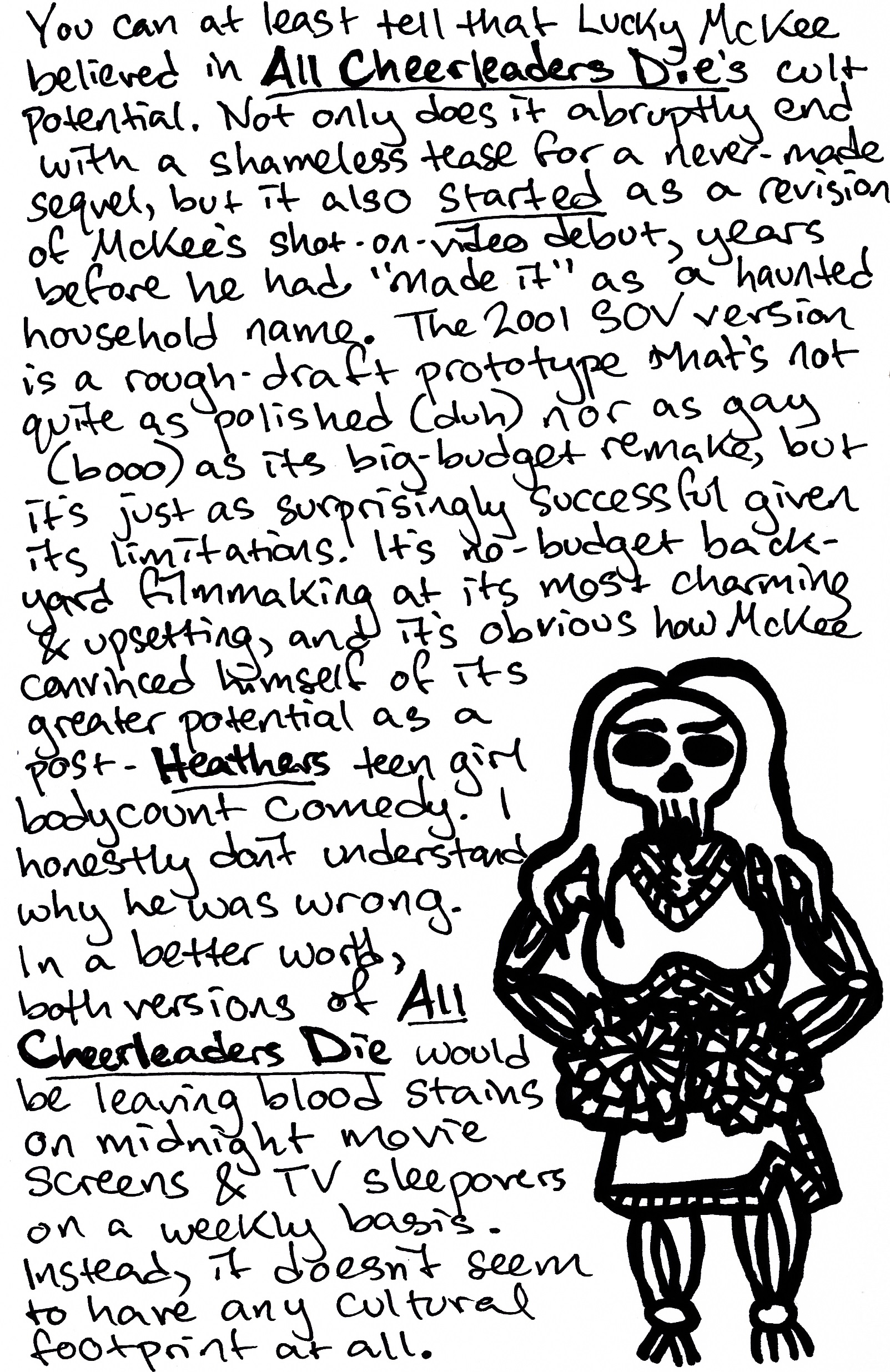
Brandon: The Swampflix Crew may not have been entirely convinced of All Cheerleaders Die‘s greatness, but you can at least tell Lucky McKee believed in its cult potential.  Not only does it abruptly end with a shameless tease for a never-made sequel, but it also started as a revision of McKee’s shot-on-video debut, years before he had “made it” as a haunted-household name.  The 2001 SOV version of All Cheerleaders Die is a rough-draft prototype that’s not quite as polished (duh) nor as gay (booo) as its big-budget “remake,” but it’s just as surprisingly successful given its limitations.  It’s no-budget backyard filmmaking at its most charming & upsetting, and it’s obvious how McKee convinced himself of its greater potential as a post-Heathers teen girl bodycount comedy.  I still don’t fully understand why he was wrong, but I’m at least glad y’all found things to enjoy about his second attempt.

Next month: Boomer presents Stepmonster (1993)

-The Swampflix Crew

Selah and the Spades (2020)

I very much wanted to adore this film, but I couldn’t shake the feeling that it never wanted to be a film in the first place. Selah and the Spades opens with a massive exposition dump detailing the kinds of intricate structural hierarchies & historical power struggles that are referenced at the front of multi-volume sci-fi & fantasy novels with corresponding maps of fictional fantasycapes. Except, it’s a very simple high school teen drama about boarding school drug trade. The movie extends the cafeteria-set introductions of various high school cliques that are normally banged out in less than a minute in films like Heathers or Mean Girls into a feature-length tome about warring “factions” and stolen “ledgers.” It’s far less invested in the inner lives of individual characters than it is in the generational passing of the torch from graduating seniors (who care more about maintaining these hierarchies than they do about moving on to college) to their underlings. The movie is so wrapped up in establishing the rules & parameters of its boarding school drug trade markets that it leaves almost no time to establish a reason for the audience to care. It plays more like a backdoor pilot for a tie-in, Degrassi-style TV series than a proper standalone feature film, establishing the rules & boundaries of its universe up front and waiting to flesh out its characters in future episodes.

The titular Selah is a popular honor student at an elite boarding school, overwhelmed both by her parents’ pressure that she academically overachieve and by her responsibilities as the figurehead of her school’s most prestigious drug-trade “faction,” known as the Spades. This premiere season of Selah and the Spades details Selah’s search for a worthy protegee to take over the reins of the Spades’ schoolwide drug ring once she graduates. Meanwhile, other jealous factions—the Bobbies, the Skins, the so-and-so’s—pressure Selah and the Spades to cede their power over the school entirely. The season finale is set at senior prom, of course, and it ends on a cliffhanger guaranteed to have you coming back for the next batch of episodes as soon as they air. I feel as if I’ve put in the work that most long-form “prestige television” dramas require before they “get good” several hours into their runtime, after all the main characters have been sketched out and the battle lines are drawn. Except, I don’t know that I’ll be sticking with this particular high school drug trade series the way I did with HBO’s Euphoria, which was much more interested in the detailed character work, morbid gallows humor, and sensationalist hedonism necessary to make this kind of prerequisite homework feel worthwhile.

Selah and the Spades looks great. This is especially evident in the couple isolated scenes where Selah directly addresses the camera during cheer squad practice, an army of uniformed cheerleader lackeys backing her up as she explains the transgressive pleasure of power in a teen girl’s life. Those isolated moments recall the transcendent cinematic achievements of coming-of-age works like Skate Kitchen & The Fits, but for the most part Selah and the Spades doesn’t feel like cinema at all. It’s pretty, but it’s largely devoid of humor, poetry, atmosphere, or a recognizable sense of danger or transgression. All that’s left is an intricately mapped-out hierarchy of warring high school cliques that I can’t imagine any audience truly caring about unless they are young enough to look up to the characters onscreen as the Cool Kids they hope to meet once they get to high school. Considering how artificial & fantastic this setting can feel, that potential audience might just have to settle for getting to know these kids better when Selah and the Spades gets picked up as the ongoing television or YA novel series it desperately wants to become. Even though I didn’t enjoy the film very much, I do hope that transition into a new medium eventually takes place. It would be a waste of these 100 minutes of self-serious table setting for the show not to be picked up after its pilot episode.

-Brandon Ledet

Bring It On (2000)

EPSON MFP image

fourhalfstar

campstamp

The cartoonish cheerleader comedy Bring It On is one of those films I watched way too many times as young lad merely because it was one of the few movies my sister & I could agree on (other titles on that short list included Clueless & My Cousin Vinny). Nostalgia can be a blinding force when it comes to judging art on its own merits, though, so I was pleased to discover on a recent drunken night after a friend’s wedding that Bring It On still holds up as a high-functioning farce. This cinematic time capsule fits in with its eras finest high school comedies: movies like Clueless, Drop Dead Gorgeous, 10 Things I Hate About You, and But, I’m a Cheerleader!. Although there’s an imperfect choice of POV that somewhat weakens its central message (more on that in a minute), Bring It On is wholly committed to its camp value in an endearing way, moves at a breeze of a swift/efficient pace, and has its heart in the right place even if it missed out on making a solid socio-political statement. It also opens with one of the greatest musical numbers ever put to film, a two minute-long performance I could gladly watch into infinity.

Instead of adopting the typical ugly duckling/beautiful swan makeover story structure that dominated much of the 90s high school movie landscape (spoofed recently in the underappreciated Mae Whitman comedy The DUFF), Bring It On follows a traditional sports movie formula and tracks the progress of a Californian cheer squad as they work their way up to the all-important, ESPN-televised “Nationals.” Although the film does include a superfluous will-they-won’t-they love triangle, it’s at heart about ethics in cheer choreography. Bring It On‘s head cheerleader, cinema’s most prominent Torrance (brought to bubbly life by my lifelong celebrity crush Kirsten Dunst), deals with the fallout of the discovery that her former captain had been stealing routines from an predominantly black school in East Compton. Crushed by the betrayal, Torrance has to reconcile with the fact that her “entire cheerleading career is a lie.” When reminded that it’s only cheerleading, Torrence retorts, “I am only cheerleading.” It’s true, too. Her squad had become her sole identity, a concern that overrides any anxieties about her education or the boys chasing after her. (I particularly enjoyed the way that latter conflict was deflated with the line, “Do us all a favor and get over yourself and tell her how you really feel.”)

I’ll give kudos to Bring It On for making its romance plot a backseat concern in relation to a sports movie conflict involving white teens ripping off black artists without recognition. It’s kind of a gutsy choice for an innocuous teen comedy from nearly two decades ago. Where the film falters is in failing to give said black cheerleading squad much to do in a story about their own artistic exploitation. A Bring It On told from the POV of the East Compton Clovers would most likely serve this story of artistic integrity & cheerleading ethics much better. From the mostly white, well-to-do Toros’ perspective, it instead become a story about white guilt & “trying to make it right.” As much as the film could’ve handled its socio-political inquiries better, though, it does find a way to completely sidestep any shameless white knighting and its Big Competition conclusion is a satisfying end for both the Toros & the Clovers in a genuinely earned moment of feel-good movie magic.

Although I’m focusing on the implications of Bring It On‘s narrative here, what makes the film such a winning success is not its sense of storytelling, but its deliriously saccharine sense of humor. I get a dreamlike sense of an overwhelming sugar rush in this film, one matched only by titles like Josie & The Pussycats and Cool as Ice. Ant-Man director Peyton Reed establishes a punishing sense of rhythm in the film’s pacing, delivering campy humor in a nonstop barrage of rapidfire dialogue set to a “You Wouldn’t Steal a DVD”/Run Lola Run style of pop music production. UCB co-founder Ian Roberts drops by as a painfully corny/horny hired gun choreographer who derails the Toros with a Fosse-obsessed “spirit fingers” routine. There’s also plenty of delightfully inane cheerleading humor like in the line, “This is not a democracy; it’s a cheerocracy,” and and in the concept of “cheer sex” (eyefucking a member of the audience during a routine). Despite a stray joke or three threatening to indulge in body shaming or sexual assault and a pair of wallet chain-sporting nu metal bozos, Bring It On never fully sours on its cheery worldview. It manages to feel like a live action cartoon in details like rigorous.toothbrushing, religious reverence for something called a “cheer stick”, and a disgusting younger brother character straight out of Teen Witch. It’s thoroughly endearing & more than a little overwhelming in is high fructose energy, a tone that fits its subject nicely.

It’s a little shallow to say so, but I really do believe Bring It On‘s entire argument for cult following legitimacy as a campy delight hinges on its opening dream sequence cheer routine. It’s a beautiful, aggressive, surreal splash of cold water that happily indulges in its own inanity, as typified in the line, “Hate us because we’re beautiful, but we’ don’t like you either. We are cheerleaders.” It’s as iconic of an opening as film could ever ask for even before it reaches its Golden Age of Hollywood musical number conclusion. Bring It On might’ve stumbled in how it handled some of the political implications of its narrative (mostly in the diminished role of the Clovers), but it’s a wildly confident camp comedy that finds its own surreal voice in its manic cheerleading humor. If you need any proof that the film is worth a look, I urge you to watch the opening number in the clip below. It’s the same kind of cinematic perfection that won me over with “Floop’s Floogies” in Spy Kids, a perfect encapsulation of what makes the film such a rare, bizarre treat.

Side Note: How weird is it that the film’s titular line is actually “Bring It.” and not “Bring it on.”? It’s a very minor distinction, but it’s one I find fascinating, not only because the studio likely found that the one word difference tested better for some strange reason, but also because the line has been culturally altered by various & plentiful spoofs that read it as “Bring it on.” Really makes you think.

-Brandon Ledet